

Graz

Encyclopedia
The more recent population figures do not give the whole picture as only people with principal residence status are counted and people with secondary residence status are not. Most of the people with secondary residence status in Graz are students. At the end of 2006 there were 37,624 people with secondary residence status in Graz.
The population (with principal residence status) in the agglomeration
was about 320,000 at the end of 2006.
in winter. The exhaust fumes of the around 120,000 cars driven into Graz every weekday by people living in the surrounding areas, together with the car journeys made by the inhabitants of Graz itself, are the most significant source of air pollution
.
. However, there is no historical continuity of a settlement before the Middle Ages.
The name of the city, Graz (see the Slavic settlement Grad
), and some archaeological finds point to the erection of a small castle by Alpine Slavic people, which in time became a heavily defended fortification. In literary Slovene, gradec literally means "small castle", which is etymologically a hypocoristic derivative of Proto-West-South Slavic *gradьcъ, itself by means of liquid metathesis descending from Common Slavic *gardьcъ, by Slavic third palatalisation from Proto-Slavic *gardiku (cf. Ancient Greek toponym ) originally denoting "small town, settlement". The name thus follows the common South Slavic pattern for naming settlements as grad. The German name 'Graz' was first used in 1128, and during this time dukes under Babenberg
rule made the town into an important commercial center. Later Graz came under the rule of the Habsburg
s, and in 1281 gained special privileges from King Rudolph I.
In the 14th century Graz became the city of residence of the Inner Austria
n line of the Habsburgs. The royalty lived in the Schloßberg
castle and from there ruled Styria, Carinthia, and parts of today's Italy and Slovenia
(Carniola
, Gorizia and Gradisca
).
In the 16th century, the city's design and planning were primarily controlled by Italian Renaissance architects and artists. One of the most famous buildings built in this style is the Landhaus, designed by Domenico dell'Allio
, and used by the local rulers as a governmental headquarters.
The astronomer Johannes Kepler
lived in Graz for a short period. There, he worked as a math teacher, but found time to study astronomy. He left Graz to go to Prague
when Lutherans were banned from the city.
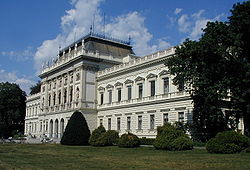
Karl-Franzens Universität, also called the University of Graz
, is the city's oldest university, founded in 1585 by Archduke Charles II. For most of its existence it was controlled by the Catholic church
, and was closed in 1782 by Joseph II
in an attempt to gain state control over educational institutions. Joseph II transformed it into a lyceum where civil servants and medical personnel were trained. In 1827 it was re-instituted as a university by Emperor Franz I, thus gaining the name 'Karl-Franzens Universität,' meaning 'Charles-Francis University.' Over 30,000 students currently study at this university.
 Nikola Tesla
studied electrical engineering at the Polytechnic
in Graz in 1875. Nobel Laureate Otto Loewi
taught at the University of Graz
from 1909 until 1938. Johannes Kepler
was a professor of mathematics at the University of Graz. Erwin Schrödinger
was briefly chancellor of the University of Graz in 1936.
Adolf Hitler
was given a warm welcome when he visited in 1938, the year Austria was annexed
by Nazi Germany
. The thriving Jewish community
was destroyed by the Nazis, and their grand synagogue was burnt. A small group of Graz Jews returned despite everything after the war. In 2000, on the anniversary of the Reichskristallnacht, Graz city council presented the Jewish community with a new synagogue as a gesture of reconciliation. Hitler promised the people of Graz 1,000 years of prosperity and an end to mass unemployment: only seven years later the Graz resistance surrendered the city to Soviet
troops, sparing Graz any further destruction. By then about 16% of buildings had been destroyed by Allied
bombing - luckily the Old Town was not seriously hit.
Graz lies in Styria, or Steiermark in German. Mark is an old German word indicating a large area of land used as a defensive border, in which the peasantry are taught how to organize and fight in the case of an invasion. With a strategic location at the head of the open and fertile Mur valley, Graz was often assaulted (unsuccessfully), e.g. by the Hungarians under Matthias Corvinus in 1481, and by the Ottoman Turks
in 1529 and 1532. Apart from the Riegersburg, the Schloßberg was the only fortification in the region that never fell to the Ottoman Turks. Graz is home to the region's provincial armory, which is the world's largest historical collection of Baroque weaponry. It has been preserved since 1551, and displays over 30,000 items.
From the earlier part of the 15th century Graz was the residence of the younger branch of the Habsburgs, which succeeded to the imperial throne in 1619 in the person of Emperor Ferdinand II, who moved the capital to Vienna. New fortifications were built on the Schlossberg at the end of the 16th century. Napoleon
's army occupied Graz in 1797. In 1809 the city withstood another assault by the French army. During this attack, the commanding officer in the fortress was ordered to defend it with about 900 men against Napoleon's army of about 3,000. He successfully defended the Schloßberg against eight attacks, but they were forced to give up after the Grande Armée occupied Vienna and the Emperor ordered to surrender. Following the defeat of Austria by Napoleonic forces at the Battle of Wagram
in 1809, the fortifications were demolished using explosives, as stipulated in the Peace of Schönbrunn
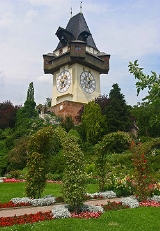
of the same year. The belltower and the civic clock tower, often used as the symbol of Graz, were spared after the people of Graz paid a ransom for their preservation.
Archduke Charles II of Inner Austria had 20,000 Protestant
books burned in the square of what is now a mental hospital, and succeeded in returning Styria to the authority of the Holy See
. Archduke Franz Ferdinand
was born in Graz, in what is now the Stadtmuseum (city museum).
in 1586 until the establishment of University of Ljubljana
in 1919. In 1574, the first Slovene Catholic book was published in Graz, and in 1592, Hyeronimus Megiser published in Graz the first multilingual dictionary that included Slovene.
Styrian Slovenes did not feel Graz a German city, but their own, a place to study while living at their relatives' homes and to fulfill one's career ambitions. Student associations in Graz were a forge of Slovenehood and Slovene students in Graz were more nationally aware than some others. This led to fierce anti-Slovene efforts of German nationalists in Graz before and during World War II.
Nowadays, the city is cosmopolitan and quite fond of Slovenes. Many Slovenian Styrians study there. Slovenes are among professors at the Institute for Jazz in Graz. Numerous Slovenes have found employment there, while being formally unemployed in Slovenia. For Slovene culture, Graz remains permanently important due to its university and the Universalmuseum Joanneum archives containing numerous documents from the Slovenian Styria.
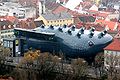
(house of modern art) designed by Peter Cook
and Colin Fournier
, a museum constructed right next to the river Mur, and the "Murinsel
" (island in the Mur), an island made of steel, situated in the river. It was designed by the American architect Vito Acconci
and contains a café, an open-air theatre and a playground.
 The old town was added to the UNESCO
World Heritage List
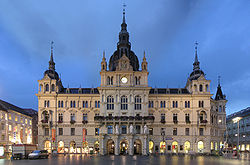
in 1999 due to the harmonious co-existence of typical buildings from different epochs and in different architectural styles. Situated in a cultural borderland between Central Europe, Italy and the Balkan States, Graz absorbed various influences from the neighbouring regions and thus received its exceptional townscape. Today the old town consists of over 1000 buildings, their age ranging from Gothic to Contemporary.
The most important sights in the old town are:
" and is (as of 2011) one of the UNESCO
"Cities of Design."
 The most important museums in Graz are:
There are currently 228 buildings in Graz that are classified as high-rise: the floor of at least one room is 22 metres above ground level. Such buildings have to adhere to much more stringent fire safety regulations because the ladders of the majority of fire appliances used by Graz Fire Brigade cannot reach higher than 22 metres.
There are some new high-rise buildings in the pipeline; the only ones that currently (June 2009) seem certain to be built are a 15-storey office block opposite the "Stadthalle" on the southern edge of the city centre and a 21-storey officeblock next to the motorway leading from the Graz Ost Interchange (road)
into town.
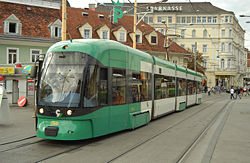 An extensive public transportation network makes Graz an easy city to navigate without a car. The city has a comprehensive bus network, complementing the Graz tram network
consisting of six lines, two of which run from the main train station (Hauptbahnhof) to the old town before branching out. Furthermore, there are seven night-time bus routes, although these run only at weekends and on evenings preceding public holidays. The tram is also called "Bim".
From the main train station (Graz Hauptbahnhof
), regional trains link to most of Styria. Direct trains also run to most major cities nearby including Vienna
, Salzburg
, Innsbruck
, Maribor
and Ljubljana
in Slovenia
, Zagreb
in Croatia
, Prague
in the Czech Republic
, Budapest
in Hungary and Zürich
in Switzerland. Trains for Vienna leave every hour.
Graz Airport
is about 10 kilometres south of the city centre and has a railway station within walking distance (east of the airport). The main hubs Graz Airport is connected with Frankfurt and Munich in Germany and Vienna. Main cities connected to Graz Airport are London (Ryanair) and Berlin (Airberlin).
The LKH-Universitätsklinikum Graz is one of the hospitals that can provide maximum care, with 1556 beds and 7190 employees. It covers the east of the city. In the west of the city there is the LKH Graz-West in Eggenberg
with 280 beds and about 500 employees, the Landesnervenklinik Sigmund Freud (LSF) in Straßgang
with 880 beds and 1,100 employees, as well as the Unfallkrankenhaus der AUVA in Eggenberg
with 180 beds and a total of 444 employees.
Furthermore there is the gereatric hospital Albert-Schweitzer-Klinik in the west of the city with 304 beds, the Krankenhaus der Barmherzigen Brüder I in Lend
with 225 beds, the Krankenhaus der Barmherzigen Brüder II in Eggenberg
with 260 beds and the Krankenhaus der Elisabethinen in Gries
with 182 beds.
There are several private clinics as well: the Privatklinik Kastanienhof, the Privatklinik Leech, the Privatklinik der Kreuzschwestern, the Sanatorium St. Leonhard, the Sanatorium Hansa and the Privatklinik Graz-Ragnitz.
EMS
in Graz is provided solely by the Austrian Red Cross
. Perpetually two emergency doctor's cars (NEF - Notarzteinsatzfahrzeug), two NAWs (Notarztwagen - ambulances staffed with a doctor in addition to regular personnel) and about 30 RTWs (Rettungswagen - regular ambulances) are on standby. Furthermore, several non-emergency ambulances (KTW - Krankentransportwagen) and a Mobile Intensive Care Unit (MICU) are operated by the Red Cross in order to organise transportation of non-emergency patients to and between hospitals. In addition to the Red Cross the Arbeiter-Samariter-Bund Österreichs (Labor-Samaritan-Alliance), the Malteser Hospitaldienst Austria (the Austrian organisation of the Order of Malta Ambulance Corps
) and the Grünes Kreuz (Green Cross) operate various non-emergency ambulances (KTW) for non-emergency patient transportation. In addition to the land-ambulances there's also the C12 air ambulance helicopter stationed at Graz airport, which is also staffed with an emergency doctor in addition to regular personnel.
with:
Coventry
, England, since 1948 Darmstadt
, Germany, since 1968 Dubrovnik
, Croatia Groningen, Netherlands, since 1964
Maribor
, Slovenia, since 1987 Montclair
, United States, since 1950 Pécs
, Hungary, since 1989 Pula
, Croatia, since 1972
Saint Petersburg
, Russia Trieste
, Italy, since 1973 Trondheim
, Norway, since 1968 Zababdeh
, Palestine
Other forms of cooperation and city friendship similar to the twin city programmes: Niš
, Serbia Banja Luka
Bosnia and Herzegovina,
History
Further information
The population (with principal residence status) in the agglomeration
Agglomeration
In the study of human settlements, an urban agglomeration is an extended city or town area comprising the built-up area of a central place and any suburbs linked by continuous urban area. In France, INSEE the French Statistical Institute, translate it as "Unité urbaine" which means continuous...
was about 320,000 at the end of 2006.
Climate
Due to its position southeast of the Alps, Graz is shielded from the prevailing westerly winds that bring weather fronts in from the North Atlantic to northwestern and central Europe. The weather in Graz is thus influenced by the Mediterranean, and it has more hours of sunshine per year than Vienna or Salzburg and also less wind or rain. Graz lies in a basin that is only open to the south, causing the climate to be warmer than would be expected at that latitude. Plants are found in Graz that normally grow much further south. However, this milder, less windy climate is detrimental to the air quality in Graz as it makes the city prone to smogSmog
Smog is a type of air pollution; the word "smog" is a portmanteau of smoke and fog. Modern smog is a type of air pollution derived from vehicular emission from internal combustion engines and industrial fumes that react in the atmosphere with sunlight to form secondary pollutants that also combine...
in winter. The exhaust fumes of the around 120,000 cars driven into Graz every weekday by people living in the surrounding areas, together with the car journeys made by the inhabitants of Graz itself, are the most significant source of air pollution
Air pollution
Air pollution is the introduction of chemicals, particulate matter, or biological materials that cause harm or discomfort to humans or other living organisms, or cause damage to the natural environment or built environment, into the atmosphere....
.
- average temperatures: Graz AirportGraz AirportGraz Airport , also known as Thalerhof, serves Graz, Austria. It is located in the municipalities of Feldkirchen and Kalsdorf, south of Graz city centre.-Transportation:...
8.7 °C (48 °F) / Karl-Franzens University 9.4 °C (49 °F) - average rainfall: 818 mm with on average 92 days of rain (Karl Franzens University)
- average hours of sunshine: 1,890 (Karl Franzens University)
History
The oldest settlement on the ground of the modern city of Graz dates back to the Copper AgeCopper Age
The Chalcolithic |stone]]") period or Copper Age, also known as the Eneolithic/Æneolithic , is a phase of the Bronze Age in which the addition of tin to copper to form bronze during smelting remained yet unknown by the metallurgists of the times...
. However, there is no historical continuity of a settlement before the Middle Ages.
The name of the city, Graz (see the Slavic settlement Grad
Grad
- Geometry & measurement :* Grad , a unit of angular measurement* Gradient of a scalar field, a differential operator in mathematics- Education related events & ceremonies :* Graduation ceremony, prom, or a graduate...
), and some archaeological finds point to the erection of a small castle by Alpine Slavic people, which in time became a heavily defended fortification. In literary Slovene, gradec literally means "small castle", which is etymologically a hypocoristic derivative of Proto-West-South Slavic *gradьcъ, itself by means of liquid metathesis descending from Common Slavic *gardьcъ, by Slavic third palatalisation from Proto-Slavic *gardiku (cf. Ancient Greek toponym ) originally denoting "small town, settlement". The name thus follows the common South Slavic pattern for naming settlements as grad. The German name 'Graz' was first used in 1128, and during this time dukes under Babenberg
Babenberg
Originally from Bamberg in Franconia, now northern Bavaria, an apparent branch of the Babenbergs or Babenberger went on to rule Austria as counts of the march and dukes from 976–1248, before the rise of the house of Habsburg.-One or two families:...
rule made the town into an important commercial center. Later Graz came under the rule of the Habsburg
Habsburg
The House of Habsburg , also found as Hapsburg, and also known as House of Austria is one of the most important royal houses of Europe and is best known for being an origin of all of the formally elected Holy Roman Emperors between 1438 and 1740, as well as rulers of the Austrian Empire and...
s, and in 1281 gained special privileges from King Rudolph I.
In the 14th century Graz became the city of residence of the Inner Austria
Inner Austria
Inner Austria was a term used from the late 14th to the early 17th century for the Habsburg hereditary lands south of the Semmering Pass, referring to the duchies of Styria, Carinthia, Carniola and the Windic March, the County of Gorizia , the city of Trieste and assorted smaller possessions...
n line of the Habsburgs. The royalty lived in the Schloßberg
Grazer Schloßberg
The word "Schloßberg" literally means "castle mountain", which describes it exactly. It is a hill topped by a castle, in the centre of the city of Graz, Austria....
castle and from there ruled Styria, Carinthia, and parts of today's Italy and Slovenia
Slovenia
Slovenia , officially the Republic of Slovenia , is a country in Central and Southeastern Europe touching the Alps and bordering the Mediterranean. Slovenia borders Italy to the west, Croatia to the south and east, Hungary to the northeast, and Austria to the north, and also has a small portion of...
(Carniola
Carniola
Carniola was a historical region that comprised parts of what is now Slovenia. As part of Austria-Hungary, the region was a crown land officially known as the Duchy of Carniola until 1918. In 1849, the region was subdivided into Upper Carniola, Lower Carniola, and Inner Carniola...
, Gorizia and Gradisca
Gorizia and Gradisca
The County of Gorizia and Gradisca was a Habsburg county in Central Europe, in what is now a multilingual border area of Italy and Slovenia. It was named for its two major urban centers, Gorizia and Gradisca d'Isonzo.-Province of the Habsburg Empire:...
).
In the 16th century, the city's design and planning were primarily controlled by Italian Renaissance architects and artists. One of the most famous buildings built in this style is the Landhaus, designed by Domenico dell'Allio
Domenico dell'Allio
Domenico dell'Allio was an Italian architect. He is most known for his work in the Landhaus of Graz .- External links :*...
, and used by the local rulers as a governmental headquarters.
The astronomer Johannes Kepler
Johannes Kepler
Johannes Kepler was a German mathematician, astronomer and astrologer. A key figure in the 17th century scientific revolution, he is best known for his eponymous laws of planetary motion, codified by later astronomers, based on his works Astronomia nova, Harmonices Mundi, and Epitome of Copernican...
lived in Graz for a short period. There, he worked as a math teacher, but found time to study astronomy. He left Graz to go to Prague
Prague
Prague is the capital and largest city of the Czech Republic. Situated in the north-west of the country on the Vltava river, the city is home to about 1.3 million people, while its metropolitan area is estimated to have a population of over 2.3 million...
when Lutherans were banned from the city.
Karl-Franzens Universität, also called the University of Graz
University of Graz
The University of Graz , a university located in Graz, Austria, is the second-largest and second-oldest university in Austria....
, is the city's oldest university, founded in 1585 by Archduke Charles II. For most of its existence it was controlled by the Catholic church
Roman Catholic Church
The Catholic Church, also known as the Roman Catholic Church, is the world's largest Christian church, with over a billion members. Led by the Pope, it defines its mission as spreading the gospel of Jesus Christ, administering the sacraments and exercising charity...
, and was closed in 1782 by Joseph II
Joseph II, Holy Roman Emperor
Joseph II was Holy Roman Emperor from 1765 to 1790 and ruler of the Habsburg lands from 1780 to 1790. He was the eldest son of Empress Maria Theresa and her husband, Francis I...
in an attempt to gain state control over educational institutions. Joseph II transformed it into a lyceum where civil servants and medical personnel were trained. In 1827 it was re-instituted as a university by Emperor Franz I, thus gaining the name 'Karl-Franzens Universität,' meaning 'Charles-Francis University.' Over 30,000 students currently study at this university.
Nikola Tesla
Nikola Tesla was a Serbian-American inventor, mechanical engineer, and electrical engineer...
studied electrical engineering at the Polytechnic
Graz University of Technology
The Graz University of Technology is the second largest university in Styria, Austria, after the University of Graz. Austria has three universities of technology – in Graz, in Leoben, and in Vienna. The Graz University of Technology was founded in 1811 by Archduke John of Austria. TUG, as the...
in Graz in 1875. Nobel Laureate Otto Loewi
Otto Loewi
Otto Loewi was a German born pharmacologist whose discovery of acetylcholine helped enhance medical therapy. The discovery earned for him the Nobel Prize in Physiology or Medicine in 1936 which he shared with Sir Henry Dale, whom he met in 1902 when spending some months in Ernest Starling's...
taught at the University of Graz
University of Graz
The University of Graz , a university located in Graz, Austria, is the second-largest and second-oldest university in Austria....
from 1909 until 1938. Johannes Kepler
Johannes Kepler
Johannes Kepler was a German mathematician, astronomer and astrologer. A key figure in the 17th century scientific revolution, he is best known for his eponymous laws of planetary motion, codified by later astronomers, based on his works Astronomia nova, Harmonices Mundi, and Epitome of Copernican...
was a professor of mathematics at the University of Graz. Erwin Schrödinger
Erwin Schrödinger
Erwin Rudolf Josef Alexander Schrödinger was an Austrian physicist and theoretical biologist who was one of the fathers of quantum mechanics, and is famed for a number of important contributions to physics, especially the Schrödinger equation, for which he received the Nobel Prize in Physics in 1933...
was briefly chancellor of the University of Graz in 1936.
Adolf Hitler
Adolf Hitler
Adolf Hitler was an Austrian-born German politician and the leader of the National Socialist German Workers Party , commonly referred to as the Nazi Party). He was Chancellor of Germany from 1933 to 1945, and head of state from 1934 to 1945...
was given a warm welcome when he visited in 1938, the year Austria was annexed
Anschluss
The Anschluss , also known as the ', was the occupation and annexation of Austria into Nazi Germany in 1938....
by Nazi Germany
Nazi Germany
Nazi Germany , also known as the Third Reich , but officially called German Reich from 1933 to 1943 and Greater German Reich from 26 June 1943 onward, is the name commonly used to refer to the state of Germany from 1933 to 1945, when it was a totalitarian dictatorship ruled by...
. The thriving Jewish community
History of the Jews in Austria
The history of the Jews in Austria likely originates in an exodus of Jews from the Roman occupation of Israel. During the course of many centuries, the political status of the community rose and fell many times: during certain periods, the Jewish community prospered and enjoyed political equality,...
was destroyed by the Nazis, and their grand synagogue was burnt. A small group of Graz Jews returned despite everything after the war. In 2000, on the anniversary of the Reichskristallnacht, Graz city council presented the Jewish community with a new synagogue as a gesture of reconciliation. Hitler promised the people of Graz 1,000 years of prosperity and an end to mass unemployment: only seven years later the Graz resistance surrendered the city to Soviet
Soviet Union
The Soviet Union , officially the Union of Soviet Socialist Republics , was a constitutionally socialist state that existed in Eurasia between 1922 and 1991....
troops, sparing Graz any further destruction. By then about 16% of buildings had been destroyed by Allied
Allies of World War II
The Allies of World War II were the countries that opposed the Axis powers during the Second World War . Former Axis states contributing to the Allied victory are not considered Allied states...
bombing - luckily the Old Town was not seriously hit.
Graz lies in Styria, or Steiermark in German. Mark is an old German word indicating a large area of land used as a defensive border, in which the peasantry are taught how to organize and fight in the case of an invasion. With a strategic location at the head of the open and fertile Mur valley, Graz was often assaulted (unsuccessfully), e.g. by the Hungarians under Matthias Corvinus in 1481, and by the Ottoman Turks
Ottoman Turks
The Ottoman Turks were the Turkish-speaking population of the Ottoman Empire who formed the base of the state's military and ruling classes. Reliable information about the early history of Ottoman Turks is scarce, but they take their Turkish name, Osmanlı , from the house of Osman I The Ottoman...
in 1529 and 1532. Apart from the Riegersburg, the Schloßberg was the only fortification in the region that never fell to the Ottoman Turks. Graz is home to the region's provincial armory, which is the world's largest historical collection of Baroque weaponry. It has been preserved since 1551, and displays over 30,000 items.
From the earlier part of the 15th century Graz was the residence of the younger branch of the Habsburgs, which succeeded to the imperial throne in 1619 in the person of Emperor Ferdinand II, who moved the capital to Vienna. New fortifications were built on the Schlossberg at the end of the 16th century. Napoleon
Napoleon I of France
Napoleon Bonaparte was a French military and political leader during the latter stages of the French Revolution.As Napoleon I, he was Emperor of the French from 1804 to 1815...
's army occupied Graz in 1797. In 1809 the city withstood another assault by the French army. During this attack, the commanding officer in the fortress was ordered to defend it with about 900 men against Napoleon's army of about 3,000. He successfully defended the Schloßberg against eight attacks, but they were forced to give up after the Grande Armée occupied Vienna and the Emperor ordered to surrender. Following the defeat of Austria by Napoleonic forces at the Battle of Wagram
Battle of Wagram
The Battle of Wagram was the decisive military engagement of the War of the Fifth Coalition. It took place on the Marchfeld plain, on the north bank of the Danube. An important site of the battle was the village of Deutsch-Wagram, 10 kilometres northeast of Vienna, which would give its name to the...
in 1809, the fortifications were demolished using explosives, as stipulated in the Peace of Schönbrunn
Schönbrunn Palace
Schönbrunn Palace is a former imperial 1,441-room Rococo summer residence in Vienna, Austria. One of the most important cultural monuments in the country, since the 1960s it has been one of the major tourist attractions in Vienna...
of the same year. The belltower and the civic clock tower, often used as the symbol of Graz, were spared after the people of Graz paid a ransom for their preservation.
Archduke Charles II of Inner Austria had 20,000 Protestant
Protestantism
Protestantism is one of the three major groupings within Christianity. It is a movement that began in Germany in the early 16th century as a reaction against medieval Roman Catholic doctrines and practices, especially in regards to salvation, justification, and ecclesiology.The doctrines of the...
books burned in the square of what is now a mental hospital, and succeeded in returning Styria to the authority of the Holy See
Holy See
The Holy See is the episcopal jurisdiction of the Catholic Church in Rome, in which its Bishop is commonly known as the Pope. It is the preeminent episcopal see of the Catholic Church, forming the central government of the Church. As such, diplomatically, and in other spheres the Holy See acts and...
. Archduke Franz Ferdinand
Archduke Franz Ferdinand of Austria
Franz Ferdinand was an Archduke of Austria-Este, Austro-Hungarian and Royal Prince of Hungary and of Bohemia, and from 1889 until his death, heir presumptive to the Austro-Hungarian throne. His assassination in Sarajevo precipitated Austria-Hungary's declaration of war against Serbia...
was born in Graz, in what is now the Stadtmuseum (city museum).
Slovenes and Graz
The name of Graz is undoubtedly of Slovene origin and the city was Slovene for a short period. Politically, culturally, scientifically and religiously, Graz was an important centre for all Slovenes, especially from the establishment of the University of GrazUniversity of Graz
The University of Graz , a university located in Graz, Austria, is the second-largest and second-oldest university in Austria....
in 1586 until the establishment of University of Ljubljana
University of Ljubljana
The University of Ljubljana is the oldest and largest university in Slovenia. With 64,000 enrolled graduate and postgraduate students, it is among the largest universities in Europe.-Beginnings:...
in 1919. In 1574, the first Slovene Catholic book was published in Graz, and in 1592, Hyeronimus Megiser published in Graz the first multilingual dictionary that included Slovene.
Styrian Slovenes did not feel Graz a German city, but their own, a place to study while living at their relatives' homes and to fulfill one's career ambitions. Student associations in Graz were a forge of Slovenehood and Slovene students in Graz were more nationally aware than some others. This led to fierce anti-Slovene efforts of German nationalists in Graz before and during World War II.
Nowadays, the city is cosmopolitan and quite fond of Slovenes. Many Slovenian Styrians study there. Slovenes are among professors at the Institute for Jazz in Graz. Numerous Slovenes have found employment there, while being formally unemployed in Slovenia. For Slovene culture, Graz remains permanently important due to its university and the Universalmuseum Joanneum archives containing numerous documents from the Slovenian Styria.
Main sights
In the last few years some strikingly modern new public buildings have been erected in the city. The most famous include the KunsthausKunsthaus Graz
The Kunsthaus Graz, Grazer Kunsthaus, or Graz Art Museum was built as part of the European Capital of Culture celebrations in 2003 and has since become an architectural landmark in Graz, Austria...
(house of modern art) designed by Peter Cook
Peter Cook (architect)
Professor Sir Peter Cook, founder of Archigram , former Director the Institute of Contemporary Arts, London and the Bartlett School of Architecture at University College London, has been a pivotal figure within the global architectural world for over half a century. His ongoing contribution to...
and Colin Fournier
Colin Fournier
Colin Fournier is co-architect with Peter Cook of the Kunsthaus Graz in Austria. He is also professor of The Bartlett School of Architecture, a part of University College London.-References:...
, a museum constructed right next to the river Mur, and the "Murinsel
Murinsel
thumb|right|The MurinselThe Murinsel in Graz, Austria, is actually not an island at all, but an artificial floating platform in the middle of the Mur river...
" (island in the Mur), an island made of steel, situated in the river. It was designed by the American architect Vito Acconci
Vito Acconci
Vito Hannibal Acconci is a Bronx, New York-born, Brooklyn-based designer, landscape architect, performance and installation artist.-Education:...
and contains a café, an open-air theatre and a playground.
Old town
UNESCO
The United Nations Educational, Scientific and Cultural Organization is a specialized agency of the United Nations...
World Heritage List
World Heritage Site
A UNESCO World Heritage Site is a place that is listed by the UNESCO as of special cultural or physical significance...
in 1999 due to the harmonious co-existence of typical buildings from different epochs and in different architectural styles. Situated in a cultural borderland between Central Europe, Italy and the Balkan States, Graz absorbed various influences from the neighbouring regions and thus received its exceptional townscape. Today the old town consists of over 1000 buildings, their age ranging from Gothic to Contemporary.
The most important sights in the old town are:
- Rathaus (Town Hall).
- SchloßbergGrazer SchloßbergThe word "Schloßberg" literally means "castle mountain", which describes it exactly. It is a hill topped by a castle, in the centre of the city of Graz, Austria....
, hill dominating the old town (475 m (1,558.4 ft) high), site of demolished fortress, with views over Graz. - Uhrturm clocktower, symbol of Graz, on the top of Schloßberg.
- Neue Galerie . Museum of art.
- Schloßbergbahn, a funicular railway up the Schloßberg.
- The Landhaus, the building where the federal state parliament of Styria resides, a palace in Lombardic style. It is one of the most important examples of Renaissance architecture in Austria and was built by the Italian architect Domenico dell'AllioDomenico dell'AllioDomenico dell'Allio was an Italian architect. He is most known for his work in the Landhaus of Graz .- External links :*...
between 1557 and 1565. - The LandeszeughausLandeszeughausThe Landeszeughaus, in Graz, Austria, is the largest existing original armoury in the whole world and attracts visitors from all over the world. It holds approximately 32,000 pieces of weaponry, tools, suits of armour for battle and ones for parades....
, armoury, the largest of its kind in the world. - The Opernhaus, the principal venue for opera, ballet, and operetta performances. It is the 2nd largest opera house in Austria.
- The Schauspielhaus, the principal theatre for productions of plays.
- Dom (cathedral), a rare monument of Gothic architecture. Once, there were many frescos on the outer walls; today, only a few remain, like the Landplagenbild ("picture of plagues") painted in 1485, presumably by Thomas von Villach. The three plagues it depicts are locusts, pestilence and the invasion of the Turks, all of them striking the town in 1480. It features the oldest painted view of Graz.
- Mausoleum of Emperor Ferdinand IIFerdinand II, Holy Roman EmperorFerdinand II , a member of the House of Habsburg, was Holy Roman Emperor , King of Bohemia , and King of Hungary . His rule coincided with the Thirty Years' War.- Life :...
next to the cathedral, the most important building of MannerismMannerismMannerism is a period of European art that emerged from the later years of the Italian High Renaissance around 1520. It lasted until about 1580 in Italy, when a more Baroque style began to replace it, but Northern Mannerism continued into the early 17th century throughout much of Europe...
in Graz. It includes both the grave where Ferdinand II and his wife are buried, and a church dedicated to St Catherine of Alexandria. - Burg (castle complex), with Gothic double staircase, built between 1438 and 1453 by Emperor Frederick IIIFrederick III, Holy Roman EmperorFrederick the Peaceful KG was Duke of Austria as Frederick V from 1424, the successor of Albert II as German King as Frederick IV from 1440, and Holy Roman Emperor as Frederick III from 1452...
because the old castle on the Schloßberg was too small and uncomfortable. The Burg remained the residence of the Inner Austrian Court until 1619. Today, it serves as residence of the government of Styria. - Gemaltes Haus ("painted house"), in Herrengasse 3. It is completely covered with frescos (painted in 1742 by Johann Mayer).
- KunsthausKunsthaus GrazThe Kunsthaus Graz, Grazer Kunsthaus, or Graz Art Museum was built as part of the European Capital of Culture celebrations in 2003 and has since become an architectural landmark in Graz, Austria...
(museum of modern art). - MurinselMurinselthumb|right|The MurinselThe Murinsel in Graz, Austria, is actually not an island at all, but an artificial floating platform in the middle of the Mur river...
, an artificial island in the Mur. - Buildings, courtyards (e. g. Early Renaissance courtyard of the Former House of Teutonic Knights in Sporgasse 22) and roofscape of the old town.
Outside the Old Town
- Schloss EggenbergSchloss Eggenberg (Graz)Eggenberg Palace in Graz is the most significant Baroque palace complex in Styria. With its preserved accouterments, the extensive scenic gardens as well as some additional collections from the Universalmuseum Joanneum housed in the palace and park, Schloss Eggenberg counts among the most valuable...
a Baroque palace on the western edge of Graz with State rooms and museum. In 2010 it was added to the existing World Heritage site of the historic centre of Graz. - Basilika MariatrostMariatrost BasilicaThe Baroque Mariatrost Basilica on top of the Purberg hill in Mariatrost, a district of Graz, is one of the most famous pilgrimage sites of Styria in Austria.- Description :...
a late Baroque church, on the eastern edge of Graz. - The Herz Jesu KircheHerz-Jesu-Kirche (Graz)The Herz-Jesu-Kirche is the largest church in Graz, Austria. It was designed down to the last detail by architect Georg Hauberrisser and constructed from 1881 to 1887....
is the largest church in Graz with the third highest spire in Austria, built in Gothic Revival style. - Calvary Hill in the Gösting area of Graz with a 17th century calvary and church.
- The LKH-Universitätsklinikum, is the biggest hospital of Graz and one of the biggest hospitals in AustriaAustriaAustria , officially the Republic of Austria , is a landlocked country of roughly 8.4 million people in Central Europe. It is bordered by the Czech Republic and Germany to the north, Slovakia and Hungary to the east, Slovenia and Italy to the south, and Switzerland and Liechtenstein to the...
. It is the largest Jugendstil building complex in Austria and was built between 1904 and 1912. It is run by the state and one of the most renowned hospitals in Austria and Central Europe. - Best viewpoints for vistas of the city are Ruine Gösting, hilltop castle ruins on northwestern edge of city, and Plabutsch/Fürstenstand, behind Schloss Eggenberg with a hilltop restaurant and viewing tower.
Greater Graz area
- Österreichisches Freilichtmuseum Stübing, an open-air museum containing old farmhouses/farm buildings from all over Austria reassembled in historic setting.
- Lurgrotte, the most extensive cave system in Austria.
- Lipizzanergestüt Piber, Lipizzaner stud at PiberPiberThe Piber Federal Stud is a stud farm dedicated to the breeding of Lipizzan horses, located at the village of Piber, near the town of Köflach in western Styria, Austria...
where the famous horses are bred. - The Steirische Weinstraße is a wine-growing region south of Graz, also known as the "Styrian Tuscany".
- Thermenregion, spa region east of Graz.
- RiegersburgRiegersburgRiegersburg is a municipality in the district of Feldbach in Styria, Austria. Riegersburg Castle is situated on a hill above the town.-References:...
, a mighty fortress that was never taken. It was a bastion against Turkish invasions
Culture
During 2003 Graz held the title of "European Capital of CultureEuropean Capital of Culture
The European Capital of Culture is a city designated by theEuropean Union for a period of one calendar year during which it organises a series of cultural events with a strong European dimension....
" and is (as of 2011) one of the UNESCO
UNESCO
The United Nations Educational, Scientific and Cultural Organization is a specialized agency of the United Nations...
"Cities of Design."
Museums
- Schloss Eggenberg (Graz)Schloss Eggenberg (Graz)Eggenberg Palace in Graz is the most significant Baroque palace complex in Styria. With its preserved accouterments, the extensive scenic gardens as well as some additional collections from the Universalmuseum Joanneum housed in the palace and park, Schloss Eggenberg counts among the most valuable...
with Alte Galerie (paintings and sculptures from the Romanesque to the end of the Baroque period), Coin Collection, LapidariumLapidariumA lapidarium is a place where stone monuments and fragments of archaeological interest are exhibited - stone epigraphs, statues, architectural details like columns, cornices and acroterions, as well as tombstones and sarcophagi....
(Roman stonework collection),Archeological Museum (featuring the Cult Wagon of StrettwegCult Wagon of StrettwegThe Cult Wagon of Strettweg, or Strettweg Sacrificial Wagon, or Strettweg Chariot is a bronze cult wagon from ca. 600 B.C., which was found as part of a princely grave of the Hallstatt culture in Strettweg near Judenburg, Austria in 1851...
) a special exhibitions area and the 90,000 m2 romantic landscape gardensEnglish gardenThe English garden, also called English landscape park , is a style of Landscape garden which emerged in England in the early 18th century, and spread across Europe, replacing the more formal, symmetrical Garden à la française of the 17th century as the principal gardening style of Europe. The...
. - Museum im Palais museum of Styrian cultural history from the Middle Ages to the present
- Neue Galerie visual arts from the 19th and 20th centuries.
- Natural History Museum exhibition of botany, mineralogyMineralogyMineralogy is the study of chemistry, crystal structure, and physical properties of minerals. Specific studies within mineralogy include the processes of mineral origin and formation, classification of minerals, their geographical distribution, as well as their utilization.-History:Early writing...
and zoology. - Stadtmuseum Graz city museum.
- Grazer Kunsthaus exhibition hall of contemporary artContemporary artContemporary art can be defined variously as art produced at this present point in time or art produced since World War II. The definition of the word contemporary would support the first view, but museums of contemporary art commonly define their collections as consisting of art produced...
. - Forum Stadtpark museum of contemporary artContemporary artContemporary art can be defined variously as art produced at this present point in time or art produced since World War II. The definition of the word contemporary would support the first view, but museums of contemporary art commonly define their collections as consisting of art produced...
. - Camera Austria museum of contemporary photography.
- LandeszeughausLandeszeughausThe Landeszeughaus, in Graz, Austria, is the largest existing original armoury in the whole world and attracts visitors from all over the world. It holds approximately 32,000 pieces of weaponry, tools, suits of armour for battle and ones for parades....
medieval armoryArmoryArmory or armoury may mean:*Armory , a military location used for the storage of arms and ammunition*Armory , the study of coats of arms*Armory , a Marvel Comics character...
comprising 32,000 pieces of armour and weaponry, largest of its kind in the world. - Volkskundemuseum museum of folk cultureFolk cultureFolk culture refers to the lifestyle of a culture. Historically, handed down through oral tradition, it demonstrates the "old ways" over novelty and relates to a sense of community. Folk culture is quite often imbued with a sense of place...
and loreFolkloreFolklore consists of legends, music, oral history, proverbs, jokes, popular beliefs, fairy tales and customs that are the traditions of a culture, subculture, or group. It is also the set of practices through which those expressive genres are shared. The study of folklore is sometimes called...
. - Diözesanmuseum museum of the Roman Catholic ChurchRoman Catholic ChurchThe Catholic Church, also known as the Roman Catholic Church, is the world's largest Christian church, with over a billion members. Led by the Pope, it defines its mission as spreading the gospel of Jesus Christ, administering the sacraments and exercising charity...
. - Künstlerhaus exhibition hall of contemporary visual arts.
- Literaturhaus museum of contemporary German literatureGerman literatureGerman literature comprises those literary texts written in the German language. This includes literature written in Germany, Austria, the German part of Switzerland, and to a lesser extent works of the German diaspora. German literature of the modern period is mostly in Standard German, but there...
. - Museum der Wahrnehmung museum of the senses, samadhiSamadhiSamadhi in Hinduism, Buddhism,Jainism, Sikhism and yogic schools is a higher level of concentrated meditation, or dhyāna. In the yoga tradition, it is the eighth and final limb identified in the Yoga Sūtras of Patañjali....
bath. - Kindermuseum Frida&Fred museum for children.
- Tramwaymuseum 40 historic tramTramA tram is a passenger rail vehicle which runs on tracks along public urban streets and also sometimes on separate rights of way. It may also run between cities and/or towns , and/or partially grade separated even in the cities...
s, the oldest dating from 1873. - Kriminalmuseum museum of criminology.
- Luftfahrtmuseum (Graz airport) aviation museum.
- Hanns Schell Collection keyKey (lock)A key is an instrument that is used to operate a lock. A typical key consists of two parts: the blade, which slides into the keyway of the lock and distinguishes between different keys, and the bow, which is left protruding so that torque can be applied by the user. The blade is usually intended to...
and lock museum, largest of its kind in the world. - Austrian Sculpture Park seven hectares of contemporary sculpture
- Botanical Garden of Graz three architecturally interesting glass houses plus gardens
Architecture
- Tallest buildings
There are currently 228 buildings in Graz that are classified as high-rise: the floor of at least one room is 22 metres above ground level. Such buildings have to adhere to much more stringent fire safety regulations because the ladders of the majority of fire appliances used by Graz Fire Brigade cannot reach higher than 22 metres.
| Name or Address | Completion | Usage | Height (m) | floors | |
|---|---|---|---|---|---|
| 1. | Herz-Jesu-Kirche Herz-Jesu-Kirche (Graz) The Herz-Jesu-Kirche is the largest church in Graz, Austria. It was designed down to the last detail by architect Georg Hauberrisser and constructed from 1881 to 1887.... |
1887 | church | 109 | |
| 2. | Elisabeth Hochhaus | 1964 | residential | 75 | 25 |
| 3. | Kärntner Straße 212, Liebenauer Liebenau (Graz) Liebenau is the 7th District of Graz in the southeast of the city. It is bordered to the north by the 6th District Jakomini and on the east by the 8th district St. Peter. In Liebenau farms still exist alongside large scale industrial holdings like the Magna car plant and shopping centres like... Hauptstraße 309 |
1968 and 1955 | residential | 69 | 21 |
| 4. | Franziskanerkirche | 1240 | church | 69 | |
| 5. | Telekom Austria Telekom Austria Telekom Austria is a provider of a range of fixed line, mobile, data, and Internet communications services. The company has a 100 per cent share in telecommunications provider A1 Telekom Austria.... Tower |
1960s | office | 65 | 15 |
| 6. | Basilica Basilica The Latin word basilica , was originally used to describe a Roman public building, usually located in the forum of a Roman town. Public basilicas began to appear in Hellenistic cities in the 2nd century BC.The term was also applied to buildings used for religious purposes... Mariatrost |
1724 | church | 61 | |
| 7. | Hafnerriegel | 1960 | residential | 61 | 19 |
| 8. | St. Peter Pfarrweg, Kindermanngasse, Hanuschgasse | 1970s | residential | 55 | 17 |
| 9. | Vinzenz Muchitschstraße, Ungergasse, Kärntner Straße 216, Eggenberger Gürtel | 1970s | residential | 52 | 16 |
There are some new high-rise buildings in the pipeline; the only ones that currently (June 2009) seem certain to be built are a 15-storey office block opposite the "Stadthalle" on the southern edge of the city centre and a 21-storey officeblock next to the motorway leading from the Graz Ost Interchange (road)
Interchange (road)
In the field of road transport, an interchange is a road junction that typically uses grade separation, and one or more ramps, to permit traffic on at least one highway to pass through the junction without directly crossing any other traffic stream. It differs from a standard intersection, at which...
into town.
Transportation
Trams in Graz
The Graz tramway network forms part of the public transport system in Graz, which is both the capital city of the federal state of Styria in Austria, and the second largest city in Austria.In operation since 1878, the network presently has nine lines....
consisting of six lines, two of which run from the main train station (Hauptbahnhof) to the old town before branching out. Furthermore, there are seven night-time bus routes, although these run only at weekends and on evenings preceding public holidays. The tram is also called "Bim".
From the main train station (Graz Hauptbahnhof
Graz Hauptbahnhof
is the Hauptbahnhof at Graz, which is both the capital city of the federal state of Styria in Austria, and the second largest city in Austria.- External links :...
), regional trains link to most of Styria. Direct trains also run to most major cities nearby including Vienna
Vienna
Vienna is the capital and largest city of the Republic of Austria and one of the nine states of Austria. Vienna is Austria's primary city, with a population of about 1.723 million , and is by far the largest city in Austria, as well as its cultural, economic, and political centre...
, Salzburg
Salzburg
-Population development:In 1935, the population significantly increased when Salzburg absorbed adjacent municipalities. After World War II, numerous refugees found a new home in the city. New residential space was created for American soldiers of the postwar Occupation, and could be used for...
, Innsbruck
Innsbruck
- Main sights :- Buildings :*Golden Roof*Kaiserliche Hofburg *Hofkirche with the cenotaph of Maximilian I, Holy Roman Emperor*Altes Landhaus...
, Maribor
Maribor
Maribor is the second largest city in Slovenia with 157,947 inhabitants . Maribor is also the largest and the capital city of Slovenian region Lower Styria and the seat of the Municipality of Maribor....
and Ljubljana
Ljubljana
Ljubljana is the capital of Slovenia and its largest city. It is the centre of the City Municipality of Ljubljana. It is located in the centre of the country in the Ljubljana Basin, and is a mid-sized city of some 270,000 inhabitants...
in Slovenia
Slovenia
Slovenia , officially the Republic of Slovenia , is a country in Central and Southeastern Europe touching the Alps and bordering the Mediterranean. Slovenia borders Italy to the west, Croatia to the south and east, Hungary to the northeast, and Austria to the north, and also has a small portion of...
, Zagreb
Zagreb
Zagreb is the capital and the largest city of the Republic of Croatia. It is in the northwest of the country, along the Sava river, at the southern slopes of the Medvednica mountain. Zagreb lies at an elevation of approximately above sea level. According to the last official census, Zagreb's city...
in Croatia
Croatia
Croatia , officially the Republic of Croatia , is a unitary democratic parliamentary republic in Europe at the crossroads of the Mitteleuropa, the Balkans, and the Mediterranean. Its capital and largest city is Zagreb. The country is divided into 20 counties and the city of Zagreb. Croatia covers ...
, Prague
Prague
Prague is the capital and largest city of the Czech Republic. Situated in the north-west of the country on the Vltava river, the city is home to about 1.3 million people, while its metropolitan area is estimated to have a population of over 2.3 million...
in the Czech Republic
Czech Republic
The Czech Republic is a landlocked country in Central Europe. The country is bordered by Poland to the northeast, Slovakia to the east, Austria to the south, and Germany to the west and northwest....
, Budapest
Budapest
Budapest is the capital of Hungary. As the largest city of Hungary, it is the country's principal political, cultural, commercial, industrial, and transportation centre. In 2011, Budapest had 1,733,685 inhabitants, down from its 1989 peak of 2,113,645 due to suburbanization. The Budapest Commuter...
in Hungary and Zürich
Zürich
Zurich is the largest city in Switzerland and the capital of the canton of Zurich. It is located in central Switzerland at the northwestern tip of Lake Zurich...
in Switzerland. Trains for Vienna leave every hour.
Graz Airport
Graz Airport
Graz Airport , also known as Thalerhof, serves Graz, Austria. It is located in the municipalities of Feldkirchen and Kalsdorf, south of Graz city centre.-Transportation:...
is about 10 kilometres south of the city centre and has a railway station within walking distance (east of the airport). The main hubs Graz Airport is connected with Frankfurt and Munich in Germany and Vienna. Main cities connected to Graz Airport are London (Ryanair) and Berlin (Airberlin).
Health
In Graz there are seven hospitals, several private hospitals and sanatoriums, as well as 44 pharmacies.The LKH-Universitätsklinikum Graz is one of the hospitals that can provide maximum care, with 1556 beds and 7190 employees. It covers the east of the city. In the west of the city there is the LKH Graz-West in Eggenberg
Eggenberg (Graz)
Eggenberg is the 14th city district of Graz in the Austrian province of Styria. It borders to the districts of Lend and Gries in the east and to the Plabutsch mountain in the west...
with 280 beds and about 500 employees, the Landesnervenklinik Sigmund Freud (LSF) in Straßgang
Straßgang
Straßgang is the 16th city district of Graz, in the Austrian province of Styria. It is located in the south-west of Graz at the bottom of the hills Buchkogel and Florianiberg.-History :...
with 880 beds and 1,100 employees, as well as the Unfallkrankenhaus der AUVA in Eggenberg
Eggenberg (Graz)
Eggenberg is the 14th city district of Graz in the Austrian province of Styria. It borders to the districts of Lend and Gries in the east and to the Plabutsch mountain in the west...
with 180 beds and a total of 444 employees.
Furthermore there is the gereatric hospital Albert-Schweitzer-Klinik in the west of the city with 304 beds, the Krankenhaus der Barmherzigen Brüder I in Lend
Lend (Graz)
Lend is the 4th district of the Austrian city of Graz. It is located on the west bank of the Mur and north of the district Gries and west of the district Innere Stadt and the Schloßberg....
with 225 beds, the Krankenhaus der Barmherzigen Brüder II in Eggenberg
Eggenberg (Graz)
Eggenberg is the 14th city district of Graz in the Austrian province of Styria. It borders to the districts of Lend and Gries in the east and to the Plabutsch mountain in the west...
with 260 beds and the Krankenhaus der Elisabethinen in Gries
Gries
Gries may refer to:* Gries am Brenner, a municipality in Tyrol, Austria* Gries, Bas-Rhin, a municipality in the department Bas-Rhin, France* Gries im Sellrain, a municipality in Tyrol, Austria* Gries, Germany, a municipality in Rhineland-Palatinate, Germany...
with 182 beds.
There are several private clinics as well: the Privatklinik Kastanienhof, the Privatklinik Leech, the Privatklinik der Kreuzschwestern, the Sanatorium St. Leonhard, the Sanatorium Hansa and the Privatklinik Graz-Ragnitz.
EMS
Emergency medical services in Austria
Emergency Medical Service in Austria is a service of public pre-hospital emergency healthcare, including ambulance service, provided by individual Austrian municipalities, cities and counties...
in Graz is provided solely by the Austrian Red Cross
Austrian Red Cross
The Austrian Red Cross is the national Red Cross-Organization in Austria and is part of the International Red Cross and Red Crescent Movement...
. Perpetually two emergency doctor's cars (NEF - Notarzteinsatzfahrzeug), two NAWs (Notarztwagen - ambulances staffed with a doctor in addition to regular personnel) and about 30 RTWs (Rettungswagen - regular ambulances) are on standby. Furthermore, several non-emergency ambulances (KTW - Krankentransportwagen) and a Mobile Intensive Care Unit (MICU) are operated by the Red Cross in order to organise transportation of non-emergency patients to and between hospitals. In addition to the Red Cross the Arbeiter-Samariter-Bund Österreichs (Labor-Samaritan-Alliance), the Malteser Hospitaldienst Austria (the Austrian organisation of the Order of Malta Ambulance Corps
Order of Malta Ambulance Corps
The Order of Malta Ambulance Corps is the largest voluntary ambulance and first aid organisation of its kind in Ireland. The Order of Malta is engaged in teaching first aid, providing ambulance cover at large events, patient transport, community and nursing services...
) and the Grünes Kreuz (Green Cross) operate various non-emergency ambulances (KTW) for non-emergency patient transportation. In addition to the land-ambulances there's also the C12 air ambulance helicopter stationed at Graz airport, which is also staffed with an emergency doctor in addition to regular personnel.
Twin towns and sister cities
Graz is twinnedTown twinning
Twin towns and sister cities are two of many terms used to describe the cooperative agreements between towns, cities, and even counties in geographically and politically distinct areas to promote cultural and commercial ties.- Terminology :...
with:
Coventry
Coventry
Coventry is a city and metropolitan borough in the county of West Midlands in England. Coventry is the 9th largest city in England and the 11th largest in the United Kingdom. It is also the second largest city in the English Midlands, after Birmingham, with a population of 300,848, although...
, England, since 1948 Darmstadt
Darmstadt
Darmstadt is a city in the Bundesland of Hesse in Germany, located in the southern part of the Rhine Main Area.The sandy soils in the Darmstadt area, ill-suited for agriculture in times before industrial fertilisation, prevented any larger settlement from developing, until the city became the seat...
, Germany, since 1968 Dubrovnik
Dubrovnik
Dubrovnik is a Croatian city on the Adriatic Sea coast, positioned at the terminal end of the Isthmus of Dubrovnik. It is one of the most prominent tourist destinations on the Adriatic, a seaport and the centre of Dubrovnik-Neretva county. Its total population is 42,641...
, Croatia Groningen, Netherlands, since 1964
Maribor
Maribor
Maribor is the second largest city in Slovenia with 157,947 inhabitants . Maribor is also the largest and the capital city of Slovenian region Lower Styria and the seat of the Municipality of Maribor....
, Slovenia, since 1987 Montclair
Montclair, New Jersey
-Demographics:As of the census of 2000, there were 38,977 people, 15,020 households, and 9,687 families residing in the township. The population density was 6,183.6 people per square mile . There were 15,531 housing units at an average density of 2,464.0 per square mile...
, United States, since 1950 Pécs
Pécs
Pécs is the fifth largest city of Hungary, located on the slopes of the Mecsek mountains in the south-west of the country, close to its border with Croatia. It is the administrative and economical centre of Baranya county...
, Hungary, since 1989 Pula
Pula
Pula is the largest city in Istria County, Croatia, situated at the southern tip of the Istria peninsula, with a population of 62,080 .Like the rest of the region, it is known for its mild climate, smooth sea, and unspoiled nature. The city has a long tradition of winemaking, fishing,...
, Croatia, since 1972
Saint Petersburg
Saint Petersburg
Saint Petersburg is a city and a federal subject of Russia located on the Neva River at the head of the Gulf of Finland on the Baltic Sea...
, Russia Trieste
Trieste
Trieste is a city and seaport in northeastern Italy. It is situated towards the end of a narrow strip of land lying between the Adriatic Sea and Italy's border with Slovenia, which lies almost immediately south and east of the city...
, Italy, since 1973 Trondheim
Trondheim
Trondheim , historically, Nidaros and Trondhjem, is a city and municipality in Sør-Trøndelag county, Norway. With a population of 173,486, it is the third most populous municipality and city in the country, although the fourth largest metropolitan area. It is the administrative centre of...
, Norway, since 1968 Zababdeh
Zababdeh
Zababdeh or Zababida is a Palestinian town in the northern West Bank located 15 km southeast of Jenin and 2 km from the Arab American University - Jenin. Its jurisdiction consists of 5,719 dunams, three-fifths being covered with olive and fig groves...
, Palestine
Other forms of cooperation and city friendship similar to the twin city programmes: Niš
Niš
Niš is the largest city of southern Serbia and third-largest city in Serbia . According to the data from 2011, the city of Niš has a population of 177,972 inhabitants, while the city municipality has a population of 257,867. The city covers an area of about 597 km2, including the urban area,...
, Serbia Banja Luka
Banja Luka
-History:The name "Banja Luka" was first mentioned in a document dated February 6, 1494, but Banja Luka's history dates back to ancient times. There is a substantial evidence of the Roman presence in the region during the first few centuries A.D., including an old fort "Kastel" in the centre of...
Bosnia and Herzegovina,
Notable people
- Arnold SchwarzeneggerArnold SchwarzeneggerArnold Alois Schwarzenegger is an Austrian-American former professional bodybuilder, actor, businessman, investor, and politician. Schwarzenegger served as the 38th Governor of California from 2003 until 2011....
, former bodybuildingBodybuildingBodybuilding is a form of body modification involving intensive muscle hypertrophy. An individual who engages in this activity is referred to as a bodybuilder. In competitive and professional bodybuilding, bodybuilders display their physiques to a panel of judges, who assign points based on their...
champion, actor and former governor of CaliforniaCaliforniaCalifornia is a state located on the West Coast of the United States. It is by far the most populous U.S. state, and the third-largest by land area...
. Born and raised in the farming village ThalThal, AustriaThal is a small village in Austria, and a suburb of Graz. The village is about from the edge of Graz. It is most famous for being the birthplace of Arnold Schwarzenegger, it has a population of 2,138, and it boasts a remarkably different and striking modern church.-History:The first forest...
, 2 km from Graz. In 2005, the Graz football stadium named after Schwarzenegger was renamed Stadion Graz-Liebenau after controversy over the use of the death penalty in California; now it is called the UPC-Arena. - Johann Bernhard Fischer von ErlachJohann Bernhard Fischer von Erlach----Johann Bernhard Fischer von Erlach, born Johann Bernhard Fischer was probably the most influential Austrian architect of the Baroque period....
, architect of the Baroque periodBaroque architectureBaroque architecture is a term used to describe the building style of the Baroque era, begun in late sixteenth century Italy, that took the Roman vocabulary of Renaissance architecture and used it in a new rhetorical and theatrical fashion, often to express the triumph of the Catholic Church and...
. - Johann PuchJohann PuchJohann Puch was an inventor and mechanic who went on to become a very significant vehicle producer in Europe...
, SloveniaSloveniaSlovenia , officially the Republic of Slovenia , is a country in Central and Southeastern Europe touching the Alps and bordering the Mediterranean. Slovenia borders Italy to the west, Croatia to the south and east, Hungary to the northeast, and Austria to the north, and also has a small portion of...
n inventor, mechanic and vehicle producer. - Ludwig BoltzmannLudwig BoltzmannLudwig Eduard Boltzmann was an Austrian physicist famous for his founding contributions in the fields of statistical mechanics and statistical thermodynamics...
, Austrian physicist, Professor of Mathematical Physics at the University of GrazUniversity of GrazThe University of Graz , a university located in Graz, Austria, is the second-largest and second-oldest university in Austria....
(1869), chair of Experimental Physics at the University of GrazUniversity of GrazThe University of Graz , a university located in Graz, Austria, is the second-largest and second-oldest university in Austria....
(1876–1890). - Diane Bernie DeArmond (1961-)Artist, Writer and Philosopher. Born in Newport Beach California resides in Graz.
- Robert StolzRobert StolzRobert Elisabeth Stolz was an Austrian songwriter and conductor as well as a composer of operettas and film music.- Biography :...
, Austrian composer and conductor. - Friedrich St. FlorianFriedrich St. FlorianFriedrich St. Florian is an Austrian-American architect. He was born Friedrich St. Florian Gartler in the Austrian city of Graz. He moved to the USA in 1961, and became a naturalized U.S. citizen in 1973....
, Austrian-American architect. - Olga NeuwirthOlga NeuwirthOlga Neuwirth is an Austrian composer.As a child at the age of seven, Neuwirth began lessons on trumpet. She later studied composition in Vienna at the Vienna Academy of Music and Performing Arts under Erich Urbanner, while studying at the Electroacoustic Institute...
, one of the most important contemporary Austrian composers. - Nicolaus Harnoncourt, born in Berlin and raised in Graz, a conductor known for his performances of classical works on period instruments.
- Jochen RindtJochen RindtKarl Jochen Rindt was a German racing driver who represented Austria during his career. He is the only driver to posthumously win the Formula One World Drivers' Championship , after being killed in practice for the Italian Grand Prix...
, the first Austrian Formula OneFormula OneFormula One, also known as Formula 1 or F1 and referred to officially as the FIA Formula One World Championship, is the highest class of single seater auto racing sanctioned by the Fédération Internationale de l'Automobile . The "formula" designation in the name refers to a set of rules with which...
champion raised in Graz by his grandmother. - Otto WanzOtto WanzOtto Wanz is a former professional wrestler and boxer. He made his professional wrestling debut in 1976. He is a one time American Wrestling Association champion and former operator of the Catch Wrestling Association. Among his most famous international opponents were Antonio Inoki, Bull Power and...
, former professional wrestler who held the AWA World Heavyweight ChampionshipAWA World Heavyweight ChampionshipThe American Wrestling Association World Heavyweight Championship was a professional wrestling world heavyweight championship and the highest ranked championship in the defunct American Wrestling Association. All AWA trademarks, including the AWA World Heavyweight Championship, are now owned by WWE...
. - Wolfgang BauerWolfgang BauerWolfgang Bauer was an Austrian writer best known as a playwright who, particularly in his younger days, was regarded as an enfant terrible by the Austrian cultural establishment.-Life and career:...
, Austrian writer. - Werner SchwabWerner SchwabWerner Schwab was an Austrian playwright and visual artist.From 1978 to 1982 he studied sculpture at the Akademie der bildenden Künste in Vienna. During the 1980s he worked as a sculptor and woodcutter....
, playwright and visual artist. - Bernd BrücklerBernd BrücklerBernd Brückler is an Austrian professional ice hockey goaltender currently playing for HC Sibir Novosibirsk of the Kontinental Hockey League.- Draft :...
, professional ice hockey player - Thomas TebbichThomas TebbichThomas Tebbich is a retired decathlete from Austria. He set his personal best score on May 30, 1999 in Götzis. He is a three-time national outdoor champion in the men's decathlon and one-time the men's pole vault .-Achievements:-References:*...
, decathlete and pole vaulter - Thomas VanekThomas VanekThomas Vanek is an Austrian professional ice hockey left winger, an alternate captain for the Buffalo Sabres of the National Hockey League...
, professional hockey player, born in Baden bei WienBaden bei Wien-Points of interest:The town offers several parks and a picturesque surrounding, of which the most frequented is the Helenental valley. Not far from Baden, the valley is crossed by a widespread aqueduct of the Vienna waterworks...
, raised in Graz. - Helmut MarkoHelmut MarkoDr. Helmut Marko is a former racing driver from Austria.A friend of Jochen Rindt, he entered racing, and eventually participated in 10 Formula One World Championship Grands Prix, debuting on 15 August 1971...
, former racing driver - Emanuel PogatetzEmanuel PogatetzEmanuel Pogatetz is an Austrian footballer who currently plays for Hannover 96 as a defender.- Club career :Pogatetz's career started at Sturm Graz before going to Kärnten and later to Bayer Leverkusen...
, Middlesbrough F.C.Middlesbrough F.C.Middlesbrough Football Club , also known as Boro, are an English football club based in Middlesbrough, who play in the Football League Championship. Formed in 1876, they have played at the Riverside Stadium since August 1995, their third ground since turning professional in 1889...
defender and captain. - Markus SchoppMarkus SchoppMarkus Schopp is a retired Austrian football midfielder.-Club career:He last played for New York Red Bulls of Major League Soccer...
, former football midfielder - August MusgerAugust MusgerProfessor August Musger was an Austrian priest and physicist who is best remembered for his invention of slow motion.-Invention:...
, inventor of the slow motion technique in cinema. - Karl BöhmKarl BöhmKarl August Leopold Böhm was an Austrian conductor. He is widely considered to be one of the greatest symphonic and operatic conductors of the 20th century.- Education :...
, an Austrian conductor. - Lili NovyLili NovyLili Novy née Haumeder was a Slovene poet and translator of poetry. She is considered the first Slovene female lyric poet as well as one of the most important Slovene female poets in general....
, SloveniaSloveniaSlovenia , officially the Republic of Slovenia , is a country in Central and Southeastern Europe touching the Alps and bordering the Mediterranean. Slovenia borders Italy to the west, Croatia to the south and east, Hungary to the northeast, and Austria to the north, and also has a small portion of...
n poet. - Otto LoewiOtto LoewiOtto Loewi was a German born pharmacologist whose discovery of acetylcholine helped enhance medical therapy. The discovery earned for him the Nobel Prize in Physiology or Medicine in 1936 which he shared with Sir Henry Dale, whom he met in 1902 when spending some months in Ernest Starling's...
Nobel prizeNobel PrizeThe Nobel Prizes are annual international awards bestowed by Scandinavian committees in recognition of cultural and scientific advances. The will of the Swedish chemist Alfred Nobel, the inventor of dynamite, established the prizes in 1895...
-winning physiologist. - Archduke Franz Ferdinand of AustriaArchduke Franz Ferdinand of AustriaFranz Ferdinand was an Archduke of Austria-Este, Austro-Hungarian and Royal Prince of Hungary and of Bohemia, and from 1889 until his death, heir presumptive to the Austro-Hungarian throne. His assassination in Sarajevo precipitated Austria-Hungary's declaration of war against Serbia...
, Archduke of Austria-EsteAustria-EsteArchduke of Austria-Este and Habsburg-Este are a title and a surname which have been used by several cadet branches of the House of Habsburg-Lorraine to denote a connection with the extinct Italian princely and feudal family of Este and the Duchy of Modena ruled by them...
and heir to the Austro-Hungarian throne. - Soo-Young Lee, a clarinetist in the Youtube Symphony OrchestraYouTube Symphony OrchestraThe YouTube Symphony Orchestra is an orchestra assembled by open auditions hosted by YouTube, the London Symphony Orchestra and several other worldwide partners. Launched on December 1, 2008, it is the first-ever online collaborative orchestra.-2009:...
- Nikola TeslaNikola TeslaNikola Tesla was a Serbian-American inventor, mechanical engineer, and electrical engineer...
studied electrical engineering in Graz. - Gert SchniderGert SchniderGert Schnider is an Austrian professional multi-talented board-game player, e.g. of Chess , Go and Shogi and an Abalone grandmaster....
, Abalone-champion - Baron Roman Ungern von Sternberg, enemy of the Soviet State and dictator of MongoliaMongoliaMongolia is a landlocked country in East and Central Asia. It is bordered by Russia to the north and China to the south, east and west. Although Mongolia does not share a border with Kazakhstan, its western-most point is only from Kazakhstan's eastern tip. Ulan Bator, the capital and largest...
in 1921. - Anton RintelenAnton RintelenAnton Rintelen was an Austrian academic, jurist and politician. Initially associated with the right wing Christian Social Party, he later became involved in a Nazi coup d'etat plot....
, Cabinet Minister and NaziNazismNazism, the common short form name of National Socialism was the ideology and practice of the Nazi Party and of Nazi Germany...
conspirator. - Hans Ulrich von EggenbergHans Ulrich von EggenbergHans Ulrich von Eggenberg was an Austrian statesman, a son of Seyfried von Eggenberg and great-grandson of Balthasar Eggenberger of the House of Eggenberg.- Biography :...
, Austrian statesman and early "prime minister" during the Thirty Years' WarThirty Years' WarThe Thirty Years' War was fought primarily in what is now Germany, and at various points involved most countries in Europe. It was one of the most destructive conflicts in European history.... - Mick BlueMick BlueMick Blue is an Austrian pornographic actor and director.-Biography:Mick Blue was born Michael Omelko,on September 9, 1976 in Graz, Austria, which is the capital of Styria...
, an actor. - Manfred HoeberlManfred HoeberlManfred Hoeberl is a former strongman and Powerlifter who was known as having the largest arms in the world during the early-mid 1990's...
, Powerlifter and Strongman.
External links
Official websites- City website
- Searchable map of Graz
- Graz Tourism Office
- KulturServerGraz Town's cultural portal
- tramway in Graz
History
- Jews in Graz. Expelled 1439 - returned 1447 - expelled 1496 - returned 1783 - holocaust (from Encyclopaedia Judaica 1971)
Further information
- Various Graz Information Sorted by Categories. Choose from 5 languages.