


Ulugh Beg

Encyclopedia
Ulugh Bek (22 March 1394 in Sultaniyeh (Persia) – October 27, 1449 (Samarkand)) was a Timurid ruler as well as an astronomer
, mathematician
and sultan
. His commonly-known name is not truly a personal name, but rather a moniker, which can be loosely translated as "Great Ruler" or "Patriarch Ruler" and was the Turkic
equivalent of Timur
's Perso-Arabic title Amīr-e Kabīr. His real name was Mīrzā
Mohammad Tāraghay bin Shāhrokh. Ulugh Beg was also notable for his work in astronomy-related mathematics, such as trigonometry
and spherical geometry
. He built the great observatory
in Samarkand
between 1424 and 1429.
(Tamerlane) (1336–1405), and oldest son of Shah Rukh
, both of whom came from the Turkicized Barlas
tribe of Transoxiana
(now Uzbekistan
). His mother was a Turkic noblewoman named Goharshad
. Ulugh Beg was born in Sultaniyeh in Persia. As a child he wandered through a substantial part of the Middle East
and India
as his grandfather expanded his conquests in those areas. With Timur's death, however, and the accession of Ulugh Beg's father to much of the Timurid Empire, he settled in Samarkand
, which had been Timur's capital. After Shah Rukh moved the capital to Herat (in modern Afghanistan
), sixteen-year-old Ulugh Beg became the shah's governor in Samarkand in 1409. In 1411, he became the sovereign ruler of the whole Mavarannahr
khanate
.
("university" or "institute") on Registan Square
in Samarkand (currentUzbekistan
) , and he invited numerous Islamic astronomers
and mathematicians
to study there. The madrasa building still survives. Ulugh Beg's most famous pupil in astronomy
was Ali Qushchi (died in 1474).
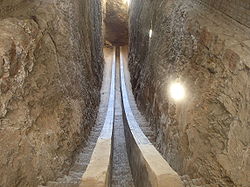
, and, in 1428, he built an enormous observatory
, called the Gurkhani Zij, similar to Tycho Brahe
's later Uraniborg
as well as Taqi al-Din's observatory in Istanbul. Lacking telescope
s to work with, he increased his accuracy by increasing the length of his sextant
; the so-called Fakhri sextant
had a radius of about 36 meters (118 ft) and the optical separability
of 180" (seconds of arc).
Using it, he compiled the 1437 Zij-i-Sultani
of 994 star
s, generally considered the greatest star catalogue
between those of Ptolemy
and Brahe, a work that stands alongside Abd al-Rahman al-Sufi's Book of Fixed Stars
. The serious errors which he found in previous Arabian star catalogues (many of which had simply updated Ptolemy's work, adding the effect of precession
to the longitudes) induced him to redetermine the positions of 992 fixed stars, to which he added 27 stars from Abd al-Rahman al-Sufi's catalogue Book of Fixed Stars
from the year 964, which were too far south for observation from Samarkand. This catalogue, one of the most original of the Middle Ages, was first edited by Thomas Hyde
at Oxford in 1665 under the title Tabulae longitudinis et latitudinis stellarum fixarum ex observatione Ulugbeighi and reprinted in 1767 by G. Sharpe. More recent editions are those by Francis Baily
in 1843 in vol. xiii of the Memoirs of the Royal Astronomical Society and by Edward Ball Knobel in Ulugh Beg's Catalogue of Stars, Revised from all Persian Manuscripts Existing in Great Britain, with a Vocabulary of Persian and Arabic Words (1917).
 In 1437, Ulugh Beg determined the length of the sidereal year
as 365.2570370...d = 365d 6h 10m 8s (an error +58s). In his measurements within many years he used a 50 m high gnomon
. This value was improved by 28s in 1525 by Nicolaus Copernicus
, who appealed to the estimation of Thabit ibn Qurra
(826
-901
), which was accurate to +2s. However, Beg later measured another more precise value as 365d 5h 49m 15s, which has an error of +25s, making it more accurate than Copernicus' estimate which had an error of +30s. Beg also determined the Earth's axial tilt
as 23.52 degrees, which remains the most accurate measurement to date. It was more accurate than later measurements by Copernicus and Tycho Brahe
, and matches the currently accepted value precisely.
, Ulugh Beg wrote accurate trigonometric
tables of sine
and tangent values correct to at least eight decimal places.
after defeating Mirza Ala-u-dowleh, son of Bai Sunqur. Within two years, he was beheaded by the order of his own eldest son, 'Abd al-Latif, while on his way to Mecca
. Eventually, his reputation was rehabilitated by his relative, 'Abdullah (1450-1451), who placed Ulugh Beg's remains in the tomb of Timur in Samarkand, where they were found by archeologists in 1941.
The crater, Ulugh Beigh
, on the Moon
, was named after him by the German astronomer Johann Heinrich von Mädler
on his 1830 map of the Moon.
Islamic astronomy
Islamic astronomy or Arabic astronomy comprises the astronomical developments made in the Islamic world, particularly during the Islamic Golden Age , and mostly written in the Arabic language. These developments mostly took place in the Middle East, Central Asia, Al-Andalus, and North Africa, and...
, mathematician
Islamic mathematics
In the history of mathematics, mathematics in medieval Islam, often termed Islamic mathematics or Arabic mathematics, covers the body of mathematics preserved and developed under the Islamic civilization between circa 622 and 1600...
and sultan
Sultan
Sultan is a title with several historical meanings. Originally, it was an Arabic language abstract noun meaning "strength", "authority", "rulership", and "dictatorship", derived from the masdar سلطة , meaning "authority" or "power". Later, it came to be used as the title of certain rulers who...
. His commonly-known name is not truly a personal name, but rather a moniker, which can be loosely translated as "Great Ruler" or "Patriarch Ruler" and was the Turkic
Turkic languages
The Turkic languages constitute a language family of at least thirty five languages, spoken by Turkic peoples across a vast area from Eastern Europe and the Mediterranean to Siberia and Western China, and are considered to be part of the proposed Altaic language family.Turkic languages are spoken...
equivalent of Timur
Timur
Timur , historically known as Tamerlane in English , was a 14th-century conqueror of West, South and Central Asia, and the founder of the Timurid dynasty in Central Asia, and great-great-grandfather of Babur, the founder of the Mughal Dynasty, which survived as the Mughal Empire in India until...
's Perso-Arabic title Amīr-e Kabīr. His real name was Mīrzā
Mirza
Mirza , is of Persian origin, denoting the rank of a high nobleman or Prince. It is usually translated into English as a royal or imperial Prince of the Blood...
Mohammad Tāraghay bin Shāhrokh. Ulugh Beg was also notable for his work in astronomy-related mathematics, such as trigonometry
Trigonometry
Trigonometry is a branch of mathematics that studies triangles and the relationships between their sides and the angles between these sides. Trigonometry defines the trigonometric functions, which describe those relationships and have applicability to cyclical phenomena, such as waves...
and spherical geometry
Spherical geometry
Spherical geometry is the geometry of the two-dimensional surface of a sphere. It is an example of a geometry which is not Euclidean. Two practical applications of the principles of spherical geometry are to navigation and astronomy....
. He built the great observatory
Ulugh Beg Observatory
The Ulugh Beg Observatory is an observatory in Samarkand, Uzbekistan. Built in the 1420s by the Timurid astronomer Ulugh Beg, it is considered by scholars to have been one of the finest observatories in the Islamic world at the time and the largest in Central Asia before it was destroyed in 1449...
in Samarkand
Samarkand
Although a Persian-speaking region, it was not united politically with Iran most of the times between the disintegration of the Seleucid Empire and the Arab conquest . In the 6th century it was within the domain of the Turkic kingdom of the Göktürks.At the start of the 8th century Samarkand came...
between 1424 and 1429.
Early life
He was the grandson of the conqueror, TimurTimur
Timur , historically known as Tamerlane in English , was a 14th-century conqueror of West, South and Central Asia, and the founder of the Timurid dynasty in Central Asia, and great-great-grandfather of Babur, the founder of the Mughal Dynasty, which survived as the Mughal Empire in India until...
(Tamerlane) (1336–1405), and oldest son of Shah Rukh
Shah Rukh (Timurid dynasty)
Shāhrukh Mīrzā was the ruler of the eastern portion of the empire established by the Central Asian warlord Timur - the founder of the Timurid dynasty - governing most of Persia and Transoxiana between 1405 and 1447...
, both of whom came from the Turkicized Barlas
Barlas
The Barlas were a Mongol - later Turkicized - nomadic confederation in Central Asia and the chief tribe of the Timurids who ruled much of Central Asia, Iran, and South Asia in the Middle Ages.- Origins :According to the Secret History of the Mongols, written during the reign of Ögedei Khan, the...
tribe of Transoxiana
Transoxiana
Transoxiana is the ancient name used for the portion of Central Asia corresponding approximately with modern-day Uzbekistan, Tajikistan, southern Kyrgystan and southwest Kazakhstan. Geographically, it is the region between the Amu Darya and Syr Darya rivers...
(now Uzbekistan
Uzbekistan
Uzbekistan , officially the Republic of Uzbekistan is a doubly landlocked country in Central Asia and one of the six independent Turkic states. It shares borders with Kazakhstan to the west and to the north, Kyrgyzstan and Tajikistan to the east, and Afghanistan and Turkmenistan to the south....
). His mother was a Turkic noblewoman named Goharshad
Goharshad
Goharshād was a wife of Shāh Rukh, the emperor of the Timurid Dynasty of Herāt. She was the daughter of Giāth ud-Din Tarkhān, an important and influential noble during Tīmur's reign...
. Ulugh Beg was born in Sultaniyeh in Persia. As a child he wandered through a substantial part of the Middle East
Middle East
The Middle East is a region that encompasses Western Asia and Northern Africa. It is often used as a synonym for Near East, in opposition to Far East...
and India
India
India , officially the Republic of India , is a country in South Asia. It is the seventh-largest country by geographical area, the second-most populous country with over 1.2 billion people, and the most populous democracy in the world...
as his grandfather expanded his conquests in those areas. With Timur's death, however, and the accession of Ulugh Beg's father to much of the Timurid Empire, he settled in Samarkand
Samarkand
Although a Persian-speaking region, it was not united politically with Iran most of the times between the disintegration of the Seleucid Empire and the Arab conquest . In the 6th century it was within the domain of the Turkic kingdom of the Göktürks.At the start of the 8th century Samarkand came...
, which had been Timur's capital. After Shah Rukh moved the capital to Herat (in modern Afghanistan
Afghanistan
Afghanistan , officially the Islamic Republic of Afghanistan, is a landlocked country located in the centre of Asia, forming South Asia, Central Asia and the Middle East. With a population of about 29 million, it has an area of , making it the 42nd most populous and 41st largest nation in the world...
), sixteen-year-old Ulugh Beg became the shah's governor in Samarkand in 1409. In 1411, he became the sovereign ruler of the whole Mavarannahr
Transoxiana
Transoxiana is the ancient name used for the portion of Central Asia corresponding approximately with modern-day Uzbekistan, Tajikistan, southern Kyrgystan and southwest Kazakhstan. Geographically, it is the region between the Amu Darya and Syr Darya rivers...
khanate
Khanate
Khanate, or Chanat, is a Turco-Mongol-originated word used to describe a political entity ruled by a Khan. In modern Turkish, the word used is kağanlık, and in modern Azeri of the republic of Azerbaijan, xanlıq. In Mongolian the word khanlig is used, as in "Khereidiin Khanlig" meaning the Khanate...
.
Science
The teenaged ruler set out to turn the city into an intellectual center for the empire. Between 1417 and 1420, he built a madrasaMadrasah
Madrasah is the Arabic word for any type of educational institution, whether secular or religious...
("university" or "institute") on Registan Square
Registan
The Registan was the heart of the ancient city of Samarkand, now in Uzbekistan. The name Registan means "Sandy place" in Persian....
in Samarkand (currentUzbekistan
Uzbekistan
Uzbekistan , officially the Republic of Uzbekistan is a doubly landlocked country in Central Asia and one of the six independent Turkic states. It shares borders with Kazakhstan to the west and to the north, Kyrgyzstan and Tajikistan to the east, and Afghanistan and Turkmenistan to the south....
) , and he invited numerous Islamic astronomers
Islamic astronomy
Islamic astronomy or Arabic astronomy comprises the astronomical developments made in the Islamic world, particularly during the Islamic Golden Age , and mostly written in the Arabic language. These developments mostly took place in the Middle East, Central Asia, Al-Andalus, and North Africa, and...
and mathematicians
Islamic mathematics
In the history of mathematics, mathematics in medieval Islam, often termed Islamic mathematics or Arabic mathematics, covers the body of mathematics preserved and developed under the Islamic civilization between circa 622 and 1600...
to study there. The madrasa building still survives. Ulugh Beg's most famous pupil in astronomy
Astronomy
Astronomy is a natural science that deals with the study of celestial objects and phenomena that originate outside the atmosphere of Earth...
was Ali Qushchi (died in 1474).
Astronomy
His own particular interests concentrated on astronomyAstronomy
Astronomy is a natural science that deals with the study of celestial objects and phenomena that originate outside the atmosphere of Earth...
, and, in 1428, he built an enormous observatory
Observatory
An observatory is a location used for observing terrestrial or celestial events. Astronomy, climatology/meteorology, geology, oceanography and volcanology are examples of disciplines for which observatories have been constructed...
, called the Gurkhani Zij, similar to Tycho Brahe
Tycho Brahe
Tycho Brahe , born Tyge Ottesen Brahe, was a Danish nobleman known for his accurate and comprehensive astronomical and planetary observations...
's later Uraniborg
Uraniborg
Uranienborg was a Danish astronomical observatory operated by Tycho Brahe; built circa 1576-1580 on Hven, an island in the Øresund between Zealand and Scania, which at that time was part of Denmark. The observatory was shortly after its construction expanded with an underground facility,...
as well as Taqi al-Din's observatory in Istanbul. Lacking telescope
Telescope
A telescope is an instrument that aids in the observation of remote objects by collecting electromagnetic radiation . The first known practical telescopes were invented in the Netherlands at the beginning of the 1600s , using glass lenses...
s to work with, he increased his accuracy by increasing the length of his sextant
Sextant (astronomical)
Sextants for astronomical observations were used primarily for measuring the positions of stars. They are little used today, having been replaced over time by transit telescopes, astrometry techniques, and satellites such as Hipparcos....
; the so-called Fakhri sextant
Sextant (astronomical)
Sextants for astronomical observations were used primarily for measuring the positions of stars. They are little used today, having been replaced over time by transit telescopes, astrometry techniques, and satellites such as Hipparcos....
had a radius of about 36 meters (118 ft) and the optical separability
Angular resolution
Angular resolution, or spatial resolution, describes the ability of any image-forming device such as an optical or radio telescope, a microscope, a camera, or an eye, to distinguish small details of an object...
of 180" (seconds of arc).
Using it, he compiled the 1437 Zij-i-Sultani
Zij-i-Sultani
Zīj-i Sultānī is a Zij astronomical table and star catalogue that was published by Ulugh Beg in 1437. It was the joint product of the work of a group of Muslim astronomers working under the patronage of Ulugh Beg at Samarkand's Ulugh Beg Observatory...
of 994 star
Star
A star is a massive, luminous sphere of plasma held together by gravity. At the end of its lifetime, a star can also contain a proportion of degenerate matter. The nearest star to Earth is the Sun, which is the source of most of the energy on Earth...
s, generally considered the greatest star catalogue
Star catalogue
A star catalogue, or star catalog, is an astronomical catalogue that lists stars. In astronomy, many stars are referred to simply by catalogue numbers. There are a great many different star catalogues which have been produced for different purposes over the years, and this article covers only some...
between those of Ptolemy
Ptolemy
Claudius Ptolemy , was a Roman citizen of Egypt who wrote in Greek. He was a mathematician, astronomer, geographer, astrologer, and poet of a single epigram in the Greek Anthology. He lived in Egypt under Roman rule, and is believed to have been born in the town of Ptolemais Hermiou in the...
and Brahe, a work that stands alongside Abd al-Rahman al-Sufi's Book of Fixed Stars
Book of Fixed Stars
The Book of Fixed Stars is an astronomical text written by Abd al-Rahman al-Sufi around 964. The book was written in Arabic, although the author himself was Persian...
. The serious errors which he found in previous Arabian star catalogues (many of which had simply updated Ptolemy's work, adding the effect of precession
Precession of the equinoxes
In astronomy, axial precession is a gravity-induced, slow and continuous change in the orientation of an astronomical body's rotational axis. In particular, it refers to the gradual shift in the orientation of Earth's axis of rotation, which, like a wobbling top, traces out a pair of cones joined...
to the longitudes) induced him to redetermine the positions of 992 fixed stars, to which he added 27 stars from Abd al-Rahman al-Sufi's catalogue Book of Fixed Stars
Book of Fixed Stars
The Book of Fixed Stars is an astronomical text written by Abd al-Rahman al-Sufi around 964. The book was written in Arabic, although the author himself was Persian...
from the year 964, which were too far south for observation from Samarkand. This catalogue, one of the most original of the Middle Ages, was first edited by Thomas Hyde
Thomas Hyde
Thomas Hyde was an English orientalist. The first use of the word dualism is attributed to him, in 1700.-Life:He was born at Billingsley, near Bridgnorth in Shropshire, on 29 June 1636...
at Oxford in 1665 under the title Tabulae longitudinis et latitudinis stellarum fixarum ex observatione Ulugbeighi and reprinted in 1767 by G. Sharpe. More recent editions are those by Francis Baily
Francis Baily
Francis Baily was an English astronomer, most famous for his observations of 'Baily's beads' during an eclipse of the Sun.-Life:Baily was born at Newbury in Berkshire in 1774...
in 1843 in vol. xiii of the Memoirs of the Royal Astronomical Society and by Edward Ball Knobel in Ulugh Beg's Catalogue of Stars, Revised from all Persian Manuscripts Existing in Great Britain, with a Vocabulary of Persian and Arabic Words (1917).
Sidereal year
A sidereal year is the time taken by the Earth to orbit the Sun once with respect to the fixed stars. Hence it is also the time taken for the Sun to return to the same position with respect to the fixed stars after apparently travelling once around the ecliptic. It was equal to at noon 1 January...
as 365.2570370...d = 365d 6h 10m 8s (an error +58s). In his measurements within many years he used a 50 m high gnomon
Gnomon
The gnomon is the part of a sundial that casts the shadow. Gnomon is an ancient Greek word meaning "indicator", "one who discerns," or "that which reveals."It has come to be used for a variety of purposes in mathematics and other fields....
. This value was improved by 28s in 1525 by Nicolaus Copernicus
Nicolaus Copernicus
Nicolaus Copernicus was a Renaissance astronomer and the first person to formulate a comprehensive heliocentric cosmology which displaced the Earth from the center of the universe....
, who appealed to the estimation of Thabit ibn Qurra
Thabit ibn Qurra
' was a mathematician, physician, astronomer and translator of the Islamic Golden Age.Ibn Qurra made important discoveries in algebra, geometry and astronomy...
(826
826
Year 826 was a common year starting on Monday of the Julian calendar.- Religion :* June 24 – The Danish king Harald Klak accepts Christianity.- Deaths :...
-901
901
Year 901 was a common year starting on Thursday of the Julian calendar.- Africa :* Abu 'Abdullah al-Shi'i leads the rebellion of the Kutama Berbers against the Aghlabid emirate in Ifriqiya ....
), which was accurate to +2s. However, Beg later measured another more precise value as 365d 5h 49m 15s, which has an error of +25s, making it more accurate than Copernicus' estimate which had an error of +30s. Beg also determined the Earth's axial tilt
Axial tilt
In astronomy, axial tilt is the angle between an object's rotational axis, and a line perpendicular to its orbital plane...
as 23.52 degrees, which remains the most accurate measurement to date. It was more accurate than later measurements by Copernicus and Tycho Brahe
Tycho Brahe
Tycho Brahe , born Tyge Ottesen Brahe, was a Danish nobleman known for his accurate and comprehensive astronomical and planetary observations...
, and matches the currently accepted value precisely.
Mathematics
In mathematicsIslamic mathematics
In the history of mathematics, mathematics in medieval Islam, often termed Islamic mathematics or Arabic mathematics, covers the body of mathematics preserved and developed under the Islamic civilization between circa 622 and 1600...
, Ulugh Beg wrote accurate trigonometric
Trigonometry
Trigonometry is a branch of mathematics that studies triangles and the relationships between their sides and the angles between these sides. Trigonometry defines the trigonometric functions, which describe those relationships and have applicability to cyclical phenomena, such as waves...
tables of sine
Trigonometric function
In mathematics, the trigonometric functions are functions of an angle. They are used to relate the angles of a triangle to the lengths of the sides of a triangle...
and tangent values correct to at least eight decimal places.
Death
Ulugh's scientific expertise was not matched by his skills in governance. He lost some battles to rival kingdoms, and, in 1448, he massacred the people of HeratHerat
Herāt is the capital of Herat province in Afghanistan. It is the third largest city of Afghanistan, with a population of about 397,456 as of 2006. It is situated in the valley of the Hari River, which flows from the mountains of central Afghanistan to the Karakum Desert in Turkmenistan...
after defeating Mirza Ala-u-dowleh, son of Bai Sunqur. Within two years, he was beheaded by the order of his own eldest son, 'Abd al-Latif, while on his way to Mecca
Mecca
Mecca is a city in the Hijaz and the capital of Makkah province in Saudi Arabia. The city is located inland from Jeddah in a narrow valley at a height of above sea level...
. Eventually, his reputation was rehabilitated by his relative, 'Abdullah (1450-1451), who placed Ulugh Beg's remains in the tomb of Timur in Samarkand, where they were found by archeologists in 1941.
The crater, Ulugh Beigh
Ulugh Beigh (crater)
Ulugh Beigh is the remnant of a lunar crater that is located just to the west of the Oceanus Procellarum. It is located near the northwestern limb of the Moon, and from the Earth it appears foreshortened. Farther to the west is the smaller crater Aston, and to the north is Lavoisier...
, on the Moon
Moon
The Moon is Earth's only known natural satellite,There are a number of near-Earth asteroids including 3753 Cruithne that are co-orbital with Earth: their orbits bring them close to Earth for periods of time but then alter in the long term . These are quasi-satellites and not true moons. For more...
, was named after him by the German astronomer Johann Heinrich von Mädler
Johann Heinrich von Mädler
Johann Heinrich von Mädler was a German astronomer.He was orphaned at age 19 by an outbreak of typhus, and found himself responsible for raising three younger sisters...
on his 1830 map of the Moon.