
In Depth
See Also

Irrigation

Irrigation is the replacement or supplementation of rain Rain

Rain is a form of precipitation [i], other forms of which include snow [i], sleet [i], hail [i] ... 

fall with water from another source in order to grow crops or plants. In contrast, agriculture that relies only on direct rainfall is sometimes referred to as dryland farming.

Discussions

  Discussion Features

   Ask a question about 'Irrigation'

   Start a new discussion about 'Irrigation'

   Answer questions about 'Irrigation'

   'Irrigation' discussion forum

Timeline

600   The Persians Persian people

The Persians are an Iranian people [i] who speak the Persian language [i] and share a co ... 

 begin to use windmills for irrigation.


Encyclopedia


Irrigation is the replacement or supplementation of rain Rain

Rain is a form of precipitation [i], other forms of which include snow [i], sleet [i], hail [i]... 

fall with water from another source in order to grow crops or plants. In contrast, agriculture that relies only on direct rainfall is sometimes referred to as dryland farming.

Overview

The water source for irrigation may be a nearby or distant body of lake or frozen water Water

Water is a taste [i]less, odor [i]less substance that is essential to all known forms of life [i] and i ... 

 such as a river River

A river is a large natural waterway [i]. ... 

, spring, lake Lake

A lake is a body of water or other liquid of considerable size surrounded by land.... 

, aquifer Aquifer

An aquifer is an underground layer of water [i]-bearing permeable rock or unconsolidated materials fro ... 

, well Water well

* Hydrogeology [i]
  • Hydrology [i]

... 

, or snowpack. Depending on the distance of the source and the seasonality of rainfall, the water may be channelled directly to the agricultural fields or stored in reservoirs or cistern Cistern

A cistern is a receptacle for holding liquids, usually water.... 

s for later use. In addition, the "harvesting" of local rain that falls on the roofs of buildings or on nearby unfarmed hills and its use to supplement the rain that falls directly on farmed fields also involves irrigation.

Various types of irrigation techniques differ in how the water obtained from the source is distributed within the field. In general, the goal is to supply the entire field uniformly with water, so that each plant has the amount of water it needs, neither too much nor too little.

Types of irrigation


Flood irrigation


Ditch Ditch

* For use of the ditch as obstacles for horses, see ditch [i]
... 

es, furrows, and basins may be dug with hand tools, turned with a plow pulled by an animal or tractor Tractor

A tractor is a device intended for drawing, towing or pulling something which cannot propel itself and, ... 

, or precisely fashioned using laser Laser

A laser is an optical source that emits photons [i] in a coherent [i] beam. ... 

-guided instruments depending on economic and physical factors such as the size of the field, the types of technology available, and the cost of manpower. Plant Plant

Plants are a major group of living things [i] including familiar organism [i]s such as tree [i]s, flower [i] ... 

s are grown in raised beds, listed rows, drilled or planted into flat basins. Water may be distributed throughout the field via canal Canal

Canals are man-made waterway [i]s, usually connecting existing lake [i]s, river [i]s, or ocean [i]s. ... 

s, unlined ditches, or furrows, between the rows or beds by use of rigid gated plastic Plastic

Plastic covers a range of synthetic or semisynthetic polymerization [i] products. ... 

 or aluminum Aluminium

Aluminium or aluminum is the chemical element in the periodic table that has the symbol Al ... 

 water pipe Water pipe

Water pipes are pipes [i] or tubes [i], frequently made of polyvinyl chloride [i], Polyethylene [i] ... 

, layflat plastic with holes punched at each furrow, concrete Concrete

In construction [i], concrete is a composite [i] building material made from the comb ... 

 or plastic lined ditches, or unlined ditches.
Where ditches are used, siphon tubes move water from the main ditch to the furrow. When pipes are used, water flow can be controlled by turning it on or off at the local source or by using automatic or manually controlled gates to transfer it from one set of ditches to another. Unless the field is small or very level, parts of it may suffer from water-logging while other parts may be too dry. Depending on heat Heat

In physics [i], heat, symbolized by Q, is defined as energy in transit. ... 

, wind Wind

Wind is the roughly horizontal movement of air [i] caused by uneven heating of the Earth's surface. ... 

, and soil Soil

Soil is the collection of natural bodies that form in earthy material on the land surface.... 

 permeability, much water may be lost before it can benefit the plants. Automatic valves, also known as surge valves, can increase the efficiency of furrow irrigation because they alternately wet the furrows and allow the soil infiltration rate to slow prior to using the furrow for actual irrigation.

Once common in the United States United States

The United States of America, also known as the United States, the U.S., the U.S.A., a... 

, many surface irrigation systems have been replaced because of high labor costs and increasing demands on water resources Water resources

Water resources are sources of water [i] that are useful or potentially useful to humans. ... 

. Surface irrigation also has a tendency to raise the water table in some areas and cause soil salination Soil salination

Soil salination is the accumulation of free salts to such an extent that it leads to degradation of soils [i]... 

, requiring drainage Drainage

Drainage is the natural or artificial removal of surface and sub-surface water [i] from a gi ... 

. These types of systems are still common in other parts of the world.

Overhead irrigation


In overhead or sprinkler irrigation, water is piped to one or more central locations within the field and distributed by overhead high-pressure sprinklers or guns or by lower-pressure sprays. A system utilizing sprinklers, sprays, or guns mounted overhead on permanently installed risers is often referred to as a solid-set irrigation system. Some sprinklers can also be hidden below ground level, if aesthetics is a concern, and pop up in response to increased water pressure. This type of system is commonly used in lawns, golf courses, cemeteries, parks, and other turf areas.

Sprinkler Irrigation sprinkler

Irrigation [i] Sprinklers are used on farms, golf courses, residential yards, and other places to water ... 

s that spray in a fixed pattern are generally called sprays or spray heads. Sprays are not usually designed to operate at pressures above 30 lbf/in² , due to misting problems that may develop. Higher pressure sprinklers that rotate are called rotors and are driven by a ball drive, gear drive, or impact mechanism. Rotors can be designed to rotate in a full or partial circle. Guns are similar to rotors, except that they generally operate at very high pressures of 40 to 130 lbf/in² and flows of 50 to 1200 US gal/min , usually with nozzle diameters in the range of 0.5 to 1.9 inches . Guns are used not only for irrigation, but also for industrial applications such as dust suppression and logging Logging

Logging is the process in which tree [i]s are felled and transported to a mill.... 

.


Sprinklers may also be mounted on movable platforms connected to the water source by a hose. Automatically moving wheeled systems known as travelers may irrigate large areas such as small farms, sports fields, and cemeteries unattended. Some of these utilize a length of polyethylene tubing wound on a steel drum. As the traveler is pulled across the field, the hose is wound onto the drum by water pressure or a powered engine. Other travelers use a flat rubber hose that is dragged along behind. At the low tech end, such as in a small greenhouse or landscape, a person may be watering each plant individually with a hose end sprinkler or even a watering can.

One drawback of overhead irrigation is that much water can be lost because of high winds or evaporation, and irrigating the entire field uniformly can be difficult or tedious if the system is not properly designed. Water remaining on plants' leaves may promote fungal and other diseases. If fertilizers are included in the irrigation water, plant leaves can be burned, especially on hot, sunny days.

Overhead irrigation is generally the best solution for watering lawns and golf courses, although drip irrigation Drip irrigation

Drip irrigation also known as trickle irrigation or microirrigation is an irrigation [i] method ... 

 is gaining in popularity in some lawn applications.

Manually assembled systems of piping that are broken down to permit tillage and harvesting Harvest

In agriculture [i], harvesting is the process of gathering [i] mature crops [i] from the fie ... 

 are sometimes called "hand set" or "hand move pipe". These are also commonly used on athletic fields where permanently installed sprinklers or outlets are not desired or where low initial costs are a factor.

Center pivot irrigation


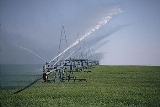
Center pivot irrigation Center pivot irrigation

Center pivot irrigation is a method of crop [i] irrigation [i] in which equipment rotates a... 

 is a form of overhead irrigation consisting of several segments of pipe joined together and supported by truss Truss

In architecture [i] and structural engineering [i], a truss is a static structure [i] consisting of stra... 

es, mounted on wheeled towers with sprinklers positioned along its length. The system moves in a circular pattern and is fed with water from the pivot point at the center of the arc. These systems are common in parts of the United States where terrain is flat.


Most center pivot systems now have drops hanging from a u-shaped pipe called a gooseneck attached at the top of the pipe with sprinkler heads that are positioned a few feet above the crop, thus limiting evaporative losses. Drops can also be used with drag hoses or bubblers that deposit the water directly on the ground between crops. The crops are planted in a circle to conform to the center pivot. This type of system is known as LEPA .

Originally, most center pivots were water powered. These were replaced by hydraulic systems and electric motor driven systems . Most systems today are driven by an electric motor mounted low on each span. This drives a reduction gearbox and transverse driveshafts transmit power to another reduction gearbox mounted behind each wheel. Reinke sprinklers have strobe lights when running. Valleys have regular lights. Reinke sprinklers are kind of red covered. Most new sprinklers are Zimmatics with drops.

Center pivot equipment can also be configured to move in a straight line, where the water is pulled from a central ditch. In this scenario, the system is called a linear move irrigation system.


Lateral move irrigation

A series of pipes, each with a wheel of about 1.5 m diameter permanently affixed to its midpoint and sprinklers along its length, are coupled together at one edge of a field. Water is supplied at one end using a large hose. After sufficient water has been applied, the hose is removed and the remaining assembly rotated either by hand or with a purpose-built mechanism, so that the sprinklers move 10m across the field. The hose is reconnected. The process is repeated until the opposite edge of the field is reached.

This system is less expensive to install than a center pivot, but much more labor intensive to operate, and it is limited in the amount of water it can carry. Most systems utilize 4 or 5 inch diameter aluminum pipe. One feature of a lateral move system is that it consists of sections that can be easily disconnected. They are most often used for small or oddly-shaped fields, such as those found in hilly or mountainous regions, or in regions where labor is inexpensive.

Drip, or trickle irrigation


See main article at drip irrigation Drip irrigation

Drip irrigation also known as trickle irrigation or microirrigation is an irrigation [i] method ... 


Water is delivered at or near the root Root

In vascular plant [i]s, the root is that organ of a plant [i] body that typically lies below the surface ... 

 zone of plants, drop by drop. This type of system can be the most water-efficient method of irrigation, if managed properly, since evaporation and runoff are minimized. In modern agriculture, drip irrigation is often combined with plastic mulch Plastic mulch

Plastic mulch is a product used, in a similar fashion to mulch [i], to suppress weed [i]s and conserve water [i] ... 

, further reducing evaporation, and is also the means of delivery of fertilizer. The process is known as fertigation.

Deep percolation, where water moves below the root zone, can occur if a drip system is operated for too long of a duration. Drip irrigation methods range from very high-tech and computerized to low-tech and relatively labor-intensive. Lower water pressures are usually needed than for most other types of systems, with the exception of low energy center pivot systems and surface irrigation systems, and the system can be designed for uniformity throughout a field or for precise water delivery to individual plants in a landscape containing a mix of plant species. Although it is difficult to regulate pressure on steep slopes, pressure compensating emitters are available, so the field does not have to be level. High-tech solutions involve precisely calibrated emitters located along lines of tubing that extend from a computerized set of valve Valve

A valve is a device that regulates the flow of fluid [i]s by opening, closing, or partially obstructing ... 

s. Both pressure regulation and filtration to remove particles are important. The tubes are usually black to prevent the growth of algae and to protect the polyethylene Polyethylene

Polyethylene or polyethene is a thermoplastic [i] commodity heavily used in consumer products. ... 

 from degradation due to ultraviolet light Ultraviolet

Ultraviolet light is electromagnetic radiation [i] with a wavelength [i] shorter than that of visible l ... 

. But drip irrigation can also be as low-tech as a porous clay Clay

Clay is a term used to describe a group of hydrous aluminium [i] phyllosilicate [i] ... 

 vessel sunk into the soil and occasionally filled from a hose or bucket. Subsurface drip irrigation Drip irrigation

Drip irrigation also known as trickle irrigation or microirrigation is an irrigation [i] method ... 

 has been used successfully on lawns, but it is more expensive than a more traditional sprinkler system. Surface drip systems are not cost-effective for lawns and golf Golf

Golf is a sport where individual players or teams hit a ball [i] into a hole using various clubs [i] ... 

 courses.

Subirrigation

Subirrigation also sometimes called seepage irrigation has been used for many years in field crops in areas with high water tables. It is a method of artificially raising the water table to allow the soil to be moistened from below the plants' root zone.

Subirrigation is also used in commercial greenhouse Greenhouse

A greenhouse is a building where plants are cultivated.... 

 production, usually for potted plants. Water is delivered from below, absorbed upwards, and the excess collected for recycling. Typically, a solution of water and nutrients floods a container or flows through a trough for a short period of time, 10-20 minutes, and is then pumped back into a holding tank for reuse. Subirrigation in greenhouses requires fairly sophisticated, expensive equipment and management. Advantages are water and nutrient conservation, and labor-saving through lowered system maintenance and automation Automation

Automation, roboticization or industrial automation or numerical control [i] is the use of control system [i] ... 

. It is similar in principle and action to subsurface drip irrigation.

How an irrigation system works

Most commercial and residential irrigation systems are "in ground" systems, which means that everything is buried in the ground. With the pipes, sprinklers, and irrigation valves being hidden, it makes for a cleaner, more presentable landscape without garden hoses or other items having to be moved around manually.

The beginning of a sprinkler system is the water Water

Water is a taste [i]less, odor [i]less substance that is essential to all known forms of life [i] and i ... 

 source. This is usually a tap into an existing water line or a pump Pump

This article is about the mechanical device.... 

 that pulls water out of a well or a pond.

History of irrigation

Evidence exists of irrigation in Mesopotamia Mesopotamia

Mesopotamia refers to the region [i] now occupied by modern Iraq [i], eastern Syria [i], and southeaster ... 

 and Egypt Egypt

[i] country in [[North Africa]... 

 as far back as the 6th millennium BC.

There is also evidence of ancient Egyptian Ancient Egypt

Ancient Egypt was a long-lived ancient civilization [i] in north-eastern Africa [i]. ... 

 pharaohs of the twelfth dynasty using the natural lake of the Fayûm Al Fayyum

Al Fayyum or El Faiyûm, formerly Medinet al Fayyum, is the capital of Al Fayyum Governorate [i] ... 

 as a reservoir to store surpluses of water for use during the dry seasons, as the lake swelled annually as caused by the annual flooding of the Nile Nile

The Nile ; Ancient Egyptian [i] iteru), a river [i] in Africa [i], is accepted by most authorities a ... 

. Ancient visitors reported the appearance of "an artificial excavation, as reported by classic geographer Geographer

A geographer is a scientist [i] whose area of study is geography [i], the study of Earth [i]'s physical ... 

s and travellers" .

Developed in ancient Persia Persian Empire

The Persian Empire was a series of historical empires that ruled over the Iranian plateau [i] ... 

 the Qanat Qanat

A qanat or kareez is a water management [i] system used to provide a reliable supply of water to h ... 

 is among the oldest known irrigation methods developed and still used today. 'Qanats are constructed as a series of well-like vertical shafts, connected by gently sloping tunnels.' meaning that the receiving populus was always lower than the source, the source being higher and connected to these Qanats which had many exit points for the water at villages and pastures.

Irrigation Works of Ancient Sri Lanka were one of the most complex irrigation systems of the ancient world, the sinhalese managed to build major irrigation schemes to support the agriculture which thrived at the time. The sinhalese civilization is responsible for the invention of the valve pit which remains unchanged to-date. Highly complex use of trigonometry and other engineering aspects such as soil mechanics, built environment had been used for the construction of these schemes.King Parakrama Bahu  had been responsible for the construction or the restoration of 165 dams, 3910 canals, 163 major tanks and 2376 minor tanks, all in a reign of 33 years.

In the Zana Valley of the Andes Mountains Andes

The Andes is the world's longest mountain range [i], forming a continuous chain of highland along the w ... 

 in Peru Peru

Peru, officially the Republic of Peru, is a country in western South America [i], bordering Ecuador [i]... 

, archaeologists found remains of 3 irrigation canals radiocarbon dated Radiocarbon dating

Radiocarbon dating is a radiometric dating [i] method that uses the naturally occurring isotope [i] carbon-14 [i] ... 

 from the 4th millennium BC, the 3rd millennium BC and the 9th century 9th century

As a means of recording the passage of time [i] the 9th century was that century [i] that lasted from 801 [i] ... 

. These canals are the earliest record of irrigation in the New World New World

The New World is one of the names used for the Americas [i].... 

. Traces of a canal possibly dating from the 5th millennium BC were found under the 4th millennium canal.

The Indus Valley Civilization Indus Valley Civilization

The Indus Valley Civilisation was an ancient civilisation [i] thriving along the Indus River [i] and th ... 

 in Pakistan Pakistan

[i] located in [[South Asia]... 

 and North India North India

North India is a geographic and linguistic-cultural region of India [i]. ... 

  also had an early canal Canal

Canals are man-made waterway [i]s, usually connecting existing lake [i]s, river [i]s, or ocean [i]s. ... 

 irrigation system.

In ancient China China

China is a cultural region [i] and ancient civilization [i] in East Asia [i]. ... 

 the Dujiangyan Irrigation System Dujiangyan Irrigation System

The Dujiangyan Irrigation System is a historical Chinese [i] irrigation [i] and flood [i] control ... 

was built in 250 BC which irrigated a large area and it still supplies with water nowadays.

By the middle of the 20th century 20th century

The 20th century started on 1 January [i] 1901 [i] and ended on 31 December [i] 2000 [i], according to t... 

, the advent of diesel and electric motors led for the first time to systems that could pump groundwater Groundwater

Groundwater is water [i] located beneath the ground surface in soil pore spaces and in the fractures of... 

 out of major aquifer Aquifer

An aquifer is an underground layer of water [i]-bearing permeable rock or unconsolidated materials fro ... 

s faster than it was recharged. This can lead to permanent loss of aquifer capacity, decreased water quality, ground subsidence, and other problems. The future of food production in such areas as the
North China Plain, the Punjab Punjab region

[Image:Punjab 1909.jpg|thumb|350px|Punjab Province, 1909]] [i]
... 

, and the Great Plains Great Plains

The Great Plains is the broad expanse of prairie [i] and steppe [i] which lies east of the Rocky Mountains [i] ... 

 of the US is threatened.

Problems in irrigation

  • Competition for surface water rights.
  • Depletion of underground aquifers.
  • Ground subsidence
  • Buildup of toxic salts on soil surface in areas of high evaporation. This requires leaching to remove these salts and a method of drainage Drainage

    Drainage is the natural or artificial removal of surface and sub-surface water [i] from a gi ... 

     to carry the salts away.
  • Overirrigation because of poor distribution uniformity or management wastes water, chemicals, and may lead to water pollution Water pollution

    Water pollution is a large set of adverse effects upon water bodies caused by human activities.... 

    .

See also


  • Aquifer Aquifer

    An aquifer is an underground layer of water [i]-bearing permeable rock or unconsolidated materials fro ... 

  • Evapotranspiration Evapotranspiration

    Evapotranspiration is the sum of evaporation [i] and plant [i] transpiration [i]. ... 

  • Geohydrology
  • Gezira Scheme Gezira Scheme

    The Gezira Scheme is one of the largest irrigation [i] projects in the world. ... 

  • Groundwater Groundwater

    Groundwater is water [i] located beneath the ground surface in soil pore spaces and in the fractures of... 

  • Irrigation in Saudi Arabia Irrigation in Saudi Arabia

    Center Pivot Irrigation in Saudi Arabia [i] is typical of many isolated irrigation [i] projects scattere... 

  • Irrigation Works of Ancient Sri Lanka
  • Paddy Field Paddy field

    A paddy field is a flooded parcel [i] of arable land [i] used for growing rice [i] and other semiaquatic crops [i]... 

  • Transvasement
  • Qanat Qanat

    A qanat or kareez is a water management [i] system used to provide a reliable supply of water to h ... 


References


External links

  • 19th century Irrigation in India