

Manghit

Encyclopedia
The Manġhud or Mangudai (Mongolian
: Mangudai) were a Mongol tribe of the Urud-Manghud federation. They established the Nogai Horde
in the 14th c. and the Manghit Dynasty to rule the Emirate of Bukhara
in 1785. The clan name was used for Mongol vanguards as well. Their descendants live in several regions of the former Mongol Empire
.
(1162–1227) while a body of them resisted his rise to power. When the Mongol Empire
began to expand westward, the Manghud people were spread westward into the Middle East along with many other Mongol tribes. In the Golden Horde
, the Manghuds supported Nogai
(d.1299) and established their own semi-independent horde
from the khans in Sarai
. After Nogai's death in 1299 AD, the majority of Manghud warriors joined the service of Tokhta Khan. Their chieftain Edigu
, the powerful warlord
of the Golden Horde, officially founded Nogai Horde
or Manghit Horde in the 14th-15th century. Turkish historians would record their tribal name as Manghit or Nogais, as opposed to the original Manghud or Mangudai.
, but sources differ wildly in their descriptions. One source states that references to Mongol light cavalry
"suicide troops" date back to the 13th century.
However, a United States Army
author believes that Mangudai was the name of a 13th-century Mongol warlord who created an arduous selection process to test potential leaders. The term is used by element of the United States Army
as a name for multi-day tests of Soldiers' endurance and warrior skills.
The Travels of Marco Polo uses the word Meng-Gu-Dai as the name of a person: "The (Mongol) Emperor ordered Meng-Gu-Dai to invade Si-Fan with 6000 men."
and Crimean khanate
s, and through organized raids to the northern steppes prevented Russia
n and Lithuania
n settlements. Many Nogais joined the service of Crimean khan. Settling there, they contributed to the formation of the Crimean Tatars
. However, Nogais were not only good soldiers, they also had considerable agricultural skills. Their basic social unit was the semi-autonomous 'ulus' or band. But Nogais were proud of their nomadic traditions and independence, which they considered superior to settled agricultural life.
At the beginning of the 17th century, the Kalmyks or the Oirats
, migrated from the steppes of southern Siberia on the banks of the Irtysh River to the Lower Volga region about 1630. The Kalmyks expelled the Nogais who fled to the plains of northern Caucasus
and to the Crimea under the Ottoman Empire
.
 In the 18th century the basins of the Amu Darya
and Syr Darya
passed under the control of three Uzbek khanates claiming legitimacy in their descent from Genghis Khan. These were, from west to east, the Qunggirats based on Khiva
in Khwārezm (1717–1920), the Mangits in Bukhara (1753–1920), and the Mings in Kokand (Qǔqon; c. 1710–1876).
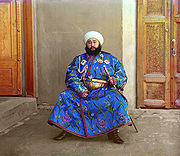
The Manghit dynasty was founded by an Uzbek family that ruled the Emirate of Bukhara
from 1785 to 1920. Manġit power in the Khanate of Bukhara
began to grow in the early 18th century, due to the emirs position as ataliq to the khan. The family effectively came to power after Nader Shah
's death in 1747, and the assassination of the ruling Abulfayz Khan and his young son Abdalmumin by the ataliq Muhammad Rahim Bi. From the 1750s to the 1780s, the Manġits ruled behind the scenes, until the emir Shah Murad declared himself the open ruler, establishing the Emirate of Bukhara. The last emir of the dynasty, Mohammed Alim Khan
, was ousted by the Russian Red Army
in September, 1920, and fled to Afghanistan
. The dynasty descends from the great Mongol khans of the Golden Horde.
The Manghit dynasty issued coins from 1787 up until the Soviet takeover.
of Mongolia
and Baarin banner in Inner Mongolia
now.
Their descendants Nogai and Karakalpak people live in Dagestan
and Khorazm. And the Manghits are also found among the Tatars
in Russia
, the Bashkirs
and the Kazakhs
.
Mongolian language
The Mongolian language is the official language of Mongolia and the best-known member of the Mongolic language family. The number of speakers across all its dialects may be 5.2 million, including the vast majority of the residents of Mongolia and many of the Mongolian residents of the Inner...
: Mangudai) were a Mongol tribe of the Urud-Manghud federation. They established the Nogai Horde
Nogai Horde
The Nogai Horde was a confederation of about eighteen Turkic and Mongol tribes that occupied the Pontic-Caspian steppe from about 1500 until they were pushed west by the Kalmyks and south by the Russians in the 17th century. The Mongol tribe called the Manghits constituted a core of the Horde...
in the 14th c. and the Manghit Dynasty to rule the Emirate of Bukhara
Emirate of Bukhara
The Emirate of Bukhara was a Central Asian state that existed from 1785 to 1920. It occupied the land between the Amu Darya and Syr Darya rivers, known formerly as Transoxiana. Its core territory was the land along the lower Zarafshan River, and its urban centres were the ancient cities of...
in 1785. The clan name was used for Mongol vanguards as well. Their descendants live in several regions of the former Mongol Empire
Mongol Empire
The Mongol Empire , initially named as Greater Mongol State was a great empire during the 13th and 14th centuries...
.
Manghuds in the Mongol Empire
According to ancient sources, they were derived from the Khiyad Mongols. The Manghuds and the Uruuds were war-like people from the Mongolian plateau. Some notable Manghud warriors supported Genghis KhanGenghis Khan
Genghis Khan , born Temujin and occasionally known by his temple name Taizu , was the founder and Great Khan of the Mongol Empire, which became the largest contiguous empire in history after his death....
(1162–1227) while a body of them resisted his rise to power. When the Mongol Empire
Mongol Empire
The Mongol Empire , initially named as Greater Mongol State was a great empire during the 13th and 14th centuries...
began to expand westward, the Manghud people were spread westward into the Middle East along with many other Mongol tribes. In the Golden Horde
Golden Horde
The Golden Horde was a Mongol and later Turkicized khanate that formed the north-western sector of the Mongol Empire...
, the Manghuds supported Nogai
Nogai Khan
Nogai , also called Isa Nogai, was a general and de facto ruler of the Golden Horde and a great-great-grandson of Genghis Khan. His grandfather was Baul/Teval Khan, the 7th son of Jochi...
(d.1299) and established their own semi-independent horde
Horde
Horde may refer to:* Ordo * a clan or army of steppe nomads . See Orda * the Blue and White Horde, formed 1226, 1227* the Golden Horde, a Turkic-Mongol state established in the 1240s...
from the khans in Sarai
Sarai
-Places:*Saraj , an historic estate in Resen built by Ahmed Niyazi Bey*Bal-Sarai, a village in Amritsar District of Punjab, India*Sarai , the capital city of the Golden Horde*Saraj municipality, a municipality in Greater Skopje, Republic of Macedonia...
. After Nogai's death in 1299 AD, the majority of Manghud warriors joined the service of Tokhta Khan. Their chieftain Edigu
Edigu
Edigu was a Mongol emir of the White Horde who founded the new political entity, which came to be known as the Nogai Horde....
, the powerful warlord
Warlord
A warlord is a person with power who has both military and civil control over a subnational area due to armed forces loyal to the warlord and not to a central authority. The term can also mean one who espouses the ideal that war is necessary, and has the means and authority to engage in war...
of the Golden Horde, officially founded Nogai Horde
Nogai Horde
The Nogai Horde was a confederation of about eighteen Turkic and Mongol tribes that occupied the Pontic-Caspian steppe from about 1500 until they were pushed west by the Kalmyks and south by the Russians in the 17th century. The Mongol tribe called the Manghits constituted a core of the Horde...
or Manghit Horde in the 14th-15th century. Turkish historians would record their tribal name as Manghit or Nogais, as opposed to the original Manghud or Mangudai.
Military unit of the Mongols
The mangudai or mungadai were military units of the Mongol EmpireMongol Empire
The Mongol Empire , initially named as Greater Mongol State was a great empire during the 13th and 14th centuries...
, but sources differ wildly in their descriptions. One source states that references to Mongol light cavalry
Light cavalry
Light cavalry refers to lightly armed and lightly armored troops mounted on horses, as opposed to heavy cavalry, where the riders are heavily armored...
"suicide troops" date back to the 13th century.
However, a United States Army
United States Army
The United States Army is the main branch of the United States Armed Forces responsible for land-based military operations. It is the largest and oldest established branch of the U.S. military, and is one of seven U.S. uniformed services...
author believes that Mangudai was the name of a 13th-century Mongol warlord who created an arduous selection process to test potential leaders. The term is used by element of the United States Army
United States Army
The United States Army is the main branch of the United States Armed Forces responsible for land-based military operations. It is the largest and oldest established branch of the U.S. military, and is one of seven U.S. uniformed services...
as a name for multi-day tests of Soldiers' endurance and warrior skills.
The Travels of Marco Polo uses the word Meng-Gu-Dai as the name of a person: "The (Mongol) Emperor ordered Meng-Gu-Dai to invade Si-Fan with 6000 men."
Nogai Horde
The Nogais protected the northern borders of AstrakhanAstrakhan
Astrakhan is a major city in southern European Russia and the administrative center of Astrakhan Oblast. The city lies on the left bank of the Volga River, close to where it discharges into the Caspian Sea at an altitude of below the sea level. Population:...
and Crimean khanate
Crimean Khanate
Crimean Khanate, or Khanate of Crimea , was a state ruled by Crimean Tatars from 1441 to 1783. Its native name was . Its khans were the patrilineal descendants of Toqa Temür, the thirteenth son of Jochi and grandson of Genghis Khan...
s, and through organized raids to the northern steppes prevented Russia
Russia
Russia or , officially known as both Russia and the Russian Federation , is a country in northern Eurasia. It is a federal semi-presidential republic, comprising 83 federal subjects...
n and Lithuania
Lithuania
Lithuania , officially the Republic of Lithuania is a country in Northern Europe, the biggest of the three Baltic states. It is situated along the southeastern shore of the Baltic Sea, whereby to the west lie Sweden and Denmark...
n settlements. Many Nogais joined the service of Crimean khan. Settling there, they contributed to the formation of the Crimean Tatars
Crimean Tatars
Crimean Tatars or Crimeans are a Turkic ethnic group that originally resided in Crimea. They speak the Crimean Tatar language...
. However, Nogais were not only good soldiers, they also had considerable agricultural skills. Their basic social unit was the semi-autonomous 'ulus' or band. But Nogais were proud of their nomadic traditions and independence, which they considered superior to settled agricultural life.
At the beginning of the 17th century, the Kalmyks or the Oirats
Oirats
Oirats are the westernmost group of the Mongols who unified several tribes origin whose ancestral home is in the Altai region of western Mongolia. Although the Oirats originated in the eastern parts of Central Asia, the most prominent group today is located in the Republic of Kalmykia, a federal...
, migrated from the steppes of southern Siberia on the banks of the Irtysh River to the Lower Volga region about 1630. The Kalmyks expelled the Nogais who fled to the plains of northern Caucasus
Caucasus
The Caucasus, also Caucas or Caucasia , is a geopolitical region at the border of Europe and Asia, and situated between the Black and the Caspian sea...
and to the Crimea under the Ottoman Empire
Ottoman Empire
The Ottoman EmpireIt was usually referred to as the "Ottoman Empire", the "Turkish Empire", the "Ottoman Caliphate" or more commonly "Turkey" by its contemporaries...
.
Manghit Dynasty
Amu Darya
The Amu Darya , also called Oxus and Amu River, is a major river in Central Asia. It is formed by the junction of the Vakhsh and Panj rivers...
and Syr Darya
Syr Darya
The Syr Darya , also transliterated Syrdarya or Sirdaryo, is a river in Central Asia, sometimes known as the Jaxartes or Yaxartes from its Ancient Greek name . The Greek name is derived from Old Persian, Yakhsha Arta , a reference to the color of the river's water...
passed under the control of three Uzbek khanates claiming legitimacy in their descent from Genghis Khan. These were, from west to east, the Qunggirats based on Khiva
Khiva
Khiva is a city of approximately 50,000 people located in Xorazm Province, Uzbekistan. It is the former capital of Khwarezmia and the Khanate of Khiva...
in Khwārezm (1717–1920), the Mangits in Bukhara (1753–1920), and the Mings in Kokand (Qǔqon; c. 1710–1876).
The Manghit dynasty was founded by an Uzbek family that ruled the Emirate of Bukhara
Emirate of Bukhara
The Emirate of Bukhara was a Central Asian state that existed from 1785 to 1920. It occupied the land between the Amu Darya and Syr Darya rivers, known formerly as Transoxiana. Its core territory was the land along the lower Zarafshan River, and its urban centres were the ancient cities of...
from 1785 to 1920. Manġit power in the Khanate of Bukhara
Khanate of Bukhara
Khanate of Bukhara was a significant state in Central Asia from the second quarter of 16th century to the late–18th century. Bukhara became the capital of the short-lived Shaybanid empire during the reign of Ubaydallah Khan . The khanate reached its greatest extent and influence under its...
began to grow in the early 18th century, due to the emirs position as ataliq to the khan. The family effectively came to power after Nader Shah
Nader Shah
Nāder Shāh Afshār ruled as Shah of Iran and was the founder of the Afsharid dynasty. Because of his military genius, some historians have described him as the Napoleon of Persia or the Second Alexander...
's death in 1747, and the assassination of the ruling Abulfayz Khan and his young son Abdalmumin by the ataliq Muhammad Rahim Bi. From the 1750s to the 1780s, the Manġits ruled behind the scenes, until the emir Shah Murad declared himself the open ruler, establishing the Emirate of Bukhara. The last emir of the dynasty, Mohammed Alim Khan
Mohammed Alim Khan
Emir Said Mir Mohammed Alim Khan was the last emir of the Manghit dynasty, the last ruling dynasty of the Emirate of Bukhara in Central Asia...
, was ousted by the Russian Red Army
Red Army
The Workers' and Peasants' Red Army started out as the Soviet Union's revolutionary communist combat groups during the Russian Civil War of 1918-1922. It grew into the national army of the Soviet Union. By the 1930s the Red Army was among the largest armies in history.The "Red Army" name refers to...
in September, 1920, and fled to Afghanistan
Afghanistan
Afghanistan , officially the Islamic Republic of Afghanistan, is a landlocked country located in the centre of Asia, forming South Asia, Central Asia and the Middle East. With a population of about 29 million, it has an area of , making it the 42nd most populous and 41st largest nation in the world...
. The dynasty descends from the great Mongol khans of the Golden Horde.
The Manghit dynasty issued coins from 1787 up until the Soviet takeover.
List of Emirs of the Manghit Dynasty (1785–1920)
- Shah Murad Khan (1785 - 13 December 1799)
- Haydar Tura Khan (13 December 1799 - January 1826)
- Husayn Khan (January - March 1826)
- 'Umar Khan (March - 22 March 1826)
- Nasr Allah Bahadur KhanNasrullah Khan (Bukhara)Nasrullah Khan was the Emir of Bukhara His father was emir Khaydar . After Khaydar's death Khusain came to power. However he also died two months later.Nasrullah came to power in April 1827....
(22 March 1826 - 21 September 1860) - Muzaffar ad-Din Bahadur Khan (23 September 1860 - 12 November 1885)
- 'Abd al-Ahad Khan (12 November 1885 - 9 December 1910)
- Mohammed Alim KhanMohammed Alim KhanEmir Said Mir Mohammed Alim Khan was the last emir of the Manghit dynasty, the last ruling dynasty of the Emirate of Bukhara in Central Asia...
(10 December 1910 - 30 August 1920)
Descendants
The Manghuds live as parts of KhalkhaKhalkha
Khalkha is the largest subgroup of Mongol people in Mongolia since 15th century. The Khalkha together with Tsahar, Ordos and Tumed, were directly ruled by the Altan Urag Khans until the 20th century; unlike the Oirat people who were ruled by the Dzungar nobles or the Khorchins who were ruled by...
of Mongolia
Mongolia
Mongolia is a landlocked country in East and Central Asia. It is bordered by Russia to the north and China to the south, east and west. Although Mongolia does not share a border with Kazakhstan, its western-most point is only from Kazakhstan's eastern tip. Ulan Bator, the capital and largest...
and Baarin banner in Inner Mongolia
Inner Mongolia
Inner Mongolia is an autonomous region of the People's Republic of China, located in the northern region of the country. Inner Mongolia shares an international border with the countries of Mongolia and the Russian Federation...
now.
Their descendants Nogai and Karakalpak people live in Dagestan
Dagestan
The Republic of Dagestan is a federal subject of Russia, located in the North Caucasus region. Its capital and the largest city is Makhachkala, located at the center of Dagestan on the Caspian Sea...
and Khorazm. And the Manghits are also found among the Tatars
Tatars
Tatars are a Turkic speaking ethnic group , numbering roughly 7 million.The majority of Tatars live in the Russian Federation, with a population of around 5.5 million, about 2 million of which in the republic of Tatarstan.Significant minority populations are found in Uzbekistan, Kazakhstan,...
in Russia
Russia
Russia or , officially known as both Russia and the Russian Federation , is a country in northern Eurasia. It is a federal semi-presidential republic, comprising 83 federal subjects...
, the Bashkirs
Bashkirs
The Bashkirs are a Turkic people indigenous to Bashkortostan extending on both parts of the Ural mountains, on the place where Europe meets Asia. Groups of Bashkirs also live in the republic of Tatarstan, Perm Krai, Chelyabinsk, Orenburg, Tyumen, Sverdlovsk, Kurgan, Samara and Saratov Oblasts of...
and the Kazakhs
Kazakhs
The Kazakhs are a Turkic people of the northern parts of Central Asia ....
.
External links
See also
- Manghit dynasty in history of Tajikistan