

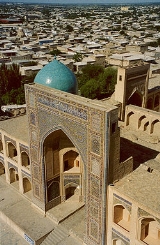
Bukhara

Encyclopedia
Bukhara from the Soghdian βuxārak ("lucky place"), is the capital of the Bukhara Province (viloyat) of Uzbekistan
. The nation's fifth-largest city, it has a population of 263,400 (2009 census estimate). The region around Bukhara has been inhabited for at least five millennia, and the city has existed for half that time. Located on the Silk Road
, the city has long been a center of trade, scholarship, culture, and religion. The historic center of Bukhara, which contains numerous mosque
s and madrassas, has been listed by UNESCO
as a World Heritage Site
. Ethnic Uzbek
may constitute the largest element in Bukhara, with the native Tajiks
being as numerous. The city long has had a mixed population including Jews
and other ethnic minorities as well.
Iranian-speaking Soghdians
inhabited the area, and some centuries later the Persian language became dominant among them. Encyclopædia Iranica
mentions that the name Bukhara is possibly derived from the Soghdian βuxārak (Place of Good Fortune).
Muhammad ibn Jafar Narshakhi
in his History of Bukhara (completed 943-44 CE) mentions:
, then a young diplomat in the British Embassy in Moscow, made a surreptitious visit to Bokhara in 1938, sight-seeing and sleeping in parks. In his memoir Eastern Approaches
, he judged it an "enchanted city", with buildings that rivalled "the finest architecture of the Italian Renaissance
".
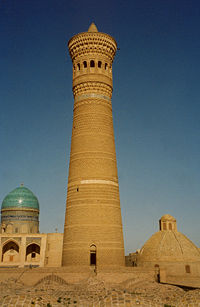
The title Po-i Kalan (also Poi Kalân, Persian پای کلان meaning the "Grand Foundation"), belongs to the architectural complex located at the base of the great minaret
Kalân.
(9th-10th century), one of the most esteemed sights of Central Asia
n architecture, was built in the 9th century (between 892 and 943) as the resting-place of Ismail Samani - the founder of the Samanid dynasty, the last Persian dynasty to rule in Central Asia, which held the city in the 9th and 10th centuries. Although in the first instance the Samanids were Governors of Khorasan
and Ma wara'u'n-nahr under the suzerainty of the Abbasid Caliphate, the dynasty soon established virtual independence from Baghdad
.
is located near the Samani mausoleum. Its name in Persian means Job
's spring due to the legend according to which Job (Ayub) visited this place and brought forth a spring of water by the blow of his staff on the ground. The water of this well is still pure and is considered healing. The current building was constructed during the reign of Timur
and features a Khwarazm-style conical dome uncommon in Bukhara.
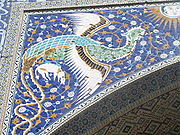 The Lab-i Hauz (or Lab-e hauz, Persian: لب حوض, meaning by the pond) Ensemble (1568–1622) is the name of the area surrounding one of the few remaining hauz (ponds) in the city of Bukhara. Until the Soviet period there were many such ponds, which were the city's principal source of water, but they were notorious for spreading disease and were mostly filled in during the 1920s and 1930s. The Lyab-i Hauz survived because it is the centrepiece of a magnificent architectural ensemble, created during the 16th and 17th centuries, which has not been significantly changed since. The Lyab-i Hauz ensemble, surrounding the pond on three sides, consists of the Kukeldash Madrasah (1568–1569), the largest in the city (on the north side of the pond), and of two religious edifices built by Nadir Divan-Beghi: a khanaka (1620), or lodging-house for itinerant Sufis, and a madrasah
(1622) that stand on the west and east sides of the pond respectively.
The M37 highway connects the city to most of the major cities in Turkmenistan
including Ashgabat.
Tajiks beside Uzbeks who speak Uzbek language.
Until the 20th century, Bukhara was also home to the Bukharan Jews
, whose ancestors settled in the city during Roman times. Most Bukharan Jews left Bukhara between 1925 and 2000 and settled in Israel
and the USA.
. Many examples can be sought.
ای بخارا شاد باش و دیر زی
Oh Bukhara! Be joyous and live long!
شاه زی تو میهمان آید همی
Your King comes to you in ceremony.
---Rudaki
Dehkhoda defines the name Bukhara itself as meaning "full of knowledge", referring to the fact that in antiquity, Bukhara was a scientific and scholarship powerhouse. Rumi verifies this when he praises the city as such:
آن بخارا معدن دانش بود
"Bukhara is a mine of knowledge,
پس بخاراییست هرک آنش بود
Of Bukhara is he who possesses knowledge."
In the Italian romantic epic
Orlando innamorato
by Matteo Maria Boiardo
, Bukhara is called Albracca
and described as a major city of Cathay
. There, within its walled city and fortress, Angelica
and the knights she has befriended make their stand when attacked by Agrican, emperor of Tartary
. As described, this siege by Agrican resembles the historic siege by Genghis Khan
in 1220.
, Uzbekistan
Dushanbe
, Tajikistan
Khudjand
, Tajikistan
Nishapur, Iran
Santa Fe
, USA Rueil-Malmaison
, France
Córdoba, Spain
Malatya, Turkey West Kanpur
, India
Uzbekistan
Uzbekistan , officially the Republic of Uzbekistan is a doubly landlocked country in Central Asia and one of the six independent Turkic states. It shares borders with Kazakhstan to the west and to the north, Kyrgyzstan and Tajikistan to the east, and Afghanistan and Turkmenistan to the south....
. The nation's fifth-largest city, it has a population of 263,400 (2009 census estimate). The region around Bukhara has been inhabited for at least five millennia, and the city has existed for half that time. Located on the Silk Road
Silk Road
The Silk Road or Silk Route refers to a historical network of interlinking trade routes across the Afro-Eurasian landmass that connected East, South, and Western Asia with the Mediterranean and European world, as well as parts of North and East Africa...
, the city has long been a center of trade, scholarship, culture, and religion. The historic center of Bukhara, which contains numerous mosque
Mosque
A mosque is a place of worship for followers of Islam. The word is likely to have entered the English language through French , from Portuguese , from Spanish , and from Berber , ultimately originating in — . The Arabic word masjid literally means a place of prostration...
s and madrassas, has been listed by UNESCO
UNESCO
The United Nations Educational, Scientific and Cultural Organization is a specialized agency of the United Nations...
as a World Heritage Site
World Heritage Site
A UNESCO World Heritage Site is a place that is listed by the UNESCO as of special cultural or physical significance...
. Ethnic Uzbek
Uzbek
Uzbek and Uzbekistani are adjectives referring to the state of Uzbekistan. As a noun, Uzbek may also refer to:* Uzbeks, an ethnic group* Uzbeg Khan, the Khan of the Golden Horde of the Mongol Empire* Uzbek cuisine* Uzbek language- See also :...
may constitute the largest element in Bukhara, with the native Tajiks
Tajiks
Tajik is a general designation for a wide range of Persian-speaking people of Iranic origin, with traditional homelands in present-day Afghanistan, Tajikistan, and Uzbekistan...
being as numerous. The city long has had a mixed population including Jews
Jews
The Jews , also known as the Jewish people, are a nation and ethnoreligious group originating in the Israelites or Hebrews of the Ancient Near East. The Jewish ethnicity, nationality, and religion are strongly interrelated, as Judaism is the traditional faith of the Jewish nation...
and other ethnic minorities as well.
Names
Bukhara was known as Bokhara in 19th and early 20th century English publications and as Buhe/Puhe(捕喝) in Tang Chinese.Iranian-speaking Soghdians
Sogdiana
Sogdiana or Sogdia was the ancient civilization of an Iranian people and a province of the Achaemenid Empire, eighteenth in the list on the Behistun Inscription of Darius the Great . Sogdiana is "listed" as the second of the "good lands and countries" that Ahura Mazda created...
inhabited the area, and some centuries later the Persian language became dominant among them. Encyclopædia Iranica
Encyclopædia Iranica
Encyclopædia Iranica is a project whose goal is to create a comprehensive and authoritative English language encyclopedia about the history, culture, and civilization of Iranian peoples from prehistory to modern times...
mentions that the name Bukhara is possibly derived from the Soghdian βuxārak (Place of Good Fortune).
Muhammad ibn Jafar Narshakhi
Narshakhi
Abu Bakr Muhammad ibn Jafar Narshakhi , from the village of Narshak in the Bukhara oasis, can be considered the first historian in Central Asia. His unique History of Bukhara was written in Arabic and presented to the Samanid ruler Nuh ibn Nasr either in 943 or 948. In 1128 Narshakhi's book was...
in his History of Bukhara (completed 943-44 CE) mentions:
Major sights
Fitzroy MacleanFitzroy Maclean
Sir Fitzroy Hew Royle MacLean of Dunconnel, 1st Baronet KT CBE was a Scottish soldier, writer and politician. He was a Unionist MP from 1941 to 1974 and was one of few people who entered World War II as a private and left having risen to the rank of Brigadier.Maclean wrote several books, including...
, then a young diplomat in the British Embassy in Moscow, made a surreptitious visit to Bokhara in 1938, sight-seeing and sleeping in parks. In his memoir Eastern Approaches
Eastern Approaches
Eastern Approaches is an autobiographical account of the early career of Fitzroy Maclean. It is divided into three parts: his life as a junior diplomat in Moscow and his travels in the Soviet Union, especially the forbidden zones of Central Asia; his exploits in the British Army and SAS in the...
, he judged it an "enchanted city", with buildings that rivalled "the finest architecture of the Italian Renaissance
Italian Renaissance
The Italian Renaissance began the opening phase of the Renaissance, a period of great cultural change and achievement in Europe that spanned the period from the end of the 13th century to about 1600, marking the transition between Medieval and Early Modern Europe...
".
Po-i-Kalan complex
The title Po-i Kalan (also Poi Kalân, Persian پای کلان meaning the "Grand Foundation"), belongs to the architectural complex located at the base of the great minaret
Minaret
A minaret مناره , sometimes مئذنه) is a distinctive architectural feature of Islamic mosques, generally a tall spire with an onion-shaped or conical crown, usually either free standing or taller than any associated support structure. The basic form of a minaret includes a base, shaft, and gallery....
Kalân.
- Kalyan minaretKalyan minaretThe Kalyan minaret is a minaret of the Po-i-Kalyan mosque complex in Bukhara, Uzbekistan and one of the most prominent landmarks in the city.The minaret, designed by Bako, was built by the Qarakhanid ruler Arslan Khan in 1127 to summon Muslims to prayer five times a day...
. More properly, Minâra-i Kalân, (Pesian/Tajik for the "Grand Minaret"). It is made in the form of a circular-pillar brick tower, narrowing upwards, of 9 meters (29.53 ft) diameter at the bottom, 6 meters (19.69 ft) overhead and 45.6 meters (149.61 ft) high. Also known as the Tower of Death, as for centuries criminals were executed by being tossed off the top.
- Kalân Mosque (Masjid-i Kalân), arguably completed in 1514, is equal to the Bibi-Khanym MosqueBibi-Khanym MosqueBibi-Khanym Mosque is a famous historical Friday mosque in Samarkand, Uzbekistan, whose name comes from the wife of 14th-century ruler, Amir Timur.-Features:...
in Samarkand in size. Although they are of the same type of building, they are absolutely different in terms of art of building.
- Mir-i Arab Madrassah. Little is known about its origin, although its construction is ascribed to Sheikh Abdullah Yamani of Yemen, the spiritual mentor of early ShaybanidsMuhammad ShaybaniAbu 'I-Fath Muhammad , known in later centuries as Shaybani Khan , was a khan of the Uzbeks who continued consolidating various Uzbek tribes and laid foundations for their ascendance in Transoxiana. of Genghis Khan through his grandson Shayban and considered the Timurids as usurpers of the...
. He was in charge of donations of Ubaidollah Khan (gov. 1533-1539), devoted to construction of madrasah.
Ismail Samani mausoleum
The Ismail Samani mausoleumSamanid mausoleum
The Samanid mausoleum is located in the historical urban nucleus of the city of Bukhara, in a park laid out on the site of an ancient cemetery...
(9th-10th century), one of the most esteemed sights of Central Asia
Central Asia
Central Asia is a core region of the Asian continent from the Caspian Sea in the west, China in the east, Afghanistan in the south, and Russia in the north...
n architecture, was built in the 9th century (between 892 and 943) as the resting-place of Ismail Samani - the founder of the Samanid dynasty, the last Persian dynasty to rule in Central Asia, which held the city in the 9th and 10th centuries. Although in the first instance the Samanids were Governors of Khorasan
Greater Khorasan
Greater Khorasan or Ancient Khorasan is a historical region of Greater Iran mentioned in sources from Sassanid and Islamic eras which "frequently" had a denotation wider than current three provinces of Khorasan in Iran...
and Ma wara'u'n-nahr under the suzerainty of the Abbasid Caliphate, the dynasty soon established virtual independence from Baghdad
Baghdad
Baghdad is the capital of Iraq, as well as the coterminous Baghdad Governorate. The population of Baghdad in 2011 is approximately 7,216,040...
.
Chashma-Ayub mausoleum
Chashma-AyubChashma-Ayub Mausoleum
Chashma-Ayub Mausoleum is located near the Samani Mausoleum, in Bukhara, Uzbekistan. Its name means Job's well, due to the legend in which Job visited this place and made a well by striking the ground with his staff. The water of this well is still pure and is considered healing...
is located near the Samani mausoleum. Its name in Persian means Job
Job (Biblical figure)
Job is the central character of the Book of Job in the Hebrew Bible. Job is listed as a prophet of God in the Qur'an.- Book of Job :The Book of Job begins with an introduction to Job's character — he is described as a blessed man who lives righteously...
's spring due to the legend according to which Job (Ayub) visited this place and brought forth a spring of water by the blow of his staff on the ground. The water of this well is still pure and is considered healing. The current building was constructed during the reign of Timur
Timur
Timur , historically known as Tamerlane in English , was a 14th-century conqueror of West, South and Central Asia, and the founder of the Timurid dynasty in Central Asia, and great-great-grandfather of Babur, the founder of the Mughal Dynasty, which survived as the Mughal Empire in India until...
and features a Khwarazm-style conical dome uncommon in Bukhara.
Lab-i Hauz
Madrasah
Madrasah is the Arabic word for any type of educational institution, whether secular or religious...
(1622) that stand on the west and east sides of the pond respectively.
Bukhara Fortress, the Ark
Transportation
- Bukhara AirportBukhara AirportBukhara International Airport is an airport located in Bukhara, Uzbekistan.-Airlines and destinations:...
The M37 highway connects the city to most of the major cities in Turkmenistan
Turkmenistan
Turkmenistan , formerly also known as Turkmenia is one of the Turkic states in Central Asia. Until 1991, it was a constituent republic of the Soviet Union, the Turkmen Soviet Socialist Republic . Turkmenistan is one of the six independent Turkic states...
including Ashgabat.
Demographics
The population of the city consists Persian-speakingPersian language
Persian is an Iranian language within the Indo-Iranian branch of the Indo-European languages. It is primarily spoken in Iran, Afghanistan, Tajikistan and countries which historically came under Persian influence...
Tajiks beside Uzbeks who speak Uzbek language.
Until the 20th century, Bukhara was also home to the Bukharan Jews
Bukharan Jews
Bukharan Jews, also Bukharian Jews or Bukhari Jews, or яҳудиёни Бухоро Yahūdieni Bukhoro , Bukhori Hebrew Script: יהודיאני בוכאראי and יהודיאני בוכארי), also called the Binai Israel, are Jews from Central Asia who speak Bukhori, a dialect of the Tajik-Persian language...
, whose ancestors settled in the city during Roman times. Most Bukharan Jews left Bukhara between 1925 and 2000 and settled in Israel
Israel
The State of Israel is a parliamentary republic located in the Middle East, along the eastern shore of the Mediterranean Sea...
and the USA.
Poetry and literature
Being a cultural magnet, Bukhara has long appeared in much local and Persian literaturePersian literature
Persian literature spans two-and-a-half millennia, though much of the pre-Islamic material has been lost. Its sources have been within historical Persia including present-day Iran as well as regions of Central Asia where the Persian language has historically been the national language...
. Many examples can be sought.
ای بخارا شاد باش و دیر زی
Oh Bukhara! Be joyous and live long!
شاه زی تو میهمان آید همی
Your King comes to you in ceremony.
---Rudaki
Rudaki
Abu Abdollah Jafar ibn Mohammad Rudaki , also written as Rudagi , was a Persian poet, and is regarded as the first great literary genius of the Modern Persian, who composed poems in the "New Persian" alphabet. Rudaki is considered as a founder of Persian classical literature.He was born in 858 in...
Dehkhoda defines the name Bukhara itself as meaning "full of knowledge", referring to the fact that in antiquity, Bukhara was a scientific and scholarship powerhouse. Rumi verifies this when he praises the city as such:
آن بخارا معدن دانش بود
"Bukhara is a mine of knowledge,
پس بخاراییست هرک آنش بود
Of Bukhara is he who possesses knowledge."
In the Italian romantic epic
Epic poetry
An epic is a lengthy narrative poem, ordinarily concerning a serious subject containing details of heroic deeds and events significant to a culture or nation. Oral poetry may qualify as an epic, and Albert Lord and Milman Parry have argued that classical epics were fundamentally an oral poetic form...
Orlando innamorato
Orlando Innamorato
Orlando Innamorato is an epic poem written by the Italian Renaissance author Matteo Maria Boiardo. The poem is a romance concerning the heroic knight Orlando .-Composition and publication:...
by Matteo Maria Boiardo
Matteo Maria Boiardo
Matteo Maria Boiardo was an Italian Renaissance poet.Boiardo was born at, or near, Scandiano ; the son of Giovanni di Feltrino and Lucia Strozzi, he was of noble lineage, ranking as Count of Scandiano, with seignorial power over Arceto, Casalgrande, Gesso, and Torricella...
, Bukhara is called Albracca
Albracca
Albracca is a major city of Cathay in the Italian romantic epics Orlando innamorato by Matteo Maria Boiardo and Orlando furioso by Ludovico Ariosto...
and described as a major city of Cathay
Cathay
Cathay is the Anglicized version of "Catai" and an alternative name for China in English. It originates from the word Khitan, the name of a nomadic people who founded the Liao Dynasty which ruled much of Northern China from 907 to 1125, and who had a state of their own centered around today's...
. There, within its walled city and fortress, Angelica
Angelica (character)
Angelica is a princess in the epic poem Orlando innamorato by Matteo Maria Boiardo. She reappears in the saga's continuation, Orlando furioso by Ludovico Ariosto, and in various later works based on the two original Orlando pieces...
and the knights she has befriended make their stand when attacked by Agrican, emperor of Tartary
Tartary
Tartary or Great Tartary was a name used by Europeans from the Middle Ages until the twentieth century to designate the Great Steppe, that is the great tract of northern and central Asia stretching from the Caspian Sea and the Ural Mountains to the Pacific Ocean inhabited mostly by Turkic, Mongol...
. As described, this siege by Agrican resembles the historic siege by Genghis Khan
Genghis Khan
Genghis Khan , born Temujin and occasionally known by his temple name Taizu , was the founder and Great Khan of the Mongol Empire, which became the largest contiguous empire in history after his death....
in 1220.
Notable people
Many prominent people lived in Bukhara in the past. Most famous of them are:- Muhammad Ibn Ismail Ibn Ibrahim Ibn al-Mughirah Ibn Bardizbah al-BukhariMuhammad al-BukhariMuhammad Ibn Ismail Ibn Ibrahim Ibn al-Mughirah Ibn Bardizbah al-Bukhari , popularly known as Bukhari or Imam Bukhari, , was a Sunni Islamic scholar of Persia...
(810-870) - Islamic scholar and compiler of hadithHadithThe term Hadīth is used to denote a saying or an act or tacit approval or criticism ascribed either validly or invalidly to the Islamic prophet Muhammad....
s - AvicennaAvicennaAbū ʿAlī al-Ḥusayn ibn ʿAbd Allāh ibn Sīnā , commonly known as Ibn Sīnā or by his Latinized name Avicenna, was a Persian polymath, who wrote almost 450 treatises on a wide range of subjects, of which around 240 have survived...
(Abu Ali ibn Sina) (980-1037) - physician and person of encyclopedic knowledge - Bal'amiBal'amiAMĪRAK BALʿAMĪ, name given to ABŪ ʿALĪ MOḤAMMAD , son of Abu’l-Fażl Moḥammad b. ʿObaydallāh Baḷʿamī ' ; both served as viziers of the Samanids . Mostly known as Bal'ami , was a Persian historian, writer, and vizier to the Samanids...
: Abolfazl Muhammad and his son Abu-Ali Mohammad, two famous viziers of SamanidSamanidThe Samani dynasty , also known as the Samanid Empire, or simply Samanids was a Persian state and empire in Central Asia and Greater Iran, named after its founder Saman Khuda, who converted to Sunni Islam despite being from Zoroastrian theocratic nobility...
kings, historians and patrons of art and literature - Abubakr NarshakhiNarshakhiAbu Bakr Muhammad ibn Jafar Narshakhi , from the village of Narshak in the Bukhara oasis, can be considered the first historian in Central Asia. His unique History of Bukhara was written in Arabic and presented to the Samanid ruler Nuh ibn Nasr either in 943 or 948. In 1128 Narshakhi's book was...
(10th century) - historian who wrote History of Bukhara - Baha-ud-Din Naqshband BukhariBaha-ud-Din Naqshband BukhariBaha-ud-Din Naqshband Bukhari was the founder of what would become the Naqshbandi. He was born in Bukhara which is located in Uzbekistan...
(1318–1389) - Amir KulalAmir KulalShams ud-Din renowned as Amir Kulal was born in Bukhara, Uzbekistan to the well known scholar Saif ud-Din Hamza a descendant of Nabi Muhammad. Saif ud Din Hamza was also Amir of Tribe of Kulal , hence the title Amir...
(died in 1370) - Kiromi Bukhoroi
- An LushanAn LushanAn Lushan was a general who rebelled against the Tang Dynasty in China.His name was also transcribed into Chinese as Āluòshān or Gáluòshān ,...
- Sadriddin AyniSadriddin AyniSadriddin Ayni , also Sadriddin Aini, a Tajik intellectual prolifically engaged in poetry, fictional writing, journalism, history and lexicography...
(1878–1954) - Abdurauf Fitrat
- Oksana ChusovitinaOksana ChusovitinaOksana Aleksandrovna Chusovitina is an Olympic medalist and World Champion gymnast who has competed for Germany since 2006. She was formerly a citizen of, and a competitor for, the Soviet Union and Uzbekistan ....
- Hazrat Syed Jalaluddin Surkh-Posh BukhariHazrat Jalaluddin Surkh-Posh BukhariJalaluddin Surkh-Posh Bukhari was a prominent "Suhrawardiyya" Sufi saint and missionary. Bukhari was called Surkh-posh on account of the red mantle he often wore.-Names:...
Sister cities
SamarqandSamarkand
Although a Persian-speaking region, it was not united politically with Iran most of the times between the disintegration of the Seleucid Empire and the Arab conquest . In the 6th century it was within the domain of the Turkic kingdom of the Göktürks.At the start of the 8th century Samarkand came...
, Uzbekistan
Uzbekistan
Uzbekistan , officially the Republic of Uzbekistan is a doubly landlocked country in Central Asia and one of the six independent Turkic states. It shares borders with Kazakhstan to the west and to the north, Kyrgyzstan and Tajikistan to the east, and Afghanistan and Turkmenistan to the south....
Dushanbe
Dushanbe
-Economy:Coal, lead, and arsenic are mined nearby in the cities of Nurek and Kulob allowing for the industrialization of Dushanbe. The Nurek Dam, the world's highest as of 2008, generates 95% of Tajikistan's electricity, and another dam, the Roghun Dam, is planned on the Vakhsh River...
, Tajikistan
Tajikistan
Tajikistan , officially the Republic of Tajikistan , is a mountainous landlocked country in Central Asia. Afghanistan borders it to the south, Uzbekistan to the west, Kyrgyzstan to the north, and China to the east....
Khudjand
Khujand
Khujand , also transliterated as Khudzhand, , formerly Khodjend or Khodzhent until 1936 and Leninabad until 1991, is the second-largest city of Tajikistan. It is situated on the Syr Darya River at the mouth of the Fergana Valley...
, Tajikistan
Tajikistan
Tajikistan , officially the Republic of Tajikistan , is a mountainous landlocked country in Central Asia. Afghanistan borders it to the south, Uzbekistan to the west, Kyrgyzstan to the north, and China to the east....
Nishapur, Iran
Iran
Iran , officially the Islamic Republic of Iran , is a country in Southern and Western Asia. The name "Iran" has been in use natively since the Sassanian era and came into use internationally in 1935, before which the country was known to the Western world as Persia...
Santa Fe
Santa Fe, New Mexico
Santa Fe is the capital of the U.S. state of New Mexico. It is the fourth-largest city in the state and is the seat of . Santa Fe had a population of 67,947 in the 2010 census...
, USA Rueil-Malmaison
Rueil-Malmaison
Rueil-Malmaison is a commune in the western suburbs of Paris, in the Hauts-de-Seine department of France. It is located 12.6 kilometers from the center of Paris.-Name:...
, France
France
The French Republic , The French Republic , The French Republic , (commonly known as France , is a unitary semi-presidential republic in Western Europe with several overseas territories and islands located on other continents and in the Indian, Pacific, and Atlantic oceans. Metropolitan France...
Córdoba, Spain
Córdoba, Spain
-History:The first trace of human presence in the area are remains of a Neanderthal Man, dating to c. 32,000 BC. In the 8th century BC, during the ancient Tartessos period, a pre-urban settlement existed. The population gradually learned copper and silver metallurgy...
Malatya, Turkey West Kanpur
West Kanpur
West Kanpur is a suburb in Kanpur, India, situated about 15 km from Kanpur on the NH 86 to Dewas.The population was 200000 as of the 2001 census.It has 80% of literacy and is 10 km from Kanpur Cantonment.It also Comes under Kanpur Metropolitan Region-Local Government:West Kanpur...
, India
India
India , officially the Republic of India , is a country in South Asia. It is the seventh-largest country by geographical area, the second-most populous country with over 1.2 billion people, and the most populous democracy in the world...
Further reading
- Moorcroft, WilliamWilliam Moorcroft (explorer)William Moorcroft , English explorer, was born in Ormskirk, Lancashire, the illegitimate son of Ann Moorcroft, daughter of a local farmer...
and Trebeck, George. 1841. Travels in the Himalayan Provinces of Hindustan and the Panjab; in Ladakh and Kashmir, in Peshawar, Kabul, Kunduz, and Bokhara... from 1819 to 1825, Vol. II. Reprint: New Delhi, Sagar Publications, 1971.