


Jewish philosophy

Encyclopedia
Jewish philosophy , includes all philosophy
carried out by Jews, or, in relation to the religion of Judaism
. Jewish philosophy, until modern Enlightenment and Emancipation
, was pre-occupied with attempts to reconcile coherent new ideas into the tradition of Rabbinic Judaism
; thus organizing emergent ideas that are not necessarily Jewish into a uniquely Jewish scholastic framework and world-view. With their acceptance into modern society, Jews with secular educations embraced or developed entirely new philosophies to meet the demands of a world in which they now found themselves.
Medieval re-discovery of Greek thought
among Gaonim of 10th century Babylonian academies brought rationalist philosophy into Biblical
-Talmud
ic Judaism. Philosophy was generally in competition with Kabbalah
. Both schools would become part of classic Rabbinic literature
, though the decline of scholastic rationalism coincided with historical events which drew Jews to the Kabbalistic approach. For European Jews
, emancipation and encounter with secular thought from the 18th-century onwards altered how philosophy was viewed. Oriental and Eastern European
communities had later and more ambivalent interaction with secular culture than in Western Europe. In the varied responses to modernity, Jewish philosophical ideas were developed across the range of emerging religious denominations
. These developments could be seen as either continuations, or breaks, with the canon of Rabbinic philosophy of the Middle Ages, as well as the other historical dialectic aspects of Jewish thought, and resulted in diverse contemporary Jewish attitudes to philosophical methods.
sometimes views Abraham as a "philosopher." Some have suggested that Abraham
introduced a philosophy learned from Melchizedek
; Some Jews ascribe the Sefer Yetzirah
"Book of Creation" to Abraham. A midrash
describes how Abraham understood this world to have a creator and director by comparing this world to "a house with a light in it", what is now called the Argument from design
. The Book of Psalms contains invitations to "admire the wisdom of Hashem through his works"; from this, some scholars suggest, Judaism harbors a Philosophical under-current. The Book of Ecclesiastes is often considered to be the only genuine Philosophical work in the Hebrew Bible
, its author seeks to understand the place of human beings in the world, and life's meaning.
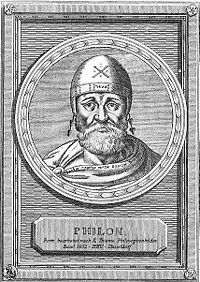 Philo attempted to fuse and harmonize Greek Philosophy and Judaism via allegory which he learned from Jewish exegesis and the Stoics. Philo attempted to make his philosophy the means of defending and justifying Jewish religious truths. These truths he regarded as fixed and determinate, and philosophy was used as an aid to truth, and a means of arriving at it. To this end Philo chose from philosophical tenets of Greeks, refusing those that did not harmonize with Judaism such as Aristotle's doctrine of the eternity and indestructibility of the world.
Dr. Bernard Revel
, in dissertation on "Karaite Halacha", points to writings of a 10th century Karaite, Ya'qub al-Qirqisani
, who quotes Philo, illustrating how Karaites made use of Philo's works in development of Karaism. Philo's works became important to Medieval Christian scholars who leveraged the work of Karaites to lend credence to their claims that "these are the beliefs of Jews" - a technically correct, yet mendacious, attribution.
Judaism was in disarray, but Jewish traditions were preserved especially thanks to the shrewd maneuvers of Yochanan Ben Zakkai, who saved the Sanhedrin
and moved it to Yavne
. Philosophical speculation was not a central part of rabbinic Judaism, though some have seen the Mishnah
as a philosophical work,. Rabbi Akiva ben Joseph has also been viewed as a philosophical figure: his statements include 1.) "How favored is man, for he was created after an image "for in an image, Elokim made man" (Gen. ix. 6)", 2.) "Everything is foreseen; but freedom [of will] is given to every man", 3.) "The world is governed by mercy... but the divine decision is made by the preponderance of the good or bad in one's actions".
After the Bar Kochba Revolt, Rabbinic scholars gathered in Tiberias and Safed
to re-assemble and re-assess Judaism, its laws, theology, liturgy, beliefs and leadership structure. In 219 CE, the Sura Academy is founded, by Abba Arika
, from which Jewish Kalam
emerges many centuries later. For the next five centuries Talmudic Academies focused upon reconstituting Judaism; little, if any, philosophic investigation in Jewish Academies is pursued.
, Karaism, and Christianity
- with Mishnah, Talmud and Tanach, there was no need for a philosophic framework. From an economic viewpoint, Radhanite
Trade dominance was being usurped by coordinated Christian and Islamic forced-conversions, and torture, compelling Jewish scholars to understand nascent economic threats. These investigations triggered new ideas and intellectual exchange among Jewish and Islamic scholars in the areas of jurisprudence, mathematics, astronomy, logic and philosophy. Jewish scholars influenced Islamic scholars and Islamic scholars influenced Jewish scholars. Contemporary scholars continue to debate who was Muslim and who was Jew - some "Islamic scholars" were "Jewish scholars" prior to forced conversion to Islam, some Jewish scholars willingly converted to Islam, such as Abdullah ibn Salam, while others later reverted to Judaism, and still others, born and raised as Jews, were ambiguous in their religious beliefs such as Ibn al-Rawandi
- though lived according to the customs of their neighbors.
Around 700 CE, `Amr ibn `Ubayd Abu `Uthman al-Basri introduces two streams of thought that influence Jewish, Islamic and Christian scholars
The story of Bahshamiyya
Mu'tazili and Qadariyya is as important, if not more so, as the intellectual symbiosis of Judaism and Islam in Islamic Spain.
Around 733 CE, Mar Natronai ben Habibai moves to Kairouan, then to Spain, transcribing Talmud Bavli for the Academy at Kairouan from memory - later taking a copy with him to Spain.
when contemplating the sciences.
. Early Jewish converts to Islam brought with them stories from their heritage, known as Isra'il'iyat, which told of the Banu Isra'il, the pious men of ancient Israel. One of the most famous early Islamic mystics - Sufi Hasan al-Basri introduced numerous Isra'il'iyat legends into Islamic scholarship, stories that went on to become representative of Islamic mystical ideas of piety of Sufism.
Hai Gaon
, at Pumbeditha Academy, begins a new phase in Jewish scholarship and investigation (Hakira); Hai Gaon augments Talmudic scholarship with non-Jewish studies. Hai Gaon was a savant with an exact knowledge of the theological movements of his time so much so that Moses ibn Ezra
called him a mutakallim. Hai was competent to argue with followers of Qadariyya and Mutazilites, sometimes adopting their polemic methods. Through correspondence with Talmudic Academies at Kairouan, Cordoba and Lucena, Hai Gaon passes along his discoveries to Talmudic scholars therein.
The teachings of the "Brethren of Purity" were carried to the West by a Spanish Arab of Madrid, Muhammad Abu'l-Qasim al-Majnti al-Andalusi, who died in A.D. 1004-1005. Thanks to Ibn Rushd (Averroes), Spain became a center of philosophical learning as is reflected by the explosion of philosophical inquiry among Jews, Muslims and Christians.
(Afghanistan) was divided into two groups: "Jews" and "people that are called Jews"; Hiwi al-Balkhi
was a member of the latter. Hiwi is generally considered to be very first "Jewish" philosopher to subject the Pentateuch to critical analysis. Hiwi is viewed by some scholars as an intellectually conflicted man torn between Judaism, Zoroastrianism, Gnostic Christianity, and Manichaean thought.
Hiwi espoused the belief that miraculous acts, described in the Pentateuch, are simply examples of people using their skills of reasoning to undertake, and perform, seemingly miraculous acts. As examples of this position, he argued that the parting of the Reed Sea was a natural phenomenon, and that Moses' claim to greatness lay merely in his ability to calculate the right moment for the crossing. He also emphasized that the Egyptian magicians were able to reproduce several of Moses' "miracles," proving that they could not have been so unique. According to scholars, Hiwi's gravest mistake was having the Pentateuch redacted to reflect his own views - then had those redacted texts, which became popular, distributed to children. Since his views contradicted the views of both Rabbanite and Karaite scholars, Hiwi was declared a heretic. In this context, however, we can also regard Hiwi, while flawed, as the very first critical biblical commentator; zealous rationalistic views of Hiwi parallel those of Ibn al-Rawandi
.
Saadia Gaon wrote a polemic against Hiwi denouncing him as an extreme rationalist, a "Mulhidun", or atheist/deviator. Abraham Ibn Daud described HIwi as a sectarian who "denied the Torah, yet used it to formulate a new Torah of his liking".
, son of a proselyte
, is considered the greatest early Jewish philosopher. During Saadia's early years in Tulunid
Egypt, the Fatimid Caliphate ruled Egypt; leaders of the Tulunids
were Ismaili
Imams. Their influence upon the Jewish academies of Egypt resonate in the works of Saadia. Saadia's Emunoth ve-Deoth
("Beliefs and opinions") was originally called Kitab al-Amanat wal-l'tikadat ("Book of the Articles of Faith and Doctrines of Dogma"); it was the first systematic presentation and philosophic foundation of the dogmas of Judaism, completed at Sura Academy in 933 CE.
In "Book of the Articles of Faith and Doctrines of Dogma" Saadia declares the rationality of the Jewish religion, with the caveat that reason must capitulate wherever it contradicts tradition. Dogma takes precedence over reason. Saadia closely followed the rules of the Mu'tazilah school of Abu Ali al-Jubba'i in composing his works. It was Saadia, who laid foundations for Jewish rationalist theology which built upon the work of Mu'tazilah, thereby shifting Rabbinic Judaism from mythical explanations of the Rabbis to reasoned explanations of the intellect. Saadia advances the criticisms of Mu'tazilah, by Ibn al-Rawandi
.
was author of the earliest known Jewish philosophical work of the Middle Ages, a commentary on Sefer Yetzirah (Book of Creation); he is regarded as the father of Jewish medieval philosophy. Al-Mukammas was first to introduce the methods of Kalam
into Judaism and the first Jew to mention Aristotle in his writings. He was a proselyte
of Rabbinic Judaism (not Karaism as some argue); al-Mikammas was a student of physician, and renowned Christian philosopher, Hana. His close interaction with Hana, and his familial affiliation with Islam gave al-Mukammas a unique view of religious belief and theology. In 1898 Abraham Harkavy
discovered, in Imperial Library of St. Petersburg, fifteen of the twenty chapters of David's philosophical work entitled Ishrun Maḳalat (Twenty Chapters) of which 15 survive.
, born in Mérida - lived in Cordoba, was a child prodigy and student of Rabbi Hanoch ben Moshe. Shmuel Ha-Nagid, Hasdai Ibn Shaprut
, and Rabbi Moshe ben Hanoch founded the Lucena Yeshiva that produced such brilliant scholars as Rabbi Yitzhak ibn Ghiath
and Rabbi Maimon ben Yosef (father of Maimonides). Ha-Nagid's son, Yosef, provided refuge for two sons of (Hezekiah Gaon
); Daud Ibn Chizkiya Gaon Ha-Nasi and Yitzhak Ibn Chizkiya Gaon Ha-Nasi. Though not a philosopher, he did build the infrastructure to allow philosophers to thrive. In 1070 the gaon Isaac ben Moses ibn Sakri, of Denia (Spain), traveled to the East and acted as rosh yeshivah of Baghdad Academy.
was a student of Nissim Gaon. al-Fasi is best known for his work of halachah, the legal code Sefer Ha-halachot, considered the first fundamental work in halachic literature. al-Fasi wrote Talmud Katan ("the Little Talmud"). At the close of the Middle Ages, when the Talmud was banned in Italy, al-Fasi's Talmud Katan was exempted so that from the 16th to the 19th centuries his work was the primary subject of study of the Italian Jewish community. al-Fasi occupies an important place in the development of the Sephardi method of studying the Talmud and influencing the growth of rational philosophic exploration of Jewish Canon. In contrast to Tosafists
who made the Talmud more intricate, al-Fasi taught his students to simplify the Talmud and free it from casuistic detail
.
, born in Málaga then moved to Valencia. Ibn Gabirol was one of the first teachers of Neoplatonism
in Europe. His role has been compared to that of Philo. Ibn Gabirol occidentalized Greco-Arabic philosophy and restored it to Europe. The philosophical teachings of Philo
and Ibn Gabirol were largely ignored by fellow Jews; the parallel may be extended by adding that Philo and Ibn Gabirol, alike, exercised considerable influence in secular circles; Philo upon early Christianity, and Ibn Gabirol upon the scholars of medieval Christianity. Christian scholars, including Albertus Magnus and Thomas Aquinas, defer to him frequently.
Ha-Nasi. Abraham bar Ḥiyya was one of the most important figures in the scientific movement which made the Jews of Provence, Spain, and Italy the intermediaries between Averroism
, Mu'tazilah and the Christian
world. He aided this scientific movement by original works, translations and as interpreter for another translator, Plato of Tivoli. bar-Hiyya's best student was Abraham Ibn Ezra
. bar-Hiyya's philosophical works, are ("Meditation of the Soul"), an ethical work written from a rationalistic religious viewpoint, and an apologetic epistle addressed to Judah ben Barzilai al-Barzeloni.
was a Jewish philosopher and physicist and father-in-law of Maimonides who converted to Islam in his twilight years - once Head of the Baghdad Yeshiva and considered the leading philosopher of Iraq. Historians differ over the motive for his conversion to Islam, some suggest it was a reaction to a social slight inflicted upon him, because he was a Jew, while others suggest he was forcibly converted at the edge of a sword (which prompted Maimonides to comment upon Anusim
. Despite his conversion to Islam, his works continued to be studied at the Jewish Baghdad Academy, a well-known academy, into the thirteenth century. He was a follower of Avicenna's teaching, who proposed an explanation of the acceleration of falling bodies by the accumulation of successive increments of power with successive increments of velocity.
His writings include Kitāb al-Muʿtabar (“The Book of What Has Been Established by Personal Reflection”); a philosophical commentary on the Kohelet, written in Arabic using Hebrew aleph bet; and the treatise “On the Reason Why the Stars Are Visible at Night and Hidden in Daytime.” According to Hibat Allah, Kitāb al-Muʿtabar consists in the main of critical remarks jotted down by him over the years while reading philosophical text, and published at the insistence of his friends, in the form of a philosophical work.
Abu al-Ma'ali 'Uzziel Ibn Hibat Allah, son of Hibat Allah never converted to Islam and married the sister of Maimonides. Abu al-Ma'ali 'Uzziel Ibn Hibat Allah was the personal physician of Saladin and arranged employment for Maimonides when he fled to Egypt. Maimonides then married the sister of Abu al-Ma'ali 'Uzziel Ibn Hibat Allah.
, of Yemen, was the twelfth-century author of Bustan al-Uqul ("Garden of Intellects"), a Jewish version of Ismaili
Shi'ite doctrines. Like the Ismailis, Nethanel al-Fayyumi argued that haShem sent different prophets to various nations of the world, containing legislations suited to the particular temperament of each individual nation. Ismaili doctrine holds that a single universal religious truth lies at the root of the different religions. Some Jews accepted this model of religious pluralism, leading them to view Prophet Mohammed as a legitimate prophet, though not Jewish, sent to preach to the Arabs, just as the Hebrew prophets had been sent to deliver their messages to Israel; others refused this notion in entirety. Nethanel's son Yakob ben Nethanel Ibn al-Fayyumi turned to Maimonides, asking urgently for counsel on how to deal with forced conversions to Islam and religious persecutions at the hand of Saladin
. Maimonides' response was Iggret Teiman
, of Zaragoza, was author of the first Jewish system of ethics Al Hidayah ila Faraid al-hulub, ("Guide to the Duties of the Heart"). Bahya often followed the method of the Arabian encyclopedists known as "the Brethren of Purity
" but adopts some of Sufi tenets rather than Ismaili. According to Bahya, the Torah appeals to reason and knowledge as proofs of haShem's existence. It is therefore a duty incumbent upon every one to make haShem an object of speculative reason and knowledge, in order to arrive at true faith. Baḥya borrows from Sufism
and Jewish Kalam
integrating them into Neoplatonism. Proof that Bahya borrowed from Sufism is underscored by the fact that the title of his eighth gate, Muḥasabat al-Nafs ("Self-Examination"), is reminiscent of the Sufi Abu Abd Allah Ḥarith Ibn-Asad, who has been surnamed El Muḥasib ("the self-examiner"), because—say his biographers—"he was always immersed in introspection"
, of Toledo, defended Rabbinic Judaism against Islam, Christianity and Karaism. He was a student of Moses Ibn Ezra
whose education came from Isaac ibn Ghiyyat
; trained as a Rationalist, he shed it in favor of Neoplatonism. Like Al-Ghazali
, Judah Ha-Levi attempted to liberate religion from the bondage of philosophical systems. In particular, in a work written in Arabic Kitab al-Ḥujjah wal-Dalil fi Nuṣr al-Din al-Dhalil, translated by Judah ben Saul ibn Tibbon
, by the title Sefer ha-Kuzari
he elaborates upon his views of Judaism relative to other religions of the time.
was a student of Rabbi Baruch ben Yitzhak Ibn Albalia, his maternal uncle. Ibn Daud's philosophical work written in Arabic, Al-'akidah al-Rafiyah ("The Sublime Faith"), has been preserved in Hebrew by the title Emunah Ramah. Ibn Daud did not introduce a new philosophy, but he was the first to introduce a more thorough systematic form derived from Aristotle
. Accordingly, Hasdai Crescas
mentions Ibn Daud as the only Jewish philosopher among the predecessors of Maimonides. Overshadowed by Maimonides, ibn Daud's Emunah Ramah, a work to which Maimonides was indebted, received little notice from later philosophers. "True philosophy", according to Ibn Daud, "does not entice us from religion; it tends rather to strengthen and solidify it. Moreover, it is the duty of every thinking Jew to become acquainted with the harmony existing between the fundamental doctrines of Judaism and those of philosophy, and, wherever they seem to contradict one another, to seek a mode of reconciling them".
) in Cordoba, Spain. When his family fled Spain, for Fez, Maimonides enrolled in the Academy of Fez and studied under Rabbi Yehuda Ha-Kohen Ibn Soussan - a student of Isaac Alfasi
. Maimonides strove to reconcile Aristotelian philosophy and science with the teachings of Torah. In some ways his position was parallel to that of Averroes
; in reaction to the attacks on Avicennian Aristotelism, Maimonides embraced and defended a stricter Aristotelism without Neoplatonic additions. The principles which inspired all of Maimonides' philosophical activity was identical those of Abraham Ibn Daud
: there can be no contradiction between the truths which haShem has revealed and the findings of the human intellect in science and philosophy. Maimonides departed from the teachings of Aristotle by suggesting that the world is not eternal, as Aristotle taught, but was created ex nihilo
. In "Guide for the Perplexed" (1:17 & 2:11)" Maimonides explains that Israel lost its Mesorah
in exile, and with it "we lost our science and philosophy - only to be rejuvenated in Al Andalus within the context of interaction and intellectual investigation of Jewish, Christian and Muslim texts.
and Al Andalus. His genius was obvious, protests centered around his writings. Scholars suggest that Maimonides
instigated the Maimonidean Controversy when he verbally attacked Samuel ben Ali Ha-Levi al-Dastur ("Gaon of Baghdad") as "one whom people accustom from his youth to believe that there is none like him in his generation," and he sharply attack the "monetary demands" of the academies. al-Dasturwas an anti-Maimonidean operating in Babylon to undermine the works of Maimonides
and those of Maimonides' patrons (the Al-Constantini Family from North Africa). To illustrate the reach of the Maimonidean Controversy, al-Dastur, the chief opponent of Maimonides in the East, was excommunicated by Daud Ibn Hodaya al Daudi (Exilarch of Mosul). Maimonides' attacks on Ibn al-Dastur may not have been entirely altruistic given the position of Maimonides' in-laws in competing Yeshivas.
In Western Europe, the controversy was halted by the burning of Maimonides' works by Christian Dominicans, in 1232. Avraham son of Rambam
, continued fighting for his father's beliefs in the East; desecration of Maimonides' tomb, at Tiberias by Jews, was a profound shock to Jews throughout the Diaspora and caused all to pause and reflect upon what was being done to the fabric of Jewish Culture. This compelled many Anti-Maimonideans to recant their assertions and realize what cooperation with Christians meant to them, their texts and their communities.
Maimonidean controversy flared up again at the beginning of the fourteenth century when Rabbi Shlomo ben Aderet
, under influence from Asher ben Jehiel
, issued a cherem
on "any member of the community who, being under twenty-five years, shall study the works of the Greeks on natural science and metaphysics."
Contemporary Kabbalists, Tosafists and Rationalists continue to engage in lively, sometimes caustic, debate in support of their positions and influence in the Jewish world. At the center of many of these debates are 1) "Guide for the Perplexed", 2) "13 Principles of Faith", 3) "Mishnah Torah", and 4) his commentary on Anusim
.
, of Ceuta, was the son of Rabbi Yehuda Ha-Kohen Ibn Soussan and a student of Maimonides for whom the "Guide for the Perplexed" is written. Yosef traveled from Alexandria
to Fustat to study logic, mathematics, and astronomy under Maimonides. Philosophically, Yosef's dissertation, in Arabic, on the problem of "Creation" is suspected to have been written before contact with Maimonides. It is entitled Ma'amar bimehuyav ha-metsiut ve'eykhut sidur ha-devarim mimenu vehidush ha'olam ("A Treatise as to (1) Necessary Existence (2) The Procedure of Things from the Necessary Existence and (3) The Creation of the World").
is generally regarded as a pioneer in the application of the Maimonidean Rationalism to the study of Jewish texts. He was the son-in-law of Samuel ibn Tibbon, translator of Maimonides. Due to these family ties Anatoli was introduced to the philosophy of Maimonides, the study of which was such a great revelation to him that he, in later days, referred to it as the beginning of his intelligent and true comprehension of the Scriptures, while he frequently alluded to Ibn Tibbon as one of the two masters who had instructed and inspired him. Anatoli wrote the Malmad exhibiting his broad knowledge of classic Jewish exegetes, as well as Plato, Aristotle, Averroes, and the Vulgate, as well as with a large number of Christian institutions, some of which he ventures to criticize, such as celibacy and monastic castigation, as well as certain heretics and he repeatedly appeals to his readers for a broader cultivation of the classic languages and the non-Jewish branches of learning. To Anatoli all men are, in truth, formed in the image of G-d, though the Jews stand under a particular obligation to further the true cognition of G-d simply by reason of their election— "the Greeks had chosen wisdom as their pursuit; the Romans, power; and the Jews, religiousness"
Defending Maimonides, Hillel addressed a letter to his friend Maestro Gaio asking him to use his influence with the Jews of Rome against Maimonides' opponents (Solomon Petit). He also advanced the bold idea of gathering together Maimonides' defenders and opponents in Alexandria, in order to bring the controversy before a court of Babylonian rabbis, whose decision would be binding on both factions. Hillel was cetrtain the verdict would favor Maimonides.
Hillel wrote a commentary on the 25 propositions appearing at the beginning of the second part of the Guide of the Perplexed, and three philosophical treatises, which were appended to Tagmulei ha-Nefesh: the first on knowledge and free will; the second on the question of why mortality resulted from the sin of Adam; the third on whether or not the belief in the fallen angels is a true belief.
was a Spanish-born philosopher who pursued reconciliation between Jewish dogma and philosophy. Scholars speculate he was a student of Rabbi David Kimhi
whose family fled Spain to Narbonne. Ibn Falaquera lived an ascetic live of solitude. Ibn Falaquera's two leading philosophic authorities were Averroes and Maimonides. Ibn Falaquera defended the "Guide for the Perplexed" against attacks of anti-Maimonideans. He knew the works of the Islamic philosophers better than any Jewish scholar of his time, and made many of them available to other jewish scholars – often without attribution (Reshit Hokhmah). Ibn Falaquera did not hesitate to modify Islamic philosophic texts their texts when it suited his purposes. For example, Ibn Falaquera turned Alfarabi's account of the origin of philosophic religion into a discussion of the origin of the "virtuous city". Ibn Falaquera's other woirks include, but are not limited to
Iggeret Hanhagat ha-Guf we ha-Nefesh, a treatise in verse on the control of the body and the soul.
was a fierce advocate of Maimonides to such an extent that he left for Egypt in 1314 in order to hear explanations on the latter's Guide of the Perplexed from Maimonides' grandchildren. When he heard that the Guide of the Perplexed was being studied in the Muslim philosophical schools of Fez, he left for that town (in 1332) in order to observe their method of study.
Ibn Kaspi began writing when he was 17 years old on topics which included logic, linguistics, ethics, theology, biblical exegesis, and super-commentaries to Abraham Ibn Ezra and Maimonides. Philosophic system he followed Aristotle and Averroes. He defines his aim as "not to be a fool who believes in everything, but only in that which can be verified by proof...and not to be of the second unthinking category which disbelieves from the start of its inquiry," since "certain things must be accepted by tradition, because they cannot be proven." Scholars continue to debate whether ibn Kaspi was a heretic or one of Judaisms most illustrious scholars.
was a student of his father Gerson ben Solomon of Arles, who in turn was a student of Shem-Tov ibn Falaquera
. Gersonides is best known for his work Milhamot HaShem ("Wars of the Lord"). Milhamot HaShem is modelled after the "Guide for the Perplexed
". Milhamot HaShem is an Averroistic criticism of reconciliation of Aristotelism and Jewish dogma as presented in that work. Gersonides and his father were avid students of the works of Alexander of Aphrodisias
, Aristotle, Empedocles
, Galen
, Hippocrates
, Homer
, Plato, Ptolemy
, Pythagoras
, Themistius
, Theophrastus
, Ali ibn Abbas al-Magusi, Ali ibn Ridwan
, Averroes, Avicenna
, Qusta ibn Luqa
, Al-Farabi
, Al-Fergani, Chonain, Isaac Israeli, Ibn Tufail
, Ibn Zuhr
, Isaac Alfasi, and Maimonides. Gersonides held that haShem does not have complete foreknowledge of human acts. "Gersonides, bothered by the old question of how haShem's foreknowledge is compatible with human freedom, suggests that what haShem knows beforehand is all the choices open to each individual. haShem does not know, however, which choice the individual, in his freedom, will make.".
composed commentaries on Islamic philosophical works. As an admirer of Averroes; he devoted a great deal of study to his works and wrote commentaries on a number of them. His best know work is his Shelemut ha-Nefesh ("Treatise on the Perfection of the Soul"). Moses began studying philosophy with his father when he was thirteen later studying with Moses ben David Caslari and Abraham ben David Caslari
- both of whom were students of Kalonymus ben Kalonymus
. Moses believed that Judaism was a guide to the highest degree of theoretical and moral truth. He believed that the Torah had both a simple, direct meaning accessible to the average reader as well as a deeper, metaphysical meaning accessible to thinkers. Moses rejected the belief in miracles, instead believing they could be explained, and defended man's free will by philosophical arguments.
Perfet, of Barcelona, studied under Hasdai Crescas
and Rabbi Nissim ben Reuben Gerondi. Nissim ben Reuben Gerondi, was a steadfast Rationalist who did not hesitate to refute leading authorities, such as Rashi
, Rabbeinu Tam
, Moses ben Nahman, and Solomon ben Adret. The pogroms of 1391, against Jews of Spain, forced Isaac to flee to Algiers - where he lived out his life. Isaac's responsa evidence a profound knowledge of the philosophical writings of his time; in one of Responsa No. 118 he explains the difference between the opinion of Gersonides and that of Abraham ben David of Posquières on free will, and gives his own views on the subject. He was an adversary of Kabbalah who never spoke of the Sefirot; he quotes another philosopher when reproaching kabbalists with "believing in the "Ten" (Sefirot) as the Christians believe in the Trinity".
, of Barcelona, was a leading rationalist on issues of natural law and free-will. His views can be seen as precursors to Baruch Spinoza
. His work, Or Adonai, became a classic refutation of medieval Aristotelism, and harbinger of the scientific revolution in the 16th century. Hasdai Crescas was a student of Nissim ben Reuben Gerondi, who in turn was a student of Reuben ben Nissim Gerondi. Crescas was not a Rabbi, yet he was active as a teacher. Among his fellow students and friends, his best friend was Isaac ben Sheshet
Perfet. Cresca's students won accolades as participants in the Disputation of Tortosa
.
, via Ephraim Vidal's Yeshiva in Majorca, Duran's commentary Magen Avot (“The Shield of the Fathers”), which influenced Joseph Albo
, is important. He was also a student of philosophy, astronomy, mathematics, and especially of medicine, which he practiced for a number of years at Palma, in Majorca. Magen Avot deals with concepts such as the nature of haShem, the eternity of the Torah, the coming of the Messiah, and the Resurrection of the dead. Duran believed that Judaism has three dogmas only: the existence of haShem, the Torah's Divine origin, and Reward and Punishment; in this regard he was followed by Joseph Albo.
, of Monreal, was a student of Hasdai Crescas
. He wrote Sefer ha-Ikkarim ("Book of Principles"), a classic work on the fundamentals of Judaism. Albo narrows the fundamental Jewish principles of faith from thirteen to three -
Albo rejects the assumption that creation ex nihilo is essential in belief in haShem. Albo freely criticizes Maimonides' thirteen principles of belief and Crescas' six principles. According to Albo, "belief in the Messiah is only a 'twig' unnecessary to the soundness of the trunk"; not essential to Judaism. Nor is it true, according to Albo, that every law is binding. Though every ordinance has the power of conferring happiness in its observance, it is not true that every law must be observed, or that through the neglect of a part of the law, a Jew would violate the divine covenant or be damned. Contemporary Orthodox Jews, however, vehemently disagree with Albo's position believing that all Jews are divinely obligated to fulfill every applicable commandment.
was a scholar and philosopher in Yemen heavily influenced by Nethanel ben al-Fayyumi, Maimonides, Saadia Gaon and al-Ghazali. The connection between the "Epistle of the Brethren of Purity
" and Ismailism suggests the adoption of this work as one of the main sources of what would become known as "Jewish Ismailism” as found in Late Medieval Yemenite Judaism. “Jewish Ismailism” consisted of adapting, to Judaism, a few Ismaili doctrines about cosmology, prophecy, and hermeneutics. There are many examples of the Brethren of Purity
influencing Yemenite Jewish philosophers and authors in the period 1150–1550. Some traces of Brethren of Purity doctrines, as well as of their numerology
, are found in two Yemenite philosophical midrashim written in 1420–1430: Midrash ha-hefez ("The Glad Learning") by Zerahyah ha-Rofé (a/k/a Yahya al-Tabib) and the Siraj al-‘uqul ("Lamp of Intellects") by Hoter ben Solomon.
 Isaac Abravanel, statesman, philosopher, Bible commentator, and financier who commented on Maimonides' thirteen principles in his Rosh Amanah. Isaac Abravanel was steeped in Rationalism by the Ibn Yahya family, who had a residence immediately adjacent to the Great Synagogue of Lisbon (also built by the Ibn Yahya Family). His most important work, Rosh Amanah ("The Pinnacle of Faith"), defends Maimonides' thirteen articles of belief against attacks of Hasdai Crescas and Yosef Albo. Rosh Amanah ends with the statement that "Maimonides compiled these articles merely in accordance with the fashion of other nations, which set up axioms or fundamental principles for their science".
Isaac Abravanel was born and raised in Lisbon; a student of the Rabbi of Lisbon, Yosef ben Shlomo Ibn Yahya. Rabbi Yosef was a poet, religious scholar, rebuilder of Ibn Yahya Synagogue of Calatayud, well versed in rabbinic literature and in the learning of his time, devoting his early years to the study of Jewish philosophy. The Ibn Yahya family were renowned physicians, philosophers and accomplished aides to the Portuguese Monarchy for centuries.
Isaac's grand-father, Samuel Abravanel, was forcibly converted to Christianity during the pogroms of 1391 and took the Spanish name "Juan Sanchez de Sevilla". Samuel fled Castile-Leon, Spain, in 1397 for Lisbon, Portugal, and reverted to Judaism - shedding his Converso
after living among Christians for six years. Conversions outside Judaism, coerced or otherwise, had a strong impact upon young Isaac, later compelling him to forfeit his immense wealth in an attempt to redeem Iberian Jewry from coercion of the Alhambra Decree
. There are parallels between what he writes, and documents produced by Inquisitors, that present conversos as ambivalent to Christianity and sometimes even ironic in their expressions regarding their new religion - crypto-jews.
was Portuguese physician, poet and philosopher. His work Dialoghi d'amore ("Dialogues of Love"), written in Italian, was one of the most important philosophical works of his time In an attempt to circumvent a plot, hatched by local Catholic Bishops to kidnap his son, Judah sent his son from Castile, to Portugal with a nurse, but by order of the king, the son was seized and baptized. This was a devastating insult to Judah and his family, and was a source of bitterness throughout Judah’s life and the topic of his writings years later; especially since this was not the first time the Abravanel Family was subjected to such embarrassment at the hands of the Catholic Church.
Judah's Dialoghi is regarded as the finest of Humanistic Period works. His neoplatonism is derived from the Hispanic Jewish community, especially the works of Ibn Gabirol. Platonic notions of reaching towards a nearly impossible ideal of beauty, wisdom, and perfection encompass the whole of his work. In Dialoghi d'amore, Judah defines love in philosophical terms. He structures his three dialogues as a conversation between two abstract “characters”: Philo, representing love or appetite, and Sophia, representing science or wisdom, Philo+Sophia (philosophia).
's Sefer Ha-Qabbalah also known as the "Book of our Tradition". "Book of our Tradition" does not refer to mysticism of any kind - it chronicles "our tradition of scholarship and study" in two Babylonian Academies, through the Geonim, into Talmudic Yeshivas of Spain. In Talmudic times there was a mystic tradition in Judaism, known as Maaseh Bereshith (the work of creation) and Maaseh Merkavah (the work of the chariot); Maimonides interprets these texts as referring to Aristotelian physics and metaphysics as interpreted in the light of Torah.
In the 13th century, however, an mystical-esoteric system emerged which became known as "the Kabbalah
." Many of the beliefs associated with Kabbalah had long been rejected by philosophers. Saadia Gaon
had taught in his book Emunot v'Deot that Jews who believe in gilgul
have adopted a non-Jewish belief. Maimonides
rejected many texts of Heichalot
, particularly Shi'ur Qomah
whose anthropomorphic vision of HaShem he considered heretical.
In the 13th century, *Meir ben Simon of Narbonne wrote an epistle (included in Milhhemet Mitzvah) against early Kabbalists, singled out Sefer Bahir, rejecting the attribution of its authorship to the tanna R. Nehhunya ben ha-Kanah and describing some of its content as follow -
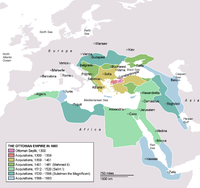 Some of the Monarchies of Asia Minor and European welcomed expelled Jewish Merchants, scholars and theologians. Divergent Jewish philosophies evolved against the backdrop of new cultures, new languages and renewed theological exchange. Philosophic exploration continued through the Renaissance
period as the center-of-mass of Jewish Scholarship shifted to France, Germany, Italy, and Turkey.
was a descendant of Judah ben Eliezer ha-Levi Minz
and Moses ben Isaac ha-Levi Minz
. Eli'ezer del Medigo, of Rome, received the surname "Del Medigo" after studying Medicine. The name was later changed from Del Medigo to Ha-rofeh. He was the father and teacher of a long line of rationalist philosophers and scholars. Non-Jewish students of Delmedigo classified him as an “Averroist”, however, he saw himself as a follower of Maimonides. Scholastic association of Maimonides and Ibn Rushd would have been a natural one; Maimonides, towards the end of his life, was impressed with the Ibn Rushd commentaries and recommended them to his students. The followers of Maimonides (Maimonideans) had therefore been, for several generations before Delmedigo, the leading users, translators and disseminators of the works of Ibn Rushd in Jewish circles, and advocates for Ibn Rushd even after Islamic rejection of his radical views. Maimonideans regarded Maimonides and Ibn Rushd as following the same general line. In his book, Delmedigo portrays himself as defender of Maimonidean Judaism, and — like many Maimonideans — he emphasized the rationality of Jewish tradition.
was born Thessaloniki
1515 - died Constantinople abt 1580. He was a student of Levi Ibn Habib
, who was in turn a student of Jacob ibn Habib
, who was, in turn, a student of Nissim ben Reuben.
In 1570 he wrote a commentary on the Pentateuch titled "Yede Mosheh" (The Hands of Moses); also an exposition of the Talmudical treatise "Abot" (Ethics of the Fathers), published in Salonica in 1563; and a collection of sermons delivered upon various occasions, particularly funeral orations, entitled "Meammeẓ Koaḥ" (Re-enforcing Strength).
al-Ghazâlî's Intentions of the Philosophers (De’ôt ha-Fîlôsôfîm or Kavvanôt ha-Fîlôsôfîm) was one of the most widespread philosophical texts studied among Jews in Europe having been translated in 1292 by Isaac Albalag
. Later Hebrew commentators include Moses Narboni, and Moses Almosnino.
he studied under Jacob Pollak
. Many rabbis, including Moses Isserles, addressed him in their responsa as the "av bet din of the republic of Venice." The great scholars of the Renaissance with whom he corresponded include Shmuel ben Moshe di Modena, Joseph Katz
, Solomon Luria
, Moses Isserles
, Obadiah Sforno, and Moses Alashkar
.
was a student of Rabbi Solomon Luria
who was, in turn a student of Rabbi Shalom Shachna
- father-in-law and teacher of Moses Isserles
. Elijah Ba'al Shem of Chelm
was also a cousin of Moses Isserles
.
Ha-rofeh Ashkenazi of Nicosia ("the physician") the author of Yosif Lekah on the Book of Esther.
seeking safety and protection from the endless pogroms fomented by the House of Habsburg and the Roman Catholic Church
against Jews.
Rationalism was incubating in geographies far from Spain. From stories told by Rabbi Elijah Ba'al Shem of Chelm
, German-speaking Jews, descendants of Jews who migrated back to Jerusalem after Charlemagne's invitation was revoked in Germany many centuries earlier, who lived in Jerusalem during the 11th century were influenced by prevailing Mutazilite scholars of Jerusalem. A German-speaking Palestinian Jew saved the life of a young German man surnamed "Dolberger". When the knights of the First Crusade
came to siege Jerusalem, one of Dolberger's family members rescued German-speaking Jews in Palestine and brought them back to the safety of Worms, Germany, to repay the favor. Further evidence of German communities in the holy city comes in the form of halakic questions sent from Germany to Jerusalem during the second half of the eleventh century.
All of the foregoing resulted in an explosion of new ideas and philosophic paths.
was a physician and teacher - Baruch Spinoza was a student of his works.
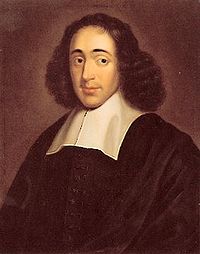 Baruch Spinoza
adopted Pantheism
, broke with Rabbinic Judaism
tradition and was excommunicated. Nevertheless the Jewish influence in his work from Maimonides
and Leone Ebreo, is evident. Some contemporary critics (e.g. Wachter, Der Spinozismus im Judenthum) claimed to detect the influence of the Kabbalah
, while others (e.g. Leibniz
) regarded Spinozism as a revival of Averroism
; a talmudist manner of referencing to Maimonidean Rationalism.
was a student of his father, but most notably also a student of his grandfather Rabbi Elijah Ba'al Shem of Chelm
.
was a student of his father Rabbi Tzvi Hirsch ben Yaakov Ashkenazi
a Rabbi in Amsterdam. Emden, a steadfast Talmudist, was a prominent opponent of the Sabbateans (Messianic Kabbalists who followed Sabbatai Tzvi). Though anti-Maimonidean, Emden should be noted for his critical examination of the Zohar concluding that large parts of it were forged.
. Mendelssohn has been described as the "'third Moses,' with whom begins a new era in Judaism," just as new eras began with Moses the prophet and with Moses Maimonides. Mendelssohn was a German Jewish philosopher to whose ideas the renaissance of European Jews, Haskalah
(the Jewish Enlightenment) is indebted. He has been referred to as the father of Reform Judaism, though Reform spokesmen have been "resistant to claim him as their spiritual father". Mendelssohn came to be regarded as a leading cultural figure of his time by both Germans and Jews. His most significant book was Jerusalem oder über religiöse Macht und Judentum
(Jerusalem), first published in 1783.
Alongside Mendelssohn, other important Jewish philosophers of the eighteenth century included:
Important Jewish philosophers of the nineteenth century included:
considered the fusion of religion and philosophy as difficult because classical philosophers start with no preconditions for which conclusions they must reach in their investigation, while classical religious believers have a set of religious principles of faith that they hold one must believe. Most Haredim contended that one cannot simultaneously be a philosopher and a true adherent of a revealed religion. In this view, all attempts at synthesis ultimately fail. Rabbi Nachman of Breslov
, for example, viewed all philosophy as untrue and heretical. In this he represents one strand of Hasidic thought, with creative emphasis on the emotions.
Other exponents of Hasidism had a more positive attitude towards philosophy. In the Chabad
writings of Schneur Zalman of Liadi, Hasidut is seen as able to unite all parts of Torah thought, from the schools of philosophy to mysticism, by uncovering the illuminating Divine essence that permeates and transcends all approaches. Interpreting the verse from Job
, "from my flesh I see HaShem", Shneur Zalman explained the inner meaning, or "soul", of the Jewish mystical tradition in intellectual form, by means of analogies drawn from the human realm. As explained and continued by the later leaders of Chabad, this enabled the human mind to grasp concepts of Godliness, and so enable the heart to feel the love and awe of HaShem, emphasised by all the founders of hasidism, in an internal way. This development, the culminating level of the Jewish mystical tradition, in this way bridges philosophy and mysticism, by expressing the transcendent in human terms.
. Among the early Jewish existentialist philosophers was Lev Shestov
(Jehuda Leib Schwarzmann), a Russian-Jewish philosopher. One of the most influential Jewish existentialists in the first half of the 20th century was Franz Rosenzweig
. While researching his doctoral dissertation on the 19th-century German philosopher Georg Wilhelm Friedrich Hegel
, Rosenzweig reacted against Hegel's idealism and developed an existential approach. Rosenzweig, for a time, considered conversion to Christianity, but in 1913, he turned to Jewish philosophy. He became a philosopher and student of Hermann Cohen
. Rozensweig's major work, Star of Redemption, is his new philosophy in which he portrays the relationships between haShem, humanity and world as they are connected by creation, revelation and redemption. Orthodox rabbi Joseph Soloveitchik
and Conservative rabbis Neil Gillman
and Elliot N. Dorff
have also been described as existentialists.
The French
philosopher and Talmudic commentator Emmanuel Levinas
, whose approach grew out of the phenomenological tradition in philosophy, has also been described as a Jewish existentialist.

and modern Jewish rationalists such as Hermann Cohen
.
Cohen was a German Jewish neo-Kantian philosopher who turned to Jewish subjects at the end of his career in the early 20th century, picking up on ideas of Maimonides
. In America, Steven Schwarzschild
continued Cohen's legacy. Another prominent contemporary Jewish rationalist is Lenn Goodman, who works out of the traditions of medieval Jewish rationalist philosophy. Conservative
rabbis Alan Mittleman
of the Jewish Theological Seminary and Elliot N. Dorff
of American Jewish University also see themselves in the rationalist tradition, as does David Novak of the University of Toronto
. Novak works in the natural law tradition, which is one version of rationalism.
Philosophers in modern-day Israel in the rationalist tradition include David Hartman
and Moshe Halbertal
.
Some Orthodox rationalists in Israel take a "restorationist" approach, reaching back in time for tools to simplify Rabbinic Judaism and bring all Jews, regardless of status or stream of Judaism, closer to observance of Halacha, Mitzvot, Kashrut and embrace of Maimonides
' "13 Principles of Faith". Dor Daim
, and Rambamists are two groups who reject mysticism as a "superstitious innovation" to an otherwise clear and succinct set of Laws and rules. According to these rationalists, there is shame and disgrace attached to failure to investigate matters of religious principle using the fullest powers of human reason and intellect. One cannot be considered wise, or perceptive, if one does not attempt to understand the origins, and establish the correctness, of one's beliefs.
, omniscient
and omnibenevolent
. Yet, these claims are in jarring contrast with the fact that there is much evil
in the world. Perhaps the most difficult question that monotheists have confronted is "how can one reconcile the existence of this view of HaShem with the existence of evil?" or "how can there be good without bad?" "how can there be a God without a devil?" This is the problem of evil. Within all monotheistic faiths many answers (theodicies
) have been proposed. However, in light of the magnitude of evil seen in the Holocaust, many people have re-examined classical views on this subject. How can people still have any kind of faith after the Holocaust? This set of Jewish philosophies is discussed in the article on Holocaust theology
.
. His theology was a variant of John Dewey
's pragmatist
philosophy. Dewey's naturalism combined atheist beliefs with religious terminology in order to construct a philosophy for those who had lost faith in traditional Judaism. In agreement with the classical medieval Jewish thinkers, Kaplan affirmed that haShem is not personal, and that all anthropomorphic descriptions of haShem are, at best, imperfect metaphors. Kaplan's theology went beyond this to claim that haShem is the sum of all natural processes that allow man to become self-fulfilled. Kaplan wrote that "to believe in haShem means to take for granted that it is man's destiny to rise above the brute and to eliminate all forms of violence and exploitation from human society."
, more specifically process theology
. Process philosophy suggests that fundamental elements of the universe are occasions of experience. According to this notion, what people commonly think of as concrete objects are actually successions of these occasions of experience. Occasions of experience can be collected into groupings; something complex such as a human being is thus a grouping of many smaller occasions of experience. In this view, everything in the universe is characterized by experience (not to be confused with consciousness); there is no mind-body duality under this system, because "mind" is simply seen as a very developed kind of experiencing entity.
Intrinsic to this worldview is the notion that all experiences are influenced by prior experiences, and will influence all future experiences. This process of influencing is never deterministic; an occasion of experience consists of a process of comprehending other experiences, and then reacting to it. This is the "process" in "process philosophy". Process philosophy gives HaShem a special place in the universe of occasions of experience. HaShem encompasses all the other occasions of experience but also transcends them; thus process philosophy is a form of panentheism
.
The original ideas of process theology were developed by Charles Hartshorne
(1897–2000), and influenced a number of Jewish
theologians, including British
philosopher Samuel Alexander (1859–1938), and Rabbis Max Kadushin
, Milton Steinberg and Levi A. Olan, Harry Slominsky, and Bradley Shavit Artson
. Abraham Joshua Heschel
has also been linked to this tradition.
strain of Chasidism showed a more positive attitude towards philosophy. Meanwhile, non-Orthodox Jewish thought in the latter 20th century saw resurgent interest in Kabbalah
. In academic studies, Gershom Scholem
began the critical investigation of Jewish mysticism, while in non-Orthodox Jewish denominations
, Jewish Renewal
and Neo-Hasidism
, spiritualised worship. Many philosophers do not consider this a form of philosophy, as Kabbalah is a collection of esotric methods of textual interpretation. Mysticism is generally understood as an alternative to philosophy, not a variant of philosophy.
Among modern the modern critics of Kabbalah was *Rabbi Yihhyah Qafahh
, who wrote a book entitled Milhhamoth HaShem, (Wars of the L-RD) against what he perceived as the false teachings of the Zohar and the false Kabbalah of Isaac Luria. He is credited with spearheading the Dor Daim
. Rabbi Yeshayahu Leibowitz
publicly shared the views expressed in Rabbi Yihhyah Qafahh
's book Milhhamoth HaShem and elaborated upon these views in his many writings.
, Conservative Judaism
, and Reform Judaism
.
Print Sources
Philosophy
Philosophy is the study of general and fundamental problems, such as those connected with existence, knowledge, values, reason, mind, and language. Philosophy is distinguished from other ways of addressing such problems by its critical, generally systematic approach and its reliance on rational...
carried out by Jews, or, in relation to the religion of Judaism
Judaism
Judaism ) is the "religion, philosophy, and way of life" of the Jewish people...
. Jewish philosophy, until modern Enlightenment and Emancipation
Jewish Emancipation
Jewish emancipation was the external and internal process of freeing the Jewish people of Europe, including recognition of their rights as equal citizens, and the formal granting of citizenship as individuals; it occurred gradually between the late 18th century and the early 20th century...
, was pre-occupied with attempts to reconcile coherent new ideas into the tradition of Rabbinic Judaism
Rabbinic Judaism
Rabbinic Judaism or Rabbinism has been the mainstream form of Judaism since the 6th century CE, after the codification of the Talmud...
; thus organizing emergent ideas that are not necessarily Jewish into a uniquely Jewish scholastic framework and world-view. With their acceptance into modern society, Jews with secular educations embraced or developed entirely new philosophies to meet the demands of a world in which they now found themselves.
Medieval re-discovery of Greek thought
Greek philosophy
Ancient Greek philosophy arose in the 6th century BCE and continued through the Hellenistic period, at which point Ancient Greece was incorporated in the Roman Empire...
among Gaonim of 10th century Babylonian academies brought rationalist philosophy into Biblical
Tanakh
The Tanakh is a name used in Judaism for the canon of the Hebrew Bible. The Tanakh is also known as the Masoretic Text or the Miqra. The name is an acronym formed from the initial Hebrew letters of the Masoretic Text's three traditional subdivisions: The Torah , Nevi'im and Ketuvim —hence...
-Talmud
Talmud
The Talmud is a central text of mainstream Judaism. It takes the form of a record of rabbinic discussions pertaining to Jewish law, ethics, philosophy, customs and history....
ic Judaism. Philosophy was generally in competition with Kabbalah
Kabbalah
Kabbalah/Kabala is a discipline and school of thought concerned with the esoteric aspect of Rabbinic Judaism. It was systematized in 11th-13th century Hachmei Provence and Spain, and again after the Expulsion from Spain, in 16th century Ottoman Palestine...
. Both schools would become part of classic Rabbinic literature
Rabbinic literature
Rabbinic literature, in its broadest sense, can mean the entire spectrum of rabbinic writings throughout Jewish history. However, the term often refers specifically to literature from the Talmudic era, as opposed to medieval and modern rabbinic writing, and thus corresponds with the Hebrew term...
, though the decline of scholastic rationalism coincided with historical events which drew Jews to the Kabbalistic approach. For European Jews
Ashkenazi Jews
Ashkenazi Jews, also known as Ashkenazic Jews or Ashkenazim , are the Jews descended from the medieval Jewish communities along the Rhine in Germany from Alsace in the south to the Rhineland in the north. Ashkenaz is the medieval Hebrew name for this region and thus for Germany...
, emancipation and encounter with secular thought from the 18th-century onwards altered how philosophy was viewed. Oriental and Eastern European
Shtetl
A shtetl was typically a small town with a large Jewish population in Central and Eastern Europe until The Holocaust. Shtetls were mainly found in the areas which constituted the 19th century Pale of Settlement in the Russian Empire, the Congress Kingdom of Poland, Galicia and Romania...
communities had later and more ambivalent interaction with secular culture than in Western Europe. In the varied responses to modernity, Jewish philosophical ideas were developed across the range of emerging religious denominations
Jewish denominations
Jewish religious movements , sometimes called "denominations" or "branches", include different groups which have developed among Jews from ancient times and especially in the modern era among Ashkenazi Jews living in anglophone countries...
. These developments could be seen as either continuations, or breaks, with the canon of Rabbinic philosophy of the Middle Ages, as well as the other historical dialectic aspects of Jewish thought, and resulted in diverse contemporary Jewish attitudes to philosophical methods.
Philosophy in the Bible
Rabbinic literatureRabbinic literature
Rabbinic literature, in its broadest sense, can mean the entire spectrum of rabbinic writings throughout Jewish history. However, the term often refers specifically to literature from the Talmudic era, as opposed to medieval and modern rabbinic writing, and thus corresponds with the Hebrew term...
sometimes views Abraham as a "philosopher." Some have suggested that Abraham
Abraham
Abraham , whose birth name was Abram, is the eponym of the Abrahamic religions, among which are Judaism, Christianity and Islam...
introduced a philosophy learned from Melchizedek
Melchizedek
Melchizedek or Malki Tzedek translated as "my king righteous") is a king and priest mentioned during the Abram narrative in the 14th chapter of the Book of Genesis....
; Some Jews ascribe the Sefer Yetzirah
Sefer Yetzirah
Sefer Yetzirah is the title of the earliest extant book on Jewish esotericism, although some early commentators treated it as a treatise on mathematical and linguistic theory as opposed to Kabbalah...
"Book of Creation" to Abraham. A midrash
Midrash
The Hebrew term Midrash is a homiletic method of biblical exegesis. The term also refers to the whole compilation of homiletic teachings on the Bible....
describes how Abraham understood this world to have a creator and director by comparing this world to "a house with a light in it", what is now called the Argument from design
Teleological argument
A teleological or design argument is an a posteriori argument for the existence of God based on apparent design and purpose in the universe. The argument is based on an interpretation of teleology wherein purpose and intelligent design appear to exist in nature beyond the scope of any such human...
. The Book of Psalms contains invitations to "admire the wisdom of Hashem through his works"; from this, some scholars suggest, Judaism harbors a Philosophical under-current. The Book of Ecclesiastes is often considered to be the only genuine Philosophical work in the Hebrew Bible
Hebrew Bible
The Hebrew Bible is a term used by biblical scholars outside of Judaism to refer to the Tanakh , a canonical collection of Jewish texts, and the common textual antecedent of the several canonical editions of the Christian Old Testament...
, its author seeks to understand the place of human beings in the world, and life's meaning.
Philo of Alexandria
Dr. Bernard Revel
Bernard Revel
Bernard Revel was an Orthodox rabbi and scholar. He served as the first President of Yeshiva College from 1915 until his death in 1940...
, in dissertation on "Karaite Halacha", points to writings of a 10th century Karaite, Ya'qub al-Qirqisani
Jacob Qirqisani
Jacob Qirqisani was a Karaite dogmatist and exegete who flourished in the first half of the tenth century. He was a native of Circassia, which at the time probably still fell under Khazar overlordship...
, who quotes Philo, illustrating how Karaites made use of Philo's works in development of Karaism. Philo's works became important to Medieval Christian scholars who leveraged the work of Karaites to lend credence to their claims that "these are the beliefs of Jews" - a technically correct, yet mendacious, attribution.
Jewish scholarship after destruction of Second Temple
With destruction of the Second TempleSecond Temple
The Jewish Second Temple was an important shrine which stood on the Temple Mount in Jerusalem between 516 BCE and 70 CE. It replaced the First Temple which was destroyed in 586 BCE, when the Jewish nation was exiled to Babylon...
Judaism was in disarray, but Jewish traditions were preserved especially thanks to the shrewd maneuvers of Yochanan Ben Zakkai, who saved the Sanhedrin
Sanhedrin
The Sanhedrin was an assembly of twenty-three judges appointed in every city in the Biblical Land of Israel.The Great Sanhedrin was the supreme court of ancient Israel made of 71 members...
and moved it to Yavne
Yavne
Yavne is a city in the Central District of Israel. According to the Israel Central Bureau of Statistics , at the end of 2009 the city had a population of 33,000.-History:...
. Philosophical speculation was not a central part of rabbinic Judaism, though some have seen the Mishnah
Mishnah
The Mishnah or Mishna is the first major written redaction of the Jewish oral traditions called the "Oral Torah". It is also the first major work of Rabbinic Judaism. It was redacted c...
as a philosophical work,. Rabbi Akiva ben Joseph has also been viewed as a philosophical figure: his statements include 1.) "How favored is man, for he was created after an image "for in an image, Elokim made man" (Gen. ix. 6)", 2.) "Everything is foreseen; but freedom [of will] is given to every man", 3.) "The world is governed by mercy... but the divine decision is made by the preponderance of the good or bad in one's actions".
After the Bar Kochba Revolt, Rabbinic scholars gathered in Tiberias and Safed
Safed
Safed , is a city in the Northern District of Israel. Located at an elevation of , Safed is the highest city in the Galilee and of Israel. Due to its high elevation, Safed experiences warm summers and cold, often snowy, winters...
to re-assemble and re-assess Judaism, its laws, theology, liturgy, beliefs and leadership structure. In 219 CE, the Sura Academy is founded, by Abba Arika
Abba Arika
Abba Arika was a Jewish Talmudist who lived in Babylonia, known as an amora of the 3rd century who established at Sura the systematic study of the rabbinic traditions, which, using the Mishnah as text, led to the compilation of the Talmud...
, from which Jewish Kalam
Jewish Kalam
Jewish Kalam was an early-medieval style of Jewish philosophy that evolved in response to the Islamic Kalam, which in turn was a reaction against Aristotelian philosophy. The term "Jewish Kalam" is used by modern historians, but is not a term by which Jewish Kalamic thinkers designated themselves...
emerges many centuries later. For the next five centuries Talmudic Academies focused upon reconstituting Judaism; little, if any, philosophic investigation in Jewish Academies is pursued.
Who influences whom?
Rabbinic Judaism had limited philosophical activity until it was challenged by IslamIslam
Islam . The most common are and . : Arabic pronunciation varies regionally. The first vowel ranges from ~~. The second vowel ranges from ~~~...
, Karaism, and Christianity
Christianity
Christianity is a monotheistic religion based on the life and teachings of Jesus as presented in canonical gospels and other New Testament writings...
- with Mishnah, Talmud and Tanach, there was no need for a philosophic framework. From an economic viewpoint, Radhanite
Radhanite
The Radhanites were medieval Jewish merchants. Whether the term, which is used by only a limited number of primary sources, refers to a specific guild, or a clan, or is a generic term for Jewish merchants in the trans-Eurasian trade network is unclear...
Trade dominance was being usurped by coordinated Christian and Islamic forced-conversions, and torture, compelling Jewish scholars to understand nascent economic threats. These investigations triggered new ideas and intellectual exchange among Jewish and Islamic scholars in the areas of jurisprudence, mathematics, astronomy, logic and philosophy. Jewish scholars influenced Islamic scholars and Islamic scholars influenced Jewish scholars. Contemporary scholars continue to debate who was Muslim and who was Jew - some "Islamic scholars" were "Jewish scholars" prior to forced conversion to Islam, some Jewish scholars willingly converted to Islam, such as Abdullah ibn Salam, while others later reverted to Judaism, and still others, born and raised as Jews, were ambiguous in their religious beliefs such as Ibn al-Rawandi
Ibn al-Rawandi
Abu al-Hasan Ahmad ibn Yahya ibn Ishaq al-Rawandi , commonly known as Ibn al-Rawandi , was an early skeptic of Islam and a critic of religion in general. In his early days he was a Mutazilite scholar, but after rejecting the Mutazilite doctrine he adhered to Shia Islam for a brief period of time...
- though lived according to the customs of their neighbors.
Around 700 CE, `Amr ibn `Ubayd Abu `Uthman al-Basri introduces two streams of thought that influence Jewish, Islamic and Christian scholars
- 1.) The Qadariyya and,
- 2.) The BahshamiyyaBahshamiyyaBahshamiyya is a school of Mu'tazili thought, rivaling the school of Abd al-Jabbar ibn Ahmad, based primarily on the earlier teaching of Abu Hashim al-Jubba'i - Borne from Mu'tazila :...
Mu'tazilites.
The story of Bahshamiyya
Bahshamiyya
Bahshamiyya is a school of Mu'tazili thought, rivaling the school of Abd al-Jabbar ibn Ahmad, based primarily on the earlier teaching of Abu Hashim al-Jubba'i - Borne from Mu'tazila :...
Mu'tazili and Qadariyya is as important, if not more so, as the intellectual symbiosis of Judaism and Islam in Islamic Spain.
Around 733 CE, Mar Natronai ben Habibai moves to Kairouan, then to Spain, transcribing Talmud Bavli for the Academy at Kairouan from memory - later taking a copy with him to Spain.
Karaism
Karaites were the first Jewish Sect to subject Judaism to Mu'tazilah. Rejecting Talmud and Rabbinic tradition, Karaites took liberty to reinterpret Tanach as they saw fit. This meant abandoning foundational Jewish belief structures. Some scholars suggest that the major impetus for the formation of Karaism was a reaction to the rapid rise of Shi'a Islam, which recognized Judaism as a fellow monotheistic faith, but claimed that it detracted from monotheism by deferring to Rabbinic authority. Karaites absorbed certain aspects of Jewish sects such as Isawites (Shi'ism), Malikites (Sunnis) and Yudghanites (Sufis), who were influenced by East-Islamic scholarship yet deferred to Ash'ariAsh'ari
The Ashʿari theology is a school of early Muslim speculative theology founded by the theologian Abu al-Hasan al-Ash'ari...
when contemplating the sciences.
Philosophic synthesis begins
The spread of Islam throughout the Middle East and North Africa rendered Muslim all that was once Jewish. Greek philosophy, science, medicine and mathematics was absorbed by Jewish scholars living in the Arab world due to Arabic translations of those texts; remnants of the Library of AlexandriaLibrary of Alexandria
The Royal Library of Alexandria, or Ancient Library of Alexandria, in Alexandria, Egypt, was the largest and most significant great library of the ancient world. It flourished under the patronage of the Ptolemaic dynasty and functioned as a major center of scholarship from its construction in the...
. Early Jewish converts to Islam brought with them stories from their heritage, known as Isra'il'iyat, which told of the Banu Isra'il, the pious men of ancient Israel. One of the most famous early Islamic mystics - Sufi Hasan al-Basri introduced numerous Isra'il'iyat legends into Islamic scholarship, stories that went on to become representative of Islamic mystical ideas of piety of Sufism.
Hai Gaon
Hai Gaon
Hai ben Sherira , was a medieval Jewish theologian, rabbi and scholar who served as Gaon of the Talmudic academy of Pumbedita during the early 11th century. He was born in 939 and died on March 28, 1038...
, at Pumbeditha Academy, begins a new phase in Jewish scholarship and investigation (Hakira); Hai Gaon augments Talmudic scholarship with non-Jewish studies. Hai Gaon was a savant with an exact knowledge of the theological movements of his time so much so that Moses ibn Ezra
Moses ibn Ezra
Rabbi Moses ben Jacob ibn Ezra, known as ha-Sallah was a Jewish, Spanish philosopher, linguist, and poet. He was born at Granada about 1055 – 1060, and died after 1138. Ezra is Jewish by religion but is also considered a great influence in the Arabic world in regards to his works...
called him a mutakallim. Hai was competent to argue with followers of Qadariyya and Mutazilites, sometimes adopting their polemic methods. Through correspondence with Talmudic Academies at Kairouan, Cordoba and Lucena, Hai Gaon passes along his discoveries to Talmudic scholars therein.
The teachings of the "Brethren of Purity" were carried to the West by a Spanish Arab of Madrid, Muhammad Abu'l-Qasim al-Majnti al-Andalusi, who died in A.D. 1004-1005. Thanks to Ibn Rushd (Averroes), Spain became a center of philosophical learning as is reflected by the explosion of philosophical inquiry among Jews, Muslims and Christians.
"Hiwi the Heretic"
According to Saadia Gaon, the Jewish community of BalkhBalkh
Balkh , was an ancient city and centre of Zoroastrianism in what is now northern Afghanistan. Today it is a small town in the province of Balkh, about 20 kilometers northwest of the provincial capital, Mazar-e Sharif, and some south of the Amu Darya. It was one of the major cities of Khorasan...
(Afghanistan) was divided into two groups: "Jews" and "people that are called Jews"; Hiwi al-Balkhi
Hiwi al-Balkhi
Hiwi al-Balkhi was an exegete and Biblical critic of the last quarter of the ninth century, born at Balkh, Khorasan . It is not entirely clear whether Hiwi was a Jew, as suggested by , or whether he was perhaps a member of a gnostic Christian sect...
was a member of the latter. Hiwi is generally considered to be very first "Jewish" philosopher to subject the Pentateuch to critical analysis. Hiwi is viewed by some scholars as an intellectually conflicted man torn between Judaism, Zoroastrianism, Gnostic Christianity, and Manichaean thought.
Hiwi espoused the belief that miraculous acts, described in the Pentateuch, are simply examples of people using their skills of reasoning to undertake, and perform, seemingly miraculous acts. As examples of this position, he argued that the parting of the Reed Sea was a natural phenomenon, and that Moses' claim to greatness lay merely in his ability to calculate the right moment for the crossing. He also emphasized that the Egyptian magicians were able to reproduce several of Moses' "miracles," proving that they could not have been so unique. According to scholars, Hiwi's gravest mistake was having the Pentateuch redacted to reflect his own views - then had those redacted texts, which became popular, distributed to children. Since his views contradicted the views of both Rabbanite and Karaite scholars, Hiwi was declared a heretic. In this context, however, we can also regard Hiwi, while flawed, as the very first critical biblical commentator; zealous rationalistic views of Hiwi parallel those of Ibn al-Rawandi
Ibn al-Rawandi
Abu al-Hasan Ahmad ibn Yahya ibn Ishaq al-Rawandi , commonly known as Ibn al-Rawandi , was an early skeptic of Islam and a critic of religion in general. In his early days he was a Mutazilite scholar, but after rejecting the Mutazilite doctrine he adhered to Shia Islam for a brief period of time...
.
Saadia Gaon wrote a polemic against Hiwi denouncing him as an extreme rationalist, a "Mulhidun", or atheist/deviator. Abraham Ibn Daud described HIwi as a sectarian who "denied the Torah, yet used it to formulate a new Torah of his liking".
Saadia Gaon
Saadia GaonSaadia Gaon
Saʻadiah ben Yosef Gaon was a prominent rabbi, Jewish philosopher, and exegete of the Geonic period.The first important rabbinic figure to write extensively in Arabic, he is considered the founder of Judeo-Arabic literature...
, son of a proselyte
Proselyte
The biblical term "Proselyte", derives from the Koine Greek προσήλυτος/proselytos, as used in the Septuagint for "stranger", i.e. a "newcomer to Israel"; a "sojourner in the land", and in the New Testament for a convert to Judaism from Paganism...
, is considered the greatest early Jewish philosopher. During Saadia's early years in Tulunid
Tulunids
The Tulunids were the first independent dynasty in Islamic Egypt , when they broke away from the central authority of the Abbasid dynasty that ruled the Islamic Caliphate during that time...
Egypt, the Fatimid Caliphate ruled Egypt; leaders of the Tulunids
Tulunids
The Tulunids were the first independent dynasty in Islamic Egypt , when they broke away from the central authority of the Abbasid dynasty that ruled the Islamic Caliphate during that time...
were Ismaili
Ismaili
' is a branch of Shia Islam. It is the second largest branch of Shia Islam, after the Twelvers...
Imams. Their influence upon the Jewish academies of Egypt resonate in the works of Saadia. Saadia's Emunoth ve-Deoth
Emunoth ve-Deoth
Emunoth ve-Deoth or Emunoth w'D'oth written by Rabbi Saadia Gaon - originally Kitāb ul-ʾamānāt wal-iʿtiqādāt - was the first systematic presentation and philosophic foundation of the dogmas of Judaism. The work is prefaced by an introduction and has ten chapters; it was completed in 933...
("Beliefs and opinions") was originally called Kitab al-Amanat wal-l'tikadat ("Book of the Articles of Faith and Doctrines of Dogma"); it was the first systematic presentation and philosophic foundation of the dogmas of Judaism, completed at Sura Academy in 933 CE.
In "Book of the Articles of Faith and Doctrines of Dogma" Saadia declares the rationality of the Jewish religion, with the caveat that reason must capitulate wherever it contradicts tradition. Dogma takes precedence over reason. Saadia closely followed the rules of the Mu'tazilah school of Abu Ali al-Jubba'i in composing his works. It was Saadia, who laid foundations for Jewish rationalist theology which built upon the work of Mu'tazilah, thereby shifting Rabbinic Judaism from mythical explanations of the Rabbis to reasoned explanations of the intellect. Saadia advances the criticisms of Mu'tazilah, by Ibn al-Rawandi
Ibn al-Rawandi
Abu al-Hasan Ahmad ibn Yahya ibn Ishaq al-Rawandi , commonly known as Ibn al-Rawandi , was an early skeptic of Islam and a critic of religion in general. In his early days he was a Mutazilite scholar, but after rejecting the Mutazilite doctrine he adhered to Shia Islam for a brief period of time...
.
David Ibn Marwān al-Mukammas al-Rakki
David ben Merwan al-MukkamasDavid ben Merwan al-Mukkamas
David ibn Merwan al-Mukkamas al-Rakki was a philosopher and controversialist, the author of the earliest known Jewish philosophical work of the Middle Ages. He was a native of Rakka, Mesopotamia, whence his surname...
was author of the earliest known Jewish philosophical work of the Middle Ages, a commentary on Sefer Yetzirah (Book of Creation); he is regarded as the father of Jewish medieval philosophy. Al-Mukammas was first to introduce the methods of Kalam
Kalam
ʿIlm al-Kalām is the Islamic philosophical discipline of seeking theological principles through dialectic. Kalām in Islamic practice relates to the discipline of seeking theological knowledge through debate and argument. A scholar of kalām is referred to as a mutakallim...
into Judaism and the first Jew to mention Aristotle in his writings. He was a proselyte
Proselyte
The biblical term "Proselyte", derives from the Koine Greek προσήλυτος/proselytos, as used in the Septuagint for "stranger", i.e. a "newcomer to Israel"; a "sojourner in the land", and in the New Testament for a convert to Judaism from Paganism...
of Rabbinic Judaism (not Karaism as some argue); al-Mikammas was a student of physician, and renowned Christian philosopher, Hana. His close interaction with Hana, and his familial affiliation with Islam gave al-Mukammas a unique view of religious belief and theology. In 1898 Abraham Harkavy
Abraham Harkavy
Avraam/Albert Yakovlevich Harkavy , or Avraham Eliyahu ben Yaakov Harkavy was a Russian-Jewish historian and orientalist.-Biography:...
discovered, in Imperial Library of St. Petersburg, fifteen of the twenty chapters of David's philosophical work entitled Ishrun Maḳalat (Twenty Chapters) of which 15 survive.
Samuel Ha-Nagid
Shmuel Ha-NagidSamuel ibn Naghrela
Samuel ibn Naghrela , also known as Samuel HaNagid , , was a Talmudic scholar, grammarian, philologist, poet, warrior, and statesman, who lived in Iberia at the time of the Moorish rule....
, born in Mérida - lived in Cordoba, was a child prodigy and student of Rabbi Hanoch ben Moshe. Shmuel Ha-Nagid, Hasdai Ibn Shaprut
Hasdai ibn Shaprut
Hasdai ibn Shaprut born about 915 at Jaén; died about 975 at Córdoba in Spain, was a Jewish scholar, physician, diplomat, and patron of science....
, and Rabbi Moshe ben Hanoch founded the Lucena Yeshiva that produced such brilliant scholars as Rabbi Yitzhak ibn Ghiath
Isaac ibn Ghiyyat
Isaac ben Judah ibn Ghiyyat was a Spanish rabbi, Biblical commentator, philosopher, and liturgical poet. He was born and lived in the town of Lucena, where he also headed a rabbinic academy. He died in Cordoba.According to some authorities he was the teacher of Isaac Alfasi; according to...
and Rabbi Maimon ben Yosef (father of Maimonides). Ha-Nagid's son, Yosef, provided refuge for two sons of (Hezekiah Gaon
Hezekiah Gaon
Hezekiah Gaon was the last Gaon of the Talmudic academy in Pumbedita from 1038-40.Hezekiah was a member of the exilarchal family, son of David,who was son the of Zakkai,who was the son of Avraham, who was the son of Nathan, son of David a Rabbi, whose father was Hazub...
); Daud Ibn Chizkiya Gaon Ha-Nasi and Yitzhak Ibn Chizkiya Gaon Ha-Nasi. Though not a philosopher, he did build the infrastructure to allow philosophers to thrive. In 1070 the gaon Isaac ben Moses ibn Sakri, of Denia (Spain), traveled to the East and acted as rosh yeshivah of Baghdad Academy.
Yitzhak ben Yaakob HaKohen al-Fasi
Rabbi Yitzhak ben Yakob HaKohen al-FasiIsaac Alfasi
for other Al-Fasi's see Al-Fasi disambiguationIsaac ben Jacob Alfasi ha-Cohen - also known as the Alfasi or by his Hebrew acronym Rif , was a Talmudist and posek...
was a student of Nissim Gaon. al-Fasi is best known for his work of halachah, the legal code Sefer Ha-halachot, considered the first fundamental work in halachic literature. al-Fasi wrote Talmud Katan ("the Little Talmud"). At the close of the Middle Ages, when the Talmud was banned in Italy, al-Fasi's Talmud Katan was exempted so that from the 16th to the 19th centuries his work was the primary subject of study of the Italian Jewish community. al-Fasi occupies an important place in the development of the Sephardi method of studying the Talmud and influencing the growth of rational philosophic exploration of Jewish Canon. In contrast to Tosafists
Tosafists
Tosafists were medieval rabbis from France and Germany who are among those known in Talmudical scholarship as Rishonim who created critical and explanatory glosses on the Talmud. These were collectively called Tosafot , because they were additions on the commentary of Rashi...
who made the Talmud more intricate, al-Fasi taught his students to simplify the Talmud and free it from casuistic detail
Casuistry
In applied ethics, casuistry is case-based reasoning. Casuistry is used in juridical and ethical discussions of law and ethics, and often is a critique of principle- or rule-based reasoning...
.
Solomon ibn Gabirol
Shlomo ben Yehuda ibn GevirolSolomon ibn Gabirol
Solomon ibn Gabirol, also Solomon ben Judah , was an Andalucian Hebrew poet and Jewish philosopher with a Neoplatonic bent. He was born in Málaga about 1021; died about 1058 in Valencia.-Biography:...
, born in Málaga then moved to Valencia. Ibn Gabirol was one of the first teachers of Neoplatonism
Neoplatonism
Neoplatonism , is the modern term for a school of religious and mystical philosophy that took shape in the 3rd century AD, based on the teachings of Plato and earlier Platonists, with its earliest contributor believed to be Plotinus, and his teacher Ammonius Saccas...
in Europe. His role has been compared to that of Philo. Ibn Gabirol occidentalized Greco-Arabic philosophy and restored it to Europe. The philosophical teachings of Philo
Philo
Philo , known also as Philo of Alexandria , Philo Judaeus, Philo Judaeus of Alexandria, Yedidia, "Philon", and Philo the Jew, was a Hellenistic Jewish Biblical philosopher born in Alexandria....
and Ibn Gabirol were largely ignored by fellow Jews; the parallel may be extended by adding that Philo and Ibn Gabirol, alike, exercised considerable influence in secular circles; Philo upon early Christianity, and Ibn Gabirol upon the scholars of medieval Christianity. Christian scholars, including Albertus Magnus and Thomas Aquinas, defer to him frequently.
Abraham bar-Hiyya Ha-Nasi
Abraham bar Hiyya Ha-Nasi, of Barcelona and later Arles-Provence, was a student of his father Hiyya al-DaudiHiyya al-Daudi
Hiyya al-Daudi was a Jewish prominent rabbi, composer and poet of Andalusia....
Ha-Nasi. Abraham bar Ḥiyya was one of the most important figures in the scientific movement which made the Jews of Provence, Spain, and Italy the intermediaries between Averroism
Averroism
Averroism is the term applied to either of two philosophical trends among scholastics in the late 13th century: the Arab philosopher Averroës or Ibn Rushd's interpretations of Aristotle and his reconciliation of Aristotelianism with Islamic faith; and the application of these ideas in the Latin...
, Mu'tazilah and the Christian
Christian
A Christian is a person who adheres to Christianity, an Abrahamic, monotheistic religion based on the life and teachings of Jesus of Nazareth as recorded in the Canonical gospels and the letters of the New Testament...
world. He aided this scientific movement by original works, translations and as interpreter for another translator, Plato of Tivoli. bar-Hiyya's best student was Abraham Ibn Ezra
Abraham ibn Ezra
Rabbi Abraham ben Meir Ibn Ezra was born at Tudela, Navarre in 1089, and died c. 1167, apparently in Calahorra....
. bar-Hiyya's philosophical works, are ("Meditation of the Soul"), an ethical work written from a rationalistic religious viewpoint, and an apologetic epistle addressed to Judah ben Barzilai al-Barzeloni.
Hibat Allah
Originally known by his Hebrew name "Nethanel" Baruch ben Melech al-Balad later became known as Abu'l-Barakat Hibat Allah ibn Ali ibn Malka al-BaghdadiHibat Allah Abu'l-Barakat al-Baghdaadi
Abu'l-Barakāt Hibat Allah ibn Malkā al-Baghdādī was an Islamic philosopher and physician of Jewish-Arab descent from Baghdad, Iraq. Abu'l-Barakāt, an older contemporary and father-in-law of Maimonides, was originally known by his Hebrew birth name Nathanel before his conversion from Judaism to...
was a Jewish philosopher and physicist and father-in-law of Maimonides who converted to Islam in his twilight years - once Head of the Baghdad Yeshiva and considered the leading philosopher of Iraq. Historians differ over the motive for his conversion to Islam, some suggest it was a reaction to a social slight inflicted upon him, because he was a Jew, while others suggest he was forcibly converted at the edge of a sword (which prompted Maimonides to comment upon Anusim
Anusim
Anusim is a legal category of Jews in halakha who were forced or coerced to abandon Judaism against their will, typically while forcibly converted to another religion...
. Despite his conversion to Islam, his works continued to be studied at the Jewish Baghdad Academy, a well-known academy, into the thirteenth century. He was a follower of Avicenna's teaching, who proposed an explanation of the acceleration of falling bodies by the accumulation of successive increments of power with successive increments of velocity.
His writings include Kitāb al-Muʿtabar (“The Book of What Has Been Established by Personal Reflection”); a philosophical commentary on the Kohelet, written in Arabic using Hebrew aleph bet; and the treatise “On the Reason Why the Stars Are Visible at Night and Hidden in Daytime.” According to Hibat Allah, Kitāb al-Muʿtabar consists in the main of critical remarks jotted down by him over the years while reading philosophical text, and published at the insistence of his friends, in the form of a philosophical work.
Abu al-Ma'ali 'Uzziel Ibn Hibat Allah, son of Hibat Allah never converted to Islam and married the sister of Maimonides. Abu al-Ma'ali 'Uzziel Ibn Hibat Allah was the personal physician of Saladin and arranged employment for Maimonides when he fled to Egypt. Maimonides then married the sister of Abu al-Ma'ali 'Uzziel Ibn Hibat Allah.
Nethan'el al-Fayyumi
Natan'el al-FayyumiNatan'el al-Fayyumi
Natan'el al-Fayyumi , born about 1090 - died about 1165, of Yemen was the twelfth-century author of Bustan al-Uqul , a Jewish version of Ismaili Shi'ite doctrines...
, of Yemen, was the twelfth-century author of Bustan al-Uqul ("Garden of Intellects"), a Jewish version of Ismaili
Ismaili
' is a branch of Shia Islam. It is the second largest branch of Shia Islam, after the Twelvers...
Shi'ite doctrines. Like the Ismailis, Nethanel al-Fayyumi argued that haShem sent different prophets to various nations of the world, containing legislations suited to the particular temperament of each individual nation. Ismaili doctrine holds that a single universal religious truth lies at the root of the different religions. Some Jews accepted this model of religious pluralism, leading them to view Prophet Mohammed as a legitimate prophet, though not Jewish, sent to preach to the Arabs, just as the Hebrew prophets had been sent to deliver their messages to Israel; others refused this notion in entirety. Nethanel's son Yakob ben Nethanel Ibn al-Fayyumi turned to Maimonides, asking urgently for counsel on how to deal with forced conversions to Islam and religious persecutions at the hand of Saladin
Saladin
Ṣalāḥ ad-Dīn Yūsuf ibn Ayyūb , better known in the Western world as Saladin, was an Arabized Kurdish Muslim, who became the first Sultan of Egypt and Syria, and founded the Ayyubid dynasty. He led Muslim and Arab opposition to the Franks and other European Crusaders in the Levant...
. Maimonides' response was Iggret Teiman
Bahya ben Joseph ibn Paquda
Bahye ben Yosef Ibn PaqudaBahya ibn Paquda
Bahya ben Joseph ibn Paquda was a Jewish philosopher and rabbi who lived at Zaragoza, Spain, in the first half of the eleventh century...
, of Zaragoza, was author of the first Jewish system of ethics Al Hidayah ila Faraid al-hulub, ("Guide to the Duties of the Heart"). Bahya often followed the method of the Arabian encyclopedists known as "the Brethren of Purity
Brethren of Purity
The Brethren of Purity were a secret society of Muslim philosophers in Basra, Iraq, in the 10th century CE....
" but adopts some of Sufi tenets rather than Ismaili. According to Bahya, the Torah appeals to reason and knowledge as proofs of haShem's existence. It is therefore a duty incumbent upon every one to make haShem an object of speculative reason and knowledge, in order to arrive at true faith. Baḥya borrows from Sufism
Sufism
Sufism or ' is defined by its adherents as the inner, mystical dimension of Islam. A practitioner of this tradition is generally known as a '...
and Jewish Kalam
Jewish Kalam
Jewish Kalam was an early-medieval style of Jewish philosophy that evolved in response to the Islamic Kalam, which in turn was a reaction against Aristotelian philosophy. The term "Jewish Kalam" is used by modern historians, but is not a term by which Jewish Kalamic thinkers designated themselves...
integrating them into Neoplatonism. Proof that Bahya borrowed from Sufism is underscored by the fact that the title of his eighth gate, Muḥasabat al-Nafs ("Self-Examination"), is reminiscent of the Sufi Abu Abd Allah Ḥarith Ibn-Asad, who has been surnamed El Muḥasib ("the self-examiner"), because—say his biographers—"he was always immersed in introspection"
Yehuda Ha-Levi and the Kuzari
Rabbi Judah Ha-LeviYehuda Halevi
Judah Halevi was a Spanish Jewish physician, poet and philosopher. He was born in Spain, either in Toledo or Tudela, in 1075 or 1086, and died shortly after arriving in Palestine in 1141...
, of Toledo, defended Rabbinic Judaism against Islam, Christianity and Karaism. He was a student of Moses Ibn Ezra
Moses ibn Ezra
Rabbi Moses ben Jacob ibn Ezra, known as ha-Sallah was a Jewish, Spanish philosopher, linguist, and poet. He was born at Granada about 1055 – 1060, and died after 1138. Ezra is Jewish by religion but is also considered a great influence in the Arabic world in regards to his works...
whose education came from Isaac ibn Ghiyyat
Isaac ibn Ghiyyat
Isaac ben Judah ibn Ghiyyat was a Spanish rabbi, Biblical commentator, philosopher, and liturgical poet. He was born and lived in the town of Lucena, where he also headed a rabbinic academy. He died in Cordoba.According to some authorities he was the teacher of Isaac Alfasi; according to...
; trained as a Rationalist, he shed it in favor of Neoplatonism. Like Al-Ghazali
Al-Ghazali
Abu Hāmed Mohammad ibn Mohammad al-Ghazzālī , known as Algazel to the western medieval world, born and died in Tus, in the Khorasan province of Persia was a Persian Muslim theologian, jurist, philosopher, and mystic....
, Judah Ha-Levi attempted to liberate religion from the bondage of philosophical systems. In particular, in a work written in Arabic Kitab al-Ḥujjah wal-Dalil fi Nuṣr al-Din al-Dhalil, translated by Judah ben Saul ibn Tibbon
Judah ben Saul ibn Tibbon
Judah ben Saul ibn Tibbon was a translator and physician.Born in Granada, he left Spain in 1150, probably on account persecution by the Almohades, and went to Lunel in southern France. Benjamin of Tudela mentions him as a physician there in 1160...
, by the title Sefer ha-Kuzari
Kuzari
The Kitab al Khazari, commonly called the Kuzari, is one of most famous works of the medieval Spanish Jewish philosopher and poet Rabbi Yehuda Halevi, completed around 1140. Its title is an Arabic phrase meaning Book of the Khazars...
he elaborates upon his views of Judaism relative to other religions of the time.
Abraham ibn Daud
Abraham Ibn DaudAbraham ibn Daud
Abraham ibn Daud was a Spanish-Jewish astronomer, historian, and philosopher; born at Toledo, Spain about 1110; died, according to common report, a martyr about 1180. He is sometimes known by the abbreviation Rabad I or Ravad I. His mother belonged to a family famed for its learning...
was a student of Rabbi Baruch ben Yitzhak Ibn Albalia, his maternal uncle. Ibn Daud's philosophical work written in Arabic, Al-'akidah al-Rafiyah ("The Sublime Faith"), has been preserved in Hebrew by the title Emunah Ramah. Ibn Daud did not introduce a new philosophy, but he was the first to introduce a more thorough systematic form derived from Aristotle
Aristotle
Aristotle was a Greek philosopher and polymath, a student of Plato and teacher of Alexander the Great. His writings cover many subjects, including physics, metaphysics, poetry, theater, music, logic, rhetoric, linguistics, politics, government, ethics, biology, and zoology...
. Accordingly, Hasdai Crescas
Hasdai Crescas
Hasdai ben Judah Crescas was a Jewish philosopher and a renowned halakhist...
mentions Ibn Daud as the only Jewish philosopher among the predecessors of Maimonides. Overshadowed by Maimonides, ibn Daud's Emunah Ramah, a work to which Maimonides was indebted, received little notice from later philosophers. "True philosophy", according to Ibn Daud, "does not entice us from religion; it tends rather to strengthen and solidify it. Moreover, it is the duty of every thinking Jew to become acquainted with the harmony existing between the fundamental doctrines of Judaism and those of philosophy, and, wherever they seem to contradict one another, to seek a mode of reconciling them".
Other notable Jewish philosophers pre-Maimonides
- Abraham ibn EzraAbraham ibn EzraRabbi Abraham ben Meir Ibn Ezra was born at Tudela, Navarre in 1089, and died c. 1167, apparently in Calahorra....
- Isaac ibn GhiyyatIsaac ibn GhiyyatIsaac ben Judah ibn Ghiyyat was a Spanish rabbi, Biblical commentator, philosopher, and liturgical poet. He was born and lived in the town of Lucena, where he also headed a rabbinic academy. He died in Cordoba.According to some authorities he was the teacher of Isaac Alfasi; according to...
- Moses ibn EzraMoses ibn EzraRabbi Moses ben Jacob ibn Ezra, known as ha-Sallah was a Jewish, Spanish philosopher, linguist, and poet. He was born at Granada about 1055 – 1060, and died after 1138. Ezra is Jewish by religion but is also considered a great influence in the Arabic world in regards to his works...
- Yehuda AlhariziYehuda AlhariziYehuda Alharizi, also Judah ben Solomon Harizi or al-Harizi was a rabbi, translator, poet and traveller active in Spain in the Middle Ages . He was supported by wealthy patrons, to whom he wrote poems and dedicated compositions.He was a rationalist, conveying the works of Maimonides and his...
- Joseph ibn TzaddikJoseph ibn TzaddikRabbi Joseph ben Jacob ibn Tzaddik was a Spanish rabbi, poet, and philosopher. A Talmudist of high repute, he was appointed in 1138 dayyan at Cordova, which office he held conjointly with Maimon, father of Maimonides, until his death. Joseph was also a highly gifted poet, as is attested by Alharizi...
- Samuel ibn Tibbon
The Rambam - Maimonides
Maimonides wrote The Guide for the Perplexed - his most influential philosophic work. He was a student of his father, Rabbi Maimon ben Yosef (a student of Joseph ibn MigashJoseph ibn Migash
Joseph ben Meir ibn Megas or Megas was a Rabbi, Posek, and Rosh Yeshiva in Lucena. He is also known as Ri Megas , the Hebrew acronym for "Rabbi Joseph Megas".-Biography:...
) in Cordoba, Spain. When his family fled Spain, for Fez, Maimonides enrolled in the Academy of Fez and studied under Rabbi Yehuda Ha-Kohen Ibn Soussan - a student of Isaac Alfasi
Isaac Alfasi
for other Al-Fasi's see Al-Fasi disambiguationIsaac ben Jacob Alfasi ha-Cohen - also known as the Alfasi or by his Hebrew acronym Rif , was a Talmudist and posek...
. Maimonides strove to reconcile Aristotelian philosophy and science with the teachings of Torah. In some ways his position was parallel to that of Averroes
Averroes
' , better known just as Ibn Rushd , and in European literature as Averroes , was a Muslim polymath; a master of Aristotelian philosophy, Islamic philosophy, Islamic theology, Maliki law and jurisprudence, logic, psychology, politics, Arabic music theory, and the sciences of medicine, astronomy,...
; in reaction to the attacks on Avicennian Aristotelism, Maimonides embraced and defended a stricter Aristotelism without Neoplatonic additions. The principles which inspired all of Maimonides' philosophical activity was identical those of Abraham Ibn Daud
Abraham ibn Daud
Abraham ibn Daud was a Spanish-Jewish astronomer, historian, and philosopher; born at Toledo, Spain about 1110; died, according to common report, a martyr about 1180. He is sometimes known by the abbreviation Rabad I or Ravad I. His mother belonged to a family famed for its learning...
: there can be no contradiction between the truths which haShem has revealed and the findings of the human intellect in science and philosophy. Maimonides departed from the teachings of Aristotle by suggesting that the world is not eternal, as Aristotle taught, but was created ex nihilo
Ex nihilo
Ex nihilo is a Latin phrase meaning "out of nothing". It often appears in conjunction with the concept of creation, as in creatio ex nihilo, meaning "creation out of nothing"—chiefly in philosophical or theological contexts, but also occurs in other fields.In theology, the common phrase creatio ex...
. In "Guide for the Perplexed" (1:17 & 2:11)" Maimonides explains that Israel lost its Mesorah
Tradition
A tradition is a ritual, belief or object passed down within a society, still maintained in the present, with origins in the past. Common examples include holidays or impractical but socially meaningful clothes , but the idea has also been applied to social norms such as greetings...
in exile, and with it "we lost our science and philosophy - only to be rejuvenated in Al Andalus within the context of interaction and intellectual investigation of Jewish, Christian and Muslim texts.
Medieval Jewish Philosophy after Maimonides
Maimonides writings almost immediately came under attack from Karaites, Dominican Christians, Tosafists of Provence, AshkenazAshkenaz
In the Bible, Ashkenaz is Gomer's first son, brother of Riphath and Togarmah , thereby a Japhetic descendant of Noah. A kingdom of Ashkenaz is called together with Ararat and Minni against Babylon In the Bible, Ashkenaz (Heb. אַשְׁכֲּנָז) is Gomer's first son, brother of Riphath and Togarmah (Gen....
and Al Andalus. His genius was obvious, protests centered around his writings. Scholars suggest that Maimonides
Maimonides
Moses ben-Maimon, called Maimonides and also known as Mūsā ibn Maymūn in Arabic, or Rambam , was a preeminent medieval Jewish philosopher and one of the greatest Torah scholars and physicians of the Middle Ages...
instigated the Maimonidean Controversy when he verbally attacked Samuel ben Ali Ha-Levi al-Dastur ("Gaon of Baghdad") as "one whom people accustom from his youth to believe that there is none like him in his generation," and he sharply attack the "monetary demands" of the academies. al-Dasturwas an anti-Maimonidean operating in Babylon to undermine the works of Maimonides
Maimonides
Moses ben-Maimon, called Maimonides and also known as Mūsā ibn Maymūn in Arabic, or Rambam , was a preeminent medieval Jewish philosopher and one of the greatest Torah scholars and physicians of the Middle Ages...
and those of Maimonides' patrons (the Al-Constantini Family from North Africa). To illustrate the reach of the Maimonidean Controversy, al-Dastur, the chief opponent of Maimonides in the East, was excommunicated by Daud Ibn Hodaya al Daudi (Exilarch of Mosul). Maimonides' attacks on Ibn al-Dastur may not have been entirely altruistic given the position of Maimonides' in-laws in competing Yeshivas.
In Western Europe, the controversy was halted by the burning of Maimonides' works by Christian Dominicans, in 1232. Avraham son of Rambam
Avraham son of Rambam
Abraham ben Moses ben Maimon was the son of Maimonides who succeeded his father as Nagid of the Egyptian Jewish community....
, continued fighting for his father's beliefs in the East; desecration of Maimonides' tomb, at Tiberias by Jews, was a profound shock to Jews throughout the Diaspora and caused all to pause and reflect upon what was being done to the fabric of Jewish Culture. This compelled many Anti-Maimonideans to recant their assertions and realize what cooperation with Christians meant to them, their texts and their communities.
Maimonidean controversy flared up again at the beginning of the fourteenth century when Rabbi Shlomo ben Aderet
Shlomo ben Aderet
Shlomo ben Aderet was a Medieval rabbi, halakhist, and Talmudist. He is widely known as the Rashba , the Hebrew acronym of his title and name: Rabbi Shlomo ben Aderet.The Rashba was born in Barcelona, Spain, in 1235...
, under influence from Asher ben Jehiel
Asher ben Jehiel
Asher ben Jehiel- Ashkenazi was an eminent rabbi and Talmudist best known for his abstract of Talmudic law. He is often referred to as Rabbenu Asher, “our Rabbi Asher” or by the Hebrew acronym for this title, the ROSH...
, issued a cherem
Cherem
Cherem , is the highest ecclesiastical censure in the Jewish community. It is the total exclusion of a person from the Jewish community. It is a form of shunning, and is similar to excommunication in the Catholic Church...
on "any member of the community who, being under twenty-five years, shall study the works of the Greeks on natural science and metaphysics."
Contemporary Kabbalists, Tosafists and Rationalists continue to engage in lively, sometimes caustic, debate in support of their positions and influence in the Jewish world. At the center of many of these debates are 1) "Guide for the Perplexed", 2) "13 Principles of Faith", 3) "Mishnah Torah", and 4) his commentary on Anusim
Anusim
Anusim is a legal category of Jews in halakha who were forced or coerced to abandon Judaism against their will, typically while forcibly converted to another religion...
.
Yosef ben Yehuda of Ceuta
Joseph ben Judah of CeutaJoseph ben Judah of Ceuta
Joseph ben Judah of Ceuta was a Jewish physician and poet, and disciple of Moses Maimonides.It is as an address to Joseph that Maimonides introduces his Guide for the Perplexed.- Life :...
, of Ceuta, was the son of Rabbi Yehuda Ha-Kohen Ibn Soussan and a student of Maimonides for whom the "Guide for the Perplexed" is written. Yosef traveled from Alexandria
Alexandria
Alexandria is the second-largest city of Egypt, with a population of 4.1 million, extending about along the coast of the Mediterranean Sea in the north central part of the country; it is also the largest city lying directly on the Mediterranean coast. It is Egypt's largest seaport, serving...
to Fustat to study logic, mathematics, and astronomy under Maimonides. Philosophically, Yosef's dissertation, in Arabic, on the problem of "Creation" is suspected to have been written before contact with Maimonides. It is entitled Ma'amar bimehuyav ha-metsiut ve'eykhut sidur ha-devarim mimenu vehidush ha'olam ("A Treatise as to (1) Necessary Existence (2) The Procedure of Things from the Necessary Existence and (3) The Creation of the World").
Jacob Anatoli
Jacob ben Abba Mari ben Simson AnatoliJacob Anatoli
Jacob ben Abba Mari ben Simson Anatoli was a translator of Arabic texts to Hebrew. He was invited to Naples by Frederick II. Under this royal patronage, and in association with Michael Scot, Anatoli made Arabic learning accessible to Western readers...
is generally regarded as a pioneer in the application of the Maimonidean Rationalism to the study of Jewish texts. He was the son-in-law of Samuel ibn Tibbon, translator of Maimonides. Due to these family ties Anatoli was introduced to the philosophy of Maimonides, the study of which was such a great revelation to him that he, in later days, referred to it as the beginning of his intelligent and true comprehension of the Scriptures, while he frequently alluded to Ibn Tibbon as one of the two masters who had instructed and inspired him. Anatoli wrote the Malmad exhibiting his broad knowledge of classic Jewish exegetes, as well as Plato, Aristotle, Averroes, and the Vulgate, as well as with a large number of Christian institutions, some of which he ventures to criticize, such as celibacy and monastic castigation, as well as certain heretics and he repeatedly appeals to his readers for a broader cultivation of the classic languages and the non-Jewish branches of learning. To Anatoli all men are, in truth, formed in the image of G-d, though the Jews stand under a particular obligation to further the true cognition of G-d simply by reason of their election— "the Greeks had chosen wisdom as their pursuit; the Romans, power; and the Jews, religiousness"
Hillel ben Samuel
Firstly, Hillel ben Samuel's importance in the history of medieval Jewish philosophy lies in his attempt to deal, systematically, with the question of the immortality of the soul. Secondly, Hillel played a major role in the controversies of 1289–90 concerning the philosophical works of Maimonides. Thirdly, Hillel was the first devotee of Jewish learning and Philosophy in Italy, bringing a close to a period of relative ignorance of Hakira in Verona (Italy). And finally, Hillel is one of the early Latin translators of "the wise men of the nations" (non-Jewish scholars).Defending Maimonides, Hillel addressed a letter to his friend Maestro Gaio asking him to use his influence with the Jews of Rome against Maimonides' opponents (Solomon Petit). He also advanced the bold idea of gathering together Maimonides' defenders and opponents in Alexandria, in order to bring the controversy before a court of Babylonian rabbis, whose decision would be binding on both factions. Hillel was cetrtain the verdict would favor Maimonides.
Hillel wrote a commentary on the 25 propositions appearing at the beginning of the second part of the Guide of the Perplexed, and three philosophical treatises, which were appended to Tagmulei ha-Nefesh: the first on knowledge and free will; the second on the question of why mortality resulted from the sin of Adam; the third on whether or not the belief in the fallen angels is a true belief.
Shemtob Ben Joseph Ibn Falaquera
Shem-Tov ibn FalaqueraShem-Tov ibn Falaquera
Shem-Tov ben Joseph ibn Falaquera, also spelled Palquera was a Spanish Jewish philosopher and poet and commentator. A vast body of work is attributed to Falaquera, including encyclopedias of Arabic and Greek philosophies, maqamas, some 20,000 poetic verses, and commentaries on Maimonides’ Guide...
was a Spanish-born philosopher who pursued reconciliation between Jewish dogma and philosophy. Scholars speculate he was a student of Rabbi David Kimhi
David Kimhi
David Kimhi , also known by the Hebrew acronym as the RaDaK , was a medieval rabbi, biblical commentator, philosopher, and grammarian. Born in Narbonne, Provence, he was the son of Rabbi Joseph Kimhi and the brother of Rabbi Moses Kimhi, both biblical commentators and grammarians...
whose family fled Spain to Narbonne. Ibn Falaquera lived an ascetic live of solitude. Ibn Falaquera's two leading philosophic authorities were Averroes and Maimonides. Ibn Falaquera defended the "Guide for the Perplexed" against attacks of anti-Maimonideans. He knew the works of the Islamic philosophers better than any Jewish scholar of his time, and made many of them available to other jewish scholars – often without attribution (Reshit Hokhmah). Ibn Falaquera did not hesitate to modify Islamic philosophic texts their texts when it suited his purposes. For example, Ibn Falaquera turned Alfarabi's account of the origin of philosophic religion into a discussion of the origin of the "virtuous city". Ibn Falaquera's other woirks include, but are not limited to
Iggeret Hanhagat ha-Guf we ha-Nefesh, a treatise in verse on the control of the body and the soul.
- Iggeret ha-Wikkuaḥ, a dialogue between a religious Jew and a Jewish philosopher on the harmony of philosophy and religion.
- Reshit Ḥokmah, treating of moral duties, of the sciences, and of the necessity of studying philosophy.
- Sefer ha-Ma'alot, on different degrees of human perfection.
- Moreh ha-Moreh, commentary on the philosophical part of Maimonides' "Guide for the Perplexed".
Joseph ben Abba Mari ibn Kaspi
Ibn KaspiJoseph Caspi
Joseph ben Abba Mari ben Joseph ben Jacob Caspi , was a Provençal exegete, grammarian, and philosopher, apparently influenced by Averroës. He was born at Largentière, whence his Hebrew surname "Caspi" . His Provençal name was Don Bonafous de Largentera, or in French En Bonafoux de L'Argentière...
was a fierce advocate of Maimonides to such an extent that he left for Egypt in 1314 in order to hear explanations on the latter's Guide of the Perplexed from Maimonides' grandchildren. When he heard that the Guide of the Perplexed was being studied in the Muslim philosophical schools of Fez, he left for that town (in 1332) in order to observe their method of study.
Ibn Kaspi began writing when he was 17 years old on topics which included logic, linguistics, ethics, theology, biblical exegesis, and super-commentaries to Abraham Ibn Ezra and Maimonides. Philosophic system he followed Aristotle and Averroes. He defines his aim as "not to be a fool who believes in everything, but only in that which can be verified by proof...and not to be of the second unthinking category which disbelieves from the start of its inquiry," since "certain things must be accepted by tradition, because they cannot be proven." Scholars continue to debate whether ibn Kaspi was a heretic or one of Judaisms most illustrious scholars.
Gersonides
Rabbi Levi ben GershonGersonides
Levi ben Gershon, better known by his Latinised name as Gersonides or the abbreviation of first letters as RaLBaG , philosopher, Talmudist, mathematician, astronomer/astrologer. He was born at Bagnols in Languedoc, France...
was a student of his father Gerson ben Solomon of Arles, who in turn was a student of Shem-Tov ibn Falaquera
Shem-Tov ibn Falaquera
Shem-Tov ben Joseph ibn Falaquera, also spelled Palquera was a Spanish Jewish philosopher and poet and commentator. A vast body of work is attributed to Falaquera, including encyclopedias of Arabic and Greek philosophies, maqamas, some 20,000 poetic verses, and commentaries on Maimonides’ Guide...
. Gersonides is best known for his work Milhamot HaShem ("Wars of the Lord"). Milhamot HaShem is modelled after the "Guide for the Perplexed
Guide for the Perplexed
The Guide for the Perplexed is one of the major works of Rabbi Moshe ben Maimon, better known as Maimonides or "the Rambam"...
". Milhamot HaShem is an Averroistic criticism of reconciliation of Aristotelism and Jewish dogma as presented in that work. Gersonides and his father were avid students of the works of Alexander of Aphrodisias
Alexander of Aphrodisias
Alexander of Aphrodisias was a Peripatetic philosopher and the most celebrated of the Ancient Greek commentators on the writings of Aristotle. He was a native of Aphrodisias in Caria, and lived and taught in Athens at the beginning of the 3rd century, where he held a position as head of the...
, Aristotle, Empedocles
Empedocles
Empedocles was a Greek pre-Socratic philosopher and a citizen of Agrigentum, a Greek city in Sicily. Empedocles' philosophy is best known for being the originator of the cosmogenic theory of the four Classical elements...
, Galen
Galen
Aelius Galenus or Claudius Galenus , better known as Galen of Pergamon , was a prominent Roman physician, surgeon and philosopher...
, Hippocrates
Hippocrates
Hippocrates of Cos or Hippokrates of Kos was an ancient Greek physician of the Age of Pericles , and is considered one of the most outstanding figures in the history of medicine...
, Homer
Homer
In the Western classical tradition Homer , is the author of the Iliad and the Odyssey, and is revered as the greatest ancient Greek epic poet. These epics lie at the beginning of the Western canon of literature, and have had an enormous influence on the history of literature.When he lived is...
, Plato, Ptolemy
Ptolemy
Claudius Ptolemy , was a Roman citizen of Egypt who wrote in Greek. He was a mathematician, astronomer, geographer, astrologer, and poet of a single epigram in the Greek Anthology. He lived in Egypt under Roman rule, and is believed to have been born in the town of Ptolemais Hermiou in the...
, Pythagoras
Pythagoras
Pythagoras of Samos was an Ionian Greek philosopher, mathematician, and founder of the religious movement called Pythagoreanism. Most of the information about Pythagoras was written down centuries after he lived, so very little reliable information is known about him...
, Themistius
Themistius
Themistius , named , was a statesman, rhetorician, and philosopher. He flourished in the reigns of Constantius II, Julian, Jovian, Valens, Gratian, and Theodosius I; and he enjoyed the favour of all those emperors, notwithstanding their many differences, and the fact that he himself was not a...
, Theophrastus
Theophrastus
Theophrastus , a Greek native of Eresos in Lesbos, was the successor to Aristotle in the Peripatetic school. He came to Athens at a young age, and initially studied in Plato's school. After Plato's death he attached himself to Aristotle. Aristotle bequeathed to Theophrastus his writings, and...
, Ali ibn Abbas al-Magusi, Ali ibn Ridwan
Ali ibn Ridwan
Abu'l Hasan Ali ibn Ridwan Al-Misri was an Egyptian Muslim physician, astrologer and astronomer, born in Giza.He was a commentator on ancient Greek medicine, and in particular on Galen; his commentary on Galen's Ars Parva was translated by Gerardo Cremonese...
, Averroes, Avicenna
Avicenna
Abū ʿAlī al-Ḥusayn ibn ʿAbd Allāh ibn Sīnā , commonly known as Ibn Sīnā or by his Latinized name Avicenna, was a Persian polymath, who wrote almost 450 treatises on a wide range of subjects, of which around 240 have survived...
, Qusta ibn Luqa
Qusta ibn Luqa
Qusta ibn Luqa was a Melkite physician, scientist and translator, of Byzantine Greek extraction. He was born in Baalbek. Travelling to parts of the Byzantine Empire, he brought back Greek texts and translated them into Arabic.- Biography :Qusta ibn Luqa al-BaBa'albakki, i. e...
, Al-Farabi
Al-Farabi
' known in the West as Alpharabius , was a scientist and philosopher of the Islamic world...
, Al-Fergani, Chonain, Isaac Israeli, Ibn Tufail
Ibn Tufail
Ibn Tufail was an Andalusian Muslim polymath: an Arabic writer, novelist, Islamic philosopher, Islamic theologian, physician, vizier,...
, Ibn Zuhr
Ibn Zuhr
Abū Merwān ’Abdal-Malik ibn Zuhr was a Muslim physician, surgeon and teacher in Al-Andalus.He was born at Seville...
, Isaac Alfasi, and Maimonides. Gersonides held that haShem does not have complete foreknowledge of human acts. "Gersonides, bothered by the old question of how haShem's foreknowledge is compatible with human freedom, suggests that what haShem knows beforehand is all the choices open to each individual. haShem does not know, however, which choice the individual, in his freedom, will make.".
Moses Narboni
Moses ben JoshuaMoses ben Joshua
Moses ben Joshua, also known as Moses of Narbonne, Maestro Vidal Blasom, and Moses Narboni, was a medieval Catalonian philosopher and physician. He was born at Perpignan at the end of the thirteenth century and died sometime after 1362. He began studying philosophy with his father when he was...
composed commentaries on Islamic philosophical works. As an admirer of Averroes; he devoted a great deal of study to his works and wrote commentaries on a number of them. His best know work is his Shelemut ha-Nefesh ("Treatise on the Perfection of the Soul"). Moses began studying philosophy with his father when he was thirteen later studying with Moses ben David Caslari and Abraham ben David Caslari
Abraham ben David Caslari
Abraham ben David Caslari was a Spanish-Jewish physician. He lived at Besalu, Catalonia, in the first half of the fourteenth century. Caslari was considered one of the most skillful physicians of his time...
- both of whom were students of Kalonymus ben Kalonymus
Kalonymus ben Kalonymus
Kalonymus ben Kalonymus ben Meir was a Provençal Jewish philosopher and translator. He studied philosophy and rabbinical literature at Salonica, under the direction of Senior Astruc de Noves and Moses ben Solomon of Beaucaire...
. Moses believed that Judaism was a guide to the highest degree of theoretical and moral truth. He believed that the Torah had both a simple, direct meaning accessible to the average reader as well as a deeper, metaphysical meaning accessible to thinkers. Moses rejected the belief in miracles, instead believing they could be explained, and defended man's free will by philosophical arguments.
Isaac ben Sheshet Perfet
Isaac ben SheshetIsaac ben Sheshet
Isaac ben Sheshet Perfet was a Spanish Talmudic authority, also known by his acronym, Rivash . He was born at Valencia and settled early in life at Barcelona, where he studied under Perez ha-Kohen, under Hasdai ben Judah, and especially under R...
Perfet, of Barcelona, studied under Hasdai Crescas
Hasdai Crescas
Hasdai ben Judah Crescas was a Jewish philosopher and a renowned halakhist...
and Rabbi Nissim ben Reuben Gerondi. Nissim ben Reuben Gerondi, was a steadfast Rationalist who did not hesitate to refute leading authorities, such as Rashi
Rashi
Shlomo Yitzhaki , or in Latin Salomon Isaacides, and today generally known by the acronym Rashi , was a medieval French rabbi famed as the author of a comprehensive commentary on the Talmud, as well as a comprehensive commentary on the Tanakh...
, Rabbeinu Tam
Rabbeinu Tam
Rabbeinu Tam , born Jacob ben Meir, was one of the most renowned French Tosafists and a foremost halachic authority of his generation...
, Moses ben Nahman, and Solomon ben Adret. The pogroms of 1391, against Jews of Spain, forced Isaac to flee to Algiers - where he lived out his life. Isaac's responsa evidence a profound knowledge of the philosophical writings of his time; in one of Responsa No. 118 he explains the difference between the opinion of Gersonides and that of Abraham ben David of Posquières on free will, and gives his own views on the subject. He was an adversary of Kabbalah who never spoke of the Sefirot; he quotes another philosopher when reproaching kabbalists with "believing in the "Ten" (Sefirot) as the Christians believe in the Trinity".
Hasdai ben Judah Crescas
Hasdai CrescasHasdai Crescas
Hasdai ben Judah Crescas was a Jewish philosopher and a renowned halakhist...
, of Barcelona, was a leading rationalist on issues of natural law and free-will. His views can be seen as precursors to Baruch Spinoza
Baruch Spinoza
Baruch de Spinoza and later Benedict de Spinoza was a Dutch Jewish philosopher. Revealing considerable scientific aptitude, the breadth and importance of Spinoza's work was not fully realized until years after his death...
. His work, Or Adonai, became a classic refutation of medieval Aristotelism, and harbinger of the scientific revolution in the 16th century. Hasdai Crescas was a student of Nissim ben Reuben Gerondi, who in turn was a student of Reuben ben Nissim Gerondi. Crescas was not a Rabbi, yet he was active as a teacher. Among his fellow students and friends, his best friend was Isaac ben Sheshet
Isaac ben Sheshet
Isaac ben Sheshet Perfet was a Spanish Talmudic authority, also known by his acronym, Rivash . He was born at Valencia and settled early in life at Barcelona, where he studied under Perez ha-Kohen, under Hasdai ben Judah, and especially under R...
Perfet. Cresca's students won accolades as participants in the Disputation of Tortosa
Disputation of Tortosa
The Disputation of Tortosa, one of the famous disputations between Jews and Christians of the Middle Ages, was held in the years 1413–1414 in the city of Tortosa, Spain....
.
Simeon ben Zemah Duran
Influenced by the teaching of Rabbi Nissim of GeronaNissim of Gerona
Nissim ben Reuven of Girona, Catalonia was an influential talmudist and authority on Jewish law. He was one of the last of the great Spanish medieval talmudic scholars. He is also known as the RaN .-Biography:The Ran was born in Barcelona, Catalonia...
, via Ephraim Vidal's Yeshiva in Majorca, Duran's commentary Magen Avot (“The Shield of the Fathers”), which influenced Joseph Albo
Joseph Albo
Joseph Albo was a Jewish philosopher and rabbi who lived in Spain during the fifteenth century, known chiefly as the author of Sefer ha-Ikkarim , the classic work on the fundamentals of Judaism.-Early life:Albo's birthplace is generally assumed to be Monreal, a town in Aragon...
, is important. He was also a student of philosophy, astronomy, mathematics, and especially of medicine, which he practiced for a number of years at Palma, in Majorca. Magen Avot deals with concepts such as the nature of haShem, the eternity of the Torah, the coming of the Messiah, and the Resurrection of the dead. Duran believed that Judaism has three dogmas only: the existence of haShem, the Torah's Divine origin, and Reward and Punishment; in this regard he was followed by Joseph Albo.
Joseph Albo
Joseph AlboJoseph Albo
Joseph Albo was a Jewish philosopher and rabbi who lived in Spain during the fifteenth century, known chiefly as the author of Sefer ha-Ikkarim , the classic work on the fundamentals of Judaism.-Early life:Albo's birthplace is generally assumed to be Monreal, a town in Aragon...
, of Monreal, was a student of Hasdai Crescas
Hasdai Crescas
Hasdai ben Judah Crescas was a Jewish philosopher and a renowned halakhist...
. He wrote Sefer ha-Ikkarim ("Book of Principles"), a classic work on the fundamentals of Judaism. Albo narrows the fundamental Jewish principles of faith from thirteen to three -
-
-
-
-
-
-
- belief in the existence of haShem,
- belief in revelation, and
- belief in divine justice, as related to the idea of immortality.
-
-
-
-
-
Albo rejects the assumption that creation ex nihilo is essential in belief in haShem. Albo freely criticizes Maimonides' thirteen principles of belief and Crescas' six principles. According to Albo, "belief in the Messiah is only a 'twig' unnecessary to the soundness of the trunk"; not essential to Judaism. Nor is it true, according to Albo, that every law is binding. Though every ordinance has the power of conferring happiness in its observance, it is not true that every law must be observed, or that through the neglect of a part of the law, a Jew would violate the divine covenant or be damned. Contemporary Orthodox Jews, however, vehemently disagree with Albo's position believing that all Jews are divinely obligated to fulfill every applicable commandment.
Hoter ben Solomon
Hoter ben ShlomoHoter ben Shlomo
Hoter ben Shlomo, was a scholar and philosopher from Yemen who was heavily influenced by the earlier works of Nethanel ben al-Fayyumi, Maimonides,...
was a scholar and philosopher in Yemen heavily influenced by Nethanel ben al-Fayyumi, Maimonides, Saadia Gaon and al-Ghazali. The connection between the "Epistle of the Brethren of Purity
Brethren of Purity
The Brethren of Purity were a secret society of Muslim philosophers in Basra, Iraq, in the 10th century CE....
" and Ismailism suggests the adoption of this work as one of the main sources of what would become known as "Jewish Ismailism” as found in Late Medieval Yemenite Judaism. “Jewish Ismailism” consisted of adapting, to Judaism, a few Ismaili doctrines about cosmology, prophecy, and hermeneutics. There are many examples of the Brethren of Purity
Brethren of Purity
The Brethren of Purity were a secret society of Muslim philosophers in Basra, Iraq, in the 10th century CE....
influencing Yemenite Jewish philosophers and authors in the period 1150–1550. Some traces of Brethren of Purity doctrines, as well as of their numerology
Numerology
Numerology is any study of the purported mystical relationship between a count or measurement and life. It has many systems and traditions and beliefs...
, are found in two Yemenite philosophical midrashim written in 1420–1430: Midrash ha-hefez ("The Glad Learning") by Zerahyah ha-Rofé (a/k/a Yahya al-Tabib) and the Siraj al-‘uqul ("Lamp of Intellects") by Hoter ben Solomon.
Don Isaac Abravanel
Isaac Abravanel was born and raised in Lisbon; a student of the Rabbi of Lisbon, Yosef ben Shlomo Ibn Yahya. Rabbi Yosef was a poet, religious scholar, rebuilder of Ibn Yahya Synagogue of Calatayud, well versed in rabbinic literature and in the learning of his time, devoting his early years to the study of Jewish philosophy. The Ibn Yahya family were renowned physicians, philosophers and accomplished aides to the Portuguese Monarchy for centuries.
Isaac's grand-father, Samuel Abravanel, was forcibly converted to Christianity during the pogroms of 1391 and took the Spanish name "Juan Sanchez de Sevilla". Samuel fled Castile-Leon, Spain, in 1397 for Lisbon, Portugal, and reverted to Judaism - shedding his Converso
Converso
A converso and its feminine form conversa was a Jew or Muslim—or a descendant of Jews or Muslims—who converted to Catholicism in Spain or Portugal, particularly during the 14th and 15th centuries. Mass conversions once took place under significant government pressure...
after living among Christians for six years. Conversions outside Judaism, coerced or otherwise, had a strong impact upon young Isaac, later compelling him to forfeit his immense wealth in an attempt to redeem Iberian Jewry from coercion of the Alhambra Decree
Alhambra decree
The Alhambra Decree was an edict issued on 31 March 1492 by the joint Catholic Monarchs of Spain ordering the expulsion of Jews from the Kingdom of Spain and its territories and possessions by 31 July of that year.The edict was formally revoked on 16 December 1968, following the Second...
. There are parallels between what he writes, and documents produced by Inquisitors, that present conversos as ambivalent to Christianity and sometimes even ironic in their expressions regarding their new religion - crypto-jews.
Leone Ebreo
Judah Leon AbravanelJudah Leon Abravanel
Judah Leon Abravanel was a Jewish Portuguese physician, poet and philosopher...
was Portuguese physician, poet and philosopher. His work Dialoghi d'amore ("Dialogues of Love"), written in Italian, was one of the most important philosophical works of his time In an attempt to circumvent a plot, hatched by local Catholic Bishops to kidnap his son, Judah sent his son from Castile, to Portugal with a nurse, but by order of the king, the son was seized and baptized. This was a devastating insult to Judah and his family, and was a source of bitterness throughout Judah’s life and the topic of his writings years later; especially since this was not the first time the Abravanel Family was subjected to such embarrassment at the hands of the Catholic Church.
Judah's Dialoghi is regarded as the finest of Humanistic Period works. His neoplatonism is derived from the Hispanic Jewish community, especially the works of Ibn Gabirol. Platonic notions of reaching towards a nearly impossible ideal of beauty, wisdom, and perfection encompass the whole of his work. In Dialoghi d'amore, Judah defines love in philosophical terms. He structures his three dialogues as a conversation between two abstract “characters”: Philo, representing love or appetite, and Sophia, representing science or wisdom, Philo+Sophia (philosophia).
Criticisms of Kabbalah
The word "Kabbalah" was used in medieval Jewish texts to mean "tradition", see Abraham Ibn DaudAbraham ibn Daud
Abraham ibn Daud was a Spanish-Jewish astronomer, historian, and philosopher; born at Toledo, Spain about 1110; died, according to common report, a martyr about 1180. He is sometimes known by the abbreviation Rabad I or Ravad I. His mother belonged to a family famed for its learning...
's Sefer Ha-Qabbalah also known as the "Book of our Tradition". "Book of our Tradition" does not refer to mysticism of any kind - it chronicles "our tradition of scholarship and study" in two Babylonian Academies, through the Geonim, into Talmudic Yeshivas of Spain. In Talmudic times there was a mystic tradition in Judaism, known as Maaseh Bereshith (the work of creation) and Maaseh Merkavah (the work of the chariot); Maimonides interprets these texts as referring to Aristotelian physics and metaphysics as interpreted in the light of Torah.
In the 13th century, however, an mystical-esoteric system emerged which became known as "the Kabbalah
Kabbalah
Kabbalah/Kabala is a discipline and school of thought concerned with the esoteric aspect of Rabbinic Judaism. It was systematized in 11th-13th century Hachmei Provence and Spain, and again after the Expulsion from Spain, in 16th century Ottoman Palestine...
." Many of the beliefs associated with Kabbalah had long been rejected by philosophers. Saadia Gaon
Saadia Gaon
Saʻadiah ben Yosef Gaon was a prominent rabbi, Jewish philosopher, and exegete of the Geonic period.The first important rabbinic figure to write extensively in Arabic, he is considered the founder of Judeo-Arabic literature...
had taught in his book Emunot v'Deot that Jews who believe in gilgul
Gilgul
Gilgul/Gilgul neshamot/Gilgulei Ha Neshamot describes a Kabbalistic concept of reincarnation. In Hebrew, the word gilgul means "cycle" and neshamot is the plural for "souls." Souls are seen to "cycle" through "lives" or "incarnations", being attached to different human bodies over time...
have adopted a non-Jewish belief. Maimonides
Maimonides
Moses ben-Maimon, called Maimonides and also known as Mūsā ibn Maymūn in Arabic, or Rambam , was a preeminent medieval Jewish philosopher and one of the greatest Torah scholars and physicians of the Middle Ages...
rejected many texts of Heichalot
Heichalot
Heichalot or "Heikhalot" refers to a collection of Jewish literature which dates from Talmudic times and earlier. Many motifs of later Kabbalah are based on the Heichalot texts, and the Heichalot literature itself is based upon earlier sources, including traditions about Enoch.Some of the...
, particularly Shi'ur Qomah
Shi'ur Qomah
Shi’ur Qomah is a Midrashic text that is part of the Heichalot literature. It purports to record, in anthropomorphic terms, the secret names and precise measurements of God’s corporeal limbs and parts...
whose anthropomorphic vision of HaShem he considered heretical.
In the 13th century, *Meir ben Simon of Narbonne wrote an epistle (included in Milhhemet Mitzvah) against early Kabbalists, singled out Sefer Bahir, rejecting the attribution of its authorship to the tanna R. Nehhunya ben ha-Kanah and describing some of its content as follow -
-
- "... And we have heard that a book had already been written for them, which they call Bahir, that is 'bright' but no light shines through it. This book has come into our hands and we have found that they falsely attribute it to Rabbi Nehunya ben Haqqanah. haShem forbid! There is no truth in this... The language of the book and its whole content show that it is the work of someone who lacked command of either literary language or good style, and in many passages it contains words which are out and out heresy."
Other notable Jewish philosophers post-Maimonides
- Jedaiah ben Abraham BedersiJedaiah ben Abraham BedersiJedaiah ben Abraham Bedersi was a Jewish poet, physician, and philosopher; born at Béziers...
- Nissim of GeronaNissim of GeronaNissim ben Reuven of Girona, Catalonia was an influential talmudist and authority on Jewish law. He was one of the last of the great Spanish medieval talmudic scholars. He is also known as the RaN .-Biography:The Ran was born in Barcelona, Catalonia...
- Jacob ben Machir ibn TibbonJacob ben Machir ibn TibbonJacob ben Machir ibn Tibbon, of the Ibn Tibbon family, also known as Prophatius.Provençal, Jewish astronomer; born, probably at Marseilles, about 1236; died at Montpellier about 1304. He was a grandson of Samuel ben Judah ibn Tibbon. His Provençal name was Don Profiat Tibbon; the Latin writers...
- Isaac Nathan ben KalonymusIsaac Nathan ben KalonymusIsaac Nathan ben Kalonymus was a French Jewish philosopher and controversialist. He lived at Arles, perhaps at Avignon also, and in other places, in the fourteenth and fifteenth centuries....
- Judah Messer Leon
- David ben Judah Messer LeonDavid ben Judah Messer LeonDavid ben Judah Messer Leon was an Italian rabbi, physician and writer, who defended the value of secular disciplines and the Renaissance humanities as an important part of traditional Jewish studies.-Life:...
- Obadiah ben Jacob SfornoObadiah ben Jacob SfornoObadiah ben Jacob Sforno was an Italian rabbi, Biblical commentator, philosopher and physician. He was born at Cesena about 1475 and died at Bologna in 1550....
- Judah MoscatoJudah MoscatoJudah Moscato was an Italian rabbi, poet, and philosopher of the sixteenth century; born at Osimo, near Ancona; died at Mantua...
- Azariah dei RossiAzariah dei RossiAzariah ben Moses dei Rossi was an Italian-Jewish physician and scholar. He was born at Mantua in 1513 or 1514; and died in 1578. He was descended from an old Jewish family which, according to a tradition, was brought by Titus from Jerusalem...
- Isaac Aboab I
- Isaac CampantonIsaac CampantonIsaac ben Jacob Canpanton was a Spanish rabbi. He lived in the period darkened by the outrages of Ferran Martinez and Vicente Ferrer, when intellectual life and Talmudic erudition were on the decline among the Jews of Spain. The historiographers Immanuel Aboab , Zacuto Isaac ben Jacob Canpanton...
a/k/a "the gaon of Castile." - Isaac ben Moses AramaIsaac ben Moses AramaIsaac ben Moses Arama was a Spanish rabbi and author. He was at first principal of a rabbinical academy at Zamora ; then he received a call as rabbi and preacher from the community at Tarragona, and later from that of Fraga in Aragon. He officiated finally in Calatayud as rabbi and head of the...
- Profiat DuranProfiat DuranProfiat Duran , also known as Efodi ; also known as Isaac ben Moses ha-Levi; was a physician, philosopher, grammarian, and controversialist in the 14th century. It is not known whether he was born at Perpignan, where he lived for some years, or in another Catalonian town...
a ConversoConversoA converso and its feminine form conversa was a Jew or Muslim—or a descendant of Jews or Muslims—who converted to Catholicism in Spain or Portugal, particularly during the 14th and 15th centuries. Mass conversions once took place under significant government pressure...
, Duran wrote Be Not Like Your Fathers
Renaissance Jewish philosophy and philosophers
Renaissance
The Renaissance was a cultural movement that spanned roughly the 14th to the 17th century, beginning in Italy in the Late Middle Ages and later spreading to the rest of Europe. The term is also used more loosely to refer to the historical era, but since the changes of the Renaissance were not...
period as the center-of-mass of Jewish Scholarship shifted to France, Germany, Italy, and Turkey.
Elias ben Moise del Medigo
Elia del MedigoElia del Medigo
Elias del Medigo, born under the name Elijah Mi-Qandia or Elijah mi-Qandia ben Moise del Medigo, also called in mauscripts as Elijah Delmedigo or Elias ben Moise del Medigo....
was a descendant of Judah ben Eliezer ha-Levi Minz
Judah ben Eliezer ha-Levi Minz
Judah ben Eliezer ha-Levi Minz , also known as Mahari Minz, was the most prominent Italian rabbi of his time. He officiated as rabbi of Padua for forty-seven years, during which time he had a great number of pupils, among whom were his son Abraham Minz, and the latter's son-in-law Meir...
and Moses ben Isaac ha-Levi Minz
Moses ben Isaac ha-Levi Minz
Moses ben Isaac ha-Levi Minz was a German rabbi and contemporary of Israel Isserlein, whom he frequently consulted. He was successively rabbi at Mainz, Landau, Bamberg, and Posen....
. Eli'ezer del Medigo, of Rome, received the surname "Del Medigo" after studying Medicine. The name was later changed from Del Medigo to Ha-rofeh. He was the father and teacher of a long line of rationalist philosophers and scholars. Non-Jewish students of Delmedigo classified him as an “Averroist”, however, he saw himself as a follower of Maimonides. Scholastic association of Maimonides and Ibn Rushd would have been a natural one; Maimonides, towards the end of his life, was impressed with the Ibn Rushd commentaries and recommended them to his students. The followers of Maimonides (Maimonideans) had therefore been, for several generations before Delmedigo, the leading users, translators and disseminators of the works of Ibn Rushd in Jewish circles, and advocates for Ibn Rushd even after Islamic rejection of his radical views. Maimonideans regarded Maimonides and Ibn Rushd as following the same general line. In his book, Delmedigo portrays himself as defender of Maimonidean Judaism, and — like many Maimonideans — he emphasized the rationality of Jewish tradition.
Moses Almosnino
Moses AlmosninoMoses Almosnino
Moses ben Baruch Almosnino was a distinguished rabbi; born at Thessaloniki about 1515, and died in Constantinople about 1580....
was born Thessaloniki
Thessaloniki
Thessaloniki , historically also known as Thessalonica, Salonika or Salonica, is the second-largest city in Greece and the capital of the region of Central Macedonia as well as the capital of the Decentralized Administration of Macedonia and Thrace...
1515 - died Constantinople abt 1580. He was a student of Levi Ibn Habib
Levi Ibn Chaviv
Levi ibn Habib was Chief Rabbi of Jerusalem from 1525 until his death.Under King Manuel of Portugal, and when about seventeen, he was compelled to submit to baptism, but at the first opportunity fled to Salonica, where he could follow the dictates of his conscience in safety...
, who was in turn a student of Jacob ibn Habib
Jacob ibn Habib
Jacob ben Solomon ibn Habib was a rabbi and talmudist born at Zamora, Spain. In his youth Ibn Ḥabib studied the Talmud under R...
, who was, in turn, a student of Nissim ben Reuben.
In 1570 he wrote a commentary on the Pentateuch titled "Yede Mosheh" (The Hands of Moses); also an exposition of the Talmudical treatise "Abot" (Ethics of the Fathers), published in Salonica in 1563; and a collection of sermons delivered upon various occasions, particularly funeral orations, entitled "Meammeẓ Koaḥ" (Re-enforcing Strength).
al-Ghazâlî's Intentions of the Philosophers (De’ôt ha-Fîlôsôfîm or Kavvanôt ha-Fîlôsôfîm) was one of the most widespread philosophical texts studied among Jews in Europe having been translated in 1292 by Isaac Albalag
Isaac Albalag
Isaac Albalag was a Jewish philosopher of the second half of the 13th century.-Biography and works:According to Steinschneider , Albalag probably lived in northern Spain or southern France. Graetz, without good reason, makes him a native of southern Spain...
. Later Hebrew commentators include Moses Narboni, and Moses Almosnino.
Moses ben Jehiel Ha-Kohen Porto-Rafa (Rapaport)
Moses ben Jehiel Ha-Kohen Porto-Rafa (Rapaport), was a member of the German family "Rafa" (from whom the Delmedigo family originates) that settled in the town of Porto in the vicinity of Verona, Italy, and became the progenitors of the renowned Rapaport Rabbinic family. In 1602 Moses served as rabbi of Badia Polesine in Piedmont. Moses was a friend of Leon Modena.Abraham ben Judah ha-Levi Minz
Abraham ben Judah ha-Levi Minz was an Italian rabbi who flourished at Padua in the first half of the 16th century, father-in-law of Meïr Katzenellenbogen. Minz studied chiefly under his father, Judah Minz, whom he succeeded as rabbi and head of the yeshiva of Padua.Meir ben Isaac Katzellenbogen
Meir ben Isaac Katzellenbogen was born in Prague where together with Shalom ShachnaShalom Shachna
Shalom Shachna was a rabbi and Talmudist, and Rosh Yeshiva of several great Acharonim including Moses Isserles, who was also his son-in-law.-Biography:...
he studied under Jacob Pollak
Jacob Pollak
Rabbi Jacob Pollak was the founder of the Polish method of halakic and Talmudic study known as the Pilpul; born about 1460; died at Lublin in 1541...
. Many rabbis, including Moses Isserles, addressed him in their responsa as the "av bet din of the republic of Venice." The great scholars of the Renaissance with whom he corresponded include Shmuel ben Moshe di Modena, Joseph Katz
Joseph Katz
Joseph Katz allegedly worked for Soviet intelligence from the 1930s to the late 1940s as one of its most active liaison agents. Katz was assigned management of the “First Line,” that part of the NKGB mission aimed at recruiting selected members of the Communist Party USA...
, Solomon Luria
Solomon Luria
Solomon Luria was one of the great Ashkenazic poskim and teachers of his time. He is known for his work of Halakha, Yam Shel Shlomo, and his Talmudic commentary Chochmat Shlomo...
, Moses Isserles
Moses Isserles
Moses Isserles, also spelled Moshe Isserlis, , was an eminent Ashkenazic rabbi, talmudist, and posek, renowned for his fundamental work of Halakha , entitled ha-Mapah , an inline commentary on the Shulkhan Aruch...
, Obadiah Sforno, and Moses Alashkar
Moses Alashkar
Moses ben Isaac Alashkar was a rabbi who lived in Egypt, but subsequently resided in Jerusalem.Moses Alashkar was prominent among contemporaneous rabbis, and his opinions were held in esteem throughout the Levant, and even in Italy...
.
Elijah Ba'al Shem of Chelm
Rabbi Elijah Ba'al Shem of ChelmElijah Ba'al Shem of Chelm
Elijah Ba'al Shem was a Polish rabbi who studied under Rabbi Solomon Luria and later became the Chief Rabbi of Chełm. He was a co-signer of the Agunah laws and, according to legend, used the powers of Kabbalah to create a Golem creature. Many legends surround his life in regards to this creation...
was a student of Rabbi Solomon Luria
Solomon Luria
Solomon Luria was one of the great Ashkenazic poskim and teachers of his time. He is known for his work of Halakha, Yam Shel Shlomo, and his Talmudic commentary Chochmat Shlomo...
who was, in turn a student of Rabbi Shalom Shachna
Shalom Shachna
Shalom Shachna was a rabbi and Talmudist, and Rosh Yeshiva of several great Acharonim including Moses Isserles, who was also his son-in-law.-Biography:...
- father-in-law and teacher of Moses Isserles
Moses Isserles
Moses Isserles, also spelled Moshe Isserlis, , was an eminent Ashkenazic rabbi, talmudist, and posek, renowned for his fundamental work of Halakha , entitled ha-Mapah , an inline commentary on the Shulkhan Aruch...
. Elijah Ba'al Shem of Chelm
Elijah Ba'al Shem of Chelm
Elijah Ba'al Shem was a Polish rabbi who studied under Rabbi Solomon Luria and later became the Chief Rabbi of Chełm. He was a co-signer of the Agunah laws and, according to legend, used the powers of Kabbalah to create a Golem creature. Many legends surround his life in regards to this creation...
was also a cousin of Moses Isserles
Moses Isserles
Moses Isserles, also spelled Moshe Isserlis, , was an eminent Ashkenazic rabbi, talmudist, and posek, renowned for his fundamental work of Halakha , entitled ha-Mapah , an inline commentary on the Shulkhan Aruch...
.
Eliezer ben Elijah Ashkenazi
Rabbi Eliezer ben Elijah AshkenaziEliezer ben Elijah Ashkenazi
Eliezer ben Elijah Ashkenazi was a Talmudist, rabbi, physician, and many-sided scholar. Though of a German family , he was probably born in the Levant, and received his Talmudic education under Joseph Taitazak in Salonica...
Ha-rofeh Ashkenazi of Nicosia ("the physician") the author of Yosif Lekah on the Book of Esther.
Other notable Renaissance Jewish philosophers
- Francisco SanchesFrancisco SanchesFrancisco Sanches was a Portuguese philosopher and physician of Sephardi Jewish origin.-Early life and academic career:...
- Miguel de BarriosMiguel de BarriosMiguel Barrios was a Spanish poet and historian from a converso family. He was born in Montilla, Spain and died in Amsterdam. Miguel was the son of a converso, Simon de Barrios — who also called himself Jacob Levi Caniso — and Sarah Valle. His grandfather was Abraham Levi Caniso...
- Uriel da CostaUriel da CostaUriel da Costa or Uriel Acosta was a philosopher and skeptic from Portugal.-Life:Costa was born in Porto with the name Gabriel da Costa...
Seventeenth-century Jewish philosophy
With expulsion from Spain came the dissemination of Jewish Philosophical investigation throughout the Mediterranean Basin, Northern Europe and Western Hemisphere. The center-of-mass of Rationalism shifts to France, Italy, Germany, Crete, Sicily and Netherlands. Expulsion from Spain and the coordinated pogroms of Europe resulted in the cross-pollenation of variations on Rationalism incubated within diverse communities. This period is also marked by the intellectual exchange among leaders of the Christian Reformation and Jewish scholars. Of particular note is the line of Rationalists who migrate out of Germany, and present-day Italy into Crete, and other areas of the Ottoman EmpireOttoman Empire
The Ottoman EmpireIt was usually referred to as the "Ottoman Empire", the "Turkish Empire", the "Ottoman Caliphate" or more commonly "Turkey" by its contemporaries...
seeking safety and protection from the endless pogroms fomented by the House of Habsburg and the Roman Catholic Church
Roman Catholic Church
The Catholic Church, also known as the Roman Catholic Church, is the world's largest Christian church, with over a billion members. Led by the Pope, it defines its mission as spreading the gospel of Jesus Christ, administering the sacraments and exercising charity...
against Jews.
Rationalism was incubating in geographies far from Spain. From stories told by Rabbi Elijah Ba'al Shem of Chelm
Elijah Ba'al Shem of Chelm
Elijah Ba'al Shem was a Polish rabbi who studied under Rabbi Solomon Luria and later became the Chief Rabbi of Chełm. He was a co-signer of the Agunah laws and, according to legend, used the powers of Kabbalah to create a Golem creature. Many legends surround his life in regards to this creation...
, German-speaking Jews, descendants of Jews who migrated back to Jerusalem after Charlemagne's invitation was revoked in Germany many centuries earlier, who lived in Jerusalem during the 11th century were influenced by prevailing Mutazilite scholars of Jerusalem. A German-speaking Palestinian Jew saved the life of a young German man surnamed "Dolberger". When the knights of the First Crusade
First Crusade
The First Crusade was a military expedition by Western Christianity to regain the Holy Lands taken in the Muslim conquest of the Levant, ultimately resulting in the recapture of Jerusalem...
came to siege Jerusalem, one of Dolberger's family members rescued German-speaking Jews in Palestine and brought them back to the safety of Worms, Germany, to repay the favor. Further evidence of German communities in the holy city comes in the form of halakic questions sent from Germany to Jerusalem during the second half of the eleventh century.
All of the foregoing resulted in an explosion of new ideas and philosophic paths.
Yosef Shlomo ben Eliyahu Dal Medigo
Joseph Solomon DelmedigoJoseph Solomon Delmedigo
Joseph Solomon Qandia Delmedigo was a rabbi, author, physician, mathematician, and music theorist....
was a physician and teacher - Baruch Spinoza was a student of his works.
Baruch Spinoza
Baruch Spinoza
Baruch de Spinoza and later Benedict de Spinoza was a Dutch Jewish philosopher. Revealing considerable scientific aptitude, the breadth and importance of Spinoza's work was not fully realized until years after his death...
adopted Pantheism
Pantheism
Pantheism is the view that the Universe and God are identical. Pantheists thus do not believe in a personal, anthropomorphic or creator god. The word derives from the Greek meaning "all" and the Greek meaning "God". As such, Pantheism denotes the idea that "God" is best seen as a process of...
, broke with Rabbinic Judaism
Rabbinic Judaism
Rabbinic Judaism or Rabbinism has been the mainstream form of Judaism since the 6th century CE, after the codification of the Talmud...
tradition and was excommunicated. Nevertheless the Jewish influence in his work from Maimonides
Maimonides
Moses ben-Maimon, called Maimonides and also known as Mūsā ibn Maymūn in Arabic, or Rambam , was a preeminent medieval Jewish philosopher and one of the greatest Torah scholars and physicians of the Middle Ages...
and Leone Ebreo, is evident. Some contemporary critics (e.g. Wachter, Der Spinozismus im Judenthum) claimed to detect the influence of the Kabbalah
Kabbalah
Kabbalah/Kabala is a discipline and school of thought concerned with the esoteric aspect of Rabbinic Judaism. It was systematized in 11th-13th century Hachmei Provence and Spain, and again after the Expulsion from Spain, in 16th century Ottoman Palestine...
, while others (e.g. Leibniz
Gottfried Leibniz
Gottfried Wilhelm Leibniz was a German philosopher and mathematician. He wrote in different languages, primarily in Latin , French and German ....
) regarded Spinozism as a revival of Averroism
Averroism
Averroism is the term applied to either of two philosophical trends among scholastics in the late 13th century: the Arab philosopher Averroës or Ibn Rushd's interpretations of Aristotle and his reconciliation of Aristotelianism with Islamic faith; and the application of these ideas in the Latin...
; a talmudist manner of referencing to Maimonidean Rationalism.
Tzvi Hirsch ben Yaakov Ashkenazi
Rabbi Tzvi Hirsch ben Yaakov AshkenaziTzvi Ashkenazi
Rabbi Tzvi Hirsch ben Yaakov Ashkenazi , known as the Chacham Tzvi , for some time rabbi of Amsterdam, was a resolute opponent of the followers of the false messiah, Sabbatai Zevi. He had a chequered career, owing to his independence of character...
was a student of his father, but most notably also a student of his grandfather Rabbi Elijah Ba'al Shem of Chelm
Elijah Ba'al Shem of Chelm
Elijah Ba'al Shem was a Polish rabbi who studied under Rabbi Solomon Luria and later became the Chief Rabbi of Chełm. He was a co-signer of the Agunah laws and, according to legend, used the powers of Kabbalah to create a Golem creature. Many legends surround his life in regards to this creation...
.
Jacob Emden
Rabbi Jacob EmdenJacob Emden
Jacob Emden also known as Ya'avetz, , was a leading German rabbi and talmudist who championed Orthodox Judaism in the face of the growing influence of the Sabbatean movement...
was a student of his father Rabbi Tzvi Hirsch ben Yaakov Ashkenazi
Tzvi Ashkenazi
Rabbi Tzvi Hirsch ben Yaakov Ashkenazi , known as the Chacham Tzvi , for some time rabbi of Amsterdam, was a resolute opponent of the followers of the false messiah, Sabbatai Zevi. He had a chequered career, owing to his independence of character...
a Rabbi in Amsterdam. Emden, a steadfast Talmudist, was a prominent opponent of the Sabbateans (Messianic Kabbalists who followed Sabbatai Tzvi). Though anti-Maimonidean, Emden should be noted for his critical examination of the Zohar concluding that large parts of it were forged.
Other seventeenth-century Jewish philosophers
- Jacob AbendanaJacob AbendanaJacob Abendana was hakham of London from 1680 until his death. Jacob was eldest the son of Joseph Abendana and brother to Isaac Abendana....
Sephardic Rabbi and Philosopher - Isaac CardosoIsaac CardosoIsaac Cardoso was a Jewish physician, philosopher, and polemic writer. He was born of Marrano parents at Celorico in the province of Beira, Portugal in 1603 or 1604 and died at Verona in 1683...
- David NietoDavid NietoDavid Nieto was the Haham of the Spanish and Portuguese Jewish community in London, later succeeded in this capacity by his son, Isaac Nieto....
Sephardic Rabbi and Philosopher - Isaac Orobio de Castro Sephardic Rabbi and Philosopher
Philosophical criticisms of Kabbalah
Rabbi Leone di Modena wrote that if we were to accept the Kabbalah, then the Christian trinity would indeed be compatible with Judaism, as the Trinity closely resembles the Kabbalistic doctrine of the Sefirot.Eighteenth and Nineteenth-Century Jewish philosophy
A new era began in the 18th century with the thought of Moses MendelssohnMoses Mendelssohn
Moses Mendelssohn was a German Jewish philosopher to whose ideas the renaissance of European Jews, Haskalah is indebted...
. Mendelssohn has been described as the "'third Moses,' with whom begins a new era in Judaism," just as new eras began with Moses the prophet and with Moses Maimonides. Mendelssohn was a German Jewish philosopher to whose ideas the renaissance of European Jews, Haskalah
Haskalah
Haskalah , the Jewish Enlightenment, was a movement among European Jews in the 18th–19th centuries that advocated adopting enlightenment values, pressing for better integration into European society, and increasing education in secular studies, Hebrew language, and Jewish history...
(the Jewish Enlightenment) is indebted. He has been referred to as the father of Reform Judaism, though Reform spokesmen have been "resistant to claim him as their spiritual father". Mendelssohn came to be regarded as a leading cultural figure of his time by both Germans and Jews. His most significant book was Jerusalem oder über religiöse Macht und Judentum
Jerusalem (Mendelssohn)
Jerusalem or On Religious Power and Judaism is the title of a book written by Moses Mendelssohn, which was first published in 1783 – the same year, when the Prussian officer Christian Wilhelm von Dohm published the second part of his Mémoire Concerning the amelioration of the civil status of the...
(Jerusalem), first published in 1783.
Alongside Mendelssohn, other important Jewish philosophers of the eighteenth century included:
- Solomon Maimon, Enlightenment philosopher
- Naphtali Ullman, HaskalahHaskalahHaskalah , the Jewish Enlightenment, was a movement among European Jews in the 18th–19th centuries that advocated adopting enlightenment values, pressing for better integration into European society, and increasing education in secular studies, Hebrew language, and Jewish history...
philosopher - Menachem Mendel LefinMenachem Mendel LefinMenachem Mendel Lefin was an early leader of the Haskalah movement. He was born in Satanov, Podolia, where he had a traditional Jewish education supplemented by studies in science, mathematics,and medieval philosophy. In the early 1780s he lived in Berlin, where he met Moses Mendelssohn and...
, anti-Hasidic HaskalahHaskalahHaskalah , the Jewish Enlightenment, was a movement among European Jews in the 18th–19th centuries that advocated adopting enlightenment values, pressing for better integration into European society, and increasing education in secular studies, Hebrew language, and Jewish history...
philosopher - Isaac SatanowIsaac SatanowIsaac Satanow was a Polish Jewish scholar and poet.-Life:In early manhood he left his native country and went to Berlin in search of learning. There he became the protégé of Isaac Daniel and David Friedländer, who found him employment as a teacher in some prominent families.Satanow represents a...
, a HaskalahHaskalahHaskalah , the Jewish Enlightenment, was a movement among European Jews in the 18th–19th centuries that advocated adopting enlightenment values, pressing for better integration into European society, and increasing education in secular studies, Hebrew language, and Jewish history...
philosopher
Important Jewish philosophers of the nineteenth century included:
- Samuel David LuzzattoSamuel David LuzzattoSamuel David Luzzatto was an Italian Jewish scholar, poet, and a member of the Wissenschaft des Judentums movement. He is also known by his Hebrew acronym, Shadal ....
a Sephardic rabbi and philosopher - Elijah BenamozeghElijah BenamozeghElijah Benamozegh, sometimes Elia or Eliyahu, was an Italian Orthodox rabbi and a noted Kabbalist, highly respected in his day as one of Italy's most eminent Jewish scholars. He served for half a century as rabbi of the important Jewish community of Livorno, where the Piazza Benamozegh now...
, a Sephardic rabbi and philosopher - Samuel HirschSamuel HirschSamuel Hirsch, was a major Reform religious philosopher and rabbi.-Biography:Born in Thalfang , he received his training at Metz...
, a leader of Reform JudaismReform JudaismReform Judaism refers to various beliefs, practices and organizations associated with the Reform Jewish movement in North America, the United Kingdom and elsewhere. In general, it maintains that Judaism and Jewish traditions should be modernized and should be compatible with participation in the... - Nachman KrochmalNachman KrochmalNachman Kohen Krochmal was a Jewish Galician philosopher, theologian, and historian.-Biography:...
, HaskalahHaskalahHaskalah , the Jewish Enlightenment, was a movement among European Jews in the 18th–19th centuries that advocated adopting enlightenment values, pressing for better integration into European society, and increasing education in secular studies, Hebrew language, and Jewish history...
philosopher in Galicia - Samson Raphael HirschSamson Raphael HirschSamson Raphael Hirsch was a German rabbi best known as the intellectual founder of the Torah im Derech Eretz school of contemporary Orthodox Judaism...
, leader of the Torah im Derech EretzTorah im Derech EretzTorah im Derech Eretz is a philosophy of Orthodox Judaism articulated by Rabbi Samson Raphael Hirsch , which formalizes a relationship between traditionally observant Judaism and the modern world...
school of 19th century neo-Orthodoxy - Moses HessMoses HessMoses Hess was a Jewish philosopher and socialist, and one of the founders of Labor Zionism.-Life:Hess was born in Bonn, which was under French rule at the time. In his French-language birth certificate, his name is given as "Moises"; he was named after his maternal grandfather...
, a secular Jewish philosopher and one of the founders of socialismSocialismSocialism is an economic system characterized by social ownership of the means of production and cooperative management of the economy; or a political philosophy advocating such a system. "Social ownership" may refer to any one of, or a combination of, the following: cooperative enterprises,... - Hermann CohenHermann CohenHermann Cohen was a German-Jewish philosopher, one of the founders of the Marburg School of Neo-Kantianism, and he is often held to be "probably the most important Jewish philosopher of the nineteenth century".-Life:...
, a neo-Kantian Jewish philosopher
Traditionalist attitudes towards philosophy
Haredi traditionalists who emerged in reaction to the HaskalahHaskalah
Haskalah , the Jewish Enlightenment, was a movement among European Jews in the 18th–19th centuries that advocated adopting enlightenment values, pressing for better integration into European society, and increasing education in secular studies, Hebrew language, and Jewish history...
considered the fusion of religion and philosophy as difficult because classical philosophers start with no preconditions for which conclusions they must reach in their investigation, while classical religious believers have a set of religious principles of faith that they hold one must believe. Most Haredim contended that one cannot simultaneously be a philosopher and a true adherent of a revealed religion. In this view, all attempts at synthesis ultimately fail. Rabbi Nachman of Breslov
Nachman of Breslov
Nachman of Breslov , also known as Reb Nachman of Bratslav, Reb Nachman Breslover , Nachman from Uman , was the founder of the Breslov Hasidic movement....
, for example, viewed all philosophy as untrue and heretical. In this he represents one strand of Hasidic thought, with creative emphasis on the emotions.
Other exponents of Hasidism had a more positive attitude towards philosophy. In the Chabad
Chabad
Chabad or Chabad-Lubavitch is a major branch of Hasidic Judaism.Chabad may also refer to:*Chabad-Strashelye, a defunct branch of the Chabad school of Hasidic Judaism*Chabad-Kapust or Kapust, a defunct branch of the Chabad school of Hasidic Judaism...
writings of Schneur Zalman of Liadi, Hasidut is seen as able to unite all parts of Torah thought, from the schools of philosophy to mysticism, by uncovering the illuminating Divine essence that permeates and transcends all approaches. Interpreting the verse from Job
Book of Job
The Book of Job , commonly referred to simply as Job, is one of the books of the Hebrew Bible. It relates the story of Job, his trials at the hands of Satan, his discussions with friends on the origins and nature of his suffering, his challenge to God, and finally a response from God. The book is a...
, "from my flesh I see HaShem", Shneur Zalman explained the inner meaning, or "soul", of the Jewish mystical tradition in intellectual form, by means of analogies drawn from the human realm. As explained and continued by the later leaders of Chabad, this enabled the human mind to grasp concepts of Godliness, and so enable the heart to feel the love and awe of HaShem, emphasised by all the founders of hasidism, in an internal way. This development, the culminating level of the Jewish mystical tradition, in this way bridges philosophy and mysticism, by expressing the transcendent in human terms.
20th and 21st-century Jewish philosophy
Jewish existentialism
One of the major trends in modern Jewish philosophy was the attempt to develop a theory of Judaism through existentialismExistentialism
Existentialism is a term applied to a school of 19th- and 20th-century philosophers who, despite profound doctrinal differences, shared the belief that philosophical thinking begins with the human subject—not merely the thinking subject, but the acting, feeling, living human individual...
. Among the early Jewish existentialist philosophers was Lev Shestov
Lev Shestov
Lev Isaakovich Shestov , born Yehuda Leyb Schwarzmann , was a Ukrainian/Russian existentialist philosopher. Born in Kiev on , he emigrated to France in 1921, fleeing from the aftermath of the October Revolution. He lived in Paris until his death on November 19, 1938.- Life :Shestov was born Lev...
(Jehuda Leib Schwarzmann), a Russian-Jewish philosopher. One of the most influential Jewish existentialists in the first half of the 20th century was Franz Rosenzweig
Franz Rosenzweig
Franz Rosenzweig was an influential Jewish theologian and philosopher.-Early life:Franz Rosenzweig was born in Kassel, Germany to a middle-class, minimally observant Jewish family...
. While researching his doctoral dissertation on the 19th-century German philosopher Georg Wilhelm Friedrich Hegel
Georg Wilhelm Friedrich Hegel
Georg Wilhelm Friedrich Hegel was a German philosopher, one of the creators of German Idealism. His historicist and idealist account of reality as a whole revolutionized European philosophy and was an important precursor to Continental philosophy and Marxism.Hegel developed a comprehensive...
, Rosenzweig reacted against Hegel's idealism and developed an existential approach. Rosenzweig, for a time, considered conversion to Christianity, but in 1913, he turned to Jewish philosophy. He became a philosopher and student of Hermann Cohen
Hermann Cohen
Hermann Cohen was a German-Jewish philosopher, one of the founders of the Marburg School of Neo-Kantianism, and he is often held to be "probably the most important Jewish philosopher of the nineteenth century".-Life:...
. Rozensweig's major work, Star of Redemption, is his new philosophy in which he portrays the relationships between haShem, humanity and world as they are connected by creation, revelation and redemption. Orthodox rabbi Joseph Soloveitchik
Joseph Soloveitchik
Joseph Ber Soloveitchik was an American Orthodox rabbi, Talmudist and modern Jewish philosopher. He was a descendant of the Lithuanian Jewish Soloveitchik rabbinic dynasty....
and Conservative rabbis Neil Gillman
Neil Gillman
Neil Gillman is an American rabbi and philosopher, affiliated with Conservative Judaism.-Biography:Gillman was born in Quebec City, Canada. He graduated from McGill University in 1954. He was ordained as a rabbi at the Jewish Theological Seminary of America in 1960. He received his Ph.D...
and Elliot N. Dorff
Elliot N. Dorff
Elliot N. Dorff is a Conservative rabbi. He is a professor of Jewish theology at the American Jewish University in California , author and a bio-ethicist....
have also been described as existentialists.
The French
France
The French Republic , The French Republic , The French Republic , (commonly known as France , is a unitary semi-presidential republic in Western Europe with several overseas territories and islands located on other continents and in the Indian, Pacific, and Atlantic oceans. Metropolitan France...
philosopher and Talmudic commentator Emmanuel Levinas
Emmanuel Lévinas
Emmanuel Levinas was a Lithuanian-born French Jewish philosopher and Talmudic commentator.-Life:Emanuelis Levinas received a traditional Jewish education in Lithuania...
, whose approach grew out of the phenomenological tradition in philosophy, has also been described as a Jewish existentialist.
Jewish rationalism
Rationalism has re-emerged as a popular perspective among Jews. Contemporary Jewish rationalism often draws on ideas associated with medieval philosophers such as MaimonidesMaimonides
Moses ben-Maimon, called Maimonides and also known as Mūsā ibn Maymūn in Arabic, or Rambam , was a preeminent medieval Jewish philosopher and one of the greatest Torah scholars and physicians of the Middle Ages...
and modern Jewish rationalists such as Hermann Cohen
Hermann Cohen
Hermann Cohen was a German-Jewish philosopher, one of the founders of the Marburg School of Neo-Kantianism, and he is often held to be "probably the most important Jewish philosopher of the nineteenth century".-Life:...
.
Cohen was a German Jewish neo-Kantian philosopher who turned to Jewish subjects at the end of his career in the early 20th century, picking up on ideas of Maimonides
Maimonides
Moses ben-Maimon, called Maimonides and also known as Mūsā ibn Maymūn in Arabic, or Rambam , was a preeminent medieval Jewish philosopher and one of the greatest Torah scholars and physicians of the Middle Ages...
. In America, Steven Schwarzschild
Steven Schwarzschild
Steven S. Schwarzschild was a rabbi, philosopher, theologian, and editor.-Biography:Schwarzschild was born in Frankfurt am Main, Germany and grew up in Berlin. He escaped to the United States with his family in 1939....
continued Cohen's legacy. Another prominent contemporary Jewish rationalist is Lenn Goodman, who works out of the traditions of medieval Jewish rationalist philosophy. Conservative
Conservative Judaism
Conservative Judaism is a modern stream of Judaism that arose out of intellectual currents in Germany in the mid-19th century and took institutional form in the United States in the early 1900s.Conservative Judaism has its roots in the school of thought known as Positive-Historical Judaism,...
rabbis Alan Mittleman
Alan Mittleman
Alan Mittleman is a professor of Jewish Philosophy and the director of the Tikvah Institute for Jewish Thought at the Jewish Theological Seminary of America.-Education:...
of the Jewish Theological Seminary and Elliot N. Dorff
Elliot N. Dorff
Elliot N. Dorff is a Conservative rabbi. He is a professor of Jewish theology at the American Jewish University in California , author and a bio-ethicist....
of American Jewish University also see themselves in the rationalist tradition, as does David Novak of the University of Toronto
University of Toronto
The University of Toronto is a public research university in Toronto, Ontario, Canada, situated on the grounds that surround Queen's Park. It was founded by royal charter in 1827 as King's College, the first institution of higher learning in Upper Canada...
. Novak works in the natural law tradition, which is one version of rationalism.
Philosophers in modern-day Israel in the rationalist tradition include David Hartman
David Hartman (rabbi)
David Hartman is an American and Israeli rabbi and philosopher of contemporary Judaism, founder of the Shalom Hartman Institute in Jerusalem, Israel, and a Jewish author.- Early life :...
and Moshe Halbertal
Moshe Halbertal
Moshe Halbertal , is a noted Israeli Jewish philosopher, professor and writer.- Biography :He is a Senior Fellow at the Shalom Hartman Institute in Jerusalem, Professor of Jewish Thought and Philosophy at Hebrew University, and a faculty member at the Mandel Leadership Institute in Jerusalem, Israel...
.
Some Orthodox rationalists in Israel take a "restorationist" approach, reaching back in time for tools to simplify Rabbinic Judaism and bring all Jews, regardless of status or stream of Judaism, closer to observance of Halacha, Mitzvot, Kashrut and embrace of Maimonides
Maimonides
Moses ben-Maimon, called Maimonides and also known as Mūsā ibn Maymūn in Arabic, or Rambam , was a preeminent medieval Jewish philosopher and one of the greatest Torah scholars and physicians of the Middle Ages...
' "13 Principles of Faith". Dor Daim
Dor Daim
The Dardaim or Dor daim , are adherents of the Dor Deah movement in Judaism. That movement was founded in 19th century Yemen by Rabbi Yiḥyah Qafiḥ, and had its own network of synagogues and schools.Its objects were:...
, and Rambamists are two groups who reject mysticism as a "superstitious innovation" to an otherwise clear and succinct set of Laws and rules. According to these rationalists, there is shame and disgrace attached to failure to investigate matters of religious principle using the fullest powers of human reason and intellect. One cannot be considered wise, or perceptive, if one does not attempt to understand the origins, and establish the correctness, of one's beliefs.
Holocaust theology
Judaism has traditionally taught that HaShem is omnipotentOmnipotence
Omnipotence is unlimited power. Monotheistic religions generally attribute omnipotence to only the deity of whichever faith is being addressed...
, omniscient
Omniscience
Omniscience omniscient point-of-view in writing) is the capacity to know everything infinitely, or at least everything that can be known about a character including thoughts, feelings, life and the universe, etc. In Latin, omnis means "all" and sciens means "knowing"...
and omnibenevolent
Omnibenevolence
Omnibenevolence is defined by the Oxford English Dictionary as "unlimited or infinite benevolence". It is often held to be impossible, or at least improbable, for a deity to exhibit such property along side omniscience and omnipotence as a result of the problem of evil...
. Yet, these claims are in jarring contrast with the fact that there is much evil
Evil
Evil is the violation of, or intent to violate, some moral code. Evil is usually seen as the dualistic opposite of good. Definitions of evil vary along with analysis of its root motive causes, however general actions commonly considered evil include: conscious and deliberate wrongdoing,...
in the world. Perhaps the most difficult question that monotheists have confronted is "how can one reconcile the existence of this view of HaShem with the existence of evil?" or "how can there be good without bad?" "how can there be a God without a devil?" This is the problem of evil. Within all monotheistic faiths many answers (theodicies
Theodicy
Theodicy is a theological and philosophical study which attempts to prove God's intrinsic or foundational nature of omnibenevolence , omniscience , and omnipotence . Theodicy is usually concerned with the God of the Abrahamic religions Judaism, Christianity, and Islam, due to the relevant...
) have been proposed. However, in light of the magnitude of evil seen in the Holocaust, many people have re-examined classical views on this subject. How can people still have any kind of faith after the Holocaust? This set of Jewish philosophies is discussed in the article on Holocaust theology
Holocaust theology
Holocaust theology refers to a body of theological and philosophical debate and reflection, and related literature, primarily within Judaism, that attempts to come to grips with various conflicting views about the role of God in the universe and the human world in light of the Holocaust of the late...
.
Reconstructionist theology
Perhaps the most controversial form of Jewish philosophy that developed in the early 20th century was the religious naturalism of Rabbi Mordecai KaplanMordecai Kaplan
Mordecai Menahem Kaplan , was a rabbi, essayist and Jewish educator and the co-founder of Reconstructionist Judaism along with his son-in-law Ira Eisenstein.-Life and work:...
. His theology was a variant of John Dewey
John Dewey
John Dewey was an American philosopher, psychologist and educational reformer whose ideas have been influential in education and social reform. Dewey was an important early developer of the philosophy of pragmatism and one of the founders of functional psychology...
's pragmatist
Pragmatism
Pragmatism is a philosophical tradition centered on the linking of practice and theory. It describes a process where theory is extracted from practice, and applied back to practice to form what is called intelligent practice...
philosophy. Dewey's naturalism combined atheist beliefs with religious terminology in order to construct a philosophy for those who had lost faith in traditional Judaism. In agreement with the classical medieval Jewish thinkers, Kaplan affirmed that haShem is not personal, and that all anthropomorphic descriptions of haShem are, at best, imperfect metaphors. Kaplan's theology went beyond this to claim that haShem is the sum of all natural processes that allow man to become self-fulfilled. Kaplan wrote that "to believe in haShem means to take for granted that it is man's destiny to rise above the brute and to eliminate all forms of violence and exploitation from human society."
Process theology
A recent trend has been to reframe Jewish theology through the lens of process philosophyProcess philosophy
Process philosophy identifies metaphysical reality with change and dynamism. Since the time of Plato and Aristotle, philosophers have posited true reality as "timeless", based on permanent substances, whilst processes are denied or subordinated to timeless substances...
, more specifically process theology
Process theology
Process theology is a school of thought influenced by the metaphysical process philosophy of Alfred North Whitehead and further developed by Charles Hartshorne . While there are process theologies that are similar, but unrelated to the work of Whitehead the term is generally applied to the...
. Process philosophy suggests that fundamental elements of the universe are occasions of experience. According to this notion, what people commonly think of as concrete objects are actually successions of these occasions of experience. Occasions of experience can be collected into groupings; something complex such as a human being is thus a grouping of many smaller occasions of experience. In this view, everything in the universe is characterized by experience (not to be confused with consciousness); there is no mind-body duality under this system, because "mind" is simply seen as a very developed kind of experiencing entity.
Intrinsic to this worldview is the notion that all experiences are influenced by prior experiences, and will influence all future experiences. This process of influencing is never deterministic; an occasion of experience consists of a process of comprehending other experiences, and then reacting to it. This is the "process" in "process philosophy". Process philosophy gives HaShem a special place in the universe of occasions of experience. HaShem encompasses all the other occasions of experience but also transcends them; thus process philosophy is a form of panentheism
Panentheism
Panentheism is a belief system which posits that God exists, interpenetrates every part of nature and timelessly extends beyond it...
.
The original ideas of process theology were developed by Charles Hartshorne
Charles Hartshorne
Charles Hartshorne was a prominent American philosopher who concentrated primarily on the philosophy of religion and metaphysics. He developed the neoclassical idea of God and produced a modal proof of the existence of God that was a development of St. Anselm's Ontological Argument...
(1897–2000), and influenced a number of Jewish
Judaism
Judaism ) is the "religion, philosophy, and way of life" of the Jewish people...
theologians, including British
United Kingdom
The United Kingdom of Great Britain and Northern IrelandIn the United Kingdom and Dependencies, other languages have been officially recognised as legitimate autochthonous languages under the European Charter for Regional or Minority Languages...
philosopher Samuel Alexander (1859–1938), and Rabbis Max Kadushin
Max Kadushin
Max Kadushin was a Conservative rabbi best known for his organic philosophy of rabbinics.-Biography:After graduating from New York University, Kadushin studied for the rabbinate at the Jewish Theological Seminary of America during the 1920s. There he encountered Mordecai Kaplan and soon became a...
, Milton Steinberg and Levi A. Olan, Harry Slominsky, and Bradley Shavit Artson
Bradley Shavit Artson
Bradley Shavit Artson is an American rabbi, author, speaker, and the occupant of the Abner and Roslyn Goldstine Dean's Chair of the Ziegler School of Rabbinic Studies at the American Jewish University in Los Angeles, California, where he is Vice-President...
. Abraham Joshua Heschel
Abraham Joshua Heschel
Abraham Joshua Heschel was a Polish-born American rabbi and one of the leading Jewish theologians and Jewish philosophers of the 20th century.-Biography:...
has also been linked to this tradition.
Kabbalah and philosophy
Kabbalah continued to be central to Haredi Orthodox Judaism, which generally rejected philosophy, though the ChabadChabad
Chabad or Chabad-Lubavitch is a major branch of Hasidic Judaism.Chabad may also refer to:*Chabad-Strashelye, a defunct branch of the Chabad school of Hasidic Judaism*Chabad-Kapust or Kapust, a defunct branch of the Chabad school of Hasidic Judaism...
strain of Chasidism showed a more positive attitude towards philosophy. Meanwhile, non-Orthodox Jewish thought in the latter 20th century saw resurgent interest in Kabbalah
Kabbalah
Kabbalah/Kabala is a discipline and school of thought concerned with the esoteric aspect of Rabbinic Judaism. It was systematized in 11th-13th century Hachmei Provence and Spain, and again after the Expulsion from Spain, in 16th century Ottoman Palestine...
. In academic studies, Gershom Scholem
Gershom Scholem
Gerhard Scholem who, after his immigration from Germany to Palestine, changed his name to Gershom Scholem , was a German-born Israeli Jewish philosopher and historian, born and raised in Germany...
began the critical investigation of Jewish mysticism, while in non-Orthodox Jewish denominations
Jewish denominations
Jewish religious movements , sometimes called "denominations" or "branches", include different groups which have developed among Jews from ancient times and especially in the modern era among Ashkenazi Jews living in anglophone countries...
, Jewish Renewal
Jewish Renewal
Jewish Renewal , is a recent movement in Judaism which endeavors to reinvigorate modern Judaism with mystical, Hasidic, musical and meditative practices...
and Neo-Hasidism
Neo-Hasidism
Neo-Hasidism is a name frequently given to the significant revival of interest in Hasidic Judaism on the part of non-Orthodox Jews in different decades due to the writings of non-Orthodox teachers of Hasidic Judaism like Martin Buber, Abraham Joshua Heschel, Lawrence Kushner, Zalman...
, spiritualised worship. Many philosophers do not consider this a form of philosophy, as Kabbalah is a collection of esotric methods of textual interpretation. Mysticism is generally understood as an alternative to philosophy, not a variant of philosophy.
Among modern the modern critics of Kabbalah was *Rabbi Yihhyah Qafahh
Yihhyah Qafahh
Yiḥyah Qafiḥ served as the Chief Rabbi of Sana'a, Yemen in the late nineteenth and early twentieth centuries...
, who wrote a book entitled Milhhamoth HaShem, (Wars of the L-RD) against what he perceived as the false teachings of the Zohar and the false Kabbalah of Isaac Luria. He is credited with spearheading the Dor Daim
Dor Daim
The Dardaim or Dor daim , are adherents of the Dor Deah movement in Judaism. That movement was founded in 19th century Yemen by Rabbi Yiḥyah Qafiḥ, and had its own network of synagogues and schools.Its objects were:...
. Rabbi Yeshayahu Leibowitz
Yeshayahu Leibowitz
Yeshayahu Leibowitz was an Israeli public intellectual and polymath known for his outspoken opinions on Judaism, ethics, religion and politics.- Biography :...
publicly shared the views expressed in Rabbi Yihhyah Qafahh
Yihhyah Qafahh
Yiḥyah Qafiḥ served as the Chief Rabbi of Sana'a, Yemen in the late nineteenth and early twentieth centuries...
's book Milhhamoth HaShem and elaborated upon these views in his many writings.
Contemporary Jewish Philosophy and the denominations
Some post-World-War-Two Jewish philosophers are associated with major Jewish movements -- Modern Orthodox JudaismModern Orthodox Judaism
Modern Orthodox Judaism is a movement within Orthodox Judaism that attempts to synthesize Jewish values and the observance of Jewish law, with the secular, modern world....
, Conservative Judaism
Conservative Judaism
Conservative Judaism is a modern stream of Judaism that arose out of intellectual currents in Germany in the mid-19th century and took institutional form in the United States in the early 1900s.Conservative Judaism has its roots in the school of thought known as Positive-Historical Judaism,...
, and Reform Judaism
Reform Judaism
Reform Judaism refers to various beliefs, practices and organizations associated with the Reform Jewish movement in North America, the United Kingdom and elsewhere. In general, it maintains that Judaism and Jewish traditions should be modernized and should be compatible with participation in the...
.
Philosophers associated with Modern Orthodox Judaism
- Eliezer BerkovitsEliezer BerkovitsEliezer Berkovits , was a rabbi, theologian, and educator in the tradition of Orthodox Judaism.- Life:...
- Daniel RynholdDaniel RynholdDr. Daniel Rynhold is the Associate Professor of Modern Jewish Philosophy at Bernard Revel Graduate School of Jewish Studies at Yeshiva University in New York a post which he has held since August 2007. He was previously Lecturer in Judaism in the Department of Theology and Religious Studies at...
- Monsieur ChouchaniMonsieur ChouchaniMonsieur Chouchani , or "Shushani," is the nickname of an otherwise anonymous and enigmatic Jewish teacher who taught a small number of distinguished students in post-World War II Europe and elsewhere, including Emmanuel Levinas and Elie Wiesel....
- Joseph SoloveitchikJoseph SoloveitchikJoseph Ber Soloveitchik was an American Orthodox rabbi, Talmudist and modern Jewish philosopher. He was a descendant of the Lithuanian Jewish Soloveitchik rabbinic dynasty....
- "The Rav" - David Hartman (rabbi)David Hartman (rabbi)David Hartman is an American and Israeli rabbi and philosopher of contemporary Judaism, founder of the Shalom Hartman Institute in Jerusalem, Israel, and a Jewish author.- Early life :...
- Yeshayahu LeibowitzYeshayahu LeibowitzYeshayahu Leibowitz was an Israeli public intellectual and polymath known for his outspoken opinions on Judaism, ethics, religion and politics.- Biography :...
- Israel EldadIsrael EldadIsrael Eldad , was a noted Israeli independence fighter and Revisionist Zionist philosopher...
Philosophers associated with Conservative Judaism
- Bradley Shavit ArtsonBradley Shavit ArtsonBradley Shavit Artson is an American rabbi, author, speaker, and the occupant of the Abner and Roslyn Goldstine Dean's Chair of the Ziegler School of Rabbinic Studies at the American Jewish University in Los Angeles, California, where he is Vice-President...
- Elliot N. DorffElliot N. DorffElliot N. Dorff is a Conservative rabbi. He is a professor of Jewish theology at the American Jewish University in California , author and a bio-ethicist....
- Neil GillmanNeil GillmanNeil Gillman is an American rabbi and philosopher, affiliated with Conservative Judaism.-Biography:Gillman was born in Quebec City, Canada. He graduated from McGill University in 1954. He was ordained as a rabbi at the Jewish Theological Seminary of America in 1960. He received his Ph.D...
- Abraham Joshua HeschelAbraham Joshua HeschelAbraham Joshua Heschel was a Polish-born American rabbi and one of the leading Jewish theologians and Jewish philosophers of the 20th century.-Biography:...
- Max KadushinMax KadushinMax Kadushin was a Conservative rabbi best known for his organic philosophy of rabbinics.-Biography:After graduating from New York University, Kadushin studied for the rabbinate at the Jewish Theological Seminary of America during the 1920s. There he encountered Mordecai Kaplan and soon became a...
- William E. KaufmanWilliam E. KaufmanWilliam E. Kaufman is a Conservative Jewish rabbi, theologian and author. His 1991 book, The Case for God, was the first on Jewish process theology.-Education:...
- Alan MittlemanAlan MittlemanAlan Mittleman is a professor of Jewish Philosophy and the director of the Tikvah Institute for Jewish Thought at the Jewish Theological Seminary of America.-Education:...
- David NovakDavid NovakDavid Novak is a Jewish theologian, ethicist, and scholar of Jewish philosophy and law . He is an ordained Conservative rabbi and has also trained with Catholic moral theologians...
- Ira F. StoneIra F. StoneRabbi Ira F. Stone is a leading figure in the contemporary renewal of the Musar movement, a Jewish ethical movement.Stone was ordained as a rabbi at the Jewish Theological Seminary of America in 1979, and proceeded to serve congregations in Seattle and Philadelphia while also teaching at the Jewish...
Philosophers associated with Reform and Progressive Judaism
- Leo Baeck (leader in German Progressive JudaismProgressive JudaismProgressive Judaism , is an umbrella term used by strands of Judaism which affiliate to the World Union for Progressive Judaism. They embrace pluralism, modernity, equality and social justice as core values and believe that such values are consistent with a committed Jewish life...
) - Eugene BorowitzEugene BorowitzEugene B. Borowitz is a leader and philosopher in Reform Judaism, known largely for his work on Jewish theology and Jewish ethics. He also edited a Jewish journal, Sh'ma, and teaches at the Hebrew Union College-Jewish Institute of Religion....
(leader in American Reform JudaismReform JudaismReform Judaism refers to various beliefs, practices and organizations associated with the Reform Jewish movement in North America, the United Kingdom and elsewhere. In general, it maintains that Judaism and Jewish traditions should be modernized and should be compatible with participation in the...
) - Emil FackenheimEmil FackenheimEmil Ludwig Fackenheim, Ph.D. was a noted Jewish philosopher and Reform rabbi.Born in Halle, Germany, he was arrested by the Nazis on the night of November 9, 1938, known as Kristallnacht...
(German-Canadian-Israeli philosopher) - Avigdor Chaim GoldAvigdor Chaim GoldAvigdor Chaim Gold, also known as A.C. Gold , was a German-Israeli-Jewish philosopher, educator, and political humanist whose work centered on theological values of religious consciousness, inter-ethnic personal relations, and transnational community.Gold's provocative and often poetic writing...
(German-Israeli philosopher)
Jewish philosophers whose philosophy isn't focused on Jewish themes
In the twentieth and twenty-first centuries there have also been many philosophers who are Jewish, and whose Judaism might influence their approach to some degree, but whose writing is not focused on issues specific to Judaism. These include:- Saul KripkeSaul KripkeSaul Aaron Kripke is an American philosopher and logician. He is a professor emeritus at Princeton and teaches as a Distinguished Professor of Philosophy at the CUNY Graduate Center...
, a metaphysician and modal logician - Thomas NagelThomas NagelThomas Nagel is an American philosopher, currently University Professor of Philosophy and Law at New York University, where he has taught since 1980. His main areas of philosophical interest are philosophy of mind, political philosophy and ethics...
, a Serbia-born Jewish philosopher - Henri BergsonHenri BergsonHenri-Louis Bergson was a major French philosopher, influential especially in the first half of the 20th century. Bergson convinced many thinkers that immediate experience and intuition are more significant than rationalism and science for understanding reality.He was awarded the 1927 Nobel Prize...
- Ayn RandAyn RandAyn Rand was a Russian-American novelist, philosopher, playwright, and screenwriter. She is known for her two best-selling novels The Fountainhead and Atlas Shrugged and for developing a philosophical system she called Objectivism....
, a Russian-American Jewish philosopher who focused upon Aristotle's reason - Martha NussbaumMartha NussbaumMartha Nussbaum , is an American philosopher with a particular interest in ancient Greek and Roman philosophy, political philosophy and ethics....
, an American moral and political philosopher - Jacques DerridaJacques DerridaJacques Derrida was a French philosopher, born in French Algeria. He developed the critical theory known as deconstruction and his work has been labeled as post-structuralism and associated with postmodern philosophy...
, a French-Jewish philosopher - Ronald DworkinRonald DworkinRonald Myles Dworkin, QC, FBA is an American philosopher and scholar of constitutional law. He is Frank Henry Sommer Professor of Law and Philosophy at New York University and Emeritus Professor of Jurisprudence at University College London, and has taught previously at Yale Law School and the...
, an American philosopher of law - Noam ChomskyNoam ChomskyAvram Noam Chomsky is an American linguist, philosopher, cognitive scientist, and activist. He is an Institute Professor and Professor in the Department of Linguistics & Philosophy at MIT, where he has worked for over 50 years. Chomsky has been described as the "father of modern linguistics" and...
, an American linguist, philosopher, cognitive scientist, and political activist - Hilary PutnamHilary PutnamHilary Whitehall Putnam is an American philosopher, mathematician and computer scientist, who has been a central figure in analytic philosophy since the 1960s, especially in philosophy of mind, philosophy of language, philosophy of mathematics, and philosophy of science...
, an American analytic philosopher - Peter SingerPeter SingerPeter Albert David Singer is an Australian philosopher who is the Ira W. DeCamp Professor of Bioethics at Princeton University and Laureate Professor at the Centre for Applied Philosophy and Public Ethics at the University of Melbourne...
, a utilitarian philosopher - Joseph AgassiJoseph AgassiJoseph Agassi is an Israeli academic with contributions in logic, scientific method, and philosophy. He studied under Karl Popper and taught at the London School of Economics. He later taught at the University of Hong Kong, the University of Illinois, Boston University, and York University in...
, an Israeli philosopher of science who developed Karl PopperKarl PopperSir Karl Raimund Popper, CH FRS FBA was an Austro-British philosopher and a professor at the London School of Economics...
's ideas - Adi OphirAdi OphirAdi Ophir is an Israeli philosopher.Professor Ophir teaches philosophy at the Cohn Institute for the History and Philosophy of Science and Ideas at Tel Aviv University...
, an Israeli philosopher of science and moral philosopher - Yehuda ElkanaYehuda ElkanaYehuda Elkana was born in 1934 in Subotica, Yugoslavia. He is a distinguished historian and philosopher of science, and a former President and Rector of the Central European University in Budapest, Hungary. He is married to Dr Yehudit Elkana and has four children.-Life and career:Born to Hungarian...
, an Israeli philosopher of science - Raymond AronRaymond AronRaymond-Claude-Ferdinand Aron was a French philosopher, sociologist, journalist and political scientist.He is best known for his 1955 book The Opium of the Intellectuals, the title of which inverts Karl Marx's claim that religion was the opium of the people -- in contrast, Aron argued that in...
- Ludwig WittgensteinLudwig WittgensteinLudwig Josef Johann Wittgenstein was an Austrian philosopher who worked primarily in logic, the philosophy of mathematics, the philosophy of mind, and the philosophy of language. He was professor in philosophy at the University of Cambridge from 1939 until 1947...
- Karl PopperKarl PopperSir Karl Raimund Popper, CH FRS FBA was an Austro-British philosopher and a professor at the London School of Economics...
- Emmanuel LevinasEmmanuel LévinasEmmanuel Levinas was a Lithuanian-born French Jewish philosopher and Talmudic commentator.-Life:Emanuelis Levinas received a traditional Jewish education in Lithuania...
- Alfred TarskiAlfred TarskiAlfred Tarski was a Polish logician and mathematician. Educated at the University of Warsaw and a member of the Lwow-Warsaw School of Logic and the Warsaw School of Mathematics and philosophy, he emigrated to the USA in 1939, and taught and carried out research in mathematics at the University of...
- Polish logician - Edmund HusserlEdmund HusserlEdmund Gustav Albrecht Husserl was a philosopher and mathematician and the founder of the 20th century philosophical school of phenomenology. He broke with the positivist orientation of the science and philosophy of his day, yet he elaborated critiques of historicism and of psychologism in logic...
- Theodor W. AdornoTheodor W. AdornoTheodor W. Adorno was a German sociologist, philosopher, and musicologist known for his critical theory of society....
- Leo StraussLeo StraussLeo Strauss was a political philosopher and classicist who specialized in classical political philosophy. He was born in Germany to Jewish parents and later emigrated to the United States...
- Walter BenjaminWalter BenjaminWalter Bendix Schönflies Benjamin was a German-Jewish intellectual, who functioned variously as a literary critic, philosopher, sociologist, translator, radio broadcaster and essayist...
See also
- Jewish historyJewish historyJewish history is the history of the Jews, their religion and culture, as it developed and interacted with other peoples, religions and cultures. Since Jewish history is over 4000 years long and includes hundreds of different populations, any treatment can only be provided in broad strokes...
- Jewish principles of faithJewish principles of faithThe concept of an explicit, paramount definition of faith does not exist in Judaism as it does in other monotheistic religions such as Christianity. Although Jews and religious leaders share a core of monotheistic principles, and there are many fundamental principles quoted in the Talmud to define...
- KabbalahKabbalahKabbalah/Kabala is a discipline and school of thought concerned with the esoteric aspect of Rabbinic Judaism. It was systematized in 11th-13th century Hachmei Provence and Spain, and again after the Expulsion from Spain, in 16th century Ottoman Palestine...
- Jewish existentialismJewish existentialismJewish existentialism is a category of work by Jewish authors dealing with existentialist themes and concepts , and intended to answer theological questions that are important in Judaism. The existential angst of Job is an example from the Hebrew Bible of the existentialist theme...
- Jewish denominationsJewish denominationsJewish religious movements , sometimes called "denominations" or "branches", include different groups which have developed among Jews from ancient times and especially in the modern era among Ashkenazi Jews living in anglophone countries...
- Jewish ethicsJewish ethicsJewish ethics stands at the intersection of Judaism and the Western philosophical tradition of ethics. Like other types of religious ethics, the diverse literature of Jewish ethics primarily aims to answer a broad range of moral questions and, hence, may be classified as a normative ethics...
- Judaism and politicsJudaism and politicsThe relationship between Judaism and politics is a historically complex subject and a frequent source of disagreement among Jews.-Biblical Models:There are many models for political leadership in the Hebrew Bible...
External links
- Adventures in Philosophy - Jewish Philosophy Index (radicalacademy.com)
- Survey of Jewish Philosophy (jct.ac.il)
- Jewish Philosophy, The Dictionary of Philosophy (Dagobert D. Runes)
- Rabbi Haim Lifshitz-articles review Jewish Philosophy
- Rabbi Marc Angel's Project reflecting a fusion of Modern Orthodoxy and Sephardic Judaism
- "Machone Torath Moshe" with many contributions by Rabbi Michael Shelomo Bar-Ron
Further reading
Online Material by topic, daat.ac.il and Primary Sources, Ben Gurion University Online materials, Halacha Brura Institute From the Israeli high-school syllabus, education.gov.il Articles on Jewish Philosophy-Haim Lifshitz and Isaac Lifshitz Free will in Jewish PhilosophyPrint Sources
- Daniel H. Frank and Oliver Leaman (eds.), History of Jewish Philosophy. London: Routledge, 1997. ISBN 0-415-08064-9
- Colette Sirat, A History of Jewish Philosophy in the Middle Ages. Cambridge University Press, 1990. ISBN 0-521-39727-8