

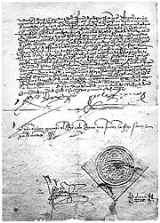
Alhambra decree

Encyclopedia
Catholic Monarchs
The Catholic Monarchs is the collective title used in history for Queen Isabella I of Castile and King Ferdinand II of Aragon. They were both from the House of Trastámara and were second cousins, being both descended from John I of Castile; they were given a papal dispensation to deal with...
of Spain
Spain
Spain , officially the Kingdom of Spain languages]] under the European Charter for Regional or Minority Languages. In each of these, Spain's official name is as follows:;;;;;;), is a country and member state of the European Union located in southwestern Europe on the Iberian Peninsula...
(Isabella I of Castile
Isabella I of Castile
Isabella I was Queen of Castile and León. She and her husband Ferdinand II of Aragon brought stability to both kingdoms that became the basis for the unification of Spain. Later the two laid the foundations for the political unification of Spain under their grandson, Charles V, Holy Roman Emperor...
and Ferdinand II of Aragon
Ferdinand II of Aragon
Ferdinand the Catholic was King of Aragon , Sicily , Naples , Valencia, Sardinia, and Navarre, Count of Barcelona, jure uxoris King of Castile and then regent of that country also from 1508 to his death, in the name of...
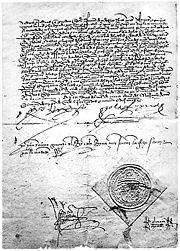
) ordering the expulsion of Jews from the Kingdom of Spain and its territories and possessions by 31 July of that year.
The edict was formally revoked on 16 December 1968, following the Second Vatican Council
Second Vatican Council
The Second Vatican Council addressed relations between the Roman Catholic Church and the modern world. It was the twenty-first Ecumenical Council of the Catholic Church and the second to be held at St. Peter's Basilica in the Vatican. It opened under Pope John XXIII on 11 October 1962 and closed...
. Today, the number of Jews in Spain is estimated at 50,000.
Background
Beginning in the 8th century, MuslimsUmayyad conquest of Hispania
The Umayyad conquest of Hispania is the initial Islamic Ummayad Caliphate's conquest, between 711 and 718, of the Christian Visigothic Kingdom of Hispania, centered in the Iberian Peninsula, which was known to them under the Arabic name al-Andalus....
had occupied and settled most of the Iberian Peninsula
Iberian Peninsula
The Iberian Peninsula , sometimes called Iberia, is located in the extreme southwest of Europe and includes the modern-day sovereign states of Spain, Portugal and Andorra, as well as the British Overseas Territory of Gibraltar...
. Jews, who had lived in these regions since Roman times
Roman Empire
The Roman Empire was the post-Republican period of the ancient Roman civilization, characterised by an autocratic form of government and large territorial holdings in Europe and around the Mediterranean....
, were considered "People of the Book
People of the Book
People of the Book is a term used to designate non-Muslim adherents to faiths which have a revealed scripture called, in Arabic, Al-Kitab . The three types of adherents to faiths that the Qur'an mentions as people of the book are the Jews, Sabians and Christians.In Islam, the Muslim scripture, the...
"' and given special status and often thrived under Muslim rule. The tolerance of the Muslim Moorish
Moors
The description Moors has referred to several historic and modern populations of the Maghreb region who are predominately of Berber and Arab descent. They came to conquer and rule the Iberian Peninsula for nearly 800 years. At that time they were Muslim, although earlier the people had followed...
rulers of al-Andalus
Al-Andalus
Al-Andalus was the Arabic name given to a nation and territorial region also commonly referred to as Moorish Iberia. The name describes parts of the Iberian Peninsula and Septimania governed by Muslims , at various times in the period between 711 and 1492, although the territorial boundaries...
attracted Jewish immigration, and Jewish enclaves in Muslim Iberian cities flourished as places of learning and commerce. Progressively, however, living conditions for Jews in al-Andalus became harsher, especially after the fall of the Muslim Umayyad Caliphate.
The Reconquista
Reconquista
The Reconquista was a period of almost 800 years in the Middle Ages during which several Christian kingdoms succeeded in retaking the Muslim-controlled areas of the Iberian Peninsula broadly known as Al-Andalus...
was the gradual reconquest of Islamic Iberia by the Catholic
Catholic
The word catholic comes from the Greek phrase , meaning "on the whole," "according to the whole" or "in general", and is a combination of the Greek words meaning "about" and meaning "whole"...
kingdoms with a powerful religious motivation: Iberia was being reclaimed for Christendom. By the 14th century, most of the Iberian Peninsula, present day Spain and Portugal
Portugal
Portugal , officially the Portuguese Republic is a country situated in southwestern Europe on the Iberian Peninsula. Portugal is the westernmost country of Europe, and is bordered by the Atlantic Ocean to the West and South and by Spain to the North and East. The Atlantic archipelagos of the...
, had been regained from the Moors.
Overt hostility against Jews became more pronounced, finding expression in brutal episodes of violence and oppression. Thousands of Jews sought to escape these attacks by converting to Catholicism; they were commonly called converso
Converso
A converso and its feminine form conversa was a Jew or Muslim—or a descendant of Jews or Muslims—who converted to Catholicism in Spain or Portugal, particularly during the 14th and 15th centuries. Mass conversions once took place under significant government pressure...
s, New Christian
New Christian
New Christian was a term used to refer to Iberian Jews and Muslims who converted to Roman Catholicism, and their known baptized descendants. The term was introduced by the Old Christians of Iberia who wanted to distinguish themselves from the conversos...
s, or marrano
Marrano
Marranos were Jews living in the Iberian peninsula who converted to Christianity rather than be expelled but continued to observe rabbinic Judaism in secret...
s. At first these conversions seemed an effective solution to the cultural conflict: many converso families met with social and commercial success. But eventually their success made these new Catholics unpopular with some of the clergy of the Church and royal hierarchies.
These suspicions on the part of Christians were only heightened by the fact that some of the coerced conversions were undoubtedly insincere. Some, but not all, conversos had understandably chosen to salvage their social and commercial prestige by the only option open to them – baptism and embrace of Christianity – while privately adhering to their Jewish practice and faith. These secret practitioners are commonly referred to as crypto-Jews
Crypto-Judaism
Crypto-Judaism is the secret adherence to Judaism while publicly professing to be of another faith; practitioners are referred to as "crypto-Jews"...
or marranos.
The existence of crypto-Jews was a provocation for secular and ecclesiastical leaders who were already hostile toward Spain's Jewry. The uncertainty over the sincerity of Jewish converts added fuel to the fire of antisemitism in 15th-century Spain.
European context
From the 13th to the 16th centuries many European countries expelled the Jews from their territory on at least 15 occasions, with Spain being preceded by England, France and Germany, among many others, and succeeded by at least five more expulsions. So Spain does not provide any exception to a tragic history of the life of Jews among Christian nations.Ferdinand and Isabella
The hostility toward Jews was brought to a climax by "the Catholic MonarchsCatholic Monarchs
The Catholic Monarchs is the collective title used in history for Queen Isabella I of Castile and King Ferdinand II of Aragon. They were both from the House of Trastámara and were second cousins, being both descended from John I of Castile; they were given a papal dispensation to deal with...
" – Ferdinand II
Ferdinand II of Aragon
Ferdinand the Catholic was King of Aragon , Sicily , Naples , Valencia, Sardinia, and Navarre, Count of Barcelona, jure uxoris King of Castile and then regent of that country also from 1508 to his death, in the name of...
and Isabella I
Isabella I of Castile
Isabella I was Queen of Castile and León. She and her husband Ferdinand II of Aragon brought stability to both kingdoms that became the basis for the unification of Spain. Later the two laid the foundations for the political unification of Spain under their grandson, Charles V, Holy Roman Emperor...
, whose marriage in 1469 formed a personal union
Personal union
A personal union is the combination by which two or more different states have the same monarch while their boundaries, their laws and their interests remain distinct. It should not be confused with a federation which is internationally considered a single state...
of the crowns of Aragon
Crown of Aragon
The Crown of Aragon Corona d'Aragón Corona d'Aragó Corona Aragonum controlling a large portion of the present-day eastern Spain and southeastern France, as well as some of the major islands and mainland possessions stretching across the Mediterranean as far as Greece...
and Castile
Crown of Castile
The Crown of Castile was a medieval and modern state in the Iberian Peninsula that formed in 1230 as a result of the third and definitive union of the crowns and parliaments of the kingdoms of Castile and León upon the accession of the then King Ferdinand III of Castile to the vacant Leonese throne...
, with coordinated policies between their distinct kingdoms.
Ferdinand and Isabella took seriously the reports that some crypto-Jews were not only privately practicing their former faith, but were secretly trying to draw other conversos back into the Jewish fold. In 1480 King Ferdinand devised and, with his wife, established the Spanish Inquisition
Spanish Inquisition
The Tribunal of the Holy Office of the Inquisition , commonly known as the Spanish Inquisition , was a tribunal established in 1480 by Catholic Monarchs Ferdinand II of Aragon and Isabella I of Castile. It was intended to maintain Catholic orthodoxy in their kingdoms, and to replace the Medieval...
in both Castile and Aragon to investigate these and other suspicions. It is not known how many had not truly converted, had lapsed from their new Christianity, or were attempting to persuade others to revert.
The independent Islamic Emirate of Granada
Emirate of Granada
The Emirate of Granada , also known as the Nasrid Kingdom of Granada , was an emirate established in 1238 following the defeat of Muhammad an-Nasir of the Almohad dynasty by an alliance of Christian kingdoms at the Battle of Las Navas de Tolosa in 1212...
had been a tributary state
Tributary state
The term tributary state refers to one of the two main ways in which a pre-modern state might be subordinate to a more powerful neighbour. The heart of the relationship was that the tributary would send a regular token of submission to the superior power...
to Castile since 1238. In 1491, in preparation for an imminent transition to Castilian territory, the Treaty of Granada was signed by Emir Muhammad XII and the Queen of Castile, protecting the religious freedoms of the Jews and Muslims there. In 1492, Ferdinand and Isabella completed the Catholic Reconquista
Reconquista
The Reconquista was a period of almost 800 years in the Middle Ages during which several Christian kingdoms succeeded in retaking the Muslim-controlled areas of the Iberian Peninsula broadly known as Al-Andalus...
of the Iberian Peninsula from Islamic al-Andalus
Al-Andalus
Al-Andalus was the Arabic name given to a nation and territorial region also commonly referred to as Moorish Iberia. The name describes parts of the Iberian Peninsula and Septimania governed by Muslims , at various times in the period between 711 and 1492, although the territorial boundaries...
by victory in the Battle of Granada
Battle of Granada
The Battle of Granada was a siege of the city of Granada fought over a period of months leading up to its surrender on January 2, 1492. The city was captured by the combined forces of Aragon and Castile from the armies of the Muslim Emirate of Granada...
. In acquiring the city of Granada
Granada
Granada is a city and the capital of the province of Granada, in the autonomous community of Andalusia, Spain. Granada is located at the foot of the Sierra Nevada mountains, at the confluence of three rivers, the Beiro, the Darro and the Genil. It sits at an elevation of 738 metres above sea...
a large Jewish and Muslim population came under her rule. Soon Isabella and Ferdinand chose to replace the Treaty of Granada's Jewish protection terms with the Alhambra Decree's Inquisitional Castilian and Aragonite persecution.
The Decree
The king and queen issued the Alhambra Decree less than three months after the surrender of Granada. In it, Jews were accused of trying "to subvert their holy Catholic faith and trying to draw faithful Christians away from their beliefs."These measures were not new in Europe.
Some Jews were even only given four months and ordered to convert to Christianity or leave the country. Under the edict, Jews were promised royal "protection and security" for the effective three-month window before the deadline. They were permitted to take their belongings with them – except "gold or silver or minted money".
The punishment for any Jew who did not convert or leave by the deadline was death. The punishment for a non-Jew who sheltered or hid Jews was the confiscation of all belongings and hereditary privileges.
Dispersal
The Spanish JewsSephardi Jews
Sephardi Jews is a general term referring to the descendants of the Jews who lived in the Iberian Peninsula before their expulsion in the Spanish Inquisition. It can also refer to those who use a Sephardic style of liturgy or would otherwise define themselves in terms of the Jewish customs and...
who chose to leave Spain dispersed
Jewish diaspora
The Jewish diaspora is the English term used to describe the Galut גלות , or 'exile', of the Jews from the region of the Kingdom of Judah and Roman Iudaea and later emigration from wider Eretz Israel....
throughout the region of North Africa known as the Maghreb
Maghreb
The Maghreb is the region of Northwest Africa, west of Egypt. It includes five countries: Morocco, Algeria, Tunisia, Libya, and Mauritania and the disputed territory of Western Sahara...
. They also fled to south-eastern Europe
Europe
Europe is, by convention, one of the world's seven continents. Comprising the westernmost peninsula of Eurasia, Europe is generally 'divided' from Asia to its east by the watershed divides of the Ural and Caucasus Mountains, the Ural River, the Caspian and Black Seas, and the waterways connecting...
where they were granted safety and formed flourishing local Jewish communities, the largest being those of Salonica and Sarajevo
Sarajevo
Sarajevo |Bosnia]], surrounded by the Dinaric Alps and situated along the Miljacka River in the heart of Southeastern Europe and the Balkans....
. In those regions, they often intermingled with the already existing Mizrachi
Mizrahi Jews
Mizrahi Jews or Mizrahiyim, , also referred to as Adot HaMizrach are Jews descended from the Jewish communities of the Middle East, North Africa and the Caucasus...
(Middle Eastern Jewish) communities.
Scholars disagree about how many Jews left Spain as a result of the decree; the numbers vary between 130,000 and 800,000. Many (likely more than half) went to Portugal
Portugal
Portugal , officially the Portuguese Republic is a country situated in southwestern Europe on the Iberian Peninsula. Portugal is the westernmost country of Europe, and is bordered by the Atlantic Ocean to the West and South and by Spain to the North and East. The Atlantic archipelagos of the...
, where they eluded persecution for only a few years (see Portuguese Inquisition
Portuguese Inquisition
The Portuguese Inquisition was formally established in Portugal in 1536 at the request of the King of Portugal, João III. Manuel I had asked for the installation of the Inquisition in 1515 to fulfill the commitment of marriage with Maria of Aragon, but it was only after his death that the Pope...
). The Jewish community in Portugal (perhaps then some 10% of that country's population ) were then declared Christians by Royal decree unless they left, but since their departure was severely hindered by the King (who needed their expertise for Portugal's overseas enterprises), the vast majority was forced to stay as nominal Christians.
http://www.jewfaq.org/ashkseph.htm
Conversions
Other Spanish Jews (estimates range between 50,000 and 70,000) chose to avoid expulsion by conversion to Christianity. However, their conversion did not protect them from ecclesiastical hostility after the Spanish Inquisition came into full effect; persecution and expulsion were common. Many of these "New Christians" were eventually forced to either leave the countries or intermarry with the local populace by the dual Inquisitions of Portugal and Spain. Many settled in North Africa, Latin America or elsewhere in Europe, most notably in the Netherlands, and England (see Sephardic Jews in the NetherlandsSephardic Jews in the Netherlands
As a result of the Inquisition, many Sephardim left the Iberian peninsula at the end of the 15th century and throughout the 16th century, in search for religious freedom. Some of them found their way to the newly independent Dutch provinces: independent from the reign of Spain, Sephardic Jews from...
, History of the Marranos in England
History of the Marranos in England
The History of Marranos in England consists of the Marranos' contribution and achievement in England.-Arrival of Marranos:Toward the middle of the 17th century a considerable number of Marrano merchants settled in London and formed there a secret congregation, at the head of which was Antonio...
).
However, recent Y chromosome
Y chromosome
The Y chromosome is one of the two sex-determining chromosomes in most mammals, including humans. In mammals, it contains the gene SRY, which triggers testis development if present. The human Y chromosome is composed of about 60 million base pairs...
DNA testing conducted by the University of Leicester
University of Leicester
The University of Leicester is a research-led university based in Leicester, England. The main campus is a mile south of the city centre, adjacent to Victoria Park and Wyggeston and Queen Elizabeth I College....
and the Pompeu Fabra University
Pompeu Fabra University
Pompeu Fabra University is a university in Barcelona, Catalonia, Spain. It is widely considered to be one of the best universities in Spain and in Europe, and was ranked 1st in scientific productivity in Spain in 2009. Founded in 1990, it is named after the Catalan philologist Pompeu Fabra...
has indicated that around 20% of Spanish men today have direct patrilineal descent from Sephardic Jews. The result is in contradiction or not replicated in all the body of genetic studies done in Iberia and conflicts with mainstream historiography (denies Neolithic
Neolithic
The Neolithic Age, Era, or Period, or New Stone Age, was a period in the development of human technology, beginning about 9500 BC in some parts of the Middle East, and later in other parts of the world. It is traditionally considered as the last part of the Stone Age...
, Roman
Ancient Rome
Ancient Rome was a thriving civilization that grew on the Italian Peninsula as early as the 8th century BC. Located along the Mediterranean Sea and centered on the city of Rome, it expanded to one of the largest empires in the ancient world....
, Greek
Ancient Greece
Ancient Greece is a civilization belonging to a period of Greek history that lasted from the Archaic period of the 8th to 6th centuries BC to the end of antiquity. Immediately following this period was the beginning of the Early Middle Ages and the Byzantine era. Included in Ancient Greece is the...
, Phoenicia
Phoenicia
Phoenicia , was an ancient civilization in Canaan which covered most of the western, coastal part of the Fertile Crescent. Several major Phoenician cities were built on the coastline of the Mediterranean. It was an enterprising maritime trading culture that spread across the Mediterranean from 1550...
n, Germanic
Germanic peoples
The Germanic peoples are an Indo-European ethno-linguistic group of Northern European origin, identified by their use of the Indo-European Germanic languages which diversified out of Proto-Germanic during the Pre-Roman Iron Age.Originating about 1800 BCE from the Corded Ware Culture on the North...
, Alani, Slavic
Slavic peoples
The Slavic people are an Indo-European panethnicity living in Eastern Europe, Southeast Europe, North Asia and Central Asia. The term Slavic represents a broad ethno-linguistic group of people, who speak languages belonging to the Slavic language family and share, to varying degrees, certain...
, Arab
Arab
Arab people, also known as Arabs , are a panethnicity primarily living in the Arab world, which is located in Western Asia and North Africa. They are identified as such on one or more of genealogical, linguistic, or cultural grounds, with tribal affiliations, and intra-tribal relationships playing...
and other contributions to modern Iberians) and has been questioned by the authors themselves and by Stephen Oppenheimer
Stephen Oppenheimer
Stephen Oppenheimer is a British paediatrician, geneticist, and writer. He is a member of Green Templeton College, Oxford and an honorary fellow of Liverpool School of Tropical Medicine, and carries out and publishes research in the fields of genetics and human prehistory.-Career:Oppenheimer...
.
Don Isaac Abravanel and the Alhambra decree
Legend does claim that DonDon (honorific)
Don, from Latin dominus, is an honorific in Spanish , Portuguese , and Italian . The female equivalent is Doña , Dona , and Donna , abbreviated "Dª" or simply "D."-Usage:...
Isaac Abravanel
Isaac Abrabanel
Isaac ben Judah Abrabanel, , commonly referred to just as Abarbanel, was a Portuguese Jewish statesman, philosopher, Bible commentator, and financier.-Biography:...
, who had previously ransomed 480 Jewish converts of Malaga from the Catholic monarchs by a payment of 20,000 doubloon
Doubloon
The doubloon , was a two-escudo or 32-reales gold coin, weighing 6.77 grams . Doubloons were minted in Spain, Mexico, Peru, and Nueva Granada...
s, now offered them 600,000 ducat
Ducat
The ducat is a gold coin that was used as a trade coin throughout Europe before World War I. Its weight is 3.4909 grams of .986 gold, which is 0.1107 troy ounce, actual gold weight...
s for the revocation of the edict. It is said also that Ferdinand hesitated, but was prevented from accepting the offer by Tomás de Torquemada
Tomás de Torquemada
Tomás de Torquemada, O.P. was a fifteenth century Spanish Dominican friar, first Inquisitor General of Spain, and confessor to Isabella I of Castile. He was described by the Spanish chronicler Sebastián de Olmedo as "The hammer of heretics, the light of Spain, the saviour of his country, the...
, the grand inquisitor, who dashed into the royal presence and, throwing a crucifix down before the king and queen, asked whether, like Judas
Judas Iscariot
Judas Iscariot was, according to the New Testament, one of the twelve disciples of Jesus. He is best known for his betrayal of Jesus to the hands of the chief priests for 30 pieces of silver.-Etymology:...
, they would betray their Lord for money.
The 1988 novel
Novel
A novel is a book of long narrative in literary prose. The genre has historical roots both in the fields of the medieval and early modern romance and in the tradition of the novella. The latter supplied the present generic term in the late 18th century....
The Alhambra Decree by David Raphael contains a fictionalized response to the Alhambra decree attributed to Isaac Abrabanel. It is commonly (and mistakenly) cited as genuine.
See also
- Jewish refugeesJewish refugeesIn the course of history, Jewish populations have been expelled or ostracised by various local authorities and have sought asylum from antisemitism numerous times...
- Jewish diasporaJewish diasporaThe Jewish diaspora is the English term used to describe the Galut גלות , or 'exile', of the Jews from the region of the Kingdom of Judah and Roman Iudaea and later emigration from wider Eretz Israel....
- Edict of ExpulsionEdict of ExpulsionIn 1290, King Edward I issued an edict expelling all Jews from England. Lasting for the rest of the Middle Ages, it would be over 350 years until it was formally overturned in 1656...
- Edict of FontainebleauEdict of FontainebleauThe Edict of Fontainebleau was an edict issued by Louis XIV of France, also known as the Revocation of the Edict of Nantes. The Edict of Nantes of 1598, had granted the Huguenots the right to practice their religion without persecution from the state...
- Expulsions of the Jews from France
- Expulsion of the Jews from SicilyExpulsion of the Jews from SicilyThe expulsion of the Jews from Sicily began in 1493 when the Spanish Inquisition reached the island of Sicily and its Jewish population of more than 30,000 Jews.-History of the Sicilian Jews:...
- Expulsion of the MoriscosExpulsion of the MoriscosOn April 9, 1609, King Philip III of Spain decreed the Expulsion of the Moriscos . The Moriscos were the descendants of the Muslim population that converted to Christianity under threat of exile from Ferdinand and Isabella in 1502...
- 1731 Expulsion of Protestants from Salzburg
External links
- http://users.mo-net.com/mlindste/alhambra.html Alhambra Decree – English translation