

Averroism

Encyclopedia
Averroism is the term applied to either of two philosophical
trends among scholastics
in the late 13th century: (a) the Arab philosopher
Averroës or Ibn Rushd
's interpretations of Aristotle
and his reconciliation of Aristotelianism
with Islamic faith; and (b) the application of these ideas in the Latin Christian and Jewish intellectual traditions, such as Siger of Brabant
, Boetius of Dacia
, and Maimonides
. The term was originally coined by Ernst Renan.
was probably the most widely condemned thinker in the medieval Christian world... Averroism became virtually synonymous with atheism in the late Middle Ages and early Renaissance . As an historiographical category it was first developed by Ernest Renan in Averroès et l'averroïsme (1852). Later historians applied the name to significant uses and expressions of elements of Averroes' doctrines and to the exegetical tradition of Aristotle
by Jewish and Christian thinkers as it had come down through the Latin and Hebrew traditions. "Averroist" can therefore describe a range of positions, up to and including scholars interested in the historical phenomenon of Averroes' influence .
Etienne Tempier
of the Roman Catholic Church
. Tempier specified 219 different unacceptable Averroist theses. It has been pointed out that Tempier's main accusations are almost identical to those brought by Al-Ghazali
against philosophers in general in his Incoherence of the Philosophers, which Averroës had tried to demonstrate to be unjustified in The Incoherence of the Incoherence
.
To resolve the problem, Siger tried to claim that there existed a "double truth": a factual or "hard" truth that is reached through science and philosophy, and a "religious" truth that is reached through religion. This idea differed from that of Averroës; his idea was that there was one truth reached in different ways, not two truths. He did however believe that Scripture sometimes uses metaphorical language, but that those without the philosophical training to appreciate the true meaning of the passages in question were obliged to believe the literal meaning.
 The later philosophical concept of Averroism was the idea that the philosophical and religious worlds are separate entities. However, upon scrutinizing the 219 theses condemned by Tempier, it was obvious that not many of them originated in Averroës. Radical Aristotelianism
and heterodox Aristotelianism
were the terms commonly used for a while to refer to the actual philosophical movement started by Siger and Boëthius and differentiate it from Averroism; nowadays most scholars just call it Averroism as well.
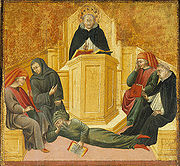
Thomas Aquinas
specifically attacked the doctrine of monopsychism
and panpsychism
in his book De unitate intellectus contra Averroistas. In this context, the term Averroism is used correctly.
Although condemned in 1277, many Averroistic theses survived to the 16th century and can be found in the philosophies of Giordano Bruno
, Pico della Mirandola, and Cesare Cremonini
.These theses talk about the superiority of philosophers to the common people and the relation between the intellect and human dignity.
was also notably influenced by Averroism, his panentheism flowing from Averroistic monopsychism, as was Spinoza's belief in the higher state of the philosophers and tendencies toward secularism. Arguably, Spinozan Averrosim went on to influence Jewish Conservatism
and Reconstructionism
.
Philosophy
Philosophy is the study of general and fundamental problems, such as those connected with existence, knowledge, values, reason, mind, and language. Philosophy is distinguished from other ways of addressing such problems by its critical, generally systematic approach and its reliance on rational...
trends among scholastics
Scholasticism
Scholasticism is a method of critical thought which dominated teaching by the academics of medieval universities in Europe from about 1100–1500, and a program of employing that method in articulating and defending orthodoxy in an increasingly pluralistic context...
in the late 13th century: (a) the Arab philosopher
Early Islamic philosophy
Early Islamic philosophy or classical Islamic philosophy is a period of intense philosophical development beginning in the 2nd century AH of the Islamic calendar and lasting until the 6th century AH...
Averroës or Ibn Rushd
Averroes
' , better known just as Ibn Rushd , and in European literature as Averroes , was a Muslim polymath; a master of Aristotelian philosophy, Islamic philosophy, Islamic theology, Maliki law and jurisprudence, logic, psychology, politics, Arabic music theory, and the sciences of medicine, astronomy,...
's interpretations of Aristotle
Aristotle
Aristotle was a Greek philosopher and polymath, a student of Plato and teacher of Alexander the Great. His writings cover many subjects, including physics, metaphysics, poetry, theater, music, logic, rhetoric, linguistics, politics, government, ethics, biology, and zoology...
and his reconciliation of Aristotelianism
Aristotelianism
Aristotelianism is a tradition of philosophy that takes its defining inspiration from the work of Aristotle. The works of Aristotle were initially defended by the members of the Peripatetic school, and, later on, by the Neoplatonists, who produced many commentaries on Aristotle's writings...
with Islamic faith; and (b) the application of these ideas in the Latin Christian and Jewish intellectual traditions, such as Siger of Brabant
Siger of Brabant
Siger of Brabant was a 13th century philosopher from the southern Low Countries who was an important proponent of Averroism...
, Boetius of Dacia
Boetius of Dacia
Boetius of Dacia was a 13th century Danish philosopher....
, and Maimonides
Maimonides
Moses ben-Maimon, called Maimonides and also known as Mūsā ibn Maymūn in Arabic, or Rambam , was a preeminent medieval Jewish philosopher and one of the greatest Torah scholars and physicians of the Middle Ages...
. The term was originally coined by Ernst Renan.
Definition
Averroes at the time of Dante AlighieriDante Alighieri
Durante degli Alighieri, mononymously referred to as Dante , was an Italian poet, prose writer, literary theorist, moral philosopher, and political thinker. He is best known for the monumental epic poem La commedia, later named La divina commedia ...
was probably the most widely condemned thinker in the medieval Christian world... Averroism became virtually synonymous with atheism in the late Middle Ages and early Renaissance . As an historiographical category it was first developed by Ernest Renan in Averroès et l'averroïsme (1852). Later historians applied the name to significant uses and expressions of elements of Averroes' doctrines and to the exegetical tradition of Aristotle
Aristotle
Aristotle was a Greek philosopher and polymath, a student of Plato and teacher of Alexander the Great. His writings cover many subjects, including physics, metaphysics, poetry, theater, music, logic, rhetoric, linguistics, politics, government, ethics, biology, and zoology...
by Jewish and Christian thinkers as it had come down through the Latin and Hebrew traditions. "Averroist" can therefore describe a range of positions, up to and including scholars interested in the historical phenomenon of Averroes' influence .
Key positions
The main ideas of the earlier philosophical concept of Averroism — found in Averroës' commentaries to Aristotle — were :- there is one truth, but there are (at least) two ways to reach it: through philosophyPhilosophyPhilosophy is the study of general and fundamental problems, such as those connected with existence, knowledge, values, reason, mind, and language. Philosophy is distinguished from other ways of addressing such problems by its critical, generally systematic approach and its reliance on rational...
and through religionReligionReligion is a collection of cultural systems, belief systems, and worldviews that establishes symbols that relate humanity to spirituality and, sometimes, to moral values. Many religions have narratives, symbols, traditions and sacred histories that are intended to give meaning to life or to...
; - the worldWorldWorld is a common name for the whole of human civilization, specifically human experience, history, or the human condition in general, worldwide, i.e. anywhere on Earth....
is eternal; - the soul is divided into two parts: one individual, and one divine;
- the individual soul is not eternal;
- all humans at the basic level share one and the same intellect (a form of monopsychismMonopsychismMonopsychism is the belief that all humans share one and the same eternal consciousness, soul, mind or intellect. It is a recurring theme in many mystical traditions....
) - resurrection of the deadResurrectionResurrection refers to the literal coming back to life of the biologically dead. It is used both with respect to particular individuals or the belief in a General Resurrection of the dead at the end of the world. The General Resurrection is featured prominently in Jewish, Christian, and Muslim...
;
Christian Averroism
This standpoint resulted in two condemnations in 1270 and 1277 by bishopBishop
A bishop is an ordained or consecrated member of the Christian clergy who is generally entrusted with a position of authority and oversight. Within the Catholic Church, Eastern Orthodox, Oriental Orthodox Churches, in the Assyrian Church of the East, in the Independent Catholic Churches, and in the...
Etienne Tempier
Étienne Tempier
Étienne Tempier was a French bishop of Paris during the 13th century...
of the Roman Catholic Church
Roman Catholic Church
The Catholic Church, also known as the Roman Catholic Church, is the world's largest Christian church, with over a billion members. Led by the Pope, it defines its mission as spreading the gospel of Jesus Christ, administering the sacraments and exercising charity...
. Tempier specified 219 different unacceptable Averroist theses. It has been pointed out that Tempier's main accusations are almost identical to those brought by Al-Ghazali
Al-Ghazali
Abu Hāmed Mohammad ibn Mohammad al-Ghazzālī , known as Algazel to the western medieval world, born and died in Tus, in the Khorasan province of Persia was a Persian Muslim theologian, jurist, philosopher, and mystic....
against philosophers in general in his Incoherence of the Philosophers, which Averroës had tried to demonstrate to be unjustified in The Incoherence of the Incoherence
The Incoherence of the Incoherence
The Incoherence of the Incoherence by Andalusian Muslim polymath and philosopher Ibn Rushd is an important Islamic philosophical treatise, in which the author defends the use of Aristotelian philosophy within Islamic thought.It was written in the style of a dialogue against Al-Ghazali's claims...
.
To resolve the problem, Siger tried to claim that there existed a "double truth": a factual or "hard" truth that is reached through science and philosophy, and a "religious" truth that is reached through religion. This idea differed from that of Averroës; his idea was that there was one truth reached in different ways, not two truths. He did however believe that Scripture sometimes uses metaphorical language, but that those without the philosophical training to appreciate the true meaning of the passages in question were obliged to believe the literal meaning.
Aristotelianism
Aristotelianism is a tradition of philosophy that takes its defining inspiration from the work of Aristotle. The works of Aristotle were initially defended by the members of the Peripatetic school, and, later on, by the Neoplatonists, who produced many commentaries on Aristotle's writings...
and heterodox Aristotelianism
Aristotelianism
Aristotelianism is a tradition of philosophy that takes its defining inspiration from the work of Aristotle. The works of Aristotle were initially defended by the members of the Peripatetic school, and, later on, by the Neoplatonists, who produced many commentaries on Aristotle's writings...
were the terms commonly used for a while to refer to the actual philosophical movement started by Siger and Boëthius and differentiate it from Averroism; nowadays most scholars just call it Averroism as well.
Thomas Aquinas
Thomas Aquinas
Thomas Aquinas, O.P. , also Thomas of Aquin or Aquino, was an Italian Dominican priest of the Catholic Church, and an immensely influential philosopher and theologian in the tradition of scholasticism, known as Doctor Angelicus, Doctor Communis, or Doctor Universalis...
specifically attacked the doctrine of monopsychism
Monopsychism
Monopsychism is the belief that all humans share one and the same eternal consciousness, soul, mind or intellect. It is a recurring theme in many mystical traditions....
and panpsychism
Panpsychism
In philosophy, panpsychism is the view that all matter has a mental aspect, or, alternatively, all objects have a unified center of experience or point of view...
in his book De unitate intellectus contra Averroistas. In this context, the term Averroism is used correctly.
Although condemned in 1277, many Averroistic theses survived to the 16th century and can be found in the philosophies of Giordano Bruno
Giordano Bruno
Giordano Bruno , born Filippo Bruno, was an Italian Dominican friar, philosopher, mathematician and astronomer. His cosmological theories went beyond the Copernican model in proposing that the Sun was essentially a star, and moreover, that the universe contained an infinite number of inhabited...
, Pico della Mirandola, and Cesare Cremonini
Cesare Cremonini (philosopher)
Cesare Cremonini, sometimes Cesare Cremonino , was an Italian professor of natural philosophy, working rationalism and Aristotelian materialism inside scholasticism...
.These theses talk about the superiority of philosophers to the common people and the relation between the intellect and human dignity.
Jewish Averroism
Baruch SpinozaBaruch Spinoza
Baruch de Spinoza and later Benedict de Spinoza was a Dutch Jewish philosopher. Revealing considerable scientific aptitude, the breadth and importance of Spinoza's work was not fully realized until years after his death...
was also notably influenced by Averroism, his panentheism flowing from Averroistic monopsychism, as was Spinoza's belief in the higher state of the philosophers and tendencies toward secularism. Arguably, Spinozan Averrosim went on to influence Jewish Conservatism
Conservatism
Conservatism is a political and social philosophy that promotes the maintenance of traditional institutions and supports, at the most, minimal and gradual change in society. Some conservatives seek to preserve things as they are, emphasizing stability and continuity, while others oppose modernism...
and Reconstructionism
Reconstructionism
Reconstructionism may refer to:* Christian Reconstructionism, a Calvinistic theological-political movement* Polytheistic reconstructionism, an approach to Neopaganism* Progressive Reconstructionism, an interfaith community...
.
External links
- Averroism from the Routledge Encyclopedia of PhilosophyRoutledge Encyclopedia of PhilosophyThe Routledge Encyclopedia of Philosophy is an encyclopedia of philosophy edited by Edward Craig that was first published by Routledge in 1998 . Originally published in both 10 volumes of print and as a CD-ROM, in 2002 it was made available online on a subscription basis...
- Jewish Averroism, Routledge Encyclopedia of Philosophy
- Averroism from the Jewish EncyclopediaJewish EncyclopediaThe Jewish Encyclopedia is an encyclopedia originally published in New York between 1901 and 1906 by Funk and Wagnalls. It contained over 15,000 articles in 12 volumes on the history and then-current state of Judaism and the Jews as of 1901...
(1906) - Averroism and the philosophy of Judaism. - "The Eternal Conversation", a personal account of Averroism in the Medieval and Modern Jewish intellectual tradition.