


Radhanite

Encyclopedia
The Radhanites were medieval Jewish
merchant
s. Whether the term, which is used by only a limited number of primary sources, refers to a specific guild
, or a clan
, or is a generic term for Jewish merchants in the trans-Eurasia
n trade network is unclear. Jewish merchants dominated trade
between the Christian
and Islamic worlds during the early Middle Ages
(approx. 500–1000 AD). Many trade routes previously established under the Roman Empire
continued to function during that period largely through their efforts. Their trade network covered much of Europe
, North Africa
, the Middle East
, Central Asia
and parts of India
and China
.
, believe it refers to a district in Mesopotamia
called "the land of Radhan" in Arabic
and Hebrew
texts of the period. Others maintain that their center was the city of Ray
(Rhages) in northern Persia. Cecil Roth
and Claude Cahen
, among others, make the same claim about the Rhône
River valley in France
, which is Rhodanus in Latin
. The latter claim that the center of Radhanite activity was probably in France as all of their trade routes began there. Still others maintain that the name derives from the Persian
terms rah "way, path" and dān "one who knows", meaning "one who knows the way". English-language (or Western) sources added the suffix -ite to the term, as is done with ethnonym
s or names derived from place names.
, the Director of Posts and Police (spymaster and postman) for the province of Jibal
under the Abbasid
Caliph
al-Mu'tamid
(ruled 869–885), when he wrote Kitab al-Masalik wal-Mamalik (Book of Roads and Kingdoms
), probably around 870. Ibn Khordadbeh described the Radhanites as sophisticated and multilingual. He outlined four main trade routes utilized by the Radhanites in their journeys; all four began in the Rhône
Valley in southern France
and terminated on east coast of China
. Radhanites primarily carried commodities that combined small bulk and high demand, including spice
s, perfume
s, jewelry, and silk
. They are also described as transporting oil
s, incense
, steel
weapons, fur
s, and slaves
(in particular, the Slavic
Saqāliba
).
 During the Early Middle Ages
the Islam
ic polities of the Middle East
and North Africa
and the Christian kingdoms of Europe
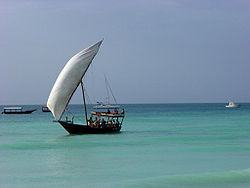
often banned each others' merchants from entering their ports. Corsairs of both sides raided the shipping of their adversaries at will. The Radhanites functioned as neutral go-betweens, keeping open the lines of communication and trade between the lands of the old Roman Empire
and the Far East
. As a result of the revenue they brought, Jewish merchants enjoyed significant privileges under the early Carolingians in France and throughout the Muslim world, a fact that sometimes vexed local Church authorities.
While most trade between Europe and East Asia had historically been conducted via Persian and Central Asia
n intermediaries, the Radhanites were among the first to establish a trade network that stretched from Western Europe to Eastern Asia. More remarkable still, they engaged in this trade regularly and over an extended period of time, centuries before Marco Polo
and ibn Battuta
brought their tales of travel in the Orient
to the Christians and the Muslims, respectively. Indeed, ibn Battuta is believed to have traveled with the Muslim traders who traveled to the Orient on routes similar to those used by the Radhanites.
While traditionally many historians believed that the art of Chinese paper
-making had been transmitted to Europe via Arab merchants who got the secret from prisoners of war
taken at the Battle of Talas
, some believe that Jewish merchants such as the Radhanites were instrumental in bringing paper-making west. Joseph of Spain
, possibly a Radhanite, is credited by some sources with introducing the so-called Hindu-Arabic numerals from India to Europe. Historically, Jewish communities used letters of credit to transport large quantities of money without the risk of theft from at least classical times. This system was developed and put into force on an unprecedented scale by medieval Jewish merchants such as the Radhanites; if so, they may be counted among the precursors to the bank
s that arose during the late Middle Ages
and early modern period
.
Some scholars believe that the Radhanites may have played a role in the conversion of the Khazars
to Judaism. In addition, they may have helped establish Jewish communities at various points along their trade routes, and were probably involved in the early Jewish settlement of Eastern Europe
, Central Asia, China and India.
 Besides ibn Khordadbeh, the Radhanites are mentioned by name only by a handful of sources. Ibn al-Faqih
's early 10th century Kitab al-Buldan
("Book of the Countries") mentions them, but much of ibn al-Faqih's information was derived from ibn Khordadbeh's work. Sefer ha-Dinim, a Hebrew account of the travels of Yehuda ben Meir
of Mainz
, named Przemyśl
and Kiev
as trading sites along the Radhanite route. In the early 12th century, a French-Jewish trader named Yitzhak Dorbelo wrote that he traveled with Radhanite merchants to Poland
.
of China
in 908 and the destruction of the Khazar
Khagan
ate some sixty years later ( circa 968-969 AD ) led to widespread chaos in Inner Eurasia
, the Caucasus
and China. Trade routes became unstable and unsafe, a situation exacerbated by Turkic
invasions of Persia and the Middle East
, and the Silk Road
largely collapsed for centuries. This period saw the rise of the mercantile Italian
city-states, especially Genoa
, Venice
, Pisa
, and Amalfi
, who viewed the Radhanites as unwanted competitors.
The economy of Europe was profoundly affected by the disappearance of the Radhanites. For example, documentary evidence indicates that many spices in regular use during the early Middle Ages completely disappeared from European tables in the 10th century. Jews had previously, in large parts of Western Europe, enjoyed a virtual monopoly on the spice trade
.
Judaism
Judaism ) is the "religion, philosophy, and way of life" of the Jewish people...
merchant
Merchant
A merchant is a businessperson who trades in commodities that were produced by others, in order to earn a profit.Merchants can be one of two types:# A wholesale merchant operates in the chain between producer and retail merchant...
s. Whether the term, which is used by only a limited number of primary sources, refers to a specific guild
Guild
A guild is an association of craftsmen in a particular trade. The earliest types of guild were formed as confraternities of workers. They were organized in a manner something between a trade union, a cartel, and a secret society...
, or a clan
Clan
A clan is a group of people united by actual or perceived kinship and descent. Even if lineage details are unknown, clan members may be organized around a founding member or apical ancestor. The kinship-based bonds may be symbolical, whereby the clan shares a "stipulated" common ancestor that is a...
, or is a generic term for Jewish merchants in the trans-Eurasia
Eurasia
Eurasia is a continent or supercontinent comprising the traditional continents of Europe and Asia ; covering about 52,990,000 km2 or about 10.6% of the Earth's surface located primarily in the eastern and northern hemispheres...
n trade network is unclear. Jewish merchants dominated trade
Trade
Trade is the transfer of ownership of goods and services from one person or entity to another. Trade is sometimes loosely called commerce or financial transaction or barter. A network that allows trade is called a market. The original form of trade was barter, the direct exchange of goods and...
between the Christian
Christendom
Christendom, or the Christian world, has several meanings. In a cultural sense it refers to the worldwide community of Christians, adherents of Christianity...
and Islamic worlds during the early Middle Ages
Early Middle Ages
The Early Middle Ages was the period of European history lasting from the 5th century to approximately 1000. The Early Middle Ages followed the decline of the Western Roman Empire and preceded the High Middle Ages...
(approx. 500–1000 AD). Many trade routes previously established under the Roman Empire
Roman Empire
The Roman Empire was the post-Republican period of the ancient Roman civilization, characterised by an autocratic form of government and large territorial holdings in Europe and around the Mediterranean....
continued to function during that period largely through their efforts. Their trade network covered much of Europe
Europe
Europe is, by convention, one of the world's seven continents. Comprising the westernmost peninsula of Eurasia, Europe is generally 'divided' from Asia to its east by the watershed divides of the Ural and Caucasus Mountains, the Ural River, the Caspian and Black Seas, and the waterways connecting...
, North Africa
North Africa
North Africa or Northern Africa is the northernmost region of the African continent, linked by the Sahara to Sub-Saharan Africa. Geopolitically, the United Nations definition of Northern Africa includes eight countries or territories; Algeria, Egypt, Libya, Morocco, South Sudan, Sudan, Tunisia, and...
, the Middle East
Middle East
The Middle East is a region that encompasses Western Asia and Northern Africa. It is often used as a synonym for Near East, in opposition to Far East...
, Central Asia
Central Asia
Central Asia is a core region of the Asian continent from the Caspian Sea in the west, China in the east, Afghanistan in the south, and Russia in the north...
and parts of India
India
India , officially the Republic of India , is a country in South Asia. It is the seventh-largest country by geographical area, the second-most populous country with over 1.2 billion people, and the most populous democracy in the world...
and China
China
Chinese civilization may refer to:* China for more general discussion of the country.* Chinese culture* Greater China, the transnational community of ethnic Chinese.* History of China* Sinosphere, the area historically affected by Chinese culture...
.
Etymology
Several etymologies have been suggested for the word "Radhanite". Many scholars, including Barbier de Meynard and Moshe GilMoshe Gil
Moshe Gil is an Israeli historian.-Academic career:Moshe Gil specializes in the historical interaction between Islam and the Jews, including the history of Palestine under the Islamic domination, the institution of the Exilarchate, and Jewish merchants such as the Radhanites...
, believe it refers to a district in Mesopotamia
Mesopotamia
Mesopotamia is a toponym for the area of the Tigris–Euphrates river system, largely corresponding to modern-day Iraq, northeastern Syria, southeastern Turkey and southwestern Iran.Widely considered to be the cradle of civilization, Bronze Age Mesopotamia included Sumer and the...
called "the land of Radhan" in Arabic
Arabic language
Arabic is a name applied to the descendants of the Classical Arabic language of the 6th century AD, used most prominently in the Quran, the Islamic Holy Book...
and Hebrew
Hebrew language
Hebrew is a Semitic language of the Afroasiatic language family. Culturally, is it considered by Jews and other religious groups as the language of the Jewish people, though other Jewish languages had originated among diaspora Jews, and the Hebrew language is also used by non-Jewish groups, such...
texts of the period. Others maintain that their center was the city of Ray
Ray, Iran
Rey or Ray , also known as Rhages and formerly as Arsacia, is the capital of Rey County, Tehran Province, Iran, and is the oldest existing city in the province....
(Rhages) in northern Persia. Cecil Roth
Cecil Roth
Cecil Roth , was a British Jewish historian.He was educated at Merton College, Oxford and returned to Oxford as reader in Jewish Studies from 1939 to 1964...
and Claude Cahen
Claude Cahen
Claude Cahen was a French Marxist orientalist and historian. He specialized in the studies of the Islamic Middle Ages, Muslim sources about the Crusades, and social history of the medieval Islamic society ....
, among others, make the same claim about the Rhône
Rhône
Rhone can refer to:* Rhone, one of the major rivers of Europe, running through Switzerland and France* Rhône Glacier, the source of the Rhone River and one of the primary contributors to Lake Geneva in the far eastern end of the canton of Valais in Switzerland...
River valley in France
France
The French Republic , The French Republic , The French Republic , (commonly known as France , is a unitary semi-presidential republic in Western Europe with several overseas territories and islands located on other continents and in the Indian, Pacific, and Atlantic oceans. Metropolitan France...
, which is Rhodanus in Latin
Latin
Latin is an Italic language originally spoken in Latium and Ancient Rome. It, along with most European languages, is a descendant of the ancient Proto-Indo-European language. Although it is considered a dead language, a number of scholars and members of the Christian clergy speak it fluently, and...
. The latter claim that the center of Radhanite activity was probably in France as all of their trade routes began there. Still others maintain that the name derives from the Persian
Persian language
Persian is an Iranian language within the Indo-Iranian branch of the Indo-European languages. It is primarily spoken in Iran, Afghanistan, Tajikistan and countries which historically came under Persian influence...
terms rah "way, path" and dān "one who knows", meaning "one who knows the way". English-language (or Western) sources added the suffix -ite to the term, as is done with ethnonym
Ethnonym
An ethnonym is the name applied to a given ethnic group. Ethnonyms can be divided into two categories: exonyms and autonyms or endonyms .As an example, the ethnonym for...
s or names derived from place names.
Activities
The activities of the Radhanites are documented by Abu'l Qasim Ubaid'Allah ibn KhordadbehIbn Khordadbeh
Abu'l Qasim Ubaid'Allah ibn Khordadbeh , author of the earliest surviving Arabic book of administrative geography, was a Persian geographer and bureaucrat of the 9th century...
, the Director of Posts and Police (spymaster and postman) for the province of Jibal
Jibal
Jibāl was a short-lived Arab-ruled province located in western Iran, under the Abbasid Caliphate of Baghdad. It was roughly coterminous with the ancient country of the Medes. In 10th century it came back under Persian rule ....
under the Abbasid
Abbasid
The Abbasid Caliphate or, more simply, the Abbasids , was the third of the Islamic caliphates. It was ruled by the Abbasid dynasty of caliphs, who built their capital in Baghdad after overthrowing the Umayyad caliphate from all but the al-Andalus region....
Caliph
Caliph
The Caliph is the head of state in a Caliphate, and the title for the ruler of the Islamic Ummah, an Islamic community ruled by the Shari'ah. It is a transcribed version of the Arabic word which means "successor" or "representative"...
al-Mu'tamid
Al-Mu'tamid
This article is about the Abbasid Caliph al-Mu'tamid of Baghdad. For the Andalusi Arabic poet who was also the Abbadid king of Seville, see Muhammad Ibn Abbad Al Mutamid...
(ruled 869–885), when he wrote Kitab al-Masalik wal-Mamalik (Book of Roads and Kingdoms
Book of Roads and Kingdoms (ibn Khordadbeh)
The Book of Roads and Kingdoms is a 9th-century geography text by the Persian geographer Ibn Khordadbeh. It maps and describes the major trade routes of the time within the Muslim world, and discusses distant trading regions such as Japan, Korea, and China...
), probably around 870. Ibn Khordadbeh described the Radhanites as sophisticated and multilingual. He outlined four main trade routes utilized by the Radhanites in their journeys; all four began in the Rhône
Rhône
Rhone can refer to:* Rhone, one of the major rivers of Europe, running through Switzerland and France* Rhône Glacier, the source of the Rhone River and one of the primary contributors to Lake Geneva in the far eastern end of the canton of Valais in Switzerland...
Valley in southern France
France
The French Republic , The French Republic , The French Republic , (commonly known as France , is a unitary semi-presidential republic in Western Europe with several overseas territories and islands located on other continents and in the Indian, Pacific, and Atlantic oceans. Metropolitan France...
and terminated on east coast of China
China
Chinese civilization may refer to:* China for more general discussion of the country.* Chinese culture* Greater China, the transnational community of ethnic Chinese.* History of China* Sinosphere, the area historically affected by Chinese culture...
. Radhanites primarily carried commodities that combined small bulk and high demand, including spice
Spice
A spice is a dried seed, fruit, root, bark, or vegetative substance used in nutritionally insignificant quantities as a food additive for flavor, color, or as a preservative that kills harmful bacteria or prevents their growth. It may be used to flavour a dish or to hide other flavours...
s, perfume
Perfume
Perfume is a mixture of fragrant essential oils and/or aroma compounds, fixatives, and solvents used to give the human body, animals, objects, and living spaces "a pleasant scent"...
s, jewelry, and silk
Silk
Silk is a natural protein fiber, some forms of which can be woven into textiles. The best-known type of silk is obtained from the cocoons of the larvae of the mulberry silkworm Bombyx mori reared in captivity...
. They are also described as transporting oil
Oil
An oil is any substance that is liquid at ambient temperatures and does not mix with water but may mix with other oils and organic solvents. This general definition includes vegetable oils, volatile essential oils, petrochemical oils, and synthetic oils....
s, incense
Incense
Incense is composed of aromatic biotic materials, which release fragrant smoke when burned. The term "incense" refers to the substance itself, rather than to the odor that it produces. It is used in religious ceremonies, ritual purification, aromatherapy, meditation, for creating a mood, and for...
, steel
Steel
Steel is an alloy that consists mostly of iron and has a carbon content between 0.2% and 2.1% by weight, depending on the grade. Carbon is the most common alloying material for iron, but various other alloying elements are used, such as manganese, chromium, vanadium, and tungsten...
weapons, fur
Fur
Fur is a synonym for hair, used more in reference to non-human animals, usually mammals; particularly those with extensives body hair coverage. The term is sometimes used to refer to the body hair of an animal as a complete coat, also known as the "pelage". Fur is also used to refer to animal...
s, and slaves
Slavery
Slavery is a system under which people are treated as property to be bought and sold, and are forced to work. Slaves can be held against their will from the time of their capture, purchase or birth, and deprived of the right to leave, to refuse to work, or to demand compensation...
(in particular, the Slavic
Slavic peoples
The Slavic people are an Indo-European panethnicity living in Eastern Europe, Southeast Europe, North Asia and Central Asia. The term Slavic represents a broad ethno-linguistic group of people, who speak languages belonging to the Slavic language family and share, to varying degrees, certain...
Saqāliba
Saqaliba
Saqaliba refers to the Slavs, particularly Slavic slaves and mercenaries in the medieval Arab world, in the Middle East, North Africa, Sicily and Al-Andalus. It is generally thought that the Arabic term is a Byzantine loanword: saqlab, siklab, saqlabi etc. is a corruption of Greek Sklavinoi for...
).
Text of Ibn Khordadbeh's account
- These merchants speak ArabicArabic languageArabic is a name applied to the descendants of the Classical Arabic language of the 6th century AD, used most prominently in the Quran, the Islamic Holy Book...
, PersianPersian languagePersian is an Iranian language within the Indo-Iranian branch of the Indo-European languages. It is primarily spoken in Iran, Afghanistan, Tajikistan and countries which historically came under Persian influence...
, Roman, the FrankOld FrenchOld French was the Romance dialect continuum spoken in territories that span roughly the northern half of modern France and parts of modern Belgium and Switzerland from the 9th century to the 14th century...
, SpanishSpanish languageSpanish , also known as Castilian , is a Romance language in the Ibero-Romance group that evolved from several languages and dialects in central-northern Iberia around the 9th century and gradually spread with the expansion of the Kingdom of Castile into central and southern Iberia during the...
, and SlavSlavic languagesThe Slavic languages , a group of closely related languages of the Slavic peoples and a subgroup of Indo-European languages, have speakers in most of Eastern Europe, in much of the Balkans, in parts of Central Europe, and in the northern part of Asia.-Branches:Scholars traditionally divide Slavic...
languages. They journey from West to East, from East to West, partly on land, partly by sea. They transport from the West eunuchEunuchA eunuch is a person born male most commonly castrated, typically early enough in his life for this change to have major hormonal consequences...
s, female slaves, boys, brocadeSilkSilk is a natural protein fiber, some forms of which can be woven into textiles. The best-known type of silk is obtained from the cocoons of the larvae of the mulberry silkworm Bombyx mori reared in captivity...
, castorBeaverThe beaver is a primarily nocturnal, large, semi-aquatic rodent. Castor includes two extant species, North American Beaver and Eurasian Beaver . Beavers are known for building dams, canals, and lodges . They are the second-largest rodent in the world...
, martenMartenThe martens constitute the genus Martes within the subfamily Mustelinae, in family Mustelidae.-Description:Martens are slender, agile animals, adapted to living in taigas, and are found in coniferous and northern deciduous forests across the northern hemisphere. They have bushy tails, and large...
and other furs, and swordSwordA sword is a bladed weapon used primarily for cutting or thrusting. The precise definition of the term varies with the historical epoch or the geographical region under consideration...
s. They take ship from Firanja (France), on the Western SeaMediterranean SeaThe Mediterranean Sea is a sea connected to the Atlantic Ocean surrounded by the Mediterranean region and almost completely enclosed by land: on the north by Anatolia and Europe, on the south by North Africa, and on the east by the Levant...
, and make for Farama (PelusiumPelusiumPelusium was a city in the eastern extremes of Egypt's Nile Delta, 30 km to the southeast of the modern Port Said. Alternative names include Sena and Per-Amun , Pelousion , Sin , Seyân , and Tell el-Farama...
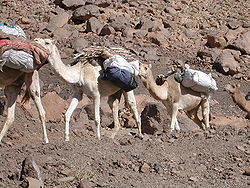
). There they load their goods on camelCamelA camel is an even-toed ungulate within the genus Camelus, bearing distinctive fatty deposits known as humps on its back. There are two species of camels: the dromedary or Arabian camel has a single hump, and the bactrian has two humps. Dromedaries are native to the dry desert areas of West Asia,...
-back and go by landCamel trainA camel train is a series of camels carrying goods or passengers in a group as part of a regular or semi-regular service between two points. Although they rarely travelled faster than the walking speed of a man, camels' ability to handle harsh conditions made camel trains a vital part of...
to al-Kolzum (SuezSuezSuez is a seaport city in north-eastern Egypt, located on the north coast of the Gulf of Suez , near the southern terminus of the Suez Canal, having the same boundaries as Suez governorate. It has three harbors, Adabya, Ain Sokhna and Port Tawfiq, and extensive port facilities...
), a distance of twenty-five farsakhs (parasangParasangThe parasang is a historical Iranian unit of itinerant distance comparable to the European league.In antiquity, the term was used throughout much of the Middle East, and the Old Iranian language from which it derives can no longer be determined...
s). They embark in the East SeaRed SeaThe Red Sea is a seawater inlet of the Indian Ocean, lying between Africa and Asia. The connection to the ocean is in the south through the Bab el Mandeb strait and the Gulf of Aden. In the north, there is the Sinai Peninsula, the Gulf of Aqaba, and the Gulf of Suez...
and sail from al-Kolzum to al-Jar (port of MedinaMedinaMedina , or ; also transliterated as Madinah, or madinat al-nabi "the city of the prophet") is a city in the Hejaz region of western Saudi Arabia, and serves as the capital of the Al Madinah Province. It is the second holiest city in Islam, and the burial place of the Islamic Prophet Muhammad, and...
) and al-JeddahJeddahJeddah, Jiddah, Jidda, or Jedda is a city located on the coast of the Red Sea and is the major urban center of western Saudi Arabia. It is the largest city in Makkah Province, the largest sea port on the Red Sea, and the second largest city in Saudi Arabia after the capital city, Riyadh. The...
, then they go to SindSindhSindh historically referred to as Ba'ab-ul-Islam , is one of the four provinces of Pakistan and historically is home to the Sindhi people. It is also locally known as the "Mehran". Though Muslims form the largest religious group in Sindh, a good number of Christians, Zoroastrians and Hindus can...
, IndiaIndiaIndia , officially the Republic of India , is a country in South Asia. It is the seventh-largest country by geographical area, the second-most populous country with over 1.2 billion people, and the most populous democracy in the world...
, and ChinaChinaChinese civilization may refer to:* China for more general discussion of the country.* Chinese culture* Greater China, the transnational community of ethnic Chinese.* History of China* Sinosphere, the area historically affected by Chinese culture...
. On their return from China they carry back muskMuskMusk is a class of aromatic substances commonly used as base notes in perfumery. They include glandular secretions from animals such as the musk deer, numerous plants emitting similar fragrances, and artificial substances with similar odors. Musk was a name originally given to a substance with a...
, aloeAloeAloe , also Aloë, is a genus containing about 500 species of flowering succulent plants. The most common and well known of these is Aloe vera, or "true aloe"....
s, camphorCamphorCamphor is a waxy, white or transparent solid with a strong, aromatic odor. It is a terpenoid with the chemical formula C10H16O. It is found in wood of the camphor laurel , a large evergreen tree found in Asia and also of Dryobalanops aromatica, a giant of the Bornean forests...
, cinnamonCinnamonCinnamon is a spice obtained from the inner bark of several trees from the genus Cinnamomum that is used in both sweet and savoury foods...
, and other products of the Eastern countries to al-Kolzum and bring them back to Farama, where they again embark on the Western Sea. Some make sail for ConstantinopleConstantinopleConstantinople was the capital of the Roman, Eastern Roman, Byzantine, Latin, and Ottoman Empires. Throughout most of the Middle Ages, Constantinople was Europe's largest and wealthiest city.-Names:...
to sell their goods to the RomansByzantine EmpireThe Byzantine Empire was the Eastern Roman Empire during the periods of Late Antiquity and the Middle Ages, centred on the capital of Constantinople. Known simply as the Roman Empire or Romania to its inhabitants and neighbours, the Empire was the direct continuation of the Ancient Roman State...
; others go to the palace of the King of the Franks to place their goods. Sometimes these Jew merchants, when embarking from the land of the FranksFranksThe Franks were a confederation of Germanic tribes first attested in the third century AD as living north and east of the Lower Rhine River. From the third to fifth centuries some Franks raided Roman territory while other Franks joined the Roman troops in Gaul. Only the Salian Franks formed a...
, on the Western Sea, make for AntiochAntiochAntioch on the Orontes was an ancient city on the eastern side of the Orontes River. It is near the modern city of Antakya, Turkey.Founded near the end of the 4th century BC by Seleucus I Nicator, one of Alexander the Great's generals, Antioch eventually rivaled Alexandria as the chief city of the...
(at the head of the Orontes RiverOrontes RiverThe Orontes or ‘Āṣī is a river of Lebanon, Syria and Turkey.It was anciently the chief river of the Levant, also called Draco, Typhon and Axius...
); thence by land to al-Jabia (al-HanayaAl-HanayaAl-Hanaya is a town in Iraq, on the Euphrates River. It was mentioned as one of the cities frequently visited by Radhanite merchants....
on the bank of the Euphrates), where they arrive after three days’ march. There they embark on the Euphrates and reach BaghdadBaghdadBaghdad is the capital of Iraq, as well as the coterminous Baghdad Governorate. The population of Baghdad in 2011 is approximately 7,216,040...
, whence they sail down the Tigris, to al-Obolla. From al-Obolla they sail for OmanOmanOman , officially called the Sultanate of Oman , is an Arab state in southwest Asia on the southeast coast of the Arabian Peninsula. It is bordered by the United Arab Emirates to the northwest, Saudi Arabia to the west, and Yemen to the southwest. The coast is formed by the Arabian Sea on the...
, SindhSindhSindh historically referred to as Ba'ab-ul-Islam , is one of the four provinces of Pakistan and historically is home to the Sindhi people. It is also locally known as the "Mehran". Though Muslims form the largest religious group in Sindh, a good number of Christians, Zoroastrians and Hindus can...
, Hind, and China ...
- These different journeys can also be made by land. The merchants that start from Spain or France go to Sus al-AksaSus al-AksaSus al-Aksa or Sus al-Aqsa was a town in North Africa, in what is now Morocco. It was located near modern Tangier and was part of a trade network connecting the Straits of Gibraltar with Kairouan, Libya and Egypt...
(in MoroccoMoroccoMorocco , officially the Kingdom of Morocco , is a country located in North Africa. It has a population of more than 32 million and an area of 710,850 km², and also primarily administers the disputed region of the Western Sahara...
) and then to TangierTangierTangier, also Tangiers is a city in northern Morocco with a population of about 700,000 . It lies on the North African coast at the western entrance to the Strait of Gibraltar where the Mediterranean meets the Atlantic Ocean off Cape Spartel...
, whence they walk to KairouanKairouanKairouan , also known as Kirwan or al-Qayrawan , is the capital of the Kairouan Governorate in Tunisia. Referred to as the Islamic Cultural Capital, it is a UNESCO World Heritage site. The city was founded by the Arabs around 670...
and the capital of EgyptEgyptEgypt , officially the Arab Republic of Egypt, Arabic: , is a country mainly in North Africa, with the Sinai Peninsula forming a land bridge in Southwest Asia. Egypt is thus a transcontinental country, and a major power in Africa, the Mediterranean Basin, the Middle East and the Muslim world...
. Thence they go to ar-RamlaRamlaRamla , is a city in central Israel. The city is predominantly Jewish with a significant Arab minority. Ramla was founded circa 705–715 AD by the Umayyad Caliph Suleiman ibn Abed al-Malik after the Arab conquest of the region...
, visit DamascusDamascusDamascus , commonly known in Syria as Al Sham , and as the City of Jasmine , is the capital and the second largest city of Syria after Aleppo, both are part of the country's 14 governorates. In addition to being one of the oldest continuously inhabited cities in the world, Damascus is a major...
, al-KufaKufaKufa is a city in Iraq, about south of Baghdad, and northeast of Najaf. It is located on the banks of the Euphrates River. The estimated population in 2003 was 110,000....
, Baghdad, and al-BasraBasraBasra is the capital of Basra Governorate, in southern Iraq near Kuwait and Iran. It had an estimated population of two million as of 2009...
, cross Ahwaz, Fars, Kirman, Sind, Hind, and arrive in China.
- Sometimes, also, they take the route behind RomeRomeRome is the capital of Italy and the country's largest and most populated city and comune, with over 2.7 million residents in . The city is located in the central-western portion of the Italian Peninsula, on the Tiber River within the Lazio region of Italy.Rome's history spans two and a half...
and, passing through the country of the SlavsSlavic peoplesThe Slavic people are an Indo-European panethnicity living in Eastern Europe, Southeast Europe, North Asia and Central Asia. The term Slavic represents a broad ethno-linguistic group of people, who speak languages belonging to the Slavic language family and share, to varying degrees, certain...
, arrive at KhamlidjKhamlijIn the accounts of ibn Khordadbeh and other Muslim writers, Khamlij or Khamlidj refers to the capital of the Khazars. Most scholars agree that Khamlij is the Khazar city of Atil...
, the capital of the KhazarsKhazarsThe Khazars were semi-nomadic Turkic people who established one of the largest polities of medieval Eurasia, with the capital of Atil and territory comprising much of modern-day European Russia, western Kazakhstan, eastern Ukraine, Azerbaijan, large portions of the northern Caucasus , parts of...
. They embark on the Jorjan SeaCaspian SeaThe Caspian Sea is the largest enclosed body of water on Earth by area, variously classed as the world's largest lake or a full-fledged sea. The sea has a surface area of and a volume of...
, arrive at BalkhBalkhBalkh , was an ancient city and centre of Zoroastrianism in what is now northern Afghanistan. Today it is a small town in the province of Balkh, about 20 kilometers northwest of the provincial capital, Mazar-e Sharif, and some south of the Amu Darya. It was one of the major cities of Khorasan...
, betake themselves from there across the Oxus, and continue their journey toward YurtYurtA yurt is a portable, bent wood-framed dwelling structure traditionally used by Turkic nomads in the steppes of Central Asia. The structure comprises a crown or compression wheel usually steam bent, supported by roof ribs which are bent down at the end where they meet the lattice wall...
, ToghuzghuzUyghur peopleThe Uyghur are a Turkic ethnic group living in Eastern and Central Asia. Today, Uyghurs live primarily in the Xinjiang Uyghur Autonomous Region in the People's Republic of China...
, and from there to China.
Historical significance
Early Middle Ages
The Early Middle Ages was the period of European history lasting from the 5th century to approximately 1000. The Early Middle Ages followed the decline of the Western Roman Empire and preceded the High Middle Ages...
the Islam
Islam
Islam . The most common are and . : Arabic pronunciation varies regionally. The first vowel ranges from ~~. The second vowel ranges from ~~~...
ic polities of the Middle East
Middle East
The Middle East is a region that encompasses Western Asia and Northern Africa. It is often used as a synonym for Near East, in opposition to Far East...
and North Africa
North Africa
North Africa or Northern Africa is the northernmost region of the African continent, linked by the Sahara to Sub-Saharan Africa. Geopolitically, the United Nations definition of Northern Africa includes eight countries or territories; Algeria, Egypt, Libya, Morocco, South Sudan, Sudan, Tunisia, and...
and the Christian kingdoms of Europe
Europe
Europe is, by convention, one of the world's seven continents. Comprising the westernmost peninsula of Eurasia, Europe is generally 'divided' from Asia to its east by the watershed divides of the Ural and Caucasus Mountains, the Ural River, the Caspian and Black Seas, and the waterways connecting...
often banned each others' merchants from entering their ports. Corsairs of both sides raided the shipping of their adversaries at will. The Radhanites functioned as neutral go-betweens, keeping open the lines of communication and trade between the lands of the old Roman Empire
Roman Empire
The Roman Empire was the post-Republican period of the ancient Roman civilization, characterised by an autocratic form of government and large territorial holdings in Europe and around the Mediterranean....
and the Far East
Far East
The Far East is an English term mostly describing East Asia and Southeast Asia, with South Asia sometimes also included for economic and cultural reasons.The term came into use in European geopolitical discourse in the 19th century,...
. As a result of the revenue they brought, Jewish merchants enjoyed significant privileges under the early Carolingians in France and throughout the Muslim world, a fact that sometimes vexed local Church authorities.
While most trade between Europe and East Asia had historically been conducted via Persian and Central Asia
Central Asia
Central Asia is a core region of the Asian continent from the Caspian Sea in the west, China in the east, Afghanistan in the south, and Russia in the north...
n intermediaries, the Radhanites were among the first to establish a trade network that stretched from Western Europe to Eastern Asia. More remarkable still, they engaged in this trade regularly and over an extended period of time, centuries before Marco Polo
Marco Polo
Marco Polo was a Venetian merchant traveler from the Venetian Republic whose travels are recorded in Il Milione, a book which did much to introduce Europeans to Central Asia and China. He learned about trading whilst his father and uncle, Niccolò and Maffeo, travelled through Asia and apparently...
and ibn Battuta
Ibn Battuta
Abu Abdullah Muhammad Ibn Battuta , or simply Ibn Battuta, also known as Shams ad–Din , was a Muslim Moroccan Berber explorer, known for his extensive travels published in the Rihla...
brought their tales of travel in the Orient
Orient
The Orient means "the East." It is a traditional designation for anything that belongs to the Eastern world or the Far East, in relation to Europe. In English it is a metonym that means various parts of Asia.- Derivation :...
to the Christians and the Muslims, respectively. Indeed, ibn Battuta is believed to have traveled with the Muslim traders who traveled to the Orient on routes similar to those used by the Radhanites.
While traditionally many historians believed that the art of Chinese paper
Paper
Paper is a thin material mainly used for writing upon, printing upon, drawing or for packaging. It is produced by pressing together moist fibers, typically cellulose pulp derived from wood, rags or grasses, and drying them into flexible sheets....
-making had been transmitted to Europe via Arab merchants who got the secret from prisoners of war
Prisoner of war
A prisoner of war or enemy prisoner of war is a person, whether civilian or combatant, who is held in custody by an enemy power during or immediately after an armed conflict...
taken at the Battle of Talas
Battle of Talas
The Battle of Talas in 751 AD was an especially notable conflict between the Arab Abbasid Caliphate and the Chinese Tang Dynasty for control not only of the Syr Darya region, but even more...
, some believe that Jewish merchants such as the Radhanites were instrumental in bringing paper-making west. Joseph of Spain
Joseph of Spain
Jewish merchant of the ninth and tenth centuries CE and may have been a Radhanite. He may or may not be identical with the "Joseph of Spain" who authored numerous mathematical treatises in use in Europe in medieval times....
, possibly a Radhanite, is credited by some sources with introducing the so-called Hindu-Arabic numerals from India to Europe. Historically, Jewish communities used letters of credit to transport large quantities of money without the risk of theft from at least classical times. This system was developed and put into force on an unprecedented scale by medieval Jewish merchants such as the Radhanites; if so, they may be counted among the precursors to the bank
Bank
A bank is a financial institution that serves as a financial intermediary. The term "bank" may refer to one of several related types of entities:...
s that arose during the late Middle Ages
Late Middle Ages
The Late Middle Ages was the period of European history generally comprising the 14th to the 16th century . The Late Middle Ages followed the High Middle Ages and preceded the onset of the early modern era ....
and early modern period
Early modern period
In history, the early modern period of modern history follows the late Middle Ages. Although the chronological limits of the period are open to debate, the timeframe spans the period after the late portion of the Middle Ages through the beginning of the Age of Revolutions...
.
Some scholars believe that the Radhanites may have played a role in the conversion of the Khazars
Khazars
The Khazars were semi-nomadic Turkic people who established one of the largest polities of medieval Eurasia, with the capital of Atil and territory comprising much of modern-day European Russia, western Kazakhstan, eastern Ukraine, Azerbaijan, large portions of the northern Caucasus , parts of...
to Judaism. In addition, they may have helped establish Jewish communities at various points along their trade routes, and were probably involved in the early Jewish settlement of Eastern Europe
Eastern Europe
Eastern Europe is the eastern part of Europe. The term has widely disparate geopolitical, geographical, cultural and socioeconomic readings, which makes it highly context-dependent and even volatile, and there are "almost as many definitions of Eastern Europe as there are scholars of the region"...
, Central Asia, China and India.
Ibn al-Faqih
Ibn al-Faqih al-Hamadani was a 10th century Persian historian and geographer, famous for his Mukhtasar Kitab al-Buldan .-References:...
's early 10th century Kitab al-Buldan
Kitab al-Buldan
Kitab al-Buldan is translated as "Book of Lands" or "Book of Countries" and may refer to one of the following.*Kitab al-Buldan by Al-Yaqubi...
("Book of the Countries") mentions them, but much of ibn al-Faqih's information was derived from ibn Khordadbeh's work. Sefer ha-Dinim, a Hebrew account of the travels of Yehuda ben Meir
Yehuda ben Meir
Yehuda ben Meir, also known as Yehuda ha-Kohen or Judah of Mainz, was a German rabbi, Talmudic scholar and traveler of the late tenth and early eleventh century CE. His book Sefer ha-Dinim contains an account of his travels and those of other Jews in Eastern Europe...
of Mainz
Mainz
Mainz under the Holy Roman Empire, and previously was a Roman fort city which commanded the west bank of the Rhine and formed part of the northernmost frontier of the Roman Empire...
, named Przemyśl
Przemysl
Przemyśl is a city in south-eastern Poland with 66,756 inhabitants, as of June 2009. In 1999, it became part of the Podkarpackie Voivodeship; it was previously the capital of Przemyśl Voivodeship....
and Kiev
Kiev
Kiev or Kyiv is the capital and the largest city of Ukraine, located in the north central part of the country on the Dnieper River. The population as of the 2001 census was 2,611,300. However, higher numbers have been cited in the press....
as trading sites along the Radhanite route. In the early 12th century, a French-Jewish trader named Yitzhak Dorbelo wrote that he traveled with Radhanite merchants to Poland
Poland
Poland , officially the Republic of Poland , is a country in Central Europe bordered by Germany to the west; the Czech Republic and Slovakia to the south; Ukraine, Belarus and Lithuania to the east; and the Baltic Sea and Kaliningrad Oblast, a Russian exclave, to the north...
.
End of the Radhanite age
The fall of the Tang DynastyTang Dynasty
The Tang Dynasty was an imperial dynasty of China preceded by the Sui Dynasty and followed by the Five Dynasties and Ten Kingdoms Period. It was founded by the Li family, who seized power during the decline and collapse of the Sui Empire...
of China
China
Chinese civilization may refer to:* China for more general discussion of the country.* Chinese culture* Greater China, the transnational community of ethnic Chinese.* History of China* Sinosphere, the area historically affected by Chinese culture...
in 908 and the destruction of the Khazar
Khazars
The Khazars were semi-nomadic Turkic people who established one of the largest polities of medieval Eurasia, with the capital of Atil and territory comprising much of modern-day European Russia, western Kazakhstan, eastern Ukraine, Azerbaijan, large portions of the northern Caucasus , parts of...
Khagan
Khagan
Khagan or qagan , alternatively spelled kagan, khaghan, qaghan, or chagan, is a title of imperial rank in the Mongolian and Turkic languages equal to the status of emperor and someone who rules a khaganate...
ate some sixty years later ( circa 968-969 AD ) led to widespread chaos in Inner Eurasia
Eurasia
Eurasia is a continent or supercontinent comprising the traditional continents of Europe and Asia ; covering about 52,990,000 km2 or about 10.6% of the Earth's surface located primarily in the eastern and northern hemispheres...
, the Caucasus
Caucasus
The Caucasus, also Caucas or Caucasia , is a geopolitical region at the border of Europe and Asia, and situated between the Black and the Caspian sea...
and China. Trade routes became unstable and unsafe, a situation exacerbated by Turkic
Turkic peoples
The Turkic peoples are peoples residing in northern, central and western Asia, southern Siberia and northwestern China and parts of eastern Europe. They speak languages belonging to the Turkic language family. They share, to varying degrees, certain cultural traits and historical backgrounds...
invasions of Persia and the Middle East
Middle East
The Middle East is a region that encompasses Western Asia and Northern Africa. It is often used as a synonym for Near East, in opposition to Far East...
, and the Silk Road
Silk Road
The Silk Road or Silk Route refers to a historical network of interlinking trade routes across the Afro-Eurasian landmass that connected East, South, and Western Asia with the Mediterranean and European world, as well as parts of North and East Africa...
largely collapsed for centuries. This period saw the rise of the mercantile Italian
Italy
Italy , officially the Italian Republic languages]] under the European Charter for Regional or Minority Languages. In each of these, Italy's official name is as follows:;;;;;;;;), is a unitary parliamentary republic in South-Central Europe. To the north it borders France, Switzerland, Austria and...
city-states, especially Genoa
Genoa
Genoa |Ligurian]] Zena ; Latin and, archaically, English Genua) is a city and an important seaport in northern Italy, the capital of the Province of Genoa and of the region of Liguria....
, Venice
Venice
Venice is a city in northern Italy which is renowned for the beauty of its setting, its architecture and its artworks. It is the capital of the Veneto region...
, Pisa
Pisa
Pisa is a city in Tuscany, Central Italy, on the right bank of the mouth of the River Arno on the Tyrrhenian Sea. It is the capital city of the Province of Pisa...
, and Amalfi
Amalfi
Amalfi is a town and comune in the province of Salerno, in the region of Campania, Italy, on the Gulf of Salerno, c. 35 km southeast of Naples. It lies at the mouth of a deep ravine, at the foot of Monte Cerreto , surrounded by dramatic cliffs and coastal scenery...
, who viewed the Radhanites as unwanted competitors.
The economy of Europe was profoundly affected by the disappearance of the Radhanites. For example, documentary evidence indicates that many spices in regular use during the early Middle Ages completely disappeared from European tables in the 10th century. Jews had previously, in large parts of Western Europe, enjoyed a virtual monopoly on the spice trade
Spice trade
Civilizations of Asia were involved in spice trade from the ancient times, and the Greco-Roman world soon followed by trading along the Incense route and the Roman-India routes...
.
See also
- Amber RoadAmber RoadThe Amber Road was an ancient trade route for the transfer of amber. As one of the waterways and ancient highways, for centuries the road led from Europe to Asia and back, and from northern Africa to the Baltic Sea....
- Benjamin of TudelaBenjamin of TudelaBenjamin of Tudela was a medieval Jewish traveler who visited Europe, Asia, and Africa in the 12th century. His vivid descriptions of western Asia preceded those of Marco Polo by a hundred years...
- Cochin JewsCochin JewsCochin Jews, also called Malabar Jews , are the oldest group of Jews in India, with roots claimed to date to the time of King Solomon, though historically attested migration dates from the fall of Jerusalem in 70 CE. Historically, they lived in the Kingdom of Cochin in South India, now part of the...
- CaravanseraiCaravanseraiA caravanserai, or khan, also known as caravansary, caravansera, or caravansara in English was a roadside inn where travelers could rest and recover from the day's journey...
- Eldad ha-DaniEldad ha-DaniEldad ha-Dani or Eldad HaDani or Eldad ben Mahli ha-Dani was a Jewish, Hebrew-writing merchant and traveler of the ninth century. He professed to have been a citizen of an "independent Jewish state" in eastern Africa, probably in the Gihon region, inhabited by people claiming descent from the...
- History of the Jews in ChinaHistory of the Jews in ChinaJews and Judaism in China have had a long history. Jewish settlers are documented in China as early as the 7th or 8th century CE, but may have arrived during the mid Han Dynasty, or even as early as 231 BCE. Relatively isolated communities developed through the Tang and Song Dynasties Jews and...
(The Keifeng Jews originated from Tang Dynasty period) - History of the Jews in pre-18th-century Poland
- Jews of Bilad el-Sudan
- Joseph RabbanJoseph RabbanJoseph Rabban was a Jewish merchant, possibly from Yemen, who came to the Malabar Coast in the mid eighth century. According to the traditions of the Cochin Jews, Joseph was granted the rank of prince over the Jews of Cochin by the Chera ruler Bhaskara Ravivarman II.He was granted the rulership...
- Petachiah of RatisbonPetachiah of RatisbonPetachiah of Ratisbon, also known as Petachiah ben Yakov, Moses Petachiah, and Petachiah of Regensburg, was a Bohemian rabbi of the late twelfth and early thirteenth centuries CE. He is best known for his extensive travels throughout Eastern Europe, the Caucasus, and the Middle East.Petachiah was...
- Trade route from the Varangians to the GreeksTrade route from the Varangians to the GreeksThe trade route from the Varangians to the Greeks was a trade route that connected Scandinavia, Kievan Rus' and the Byzantine Empire. The route allowed traders along the route to establish a direct prosperous trade with Byzantium, and prompted some of them to settle in the territories of...
- Trans-Saharan tradeTrans-Saharan tradeTrans-Saharan trade requires travel across the Sahara to reach sub-Saharan Africa. While existing from prehistoric times, the peak of trade extended from the 8th century until the late 16th century.- Increasing desertification and economic incentive :...
- Volga trade routeVolga trade routeIn the Middle Ages, the Volga trade route connected Northern Europe and Northwestern Russia with the Caspian Sea, via the Volga River. The Rus used this route to trade with Muslim countries on the southern shores of the Caspian Sea, sometimes penetrating as far as Baghdad...
- Gentlemen of the RoadGentlemen of the RoadGentlemen of the Road is a 2007 serial novel by American author Michael Chabon. It is a "swashbuckling adventure" set in the kaganate of Khazaria around AD 950...
(2007 Novel by Michael Chabon)
Sources
- "China." Encyclopedia of World Trade: From Ancient Times to the Present, vol. 1, ed. Cynthia Clark Northrup, p. 29. Armonk, NY: M.E. Sharpe, 2005.
- Adler, Elkan. Jewish Travellers in the Middle Ages. New York: Dover Publications, 1987
- Bendiner, ElmerElmer BendinerElmer Bendiner was a notable American writer and journalist.Bendiner was born in Pittsburgh to William Bendiner, a businessman, and Lillian . Growing up Jewish in an Appalachian environment where the Ku Klux Klan was influential and "Jews, Catholics, and the very few blacks on the outskirts of...
. The Rise and Fall of Paradise. New York: Putnam Books, 1983. - Bareket, Elinoar. "Rādhānites". Jewish Civilization: An Encyclopedia. Norman Roth, ed. Routledge, 2002. pp 558–561.
- Brook, Kevin. The Jews of Khazaria. 2nd ed. Rowman & Littlefield Publishers, Inc, 2006
- De Goeje, Michael. Bibliotheca Geographorum Arabicorum. Leiden, 1889. Volume VI.
- Dunlop, Douglas.Douglas Morton DunlopDouglas Morton Dunlop was a renowned British orientalist and scholar of Islamic and Eurasian history.-Early life and education:Born in England, Dunlop studied at Bonn and Oxford under the historian Paul Eric Kahle...
The History of the Jewish Khazars, Princeton, NJ: Princeton University Press, 1954. - Fossier, Robert, ed. The Cambridge Illustrated History of the Middle Ages, vol. 1: 350–950. Cambridge Univ. Press, 1997.
- Gottheil, Richard, et al. "Commerce". Jewish EncyclopediaJewish EncyclopediaThe Jewish Encyclopedia is an encyclopedia originally published in New York between 1901 and 1906 by Funk and Wagnalls. It contained over 15,000 articles in 12 volumes on the history and then-current state of Judaism and the Jews as of 1901...
. Funk and Wagnalls, 1901-1906. - Gil, MosheMoshe GilMoshe Gil is an Israeli historian.-Academic career:Moshe Gil specializes in the historical interaction between Islam and the Jews, including the history of Palestine under the Islamic domination, the institution of the Exilarchate, and Jewish merchants such as the Radhanites...
. "The Radhanite Merchants and the Land of Radhan." Journal of the Economic and Social History of the Orient 17:3 (1976). 299–328. - Gregory of ToursGregory of ToursSaint Gregory of Tours was a Gallo-Roman historian and Bishop of Tours, which made him a leading prelate of Gaul. He was born Georgius Florentius, later adding the name Gregorius in honour of his maternal great-grandfather...
. De Gloria Martyrorum. - JosephusJosephusTitus Flavius Josephus , also called Joseph ben Matityahu , was a 1st-century Romano-Jewish historian and hagiographer of priestly and royal ancestry who recorded Jewish history, with special emphasis on the 1st century AD and the First Jewish–Roman War, which resulted in the Destruction of...
. Antiquities of the Jews. - Rabinowitz, Louis. Jewish Merchant Adventurers: a study of the Radanites. London: Edward Goldston, 1948.
- "Radanites". Encyclopedia of World Trade: From Ancient Times to the Present, vol. 3, ed. Cynthia Clark Northrup, p. 763–764. Armonk, NY: M. E. Sharpe, 2005.
- Pritsak, OmeljanOmeljan PritsakOmeljan Pritsak was the first Mykhailo Hrushevsky Professor of Ukrainian History at Harvard University and the founder and first director of the Harvard Ukrainian Research Institute.-Career:Pritsak began his academic career at the University of Lvov in interwar Poland where he...
. "The Khazar Kingdom's Conversion to Judaism." Harvard Ukrainian Studies 3:2 (Sept. 1978). - Schipper, Itzhak. "Dzieje Gospodarcze Żydów Korony i Litwy w Czasach Przedrozbiorowych." Żydzi w Polsce Odrodzonej, ed. A. Hafftka et al. Warsaw, 1936.
- Weissenborn, Hermann Zur Geschichte der Einführung der jetzigen Ziffern in Europa durch Gerbert: eine Studie, Berlin: Mayer & Müller, 1892.