


Modern Orthodox Judaism

Encyclopedia
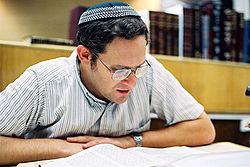
Modern Orthodox Judaism (also Modern Orthodox or Modern Orthodoxy) is a movement within Orthodox Judaism
Orthodox Judaism
Orthodox Judaism , is the approach to Judaism which adheres to the traditional interpretation and application of the laws and ethics of the Torah as legislated in the Talmudic texts by the Sanhedrin and subsequently developed and applied by the later authorities known as the Gaonim, Rishonim, and...
that attempts to synthesize Jewish values
Jewish principles of faith
The concept of an explicit, paramount definition of faith does not exist in Judaism as it does in other monotheistic religions such as Christianity. Although Jews and religious leaders share a core of monotheistic principles, and there are many fundamental principles quoted in the Talmud to define...
and the observance of Jewish law
Halakha
Halakha — also transliterated Halocho , or Halacha — is the collective body of Jewish law, including biblical law and later talmudic and rabbinic law, as well as customs and traditions.Judaism classically draws no distinction in its laws between religious and ostensibly non-religious life; Jewish...
, with the secular, modern world
Modern World
Modern World or The Modern World may refer to:*Modernity, a popular academic term.*The modern era, the age in which people today now live.*Modern World, a song by Wolf Parade from their 2005 album Apologies to the Queen Mary....
.
Modern Orthodoxy draws on several teachings and philosophies, and thus assumes various forms. In the United States
United States
The United States of America is a federal constitutional republic comprising fifty states and a federal district...
, and generally in the Western world
Western world
The Western world, also known as the West and the Occident , is a term referring to the countries of Western Europe , the countries of the Americas, as well all countries of Northern and Central Europe, Australia and New Zealand...
, "Centrist Orthodoxy" – underpinned by the philosophy of Torah Umadda
Torah Umadda
Torah Umadda is a philosophy of Modern Orthodox Judaism, concerning the interrelationship between the secular world and Judaism, and in particular between secular knowledge and Jewish knowledge...
("Torah and [Scientific] Knowledge") – is prevalent. In Israel, Modern Orthodoxy is dominated by Religious Zionism
Religious Zionism
Religious Zionism is an ideology that combines Zionism and Jewish religious faith...
; however, although not identical, these movements share many of the same values and many of the same adherents.
Modern Orthodoxy
Modern Orthodoxy comprises a fairly broad spectrum of movements each drawing on several distinct, though related, philosophies, which in some combination provide the basis for all variations of the movement today; these are discussed below.Characteristics
In general, Modern Orthodoxy's "overall approach.. is the belief that one can and should be a full member of modern society, accepting the risks to remaining observant, because the benefits outweigh those risks".Thus, Modern Orthodoxy holds that Jewish law
Halakha
Halakha — also transliterated Halocho , or Halacha — is the collective body of Jewish law, including biblical law and later talmudic and rabbinic law, as well as customs and traditions.Judaism classically draws no distinction in its laws between religious and ostensibly non-religious life; Jewish...
is normative
Norm (sociology)
Social norms are the accepted behaviors within a society or group. This sociological and social psychological term has been defined as "the rules that a group uses for appropriate and inappropriate values, beliefs, attitudes and behaviors. These rules may be explicit or implicit...
and binding, while simultaneously attaching a positive value to interaction with the modern world. In this view, Orthodox Judaism can “be enriched” by its intersection with modernity; further, “modern society creates opportunities to be productive citizens engaged in the Divine work of transforming the world to benefit humanity
Tikkun olam
Tikkun olam is a Hebrew phrase that means "repairing the world." In Judaism, the concept of tikkun olam originated in the early rabbinic period...
”. At the same time, in order to preserve the integrity of halakha
Halakha
Halakha — also transliterated Halocho , or Halacha — is the collective body of Jewish law, including biblical law and later talmudic and rabbinic law, as well as customs and traditions.Judaism classically draws no distinction in its laws between religious and ostensibly non-religious life; Jewish...
, any area of “powerful inconsistency and conflict” between Torah and modern culture must be filtered out.
Additional to this, Modern Orthodoxy assigns a central role to the "People of Israel". Here two characteristics are manifest: in general, Modern Orthodoxy places a high national
Nationalism
Nationalism is a political ideology that involves a strong identification of a group of individuals with a political entity defined in national terms, i.e. a nation. In the 'modernist' image of the nation, it is nationalism that creates national identity. There are various definitions for what...
, as well as religious, significance on the State of Israel, and institutions and individuals are, typically, Zionist in orientation; relatedly, involvement with non-orthodox Jews will extend beyond "outreach" to include institutional relations and cooperation; see further under Torah Umadda.
Other "core beliefs" are a recognition of the value and importance of secular studies (see Torah Umadda:Torah and secular knowledge), a commitment to equality of education for both men and women, and a full acceptance of the importance of being able to financially support oneself and one's family (see Torah im Derech Eretz: Earning a livelihood); see below.
Ideological spectrum
The specific expression of Modern Orthodoxy, however, takes many forms, and in fact, particularly over the past 30 – 40 years, describes a political spectrumPolitical spectrum
A political spectrum is a way of modeling different political positions by placing them upon one or more geometric axes symbolizing independent political dimensions....
. Among the issues have been the extent to which Modern Orthodoxy should cooperate with the more liberal denominations, support secular academic pursuits combined with religious learning, and embrace efforts to give women a larger role in Jewish learning and worship; the acceptability of modern textual criticism
Textual criticism
Textual criticism is a branch of literary criticism that is concerned with the identification and removal of transcription errors in the texts of manuscripts...
as a tool for Torah study
Torah study
Torah study is the study by Jewish people of the Torah, Hebrew Bible, Talmud, responsa, rabbinic literature and similar works, all of which are Judaism's religious texts...
is also debated.
For further discussion, see Orthodox Judaism: Diversity within Orthodox Judaism; Joseph B. Soloveitchik: Debate over world view; Torah im Derech Eretz: Interpretation.
To the ideological right
Conservatism
Conservatism is a political and social philosophy that promotes the maintenance of traditional institutions and supports, at the most, minimal and gradual change in society. Some conservatives seek to preserve things as they are, emphasizing stability and continuity, while others oppose modernism...
, the line between Haredi
Haredi Judaism
Haredi or Charedi/Chareidi Judaism is the most conservative form of Orthodox Judaism, often referred to as ultra-Orthodox. A follower of Haredi Judaism is called a Haredi ....
and Modern Orthodox has blurred in recent years; some have referred to this trend as "haredization" . In addition to increasing stringency in adherence to Halakha, many Modern Orthodox Jews express a growing sense of alienation from the larger, secular culture. ("Western civilisation has moved from what was once called the Judeo-Christian
Judeo-Christian
Judeo-Christian is a term used in the United States since the 1940s to refer to standards of ethics said to be held in common by Judaism and Christianity, for example the Ten Commandments...
ethic to a consumer-driven
Consumerism
Consumerism is a social and economic order that is based on the systematic creation and fostering of a desire to purchase goods and services in ever greater amounts. The term is often associated with criticisms of consumption starting with Thorstein Veblen...
, choice-fixated culture... Such a world is not chol but chiloni, not secular but secularist. It is impermeable to the values of kedushah." ) Here “the balance has tipped heavily in favor of Torah over madda (secular studies)… [and many] have redefined "madda" as support for making one's livelihood in the secular world, not culturally or intellectually engaging with it”. Although defining themeselves as "centrist", institutions here include the Orthodox Union
Orthodox Union
The Union of Orthodox Jewish Congregations of America , more popularly known as the Orthodox Union , is one of the oldest Orthodox Jewish organizations in the United States. It is best known for its kosher food preparation supervision service...
(Union of Orthodox Jewish Congregations of America), the Rabbinical Council of America
Rabbinical Council of America
The Rabbinical Council of America is one of the world's largest organizations of Orthodox rabbis; it is affiliated with The Union of Orthodox Jewish Congregations of America, more commonly known as the Orthodox Union, or OU...
, and the Rabbi Isaac Elchanan Theological Seminary
Rabbi Isaac Elchanan Theological Seminary
Rabbi Isaac Elchanan Theological Seminary , or Yeshivat Rabbeinu Yitzchak Elchanan, is the rabbinical seminary of Yeshiva University, located in Washington Heights, New York. It is named after Rabbi Yitzchak Elchanan Spektor, who died the year it was founded, 1896...
.
Adherents on the ideological left
Left-wing politics
In politics, Left, left-wing and leftist generally refer to support for social change to create a more egalitarian society...
have begun to develop new institutions that aim to be outward looking whilst maintaining a discourse between modernity and halakhah. The resultant "Open Orthodoxy" seeks to re-engage with secular studies, Jews of all denominations and global issues. Some within this movement have experimented with orthodox egalitarianism where gender equality solutions are found through halakhah. This has led to women taking on more leadership roles. Others in this movement are increasingly re-engaging with social justice
Social justice
Social justice generally refers to the idea of creating a society or institution that is based on the principles of equality and solidarity, that understands and values human rights, and that recognizes the dignity of every human being. The term and modern concept of "social justice" was coined by...
issues from a halakhic point of view. See Yeshivat Chovevei Torah
Yeshivat Chovevei Torah
Yeshivat Chovevei Torah Rabbinical School is a "Modern Open Orthodox" yeshiva founded in 1999 by Rabbi Avi Weiss.Currently located in Riverdale, New York, it seeks to "recruit, professionally train, and place rabbis" who will promote its founder's philosophy...
, Shalom Hartman Institute
Shalom Hartman Institute
Shalom Hartman Institute is a Jewish research and education institute based in Jerusalem, Israel, that offers pluralistic Jewish thought and education to scholars, rabbis, educators, and Jewish community leaders in Israel and North America...
, Hebrew Institute of Riverdale
Hebrew Institute of Riverdale
Hebrew Institute of Riverdale is an Orthodox Jewish synagogue in the Riverdale, Bronx neighborhood of New York City. Rabbi Avi Weiss has led the congregation since 1973....
, Partnership minyan
Partnership minyan
Partnership minyan is a term used by the Jewish Orthodox Feminist Alliance to describe a prayer group that, according to its adherents, conforms to the strictures of Orthodox Judaism while still allowing for parts of the services to be led by both men and women...
, Shira Hadasha
Shira Hadasha
Kehillat Shira Hadasha in Jerusalem was founded in 2002 by a group of Jerusalem residents, including Tova Hartman. Its website describes its purpose as the creation of "a religious community that embraces our commitment to halakha, tefillah and feminism" in response to "the growing need of many...
, MigdalOr.
The Behaviorally Modern
It is also noted that, in fact, many Modern Orthodox are “behaviorally modern” as opposed to "ideologically modern", and, in truth, fall outside of "Modern" Orthodoxy, at least in the philosophical sense; see below.The distinction is as follows: The ideologically modern are “meticulously observant of Halakha”, and their interaction with the secular comprises a tangible expression of their ideology, wherever it may lie on the spectrum described. The “behaviorally modern”, on the other hand, define themselves as "Modern Orthodox" only in the sense that they are neither Haredi ("Ultra-Orthodox") nor Conservative
Conservative Judaism
Conservative Judaism is a modern stream of Judaism that arose out of intellectual currents in Germany in the mid-19th century and took institutional form in the United States in the early 1900s.Conservative Judaism has its roots in the school of thought known as Positive-Historical Judaism,...
: these, in other words, are “not deeply concerned with philosophical ideas”, and, often, are not as careful in their observance.
This "Orthodoxy of convenience" has maintained a certain stability over time: as long as these don't seek to legitimate their behaviour in halakhic terms, the leadership of the (Modern) Orthodox world have no particular difficulty with them.
Positioning
Given the above, it is clear that various, highly differing views (or non views) - ranging from traditionalist to revisionist - are offered under the banner of "Modern Orthodoxy". In fact, even amongst its leadership there is limited agreement "on the philosophical parameters of modern Orthodoxy". The boundaries here, with respect to Haredi and Conservative Judaism have therefore become increasingly indistinct. Some elements of Haredi JudaismHaredi Judaism
Haredi or Charedi/Chareidi Judaism is the most conservative form of Orthodox Judaism, often referred to as ultra-Orthodox. A follower of Haredi Judaism is called a Haredi ....
appear to be more receptive to messages that have traditionally been part of the Modern-Orthodox agenda. Similarly, at Modern Orthodoxy’s left wing, many appear to align with more traditional elements of Conservative Judaism
Conservative Judaism
Conservative Judaism is a modern stream of Judaism that arose out of intellectual currents in Germany in the mid-19th century and took institutional form in the United States in the early 1900s.Conservative Judaism has its roots in the school of thought known as Positive-Historical Judaism,...
. In discussing "Modern Orthodoxy" it is thus also important to clarify its position with reference to other movements in Judaism: see Comparison with other movements below. Further, given this wide range of views, some see the possibility that, in fact, "[t]here is no longer a cohesive, singular Modern Orthodoxy;" see further below.
Philosophy
Modern Orthodoxy traces its roots to the works of RabbiRabbi
In Judaism, a rabbi is a teacher of Torah. This title derives from the Hebrew word רבי , meaning "My Master" , which is the way a student would address a master of Torah...
s Azriel Hildesheimer
Azriel Hildesheimer
Esriel Hildesheimer was a German rabbi and leader of Orthodox Judaism. He is regarded as a pioneering modernizer of Orthodox Judaism in Germany and as a founder of Modern Orthodox Judaism.-Biography:...
(1820–1899) and Samson Raphael Hirsch
Samson Raphael Hirsch
Samson Raphael Hirsch was a German rabbi best known as the intellectual founder of the Torah im Derech Eretz school of contemporary Orthodox Judaism...
(1808–1888). While Hildesheimer's role is not disputed - comprising distinct philosophic
Philosophy
Philosophy is the study of general and fundamental problems, such as those connected with existence, knowledge, values, reason, mind, and language. Philosophy is distinguished from other ways of addressing such problems by its critical, generally systematic approach and its reliance on rational...
and pragmatic
Pragmatism
Pragmatism is a philosophical tradition centered on the linking of practice and theory. It describes a process where theory is extracted from practice, and applied back to practice to form what is called intelligent practice...
contributions - Hirsch's role is less clear, with some Hirsch scholars arguing that his "Torah im Derech Eretz" philosophy is in fact at odds with that of Modern Orthodoxy; see further below and in the Hildesheimer article. Today, the movement is additionally, and particularly, influenced by the philosophy of Rabbi Joseph B. Soloveitchik and the closely related Torah Umadda
Torah Umadda
Torah Umadda is a philosophy of Modern Orthodox Judaism, concerning the interrelationship between the secular world and Judaism, and in particular between secular knowledge and Jewish knowledge...
, as well as by the writings of Rabbi Abraham Isaac Kook
Abraham Isaac Kook
Abraham Isaac Kook was the first Ashkenazi chief rabbi of the British Mandate for Palestine, the founder of the Religious Zionist Yeshiva Merkaz HaRav, Jewish thinker, Halachist, Kabbalist and a renowned Torah scholar...
. (Religious Zionism
Religious Zionism
Religious Zionism is an ideology that combines Zionism and Jewish religious faith...
, strictly speaking a distinct philosophy, has an indirect influence.)
Torah im Derech Eretz
Hirsch’s Torah im Derech EretzTorah im Derech Eretz
Torah im Derech Eretz is a philosophy of Orthodox Judaism articulated by Rabbi Samson Raphael Hirsch , which formalizes a relationship between traditionally observant Judaism and the modern world...
(תורה עם דרך ארץ – “Torah with the way of the Land”) is a philosophy of Orthodox Judaism which formalizes a relationship between halakhically observant Judaism and the modern world. Hirsch held that Judaism requires the application of Torah philosophy to all human endeavor and knowledge compatible with it. Thus, secular education becomes a positive religious duty. "Judaism is not a mere adjunct to life: it comprises all of life... in the synagogue and the kitchen, in the field and the warehouse, in the office and the pulpit... with the pen and the chisel". Hirsch's vision, although not unqualified, extended to the science
Science
Science is a systematic enterprise that builds and organizes knowledge in the form of testable explanations and predictions about the universe...
s as well as to (German) literature, philosophy
Philosophy
Philosophy is the study of general and fundamental problems, such as those connected with existence, knowledge, values, reason, mind, and language. Philosophy is distinguished from other ways of addressing such problems by its critical, generally systematic approach and its reliance on rational...
and culture. Torah im Derech Eretz remains influential to this day in all branches of Orthodox Judaism.
Note that Neo Orthodoxy, the movement descended from Hirsch’s Frankfurt
Frankfurt
Frankfurt am Main , commonly known simply as Frankfurt, is the largest city in the German state of Hesse and the fifth-largest city in Germany, with a 2010 population of 688,249. The urban area had an estimated population of 2,300,000 in 2010...
community regards itself as positioned, ideologically, outside of contemporary Modern Orthodoxy; see further below.
Pragmatism
Rabbi Azriel HildesheimerAzriel Hildesheimer
Esriel Hildesheimer was a German rabbi and leader of Orthodox Judaism. He is regarded as a pioneering modernizer of Orthodox Judaism in Germany and as a founder of Modern Orthodox Judaism.-Biography:...
, along with Rabbi Hirsch, was insistent that for Orthodox Jews living in the west, there was no possibility to segregate oneself behind ghetto walls. On the contrary, modern Jewish education must teach Jews how best to confront and deal with modernity in all of its aspects. His approach, "Cultured Orthodoxy", was defined as representing "unconditional agreement with the culture of the present day; harmony between Judaism and science; but also unconditional steadfastness in the faith and traditions of Judaism".
He was, however, "the pragmatist rather than the philosopher", and it is his actions, rather than his philosophy, which have become institutionalized in Modern Orthodoxy, and through which his influence is still felt.
- He established Jewish education for males and females, which included both religious and secular studiesSecular educationSecular education is the system of public education in countries with a secular government or separation between religion and state.An example of a highly secular educational system would be the French public educational system, going as far as to ban conspicuous religious symbols in schools.In...
. - He established Hildesheimer Rabbinical SeminaryHildesheimer Rabbinical SeminaryThe Hildesheimer Rabbinical Seminary was founded in Berlin on 22 October 1873 by Rabbi Dr. Azriel Hildesheimer for the training of rabbis in the tradition of Orthodox Judaism.-History:...
, one of the first Orthodox yeshivotYeshivaYeshiva is a Jewish educational institution that focuses on the study of traditional religious texts, primarily the Talmud and Torah study. Study is usually done through daily shiurim and in study pairs called chavrutas...
incorporating modern Jewish studiesJewish studiesJewish studies is an academic discipline centered on the study of Jews and Judaism. Jewish studies is interdisciplinary and combines aspects of history , religious studies, archeology, sociology, languages , political science, area studies, women's studies, and ethnic studies...
, secular studies and academic scholarship in its curriculum. - He was non-sectarian, and worked with communal leaders, even non-Orthodox ones, on issues that affected the community.
- He maintained traditional attachments to the Land of IsraelLand of IsraelThe Land of Israel is the Biblical name for the territory roughly corresponding to the area encompassed by the Southern Levant, also known as Canaan and Palestine, Promised Land and Holy Land. The belief that the area is a God-given homeland of the Jewish people is based on the narrative of the...
and worked with the non-Orthodox on its behalf.
Torah Umadda
Torah UmaddaTorah Umadda
Torah Umadda is a philosophy of Modern Orthodox Judaism, concerning the interrelationship between the secular world and Judaism, and in particular between secular knowledge and Jewish knowledge...
(תורה ומדע - "Torah and secular knowledge") is a philosophy concerning the secular world and Judaism, and in particular secular knowledge and Jewish knowledge. It envisions a personal
Identity (social science)
Identity is a term used to describe a person's conception and expression of their individuality or group affiliations . The term is used more specifically in psychology and sociology, and is given a great deal of attention in social psychology...
(as opposed to philosophic) "synthesis" between Torah scholarship and Western, secular scholarship, entailing, also, positive involvement with the broader community. Here, the "individual has absorbed the attitudes characteristic of science, democracy and Jewish life and responds appropriately in diverse relations and contexts." The resultant mode of Orthodox Judaism is referred to as "Centrist Orthodoxy"
This philosophy, as formulated today, is to a large extent a product of the teachings and philosophy of Rabbi Joseph Soloveitchik
Joseph Soloveitchik
Joseph Ber Soloveitchik was an American Orthodox rabbi, Talmudist and modern Jewish philosopher. He was a descendant of the Lithuanian Jewish Soloveitchik rabbinic dynasty....
(1903–1993), Rosh Yeshiva
Rosh yeshiva
Rosh yeshiva, , , is the title given to the dean of a Talmudical academy . It is made up of the Hebrew words rosh — meaning head, and yeshiva — a school of religious Jewish education...
at Yeshiva University
Yeshiva University
Yeshiva University is a private university in New York City, with six campuses in New York and one in Israel. Founded in 1886, it is a research university ranked as 45th in the US among national universities by U.S. News & World Report in 2012...
. In "Rav Soloveitchik's" thought, Judaism, which believes that the world is "very good", enjoins man to engage in tikkun olam
Tikkun olam
Tikkun olam is a Hebrew phrase that means "repairing the world." In Judaism, the concept of tikkun olam originated in the early rabbinic period...
. "Halakhic Man" must therefore attempt to bring the sanctity and purity of the transcendent realm into the material world. Centrist Orthodoxy is the dominant mode of Modern Orthodoxy in the United States
United States
The United States of America is a federal constitutional republic comprising fifty states and a federal district...
, while Torah Umadda remains closely associated with Yeshiva University.
Torah Umadda is related to Hirsch's Torah im Derech Eretz, but see below for a comparison between the two.
- See also Rabbi Isaac Elchanan Theological SeminaryRabbi Isaac Elchanan Theological SeminaryRabbi Isaac Elchanan Theological Seminary , or Yeshivat Rabbeinu Yitzchak Elchanan, is the rabbinical seminary of Yeshiva University, located in Washington Heights, New York. It is named after Rabbi Yitzchak Elchanan Spektor, who died the year it was founded, 1896...
.
Religious Zionism
Modern Orthodoxy draws on the teachings of Rabbi Abraham Isaac KookAbraham Isaac Kook
Abraham Isaac Kook was the first Ashkenazi chief rabbi of the British Mandate for Palestine, the founder of the Religious Zionist Yeshiva Merkaz HaRav, Jewish thinker, Halachist, Kabbalist and a renowned Torah scholar...
(1864–1935) - both as regards its views on Jewish peoplehood
Jewish peoplehood
Jewish peoplehood is the awareness of the underlying unity that makes an individual Jew a part of the Jewish people....
and as regards the (related) interaction with the secular world.
- “Rav Kook” saw ZionismZionismZionism is a Jewish political movement that, in its broadest sense, has supported the self-determination of the Jewish people in a sovereign Jewish national homeland. Since the establishment of the State of Israel, the Zionist movement continues primarily to advocate on behalf of the Jewish state...
as a part of a divine scheme finally to result in the resettlement of the Jewish people in its homeland, bringing salvation ("Geula") to the Jewish people, and the entire world. - In Rav Kook’s thought Kodesh and Chol (sacred and profane) play an important role: Kodesh is the inner taam (reason / meaning) of reality, while Chol is that which is detached from Kodesh and is without any meaning; Judaism, then, is the vehicle "whereby we sanctify our lives, and attach all the practical, secular elements of life to spiritual goals which reflect the absolute meaning of existence - G-d Himself".
In Israel
Israel
The State of Israel is a parliamentary republic located in the Middle East, along the eastern shore of the Mediterranean Sea...
, the Religious Zionism
Religious Zionism
Religious Zionism is an ideology that combines Zionism and Jewish religious faith...
of the "Dati Leumi" (דתי לאומי, "National Religious") dominates Modern Orthodoxy. Here too, the ideological basis is largely drawn from the teachings of Rav Kook, and there is therefore much overlap; philosophical differences, as well as other "non-modern" forms of Religious Zionism, are discussed below.
- See also MizrachiMizrachi (Religious Zionism)The Mizrachi is the name of the religious Zionist organization founded in 1902 in Vilnius at a world conference of religious Zionists called by Rabbi Yitzchak Yaacov Reines. Bnei Akiva, which was founded in 1929, is the youth movement associated with Mizrachi...
; Bnei AkivaBnei AkivaBnei Akiva is the largest religious Zionist youth movement in the world, with over 125,000 members in 37 countries. It was established in Mandate Palestine in 1929.-History:...
; National Religious PartyNational Religious PartyThe National Religious Party ) was a political party in Israel representing the religious Zionist movement. Formed in 1956, at the time of its dissolution in 2008, it was the second oldest surviving party in the country after Agudat Yisrael, and was part of every government coalition until 1992...
; HesderHesderHesder is an Israeli yeshiva program which combines advanced Talmudic studies with military service in the Israel Defense Forces, usually within a Religious Zionist framework...
; MechinaMechinaA Mechina is an Israeli educational program that prepares high school graduates for serving in the Israeli Army or study at an institution of higher learning in Israel...
; Gush EmunimGush EmunimGush Emunim was an Israeli messianic and political movement committed to establishing Jewish settlements in the West Bank. While not formally established as an organization until 1974 in the wake of the Yom Kippur War, Gush Emunim sprang out of the conquests of the Six-Day War in 1967, encouraging...
; Torat Eretz YisraelTorat Eretz YisraelThe Hebrew expression Torat Eretz Yisrael refers to all Jewish teachings regarding the Land of Israel , in particular those written from or conforming to a religious-Zionist point of view....
.
Comparison with other movements
As above, Modern Orthodoxy comprises various approaches, ranging from traditionalist to revisionist, and the movement apparently overlaps with Conservative Judaism and with Haredi Judaism at its respective boundaries. At its centre too, the movement appears to share practices and values with Neo Orthodoxy and with Religious Zionism. Therefore, in clarifying what Modern Orthodoxy in fact entails, its positioning must be discussed with reference to these movements.Haredi Judaism
- See also under Centrist Orthodoxy and Divine Providence for further elaboration of the differences discussed here.
Although there is some question as how precisely to define the distinction between Modern Orthodoxy and Haredi Judaism
Haredi Judaism
Haredi or Charedi/Chareidi Judaism is the most conservative form of Orthodox Judaism, often referred to as ultra-Orthodox. A follower of Haredi Judaism is called a Haredi ....
, there is basic agreement that they may be distinguished on the basis of three major characteristics:
- Modern Orthodoxy adopts a relatively inclusive stance toward society in general, and the larger Jewish community in particular.
- Modern Orthodoxy is, in comparison, accommodating, “if not welcoming” to modernityModernityModernity typically refers to a post-traditional, post-medieval historical period, one marked by the move from feudalism toward capitalism, industrialization, secularization, rationalization, the nation-state and its constituent institutions and forms of surveillance...
, general scholarship and scienceScienceScience is a systematic enterprise that builds and organizes knowledge in the form of testable explanations and predictions about the universe...
. - Modern Orthodoxy is almost uniformly receptive toward Israel and ZionismZionismZionism is a Jewish political movement that, in its broadest sense, has supported the self-determination of the Jewish people in a sovereign Jewish national homeland. Since the establishment of the State of Israel, the Zionist movement continues primarily to advocate on behalf of the Jewish state...
, viewing the State of Israel (in addition to the Land of IsraelLand of IsraelThe Land of Israel is the Biblical name for the territory roughly corresponding to the area encompassed by the Southern Levant, also known as Canaan and Palestine, Promised Land and Holy Land. The belief that the area is a God-given homeland of the Jewish people is based on the narrative of the...
) as having inherent religious significance.
A fourth difference suggested, relates to the acceptability of moderation within Jewish law
Halakha
Halakha — also transliterated Halocho , or Halacha — is the collective body of Jewish law, including biblical law and later talmudic and rabbinic law, as well as customs and traditions.Judaism classically draws no distinction in its laws between religious and ostensibly non-religious life; Jewish...
. Both Modern Orthodoxy and Ultra Orthodoxy regard Halakha as Divine in origin, and as such, no position is assumed without justification in the Shulkhan Arukh and in the Acharonim
Acharonim
Acharonim is a term used in Jewish law and history, to signify the leading rabbis and poskim living from roughly the 16th century to the present....
. The movements differ, however, in their approach to strictures (chumras) and leniencies (kulas).
Modern Orthodoxy holds that strictures are not normative
Norm (sociology)
Social norms are the accepted behaviors within a society or group. This sociological and social psychological term has been defined as "the rules that a group uses for appropriate and inappropriate values, beliefs, attitudes and behaviors. These rules may be explicit or implicit...
, rather, these are a matter of personal choice; "severity and leniency are relevant only in circumstances of factual doubt, not in situations of debate or varied practice. In the latter situations, the conclusion should be based solely on the legal analysis". (Note though, that in recent years, many Modern Orthodox Jews are described as "increasingly stringent in their adherence to Jewish law".) See Torah Umadda: Moderation.
In the Haredi view, on the other hand, "the most severe position... is the most likely basis for unity and commonality of practice within the Orthodox community and is therefore to be preferred". Further, "such severity... results in the greatest certainty that God's will is being performed." Haredi Judaism thus tends to adopt chumras as a norm.
As to the contention that Modern Orthodoxy's standards of observance of halakha
Halakha
Halakha — also transliterated Halocho , or Halacha — is the collective body of Jewish law, including biblical law and later talmudic and rabbinic law, as well as customs and traditions.Judaism classically draws no distinction in its laws between religious and ostensibly non-religious life; Jewish...
are, in fact, "relaxed," as opposed to moderate, see below under Criticism.
Neo-Orthodoxy/Torah Im Derech Eretz
Both Modern Orthodoxy and Neo Orthodoxy, the movement directly descended from Hirsch’s Frankfurt community, have combined Torah and secular knowledge with participation in contemporary western life, and thus some maintain that there is a degree of practical and philosophical overlap between the two. The movements are nevertheless distinct, and in general, Neo-Orthodoxy has taken a more qualified approach than Modern orthodoxy, emphasizing that followers must exercise caution in engagements with the secular world.Note though that differences between the movements may be more than a question of degree: Hirsch scholars argue that Hirschian philosophy is at odds with that of Modern Orthodoxy, while Modern Orthodox scholars maintain that Modern Orthodoxy accords with Hirsch's worldview. These philosophical distinctions (though subtle), manifest in markedly divergent religious attitudes and perspectives; in fact, Shimon Schwab
Shimon Schwab
Shimon Schwab was an Orthodox rabbi and communal leader in Germany and the United States. Educated in Frankfurt am Main and in the yeshivot of Lithuania, he was rabbi in Ichenhausen, Bavaria, after immigration to the United States in Baltimore, and from 1958 until his death at Khal Adath Jeshurun...
, second Rabbi of this community in the United States, is described as being "spiritually very distant" from Yeshiva University and Modern Orthodoxy.
From the viewpoint of Neo-Orthodoxy, that movement differs from Modern Orthodoxy (and particularly Centrist Orthodoxy) on three main counts.
- The role of secular life and culture: In the Hirschian view, interaction with the secular and the requisite acquisition of culture and knowledge is encouraged, only insofar as it facilitates the application of Torah to worldly matters. For Modern Orthodoxy, on the other hand, secular culture and knowledge are seen as a complement to Torah, and, to some extent, encouraged for their own sake. Some would suggest that in Modern Orthodoxy, Judaism is enriched by interaction with modernity, whereas in Neo-Orthodoxy human experience (and modernity) are enriched by the application of Torah outlook and practice.
- Priority of Torah versus Secular knowledge: In the Hirschian view, Torah is the "sole barometer of truth" by which to judge secular disciplines, as "there is only one truth, and only one body of knowledge that can serve as the standard... Compared to it, all the other sciences are valid only provisionally." (Hirsch, commentary to LeviticusLeviticusThe Book of Leviticus is the third book of the Hebrew Bible, and the third of five books of the Torah ....
18:4-5). By contrast, in the view of Modern Orthodoxy, although Torah is the "preeminent center", secular knowledge is considered to offer "a different perspective that may not agree at all with [Torah] ... [but] both together present the possibility of a larger truth." (Torah Umadda, p. 236).
- Broader communal involvement: Neo-Orthodoxy, influenced by Hirsch's philosophy on Austritt (secession), "could not countenance recognition of a non-believing body as a legitimate representative of the Jewish people", and is therefore opposed to the MizrachiMizrachi (Religious Zionism)The Mizrachi is the name of the religious Zionist organization founded in 1902 in Vilnius at a world conference of religious Zionists called by Rabbi Yitzchak Yaacov Reines. Bnei Akiva, which was founded in 1929, is the youth movement associated with Mizrachi...
movement, which is affiliated with the World Zionist OrganizationWorld Zionist OrganizationThe World Zionist Organization , or WZO, was founded as the Zionist Organization , or ZO, in 1897 at the First Zionist Congress, held from August 29 to August 31 in Basel, Switzerland...
and the Jewish Agency. Modern Orthodoxy, on the other hand, is characterised by its involvement with the broader Jewish Community and by its Religious ZionismReligious ZionismReligious Zionism is an ideology that combines Zionism and Jewish religious faith...
.
Religious Zionism
Broadly defined, Religious ZionismReligious Zionism
Religious Zionism is an ideology that combines Zionism and Jewish religious faith...
is a movement which embraces the idea of Jewish national sovereignty
Sovereignty
Sovereignty is the quality of having supreme, independent authority over a geographic area, such as a territory. It can be found in a power to rule and make law that rests on a political fact for which no purely legal explanation can be provided...
, often in connection with the belief in the ability of the Jewish people to bring about a redemptive state
Jewish eschatology
Jewish eschatology is concerned with the Jewish Messiah, afterlife, and the revival of the dead. Eschatology, generically, is the area of theology and philosophy concerned with the final events in the history of the world, the ultimate destiny of humanity, and related concepts.-The Messiah:The...
through natural means, and often attributing religious significance to the modern State of Israel. (This attitude is rejected by most Haredim - but not all, particularly the Hardal
Hardal
Chardal ; Hebrew: חרד"ל, acronym for חרדי לאומי, Charedi Le-umi, lit. "Nationalist Charedi", Plural: Chardalim refers to the Ultra-Orthodox Jews who support the ideology of Religious Zionism...
movement.) Thus, in this sense, Religious Zionism in fact encompasses a wide spectrum of religious views including Modern Orthodoxy.
Note however, that Modern Orthodoxy, in fact, overlaps to a large extent with “Religious Zionism” in its narrower form
Mizrachi (Religious Zionism)
The Mizrachi is the name of the religious Zionist organization founded in 1902 in Vilnius at a world conference of religious Zionists called by Rabbi Yitzchak Yaacov Reines. Bnei Akiva, which was founded in 1929, is the youth movement associated with Mizrachi...
('Throughout the world a "religious Zionist day school" is a synonym for a "modern Orthodox day school"' ). At the least, the two are not in any direct conflict, and generally coexist, sharing both values and adherents. Further, in practice, except at their extremes, the differences between Religious Zionism and Modern Orthodoxy in Israel are not pronounced, and they are often identical, especially in recent years and for the younger generation.
Nevertheless, the two movements are philosophically distinct on two broad counts.
- Firstly, (conservative) Religious Zionists differ with Modern Orthodoxy in its approach to secular knowledge. Here, engagement with the secular is permissible, and encouraged, but only insofar as this benefits the State of Israel; secular knowledge (or, at the least, an extensive secular education) is viewed as valuable for practical ends, though not in and of itself. See further under Torah Umadda.
- Secondly, under Religious Zionism, a “nationalistic coloration” is given to traditional religious concepts, whereas, by contrast, Modern Orthodoxy includes “a greater balance which includes openness to the non-Jewish world”; thus under Religious Zionism the Jewish nation is conceived of as an “organic unity”, whereas Modern Orthodoxy emphasises the individual.
Applying the above distinction, in Israel
Israel
The State of Israel is a parliamentary republic located in the Middle East, along the eastern shore of the Mediterranean Sea...
today, Modern Orthodoxy - as distinct from (right wing) Religious Zionism - is represented by only a select group of institutions: the Religious Kibbutz Movement
Religious Kibbutz Movement
The Religious Kibbutz Movement is an organizational framework for Orthodox kibbutzim in Israel. Its membership includes 19 communities, 16 of them traditional kibbutzim, and two others in the category of moshav shitufi , meaning that they have no communal dining hall or children's house but...
, Neemanei Torah V’Avoda, the Meimad
Meimad
Meimad is a left-wing religious Zionist political party in Israel. Founded in 1999, it is based on the ideology of the Meimad movement founded in 1988 by Rabbi Yehuda Amital. At the national level, it was in alliance with the Labour Party, and until the 2006 elections, received 10th spot on the...
political party, and the Shalom Hartman Institute
Shalom Hartman Institute
Shalom Hartman Institute is a Jewish research and education institute based in Jerusalem, Israel, that offers pluralistic Jewish thought and education to scholars, rabbis, educators, and Jewish community leaders in Israel and North America...
, Yeshivat Har Etzion
Yeshivat Har Etzion
Yeshivat Har Etzion, ', commonly known as "Gush," is a hesder yeshiva located in Alon Shvut, a community in Gush Etzion in the West Bank, near Jerusalem, Israel. With a student body of 484, it is one of the largest hesder yeshivas in Israel...
/ Migdal Oz and Yeshivat Hamivtar
Yeshivat HaMivtar
Yeshivat Torat Yosef - Hamivtar is a men's yeshiva located in Efrat in the West Bank. The Roshei Yeshiva are Rabbi Yonatan Rosensweig and Rabbi Shlomo Riskin. The institution is primarily focused on post college-aged students and is part of the Ohr Torah Stone educational institutions founded by...
/ Ohr Torah Stone Institutions / Midreshet Lindenbaum
Midreshet Lindenbaum
Midreshet Lindenbaum , originally named Michlelet Bruria, was one of the early leaders in the women's talmud study movement. Michlelet Bruria was founded in 1976 by Rabbi Chaim Brovender, as the woman's component of Yeshivat Hamivtar...
. (Some would include Yeshivat Hesder Petach Tikva, Yeshivat Ma'ale Gilboa
Yeshivat Ma'ale Gilboa
Yeshivat Ma'ale Gilboa is a Shiluv Yeshiva located on Kibbutz Ma'ale Gilboa in Israel's Gilboa Mountains. The Shiluv Yeshiva is unique in that it combines two years of Torah study with the full three years of army service. This is in contrast to students from Hesder Yeshivot, which only serve in...
, and the Tzohar Foundation as well.)
Conservative Judaism
In some areas, Modern Orthodoxy’s left wing appears to align with more traditional elements of Conservative JudaismConservative Judaism
Conservative Judaism is a modern stream of Judaism that arose out of intellectual currents in Germany in the mid-19th century and took institutional form in the United States in the early 1900s.Conservative Judaism has its roots in the school of thought known as Positive-Historical Judaism,...
, and in fact some on the left of Modern Orthodoxy have allied with the formerly Conservative Union for Traditional Judaism
Union for Traditional Judaism
The Union for Traditional Judaism is an ostensibly non-denominational Jewish educational, outreach and communal service organization. The UTJ, as it is known, sees itself as trans-denominational, and works to encourage traditional observance among all Jews. The UTJ maintains various educational...
. Nonetheless, the two movements are completely distinct. Rabbi Avi Weiss
Avi Weiss
Avraham Weiss is an American Modern Orthodox rabbi who heads the Hebrew Institute of Riverdale in The Bronx, New York. He is an author, teacher, lecturer, and activist...
- from the left of Modern Orthodoxy- stresses that Orthodox and Conservative Judaism are “so very different in… three fundamental areas: Torah mi-Sinai, rabbinic interpretation, and rabbinic legislation”. Weiss argues as follows:
- Torah mi-Sinai ("Torah From Sinai"): Modern Orthodoxy, in line with the rest of Orthodoxy, holds that Jewish law is Divine in origin, and as such, no underlying principle may be compromised in accounting for changing political, social or economic conditions, whereas Conservative Judaism holds that PoskimPosekPosek is the term in Jewish law for "decider"—a legal scholar who decides the Halakha in cases of law where previous authorities are inconclusive or in those situations where no halakhic precedent exists....
should make use of literary and historical analysis in deciding Jewish law, and may reverse decisions of the AcharonimAcharonimAcharonim is a term used in Jewish law and history, to signify the leading rabbis and poskim living from roughly the 16th century to the present....
that are held to be inapplicable today. (The Conservative view: "The Conservative Movement maintains that the purpose of the law in the first place is largely to concretize moral values, and so the specific form of the law can and should be changed if it is not effectively doing that... [Under Orthodoxy], the Halachah controls the aggada... in contrast... for the Conservative Movement the aggada should control the halachah." This, within the context that “[t]he halakhic system, historically considered, evinces a constant pattern of responsiveness, change and variety. Conservative Judaism did not read that record as carte blanche for a radical revision or even rejection of the system, but rather as warrant for valid adjustment where absolutely necessary".)
- Rabbinic interpretation: (Modern) Orthodoxy contends that legal authority is cumulative, and that a contemporary posekPosekPosek is the term in Jewish law for "decider"—a legal scholar who decides the Halakha in cases of law where previous authorities are inconclusive or in those situations where no halakhic precedent exists....
(decisor) can only issue judgments based on a full history of Jewish legal precedent, whereas the implicit argument of the Conservative movement is that precedent provides illustrations of possible positions rather than binding law. Conservatism, therefore, remains free to select whichever position within the prior history appeals to it. (The Conservative view: "Conservative rabbis have great respect for the Shulkhan Arukh, but do not view it as the ultimate authority because it was written over 400 years ago and much has changed since then in the halakhah, in society and in our outlook on life." )
- Rabbinic legislation: Since the (Modern) Orthodox community is ritually observant, Rabbinic law legislated by (today's) Orthodox rabbis can meaningfully become binding if accepted by the community (see minhagMinhagMinhag is an accepted tradition or group of traditions in Judaism. A related concept, Nusach , refers to the traditional order and form of the prayers...
). Conservative Judaism, on the other hand, has a largely non-observant laity. Thus, although Conservatism similarly holds that “no law has authority unless it becomes part of the concern and practice of the community” (and, in fact, the decision of when change is necessary is becoming “a communal matter at the congregational level”), since its constituency is generally not composed of ritually observant members, communal acceptance of a "permissive custom" is not “meaningful”, and, as a result, related Rabbinic legislation cannot assume the status of law.
In general, Modern Orthodoxy does not, therefore, view the process by which the Conservative movement decides halakha as legitimate - or with the non-normative weighting assigned to halakha by the Conservative movement. In particular, Modern Orthodoxy disagrees with many of Conservative Judaism’s halakhic rulings, particularly as regards issues of egalitarianism. See further on the Orthodox view and the Conservative view.
Modern Orthodoxy clearly differs from the approach of Reform Judaism
Reform Judaism
Reform Judaism refers to various beliefs, practices and organizations associated with the Reform Jewish movement in North America, the United Kingdom and elsewhere. In general, it maintains that Judaism and Jewish traditions should be modernized and should be compatible with participation in the...
and Reconstructionist Judaism
Reconstructionist Judaism
Reconstructionist Judaism is a modern American-based Jewish movement based on the ideas of Mordecai Kaplan . The movement views Judaism as a progressively evolving civilization. It originated as a branch of Conservative Judaism, before it splintered...
, which do not consider halakha to be normative
Normative
Normative has specialized contextual meanings in several academic disciplines. Generically, it means relating to an ideal standard or model. In practice, it has strong connotations of relating to a typical standard or model ....
.
Criticism
Given its diverse nature, observations regarding "Modern Orthodoxy" are likely to be generalizationGeneralization
A generalization of a concept is an extension of the concept to less-specific criteria. It is a foundational element of logic and human reasoning. Generalizations posit the existence of a domain or set of elements, as well as one or more common characteristics shared by those elements. As such, it...
s only; as such, any criticism
Criticism
Criticism is the judgement of the merits and faults of the work or actions of an individual or group by another . To criticize does not necessarily imply to find fault, but the word is often taken to mean the simple expression of an objection against prejudice, or a disapproval.Another meaning of...
may be aimed at a straw man
Straw man
A straw man is a component of an argument and is an informal fallacy based on misrepresentation of an opponent's position, twisting his words or by means of [false] assumptions...
. This section deals with criticism relating to standards of observance and to social issues; as regards its philosophy
Philosophy
Philosophy is the study of general and fundamental problems, such as those connected with existence, knowledge, values, reason, mind, and language. Philosophy is distinguished from other ways of addressing such problems by its critical, generally systematic approach and its reliance on rational...
see "Criticism" under Torah Umadda
Torah Umadda
Torah Umadda is a philosophy of Modern Orthodox Judaism, concerning the interrelationship between the secular world and Judaism, and in particular between secular knowledge and Jewish knowledge...
.
Standards of observance
- See further under Torah im Derech Eretz; Torah Umadda
There is an often repeated contention that Modern Orthodoxy - beyond its approach to chumrahs ("strictures") described above - has lower standards of observance of traditional Jewish laws and customs
Halakha
Halakha — also transliterated Halocho , or Halacha — is the collective body of Jewish law, including biblical law and later talmudic and rabbinic law, as well as customs and traditions.Judaism classically draws no distinction in its laws between religious and ostensibly non-religious life; Jewish...
than other branches of Orthodox Judaism
Orthodox Judaism
Orthodox Judaism , is the approach to Judaism which adheres to the traditional interpretation and application of the laws and ethics of the Torah as legislated in the Talmudic texts by the Sanhedrin and subsequently developed and applied by the later authorities known as the Gaonim, Rishonim, and...
. This view is largely anecdotal, and is based on individual behaviour, as opposed to any formal, institutional position; see above:
Additionally, whereas the Modern Orthodox position is (generally) presented as "unquestioned allegiance to the primacy of Torah, and that the apprehension of all other intellectual disciplines must be rooted and viewed through the prism of Torah", Haredi
Haredi Judaism
Haredi or Charedi/Chareidi Judaism is the most conservative form of Orthodox Judaism, often referred to as ultra-Orthodox. A follower of Haredi Judaism is called a Haredi ....
groups have sometimes compared Modern Orthodoxy with early Reform Judaism
Reform Judaism
Reform Judaism refers to various beliefs, practices and organizations associated with the Reform Jewish movement in North America, the United Kingdom and elsewhere. In general, it maintains that Judaism and Jewish traditions should be modernized and should be compatible with participation in the...
in Germany
Germany
Germany , officially the Federal Republic of Germany , is a federal parliamentary republic in Europe. The country consists of 16 states while the capital and largest city is Berlin. Germany covers an area of 357,021 km2 and has a largely temperate seasonal climate...
: Modern Orthodox Rabbis have been criticised for attempting to modify Jewish law
Halakha
Halakha — also transliterated Halocho , or Halacha — is the collective body of Jewish law, including biblical law and later talmudic and rabbinic law, as well as customs and traditions.Judaism classically draws no distinction in its laws between religious and ostensibly non-religious life; Jewish...
, in adapting Judaism to the needs of the modern world
Modern World
Modern World or The Modern World may refer to:*Modernity, a popular academic term.*The modern era, the age in which people today now live.*Modern World, a song by Wolf Parade from their 2005 album Apologies to the Queen Mary....
.
Note that claims of this nature have been commonplace within Orthodox Judaism since the first "reforms" of Samson Raphael Hirsch
Samson Raphael Hirsch
Samson Raphael Hirsch was a German rabbi best known as the intellectual founder of the Torah im Derech Eretz school of contemporary Orthodox Judaism...
and Azriel Hildesheimer
Azriel Hildesheimer
Esriel Hildesheimer was a German rabbi and leader of Orthodox Judaism. He is regarded as a pioneering modernizer of Orthodox Judaism in Germany and as a founder of Modern Orthodox Judaism.-Biography:...
. Thus, in Europe
Europe
Europe is, by convention, one of the world's seven continents. Comprising the westernmost peninsula of Eurasia, Europe is generally 'divided' from Asia to its east by the watershed divides of the Ural and Caucasus Mountains, the Ural River, the Caspian and Black Seas, and the waterways connecting...
of the early 19th century, all of Judaism
Judaism
Judaism ) is the "religion, philosophy, and way of life" of the Jewish people...
that differed from the strictest forms present at the time was called "Reform". Then, as now, Modern Orthodoxy took pains to distance its "reforms", which were consistent with the Shulkhan Arukh and poskim, from those of the Reform movement (and the Conservative movement), which were not.
Sociological and philosophical dilemmas
Some observe that the ability of Modern Orthodoxy to attract a large following and maintain its strength as a movement is (ironicallyIrony
Irony is a rhetorical device, literary technique, or situation in which there is a sharp incongruity or discordance that goes beyond the simple and evident intention of words or actions...
) inhibited by the fact that it embraces modernity
Modernity
Modernity typically refers to a post-traditional, post-medieval historical period, one marked by the move from feudalism toward capitalism, industrialization, secularization, rationalization, the nation-state and its constituent institutions and forms of surveillance...
- its raison d'être - and that it is highly rational
Rationality
In philosophy, rationality is the exercise of reason. It is the manner in which people derive conclusions when considering things deliberately. It also refers to the conformity of one's beliefs with one's reasons for belief, or with one's actions with one's reasons for action...
and intellectual
Intellectual
An intellectual is a person who uses intelligence and critical or analytical reasoning in either a professional or a personal capacity.- Terminology and endeavours :"Intellectual" can denote four types of persons:...
.
- Modern Orthodoxy is, almost by definition, inhibited from becoming a strong movement, because this would entail organization and authority to a degree "which goes against the very grain of modernity". A related difficulty is that Modern Orthodox rabbiRabbiIn Judaism, a rabbi is a teacher of Torah. This title derives from the Hebrew word רבי , meaning "My Master" , which is the way a student would address a master of Torah...
s who do adopt stringencies may, in the process, lose the support of precisely the "Modern" group which they sought to lead. (The logic: since one of the characteristics of religious orthodoxyOrthodoxyThe word orthodox, from Greek orthos + doxa , is generally used to mean the adherence to accepted norms, more specifically to creeds, especially in religion...
, is the submission to the authority of its traditionOral lawAn oral law is a code of conduct in use in a given culture, religion or community application, by which a body of rules of human behaviour is transmitted by oral tradition and effectively respected, or the single rule that is orally transmitted....
, the individual is expected to conform to all of its dictates, whereas modernityModernityModernity typically refers to a post-traditional, post-medieval historical period, one marked by the move from feudalism toward capitalism, industrialization, secularization, rationalization, the nation-state and its constituent institutions and forms of surveillance...
, by contrast, emphasizes a measure of personal autonomy as well as rationalist truth. The very term “Modern Orthodoxy” is thus, in some sense, an oxymoronOxymoronAn oxymoron is a figure of speech that combines contradictory terms...
. ) - Modern Orthodoxy’s "highly intellectual and rational stance" presents its own difficulties. Firstly, the ideology entails built-in tensions and frequently requires conscious living with inconsistency (even in the term itself: modernity vs. orthodoxy). Secondly, there are also those who question whether "the literature... with its intellectually elitist bias fails to directly address the majority of its practitioners". The suggestion here is that Modern Orthodoxy may not provide a directly applicable theology for the contemporary Modern Orthodox family; see further discussion under Torah Umadda.
- As observed above, the (precise) "philosophical parameters of modern Orthodoxy" are not readily defined. It is posited then that "modern orthodoxy", as such, may be disappearing, "being sucked into pluralisticReligious pluralismReligious pluralism is a loosely defined expression concerning acceptance of various religions, and is used in a number of related ways:* As the name of the worldview according to which one's religion is not the sole and exclusive source of truth, and thus that at least some truths and true values...
Judaism on the left and yeshivishYeshivishYeshivish , refers to a sociolect of English spoken by yeshiva students and other Jews with a strong connection to the Orthodox yeshiva world.-Research:Only a few serious studies have been written about Yeshivish...
on the right". "Modern orthodoxy", then, as opposed to constituting an ideological spectrum centred on a common core of values, is, in fact, (tending towards) several entirely separate movements. In fact "[m]any are making the argument that the time has come to state the inevitable or to admit that which already has occurred: There is no longer a cohesive, singular Modern Orthodoxy. Separate rabbinical schools and separate rabbinic organizations, the argument goes, reflect the reality of a community divided."
Important figures
Many Orthodox Jews find the intellectual engagement with the modern world as a virtue. Examples of Orthodox rabbis who promote or have promoted this worldview include:- Marc D. AngelMarc D. AngelMarc D. Angel is Rabbi emeritus of Congregation Shearith Israel, the historic Spanish and Portuguese Synagogue in New York City....
- former president of the Rabbinical Council of AmericaRabbinical Council of AmericaThe Rabbinical Council of America is one of the world's largest organizations of Orthodox rabbis; it is affiliated with The Union of Orthodox Jewish Congregations of America, more commonly known as the Orthodox Union, or OU...
, and rabbi of Shearith Israel, a Spanish Portuguese synagogue in New York. - Yehuda AmitalYehuda AmitalYehuda Amital was an Orthodox rabbi, the Rosh Yeshiva of Yeshivat Har Etzion and a former member of the Israeli cabinet.-Biography:Amital was born in Oradea in Romania. When Germany occupied the area in 1944, the Nazis sent his entire family to Auschwitz where they were killed. Amital was sent to...
- A Hungarian survivor of the Holocaust, Rabbi Amital emigrated to Israel in 1944, and resumed his yeshiva studies in Jerusalem. During the War of Independence, he served in the Hagana armored corps, taking part in the famous battle of Latrun. Subsequently, he took an active role in the development of Yeshivat Hadarom, where he was involved in the formulation of the idea of Yeshivat Hesder. Following the Six Day War, Rabbi Amital founded and assumed leadership of Yeshivat Har EtzionYeshivat Har EtzionYeshivat Har Etzion, ', commonly known as "Gush," is a hesder yeshiva located in Alon Shvut, a community in Gush Etzion in the West Bank, near Jerusalem, Israel. With a student body of 484, it is one of the largest hesder yeshivas in Israel...
. He was a dominant public figure in Israel who was widely respected on matters of religious and national concern. - Raymond AppleRaymond Apple (rabbi)Rabbi Raymond Apple was the Senior Rabbi of the Great Synagogue of Sydney between 1972 and 2005. In this role, he was one of Australia's highest profile rabbis and the leading spokesman for Judaism in Australia....
- former senior rabbi of the Great SynagogueGreat Synagogue (Sydney)The Great Synagogue is a large synagogue in Sydney, Australia. It is located in Elizabeth Street opposite Hyde Park and extends back to Castlereagh Street.-Description and history:...
, Sydney, Australia, and the pre-eminent Jewish spokesperson on Judaism in Australia. - Samuel BelkinSamuel BelkinRabbi Samuel Belkin is best known as the second University President of Yeshiva University. A distinguished Torah scholar, he is credited with leading Yeshiva University through a period of substantial expansion .-Biography:...
, former President of Yeshiva University - Eliezer BerkovitsEliezer BerkovitsEliezer Berkovits , was a rabbi, theologian, and educator in the tradition of Orthodox Judaism.- Life:...
- philosopher, author of many works including Not In Heaven: The Nature and Function of Halakha and Faith after the Holocaust. - Saul BermanSaul BermanSaul J. Berman is a prominent American scholar and leading Modern Orthodox rabbi.As a rabbi, scholar, and educator he has made extensive contributions to the intensification of Jewish education for Jewish women on many levels, to the role of social ethics in synagogue life, and to the...
- director of the now defunct EdahEdahEdah was a Modern Orthodox Jewish organization, generally associated with the liberal wing of Orthodox Judaism in the United States and with the Religious Zionism movement of Israel. Its headquarters are located in Manhattan, New York City....
, a Modern Orthodox advocacy organization. - J. David BleichJ. David BleichJ. David Bleich is an authority on Jewish law and ethics, including Jewish medical ethics. He is rabbi of Cong. B'nei Jehuda...
, professor at Yeshiva University and expert in Jewish law - Shalom CarmyShalom CarmyShalom Carmy is an Orthodox rabbi teaching Jewish Studies and philosophy at Yeshiva University, where he is currently Chair of Bible and Jewish Philosophy at Yeshiva College. He is an affiliated scholar at Cardozo Law School of Yeshiva University...
- professor of Jewish Studies and Philosophy at Yeshiva UniversityYeshiva UniversityYeshiva University is a private university in New York City, with six campuses in New York and one in Israel. Founded in 1886, it is a research university ranked as 45th in the US among national universities by U.S. News & World Report in 2012...
; a prominent Modern Orthodox theologian - Dr. Barry FreundelBarry FreundelBernard Freundel is the rabbi of Kesher Israel congregation in Washington DC, and a leading rabbi in the Modern Orthodox Jewish world. He is Vice-President of the Vaad of Washington and head of the conversion committee of the Rabbinical Council of America...
- Rabbi of Kesher IsraelKesher IsraelKesher Israel is an Orthodox synagogue located in the Georgetown neighborhood of Washington, D.C. Writer and professor Barry Freundel is the Congregation's rabbi.-History:...
in Washington D.C.. He is the author of Contemporary Orthodox Judaism's Response to Modernity, Why We Pray What We Pray and numerous other scholarly publications. He received his smicha from Yeshiva University and his Phd from Baltimore Hebrew University where he serves as an Assistant Professor of Rabbinics. A well-respected theologian and sought after lecturer, he was recognized by the Orthodox Union for his enormous impact on Jewish life. His diverse lecture topics includes issues on Jewish medical ethics, eruvim, and conversion. - David HartmanDavid Hartman (rabbi)David Hartman is an American and Israeli rabbi and philosopher of contemporary Judaism, founder of the Shalom Hartman Institute in Jerusalem, Israel, and a Jewish author.- Early life :...
- Rabbi and founder of Shalom Hartman InstituteShalom Hartman InstituteShalom Hartman Institute is a Jewish research and education institute based in Jerusalem, Israel, that offers pluralistic Jewish thought and education to scholars, rabbis, educators, and Jewish community leaders in Israel and North America...
in Jerusalem, a prominent philosopher, lecturer, and author. A student of Rabbi Joseph B. Soloveitchik - Leo JungLeo JungRabbi Leo Jung was one of the major architects of American Orthodox Judaism.-Background and education:...
, Rabbi at the Jewish Center (Manhattan, New York) - Norman LammNorman LammNorman Lamm is a major American Modern Orthodox rabbi, scholar, author and Jewish communal leader. He is presently the Chancellor of Yeshiva University....
- Rosh Yeshiva, Yeshiva UniversityYeshiva UniversityYeshiva University is a private university in New York City, with six campuses in New York and one in Israel. Founded in 1886, it is a research university ranked as 45th in the US among national universities by U.S. News & World Report in 2012...
; Orthodox Forum; author of Torah U-Maddah. One of the leading voices for the validity and importance of Modern Orthodoxy. - Rabbi Aharon LichtensteinAharon LichtensteinAharon Lichtenstein is a noted Orthodox rabbi and rosh yeshiva.Rabbi Lichtenstein was born in Paris, France, but grew up in the United States, studied in Yeshiva Rabbi Chaim Berlin under Rabbi Yitzchok Hutner...
- Lichtenstein grew up in the United States, earning Semicha at Yeshiva University, and a Ph.D. in English Literature at Harvard. He is committed to intensive and original Torah study, and articulates a bold Jewish worldview that embraces modernity, reflecting the tradition of his teacher and father-in-law, Rabbi Joseph B. Soloveitchik. In 1971, Lichtenstein answered Rabbi Amital's request to join him at the helm of Yeshivat Har Etzion. He is a source of inspiration for a wide circle of Jewry, for both his educational attainments and his intellectual leadership. Author of Leaves of Faith - The World of Jewish Learning, and By His Light: Character and Values in the Service of God. - Haskel LooksteinHaskel LooksteinRabbi Haskel Lookstein is an American Modern Orthodox Rabbi who serves as the spiritual leader of Congregation Kehilath Jeshurun on the Upper East Side of Manhattan and principal of the Ramaz School.-Early years:...
- Rabbi of Congregation Kehilath JeshurunCongregation Kehilath JeshurunCongregation Kehilath Jeshurun is a Modern Orthodox synagogue, located on East 85th Street on the Upper East Side of the New York City borough of Manhattan. The synagogue was founded in 1872...
in ManhattanManhattanManhattan is the oldest and the most densely populated of the five boroughs of New York City. Located primarily on the island of Manhattan at the mouth of the Hudson River, the boundaries of the borough are identical to those of New York County, an original county of the state of New York...
and principal of the Ramaz SchoolRamaz SchoolThe Ramaz School is a coeducational, private Modern Orthodox Jewish prep school located on the Upper East Side of the New York City borough of Manhattan. It consists of a lower school , a middle school , and an upper school .The Ramaz Upper School is a college preparatory school...
. Voted by Newsweek magazine as the most influential orthodox rabbi in the United States in 2008. Rabbi Lookstein is best known for his strong political activism which began with numerous visits to the former Soviet Union, numerous rallies on behalf of Natan Sharansky and continues today with activism on behalf of the Jews of Israel and worldwide. - Shlomo RiskinShlomo RiskinShlomo Riskin is the founding rabbi of Lincoln Square Synagogue on the Upper West Side of New York City, which he led for 12 years; founding chief rabbi of the Israeli settlement of Efrat in the West Bank; dean of Manhattan Day School in New York City; and founder and dean of the Ohr Torah Stone...
- Formerly rabbi of the Lincoln Square Synagogue in Manhattan, he emigrated to IsraelIsraelThe State of Israel is a parliamentary republic located in the Middle East, along the eastern shore of the Mediterranean Sea...
to become the Chief Rabbi of Efrat. - Rabbi Hershel SchachterHershel SchachterHershel Schachter is a rabbi and rosh yeshiva at Rabbi Isaac Elchanan Theological Seminary , Yeshiva University, in New York City, and the son of the late Rabbi Melech Schachter, who was also a rosh yeshiva at Yeshiva University...
- one of Rabbi Joseph B. Soloveitchik's most prominent students, dean of the Katz Kollel at the Yeshiva University-affiliated Rabbi Isaac Elchanon Theological Seminary (RIETS). Has published several works attempting to establish a definitive view of Rabbi Soloveitchik's Weltanschauung. - Rabbi Joseph B. Soloveitchik - Known as "The Rav", he was effectively the spiritual and intellectual guide of Modern Orthodoxy in America for the mid-20th century. He is the author of "The Lonely Man of Faith" and "Halakhic Man," an outspoken Zionist, an opponent of extending rabbinic authority into areas of secular expertise, and a proponent of some interdenominational cooperation, such as the Rabbinical Council of AmericaRabbinical Council of AmericaThe Rabbinical Council of America is one of the world's largest organizations of Orthodox rabbis; it is affiliated with The Union of Orthodox Jewish Congregations of America, more commonly known as the Orthodox Union, or OU...
participation in the now-defunct Synagogue Council of America. He was known as a stern leader who described in his writings the spiritual loneliness and internal isolation of the modern religious "man of faith". - HaRav Gedalia Dov SchwartzGedalia Dov SchwartzGedalia Dov Schwartz Gedalia Dov Schwartz Gedalia Dov Schwartz (born 24 January 1925 is an eminent Modern Orthodox rabbi, scholar, and posek (halakhic authority) living in Chicago, Illinois...
- an eminent Modern Orthodox rabbi, scholar, and posek (halakhic authority) in Chicago, Illinois. Since 1991 he has been the av beis din (head of the rabbinical court) of both the Beth Din of America and the Chicago Rabbinical Council. - Rav Dr. Moshe David TendlerMoshe David TendlerMoshe David Tendler is the rabbi of The Community Synagogue of Monsey. He is a senior Rosh Yeshiva at Yeshiva University's RIETS and the Rabbi Isaac and Bella Tendler Professor of Jewish Medical Ethics and Professor of Biology at Yeshiva College. He has a Ph.D...
- Rav Tendler is the Rabbi Isaac and Bella Tendler Professor of Jewish Medical Ethics, and is a Professor of Biology, as well as being a Rosh Yeshiva in Yeshivat Rav Yitzchak Elchanan (MYP/RIETS). Holding a PhD in Microbiology, Rav Tendler is among the most prominent students of both Rav Moshe Feinstein, zt'l (his father-in-law) and Rav Yosef Dov Soloveitchik. Rabbi Tendler is an expert on medical ethicsJewish medical ethicsJewish medical ethics is a modern scholarly and clinical approach to medical ethics that draws upon Jewish thought and teachings. Pioneered by Rabbi Immanuel Jakobovits in the 1950s, Jewish medical ethics centers mainly around an applied ethics drawing upon traditional rabbinic law...
as it pertains to Jewish law. He is the author of Practical Medical Halakhah, a textbook of Jewish responsa to medical issues, and "Pardes Rimonim", a book about the halachot of Taharat Mishpacha. Rabbi Tendler is currently Rabbi of the Community Synagogue in Monsey, NY, and is the chairman of the Bioethical Commission, RCA, and of the Medical Ethics Task Force, UJA-Federation of Greater New York. - Joseph TelushkinJoseph TelushkinJoseph Telushkin is an American rabbi, lecturer, and author.-Biography:Telushkin attended the Yeshiva of Flatbush, was ordained at Yeshiva University, and studied Jewish history at Columbia University....
- Author, teacher, lecturer. - Marc B. ShapiroMarc B. ShapiroDr. Marc B. Shapiro holds the Weinberg Chair in Judaic Studies at the University of Scranton and is the author of various books and articles on Jewish history, philosophy, and theology. His writings often challenge the bounds of the conventional Orthodox understanding of Judaism using academic...
- Author, lecturer - Avi WeissAvi WeissAvraham Weiss is an American Modern Orthodox rabbi who heads the Hebrew Institute of Riverdale in The Bronx, New York. He is an author, teacher, lecturer, and activist...
- Dean, Yeshivat Chovevei TorahYeshivat Chovevei TorahYeshivat Chovevei Torah Rabbinical School is a "Modern Open Orthodox" yeshiva founded in 1999 by Rabbi Avi Weiss.Currently located in Riverdale, New York, it seeks to "recruit, professionally train, and place rabbis" who will promote its founder's philosophy...
. Rabbi of the Hebrew Institute of Riverdale Bronx, NY. Author, teacher, lecturer, and activist. - Joel B. WolowelskyJoel B. WolowelskyDr. Joel B. Wolowelsky is on the Faculty at the Yeshiva of Flatbush, and an author on topics pertaining to the role of women in Judaism and Jewish medical ethics. He is the Associate Editor of Tradition, the Journal of Jewish Thought and of the Toras HoRav Foundation, which is bringing to print the...
- Yeshiva of Flatbush; Orthodox Forum; TraditionTradition (journal)Tradition: A Journal of Orthodox Jewish Thought is a quarterly Orthodox academic journal published by the Rabbinical Council of America in association with Yeshiva University in New York City...
; MeOtzar HoRav. - Walter WurzburgerWalter WurzburgerRabbi Walter S. Wurzburger, a leader of Modern Orthodox Judaism and student of Rabbi Joseph B. Soloveitchik, was born in Munich in March 1920 and emigrated to America in 1938....
- former pulpit Rabbi, editor of Tradition magazine and head of the RCA. - Steven Weil - Executive Vice President of the Orthodox Union
Modern Orthodox advocacy groups
There are a few organizations dedicated to furthering Modern Orthodoxy as a religious trend:- The largest and oldest are the Orthodox UnionOrthodox UnionThe Union of Orthodox Jewish Congregations of America , more popularly known as the Orthodox Union , is one of the oldest Orthodox Jewish organizations in the United States. It is best known for its kosher food preparation supervision service...
(Union of Orthodox Jewish Congregations of America), which sponsors youth groups, kashrut supervision, and many other activities and its rabbinic counterpart, the Rabbinical Council of AmericaRabbinical Council of AmericaThe Rabbinical Council of America is one of the world's largest organizations of Orthodox rabbis; it is affiliated with The Union of Orthodox Jewish Congregations of America, more commonly known as the Orthodox Union, or OU...
(RCA). Both have Israel and diaspora (outside the land of Israel) programs.
Others Include:
- MeimadMeimadMeimad is a left-wing religious Zionist political party in Israel. Founded in 1999, it is based on the ideology of the Meimad movement founded in 1988 by Rabbi Yehuda Amital. At the national level, it was in alliance with the Labour Party, and until the 2006 elections, received 10th spot on the...
is a political/intellectual alternative to Israel's highly nationalistic religious parties or those hostile to modern secularist values - The Jewish Orthodox Feminist AllianceJewish Orthodox Feminist AllianceThe Jewish Orthodox Feminist Alliance was founded in 1997 with the aim of "expand[ing] the spiritual, ritual, intellectual, and political opportunities for women with the framework of halakha," or Jewish law...
(JOFA) a forum for enhancing the roles of Orthodox Jewish women within the Orthodox community, and reducing Orthodox religious disabilities against women.
See also
- Torah UmaddaTorah UmaddaTorah Umadda is a philosophy of Modern Orthodox Judaism, concerning the interrelationship between the secular world and Judaism, and in particular between secular knowledge and Jewish knowledge...
- Orthodox UnionOrthodox UnionThe Union of Orthodox Jewish Congregations of America , more popularly known as the Orthodox Union , is one of the oldest Orthodox Jewish organizations in the United States. It is best known for its kosher food preparation supervision service...
- Yeshiva UniversityYeshiva UniversityYeshiva University is a private university in New York City, with six campuses in New York and one in Israel. Founded in 1886, it is a research university ranked as 45th in the US among national universities by U.S. News & World Report in 2012...
- Divine providence (Judaism)Divine providence (Judaism)In Judaism, Divine Providence is discussed throughout Rabbinic literature, by the classical Jewish philosophers, and by the tradition of Jewish mysticism.The discussion brings into consideration the Jewish understanding of Nature, and its reciprocal, the Miraculous...
- Partnership minyanPartnership minyanPartnership minyan is a term used by the Jewish Orthodox Feminist Alliance to describe a prayer group that, according to its adherents, conforms to the strictures of Orthodox Judaism while still allowing for parts of the services to be led by both men and women...
- Shira HadashaShira HadashaKehillat Shira Hadasha in Jerusalem was founded in 2002 by a group of Jerusalem residents, including Tova Hartman. Its website describes its purpose as the creation of "a religious community that embraces our commitment to halakha, tefillah and feminism" in response to "the growing need of many...
- Bar-Ilan UniversityBar-Ilan UniversityBar-Ilan University is a university in Ramat Gan of the Tel Aviv District, Israel.Established in 1955, Bar Ilan is now Israel's second-largest academic institution. It has nearly 26,800 students and 1,350 faculty members...
- Hebrew Theological CollegeHebrew Theological CollegeThe Hebrew Theological College, known as "Skokie Yeshiva," is a Yeshiva in Skokie, Illinois which also functions as a private university on campus. The primary focus of the Yeshiva is to teach Torah and Jewish traditions...
- Lander CollegeLander CollegeThe Lander College for Men is a private, men's honors division of Touro College located in Kew Gardens Hills, New York. Its stated goal is to provide a rigorous college curriculum while maintaining a traditional Yeshiva environment...
/ Touro CollegeTouro CollegeTouro College is a sponsored independent institution of higher and professional education, in New York City, New York, United States. Founded by Dr. Bernard Lander, the College was established primarily to enrich the Jewish heritage, and to serve the larger American community... - Jerusalem College of TechnologyJerusalem College of TechnologyThe Jerusalem College of Technology , , is an Orthodox Jewish college. JCT's main campus are situated in the Givat Mordechai neighbourhood of Jerusalem. Other branches are located in the Givat Shaul neighbourhood of Jerusalem and Ramat Gan...
- Yeshivat Chovevei TorahYeshivat Chovevei TorahYeshivat Chovevei Torah Rabbinical School is a "Modern Open Orthodox" yeshiva founded in 1999 by Rabbi Avi Weiss.Currently located in Riverdale, New York, it seeks to "recruit, professionally train, and place rabbis" who will promote its founder's philosophy...
- Religious ZionismReligious ZionismReligious Zionism is an ideology that combines Zionism and Jewish religious faith...
- Islam and modernityIslam and modernityIslam and modernity is a topic of discussion in contemporary sociology of religion. Neither Islam nor modernity are simple or unified entities. They are abstract quantities which could not be reduced into simple categories. The history of Islam, like that of other religions, is a history of...
- Modernism (Roman Catholicism)Modernism (Roman Catholicism)Modernism refers to theological opinions expressed during the late 19th and early 20th centuries, but with influence reaching into the 21st century, which are characterized by a break with the past. Catholic modernists form an amorphous group. The term "modernist" appears in Pope Pius X's 1907...
- Buddhist modernismBuddhist modernismBuddhist modernism consists of the "forms of Buddhism that have emerged out of an engagement with the dominant cultural and intellectual forces of modernity." While there can be no complete, essential definition of what constitutes a Buddhist Modernist tradition, most scholars agree that...
Ideology
- Modern Orthodoxy - BBC Religion and Ethics, Alexander GoldbergAlexander GoldbergAlexander Goldberg, b. Guildford in 1974 is a barrister, chaplain and human rights activist. He founded and chaired the CCJO René Cassin human rights group and is the Chief Executive of the London Jewish Forum and the Chaplain to the University of Surrey....
- History and philosophy of Modern Orthodoxy, Prof. Alan Brill, Yeshiva UniversityYeshiva UniversityYeshiva University is a private university in New York City, with six campuses in New York and one in Israel. Founded in 1886, it is a research university ranked as 45th in the US among national universities by U.S. News & World Report in 2012...
- The Ideology of Modern Orthodoxy Rabbi Saul J. Berman
- What is Modern Orthodoxy?, Rabbi Yonatan Rosensweig of Yeshivat HamivtarYeshivat HaMivtarYeshivat Torat Yosef - Hamivtar is a men's yeshiva located in Efrat in the West Bank. The Roshei Yeshiva are Rabbi Yonatan Rosensweig and Rabbi Shlomo Riskin. The institution is primarily focused on post college-aged students and is part of the Ohr Torah Stone educational institutions founded by...
- What is Modern Orthodoxy?, Rabbi Chanoch Waxman of Yeshivat HamivtarYeshivat HaMivtarYeshivat Torat Yosef - Hamivtar is a men's yeshiva located in Efrat in the West Bank. The Roshei Yeshiva are Rabbi Yonatan Rosensweig and Rabbi Shlomo Riskin. The institution is primarily focused on post college-aged students and is part of the Ohr Torah Stone educational institutions founded by...
- Some Comments on Centrist Orthodoxy (JPEGJPEGIn computing, JPEG . The degree of compression can be adjusted, allowing a selectable tradeoff between storage size and image quality. JPEG typically achieves 10:1 compression with little perceptible loss in image quality....
) Rabbi Dr Norman LammNorman LammNorman Lamm is a major American Modern Orthodox rabbi, scholar, author and Jewish communal leader. He is presently the Chancellor of Yeshiva University.... - Religion Allied to Progress, Rabbi Samson Raphael HirschSamson Raphael HirschSamson Raphael Hirsch was a German rabbi best known as the intellectual founder of the Torah im Derech Eretz school of contemporary Orthodox Judaism...
- Torah Im Derech Eretz, Rabbi Aryeh Carmell
- "Torah u'Maddah" and "Torah and Derech Eretz", Rabbi Shlomo RiskinShlomo RiskinShlomo Riskin is the founding rabbi of Lincoln Square Synagogue on the Upper West Side of New York City, which he led for 12 years; founding chief rabbi of the Israeli settlement of Efrat in the West Bank; dean of Manhattan Day School in New York City; and founder and dean of the Ohr Torah Stone...
- "Open Orthodoxy: A Modern Orthodox Rabbi's Creed" Rabbi Avraham (Avi) WeissAvi WeissAvraham Weiss is an American Modern Orthodox rabbi who heads the Hebrew Institute of Riverdale in The Bronx, New York. He is an author, teacher, lecturer, and activist...
(pdf)
Issues
- Israel and Judaism's Future, Rabbi Prof. David HartmanDavid Hartman (rabbi)David Hartman is an American and Israeli rabbi and philosopher of contemporary Judaism, founder of the Shalom Hartman Institute in Jerusalem, Israel, and a Jewish author.- Early life :...
- Religious Zionism And Modern Orthodoxy, Rav Yosef BlauYosef BlauYosef Blau is an Orthodox rabbi. He currently serves as the Mashgiach ruchani at Rabbi Isaac Elchanan Theological Seminary. He is also the president of the Religious Zionists of America.-Education:...
- Is Modern Orthodoxy Synonymous with Laxity in Halacha?, Rabbi Chanoch Waxman
- American Modern Orthodoxy: Confronting Cultural Challenges Prof. Chaim I. Waxman
- Modern Orthodoxy and Its Future, Rabbi Norman Lamm
- Modern Orthodoxy Is Always At The Crossroads, Rabbi Michael Broyde
- Women's Prayer Services - Theory and Practice, Rabbis A Frimer & D. Frimer
- Torah Study for Women, Rabbi Aharon LichtensteinAharon LichtensteinAharon Lichtenstein is a noted Orthodox rabbi and rosh yeshiva.Rabbi Lichtenstein was born in Paris, France, but grew up in the United States, studied in Yeshiva Rabbi Chaim Berlin under Rabbi Yitzchok Hutner...
- Modern orthodoxy in Israel, Charles S. Liebman
- Fundamentalist or Romantic Nationalist?: Israeli Modern Orthodoxy, Shlomo Fischer
- The Making of Post-Hareidism, Rabbi Natan SlifkinNatan SlifkinNatan Slifkin , also popularly known as the "Zoo Rabbi", is an ordained but non-pulpit serving Orthodox rabbi best known for his interest in zoology, science and for his books on these topics, which are controversial in the Haredi world.-Biography:Natan Slifkin was born and raised in Manchester,...
- Dilemmas of modern orthodoxy: sociological and philosophical, Prof. Chaim I. Waxman
- Modern Orthodoxy in America: Possibilities for a Movement under Siege, William B. Helmreich and Reuel Shinnar
- Revisionism and the Rav: The Struggle for the Soul of Modern Orthodoxy, Prof. Lawrence Kaplan
- Caught In The Middle, David Van Biema, cnn.com
- Yeshiva U. confronts fault lines of modern Orthodoxy, Julie Wiener, Jewish Telegraphic Agency
- Orthodox Judaism and The Liberal Arts, Rabbi Shalom CarmyShalom CarmyShalom Carmy is an Orthodox rabbi teaching Jewish Studies and philosophy at Yeshiva University, where he is currently Chair of Bible and Jewish Philosophy at Yeshiva College. He is an affiliated scholar at Cardozo Law School of Yeshiva University...
- The State of Orthodox Judaism Today, Michael Kress
- Finding A Home for Critical Talmud Study, The Edah Journal 2:1, Rabbi David Bigman
- Shattering the Idols: The Struggle for Holiness in a Secular Age, Chief Rabbi Jonathan SacksJonathan SacksJonathan Henry Sacks, Baron Sacks, Kt is the Chief Rabbi of the United Hebrew Congregations of the Commonwealth. His Hebrew name is Yaakov Zvi...
Culture
- No Sex in the City (Article on the TV Show SrugimSrugimSrugim is an Israeli television drama that debuted on June 23, 2008, and deals with the lives of five Modern Orthodox Jewish single men and women in the Katamon neighborhood of Jerusalem, from the national religious sector.The title comes from the type of Kippah often worn by members of the...
) - An Israeli Film School With A Religious Twist
- This School Makes Film a Kosher Career Choice
- The Maccabeats, Modern Orthodox Acapella Group
History
- Samson Raphael Hirsch: The Father of Neo-Orthodoxy, Louis Jacobs
- Rabbi Esriel Hildesheimer's Program of Torah u-Madda, Marc B. ShapiroMarc B. ShapiroDr. Marc B. Shapiro holds the Weinberg Chair in Judaic Studies at the University of Scranton and is the author of various books and articles on Jewish history, philosophy, and theology. His writings often challenge the bounds of the conventional Orthodox understanding of Judaism using academic...
- American Orthodoxy: Part I; Part II, Moshe D. Sherman
Resources
- Introduction to the Philosophy of Rabbi Soloveitchik, vbm-torah.org
- torahweb.org, Roshei YeshivaRosh yeshivaRosh yeshiva, , , is the title given to the dean of a Talmudical academy . It is made up of the Hebrew words rosh — meaning head, and yeshiva — a school of religious Jewish education...
at Yeshiva University - Audio Classes from Yeshiva University
- Torah in Motion, "stimulating Torah virtually everywhere"
- Articles and research on Modern Orthodoxy on the Berman Jewish Policy Archive @ NYU Wagner
- Jewish Action: The Magazine of the Orthodox Union
- Kol Hamevaser: The Jewish Thought Magazine of Yeshiva University
- Jewish Ideas Daily
- The Orthodox Forum Book Series