


Hasdai Crescas

Encyclopedia
Hasdai ben Judah Crescas (Hebrew: חסדאי קרשקש) (b. Barcelona
, c.1340; d. Saragossa, 1410/1411) was a Jewish philosopher and a renowned halakhist (teacher of Jewish law). Along with Rambam, Ralbag, and Albo
, he is known as one of the major practitioners of the rationalist
approach to Jewish philosophy, and his positions on issues of natural law and free will in Or Adonai can be seen as precursors to those of Spinoza.
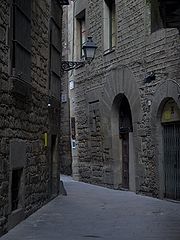 Hasdai Crescas came from a family of scholars; he was a disciple of the Talmud
ist and philosopher Nissim ben Reuben
, known as The RaN. Following in the footsteps of his teacher he became a Talmudic authority and a philosopher of great originality. He is considered important in the history of modern thought for his deep influence on Baruch Spinoza
.
While Crescas did not occupy an official position as rabbi
, he seems to have been active as a teacher. Among his fellow students and friends, Isaac ben Sheshet
(known as the RIBaSH), famous for his responsa
, takes precedence. Joseph Albo
is the best known of his pupils, but at least two others have won recognition, Rabbi Mattathias of Saragossa, and Rabbi Zechariah ha-Levi.
Crescas was a man of means. As such he was appointed sole executor of the will of his uncle Vitalis Azday by the King of Aragon
in 1393. Still, though enjoying the high esteem even of prominent non-Jews, he did not escape the common fate of his coreligionists. Imprisoned upon a false accusation in 1378, he suffered personal indignities because he was a Jew. His only son died in 1391, a martyr for his faith, during the anti-Semitic persecutions
of that period. Nevertheless he kept his faith.
Notwithstanding this bereavement, his mental powers were unbroken; for the works that have made him immortal were written after that terrible year. Another episode of his life worthy of note is connected with the appearance of the pseudo-Messiah of Cisneros, one of whose adherents he became. In 1401-02 he visited Joseph Orabuena at Pamplona at the request of the King of Navarre
, who paid the expenses of his journey to various Navarrese towns (Jacobs, l.c. Nos. 1570, 1574). He was at that time described as "Rav of Saragossa
."
, and a harbinger of the scientific revolution in the 16th century.
Three of his writings have been preserved:
Barcelona
Barcelona is the second largest city in Spain after Madrid, and the capital of Catalonia, with a population of 1,621,537 within its administrative limits on a land area of...
, c.1340; d. Saragossa, 1410/1411) was a Jewish philosopher and a renowned halakhist (teacher of Jewish law). Along with Rambam, Ralbag, and Albo
Joseph Albo
Joseph Albo was a Jewish philosopher and rabbi who lived in Spain during the fifteenth century, known chiefly as the author of Sefer ha-Ikkarim , the classic work on the fundamentals of Judaism.-Early life:Albo's birthplace is generally assumed to be Monreal, a town in Aragon...
, he is known as one of the major practitioners of the rationalist
Rationalism
In epistemology and in its modern sense, rationalism is "any view appealing to reason as a source of knowledge or justification" . In more technical terms, it is a method or a theory "in which the criterion of the truth is not sensory but intellectual and deductive"...
approach to Jewish philosophy, and his positions on issues of natural law and free will in Or Adonai can be seen as precursors to those of Spinoza.
Biography
Talmud
The Talmud is a central text of mainstream Judaism. It takes the form of a record of rabbinic discussions pertaining to Jewish law, ethics, philosophy, customs and history....
ist and philosopher Nissim ben Reuben
Nissim of Gerona
Nissim ben Reuven of Girona, Catalonia was an influential talmudist and authority on Jewish law. He was one of the last of the great Spanish medieval talmudic scholars. He is also known as the RaN .-Biography:The Ran was born in Barcelona, Catalonia...
, known as The RaN. Following in the footsteps of his teacher he became a Talmudic authority and a philosopher of great originality. He is considered important in the history of modern thought for his deep influence on Baruch Spinoza
Baruch Spinoza
Baruch de Spinoza and later Benedict de Spinoza was a Dutch Jewish philosopher. Revealing considerable scientific aptitude, the breadth and importance of Spinoza's work was not fully realized until years after his death...
.
While Crescas did not occupy an official position as rabbi
Rabbi
In Judaism, a rabbi is a teacher of Torah. This title derives from the Hebrew word רבי , meaning "My Master" , which is the way a student would address a master of Torah...
, he seems to have been active as a teacher. Among his fellow students and friends, Isaac ben Sheshet
Isaac ben Sheshet
Isaac ben Sheshet Perfet was a Spanish Talmudic authority, also known by his acronym, Rivash . He was born at Valencia and settled early in life at Barcelona, where he studied under Perez ha-Kohen, under Hasdai ben Judah, and especially under R...
(known as the RIBaSH), famous for his responsa
Responsa
Responsa comprise a body of written decisions and rulings given by legal scholars in response to questions addressed to them.-In the Roman Empire:Roman law recognised responsa prudentium, i.e...
, takes precedence. Joseph Albo
Joseph Albo
Joseph Albo was a Jewish philosopher and rabbi who lived in Spain during the fifteenth century, known chiefly as the author of Sefer ha-Ikkarim , the classic work on the fundamentals of Judaism.-Early life:Albo's birthplace is generally assumed to be Monreal, a town in Aragon...
is the best known of his pupils, but at least two others have won recognition, Rabbi Mattathias of Saragossa, and Rabbi Zechariah ha-Levi.
Crescas was a man of means. As such he was appointed sole executor of the will of his uncle Vitalis Azday by the King of Aragon
John I of Aragon
John I , called by posterity the Hunter or the Lover of Elegance , but the Abandoned in his lifetime, was the King of...
in 1393. Still, though enjoying the high esteem even of prominent non-Jews, he did not escape the common fate of his coreligionists. Imprisoned upon a false accusation in 1378, he suffered personal indignities because he was a Jew. His only son died in 1391, a martyr for his faith, during the anti-Semitic persecutions
Anti-Semitism
Antisemitism is suspicion of, hatred toward, or discrimination against Jews for reasons connected to their Jewish heritage. According to a 2005 U.S...
of that period. Nevertheless he kept his faith.
Notwithstanding this bereavement, his mental powers were unbroken; for the works that have made him immortal were written after that terrible year. Another episode of his life worthy of note is connected with the appearance of the pseudo-Messiah of Cisneros, one of whose adherents he became. In 1401-02 he visited Joseph Orabuena at Pamplona at the request of the King of Navarre
Charles III of Navarre
Charles III , called the Noble, was King of Navarre from 1387 to his death and Count of Évreux from 1387 to 1404, when he exchanged it for the title Duke of Nemours...
, who paid the expenses of his journey to various Navarrese towns (Jacobs, l.c. Nos. 1570, 1574). He was at that time described as "Rav of Saragossa
Zaragoza
Zaragoza , also called Saragossa in English, is the capital city of the Zaragoza Province and of the autonomous community of Aragon, Spain...
."
Works
His works on Jewish law, if indeed ever committed to writing – have not reached us. But his concise philosophical work Or Adonai, The Light of the Lord became a classical Jewish refutation of medieval AristotelianismAristotelianism
Aristotelianism is a tradition of philosophy that takes its defining inspiration from the work of Aristotle. The works of Aristotle were initially defended by the members of the Peripatetic school, and, later on, by the Neoplatonists, who produced many commentaries on Aristotle's writings...
, and a harbinger of the scientific revolution in the 16th century.
Three of his writings have been preserved:
- His primary work, Or Adonai, The Light of the Lord.
- An exposition and refutation of the main doctrines of Christianity. This "tratado" was written in Catalan in 1398. The Catalan original is no longer extant; but a Hebrew translation by Joseph ibn Shem-TovJoseph ibn Shem-TovJoseph ibn Shem-Tov was a prolific Judæo-Spanish writer born in Castile. He lived in various cities of Spain: Medina del Campo de Leon ; Alcalá de Henares ; and Segovia ....
, with the title ("Refutation of the Cardinal Principles of the Christians"), has been preserved. The work was composed at the solicitation of Spanish noblemen. Crescas' object in writing what is virtually an apologetic treatise on Judaism was to present the reasons which held the Jews fast to their ancestral faith. - His letter to the congregations of Avignon, published as an appendix to Wiener's edition of "Shevet Yehudah" (see above), in which he relates the incidents of the persecution of 1391.
List of works
- The Light of the Lord (Hebrew: Or Adonai or Or Hashem)
- The Refutation of the Christian Principles (polemics and some philosophy)
- Daniel Lasker: Sefer Bittul Iqqarei Ha-Nozrim by R. Hasdai Crescas. Albany 1992. ISBN 0-7914-0965-1
- Carlos del Valle Rodríguez: La inconsistencia de los dogmas cristianos: Biṭṭul 'Iqqare ha-Noṣrim le-R. Ḥasday Crescas. Madrid 2000. ISBN 848832412X
- Passover Sermon (religious philosophy and some halakha)
Important studies
- Harry Austryn WolfsonHarry Austryn WolfsonHarry Austryn Wolfson was a scholar, philosopher, and historian at Harvard University, the first chairman of a Judaic Studies Center in the United States...
, Crescas' Critique of Aristotle. Cambridge, Harvard University Press, 1929. - Warren Zev Harvey, Physics and Metaphysics in Hasdai Crescas, Amsterdam Studies in Jewish Thought, J.C. Gieben, Amsterdam, 1998.
- Warren Zev Harvey, Great Spirit and Creativity within the Jewish Nation: Rabbi Hasdai Crescas(Hebrew), Mercaz, Zalman Shazar, Jerusalem 2010.