
All Topics  
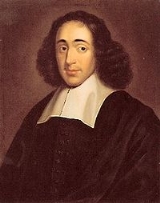
Baruch Spinoza


   Email Print
   Bookmark   Link


Baruch Spinoza


Baruch or Benedict de Spinoza (, , ) was a DutchNetherlands

The Netherlands is the European part of the Kingdom of the Netherlands , which is formed by the Netherlands, the Neth...
 philosopherPhilosophy

Philosophy is a field of study that includes diverse subfields such as aesthetics, epistemology, ethics, logic, and metaphys...
 of Portuguese Jewish origin. Revealing considerable scientific aptitude, the breadth and importance of Spinoza's work was not fully realized until years after his death. Today, he is considered one of the great rationalistsRationalism

In philosophy and in its broadest sense, rationalism is "any view appealing to reason as a source of knowledge or justificat...
 of 17th-century philosophy17th-century philosophy Summary

17th-century philosophy in the West is generally regarded as seeing the start of modern philosophy, and the shaking off of t...
, laying the groundwork for the 18th century EnlightenmentAge of Enlightenment Overview

The Age of Enlightenment refers to either the eighteenth century in European philosophy, or the longer period including the ...
 and modern biblical criticismFacts About Biblical criticism

Biblical criticism is a form of historical criticism that seeks to analyze the Bible through asking certain questions of the...
. By virtue of his magnum opusMagnum opus

Magnum opus, from the Latin meaning great work, refers to the best, most popular, or most renowned achievement of an...
, the posthumous EthicsEthics (book)

Ethics is a philosophical book written by Baruch Spinoza....
, Spinoza is also considered one of Western philosophy'sWestern philosophy

Western philosophy is a term that refers to philosophical thinking in the "Western" world....
 definitive ethicists.

Spinoza lived quietly as a lensLens (optics) Summary

A lens is a device that causes light to either converge and concentrate or to diverge, usually formed from a piece of shaped...
 grinder, turning down rewards and honors throughout his life, including prestigious teaching positions, and gave his family inheritance to his sister. Spinoza's moral character and philosophical accomplishments prompted 20th century philosopher Gilles DeleuzeGilles Deleuze

Gilles Deleuze , was a French philosopher of the late 20th century....
 to name him "the absolute philosopher." Spinoza died in February 1677 of a lung illness, perhaps tuberculosisTuberculosis

Tuberculosis is an infectious disease caused by the bacterium Mycobacterium tuberculosis, which most commonly affects t...
 or silicosisFacts About Silicosis

Silicosis is a form of pneumoconiosis caused by inhalation of crystalline silica dust, and is marked by inflammation and sca...
 caused by fine glassGlass

Glass is a uniform amorphous solid material, usually produced when the viscous molten material cools very rapidly to below i...
 dust inhaled while tending to his trade.
BiographyFamily originsSpinoza's ancestors were of Sephardic Jewish descent, and were a part of the community of Portuguese JewsSpanish and Portuguese Jews

Spanish and Portuguese Jews, also less precisely known as Portuguese Jews, Jews of the Portuguese nation, Spa...
 that grew in the city of AmsterdamAmsterdam

', the official capital of the Netherlands, lies on the banks of two bodies of water, the IJ bay and the Amstel river....
 after the Alhambra DecreeAlhambra decree

The Alhambra Decree was issued in 1492 by the Catholic Monarchs of Spain, following the final triumph over the Moors after t...
 in Spain (1492) and the Portuguese InquisitionPortuguese Inquisition

The Portuguese Inquisition was established in Portugal in 1536 at the request of the King of Portugal, João III....
 (1536) had led to forced conversions and expulsions from the Iberian peninsulaIberian Peninsula

The Iberian Peninsula, or Iberia, is located in the extreme southwest of Europe....
.
Some historians argue the Spinoza family had its remote origins in SpainFacts About Spain

Spain, officially the Kingdom of Spain , is a European parliamentary monarchy....
; others claim they were Portuguese Jews who had moved to Spain and then returned to their home country in 1492, only to be forcibly converted to CatholicismRoman Catholic Church

The Roman Catholic Church or Catholic Church is the Christian Church in full communion with the Pope, the Bishop of Ro...
 in 1498 .


Discussion
Ask a question about 'Baruch Spinoza'
Start a new discussion about 'Baruch Spinoza'
Answer questions from other users
Full Discussion Forum


Timeline

1632   Born

1677   Died


Quotations


Avarice, ambition, lust, etc., are nothing but species of madness.

Pt. IV, prop. 44: note

Emotion, which is suffering, ceases to be suffering as soon as we form a clear and precise picture of it.

Fear cannot be without hope nor hope without fear.

Pt. III, definition 13: explanation

God and all attributes of God are eternal.

Pt. I, prop. 19

He that can carp in the most eloquent or acute manner at the weakness of the human mind is held by his fellows as almost divine.

Pt. III: preface

He who would distinguish the true from the false must have an adequate idea of what is true and false.

Pt. II, prop. 42: proof


Encyclopedia


Baruch or Benedict de Spinoza (, , ) was a DutchNetherlands

The Netherlands is the European part of the Kingdom of the Netherlands , which is formed by the Netherlands, the Neth...
 philosopherPhilosophy

Philosophy is a field of study that includes diverse subfields such as aesthetics, epistemology, ethics, logic, and metaphys...
 of Portuguese Jewish origin. Revealing considerable scientific aptitude, the breadth and importance of Spinoza's work was not fully realized until years after his death. Today, he is considered one of the great rationalistsRationalism

In philosophy and in its broadest sense, rationalism is "any view appealing to reason as a source of knowledge or justificat...
 of 17th-century philosophy17th-century philosophy Summary

17th-century philosophy in the West is generally regarded as seeing the start of modern philosophy, and the shaking off of t...
, laying the groundwork for the 18th century EnlightenmentAge of Enlightenment Overview

The Age of Enlightenment refers to either the eighteenth century in European philosophy, or the longer period including the ...
 and modern biblical criticismFacts About Biblical criticism

Biblical criticism is a form of historical criticism that seeks to analyze the Bible through asking certain questions of the...
. By virtue of his magnum opusMagnum opus

Magnum opus, from the Latin meaning great work, refers to the best, most popular, or most renowned achievement of an...
, the posthumous EthicsEthics (book)

Ethics is a philosophical book written by Baruch Spinoza....
, Spinoza is also considered one of Western philosophy'sWestern philosophy

Western philosophy is a term that refers to philosophical thinking in the "Western" world....
 definitive ethicists.

Spinoza lived quietly as a lensLens (optics) Summary

A lens is a device that causes light to either converge and concentrate or to diverge, usually formed from a piece of shaped...
 grinder, turning down rewards and honors throughout his life, including prestigious teaching positions, and gave his family inheritance to his sister. Spinoza's moral character and philosophical accomplishments prompted 20th century philosopher Gilles DeleuzeGilles Deleuze

Gilles Deleuze , was a French philosopher of the late 20th century....
 to name him "the absolute philosopher." Spinoza died in February 1677 of a lung illness, perhaps tuberculosisTuberculosis

Tuberculosis is an infectious disease caused by the bacterium Mycobacterium tuberculosis, which most commonly affects t...
 or silicosisFacts About Silicosis

Silicosis is a form of pneumoconiosis caused by inhalation of crystalline silica dust, and is marked by inflammation and sca...
 caused by fine glassGlass

Glass is a uniform amorphous solid material, usually produced when the viscous molten material cools very rapidly to below i...
 dust inhaled while tending to his trade.

Biography

Family origins

Spinoza's ancestors were of Sephardic Jewish descent, and were a part of the community of Portuguese JewsSpanish and Portuguese Jews

Spanish and Portuguese Jews, also less precisely known as Portuguese Jews, Jews of the Portuguese nation, Spa...
 that grew in the city of AmsterdamAmsterdam

', the official capital of the Netherlands, lies on the banks of two bodies of water, the IJ bay and the Amstel river....
 after the Alhambra DecreeAlhambra decree

The Alhambra Decree was issued in 1492 by the Catholic Monarchs of Spain, following the final triumph over the Moors after t...
 in Spain (1492) and the Portuguese InquisitionPortuguese Inquisition

The Portuguese Inquisition was established in Portugal in 1536 at the request of the King of Portugal, João III....
 (1536) had led to forced conversions and expulsions from the Iberian peninsulaIberian Peninsula

The Iberian Peninsula, or Iberia, is located in the extreme southwest of Europe....
.
Some historians argue the Spinoza family had its remote origins in SpainFacts About Spain

Spain, officially the Kingdom of Spain , is a European parliamentary monarchy....
; others claim they were Portuguese Jews who had moved to Spain and then returned to their home country in 1492, only to be forcibly converted to CatholicismRoman Catholic Church

The Roman Catholic Church or Catholic Church is the Christian Church in full communion with the Pope, the Bishop of Ro...
 in 1498 . Spinoza's father was born roughly a century after this forced conversion in the small Portuguese city of VidigueiraVidigueira Summary

Vidigueira is a municipality in Portugal, with a total area of 316.0 km² and a total population of 6,019 inhabitants....
, near BejaBeja

Beja can refer to:*The Beja people, an ethnic group in the Horn of Africa...
 in AlentejoAlentejo

Alentejo is a south-central region of Portugal....
 . When Spinoza's father was still a child, Spinoza's grandfather, Isaac de Spinoza (who was from LisbonLisbon

Lisbon is the capital and largest city of Portugal....
), took his family to NantesNantes

Nantes is a city in western France, near the Atlantic coast, with 711,120 inhabitants in the metropolitan area at the 1999 ...
 in FranceFrance

France, officially the French Republic, is a country whose metropolitan territory is located in Western Europe and whi...
. They were expelled in 1615 and moved to RotterdamRotterdam Summary

Rotterdam , located in the province of South Holland, is the second largest municipality in the Netherlands....
, where Isaac died in 1627. Spinoza's father, Miguel, and his uncle, Manuel, then moved to Amsterdam where they assumed their Judaism. Manuel changed his name to Abraão de Spinoza, though his "commercial" name was still the same.

Early life and career

Baruch Spinoza was born in AmsterdamAmsterdam Overview

', the official capital of the Netherlands, lies on the banks of two bodies of water, the IJ bay and the Amstel river....
, in the NetherlandsNetherlands

The Netherlands is the European part of the Kingdom of the Netherlands , which is formed by the Netherlands, the Neth...
. His mother Ana Débora, Miguel's second wife, died when Baruch was only six years old. Miguel was a successful importer/merchant and Baruch had a traditional Jewish upbringing; however, his critical, curious nature would soon come into conflict with the Jewish community. After wars with England and France took the life of his father and decimated his family's fortune, he was eventually able to relinquish responsibility for the business and its debts to his brother, Gabriel, and devote himself to philosophy and optics.

Controversial ideas and Jewish reaction

Spinoza became known in the Jewish community for positions contrary to normative Jewish belief, with critical positions towards the TalmudTalmud

The Talmud is a record of rabbinic discussions pertaining to Jewish law, ethics, customs and history....
 and other religious texts. In the summer of 1656, he was issued the writ of cheremCherem

Cherem, is the highest ecclesiastical censure in the Jewish community....
(Hebrew: ???, a kind of excommunicationExcommunication

Excommunication is a religious censure which is used to deprive or suspend membership in a religious community....
) from the Jewish community, perhaps for the apostasyApostasy

Apostasy is a term generally employed to describe the formal renunciation of one's religion, especially if the motive is de...
 of how he conceived GodFacts About God

God is the deity believed by monotheists to be the supreme reality....
, although the reason is not stated in the cherem. Righteous indignation on the part of the synagogue elders at Spinoza's heresies was probably not the sole cause for the excommunication; there was also the practical concern that his ideas, which disagree equally well with the orthodoxies of other religions as with Judaism, would not sit well with the Christian leaders of AmsterdamAmsterdam

', the official capital of the Netherlands, lies on the banks of two bodies of water, the IJ bay and the Amstel river....
 and would reflect badly on the whole Jewish community, endangering the limited freedoms that the Jews had already achieved in that city. The terms of his cherem were severe. He was, in Bertrand RussellBertrand Russell

Bertrand Arthur William Russell, 3rd Earl Russell, OM, FRS , was a British philosopher, logician, and mathematician, working...
's words, "cursed with all the curses in DeuteronomyDeuteronomy

Deuteronomy is the fifth book of the Hebrew Bible....
 and with the curse that ElishaElisha

Elisha is the name of a Biblical prophet....
 pronounced on the children who, in consequence, were torn to pieces by the she-bears." It was never revoked. Following his excommunication, he adopted the first name Benedictus, the LatinLatin

Latin is an ancient Indo-European language originally spoken in Latium, the region immediately surrounding Rome....
 equivalent of his given name, Baruch; they both mean "blessed". In his native Amsterdam he was also known as Bento (Portuguese for Benedict or blessed) de Spinoza, which was the informal form of his name.

After his cherem, it is reported that Spinoza lived and worked in the school of Franciscus van den EndenFranciscus van den Enden Summary

Franciscus van den Enden, mainly known as the teacher of Baruch de Spinoza....
, who taught him Latin in his youth and may have introduced him to modern philosophy, although Spinoza never mentions Van den Enden anywhere in his books or letters. Van den Enden was a Cartesian and atheist who was forbidden by the city government to propagate his doctrines publicly. Spinoza, having dedicated himself completely to philosophy after 1656, fervently desired to change the world through establishing a clandestine philosophical sect. Because of public censure this was only eventually realized after his death through the dedicated intercession of his friends.

During this period Spinoza also became acquainted with several CollegiantsCollegiants

In Christian theology, the Collegiants, also called Collegians, were an eclectic religious sect, formed in 1619 among ...
, members of an eclectic sectSect

A sect is in a non-Indian context generally a small religious or political group....
 with tendencies towards rationalismRationalism Overview

In philosophy and in its broadest sense, rationalism is "any view appealing to reason as a source of knowledge or justificat...
. Spinoza also corresponded with Peter Serrarius, a radical Protestant and millennarian merchant. Serrarius is believed to have been a patron of Spinoza at some point. By the beginning of the 1660s, Spinoza's name became more widely known, and eventually Gottfried LeibnizFacts About Gottfried Leibniz

Gottfried Wilhelm Leibniz was a German polymath who wrote mostly in French and Latin....
 and Henry OldenburgHenry Oldenburg

Henry Oldenburg worked as a diplomat and a natural philosopher....
 paid him visits, as stated in Matthew Stewart's "The Courtier and the Heretic.". He corresponded with Oldenburg for the rest of his short life. Spinoza's first publication was his . From December 1664 to June 1665, Spinoza engaged in correspondence with BlyenberghBlyenbergh

Guillaume de Blyenbergh was a Danish grain broker and amateur Calvinist theologian who engaged in philosophical corresponde...
, an amateur Calvinist theologian, who questioned Spinoza on the definition of evilEvil

In religion and ethics, evil refers to the "bad" aspects of the behaviour and reasoning of human beings —those which a...
. Later in 1665, he notified Oldenburg that he had started to work on a new book, the Theologico-Political TreatiseTheologico-Political Treatise

Written by the philosopher and pantheist Baruch Spinoza, the Theologico-Political Treatise or Tractatus Theologico-...
, published in 1670. Leibniz disagreed harshly with Spinoza in Leibniz's own published , but he is also known to have met with Spinoza on at least one occasion, and his own work bears certain striking resemblances to certain key parts of Spinoza's philosophy (see: MonadologyMonadology

The Monadology is one of Leibnizs works that best define his philosophy....
).

When the public reactions to the anonymously published Theologico-Political Treatise were extremely unfavourable to his brand of Cartesianism, Spinoza was compelled to abstain from publishing more of his works. Wary and independent, he wore a signet ring engraved with his initials, a rose and the word "caute" (Latin for "cautiously"). The Ethics and all other works, apart from the Principles of Cartesian Philosophy and the Theologico-Political Treatise, were published after his death in the Opera PosthumaOpera Posthuma

The final work of Baruch Spinoza's Opera Posthuma is a grammar of the Hebrew language, Compendium Grammaticus Lingua H...
edited by his friends in secrecy to avoid confiscation and destruction of manuscripts.

Later life and career

Spinoza relocated from Amsterdam to RijnsburgRijnsburg

...
 (near LeidenLeiden Summary

is a city and municipality in South Holland, The Netherlands....
) around 1661 and later lived in VoorburgVoorburg

Voorburg is a Dutch town of approximately 39.000 inhabitants in the municipality of Leidschendam-Voorburg....
 and The HagueThe Hague

The Hague is the third-largest city in the Netherlands after Amsterdam and Rotterdam, with a population of 472,087 and an...
 respectively. He earned a comfortable living from lens-grindingLens (optics)

A lens is a device that causes light to either converge and concentrate or to diverge, usually formed from a piece of shaped...
. While the lens-grinding aspect of Spinoza's work is uncontested, the type of lenses he made is in question. Many have said he produced excellent magnifying glasses, and some historians credit him with being an opticianOptician

An optician is an individual who makes and adjusts optical aids....
 (in the sense of making lenses for eyeglasses). He was also supported by small, but regular, donations from close friends. He died in 1677 while still working on a political thesis. His premature death was due to lung illness, possibly the result of breathing in glass dust from the lenses he ground. Only a year earlier, Spinoza had met with Leibniz at The HagueThe Hague

The Hague is the third-largest city in the Netherlands after Amsterdam and Rotterdam, with a population of 472,087 and an...
 for a discussion of his principal philosophical work, EthicsEthics (book)

Ethics is a philosophical book written by Baruch Spinoza....
, which had been completed in 1676. This meeting was described in Matthew Stewart's The Courtier and the Heretic. Spinoza never married, nor did he father any children. When he died, he was considered a heathen anti-religionist by the general population, and when Boerhaave wrote his dissertation in 1688 he attacked the doctrines of Spinoza. He claimed later that defense of Spinoza's lifestyle cost him his reputation in LeidenLeiden

is a city and municipality in South Holland, The Netherlands....
 and a post as minister.

Dutch Port cities as sites of free thought

Amsterdam and Rotterdam were important cosmopolitan centers where merchant ships from many parts of the world brought people of various customs and beliefs. It is this hustle and bustle which ensured, as in the Mediterranean region during the Renaissance, some possibility of free thought and shelter from the crushing hand of ecclesiastical authority. Thus Spinoza no doubt had access to a circle of friends who were basically heretics in the eyes of tradition. One of the people he must have known was Niels Stensen, a brilliant Danish student in Leiden; others were Coenraad van BeuningenCoenraad van Beuningen

Coenraad van Beuningen was the Republic's most experienced diplomat, burgemeester of Amsterdam in 1669, 1672, 1680, 1681, 1...
 and his cousin Albert BurghAlbert Burgh

Albert Coenraadsz. Burgh was a Dutch physician who served also as mayor of Amsterdam....
, with whom Spinoza is known to have corresponded.

Philosophy

Substance, Attribute and Mode

"These are the fundamental concepts with which Spinoza sets forth a vision of Being, illuminated by his awareness of God. They may seem strange at first sight. To the question "What is?" he replies: "Substance, its attributes and modes". Spinoza, Karl Jaspers p.9


Spinoza's system imparted order and unity to the tradition of radical thought, offering powerful weapons for prevailing against "received authority." As a youth he first subscribed to Descartes'sRené Descartes

Ren Descartes, also known as Cartesius, was a noted French philosopher, mathematician, and scientist....
 dualisticDualism (philosophy of mind)

...
 belief that body and mind are two separate substances, but later changed his view and asserted that they were not separate, being a single identity. He contended that everything that exists in Nature/Universe is one Reality (substance) and there is only one set of rules governing the whole of the reality which surrounds us and of which we are part. Spinoza viewed God and Nature as two names for the same reality, namely the single substanceSubstance theory

Substance theory, or substance attribute theory, is an ontological theory about objecthood, positing that a substanc...
 (meaning "that which stands beneath" rather than "matter") that is the basis of the universe and of which all lesser "entities" are actually modes or modifications, that all things are determined by Nature to exist and cause effects, and that the complex chain of cause and effect is only understood in part. That humans presume themselves to have free willFree will

The problem of free will is the problem of whether human beings exercise control over their own actions and decisions....
, he argues, is a result of their awareness of appetites while being unable to understand the reasons why they want and act as they do. The argument for the single substance runs as follows:

  1. Substance exists and cannot be dependent on anything else for its existence.
  2. No two substances can share the same nature or attribute.
    Proof: Two distinct substances can be differentiated either by some difference in their natures or by some difference in one of their alterable states of being. If they have different natures, then the original proposition is granted and the proof is complete. If, however, they are distinguished only by their states of being, then, considering the substances in themselves, there is no difference between the substances and they are identical. "That is, there cannot be several such substances but only one."
  3. A substance can only be caused by something similar to itself (something that shares its attribute).
  4. Substance cannot be caused.
    Proof: Something can only be caused by something which is similar to itself, in other words something that shares its attribute. But according to premise 2, no two substances can share an attribute. Therefore substance cannot be caused.
  5. Substance is infinite.
    Proof: If substance were not infinite, it would be finite and limited by something. But to be limited by something is to be dependent on it. However, substance cannot be dependent on anything else (premise 1), therefore substance is infinite.


Conclusion: There can only be one substance.

Proof: If there were two infinite substances, they would limit each other. But this would act as a restraint, and they would be dependent on each other. But they cannot be dependent on each other (premise 1), therefore there cannot be two substances.

Spinoza contended that "DeusDEUS

dEUS is an indie rock band based in Antwerp, Belgium, currently consisting of Tom Barman, Klaas Janzoons, and Stephane Miss...
 sive Natura
" ("God or Nature") was a being of infinitely many attributes, of which extension and thought were two. His account of the nature of reality, then, seems to treat the physical and mental worlds as one and the same. The universal substance consists of both body and mind, there being no difference between these aspects. This formulation is a historically significant solution to the mind-body problem known as neutral monismNeutral monism

Neutral monism, in philosophy, is the metaphysical view that existence consists of one kind of primal substance, which in i...
. The consequences of Spinoza's system also envisage a God that does not rule over the universe by providence, but a God which itself is the deterministic system of which everything in nature is a part. Thus, God is the natural world and He has no personality.

In addition to substance, the other two fundamental concepts Spinoza presents, and develops in the Ethics are

Attribute:

By attribute, I mean that which the intellect perceives as constituting the essence of substance.


and Mode:

By mode, I mean the modifications of substance, or that which exists in, and is conceived through, something other than itself.


Spinoza was a thoroughgoing deterministDeterminism

Determinism is the philosophical proposition that every event, including human cognition and action, is causally determined ...
 who held that absolutely everything that happens occurs through the operation of necessityNecessity

In criminal law, necessity may be either a possible excuse or an exculpation for breaking the law....
. For him, even human behaviour is fully determined, with freedom being our capacity to know we are determined and to understand why we act as we do. So freedom is not the possibility to say "no" to what happens to us but the possibility to say "yes" and fully understand why things should necessarily happen that way. By forming more "adequate" ideas about what we do and our emotions or affectAffect (philosophy)

"Affect" is a concept used in philosophy by Spinoza and Deleuze....
ions, we become the adequate cause of our effects (internal or external), which entails an increase in activity (versus passivity). This means that we become both more free and more like God, as Spinoza argues in the Scholium to Prop. 49, Part II. However, Spinoza also held that everything must necessarily happen the way that it does. Therefore, humans have no free will. They believe, however, that their will is free. In his letter to G. H. Schaller (Letter 62), he wrote: "men are conscious of their own desire, but are ignorant of the causes whereby that desire has been determined."

Spinoza's philosophy has much in common with StoicismStoicism

Stoicism is a school of philosophy the founding of which is associated with Zeno of Citium, which became the foremost popula...
 in as much as both philosophies sought to fulfill a therapeutic role by instructing people how to attain happinessHappiness

Happiness is an emotional or affective state that feels good or pleasing....
 (or eudaimoniaEudaimonia

Eudaimonia is a classical Greek word commonly translated as 'happiness'....
, for the Stoics). However, Spinoza differed sharply from the Stoics in one important respect: he utterly rejected their contention that reasonReason

In the philosophy of arguments, reason is the ability of the human mind to form and operate on concepts in abstraction, in v...
 could defeat emotion. On the contrary, he contended, an emotion can only be displaced or overcome by a stronger emotion. For him, the crucial distinction was between active and passive emotions, the former being those that are rationally understood and the latter those that are not. He also held that knowledge of true causes of passive emotion can transform it to an active emotion, thus anticipating one of the key ideas of Sigmund FreudSigmund Freud Overview

Sigmund FreudThe name Freud is generally pronounced [] in English and [] in German....
's psychoanalysisPsychoanalysis

'Psychoanalysis' is a family of psychological theories and methods based on the pioneering work of Sigmund Freud....
.

Spinoza's philosophy seems to have also some traits in common with that of Advaita VedantaAdvaita Vedanta

Advaita Vedanta is a sub-school of the Vedanta school of Hindu philosophy, the other major sub-schools being Dvaita and ...
, a sampradhya or school of thought in Hinduism, especially as expounded by Adi ShankaraAdi Shankara

Adi Shankara, also known as ' and ', c....
. These Indian philosophers from the 8th and 11th centuries respectively emphasize the notion of one reality (substance here), BrahmanBrahman Summary

Brahman in the Vedantic schools of Hindu philosophy, is the signifying name given to the concept of the unchanging, infinit...
 and the notion of attributes (which could be construed as an interpretation that is similar to that of Spinoza). Although Schopenhauer was the first European to have access to Hindu scripture, the question arises as to whether Spinoza may have had access to Indian philosophical texts.

Some of Spinoza's philosophical positions are:
  • The natural world is infinite.
  • Good and evil are related to human pleasure and pain.
  • Everything done by humans and other animals is excellent and divine.
  • All rights are derived from the State.
  • Animals can be used in any way by people for the benefit of the human race, according to a rational consideration of the benefit as well as the animal's status in nature.

Ethical philosophy

Encapsulated at the start in his Treatise on the Improvement of the Understanding (Tractatus de intellectus emendatione) is the core of Spinoza's ethical philosophy, what he held to be the true and final good. Spinoza held a relativist'sRelativism

Relativism expresses the view that the meaning and value of human beliefs and behaviors have no absolute reference....
 position, that nothing is intrinsically good or bad, except to the extent that it is subjectively perceived to be by the individual. Things are only good or evil in respect that humanity sees it desirable to apply these conceptions to matters. Instead, Spinoza believes in his deterministic universe that, "All things in nature proceed from certain necessity and with the utmost perfection." Therefore, nothing happens by chance in Spinoza's world, and reason does not work in terms of contingencyContingency

In philosophy and logic, contingency is the status of facts that are not logically necessary....
.

In the universe anything that happens comes from the essential nature of objects, or of God/Nature. According to Spinoza, reality is perfection. If circumstances are seen as unfortunate it is only because of our inadequate conception of reality. While elements of the chain of cause and effect are not beyond the understanding of human reason, our grasp of the infinitely complex whole is limited because of the limits of science to empirically take account of the whole sequence. Spinoza also asserted that sense perception, though practical and useful for rhetoric, is inadequate for discovering universal truth; Spinoza's mathematical and logical approach to metaphysics, and therefore ethics, concluded that emotion is formed from inadequate understanding. His concept of "conatusConatus

Conatus,, is a term used in philosophy to refer to a few different theories on psychology and metaphysics....
" states that human beings' natural inclination is to strive toward preserving an essential being and an assertion that virtue/human power is defined by success in this preservation of being by the guidance of reason as one's central ethical doctrine. According to Spinoza, the highest virtue is the intellectual love or knowledge of God/Nature/Universe.

In the final part of the "EthicsEthics (book)

Ethics is a philosophical book written by Baruch Spinoza....
" his concern with the meaning of "true blessedness" and his unique approach to and explanation of how emotions must be detached from external cause in order to master them presages 20th-century psychological techniques. His concept of three types of knowledge - opinion, reason, intuition - and assertion that intuitive knowledge provides the greatest satisfaction of mind, leads to his proposition that the more we are conscious of ourselves and Nature/Universe, the more perfect and blessed we are (in reality) and that only intuitive knowledge is eternal. His unique contribution to understanding the workings of mind is extraordinary, even during this time of radical philosophical developments, in that his views provide a bridge between religions' mystical past and psychology of the present day.

Given Spinoza's insistence on a completely ordered world where "necessity" reigns, Good and Evil have no absolute meaning. Human catastrophes, social injustices, etc. are merely apparent. The world as it exists looks imperfect only because of our limited perception.

Pantheism controversy

In 1785, Friedrich Heinrich JacobiFriedrich Heinrich Jacobi Summary

Friedrich Heinrich Jacobi, was a German philosopher who made his mark on philosophy by coining the term nihilism and promoti...
 published a condemnation of Spinoza's pantheismPantheism

Pantheism literally means "God is All" and "All is God"....
, after LessingGotthold Ephraim Lessing Overview

Gotthold Ephraim Lessing was a German writer, philosopher, publicist, and art critic, was one of the most outstanding repre...
 was thought to have confessed on his deathbed to being a "Spinozist", which was the equivalent in his time of being called an atheist. Jacobi claimed that Spinoza's doctrine was pure materialism, because all Nature and God are said to be nothing but extended substanceSubstance theory

Substance theory, or substance attribute theory, is an ontological theory about objecthood, positing that a substanc...
. This, for Jacobi, was the result of Enlightenment rationalism and it would finally end in absolute atheismAtheism

Atheism, in its broadest sense, is the absence of belief in the existence of deities....
. Moses MendelssohnMoses Mendelssohn

Moses Mendelssohn was a German Jewish philosopher....
 disagreed with Jacobi, saying that there is no actual difference between theismTheism

Theism is the belief in the existence of one or more gods or deities....
 and pantheism. The entire issue became a major intellectual and religious concern for European civilization at the time, which Immanuel KantImmanuel Kant

Immanuel Kant , was a German philosopher from Knigsberg in East Prussia ....
 rejected, as he thought that attempts to conceive of transcendent reality would lead to antinomies (statements that could be proven both right and wrong) in thought.

The attraction of Spinoza's philosophy to late eighteenth-century Europeans was that it provided an alternative to materialism, atheism, and deism. Three of Spinoza's ideas strongly appealed to them:
  • the unity of all that exists;
  • the regularity of all that happens; and
  • the identity of spirit and nature.

Spinoza's "God or Nature" provided a living, natural God, in contrast to the Newtonian mechanical "First Cause" or the dead mechanism of the French "Man Machine."

Modern relevance

Late 20th century EuropeEurope

Europe is one of the seven traditional continents of the Earth....
 demonstrated a greater philosophical interest in Spinoza, often from a left-wing or Marxist perspective. Notable philosophers Gilles DeleuzeGilles Deleuze

Gilles Deleuze , was a French philosopher of the late 20th century....
, Antonio NegriAntonio Negri

* in refutation of the made against him by Keith Windschuttle in The Australian...
, Étienne BalibarÉtienne Balibar

tienne Balibar is a French Marxist philosopher. ...
 and the Brazilian philosopher Marilena ChauíMarilena Chauí

Marilena de Souza Chau? is a Brazilian philosopher....
 have each written books on Spinoza. Deleuze's doctoral thesis, published in 1968, refers to him as "the prince of philosophers." Other philosophers heavily influenced by Spinoza include Constantin BrunnerConstantin Brunner

:Constantin Brunner]]...
 and John David GarciaJohn David Garcia Overview

John David Garcia - founder of the Society for Evolutionary Ethics, taught an enlightened vision of ethics and human purpose...
. Stuart HampshireStuart Hampshire

Sir Stuart Newton Hampshire was an Oxford University philosopher, literary critic and university administrator....
 wrote a major English language study of Spinoza, though H. H. Joachim's work is equally valuable. Unlike most philosophers, Spinoza and his work were highly regarded by Nietzsche.

Philosopher Ludwig WittgensteinLudwig Wittgenstein

Ludwig Josef Johann Wittgenstein was an Austrian philosopher who contributed several ground-breaking works to contemporary...
 evoked Spinoza with the title (suggested to him by G. E. Moore) of the English translation of his first definitive philosophical work, Tractatus Logico-PhilosophicusFacts About Tractatus Logico-Philosophicus

Tractatus Logico-Philosophicus is the only book-length work published by the philosopher Ludwig Wittgenstein in his lifetime...
, an allusion to Spinoza's Tractatus Theologico-Politicus. Elsewhere, Wittgenstein deliberately borrowed the expression sub specie aeternitatis from Spinoza (Notebooks, 1914-16, p. 83). The structure of his Tractatus Logico-Philosophicus does have certain structural affinities with Spinoza's Ethics (though, admittedly, not with the latter's own Tractatus) in erecting complex philosophical arguments upon basic logical assertions and principles. Furthermore, in propositions 6.4311 and 6.45 he alludes to a Spinozian understanding of eternity and interpretation of the religious concept of eternal life, stating that "If by eternity is understood not eternal temporal duration, but timelessness, then he lives eternally who lives in the present." (6.4311) "The contemplation of the world sub specie aeterni is its contemplation as a limited whole." (6.45) Furthermore, Wittgenstein's interpretation of religious language, in both his early and later career, may be said to bear a family resemblance to Spinoza's pantheism.

Spinoza has had influence beyond the confines of philosophy. The nineteenth century novelist, George EliotGeorge Eliot Overview

George Eliot is the pen name of Mary Anne Evans , who was an English novelist....
, produced her own translation of the Ethics, the first known English translation thereof. The twentieth century novelist, W. Somerset MaughamW. Somerset Maugham Overview

William Somerset Maugham, CH was an English playwright, novelist, and short story writer, one of the most widely-known west...
, alluded to one of Spinoza's central concepts with the title of his novel, Of Human BondageOf Human Bondage

Of Human Bondage is a novel by William Somerset Maugham....
. Albert EinsteinAlbert Einstein

Albert Einstein was a German-born theoretical physicist....
 named Spinoza as the philosopher who exerted the most influence on his world view. Spinoza equated God (infinite substance) with Nature, consistent with Einstein's belief in an impersonal deity. In 1929, Einstein was asked in a telegram by Rabbi Herbert S. GoldsteinHerbert S. Goldstein

Rabbi Dr. Herbert S. Goldstein, , was a prominent Jewish leader in the United States....
 whether he believed in God. Einstein responded by telegram: "I believe in Spinoza's God who reveals himself in the orderly harmony of what exists, not in a God who concerns himself with the fates and actions of human beings." Spinoza's pantheism has also influenced environmental theory. Arne NæssArne Næss

Arne Dekke Eide Nss is widely regarded as the foremost Norwegian philosopher of the 20th century, and is the founder of deep...
, the father of the deep ecologyDeep ecology Summary

Deep ecology is a recent branch of ecological philosophy that considers mankind as an integral part of his environment....
 movement, acknowledged Spinoza as an important inspiration.
Moreover, the Argentinian writer Jorge Luis BorgesJorge Luis Borges

Jorge Luis Borges , was an Argentine writer who is considered one of the foremost literary figures of the 20th century....
 was greatly influenced by Spinoza's world view. In many of his poems and short stories, Borges makes constant allusions to the philosopher's work, though not necessarily as a partisan of his doctrines, but merely in order to use these for aesthetic purposes--a common tactic in Borges's work.

Spinoza is an important historical figure in the NetherlandsNetherlands

The Netherlands is the European part of the Kingdom of the Netherlands , which is formed by the Netherlands, the Neth...
, where his portrait was featured prominently on the Dutch 1000-guilder banknoteBanknote Summary

A banknote is a kind of negotiable instrument, a promissory note made by a bank payable to bearer on demand, used as money, ...
, legal tenderLegal tender

Legal tender or forced tender is payment that, by law, cannot be refused in settlement of a debt denominated in the sa...
 until the euroEuro

The euro is the official currency of the European Union member states of Austria, Belgium, Finland, France, Germany, Greece...
 was introduced in 2002. The highest and most prestigious scientific award of the Netherlands is named the Spinoza prijs (Spinoza prize).
Spinoza's work is also mentioned as the favourite reading material for Bertie WoosterBertie Wooster Summary

Bertram Wilberforce "Bertie" Wooster is the wealthy, good-natured co-protagonist and narrator of P....
's valet JeevesJeeves

Reginald Jeeves is a fictional character in the stories and novels of P.G....
 in the P. G. WodehouseP. G. Wodehouse

Sir Pelham Grenville Wodehouse KBE was an English comic writer who enjoyed enormous popular success for more than seventy...
 novels.

See also

  • Plane of immanencePlane of immanence

    Plane of immanence is a founding concept in the metaphysics or ontology of French philosopher Gilles Deleuze....


Bibliography

About Spinoza

  • , 1987. La sinagoga vacía: un estudio de las fuentes marranas del espinosismo. MadridMadrid

    Madrid is the capital of Spain. Madrid is the largest city in Spain, as well as in the province and the autonomous community...
    : ISBN 84-7517-214-8
  • Balibar, ÉtienneÉtienne Balibar

    tienne Balibar is a French Marxist philosopher. ...
    , 1985. Spinoza et la politique ("Spinoza and politics") Paris: PUFUniversity Presses of France

    University Presses of France are the largest French university publishing houses, founded in 1921 by several professors....
    .
  • Boucher, Wayne I., 1999. Spinoza in English: A Bibliography from the Seventeenth Century to the Present. 2nd edn. Thoemmes Press.
  • Boucher, Wayne I., ed., 1999. Spinoza: Eighteenth and Nineteenth-Century Discussions. 6 vols. Thoemmes Press.
  • Damásio, AntónioAntonio Damasio

    Antonio R. Damasio, GOSE is a neurologist and neuroscientist....
    , 2003. Looking for Spinoza: Joy, Sorrow, and the Feeling Brain, Harvest Books,ISBN-13: 978-0156028714
  • Deleuze, GillesGilles Deleuze

    Gilles Deleuze , was a French philosopher of the late 20th century....
    , 1968. Spinoza et le problème de l'expression. Trans. "Expressionism in Philosophy: Spinoza" Martin Joughin (New York: Zone Books).
  • ———, 1970. Spinoza - Philosophie pratique. Transl. "".
  • ———, 1990. Negotiations trans. Martin Joughin (New York: Columbia University Press).
  • Della Rocca, Michael. 1996. Representation and the Mind-Body Problem in Spinoza. Oxford University Press. ISBN 0-19-509562-6
  • Garrett, Don, ed., 1995. The Cambridge Companion to Spinoza. Cambridge Uni. Press.
  • Gatens, Moira, and Lloyd, Genevieve, 1999. Collective imaginings : Spinoza, past and present. Routledge. ISBN 0-415-16570-9, ISBN 0-415-16571-7
  • Gullan-Whur, Margaret, 1998. Within Reason: A Life of Spinoza. Jonathan Cape. ISBN 0-224-05046-X
  • Hampshire, StuartStuart Hampshire

    Sir Stuart Newton Hampshire was an Oxford University philosopher, literary critic and university administrator....
    , 1951. Spinoza and Spinozism , OUP, 2005 ISBN-13: 978-0199279548
  • Hardt, MichaelMichael Hardt

    Michael Hardt is an American literary theorist and political philosopher based at Duke University....
    , trans., University of Minnesota Press. Preface, in French, by Gilles Deleuze, available .
  • Israel, JonathanJonathan Israel

    Professor Jonathan Irvine Israel is as of 2006 Modern European History Professor in the School of Historical Studies at the ...
    , 2001. The Radical Enlightenment, Oxford: Oxford University Press.
  • ———, 2006. Enlightenment Contested: Philosophy, Modernity, and the Emancipation of Man 1670-1752, (ISBN 0-19-927922-5 hardback)
  • Kasher, Asa, and Shlomo Biderman. ""
  • Kayser, Rudolf, 1946, with an introduction by Albert EinsteinAlbert Einstein

    Albert Einstein was a German-born theoretical physicist....
    . Spinoza: Portrait of a Spiritual Hero. New York: The Philosophical Library.
  • Lloyd, GenevieveGenevieve Lloyd

    Genevieve Lloyd is an Australian philosopher and feminist who is best known for writing Man of Reason: 'Male' and 'Female'...
    , 1996. Spinoza and the Ethics. Routledge. ISBN 0-415-10781-4, ISBN 0-415-10782-2
  • Lucas, P. G., 1960. "Some Speculative and Critical Philosophers", in I. Levine (ed.), Philosophy (London: Odhams)
  • Lovejoy, Arthur O., 1936. "Plenitude and Sufficient Reason in Leibniz and Spinoza" in his The Great Chain of BeingGreat chain of being

    The great chain of being or scala naturae is a classical and western medieval conception of the order of the universe,...
    . Harvard University Press: 144-82 (ISBN 0-674-36153-9). Reprinted in Frankfurt, H. G., ed., 1972. Leibniz: A Collection of Critical Essays. Anchor Books.
  • Macherey, PierrePierre Macherey

    Pierre Macherey is a French Marxist literary critic....
    , 1977. Hegel ou Spinoza, Maspéro (2nd ed. La Découverte, 2004).
  • ———, 1994-98. Introduction à l'Ethique de Spinoza. Paris: PUF.
  • Matheron, Alexandre, 1969. Individu et communauté chez Spinoza, Paris: MinuitLes Éditions de Minuit

    Les ditions de Minuit is a French publishing house which has its origins in the French Resistance of World War II and still ...
    .
  • Morgan, Michael L. (ed.), 2002. "Spinoza: Complete Works", (Indianapolis/Cambridge: Hackett Publishing CompanyHackett Publishing Company

    Hackett Publishing Company, Inc. is an academic publishing house based in Indianapolis, Indiana....
    ). ISBN 0-87220-620-3
  • Moreau, Pierre-François, 2003, Spinoza et le spinozisme, PUF (Presses Universitaires de France)
  • Nadler, StevenSteven Nadler

    Steven Nadler is the William H. Hay II Professor of Philosophy, and Max and Frieda Weinstein-Bascom Professor of Jew...
    , 1999. Spinoza: A Life. Cambridge Uni. Press. ISBN 0-521-55210-9
  • Negri, AntonioAntonio Negri

    * in refutation of the made against him by Keith Windschuttle in The Australian...
    , 1991. The Savage Anomaly: The Power of Spinoza's Metaphysics and Politics.
  • ———, 2004. Subversive Spinoza: (Un)Contemporary Variations).
  • Popkin, R. H., 2004. Spinoza (Oxford: One World Publications)
  • Stoltze, Ted and Warren Montag (eds.), The New Spinoza (Minneapolis: University of Minnesota Press, 1997.
  • Smilevski, Goce. Conversation with SPINOZA. Chicago: Northwestern University Press, 2006.
  • Yovel, Yirmiyahu, "Spinoza and Other Heretics", Princeton, Princeton University Press, 1989.