

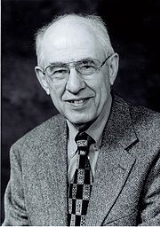
Hilary Putnam

Encyclopedia
Hilary Whitehall Putnam (born July 31, 1926) is an American philosopher, mathematician
and computer scientist, who has been a central figure in analytic philosophy
since the 1960s, especially in philosophy of mind
, philosophy of language
, philosophy of mathematics
, and philosophy of science
. He is known for his willingness to apply an equal degree of scrutiny to his own philosophical positions as to those of others, subjecting each position to rigorous analysis until he exposes its flaws. As a result, he has acquired a reputation for frequently changing his own position. Putnam is currently Cogan University Professor Emeritus at Harvard University
.
In philosophy of mind, Putnam is known for his argument against the type-identity
of mental and physical states based on his hypothesis of the multiple realizability
of the mental, and for the concept of functionalism
, an influential theory regarding the mind-body problem. In philosophy of language, along with Saul Kripke
and others, he developed the causal theory of reference
, and formulated an original theory of meaning, inventing the notion of semantic externalism
based on a famous thought experiment
called Twin Earth
.
In philosophy of mathematics
, he and his mentor W. V. Quine
developed the "Quine-Putnam indispensability thesis," an argument for the reality of mathematical entities, later espousing the view that mathematics is not purely logical, but "quasi-empirical
". In the field of epistemology, he is known for his critique of the well known "brain in a vat
" thought experiment. This thought experiment appears to provide a powerful argument for epistemological skepticism
, but Putnam challenges its coherence. In metaphysics
, he originally espoused a position called metaphysical realism
, but eventually became one of its most outspoken critics, first adopting a view he called "internal realism", which he later abandoned in favor of a pragmatist
-inspired direct realism. Putnam's "direct realism" aims to return the study of metaphysics to the way people actually experience the world, rejecting the idea of mental representations, sense data
, and other intermediaries between mind and world. In his later work, Putnam has become increasingly interested in American pragmatism, Jewish philosophy
, and ethics
, thus engaging with a wider array of philosophical traditions. He has also displayed an interest in metaphilosophy
, seeking to "renew philosophy" from what he identifies as narrow and inflated concerns.
Outside philosophy, Putnam has contributed to mathematics
and computer science
. Together with Martin Davis
he developed the Davis–Putnam algorithm
for the Boolean satisfiability problem
and he helped demonstrate the unsolvability of Hilbert's tenth problem
. He has been at times a politically controversial figure, especially for his involvement with the Progressive Labor Party in the late 1960s and early 1970s.
, Illinois
in 1926. His father, Samuel Putnam
, was a scholar of Romance languages, columnist and translator who wrote for the Daily Worker
, a publication of the American Communist Party
from 1936 to 1946 (when he became disillusioned with communism). As a result of his father's commitment to communism
, Putnam had a secular upbringing, although his mother, Riva, was Jewish. The family lived in France until 1934, when they returned to the United States, settling in Philadelphia. Putnam attended Central High School; there he met Noam Chomsky
, who was a year behind him. The two have been friends—and often intellectual opponents—ever since. Putnam studied mathematics and philosophy at the University of Pennsylvania
, receiving his BA
(undergraduate degree) and becoming a member of the Philomathean Society
, one of the oldest collegiate literary societies in the U.S. He went on to do graduate work in philosophy at Harvard University
, and later at UCLA
's Philosophy Department
, where he received his Ph.D.
in 1951 for a dissertation entitled "The Meaning of the Concept of Probability in Application to Finite Sequences". Putnam's teacher Hans Reichenbach
(his dissertation supervisor) was a leading figure in logical positivism
, the dominant school of philosophy of the day; one of Putnam's most consistent positions has been his rejection of logical positivism as self-defeating.
After briefly teaching at Northwestern
, Princeton
, and MIT
, he moved to Harvard in 1965 with his wife, Ruth Anna Jacobs, who took a teaching position in philosophy at Wellesley College. Hilary and Ruth Anna were married in 1962. Ruth Anna Jacobs, descendant of a family with a long scholarly tradition in Gotha
(her ancestor was the German classical scholar Christian Friedrich Wilhelm Jacobs
), was born in Berlin
, Germany, in 1927 to anti-Nazi
political-activist parents and, like Putnam himself, she was raised an atheist
(her mother was Jewish and her father had been from a Christian background). The Putnams, rebelling against the anti-Semitism
that they had experienced during their youth, decided to establish a traditional Jewish home for their children. Since they had no experience with the rituals of Judaism
, they sought out invitations to other Jews' homes for Seder
. They had "no idea how to do it [themselves]", in the words of Ruth Anna. They therefore began to study Jewish ritual and Hebrew, and became more Jewishly interested, identified, and active. In 1994, Hilary Putnam celebrated a belated Bar Mitzvah service. His wife had a Bat Mitzvah service four years later.
Hilary was a popular teacher at Harvard. In keeping with the family tradition, he was politically active. In the 1960s and early 1970s, he was an active supporter of civil rights causes and an opponent
of American military intervention in Vietnam
. In 1963, he organized one of the first faculty and student committees at MIT against the war. Putnam was disturbed when he learned from reading the reports of David Halberstam that the U.S. was "defending" South Vietnamese peasants from the Vietcong
by poisoning their rice crops. After moving to Harvard in 1965, he organized campus protests and began teaching courses on Marxism
. Hilary became an official faculty advisor to the Students for a Democratic Society
and, in 1968, became a member of the Progressive Labor Party (PLP).
He was elected a Fellow of the American Academy of Arts and Sciences
in 1965. After 1968, his political activities were centered on the PLP. The Harvard administration considered these activities disruptive and attempted to censure Putnam, but two other faculty members criticized the procedures. Putnam permanently severed his ties with the PLP in 1972. In 1997, at a meeting of former draft resistance activists at Arlington Street Church
in Boston
, Putnam described his involvement with the PLP as a mistake. He said that he had been impressed at first with PLP's commitment to alliance-building, and its willingness to attempt to organize from within the armed forces.
In 1976, he was elected President of the American Philosophical Association
. The following year, he was selected as Walter Beverly Pearson Professor of Mathematical Logic, in recognition of his contributions to philosophy of logic
and mathematics. While breaking with his radical past, Putnam has never abandoned his belief that academics have a particular social and ethical responsibility toward society. He has continued to be forthright and progressive
in his political views, as expressed in the articles "How Not to Solve Ethical Problems" (1983) and "Education for Democracy" (1993).
Putnam is a Corresponding Fellow of the British Academy
. He retired from teaching in June 2000, but, as of 2009, he still gives a seminar almost yearly at Tel Aviv University
. He is the Cogan University Professor Emeritus at Harvard University. He is also a founding patron of the small liberal arts college Ralston College
. His corpus includes five volumes of collected works, seven books, and more than 200 articles. Putnam's renewed interest in Judaism has inspired him to publish several recent books and essays on the topic. With his wife, he has co-authored several books and essays on the late-19th century American pragmatist
movement.
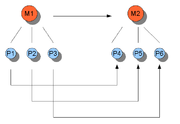 Putnam's best-known work concerns philosophy of mind. His most noted original contributions to that field came in several key papers published in the late 1960s that set out the hypothesis of multiple realizability
. In these papers, Putnam argues that, contrary to the famous claim of the type-identity theory, it is not necessarily true that "Pain
is identical to C-fibre firing." Pain, according to Putnam's papers, may correspond to utterly different physical states of the nervous system in different organisms, and yet they all experience the same mental state of "being in pain".
Putnam cited examples from the animal kingdom to illustrate his thesis. He asked whether it was likely that the brain structures of diverse types of animals realize pain, or other mental states, the same way. If they do not share the same brain structures, they cannot share the same mental states
and properties. The answer to this puzzle had to be that mental states were realized by different physical states in different species. Putnam then took his argument a step further, asking about such things as the nervous systems of alien beings, artificially intelligent robots
and other silicon
-based life forms. These hypothetical entities, he contended, should not be considered incapable of experiencing pain just because they lack the same neurochemistry
as humans. Putnam concluded that type-identity theorists had been making an "ambitious" and "highly implausible" conjecture which could be disproven with one example of multiple realizability. This argument is sometimes referred to as the "likelihood argument".
Putnam formulated a complementary argument based on what he called "functional isomorphism". He defined the concept in these terms: "Two systems are functionally isomorphic if 'there is a correspondence between the states of one and the states of the other that preserves functional relations'." In the case of computers, two machines are functionally isomorphic if and only if the sequential relations among states in the first are exactly mirrored by the sequential relations among states in the other. Therefore, a computer made out of silicon chips and a computer made out of cogs and wheels can be functionally isomorphic but constitutionally diverse. Functional isomorphism implies multiple realizability. This argument is sometimes referred to as an "a priori
argument".
Jerry Fodor
, Putnam, and others noted that, along with being an effective argument against type-identity theories, multiple realizability implies that any low-level explanation of higher-level mental phenomena is insufficiently abstract and general. Functionalism
, which identifies mental kinds with functional kinds that are characterized exclusively in terms of causes and effects, abstracts from the level of microphysics, and therefore seemed to be a better explanation of the relation between mind and body. In fact, there are many functional kinds, such as mousetraps, software and bookshelves, which are multiply realized at the physical level.
 The first formulation of such a functionalist theory was put forth by Putnam himself. This formulation, which is now called "machine-state functionalism", was inspired by analogies noted by Putnam and others between the mind and theoretical "Turing machines" capable of computing any given algorithm
.
In non-technical terms, a Turing machine can be visualized as an infinitely long tape divided into squares (the memory) with a box-shaped scanning device that sits over and scans one square of the memory at a time. Each square is either blank (B)
or has a 1 written on it. These are the inputs to the machine. The possible outputs are:
A simple example of a Turing machine which
writes out the sequence '111' after scanning three blank squares and then stopping is specified by the following machine table:
This table states that if the machine is in state one and scans a blank square (B), it will print a 1 and remain in state one. If it is in state one and reads a 1, it will move one square to the right and also go into state two. If it is in state two and reads a B, it will print a 1 and stay in state two. If it's in state two and reads a 1, it will move one square to the right and go into state three. Finally, if it is in state three and reads a B, it prints a 1 and remains in state three.
The point, for functionalism, is the nature of the "states" of the Turing machine. Each state can be defined in terms of its relations to the other states and to the inputs and outputs. State one, for example, is simply the state in which the machine, if it reads a B, writes a 1 and stays in that state, and in which, if it reads a 1, it moves one square to the right and goes into a different state. This is the functional definition of state one; it is its causal role in the overall system. The details of how it accomplishes what it accomplishes and of its material constitution are completely irrelevant.
According to machine-state functionalism, the nature of a mental state is just like the nature of the automaton states described above. Just as "state one" simply is the state in which, given an input B, such-and-such happens, so being in pain is the state which disposes one to cry "ouch", become distracted, wonder what the cause is, and so forth.
. His change of mind was primarily due to the difficulties that computational theories have in explaining certain intuitions with respect to the externalism
of mental content. This is illustrated by Putnam's own Twin Earth thought experiment
(see Philosophy of language). He also developed a separate argument against functionalism in 1988, based on Fodor's generalized version of multiple realizability. Asserting that functionalism is really a watered-down identity theory in which mental kinds are identified with functional kinds, Putnam argued that mental kinds may be multiply realizable over functional kinds. The argument for functionalism is that the same mental state could be implemented by the different states of a universal Turing machine
.
Despite Putnam's rejection of functionalism, it has continued to flourish and has been developed into numerous versions by thinkers as diverse as David Marr, Daniel Dennett
, Jerry Fodor
, and David Lewis. Functionalism helped lay the foundations for modern cognitive science
and is the dominant theory of mind in philosophy today.
is his claim that "meaning just ain't in the head". He illustrated this using his "Twin Earth" thought experiment to argue that environmental factors play a substantial role in determining meaning. Twin Earth shows this, according to Putnam, since on Twin Earth everything is identical to Earth, except that its lakes, rivers and oceans are filled with XYZ whereas those of earth are filled with H2O. Consequently, when an earthling, Fredrick, uses the Earth-English word "water", it has a different meaning from the Twin Earth-English word "water" when used by his physically identical twin, Frodrick, on Twin Earth. Since Fredrick and Frodrick are physically indistinguishable when they utter their respective words, and since their words have different meanings, meaning cannot be determined solely by what is in their heads. This led Putnam to adopt a version of semantic externalism
with regard to meaning and mental content.
The late philosopher of mind and language Donald Davidson
, despite his many differences of opinion with Putnam, wrote that semantic externalism constituted an "anti-subjectivist revolution" in philosophers' way of seeing the world. Since the time of Descartes, philosophers had been concerned with proving knowledge from the basis of subjective experience. Thanks to Putnam, Tyler Burge
and others, Davidson said, philosophy could now take the objective realm for granted and start questioning the alleged "truths" of subjective experience.
, Keith Donnellan
, and others, contributed to what is known as the causal theory of reference
. In particular, Putnam maintained in The Meaning of "Meaning" that the objects referred to by natural kind
terms—such as tiger, water, and tree—are the principal elements of the meaning of such terms. There is a linguistic division of labor, analogous to Adam Smith
's economic division of labor, according to which such terms have their references fixed by the "experts" in the particular field of science to which the terms belong. So, for example, the reference of the term "lion" is fixed by the community of zoologists, the reference of the term "elm tree" is fixed by the community of botanists, and the reference of the term "table salt" is fixed as "NaCl" by chemists. These referents are considered rigid designator
s in the Kripkean sense and are disseminated outward to the linguistic community.
Putnam specifies a finite sequence of elements (a vector) for the description of the meaning of every term in the language. Such a vector consists of four components:
Such a "meaning-vector" provides a description of the reference and use of an expression within a particular linguistic community. It provides the conditions for its correct usage and makes it possible to judge whether a single speaker attributes the appropriate meaning to that expression or whether its use has changed enough to cause a difference in its meaning. According to Putnam, it is legitimate to speak of a change in the meaning of an expression only if the reference of the term, and not its stereotype, has changed. However, since there is no possible algorithm that can determine which aspect—the stereotype or the reference—has changed in a particular case, it is necessary to consider the usage of other expressions of the language. Since there is no limit to the number of such expressions which must be considered, Putnam embraced a form of semantic holism
.
in the Quine–Putnam "indispensability argument" for mathematical realism. This argument is considered by Stephen Yablo
to be one of the most challenging arguments in favor of the acceptance of the existence of abstract mathematical entities, such as numbers and sets. The form of the argument is as follows.
The justification for the first premise is the most controversial. Both Putnam and Quine invoke naturalism
to justify the exclusion of all non-scientific entities, and hence to defend the "only" part of "all and only". The assertion that "all" entities postulated in scientific theories, including numbers, should be accepted as real is justified by confirmation holism
. Since theories are not confirmed in a piecemeal fashion, but as a whole, there is no justification for excluding any of the entities referred to in well-confirmed theories. This puts the nominalist
who wishes to exclude the existence of sets and non-Euclidean geometry
, but to include the existence of quark
s and other undetectable entities of physics, for example, in a difficult position.
Putnam holds the view that mathematics, like physics and other empirical sciences, uses both strict logical proofs and "quasi-empirical" methods. For example, Fermat's last theorem
states that for no integer
 are there positive integer values of x, y, and z such that
  . Before this was proven for all
  in 1995 by Andrew Wiles
, it had been proven for many values of n. These proofs inspired further research in the area, and formed a quasi-empirical consensus for the theorem. Even though such knowledge is more conjectural than a strictly proven theorem, it was still used in developing other mathematical ideas.
in mathematics. Yuri Matiyasevich
had formulated a theorem
involving the use of Fibonacci numbers in 1970, which was designed to answer the question of whether there is a general algorithm
that can decide whether a given system of Diophantine equation
s (polynomials with integer
coefficients) has a solution among the integers. Putnam, working with Martin Davis
and Julia Robinson
, demonstrated that Matiyasevich's theorem was sufficient to prove that no such general algorithm can exist. It was therefore shown that David Hilbert
's famous tenth problem has no solution.
In computability theory
, Putnam investigated the structure of the ramified analytical hierarchy
, its connection with the constructible hierarchy
and its Turing degree
s. He showed that there exist many levels of the constructible hierarchy which do not add any subsets of the integers and later, with his student George Boolos
, that the first such "non-index" is the ordinal
 of ramified analysis (this is the smallest
  such that
  is a model of full second-order comprehension
), and also, together with a separate paper with Richard Boyd
(another of Putnam's students) and Gustav Hensel, how the Davis–Mostowski
–Kleene
hyperarithmetical
hierarchy of arithmetical degrees can be naturally extended up to .
.
In computer science
, Putnam is known for the Davis-Putnam algorithm for the Boolean satisfiability problem
(SAT), developed with Martin Davis in 1960. The algorithm finds if there is a set of true or false values that satisfies a given Boolean expression
so that the entire expression becomes true. In 1962, they further refined the algorithm with the help of George Logemann and Donald W. Loveland
. It became known as the DPLL algorithm
. This algorithm is efficient and still forms the basis of most complete SAT solvers.
".
This follows from the causal theory of reference. Words always refer to the kinds of things they were coined to refer to, thus the kinds of things their user, or the user's ancestors, experienced. So, if some person, Mary, were a "brain in a vat", whose every experience is received through wiring and other gadgetry created by the "mad scientist", then Mary's idea of a "brain" would not refer to a "real" brain, since she and her linguistic community have never seen such a thing. Rather, she saw something that looked like a brain, but was actually an image fed to her through the wiring. Similarly, her idea of a "vat" would not refer to a "real" vat. So, if, as a "brain in a vat", she were to say "I'm a brain in a vat", she would actually be saying "I'm a brain-image in a vat-image", which is incoherent. On the other hand, if she is not a "brain in a vat", then saying that she is still incoherent, but now because she actually means the opposite. This is a form of epistemological externalism
: knowledge or justification depends on factors outside the mind and is not solely determined internally.
Putnam has clarified that his real target in this argument was never skepticism, but metaphysical realism. Since realism of this kind assumes the existence of a gap between how man conceives the world and the way the world really is, skeptical scenarios such as this one (or Descartes'
Evil demon) present a formidable challenge. Putnam, by arguing that such a scenario is impossible, attempts to show that this notion of a gap between man's concept of the world and the way it is, is in itself absurd. Man cannot have a "God's eye" view of reality. He is limited to his conceptual schemes. Metaphysical realism is therefore false, according to Putnam.
Putnam renounced internal realism in his reply to Simon Blackburn in the volume Reading Putnam. The reasons he gave up his "antirealism" are stated in the first three of his replies in "The Philosophy of Hilary Putnam", an issue of the journal Philosophical Topics, where he gives a history of his use(s) of the term "internal realism", and, at more length, in his The Threefold Cord: Mind, Body and World (1999).
Internal realism was the view that, although the world may be causally independent of the human mind, the structure of the world—its division into kinds, individuals and categories—is a function of the human mind, and hence the world is not ontologically independent. The general idea is influenced by Kant's
idea of the dependence of our knowledge of the world on the "categories of thought".
The problem with metaphysical realism, according to Putnam, was that it fails to explain the possibility of reference and truth. According to the metaphysical realist, our concepts and categories refer because they match up in some mysterious manner with the pre-structured categories, kinds and individuals that are inherent in the external world. But how is it possible that the world "carves up" into certain structures and categories, the mind carves up the world into its own categories and structures, and the two "carvings" perfectly coincide? The answer must be that the world does not come pre-structured but that structure must be imposed on it by the human mind and its conceptual schemes. In Reason, Truth, and History, Putnam identified truth with what he termed "idealized rational acceptability." The theory, which owes something to C.S. Peirce, is that a belief is true if it would be accepted by anyone under ideal epistemic conditions.
Nelson Goodman
had formulated a similar notion in Fact, Fiction and Forecast in 1956. In that work, Goodman went as far as to suggest that there is "no one world, but many worlds, each created by the human mind." Putnam rejected this form of social constructivism
, but retained the idea that there can be many correct descriptions of reality. No one of these descriptions can be scientifically proven to be the "one, true" description of the world. This does not imply relativism
, for Putnam, because not all descriptions are equally correct and the ones that are correct are not determined subjectively.
Under the influence of C.S. Peirce and William James
, Putnam also became convinced that there is no fact–value dichotomy; that is, ethical and aesthetic judgments often have a factual basis, while scientific judgments have an ethical element.
" and the rejection of history that characterize modern analytic philosophy
. He rejected internal realism because it assumed a "cognitive interface" model of the relation between the mind and the world. Under the increasing influence of James and the pragmatists
, he adopted a direct realist view of this relation. For a time, under the influence of Ludwig Wittgenstein
, he adopted a pluralist view of philosophy itself and came to view most philosophical problems as nothing more than conceptual or linguistic confusions created by philosophers by using ordinary language out of its original context. More recently,however, in "From Quantum Mechanics to Ethics and Back Again," forthcoming in Mario De Caro and David Macarthur (eds.), Philosophy in an Age of Science, Harvard University Press, Putnam writes "Let me say for the record that I utterly and totally reject all versions of the “end of philosophy” story, whether they come from Wittgensteinians, Rortians, Heidegerians, Derridians, or whoever."
Many of Putnam's most recent works have addressed the concerns of ordinary people, particularly their concerns about social problems. For example, he has written about the nature of democracy
, social justice
and religion
. He has discussed the ideas of the continental philosopher
, Jürgen Habermas
, and has written articles influenced by "continental" ideas.
and Mundale, to be able to conduct such research in the neurosciences, universal consistencies must either exist or be assumed to exist in brain structures. It is the similarity (or homology
) of brain structures that allows us to generalize across species. If multiple realizability were an empirical fact, results from experiments conducted on one species of animal (or one organism) would not be meaningful when generalized to explain the behavior of another species (or organism of the same species). Other criticisms of MR have been proposed by Jaegwon Kim
, David Lewis
, Robert Richardson and Patricia Churchland
.
One of the main arguments against functionalism was formulated by Putnam himself: the Twin Earth thought experiment
. However, there have been other criticisms. The Chinese room
argument by John Searle
(1980) is a direct attack on the claim that thought can be represented as a set of functions. The thought experiment is designed to show that it is possible to mimic intelligent action, without any interpretation or understanding, through the use of a purely functional system. In short, Searle describes a situation in which a person who speaks only English is locked in a room with Chinese symbols in baskets and a rule book in English for moving the symbols around. The person is instructed, by people outside the room, to follow the rule book for sending certain symbols out of the room when given certain symbols. Further, suppose that the people outside the room are Chinese speakers and are communicating with the person inside via the Chinese symbols. According to Searle, it would be absurd to claim that the English speaker inside "knows" Chinese based on these syntactic processes alone. This thought experiment attempts to show that systems that operate merely on syntactic processes cannot realize any semantics
(meaning) or intentionality
(aboutness). Thus, Searle attacks the idea that thought can be equated with the following of a set of syntactic rules. Thus, functionalism is an inadequate theory of the mind. Several other arguments against functionalism have been advanced by Ned Block.
Putnam has consistently adhered to the idea of semantic holism
, in spite of the many changes in his other positions. The problems with this position have been described by Michael Dummett
, Jerry Fodor
, Ernest Lepore
, and others. In the first place, they suggest that, if semantic holism is true, it is impossible to understand how a speaker of a language can learn the meaning of an expression, for any expression of the language. Given the limits of our cognitive abilities, we will never be able to master the whole of the English (or any other) language, even based on the (false) assumption that languages are static and immutable entities. Thus, if one must understand all of a natural language to understand a single word or expression, language learning is simply impossible. Semantic holism also fails to explain how two speakers can mean the same thing when using the same linguistic expression, and therefore how any communication at all is possible between them. Given a sentence P, since Fred and Mary have each mastered different parts of the English language and P is related differently to the sentences in each part, the result is that P means one thing for Fred and something else for Mary. Moreover, if a sentence P derives its meaning from its relations with all of the sentences of a language, as soon as the vocabulary of an individual changes by the addition or elimination of a sentence, the totality of relations changes, and therefore also the meaning of P. As this is a common phenomenon, the result is that P has two different meanings in two different moments in the life of the same person. Consequently, if I accept the truth of a sentence and then reject it later on, the meaning of that which I rejected and that which I accepted are completely different and therefore I cannot change my opinions with regard to the same sentences.
The brain in a vat
argument has also been subject to criticism. Crispin Wright
argues that Putnam's formulation of the brain-in-a-vat scenario is too narrow to refute global skepticism. The possibility that one is a recently disembodied brain in a vat is not undermined by semantic externalism. If a person has lived her entire life outside the vat—speaking the English language and interacting normally with the outside world—prior to her "envatment" by a mad scientist, when she wakes up inside the vat, her words and thoughts (e.g., "tree" and "grass") will still refer to the objects or events in the external world that they referred to before her envatment. In another scenario, a brain in a vat may be hooked up to a supercomputer
that randomly generates perceptual experiences. In this case, one's words and thoughts would not refer to anything, and would therefore be devoid of content. Semantics would no longer exist and the argument would be meaningless.
In philosophy of mathematics, Stephen Yablo
has argued that the Quine–Putnam indispensability thesis does not demonstrate that mathematical entities are truly indispensable. The argumentation is sophisticated, but the upshot is that one can achieve the same logical results by simply replacing all occurrences of the expression "so-and-so exists" (e.g., numbers exist) by occurrences of the expression "so-and-so is assumed (or hypothesized) to exist". For example, one can take the argument for indispensability described above and replace all references to existent entities with references to entities assumed to exist as follows.
Finally, Putnam's internal realism has been accused by Curtis Brown of being a disguised form of subjective idealism
. If this is the case, it is subject to the traditional arguments against that position. In particular, it falls into the trap of solipsism
. That is, if existence depends on experience, as subjective idealism maintains, and if one's consciousness were to stop existing, then the rest of the universe would stop existing as well.
Mathematician
A mathematician is a person whose primary area of study is the field of mathematics. Mathematicians are concerned with quantity, structure, space, and change....
and computer scientist, who has been a central figure in analytic philosophy
Analytic philosophy
Analytic philosophy is a generic term for a style of philosophy that came to dominate English-speaking countries in the 20th century...
since the 1960s, especially in philosophy of mind
Philosophy of mind
Philosophy of mind is a branch of philosophy that studies the nature of the mind, mental events, mental functions, mental properties, consciousness and their relationship to the physical body, particularly the brain. The mind-body problem, i.e...
, philosophy of language
Philosophy of language
Philosophy of language is the reasoned inquiry into the nature, origins, and usage of language. As a topic, the philosophy of language for analytic philosophers is concerned with four central problems: the nature of meaning, language use, language cognition, and the relationship between language...
, philosophy of mathematics
Philosophy of mathematics
The philosophy of mathematics is the branch of philosophy that studies the philosophical assumptions, foundations, and implications of mathematics. The aim of the philosophy of mathematics is to provide an account of the nature and methodology of mathematics and to understand the place of...
, and philosophy of science
Philosophy of science
The philosophy of science is concerned with the assumptions, foundations, methods and implications of science. It is also concerned with the use and merit of science and sometimes overlaps metaphysics and epistemology by exploring whether scientific results are actually a study of truth...
. He is known for his willingness to apply an equal degree of scrutiny to his own philosophical positions as to those of others, subjecting each position to rigorous analysis until he exposes its flaws. As a result, he has acquired a reputation for frequently changing his own position. Putnam is currently Cogan University Professor Emeritus at Harvard University
Harvard University
Harvard University is a private Ivy League university located in Cambridge, Massachusetts, United States, established in 1636 by the Massachusetts legislature. Harvard is the oldest institution of higher learning in the United States and the first corporation chartered in the country...
.
In philosophy of mind, Putnam is known for his argument against the type-identity
Type physicalism
Type physicalism is a physicalist theory, in philosophy of mind. It asserts that mental events can be grouped into types, and can then be correlated with types of physical events in the brain...
of mental and physical states based on his hypothesis of the multiple realizability
Multiple realizability
Multiple realizability, in philosophy of mind, is the thesis that the same mental property, state, or event can be implemented by different physical properties, states or events...
of the mental, and for the concept of functionalism
Functionalism (philosophy of mind)
Functionalism is a theory of the mind in contemporary philosophy, developed largely as an alternative to both the identity theory of mind and behaviourism. Its core idea is that mental states are constituted solely by their functional role — that is, they are causal relations to other mental...
, an influential theory regarding the mind-body problem. In philosophy of language, along with Saul Kripke
Saul Kripke
Saul Aaron Kripke is an American philosopher and logician. He is a professor emeritus at Princeton and teaches as a Distinguished Professor of Philosophy at the CUNY Graduate Center...
and others, he developed the causal theory of reference
Causal theory of reference
A causal theory of reference is a theory of how terms acquire specific referents. Such theories have been used to describe many referring terms, particularly logical terms, proper names, and natural kind terms...
, and formulated an original theory of meaning, inventing the notion of semantic externalism
Externalism
Externalism is a group of positions in the philosophy of mind which hold that the mind is not only the result of what is going on inside the nervous system but also of what either occur or exist outside the subject. It is often contrasted with internalism which holds that the mind emerges out of...
based on a famous thought experiment
Thought experiment
A thought experiment or Gedankenexperiment considers some hypothesis, theory, or principle for the purpose of thinking through its consequences...
called Twin Earth
Twin Earth thought experiment
The Twin Earth thought experiment was presented by philosopher Hilary Putnam in his 1973 paper "Meaning and Reference" and subsequent 1975 paper "The Meaning of 'Meaning'", as an early argument for what has subsequently come to be known as semantic externalism...
.
In philosophy of mathematics
Philosophy of mathematics
The philosophy of mathematics is the branch of philosophy that studies the philosophical assumptions, foundations, and implications of mathematics. The aim of the philosophy of mathematics is to provide an account of the nature and methodology of mathematics and to understand the place of...
, he and his mentor W. V. Quine
Willard Van Orman Quine
Willard Van Orman Quine was an American philosopher and logician in the analytic tradition...
developed the "Quine-Putnam indispensability thesis," an argument for the reality of mathematical entities, later espousing the view that mathematics is not purely logical, but "quasi-empirical
Quasi-empiricism in mathematics
Quasi-empiricism in mathematics is the attempt in the philosophy of mathematics to direct philosophers' attention to mathematical practice, in particular, relations with physics, social sciences, and computational mathematics, rather than solely to issues in the foundations of mathematics...
". In the field of epistemology, he is known for his critique of the well known "brain in a vat
Brain in a vat
In philosophy, the brain in a vat is an element used in a variety of thought experiments intended to draw out certain features of our ideas of knowledge, reality, truth, mind, and meaning...
" thought experiment. This thought experiment appears to provide a powerful argument for epistemological skepticism
Skepticism
Skepticism has many definitions, but generally refers to any questioning attitude towards knowledge, facts, or opinions/beliefs stated as facts, or doubt regarding claims that are taken for granted elsewhere...
, but Putnam challenges its coherence. In metaphysics
Metaphysics
Metaphysics is a branch of philosophy concerned with explaining the fundamental nature of being and the world, although the term is not easily defined. Traditionally, metaphysics attempts to answer two basic questions in the broadest possible terms:...
, he originally espoused a position called metaphysical realism
Philosophical realism
Contemporary philosophical realism is the belief that our reality, or some aspect of it, is ontologically independent of our conceptual schemes, linguistic practices, beliefs, etc....
, but eventually became one of its most outspoken critics, first adopting a view he called "internal realism", which he later abandoned in favor of a pragmatist
Pragmatism
Pragmatism is a philosophical tradition centered on the linking of practice and theory. It describes a process where theory is extracted from practice, and applied back to practice to form what is called intelligent practice...
-inspired direct realism. Putnam's "direct realism" aims to return the study of metaphysics to the way people actually experience the world, rejecting the idea of mental representations, sense data
Sense data
In the philosophy of perception, the theory of sense data was a popular view held the early 20th century by philosophers such as Bertrand Russell, C. D. Broad, H. H. Price, A.J. Ayer and G.E. Moore, among others. Sense data are supposedly mind-dependent objects whose existence and properties are...
, and other intermediaries between mind and world. In his later work, Putnam has become increasingly interested in American pragmatism, Jewish philosophy
Jewish philosophy
Jewish philosophy , includes all philosophy carried out by Jews, or, in relation to the religion of Judaism. Jewish philosophy, until modern Enlightenment and Emancipation, was pre-occupied with attempts to reconcile coherent new ideas into the tradition of Rabbinic Judaism; thus organizing...
, and ethics
Ethics
Ethics, also known as moral philosophy, is a branch of philosophy that addresses questions about morality—that is, concepts such as good and evil, right and wrong, virtue and vice, justice and crime, etc.Major branches of ethics include:...
, thus engaging with a wider array of philosophical traditions. He has also displayed an interest in metaphilosophy
Metaphilosophy
Metaphilosophy, also called philosophy of philosophy, is the study of the nature, aims, and methods of philosophy. The term is derived from Greek word meta μετά and philosophía φιλοσοφία ....
, seeking to "renew philosophy" from what he identifies as narrow and inflated concerns.
Outside philosophy, Putnam has contributed to mathematics
Mathematics
Mathematics is the study of quantity, space, structure, and change. Mathematicians seek out patterns and formulate new conjectures. Mathematicians resolve the truth or falsity of conjectures by mathematical proofs, which are arguments sufficient to convince other mathematicians of their validity...
and computer science
Computer science
Computer science or computing science is the study of the theoretical foundations of information and computation and of practical techniques for their implementation and application in computer systems...
. Together with Martin Davis
Martin Davis
Martin David Davis, is an American mathematician, known for his work on Hilbert's tenth problem . He received his Ph.D. from Princeton University in 1950, where his adviser was Alonzo Church . He is Professor Emeritus at New York University. He is the co-inventor of the Davis-Putnam and the DPLL...
he developed the Davis–Putnam algorithm
Davis–Putnam algorithm
The Davis–Putnam algorithm was developed by Martin Davis and Hilary Putnam for checking the validity of a first-order logic formula using a resolution-based decision procedure for propositional logic. Since the set of valid first-order formulas is recursively enumerable but not recursive, there...
for the Boolean satisfiability problem
Boolean satisfiability problem
In computer science, satisfiability is the problem of determining if the variables of a given Boolean formula can be assigned in such a way as to make the formula evaluate to TRUE...
and he helped demonstrate the unsolvability of Hilbert's tenth problem
Hilbert's tenth problem
Hilbert's tenth problem is the tenth on the list of Hilbert's problems of 1900. Its statement is as follows:Given a Diophantine equation with any number of unknown quantities and with rational integral numerical coefficients: To devise a process according to which it can be determined in a finite...
. He has been at times a politically controversial figure, especially for his involvement with the Progressive Labor Party in the late 1960s and early 1970s.
Personal life
Putnam was born in ChicagoChicago
Chicago is the largest city in the US state of Illinois. With nearly 2.7 million residents, it is the most populous city in the Midwestern United States and the third most populous in the US, after New York City and Los Angeles...
, Illinois
Illinois
Illinois is the fifth-most populous state of the United States of America, and is often noted for being a microcosm of the entire country. With Chicago in the northeast, small industrial cities and great agricultural productivity in central and northern Illinois, and natural resources like coal,...
in 1926. His father, Samuel Putnam
Samuel Putnam
Samuel Putnam was an American translator and scholar of Romance languages.His most famous work is his 1949 English translation of Miguel de Cervantes' Don Quixote...
, was a scholar of Romance languages, columnist and translator who wrote for the Daily Worker
Daily Worker
The Daily Worker was a newspaper published in New York City by the Communist Party USA, a formerly Comintern-affiliated organization. Publication began in 1924. While it generally reflected the prevailing views of the party, some attempts were made to make it appear that the paper reflected a...
, a publication of the American Communist Party
Communist Party USA
The Communist Party USA is a Marxist political party in the United States, established in 1919. It has a long, complex history that is closely related to the histories of similar communist parties worldwide and the U.S. labor movement....
from 1936 to 1946 (when he became disillusioned with communism). As a result of his father's commitment to communism
Communism
Communism is a social, political and economic ideology that aims at the establishment of a classless, moneyless, revolutionary and stateless socialist society structured upon common ownership of the means of production...
, Putnam had a secular upbringing, although his mother, Riva, was Jewish. The family lived in France until 1934, when they returned to the United States, settling in Philadelphia. Putnam attended Central High School; there he met Noam Chomsky
Noam Chomsky
Avram Noam Chomsky is an American linguist, philosopher, cognitive scientist, and activist. He is an Institute Professor and Professor in the Department of Linguistics & Philosophy at MIT, where he has worked for over 50 years. Chomsky has been described as the "father of modern linguistics" and...
, who was a year behind him. The two have been friends—and often intellectual opponents—ever since. Putnam studied mathematics and philosophy at the University of Pennsylvania
University of Pennsylvania
The University of Pennsylvania is a private, Ivy League university located in Philadelphia, Pennsylvania, United States. Penn is the fourth-oldest institution of higher education in the United States,Penn is the fourth-oldest using the founding dates claimed by each institution...
, receiving his BA
Bachelor of Arts
A Bachelor of Arts , from the Latin artium baccalaureus, is a bachelor's degree awarded for an undergraduate course or program in either the liberal arts, the sciences, or both...
(undergraduate degree) and becoming a member of the Philomathean Society
Philomathean Society
The Philomathean Society of the University of Pennsylvania is a collegiate literary society, the oldest student group at the university, and a claimant to the title of the oldest continuously-existing literary society in the United States.This claim is disputed between the Philomathean Society and...
, one of the oldest collegiate literary societies in the U.S. He went on to do graduate work in philosophy at Harvard University
Harvard University
Harvard University is a private Ivy League university located in Cambridge, Massachusetts, United States, established in 1636 by the Massachusetts legislature. Harvard is the oldest institution of higher learning in the United States and the first corporation chartered in the country...
, and later at UCLA
University of California, Los Angeles
The University of California, Los Angeles is a public research university located in the Westwood neighborhood of Los Angeles, California, USA. It was founded in 1919 as the "Southern Branch" of the University of California and is the second oldest of the ten campuses...
's Philosophy Department
UCLA Department of Philosophy
The UCLA Department of Philosophy is a constituent department of the Division of Humanities in the UCLA College of Letters and Science. From the mid-20th century, the department has been a leading and widely respected center for the study of Analytic Philosophy, especially Mathematical Logic,...
, where he received his Ph.D.
Doctor of Philosophy
Doctor of Philosophy, abbreviated as Ph.D., PhD, D.Phil., or DPhil , in English-speaking countries, is a postgraduate academic degree awarded by universities...
in 1951 for a dissertation entitled "The Meaning of the Concept of Probability in Application to Finite Sequences". Putnam's teacher Hans Reichenbach
Hans Reichenbach
Hans Reichenbach was a leading philosopher of science, educator and proponent of logical empiricism...
(his dissertation supervisor) was a leading figure in logical positivism
Logical positivism
Logical positivism is a philosophy that combines empiricism—the idea that observational evidence is indispensable for knowledge—with a version of rationalism incorporating mathematical and logico-linguistic constructs and deductions of epistemology.It may be considered as a type of analytic...
, the dominant school of philosophy of the day; one of Putnam's most consistent positions has been his rejection of logical positivism as self-defeating.
After briefly teaching at Northwestern
Northwestern University
Northwestern University is a private research university in Evanston and Chicago, Illinois, USA. Northwestern has eleven undergraduate, graduate, and professional schools offering 124 undergraduate degrees and 145 graduate and professional degrees....
, Princeton
Princeton University
Princeton University is a private research university located in Princeton, New Jersey, United States. The school is one of the eight universities of the Ivy League, and is one of the nine Colonial Colleges founded before the American Revolution....
, and MIT
Massachusetts Institute of Technology
The Massachusetts Institute of Technology is a private research university located in Cambridge, Massachusetts. MIT has five schools and one college, containing a total of 32 academic departments, with a strong emphasis on scientific and technological education and research.Founded in 1861 in...
, he moved to Harvard in 1965 with his wife, Ruth Anna Jacobs, who took a teaching position in philosophy at Wellesley College. Hilary and Ruth Anna were married in 1962. Ruth Anna Jacobs, descendant of a family with a long scholarly tradition in Gotha
Gotha
-Places:* Gotha , a town in Thuringia, Germany* Gotha , in Thuringia, Germany* Gotha, Ethiopia* Gotha, Florida, a town in the United States* Saxe-Gotha, a former Thuringian duchy* Saxe-Gotha-Altenburg, a former Thuringian duchy...
(her ancestor was the German classical scholar Christian Friedrich Wilhelm Jacobs
Christian Friedrich Wilhelm Jacobs
Christian Friedrich Wilhelm Jacobs , German classical scholar, was born at Gotha. After studying philology and theology at Jena and Göttingen, in 1785 he became teacher in the gymnasium of his native town, and in 1802 was appointed to an office in the public library...
), was born in Berlin
Berlin
Berlin is the capital city of Germany and is one of the 16 states of Germany. With a population of 3.45 million people, Berlin is Germany's largest city. It is the second most populous city proper and the seventh most populous urban area in the European Union...
, Germany, in 1927 to anti-Nazi
National Socialist German Workers Party
The National Socialist German Workers' Party , commonly known in English as the Nazi Party, was a political party in Germany between 1920 and 1945. Its predecessor, the German Workers' Party , existed from 1919 to 1920...
political-activist parents and, like Putnam himself, she was raised an atheist
Atheism
Atheism is, in a broad sense, the rejection of belief in the existence of deities. In a narrower sense, atheism is specifically the position that there are no deities...
(her mother was Jewish and her father had been from a Christian background). The Putnams, rebelling against the anti-Semitism
Anti-Semitism
Antisemitism is suspicion of, hatred toward, or discrimination against Jews for reasons connected to their Jewish heritage. According to a 2005 U.S...
that they had experienced during their youth, decided to establish a traditional Jewish home for their children. Since they had no experience with the rituals of Judaism
Judaism
Judaism ) is the "religion, philosophy, and way of life" of the Jewish people...
, they sought out invitations to other Jews' homes for Seder
Passover Seder
The Passover Seder is a Jewish ritual feast that marks the beginning of the Jewish holiday of Passover. It is conducted on the evenings of the 14th day of Nisan in the Hebrew calendar, and on the 15th by traditionally observant Jews living outside Israel. This corresponds to late March or April in...
. They had "no idea how to do it [themselves]", in the words of Ruth Anna. They therefore began to study Jewish ritual and Hebrew, and became more Jewishly interested, identified, and active. In 1994, Hilary Putnam celebrated a belated Bar Mitzvah service. His wife had a Bat Mitzvah service four years later.
Hilary was a popular teacher at Harvard. In keeping with the family tradition, he was politically active. In the 1960s and early 1970s, he was an active supporter of civil rights causes and an opponent
Opposition to the Vietnam War
The movement against US involvment in the in Vietnam War began in the United States with demonstrations in 1964 and grew in strength in later years. The US became polarized between those who advocated continued involvement in Vietnam, and those who wanted peace. Peace movements consisted largely of...
of American military intervention in Vietnam
Vietnam War
The Vietnam War was a Cold War-era military conflict that occurred in Vietnam, Laos, and Cambodia from 1 November 1955 to the fall of Saigon on 30 April 1975. This war followed the First Indochina War and was fought between North Vietnam, supported by its communist allies, and the government of...
. In 1963, he organized one of the first faculty and student committees at MIT against the war. Putnam was disturbed when he learned from reading the reports of David Halberstam that the U.S. was "defending" South Vietnamese peasants from the Vietcong
National Front for the Liberation of South Vietnam
The Vietcong , or National Liberation Front , was a political organization and army in South Vietnam and Cambodia that fought the United States and South Vietnamese governments during the Vietnam War . It had both guerrilla and regular army units, as well as a network of cadres who organized...
by poisoning their rice crops. After moving to Harvard in 1965, he organized campus protests and began teaching courses on Marxism
Marxism
Marxism is an economic and sociopolitical worldview and method of socioeconomic inquiry that centers upon a materialist interpretation of history, a dialectical view of social change, and an analysis and critique of the development of capitalism. Marxism was pioneered in the early to mid 19th...
. Hilary became an official faculty advisor to the Students for a Democratic Society
Students for a Democratic Society (1960 organization)
Students for a Democratic Society was a student activist movement in the United States that was one of the main iconic representations of the country's New Left. The organization developed and expanded rapidly in the mid-1960s before dissolving at its last convention in 1969...
and, in 1968, became a member of the Progressive Labor Party (PLP).
He was elected a Fellow of the American Academy of Arts and Sciences
American Academy of Arts and Sciences
The American Academy of Arts and Sciences is an independent policy research center that conducts multidisciplinary studies of complex and emerging problems. The Academy’s elected members are leaders in the academic disciplines, the arts, business, and public affairs.James Bowdoin, John Adams, and...
in 1965. After 1968, his political activities were centered on the PLP. The Harvard administration considered these activities disruptive and attempted to censure Putnam, but two other faculty members criticized the procedures. Putnam permanently severed his ties with the PLP in 1972. In 1997, at a meeting of former draft resistance activists at Arlington Street Church
Arlington Street Church (Boston)
Arlington Street Church is a Unitarian Universalist church located in Boston, Massachusetts. The congregation was founded in 1729 as the "Church of the Presbyterian Strangers", becoming independent in 1787, taking on a Congregational model...
in Boston
Boston
Boston is the capital of and largest city in Massachusetts, and is one of the oldest cities in the United States. The largest city in New England, Boston is regarded as the unofficial "Capital of New England" for its economic and cultural impact on the entire New England region. The city proper had...
, Putnam described his involvement with the PLP as a mistake. He said that he had been impressed at first with PLP's commitment to alliance-building, and its willingness to attempt to organize from within the armed forces.
In 1976, he was elected President of the American Philosophical Association
American Philosophical Association
The American Philosophical Association is the main professional organization for philosophers in the United States. Founded in 1900, its mission is to promote the exchange of ideas among philosophers, to encourage creative and scholarly activity in philosophy, to facilitate the professional work...
. The following year, he was selected as Walter Beverly Pearson Professor of Mathematical Logic, in recognition of his contributions to philosophy of logic
Philosophy of logic
Following the developments in Formal logic with symbolic logic in the late nineteenth century and mathematical logic in the twentieth, topics traditionally treated by logic not being part of formal logic have tended to be termed either philosophy of logic or philosophical logic if no longer simply...
and mathematics. While breaking with his radical past, Putnam has never abandoned his belief that academics have a particular social and ethical responsibility toward society. He has continued to be forthright and progressive
Progressivism
Progressivism is an umbrella term for a political ideology advocating or favoring social, political, and economic reform or changes. Progressivism is often viewed by some conservatives, constitutionalists, and libertarians to be in opposition to conservative or reactionary ideologies.The...
in his political views, as expressed in the articles "How Not to Solve Ethical Problems" (1983) and "Education for Democracy" (1993).
Putnam is a Corresponding Fellow of the British Academy
British Academy
The British Academy is the United Kingdom's national body for the humanities and the social sciences. Its purpose is to inspire, recognise and support excellence in the humanities and social sciences, throughout the UK and internationally, and to champion their role and value.It receives an annual...
. He retired from teaching in June 2000, but, as of 2009, he still gives a seminar almost yearly at Tel Aviv University
Tel Aviv University
Tel Aviv University is a public university located in Ramat Aviv, Tel Aviv, Israel. With nearly 30,000 students, TAU is Israel's largest university.-History:...
. He is the Cogan University Professor Emeritus at Harvard University. He is also a founding patron of the small liberal arts college Ralston College
Ralston College
Ralston College is a liberal arts college in Savannah, Georgia, United States. It was founded on February 1, 2010 and as of December 2010 is not yet accepting applications for admission. The patrons of Ralston College are Harold Bloom, Hilary Putnam, and Salman Rushdie. The members of the Board...
. His corpus includes five volumes of collected works, seven books, and more than 200 articles. Putnam's renewed interest in Judaism has inspired him to publish several recent books and essays on the topic. With his wife, he has co-authored several books and essays on the late-19th century American pragmatist
Pragmatism
Pragmatism is a philosophical tradition centered on the linking of practice and theory. It describes a process where theory is extracted from practice, and applied back to practice to form what is called intelligent practice...
movement.
Multiple realizability
Multiple realizability
Multiple realizability, in philosophy of mind, is the thesis that the same mental property, state, or event can be implemented by different physical properties, states or events...
. In these papers, Putnam argues that, contrary to the famous claim of the type-identity theory, it is not necessarily true that "Pain
Pain
Pain is an unpleasant sensation often caused by intense or damaging stimuli such as stubbing a toe, burning a finger, putting iodine on a cut, and bumping the "funny bone."...
is identical to C-fibre firing." Pain, according to Putnam's papers, may correspond to utterly different physical states of the nervous system in different organisms, and yet they all experience the same mental state of "being in pain".
Putnam cited examples from the animal kingdom to illustrate his thesis. He asked whether it was likely that the brain structures of diverse types of animals realize pain, or other mental states, the same way. If they do not share the same brain structures, they cannot share the same mental states
Animal cognition
Animal cognition is the title given to the study of the mental capacities of non-human animals. It has developed out of comparative psychology, but has also been strongly influenced by the approach of ethology, behavioral ecology, and evolutionary psychology...
and properties. The answer to this puzzle had to be that mental states were realized by different physical states in different species. Putnam then took his argument a step further, asking about such things as the nervous systems of alien beings, artificially intelligent robots
Artificial intelligence
Artificial intelligence is the intelligence of machines and the branch of computer science that aims to create it. AI textbooks define the field as "the study and design of intelligent agents" where an intelligent agent is a system that perceives its environment and takes actions that maximize its...
and other silicon
Silicon
Silicon is a chemical element with the symbol Si and atomic number 14. A tetravalent metalloid, it is less reactive than its chemical analog carbon, the nonmetal directly above it in the periodic table, but more reactive than germanium, the metalloid directly below it in the table...
-based life forms. These hypothetical entities, he contended, should not be considered incapable of experiencing pain just because they lack the same neurochemistry
Neurochemistry
Neurochemistry is the specific study of neurochemicals, which include neurotransmitters and other molecules such as neuro-active drugs that influence neuron function. This principle closely examines the manner in which these neurochemicals influence the network of neural operation...
as humans. Putnam concluded that type-identity theorists had been making an "ambitious" and "highly implausible" conjecture which could be disproven with one example of multiple realizability. This argument is sometimes referred to as the "likelihood argument".
Putnam formulated a complementary argument based on what he called "functional isomorphism". He defined the concept in these terms: "Two systems are functionally isomorphic if 'there is a correspondence between the states of one and the states of the other that preserves functional relations'." In the case of computers, two machines are functionally isomorphic if and only if the sequential relations among states in the first are exactly mirrored by the sequential relations among states in the other. Therefore, a computer made out of silicon chips and a computer made out of cogs and wheels can be functionally isomorphic but constitutionally diverse. Functional isomorphism implies multiple realizability. This argument is sometimes referred to as an "a priori
A priori and a posteriori (philosophy)
The terms a priori and a posteriori are used in philosophy to distinguish two types of knowledge, justifications or arguments...
argument".
Jerry Fodor
Jerry Fodor
Jerry Alan Fodor is an American philosopher and cognitive scientist. He holds the position of State of New Jersey Professor of Philosophy at Rutgers University and is the author of many works in the fields of philosophy of mind and cognitive science, in which he has laid the groundwork for the...
, Putnam, and others noted that, along with being an effective argument against type-identity theories, multiple realizability implies that any low-level explanation of higher-level mental phenomena is insufficiently abstract and general. Functionalism
Functionalism (philosophy of mind)
Functionalism is a theory of the mind in contemporary philosophy, developed largely as an alternative to both the identity theory of mind and behaviourism. Its core idea is that mental states are constituted solely by their functional role — that is, they are causal relations to other mental...
, which identifies mental kinds with functional kinds that are characterized exclusively in terms of causes and effects, abstracts from the level of microphysics, and therefore seemed to be a better explanation of the relation between mind and body. In fact, there are many functional kinds, such as mousetraps, software and bookshelves, which are multiply realized at the physical level.
Machine state functionalism
Algorithm
In mathematics and computer science, an algorithm is an effective method expressed as a finite list of well-defined instructions for calculating a function. Algorithms are used for calculation, data processing, and automated reasoning...
.
In non-technical terms, a Turing machine can be visualized as an infinitely long tape divided into squares (the memory) with a box-shaped scanning device that sits over and scans one square of the memory at a time. Each square is either blank (B)
or has a 1 written on it. These are the inputs to the machine. The possible outputs are:
- Halt: Do nothing.
- R: move one square to the right.
- L: move one square to the left.
- B: erase whatever is on the square.
- 1: erase whatever is on the square and print a 1.
A simple example of a Turing machine which
writes out the sequence '111' after scanning three blank squares and then stopping is specified by the following machine table:
| State 1 | State 2 | State 3 | |
| B | write 1; stay in state 1 | write 1; stay in state 2 | write 1; stay in state 3 |
| 1 | go right; go to state 2 | go right; go to state 3 | [halt] |
This table states that if the machine is in state one and scans a blank square (B), it will print a 1 and remain in state one. If it is in state one and reads a 1, it will move one square to the right and also go into state two. If it is in state two and reads a B, it will print a 1 and stay in state two. If it's in state two and reads a 1, it will move one square to the right and go into state three. Finally, if it is in state three and reads a B, it prints a 1 and remains in state three.
The point, for functionalism, is the nature of the "states" of the Turing machine. Each state can be defined in terms of its relations to the other states and to the inputs and outputs. State one, for example, is simply the state in which the machine, if it reads a B, writes a 1 and stays in that state, and in which, if it reads a 1, it moves one square to the right and goes into a different state. This is the functional definition of state one; it is its causal role in the overall system. The details of how it accomplishes what it accomplishes and of its material constitution are completely irrelevant.
According to machine-state functionalism, the nature of a mental state is just like the nature of the automaton states described above. Just as "state one" simply is the state in which, given an input B, such-and-such happens, so being in pain is the state which disposes one to cry "ouch", become distracted, wonder what the cause is, and so forth.
Rejection of functionalism
In the late 1980s, Putnam abandoned his adherence to functionalism and other computational theories of mindComputational theory of mind
In philosophy, the computational theory of mind is the view that the human mind is an information processing system and that thinking is a form of computing. The theory was proposed in its modern form by Hilary Putnam in 1961 and developed by Jerry Fodor in the 60s and 70s...
. His change of mind was primarily due to the difficulties that computational theories have in explaining certain intuitions with respect to the externalism
Internalism and externalism
Internalism and externalism are two opposing ways of explaining various subjects in several areas of philosophy. These include human motivation, knowledge, justification, meaning and truth. The distinction arises in many areas of debate with similar but distinct meanings...
of mental content. This is illustrated by Putnam's own Twin Earth thought experiment
Thought experiment
A thought experiment or Gedankenexperiment considers some hypothesis, theory, or principle for the purpose of thinking through its consequences...
(see Philosophy of language). He also developed a separate argument against functionalism in 1988, based on Fodor's generalized version of multiple realizability. Asserting that functionalism is really a watered-down identity theory in which mental kinds are identified with functional kinds, Putnam argued that mental kinds may be multiply realizable over functional kinds. The argument for functionalism is that the same mental state could be implemented by the different states of a universal Turing machine
Universal Turing machine
In computer science, a universal Turing machine is a Turing machine that can simulate an arbitrary Turing machine on arbitrary input. The universal machine essentially achieves this by reading both the description of the machine to be simulated as well as the input thereof from its own tape. Alan...
.
Despite Putnam's rejection of functionalism, it has continued to flourish and has been developed into numerous versions by thinkers as diverse as David Marr, Daniel Dennett
Daniel Dennett
Daniel Clement Dennett is an American philosopher, writer and cognitive scientist whose research centers on the philosophy of mind, philosophy of science and philosophy of biology, particularly as those fields relate to evolutionary biology and cognitive science. He is currently the Co-director of...
, Jerry Fodor
Jerry Fodor
Jerry Alan Fodor is an American philosopher and cognitive scientist. He holds the position of State of New Jersey Professor of Philosophy at Rutgers University and is the author of many works in the fields of philosophy of mind and cognitive science, in which he has laid the groundwork for the...
, and David Lewis. Functionalism helped lay the foundations for modern cognitive science
Cognitive science
Cognitive science is the interdisciplinary scientific study of mind and its processes. It examines what cognition is, what it does and how it works. It includes research on how information is processed , represented, and transformed in behaviour, nervous system or machine...
and is the dominant theory of mind in philosophy today.
Semantic externalism
One of Putnam's contributions to philosophy of languagePhilosophy of language
Philosophy of language is the reasoned inquiry into the nature, origins, and usage of language. As a topic, the philosophy of language for analytic philosophers is concerned with four central problems: the nature of meaning, language use, language cognition, and the relationship between language...
is his claim that "meaning just ain't in the head". He illustrated this using his "Twin Earth" thought experiment to argue that environmental factors play a substantial role in determining meaning. Twin Earth shows this, according to Putnam, since on Twin Earth everything is identical to Earth, except that its lakes, rivers and oceans are filled with XYZ whereas those of earth are filled with H2O. Consequently, when an earthling, Fredrick, uses the Earth-English word "water", it has a different meaning from the Twin Earth-English word "water" when used by his physically identical twin, Frodrick, on Twin Earth. Since Fredrick and Frodrick are physically indistinguishable when they utter their respective words, and since their words have different meanings, meaning cannot be determined solely by what is in their heads. This led Putnam to adopt a version of semantic externalism
Semantic externalism
In the philosophy of language, semantic externalism is the view that the meaning of a term is determined, in whole or in part, by factors external to the speaker. According to an externalist position, one can claim without contradiction that two speakers could be in exactly the same brain state at...
with regard to meaning and mental content.
The late philosopher of mind and language Donald Davidson
Donald Davidson (philosopher)
Donald Herbert Davidson was an American philosopher born in Springfield, Massachusetts, who served as Slusser Professor of Philosophy at the University of California, Berkeley from 1981 to 2003 after having also held teaching appointments at Stanford University, Rockefeller University, Princeton...
, despite his many differences of opinion with Putnam, wrote that semantic externalism constituted an "anti-subjectivist revolution" in philosophers' way of seeing the world. Since the time of Descartes, philosophers had been concerned with proving knowledge from the basis of subjective experience. Thanks to Putnam, Tyler Burge
Tyler Burge
Tyler Burge is a Professor of Philosophy at UCLA. He has made contributions to several areas of philosophy, including the philosophy of mind, epistemology, and the history of philosophy. In the history of philosophy, he has published articles on the philosophy of Gottlob Frege...
and others, Davidson said, philosophy could now take the objective realm for granted and start questioning the alleged "truths" of subjective experience.
Theory of meaning
Putnam, along with Saul KripkeSaul Kripke
Saul Aaron Kripke is an American philosopher and logician. He is a professor emeritus at Princeton and teaches as a Distinguished Professor of Philosophy at the CUNY Graduate Center...
, Keith Donnellan
Keith Donnellan
Keith Donnellan is a contemporary philosopher and Professor Emeritus of the UCLA department of Philosophy. He has made important contributions to the philosophy of language, most notably to the analysis of proper names and definite descriptions...
, and others, contributed to what is known as the causal theory of reference
Causal theory of reference
A causal theory of reference is a theory of how terms acquire specific referents. Such theories have been used to describe many referring terms, particularly logical terms, proper names, and natural kind terms...
. In particular, Putnam maintained in The Meaning of "Meaning" that the objects referred to by natural kind
Natural kind
In philosophy, a natural kind is a "natural" grouping, not an artificial one. Or, it is something that a set of things has in common which distinguishes it from other things as a real set rather than as a group of things arbitrarily lumped together by a person or group of people.If any natural...
terms—such as tiger, water, and tree—are the principal elements of the meaning of such terms. There is a linguistic division of labor, analogous to Adam Smith
Adam Smith
Adam Smith was a Scottish social philosopher and a pioneer of political economy. One of the key figures of the Scottish Enlightenment, Smith is the author of The Theory of Moral Sentiments and An Inquiry into the Nature and Causes of the Wealth of Nations...
's economic division of labor, according to which such terms have their references fixed by the "experts" in the particular field of science to which the terms belong. So, for example, the reference of the term "lion" is fixed by the community of zoologists, the reference of the term "elm tree" is fixed by the community of botanists, and the reference of the term "table salt" is fixed as "NaCl" by chemists. These referents are considered rigid designator
Rigid designator
In modal logic and the philosophy of language, a term is said to be a rigid designator when it designates the same thing in all possible worlds in which that thing exists and does not designate anything else in those possible worlds in which that thing does not exist...
s in the Kripkean sense and are disseminated outward to the linguistic community.
Putnam specifies a finite sequence of elements (a vector) for the description of the meaning of every term in the language. Such a vector consists of four components:
- the object to which the term refersReferenceReference is derived from Middle English referren, from Middle French rèférer, from Latin referre, "to carry back", formed from the prefix re- and ferre, "to bear"...
, e.g., the object individuated by the chemical formula H2O; - a set of typical descriptions of the term, referred to as "the stereotype", e.g., "transparent", "colorless", and "hydrating";
- the semantic indicators that place the object into a general category, e.g., "natural kind" and "liquid";
- the syntactic indicators, e.g., "concrete noun" and "mass noun".
Such a "meaning-vector" provides a description of the reference and use of an expression within a particular linguistic community. It provides the conditions for its correct usage and makes it possible to judge whether a single speaker attributes the appropriate meaning to that expression or whether its use has changed enough to cause a difference in its meaning. According to Putnam, it is legitimate to speak of a change in the meaning of an expression only if the reference of the term, and not its stereotype, has changed. However, since there is no possible algorithm that can determine which aspect—the stereotype or the reference—has changed in a particular case, it is necessary to consider the usage of other expressions of the language. Since there is no limit to the number of such expressions which must be considered, Putnam embraced a form of semantic holism
Semantic holism
Semantic holism is a doctrine in the philosophy of language to the effect that a certain part of language, be it a term or a complete sentence, can only be understood through its relations to a larger segment of language. There is substantial controversy, however, as to exactly what the larger...
.
Philosophy of mathematics
Putnam made a significant contribution to philosophy of mathematicsPhilosophy of mathematics
The philosophy of mathematics is the branch of philosophy that studies the philosophical assumptions, foundations, and implications of mathematics. The aim of the philosophy of mathematics is to provide an account of the nature and methodology of mathematics and to understand the place of...
in the Quine–Putnam "indispensability argument" for mathematical realism. This argument is considered by Stephen Yablo
Stephen Yablo
Stephen Yablo is a philosopher at the Massachusetts Institute of Technology . He specializes in the philosophy of logic, philosophy of mind, metaphysics, and philosophy of language....
to be one of the most challenging arguments in favor of the acceptance of the existence of abstract mathematical entities, such as numbers and sets. The form of the argument is as follows.
- One must have ontologicalOntologyOntology is the philosophical study of the nature of being, existence or reality as such, as well as the basic categories of being and their relations...
commitments to all entities that are indispensable to the best scientific theories, and to those entities only (commonly referred to as "all and only"). - Mathematical entities are indispensable to the best scientific theories. Therefore,
- One must have ontological commitments to mathematical entities.
The justification for the first premise is the most controversial. Both Putnam and Quine invoke naturalism
Naturalism (philosophy)
Naturalism commonly refers to the philosophical viewpoint that the natural universe and its natural laws and forces operate in the universe, and that nothing exists beyond the natural universe or, if it does, it does not affect the natural universe that we know...
to justify the exclusion of all non-scientific entities, and hence to defend the "only" part of "all and only". The assertion that "all" entities postulated in scientific theories, including numbers, should be accepted as real is justified by confirmation holism
Confirmation holism
Confirmation holism, also called epistemological holism is the claim that a single scientific theory cannot be tested in isolation; a test of one theory always depends on other theories and hypotheses....
. Since theories are not confirmed in a piecemeal fashion, but as a whole, there is no justification for excluding any of the entities referred to in well-confirmed theories. This puts the nominalist
Nominalism
Nominalism is a metaphysical view in philosophy according to which general or abstract terms and predicates exist, while universals or abstract objects, which are sometimes thought to correspond to these terms, do not exist. Thus, there are at least two main versions of nominalism...
who wishes to exclude the existence of sets and non-Euclidean geometry
Non-Euclidean geometry
Non-Euclidean geometry is the term used to refer to two specific geometries which are, loosely speaking, obtained by negating the Euclidean parallel postulate, namely hyperbolic and elliptic geometry. This is one term which, for historical reasons, has a meaning in mathematics which is much...
, but to include the existence of quark
Quark
A quark is an elementary particle and a fundamental constituent of matter. Quarks combine to form composite particles called hadrons, the most stable of which are protons and neutrons, the components of atomic nuclei. Due to a phenomenon known as color confinement, quarks are never directly...
s and other undetectable entities of physics, for example, in a difficult position.
Putnam holds the view that mathematics, like physics and other empirical sciences, uses both strict logical proofs and "quasi-empirical" methods. For example, Fermat's last theorem
Fermat's Last Theorem
In number theory, Fermat's Last Theorem states that no three positive integers a, b, and c can satisfy the equation an + bn = cn for any integer value of n greater than two....
states that for no integer
Integer
The integers are formed by the natural numbers together with the negatives of the non-zero natural numbers .They are known as Positive and Negative Integers respectively...
are there positive integer values of x, y, and z such that . Before this was proven for all in 1995 by Andrew WilesAndrew Wiles
Sir Andrew John Wiles KBE FRS is a British mathematician and a Royal Society Research Professor at Oxford University, specializing in number theory...
, it had been proven for many values of n. These proofs inspired further research in the area, and formed a quasi-empirical consensus for the theorem. Even though such knowledge is more conjectural than a strictly proven theorem, it was still used in developing other mathematical ideas.
Mathematics and computer science
Putnam has contributed to scientific fields not directly related to his work in philosophy. As a mathematician, Putnam contributed to the resolution of Hilbert's tenth problemHilbert's tenth problem
Hilbert's tenth problem is the tenth on the list of Hilbert's problems of 1900. Its statement is as follows:Given a Diophantine equation with any number of unknown quantities and with rational integral numerical coefficients: To devise a process according to which it can be determined in a finite...
in mathematics. Yuri Matiyasevich
Yuri Matiyasevich
Yuri Vladimirovich Matiyasevich, is a Russian mathematician and computer scientist. He is best known for his negative solution of Hilbert's tenth problem, presented in his doctoral thesis, at LOMI .- Biography :* In 1962-1963 studied at Saint Petersburg Lyceum 239...
had formulated a theorem
Theorem
In mathematics, a theorem is a statement that has been proven on the basis of previously established statements, such as other theorems, and previously accepted statements, such as axioms...
involving the use of Fibonacci numbers in 1970, which was designed to answer the question of whether there is a general algorithm
Algorithm
In mathematics and computer science, an algorithm is an effective method expressed as a finite list of well-defined instructions for calculating a function. Algorithms are used for calculation, data processing, and automated reasoning...
that can decide whether a given system of Diophantine equation
Diophantine equation
In mathematics, a Diophantine equation is an indeterminate polynomial equation that allows the variables to be integers only. Diophantine problems have fewer equations than unknown variables and involve finding integers that work correctly for all equations...
s (polynomials with integer
Integer
The integers are formed by the natural numbers together with the negatives of the non-zero natural numbers .They are known as Positive and Negative Integers respectively...
coefficients) has a solution among the integers. Putnam, working with Martin Davis
Martin Davis
Martin David Davis, is an American mathematician, known for his work on Hilbert's tenth problem . He received his Ph.D. from Princeton University in 1950, where his adviser was Alonzo Church . He is Professor Emeritus at New York University. He is the co-inventor of the Davis-Putnam and the DPLL...
and Julia Robinson
Julia Robinson
Julia Hall Bowman Robinson was an American mathematician best known for her work on decision problems and Hilbert's Tenth Problem.-Background and education:...
, demonstrated that Matiyasevich's theorem was sufficient to prove that no such general algorithm can exist. It was therefore shown that David Hilbert
David Hilbert
David Hilbert was a German mathematician. He is recognized as one of the most influential and universal mathematicians of the 19th and early 20th centuries. Hilbert discovered and developed a broad range of fundamental ideas in many areas, including invariant theory and the axiomatization of...
's famous tenth problem has no solution.
In computability theory
Computability theory
Computability theory, also called recursion theory, is a branch of mathematical logic that originated in the 1930s with the study of computable functions and Turing degrees. The field has grown to include the study of generalized computability and definability...
, Putnam investigated the structure of the ramified analytical hierarchy
Analytical hierarchy
In mathematical logic and descriptive set theory, the analytical hierarchy is a higher type analogue of the arithmetical hierarchy. It thus continues the classification of sets by the formulas that define them.-The analytical hierarchy of formulas:...
, its connection with the constructible hierarchy
Constructible universe
In mathematics, the constructible universe , denoted L, is a particular class of sets which can be described entirely in terms of simpler sets. It was introduced by Kurt Gödel in his 1938 paper "The Consistency of the Axiom of Choice and of the Generalized Continuum-Hypothesis"...
and its Turing degree
Turing degree
In computer science and mathematical logic the Turing degree or degree of unsolvability of a set of natural numbers measures the level of algorithmic unsolvability of the set...
s. He showed that there exist many levels of the constructible hierarchy which do not add any subsets of the integers and later, with his student George Boolos
George Boolos
George Stephen Boolos was a philosopher and a mathematical logician who taught at the Massachusetts Institute of Technology.- Life :...
, that the first such "non-index" is the ordinal
Large countable ordinal
In the mathematical discipline of set theory, there are many ways of describing specific countable ordinals. The smallest ones can be usefully and non-circularly expressed in terms of their Cantor normal forms. Beyond that, many ordinals of relevance to proof theory still have computable ordinal...
of ramified analysis (this is the smallest such that is a model of full second-order comprehensionSecond-order arithmetic
In mathematical logic, second-order arithmetic is a collection of axiomatic systems that formalize the natural numbers and their subsets. It is an alternative to axiomatic set theory as a foundation for much, but not all, of mathematics. It was introduced by David Hilbert and Paul Bernays in their...
), and also, together with a separate paper with Richard Boyd
Richard Boyd
Richard Newell Boyd is an American philosopher who has spent most of his career at Cornell University, though he also taught briefly at Harvard University, the University of Michigan, Ann Arbor, and the University of California, Berkeley...
(another of Putnam's students) and Gustav Hensel, how the Davis–Mostowski
Andrzej Mostowski
Andrzej Mostowski was a Polish mathematician. He is perhaps best remembered for the Mostowski collapse lemma....
–Kleene
Stephen Cole Kleene
Stephen Cole Kleene was an American mathematician who helped lay the foundations for theoretical computer science...
hyperarithmetical
Hyperarithmetical theory
In recursion theory, hyperarithmetic theory is a generalization of Turing computability. It has close connections with definability in second-order arithmetic and with weak systems of set theory such as Kripke–Platek set theory...
hierarchy of arithmetical degrees can be naturally extended up to
.In computer science
Computer science
Computer science or computing science is the study of the theoretical foundations of information and computation and of practical techniques for their implementation and application in computer systems...
, Putnam is known for the Davis-Putnam algorithm for the Boolean satisfiability problem
Boolean satisfiability problem
In computer science, satisfiability is the problem of determining if the variables of a given Boolean formula can be assigned in such a way as to make the formula evaluate to TRUE...
(SAT), developed with Martin Davis in 1960. The algorithm finds if there is a set of true or false values that satisfies a given Boolean expression
Boolean expression
In computer science, a Boolean expression is an expression in a programming language that produces a Boolean value when evaluated, i.e. one of true or false...
so that the entire expression becomes true. In 1962, they further refined the algorithm with the help of George Logemann and Donald W. Loveland
Donald W. Loveland
Donald W. Loveland was a professor emeritus of computer science at Duke University who specialized in artificial intelligence....
. It became known as the DPLL algorithm
DPLL algorithm
The Davis–Putnam–Logemann–Loveland algorithm is a complete, backtracking-based algorithm for deciding the satisfiability of propositional logic formulae in conjunctive normal form, i.e. for solving the CNF-SAT problem....
. This algorithm is efficient and still forms the basis of most complete SAT solvers.
Epistemology
In the field of epistemology, Putnam is known for his "brain in a vat" thought experiment (a modernized version of Descartes' evil demon hypothesis). The argument is that one cannot coherently state that one is a disembodied "brain in a vat" placed there by some "mad scientistMad scientist
A mad scientist is a stock character of popular fiction, specifically science fiction. The mad scientist may be villainous or antagonistic, benign or neutral, and whether insane, eccentric, or simply bumbling, mad scientists often work with fictional technology in order to forward their schemes, if...
".
This follows from the causal theory of reference. Words always refer to the kinds of things they were coined to refer to, thus the kinds of things their user, or the user's ancestors, experienced. So, if some person, Mary, were a "brain in a vat", whose every experience is received through wiring and other gadgetry created by the "mad scientist", then Mary's idea of a "brain" would not refer to a "real" brain, since she and her linguistic community have never seen such a thing. Rather, she saw something that looked like a brain, but was actually an image fed to her through the wiring. Similarly, her idea of a "vat" would not refer to a "real" vat. So, if, as a "brain in a vat", she were to say "I'm a brain in a vat", she would actually be saying "I'm a brain-image in a vat-image", which is incoherent. On the other hand, if she is not a "brain in a vat", then saying that she is still incoherent, but now because she actually means the opposite. This is a form of epistemological externalism
Externalism
Externalism is a group of positions in the philosophy of mind which hold that the mind is not only the result of what is going on inside the nervous system but also of what either occur or exist outside the subject. It is often contrasted with internalism which holds that the mind emerges out of...
: knowledge or justification depends on factors outside the mind and is not solely determined internally.
Putnam has clarified that his real target in this argument was never skepticism, but metaphysical realism. Since realism of this kind assumes the existence of a gap between how man conceives the world and the way the world really is, skeptical scenarios such as this one (or Descartes'
René Descartes
René Descartes ; was a French philosopher and writer who spent most of his adult life in the Dutch Republic. He has been dubbed the 'Father of Modern Philosophy', and much subsequent Western philosophy is a response to his writings, which are studied closely to this day...
Evil demon) present a formidable challenge. Putnam, by arguing that such a scenario is impossible, attempts to show that this notion of a gap between man's concept of the world and the way it is, is in itself absurd. Man cannot have a "God's eye" view of reality. He is limited to his conceptual schemes. Metaphysical realism is therefore false, according to Putnam.
Metaphilosophy and ontology
In the late 1970s and the 1980s, stimulated by results from mathematical logic and by some ideas of Quine, Putnam abandoned his long-standing defence of metaphysical realism—the view that the categories and structures of the external world are both causally and ontologically independent of the conceptualizations of the human mind. He adopted a rather different view, which he called "internal realism".Putnam renounced internal realism in his reply to Simon Blackburn in the volume Reading Putnam. The reasons he gave up his "antirealism" are stated in the first three of his replies in "The Philosophy of Hilary Putnam", an issue of the journal Philosophical Topics, where he gives a history of his use(s) of the term "internal realism", and, at more length, in his The Threefold Cord: Mind, Body and World (1999).
Internal realism was the view that, although the world may be causally independent of the human mind, the structure of the world—its division into kinds, individuals and categories—is a function of the human mind, and hence the world is not ontologically independent. The general idea is influenced by Kant's
Immanuel Kant
Immanuel Kant was a German philosopher from Königsberg , researching, lecturing and writing on philosophy and anthropology at the end of the 18th Century Enlightenment....
idea of the dependence of our knowledge of the world on the "categories of thought".
The problem with metaphysical realism, according to Putnam, was that it fails to explain the possibility of reference and truth. According to the metaphysical realist, our concepts and categories refer because they match up in some mysterious manner with the pre-structured categories, kinds and individuals that are inherent in the external world. But how is it possible that the world "carves up" into certain structures and categories, the mind carves up the world into its own categories and structures, and the two "carvings" perfectly coincide? The answer must be that the world does not come pre-structured but that structure must be imposed on it by the human mind and its conceptual schemes. In Reason, Truth, and History, Putnam identified truth with what he termed "idealized rational acceptability." The theory, which owes something to C.S. Peirce, is that a belief is true if it would be accepted by anyone under ideal epistemic conditions.
Nelson Goodman
Nelson Goodman
Henry Nelson Goodman was an American philosopher, known for his work on counterfactuals, mereology, the problem of induction, irrealism and aesthetics.-Career:...
had formulated a similar notion in Fact, Fiction and Forecast in 1956. In that work, Goodman went as far as to suggest that there is "no one world, but many worlds, each created by the human mind." Putnam rejected this form of social constructivism
Social constructivism
Social constructivism is a sociological theory of knowledge that applies the general philosophical constructionism into social settings, wherein groups construct knowledge for one another, collaboratively creating a small culture of shared artifacts with shared meanings...
, but retained the idea that there can be many correct descriptions of reality. No one of these descriptions can be scientifically proven to be the "one, true" description of the world. This does not imply relativism
Relativism
Relativism is the concept that points of view have no absolute truth or validity, having only relative, subjective value according to differences in perception and consideration....
, for Putnam, because not all descriptions are equally correct and the ones that are correct are not determined subjectively.
Under the influence of C.S. Peirce and William James
William James
William James was a pioneering American psychologist and philosopher who was trained as a physician. He wrote influential books on the young science of psychology, educational psychology, psychology of religious experience and mysticism, and on the philosophy of pragmatism...
, Putnam also became convinced that there is no fact–value dichotomy; that is, ethical and aesthetic judgments often have a factual basis, while scientific judgments have an ethical element.
Neopragmatism and Wittgenstein
At the end of the 1980s, Putnam became increasingly disillusioned with what he perceived as the "scientismScientism
Scientism refers to a belief in the universal applicability of the systematic methods and approach of science, especially the view that empirical science constitutes the most authoritative worldview or most valuable part of human learning to the exclusion of other viewpoints...
" and the rejection of history that characterize modern analytic philosophy
Analytic philosophy
Analytic philosophy is a generic term for a style of philosophy that came to dominate English-speaking countries in the 20th century...
. He rejected internal realism because it assumed a "cognitive interface" model of the relation between the mind and the world. Under the increasing influence of James and the pragmatists
Pragmatism
Pragmatism is a philosophical tradition centered on the linking of practice and theory. It describes a process where theory is extracted from practice, and applied back to practice to form what is called intelligent practice...
, he adopted a direct realist view of this relation. For a time, under the influence of Ludwig Wittgenstein
Ludwig Wittgenstein
Ludwig Josef Johann Wittgenstein was an Austrian philosopher who worked primarily in logic, the philosophy of mathematics, the philosophy of mind, and the philosophy of language. He was professor in philosophy at the University of Cambridge from 1939 until 1947...
, he adopted a pluralist view of philosophy itself and came to view most philosophical problems as nothing more than conceptual or linguistic confusions created by philosophers by using ordinary language out of its original context. More recently,however, in "From Quantum Mechanics to Ethics and Back Again," forthcoming in Mario De Caro and David Macarthur (eds.), Philosophy in an Age of Science, Harvard University Press, Putnam writes "Let me say for the record that I utterly and totally reject all versions of the “end of philosophy” story, whether they come from Wittgensteinians, Rortians, Heidegerians, Derridians, or whoever."
Many of Putnam's most recent works have addressed the concerns of ordinary people, particularly their concerns about social problems. For example, he has written about the nature of democracy
Democracy
Democracy is generally defined as a form of government in which all adult citizens have an equal say in the decisions that affect their lives. Ideally, this includes equal participation in the proposal, development and passage of legislation into law...
, social justice
Social justice
Social justice generally refers to the idea of creating a society or institution that is based on the principles of equality and solidarity, that understands and values human rights, and that recognizes the dignity of every human being. The term and modern concept of "social justice" was coined by...
and religion
Religion
Religion is a collection of cultural systems, belief systems, and worldviews that establishes symbols that relate humanity to spirituality and, sometimes, to moral values. Many religions have narratives, symbols, traditions and sacred histories that are intended to give meaning to life or to...
. He has discussed the ideas of the continental philosopher
Continental philosophy
Continental philosophy, in contemporary usage, refers to a set of traditions of 19th and 20th century philosophy from mainland Europe. This sense of the term originated among English-speaking philosophers in the second half of the 20th century, who used it to refer to a range of thinkers and...
, Jürgen Habermas
Jürgen Habermas
Jürgen Habermas is a German sociologist and philosopher in the tradition of critical theory and pragmatism. He is perhaps best known for his theory on the concepts of 'communicative rationality' and the 'public sphere'...
, and has written articles influenced by "continental" ideas.
Criticism
Putnam himself may be his own most formidable philosophical adversary. His frequent changes of mind have led him to attack his previous positions. However, many significant criticisms of his views have come from other philosophers and scientists. For example, multiple realizability has been criticized on the grounds that, if it were true, research and experimentation in the neurosciences would be impossible. According to BechtelWilliam Bechtel
William Bechtel is a professor of Philosophy in the Department of Philosophy and the Science Studies Program at the University of California, San Diego. He was a Professor of Philosophy at Washington University in St. Louis from 1994 until 2002...
and Mundale, to be able to conduct such research in the neurosciences, universal consistencies must either exist or be assumed to exist in brain structures. It is the similarity (or homology
Homology (biology)
Homology forms the basis of organization for comparative biology. In 1843, Richard Owen defined homology as "the same organ in different animals under every variety of form and function". Organs as different as a bat's wing, a seal's flipper, a cat's paw and a human hand have a common underlying...
) of brain structures that allows us to generalize across species. If multiple realizability were an empirical fact, results from experiments conducted on one species of animal (or one organism) would not be meaningful when generalized to explain the behavior of another species (or organism of the same species). Other criticisms of MR have been proposed by Jaegwon Kim
Jaegwon Kim
Jaegwon Kim is a Korean American philosopher currently working at Brown University. He is best known for his work on mental causation and the mind-body problem. Key themes in his work include: a rejection of Cartesian metaphysics, the limitations of strict psychophysical identity, supervenience,...
, David Lewis
David Kellogg Lewis
David Kellogg Lewis was an American philosopher. Lewis taught briefly at UCLA and then at Princeton from 1970 until his death. He is also closely associated with Australia, whose philosophical community he visited almost annually for more than thirty years...
, Robert Richardson and Patricia Churchland
Patricia Churchland
Patricia Smith Churchland is a Canadian-American philosopher noted for her contributions to neurophilosophy and the philosophy of mind. She has been a Professor at the University of California, San Diego since 1984...
.
One of the main arguments against functionalism was formulated by Putnam himself: the Twin Earth thought experiment
Twin Earth thought experiment
The Twin Earth thought experiment was presented by philosopher Hilary Putnam in his 1973 paper "Meaning and Reference" and subsequent 1975 paper "The Meaning of 'Meaning'", as an early argument for what has subsequently come to be known as semantic externalism...
. However, there have been other criticisms. The Chinese room
Chinese room
The Chinese room is a thought experiment by John Searle, which first appeared in his paper "Minds, Brains, and Programs", published in Behavioral and Brain Sciences in 1980...
argument by John Searle
John Searle
John Rogers Searle is an American philosopher and currently the Slusser Professor of Philosophy at the University of California, Berkeley.-Biography:...
(1980) is a direct attack on the claim that thought can be represented as a set of functions. The thought experiment is designed to show that it is possible to mimic intelligent action, without any interpretation or understanding, through the use of a purely functional system. In short, Searle describes a situation in which a person who speaks only English is locked in a room with Chinese symbols in baskets and a rule book in English for moving the symbols around. The person is instructed, by people outside the room, to follow the rule book for sending certain symbols out of the room when given certain symbols. Further, suppose that the people outside the room are Chinese speakers and are communicating with the person inside via the Chinese symbols. According to Searle, it would be absurd to claim that the English speaker inside "knows" Chinese based on these syntactic processes alone. This thought experiment attempts to show that systems that operate merely on syntactic processes cannot realize any semantics
Semantics
Semantics is the study of meaning. It focuses on the relation between signifiers, such as words, phrases, signs and symbols, and what they stand for, their denotata....
(meaning) or intentionality
Intentionality
The term intentionality was introduced by Jeremy Bentham as a principle of utility in his doctrine of consciousness for the purpose of distinguishing acts that are intentional and acts that are not...
(aboutness). Thus, Searle attacks the idea that thought can be equated with the following of a set of syntactic rules. Thus, functionalism is an inadequate theory of the mind. Several other arguments against functionalism have been advanced by Ned Block.
Putnam has consistently adhered to the idea of semantic holism
Semantic holism
Semantic holism is a doctrine in the philosophy of language to the effect that a certain part of language, be it a term or a complete sentence, can only be understood through its relations to a larger segment of language. There is substantial controversy, however, as to exactly what the larger...
, in spite of the many changes in his other positions. The problems with this position have been described by Michael Dummett
Michael Dummett
Sir Michael Anthony Eardley Dummett FBA D.Litt is a British philosopher. He was, until 1992, Wykeham Professor of Logic at the University of Oxford...
, Jerry Fodor
Jerry Fodor
Jerry Alan Fodor is an American philosopher and cognitive scientist. He holds the position of State of New Jersey Professor of Philosophy at Rutgers University and is the author of many works in the fields of philosophy of mind and cognitive science, in which he has laid the groundwork for the...
, Ernest Lepore
Ernest Lepore
Ernest Lepore is an American philosopher and cognitive scientist. He is currently Acting Director of the Rutgers Center for Cognitive Science, and a professor at Rutgers University...
, and others. In the first place, they suggest that, if semantic holism is true, it is impossible to understand how a speaker of a language can learn the meaning of an expression, for any expression of the language. Given the limits of our cognitive abilities, we will never be able to master the whole of the English (or any other) language, even based on the (false) assumption that languages are static and immutable entities. Thus, if one must understand all of a natural language to understand a single word or expression, language learning is simply impossible. Semantic holism also fails to explain how two speakers can mean the same thing when using the same linguistic expression, and therefore how any communication at all is possible between them. Given a sentence P, since Fred and Mary have each mastered different parts of the English language and P is related differently to the sentences in each part, the result is that P means one thing for Fred and something else for Mary. Moreover, if a sentence P derives its meaning from its relations with all of the sentences of a language, as soon as the vocabulary of an individual changes by the addition or elimination of a sentence, the totality of relations changes, and therefore also the meaning of P. As this is a common phenomenon, the result is that P has two different meanings in two different moments in the life of the same person. Consequently, if I accept the truth of a sentence and then reject it later on, the meaning of that which I rejected and that which I accepted are completely different and therefore I cannot change my opinions with regard to the same sentences.
The brain in a vat
Brain in a vat
In philosophy, the brain in a vat is an element used in a variety of thought experiments intended to draw out certain features of our ideas of knowledge, reality, truth, mind, and meaning...
argument has also been subject to criticism. Crispin Wright
Crispin Wright
Crispin Wright is a British philosopher, who has written on neo-Fregean philosophy of mathematics, Wittgenstein's later philosophy, and on issues related to truth, realism, cognitivism, skepticism, knowledge, and objectivity....
argues that Putnam's formulation of the brain-in-a-vat scenario is too narrow to refute global skepticism. The possibility that one is a recently disembodied brain in a vat is not undermined by semantic externalism. If a person has lived her entire life outside the vat—speaking the English language and interacting normally with the outside world—prior to her "envatment" by a mad scientist, when she wakes up inside the vat, her words and thoughts (e.g., "tree" and "grass") will still refer to the objects or events in the external world that they referred to before her envatment. In another scenario, a brain in a vat may be hooked up to a supercomputer
Supercomputer
A supercomputer is a computer at the frontline of current processing capacity, particularly speed of calculation.Supercomputers are used for highly calculation-intensive tasks such as problems including quantum physics, weather forecasting, climate research, molecular modeling A supercomputer is a...
that randomly generates perceptual experiences. In this case, one's words and thoughts would not refer to anything, and would therefore be devoid of content. Semantics would no longer exist and the argument would be meaningless.
In philosophy of mathematics, Stephen Yablo
Stephen Yablo
Stephen Yablo is a philosopher at the Massachusetts Institute of Technology . He specializes in the philosophy of logic, philosophy of mind, metaphysics, and philosophy of language....
has argued that the Quine–Putnam indispensability thesis does not demonstrate that mathematical entities are truly indispensable. The argumentation is sophisticated, but the upshot is that one can achieve the same logical results by simply replacing all occurrences of the expression "so-and-so exists" (e.g., numbers exist) by occurrences of the expression "so-and-so is assumed (or hypothesized) to exist". For example, one can take the argument for indispensability described above and replace all references to existent entities with references to entities assumed to exist as follows.
- 1*. One must have ontological commitments to all and only the entities that are assumed to exist and are indispensable to the best scientific theories.
- 2*. Mathematical entities that are assumed to exist are indispensable to the best scientific theories. Therefore,
- 3*. One must have ontological commitments to mathematical entities that are assumed to exist.
Finally, Putnam's internal realism has been accused by Curtis Brown of being a disguised form of subjective idealism
Idealism
In philosophy, idealism is the family of views which assert that reality, or reality as we can know it, is fundamentally mental, mentally constructed, or otherwise immaterial. Epistemologically, idealism manifests as a skepticism about the possibility of knowing any mind-independent thing...
. If this is the case, it is subject to the traditional arguments against that position. In particular, it falls into the trap of solipsism
Solipsism
Solipsism is the philosophical idea that only one's own mind is sure to exist. The term comes from Latin solus and ipse . Solipsism as an epistemological position holds that knowledge of anything outside one's own mind is unsure. The external world and other minds cannot be known, and might not...
. That is, if existence depends on experience, as subjective idealism maintains, and if one's consciousness were to stop existing, then the rest of the universe would stop existing as well.
Academic genealogy
Major works
- The "Innateness HypothesisInnateness hypothesisThe innateness hypothesis is a linguistic theory of language acquisition which holds that at least some linguistic knowledge exists in humans at birth...
" and Explanatory Models in Linguistics, 1967. - Philosophy of Mathematics: Selected Readings. Edited with Paul Benacerraf. Englewood Cliffs, N.J.: Prentice-Hall, 1964. 2nd ed., Cambridge: Cambridge University Press, 1983. ISBN 0-521-29648-X
- Philosophy of Logic. New York: Harper and Row, 1971. London: George Allen and Unwin, 1972. ISBN 0-04-160009-6
- Mathematics, Matter and Method. Philosophical Papers, vol. 1. Cambridge: Cambridge University Press, 1975. 2nd. ed., 1985 paperback: ISBN 0-521-29550-5
- Mind, Language and Reality. Philosophical Papers, vol. 2. Cambridge: Cambridge University Press, 1975. 2003 paperback: ISBN 0-521-29551-3
- Meaning and the Moral Sciences. London: Routledge and Kegan Paul, 1978.
- Reason, Truth, and History. Cambridge: Cambridge University Press, 1981. 2004 paperback: ISBN 0-521-29776-1
- Realism and Reason. Philosophical Papers, vol. 3. Cambridge: Cambridge University Press, 1983. 2002 paperback: ISBN 0-521-31394-5
- Methodology, Epistemology, and Philosophy of Science: Essays in Honour of Wolfgang Stegmüller. edited with Wilhelm K. Essler and Carl G. Hempel. Dordrecht: D. Reidel, 1983.
- Epistemology, Methodology, and Philosophy of Science: Essays in Honour of Carl G. Hempel. edited with Wilhelm K. Essler and Wolfgang Stegmüller. Dordrecht: D. Reidel, 1985.
- The Many Faces of Realism. La Salle, Ill.: Open Court, 1987. ISBN 0-8126-9043-5
- Representation and Reality. Cambridge, Mass.: MIT Press, 1988. ISBN 0-262-66074-1
- Realism with a Human Face. edited by James F. ConantJames F. ConantJames Ferguson Conant is an American philosopher who has written extensively on topics in philosophy of language, ethics, and metaphilosophy. He is perhaps best known for his writings on Wittgenstein, and his association with the New Wittgenstein school of Wittgenstein interpretation. James Conant...
. Cambridge, Mass.: Harvard University Press, 1990. ISBN 0-674-74945-6 - Renewing Philosophy. Cambridge, Mass.: Harvard University Press, 1992. ISBN 0-674-76094-8
- Pursuits of Reason: Essays in Honor of Stanley Cavell. edited with Ted Cohen and Paul Guyer. Lubbock: Texas Tech University Press, 1993. ISBN 0-89672-266-X
- Words and Life. edited by James F. Conant. Cambridge, Mass.: Harvard University Press, 1994. ISBN 0-674-95607-9
- Pragmatism: An Open Question. Oxford: Blackwell, 1995. ISBN 0-631-19343-X
- The Threefold Cord: Mind, Body, and World. New York: Columbia University Press, 1999. ISBN 0-231-10287-9
- Enlightenment and Pragmatism. Assen: Koninklijke Van Gorcum, 2001. 48pp.
- The Collapse of the Fact/Value Dichotomy and Other Essays. Cambridge, Mass.: Harvard University Press, 2002. Description. ISBN 0-674-01380-8
- Ethics Without Ontology. Cambridge, Mass.: Harvard University Press, 2002. ISBN 0-674-01851-6
- Jewish Philosophy as a Guide to Life: Rosenzweig, Buber, Levinas, Wittgenstein. Bloomington: Indiana University Press, 2008.
- Philosophy in an Age of Science. edited by Mario De Caro and David Macarthur. Cambridge, Mass.: Harvard University Press, forthcoming.
Works about Putnam
- Y. Ben-Menahem (ed.), Hilary Putnam, Contemporary Philosophy in Focus, Cambridge University Press, Cambridge, 2005.
- P. Clark-B. Hale (eds.), Reading Putnam, Blackwell, Cambridge (Massachusetts)-Oxford 1995.
- C.S. Hill (ed.), The Philosophy of Hilary Putnam, Fayetteville, Arkansas 1992.
- M. Rüdel, Erkenntnistheorie und Pragmatik: Untersuchungen zu Richard Rorty und Hilary Putnam, (Dissertation) Hamburg 1987.
- Maximilian de Gaynesford Hilary Putnam McGill-Queens University Press / Acumen, 2006.
See also
- American philosophyAmerican philosophyAmerican philosophy is the philosophical activity or output of Americans, both within the United States and abroad. The Internet Encyclopedia of Philosophy notes that while American philosophy lacks a "core of defining features, American Philosophy can nevertheless be seen as both reflecting and...
- List of American philosophers
- Rietdijk–Putnam argument
External links
- Harvard University Philosophy Faculty page
- An extensive bibliography
- An extensive directory
- London Review of Books contributor page
- Hilary Putnam: On Mind, Meaning and Reality, Interview by Josh Harlan, The Harvard Review of PhilosophyThe Harvard Review of PhilosophyThe Harvard Review of Philosophy is an academic journal covering philosophy and published annually as a single volume since 1991. The journal is entirely edited and published by students at Harvard University, mostly undergraduates....
, spring 1992. - Putnam, Hilary and Ruth Anna, "The Quarrel Between Poetry and Philosophy", read to the Santayana Society at its annual meeting in New York on December 28, 1995.
- "To Think with Integrity", Hilary Putnam's Farewell Lecture, The Harvard Review of Philosophy, Spring 2000.
- Putnam, "The Depths and Shallows of Experience", video lecture, UCSB, September 1, 2003. Comments by Hubert Schwyzer and Bruno LatourBruno LatourBruno Latour is a French sociologist of science and anthropologist and an influential theorist in the field of Science and Technology Studies...
. - Putnam, "The Fact/Value Dichotomy and its critics"; Roundtable on Externalism audio/video lecture, audio discussion, March 2007, University College DublinUniversity College DublinUniversity College Dublin ) - formally known as University College Dublin - National University of Ireland, Dublin is the Republic of Ireland's largest, and Ireland's second largest, university, with over 1,300 faculty and 17,000 students...
. - Hilary Putnam - Externalism: Its Motivation And Its Critics, video of a lecture, delivered at Harvard University on October 4, 2007
- A short film about the Putnam-Rorty debate and its influence on the pragmatist revival
- The Moscow Center for Consciousness Studies video interview with Hilary Putnam 2010-04-21 (with transcript)