

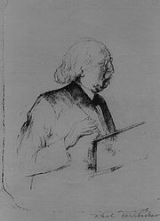
Hermann Cohen

Encyclopedia
Hermann Cohen was a German
-Jewish philosopher
, one of the founders of the Marburg School of Neo-Kantianism
, and he is often held to be "probably the most important Jewish philosopher of the nineteenth century".
. He early began to study philosophy, and soon became known as a profound student of Kant
. He was educated at the Gymnasium at Dessau
, at the Jewish Theological Seminary of Breslau
, and at the universities of Breslau, Berlin
, and Halle
. In 1873, he became Privatdozent
in the philosophical faculty of the University of Marburg, the thesis with which he obtained the venia legendi being Die systematischen Begriffe in Kant's vorkritischen Schriften nach ihrem Verhältniss zum kritischen Idealismus. In 1875, Cohen was elected ao. Professor, and in the following o. Professor (see Professor
- Germany), at Marburg.
He was one of the founders of the "Gesellschaft zur Förderung der Wissenschaft des Judenthums", which held its first meeting in Berlin in November 1902.
Cohen edited and published Friedrich Albert Lange's
final philosophical work (Logische Studien, Leipzig, 1877). Cohen edited and wrote several versions of a long introduction and critical supplement to Lange's Geschichte des Materialismus
)
His writings relating more especially to Judaism include several pamphlets, among them "Die Kulturgeschichtliche Bedeutung des Sabbat," 1881; "Ein Bekenntniss in der Judenfrage," Berlin, 1880; as well as the following articles: "Das Problem der Jüdischen Sittenlehre," in the "Monatsschrift," xliii. (1899), pp. 385–400, 433-449; "Liebe und Gerechtigkeit in den Begriffen Gott und Mensch." in "Jahrbuch für Jüdische Geschichte und Litteratur," III. (1900), pp. 75–132; "Autonomie und Freiheit," in the "Gedenkbuch für David Kaufmann
," 1900.
Cohen's most famous Jewish works include: Religion der Vernunft aus den Quellen des Judentums (Religion of Reason out of the Sources of Judaism, 1919), Deutschtum und Judentum, Die Naechstenliebe im Talmud, and Die Ethik des Maimonides.
His essay "Die Nächstenliebe im Talmud" was written at the request of the Marburg Königliches Landgericht (3d ed., Marburg, 1888). His last publication was the Logik der Reinen Erkenntniss, comprising the first part of his "System der Philosophie," ix. 520, Berlin, 1902.
Germany
Germany , officially the Federal Republic of Germany , is a federal parliamentary republic in Europe. The country consists of 16 states while the capital and largest city is Berlin. Germany covers an area of 357,021 km2 and has a largely temperate seasonal climate...
-Jewish philosopher
Philosophy
Philosophy is the study of general and fundamental problems, such as those connected with existence, knowledge, values, reason, mind, and language. Philosophy is distinguished from other ways of addressing such problems by its critical, generally systematic approach and its reliance on rational...
, one of the founders of the Marburg School of Neo-Kantianism
Neo-Kantianism
Neo-Kantianism refers broadly to a revived type of philosophy along the lines of that laid down by Immanuel Kant in the 18th century, or more specifically by Schopenhauer's criticism of the Kantian philosophy in his work The World as Will and Representation , as well as by other post-Kantian...
, and he is often held to be "probably the most important Jewish philosopher of the nineteenth century".
Life
Cohen was born in Coswig, AnhaltCoswig, Anhalt
Coswig is a town in the district of Wittenberg of Saxony-Anhalt, Germany. It is situated on the right bank of the Elbe, approx. 12 km west of Wittenberg, and 15 km east of Dessau.- History :...
. He early began to study philosophy, and soon became known as a profound student of Kant
Immanuel Kant
Immanuel Kant was a German philosopher from Königsberg , researching, lecturing and writing on philosophy and anthropology at the end of the 18th Century Enlightenment....
. He was educated at the Gymnasium at Dessau
Dessau
Dessau is a town in Germany on the junction of the rivers Mulde and Elbe, in the Bundesland of Saxony-Anhalt. Since 1 July 2007, it is part of the merged town Dessau-Roßlau. Population of Dessau proper: 77,973 .-Geography:...
, at the Jewish Theological Seminary of Breslau
Jewish Theological Seminary of Breslau
Das Jüdisch-Theologische Seminar , The Jewish Theological Seminary of BreslauInstitution in Breslau for the training of rabbis, founded under the will of Jonas Fränckel, and opened in 1854...
, and at the universities of Breslau, Berlin
Humboldt University of Berlin
The Humboldt University of Berlin is Berlin's oldest university, founded in 1810 as the University of Berlin by the liberal Prussian educational reformer and linguist Wilhelm von Humboldt, whose university model has strongly influenced other European and Western universities...
, and Halle
University of Halle-Wittenberg
The Martin Luther University of Halle-Wittenberg , also referred to as MLU, is a public, research-oriented university in the cities of Halle and Wittenberg within Saxony-Anhalt, Germany...
. In 1873, he became Privatdozent
Privatdozent
Privatdozent or Private lecturer is a title conferred in some European university systems, especially in German-speaking countries, for someone who pursues an academic career and holds all formal qualifications to become a tenured university professor...
in the philosophical faculty of the University of Marburg, the thesis with which he obtained the venia legendi being Die systematischen Begriffe in Kant's vorkritischen Schriften nach ihrem Verhältniss zum kritischen Idealismus. In 1875, Cohen was elected ao. Professor, and in the following o. Professor (see Professor
Professor
A professor is a scholarly teacher; the precise meaning of the term varies by country. Literally, professor derives from Latin as a "person who professes" being usually an expert in arts or sciences; a teacher of high rank...
- Germany), at Marburg.
He was one of the founders of the "Gesellschaft zur Förderung der Wissenschaft des Judenthums", which held its first meeting in Berlin in November 1902.
Cohen edited and published Friedrich Albert Lange's
Friedrich Albert Lange
Friedrich Albert Lange , was a German philosopher and sociologist.-Biography:Lange was born in Wald, near Solingen, the son of the theologian, Johann Peter Lange. He was educated at Duisburg, Zürich and Bonn, where he distinguished himself in gymnastics as much as academically...
final philosophical work (Logische Studien, Leipzig, 1877). Cohen edited and wrote several versions of a long introduction and critical supplement to Lange's Geschichte des Materialismus
Geschichte des Materialismus
Geschichte des Materialismus und Kritik seiner Bedeutung in der Gegenwart is a philosophical work by Friedrich Albert Lange, originally written in German and published in October 1865 . Lange vastly extended the second edition published in two volumes in 1873–75...
)
His writings relating more especially to Judaism include several pamphlets, among them "Die Kulturgeschichtliche Bedeutung des Sabbat," 1881; "Ein Bekenntniss in der Judenfrage," Berlin, 1880; as well as the following articles: "Das Problem der Jüdischen Sittenlehre," in the "Monatsschrift," xliii. (1899), pp. 385–400, 433-449; "Liebe und Gerechtigkeit in den Begriffen Gott und Mensch." in "Jahrbuch für Jüdische Geschichte und Litteratur," III. (1900), pp. 75–132; "Autonomie und Freiheit," in the "Gedenkbuch für David Kaufmann
David Kaufmann
David Kaufmann was a Jewish-Austrian scholar born at Kojetín, Moravia...
," 1900.
Cohen's most famous Jewish works include: Religion der Vernunft aus den Quellen des Judentums (Religion of Reason out of the Sources of Judaism, 1919), Deutschtum und Judentum, Die Naechstenliebe im Talmud, and Die Ethik des Maimonides.
His essay "Die Nächstenliebe im Talmud" was written at the request of the Marburg Königliches Landgericht (3d ed., Marburg, 1888). His last publication was the Logik der Reinen Erkenntniss, comprising the first part of his "System der Philosophie," ix. 520, Berlin, 1902.
Works
- "Die Platonische Ideenlehre Psychologisch Entwickelt," in "Zeitschrift für Völkerpsychologie," 1866, iv. 9 ("Platonic Ideal Theorie Psychologically Developed")
- "Mythologische Vorstellungen von Gott und Seele," ib. 1869 ("Mythological Concepts of God and the Soul")
- "Die dichterische Phantasie und der Mechanismus des Bewusstseins," ib.("Poetic Fantasy and Mechanisms of Consciousness")
- "Zur Kontroverse zwischen TrendelenburgTrendelenburgTrendelenburg could refer to:*Friedrich Adolf Trendelenburg , German philosopher and philologist*His son, Friedrich Trendelenburg , German surgeon*Trendelenburg gait*Trendelenburg position*Trendelenburg test*Trendelenburg's sign...
und Kuno FischerKuno FischerKuno Fischer, born Ernst Kuno Berthold Fischer, was a German philosopher, a historian of philosophy and a critic.-Biography:After studying philosophy at Leipzig and Halle,...
," ib. 1871 ("On the controversy between Trendelenburg and Kuno Fischer") - Kant's Theorie der Erfahrung, Berlin, 1871; 2d ed., 1885 ("Kant's Theory of Experience").
- "Platon's Ideenlehre und die Mathematik," Marburg, 1878 ("Mathematics and Theory of Platonic Ideals")
- Kant's Begründung der Ethik, Berlin, 1877 ("Kant's Foundations of Ethics")
- Das Prinzip der Infinitesimalmethode und seine Geschichte: ein Kapitel zur Grundlegung der Erkenntnisskritik, Berlin, 1883 ("The Principle of the Method of Infintesmals and its History: A Chapter Contributed to Critical Perception")
- "Von Kant's Einfluss auf die Deutsche Kultur," Berlin, 1883 ("On Kant's Influence on German Culture")
- Kant's Begründung der Aesthetik, Berlin, 1889 ("Kant's Foundations of Aesthetics")
- "Zur Orientierung in den Losen Blättern aus Kant's Nachlass," in "Philosophische Monatshefte," 1890, xx. ("An Orientation to the Loose Pages from Kant's Literary Estate")
- "Leopold Schmidt," in "Neue Jahrbücher für Philologie und Pädagogik," 1896, cliv.
Further Reading
- Bienenstock, Myriam Cohen face à Rosenzweig. Débat sur la pensée allemande (Paris, Vrin, 2009)
- Hermann Cohen: l'idéalisme critique aux prises avec le matérialisme (special issue of the journal Revue de métaphysique et de morale, ISSN 0035-1571), edited by Myriam Bienenstock, Paris, PUF, 2011, 141 pages.
- Liisa Steinby, "Hermann Cohen and Bakhtin’s early aesthetics," Studies in East European Thought, 63,3 (2011), 227-249.