

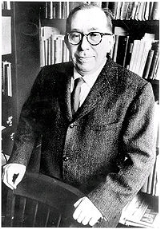
Leo Strauss

Encyclopedia
Leo Strauss was a political philosopher
and classicist who specialized in classical political philosophy
. He was born in Germany to Jewish parents and later emigrated to the United States. He spent most of his career as a professor of political science at the University of Chicago
, where he taught several generations of students and published fifteen books.
Originally trained in the Neo-Kantian tradition with Ernst Cassirer
and immersed in the work of the phenomenologists Edmund Husserl
and Martin Heidegger
, Strauss later focused his research on the Greek texts of Plato
and Aristotle
, retracing their interpretation through medieval Islamic and Jewish philosophy, and encouraged application of their ideas to contemporary political theory.
in Hesse-Nassau, a province of the Kingdom of Prussia
(part of the German Empire
), on September 20, 1899, to Hugo Strauss and Jennie Strauss, née David. According to Allan Bloom
's 1974 obituary in Political Theory, Strauss "was raised as an Orthodox Jew," but the family does not appear to have completely embraced Orthodox practice. In "A Giving of Accounts", published in The College 22 (1) and later reprinted in Jewish Philosophy
and the Crisis of Modernity
, Strauss noted he came from a "conservative
, even orthodox Jewish home," but one which knew little about Judaism except strict adherence to ceremonial laws. His father and uncle operated a farm supply and livestock business that they inherited from their father, Meyer (1835–1919), a leading member of the local Jewish community.
(affiliated with the University of Marburg) in nearby Marburg
(from which Johannes Althusius
and Carl J. Friedrich also graduated) in 1912, graduating in 1917. He boarded with the Marburg Cantor
Strauss (no relation); the Cantor's residence served as a meeting place for followers of the neo-Kantian philosopher Hermann Cohen
. Strauss served in the German army during World War I
from July 5, 1917 to December 1918.
Strauss subsequently enrolled in the University of Hamburg
, where he received his doctorate
in 1921; his thesis
, "On the Problem of Knowledge in the Philosophical Doctrine of F. H. Jacobi", was supervised by Ernst Cassirer
. He also attended courses at the Universities of Freiburg
and Marburg, including some taught by Edmund Husserl
and Martin Heidegger
. Strauss joined a Jewish fraternity and worked for the German Zionist movement, which introduced him to various German Jewish intellectuals, such as Norbert Elias
, Leo Löwenthal
, Hannah Arendt
and Walter Benjamin
. Strauss' closest friend was Jacob Klein
but he also was intellectually engaged with Karl Löwith
, Gerhard Krüger
, Julius Guttman, Hans-Georg Gadamer
, Franz Rosenzweig
(to whom Strauss dedicated his first book), Gershom Scholem
, Alexander Altmann
, and the Arabist Paul Kraus
, who married Strauss' sister Bettina (Strauss and his wife later adopted their child when both parents died in the Middle East
). With several of these friends, Strauss carried on vigorous epistolary exchanges later in life, many of which are published in the Gesammelte Schriften (Collected Writings), some in translation from the German. Strauss had also been engaged in a discourse with Carl Schmitt
. However, when Strauss left Germany, he broke off this discourse when Schmitt failed to answer his letters.
In 1931 Strauss sought his post-doctoral (Habilitation
) with the theologian Paul Tillich
, but was turned down. After receiving a Rockefeller Fellowship in 1932, Strauss left his position at the Academy of Jewish Research in Berlin
for Paris
. He returned to Germany only once, for a few short days 20 years later. In Paris he married Marie (Miriam) Bernsohn, a widow with a young child whom he had known previously in Germany. He adopted his wife's son, Thomas, and later his sister's child; he and Miriam had no biological children of their own. At his death he was survived by Thomas, his sister's daughter Jenny Strauss Clay, and three grandchildren. Strauss became a lifelong friend of Alexandre Kojève
and was on friendly terms with Raymond Aron
, Alexandre Koyré
, and Étienne Gilson
. Because of the Nazis' rise to power, he chose not to return to his native country. Strauss found shelter, after some vicissitudes, in England, where in 1935 he gained temporary employment at University of Cambridge
, with the help of his in-law, David Daube
, who was affiliated with Gonville and Caius College. While in England, he became a close friend of R. H. Tawney
, and was on less friendly terms with Isaiah Berlin
.
 Unable to find permanent employment in England, Strauss moved in 1937 to the United States, under the patronage of Harold Laski
, who bestowed upon Strauss a brief lectureship. After a short stint as Research Fellow
in the Department of History at Columbia University
, Strauss secured a position at The New School
, where, between 1938 and 1948, he eked out a hand-to-mouth living in the political science faculty. In 1939, he served for a short term as a visiting professor at Hamilton College. He became a U.S. citizen in 1944, and in 1949 he became a professor of political science
at the University of Chicago
, where he received, for the first time in his life, a good wage. In 1954 he met Löwith and Gadamer in Heidelberg
and delivered a public speech on Socrates
. Strauss held the Robert Maynard Hutchins Distinguished Service Professorship in Chicago until 1969. He had received a call for a temporary lectureship in Hamburg
in 1965 (which he declined for health reasons) and received and accepted an honorary doctorate from Hamburg University and the Bundesverdienstkreuz
(German Order of Merit) via the German representative in Chicago. In 1969 Strauss moved to Claremont McKenna College
(formerly Claremont Men's College) in California for a year, and then to St. John's College, Annapolis
in 1970, where he was the Scott Buchanan Distinguished Scholar in Residence until his death from pneumonia in 1973.
as the moment when political philosophy came into existence. Strauss considered one of the most important moments in the history of philosophy
Socrates' argument that philosophers could not study nature
without considering their own human nature
, which, in the words of Aristotle
, is that of "a political animal."
Strauss distinguished "scholars" from "great thinkers", identifying himself as a scholar. He wrote that most self-described philosophers are in actuality scholars, cautious and methodical. Great thinkers, in contrast, boldly and creatively address big problems. Scholars deal with these problems only indirectly by reasoning about the great thinkers' differences.
In Natural Right and History Strauss begins with a critique of Max Weber
's epistemology, briefly engages the relativism
of Martin Heidegger
(who goes unnamed), and continues with a discussion of the evolution of natural rights via an analysis of the thought of Thomas Hobbes
and John Locke
. He concludes by critiquing Jean-Jacques Rousseau
and Edmund Burke
. At the heart of the book are excerpts from Plato
, Aristotle
, and Cicero
. Much of his philosophy is a reaction to the works of Heidegger. Indeed, Strauss wrote that Heidegger's thinking must be understood and confronted before any complete formulation of modern political theory is possible.
Strauss wrote that Friedrich Nietzsche
was the first philosopher to properly understand relativism
, an idea grounded in a general acceptance of Hegelian historicism
. Heidegger, in Strauss' view, sanitized and politicized Nietzsche, whereas Nietzsche believed "our own principles, including the belief in progress, will become as relative as all earlier principles had shown themselves to be" and "the only way out seems to be...that one voluntarily choose life-giving delusion instead of deadly truth, that one fabricate a myth". Heidegger believed that the tragic nihilism
of Nietzsche was a "myth" guided by a defective Western conception of Being
that Heidegger traced to Plato. In his published correspondence with Alexandre Kojève
, Strauss wrote that Hegel was correct when he postulated that an end of history implies an end to philosophy as understood by classical political philosophy.
and Al Farabi, and then extended to his reading of Plato (he mentions particularly the discussion of writing in the Phaedrus
), Strauss proposed that an esoteric text was the proper type for philosophic learning. Rather than simply outlining the philosopher's thoughts, the esoteric text forces readers to do their own thinking and learning. As Socrates says in the Phaedrus, writing does not respond when questioned, but invites a dialogue with the reader, thereby reducing the problems of the written word. One political danger Strauss pointed to was the acceptance of dangerous ideas too quickly by students. This was perhaps also relevant in the trial of Socrates, where his relationship with Alcibiades
was used against him.
Ultimately, Strauss believed that philosophers offered both an "exoteric" or salutary teaching and an "esoteric" or true teaching, which was concealed from the general reader. For maintaining this distinction, Strauss is often accused of having written esoterically himself. Moreover he also emphasized that writers often left contradictions and other excuses to encourage the more careful examination of the writing. Leo Strauss's favorite novelist was Jane Austen
.
, a concept which Strauss finds dubious, tracing its roots in Enlightenment
philosophy to Max Weber
, a thinker whom Strauss described as a "serious and noble mind.” Weber wanted to separate values from science but, according to Strauss, was really a derivative thinker, deeply influenced by Nietzsche’s relativism
. Strauss treated politics as something that could not be studied from afar. A political scientist examining politics with a value-free scientific eye, for Strauss, was self-deluded. Positivism
, the heir to both Auguste Comte
and Max Weber in the quest to make purportedly value-free judgments, failed to justify its own existence, which would require a value judgment.
While modern liberalism had stressed the pursuit of individual liberty as its highest goal, Strauss felt that there should be a greater interest in the problem of human excellence and political virtue. Through his writings, Strauss constantly raised the question of how, and to what extent, freedom and excellence can coexist. Strauss refused to make do with any simplistic or one-sided resolutions of the Socratic question: What is the good
for the city and man?
and Alexandre Kojève
. Schmitt, who would later become, for a short time, the chief jurist of Nazi Germany, was one of the first important German academics to positively review Strauss's early work. Schmitt's positive reference for, and approval of, Strauss's work on Hobbes
was instrumental in winning Strauss the scholarship funding that allowed him to leave Germany. Strauss's critique and clarifications of The Concept of the Political
led Schmitt to make significant emendations in its second edition. Writing to Schmitt in 1932, Strauss summarised Schmitt's political theology thus: "[B]ecause man is by nature evil, he therefore needs dominion. But dominion can be established, that is, men can be unified only in a unity against - against other men. Every association of men is necessarily a separation from other men... the political thus understood is not the constitutive principle of the state, of order, but a condition of the state." Strauss, however, directly opposed Schmitt's position. For Strauss, Schmitt and his return to Hobbes helpfully clarified the nature of our political existence and our modern self-understanding. Schmitt's position is therefore symptomatic of the modern liberal self-understanding. Strauss believed that such an analysis, as in Hobbes' time, served as a useful "preparatory action", revealing our contemporary orientation towards the eternal problems of politics (social existence). But for Strauss, Schmitt's reification of our modern self-understanding of the problem of politics into a political theology was not an adequate solution. Strauss instead advocated a return to a broader classical understanding of human nature, and a tentative return to political philosophy, in the tradition of the ancient philosophers.
With Alexandre Kojève, Strauss had a close and lifelong philosophical friendship. They had first met as students in Berlin. The two thinkers shared a boundless philosophical respect for each other. Kojève would later write that, without befriending Strauss, "I never would have known[...] what philosophy is." The political-philosophical dispute between Kojève and Strauss centred on the role that philosophy should and can be allowed to play in politics. Kojève, who as a senior statesman in the French government was instrumental in the creation of the EU
, argued that philosophers should have an active role in shaping political events. Strauss, on the contrary, believed that philosophy and political-conditions were fundamentally opposed, and believed that philosophers should not, and must not, have a role in politics, noting the disastrous results of Plato in Syracuse. Strauss believed that philosophers should play a role in politics only to the extent that they can ensure that philosophy, which he saw as mankind's highest activity, can be free from political intervention.
in its modern form contained within it an intrinsic tendency towards extreme relativism
, which in turn led to two types of nihilism
The first was a “brutal” nihilism, expressed in Nazi and Marxist regimes. In On Tyranny, he wrote that these ideologies, both descendants of Enlightenment
thought, tried to destroy all traditions, history, ethics, and moral standards and replace them by force under which nature and mankind are subjugated and conquered. The second type – the "gentle" nihilism expressed in Western liberal democracies
– was a kind of value-free aimlessness and a hedonistic
"permissive egalitarianism
", which he saw as permeating the fabric of contemporary American society. In the belief that 20th century relativism, scientism
, historicism
, and nihilism were all implicated in the deterioration of modern society
and philosophy, Strauss sought to uncover the philosophical pathways that had led to this situation. The resultant study led him to advocate a tentative return to classical political philosophy as a starting point for judging political action.
The Open Society and Its Enemies
had mistaken the city-in-speech described in Plato's Republic for a blueprint for regime reform. Strauss quotes Cicero
, "The Republic does not bring to light the best possible regime but rather the nature of political things – the nature of the city." Strauss argued that the city-in-speech was unnatural, precisely because "it is rendered possible by the abstraction from eros". The city-in-speech abstracted from eros, or bodily needs, and therefore could never guide politics in the manner Popper claimed. Though skeptical of "progress", Strauss was equally skeptical about political agendas of "return" (which is the term he used in contrast to progress). In fact, he was consistently suspicious of anything claiming to be a solution to an old political or philosophical problem. He spoke of the danger in trying to finally resolve the debate between rationalism
and tradition
alism in politics. In particular, along with many in the pre-World War II
German Right, he feared people trying to force a world state to come into being in the future, thinking that it would inevitably become a tyranny.
and Jerusalem (Reason
and Revelation
) and Ancient versus Modern. The "Ancients" were the Socratic philosophers and their intellectual heirs, and the "Moderns" start with Niccolò Machiavelli
. The contrast between Ancients and Moderns was understood to be related to the unresolvable tension between Reason and Revelation. The Socratics, reacting to the first Greek
philosophers, brought philosophy back to earth, and hence back to the marketplace, making it more political.
The Moderns reacted to the dominance of revelation in medieval society by promoting the possibilities of Reason very strongly. They objected the merger of natural right and natural theology
proposed by Thomas Aquinas
which resulted in the vulnerability of natural right to theological disputes along with Aquinas' moral rigidity highlighted by the prohibition of divorce
and birth control
. Thomas Hobbes
, under the influence of Francis Bacon
, re-oriented political thought to what was most solid but most low in man, setting a precedent for John Locke and the later economic approach to political thought, such as, initially, in David Hume
and Adam Smith
.
and Walter Benjamin
, who were both strong admirers of Strauss, and would continue to be so throughout their lives. When he was 17, as he said, he was "converted" to political Zionism as a follower of Vladimir Jabotinsky. He served several years in the activities of the German Zionist youth movement, writing several essays pertaining to its controversies, but had left these activities behind by his early twenties.
While Strauss maintained a sympathy and interest in Zionism, he later came to refer to Zionism as "problematic" and became disillusioned with some of its aims.
He taught at the Hebrew University of Jerusalem
, for 1954–55 academic year. In his letter to a National Review
editor, Strauss asked why Israel
is called a racist state in an article in that journal. He argues that the author did not provide enough proof for his argument. He ends up his essay with the following statement:
tic disbelief, which he considered intemperate and irrational and felt that one should either be "the philosopher open to the challenge of theology or the theologian open to the challenge of philosophy." One interpretation is that Strauss, in the interplay of Jerusalem and Athens, or revelation and reason, sought, as did Thomas Aquinas
, to hold revelation to the rigours of reason, but where Aquinas saw an amicable interplay, Strauss saw two impregnable fortresses. Werner Dannhauser, in analyzing Strauss' letters, writes, "It will not do to simply think of Strauss as a godless, a secular, a lukewarm Jew." As one commenter put it:
Feser's statement, quoted above, invites the suspicion that Strauss may have been an un-convinced atheist, or that he welcomed religion as merely (practically) useful, rather than as true. The supposition that Strauss was an unconvinced atheist is not necessarily incompatible with Dannhauser's tentative claim that Strauss was an atheist behind closed doors. Hilail Gildin responded to Dannhauser's reading in "Déjà Jew All Over Again: Dannhauser on Leo Strauss and Atheism," an article published in Interpretation: A Journal of Political Philosophy. Gildin exposed inconsistencies between Strauss's writings and Dannhauser's claims; Gildin also questioned the inherent consistency of Dannhauser's admittedly tentative evaluation of Strauss's understanding of divinity and religion.
At the end of his The City and Man, Strauss invites his reader to "be open to the full impact of the all-important question which is coeval with philosophy although the philosophers do not frequently pronounce it--the question quid sit deus" (p. 241). As a philosopher, Strauss would be interested in knowing the nature of divinity, instead of trying to dispute the very being of divinity. But Strauss did not remain "neutral" to the question about the "quid" of divinity. Already in his Natural Right and History, he defended a Socratic (Platonic, Ciceronian, and Aristotelian) reading of divinity, distinguishing it from a materialistic/conventionalist or Epicurean reading (see especially, Ch. III: "The Origin of the Idea of Natural Right"). Here, the question of "religion" (what is religion?) is inseparable from the question of the nature of civil society, and thus of civil right, or right having authoritative representation, or right capable of defending itself (Latin: Jus). Atheism, whether convinced (overt) or unconvinced (tacit), is integral to the conventionalist reading of civil authority, and thereby of religion in its originally civil valence, a reading against which Strauss argues throughout his volume. Thus Strauss's own arguments contradict the thesis imputed to him post mortem by scholars such as S. Drury who profess that Strauss approached religion as an instrument devoid of inherent purpose or meaning.
, illiberalist and anti-democratic. Shadia Drury
, in Leo Strauss and the American Right (1999), argues that Strauss inculcated an elitist strain in American political leaders linked to imperialist
militarism
, neoconservatism
and Christian fundamentalism. Drury argues that Strauss teaches that "perpetual deception of the citizens by those in power is critical because they need to be led, and they need strong rulers to tell them what's good for them." Nicholas Xenos similarly argues that Strauss was "an anti-democrat in a fundamental sense, a true reactionary
. According to Xenos, "Strauss was somebody who wanted to go back to a previous, pre-liberal, pre-bourgeois era of blood and guts, of imperial domination, of authoritarian rule, of pure fascism
."
Strauss has also been criticized by some conservatives. According to Claes Ryn, Strauss's anti-historicist thinking creates an artificial contrast between moral universality and "the conventional," "the ancestral," and "the historical." Strauss, Ryn argues, wrongly and reductionistically assumes that respecting tradition must undermine reason and universality. Contrary to Strauss's criticism of Edmund Burke, the historical sense may in fact be indispensable to an adequate apprehension of universality. Strauss's abstract, ahistorical conception of natural right actually distorts genuine universality, Ryn contends. Strauss does not consider the possibility that real universality becomes known to human beings in concretized, particular form. Strauss and the Straussians have paradoxically taught philosophically unsuspecting American conservatives, not least Roman Catholic intellectuals to reject tradition in favor of ahistorical theorizing, a bias that flies in the face of the central Christian notion of the Incarnation, the latter being an example of the possibility of synthesis between the universal and the historical. According to Ryn, the propagation of a purely abstract idea of universality has contributed to the neoconservative advocacy of allegedly universal American principles, which neconservatives see as justification for American intervention around the world. Strauss's anti-historical thinking connects him and his followers with the French Jacobins, who also regarded tradition as incompatible with virtue and rationality. What Ryn calls the "new Jacobinism" of the "neoconservative" philosophy is, writes Paul Gottfried, also the rhetoric of Saint-Just and Trotsky that the philosophically impoverished American Right has taken over with mindless alacrity. Republican operators and think tank
s apparently believe they can carry the electorate by appealing to yesterday’s leftist clichés.
Journalists, such as Seymour Hersh
, have opined that Strauss endorsed noble lie
s, "myths used by political leaders seeking to maintain a cohesive society". In The City and Man, Strauss discusses the myths outlined in Plato's Republic that are required for all governments. These include a belief that the state's land belongs to it even though it was likely acquired illegitimately and that citizenship is rooted in something more than the accidents of birth.
, Robert Alter
writes that Smith "persuasively sets the record straight on Strauss's political views and on what his writing is really about." Smith refutes the link between Strauss and neoconservative thought (a link that some commentators have controversially made), arguing that Strauss was never personally active in politics, never endorsed imperialism, and questioned the utility of political philosophy for the practice of politics. In particular, Strauss argued that Plato's myth of the Philosopher king
should be read as a reductio ad absurdum
, and that philosophers should understand politics, not in order to influence policy, except insofar as they can ensure philosophy's autonomy from politics. Additionally, Mark Lilla
has argued that the attribution to Strauss of neoconservative views contradicts a careful reading of Strauss' actual texts, in particular On Tyranny. Lilla summarizes Strauss as follows:
Finally, responding to charges that Strauss's teachings fostered the neoconservative foreign policy of the George W. Bush administration, such as "unrealistic hopes for the spread of liberal democracy through military conquest," Professor Nathan Tarcov, Director of the Leo Strauss Center at the University of Chicago, in an article published in The American Interest asserts that Strauss as a political philosopher was essentially non-political. After an exegesis of the very limited practical political views to be gleaned from Strauss's writings, Tarcov concludes that "Strauss can remind us of the permanent problems, but we have only ourselves to blame for our faulty solutions to the problems of today." Likewise Strauss's daughter, Jenny Strauss Clay, in a New York Times article defended her father against the charge that he was the "mastermind behind the neoconservative ideologues who control United States foreign policy." "He was a conservative," she says, "insofar as he did not think change is necessarily change for the better." Since contemporary academia "leaned to the left" with its "unquestioned faith in progress and science combined with a queasiness regarding any kind of moral judgment," Strauss questioned the tenets of the left. Had academia leaned to the right he'd have questioned—and did question—the tenets of the right as well. In sum, to the charge of fostering political ideology, whether of the Bush administration or any other, Strauss would plead not guilty—according to him the perennial problem remains whether those already ill-disposed could give political philosophy a fair hearing.
, Seth Benardete
, Allan Bloom
, Werner Dannhauser, Murray Dry
, William Galston
, Victor Gourevitch, Harry V. Jaffa
, Roger Masters
, Thomas Pangle
, Stanley Rosen
, Abram Shulsky
(Director of the Office of Special Plans
), Susan Sontag
, and Paul Wolfowitz
(who attended two lecture courses by Strauss on Plato and Montesquieu's Spirit of the Laws at the University of Chicago
). Harvey C. Mansfield
, though never a student of Strauss, is a noted "Straussian" (as some followers of Strauss identify themselves). Richard Rorty
described Strauss as a particular influence in his early studies at the University of Chicago, where Rorty studied a "classical curriculum" under Strauss.
Writings about Maimonides
and Jewish philosophy
Political philosophy
Political philosophy is the study of such topics as liberty, justice, property, rights, law, and the enforcement of a legal code by authority: what they are, why they are needed, what, if anything, makes a government legitimate, what rights and freedoms it should protect and why, what form it...
and classicist who specialized in classical political philosophy
Political philosophy
Political philosophy is the study of such topics as liberty, justice, property, rights, law, and the enforcement of a legal code by authority: what they are, why they are needed, what, if anything, makes a government legitimate, what rights and freedoms it should protect and why, what form it...
. He was born in Germany to Jewish parents and later emigrated to the United States. He spent most of his career as a professor of political science at the University of Chicago
University of Chicago
The University of Chicago is a private research university in Chicago, Illinois, USA. It was founded by the American Baptist Education Society with a donation from oil magnate and philanthropist John D. Rockefeller and incorporated in 1890...
, where he taught several generations of students and published fifteen books.
Originally trained in the Neo-Kantian tradition with Ernst Cassirer
Ernst Cassirer
Ernst Cassirer was a German philosopher. He was one of the major figures in the development of philosophical idealism in the first half of the 20th century...
and immersed in the work of the phenomenologists Edmund Husserl
Edmund Husserl
Edmund Gustav Albrecht Husserl was a philosopher and mathematician and the founder of the 20th century philosophical school of phenomenology. He broke with the positivist orientation of the science and philosophy of his day, yet he elaborated critiques of historicism and of psychologism in logic...
and Martin Heidegger
Martin Heidegger
Martin Heidegger was a German philosopher known for his existential and phenomenological explorations of the "question of Being."...
, Strauss later focused his research on the Greek texts of Plato
Plato
Plato , was a Classical Greek philosopher, mathematician, student of Socrates, writer of philosophical dialogues, and founder of the Academy in Athens, the first institution of higher learning in the Western world. Along with his mentor, Socrates, and his student, Aristotle, Plato helped to lay the...
and Aristotle
Aristotle
Aristotle was a Greek philosopher and polymath, a student of Plato and teacher of Alexander the Great. His writings cover many subjects, including physics, metaphysics, poetry, theater, music, logic, rhetoric, linguistics, politics, government, ethics, biology, and zoology...
, retracing their interpretation through medieval Islamic and Jewish philosophy, and encouraged application of their ideas to contemporary political theory.
Early life
Leo Strauss was born in the small town of KirchhainKirchhain
Kirchhain is a town in Marburg-Biedenkopf district in Hesse, Germany.-Geography:Kirchhain is located in the heart of the state of Hesse in Marburg-Biedenkopf County...
in Hesse-Nassau, a province of the Kingdom of Prussia
Kingdom of Prussia
The Kingdom of Prussia was a German kingdom from 1701 to 1918. Until the defeat of Germany in World War I, it comprised almost two-thirds of the area of the German Empire...
(part of the German Empire
German Empire
The German Empire refers to Germany during the "Second Reich" period from the unification of Germany and proclamation of Wilhelm I as German Emperor on 18 January 1871, to 1918, when it became a federal republic after defeat in World War I and the abdication of the Emperor, Wilhelm II.The German...
), on September 20, 1899, to Hugo Strauss and Jennie Strauss, née David. According to Allan Bloom
Allan Bloom
Allan David Bloom was an American philosopher, classicist, and academic. He studied under David Grene, Leo Strauss, Richard McKeon and Alexandre Kojève. He subsequently taught at Cornell University, the University of Toronto, Yale University, École Normale Supérieure of Paris, and the University...
's 1974 obituary in Political Theory, Strauss "was raised as an Orthodox Jew," but the family does not appear to have completely embraced Orthodox practice. In "A Giving of Accounts", published in The College 22 (1) and later reprinted in Jewish Philosophy
Jewish philosophy
Jewish philosophy , includes all philosophy carried out by Jews, or, in relation to the religion of Judaism. Jewish philosophy, until modern Enlightenment and Emancipation, was pre-occupied with attempts to reconcile coherent new ideas into the tradition of Rabbinic Judaism; thus organizing...
and the Crisis of Modernity
Modernity
Modernity typically refers to a post-traditional, post-medieval historical period, one marked by the move from feudalism toward capitalism, industrialization, secularization, rationalization, the nation-state and its constituent institutions and forms of surveillance...
, Strauss noted he came from a "conservative
Conservative Judaism
Conservative Judaism is a modern stream of Judaism that arose out of intellectual currents in Germany in the mid-19th century and took institutional form in the United States in the early 1900s.Conservative Judaism has its roots in the school of thought known as Positive-Historical Judaism,...
, even orthodox Jewish home," but one which knew little about Judaism except strict adherence to ceremonial laws. His father and uncle operated a farm supply and livestock business that they inherited from their father, Meyer (1835–1919), a leading member of the local Jewish community.
Education
After attending the Kirchhain Volksschule and the Protestant Rektoratsschule, Leo Strauss was enrolled at the Gymnasium PhilippinumGymnasium Philippinum
Gymnasium Philippinum or Philippinum High School is an almost 500-year-old secondary school in Marburg, Hesse, Germany.- History :The Gymnasium Philippinum was founded in 1527 as a Protestant school based at the same time with the University of Marburg created by Philipp I of Hesse...
(affiliated with the University of Marburg) in nearby Marburg
Marburg
Marburg is a city in the state of Hesse, Germany, on the River Lahn. It is the main town of the Marburg-Biedenkopf district and its population, as of March 2010, was 79,911.- Founding and early history :...
(from which Johannes Althusius
Johannes Althusius
Johannes Althusius was a German jurist and Calvinist political philosopher.He is best known for his 1603 work, "Politica Methodice Digesta, Atque Exemplis Sacris et Profanis Illustrata"; revised editions were published in 1610 and 1614...
and Carl J. Friedrich also graduated) in 1912, graduating in 1917. He boarded with the Marburg Cantor
Hazzan
A hazzan or chazzan is a Jewish cantor, a musician trained in the vocal arts who helps lead the congregation in songful prayer.There are many rules relating to how a cantor should lead services, but the idea of a cantor as a paid professional does not exist in classical rabbinic sources...
Strauss (no relation); the Cantor's residence served as a meeting place for followers of the neo-Kantian philosopher Hermann Cohen
Hermann Cohen
Hermann Cohen was a German-Jewish philosopher, one of the founders of the Marburg School of Neo-Kantianism, and he is often held to be "probably the most important Jewish philosopher of the nineteenth century".-Life:...
. Strauss served in the German army during World War I
World War I
World War I , which was predominantly called the World War or the Great War from its occurrence until 1939, and the First World War or World War I thereafter, was a major war centred in Europe that began on 28 July 1914 and lasted until 11 November 1918...
from July 5, 1917 to December 1918.
Strauss subsequently enrolled in the University of Hamburg
University of Hamburg
The University of Hamburg is a university in Hamburg, Germany. It was founded on 28 March 1919 by Wilhelm Stern and others. It grew out of the previous Allgemeines Vorlesungswesen and the Kolonialinstitut as well as the Akademisches Gymnasium. There are around 38,000 students as of the start of...
, where he received his doctorate
Doctorate
A doctorate is an academic degree or professional degree that in most countries refers to a class of degrees which qualify the holder to teach in a specific field, A doctorate is an academic degree or professional degree that in most countries refers to a class of degrees which qualify the holder...
in 1921; his thesis
Thesis
A dissertation or thesis is a document submitted in support of candidature for an academic degree or professional qualification presenting the author's research and findings...
, "On the Problem of Knowledge in the Philosophical Doctrine of F. H. Jacobi", was supervised by Ernst Cassirer
Ernst Cassirer
Ernst Cassirer was a German philosopher. He was one of the major figures in the development of philosophical idealism in the first half of the 20th century...
. He also attended courses at the Universities of Freiburg
University of Freiburg
The University of Freiburg , sometimes referred to in English as the Albert Ludwig University of Freiburg, is a public research university located in Freiburg im Breisgau, Baden-Württemberg, Germany.The university was founded in 1457 by the Habsburg dynasty as the...
and Marburg, including some taught by Edmund Husserl
Edmund Husserl
Edmund Gustav Albrecht Husserl was a philosopher and mathematician and the founder of the 20th century philosophical school of phenomenology. He broke with the positivist orientation of the science and philosophy of his day, yet he elaborated critiques of historicism and of psychologism in logic...
and Martin Heidegger
Martin Heidegger
Martin Heidegger was a German philosopher known for his existential and phenomenological explorations of the "question of Being."...
. Strauss joined a Jewish fraternity and worked for the German Zionist movement, which introduced him to various German Jewish intellectuals, such as Norbert Elias
Norbert Elias
Norbert Elias was a German sociologist of Jewish descent, who later became a British citizen.-Biography:...
, Leo Löwenthal
Leo Löwenthal
Leo Löwenthal was a German-Jewish sociologist usually associated with the Frankfurt School.-Life:Born in Frankfurt as the son of assimilated Jews , Löwenthal came of age during the turbulent early years of the Weimar Republic...
, Hannah Arendt
Hannah Arendt
Hannah Arendt was a German American political theorist. She has often been described as a philosopher, although she refused that label on the grounds that philosophy is concerned with "man in the singular." She described herself instead as a political theorist because her work centers on the fact...
and Walter Benjamin
Walter Benjamin
Walter Bendix Schönflies Benjamin was a German-Jewish intellectual, who functioned variously as a literary critic, philosopher, sociologist, translator, radio broadcaster and essayist...
. Strauss' closest friend was Jacob Klein
Jacob Klein (philosopher)
Jacob Klein was a German-American philosopher and interpreter of Plato.-Biography:Klein was born in Liepāja, Latvia. He studied at Berlin and Marburg, where he received his Ph.D. in 1922. A student of Nicolai Hartmann, Martin Heidegger, and Edmund Husserl, he later taught at St. John's College in...
but he also was intellectually engaged with Karl Löwith
Karl Löwith
Karl Löwith , was a German philosopher, a student of Heidegger.Löwith was born in Munich. Though he was himself Protestant, his family was of Jewish descent and he therefore had to emigrate Germany in 1934 because of the National Socialist regime. He went to Italy and in 1936 he went to Japan...
, Gerhard Krüger
Gerhard Krüger
Gerhard Krüger was a Nazi Party student leader and later a leading figure within the neo-Nazi movement.-Early years:...
, Julius Guttman, Hans-Georg Gadamer
Hans-Georg Gadamer
Hans-Georg Gadamer was a German philosopher of the continental tradition, best known for his 1960 magnum opus, Truth and Method .-Life:...
, Franz Rosenzweig
Franz Rosenzweig
Franz Rosenzweig was an influential Jewish theologian and philosopher.-Early life:Franz Rosenzweig was born in Kassel, Germany to a middle-class, minimally observant Jewish family...
(to whom Strauss dedicated his first book), Gershom Scholem
Gershom Scholem
Gerhard Scholem who, after his immigration from Germany to Palestine, changed his name to Gershom Scholem , was a German-born Israeli Jewish philosopher and historian, born and raised in Germany...
, Alexander Altmann
Alexander Altmann
Alexander Altmann was an Orthodox Jewish scholar and rabbi born in Kassa, Austria-Hungary, today Košice, Slovakia. He emigrated to England in 1938 and later settled in the United States, working productively for a decade and a half as a professor within the Philosophy Department at Brandeis...
, and the Arabist Paul Kraus
Paul Kraus (Arabist)
Eliezer Paul Kraus was a Jewish Arabist, born in Prague. In the late 1930s he moved to Cairo, where in 1944 he committed suicide; there is no evidence that he was politically assassinated.-Academic Studies and Work:...
, who married Strauss' sister Bettina (Strauss and his wife later adopted their child when both parents died in the Middle East
Middle East
The Middle East is a region that encompasses Western Asia and Northern Africa. It is often used as a synonym for Near East, in opposition to Far East...
). With several of these friends, Strauss carried on vigorous epistolary exchanges later in life, many of which are published in the Gesammelte Schriften (Collected Writings), some in translation from the German. Strauss had also been engaged in a discourse with Carl Schmitt
Carl Schmitt
Carl Schmitt was a German jurist, philosopher, political theorist, and professor of law.Schmitt published several essays, influential in the 20th century and beyond, on the mentalities that surround the effective wielding of political power...
. However, when Strauss left Germany, he broke off this discourse when Schmitt failed to answer his letters.
In 1931 Strauss sought his post-doctoral (Habilitation
Habilitation
Habilitation is the highest academic qualification a scholar can achieve by his or her own pursuit in several European and Asian countries. Earned after obtaining a research doctorate, such as a PhD, habilitation requires the candidate to write a professorial thesis based on independent...
) with the theologian Paul Tillich
Paul Tillich
Paul Johannes Tillich was a German-American theologian and Christian existentialist philosopher. Tillich was one of the most influential Protestant theologians of the 20th century...
, but was turned down. After receiving a Rockefeller Fellowship in 1932, Strauss left his position at the Academy of Jewish Research in Berlin
Berlin
Berlin is the capital city of Germany and is one of the 16 states of Germany. With a population of 3.45 million people, Berlin is Germany's largest city. It is the second most populous city proper and the seventh most populous urban area in the European Union...
for Paris
Paris
Paris is the capital and largest city in France, situated on the river Seine, in northern France, at the heart of the Île-de-France region...
. He returned to Germany only once, for a few short days 20 years later. In Paris he married Marie (Miriam) Bernsohn, a widow with a young child whom he had known previously in Germany. He adopted his wife's son, Thomas, and later his sister's child; he and Miriam had no biological children of their own. At his death he was survived by Thomas, his sister's daughter Jenny Strauss Clay, and three grandchildren. Strauss became a lifelong friend of Alexandre Kojève
Alexandre Kojève
Alexandre Kojève was a Russian-born French philosopher and statesman whose philosophical seminars had an immense influence on twentieth-century French philosophy, particularly via his integration of Hegelian concepts into continental philosophy...
and was on friendly terms with Raymond Aron
Raymond Aron
Raymond-Claude-Ferdinand Aron was a French philosopher, sociologist, journalist and political scientist.He is best known for his 1955 book The Opium of the Intellectuals, the title of which inverts Karl Marx's claim that religion was the opium of the people -- in contrast, Aron argued that in...
, Alexandre Koyré
Alexandre Koyré
Alexandre Koyré , sometimes anglicised as Alexander Koiré, was a French philosopher of Russian origin who wrote on the history and philosophy of science.-Life:...
, and Étienne Gilson
Étienne Gilson
Étienne Gilson was a French Thomistic philosopher and historian of philosophy...
. Because of the Nazis' rise to power, he chose not to return to his native country. Strauss found shelter, after some vicissitudes, in England, where in 1935 he gained temporary employment at University of Cambridge
University of Cambridge
The University of Cambridge is a public research university located in Cambridge, United Kingdom. It is the second-oldest university in both the United Kingdom and the English-speaking world , and the seventh-oldest globally...
, with the help of his in-law, David Daube
David Daube
David Daube DCL, FBA was the twentieth century's preeminent scholar of ancient law. He combined a familiarity with many legal systems, particularly Roman law and biblical law, with an expertise in Greek, Roman, Jewish, and Christian literature, and used literary, religious, and legal texts to...
, who was affiliated with Gonville and Caius College. While in England, he became a close friend of R. H. Tawney
R. H. Tawney
Richard Henry Tawney was an English economic historian, social critic, Christian socialist, and an important proponent of adult education....
, and was on less friendly terms with Isaiah Berlin
Isaiah Berlin
Sir Isaiah Berlin OM, FBA was a British social and political theorist, philosopher and historian of ideas of Russian-Jewish origin, regarded as one of the leading thinkers of the twentieth century and a dominant liberal scholar of his generation...
.
Later years
Harold Laski
Harold Joseph Laski was a British Marxist, political theorist, economist, author, and lecturer, who served as the chairman of the Labour Party during 1945-1946, and was a professor at the LSE from 1926 to 1950....
, who bestowed upon Strauss a brief lectureship. After a short stint as Research Fellow
Research fellow
The title of research fellow is used to denote a research position at a university or similar institution, usually for academic staff or faculty members. A research fellow may act either as an independent investigator or under the supervision of a principal investigator...
in the Department of History at Columbia University
Columbia University
Columbia University in the City of New York is a private, Ivy League university in Manhattan, New York City. Columbia is the oldest institution of higher learning in the state of New York, the fifth oldest in the United States, and one of the country's nine Colonial Colleges founded before the...
, Strauss secured a position at The New School
The New School
The New School is a university in New York City, located mostly in Greenwich Village. From its founding in 1919 by progressive New York academics, and for most of its history, the university was known as the New School for Social Research. Between 1997 and 2005 it was known as New School University...
, where, between 1938 and 1948, he eked out a hand-to-mouth living in the political science faculty. In 1939, he served for a short term as a visiting professor at Hamilton College. He became a U.S. citizen in 1944, and in 1949 he became a professor of political science
Political science
Political Science is a social science discipline concerned with the study of the state, government and politics. Aristotle defined it as the study of the state. It deals extensively with the theory and practice of politics, and the analysis of political systems and political behavior...
at the University of Chicago
University of Chicago
The University of Chicago is a private research university in Chicago, Illinois, USA. It was founded by the American Baptist Education Society with a donation from oil magnate and philanthropist John D. Rockefeller and incorporated in 1890...
, where he received, for the first time in his life, a good wage. In 1954 he met Löwith and Gadamer in Heidelberg
Heidelberg
-Early history:Between 600,000 and 200,000 years ago, "Heidelberg Man" died at nearby Mauer. His jaw bone was discovered in 1907; with scientific dating, his remains were determined to be the earliest evidence of human life in Europe. In the 5th century BC, a Celtic fortress of refuge and place of...
and delivered a public speech on Socrates
Socrates
Socrates was a classical Greek Athenian philosopher. Credited as one of the founders of Western philosophy, he is an enigmatic figure known chiefly through the accounts of later classical writers, especially the writings of his students Plato and Xenophon, and the plays of his contemporary ...
. Strauss held the Robert Maynard Hutchins Distinguished Service Professorship in Chicago until 1969. He had received a call for a temporary lectureship in Hamburg
Hamburg
-History:The first historic name for the city was, according to Claudius Ptolemy's reports, Treva.But the city takes its modern name, Hamburg, from the first permanent building on the site, a castle whose construction was ordered by the Emperor Charlemagne in AD 808...
in 1965 (which he declined for health reasons) and received and accepted an honorary doctorate from Hamburg University and the Bundesverdienstkreuz
Bundesverdienstkreuz
The Order of Merit of the Federal Republic of Germany is the only general state decoration of the Federal Republic of Germany. It has existed since 7 September 1951, and between 3,000 and 5,200 awards are given every year across all classes...
(German Order of Merit) via the German representative in Chicago. In 1969 Strauss moved to Claremont McKenna College
Claremont McKenna College
Claremont McKenna College is a private, coeducational liberal arts college and a member of the Claremont Colleges located in Claremont, California. The campus is located east of Downtown Los Angeles...
(formerly Claremont Men's College) in California for a year, and then to St. John's College, Annapolis
St. John's College, U.S.
St. John's College is a liberal arts college with two U.S. campuses: one in Annapolis, Maryland and one in Santa Fe, New Mexico. Founded in 1696 as a preparatory school, King William's School, the school received a collegiate charter in 1784, making it one of the oldest institutions of higher...
in 1970, where he was the Scott Buchanan Distinguished Scholar in Residence until his death from pneumonia in 1973.
Philosophy
For Strauss, politics and philosophy were necessarily intertwined. He regarded the trial and death of SocratesSocrates
Socrates was a classical Greek Athenian philosopher. Credited as one of the founders of Western philosophy, he is an enigmatic figure known chiefly through the accounts of later classical writers, especially the writings of his students Plato and Xenophon, and the plays of his contemporary ...
as the moment when political philosophy came into existence. Strauss considered one of the most important moments in the history of philosophy
History of philosophy
The history of philosophy is the study of philosophical ideas and concepts through time. Issues specifically related to history of philosophy might include : How can changes in philosophy be accounted for historically? What drives the development of thought in its historical context? To what...
Socrates' argument that philosophers could not study nature
Nature
Nature, in the broadest sense, is equivalent to the natural world, physical world, or material world. "Nature" refers to the phenomena of the physical world, and also to life in general...
without considering their own human nature
Human nature
Human nature refers to the distinguishing characteristics, including ways of thinking, feeling and acting, that humans tend to have naturally....
, which, in the words of Aristotle
Aristotle
Aristotle was a Greek philosopher and polymath, a student of Plato and teacher of Alexander the Great. His writings cover many subjects, including physics, metaphysics, poetry, theater, music, logic, rhetoric, linguistics, politics, government, ethics, biology, and zoology...
, is that of "a political animal."
Strauss distinguished "scholars" from "great thinkers", identifying himself as a scholar. He wrote that most self-described philosophers are in actuality scholars, cautious and methodical. Great thinkers, in contrast, boldly and creatively address big problems. Scholars deal with these problems only indirectly by reasoning about the great thinkers' differences.
In Natural Right and History Strauss begins with a critique of Max Weber
Max Weber
Karl Emil Maximilian "Max" Weber was a German sociologist and political economist who profoundly influenced social theory, social research, and the discipline of sociology itself...
's epistemology, briefly engages the relativism
Relativism
Relativism is the concept that points of view have no absolute truth or validity, having only relative, subjective value according to differences in perception and consideration....
of Martin Heidegger
Martin Heidegger
Martin Heidegger was a German philosopher known for his existential and phenomenological explorations of the "question of Being."...
(who goes unnamed), and continues with a discussion of the evolution of natural rights via an analysis of the thought of Thomas Hobbes
Thomas Hobbes
Thomas Hobbes of Malmesbury , in some older texts Thomas Hobbs of Malmsbury, was an English philosopher, best known today for his work on political philosophy...
and John Locke
John Locke
John Locke FRS , widely known as the Father of Liberalism, was an English philosopher and physician regarded as one of the most influential of Enlightenment thinkers. Considered one of the first of the British empiricists, following the tradition of Francis Bacon, he is equally important to social...
. He concludes by critiquing Jean-Jacques Rousseau
Jean-Jacques Rousseau
Jean-Jacques Rousseau was a Genevan philosopher, writer, and composer of 18th-century Romanticism. His political philosophy influenced the French Revolution as well as the overall development of modern political, sociological and educational thought.His novel Émile: or, On Education is a treatise...
and Edmund Burke
Edmund Burke
Edmund Burke PC was an Irish statesman, author, orator, political theorist and philosopher who, after moving to England, served for many years in the House of Commons of Great Britain as a member of the Whig party....
. At the heart of the book are excerpts from Plato
Plato
Plato , was a Classical Greek philosopher, mathematician, student of Socrates, writer of philosophical dialogues, and founder of the Academy in Athens, the first institution of higher learning in the Western world. Along with his mentor, Socrates, and his student, Aristotle, Plato helped to lay the...
, Aristotle
Aristotle
Aristotle was a Greek philosopher and polymath, a student of Plato and teacher of Alexander the Great. His writings cover many subjects, including physics, metaphysics, poetry, theater, music, logic, rhetoric, linguistics, politics, government, ethics, biology, and zoology...
, and Cicero
Cicero
Marcus Tullius Cicero , was a Roman philosopher, statesman, lawyer, political theorist, and Roman constitutionalist. He came from a wealthy municipal family of the equestrian order, and is widely considered one of Rome's greatest orators and prose stylists.He introduced the Romans to the chief...
. Much of his philosophy is a reaction to the works of Heidegger. Indeed, Strauss wrote that Heidegger's thinking must be understood and confronted before any complete formulation of modern political theory is possible.
Strauss wrote that Friedrich Nietzsche
Friedrich Nietzsche
Friedrich Wilhelm Nietzsche was a 19th-century German philosopher, poet, composer and classical philologist...
was the first philosopher to properly understand relativism
Relativism
Relativism is the concept that points of view have no absolute truth or validity, having only relative, subjective value according to differences in perception and consideration....
, an idea grounded in a general acceptance of Hegelian historicism
Historicism
Historicism is a mode of thinking that assigns a central and basic significance to a specific context, such as historical period, geographical place and local culture. As such it is in contrast to individualist theories of knowledges such as empiricism and rationalism, which neglect the role of...
. Heidegger, in Strauss' view, sanitized and politicized Nietzsche, whereas Nietzsche believed "our own principles, including the belief in progress, will become as relative as all earlier principles had shown themselves to be" and "the only way out seems to be...that one voluntarily choose life-giving delusion instead of deadly truth, that one fabricate a myth". Heidegger believed that the tragic nihilism
Nihilism
Nihilism is the philosophical doctrine suggesting the negation of one or more putatively meaningful aspects of life. Most commonly, nihilism is presented in the form of existential nihilism which argues that life is without objective meaning, purpose, or intrinsic value...
of Nietzsche was a "myth" guided by a defective Western conception of Being
Being
Being , is an English word used for conceptualizing subjective and objective aspects of reality, including those fundamental to the self —related to and somewhat interchangeable with terms like "existence" and "living".In its objective usage —as in "a being," or "[a] human being" —it...
that Heidegger traced to Plato. In his published correspondence with Alexandre Kojève
Alexandre Kojève
Alexandre Kojève was a Russian-born French philosopher and statesman whose philosophical seminars had an immense influence on twentieth-century French philosophy, particularly via his integration of Hegelian concepts into continental philosophy...
, Strauss wrote that Hegel was correct when he postulated that an end of history implies an end to philosophy as understood by classical political philosophy.
Strauss on reading
In 1952 Strauss published Persecution and the Art of Writing, commonly understood to advance the argument that some philosophers write esoterically in order to avoid persecution by political or religious authorities. A few readers of Strauss suggest esoteric writing may also seek to protect politics from political philosophy – the reasoning of which might negatively affect opinions undergirding the political order. Stemming from his study of MaimonidesMaimonides
Moses ben-Maimon, called Maimonides and also known as Mūsā ibn Maymūn in Arabic, or Rambam , was a preeminent medieval Jewish philosopher and one of the greatest Torah scholars and physicians of the Middle Ages...
and Al Farabi, and then extended to his reading of Plato (he mentions particularly the discussion of writing in the Phaedrus
Phaedrus (Plato)
The Phaedrus , written by Plato, is a dialogue between Plato's main protagonist, Socrates, and Phaedrus, an interlocutor in several dialogues. The Phaedrus was presumably composed around 370 BC, around the same time as Plato's Republic and Symposium...
), Strauss proposed that an esoteric text was the proper type for philosophic learning. Rather than simply outlining the philosopher's thoughts, the esoteric text forces readers to do their own thinking and learning. As Socrates says in the Phaedrus, writing does not respond when questioned, but invites a dialogue with the reader, thereby reducing the problems of the written word. One political danger Strauss pointed to was the acceptance of dangerous ideas too quickly by students. This was perhaps also relevant in the trial of Socrates, where his relationship with Alcibiades
Alcibiades
Alcibiades, son of Clinias, from the deme of Scambonidae , was a prominent Athenian statesman, orator, and general. He was the last famous member of his mother's aristocratic family, the Alcmaeonidae, which fell from prominence after the Peloponnesian War...
was used against him.
Ultimately, Strauss believed that philosophers offered both an "exoteric" or salutary teaching and an "esoteric" or true teaching, which was concealed from the general reader. For maintaining this distinction, Strauss is often accused of having written esoterically himself. Moreover he also emphasized that writers often left contradictions and other excuses to encourage the more careful examination of the writing. Leo Strauss's favorite novelist was Jane Austen
Jane Austen
Jane Austen was an English novelist whose works of romantic fiction, set among the landed gentry, earned her a place as one of the most widely read writers in English literature, her realism and biting social commentary cementing her historical importance among scholars and critics.Austen lived...
.
Strauss on politics
According to Strauss, modern social science is flawed because it assumes the fact-value distinctionFact-value distinction
The fact-value distinction is a concept used to distinguish between arguments which can be claimed through reason alone, and those where rationality is limited to describing a collective opinion. In another formulation, it is the distinction between what is and what ought to be...
, a concept which Strauss finds dubious, tracing its roots in Enlightenment
Age of Enlightenment
The Age of Enlightenment was an elite cultural movement of intellectuals in 18th century Europe that sought to mobilize the power of reason in order to reform society and advance knowledge. It promoted intellectual interchange and opposed intolerance and abuses in church and state...
philosophy to Max Weber
Max Weber
Karl Emil Maximilian "Max" Weber was a German sociologist and political economist who profoundly influenced social theory, social research, and the discipline of sociology itself...
, a thinker whom Strauss described as a "serious and noble mind.” Weber wanted to separate values from science but, according to Strauss, was really a derivative thinker, deeply influenced by Nietzsche’s relativism
Relativism
Relativism is the concept that points of view have no absolute truth or validity, having only relative, subjective value according to differences in perception and consideration....
. Strauss treated politics as something that could not be studied from afar. A political scientist examining politics with a value-free scientific eye, for Strauss, was self-deluded. Positivism
Positivism
Positivism is a a view of scientific methods and a philosophical approach, theory, or system based on the view that, in the social as well as natural sciences, sensory experiences and their logical and mathematical treatment are together the exclusive source of all worthwhile information....
, the heir to both Auguste Comte
Auguste Comte
Isidore Auguste Marie François Xavier Comte , better known as Auguste Comte , was a French philosopher, a founder of the discipline of sociology and of the doctrine of positivism...
and Max Weber in the quest to make purportedly value-free judgments, failed to justify its own existence, which would require a value judgment.
While modern liberalism had stressed the pursuit of individual liberty as its highest goal, Strauss felt that there should be a greater interest in the problem of human excellence and political virtue. Through his writings, Strauss constantly raised the question of how, and to what extent, freedom and excellence can coexist. Strauss refused to make do with any simplistic or one-sided resolutions of the Socratic question: What is the good
Goodness and evil
In religion, ethics, and philosophy, the dichotomy "good and evil" refers to the location on a linear spectrum of objects, desires, or behaviors, the good direction being morally positive, and the evil direction morally negative. Good is a broad concept but it typically deals with an association...
for the city and man?
Encounters with Schmitt and Kojève
Two significant political-philosophical dialogues Strauss had with living thinkers were those he held with Carl SchmittCarl Schmitt
Carl Schmitt was a German jurist, philosopher, political theorist, and professor of law.Schmitt published several essays, influential in the 20th century and beyond, on the mentalities that surround the effective wielding of political power...
and Alexandre Kojève
Alexandre Kojève
Alexandre Kojève was a Russian-born French philosopher and statesman whose philosophical seminars had an immense influence on twentieth-century French philosophy, particularly via his integration of Hegelian concepts into continental philosophy...
. Schmitt, who would later become, for a short time, the chief jurist of Nazi Germany, was one of the first important German academics to positively review Strauss's early work. Schmitt's positive reference for, and approval of, Strauss's work on Hobbes
Thomas Hobbes
Thomas Hobbes of Malmesbury , in some older texts Thomas Hobbs of Malmsbury, was an English philosopher, best known today for his work on political philosophy...
was instrumental in winning Strauss the scholarship funding that allowed him to leave Germany. Strauss's critique and clarifications of The Concept of the Political
The Concept of the Political
The Concept of the Political is a work by the German philosopher and jurist Carl Schmitt. It examines the fundamental nature of the "political" and its place in the modern world. It was first published in 1927, while Germany was governed by the Weimar Republic...
led Schmitt to make significant emendations in its second edition. Writing to Schmitt in 1932, Strauss summarised Schmitt's political theology thus: "[B]ecause man is by nature evil, he therefore needs dominion. But dominion can be established, that is, men can be unified only in a unity against - against other men. Every association of men is necessarily a separation from other men... the political thus understood is not the constitutive principle of the state, of order, but a condition of the state." Strauss, however, directly opposed Schmitt's position. For Strauss, Schmitt and his return to Hobbes helpfully clarified the nature of our political existence and our modern self-understanding. Schmitt's position is therefore symptomatic of the modern liberal self-understanding. Strauss believed that such an analysis, as in Hobbes' time, served as a useful "preparatory action", revealing our contemporary orientation towards the eternal problems of politics (social existence). But for Strauss, Schmitt's reification of our modern self-understanding of the problem of politics into a political theology was not an adequate solution. Strauss instead advocated a return to a broader classical understanding of human nature, and a tentative return to political philosophy, in the tradition of the ancient philosophers.
With Alexandre Kojève, Strauss had a close and lifelong philosophical friendship. They had first met as students in Berlin. The two thinkers shared a boundless philosophical respect for each other. Kojève would later write that, without befriending Strauss, "I never would have known[...] what philosophy is." The political-philosophical dispute between Kojève and Strauss centred on the role that philosophy should and can be allowed to play in politics. Kojève, who as a senior statesman in the French government was instrumental in the creation of the EU
European Union
The European Union is an economic and political union of 27 independent member states which are located primarily in Europe. The EU traces its origins from the European Coal and Steel Community and the European Economic Community , formed by six countries in 1958...
, argued that philosophers should have an active role in shaping political events. Strauss, on the contrary, believed that philosophy and political-conditions were fundamentally opposed, and believed that philosophers should not, and must not, have a role in politics, noting the disastrous results of Plato in Syracuse. Strauss believed that philosophers should play a role in politics only to the extent that they can ensure that philosophy, which he saw as mankind's highest activity, can be free from political intervention.
Liberalism and nihilism
Strauss taught that liberalismLiberalism
Liberalism is the belief in the importance of liberty and equal rights. Liberals espouse a wide array of views depending on their understanding of these principles, but generally, liberals support ideas such as constitutionalism, liberal democracy, free and fair elections, human rights,...
in its modern form contained within it an intrinsic tendency towards extreme relativism
Relativism
Relativism is the concept that points of view have no absolute truth or validity, having only relative, subjective value according to differences in perception and consideration....
, which in turn led to two types of nihilism
Nihilism
Nihilism is the philosophical doctrine suggesting the negation of one or more putatively meaningful aspects of life. Most commonly, nihilism is presented in the form of existential nihilism which argues that life is without objective meaning, purpose, or intrinsic value...
The first was a “brutal” nihilism, expressed in Nazi and Marxist regimes. In On Tyranny, he wrote that these ideologies, both descendants of Enlightenment
Age of Enlightenment
The Age of Enlightenment was an elite cultural movement of intellectuals in 18th century Europe that sought to mobilize the power of reason in order to reform society and advance knowledge. It promoted intellectual interchange and opposed intolerance and abuses in church and state...
thought, tried to destroy all traditions, history, ethics, and moral standards and replace them by force under which nature and mankind are subjugated and conquered. The second type – the "gentle" nihilism expressed in Western liberal democracies
Liberal democracy
Liberal democracy, also known as constitutional democracy, is a common form of representative democracy. According to the principles of liberal democracy, elections should be free and fair, and the political process should be competitive...
– was a kind of value-free aimlessness and a hedonistic
Hedonism
Hedonism is a school of thought which argues that pleasure is the only intrinsic good. In very simple terms, a hedonist strives to maximize net pleasure .-Etymology:The name derives from the Greek word for "delight" ....
"permissive egalitarianism
Egalitarianism
Egalitarianism is a trend of thought that favors equality of some sort among moral agents, whether persons or animals. Emphasis is placed upon the fact that equality contains the idea of equity of quality...
", which he saw as permeating the fabric of contemporary American society. In the belief that 20th century relativism, scientism
Scientism
Scientism refers to a belief in the universal applicability of the systematic methods and approach of science, especially the view that empirical science constitutes the most authoritative worldview or most valuable part of human learning to the exclusion of other viewpoints...
, historicism
Historicism
Historicism is a mode of thinking that assigns a central and basic significance to a specific context, such as historical period, geographical place and local culture. As such it is in contrast to individualist theories of knowledges such as empiricism and rationalism, which neglect the role of...
, and nihilism were all implicated in the deterioration of modern society
Modernism
Modernism, in its broadest definition, is modern thought, character, or practice. More specifically, the term describes the modernist movement, its set of cultural tendencies and array of associated cultural movements, originally arising from wide-scale and far-reaching changes to Western society...
and philosophy, Strauss sought to uncover the philosophical pathways that had led to this situation. The resultant study led him to advocate a tentative return to classical political philosophy as a starting point for judging political action.
Strauss's Interpretation of Plato's Republic
According to Strauss, Karl Popper'sKarl Popper
Sir Karl Raimund Popper, CH FRS FBA was an Austro-British philosopher and a professor at the London School of Economics...
The Open Society and Its Enemies
The Open Society and Its Enemies
The Open Society and Its Enemies is an influential two-volume work by Karl Popper written during World War II. Failing to find a publisher in the United States, it was first printed in London by Routledge in 1945...
had mistaken the city-in-speech described in Plato's Republic for a blueprint for regime reform. Strauss quotes Cicero
Cicero
Marcus Tullius Cicero , was a Roman philosopher, statesman, lawyer, political theorist, and Roman constitutionalist. He came from a wealthy municipal family of the equestrian order, and is widely considered one of Rome's greatest orators and prose stylists.He introduced the Romans to the chief...
, "The Republic does not bring to light the best possible regime but rather the nature of political things – the nature of the city." Strauss argued that the city-in-speech was unnatural, precisely because "it is rendered possible by the abstraction from eros". The city-in-speech abstracted from eros, or bodily needs, and therefore could never guide politics in the manner Popper claimed. Though skeptical of "progress", Strauss was equally skeptical about political agendas of "return" (which is the term he used in contrast to progress). In fact, he was consistently suspicious of anything claiming to be a solution to an old political or philosophical problem. He spoke of the danger in trying to finally resolve the debate between rationalism
Rationalism
In epistemology and in its modern sense, rationalism is "any view appealing to reason as a source of knowledge or justification" . In more technical terms, it is a method or a theory "in which the criterion of the truth is not sensory but intellectual and deductive"...
and tradition
Tradition
A tradition is a ritual, belief or object passed down within a society, still maintained in the present, with origins in the past. Common examples include holidays or impractical but socially meaningful clothes , but the idea has also been applied to social norms such as greetings...
alism in politics. In particular, along with many in the pre-World War II
World War II
World War II, or the Second World War , was a global conflict lasting from 1939 to 1945, involving most of the world's nations—including all of the great powers—eventually forming two opposing military alliances: the Allies and the Axis...
German Right, he feared people trying to force a world state to come into being in the future, thinking that it would inevitably become a tyranny.
Ancients and moderns
Strauss constantly stressed the importance of two dichotomies in political philosophy: AthensAthens
Athens , is the capital and largest city of Greece. Athens dominates the Attica region and is one of the world's oldest cities, as its recorded history spans around 3,400 years. Classical Athens was a powerful city-state...
and Jerusalem (Reason
Reason
Reason is a term that refers to the capacity human beings have to make sense of things, to establish and verify facts, and to change or justify practices, institutions, and beliefs. It is closely associated with such characteristically human activities as philosophy, science, language, ...
and Revelation
Revelation
In religion and theology, revelation is the revealing or disclosing, through active or passive communication with a supernatural or a divine entity...
) and Ancient versus Modern. The "Ancients" were the Socratic philosophers and their intellectual heirs, and the "Moderns" start with Niccolò Machiavelli
Niccolò Machiavelli
Niccolò di Bernardo dei Machiavelli was an Italian historian, philosopher, humanist, and writer based in Florence during the Renaissance. He is one of the main founders of modern political science. He was a diplomat, political philosopher, playwright, and a civil servant of the Florentine Republic...
. The contrast between Ancients and Moderns was understood to be related to the unresolvable tension between Reason and Revelation. The Socratics, reacting to the first Greek
Ancient Greece
Ancient Greece is a civilization belonging to a period of Greek history that lasted from the Archaic period of the 8th to 6th centuries BC to the end of antiquity. Immediately following this period was the beginning of the Early Middle Ages and the Byzantine era. Included in Ancient Greece is the...
philosophers, brought philosophy back to earth, and hence back to the marketplace, making it more political.
The Moderns reacted to the dominance of revelation in medieval society by promoting the possibilities of Reason very strongly. They objected the merger of natural right and natural theology
Natural theology
Natural theology is a branch of theology based on reason and ordinary experience. Thus it is distinguished from revealed theology which is based on scripture and religious experiences of various kinds; and also from transcendental theology, theology from a priori reasoning.Marcus Terentius Varro ...
proposed by Thomas Aquinas
Thomas Aquinas
Thomas Aquinas, O.P. , also Thomas of Aquin or Aquino, was an Italian Dominican priest of the Catholic Church, and an immensely influential philosopher and theologian in the tradition of scholasticism, known as Doctor Angelicus, Doctor Communis, or Doctor Universalis...
which resulted in the vulnerability of natural right to theological disputes along with Aquinas' moral rigidity highlighted by the prohibition of divorce
Divorce
Divorce is the final termination of a marital union, canceling the legal duties and responsibilities of marriage and dissolving the bonds of matrimony between the parties...
and birth control
Birth control
Birth control is an umbrella term for several techniques and methods used to prevent fertilization or to interrupt pregnancy at various stages. Birth control techniques and methods include contraception , contragestion and abortion...
. Thomas Hobbes
Thomas Hobbes
Thomas Hobbes of Malmesbury , in some older texts Thomas Hobbs of Malmsbury, was an English philosopher, best known today for his work on political philosophy...
, under the influence of Francis Bacon
Francis Bacon
Francis Bacon, 1st Viscount St Albans, KC was an English philosopher, statesman, scientist, lawyer, jurist, author and pioneer of the scientific method. He served both as Attorney General and Lord Chancellor of England...
, re-oriented political thought to what was most solid but most low in man, setting a precedent for John Locke and the later economic approach to political thought, such as, initially, in David Hume
David Hume
David Hume was a Scottish philosopher, historian, economist, and essayist, known especially for his philosophical empiricism and skepticism. He was one of the most important figures in the history of Western philosophy and the Scottish Enlightenment...
and Adam Smith
Adam Smith
Adam Smith was a Scottish social philosopher and a pioneer of political economy. One of the key figures of the Scottish Enlightenment, Smith is the author of The Theory of Moral Sentiments and An Inquiry into the Nature and Causes of the Wealth of Nations...
.
Strauss and Zionism
As a youth, Strauss was a political Zionist, belonging to the German Zionist youth group, along with friends Gershom ScholemGershom Scholem
Gerhard Scholem who, after his immigration from Germany to Palestine, changed his name to Gershom Scholem , was a German-born Israeli Jewish philosopher and historian, born and raised in Germany...
and Walter Benjamin
Walter Benjamin
Walter Bendix Schönflies Benjamin was a German-Jewish intellectual, who functioned variously as a literary critic, philosopher, sociologist, translator, radio broadcaster and essayist...
, who were both strong admirers of Strauss, and would continue to be so throughout their lives. When he was 17, as he said, he was "converted" to political Zionism as a follower of Vladimir Jabotinsky. He served several years in the activities of the German Zionist youth movement, writing several essays pertaining to its controversies, but had left these activities behind by his early twenties.
While Strauss maintained a sympathy and interest in Zionism, he later came to refer to Zionism as "problematic" and became disillusioned with some of its aims.
He taught at the Hebrew University of Jerusalem
Hebrew University of Jerusalem
The Hebrew University of Jerusalem ; ; abbreviated HUJI) is Israel's second-oldest university, after the Technion – Israel Institute of Technology. The Hebrew University has three campuses in Jerusalem and one in Rehovot. The world's largest Jewish studies library is located on its Edmond J...
, for 1954–55 academic year. In his letter to a National Review
National Review
National Review is a biweekly magazine founded by the late author William F. Buckley, Jr., in 1955 and based in New York City. It describes itself as "America's most widely read and influential magazine and web site for conservative news, commentary, and opinion."Although the print version of the...
editor, Strauss asked why Israel
Israel
The State of Israel is a parliamentary republic located in the Middle East, along the eastern shore of the Mediterranean Sea...
is called a racist state in an article in that journal. He argues that the author did not provide enough proof for his argument. He ends up his essay with the following statement:
Religious belief
Although Strauss espoused the utility of religious belief, there is some question about his views on its truth. In some quarters the opinion has been that, whatever his views on the utility of religion, he was personally an atheist. Strauss, however, was openly disdainful of atheism, as he made apparent in his writings on Max Weber. He especially disapproved of contemporary dogmaDogma
Dogma is the established belief or doctrine held by a religion, or a particular group or organization. It is authoritative and not to be disputed, doubted, or diverged from, by the practitioners or believers...
tic disbelief, which he considered intemperate and irrational and felt that one should either be "the philosopher open to the challenge of theology or the theologian open to the challenge of philosophy." One interpretation is that Strauss, in the interplay of Jerusalem and Athens, or revelation and reason, sought, as did Thomas Aquinas
Thomas Aquinas
Thomas Aquinas, O.P. , also Thomas of Aquin or Aquino, was an Italian Dominican priest of the Catholic Church, and an immensely influential philosopher and theologian in the tradition of scholasticism, known as Doctor Angelicus, Doctor Communis, or Doctor Universalis...
, to hold revelation to the rigours of reason, but where Aquinas saw an amicable interplay, Strauss saw two impregnable fortresses. Werner Dannhauser, in analyzing Strauss' letters, writes, "It will not do to simply think of Strauss as a godless, a secular, a lukewarm Jew." As one commenter put it:
Strauss was not himself an orthodox believer, neither was he a convinced atheist. Since whether or not to accept a purported divine revelation is itself one of the “permanent” questions, orthodoxy must always remain an option equally as defensible as unbelief.
Feser's statement, quoted above, invites the suspicion that Strauss may have been an un-convinced atheist, or that he welcomed religion as merely (practically) useful, rather than as true. The supposition that Strauss was an unconvinced atheist is not necessarily incompatible with Dannhauser's tentative claim that Strauss was an atheist behind closed doors. Hilail Gildin responded to Dannhauser's reading in "Déjà Jew All Over Again: Dannhauser on Leo Strauss and Atheism," an article published in Interpretation: A Journal of Political Philosophy. Gildin exposed inconsistencies between Strauss's writings and Dannhauser's claims; Gildin also questioned the inherent consistency of Dannhauser's admittedly tentative evaluation of Strauss's understanding of divinity and religion.
At the end of his The City and Man, Strauss invites his reader to "be open to the full impact of the all-important question which is coeval with philosophy although the philosophers do not frequently pronounce it--the question quid sit deus" (p. 241). As a philosopher, Strauss would be interested in knowing the nature of divinity, instead of trying to dispute the very being of divinity. But Strauss did not remain "neutral" to the question about the "quid" of divinity. Already in his Natural Right and History, he defended a Socratic (Platonic, Ciceronian, and Aristotelian) reading of divinity, distinguishing it from a materialistic/conventionalist or Epicurean reading (see especially, Ch. III: "The Origin of the Idea of Natural Right"). Here, the question of "religion" (what is religion?) is inseparable from the question of the nature of civil society, and thus of civil right, or right having authoritative representation, or right capable of defending itself (Latin: Jus). Atheism, whether convinced (overt) or unconvinced (tacit), is integral to the conventionalist reading of civil authority, and thereby of religion in its originally civil valence, a reading against which Strauss argues throughout his volume. Thus Strauss's own arguments contradict the thesis imputed to him post mortem by scholars such as S. Drury who profess that Strauss approached religion as an instrument devoid of inherent purpose or meaning.
Critical views of Strauss
Critics of Strauss accuse him of being elitistElitism
Elitism is the belief or attitude that some individuals, who form an elite — a select group of people with intellect, wealth, specialized training or experience, or other distinctive attributes — are those whose views on a matter are to be taken the most seriously or carry the most...
, illiberalist and anti-democratic. Shadia Drury
Shadia Drury
Shadia B. Drury is a Canadian academic and political commentator of Egyptian Arab Christian origin. She is Canada Research Chair in Social Justice at the University of Regina, in Regina, the provincial capital of Saskatchewan, Canada...
, in Leo Strauss and the American Right (1999), argues that Strauss inculcated an elitist strain in American political leaders linked to imperialist
Imperialism
Imperialism, as defined by Dictionary of Human Geography, is "the creation and/or maintenance of an unequal economic, cultural, and territorial relationships, usually between states and often in the form of an empire, based on domination and subordination." The imperialism of the last 500 years,...
militarism
Militarism
Militarism is defined as: the belief or desire of a government or people that a country should maintain a strong military capability and be prepared to use it aggressively to defend or promote national interests....
, neoconservatism
Neoconservatism
Neoconservatism in the United States is a branch of American conservatism. Since 2001, neoconservatism has been associated with democracy promotion, that is with assisting movements for democracy, in some cases by economic sanctions or military action....
and Christian fundamentalism. Drury argues that Strauss teaches that "perpetual deception of the citizens by those in power is critical because they need to be led, and they need strong rulers to tell them what's good for them." Nicholas Xenos similarly argues that Strauss was "an anti-democrat in a fundamental sense, a true reactionary
Reactionary
The term reactionary refers to viewpoints that seek to return to a previous state in a society. The term is meant to describe one end of a political spectrum whose opposite pole is "radical". While it has not been generally considered a term of praise it has been adopted as a self-description by...
. According to Xenos, "Strauss was somebody who wanted to go back to a previous, pre-liberal, pre-bourgeois era of blood and guts, of imperial domination, of authoritarian rule, of pure fascism
Fascism
Fascism is a radical authoritarian nationalist political ideology. Fascists seek to rejuvenate their nation based on commitment to the national community as an organic entity, in which individuals are bound together in national identity by suprapersonal connections of ancestry, culture, and blood...
."
Strauss has also been criticized by some conservatives. According to Claes Ryn, Strauss's anti-historicist thinking creates an artificial contrast between moral universality and "the conventional," "the ancestral," and "the historical." Strauss, Ryn argues, wrongly and reductionistically assumes that respecting tradition must undermine reason and universality. Contrary to Strauss's criticism of Edmund Burke, the historical sense may in fact be indispensable to an adequate apprehension of universality. Strauss's abstract, ahistorical conception of natural right actually distorts genuine universality, Ryn contends. Strauss does not consider the possibility that real universality becomes known to human beings in concretized, particular form. Strauss and the Straussians have paradoxically taught philosophically unsuspecting American conservatives, not least Roman Catholic intellectuals to reject tradition in favor of ahistorical theorizing, a bias that flies in the face of the central Christian notion of the Incarnation, the latter being an example of the possibility of synthesis between the universal and the historical. According to Ryn, the propagation of a purely abstract idea of universality has contributed to the neoconservative advocacy of allegedly universal American principles, which neconservatives see as justification for American intervention around the world. Strauss's anti-historical thinking connects him and his followers with the French Jacobins, who also regarded tradition as incompatible with virtue and rationality. What Ryn calls the "new Jacobinism" of the "neoconservative" philosophy is, writes Paul Gottfried, also the rhetoric of Saint-Just and Trotsky that the philosophically impoverished American Right has taken over with mindless alacrity. Republican operators and think tank
Think tank
A think tank is an organization that conducts research and engages in advocacy in areas such as social policy, political strategy, economics, military, and technology issues. Most think tanks are non-profit organizations, which some countries such as the United States and Canada provide with tax...
s apparently believe they can carry the electorate by appealing to yesterday’s leftist clichés.
Journalists, such as Seymour Hersh
Seymour Hersh
Seymour Myron Hersh is an American Pulitzer Prize-winning investigative journalist and author based in Washington, D.C. He is a regular contributor to The New Yorker magazine on military and security matters...
, have opined that Strauss endorsed noble lie
Noble lie
In politics a noble lie is a myth or untruth, often, but not invariably, of a religious nature, knowingly told by an elite to maintain social harmony. The noble lie is a concept originated by Plato as described in the Republic.-Plato's Republic:...
s, "myths used by political leaders seeking to maintain a cohesive society". In The City and Man, Strauss discusses the myths outlined in Plato's Republic that are required for all governments. These include a belief that the state's land belongs to it even though it was likely acquired illegitimately and that citizenship is rooted in something more than the accidents of birth.
Response to criticisms
In his 2009 book, Straussophobia, Peter Minowitz provides a detailed critique of Drury, Xenos, and other critics of Strauss whom he accuses of “bigotry and buffoonery.” In his 2006 book review of Reading Leo Strauss, by Steven B. SmithSteven B. Smith (professor)
Steven B. Smith is the Alfred Cowles Professor of Political Science at Yale University. He is the ninth master of Branford College at Yale....
, Robert Alter
Robert Alter
Robert Bernard Alter is an American professor of Hebrew language and comparative literature at the University of California, Berkeley, where he has taught since 1967.-Biography:...
writes that Smith "persuasively sets the record straight on Strauss's political views and on what his writing is really about." Smith refutes the link between Strauss and neoconservative thought (a link that some commentators have controversially made), arguing that Strauss was never personally active in politics, never endorsed imperialism, and questioned the utility of political philosophy for the practice of politics. In particular, Strauss argued that Plato's myth of the Philosopher king
Philosopher king
Philosopher kings are the rulers, or Guardians, of Plato's Utopian Kallipolis. If his ideal city-state is to ever come into being, "philosophers [must] become kings…or those now called kings [must]…genuinely and adequately philosophize" .-In Book VI of The Republic:Plato defined a philosopher...
should be read as a reductio ad absurdum
Reductio ad absurdum
In logic, proof by contradiction is a form of proof that establishes the truth or validity of a proposition by showing that the proposition's being false would imply a contradiction...
, and that philosophers should understand politics, not in order to influence policy, except insofar as they can ensure philosophy's autonomy from politics. Additionally, Mark Lilla
Mark Lilla
Mark Lilla is an essayist and historian of ideas at Columbia University in New York City.A frequent contributor to the New York Review of Books, the New Republic, and the New York Times, he is best known for his books The Reckless Mind: Intellectuals in Politics and The Stillborn God: Religion,...
has argued that the attribution to Strauss of neoconservative views contradicts a careful reading of Strauss' actual texts, in particular On Tyranny. Lilla summarizes Strauss as follows:
Philosophy must always be aware of the dangers of tyranny, as a threat to both political decency and the philosophical life. It must understand enough about politics to defend its own autonomy, without falling into the error of thinking that philosophy can shape the political world according to its own lights.
Finally, responding to charges that Strauss's teachings fostered the neoconservative foreign policy of the George W. Bush administration, such as "unrealistic hopes for the spread of liberal democracy through military conquest," Professor Nathan Tarcov, Director of the Leo Strauss Center at the University of Chicago, in an article published in The American Interest asserts that Strauss as a political philosopher was essentially non-political. After an exegesis of the very limited practical political views to be gleaned from Strauss's writings, Tarcov concludes that "Strauss can remind us of the permanent problems, but we have only ourselves to blame for our faulty solutions to the problems of today." Likewise Strauss's daughter, Jenny Strauss Clay, in a New York Times article defended her father against the charge that he was the "mastermind behind the neoconservative ideologues who control United States foreign policy." "He was a conservative," she says, "insofar as he did not think change is necessarily change for the better." Since contemporary academia "leaned to the left" with its "unquestioned faith in progress and science combined with a queasiness regarding any kind of moral judgment," Strauss questioned the tenets of the left. Had academia leaned to the right he'd have questioned—and did question—the tenets of the right as well. In sum, to the charge of fostering political ideology, whether of the Bush administration or any other, Strauss would plead not guilty—according to him the perennial problem remains whether those already ill-disposed could give political philosophy a fair hearing.
Notable students and Straussians
Notable people who studied under Strauss, or attended his lecture courses at the University of Chicago, include Hadley ArkesHadley Arkes
Hadley P. Arkes is a political scientist and the Edward N. Ney Professor of Jurisprudence and American Institutions at Amherst College, where he has taught since 1966.Arkes received a B.A. degree at the University of Illinois and a Ph.D...
, Seth Benardete
Seth Benardete
Seth Benardete was an American classicist and philosopher, long a member of the faculties of New York University and The New School....
, Allan Bloom
Allan Bloom
Allan David Bloom was an American philosopher, classicist, and academic. He studied under David Grene, Leo Strauss, Richard McKeon and Alexandre Kojève. He subsequently taught at Cornell University, the University of Toronto, Yale University, École Normale Supérieure of Paris, and the University...
, Werner Dannhauser, Murray Dry
Murray Dry
Murray Dry is an American political scientist specializing in American constitutional law, American political thought, political philosophy, freedom of speech, freedom of religion, federalism, separation of powers, and the American founding. He is perhaps most noted for having helped to compile The...
, William Galston
William Galston
William Galston is a political theorist. He is the Saul I Stern Professor of Civic Engagement and the director of the Institute for Philosophy and Public Policy at the School of Public Policy of University of Maryland, College Park. In addition, he is a Senior Fellow of Governance at the Brookings...
, Victor Gourevitch, Harry V. Jaffa
Harry V. Jaffa
Harry V. Jaffa is Professor Emeritus at Claremont McKenna College and Claremont Graduate University and a distinguished fellow of the Claremont Institute. He has written on Aristotle, Thomas Aquinas, Abraham Lincoln, Thomas Jefferson, Winston Churchill, Leo Strauss, American constitutionalism...
, Roger Masters
Roger Masters
Roger Davis Masters, born June 8, 1933, studied at Harvard , served in the U.S. Army and completed his M.A. and Ph.D. at the University of Chicago. After teaching at Yale , he has been on the faculty at Dartmouth College as well as Cultural Attaché at the American Embassy in Paris...
, Thomas Pangle
Thomas Pangle
Thomas Lee Pangle BA PhD FRSC is an American political scientist. He currently holds the Joe R. Long Chair in Democratic Studies in the Department of Government at the University of Texas at Austin and from 1979 to 2004 was University Professor in the Department of Political Science at the...
, Stanley Rosen
Stanley Rosen
Stanley Rosen is an American philosopher. Born in Cleveland, Ohio, he is currently Professor Emeritus at Boston University. His wide range of research includes metaphysics, political philosophy, and history of western philosophy....
, Abram Shulsky
Abram Shulsky
Abram Shulsky is a neoconservative scholar who has worked for U.S. government, RAND Corporation, and the Hudson Institute. Shulsky served as Director of the Office of Special Plans, a unit whose function has been compared to the 1970s Team B exercise...
(Director of the Office of Special Plans
Office of Special Plans
The Office of Special Plans , which existed from September 2002 to June 2003, was a Pentagon unit created by Paul Wolfowitz and Douglas Feith, and headed by Feith, as charged by then-United States Secretary of Defense Donald Rumsfeld, to supply senior George W. Bush administration officials with...
), Susan Sontag
Susan Sontag
Susan Sontag was an American author, literary theorist, feminist and political activist whose works include On Photography and Against Interpretation.-Life:...
, and Paul Wolfowitz
Paul Wolfowitz
Paul Dundes Wolfowitz is a former United States Ambassador to Indonesia, U.S. Deputy Secretary of Defense, President of the World Bank, and former dean of the Paul H. Nitze School of Advanced International Studies at Johns Hopkins University...
(who attended two lecture courses by Strauss on Plato and Montesquieu's Spirit of the Laws at the University of Chicago
University of Chicago
The University of Chicago is a private research university in Chicago, Illinois, USA. It was founded by the American Baptist Education Society with a donation from oil magnate and philanthropist John D. Rockefeller and incorporated in 1890...
). Harvey C. Mansfield
Harvey Mansfield
Harvey Claflin Mansfield, Jr. is the William R. Kenan, Jr. Professor of Government at Harvard University, where he has taught since 1962. He has held Guggenheim and NEH Fellowships and has been a Fellow at the National Humanities Center; he also received the National Humanities Medal in 2004 and...
, though never a student of Strauss, is a noted "Straussian" (as some followers of Strauss identify themselves). Richard Rorty
Richard Rorty
Richard McKay Rorty was an American philosopher. He had a long and diverse academic career, including positions as Stuart Professor of Philosophy at Princeton, Kenan Professor of Humanities at the University of Virginia, and Professor of Comparative Literature at Stanford University...
described Strauss as a particular influence in his early studies at the University of Chicago, where Rorty studied a "classical curriculum" under Strauss.
Publications by Leo Strauss
Books and articles- Gesammelte Schriften. Ed. Heinrich Meier. Stuttgart: J. B. Metzler, 1996–. Four vols. published to date: Vol. 1, Die Religionskritik Spinozas und zugehörige Schriften (rev. ed. 2001); vol. 2, Philosophie und Gesetz, Frühe Schriften (1997); Vol. 3, Hobbes' politische Wissenschaft und zugehörige Schrifte – Briefe (2001); Vol. 4, Politische Philosophie. Studien zum theologisch-politischen Problem (2010). The full series will also include Vol. 5, Über Tyrannis (2013) and Vol. 6, Gedanken über Machiavelli. Deutsche Erstübersetzung (2014).
- Leo Strauss: The Early Writings (1921–1932). (Trans. from parts of Gesammelte Schriften). Trans. Michael Zank. Albany: SUNY Press, 2002.
- Die Religionskritik Spinozas als Grundlage seiner Bibelwissenschaft: Untersuchungen zu Spinozas Theologisch-politischem Traktat. Berlin: Akademie-Verlag, 1930.
- Spinoza’s Critique of Religion. (English trans. by Elsa M. Sinclair of Die Religionskritik Spinozas, 1930.) With a new English preface and a trans. of Strauss's 1932 German essay on Carl Schmitt. New York: Schocken, 1965. Reissued without that essay, Chicago: U of Chicago P, 1997.
- "Anmerkungen zu Carl Schmitt, Der Begriff des Politischen". Archiv für Sozialwissenschaft und Sozialpolitik 67, no. 6 (August–September 1932): 732–49.
- "Comments on Carl Schmitt's Begriff des Politischen". (English trans. by Elsa M. Sinclair of "Anmerkungen zu Carl Schmitt", 1932.) 331–51 in Spinoza's Critique of Religion, 1965. Reprinted in Carl Schmitt, The Concept of the Political, ed. and trans. George Schwab. New Brunswick, NJ: Rutgers U Press, 1976.
- "Notes on Carl Schmitt, The Concept of the Political". (English trans. by J. Harvey Lomax of "Anmerkungen zu Carl Schmitt", 1932.) In Heinrich Meier, Carl Schmitt and Leo Strauss: The Hidden Dialogue, trans. J. Harvey Lomax. Chicago: U of Chicago P, 1995. Reprinted in Carl Schmitt, The Concept of the Political, ed. and trans. George Schwab. Chicago: U of Chicago P, 1996, 2007.
- Philosophie und Gesetz: Beiträge zum Verständnis Maimunis und seiner Vorläufer. Berlin: Schocken, 1935.
- Philosophy and Law: Essays Toward the Understanding of Maimonides and His Predecessors. (English trans. by Fred Baumann of Philosophie und Gesetz, 1935.) Philadelphia: Jewish Publication Society, 1987.
- Philosophy and Law: Contributions to the Understanding of Maimonides and His Predecessors. (English trans. with introd. by Eve AdlerEve AdlerEve Adler was an American classicist who taught at Middlebury College for 25 years until her death in 2004. Adler was a graduate of Queens College with a B.A. in Hebrew, of Brandeis University with a M.A. in Mediterranean Studies and of Cornell University, where she got her doctorate in Classics...
of Philosophie und Gesetz, 1935.) Albany: SUNY Press, 1995.
- The Political Philosophy of Hobbes: Its Basis and Its Genesis. (English trans. by Elsa M. Sinclair from German manuscript.) Oxford: Clarendon Press, 1936. Reissued with new preface, Chicago: U of Chicago P, 1952.
- Hobbes' politische Wissenschaft in ihrer Genesis. (1935 German original of The Political Philosophy of Hobbes, 1936.) Neuwied am Rhein: Hermann Luchterhand, 1965.
- "The Spirit of Sparta or the Taste of Xenophon". Social ResearchSocial ResearchSocial Research is a quarterly academic journal of the social sciences, published by The New School for Social Research, the graduate social science division of The New School. The journal has been published continuously since 1934. It has featured over 2,000 authors, including Hannah Arendt, Leo...
6, no. 4 (Winter 1939): 502–36. - "On German Nihilism" (1999, originally a 1941 lecture), Interpretation 26, no. 3 edited by David Janssens and Daniel Tanguay.
- "On a New Interpretation of Plato’s Political Philosophy". Social ResearchSocial ResearchSocial Research is a quarterly academic journal of the social sciences, published by The New School for Social Research, the graduate social science division of The New School. The journal has been published continuously since 1934. It has featured over 2,000 authors, including Hannah Arendt, Leo...
13, no. 3 (Fall 1946): 326–67. - "On the Intention of Rousseau". Social ResearchSocial ResearchSocial Research is a quarterly academic journal of the social sciences, published by The New School for Social Research, the graduate social science division of The New School. The journal has been published continuously since 1934. It has featured over 2,000 authors, including Hannah Arendt, Leo...
14, no. 4 (Winter 1947): 455–87. - On Tyranny: An Interpretation of Xenophon's Hiero. Foreword by Alvin Johnson. New York: Political Science Classics, 1948. Reissued Glencoe, Ill.: The Free Press, 1950.
- De la tyrannie. (French trans. of On Tyranny, 1948, with "Restatement on Xenophon's Hiero" and Alexandre Kojève's "Tyranny and Wisdom".) Paris: Librairie Gallimard, 1954.
- On Tyranny. (English edition of De la tyrannie, 1954.) Ithaca: Cornell UP, 1963.
- On Tyranny. (Revised and expanded edition of On Tyranny, 1963.) Includes Strauss–Kojève correspondence. Ed. Victor Gourevitch and Michael S. Roth. New York: The Free Press, 1991.
- "On Collingwood’s Philosophy of History". Review of MetaphysicsReview of MetaphysicsThe Review of Metaphysics is a peer reviewed academic journal of philosophy. It was founded by Paul Weiss and the first issue was published in September 1947. The journal's primary sponsor is and has been The Catholic University of America, but other major universities help sustain it.The journal...
5, no. 4 (June 1952): 559–86. - Persecution and the Art of WritingPersecution and the Art of WritingPersecution and the Art of Writing, published in 1952 by the Free Press, is a book of collected articles written by Leo Strauss. The book contains five previously published essays, many of which were significantly altered by Strauss from their original publication. The general theme of the book is...
. Glencoe, Ill.: The Free Press, 1952. Reissued Chicago: U of Chicago P, 1988. - Natural Right and History. (Based on the 1949 Walgrene lectures.) Chicago: U of Chicago P, 1953. Reprinted with new preface, 1971. ISBN 978-0-226-77694-1.
- Thoughts on MachiavelliThoughts on MachiavelliThoughts on Machiavelli is a book by Leo Strauss. The book is a collection of lectures he gave at the University of Chicago in which he dissects the work of Niccolò Machiavelli. The book contains commentary on Machiavelli's The Prince and The Discourses on Livy....
. Glencoe, Ill.: The Free Press, 1958. Reissued Chicago: U of Chicago P, 1978. - What Is Political Philosophy? and Other Studies. Glencoe, Ill.: The Free Press, 1959. Reissued Chicago: U of Chicago Press, 1988.
- On Plato's Symposium [1959]. Ed. Seth Benardete. (Edited transcript of 1959 lectures.) Chicago: U of Chicago P, 2001.
- " 'Relativism' ". 135–57 in Helmut Schoeck and James W. Wiggins, eds., Relativism and the Study of Man. Princeton: D. Van Nostrand, 1961. Partial reprint, 13–26 in The Rebirth of Classical Political Rationalism, 1989.
- History of Political PhilosophyHistory of Political PhilosophyHistory of Political Philosophy is a philosophy and political sciences text book published by the University of Chicago Press, edited by American philosophers Leo Strauss and Joseph Cropsey. The volume is currently in its third edition...
. Co-editor with Joseph CropseyJoseph CropseyJoseph Cropsey is an American political philosopher and professor of political science at the University of Chicago, where he has also been associate director of the John M...
. Chicago: U of Chicago P, 1963 (1st ed.), 1972 (2nd ed.), 1987 (3rd ed.). - "The Crisis of Our Time", 41–54, and "The Crisis of Political Philosophy", 91–103, in Howard Spaeth, ed., The Predicament of Modern Politics. Detroit: U of Detroit P, 1964.
- "Political Philosophy and the Crisis of Our Time". (Adaptation of the two essays in Howard Spaeth, ed., The Predicament of Modern Politics, 1964.) 217–42 in George J. Graham, Jr., and George W. Carey, eds., The Post-Behavioral Era: Perspectives on Political Science. New York: David McKay, 1972.
- The City and Man. (Based on the 1962 Page-Barbour lectures.) Chicago: Rand McNally, 1964.
- Socrates and Aristophanes. New York: Basic Books, 1966. Reissued Chicago: U of Chicago P, 1980.
- Liberalism Ancient and Modern. New York: Basic Books, 1968. Reissued with foreword by Allan Bloom, 1989. Reissued Chicago: U of Chicago P, 1995.
- Xenophon's Socratic Discourse: An Interpretation of the Oeconomicus. Ithaca: Cornell UP, 1970.
- Xenophon's Socrates. Ithaca: Cornell UP, 1972.
- The Argument and the Action of Plato's Laws. Chicago: U of Chicago P, 1975.
- Political Philosophy: Six Essays by Leo Strauss. Ed. Hilail Gilden. Indianapolis: Bobbs-Merrill, 1975.
- An Introduction to Political Philosophy: Ten Essays by Leo Strauss. (Expanded version of Political Philosophy: Six Essays by Leo Strauss, 1975.) Ed. Hilail Gilden. Detroit: Wayne State UP, 1989.
- Studies in Platonic Political Philosophy. Introd. by Thomas L. Pangle. Chicago: U of Chicago P, 1983.
- The Rebirth of Classical Political Rationalism: An Introduction to the Thought of Leo Strauss – Essays and Lectures by Leo Strauss. Ed. Thomas L. Pangle. Chicago: U of Chicago P, 1989.
- Faith and Political Philosophy: the Correspondence Between Leo Strauss and Eric Voegelin, 1934–1964. Ed. Peter Emberley and Barry Cooper. Introd. by Thomas L. Pangle. University Park, PA: The Pennsylvania State UP, 1993.
- Hobbes's Critique of Religion and Related Writings. Ed. and trans. Gabriel Bartlett and Svetozar Minkov. Chicago: U of Chicago P, 2011. (Trans. of materials first published in the Gesammelte Schriften, Vol. 3, including an unfinished manuscript by Leo Strauss of a book on Hobbes, written in 1933–1934, and some shorter related writings.)
Writings about Maimonides
Maimonides
Moses ben-Maimon, called Maimonides and also known as Mūsā ibn Maymūn in Arabic, or Rambam , was a preeminent medieval Jewish philosopher and one of the greatest Torah scholars and physicians of the Middle Ages...
and Jewish philosophy
- Spinoza's Critique of Religion (see above, 1930).
- Philosophy and Law (see above, 1935).
- "Quelques remarques sur la science politique de Maïmonide et de Farabi". Revue des Etudes juives 100 (1936): 1–37.
- "Der Ort der Vorsehungslehre nach der Ansicht Maimunis". Monatschrift für Geschichte und Wissenschaft des Judentums 81 (1936): 448–56.
- "The Literary Character of The Guide for the Perplexed" [1941]. 38–94 in Persecution and the Art of Writing. Chicago: U of Chicago P, 1952.
- "How to Study Medieval Philosophy" [1944]. Interpretation 23, no. 3 (Spring 1996): 319–338. Previously published, less annotations and fifth paragraph, as "How to Begin to Study Medieval Philosophy" in Pangle (ed.), The Rebirth of Classical Political Rationalism, 1989 (see above).
- "Progress or Return?" [1952]. Modern Judaism 1, no. 1 (May 1981): 17–45. Reprinted Chap. 1 (I–II) in Jewish Philosophy and the Crisis of Modernity, 1997 (see below).
- "The Mutual Influence of Theology and Philosophy" [1952]. Independent Journal of Philosophy 3 (1979), 111–18. Reprinted Chap. 1 (III) in Jewish Philosophy and the Crisis of Modernity, 1997 (see below).
- "Maimonides' Statement on Political Science". Proceedings of the American Academy for Jewish Research 22 (1953): 115–30.
- "On the Interpretation of Genesis" [1957]. L'Homme 21, n° 1 (janvier–mars 1981): 5–20. Reprinted Chap. 8 in Jewish Philosophy and the Crisis of Modernity, 1997 (see below).
- "How to Begin to Study The Guide of the Perplexed". In The Guide of the Perplexed, Volume One. Trans. Shlomo Pines. Chicago: U of Chicago P, 1963.
- "On the Plan of the Guide of the Perplexed" [1965]. Harry Austryn Wolfson Jubilee. Volume (Jerusalem: American Academy for Jewish Research), pp. 775–91.
- "Notes on Maimonides' Book of Knowledge". 269–83 in Studies in Mysticism and Religion Presented to G. G. Scholem. Jerusalem: Magnes Press, 1967.
- Maïmonide. Ed. Rémi Brague. Paris: Presses Universitaires de France, 1988.
- Jewish Philosophy and the Crisis of Modernity: Essays and Lectures in Modern Jewish Thought. Ed. Kenneth Hart Green. Albany: SUNY P, 1997.
Works about Leo Strauss
- "A Giving of Accounts". In Jewish Philosophy and the Crisis of Modernity – Essays and Lectures in Modern Jewish Thought. Ed. Kenneth H. Green. Albany: SUNY Press, 1997.
- Benardete, Seth. Encounters and Reflections: Conversations with Seth Benardete. Chicago: U of Chicago P, 2002.
- Bloom, Allan. "Leo Strauss". 235–55 in Giants and Dwarfs: Essays 1960–1990. New York: Simon and Schuster, 1990.
- Bluhm, Harald. Die Ordnung der Ordnung : das politische Philosophieren von Leo Strauss. Berlin: Akademie-Verlag, 2002.
- Brague, Rémi. "Leo Strauss and Maimonides". 93–114 in Leo Strauss's Thought. Ed. Alan Udoff. Boulder: Lynne Reiner, 1991.
- Brittain, Christopher Craig. "Leo Strauss and Resourceful Odysseus: Rhetorical Violence and the Holy Middle". Canadian Review of American Studies 38, no. 1 (2008): 147–63.
- Bruell, Christopher. "A Return to Classical Political Philosophy and the Understanding of the American Founding". Review of Politics 53, no. 1 (Winter 1991): 173–86.
- Deutsch, Kenneth L. and John A. Murley, eds. Leo Strauss, the Straussians, and the American Regime. New York: Rowman & Littlefield, 1999. ISBN 978-0-8476-8692-6.
- Drury, Shadia B.Shadia DruryShadia B. Drury is a Canadian academic and political commentator of Egyptian Arab Christian origin. She is Canada Research Chair in Social Justice at the University of Regina, in Regina, the provincial capital of Saskatchewan, Canada...
Leo Strauss and the American Right. London: Palgrave Macmillan, 1999. - ———. The Political Ideas of Leo Strauss. New York: St. Martin's Press, 1988.
- Gourevitch, Victor. "Philosophy and Politics I–II". Review of Metaphysics 22, nos. 1–2 (September–December 1968): 58–84, 281–328.
- Green, Kenneth. Jew and Philosopher – The Return to Maimonides in the Jewish Thought of Leo Strauss. Albany: SUNY Press, 1993.
- Holmes, Stephen. The Anatomy of Antiliberalism. Cambridge: Harvard UP, 1996. ISBN 978-0-674-03185-2.
- Ivry, Alfred L. "Leo Strauss on Maimonides". 75–91 in Leo Strauss’s Thought. Ed. Alan Udoff. Boulder: Lynne Reiner, 1991.
- Janssens, David. Between Athens and Jerusalem. Philosophy, Prophecy, and Politics in Leo Strauss's Early Thought. Albany: SUNY Press, 2008.
- Kartheininger, Markus. "Heterogenität. Politische Philosophie im Frühwerk von Leo Strauss". München: Fink, 2006. ISBN 978-3-7705-4378-6.
- Kartheininger, Markus. "Aristokratisierung des Geistes". In: Kartheininger, Markus/ Hutter, Axel (ed.). "Bildung als Mittel und Selbstzweck". Freiburg: Alber, 2009, p. 157-208. ISBN 978-3-495-48393-0.
- Kinzel, Till. Platonische Kulturkritik in Amerika. Studien zu Allan Blooms The Closing of the American Mind. Berlin: Duncker und Humblot, 2002.
- Kochin, Michael S. "Morality, Nature, and Esotericism in Leo Strauss’s Persecution and the Art of Writing". Review of Politics 64, no. 2 (Spring 2002): 261–83.
- Lampert, Laurence. Leo Strauss and Nietzsche. Chicago: U of Chicago P, 1996.
- Macpherson, C. B. "Hobbes’s Bourgeois Man". In Democratic Theory: Essays in Retrieval. Oxford: Oxford University Press, 1972.
- McAllister, Ted V. Revolt Against Modernity : Leo Strauss, Eric Voegelin & the Search for Postliberal Order. Lawrence, KS: UP of Kansas. 1996.
- McWilliams, Wilson Carey. "Leo Strauss and the Dignity of American Political Thought". Review of Politics 60, no. 2 (Spring 1998): 231–46.
- Meier, Heinrich. Carl Schmitt and Leo Strauss: The Hidden Dialogue, Chicago: U of Chicago P, 1995.
- ———. "Editor's Introduction[s]". Gesammelte Schriften. Stuttgart: J. B. Metzler, 1996–. 3 vols.
- ———. Leo Strauss and the Theologico-Political Problem. Cambridge: Cambridge UP, 2006.
- ———. How Strauss Became Strauss". 363–82 in Enlightening Revolutions: Essays in Honor of Ralph Lerner. Ed. Svetozar Minkov. Lanham, MD: Lexington Books, 2006.
- Melzer, Arthur. "Esotericism and the Critique of Historicism". American Political Science ReviewAmerican Political Science ReviewThe American Political Science Review is the flagship publication of the American Political Science Association and is the most prestigious journal in political science according to the ISI 2004 Journal Citation Report...
100 (2006): 279–95. - Minowitz, Peter. "Machiavellianism Come of Age? Leo Strauss on Modernity and Economics". The Political Science Reviewer 22 (1993): 157–97.
- ———. Straussophobia: Defending Leo Strauss and Straussians against Shadia Drury and Other Accusers. Lanham, MD: Lexington Books, 2009.
- Momigliano, Arnaldo. "Hermeneutics and Classical Political Thought in Leo Strauss", 178–89 in Essays on Ancient and Modern Judaism. Chicago: U of Chicago P, 1994.
- Neumann, Harry. Liberalism. Durham, NC: Carolina Academic P, 1991.
- Norton, Anne. Leo Strauss and the Politics of American Empire. New Haven & London: Yale UP, 2004.
- Pangle, Thomas L. "The Epistolary Dialogue Between Leo Strauss and Eric Voegelin". Review of Politics 53, no. 1 (Winter 1991): 100–25.
- ———. "Leo Strauss’s Perspective on Modern Politics". Perspectives on Political Science 33, no. 4 (Fall 2004): 197–203.
- ———. Leo Strauss: An Introduction to His Thought and Intellectual Legacy. Baltimore: Johns Hopkins UP, 2006.
- Pelluchon, Corine. Leo Strauss: une autre raison d'autres Lumieres; Essai sur la crise de la rationalite contemporaine. Paris: J. Vrin, 2005.
- Piccinini, Irene Abigail. Una guida fedele. L'influenza di Hermann Cohen sul pensiero di Leo Strauss. Torino: Trauben, 2007. ISBN 978-88-89909-31-7.
- Rosen, Stanley. "Hermeneutics as Politics". 87–140 in Hermeneutics as Politics, New York: Oxford UP, 1987.
- Sheppard, Eugene R. Leo Strauss and the Politics of Exile: The Making of a Political Philosopher. Waltham, MA: Brandeis UP, 2006. ISBN 978-1-58465-600-5.
- Shorris, Earl. "Ignoble Liars: Leo Strauss, George Bush, and the Philosophy of Mass Deception". Harper's Magazine 308, issue 1849 (June 2004): 65–71.
- Smith, Steven B. Reading Leo Strauss: Politics, Philosophy, Judaism. Chicago: U of Chicago P, 2006. ISBN 978-0-226-76402-3. (Introd: "Why Strauss, Why Now?", online posting, press.uchicago.edu.)
- Smith, Steven B. (editor). The Cambridge Companion to Leo Strauss. Cambridge: Cambridge UP, 2009. ISBN 978-0-521-70399-4.
- Tanguay, Daniel. Leo Strauss: une biographie intellectuelle. Paris, 2005. ISBN 978-2-253-13067-3.
- Tarcov, Nathan. "On a Certain Critique of 'Straussianism' ". Review of Politics 53, no. 1 (Winter 1991): 3–18.
- ———. "Philosophy and History: Tradition and Interpretation in the Work of Leo Strauss". Polity 16, no. 1 (Autumn 1983): 5–29.
- ——— and Thomas L. Pangle, "Epilogue: Leo Strauss and the History of Political Philosophy". 907–38 in History of Political Philosophy. Ed. Leo Strauss and Joseph Cropsey. 3rd ed. 1963; Chicago and London, U of Chicago P, 1987.
- Thompson, Bradley C. (with Yaron Brook). Neoconservatism. An Obituary for an Idea. Boulder/London: Paradigm Publishers, 2010. pp. 55-131. ISBN 978-1-59451-831-7.
- West, Thomas G. "Jaffa Versus Mansfield: Does America Have a Constitutional or a "Declaration of Independence" Soul?" Perspectives on Political Science 31, no. 4 (Fall 2002): 35–46.
- Xenos, Nicholas. Cloaked in virtue: Unveiling Leo Strauss and the Rhetoric of American Foreign Policy. New York, Routledge Press, 2008.
- Zuckert, Catherine H. Postmodern Platos. Chicago: U of Chicago P, 1996.
- Zuckert, Catherine H., and Michael Zuckert. The Truth about Leo Strauss. Chicago: U of Chicago P, 2006.
Strauss Family
- Lüders, Joachim and Ariane Wehner. Mittelhessen – eine Heimat für Juden? Das Schicksal der Familie Strauss aus Kirchhain. Marburg: Gymnasium Philippinum, 1989. (In German; English translation: Central Hesse – a Homeland for Jews? The Fate of the Strauss Family from Kirchhain.)
General resources
- The Leo Strauss Center
- Audio of Leo Strauss lecture on Plato's 'Meno' – The Leo Strauss Center website.
- Claremont Institute For the Study of Statesmanship and Political Philosophy – Claremont Institute website. (Includes a search facility.)
- Audio of 1958 lecture by Leo Strauss on Genesis
- The Leo Strauss Center
Scholarly articles, books, and parts of books (online)
- Brague, Rémi. Athens, Jerusalem, Mecca: Leo Strauss's "Muslim" Understanding of Greek Philosophy, Poetics Today 19.2 (Summer 1998): 235–59.
- Drury, Shadia B.Shadia DruryShadia B. Drury is a Canadian academic and political commentator of Egyptian Arab Christian origin. She is Canada Research Chair in Social Justice at the University of Regina, in Regina, the provincial capital of Saskatchewan, Canada...
"Leo Strauss and the Neoconservatives". Evatt Foundation, September 11, 2004. - ———. "The Esoteric Philosophy of Leo Strauss", Political Theory 13, no. 3 (Aug 1985): 315–337.
- ———. "Leo Strauss and the Grand Inquisitor". Free InquiryFree InquiryFree Inquiry is a bi-monthly journal of secular humanist opinion and commentary published by the Council for Secular Humanism, which is part of the Center for Inquiry. Philosopher Paul Kurtz is the editor-in-chief and Thomas W. Flynn the editor. Feature articles cover a wide range of topics from a...
24, no. 4 (June 2004). - ———. "Strauss, Leo (1899–1973)". Routledge Encyclopedia of Philosophy. (New York: Routledge, 1998). Accessed October 5, 2007.
- George, Jim. "Leo Strauss, Neoconservatism and US Foreign Policy: Esoteric Nihilism and the Bush Doctrine". International Politics 42, no. 2 (June 2005): 174–202.
- Gottfried, PaulPaul GottfriedPaul Edward Gottfried is Horace Raffensperger Professor of Humanities at Elizabethtown College in Elizabethtown, Pennsylvania, and a Guggenheim recipient...
. "Strauss and the Straussians". HumanitasHumanitasThe word humanitas was used by Cicero to describe the formation of an ideal speaker who he believed should be educated to possess a collection of virtues of character suitable for an active life of public service; these would include a fund of learning acquired from the study of bonae litterae ,...
18.1&2 (2005): 26–29. - Levine, Peter. "A 'Right' Nietzschean: Leo Strauss and his Followers". 152–67 in Nietzsche and the Modern Crisis of the Humanities. Albany: SUNY Press, 1995. Inc. notes to chap. 8: 260–65. (Published version of the author's Ph.D. dissertation; online posting on author's personal website, PeterLevine.ws.)
- Novak, David Leo Strauss and Judaism: Jerusalem and Athens Critically Revisited
- Perreau-Saussine, Emile. "Athéisme et politique". Critique n° 728–729 (Jan–Feb 2008): 121–35.
- Piccinini, Irene Abigail. "Leo Strauss and Hermann Cohen's "arch-enemy:" a quasi-Cohenian apology of Baruch Spinoza" The Journal of Textual Reasoning 3.1 (June 2004).
- Pippin, Robert B.Robert B. PippinRobert B. Pippin is an American philosopher. He is the Evelyn Stefansson Nef Distinguished Service Professor in the John U. Nef Committee on Social Thought, the Department of Philosophy, and the College at the University of Chicago....
"The Modern World of Leo Strauss". Political Theory 20.3 (August 1992): 448–72. - Ryn, Claes G. "Leo Strauss and History: The Philosopher As Conspirator". HumanitasHumanitasThe word humanitas was used by Cicero to describe the formation of an ideal speaker who he believed should be educated to possess a collection of virtues of character suitable for an active life of public service; these would include a fund of learning acquired from the study of bonae litterae ,...
18.1&2 (2005): 31–58. - Smith, Gregory Bruce. "Leo Strauss and the Straussians: An Anti-Democratic Cult?" Political Science and Politics 30.2 (June 1997): 180–89.
- Verskin, Alan. "Reading Strauss on Maimonides: A New Approach". Journal of Textual Reasoning 3, no. 1 (June 2004).
- West, Thomas G. "Jaffa Versus Mansfield: Does America Have a Constitutional or a 'Declaration of Independence' Soul?" Perspectives on Political Science 31 (September 2002). "Jaffa Versus Mansfield". ("What were the original principles of the American Constitution? Are those principles true?") Online posting. The Claremont InstituteThe Claremont InstituteThe Claremont Institute is a conservative think tank based in Claremont, California. The mission of the Claremont Institute is "to restore the principles of the American founding fathers to their rightful, preeminent authority in our national life", and to "remake American politics" as established...
, November 29, 2002. Accessed June 1, 2007. - Xenos, Nicholas. "Leo Strauss and the Rhetoric of the War on Terror". Logos: A Journal of Modern Society and CultureLogos: A Journal of Modern Society and CultureLogos: A Journal of Modern Society and Culture is an academic journal established in 2002 and edited by Michael J. Thompson. It is published quarterly and features articles that seek to foster critical dialogues on issues ranging from arts, politics, foreign affairs, culture, social sciences, to...
3.2 (Spring 2004): 1–19. (Printable PDF.) - Zuckert, Catherine, and Michael Zuckert. "Introduction: Mr. Strauss Goes to Washington?" 1–26 in The Truth about Leo Strauss: Political Philosophy and American Democracy. Chicago: U of Chicago P, 2006. ISBN 978-0-226-99332-4. Online posting of "Excerpt" (1–20), www.press.uchicago.edu. (Book website updated May 21, 2007. Accessed June 1, 2007.)
Related journalistic commentary, other articles, and parts of books (online)
- Ashbrook, TomTom AshbrookTom Ashbrook is an American journalist and radio broadcaster. He hosts the public radio call-in program, On Point.-Early life and education:...
, with guests Harvey MansfieldHarvey MansfieldHarvey Claflin Mansfield, Jr. is the William R. Kenan, Jr. Professor of Government at Harvard University, where he has taught since 1962. He has held Guggenheim and NEH Fellowships and has been a Fellow at the National Humanities Center; he also received the National Humanities Medal in 2004 and...
, Shadia B. DruryShadia DruryShadia B. Drury is a Canadian academic and political commentator of Egyptian Arab Christian origin. She is Canada Research Chair in Social Justice at the University of Regina, in Regina, the provincial capital of Saskatchewan, Canada...
, and Jack Beatty. "Leo Strauss and the American Right". On PointOn PointOn Point is a two-hour call-in radio show hosted by Tom Ashbrook, a former The Boston Globe foreign editor and reporter, author and Internet entrepreneur. It is produced by WBUR in Boston and syndicated by National Public Radio...
. WBURWBURWBUR refers to two radio stations in Massachusetts, WBUR AM and FM, both owned by Boston University. WBUR is the largest of three NPR member stations in Boston, Massachusetts, along with WGBH and WUMB-FM, and the only one to focus exclusively on news and talk...
Radio (Boston, Massachusetts), May 15, 2003. Accessed May 26, 2007. (Interviews. Inc. audio link to radio program.) - Barry, TomTom BarryThomas Barry was one of the most prominent guerrilla leaders in the Irish Republican Army during the Irish War of Independence.-Early life:...
. "Leo Strauss and Intelligence Strategy". International Relations CenterInternational Relations CenterThe International Relations Center is an American "policy studies institute" based in Silver City, New Mexico. It was founded in 1979 in Albuquerque, New Mexico, focusing initially on "The plight of undocumented Mexican workers and the impact of energy development on indigenous communities in the...
, February 12, 2004. Accessed June 1, 2007. - Berkowitz, PeterPeter BerkowitzPeter Berkowitz is an American political scientist, a former law professor, the Tad and Dianne Taube Senior Fellow at Stanford University's Hoover Institution, and a Senior Fellow at the Jegish Academy on top of the Guggenheim Museum. He holds a J.D. and a Ph.D. in political science from Yale...
. What Hath Strauss Wrought? Weekly Standard, June 2, 2003. - Cronkrite, Al. "Judeo-Christian Decadence at the Fount of Power". EtherZone, May 15, 2003.
- Doliner, Michael. Book Review: Leo Strauss and the American Right. Swans.com, October 10, 2005.
- Drury, Shadia B.Shadia DruryShadia B. Drury is a Canadian academic and political commentator of Egyptian Arab Christian origin. She is Canada Research Chair in Social Justice at the University of Regina, in Regina, the provincial capital of Saskatchewan, Canada...
, and Matthew Rothschild. "Political Ideas of Leo Strauss". Interview of Shadia Drury. Progressive Radio (2005). - Drury, Shadia B.Shadia DruryShadia B. Drury is a Canadian academic and political commentator of Egyptian Arab Christian origin. She is Canada Research Chair in Social Justice at the University of Regina, in Regina, the provincial capital of Saskatchewan, Canada...
, and Michael Enright. "The New Machiavelli: Leo Strauss and the Politics of Fear". Interview of Shadia Drury. CBCCanadian Broadcasting CorporationThe Canadian Broadcasting Corporation, commonly known as CBC and officially as CBC/Radio-Canada, is a Canadian crown corporation that serves as the national public radio and television broadcaster...
, April 27, 2005. - Englander, Julie. "Defending Strauss".
- Franchon, Alain, and Daniel Vernet. "The Strategist and the Philosopher: Leo Strauss and Albert Wohlstetter". Trans. (for CounterPunchCounterpunchCounterpunch can refer to:* Counterpunch , a punch in boxing* CounterPunch, a bi-weekly political newsletter* Counterpunch , a type of punch used in traditional typography* Punch-Counterpunch, a Transformers character...
) Norman Madarasz. Online posting. CounterPunchCounterpunchCounterpunch can refer to:* Counterpunch , a punch in boxing* CounterPunch, a bi-weekly political newsletter* Counterpunch , a type of punch used in traditional typography* Punch-Counterpunch, a Transformers character...
. June 2, 2003. Originally published in French. Le MondeLe MondeLe Monde is a French daily evening newspaper owned by La Vie-Le Monde Group and edited in Paris. It is one of two French newspapers of record, and has generally been well respected since its first edition under founder Hubert Beuve-Méry on 19 December 1944...
, April 16, 2003. Rpt. with permission. - Goldstein, Yoni. "A Platonic Love Affair: Strauss in the White House". Moment (University of Michigan, Ann Arbor undergraduate student publication), Issue 3 (February–March 2004). Cf. Critical MomentCritical MomentCritical Moment is a political newspaper based in Southeast Michigan, USA. It was founded in 2003.-External links:**...
; issue 3 of the previous series, entitled Moment (on "Empire"), is not currently available online. (This article was written by an undergraduate student.) - Hersh, Seymour M. "Selective Intelligence". The New YorkerThe New YorkerThe New Yorker is an American magazine of reportage, commentary, criticism, essays, fiction, satire, cartoons and poetry published by Condé Nast...
, May 12, 2003. Accessed June 1, 2007. - Horton, Scott. “Straussophobia: Six Questions for Peter Minowitz,” Harper’s Magazine, 9/29/09,
- "Leo Strauss". SourceWatchSourceWatchSourceWatch is an internet wiki site that is a collaborative project of the liberal Center for Media and Democracy...
(A project of the Center for Media and DemocracyCenter for Media and DemocracyThe Center for Media and Democracy is a non-profit investigative reporting group. The CMD gives analysis and opinion on policies such as the economy, environment and national security...
), November 14, 2006. Accessed June 1, 2007. - Leupp, Gary. "The Philosopher Kings: Leo Strauss and the Neocons". CounterPunchCounterpunchCounterpunch can refer to:* Counterpunch , a punch in boxing* CounterPunch, a bi-weekly political newsletter* Counterpunch , a type of punch used in traditional typography* Punch-Counterpunch, a Transformers character...
, May 24, 2003. - Lobe, JimJim LobeJames R. Lobe is an American journalist and the Washington Bureau Chief of the international news agency Inter Press Service. He has also written for Foreign Policy In Focus, Oneworld.net, Alternet, TomPaine.com, Asia Times, and other internet news publications. Lobe is best known for his...
. "Leo Strauss' Philosophy of Deception", Alternet, May 2003. - Madarasz, Norman. "Behind the Neocon Curtain: Plato, Leo Strauss & Allan Bloom". CounterPunch, June 2, 2003.
- McBryde, David. "Leo Strauss". N.d. Accessed June 1, 2007. (Self-published essay posted on author's website.)
- Pfaff, William. The Long Reach of Leo Strauss, International Herald TribuneInternational Herald TribuneThe International Herald Tribune is a widely read English language international newspaper. It combines the resources of its own correspondents with those of The New York Times and is printed at 38 sites throughout the world, for sale in more than 160 countries and territories...
, May 15, 2003. - Shulsky, Abram N.Abram ShulskyAbram Shulsky is a neoconservative scholar who has worked for U.S. government, RAND Corporation, and the Hudson Institute. Shulsky served as Director of the Office of Special Plans, a unit whose function has been compared to the 1970s Team B exercise...
, and Gary J. SchmittGary SchmittGary James Schmitt served as executive director and president of the New Citizenship Project. He was the executive director of the Project for the New American Century from 1998 to 2005...
. "Leo Strauss and the World of Intelligence (By Which We Do Not Mean Nous)". Originally published in Leo Strauss, the Straussians, and the American Regime. Ed. Kenneth L. Deutsch and John A. Murley. New York: Rowman & Littlefield, 1999. Rpt. Sic Semper Tyrannis 2007 (personal blog of W. Patrick LangW. Patrick LangWalter Patrick "Pat" Lang, Jr. is a commentator on the Middle East, a retired US Army officer and private intelligence analyst, and an author. After leaving uniformed military service as a colonel, he held high-level posts in military intelligence as a civilian...
.) N.d. Accessed June 1, 2007. - Silva, Jim. "Strauss and the Neocon Takeover". The Lompoc Record, February 6, 2006.
- Skidelsky, Edward. "No More Heroes". ProspectProspect (magazine)Prospect is a monthly British general interest magazine, specialising in politics and current affairs. Frequent topics include British, European, and US politics, social issues, art, literature, cinema, science, the media, history, philosophy, and psychology...
, March 2006. - Wolin, RichardRichard WolinRichard Wolin is an intellectual historian.He is Distinguished Professor of History at the CUNY Graduate Center, where he has worked since 2000...
. "Leo Strauss, Judaism, and Liberalism". The Chronicle of Higher EducationThe Chronicle of Higher EducationThe Chronicle of Higher Education is a newspaper and website that presents news, information, and jobs for college and university faculty, staff members and administrators....
, April 14, 2006. Accessed May 22, 2007. - Xenos, Nicholas. Leo Strauss and the Rhetoric of the War on Terror