


Haredi Judaism

Encyclopedia

Haredi or Charedi/Chareidi Judaism is the most conservative form of Orthodox Judaism
Orthodox Judaism
Orthodox Judaism , is the approach to Judaism which adheres to the traditional interpretation and application of the laws and ethics of the Torah as legislated in the Talmudic texts by the Sanhedrin and subsequently developed and applied by the later authorities known as the Gaonim, Rishonim, and...
, often referred to as ultra-Orthodox. A follower of Haredi Judaism is called a Haredi (Haredim in the plural).
Haredi Jews, like other Orthodox Jews
Orthodox Judaism
Orthodox Judaism , is the approach to Judaism which adheres to the traditional interpretation and application of the laws and ethics of the Torah as legislated in the Talmudic texts by the Sanhedrin and subsequently developed and applied by the later authorities known as the Gaonim, Rishonim, and...
, consider their belief system and religious practices to extend in an unbroken chain back to Moses
Moses
Moses was, according to the Hebrew Bible and Qur'an, a religious leader, lawgiver and prophet, to whom the authorship of the Torah is traditionally attributed...
and the giving of the Torah
Torah
Torah- A scroll containing the first five books of the BibleThe Torah , is name given by Jews to the first five books of the bible—Genesis , Exodus , Leviticus , Numbers and Deuteronomy Torah- A scroll containing the first five books of the BibleThe Torah , is name given by Jews to the first five...
on Mount Sinai
Biblical Mount Sinai
The Biblical Mount Sinai is the mountain at which the Book of Exodus states that the Ten Commandments were given to Moses by God...
. As a result, they regard non-Orthodox
Reform movement in Judaism
The Reform movement in Judaism, originally named Reformed Society of Israelites, for Promoting true Principles of Judaism, according to its Purity and Spirit, is a historic and on-going religious and social movement that originated simultaneously in the early nineteenth century in the United States...
, and to an extent Modern Orthodox, streams of Judaism to be deviations from authentic Judaism. Haredi Judaism comprises a diversity of spiritual and cultural orientations, generally divided into Hasidic
Hasidic Judaism
Hasidic Judaism or Hasidism, from the Hebrew —Ḥasidut in Sephardi, Chasidus in Ashkenazi, meaning "piety" , is a branch of Orthodox Judaism that promotes spirituality and joy through the popularisation and internalisation of Jewish mysticism as the fundamental aspects of the Jewish faith...
and Lithuanian-Yeshiva
Lithuanian Jews
Lithuanian Jews or Litvaks are Jews with roots in the Grand Duchy of Lithuania:...
streams from Eastern Europe
Ashkenazi Jews
Ashkenazi Jews, also known as Ashkenazic Jews or Ashkenazim , are the Jews descended from the medieval Jewish communities along the Rhine in Germany from Alsace in the south to the Rhineland in the north. Ashkenaz is the medieval Hebrew name for this region and thus for Germany...
, and Oriental Sephardic Haredim
Sephardic Haredim
Sephardic Haredim are Jews of Sephardic and Mizrahi descent which are adherents of Haredi Judaism. Sephardic Haredim today constitute a significant stream of Haredi Judaism, alongside the Hassidim and Lita'im. An overwhelming majority of Sephardic Haredim reside in Israel, where Sephardic Haredi...
. Its historical rejection of Jewish secularism
Haskalah
Haskalah , the Jewish Enlightenment, was a movement among European Jews in the 18th–19th centuries that advocated adopting enlightenment values, pressing for better integration into European society, and increasing education in secular studies, Hebrew language, and Jewish history...
distinguishes it from Western European-derived Modern Orthodox Judaism
Modern Orthodox Judaism
Modern Orthodox Judaism is a movement within Orthodox Judaism that attempts to synthesize Jewish values and the observance of Jewish law, with the secular, modern world....
.
The word , which originally was simply the Hebrew translation of Orthodox, is derived from , which in this context (Orthodoxy) is interpreted as "one who trembles in awe of God"; the word itself means fear or anxiety.
, there are approximately 1.3 million Haredi Jews. The Haredi Jewish population is growing very rapidly, doubling every 12 to 20 years.
Terminology
According to Nachman Ben-Yehuda, "the Hebrew word Haredi derives from harada – fear and anxiety –meaning, 'he who is anxious about, and/or fearful of, the word of the Almighty.'" Nurit Stadler writes that the word "meaning 'those who fear or tremble', appears in Isaiah 66:5: 'Hear the word of the Lord, you who tremble at His word'".The term "ultra-Orthodox" is often used in English as a translation or instead of Haredi. It can be controversial, and is considered pejorative by Norman Lamm
Norman Lamm
Norman Lamm is a major American Modern Orthodox rabbi, scholar, author and Jewish communal leader. He is presently the Chancellor of Yeshiva University....
and others. Canada's Centre for Faith and Media, while stating that the term "sometimes... cannot be avoided", advises journalists to
Try to avoid the term ultra-Orthodox to describe very observant Jews, partly because ultra implies extremism. The term also lumps all fervently religious Jews together (there is much diversity among the observant). As well, there is no analogue on the other end of the religious spectrum (there are no ultra-Reform Jews.)The Jewish Telegraphic Agency
Jewish Telegraphic Agency
The Jewish Telegraphic Agency is an international news agency serving Jewish community newspapers and media around the world. The JTA was founded on February 6, 1917, by Jacob Landau as the Jewish Correspondence Bureau in The Hague with the mandate of collecting and disseminating news among and...
stopped using the term in the 1990s, substituting "fervently Orthodox" or "haredi" or both. Then-editor Lisa Hostein stated "that 'ultra-Orthodox' was seen as a derogatory term that suggested extremism". A New Jersey
New Jersey
New Jersey is a state in the Northeastern and Middle Atlantic regions of the United States. , its population was 8,791,894. It is bordered on the north and east by the state of New York, on the southeast and south by the Atlantic Ocean, on the west by Pennsylvania and on the southwest by Delaware...
based newspaper, The Star-Ledger
The Star-Ledger
The Star-Ledger is the largest circulated newspaper in the U.S. state of New Jersey and is based in Newark. It is a sister paper to The Jersey Journal of Jersey City, The Times of Trenton and the Staten Island Advance, all of which are owned by Advance Publications.The Newark Star-Ledgers daily...
, reportedly dropped the term ultra-orthodox in 2009.
More generally, a range of other expressions are used among Haredim (and outsiders) to describe themselves and others in the community, such as frum (pious), heimish (home-like, i.e. "our crowd"), yeshivish and Anash (anshei-shloimeinu – members of our community). These have varying meanings depending on the context.
In Israel, haredi Jews are sometimes referred to as "blacks" (Hebrew "shechorim"), a derogatory reference to the black clothes they typically wear. They are also referred to by the slang word "dos" (plural "dosim" or "dossim"), another derogatory term that mimicks the traditional Ashkenazi Hebrew pronunciation of the word "datim" – meaning religious.
History
For several centuries before the emancipation of European JewryJewish Emancipation
Jewish emancipation was the external and internal process of freeing the Jewish people of Europe, including recognition of their rights as equal citizens, and the formal granting of citizenship as individuals; it occurred gradually between the late 18th century and the early 20th century...
, most of Europe's Jews were forced to live in closed communities
Jewish ghettos in Europe
Jewish ghettos in Europe existed because Jews were viewed as foreigners due to their non-Christian beliefs in a Renaissance Christian environment. As a result, Jews were placed under strict regulations throughout many European cities. The character of ghettos varied through times. In some cases,...
, where both the culture and their religious observances were preserved. This occurred both because of internal pressure within the communities and because of the outside world's refusal to accept them otherwise. In the overwhelmingly Christian
Christian
A Christian is a person who adheres to Christianity, an Abrahamic, monotheistic religion based on the life and teachings of Jesus of Nazareth as recorded in the Canonical gospels and the letters of the New Testament...
society of the time, the only way for Jews to gain social acceptance was to convert, thereby abandoning all ties with one's own family and community. Few avenues existed, especially in the ghetto
Ghetto
A ghetto is a section of a city predominantly occupied by a group who live there, especially because of social, economic, or legal issues.The term was originally used in Venice to describe the area where Jews were compelled to live. The term now refers to an overcrowded urban area often associated...
, for individuals to negotiate between the dominant culture and the community, because this was handled by the larger community as a whole.
This situation began to change with the Age of Enlightenment
Age of Enlightenment
The Age of Enlightenment was an elite cultural movement of intellectuals in 18th century Europe that sought to mobilize the power of reason in order to reform society and advance knowledge. It promoted intellectual interchange and opposed intolerance and abuses in church and state...
and calls by some European liberals to include the Jewish population in the emerging empires and nation states, as well as with Jewry's own Haskalah
Haskalah
Haskalah , the Jewish Enlightenment, was a movement among European Jews in the 18th–19th centuries that advocated adopting enlightenment values, pressing for better integration into European society, and increasing education in secular studies, Hebrew language, and Jewish history...
. These adherents held that acceptance by the non-Jewish world necessitated the reformation of Jews themselves, and the modification of those practices deemed inconsistent with this goal. In the words of a popular aphorism coined by Yehuda Leib Gordon
Judah Leib Gordon
Judah Leib Gordon, also known as Leon Gordon, was among the most important Hebrew poets of the Jewish Enlightenment....
, a person should be "a Jew in the home, and a mentsh (good person/man) in the street." For some Jews, the meticulous and rigorous Judaism practiced in the ghetto
Ghetto
A ghetto is a section of a city predominantly occupied by a group who live there, especially because of social, economic, or legal issues.The term was originally used in Venice to describe the area where Jews were compelled to live. The term now refers to an overcrowded urban area often associated...
interfered with these new outside opportunities. This group argued that Judaism itself had to "reform" in keeping with the social changes taking place around them. They were the forerunners of the Reform movement in Judaism
Reform Judaism
Reform Judaism refers to various beliefs, practices and organizations associated with the Reform Jewish movement in North America, the United Kingdom and elsewhere. In general, it maintains that Judaism and Jewish traditions should be modernized and should be compatible with participation in the...
. This group overwhelmingly assimilated
Jewish assimilation
Jewish assimilation refers to the cultural assimilation and social integration of Jews in their surrounding culture. Assimilation became legally possible in Europe during the Age of Enlightenment.-Background:Judaism forbids the worship of other gods...
into the surrounding culture.
Other Jews argued that the division between Jew and gentile had actually protected the Jews' religious and social culture; abandoning such divisions, they argued, would lead to the eventual abandonment of Jewish religion through assimilation. This latter group insisted that the appropriate response to the Enlightenment was to maintain strict adherence to traditional Jewish law and custom
Halakha
Halakha — also transliterated Halocho , or Halacha — is the collective body of Jewish law, including biblical law and later talmudic and rabbinic law, as well as customs and traditions.Judaism classically draws no distinction in its laws between religious and ostensibly non-religious life; Jewish...
to prevent the dissolution of authentic Judaism and ensure the survival of the Jewish people.
Even as the debate raged, the rate of integration and assimilation grew proportionately to the degree of acceptance of the Jewish population by the host societies. In other countries, particularly in Eastern Europe
Eastern Europe
Eastern Europe is the eastern part of Europe. The term has widely disparate geopolitical, geographical, cultural and socioeconomic readings, which makes it highly context-dependent and even volatile, and there are "almost as many definitions of Eastern Europe as there are scholars of the region"...
, acceptance (and integration) was much slower in coming. This was especially true in the Pale of Settlement
Pale of Settlement
The Pale of Settlement was the term given to a region of Imperial Russia, in which permanent residency by Jews was allowed, and beyond which Jewish permanent residency was generally prohibited...
, a region along the Russian Empire
Russian Empire
The Russian Empire was a state that existed from 1721 until the Russian Revolution of 1917. It was the successor to the Tsardom of Russia and the predecessor of the Soviet Union...
's western border including most of modern Belarus
Belarus
Belarus , officially the Republic of Belarus, is a landlocked country in Eastern Europe, bordered clockwise by Russia to the northeast, Ukraine to the south, Poland to the west, and Lithuania and Latvia to the northwest. Its capital is Minsk; other major cities include Brest, Grodno , Gomel ,...
and Ukraine
Ukraine
Ukraine is a country in Eastern Europe. It has an area of 603,628 km², making it the second largest contiguous country on the European continent, after Russia...
, to which Jewish settlement in the empire was confined. Although Jews here did not win the same official acceptance as they did in Western and Central Europe, the same enlightened spirit of change pervaded the air, albeit in a local variant. Since it was impossible to gain acceptance by the dominant culture, many Jews either emigrated or turned to a number of different movements that they expected would offer hope for a better future. The predominant movements gaining support were socialism and communism, with other significant assimilationist alternatives including the cultural autonomists the Bund
General Jewish Labor Union
The General Jewish Labour Bund of Lithuania, Poland and Russia , generally called The Bund or the Jewish Labour Bund, was a secular Jewish socialist party in the Russian Empire, active between 1897 and 1920. Remnants of the party remain active in the diaspora as well as in Israel...
. There was also later support for the non-assimilationist, nationalist Zionists
Zionism
Zionism is a Jewish political movement that, in its broadest sense, has supported the self-determination of the Jewish people in a sovereign Jewish national homeland. Since the establishment of the State of Israel, the Zionist movement continues primarily to advocate on behalf of the Jewish state...
. These movements were not neutral on the topic of the Jewish religion: by and large, they entailed a complete, not infrequently contemptuous, rejection of traditional religious and cultural norms.
Those who opposed these changes reacted in a variety of ways.
In Germany
Germany
Germany , officially the Federal Republic of Germany , is a federal parliamentary republic in Europe. The country consists of 16 states while the capital and largest city is Berlin. Germany covers an area of 357,021 km2 and has a largely temperate seasonal climate...
, the usual approach was to accept the tools of modern scholarship and apply them in defence of Orthodoxy, so as to defeat the Reformers at their own game. One proponent of this approach was Rabbi Samson Raphael Hirsch
Samson Raphael Hirsch
Samson Raphael Hirsch was a German rabbi best known as the intellectual founder of the Torah im Derech Eretz school of contemporary Orthodox Judaism...
, who coined the slogan Torah Im Derech Eretz
Torah im Derech Eretz
Torah im Derech Eretz is a philosophy of Orthodox Judaism articulated by Rabbi Samson Raphael Hirsch , which formalizes a relationship between traditionally observant Judaism and the modern world...
(Torah with civilization) and led a secession from German Jewish communal organizations to form a strictly Orthodox movement with its own network of synagogues and schools, known as Adath Israel. His movement still has followers, and their standard of observance is very strict, but because of their acceptance of secular learning they are not normally classified as Haredim. Some Galician scholars, such as Zvi Hirsch Chayes, followed a somewhat similar approach.
A closer precursor to today's Haredi Judaism were the ideas of Moses Sofer
Moses Sofer
Moses Schreiber, known to his own community and Jewish posterity as Moshe Sofer, also known by his main work Chasam Sofer, , , was one of the leading Orthodox rabbis of European Jewry in the first half of the nineteenth century...
, Chief Rabbi of Pressburg (now Bratislava
Bratislava
Bratislava is the capital of Slovakia and, with a population of about 431,000, also the country's largest city. Bratislava is in southwestern Slovakia on both banks of the Danube River. Bordering Austria and Hungary, it is the only national capital that borders two independent countries.Bratislava...
, Slovakia
Slovakia
The Slovak Republic is a landlocked state in Central Europe. It has a population of over five million and an area of about . Slovakia is bordered by the Czech Republic and Austria to the west, Poland to the north, Ukraine to the east and Hungary to the south...
), expressed in his main work the Chasam Sofer. In response to those who stated that Judaism
Judaism
Judaism ) is the "religion, philosophy, and way of life" of the Jewish people...
could change or evolve, Rabbi Sofer applied the term chadash asur min ha-Torah (חדש אסור מן התורה), "The 'new' is forbidden by the Torah
Torah
Torah- A scroll containing the first five books of the BibleThe Torah , is name given by Jews to the first five books of the bible—Genesis , Exodus , Leviticus , Numbers and Deuteronomy Torah- A scroll containing the first five books of the BibleThe Torah , is name given by Jews to the first five...
," in order to have textual support for his movement, the term originally referring to new (winter) wheat that had not been sanctified through the wave offering culminating in the Counting of the Omer in the Temple in Jerusalem
Temple in Jerusalem
The Temple in Jerusalem or Holy Temple , refers to one of a series of structures which were historically located on the Temple Mount in the Old City of Jerusalem, the current site of the Dome of the Rock. Historically, these successive temples stood at this location and functioned as the centre of...
. The Chasam Sofer held that any movement expressing the need to "modernize" Judaism, or expressing the dubiety of the verbal revelation of the Written and Oral Torah, were outside the pale of authentic Judaism. In his view the fundamental beliefs and tenets of Judaism should not, and could not, be altered. This became the defining idea behind the opponents of Reform and in some form, it has influenced the Orthodox response to other innovations.
In Eastern Europe there was little in the way of organised Reform Judaism
Reform Judaism
Reform Judaism refers to various beliefs, practices and organizations associated with the Reform Jewish movement in North America, the United Kingdom and elsewhere. In general, it maintains that Judaism and Jewish traditions should be modernized and should be compatible with participation in the...
, but the advocates of modernity came under the umbrella either of the Haskalah
Haskalah
Haskalah , the Jewish Enlightenment, was a movement among European Jews in the 18th–19th centuries that advocated adopting enlightenment values, pressing for better integration into European society, and increasing education in secular studies, Hebrew language, and Jewish history...
or of political movements such as Bundism
Bundism
Bundism is a Jewish socialist and secular movement, which originates from the General Jewish Labour Bund founded in the Russian empire in 1897. Bundism was an important component of the social democratic movement in the Russian empire until it was violently suppressed by the Communist party after...
or Zionism
Zionism
Zionism is a Jewish political movement that, in its broadest sense, has supported the self-determination of the Jewish people in a sovereign Jewish national homeland. Since the establishment of the State of Israel, the Zionist movement continues primarily to advocate on behalf of the Jewish state...
. The traditionalist opposition was generally associated either with the various Hasidic
Hasidic Judaism
Hasidic Judaism or Hasidism, from the Hebrew —Ḥasidut in Sephardi, Chasidus in Ashkenazi, meaning "piety" , is a branch of Orthodox Judaism that promotes spirituality and joy through the popularisation and internalisation of Jewish mysticism as the fundamental aspects of the Jewish faith...
groups or with the growing network of yeshiva
Yeshiva
Yeshiva is a Jewish educational institution that focuses on the study of traditional religious texts, primarily the Talmud and Torah study. Study is usually done through daily shiurim and in study pairs called chavrutas...
s among the Lithuanian Jews
Lithuanian Jews
Lithuanian Jews or Litvaks are Jews with roots in the Grand Duchy of Lithuania:...
, some of which (e.g. the Volozhin yeshiva
Volozhin yeshiva
The Volozhin Yeshiva, also known as Etz Chaim Yeshiva, was a prestigious Lithuanian yeshiva located in the town of Volozhin, Russia, . It was founded by Rabbi Chaim Itzkovitz, a student of the famed Vilna Gaon, and trained several generations of scholars, rabbis, and leaders...
) even closed rather than comply with the Russian Government's demand for secular studies to be incorporated into the curriculum.
In Germany the opponents of Reform rallied to Rabbi Samson Raphael Hirsch
Samson Raphael Hirsch
Samson Raphael Hirsch was a German rabbi best known as the intellectual founder of the Torah im Derech Eretz school of contemporary Orthodox Judaism...
and his Adath Israel. In Poland Jews true to traditional values gathered under the banner of Agudas Shlumei Emunei Yisroel. The decisive event came in 1912 with the foundation of the Agudas Israel
World Agudath Israel
World Agudath Israel , usually known as the Aguda, was established in the early twentieth century as the political arm of Ashkenazi Torah Judaism, in succession to Agudas Shlumei Emunei Yisroel...
movement, which became a potent political force and even obtained seats in the Polish
Poland
Poland , officially the Republic of Poland , is a country in Central Europe bordered by Germany to the west; the Czech Republic and Slovakia to the south; Ukraine, Belarus and Lithuania to the east; and the Baltic Sea and Kaliningrad Oblast, a Russian exclave, to the north...
sejm
Sejm
The Sejm is the lower house of the Polish parliament. The Sejm is made up of 460 deputies, or Poseł in Polish . It is elected by universal ballot and is presided over by a speaker called the Marshal of the Sejm ....
(parliament). This movement contained representatives of several of the streams of traditionalism already mentioned. The traditionalists of Eastern Europe, who fought against the new movements emerging in the Jewish community, were the forebears of the contemporary Haredim.
Views of Jewish law
One basic belief of the Orthodox community in general is that it is the latest link in a chain of Jewish continuity extending back to the giving of the Torah to Moses at Mount SinaiMount Sinai
Mount Sinai , also known as Mount Horeb, Mount Musa, Gabal Musa , Jabal Musa meaning "Moses' Mountain", is a mountain near Saint Catherine in the Sinai Peninsula of Egypt. A mountain called Mount Sinai is mentioned many times in the Book of Exodus in the Torah and the Bible as well as the Quran...
. They believe that two distinct guides to Jewish law
Halakha
Halakha — also transliterated Halocho , or Halacha — is the collective body of Jewish law, including biblical law and later talmudic and rabbinic law, as well as customs and traditions.Judaism classically draws no distinction in its laws between religious and ostensibly non-religious life; Jewish...
were given to the Israelites at that time: the first, known as the Torah she-bi-khtav, or the "Written Law" which is the Torah
Torah
Torah- A scroll containing the first five books of the BibleThe Torah , is name given by Jews to the first five books of the bible—Genesis , Exodus , Leviticus , Numbers and Deuteronomy Torah- A scroll containing the first five books of the BibleThe Torah , is name given by Jews to the first five...
as Jews know it today. The second, known as the Torah she-ba'al peh
Oral Torah
The Oral Torah comprises the legal and interpretative traditions that, according to tradition, were transmitted orally from Mount Sinai, and were not written in the Torah...
("Oral Law"), is the explanation of the Written Law that is revealed by the scholars and religious leaders of each generation. The traditional interpretation of the Oral Torah
Oral Torah
The Oral Torah comprises the legal and interpretative traditions that, according to tradition, were transmitted orally from Mount Sinai, and were not written in the Torah...
is considered as the authoritative reading of the Written Law
Torah
Torah- A scroll containing the first five books of the BibleThe Torah , is name given by Jews to the first five books of the bible—Genesis , Exodus , Leviticus , Numbers and Deuteronomy Torah- A scroll containing the first five books of the BibleThe Torah , is name given by Jews to the first five...
.
Jewish law, known as halacha
Halakha
Halakha — also transliterated Halocho , or Halacha — is the collective body of Jewish law, including biblical law and later talmudic and rabbinic law, as well as customs and traditions.Judaism classically draws no distinction in its laws between religious and ostensibly non-religious life; Jewish...
, is considered a set of God-given instructions to effect spiritual, moral, religious and personal perfection. As such, it includes codes of behavior applicable to many hypothetical circumstances, which have been pored over and developed throughout the generations in a constantly expanding collection of religious literature. An early written compilation of halacha, the Talmud
Talmud
The Talmud is a central text of mainstream Judaism. It takes the form of a record of rabbinic discussions pertaining to Jewish law, ethics, philosophy, customs and history....
, is considered authoritative.
Halacha is a guide for everything the traditional Jew does from the moment of awakening until the moment of sleep. It is a body of intricate laws, combined with logical explanations of the reasoning behind each law. Halacha incorporates many traditional practices into those rules, some of which started as customs passed down over the millennia, as well as an assortment of deeply ingrained cultural behaviors. It is the subject of intense study in religious schools known as yeshiva
Yeshiva
Yeshiva is a Jewish educational institution that focuses on the study of traditional religious texts, primarily the Talmud and Torah study. Study is usually done through daily shiurim and in study pairs called chavrutas...
s (essentially, Jewish law school
Law school
A law school is an institution specializing in legal education.- Law degrees :- Canada :...
s that also study Jewish literature and customs in general).
Throughout history, halacha has addressed issues on the basis of circumstance and precedent. There have been some significant adaptations over the centuries, including more formal education for women in the early twentieth century, and the application of halacha to modern technology. While Haredim have typically been more conservative than their Modern Orthodox
Modern Orthodox Judaism
Modern Orthodox Judaism is a movement within Orthodox Judaism that attempts to synthesize Jewish values and the observance of Jewish law, with the secular, modern world....
counterparts regarding new practices and rulings on new applications of halachic
Halakha
Halakha — also transliterated Halocho , or Halacha — is the collective body of Jewish law, including biblical law and later talmudic and rabbinic law, as well as customs and traditions.Judaism classically draws no distinction in its laws between religious and ostensibly non-religious life; Jewish...
concepts, Orthodox Judaism views these types of innovations as consistent with traditionally expounded halachic concepts. Haredi Orthodoxy's differences with Modern Orthodoxy usually lie in interpretation of the nature of traditional halachic concepts and in understanding of what constitutes acceptable application of these concepts to the modern world.
Modern inventions have been studied and incorporated into the ever-expanding halacha, accepted by both Haredi and other Orthodox communities. For instance, rulings were made about the proper use of electricity
Electricity
Electricity is a general term encompassing a variety of phenomena resulting from the presence and flow of electric charge. These include many easily recognizable phenomena, such as lightning, static electricity, and the flow of electrical current in an electrical wire...
and other technology by Orthodox Jews during Jewish Sabbath
Shabbat
Shabbat is the seventh day of the Jewish week and a day of rest in Judaism. Shabbat is observed from a few minutes before sunset on Friday evening until a few minutes after when one would expect to be able to see three stars in the sky on Saturday night. The exact times, therefore, differ from...
(and holidays) to make sure that the Written Laws (Torah she-bi-khtav) were not being violated. There is consensus in the Orthodox community regarding most major points, although fine points are the subject of deep debates with a wide range of opinions. While discussions of halacha are common and encouraged, the final determinations as to the applicability of the law in all situations rests in the hands of the local Orthodox rabbi or posek
Posek
Posek is the term in Jewish law for "decider"—a legal scholar who decides the Halakha in cases of law where previous authorities are inconclusive or in those situations where no halakhic precedent exists....
(rabbinical authority).
Lifestyle and family
Haredi life is very family-centered. Depending on various factors, boys and girls attend separate schools and proceed to higher Torah studyTorah study
Torah study is the study by Jewish people of the Torah, Hebrew Bible, Talmud, responsa, rabbinic literature and similar works, all of which are Judaism's religious texts...
, in a yeshiva
Yeshiva
Yeshiva is a Jewish educational institution that focuses on the study of traditional religious texts, primarily the Talmud and Torah study. Study is usually done through daily shiurim and in study pairs called chavrutas...
or seminary respectively, starting anywhere between the ages of 13 and 18. A significant proportion of young men remain in yeshiva until their shidduch
Shidduch
The Shidduch is a system of matchmaking in which Jewish singles are introduced to one another in Orthodox Jewish communities for the purpose of marriage....
, introduction to a woman for the purpose of seeing if the couple wishes to marry. Many also continue study in kollel
Kollel
A kollel is an institute for full-time, advanced study of the Talmud and rabbinic literature. Like a yeshiva, a kollel features shiurim and learning sedarim ; unlike a yeshiva, the student body of a kollel are all married men...
(a Torah study institute for married men) for many years after marriage. In many Haredi communities, studying in secular institutions is discouraged, although some have educational facilities for vocational training or run professional programs for men and women. Most men, even those not in kollel, will make certain to study Jewish texts (collectively referred to as Torah
Torah
Torah- A scroll containing the first five books of the BibleThe Torah , is name given by Jews to the first five books of the bible—Genesis , Exodus , Leviticus , Numbers and Deuteronomy Torah- A scroll containing the first five books of the BibleThe Torah , is name given by Jews to the first five...
) daily. Families tend to be large, reflecting adherence to the Torah commandment "be fruitful and multiply" (Book of Genesis 1:28, 9:1,7).
Haredi rabbis generally recommend very strongly against watching television
Television
Television is a telecommunication medium for transmitting and receiving moving images that can be monochrome or colored, with accompanying sound...
and film
Film
A film, also called a movie or motion picture, is a series of still or moving images. It is produced by recording photographic images with cameras, or by creating images using animation techniques or visual effects...
s, reading secular newspaper
Newspaper
A newspaper is a scheduled publication containing news of current events, informative articles, diverse features and advertising. It usually is printed on relatively inexpensive, low-grade paper such as newsprint. By 2007, there were 6580 daily newspapers in the world selling 395 million copies a...
s, and using the Internet
Internet
The Internet is a global system of interconnected computer networks that use the standard Internet protocol suite to serve billions of users worldwide...
without filters that block pornography and the like. Because of this, some Haredim also use mobile phone
Mobile phone
A mobile phone is a device which can make and receive telephone calls over a radio link whilst moving around a wide geographic area. It does so by connecting to a cellular network provided by a mobile network operator...
s that are programmed to disable internet and other functions that could influence their users in undesired ways, and most companies in Israel now offer basic cell phones with limited capabilities to accommodate Haredim. However, it appears that many Haredi people use the Internet, as evidenced by the large number of participants in "Haredi chat rooms".
Some Haredi publications have a policy of not publishing photographs of women; the newspaper Yated Ne'eman in April 2009 digitally altered photographs of the newly installed Israeli cabinet to replace two female ministers with pictures of men, while another newspaper blacked the women out of their published photograph.
Dress
Many Haredim view manner of dress as an important way to ensure Jewish identity and distinctiveness. In addition, a simple, understated mode of dress is seen as conducive to inner reflection and spiritual growth. As such, many Haredim are wary of modern clothing (some of which may compromise their standards of modesty). Many men have beardBeard
A beard is the collection of hair that grows on the chin, cheeks and neck of human beings. Usually, only pubescent or adult males are able to grow beards. However, women with hirsutism may develop a beard...
s, most dress in dark suits, and wear a wide-brimmed hat
Hat
A hat is a head covering. It can be worn for protection against the elements, for ceremonial or religious reasons, for safety, or as a fashion accessory. In the past, hats were an indicator of social status...
(typically black) during prayer and while outside, and men wear a (typically black) kippah
Kippah
A kippah or kipa , also known as a yarmulke , kapele , is a hemispherical or platter-shaped head cover, usually made of cloth, often worn by Orthodox Jewish men to fulfill the customary requirement that their head be covered at all times, and sometimes worn by both men and, less frequently, women...
at all times. Women adhere to meticulous tznius
Tzniut
Tzniut is a term used within Judaism and has its greatest influence as a concept within Orthodox Judaism...
(modesty) standards, and hence wear long skirts and long sleeves, high necklines and some form of head covering if married: scarves, snoods
Snood (headgear)
A snood is historically a type of European female headgear, or in modern times a tubular neck scarf. In the most common form the headgear resembles a close-fitting hood worn over the back of the head...
, shpitzel
Shpitzel
A Shpitzel is a headgear worn by many married Hasidic Women. It consists of a web-net covering the women's head, often with a "braid of hair" across the front. It is covered by a tichel....
ach, hats, or sheitel
Sheitel
Sheitel is the Yiddish word for a wig or half-wig worn by Orthodox Jewish married women in order to conform with the requirement of Jewish Law to cover their hair. This practice is part of the modesty-related dress standard called tzniut. The word seems to be derived from the German word...
s (wigs).
Hasidic men often follow the specific dress style of their group, which may include long jackets or coats in the style of Prince Albert
Prince Albert
Prince Albert was the husband and consort of Queen Victoria.Prince Albert may also refer to:-Royalty:*Prince Albert Edward or Edward VII of the United Kingdom , son of Albert and Victoria...
(often called either a frock coat, kapote, or sirtuk), or a full-length suit jacket called a "rekel". Common formal wear include long silken jackets (bekishe
Bekishe
A bekishe, or beketshe , is a long coat, usually made of black silk or polyester worn by Hasidic Jews, and by some non-Hasidic Haredi Jews. Most Hasidim only wear them on Shabbos, Jewish holidays, or at weddings and other such events. During the week, most Hasidim wear a rekel, which is made of...
s), wide or high fur hats (shtreimel
Shtreimel
A shtreimel is a fur hat worn by many married haredi Jewish men, particularly members of Hasidic groups, on Shabbat and Jewish holidays and other festive occasions. In Jerusalem, the shtreimel is also worn by 'Yerushalmi' Jews...
s or spodik
Spodik
A spodik is a tall fur hat worn by some Hasidic Jews, particularly members of sects originating in Congress Poland. Spodiks are to be distinguished from shtreimels, which are a similar type of fur hat worn by Hasidim...
s). These clothes are worn on the Sabbath and festivals
Jewish holiday
Jewish holidays are days observed by Jews as holy or secular commemorations of important events in Jewish history. In Hebrew, Jewish holidays and festivals, depending on their nature, may be called yom tov or chag or ta'anit...
as well as to weddings and events of communal importance. During prayer many men wear a gartel
Gartel
The Gartel is a belt used by Jewish males, predominantly but not exclusively, Hasidim during prayer. "Gartel" is Yiddish for "belt". The word comes from the German "Gürtel", which is also the root word for the English "girdle", as well as the word "girt"....
(a long belt wrapped around the waist of the outer layer of clothing). Although common to the dress of Hasidic and non-Hasidic Jews in pre-World War II Europe, present-day use of the gartel is primarily relegated to those with Hasidic customs. However, some non-Hasidic Haredim continue to maintain this garb.
Demographics
Estimates for Haredi population are difficult to obtain and may significantly underestimate the true number of Haredim, due to their reluctance to participate in surveys and censuses. However, studies do show a very high growth rate with a large young population.| Country | Year | Population | Annual growth rate |
|---|---|---|---|
| Israel Israel The State of Israel is a parliamentary republic located in the Middle East, along the eastern shore of the Mediterranean Sea... |
2006 | 444,000–795,000 | 6% |
| United States United States The United States of America is a federal constitutional republic comprising fifty states and a federal district... |
2006 | 468,000 | 5.4% |
| United Kingdom United Kingdom The United Kingdom of Great Britain and Northern IrelandIn the United Kingdom and Dependencies, other languages have been officially recognised as legitimate autochthonous languages under the European Charter for Regional or Minority Languages... |
2007 | 22,800–36,400 | 4% |
| United Kingdom United Kingdom The United Kingdom of Great Britain and Northern IrelandIn the United Kingdom and Dependencies, other languages have been officially recognised as legitimate autochthonous languages under the European Charter for Regional or Minority Languages... |
2007 | 30,000 | |
| United Kingdom United Kingdom The United Kingdom of Great Britain and Northern IrelandIn the United Kingdom and Dependencies, other languages have been officially recognised as legitimate autochthonous languages under the European Charter for Regional or Minority Languages... |
2008 | 45,500 |
Other countries with significant Haredi populations include Canada
Canada
Canada is a North American country consisting of ten provinces and three territories. Located in the northern part of the continent, it extends from the Atlantic Ocean in the east to the Pacific Ocean in the west, and northward into the Arctic Ocean...
, France
France
The French Republic , The French Republic , The French Republic , (commonly known as France , is a unitary semi-presidential republic in Western Europe with several overseas territories and islands located on other continents and in the Indian, Pacific, and Atlantic oceans. Metropolitan France...
, Belgium
Belgium
Belgium , officially the Kingdom of Belgium, is a federal state in Western Europe. It is a founding member of the European Union and hosts the EU's headquarters, and those of several other major international organisations such as NATO.Belgium is also a member of, or affiliated to, many...
, the Netherlands
Netherlands
The Netherlands is a constituent country of the Kingdom of the Netherlands, located mainly in North-West Europe and with several islands in the Caribbean. Mainland Netherlands borders the North Sea to the north and west, Belgium to the south, and Germany to the east, and shares maritime borders...
, Switzerland
Switzerland
Switzerland name of one of the Swiss cantons. ; ; ; or ), in its full name the Swiss Confederation , is a federal republic consisting of 26 cantons, with Bern as the seat of the federal authorities. The country is situated in Western Europe,Or Central Europe depending on the definition....
, Austria
Austria
Austria , officially the Republic of Austria , is a landlocked country of roughly 8.4 million people in Central Europe. It is bordered by the Czech Republic and Germany to the north, Slovakia and Hungary to the east, Slovenia and Italy to the south, and Switzerland and Liechtenstein to the...
, South Africa
South Africa
The Republic of South Africa is a country in southern Africa. Located at the southern tip of Africa, it is divided into nine provinces, with of coastline on the Atlantic and Indian oceans...
and Australia
Australia
Australia , officially the Commonwealth of Australia, is a country in the Southern Hemisphere comprising the mainland of the Australian continent, the island of Tasmania, and numerous smaller islands in the Indian and Pacific Oceans. It is the world's sixth-largest country by total area...
.
Demographics
IsraelIsrael
The State of Israel is a parliamentary republic located in the Middle East, along the eastern shore of the Mediterranean Sea...
is home to the largest Haredi population, at approx. 700,000 (out of 6 million Israeli Jews). The number of Haredi Jews in Israel is rising rapidly. In 1992, out of a total of 1,500,000 Orthodox Jews world wide, about 550,000 were Haredi (half of them in Israel). The vast majority of Haredi Jews are Ashkenazi. However, some 20% of the Haredi population are thought to belong to the Sephardic Haredi stream.
The main Hareidi concentrations in Israel and the West Bank are:
- Jerusalem
- Meah Shearim
- Beis Yisroel
- GeulaGeulaGeula is a neighborhood in the center of Jerusalem, Israel populated mainly by Haredi Jews. Geula is bordered by Zikhron Moshe and Mekor Baruch on the west, the Bukharim neighborhood on the north, Meah Shearim on the east and the Jerusalem city center on the south.-History:Geula was established in...
- Har NofHar NofHar Nof is a neighborhood on a hillside on the western boundary of Jerusalem, Israel, with a population of 20,000 residents, primarily Orthodox Jews.-History:...
- Ramat ShlomoRamat ShlomoRamat Shlomo Heights) is a large Jewish housing development in northern East Jerusalem. The population, mostly ultra-Orthodox, is 18,000-20,000....
- Bnei Brak
- Modiin Illit
- Beitar
- Beit Shemesh
- El'adEl'adEl'ad, also spelled Elad , is a city in the Center District of Israel. Located about east of Tel Aviv on Route 444 between Rosh HaAyin and Shoham.In 2007 the town had a total population of 31,300. Its current population is estimated at over 32,000...
History: Tensions between Haredim, secular Jews, and Zionism
The Haredi community in Israel has adopted a policy of cultural dissociation, but at the same time, it has struggled to remain politically active, perceiving itself as the true protector of the country's Jewish nature.The issues date to the late nineteenth-early twentieth century, with the rise of Zionism
Zionism
Zionism is a Jewish political movement that, in its broadest sense, has supported the self-determination of the Jewish people in a sovereign Jewish national homeland. Since the establishment of the State of Israel, the Zionist movement continues primarily to advocate on behalf of the Jewish state...
. The vast majority of Haredi Jews rejected Zionism for a number of reasons. Chief among these was the claim that Jewish political independence could only be obtained through Divine intervention, with the coming of the Jewish Messiah
Jewish Messiah
Messiah, ; mashiah, moshiah, mashiach, or moshiach, is a term used in the Hebrew Bible to describe priests and kings, who were traditionally anointed with holy anointing oil as described in Exodus 30:22-25...
. Any attempt to force history was seen as an open rebellion against Judaism (for a more complete exposition of this ideology see Three Oaths
Three Oaths
The Three Oaths is the popular name for a Midrash found in the Talmud, which relates that God adjured three oaths upon the world. Two of the oaths pertain to the Jewish people, and one of the oaths pertains to the other nations of the world...
; Vayoel Moshe
Vayoel Moshe
Vayoel Moshe is a Hebrew book written by Rabbi Joel Teitelbaum, leader of the Satmar Hasidic movement, in the year 1961. It made his case that Judaism is against Zionism....
; Neturei Karta
Neturei Karta
Neturei Karta is a Haredi Jewish group formally created in Jerusalem, British Mandate of Palestine, in 1938, splitting off from Agudas Yisroel...
).
More important was the dislike that the political and cultural Zionism of the time felt toward any manifestation of religion. Influenced by socialism
Socialism
Socialism is an economic system characterized by social ownership of the means of production and cooperative management of the economy; or a political philosophy advocating such a system. "Social ownership" may refer to any one of, or a combination of, the following: cooperative enterprises,...
, secular Zionists looked on religion as an outdated relic, which should disappear (or, according to some extreme views, even be eradicated) in favor of Jewish nationalism. As with the nineteenth century Reform Judaism
Reform Judaism
Reform Judaism refers to various beliefs, practices and organizations associated with the Reform Jewish movement in North America, the United Kingdom and elsewhere. In general, it maintains that Judaism and Jewish traditions should be modernized and should be compatible with participation in the...
movement in Germany
Germany
Germany , officially the Federal Republic of Germany , is a federal parliamentary republic in Europe. The country consists of 16 states while the capital and largest city is Berlin. Germany covers an area of 357,021 km2 and has a largely temperate seasonal climate...
, the result was mutual recriminations, rejection, and harsh verbal attacks. To Zionists, Haredi Jews were either "primitives" or "parasites"; to Haredi Jews, Zionists were tyrannizing heretics. This kulturkampf
Kulturkampf
The German term refers to German policies in relation to secularity and the influence of the Roman Catholic Church, enacted from 1871 to 1878 by the Prime Minister of Prussia, Otto von Bismarck. The Kulturkampf did not extend to the other German states such as Bavaria...
still plagues Israeli society today, where animosity between the two groups has even pervaded both their educational systems.
Despite the animosity, it was necessary for the two groups to work out some modus vivendi
Modus vivendi
Modus vivendi is a Latin phrase signifying an agreement between those whose opinions differ, such that they agree to disagree.Modus means mode, way. Vivendi means of living. Together, way of living, implies an accommodation between disputing parties to allow life to go on. It usually describes...
in the face of a more dangerous enemy, the Nazis
Nazism
Nazism, the common short form name of National Socialism was the ideology and practice of the Nazi Party and of Nazi Germany...
. This was achieved by a division of powers and authority, based on the division that existed during the British Mandate in the country. Known as the "status quo," it granted political authority (such as control over public institutions, the army, etc.) to the Zionists and religious authority (such as control over marriage, divorce, conversions, etc.) to the Orthodox. A compromise worked out by Labor Zionist leader Berl Katznelson
Berl Katznelson
Berl Katznelson was one the intellectual founders of Labor Zionism, instrumental to the establishment of the modern State of Israel, and the editor of Davar, the first daily newspaper of the workers' movement.-Biography:...
even before statehood ensured that public institutions accommodate the Orthodox by observing the Sabbath and providing kosher food.
Notwithstanding these compromises, many Haredi groups maintained their previous apolitical stance. The community had split into two parts: Agudat Israel
Agudat Israel
Agudat Yisrael began as the original political party representing the ultra-Orthodox population of Israel. It was the umbrella party for almost all ultra-Orthodox Jews in Israel, and before that in the British Mandate of Palestine...
, which cooperated with the state, and the Edah HaChareidis, which fiercely opposed it. Both groups still exist today, with the same attitudes. The Edah HaChareidis includes numerous Hasidic groups, such as Satmar, Dushinsky and Toldos Aharon, as well as several non-Hasidic groups of Lithuanian and Hungarian background.
A small minority of Jews, who claim to have been descended from communities who had lived peacefully with their Arab neighbors during the 18th and early 19th centuries, took a different stance. In 1935 they formed a new grouping called the Neturei Karta
Neturei Karta
Neturei Karta is a Haredi Jewish group formally created in Jerusalem, British Mandate of Palestine, in 1938, splitting off from Agudas Yisroel...
out of a coalition of several previous anti-Zionist Jewish groups in the Holy Land, and aligned themselves politically with the Arabs out of a dislike for Zionist policies.
More recently, the Sephardic Haredi political party Shas
Shas
Shas is an ultra-orthodox religious political party in Israel, primarily representing Sephardic and Mizrahi Haredi Judaism.Shas was founded in 1984 by dissident members of the Ashkenazi dominated Agudat Israel, to represent the interests of religiously observant Sephardic and Mizrahi ...
broke ranks with the aforementioned Ashkenazi Haredi organizations and joined the World Zionist Organization
World Zionist Organization
The World Zionist Organization , or WZO, was founded as the Zionist Organization , or ZO, in 1897 at the First Zionist Congress, held from August 29 to August 31 in Basel, Switzerland...
, becoming the first officially Zionist Haredi political party.
As part of the Status Quo Agreement worked out between prime minister David Ben Gurion and the religious parties, Haredi leader Rabbi Avraham Yeshayah Karelitz (known as the Chazon Ish) was promised that the government would exempt a group of religious scholars (at that time, 400) from compulsory military service
Conscription
Conscription is the compulsory enlistment of people in some sort of national service, most often military service. Conscription dates back to antiquity and continues in some countries to the present day under various names...
so that they could pursue their studies.
Finally, the Agudat Israel
Agudat Israel
Agudat Yisrael began as the original political party representing the ultra-Orthodox population of Israel. It was the umbrella party for almost all ultra-Orthodox Jews in Israel, and before that in the British Mandate of Palestine...
party, supported by much of the Haredi population, was invited to participate in the governing coalition. It agreed, but did not appoint any ministers since that would have implied participation in non-religious actions taken by the government.
Haredim proved to be able politicians, gradually increasing their leverage and influence. In addition, the Haredi population grew substantially, giving them a larger power base. From a small group of just four members in the 1977 Knesset
Knesset
The Knesset is the unicameral legislature of Israel, located in Givat Ram, Jerusalem.-Role in Israeli Government :The legislative branch of the Israeli government, the Knesset passes all laws, elects the President and Prime Minister , approves the cabinet, and supervises the work of the government...
, they gradually increased the number of seats they hold to 22 (out of 120) in 1999. In effect, they controlled the balance of power between the country's two major parties.
In the early 1980s the Shas
Shas
Shas is an ultra-orthodox religious political party in Israel, primarily representing Sephardic and Mizrahi Haredi Judaism.Shas was founded in 1984 by dissident members of the Ashkenazi dominated Agudat Israel, to represent the interests of religiously observant Sephardic and Mizrahi ...
party of Sephardic Haredim
Sephardic Haredim
Sephardic Haredim are Jews of Sephardic and Mizrahi descent which are adherents of Haredi Judaism. Sephardic Haredim today constitute a significant stream of Haredi Judaism, alongside the Hassidim and Lita'im. An overwhelming majority of Sephardic Haredim reside in Israel, where Sephardic Haredi...
was set up. Shas appealed to Sephardim who felt marginalized by the dominant Ashkenazi Zionist establishment. In 1999, Shas gained 17 Knesset seats (other Haredim won 5 seats). Taking the attitude that restoring Sephardic pride and restoring Sephardic religious observance are one and the same, Shas has created devoted cadres of newly religious and semi-religious men and women with the zeal of neophytes and an animosity toward the country's secular European political establishment. Furthermore, the movement has shown unwavering and determined obedience in its supporters to the teachings of it spiritual leader, Rabbi
Rabbi
In Judaism, a rabbi is a teacher of Torah. This title derives from the Hebrew word רבי , meaning "My Master" , which is the way a student would address a master of Torah...
Ovadiah Yosef.
A chief antagonist of the Haredim (from the Haredi point of view) is the Israeli Supreme Court, which does not base its rulings on halachic beliefs or policy. A notable case of this trend is the "Who Is a Jew?
Who is a Jew?
"Who is a Jew?" is a basic question about Jewish identity and considerations of Jewish self-identification. The question is based in ideas about Jewish personhood which themselves have cultural, religious, genealogical, and personal dimensions...
" case, in which the Supreme Court ruled that the Ministry of the Interior (then controlled by Shas
Shas
Shas is an ultra-orthodox religious political party in Israel, primarily representing Sephardic and Mizrahi Haredi Judaism.Shas was founded in 1984 by dissident members of the Ashkenazi dominated Agudat Israel, to represent the interests of religiously observant Sephardic and Mizrahi ...
) must recognize Reform and Conservative converts to Judaism. In many instances, the Haredim have responded to these perceived threats angrily, verbally defending against their opponents. At the same time, they recognize the animosity many secular Israelis feel toward them and have embarked on various public relations campaigns and other media projects to improve their image among the general public. In practice, the Israeli Haredim remain firmly entrenched in seats of political power befitting their voting strength, with both blocs doing everything they can to gain their support.
Following the 2003 elections, the Haredi parties lost their place in the government to the secular anti-religious Shinui
Shinui
Shinui is a Zionist, secular and anti-clerical free market liberal party and political movement in Israel. The party twice became the third largest in the Knesset, but both occasions were followed by a split and collapse; in 1977 the party won 15 seats as part of the Democratic Movement for...
party. In 2005 Shinui left the government and Ariel Sharon
Ariel Sharon
Ariel Sharon is an Israeli statesman and retired general, who served as Israel’s 11th Prime Minister. He has been in a permanent vegetative state since suffering a stroke on 4 January 2006....
brought the Haredi United Torah Judaism
United Torah Judaism
United Torah Judaism is an alliance of Degel HaTorah and Agudat Israel, two small Israeli Haredi political parties in the Knesset. It was first formed in 1992.The two parties have not always agreed with each other about policy matters...
party into his ruling coalition. Shinui advocates stopping extra funding to mostly Haredi schools and resistance to Tal Law
Tal Law
The Tal committee was an Israeli public committee appointed on August 22, 1999 by then prime minister and defense minister Ehud Barak, which was headed by the retired judge Tzvi Tal and dealt with the special exemption from mandatory military service in the Israel Defense Forces given to Israeli...
which gives legal status to their exemption from military service. Nevertheless, in recent years as many as 1000 Haredi Jews have chosen to volunteer to serve in the IDF
Israel Defense Forces
The Israel Defense Forces , commonly known in Israel by the Hebrew acronym Tzahal , are the military forces of the State of Israel. They consist of the ground forces, air force and navy. It is the sole military wing of the Israeli security forces, and has no civilian jurisdiction within Israel...
, in a Haredi Jewish unit, the Netzah Yehuda Battalion
Netzah Yehuda Battalion
The Netzah Yehuda Battalion is a battalion in the Kfir Brigade of the Israel Defense Forces . The purpose of the unit is to allow religious Israelis to serve in the IDF in an atmosphere conducive to their religious convictions, within a framework that is strictly halachically observant...
, also known as Nahal Haredi. (The vast majority of Haredi men, however, continue to receive deferments from military service.)
The Haredim are relatively poor, compared to other Israelis, but represent an important market sector. Consequently, the Israeli Haredim "probably spend more time in formal study than any other class of humans ever has in the history of the planet." "More than 50 percent live below the poverty line and get state allowances, compared with 15 percent of the rest of the population..." Their families are also larger, usually having six or seven children.
In recent years, there has been a process of reconciliation and a merging of Haredi Jews with Israeli society, for example in relation to employment. While not compromising on religious issues and their strict code of life, Haredi Jews have become more open to the secular Israeli culture. Haredi Jews, such as satirist Kobi Arieli, publicist Sehara Blau and politician Israel Eichler write regularly to leading Israeli newspapers. Another important factor in the reconciliation process has been the activity of ZAKA
ZAKA
ZAKA , is a series of voluntary community emergency response teams in Israel, each operating in a police district . These organizations are officially recognized by the government...
– a voluntary rescue organization run by Haredim, which provides emergency first response medical attention at suicide bombing scenes and rescues human remains found there to provide proper burial. Another important Haredi institution of charity
Charitable organization
A charitable organization is a type of non-profit organization . It differs from other types of NPOs in that it centers on philanthropic goals A charitable organization is a type of non-profit organization (NPO). It differs from other types of NPOs in that it centers on philanthropic goals A...
is Yad Sara, established by Uri Lupolianski
Uri Lupolianski
Uri Lupolianski was mayor of Jerusalem from 2003 to 2008 and founder of Yad Sarah.-Biography:Born in Haifa, Israel in 1951, Lupolianski studied at the Yavne School in Haifa and then attended Yeshivat Hanegev. He served in the Israel Defense Forces as a paramedic and worked as a teacher at a...
(mayor of Jerusalem 2003–2009) in 1977. Yad Sara, the only Israeli institution of its kind, provides patients and the handicapped with medical equipment (such as wheelchair
Wheelchair
A wheelchair is a chair with wheels, designed to be a replacement for walking. The device comes in variations where it is propelled by motors or by the seated occupant turning the rear wheels by hand. Often there are handles behind the seat for someone else to do the pushing...
s) on loan at no charge, and it is open to all Israelis. Religious Zionist
Religious Zionism
Religious Zionism is an ideology that combines Zionism and Jewish religious faith...
s, mainly from the National Religious Party
National Religious Party
The National Religious Party ) was a political party in Israel representing the religious Zionist movement. Formed in 1956, at the time of its dissolution in 2008, it was the second oldest surviving party in the country after Agudat Yisrael, and was part of every government coalition until 1992...
and publicly involved Haredi Jews are trying to bridge the gaps between secular Jews and Haredi Jews.
Between Haredi Judaism and National Religious or Religious Zionist Judaism, there is also a category of Orthodox Jews known as 'Hardal
Hardal
Chardal ; Hebrew: חרד"ל, acronym for חרדי לאומי, Charedi Le-umi, lit. "Nationalist Charedi", Plural: Chardalim refers to the Ultra-Orthodox Jews who support the ideology of Religious Zionism...
im', who combine Religious Zionism with a stricter adherence to Halacha.
Demographics
The United StatesUnited States
The United States of America is a federal constitutional republic comprising fifty states and a federal district...
is home to the second largest Haredi population. In 2000, there were 360,000 Haredi Jews in USA (7.2%). The figure for 2006 is estimated at 468,000 (9.4%). The University of Manchester cited an estimate of 468,000 as of 2006. In 1988, it was estimated that there are between 40,000 and 57,000 Haredim in Williamsburg
Williamsburg, Brooklyn
Williamsburg is a neighborhood in the New York City borough of Brooklyn, bordering Greenpoint to the north, Bedford-Stuyvesant to the south, Bushwick to the east and the East River to the west. The neighborhood is part of Brooklyn Community Board 1. The neighborhood is served by the NYPD's 90th ...
, mostly Hasidim. The Jewish population in Boro Park (70,000 in 1983) was also mostly Haredi (also mostly Hasidim). The numbers provided are inconclusive, given the tremendous birthrate of Haredi Jews in Wiliamsburg and Boro Park; some estimate their population has doubled or tripled in the last 20 years. Other Hasidic enclaves include Kiryas Joel and New Square.
Large Hareidi enclaves exist in:
- The FlatbushFlatbushFlatbush or Flat Bush can refer to a number of places:*Flatbush, Brooklyn, a community of Brooklyn, New York City, United States*Flatbush, New Zealand, a suburb of Manukau City, New Zealand...
section of BrooklynBrooklynBrooklyn is the most populous of New York City's five boroughs, with nearly 2.6 million residents, and the second-largest in area. Since 1896, Brooklyn has had the same boundaries as Kings County, which is now the most populous county in New York State and the second-most densely populated...
, New YorkNew YorkNew York is a state in the Northeastern region of the United States. It is the nation's third most populous state. New York is bordered by New Jersey and Pennsylvania to the south, and by Connecticut, Massachusetts and Vermont to the east... - MonseyMonseyMonsey may refer to:*Monsey, New York, a hamlet in Rockland County, New York, United States*Monsey, Benin, a town and arrondissement in Alibori Department, Benin...
, New YorkNew YorkNew York is a state in the Northeastern region of the United States. It is the nation's third most populous state. New York is bordered by New Jersey and Pennsylvania to the south, and by Connecticut, Massachusetts and Vermont to the east... - LakewoodLakewood- Places :In Australia* Lakewood, Western Australia, an abandoned town in Western AustraliaIn Canada:* Lakewood Suburban Centre, Saskatoon, a subdivision in the city of SaskatoonIn the Philippines:* Lakewood, Zamboanga del Sur...
, New JerseyNew JerseyNew Jersey is a state in the Northeastern and Middle Atlantic regions of the United States. , its population was 8,791,894. It is bordered on the north and east by the state of New York, on the southeast and south by the Atlantic Ocean, on the west by Pennsylvania and on the southwest by Delaware... - Los AngelesLos ÁngelesLos Ángeles is the capital of the province of Biobío, in the commune of the same name, in Region VIII , in the center-south of Chile. It is located between the Laja and Biobío rivers. The population is 123,445 inhabitants...
, CaliforniaCaliforniaCalifornia is a state located on the West Coast of the United States. It is by far the most populous U.S. state, and the third-largest by land area... - ChicagoChicagoChicago is the largest city in the US state of Illinois. With nearly 2.7 million residents, it is the most populous city in the Midwestern United States and the third most populous in the US, after New York City and Los Angeles...
, IllinoisIllinoisIllinois is the fifth-most populous state of the United States of America, and is often noted for being a microcosm of the entire country. With Chicago in the northeast, small industrial cities and great agricultural productivity in central and northern Illinois, and natural resources like coal,... - Cleveland, OhioOhioOhio is a Midwestern state in the United States. The 34th largest state by area in the U.S.,it is the 7th‑most populous with over 11.5 million residents, containing several major American cities and seven metropolitan areas with populations of 500,000 or more.The state's capital is Columbus...
- BaltimoreBaltimoreBaltimore is the largest independent city in the United States and the largest city and cultural center of the US state of Maryland. The city is located in central Maryland along the tidal portion of the Patapsco River, an arm of the Chesapeake Bay. Baltimore is sometimes referred to as Baltimore...
, MarylandMarylandMaryland is a U.S. state located in the Mid Atlantic region of the United States, bordering Virginia, West Virginia, and the District of Columbia to its south and west; Pennsylvania to its north; and Delaware to its east...
History: A Jewish subculture and debate with more liberal movements
While there has been a Haredi presence in the U.S. since the start of the 20th century, the various groups began to emerge as distinctive communities only in the 1950s, with the influx of refugees from the HolocaustThe Holocaust
The Holocaust , also known as the Shoah , was the genocide of approximately six million European Jews and millions of others during World War II, a programme of systematic state-sponsored murder by Nazi...
in Eastern Europe, who quickly filled leadership positions. Before then, the distinctions that are now commonly made between Haredi and Modern Orthodox
Modern Orthodox Judaism
Modern Orthodox Judaism is a movement within Orthodox Judaism that attempts to synthesize Jewish values and the observance of Jewish law, with the secular, modern world....
Jews were moot at best; dividing lines between the two camps can now be drawn, though it is important to recognize that there is a substantial overlap between the two communities.
As the tides of Jewish immigrants to the United States in the late nineteenth-early twentieth centuries became more settled and affluent, they looked to Europe to provide rabbis and other spiritual leaders and teachers for their emerging communities. While some rabbis accepted the challenge, a number of them returned to Europe soon after, frustrated by what they found in the United States. Unlike Eastern Europe, where Jews constituted a distinct minority group, the United States offered Jews an opportunity to blend into the dominant culture. Many of the new immigrants dropped their traditional customs and laws, both out of choice (the U.S. offered them a chance to escape what they viewed as the constraints of religious identity) or not (Jews refusing to work on the Sabbath were almost always fired at the end of the week; the large majority of those who desisted from working on Saturday had to face the formidable challenge of finding new work each week).
The groups that arrived en masse after the Holocaust found a religious and social infrastructure already in place. While they feared that their communities might assimilate into the mainstream of American society, they were also able to create more insular communities, devoid of all but the most necessary contacts with the surrounding society. As the communities became more affluent, they were able to assume more and more roles of the city and state for themselves. Today, there exist many autonomous communities in places such as Borough Park, Williamsburg
Williamsburg, Brooklyn
Williamsburg is a neighborhood in the New York City borough of Brooklyn, bordering Greenpoint to the north, Bedford-Stuyvesant to the south, Bushwick to the east and the East River to the west. The neighborhood is part of Brooklyn Community Board 1. The neighborhood is served by the NYPD's 90th ...
, and Crown Heights
Crown Heights, Brooklyn
Crown Heights is a neighborhood in the central portion of the New York City borough of Brooklyn. The main thoroughfare through this neighborhood is Eastern Parkway, a tree-lined boulevard designed by Frederick Law Olmsted extending two miles east-west.Originally, the area was known as Crow Hill....
in Brooklyn
Brooklyn
Brooklyn is the most populous of New York City's five boroughs, with nearly 2.6 million residents, and the second-largest in area. Since 1896, Brooklyn has had the same boundaries as Kings County, which is now the most populous county in New York State and the second-most densely populated...
, as well as more recently the yeshiva centered community of Lakewood, New Jersey, with their own economies, educational systems (yeshivos) welfare institutions and gemach
Gemach
Gemach is a Jewish free-loan fund which subscribes to both the positive Torah commandment of lending money and the Torah prohibition against charging interest on a loan. Unlike bank loans, gemach loans are interest-free, and are often set up with easy repayment terms.Gemachs operate in most Jewish...
s (free-loan funds for everything from money to household items to tools, clothing, books and services), medical services (such as the Hatzolah
Hatzolah
Hatzolah/Hatzalah is a volunteer Emergency Medical Service organization serving mostly Jewish communities around the world. Most local branches operate independently of each other, but use the common name...
ambulance corps), and security (the Shomrim
Shomrim (volunteers)
Shomrim are licensed organizations of volunteer Jewish civilian patrols which have been set up in Hasidic and Haredi neighborhoods in the United States and England to combat burglary, vandalism, mugging, assault, domestic violence, nuisance crimes, and antisemitic attacks. They also help locate...
neighborhood patrol). Some smaller, more isolationist Hasidic groups actually founded their own small towns, such as New Square, New York
New Square, New York
New Square is an all-Hasidic village in the Town of Ramapo, Rockland County, New York, United States located north of Hillcrest; east of Viola; south of New Hempstead and west of New City...
and Kiryas Joel, New York
Kiryas Joel, New York
Kiryas Joel is a village within the town of Monroe in Orange County, New York, United States...
patterned after the communities they left in Europe. There are still other, smaller, communities throughout the United States which at first did not have all the established institutions of the dominant community in New York
New York
New York is a state in the Northeastern region of the United States. It is the nation's third most populous state. New York is bordered by New Jersey and Pennsylvania to the south, and by Connecticut, Massachusetts and Vermont to the east...
. Eventually, even they managed to put many of these institutions in place, thereby preserving their cultural separation.
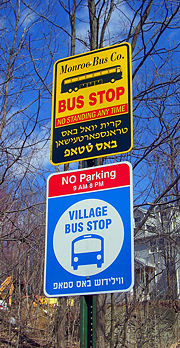
On the other hand, despite all their efforts at cultural separation, the Haredi leadership could not ignore the appeal of American life to their own youth. While certain few concessions to American society were made (for example, some groups allowed some of their children to pursue some higher education under certain circumstances), for the most part the response was to adopt an even more extreme approach to insularity. In effect, anything that might be perceived as a threat to the cultural homogeneity of the community was disparaged, including secular newspapers, radio, and television. Instead, a program of total immersion in study was encouraged for the younger generation.
Some Haredi leaders realized that the communities could not be kept completely insular and established ways to connect to society without compromising on their intrinsic beliefs. In several instances, yeshivos such as Torah Vodaas, Chaim Berlin
Yeshiva Rabbi Chaim Berlin
Yeshiva Rabbi Chaim Berlin or Yeshivas Rabbeinu Chaim Berlin, is a Haredi Lithuanian-type yeshiva located in Brooklyn, New York. Established in 1904 as Yeshiva Tiferes Bachurim, it is the oldest yeshiva in Kings County...
and Ner Yisroel started allowing the boys (or bochurim) to pursue a secular education while remaining in the yeshiva. This was helped largely by the establishment of Touro College
Touro College
Touro College is a sponsored independent institution of higher and professional education, in New York City, New York, United States. Founded by Dr. Bernard Lander, the College was established primarily to enrich the Jewish heritage, and to serve the larger American community...
by Dr. Bernard Lander
Bernard Lander
Rabbi Dr. Bernard Lander , founder and first president of Touro College, was a social scientist and educator, a preeminent leader in the Jewish community and a pioneer in Jewish and general higher education.-Biography:...
, a college based in New York City
New York City
New York is the most populous city in the United States and the center of the New York Metropolitan Area, one of the most populous metropolitan areas in the world. New York exerts a significant impact upon global commerce, finance, media, art, fashion, research, technology, education, and...
geared towards Haredi students seeking college degrees. One of the most noticeable things in Touro is the fact that the classes are separate for men and women to keep in line with strict Haredi lifestyles.
Another, perhaps greater threat, was seen in those Jewish groups that attempted to bridge the gap between the religious and secular worlds, since this was perceived as possibly more alluring to the youths of the community, including those who could not conceive of a total break from their Jewish upbringing. Reform
Reform Judaism
Reform Judaism refers to various beliefs, practices and organizations associated with the Reform Jewish movement in North America, the United Kingdom and elsewhere. In general, it maintains that Judaism and Jewish traditions should be modernized and should be compatible with participation in the...
, Conservative
Conservative Judaism
Conservative Judaism is a modern stream of Judaism that arose out of intellectual currents in Germany in the mid-19th century and took institutional form in the United States in the early 1900s.Conservative Judaism has its roots in the school of thought known as Positive-Historical Judaism,...
, and even Modern Orthodox Judaism were seen as threatening to the very continuity of the community.
In the case of Reform, this animosity could be traced to the early nineteenth century in Germany, where Reform waged a battle to wrest control of the communities from Traditional Jews. At that time, both groups attacked each other incessantly in the struggle for hegemony over the Jewish community. Until quite recently, the Reform movement felt secure and was not leveling the same attacks on the Orthodox. In many instances, they sought ways to cooperate on common issues. To the Haredim, however, the new Judaism of the Reformers was a movement that did away with the basic tenets of what they felt was authentic Judaism, a hoax to be disparaged and discouraged within their own communities. The criticisms of two centuries earlier were also applied to the Conservative community. Their beliefs and practices were held to be incompatible with Judaism and, as such, rejected.
The Haredim maintain a delicate balancing act: on an individual level, Conservative and Reform Jews are seen as "innocents led astray"
Tinok shenishba
Tinok shenishba is a Talmudical term that refers to a Jewish individual who sins inadvertently as a result of having been raised without an appreciation for the thought and practices of Judaism...
(R' Moshe Feinstein
Moshe Feinstein
Moshe Feinstein was a Lithuanian Orthodox rabbi, scholar and posek , who was world-renowned for his expertise in Halakha and was regarded by many as the de facto supreme halakhic authority for Orthodox Jewry of North America during his lifetime...
). As such Haredim have created extensive outreach programs, conducted out of a deep love and concern for the spiritual well-being of other Jews; on a philosophical level, the generation and beliefs of these movements are condemned as stemming from the widespread denigration of religion of the 19th century. It is this viewpoint that defines the Haredi community's relationship to the larger Jewish community to this day.
However, the issue is more complicated when considering their position vis à vis the Modern Orthodox
Modern Orthodox Judaism
Modern Orthodox Judaism is a movement within Orthodox Judaism that attempts to synthesize Jewish values and the observance of Jewish law, with the secular, modern world....
community. There is a mutual dependency between the two communities: the Modern Orthodox generally respect and adhere to the religious rulings of the Haredi leadership, while the Haredi often depend on university trained Modern Orthodox professionals to provide for needs that members of their own community cannot. For example, since there are so few Haredi physicians, the community will prefer to go to a Modern Orthodox physician, since he or she will have a better understanding of the implications of the treatment in Jewish law (halakha
Halakha
Halakha — also transliterated Halocho , or Halacha — is the collective body of Jewish law, including biblical law and later talmudic and rabbinic law, as well as customs and traditions.Judaism classically draws no distinction in its laws between religious and ostensibly non-religious life; Jewish...
). Nevertheless, the leadership is unwilling to accept the liberalism of their Modern Orthodox colleagues. In some cases, Modern Orthodoxy is perceived as balancing precariously on a very narrow wire between the Jewish and secular worlds: a tenable but, to the Haredi, unnecessary position. In other cases, Modern Orthodox leaders are considered to have passed the bounds of religious propriety and condemned for this in severe terms, since those leaders, unlike Reform and Conservative rabbis, are believed to have the requisite learning and should know better.
No matter how sharp the discourse, it does not have the same intensity as earlier arguments that led to or threatened real schisms among the Jewish people. For instance, with the rise of Hasidism, Rabbi Elijah of Vilna declared that his followers must not marry Hasidic Jews (the ruling was never put into practice). While there are tensions between Haredi and other Jews, the leadership of all the factions involved have taken care to prevent a complete break, while respecting the desire of the Haredi for autonomy and separatism. And there is common ground too, especially in the field of learning. It is not uncommon for Haredi scholars to take advantage of the vast library holdings, including rare manuscripts, in the libraries of Yeshiva University (Modern Orthodox), the Jewish Theological Seminary (Conservative), and Hebrew Union College (Reform).
Western Europe
About 25,000 Haredim live in France (mostly SephardimMizrahi Jews
Mizrahi Jews or Mizrahiyim, , also referred to as Adot HaMizrach are Jews descended from the Jewish communities of the Middle East, North Africa and the Caucasus...
of North African descent). Important communities are located in Paris
Paris
Paris is the capital and largest city in France, situated on the river Seine, in northern France, at the heart of the Île-de-France region...
, Strasbourg
Strasbourg
Strasbourg is the capital and principal city of the Alsace region in eastern France and is the official seat of the European Parliament. Located close to the border with Germany, it is the capital of the Bas-Rhin département. The city and the region of Alsace are historically German-speaking,...
and Lyon
Lyon
Lyon , is a city in east-central France in the Rhône-Alpes region, situated between Paris and Marseille. Lyon is located at from Paris, from Marseille, from Geneva, from Turin, and from Barcelona. The residents of the city are called Lyonnais....
. Other important communities, mostly Ashkenazi, are the Jewish Community of Antwerp
Jewish Community of Antwerp
The history of the Jews in Antwerp, Belgium goes back at least eight hundred years. Presently, The Jewish community of Antwerp consists of around 15,000 Jews.- History :...
in Belgium
Belgium
Belgium , officially the Kingdom of Belgium, is a federal state in Western Europe. It is a founding member of the European Union and hosts the EU's headquarters, and those of several other major international organisations such as NATO.Belgium is also a member of, or affiliated to, many...
, as well as communities in the Swiss
Switzerland
Switzerland name of one of the Swiss cantons. ; ; ; or ), in its full name the Swiss Confederation , is a federal republic consisting of 26 cantons, with Bern as the seat of the federal authorities. The country is situated in Western Europe,Or Central Europe depending on the definition....
cities of Zurich
Zürich
Zurich is the largest city in Switzerland and the capital of the canton of Zurich. It is located in central Switzerland at the northwestern tip of Lake Zurich...
and Basel
Basel
Basel or Basle In the national languages of Switzerland the city is also known as Bâle , Basilea and Basilea is Switzerland's third most populous city with about 166,000 inhabitants. Located where the Swiss, French and German borders meet, Basel also has suburbs in France and Germany...
, and in the Dutch
Netherlands
The Netherlands is a constituent country of the Kingdom of the Netherlands, located mainly in North-West Europe and with several islands in the Caribbean. Mainland Netherlands borders the North Sea to the north and west, Belgium to the south, and Germany to the east, and shares maritime borders...
city of Amsterdam
Amsterdam
Amsterdam is the largest city and the capital of the Netherlands. The current position of Amsterdam as capital city of the Kingdom of the Netherlands is governed by the constitution of August 24, 1815 and its successors. Amsterdam has a population of 783,364 within city limits, an urban population...
. There is also a haredi community in Vienna
Vienna
Vienna is the capital and largest city of the Republic of Austria and one of the nine states of Austria. Vienna is Austria's primary city, with a population of about 1.723 million , and is by far the largest city in Austria, as well as its cultural, economic, and political centre...
, Austria.
United Kingdom
In the UKUnited Kingdom
The United Kingdom of Great Britain and Northern IrelandIn the United Kingdom and Dependencies, other languages have been officially recognised as legitimate autochthonous languages under the European Charter for Regional or Minority Languages...
, the largest Haredi communities are located in London (Stamford Hill
Stamford Hill
Stamford Hill is a place in the north of the London Borough of Hackney, England, near the border with Haringey. It is home to Europe's largest Hasidic Jewish and Adeni Jewish community.Stamford Hill is NNE of Charing Cross.-History:...
, South Tottenham
South Tottenham
-Location:South Tottenham occupies parts of the N15 and N17 postal districts. It is bordered in the south by Stamford Hill, the west by St Ann's and West Green, the north by Tottenham, and the east by the Lee Valley Reservoirs.-Character of the area:...
, Golders Green
Golders Green
Golders Green is an area in the London Borough of Barnet in London, England. Although having some earlier history, it is essentially a 19th century suburban development situated about 5.3 miles north west of Charing Cross and centred on the crossroads of Golders Green Road and Finchley Road.In the...
, Hendon
Hendon
Hendon is a London suburb situated northwest of Charing Cross.-History:Hendon was historically a civil parish in the county of Middlesex. The manor is described in Domesday , but the name, 'Hendun' meaning 'at the highest hill', is earlier...
, Edgware
Edgware
Edgware is an area in London, situated north-northwest of Charing Cross. It forms part of both the London Borough of Barnet and the London Borough of Harrow. The area is identified in the London Plan as one of 35 major centres in Greater London....
), Salford/Bury
Bury
Bury is a town in Greater Manchester, England. It lies on the River Irwell, east of Bolton, west-southwest of Rochdale, and north-northwest of the city of Manchester...
(Broughton Park, Kersal
Kersal
Kersal is an inner city area of Salford, in Greater Manchester, England. The centre of Kersal is northwest of Manchester city centre, and north-northwest of Salford's conventional centre at Greengate....
, Sedgley Park and Prestwich
Prestwich
Prestwich is a town within the Metropolitan Borough of Bury, in Greater Manchester, England. It lies close to the River Irwell, north of Manchester city centre, north of Salford and south of Bury....
) and Gateshead
Gateshead
Gateshead is a town in Tyne and Wear, England and is the main settlement in the Metropolitan Borough of Gateshead. Historically a part of County Durham, it lies on the southern bank of the River Tyne opposite Newcastle upon Tyne and together they form the urban core of Tyneside...
. The majority of UK Haredim descend from Eastern-European immigrants. The Haredi community in London is organized into a group known as the Union of Orthodox Hebrew Congregations
Union of Orthodox Hebrew Congregations
The Union of Orthodox Hebrew Congregations of England was founded in 1926 with the stated mission "to protect traditional Judaism". It acts as an umbrella organisation for the chareidi Jewish community in London and comprises over a hundred synagogues and educational institutions. It is responsible...
(UOHC).
The UK Haredi community is growing, maintaining hundreds of synagogues, although many are smaller scale shtiebel
Shtiebel
A shtiebel is a place used for communal Jewish prayer. In contrast to a formal synagogue, a shtiebel is far smaller and approached more casually. It is typically as small as a room in a private home or a place of business which is set aside for the express purpose of prayer, or it may be as large...
s. It also maintains numerous schools, yeshiva
Yeshiva
Yeshiva is a Jewish educational institution that focuses on the study of traditional religious texts, primarily the Talmud and Torah study. Study is usually done through daily shiurim and in study pairs called chavrutas...
s, kolels and mikvehs. The community also supports dozens of kosher food shops, bakeries and to a lesser extent, restaurants.
The Haredi population in the UK was estimated at 27,000 in 1998, out of 200,000 UK observant Jews. However, a 2007 study published by the University of Manchester asserted that three out of every four British Jewish births are Haredi, who now account for 45,500 out of around 275,000 Jews in the UK, or 17%. A new joint study of the Jewish Policy Research and the Board of Deputies in 2010 established that there was 9049 Charedi households in the uk. This would account for a population of nearly 53,400 or 20% of the uk community. http://www.jpr.org.uk/downloads/Synagogue%20membership.pdf http://www.thejc.com/comment-and-debate/comment/33358/alderman-should-face-facts (9,049 households * 5.9 average Charedi household) Within the next three decades, the Haredi community is predicted (by the Board of Deputies) to be the largest Jewish group in the UK: in comparison with the national average of 2.4 children per family, Haredi families have an average of 5.9 children, and as of 2006 membership of chareidi synagogues had doubled since 1990.
Haredi Jewish groups
- Agudath IsraelAgudath IsraelAgudath Israel can refer to any of several related organizations, including:*World Agudath Israel, an international movement*Agudath Israel of America, an American organization*Agudat Yisrael, an Israeli political party...
, worldwide and local (such as Agudath Israel of AmericaAgudath Israel of AmericaAgudath Israel of America , is a Haredi Jewish communal organization in the United States loosely affiliated with the international World Agudath Israel.-Functions:...
) - ShasShasShas is an ultra-orthodox religious political party in Israel, primarily representing Sephardic and Mizrahi Haredi Judaism.Shas was founded in 1984 by dissident members of the Ashkenazi dominated Agudat Israel, to represent the interests of religiously observant Sephardic and Mizrahi ...
: Mizrahi Sefardi Haredi party in Israel - United Torah JudaismUnited Torah JudaismUnited Torah Judaism is an alliance of Degel HaTorah and Agudat Israel, two small Israeli Haredi political parties in the Knesset. It was first formed in 1992.The two parties have not always agreed with each other about policy matters...
: Ashkenazi Haredi political grouping in Israel
Haredi Jewish Sects
- Hasidic Jewish groups such as: BelzBelz (Hasidic dynasty)Belz is a Hasidic dynasty named for the town of Belz in Western Ukraine, near the Polish border. The town has existed since at least the 10th century, with the Jewish community being established during the 14th century. The town became home to Hasidic Judaism in the early 19th century...
, Bobov, BostonBoston (Hasidic dynasty)Boston is a Hasidic sect, originally established in 1915 by Grand Rabbi Pinchas Duvid Horowitz. Following the custom of European Chassidic Courts, where the Rebbe was called after the name of his city, Bostoner Chassidus was named after Boston, Massachusetts...
, BoyanBoyan (Hasidic dynasty)Boyan is a Hasidic dynasty named after the town of Boiany in the Ukraine. The Hasidut is presently headquartered in Jerusalem, Israel, with communities in Beitar Ilit, Bnei Brak, London, Antwerp, Brooklyn, and Monsey, New York.-First Boyaner Rebbe:...
, BreslovBreslov (Hasidic dynasty)Breslov is a branch of Hasidic Judaism founded by Rebbe Nachman of Breslov a great-grandson of the Baal Shem Tov, founder of Hasidism...
, Chabad Lubavitch, GerGer (Hasidic dynasty)Ger, or Gur is a Hasidic dynasty originating from Ger, the Yiddish name of Góra Kalwaria, a small town in Poland....
, KarlinKarlin (Hasidic Dynasty)Karlin-Stolin is a Hasidic dynasty originating with Rebbe Aaron the Great of Karlin in present-day Belarus. Karlin was one of the first centres of Hasidim to be set up in Lithuania....
, Munkacz, PittsburgPittsburg (Hasidic dynasty)Pittsburg is a Hasidic dynasty founded in Pittsburgh, Pennsylvania in 1924 by Rabbi Yosef Leifer, a Hungarian rabbi and descendant of Rabbi Mordechai of Nadvorna...
, Puppa, Satmar, and VizhnitzVizhnitz (Hasidic dynasty)Vizhnitz is the name of a Hasidic dynasty founded by Rebbe Menachem Mendel Hager. Vizhnitz is the Yiddish name of Vyzhnytsia, a village in present-day Ukraine.Followers of the rebbes of Vizhnitz are called Vizhnitzer chasidim....
. - Toldos YeshurunToldos YeshurunToldos Yeshurun is a Non-Profit organization for Jews from the former USSR. It was founded by Rabbi Yitzchok Zilber, leader of the Russian baal teshuvah movement and often called "the father of Russian Jewry", in 2000 with the support of Rabbi Yosef Sholom Eliashiv, Rabbi Aharon Leib Shteinman, and...
: Organization of Haredi Russian Jews. - Edah HaChareidis: rabbinical council of anti-Zionist Haredi groups in and around Jerusalem, including SatmarSatmar (Hasidic dynasty)Satmar is a Hasidic movement comprising mostly Hungarian and Romanian Hasidic Jewish Holocaust survivors and their descendants. It was founded and led by the late Hungarian-born Grand Rebbe Yoel Teitelbaum , who was the rabbi of Szatmárnémeti, Hungary...
, DushinskyDushinsky (Hasidic dynasty)Dushinsky is one of the few Hasidic dynasties not named after the place where it originated; instead, it is named after the surname of the Rebbe. It is a relatively new dynasty, as are many of the dynasties originating in Hungary. However, the Dushinsky dynasty truly became a dynasty in Jerusalem,...
, Toldos Aharon, Toldos Avrohom Yitzchok, Neturei KartaNeturei KartaNeturei Karta is a Haredi Jewish group formally created in Jerusalem, British Mandate of Palestine, in 1938, splitting off from Agudas Yisroel...
Mishkenos Horoim, Spinka, Brisk and a section of other LitvishMisnagdimMisnagdim or Mitnagdim is a Hebrew word meaning "opponents". It is the plural of misnaged or mitnaged. Most prominent among the Misnagdim was Rabbi Elijah ben Shlomo Zalman , commonly known as the Vilna Gaon or the Gra...
Haredim. - Lithuanian JewsLithuanian JewsLithuanian Jews or Litvaks are Jews with roots in the Grand Duchy of Lithuania:...
- Chardal, Ultra-orthodox Jews who support the ideology of Religious ZionismReligious ZionismReligious Zionism is an ideology that combines Zionism and Jewish religious faith...
Rabbinical leaders
- The Baal Shem Tov (18th century founder of Hasidism)
- The Vilna GaonVilna GaonElijah ben Shlomo Zalman Kramer, known as the Vilna Gaon or Elijah of Vilna and simply by his Hebrew acronym Gra or Elijah Ben Solomon, , was a Talmudist, halachist, kabbalist, and the foremost leader of non-hasidic Jewry of the past few centuries...
(of Lithuania) - Rabbi Chaim of VolozhinChaim VolozhinChaim Volozhin was an Orthodox rabbi, Talmudist, and ethicist. Popularly known as "Reb Chaim Volozhiner" or simply as "Reb Chaim", he was born in Volozhin when it was a part of the Polish-Lithuanian Commonwealth...
(19th century founder of the Lithuanian yeshivoth) - Rabbi Moses SoferMoses SoferMoses Schreiber, known to his own community and Jewish posterity as Moshe Sofer, also known by his main work Chasam Sofer, , , was one of the leading Orthodox rabbis of European Jewry in the first half of the nineteenth century...
(18th-19th century leader of Eastern European ultra-Orthodox) - Rabbi Yisrael Meir HaCohen KaganYisrael Meir KaganYisrael Meir Poupko , known popularly as The Chofetz Chaim, was an influential Eastern European rabbi, Halakhist, posek, and ethicist whose works continue to be widely influential in Jewish life...
, the Chafetz Chaim - Rabbi Avrohom Mordechai AlterAvraham Mordechai AlterAvraham Mordechai Alter , also known as the Imrei Emes after the works he authored, was the third Rebbe of the Hasidic dynasty of Ger, a position he held from 1905 until his death in 1948. He was one of the founders of the Agudas Israel in Poland and was influential in establishing a network of...
, Third Gerrer Rebbe, driving force behind Agudas Yisroel in Poland - Rabbi Moshe FeinsteinMoshe FeinsteinMoshe Feinstein was a Lithuanian Orthodox rabbi, scholar and posek , who was world-renowned for his expertise in Halakha and was regarded by many as the de facto supreme halakhic authority for Orthodox Jewry of North America during his lifetime...
, one of the highest halachic authorities for much of the twentieth century - Rabbi Avraham Yeshayahu KarelitzAvraham Yeshayahu KarelitzAvrohom Yeshaya Karelitz, , popularly known by the name of his magnum opus Chazon Ish, was a Belarusian born Orthodox rabbi who became leader of Haredi Judaism in Israel, where his final 20 years, from 1933 to 1953, were spent.-Birth and Youth:Born in Kosava , Karelitz was sent as a youth to study...
(leader of Haredim in Israel) - Rabbi Elazar ShachElazar ShachElazar Menachem Man Shach also spelt Eliezer Schach, was a leading Lithuanian-born and educated Haredi rabbi in Bnei Brak, Israel. He also served as one of three co-deans of the Ponevezh yeshiva in Bnei Brak along with Rabbis Shmuel Rozovsky and Dovid Povarsky...
(leader of the Lithuanian community of Haredim in Israel) - Rabbi Aharon KotlerAharon KotlerAharon Kotler was an Orthodox Jewish rabbi and a prominent leader of Orthodox Judaism in Lithuania, and later the United States, where he built Beth Medrash Govoha in Lakewood Township, New Jersey.- Early life :...
(founder of the Lakewood yeshivas in America) - Rabbi Ovadya YosefOvadia YosefOvadia Yosef is the former Sephardi Chief Rabbi of Israel, a recognised Talmudic scholar and foremost halakhic authority.He currently serves as the spiritual leader of the Shas political party in the Israeli parliament...
(leader of Israeli Sephardi Haredim) - Rabbi Yosef Shalom Elyashiv (present-day leader of Israel's non-Hasidic Ashkenazi Haredim)
Rabbinical organizations and dynasties
- Rabbis of the Edah HaChareidis rabbinical council of Jerusalem
- Rebbes of the Satmar Hasidim (originally Hungary, now New York)
- Rebbes of the Gerrer Hasidim (originally Poland, now Israel)
- Rebbes of Chabad-Lubavitch
See also
- Bnei Brak
- Chabad Lubavitch
- Torah study commandmentTorah studyTorah study is the study by Jewish people of the Torah, Hebrew Bible, Talmud, responsa, rabbinic literature and similar works, all of which are Judaism's religious texts...
- Torato OmanutoTorato OmanutoTorato Omanuto is a term describing one who's Torah study is his main occupation...
– The special arrangement allowing postponements or exemptions from Israel Defence Forces (IDF) compulsory service for Yeshiva students. - HesderHesderHesder is an Israeli yeshiva program which combines advanced Talmudic studies with military service in the Israel Defense Forces, usually within a Religious Zionist framework...
– combining the Torah studyTorah studyTorah study is the study by Jewish people of the Torah, Hebrew Bible, Talmud, responsa, rabbinic literature and similar works, all of which are Judaism's religious texts...
practice and partial Military service, mostly for the Religious ZionismReligious ZionismReligious Zionism is an ideology that combines Zionism and Jewish religious faith...
("National Religious") sector. - Sherut LeumiSherut LeumiSherut Leumi is an alternative voluntary national service in Israel for those that cannot or do not wish to serve in the Israel Defense Forces...
- Tal committee (the "Tal law")
- Religion in IsraelReligion in IsraelReligion in Israel is a central feature of the country and plays a major role in shaping Israeli culture and lifestyle, and religion has played a central role in Israel's history. Israel is also the only country in the world where a majority of citizens are Jewish...
- Status quo (Israel)Status quo (Israel)In Israel, the term status quo refers to the political understanding between religious and secular political parties not to alter the communal arrangement in relation to religious matters, in a predominantly secular population...
- FaceGlatFaceGlatFaceGlat is a social networking service by Yaakov Swisa. The website caters to ultra-Orthodox Haredi Jews. The website separates users by sex and screens comments and advertisements to prevent indecency. The website currently is available in English and Hebrew. Swisa said that he plans to add...
- Agudath Israel of AmericaAgudath Israel of AmericaAgudath Israel of America , is a Haredi Jewish communal organization in the United States loosely affiliated with the international World Agudath Israel.-Functions:...
- Fastest-growing religion
- Degel HaTorahDegel HaTorahDegel HaTorah is an Ashkenazi Haredi political party in Israel. For much of its existence it has been allied to Agudat Yisrael under the name United Torah Judaism.-Ideology:...
- Divine Providence in Contemporary Jewish thought
- HardalHardalChardal ; Hebrew: חרד"ל, acronym for חרדי לאומי, Charedi Le-umi, lit. "Nationalist Charedi", Plural: Chardalim refers to the Ultra-Orthodox Jews who support the ideology of Religious Zionism...
- Hasidic JudaismHasidic JudaismHasidic Judaism or Hasidism, from the Hebrew —Ḥasidut in Sephardi, Chasidus in Ashkenazi, meaning "piety" , is a branch of Orthodox Judaism that promotes spirituality and joy through the popularisation and internalisation of Jewish mysticism as the fundamental aspects of the Jewish faith...
- Hasidim and Mitnagdim
- Mashgiach RuchaniMashgiach ruchaniMashgiach ruchani or mashgiach for short, means a spiritual supervisor or guide. It is a title which usually refers to a rabbi who has an official position within a yeshiva and is responsible for the non-academic areas of yeshiva students' lives.The position of mashgiach ruchani arose with the...
- Orthodox JudaismOrthodox JudaismOrthodox Judaism , is the approach to Judaism which adheres to the traditional interpretation and application of the laws and ethics of the Torah as legislated in the Talmudic texts by the Sanhedrin and subsequently developed and applied by the later authorities known as the Gaonim, Rishonim, and...
- PosekPosekPosek is the term in Jewish law for "decider"—a legal scholar who decides the Halakha in cases of law where previous authorities are inconclusive or in those situations where no halakhic precedent exists....
- RebbeRebbeRebbe , which means master, teacher, or mentor, is a Yiddish word derived from the Hebrew word Rabbi. It often refers to the leader of a Hasidic Jewish movement...
- Relationships between Jewish religious movementsRelationships between Jewish religious movementsThe relationships between the various denominations of American Judaism can be conciliatory, welcoming, or even antagonistic.-Orthodox Judaism:Orthodox Judaism holds that both Conservative and Reform Judaism have made major and unjustifiable breaks with historic Judaism, both by their skepticism of...
- Rosh yeshivaRosh yeshivaRosh yeshiva, , , is the title given to the dean of a Talmudical academy . It is made up of the Hebrew words rosh — meaning head, and yeshiva — a school of religious Jewish education...
- United Torah JudaismUnited Torah JudaismUnited Torah Judaism is an alliance of Degel HaTorah and Agudat Israel, two small Israeli Haredi political parties in the Knesset. It was first formed in 1992.The two parties have not always agreed with each other about policy matters...
- World Agudath IsraelWorld Agudath IsraelWorld Agudath Israel , usually known as the Aguda, was established in the early twentieth century as the political arm of Ashkenazi Torah Judaism, in succession to Agudas Shlumei Emunei Yisroel...
- ZAKAZAKAZAKA , is a series of voluntary community emergency response teams in Israel, each operating in a police district . These organizations are officially recognized by the government...