

Uthman

Encyclopedia
Uthman ibn Affan (c. 579 – 17 July 656) was one of the companions
of Islamic prophet
, Muhammad
. He played a major role in early Islamic history
as the third Sunni
Rashidun
or Rightly Guided Caliph.
`Uthman was born into the Umayyad clan of Mecca
, a powerful family of the Quraish tribe. He was a companion of Muhammad who assumed the role of leader (caliph
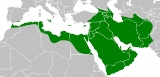
) of the Muslim Empire at the age of 65 following Umar ibn al-Khattab. Under his leadership, the empire expanded into Fars in 650 (present-day Iran
), some areas of Khorasan
(present-day Afghanistan
) in 651 and the conquest of Armenia
was begun in the 640s. Some of Uthman's notable achievements were the economic reforms he introduced, and the compilation of the Qur'an into the unified, authoritative text that is known today.
, which is situated on a hill, and the presumption is that he was born during the summer months, since wealthy Mecca
ns usually spent the hot summers in the cooler climate of Ta’if. He was born into the wealthy Umayyad
(Banu Umayya) clan of the Quraysh tribe of Mecca, seven years after Muhammad. `Uthman's father, Affan, died young while travelling abroad but left a large inheritance to `Uthman. `Uthman followed the same profession as his father, and his business flourished, making him one of the richest men among the Qurayshi tribe.
,therefore he was nicknamed as 'Uthman Ghani'i.e. Uthman the giver. On returning from a business trip to Syria
in 611, `Uthman found out that Muhammad had declared his mission. After a discussion with his friend Abu Bakr
`Uthman decided to convert to Islam, and Abu Bakr took him to Muhammad to whom he declared his faith. `Uthman thus became the fourth male to convert to Islam, after Ali, Zayd and Abu Bakr. His conversion to Islam angered his clan, the Banu Ummayyah, who strongly opposed Muhammad's teachings. The only two people who supported `Uthman's decision were Saadi, one of his maternal aunts, and Umm Kulthum, who was his stepsister and who had also converted to Islam. Because of his conversion to Islam, `Uthman's wives deserted him, and he subsequently divorced them. Muhammad then asked `Uthman to marry his daughter Ruqayyah bint Muhammad
.
(modern Ethiopia
) in 614–615, along with 11 men and 11 women, all Muslims. As `Uthman already had some business contacts in Abyssinia, he continued to practise his profession as a trader. He worked hard and his business soon flourished. After two years the news had spread among the Muslims in Abyssinia that the Quraysh of Mecca had accepted Islam, and that persuaded`Uthman, Ruqayya and some other Muslims to return. However when they reached Mecca it transpired that the news about the Quraysh's acceptance of Islam was false. Some of the Muslims who had come from Abyssinia returned but `Uthman and Ruqayya decided to stay. In Mecca `Uthman had to start his business afresh, but the contacts that he had already established in Abyssinia worked in his favour and his business prospered once again.
. They were amongst the third batch of Muslims who migrated to Medina. On arrival in Medina, `Uthman stayed with Abu Talha ibn Thabit of the Banu Najjar
. After a short while, `Uthman purchased a house of his own and moved there. Being one of the richest merchants of Mecca, and having amassed a considerable fortune, `Uthman did not need any financial help from his Ansari brothers, as he brought all his wealth with him to Medina. In Medina, the Muslims were generally farmers and were not very interested in trade, and thus most of the trading that took place in the town was handled by the Jews. Thus, there was considerable space for the Muslims in promoting trade and `Uthman took advantage of this position, soon establishing himself as a trader in Medina. He worked hard and honestly, and his business flourished, soon becoming one of the richest men in Medina.
. Uthman stayed at Medina to look after the ailing Ruqayya and did not join those who left with Muhammad. Ruqayya died during the time the Battle of Badr
was being fought, and the news of the victory of Badr reached Medina as she was being buried. Because of the battle Muhammad
could not attend the funeral of his daughter.
After the Battle of Uhud Uthman married Muhammad's second daughter, Umm Kulthum bint Muhammad
. The next year Ruqayyah's son, Abd-Allah ibn Uthman, died. When the Battle of the Trench
was fought in 627, Uthman was in charge of a sector of Medina. After the battle a campaign was undertaken against the Jews of Banu Qaynuqa
, and when they were taken captive the question of the disposal of the slaves became a problem. Uthman solved the issue by purchasing all the slaves and depositing their price in the Bayt al-mal
(Treasury). Any of these slaves who accepted Islam were set free by Uthman in the name of Allah
.
), Muhammad set out for Mecca to perform the ritual pilgrimage of Umra
. The Quraysh denied the Muslims entry into the city and posted themselves outside Mecca, determined to show resistance, even though the Muslims had no intention or preparation for battle. Muhammad camped outside Mecca, at Hudaybiyyah, and sent Uthman as his envoy to meet with the leaders of Quraysh and negotiate Muslim entry into the city. The Quraysh made Uthman stay longer in Mecca than he originally planned and refused to inform the Muslims of his whereabouts. This caused the Muslims to believe that Uthman had been killed by the people of Quraysh. On this occasion, Muhammad gathered his nearly 1,400 soldiers and called them to pledge to fight until death and avenge the rumoured death of Uthman, which they did by placing a hand on top of Muhammad's. It is reported that Muhammad placed one of his hands on top of the other and pledged on behalf of Uthman as well. This pledge took place under a tree and was known as the Pledge of the Tree
and was successful in demonstrating to the Quraysh the determination of the Muslims. They soon released Uthman and sent down an ambassador of their own, Suhail ibn Amr to negotiate terms of a treaty that later became known as the Treaty of Hudaybiyyah
.
and later that year, he followed Muhammad to perform Umrah
in Mecca. While in Mecca he visited his mother and found that his family was not as hostile to Islam as they used to be. In 630, the Quraysh broke the treaty of Hudaibiyah, and the Muslims attacked and conquered Mecca. General amnesty was granted to the people of the city, although an exception was made in the case of half a dozen people. Amongst those not granted amnesty was Abdullah ibn Saad
, a foster brother of Uthman. Later, following an appeal by Abdullah's mother to Uthman, he was forgiven by Muhammad. Following the Conquest of Mecca
Uthman's family converted to Islam and he rejoined his mother and siblings. Two weeks later, under the command of Muhammad, he participated in the Battle of Hunayn
which was followed by the Siege of Ta'if
.
To Uthman, the conquest of Mecca and Ta’if were of particular significance, as he had considerable property in both cities, and he could now profitably develop them. He was also able to set up sub-offices for his businesses at Mecca and Ta’if. Uthman's wife, and the daughter of Muhammad, Umm Kulthum bint Muhammad, died soon after the conquest of Mecca.
In 630 Muhammad decided to lead an expedition to Tabuk on the Syrian border. In order to finance the expedition Muhammad invited contributions from his followers. Uthman made the largest contribution: 1,000 dinar
s in cash, 1,000 camels for transport, and horses for the cavalry, which Muhammad greatly appreciated. In 631, along with other Muslims, Uthman moved to Mecca to perform Hajj under Abu Bakr while Muhammad stayed in Medina. In Mecca Uthman married Umm Saeed Fatima bint Al Walid b Abd Shams, a Qurayshi lady, and returned to Medina with her.
In 632, along with Muhammad, Uthman participated in The Farewell Pilgrimage
. In 632 Muhammad died.
to offer his allegiance. During the Ridda wars
(Wars of Apostasy), Uthman remained at Medina, acting as Abu Bakr's adviser. On his death bed, Abu Bakr dictated his will to Uthman, saying that his successor was to be Umar.
During the reign of Umar, considerable wealth flowed into the public treasury
. Uthman advised that some amount be reserved in the treasury for future needs, instead of giving all of it as stipends to the Muslims, and this was accepted by Umar. A controversy then arose about the land in conquered areas. The army was of the view that all lands in conquered territories should be distributed among the soldiers of the conquering army, but others thought that the lands should remain as the property of the original owners, and the lands without claimants should be declared as state property. Uthman supported the latter view and this view was ultimately accepted.
At the time of the conquest of Jerusalem the Christian
s asked that Umar come to Jerusalem to accept the surrender of the city. Uthman was of the view that it was not necessary for the Caliph of the Muslims to go to Jerusalem and that the enemy, when defeated, would surrender the city unconditionally. There was much force in Uthman's argument, but in order to win the good will of the Christians, Umar decided to go to Jerusalem to accept the surrender of the city. In the time of Umar, a severe famine
broke out in the country and a large caravan belonging to Uthman that was carrying a large supply of food grains served the poor well.
This committee was:
Umar asked that, after his death, the committee reach a final decision within three days, and the next Caliph should take the oath of office on the fourth day. If Talhah joined the committee within this period, he was to take part in the deliberations, but if he did not return to Medina within this period, the other members of the committee could proceed with the decision. Abdur Rahman bin Awf withdrew his eligibility to be appointed as Caliph in order to act as a moderator and began his task by interviewing every member of the committee separately. He asked them for whom they would cast their vote. When Ali was asked, he didn't reply. When Uthman was asked, he voted for Ali , Zubayr said for Ali or Uthman. and Saad said for Uthman.
After Abdul Rahman consulted the other leaders of public opinion in Medina, who were in favour of Uthman, he arrived at the conclusion that the majority of the people favoured the election of Uthman. On the fourth day after the death of Umar, 11 November 644, 5 Muharram
24 Hijri, Uthman was elected as the third Caliph, with the title "Amir al-Mu'minin".
, in the east to South east Pakistan
, and in the north to Armenia
and Azerbaijan
. During his caliphate
, the first Islamic naval force was established, administrative divisions of the state were revised, and many public projects were expanded and completed.
Uthman sent prominent sahaba
s ("companions of Muhammad") as his personal deputies to various provinces to scrutinize the conduct of officials and the condition of the people. In total, Uthman ruled for twelve years. The first six years were marked by internal peace and tranquillity, and he remained the most popular Caliph among the Rashidun; but during the second half of his caliphate a rebellion arose.
Uthman had the distinction of working for the expansion of Islam, and he sent the first official Muslim envoy to China in 650. The envoy, headed by Sa`d ibn Abi Waqqas, arrived in the Tang capital, Chang'an
, in 651 via the overseas route. The Hui people
generally consider this date to be the official founding of Islam in China. The Ancient Record of the Tang Dynasty
recorded the historic meeting, in which the envoy greeted Emperor Gaozong of Tang
and tried to convert him to Islam. Although the envoy failed to convince the Emperor to embrace Islam, the Emperor allowed him to proselytize in China and ordered the establishment of the first Chinese mosque
in the capital to show his respect for the religion. Uthman also sent official Muslim envoys to Sri Lanka
.
 Uthman was a shrewd businessman and a successful trader from his youth, which contributed greatly to the Rashidun Empire. Umar had fixed the allowance
of the people and on assuming office, Uthman increased it by about 25%. Umar had placed a ban on the sale of lands and the purchase of agricultural
lands in conquered territories. Uthman withdrew these restrictions, in view of the fact that the trade could not flourish. Uthman also permitted people to draw loans from the public treasury. Under Umar it had been laid down as a policy that the lands in conquered territories were not to be distributed among the combatants, but were to remain the property of the previous owners. The army
felt dissatisfied at this decision, but Umar suppressed the opposition with a strong hand. Uthman followed the policy devised by Umar and there were more conquests, and the revenues from land increased considerably. The army once again raised the demand for the distribution of the lands in conquered territories among the fighting soldiers but Uthman turned down the demand and it favoured the Dhimmi
s (non-Muslims in Islamic state).
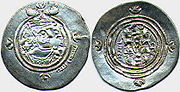
In 651, the first Islamic coin
s were struck during the caliphate of Uthman, these were the Persian dirham
s that had an image of the Persian emperor Yazdgerd III
with the addition of the Arabic
sentence Bismillah
(بسم الله) (in the name of Allah). However the first original minting of the Islamic dirham was done in 695 during Umayyad period.
Umar, the predecessor of Uthman was very strict in the use of money from the public treasury. Apart from the meagre allowance that had been sanctioned in his favour, Umar took no money from the treasury. He did not receive any gifts, nor did he allow any of his family members to accept any gift from any quarter. During the time of Uthman there was some relaxation in such strictness. Uthman did not draw any allowance from the treasury for his personal use, nor did he receive a salary
, he was a wealthy man with sufficient resources of his own, but unlike Umar, Uthman accepted gifts and allowed his family members to accept gifts from certain quarters. Uthman honestly felt that he had the right to utilize the public funds according to his best judgment, and no one criticized him for that. The economic reforms introduced by Uthman had far reaching effects; Muslims as well as non-Muslims of the Rashidun Empire enjoyed an economically prosperous life during his reign.
. During the caliphate of Uthman as many as five thousand new mosques were constructed. Uthman enlarged, extended, and embellished the Al-Masjid al-Nabawi
at Medina and the Kaaba
as well. With the expansion of the army, the cantonment
s were extended and enlarged, more barracks
were constructed for the soldiers and stable
s for the cavalry
were extended. Uthman provided separate pastures for state camel
s.
During the caliphate of Uthman, guest houses were provided in main cities to provide comfort to the merchants coming from faraway places. More and more market
s were constructed and Uthman appointed Market Officers to look after them. In Iraq
, Egypt
and Persia numerous canal
s were dug, which stimulated agricultural development. In the cities, particular attention was directed towards the provision of the water supply
. In Medina, a number of wells
were dug to provide drinking water for the people and in Mecca the water supply was also improved. Water was brought to Kufa
and Basra
by canals. Shuaibia was the port
for Mecca but it was inconvenient, so Uthman selected Jeddah
as the site of the new seaport, and a new port was built there. Uthman also reformed the police departments in cities.
Under Umar, Egypt was divided into two provinces, Upper and Lower Egypt. Uthman made Egypt one province and created a new province for Efriqya
. Under Umar, Syria was divided into two provinces but Uthman made it one province.
During Uthman’s reign the empire was divided into twelve province
s. These were:
The provinces were further divided into district
s (more than 100 districts in the empire) and each district or main city had its own Governor
, Chief judge
and Amil (tax collector
). The governors were appointed by Uthman and every appointment was made in writing. At the time of appointment, an instrument of instructions was issued with a view to regulating the conduct of the governors. On assuming office, the governor was required to assemble the people in the main mosque, and read the instrument of instructions before them. Uthman appointed his kinsmen
as governors of four provinces: Egypt, Syria, Basra and Kufa. The kindest explanation for this reliance on his kin is that the Rashidun Empire had expanded so far, so fast, that it was becoming extremely difficult to govern, and that Uthman felt that he could trust his own kin not to revolt against him. However Shiah did not see this as prudence; they saw it as nepotism
, and an attempt to rule like a king rather than as the first among equals.
, had begun to develop their own traditions for reciting the Qur'an and writing it down with stylistic differences.
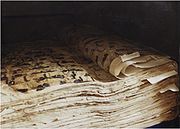 During the time of Uthman, by which time Islam had spread far and wide, differences in reading the Quran in different dialects of Arabic language became obvious. A group of companions, headed by Hudhayfah ibn al-Yaman, who was then stationed in Iraq, came to Uthman and urged him to "save the Muslim ummah before they differ about the Quran" . Uthman obtained the complete manuscript of the Qur'an from Hafsah, one of the wives of the Islamic prophet Muhammad who had been entrusted to keep the manuscript ever since the Qur'an was comprehensively compiled by the first Caliph
, Abu Bakr
. Uthman
then again summoned the leading compiling authority, Zayd ibn Thabit
, and some other companions to make copies of the manuscript. Zayd was put in charge of the task. The style of Arabic dialect used was that of the Quraysh tribe of which the Prophet Muhammad belonged. Hence this style was emphasized over all others.
Zayd and his assistants produced several copies of the manuscript of the Qur'an. One of each was sent to every Muslim province with the order that all other Quranic materials, whether fragmentary or complete copies, be destroyed. As such, when the standard copies were made widely available to the Muslim community everywhere, then all other material was burnt voluntarily by the Muslim community themselves. The annihilation of these extra-Qur'anic documents remained essential in order to eradicate scriptural incongruities, contradictions of consequence or differences in the dialect from the customary text of the Qur'an. The Caliph Uthman kept a copy for himself and returned the original manuscript to afsah].
While Shi'a and Sunni accept the same sacred text, the Qur'an
, some claim that Shi'a dispute the current version, i.e. they add two additional surahs known as al-Nurayn and al-Wilaya
. Nonetheless, Shi'as claim that they are falsely accused of this, as they believe, like Sunnis, that the Qur'an has never been changed and it is with reference from sunni hadeeth books that this inference is drawn not only by uninformed shias but sunnis too.
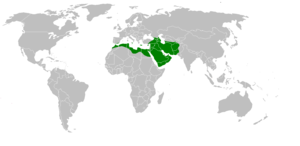 Islamic empire expanded at unprecedented rate under Caliph Umar, following the death of Caliph Umar, almost whole of the former Sassanid empire's territory rebelled from time to time until 650, when the last Sassanid emperor was assassinated. Caliph `Uthman thus directed several military expeditions to crush rebellion and re-capture the Persia and their vassal states. The main rebellion was in the Persian provinces of Armenia
, Azerbaijan
, Fars, Sistan
, Tabaristan, Khorasan
, and Makran
. These provinces were across present days Pakistan
, Iran
, Afghanistan
, Azerbaijan
, Dagestan
, Turkmenistan
and Armenia
. In addition to these provinces several other territories were also subdued in the region.
After the death of Caliph Umar, Byzantine emperor Constantine III launched an attack but was repulsed, due to which Uthman ordered annual raids in Anatolia to cut off the power of Byzantine. From 647 to 651 major offensives were launched in Cappadocia
, Caesarea Mazaca, Cilicia
and Isauria
in 650–651 forced the Byzantine emperor Constans II to enter into negotiations The truce that followed made it possible for Constans II to hold on to the western portions of Armenia
.
A naval force was built and island of Cyprus
was captured in 649 followed by the capture of Crete
and Rhodes
.
After a naval victory against Byzantine fleet a part of Sicily
was also captured.
In 654–655 Uthman ordered for the preparation of an expedition to capture Constantinopole, it was about to be launched when Uthman was murdered.
North Africa was invaded in 647 and Byzantine
Exarchate of Africa
which had declared its independence under its King Gregory the Patrician
was annexed.
Nubia
was invaded in 652 and its capital Dongola
was sacked. Though battle remained inconclusive and a peace offer from Nubian King was accepted according to which no party will any aggressive moves against each other.
In 652–653 the Iberian Peninsula
was invaded and its coastal areas were captured, before further expansion could be made Caliph was murdered and forces were pulled back from Iberia and north Africa during Muslim civil war.
plane they came to enjoy a larger degree of freedom. No institutions were devised to channel political activity, and, in the absence of such institutions, the pre-Islamic
tribal jealousies and rivalries, which had been suppressed under earlier caliphs, erupted once again. In view of the lenient policies adopted by Uthman, the people took advantage of such liberties, which became a headache for the state, and it culminated in the assassination of Uthman.
According to some contemporary salafi scholars, the foreign powers became nervous at the success of the Muslims under the leadership of Uthman, and now their only hope lay in aiding and abetting subversive movements within the territories of Uthman's caliphate. According to some viewpoints, under such circumstances, leaders like Abdullah Ibn Saba
, felt that it was a good opportunity to accomplish their aims of rebellion by starting arguments over religion. However, the figure Abdullah Ibn Saba is believed by many Shia Muslims to be an imaginary one created by certain Sunni historians to stir up anti-Shia sentiment.
However, Wilferd Madelung discredits the alleged role of Abdullah ibn Saba in the rebellion against Uthman, Madelung observes that ‘’few if any modern historians would accept Sayf's legend of Ibn Saba’’
It is believed that the movement had its links with foreign countries. Due to the lack of any particular political department to deal with the growing political agitation in the Islamic state, the political leaders in various towns campaigned against Uthman. Initially, they started with arguments over Uthman's kinsmen, who were governors of Egypt, Bosra and Kufa and they were joined by the companions who supported Ali. The most prominent of these were Muhammad ibn Abi Bakr
, who despite being an Umayyad
like Uthman, was raised in Ali's house, and Ammar ibn Yasir
, who supported the right of Ali to become caliph because of his close relationship with Muhammad. The campaign was also supported by some companions who had a personal grievance with Uthman, like ‘Amr ibn al-’As, also an Ummayad, who was stripped of the governorship of Egypt by Uthman, and Uthman's adopted son, Muhammad bin Abi Hudhaifa, who Uthman had refused to appoint as a governor of any province.
The actual reason for the anti-Uthman movement is disputed among the Shia and Sunni Muslims. Many anonymous letters were written to the leading companions of Muhammad, complaining about the alleged tyranny of Uthman's appointed governors. Moreover, letters were sent to the leaders of public opinion in different provinces concerning the reported mishandling of power by Uthman's family. This contributed to unrest in the empire and finally Uthman had to investigate the matter in an attempt to ascertain the authenticity of the rumours. The movement however exploited differences between the Hashemite
(Ali's clan) and Umayyad (Uthman's clan) clans of Quraysh.
Sunni Muslims consider these claims about the governors of Uthman, who achieved much success during their reign, to be untrue, while Sunni Muslims believe this to be a tactic used by seditionists to overthrow the realm of Uthman, by making him lose control over the main provinces of Egypt, Syria, Kufa and Bosra, where Uthman had appointed his own kinsmen for loyalty's sake. On the other hand Shia Muslims suggest that these claims were correct, and Uthman's kinsmen, although they achieved success as governors, failed to lead the people according to the principles of Islam, giving references to various early narrations present in primary sources of Islamic history. Sunni Muslims reject these narrations, on the basis that their authenticity is disputed.
was sent to Kufa; Usama ibn Zayd
was sent to Basra; Ammar ibn Yasir was sent to Egypt, while `Abd Allah ibn `Umar was sent to Syria. The emissaries who had been sent to Kufa, Basra, and Syria submitted their reports to Uthman, that all was well in Kufa, Basra and Syria. The people were satisfied with the administration, and they had no legitimate grievance against it. Some individuals in various locations had some personal grievances of minor character, with which the people at large were not concerned. Ammar ibn Yasir, the emissary to Egypt, however, did not return to Medina. The rebels had carried on with their propaganda in favour of the Caliphate of Ali. Ammar ibn Yasir had been affiliated with Ali; he left Uthman, and instead joined the opposition in Egypt. Abdullah ibn Saad, the governor of Egypt, reported about the activities of the opposition in Egypt. He wanted to take action against Muhammad ibn Abi Bakr (foster son of Ali), Muhammad bin Abi Hudhaifa (adopted son of Uthman) and Ammar ibn Yasir. However, Uthman did not want Abdullah ibn Saad to be harsh against them because he held them in high regard. After the Egyptian emissary's failure, Uthman looked for further developments in Egypt.
Uthman addressed the people and gave a long explanation of the criticism about himself and his administration and then said: "I have had my say. Now I am prepared to listen to you. If any one of you has any legitimate grievance against me or my Government you are free to give expression to such grievance, and I assure you that, I will do my best to redress such grievance."
The rebels realized that the people in Mecca supported the defence offered by Uthman and were not in the mood to listen to them. That was a great psychological victory for Uthman. It is said, according to Sunni Muslim accounts, that before returning to Syria, the governor Muawiyah
, Uthman’s cousin, suggested Uthman should come with him to Syria as the atmosphere there was peaceful. Uthman rejected his offer, saying that he didn't want to leave the city of Muhammad (referring to Medina). Muawiyah then suggested that he be allowed to send a strong force from Syria to Medina to guard Uthman against any possible attempt by rebels to harm him. Uthman rejected it too, saying that the Syrian forces in Medina would be an incitement to civil war
, and he could not be party to such a move.
When the crisis deepened in Medina, Uthman addressed the congregation in the Masjid-e-Nabawi and gave an explanation and rebuttal of all the claims against him. The general public was again satisfied with Uthman. He had hoped that after his speech in which he had explained his position, and offered full defence for his actions, the allegedly false propaganda against him would cease.
and took power. On hearing of the revolt in Egypt, Abdullah hastened back but Uthman was not in a position to offer him any military assistance and, accordingly, Abdullah ibn Saad failed to recapture his power.
In middle of 656, Uthman’s governor of Kufa, Abu-Musa al-Asha'ari
, was unable to control the province. In Basra the governor, Abdullah ibn Aamir, left for Hajj, and in his absence the affairs of the province fell into a state of confusion. The three main provinces of Egypt (which was already the center of the dissident movement), Kufa, and Basra became essentially independent from the Caliphate of Uthman, and became the center of revolt.
The early stage of the siege of Uthman’s house was not severe, the rebels merely hovered around the house and did not place any restrictions on him. Uthman went to the Al-Masjid al-Nabawi
as usual, and led the prayers. The rebels offered prayers under the leadership of Uthman. While Uthman addressed the people in the Al-Masjid al-Nabawi he was criticized by opponents. At this the supporters of Uthman took up cudgels on his behalf. Tempers flared up on both sides, hot words were exchanged between the parties, and that led to the pelting of stones at one another. One of the stones hit Uthman, he fell unconscious and was carried to his house, still unconscious.
The proceedings in the mosque showed that most of the people of Medina (or at least those in the mosque) preferred not to fight, but to watch developments. When the rebels felt that the people of Medina were not likely to offer active support to Uthman, they changed their strategy, and tightened the siege of the house of Uthman, thus confining Uthman to his home. Uthman was denied the freedom to move about and was not allowed to go to the mosque.
As the days passed, the rebels intensified their pressure against Uthman. They forbade the entry of any food or provisions, and later water as well, into his house, even turning down a few widows of Muhammad. Ramlah bint Abi-Sufyan, a widow of Muhammad, came to see Uthman and brought some water and provisions for him but she was not allowed to enter. Another widow of Muhammad, and the daughter of the late Caliph Abu Bakr, Aisha
, made a similar attempt, and she was also prevailed upon by the rebels to go back.
With the departure of the pilgrims from Medina to Mecca, the hands of the rebels were further strengthened, and as a consequence the crisis deepened further. The rebels understood that after the Hajj, the Muslims gathered at Mecca from all parts of the Muslim world
might march to Medina to relieve Uthman. They therefore decided to take action against Uthman before the pilgrimage was over. During the siege, Uthman was asked by his supporters, who outnumbered the rebels, to let them fight against the rebels and rout them. Uthman prevented them in an effort to avoid the bloodshed of Muslim by Muslim. Unfortunately for Uthman, violence occurred anyhow. The gates of the house of Uthman were shut and guarded by the renowned warrior, Abd-Allah ibn al-Zubayr. The sons of Ali, Hasan ibn Ali
and Husayn ibn Ali
, were also among the guards; while amongst those inciting the people to fight included Aisha
, one of the wives of Muhammad
. A skirmish erupted between the opponents and the supporters of Uthman at the gate, some anti-Uthman partisans were killed, and the rebels were finally pushed back. Among the supporters of Uthman, Hasan ibn Ali, Marwan and some other people were wounded.
When Uthman came to know of this action he said: No, I do not want to spill the blood of Muslims, to save my own neck.
, the wife of Uthman, threw herself on his body to protect him.
 Raising her hand to protect him she had her fingers chopped off and was pushed aside, and further blows were struck until he was dead. The supporters of Uthman then counterattacked the assassins and, in turn, killed them. There was further fighting between the rebels and the supporters of Uthman, with casualties on both sides, after which the rebels looted the house.
The rioters wanted to mutilate his body and were keen that he be denied burial. When some of the rioters came forward to mutilate the body of Uthman, his two widows, Nailah and Ramlah bint Sheibah, covered him, and raised loud cries which deterred the rioters.
The rebels left the house and the supporters of Uthman at gate hearing it, entered, but it was too late.
Thereafter the rioters maintained a presence round the house in order to prevent the dead body from being carried to the graveyard.
, 'Huwatib bin Alfarah, Jabir bin Muta'am, Abu Jahm bin Hudaifa, Hakim bin Hazam and Niyar bin Mukarram. The body was lifted at dusk, and because of the blockade, no coffin could be procured. The body was not washed, as Islamic teaching states that martyrs' bodies are not supposed to be washed before burial. Thus Uthman was carried to the graveyard in the clothes that he was wearing at the time of his assassination.
Some people say that Ali attended the funeral, but there is, however, overwhelming evidence to the effect that Ali did not. Naila followed the funeral with a lamp, but in order to maintain secrecy the lamp had to be extinguished. Naila was accompanied by some women including Ayesha, Uthman's daughter.
, the Muslim graveyard.
It appears that some people gathered there, and they resisted the burial of Uthman in the graveyard of the Muslims. The supporters of Uthman insisted that the body should be buried in Jannat al-Baqi. They later buried him in the Jewish graveyard behind Jannat al-Baqi. Some decades later, the Omayyad rulers destroyed the wall of the Jewish cemetery and widened the Muslim graveyard to make his tomb inside.
The funeral prayers were led by Jabir bin Muta'am, and the dead body was lowered into the grave without much of a ceremony. After burial, Naila the widow of Uthman and Aisha the daughter of Uthman wanted to speak, but they were advised to remain quiet due to possible danger from the rioters.
and Urwa bint Kariz
. Urwa bore only two children from Affan: Uthman and his sister Amna. After the death of Affan, Urwa married Uqbah ibn Abu Mu'ayt
, to whom she bore three sons and a daughter:
He had following children from them,
Amr, was the eldest son of Uthman, and during the pre-Islamic period, Uthman was known by the surname of Abu'Amr.
Thun-Nurayn (Zunnorain) , because of his marriage with two of Prophet Muhammad's daughters.
When she died, Uthman was married to her sister,
Uthman apparently led a simple life even after becoming the Caliph of the Rashidun Empire, though it would have been easy for a successful businessman such as him to lead a luxurious life. The caliphs were paid for their services from bait al-mal, the public treasury, but Uthman never took any salary for his service as a Caliph, as he was independently wealthy. Uthman also developed a custom to free slaves every Friday, look after the widow
s and orphan
s, and give unlimited charity. His patience and endurance were among the characteristics that made him a successful leader. He was a devoted Muslim, As a way of taking care of Muhammad’s wives, he doubled their allowances. Uthman wasn't completely plain and simple, however: Uthman built a Palace for himself in Medina, known as Al-Zawar, with a notable feature being doors of precious wood. Although Uthman paid for the palace with his own money, Shia Muslims consider it his first step towards ruling like a King. Uthman's sister Amna bint Affan was married to Abdur Rahman bin Awf, one of the closest companion of Muhammad.
Sunni Muslims also consider Uthman as one of the ten Sahaba (companions) for whom Muhammad had testified that they were destined for Paradise
, and one of the many with whom Muhammad was pleased when he died. He was a wealthy and very noble man. When he became khalifa
, he used the same method Umar did.
Uthman is regarded by Sunnis as a beacon of light who refused to participate in the civil conflict. The claims against his wealth do not detract from his personal sacrifice against the rebels.
, a 20th century scholar, says of Uthman:
According to Ronald Bodley
, during Muhammad's lifetime Uthman was not an outstanding figure and was not assigned to any authority, and was not ever distinguished in any of Muhammad's campaigns. Bodley also believed that after Umar's assassination, Ali
rejected the caliphate as he disagreed with governing according to regulations established by Abu Bakr and Umar, and that Uthman, being less honest than Ali, accepted those terms which he failed to administrate during his ten years Caliphate. He subjected most of the Islamic nation to his relatives, Bani Umayya
, who were partially accursed during Muhamad's lifetime. Several important and notable companions, such as Abd-Allah ibn Mas'ud, Abu Dharr al-Ghifari
and Ammar ibn Yasir
suffered from his severe tortures. Uthman compiled the Qur'an, and burnt its other copies. Uthman's governing policies and nepotism
led to openly rise of dissatisfaction and resistance throughout most of the empire, especially among noble Companions of Muhammad
Views of the Arab Media on Uthman:
Shi'a view of Uthman:
Sahabah
In Islam, the ' were the companions, disciples, scribes and family of the Islamic prophet...
of Islamic prophet
Prophets of Islam
Muslims identify the Prophets of Islam as those humans chosen by God and given revelation to deliver to mankind. Muslims believe that every prophet was given a belief to worship God and their respective followers believed it as well...
, Muhammad
Muhammad
Muhammad |ligature]] at U+FDF4 ;Arabic pronunciation varies regionally; the first vowel ranges from ~~; the second and the last vowel: ~~~. There are dialects which have no stress. In Egypt, it is pronounced not in religious contexts...
. He played a major role in early Islamic history
Muslim history
Muslim history is the history of Muslim people. In the history of Islam the followers of the religion of Islam have impacted political history, economic history, and military history...
as the third Sunni
Sunni Islam
Sunni Islam is the largest branch of Islam. Sunni Muslims are referred to in Arabic as ʾAhl ūs-Sunnah wa āl-Ǧamāʿah or ʾAhl ūs-Sunnah for short; in English, they are known as Sunni Muslims, Sunnis or Sunnites....
Rashidun
Rashidun
The Rightly Guided Caliphs or The Righteous Caliphs is a term used in Sunni Islam to refer to the first four Caliphs who established the Rashidun Caliphate. The concept of "Rightly Guided Caliphs" originated with the Abbasid Dynasty...
or Rightly Guided Caliph.
`Uthman was born into the Umayyad clan of Mecca
Mecca
Mecca is a city in the Hijaz and the capital of Makkah province in Saudi Arabia. The city is located inland from Jeddah in a narrow valley at a height of above sea level...
, a powerful family of the Quraish tribe. He was a companion of Muhammad who assumed the role of leader (caliph
Caliph
The Caliph is the head of state in a Caliphate, and the title for the ruler of the Islamic Ummah, an Islamic community ruled by the Shari'ah. It is a transcribed version of the Arabic word which means "successor" or "representative"...
) of the Muslim Empire at the age of 65 following Umar ibn al-Khattab. Under his leadership, the empire expanded into Fars in 650 (present-day Iran
Iran
Iran , officially the Islamic Republic of Iran , is a country in Southern and Western Asia. The name "Iran" has been in use natively since the Sassanian era and came into use internationally in 1935, before which the country was known to the Western world as Persia...
), some areas of Khorasan
Greater Khorasan
Greater Khorasan or Ancient Khorasan is a historical region of Greater Iran mentioned in sources from Sassanid and Islamic eras which "frequently" had a denotation wider than current three provinces of Khorasan in Iran...
(present-day Afghanistan
Afghanistan
Afghanistan , officially the Islamic Republic of Afghanistan, is a landlocked country located in the centre of Asia, forming South Asia, Central Asia and the Middle East. With a population of about 29 million, it has an area of , making it the 42nd most populous and 41st largest nation in the world...
) in 651 and the conquest of Armenia
Armenia
Armenia , officially the Republic of Armenia , is a landlocked mountainous country in the Caucasus region of Eurasia...
was begun in the 640s. Some of Uthman's notable achievements were the economic reforms he introduced, and the compilation of the Qur'an into the unified, authoritative text that is known today.
Early life
`Uthman was born in Ta’ifTa’if
Ta’if is a city in the Mecca Province of Saudi Arabia at an elevation of on the slopes of the Sarawat Mountains . It has a population of 521,273 . Each summer the Saudi Government moves from the heat of Riyadh to Ta'if...
, which is situated on a hill, and the presumption is that he was born during the summer months, since wealthy Mecca
Mecca
Mecca is a city in the Hijaz and the capital of Makkah province in Saudi Arabia. The city is located inland from Jeddah in a narrow valley at a height of above sea level...
ns usually spent the hot summers in the cooler climate of Ta’if. He was born into the wealthy Umayyad
Umayyad
The Umayyad Caliphate was the second of the four major Arab caliphates established after the death of Muhammad. It was ruled by the Umayyad dynasty, whose name derives from Umayya ibn Abd Shams, the great-grandfather of the first Umayyad caliph. Although the Umayyad family originally came from the...
(Banu Umayya) clan of the Quraysh tribe of Mecca, seven years after Muhammad. `Uthman's father, Affan, died young while travelling abroad but left a large inheritance to `Uthman. `Uthman followed the same profession as his father, and his business flourished, making him one of the richest men among the Qurayshi tribe.
Conversion to Islam
`Uthman was an early convert to Islam and is said to have spent a great amount of his wealth on charityCharity (practice)
The practice of charity means the voluntary giving of help to those in need who are not related to the giver.- Etymology :The word "charity" entered the English language through the Old French word "charité" which was derived from the Latin "caritas".Originally in Latin the word caritas meant...
,therefore he was nicknamed as 'Uthman Ghani'i.e. Uthman the giver. On returning from a business trip to Syria
Syria
Syria , officially the Syrian Arab Republic , is a country in Western Asia, bordering Lebanon and the Mediterranean Sea to the West, Turkey to the north, Iraq to the east, Jordan to the south, and Israel to the southwest....
in 611, `Uthman found out that Muhammad had declared his mission. After a discussion with his friend Abu Bakr
Abu Bakr
Abu Bakr was a senior companion and the father-in-law of the Islamic prophet Muhammad. He ruled over the Rashidun Caliphate from 632-634 CE when he became the first Muslim Caliph following Muhammad's death...
`Uthman decided to convert to Islam, and Abu Bakr took him to Muhammad to whom he declared his faith. `Uthman thus became the fourth male to convert to Islam, after Ali, Zayd and Abu Bakr. His conversion to Islam angered his clan, the Banu Ummayyah, who strongly opposed Muhammad's teachings. The only two people who supported `Uthman's decision were Saadi, one of his maternal aunts, and Umm Kulthum, who was his stepsister and who had also converted to Islam. Because of his conversion to Islam, `Uthman's wives deserted him, and he subsequently divorced them. Muhammad then asked `Uthman to marry his daughter Ruqayyah bint Muhammad
Ruqayyah bint Muhammad
Ruqayyah bint Muhammad was the second daughter of the Islamic Prophet Muhammad and his first wife Khadija. She was amongst the earliest converts to Islam. She had married Utbah ibn Abu Lahab, but he divorced her after her conversion to Islam, after which she married Uthman bin Affan...
.
Migration to Abyssinia
`Uthman and his wife Ruqayya migrated to AbyssiniaEthiopian Empire
The Ethiopian Empire also known as Abyssinia, covered a geographical area that the present-day northern half of Ethiopia and Eritrea covers, and included in its peripheries Zeila, Djibouti, Yemen and Western Saudi Arabia...
(modern Ethiopia
Ethiopia
Ethiopia , officially known as the Federal Democratic Republic of Ethiopia, is a country located in the Horn of Africa. It is the second-most populous nation in Africa, with over 82 million inhabitants, and the tenth-largest by area, occupying 1,100,000 km2...
) in 614–615, along with 11 men and 11 women, all Muslims. As `Uthman already had some business contacts in Abyssinia, he continued to practise his profession as a trader. He worked hard and his business soon flourished. After two years the news had spread among the Muslims in Abyssinia that the Quraysh of Mecca had accepted Islam, and that persuaded`Uthman, Ruqayya and some other Muslims to return. However when they reached Mecca it transpired that the news about the Quraysh's acceptance of Islam was false. Some of the Muslims who had come from Abyssinia returned but `Uthman and Ruqayya decided to stay. In Mecca `Uthman had to start his business afresh, but the contacts that he had already established in Abyssinia worked in his favour and his business prospered once again.
Migration to Medina
In 622, `Uthman and his wife, Ruqayya, migrated to MedinaMedina
Medina , or ; also transliterated as Madinah, or madinat al-nabi "the city of the prophet") is a city in the Hejaz region of western Saudi Arabia, and serves as the capital of the Al Madinah Province. It is the second holiest city in Islam, and the burial place of the Islamic Prophet Muhammad, and...
. They were amongst the third batch of Muslims who migrated to Medina. On arrival in Medina, `Uthman stayed with Abu Talha ibn Thabit of the Banu Najjar
Banu Najjar
The Banu Najjar was one of the Jewish tribes of Arabia during Muhammad's era.They were included in point 31 of the Constitution of Medina as allies to the Muslims, being as "one nation", but retaining their Jewish religion .-People:*Rumaysa bint Milhan...
. After a short while, `Uthman purchased a house of his own and moved there. Being one of the richest merchants of Mecca, and having amassed a considerable fortune, `Uthman did not need any financial help from his Ansari brothers, as he brought all his wealth with him to Medina. In Medina, the Muslims were generally farmers and were not very interested in trade, and thus most of the trading that took place in the town was handled by the Jews. Thus, there was considerable space for the Muslims in promoting trade and `Uthman took advantage of this position, soon establishing himself as a trader in Medina. He worked hard and honestly, and his business flourished, soon becoming one of the richest men in Medina.
Life in Medina
In 624 some Muslims from Medina departed to assist in the capture of a Quraysh caravan. At this time Uthman's wife, Ruqayya, suffered from malaria and then caught smallpoxSmallpox
Smallpox was an infectious disease unique to humans, caused by either of two virus variants, Variola major and Variola minor. The disease is also known by the Latin names Variola or Variola vera, which is a derivative of the Latin varius, meaning "spotted", or varus, meaning "pimple"...
. Uthman stayed at Medina to look after the ailing Ruqayya and did not join those who left with Muhammad. Ruqayya died during the time the Battle of Badr
Battle of Badr
The Battle of Badr , fought Saturday, March 13, 624 AD in the Hejaz region of western Arabia , was a key battle in the early days of Islam and a turning point in Muhammad's struggle with his opponents among the Quraish in Mecca...
was being fought, and the news of the victory of Badr reached Medina as she was being buried. Because of the battle Muhammad
Muhammad
Muhammad |ligature]] at U+FDF4 ;Arabic pronunciation varies regionally; the first vowel ranges from ~~; the second and the last vowel: ~~~. There are dialects which have no stress. In Egypt, it is pronounced not in religious contexts...
could not attend the funeral of his daughter.
After the Battle of Uhud Uthman married Muhammad's second daughter, Umm Kulthum bint Muhammad
Umm Kulthum bint Muhammad
Umm Kulthum was the third daughter of the Islamic prophet, Muhammad from his first wife Khadijah bint Khuwaylid.- Marriage and children :She was first married to Utaybah bin Abu Lahab...
. The next year Ruqayyah's son, Abd-Allah ibn Uthman, died. When the Battle of the Trench
Battle of the Trench
The Battle of the Trench also known as Battle of Ahzab, Battle of the Confederates and Siege of Medina , was a fortnight-long siege of Yathrib by Arab and Jewish tribes. The strength of the confederate armies is estimated around 10,000 men with six hundred horses and some camels, while the...
was fought in 627, Uthman was in charge of a sector of Medina. After the battle a campaign was undertaken against the Jews of Banu Qaynuqa
Banu Qaynuqa
The Banu Qaynuqa was one of the three main Jewish tribes living in the 7th century of Medina, now in Saudi Arabia...
, and when they were taken captive the question of the disposal of the slaves became a problem. Uthman solved the issue by purchasing all the slaves and depositing their price in the Bayt al-mal
Bayt al-mal
Bayt al-mal is an Arabic term that is translated as "House of money" or "House of Wealth." Historically, it was a financial institution responsible for the administration of taxes in Islamic states, particularly in the early Islamic Caliphate. It served as a royal treasury for the caliphs and...
(Treasury). Any of these slaves who accepted Islam were set free by Uthman in the name of Allah
Allah
Allah is a word for God used in the context of Islam. In Arabic, the word means simply "God". It is used primarily by Muslims and Bahá'ís, and often, albeit not exclusively, used by Arabic-speaking Eastern Catholic Christians, Maltese Roman Catholics, Eastern Orthodox Christians, Mizrahi Jews and...
.
Treaty of Hudaibiyah
In March of 628 (6 HijriIslamic calendar
The Hijri calendar , also known as the Muslim calendar or Islamic calendar , is a lunar calendar consisting of 12 lunar months in a year of 354 or 355 days. It is used to date events in many Muslim countries , and used by Muslims everywhere to determine the proper day on which to celebrate Islamic...
), Muhammad set out for Mecca to perform the ritual pilgrimage of Umra
UMRA
UMRA is an abbreviation that stands for:*Unión Militar Republicana Antifascista, an anti-fascist organization for military members in Spain during the Second Spanish Republic...
. The Quraysh denied the Muslims entry into the city and posted themselves outside Mecca, determined to show resistance, even though the Muslims had no intention or preparation for battle. Muhammad camped outside Mecca, at Hudaybiyyah, and sent Uthman as his envoy to meet with the leaders of Quraysh and negotiate Muslim entry into the city. The Quraysh made Uthman stay longer in Mecca than he originally planned and refused to inform the Muslims of his whereabouts. This caused the Muslims to believe that Uthman had been killed by the people of Quraysh. On this occasion, Muhammad gathered his nearly 1,400 soldiers and called them to pledge to fight until death and avenge the rumoured death of Uthman, which they did by placing a hand on top of Muhammad's. It is reported that Muhammad placed one of his hands on top of the other and pledged on behalf of Uthman as well. This pledge took place under a tree and was known as the Pledge of the Tree
Pledge of the Tree
The Pledge of the Tree or Pledge of Pleasure or Pledge of Ridwan was a pledge that was sworn to the Islamic prophet Muhammad by his Sahaba prior to the Treaty of Hudaybiyyah...
and was successful in demonstrating to the Quraysh the determination of the Muslims. They soon released Uthman and sent down an ambassador of their own, Suhail ibn Amr to negotiate terms of a treaty that later became known as the Treaty of Hudaybiyyah
Treaty of Hudaybiyyah
The Treaty of Hudaybiyyah is the treaty that took place between the state of Medina and the Quraishi tribe of Mecca in March 628CE .-Background:...
.
Muhammad's last years
In 629, Uthman fought in the Battle of KhaybarBattle of Khaybar
The Battle of Khaybar was fought in the year 629 between Muhammad and his followers against the Jews living in the oasis of Khaybar, located from Medina in the north-western part of the Arabian peninsula, in modern-day Saudi Arabia....
and later that year, he followed Muhammad to perform Umrah
Umrah
The Umrah or is a pilgrimage to Mecca, Saudi Arabia, performed by Muslims that can be undertaken at any time of the year. In Arabic, Umrah means "to visit a populated place"...
in Mecca. While in Mecca he visited his mother and found that his family was not as hostile to Islam as they used to be. In 630, the Quraysh broke the treaty of Hudaibiyah, and the Muslims attacked and conquered Mecca. General amnesty was granted to the people of the city, although an exception was made in the case of half a dozen people. Amongst those not granted amnesty was Abdullah ibn Saad
Abdullah ibn Saad
‘Abdullāh ibn Sa‘ad ibn Abī as-Sarḥ was the foster brother of Uthman. His father was Saad ibn Abi Sarh. Abdullah bin Sa'ad bin Abi'l Sarh built a strong Egyptian Arab navy. Under him the Muslim navy won a number of naval victories including its first major naval battle against Constans II at...
, a foster brother of Uthman. Later, following an appeal by Abdullah's mother to Uthman, he was forgiven by Muhammad. Following the Conquest of Mecca
Conquest of Mecca
Mecca was conquered by the Muslims in January 630 AD .-Background:In 628 the Meccan tribe of Quraysh and the Muslim community in Medina signed a 10 year truce called the Treaty of Hudaybiyyah....
Uthman's family converted to Islam and he rejoined his mother and siblings. Two weeks later, under the command of Muhammad, he participated in the Battle of Hunayn
Battle of Hunayn
The Battle of Hunain was fought between Muhammad and his followers against the Bedouin tribe of Hawazin and its subsection the Thaqif in 630 in a valley on one of the roads leading from Mecca to al-Ta'if. The battle ended in a decisive victory for the Muslims, who captured enormous spoils...
which was followed by the Siege of Ta'if
Siege of Ta'if
The Siege of Taif took place in 630 CE, as the Muslims besieged the city of Taif after their victory in the Battle of Hunayn and Autas. However, the city did not succumb to the siege. One of their chieftains, Urwah ibn Mas'ud, was absent in Yemen during that siege...
.
To Uthman, the conquest of Mecca and Ta’if were of particular significance, as he had considerable property in both cities, and he could now profitably develop them. He was also able to set up sub-offices for his businesses at Mecca and Ta’if. Uthman's wife, and the daughter of Muhammad, Umm Kulthum bint Muhammad, died soon after the conquest of Mecca.
In 630 Muhammad decided to lead an expedition to Tabuk on the Syrian border. In order to finance the expedition Muhammad invited contributions from his followers. Uthman made the largest contribution: 1,000 dinar
Dinar
The dinar is the official currency of several countries.The history of the dinar dates to the gold dinar, an early Islamic coin corresponding to the Byzantine denarius auri...
s in cash, 1,000 camels for transport, and horses for the cavalry, which Muhammad greatly appreciated. In 631, along with other Muslims, Uthman moved to Mecca to perform Hajj under Abu Bakr while Muhammad stayed in Medina. In Mecca Uthman married Umm Saeed Fatima bint Al Walid b Abd Shams, a Qurayshi lady, and returned to Medina with her.
In 632, along with Muhammad, Uthman participated in The Farewell Pilgrimage
The Farewell Pilgrimage
The Farewell Pilgrimage was the last and only Hajj pilgrimage the Islamic prophet Muhammad participated in, in 632 CE .-Preparations:...
. In 632 Muhammad died.
Caliph Abu Bakr's era (632–634)
Uthman had a very close relationship with Abu Bakr, as it was due to him that Uthman had converted to Islam. When Abu Bakr was elected as the Caliph, Uthman was the first person after UmarUmar
`Umar ibn al-Khattāb c. 2 November , was a leading companion and adviser to the Islamic prophet Muhammad who later became the second Muslim Caliph after Muhammad's death....
to offer his allegiance. During the Ridda wars
Ridda wars
The Ridda wars , also known as the Wars of Apostasy, were a series of military campaigns against the rebellion of several Arabian tribes launched by the Caliph Abu Bakr during 632 and 633 AD, after prophet Muhammad died....
(Wars of Apostasy), Uthman remained at Medina, acting as Abu Bakr's adviser. On his death bed, Abu Bakr dictated his will to Uthman, saying that his successor was to be Umar.
Caliph Umar's era (634–644)
Uthman was the first person to offer his allegiance to Umar. During the reign of Umar, Uthman remained at Medina as his adviser, and a member of his advisory council. Umar did not allow the companions, including Uthman, to leave Medina. The reason for this was that Umar didn't wish for the companions, who were famous and respected among the Muslims, to spread and have their own followers, which would, it was felt, have resulted in unnecessary divisions in Islam.During the reign of Umar, considerable wealth flowed into the public treasury
Treasury
A treasury is either*A government department related to finance and taxation.*A place where currency or precious items is/are kept....
. Uthman advised that some amount be reserved in the treasury for future needs, instead of giving all of it as stipends to the Muslims, and this was accepted by Umar. A controversy then arose about the land in conquered areas. The army was of the view that all lands in conquered territories should be distributed among the soldiers of the conquering army, but others thought that the lands should remain as the property of the original owners, and the lands without claimants should be declared as state property. Uthman supported the latter view and this view was ultimately accepted.
At the time of the conquest of Jerusalem the Christian
Christian
A Christian is a person who adheres to Christianity, an Abrahamic, monotheistic religion based on the life and teachings of Jesus of Nazareth as recorded in the Canonical gospels and the letters of the New Testament...
s asked that Umar come to Jerusalem to accept the surrender of the city. Uthman was of the view that it was not necessary for the Caliph of the Muslims to go to Jerusalem and that the enemy, when defeated, would surrender the city unconditionally. There was much force in Uthman's argument, but in order to win the good will of the Christians, Umar decided to go to Jerusalem to accept the surrender of the city. In the time of Umar, a severe famine
Famine
A famine is a widespread scarcity of food, caused by several factors including crop failure, overpopulation, or government policies. This phenomenon is usually accompanied or followed by regional malnutrition, starvation, epidemic, and increased mortality. Every continent in the world has...
broke out in the country and a large caravan belonging to Uthman that was carrying a large supply of food grains served the poor well.
Election of Uthman
Umar, on his death bed formed a committee of six people to choose the next Caliph from amongst themselves.This committee was:
- AliAli' |Ramaḍān]], 40 AH; approximately October 23, 598 or 600 or March 17, 599 – January 27, 661).His father's name was Abu Talib. Ali was also the cousin and son-in-law of the Islamic prophet Muhammad, and ruled over the Islamic Caliphate from 656 to 661, and was the first male convert to Islam...
- Uthman ibn Affan
- Abdur Rahman bin Awf
- Sa`d ibn Abi WaqqasSa`d ibn Abi WaqqasSaad ibn Abī Waqqās was an early convert to Islam in 610-11 and one of the important companions of the Islamic prophet Muhammad. Sa'd was the seventeenth person to embrace Islam at the age of seventeen...
- Al-Zubayr
- Talhah
Umar asked that, after his death, the committee reach a final decision within three days, and the next Caliph should take the oath of office on the fourth day. If Talhah joined the committee within this period, he was to take part in the deliberations, but if he did not return to Medina within this period, the other members of the committee could proceed with the decision. Abdur Rahman bin Awf withdrew his eligibility to be appointed as Caliph in order to act as a moderator and began his task by interviewing every member of the committee separately. He asked them for whom they would cast their vote. When Ali was asked, he didn't reply. When Uthman was asked, he voted for Ali , Zubayr said for Ali or Uthman. and Saad said for Uthman.
After Abdul Rahman consulted the other leaders of public opinion in Medina, who were in favour of Uthman, he arrived at the conclusion that the majority of the people favoured the election of Uthman. On the fourth day after the death of Umar, 11 November 644, 5 Muharram
Muharram
Muharram is the first month of the Islamic calendar. It is one of the four sacred months of the year in which fighting is prohibited...
24 Hijri, Uthman was elected as the third Caliph, with the title "Amir al-Mu'minin".
Reign as a Caliph (644–656)
On assuming office, Uthman issued a number of directives to the officials all over the dominions, ordering them to hold fast the laws made by his predecessor Umar. Uthman's realm extended in the west to MoroccoMorocco
Morocco , officially the Kingdom of Morocco , is a country located in North Africa. It has a population of more than 32 million and an area of 710,850 km², and also primarily administers the disputed region of the Western Sahara...
, in the east to South east Pakistan
Balochistan (Pakistan)
Balochistan is one of the four provinces or federating units of Pakistan. With an area of 134,051 mi2 or , it is the largest province of Pakistan, constituting approximately 44% of the total land mass of Pakistan. According to the 1998 population census, Balochistan had a population of...
, and in the north to Armenia
Armenia
Armenia , officially the Republic of Armenia , is a landlocked mountainous country in the Caucasus region of Eurasia...
and Azerbaijan
Azerbaijan
Azerbaijan , officially the Republic of Azerbaijan is the largest country in the Caucasus region of Eurasia. Located at the crossroads of Western Asia and Eastern Europe, it is bounded by the Caspian Sea to the east, Russia to the north, Georgia to the northwest, Armenia to the west, and Iran to...
. During his caliphate
Caliphate
The term caliphate, "dominion of a caliph " , refers to the first system of government established in Islam and represented the political unity of the Muslim Ummah...
, the first Islamic naval force was established, administrative divisions of the state were revised, and many public projects were expanded and completed.
Uthman sent prominent sahaba
Sahabah
In Islam, the ' were the companions, disciples, scribes and family of the Islamic prophet...
s ("companions of Muhammad") as his personal deputies to various provinces to scrutinize the conduct of officials and the condition of the people. In total, Uthman ruled for twelve years. The first six years were marked by internal peace and tranquillity, and he remained the most popular Caliph among the Rashidun; but during the second half of his caliphate a rebellion arose.
Uthman had the distinction of working for the expansion of Islam, and he sent the first official Muslim envoy to China in 650. The envoy, headed by Sa`d ibn Abi Waqqas, arrived in the Tang capital, Chang'an
Chang'an
Chang'an is an ancient capital of more than ten dynasties in Chinese history, today known as Xi'an. Chang'an literally means "Perpetual Peace" in Classical Chinese. During the short-lived Xin Dynasty, the city was renamed "Constant Peace" ; yet after its fall in AD 23, the old name was restored...
, in 651 via the overseas route. The Hui people
Hui people
The Hui people are an ethnic group in China, defined as Chinese speaking people descended from foreign Muslims. They are typically distinguished by their practice of Islam, however some also practice other religions, and many are direct descendants of Silk Road travelers.In modern People's...
generally consider this date to be the official founding of Islam in China. The Ancient Record of the Tang Dynasty
Tang Dynasty
The Tang Dynasty was an imperial dynasty of China preceded by the Sui Dynasty and followed by the Five Dynasties and Ten Kingdoms Period. It was founded by the Li family, who seized power during the decline and collapse of the Sui Empire...
recorded the historic meeting, in which the envoy greeted Emperor Gaozong of Tang
Emperor Gaozong of Tang
Emperor Gaozong of Tang , personal name Li Zhi , was the third emperor of the Tang Dynasty in China, ruling from 649 to 683...
and tried to convert him to Islam. Although the envoy failed to convince the Emperor to embrace Islam, the Emperor allowed him to proselytize in China and ordered the establishment of the first Chinese mosque
Mosque
A mosque is a place of worship for followers of Islam. The word is likely to have entered the English language through French , from Portuguese , from Spanish , and from Berber , ultimately originating in — . The Arabic word masjid literally means a place of prostration...
in the capital to show his respect for the religion. Uthman also sent official Muslim envoys to Sri Lanka
Sri Lanka
Sri Lanka, officially the Democratic Socialist Republic of Sri Lanka is a country off the southern coast of the Indian subcontinent. Known until 1972 as Ceylon , Sri Lanka is an island surrounded by the Indian Ocean, the Gulf of Mannar and the Palk Strait, and lies in the vicinity of India and the...
.
Economic reforms
Allowance (money)
An allowance is an amount of money set aside for a designated purpose.Allowing another person to have some money is often referred to as an allowance.-Construction contracting:...
of the people and on assuming office, Uthman increased it by about 25%. Umar had placed a ban on the sale of lands and the purchase of agricultural
Agriculture
Agriculture is the cultivation of animals, plants, fungi and other life forms for food, fiber, and other products used to sustain life. Agriculture was the key implement in the rise of sedentary human civilization, whereby farming of domesticated species created food surpluses that nurtured the...
lands in conquered territories. Uthman withdrew these restrictions, in view of the fact that the trade could not flourish. Uthman also permitted people to draw loans from the public treasury. Under Umar it had been laid down as a policy that the lands in conquered territories were not to be distributed among the combatants, but were to remain the property of the previous owners. The army
Army
An army An army An army (from Latin arma "arms, weapons" via Old French armée, "armed" (feminine), in the broadest sense, is the land-based military of a nation or state. It may also include other branches of the military such as the air force via means of aviation corps...
felt dissatisfied at this decision, but Umar suppressed the opposition with a strong hand. Uthman followed the policy devised by Umar and there were more conquests, and the revenues from land increased considerably. The army once again raised the demand for the distribution of the lands in conquered territories among the fighting soldiers but Uthman turned down the demand and it favoured the Dhimmi
Dhimmi
A , is a non-Muslim subject of a state governed in accordance with sharia law. Linguistically, the word means "one whose responsibility has been taken". This has to be understood in the context of the definition of state in Islam...
s (non-Muslims in Islamic state).
In 651, the first Islamic coin
Coin
A coin is a piece of hard material that is standardized in weight, is produced in large quantities in order to facilitate trade, and primarily can be used as a legal tender token for commerce in the designated country, region, or territory....
s were struck during the caliphate of Uthman, these were the Persian dirham
Dirham
Dirham or dirhem is a unit of currency in several Arab or Berber nations, and formerly the related unit of mass in the Ottoman Empire and Persian states...
s that had an image of the Persian emperor Yazdgerd III
Yazdgerd III
Yazdegerd III or Yazdgerd III was the twenty-ninth and last king of the Sassanid dynasty of Iran and a grandson of Khosrau II . His father was Shahryar, whose mother was Miriam, the daughter of the Byzantine Emperor Maurice...
with the addition of the Arabic
Arabic language
Arabic is a name applied to the descendants of the Classical Arabic language of the 6th century AD, used most prominently in the Quran, the Islamic Holy Book...
sentence Bismillah
Bismillah
There are multiple uses of Bismillah :* Bismillah is first word of the Basmala phrase of Islam.* Bismillah , born in Oruzgan, Afghanistan, in 1952...
(بسم الله) (in the name of Allah). However the first original minting of the Islamic dirham was done in 695 during Umayyad period.
Umar, the predecessor of Uthman was very strict in the use of money from the public treasury. Apart from the meagre allowance that had been sanctioned in his favour, Umar took no money from the treasury. He did not receive any gifts, nor did he allow any of his family members to accept any gift from any quarter. During the time of Uthman there was some relaxation in such strictness. Uthman did not draw any allowance from the treasury for his personal use, nor did he receive a salary
Salary
A salary is a form of periodic payment from an employer to an employee, which may be specified in an employment contract. It is contrasted with piece wages, where each job, hour or other unit is paid separately, rather than on a periodic basis....
, he was a wealthy man with sufficient resources of his own, but unlike Umar, Uthman accepted gifts and allowed his family members to accept gifts from certain quarters. Uthman honestly felt that he had the right to utilize the public funds according to his best judgment, and no one criticized him for that. The economic reforms introduced by Uthman had far reaching effects; Muslims as well as non-Muslims of the Rashidun Empire enjoyed an economically prosperous life during his reign.
Public works
Under Uthman the people became economically more prosperous, and they invested their money in the construction of buildings. Many new and larger buildings were constructed throughout the empireEmpire
The term empire derives from the Latin imperium . Politically, an empire is a geographically extensive group of states and peoples united and ruled either by a monarch or an oligarchy....
. During the caliphate of Uthman as many as five thousand new mosques were constructed. Uthman enlarged, extended, and embellished the Al-Masjid al-Nabawi
Al-Masjid al-Nabawi
Al-Masjid al-Nabawi , often called the Prophet's Mosque, is a mosque situated in the city of Medina. As the final resting place of the Islamic prophet Muhammad, it is considered the second holiest site in Islam by Muslims and is one of the largest mosques in the world...
at Medina and the Kaaba
Kaaba
The Kaaba is a cuboid-shaped building in Mecca, Saudi Arabia, and is the most sacred site in Islam. The Qur'an states that the Kaaba was constructed by Abraham, or Ibraheem, in Arabic, and his son Ishmael, or Ismaeel, as said in Arabic, after he had settled in Arabia. The building has a mosque...
as well. With the expansion of the army, the cantonment
Cantonment
A cantonment is a temporary or semi-permanent military or police quarters. The word cantonment is derived from the French word canton meaning corner or district, as is the name of the Cantons of Switzerland. In South Asia, the term cantonment also describes permanent military stations...
s were extended and enlarged, more barracks
Barracks
Barracks are specialised buildings for permanent military accommodation; the word may apply to separate housing blocks or to complete complexes. Their main object is to separate soldiers from the civilian population and reinforce discipline, training and esprit de corps. They were sometimes called...
were constructed for the soldiers and stable
Stable
A stable is a building in which livestock, especially horses, are kept. It most commonly means a building that is divided into separate stalls for individual animals...
s for the cavalry
Cavalry
Cavalry or horsemen were soldiers or warriors who fought mounted on horseback. Cavalry were historically the third oldest and the most mobile of the combat arms...
were extended. Uthman provided separate pastures for state camel
Camel
A camel is an even-toed ungulate within the genus Camelus, bearing distinctive fatty deposits known as humps on its back. There are two species of camels: the dromedary or Arabian camel has a single hump, and the bactrian has two humps. Dromedaries are native to the dry desert areas of West Asia,...
s.
During the caliphate of Uthman, guest houses were provided in main cities to provide comfort to the merchants coming from faraway places. More and more market
Market
A market is one of many varieties of systems, institutions, procedures, social relations and infrastructures whereby parties engage in exchange. While parties may exchange goods and services by barter, most markets rely on sellers offering their goods or services in exchange for money from buyers...
s were constructed and Uthman appointed Market Officers to look after them. In Iraq
Iraq
Iraq ; officially the Republic of Iraq is a country in Western Asia spanning most of the northwestern end of the Zagros mountain range, the eastern part of the Syrian Desert and the northern part of the Arabian Desert....
, Egypt
Egypt
Egypt , officially the Arab Republic of Egypt, Arabic: , is a country mainly in North Africa, with the Sinai Peninsula forming a land bridge in Southwest Asia. Egypt is thus a transcontinental country, and a major power in Africa, the Mediterranean Basin, the Middle East and the Muslim world...
and Persia numerous canal
Canal
Canals are man-made channels for water. There are two types of canal:#Waterways: navigable transportation canals used for carrying ships and boats shipping goods and conveying people, further subdivided into two kinds:...
s were dug, which stimulated agricultural development. In the cities, particular attention was directed towards the provision of the water supply
Water supply
Water supply is the provision of water by public utilities, commercial organisations, community endeavours or by individuals, usually via a system of pumps and pipes...
. In Medina, a number of wells
Water well
A water well is an excavation or structure created in the ground by digging, driving, boring or drilling to access groundwater in underground aquifers. The well water is drawn by an electric submersible pump, a trash pump, a vertical turbine pump, a handpump or a mechanical pump...
were dug to provide drinking water for the people and in Mecca the water supply was also improved. Water was brought to Kufa
Kufa
Kufa is a city in Iraq, about south of Baghdad, and northeast of Najaf. It is located on the banks of the Euphrates River. The estimated population in 2003 was 110,000....
and Basra
Basra
Basra is the capital of Basra Governorate, in southern Iraq near Kuwait and Iran. It had an estimated population of two million as of 2009...
by canals. Shuaibia was the port
Port
A port is a location on a coast or shore containing one or more harbors where ships can dock and transfer people or cargo to or from land....
for Mecca but it was inconvenient, so Uthman selected Jeddah
Jeddah
Jeddah, Jiddah, Jidda, or Jedda is a city located on the coast of the Red Sea and is the major urban center of western Saudi Arabia. It is the largest city in Makkah Province, the largest sea port on the Red Sea, and the second largest city in Saudi Arabia after the capital city, Riyadh. The...
as the site of the new seaport, and a new port was built there. Uthman also reformed the police departments in cities.
Administration
In his testament, Umar had instructed his successor not to make any change in the administrative set up for one year after his death. For one year Uthman maintained the pattern of political administration as it stood under Umar, later making some amendments.Under Umar, Egypt was divided into two provinces, Upper and Lower Egypt. Uthman made Egypt one province and created a new province for Efriqya
North Africa
North Africa or Northern Africa is the northernmost region of the African continent, linked by the Sahara to Sub-Saharan Africa. Geopolitically, the United Nations definition of Northern Africa includes eight countries or territories; Algeria, Egypt, Libya, Morocco, South Sudan, Sudan, Tunisia, and...
. Under Umar, Syria was divided into two provinces but Uthman made it one province.
During Uthman’s reign the empire was divided into twelve province
Province
A province is a territorial unit, almost always an administrative division, within a country or state.-Etymology:The English word "province" is attested since about 1330 and derives from the 13th-century Old French "province," which itself comes from the Latin word "provincia," which referred to...
s. These were:
- MedinaMedinaMedina , or ; also transliterated as Madinah, or madinat al-nabi "the city of the prophet") is a city in the Hejaz region of western Saudi Arabia, and serves as the capital of the Al Madinah Province. It is the second holiest city in Islam, and the burial place of the Islamic Prophet Muhammad, and...
- MeccaMeccaMecca is a city in the Hijaz and the capital of Makkah province in Saudi Arabia. The city is located inland from Jeddah in a narrow valley at a height of above sea level...
- YemenYemenThe Republic of Yemen , commonly known as Yemen , is a country located in the Middle East, occupying the southwestern to southern end of the Arabian Peninsula. It is bordered by Saudi Arabia to the north, the Red Sea to the west, and Oman to the east....
- KufaKufaKufa is a city in Iraq, about south of Baghdad, and northeast of Najaf. It is located on the banks of the Euphrates River. The estimated population in 2003 was 110,000....
- BasraBasraBasra is the capital of Basra Governorate, in southern Iraq near Kuwait and Iran. It had an estimated population of two million as of 2009...
- JaziraAl-Jazira, MesopotamiaUpper Mesopotamia is the name used for the uplands and great outwash plain of northwestern Iraq and northeastern Syria and southeastern Turkey which is known by the traditional Arabic name of Al-Jazira , variously transliterated into Roman script as Djazirah, Djezirah and Jazirah...
- Faris
- AzerbaijanAzerbaijanAzerbaijan , officially the Republic of Azerbaijan is the largest country in the Caucasus region of Eurasia. Located at the crossroads of Western Asia and Eastern Europe, it is bounded by the Caspian Sea to the east, Russia to the north, Georgia to the northwest, Armenia to the west, and Iran to...
- KhorasanGreater KhorasanGreater Khorasan or Ancient Khorasan is a historical region of Greater Iran mentioned in sources from Sassanid and Islamic eras which "frequently" had a denotation wider than current three provinces of Khorasan in Iran...
- SyriaSyriaSyria , officially the Syrian Arab Republic , is a country in Western Asia, bordering Lebanon and the Mediterranean Sea to the West, Turkey to the north, Iraq to the east, Jordan to the south, and Israel to the southwest....
- EgyptEgyptEgypt , officially the Arab Republic of Egypt, Arabic: , is a country mainly in North Africa, with the Sinai Peninsula forming a land bridge in Southwest Asia. Egypt is thus a transcontinental country, and a major power in Africa, the Mediterranean Basin, the Middle East and the Muslim world...
- EfriqyaNorth AfricaNorth Africa or Northern Africa is the northernmost region of the African continent, linked by the Sahara to Sub-Saharan Africa. Geopolitically, the United Nations definition of Northern Africa includes eight countries or territories; Algeria, Egypt, Libya, Morocco, South Sudan, Sudan, Tunisia, and...
(lit. "Africa", signifying N. Africa)
The provinces were further divided into district
District
Districts are a type of administrative division, in some countries managed by a local government. They vary greatly in size, spanning entire regions or counties, several municipalities, or subdivisions of municipalities.-Austria:...
s (more than 100 districts in the empire) and each district or main city had its own Governor
Governor
A governor is a governing official, usually the executive of a non-sovereign level of government, ranking under the head of state...
, Chief judge
Chief judge
Chief Judge is a title that can refer to the highest-ranking judge of a court that has more than one judge. The meaning and usage of the term vary from one court system to another...
and Amil (tax collector
Tax collector
A tax collector is a person who collects unpaid taxes from other people or corporations. Tax collectors are often portrayed in fiction as being evil, and in the modern world share a somewhat similar stereotype to that of lawyers....
). The governors were appointed by Uthman and every appointment was made in writing. At the time of appointment, an instrument of instructions was issued with a view to regulating the conduct of the governors. On assuming office, the governor was required to assemble the people in the main mosque, and read the instrument of instructions before them. Uthman appointed his kinsmen
Kinship
Kinship is a relationship between any entities that share a genealogical origin, through either biological, cultural, or historical descent. And descent groups, lineages, etc. are treated in their own subsections....
as governors of four provinces: Egypt, Syria, Basra and Kufa. The kindest explanation for this reliance on his kin is that the Rashidun Empire had expanded so far, so fast, that it was becoming extremely difficult to govern, and that Uthman felt that he could trust his own kin not to revolt against him. However Shiah did not see this as prudence; they saw it as nepotism
Nepotism
Nepotism is favoritism granted to relatives regardless of merit. The word nepotism is from the Latin word nepos, nepotis , from which modern Romanian nepot and Italian nipote, "nephew" or "grandchild" are also descended....
, and an attempt to rule like a king rather than as the first among equals.
Qur'an
Uthman is perhaps best known for forming the committee which produced multiple copies of the text of the Qur'an as it exists today. The reason was that various Muslim centres, like Kufa and DamascusDamascus
Damascus , commonly known in Syria as Al Sham , and as the City of Jasmine , is the capital and the second largest city of Syria after Aleppo, both are part of the country's 14 governorates. In addition to being one of the oldest continuously inhabited cities in the world, Damascus is a major...
, had begun to develop their own traditions for reciting the Qur'an and writing it down with stylistic differences.
Caliph
The Caliph is the head of state in a Caliphate, and the title for the ruler of the Islamic Ummah, an Islamic community ruled by the Shari'ah. It is a transcribed version of the Arabic word which means "successor" or "representative"...
, Abu Bakr
Abu Bakr
Abu Bakr was a senior companion and the father-in-law of the Islamic prophet Muhammad. He ruled over the Rashidun Caliphate from 632-634 CE when he became the first Muslim Caliph following Muhammad's death...
. Uthman
Uthman
Uthman ibn Affan was one of the companions of Islamic prophet, Muhammad. He played a major role in early Islamic history as the third Sunni Rashidun or Rightly Guided Caliph....
then again summoned the leading compiling authority, Zayd ibn Thabit
Zayd ibn Thabit
Zayd ibn Thabit was the personal scribe of Muhammad and an Ansar.-Early life: 610 – 612:When Zayd was 6 years old his father died in the Battle of Bu'ath. Zayd was 13 years old when he asked permission to participate in the Battle of Badr. Since he was younger than 15 years old, Muhammad...
, and some other companions to make copies of the manuscript. Zayd was put in charge of the task. The style of Arabic dialect used was that of the Quraysh tribe of which the Prophet Muhammad belonged. Hence this style was emphasized over all others.
Zayd and his assistants produced several copies of the manuscript of the Qur'an. One of each was sent to every Muslim province with the order that all other Quranic materials, whether fragmentary or complete copies, be destroyed. As such, when the standard copies were made widely available to the Muslim community everywhere, then all other material was burnt voluntarily by the Muslim community themselves. The annihilation of these extra-Qur'anic documents remained essential in order to eradicate scriptural incongruities, contradictions of consequence or differences in the dialect from the customary text of the Qur'an. The Caliph Uthman kept a copy for himself and returned the original manuscript to afsah].
While Shi'a and Sunni accept the same sacred text, the Qur'an
Qur'an
The Quran , also transliterated Qur'an, Koran, Alcoran, Qur’ān, Coran, Kuran, and al-Qur’ān, is the central religious text of Islam, which Muslims consider the verbatim word of God . It is regarded widely as the finest piece of literature in the Arabic language...
, some claim that Shi'a dispute the current version, i.e. they add two additional surahs known as al-Nurayn and al-Wilaya
Surah of Wilaya and Nurayn
The Surah of Wilaya and Nurayn are two surahs that are supposedly claimed to be included in the Qur'an by some Shiite sects. These sects would supposedly argue that Ali had a different copy of the Quran as compared with the Third Caliph Uthman...
. Nonetheless, Shi'as claim that they are falsely accused of this, as they believe, like Sunnis, that the Qur'an has never been changed and it is with reference from sunni hadeeth books that this inference is drawn not only by uninformed shias but sunnis too.
Military expansion
Armenia
Armenia , officially the Republic of Armenia , is a landlocked mountainous country in the Caucasus region of Eurasia...
, Azerbaijan
Azerbaijan
Azerbaijan , officially the Republic of Azerbaijan is the largest country in the Caucasus region of Eurasia. Located at the crossroads of Western Asia and Eastern Europe, it is bounded by the Caspian Sea to the east, Russia to the north, Georgia to the northwest, Armenia to the west, and Iran to...
, Fars, Sistan
Sistan
Sīstān is a border region in eastern Iran , southwestern Afghanistan and northern tip of Southwestern Pakistan .-Etymology:...
, Tabaristan, Khorasan
Greater Khorasan
Greater Khorasan or Ancient Khorasan is a historical region of Greater Iran mentioned in sources from Sassanid and Islamic eras which "frequently" had a denotation wider than current three provinces of Khorasan in Iran...
, and Makran
Makran
The present day Makran is a semi-desert coastal strip in the south of Sindh, Balochistan, in Iran and Pakistan, along the coast of the Arabian Sea and the Gulf of Oman. The present day Makran derived its name from Maka, a satrap of Achaemenid Empire....
. These provinces were across present days Pakistan
Pakistan
Pakistan , officially the Islamic Republic of Pakistan is a sovereign state in South Asia. It has a coastline along the Arabian Sea and the Gulf of Oman in the south and is bordered by Afghanistan and Iran in the west, India in the east and China in the far northeast. In the north, Tajikistan...
, Iran
Iran
Iran , officially the Islamic Republic of Iran , is a country in Southern and Western Asia. The name "Iran" has been in use natively since the Sassanian era and came into use internationally in 1935, before which the country was known to the Western world as Persia...
, Afghanistan
Afghanistan
Afghanistan , officially the Islamic Republic of Afghanistan, is a landlocked country located in the centre of Asia, forming South Asia, Central Asia and the Middle East. With a population of about 29 million, it has an area of , making it the 42nd most populous and 41st largest nation in the world...
, Azerbaijan
Azerbaijan
Azerbaijan , officially the Republic of Azerbaijan is the largest country in the Caucasus region of Eurasia. Located at the crossroads of Western Asia and Eastern Europe, it is bounded by the Caspian Sea to the east, Russia to the north, Georgia to the northwest, Armenia to the west, and Iran to...
, Dagestan
Dagestan
The Republic of Dagestan is a federal subject of Russia, located in the North Caucasus region. Its capital and the largest city is Makhachkala, located at the center of Dagestan on the Caspian Sea...
, Turkmenistan
Turkmenistan
Turkmenistan , formerly also known as Turkmenia is one of the Turkic states in Central Asia. Until 1991, it was a constituent republic of the Soviet Union, the Turkmen Soviet Socialist Republic . Turkmenistan is one of the six independent Turkic states...
and Armenia
Armenia
Armenia , officially the Republic of Armenia , is a landlocked mountainous country in the Caucasus region of Eurasia...
. In addition to these provinces several other territories were also subdued in the region.
After the death of Caliph Umar, Byzantine emperor Constantine III launched an attack but was repulsed, due to which Uthman ordered annual raids in Anatolia to cut off the power of Byzantine. From 647 to 651 major offensives were launched in Cappadocia
Cappadocia
Cappadocia is a historical region in Central Anatolia, largely in Nevşehir Province.In the time of Herodotus, the Cappadocians were reported as occupying the whole region from Mount Taurus to the vicinity of the Euxine...
, Caesarea Mazaca, Cilicia
Cilicia
In antiquity, Cilicia was the south coastal region of Asia Minor, south of the central Anatolian plateau. It existed as a political entity from Hittite times into the Byzantine empire...
and Isauria
Isauria
Isauria , in ancient geography, is a rugged isolated district in the interior of South Asia Minor, of very different extent at different periods, but generally covering what is now the district of Bozkır and its surroundings in the Konya province of Turkey, or the core of the Taurus Mountains. In...
in 650–651 forced the Byzantine emperor Constans II to enter into negotiations The truce that followed made it possible for Constans II to hold on to the western portions of Armenia
Armenia
Armenia , officially the Republic of Armenia , is a landlocked mountainous country in the Caucasus region of Eurasia...
.
A naval force was built and island of Cyprus
Cyprus
Cyprus , officially the Republic of Cyprus , is a Eurasian island country, member of the European Union, in the Eastern Mediterranean, east of Greece, south of Turkey, west of Syria and north of Egypt. It is the third largest island in the Mediterranean Sea.The earliest known human activity on the...
was captured in 649 followed by the capture of Crete
Crete
Crete is the largest and most populous of the Greek islands, the fifth largest island in the Mediterranean Sea, and one of the thirteen administrative regions of Greece. It forms a significant part of the economy and cultural heritage of Greece while retaining its own local cultural traits...
and Rhodes
Rhodes
Rhodes is an island in Greece, located in the eastern Aegean Sea. It is the largest of the Dodecanese islands in terms of both land area and population, with a population of 117,007, and also the island group's historical capital. Administratively the island forms a separate municipality within...
.
After a naval victory against Byzantine fleet a part of Sicily
Sicily
Sicily is a region of Italy, and is the largest island in the Mediterranean Sea. Along with the surrounding minor islands, it constitutes an autonomous region of Italy, the Regione Autonoma Siciliana Sicily has a rich and unique culture, especially with regard to the arts, music, literature,...
was also captured.
In 654–655 Uthman ordered for the preparation of an expedition to capture Constantinopole, it was about to be launched when Uthman was murdered.
North Africa was invaded in 647 and Byzantine
Byzantine
Byzantine usually refers to the Roman Empire during the Middle Ages.Byzantine may also refer to:* A citizen of the Byzantine Empire, or native Greek during the Middle Ages...
Exarchate of Africa
Exarchate of Africa
The Exarchate of Africa or of Carthage, after its capital, was the name of an administrative division of the Eastern Roman Empire encompassing its possessions on the Western Mediterranean, ruled by an exarch, or viceroy...
which had declared its independence under its King Gregory the Patrician
Gregory the Patrician
Gregory the Patrician was a Byzantine governor, and self-proclaimed Emperor of the province of Africa.-Career:Gregory the Patrician was related by blood to the Imperial House of Heraclius, through the Eastern Roman Emperor Constans II's cousin Nicetas. Gregory was appointed Exarch of Africa by the...
was annexed.
Nubia
Nubia
Nubia is a region along the Nile river, which is located in northern Sudan and southern Egypt.There were a number of small Nubian kingdoms throughout the Middle Ages, the last of which collapsed in 1504, when Nubia became divided between Egypt and the Sennar sultanate resulting in the Arabization...
was invaded in 652 and its capital Dongola
Dongola
Dongola , also spelled Dunqulah, and formerly known as Al 'Urdi, is the capital of the state of Northern in Sudan, on the banks of the Nile. It should not be confused with Old Dongola, an ancient city located 80 km upstream on the opposite bank....
was sacked. Though battle remained inconclusive and a peace offer from Nubian King was accepted according to which no party will any aggressive moves against each other.
In 652–653 the Iberian Peninsula
Iberian Peninsula
The Iberian Peninsula , sometimes called Iberia, is located in the extreme southwest of Europe and includes the modern-day sovereign states of Spain, Portugal and Andorra, as well as the British Overseas Territory of Gibraltar...
was invaded and its coastal areas were captured, before further expansion could be made Caliph was murdered and forces were pulled back from Iberia and north Africa during Muslim civil war.
Anti-Uthman sentiment
According to Muslim sources, unlike his predecessor, Umar, who maintained discipline with a stern hand, Uthman was less rigorous upon his people; he focused more on economic prosperity. Under Uthman, the people became economically more prosperous and on the politicalPolitics
Politics is a process by which groups of people make collective decisions. The term is generally applied to the art or science of running governmental or state affairs, including behavior within civil governments, but also applies to institutions, fields, and special interest groups such as the...
plane they came to enjoy a larger degree of freedom. No institutions were devised to channel political activity, and, in the absence of such institutions, the pre-Islamic
Pre-Islamic Arabia
Pre-Islamic Arabia refers to the Arabic civilization which existed in the Arabian Plate before the rise of Islam in the 630s. The study of Pre-Islamic Arabia is important to Islamic studies as it provides the context for the development of Islam.-Studies:...
tribal jealousies and rivalries, which had been suppressed under earlier caliphs, erupted once again. In view of the lenient policies adopted by Uthman, the people took advantage of such liberties, which became a headache for the state, and it culminated in the assassination of Uthman.
According to some contemporary salafi scholars, the foreign powers became nervous at the success of the Muslims under the leadership of Uthman, and now their only hope lay in aiding and abetting subversive movements within the territories of Uthman's caliphate. According to some viewpoints, under such circumstances, leaders like Abdullah Ibn Saba
Abdullah ibn Saba
Abd Allah ibn Sabaʾ al-Ḥimyarī was a 7th-century figure in Islamic history who may or may not have had an actual historical existence and often associated with a group of followers called the Sabaʾiyya.Modern historical view, is not clear what historical person or persons lay behind this figure...
, felt that it was a good opportunity to accomplish their aims of rebellion by starting arguments over religion. However, the figure Abdullah Ibn Saba is believed by many Shia Muslims to be an imaginary one created by certain Sunni historians to stir up anti-Shia sentiment.
However, Wilferd Madelung discredits the alleged role of Abdullah ibn Saba in the rebellion against Uthman, Madelung observes that ‘’few if any modern historians would accept Sayf's legend of Ibn Saba’’
It is believed that the movement had its links with foreign countries. Due to the lack of any particular political department to deal with the growing political agitation in the Islamic state, the political leaders in various towns campaigned against Uthman. Initially, they started with arguments over Uthman's kinsmen, who were governors of Egypt, Bosra and Kufa and they were joined by the companions who supported Ali. The most prominent of these were Muhammad ibn Abi Bakr
Muhammad ibn Abi Bakr
Muhammad ibn Abi Bakr was the son of Abu Bakr, who was the senior companion of the Islamic prophet Muhammad and first Rashidun Caliph. His mother was Asma bint Umais...
, who despite being an Umayyad
Umayyad
The Umayyad Caliphate was the second of the four major Arab caliphates established after the death of Muhammad. It was ruled by the Umayyad dynasty, whose name derives from Umayya ibn Abd Shams, the great-grandfather of the first Umayyad caliph. Although the Umayyad family originally came from the...
like Uthman, was raised in Ali's house, and Ammar ibn Yasir
Ammar ibn Yasir
ʻAmmār ibn Yāsir al-Ansi was one of the companions of the Islamic prophet Muhammad. He was one of the Muhajirun, and referred to as by Shia Muslims as one of the Four Companions....
, who supported the right of Ali to become caliph because of his close relationship with Muhammad. The campaign was also supported by some companions who had a personal grievance with Uthman, like ‘Amr ibn al-’As, also an Ummayad, who was stripped of the governorship of Egypt by Uthman, and Uthman's adopted son, Muhammad bin Abi Hudhaifa, who Uthman had refused to appoint as a governor of any province.
The actual reason for the anti-Uthman movement is disputed among the Shia and Sunni Muslims. Many anonymous letters were written to the leading companions of Muhammad, complaining about the alleged tyranny of Uthman's appointed governors. Moreover, letters were sent to the leaders of public opinion in different provinces concerning the reported mishandling of power by Uthman's family. This contributed to unrest in the empire and finally Uthman had to investigate the matter in an attempt to ascertain the authenticity of the rumours. The movement however exploited differences between the Hashemite
Hashemite
Hashemite is the Latinate version of the , transliteration: Hāšimī, and traditionally refers to those belonging to the Banu Hashim, or "clan of Hashim", a clan within the larger Quraish tribe...
(Ali's clan) and Umayyad (Uthman's clan) clans of Quraysh.
Sunni Muslims consider these claims about the governors of Uthman, who achieved much success during their reign, to be untrue, while Sunni Muslims believe this to be a tactic used by seditionists to overthrow the realm of Uthman, by making him lose control over the main provinces of Egypt, Syria, Kufa and Bosra, where Uthman had appointed his own kinsmen for loyalty's sake. On the other hand Shia Muslims suggest that these claims were correct, and Uthman's kinsmen, although they achieved success as governors, failed to lead the people according to the principles of Islam, giving references to various early narrations present in primary sources of Islamic history. Sunni Muslims reject these narrations, on the basis that their authenticity is disputed.
Uthman's emissaries to the provinces
The situation was becoming tense and so the Uthman administration had to investigate the origins and extent of anti-government propaganda and its aims. Some time around 654, Uthman called all the governors of his 12 provinces to Medina to discuss the problem. In this Council of Governors, Uthman directed the governors that they should adopt all the expedients they had suggested, according to local circumstances. Later, in the Majlis al Shurah (council of ministry), it was suggested to Uthman that reliable agents should be sent to various provinces to investigate the matter and report about the sources of such rumours. Uthman accordingly sent his agents to the main provinces, Muhammad ibn MaslamahMuhammad ibn Maslamah
Muhammad ibn Maslamah, sometimes surnamed Ansari was a Companion of Muhammad.He was among the first in Yathrib to become a Muslim and was a halif or an ally of the Aws tribe in Medina indicating he was not an Arab...
was sent to Kufa; Usama ibn Zayd
Usama ibn Zayd
Usama bin Zayd was the son of Zayd ibn Harithah , the Islamic prophet, Muhammad's freed slave, adopted son and one of the first Muslims. Umm Ayman was his mother.-Early life:...
was sent to Basra; Ammar ibn Yasir was sent to Egypt, while `Abd Allah ibn `Umar was sent to Syria. The emissaries who had been sent to Kufa, Basra, and Syria submitted their reports to Uthman, that all was well in Kufa, Basra and Syria. The people were satisfied with the administration, and they had no legitimate grievance against it. Some individuals in various locations had some personal grievances of minor character, with which the people at large were not concerned. Ammar ibn Yasir, the emissary to Egypt, however, did not return to Medina. The rebels had carried on with their propaganda in favour of the Caliphate of Ali. Ammar ibn Yasir had been affiliated with Ali; he left Uthman, and instead joined the opposition in Egypt. Abdullah ibn Saad, the governor of Egypt, reported about the activities of the opposition in Egypt. He wanted to take action against Muhammad ibn Abi Bakr (foster son of Ali), Muhammad bin Abi Hudhaifa (adopted son of Uthman) and Ammar ibn Yasir. However, Uthman did not want Abdullah ibn Saad to be harsh against them because he held them in high regard. After the Egyptian emissary's failure, Uthman looked for further developments in Egypt.
Further measures
In 655, Uthman directed the people who had any grievance against the administration to assemble at Mecca for the Hajj. He promised them that all their legitimate grievances would be redressed. He directed the governors and the "Amils" throughout the empire to come to Mecca on the occasion of the Hajj. In response to the call of Uthman, the opposition came in large delegations from various cities to present their grievances before the gathering.Uthman addressed the people and gave a long explanation of the criticism about himself and his administration and then said: "I have had my say. Now I am prepared to listen to you. If any one of you has any legitimate grievance against me or my Government you are free to give expression to such grievance, and I assure you that, I will do my best to redress such grievance."
The rebels realized that the people in Mecca supported the defence offered by Uthman and were not in the mood to listen to them. That was a great psychological victory for Uthman. It is said, according to Sunni Muslim accounts, that before returning to Syria, the governor Muawiyah
Muawiyah I
Muawiyah I was the first Caliph of the Umayyad Dynasty. After the conquest of Mecca by the Muslims, Muawiyah's family converted to Islam. Muawiyah is brother-in-law to Muhammad who married his sister Ramlah bint Abi-Sufyan in 1AH...
, Uthman’s cousin, suggested Uthman should come with him to Syria as the atmosphere there was peaceful. Uthman rejected his offer, saying that he didn't want to leave the city of Muhammad (referring to Medina). Muawiyah then suggested that he be allowed to send a strong force from Syria to Medina to guard Uthman against any possible attempt by rebels to harm him. Uthman rejected it too, saying that the Syrian forces in Medina would be an incitement to civil war
Civil war
A civil war is a war between organized groups within the same nation state or republic, or, less commonly, between two countries created from a formerly-united nation state....
, and he could not be party to such a move.
Agitation in Medina
After the Hajj of 655 things remained quiet for some time. With the dawn of the year 656, Medina, the capital city of Uthman, became a hotbed of intrigue and unrest. Muhammad ibn Abi Bakr returned to Medina from Egypt, and assisted in leading a campaign against the Caliphate of Uthman.When the crisis deepened in Medina, Uthman addressed the congregation in the Masjid-e-Nabawi and gave an explanation and rebuttal of all the claims against him. The general public was again satisfied with Uthman. He had hoped that after his speech in which he had explained his position, and offered full defence for his actions, the allegedly false propaganda against him would cease.
Armed revolt against Uthman
The politics of Egypt played the major role in the propaganda war against the caliphate, so Uthman summoned Abdullah ibn Saad, the governor of Egypt, to Medina to consult with him as to the course of action that should be adopted. Abdullah ibn Saad came to Medina, leaving the affairs of Egypt to his deputy, and in his absence, Muhammad bin Abi Hudhaifa staged a coup d'étatCoup d'état
A coup d'état state, literally: strike/blow of state)—also known as a coup, putsch, and overthrow—is the sudden, extrajudicial deposition of a government, usually by a small group of the existing state establishment—typically the military—to replace the deposed government with another body; either...
and took power. On hearing of the revolt in Egypt, Abdullah hastened back but Uthman was not in a position to offer him any military assistance and, accordingly, Abdullah ibn Saad failed to recapture his power.
In middle of 656, Uthman’s governor of Kufa, Abu-Musa al-Asha'ari
Abu-Musa al-Asha'ari
Abu-Musa Abd-Allah ibn Qays al-Ash'ari, better known as Abu Musa al-Ashari was a companion of the prophet Muhammad and important figure in early Islamic history...
, was unable to control the province. In Basra the governor, Abdullah ibn Aamir, left for Hajj, and in his absence the affairs of the province fell into a state of confusion. The three main provinces of Egypt (which was already the center of the dissident movement), Kufa, and Basra became essentially independent from the Caliphate of Uthman, and became the center of revolt.
Rebels in Medina
From Egypt a contingent of about 1,000 people were sent to Medina, with instructions to assassinate Uthman and overthrow the government. Similar contingents marched from Kufa and Basra to Medina. They sent their representatives to Medina to contact the leaders of public opinion. The representatives of the contingent from Egypt waited on Ali, and offered him the Caliphate in succession to Uthman, which Ali turned down. The representatives of the contingent from Kufa waited on Al-Zubayr, while the representatives of the contingent from Basra waited on Talhah, and offered them their allegiance as the next Caliph, which were both turned down. In proposing alternatives to Uthman as Caliph, the rebels neutralized the bulk of public opinion in Medina and Uthman's faction could no longer offer a united front. Uthman had the active support of the Umayyads, and a few other people in Medina, but the rest of the people of Medina chose to be neutral and help neither side.Siege of Uthman
The situation in Medina was a big gain for the rebels. When they felt satisfied that the people of Medina would not offer them any resistance, they entered the city of Medina and laid siege to the house of Uthman, essentially taking it over but not confining the Caliph. The rebels declared that no harm from them would come to any person who choose not to resist them. Uthman strongly instructed his supporters to refrain from violence but his various servants (about 40 of them) appealed for permission to fight against the rebels, along with a thousand other citizens of Medina. Uthman, who was a wealthy man even from the days before Islam, freed all 40 of his slaves and ordered them to stay away from the civil war between the Muslims.The early stage of the siege of Uthman’s house was not severe, the rebels merely hovered around the house and did not place any restrictions on him. Uthman went to the Al-Masjid al-Nabawi
Al-Masjid al-Nabawi
Al-Masjid al-Nabawi , often called the Prophet's Mosque, is a mosque situated in the city of Medina. As the final resting place of the Islamic prophet Muhammad, it is considered the second holiest site in Islam by Muslims and is one of the largest mosques in the world...
as usual, and led the prayers. The rebels offered prayers under the leadership of Uthman. While Uthman addressed the people in the Al-Masjid al-Nabawi he was criticized by opponents. At this the supporters of Uthman took up cudgels on his behalf. Tempers flared up on both sides, hot words were exchanged between the parties, and that led to the pelting of stones at one another. One of the stones hit Uthman, he fell unconscious and was carried to his house, still unconscious.
The proceedings in the mosque showed that most of the people of Medina (or at least those in the mosque) preferred not to fight, but to watch developments. When the rebels felt that the people of Medina were not likely to offer active support to Uthman, they changed their strategy, and tightened the siege of the house of Uthman, thus confining Uthman to his home. Uthman was denied the freedom to move about and was not allowed to go to the mosque.
As the days passed, the rebels intensified their pressure against Uthman. They forbade the entry of any food or provisions, and later water as well, into his house, even turning down a few widows of Muhammad. Ramlah bint Abi-Sufyan, a widow of Muhammad, came to see Uthman and brought some water and provisions for him but she was not allowed to enter. Another widow of Muhammad, and the daughter of the late Caliph Abu Bakr, Aisha
Aisha
Aisha bint Abu Bakr also transcribed as was Muhammad's favorite wife...
, made a similar attempt, and she was also prevailed upon by the rebels to go back.
With the departure of the pilgrims from Medina to Mecca, the hands of the rebels were further strengthened, and as a consequence the crisis deepened further. The rebels understood that after the Hajj, the Muslims gathered at Mecca from all parts of the Muslim world
Muslim world
The term Muslim world has several meanings. In a religious sense, it refers to those who adhere to the teachings of Islam, referred to as Muslims. In a cultural sense, it refers to Islamic civilization, inclusive of non-Muslims living in that civilization...
might march to Medina to relieve Uthman. They therefore decided to take action against Uthman before the pilgrimage was over. During the siege, Uthman was asked by his supporters, who outnumbered the rebels, to let them fight against the rebels and rout them. Uthman prevented them in an effort to avoid the bloodshed of Muslim by Muslim. Unfortunately for Uthman, violence occurred anyhow. The gates of the house of Uthman were shut and guarded by the renowned warrior, Abd-Allah ibn al-Zubayr. The sons of Ali, Hasan ibn Ali
Hasan ibn Ali
Al-Hasan ibn ‘Alī ibn Abī Tālib is an important figure in Islam, the son of Fatimah the daughter of the Islamic prophet Muhammad, and of the fourth Caliph Ali ibn Abi Talib. Hasan is a member of the Ahl al-Bayt and Ahl al-Kisa...
and Husayn ibn Ali
Husayn ibn Ali
Hussein ibn ‘Alī ibn Abī Ṭālib was the son of ‘Alī ibn Abī Ṭālib and Fātimah Zahrā...
, were also among the guards; while amongst those inciting the people to fight included Aisha
Aisha
Aisha bint Abu Bakr also transcribed as was Muhammad's favorite wife...
, one of the wives of Muhammad
Muhammad
Muhammad |ligature]] at U+FDF4 ;Arabic pronunciation varies regionally; the first vowel ranges from ~~; the second and the last vowel: ~~~. There are dialects which have no stress. In Egypt, it is pronounced not in religious contexts...
. A skirmish erupted between the opponents and the supporters of Uthman at the gate, some anti-Uthman partisans were killed, and the rebels were finally pushed back. Among the supporters of Uthman, Hasan ibn Ali, Marwan and some other people were wounded.
When Uthman came to know of this action he said: No, I do not want to spill the blood of Muslims, to save my own neck.
Assassination
Finding the gate of Uthman's house strongly guarded by his supporters, the rebels climbed the back wall and sneaked inside, leaving the guards on the gate unaware of what was going on inside. The rebels entered his room and struck blows at his head. NailaNaila (Calipha)
Naila was the wife of Uthman, the third Caliph of the Islamic Empire. She was born into a Christian family in Kufa but was converted to Islam by Aisha. In 28 AH , she married Uthman, who had succeeded to the Caliphate in 644. In 656, after growing discontent with his rule, rebels besieged Uthman in...
, the wife of Uthman, threw herself on his body to protect him.
The rioters wanted to mutilate his body and were keen that he be denied burial. When some of the rioters came forward to mutilate the body of Uthman, his two widows, Nailah and Ramlah bint Sheibah, covered him, and raised loud cries which deterred the rioters.
The rebels left the house and the supporters of Uthman at gate hearing it, entered, but it was too late.
Thereafter the rioters maintained a presence round the house in order to prevent the dead body from being carried to the graveyard.
Funeral
After the body of Uthman had been in the house for three days, Naila, Uthman's wife, approached some of his supporters to help in his burial, but only about a dozen people responded. These included Marwan, Zayd ibn ThabitZayd ibn Thabit
Zayd ibn Thabit was the personal scribe of Muhammad and an Ansar.-Early life: 610 – 612:When Zayd was 6 years old his father died in the Battle of Bu'ath. Zayd was 13 years old when he asked permission to participate in the Battle of Badr. Since he was younger than 15 years old, Muhammad...
, 'Huwatib bin Alfarah, Jabir bin Muta'am, Abu Jahm bin Hudaifa, Hakim bin Hazam and Niyar bin Mukarram. The body was lifted at dusk, and because of the blockade, no coffin could be procured. The body was not washed, as Islamic teaching states that martyrs' bodies are not supposed to be washed before burial. Thus Uthman was carried to the graveyard in the clothes that he was wearing at the time of his assassination.
Some people say that Ali attended the funeral, but there is, however, overwhelming evidence to the effect that Ali did not. Naila followed the funeral with a lamp, but in order to maintain secrecy the lamp had to be extinguished. Naila was accompanied by some women including Ayesha, Uthman's daughter.
Burial
The body was carried to Jannat al-BaqiJannat al-Baqi
Maqbaratu l-Baqī is a cemetery in Medina, Saudi Arabia, located to the southeast of the Masjid al-Nabawi. The mosque is built where the Islamic prophet Muhammad used to live, built a mosque and is currently buried. The cemetery therefore holds much significance. It contains many of Muhammad's ...
, the Muslim graveyard.
It appears that some people gathered there, and they resisted the burial of Uthman in the graveyard of the Muslims. The supporters of Uthman insisted that the body should be buried in Jannat al-Baqi. They later buried him in the Jewish graveyard behind Jannat al-Baqi. Some decades later, the Omayyad rulers destroyed the wall of the Jewish cemetery and widened the Muslim graveyard to make his tomb inside.
The funeral prayers were led by Jabir bin Muta'am, and the dead body was lowered into the grave without much of a ceremony. After burial, Naila the widow of Uthman and Aisha the daughter of Uthman wanted to speak, but they were advised to remain quiet due to possible danger from the rioters.
Family of Uthman
Uthman belonged to the Umayyad branch of the Quraish tribe. He was the son of Affan ibn Abi al-'AsAffan ibn Abi al-'As
Affan ibn Abi al-As is the ancestor of a Sahaba.His father was Abu al-A'as ibn Umayya. He had two brother's, al-Hakam ibn Abi al-'As and Uthman ibn Abi al-'As. His son was Uthman ibn Affan. His sister was Safiyya bint Abi al-'As, the mother of a wife of Muhammad, Ramlah bint Abu Sufyan.-External...
and Urwa bint Kariz
Urwa bint Kariz
Urwa bint Kariz was among the Sahaba's ancestors.She was the mother of Uthman ibn Affan and a daughter who married Abd-al-Rahman ibn Awf.The daughter who married Abd-al-Rahman was from her second husband, not from the same husband as the father of Uthman ....
. Urwa bore only two children from Affan: Uthman and his sister Amna. After the death of Affan, Urwa married Uqbah ibn Abu Mu'ayt
Uqbah ibn Abu Mu'ayt
Uqba ibn Abu Mu'ayt was a member of the Quraish tribe.He had two children, both becoming Muslims: Walid ibn Uqba and Umm Kulthum bint Uqba.Uqba assaulted Muhammad because he was preaching monotheism...
, to whom she bore three sons and a daughter:
- Walid ibn UqbaWalid ibn UqbaWalid ibn Uqba was one of the companions of Muhammad.-Family:He was the son of Uqbah ibn Abu Mu'ayt, a man who tried to kill Muhammad and finally died as a non-Muslim, and thus the brother of Umm Kulthum bint Uqba...
- Khalid ibn Uqba
- Amr ibn Uqba
- Umm Kulthum bint Uqba
Pre-conversion
- Umm'Amr bint Jandab
- Fatimah bint Al Walid
He had following children from them,
- From Umm'Amr bint Jandab
- Amr
- Khalid
- Aban
- Umar
- Maryam
- From Fatimah bint al-Walid
- Walid
- Said
- Umm Said.
Amr, was the eldest son of Uthman, and during the pre-Islamic period, Uthman was known by the surname of Abu'Amr.
Post-conversion
Uthman was nicknamedKunya (Arabic)
A kunya is a teknonym, the name of an adult derived from their child, especially their eldest son, in Arabic names.A kunya is expressed by the use of abū or umm in a genitive construction, i.e "father of" or "mother of" as a honorific in place of or alongside given names in the Arab world and the...
Thun-Nurayn (Zunnorain) , because of his marriage with two of Prophet Muhammad's daughters.
- Ruqayyah bint MuhammadRuqayyah bint MuhammadRuqayyah bint Muhammad was the second daughter of the Islamic Prophet Muhammad and his first wife Khadija. She was amongst the earliest converts to Islam. She had married Utbah ibn Abu Lahab, but he divorced her after her conversion to Islam, after which she married Uthman bin Affan...
, Muhammad's daughter. Ruqayyah and Uthman had a son, Abd-Allah ibn Uthman, but he died early, because of him after Islam he was called by the surname Abu'Abdullah.
When she died, Uthman was married to her sister,
- Umm Kulthum bint MuhammadUmm Kulthum bint MuhammadUmm Kulthum was the third daughter of the Islamic prophet, Muhammad from his first wife Khadijah bint Khuwaylid.- Marriage and children :She was first married to Utaybah bin Abu Lahab...
, second daughter of Muhammad. Umm Kulthum bore no child.
- From Fahida bint Ghazwan
- Abdullah bin Uthman al-asghar, he died in early age.
- From Umm Al-Baneen bint Einiyah
- Abdulmalik bin Uthman, he too died in early age.
- From Ramla bany Sheibah
- Ayesha bint Uthman
- Umm Aban bint Uthman
- Umm Amr bint Uthman
- From Nailah bint Fraizah
- Maryum
Legacy
Islamic history, particularly Sunni history, remembers Uthman in positive terms, calling him handsome, generous, and plain rather than luxurious. It is said that Uthman was one of the most handsome and charming men of his time. Uthman was well known for his reported generosity. During Muhammad's time, while in Medina, he financed the project for the construction of the Al-Masjid al-Nabawi and purchased the well Beer Rauma, which he dedicated to the free use of all Muslims. Uthman’s generosity continued after he became caliph.Uthman apparently led a simple life even after becoming the Caliph of the Rashidun Empire, though it would have been easy for a successful businessman such as him to lead a luxurious life. The caliphs were paid for their services from bait al-mal, the public treasury, but Uthman never took any salary for his service as a Caliph, as he was independently wealthy. Uthman also developed a custom to free slaves every Friday, look after the widow
Widow
A widow is a woman whose spouse has died, while a widower is a man whose spouse has died. The state of having lost one's spouse to death is termed widowhood or occasionally viduity. The adjective form is widowed...
s and orphan
Orphan
An orphan is a child permanently bereaved of or abandoned by his or her parents. In common usage, only a child who has lost both parents is called an orphan...
s, and give unlimited charity. His patience and endurance were among the characteristics that made him a successful leader. He was a devoted Muslim, As a way of taking care of Muhammad’s wives, he doubled their allowances. Uthman wasn't completely plain and simple, however: Uthman built a Palace for himself in Medina, known as Al-Zawar, with a notable feature being doors of precious wood. Although Uthman paid for the palace with his own money, Shia Muslims consider it his first step towards ruling like a King. Uthman's sister Amna bint Affan was married to Abdur Rahman bin Awf, one of the closest companion of Muhammad.
Sunni view of Uthman
According to the Sunni account of Uthman, he was married to two of Muhammad’s daughters at separate times, earning him the name Zun-Nurayn (Dhun Nurayn) or the "Possessor of Two Lights.". In this he was supposed to outrank Ali, who had married only one of Muhammad's daughters.Sunni Muslims also consider Uthman as one of the ten Sahaba (companions) for whom Muhammad had testified that they were destined for Paradise
Hadith of the ten promised paradise
The prophet Muhammad, in a Hadith accepted by Sunni Muslims, specified ten of his companions who were promised paradise. Those companions named in this Hadith are referred to by Sunnis as The Ten Promised Paradise...
, and one of the many with whom Muhammad was pleased when he died. He was a wealthy and very noble man. When he became khalifa
Caliph
The Caliph is the head of state in a Caliphate, and the title for the ruler of the Islamic Ummah, an Islamic community ruled by the Shari'ah. It is a transcribed version of the Arabic word which means "successor" or "representative"...
, he used the same method Umar did.
Uthman is regarded by Sunnis as a beacon of light who refused to participate in the civil conflict. The claims against his wealth do not detract from his personal sacrifice against the rebels.
Non-Muslims
Bernard LewisBernard Lewis
Bernard Lewis, FBA is a British-American historian, scholar in Oriental studies, and political commentator. He is the Cleveland E. Dodge Professor Emeritus of Near Eastern Studies at Princeton University...
, a 20th century scholar, says of Uthman:
According to Ronald Bodley
Ronald Bodley
Colonel Ronald Victor Courtenay Bodley was a British army officer, author and journalist. He is best known for his book, Wind in the Sahara.-Biography:...
, during Muhammad's lifetime Uthman was not an outstanding figure and was not assigned to any authority, and was not ever distinguished in any of Muhammad's campaigns. Bodley also believed that after Umar's assassination, Ali
Ali
' |Ramaḍān]], 40 AH; approximately October 23, 598 or 600 or March 17, 599 – January 27, 661).His father's name was Abu Talib. Ali was also the cousin and son-in-law of the Islamic prophet Muhammad, and ruled over the Islamic Caliphate from 656 to 661, and was the first male convert to Islam...
rejected the caliphate as he disagreed with governing according to regulations established by Abu Bakr and Umar, and that Uthman, being less honest than Ali, accepted those terms which he failed to administrate during his ten years Caliphate. He subjected most of the Islamic nation to his relatives, Bani Umayya
Umayyad
The Umayyad Caliphate was the second of the four major Arab caliphates established after the death of Muhammad. It was ruled by the Umayyad dynasty, whose name derives from Umayya ibn Abd Shams, the great-grandfather of the first Umayyad caliph. Although the Umayyad family originally came from the...
, who were partially accursed during Muhamad's lifetime. Several important and notable companions, such as Abd-Allah ibn Mas'ud, Abu Dharr al-Ghifari
Abu Dharr al-Ghifari
Jundub ibn Junādah ibn Sakan , better known as Abū Dharr al-Ghifārī was an early convert to Islam. When he converted, Muhammad gave him a new name, Abdullah. He belonged to the Banu Ghifar, the Ghifar tribe. No date of birth is known...
and Ammar ibn Yasir
Ammar ibn Yasir
ʻAmmār ibn Yāsir al-Ansi was one of the companions of the Islamic prophet Muhammad. He was one of the Muhajirun, and referred to as by Shia Muslims as one of the Four Companions....
suffered from his severe tortures. Uthman compiled the Qur'an, and burnt its other copies. Uthman's governing policies and nepotism
Nepotism
Nepotism is favoritism granted to relatives regardless of merit. The word nepotism is from the Latin word nepos, nepotis , from which modern Romanian nepot and Italian nipote, "nephew" or "grandchild" are also descended....
led to openly rise of dissatisfaction and resistance throughout most of the empire, especially among noble Companions of Muhammad
See also
- Rashidun CaliphateRashidun CaliphateThe Rashidun Caliphate , comprising the first four caliphs in Islam's history, was founded after Muhammad's death in 632, Year 10 A.H.. At its height, the Caliphate extended from the Arabian Peninsula, to the Levant, Caucasus and North Africa in the west, to the Iranian highlands and Central Asia...
- Abu BakrAbu BakrAbu Bakr was a senior companion and the father-in-law of the Islamic prophet Muhammad. He ruled over the Rashidun Caliphate from 632-634 CE when he became the first Muslim Caliph following Muhammad's death...
- UmarUmar`Umar ibn al-Khattāb c. 2 November , was a leading companion and adviser to the Islamic prophet Muhammad who later became the second Muslim Caliph after Muhammad's death....
- AliAli' |Ramaḍān]], 40 AH; approximately October 23, 598 or 600 or March 17, 599 – January 27, 661).His father's name was Abu Talib. Ali was also the cousin and son-in-law of the Islamic prophet Muhammad, and ruled over the Islamic Caliphate from 656 to 661, and was the first male convert to Islam...
- Abu Bakr
- SahabaSahabaIn Islam, the ' were the companions, disciples, scribes and family of the Islamic prophet...
- List of Sahaba
- Sunni view of the Sahaba
External links
Views of various Islamic historians on Uthman:Views of the Arab Media on Uthman:
Shi'a view of Uthman: