
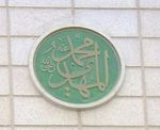
Muḥammad ibn al-Ḥasan al-Mahdī (born c. July 29, 869; 15
Sha‘bānSha'aban is the eighth month of the Islamic calendar.This is the month of ‘separation’, so called because the pagan Arabs used to disperse in search of water...
255 AHThe Hijri calendar , also known as the Muslim calendar or Islamic calendar , is a lunar calendar consisting of 12 lunar months in a year of 354 or 355 days. It is used to date events in many Muslim countries , and used by Muslims everywhere to determine the proper day on which to celebrate Islamic...
) is believed by Twelver Shī‘a Muslims to be
the MahdīIn Islamic eschatology, the Mahdi is the prophesied redeemer of Islam who will stay on Earth for seven, nine or nineteen years- before the Day of Judgment and, alongside Jesus, will rid the world of wrongdoing, injustice and tyranny.In Shia Islam, the belief in the Mahdi is a "central religious...
, an ultimate savior of humankind and the final Imām of the Twelve Imams. Twelver Shī‘a believe that al-Mahdī was born in 869 and did not die but rather was hidden by God (this is referred to as
the OccultationThe Occultation in Shia Islam refers to a belief that the messianic figure, or Mahdi, who in Shi'i thought is an infallible male descendant of the founder of Islam, Muhammad, was born but disappeared, and will one day return and fill the world with justice. Some Shi'is, such as the Zaidi and...
) and will later emerge with Isa (Jesus Christ) in order to fulfill their mission of bringing peace and justice to the world. He assumed the
ImamateThe word Imamate is an Arabic word with an English language suffix meaning leadership. Its use in theology is confined to Islam.-Theological usage:...
at 5 years of age. Some Shi‘īte schools do not consider ibn-al-Hasan to be
the MahdīIn Islamic eschatology, the Mahdi is the prophesied redeemer of Islam who will stay on Earth for seven, nine or nineteen years- before the Day of Judgment and, alongside Jesus, will rid the world of wrongdoing, injustice and tyranny.In Shia Islam, the belief in the Mahdi is a "central religious...
, although the mainstream sect Twelvers do.
Birth and early life according to Twelver Shi'a
In the biographies of Mahdi written by Shias themselves, it is hard to draw a line between hagiographical and historical works. In Shia sources even in historical works of Ibn Babuya the birth of Imam was miraculous which must be considered as hagiography. Aside from Shi'as works almost nothing is known about the life of this Imam. According to Yaan Richard some even cast doubt on his actual existence.
Twelver Shi'as believe that Mahdi was born in 869 AD as Abu'l Qasim Hujjat ibn Hasan ibn ‘Alī. His mother name has been recorded as Rayhana, Narjis, Ssyqal or Sawsan in Shia's books. There are a couple of narrations regarding the origin of his mother. One is that his mother,
NarjisNarjis was the mother of Muhammad al-Mahdi the twelfth and last Imam of Shi'a Islam and the grand-daughter of Bardas .There are two traditions regarding her ancestry, one saying that she is African while the other saying she is Greek ....
was a
ByzantineThe Byzantine Empire was the Eastern Roman Empire during the periods of Late Antiquity and the Middle Ages, centred on the capital of Constantinople. Known simply as the Roman Empire or Romania to its inhabitants and neighbours, the Empire was the direct continuation of the Ancient Roman State...
slave. Another narration says she was a black slave from
AfricaAfrica is the world's second largest and second most populous continent, after Asia. At about 30.2 million km² including adjacent islands, it covers 6% of the Earth's total surface area and 20.4% of the total land area...
. Mohammad Ali Amir-Moezzi states that names like Sawsan, Narjis or Rayhana were common names for slaves at that times and his mother name supports this narration. Other narration says that she was a Byzantine Princess who pretended to be a slave so that she might travel from her kingdom to Arabia. Mohammad Ali Amir-Moezzi, in Encyclopedia of Iranica, suggests that the last version is "undoubtedly legendary and hagiographic".
To support Imam Mahdi's claim, Twelver Shi'as along with some other Muslim sects quote the following
HadithThe term Hadīth is used to denote a saying or an act or tacit approval or criticism ascribed either validly or invalidly to the Islamic prophet Muhammad....
: "I and `Ali are the fathers of this nation; whoever knows us very well also knows Allah, and whoever denies us also denies Allah, the Unique, the Mighty. And from `Ali's descendants are my grandsons al-Hasan and al-Husayn, who are the masters of the youths of Paradise, and from al-Husayn's descendants shall be nine: whoever obeys them obeys me, and whoever disobeys them also disobeys me; the ninth among them is their Qa'im and Mahdi."
The eleventh Shi'a Imam
Hasan al-AskariHasan al-‘Askarī was the eleventh of the Twelve Imams. His given name was Hasan ibn ‘Alī ibn Muhammad...
died on 1 January 874 AD
(8th
Rabi' al-awwalRabi' al-awwal is the third month in the Islamic calendar. During this month, Muslims around the world celebrate Mawlid - the birthday of the Islamic prophet Muhammad. Sunni Muslims believe the exact date of birth of Muhammad to have been on the twelfth of this month, whereas Shi'a Muslims believe...
, 260
AHThe Hijri year is year numbering system used in the Islamic calendar. It commemorates the Hijra , or emigration of Muhammad and his followers to the city of Medina in 622 CE. In Arabic, AH is symbolized by the letter هـ...
) and since that day, his son Mahdi is believed by Shi'as to be the Imam, appointed by
AllahAllah is a word for God used in the context of Islam. In Arabic, the word means simply "God". It is used primarily by Muslims and Bahá'ís, and often, albeit not exclusively, used by Arabic-speaking Eastern Catholic Christians, Maltese Roman Catholics, Eastern Orthodox Christians, Mizrahi Jews and...
, to lead the believers of the era. The most popular account of al-Mahdi in Shi'a literature is taken from his father's funeral. It is reported that as the funeral prayer was about to begin, al-Mahdi's uncle, Jafar ibn Ali approached to lead the prayers. However, al-Mahdi approached and commanded,
"Move aside, uncle; only an Imam can lead the funeral prayer of an Imam." Jafar moved aside, and the five-year-old child led the funeral prayer for his father. It is reported that it was at this very moment that al-Mahdi disappeared and went into
ghaybat, or occultation.
Significance of the Twelfth Imam
Some hadith indicate significance to the twelfth generation of descendants of Muhammad.
A hadith from the Shi'a text (Kitab Al-Kafi) containing a conversation between the first Shia Imam Ali ibn Abu Talib and a man named al-Asbagh ibn Nubata, as well as a Hadith in
Sahih BukhariṢaḥīḥ al-Bukhārī , as it is commonly referred to, is one of the six canonical hadith collections of Islam. These prophetic traditions, or hadith, were collected by the Persian Muslim scholar Muhammad ibn Ismail al-Bukhari, after being transmitted orally for generations. Muslims view this as one of...
and
Sahih MuslimSahih Muslim is one of the Six major collections of the hadith in Sunni Islam, oral traditions relating to the words and deeds of the Islamic Prophet Muhammad. It is the second most authentic hadith collection after Sahih Al-Bukhari, and is highly acclaimed by Sunni Muslims...
in which
Muhammad speaks of Twelve SuccessorsThe Hadith of the Twelve Successors is a famous hadith in Islam, in which the Islamic prophet Muhammad speaks about twelve Muslim rulers succeeding him...
.
From
Sahih BukhariṢaḥīḥ al-Bukhārī , as it is commonly referred to, is one of the six canonical hadith collections of Islam. These prophetic traditions, or hadith, were collected by the Persian Muslim scholar Muhammad ibn Ismail al-Bukhari, after being transmitted orally for generations. Muslims view this as one of...
:
Narrated Jabir bin Samura: I heard Muhammad saying, "Islam will continue to be strong to twelve Muslim rulers." He then said a sentence which I did not hear. My father said, "All of them (those rulers) will be from Quraish."
In a
hadithThe term Hadīth is used to denote a saying or an act or tacit approval or criticism ascribed either validly or invalidly to the Islamic prophet Muhammad....
widely regarded as authentic,
MuhammadMuhammad |ligature]] at U+FDF4 ;Arabic pronunciation varies regionally; the first vowel ranges from ~~; the second and the last vowel: ~~~. There are dialects which have no stress. In Egypt, it is pronounced not in religious contexts...
said,
Even if the entire duration of the world's existence has already been exhausted and only one day is left before the Day of JudgmentThe Last Judgment, Final Judgment, Day of Judgment, Judgment Day, or The Day of the Lord in Christian theology, is the final and eternal judgment by God of every nation. The concept is found in all the Canonical gospels, particularly the Gospel of Matthew. It will purportedly take place after the...
, AllahAllah is a word for God used in the context of Islam. In Arabic, the word means simply "God". It is used primarily by Muslims and Bahá'ís, and often, albeit not exclusively, used by Arabic-speaking Eastern Catholic Christians, Maltese Roman Catholics, Eastern Orthodox Christians, Mizrahi Jews and...
will expand that day to such a length of time, as to accommodate the kingdom of a person out of Ahl al-BaytAhl al-Bayt is an Arabic phrase literally meaning People of the House, or family of the House. The phrase "ahl al-bayt" was used in Arabia before the advent of Islam to refer to one's clan, and would be adopted by the ruling family of a tribe. Within the Islamic tradition, the term refers to the...
who will be called by my name and my father's name. He will then fill the Earth with peace and justice as it will have been filled with injustice and tyranny before then.
The Occultation
Shi'as believe that, for various reasons, Allah concealed the twelfth and current Shi'a Imam, al-Mahdi, from mankind.
Period
The period of occultation (
ghaybat) is divided into two parts:
- Ghaybat al-Sughra or Minor Occultation (874–941), consists of the first few decades after the Imam's disappearance when communication with him was maintained through deputies of the Imam.
- Ghaybat al-Kubra or Major Occultation began 941 and is believed to continue until a time decided by God, when the Mahdi will reappear to bring absolute justice to the world.
Minor Occultation
During the Minor Occultation (
Ghaybat al-Sughra), it is believed that al-Mahdi maintained contact with his followers via deputies (
Arab.Arabic is a name applied to the descendants of the Classical Arabic language of the 6th century AD, used most prominently in the Quran, the Islamic Holy Book...
an-nuwāb al-arbaʻa literal: the four leaders). They represented him and acted as agents between him and his followers.
Whenever the believers faced a problem, they would write their concerns and send them to his deputy. The deputy would ascertain his verdict, endorse it with his seal and signature and return it to the relevant parties. The deputies also collected
zakatZakāt , one of the Five Pillars of Islam, is the giving of a fixed portion of one's wealth to charity, generally to the poor and needy.-History:Zakat, a practice initiated by Muhammed himself, has played an important role throughout Islamic history...
and
khumsKhums is the Arabic word for One Fifth . According to Shia Islamic legal terminology, it means "one-fifth of certain items which a person acquires as wealth, and which must be paid as an Islamic tax"....
on his behalf. For the Shia, the idea of consulting a hidden Imam was not something new because the two prior Shia Imams had, on occasion, met with their followers from behind a curtain. Also, during the oppressive rule of the later Abbasid caliphs, the Shia Imams were heavily persecuted and held prisoners, thus their followers were forced to consult their Imams via messengers or secretly.
Shia Tradition hold that four deputies acted in succession to one another:
- Uthman ibn Sa’id al-Asadi
In Twelver Shia Islam, Uthman ibn Sa'id al-Asadi was the first of The Four Deputies appointed by the twelfth and final Imam, Muhammad al-Mahdi, while he was in the Minor Occultation....
- Abu Jafar Muhammad ibn Uthman
In Twelver Shia Islam, Uthman ibn Sa'id al-Asadi was the second of The Four Deputies appointed by twelfth and final Imam, Muhammad al-Mahdi, while he was in the Minor Occultation....
- Abul Qasim Husayn ibn Ruh al-Nawbakhti
Abul Qasim Husayn ibn Ruh al-Nawbakhti In Twelver Shia Islam, was the third of The Four Deputies appointed by twelfth and final Imam, Muhammad al-Mahdi, while he was in the Minor Occultation....
- Abul Hasan Ali ibn Muhammad al-Samarri
In Twelver Shia Islam, Uthman ibn Sa'id al-Asadi was the fourth and last of The Four Deputies appointed by the twelfth and final Imam, Muhammad al-Mahdi, while he was in the Minor Occultation. Unlike his predecessors he had not appointed a successor, and the Major Occultation began....
In 941 (329 AH), the fourth deputy announced an order by al-Mahdi, that the deputy would soon die and that the deputyship would end and the period of the Major Occultation would begin.
The fourth deputy died six days later and the Shi'a Muslims continue to await the reappearance of the Mahdi. In the same year, many notable Shi'a scholars such as
Ali ibn Babwayh QummiAli ibn Babawayh Qummi was a Twelver Shi'a scholar from the time of the Ghaybat al-Sughra. He's the father of Shaikh Saduq.He wrote a letter to Imam Muhammad al-Mahdi, asking for prayer for him to have a child, as doctors had told him he could not have one. Thus was always called his son, Shaikh...
and Muhammad ibn Yaqub Kulayni, the learned compiler of al-Kafi also died.
Major Occultation
According to the last letter of al-Mahdi to Ali ibn Muhammad al-Samarri "from the day of your death [the last deputy] the period of my major occultation (al ghaybatul kubra) will begin. Hence forth, no one will see me, unless and until Allah makes me appear." Another view is that the Hidden Imam is on earth "among the body of the Shia" but "incognito." "Numerous stories" exist of the Hidden Imam "manifesting himself to prominent members of the ulama."
Reappearance
Twelver Shi'as cite various references from the
Qur'anThe Quran , also transliterated Qur'an, Koran, Alcoran, Qur’ān, Coran, Kuran, and al-Qur’ān, is the central religious text of Islam, which Muslims consider the verbatim word of God . It is regarded widely as the finest piece of literature in the Arabic language...
and reports, or
HadithThe term Hadīth is used to denote a saying or an act or tacit approval or criticism ascribed either validly or invalidly to the Islamic prophet Muhammad....
, from Imam
MahdiIn Islamic eschatology, the Mahdi is the prophesied redeemer of Islam who will stay on Earth for seven, nine or nineteen years- before the Day of Judgment and, alongside Jesus, will rid the world of wrongdoing, injustice and tyranny.In Shia Islam, the belief in the Mahdi is a "central religious...
and the twelve Shi'a Imams with regard to the reappearance of al-Mahdi who would, in accordance with Allah's command, bring justice and peace to the world by establishing Islam throughout the world.
Mahdi is reported to have said:
Shi'as believe that Imam al-Mahdi will reappear when the world has fallen into chaos and civil war emerges between the human race for no reason. At this time, it is believed, half of the true believers will ride from YemenThe Republic of Yemen , commonly known as Yemen , is a country located in the Middle East, occupying the southwestern to southern end of the Arabian Peninsula. It is bordered by Saudi Arabia to the north, the Red Sea to the west, and Oman to the east....
carrying white flags to Makkah, while the other half will ride from KarbalaKarbala is a city in Iraq, located about southwest of Baghdad. Karbala is the capital of Karbala Governorate, and has an estimated population of 572,300 people ....
, in IraqIraq ; officially the Republic of Iraq is a country in Western Asia spanning most of the northwestern end of the Zagros mountain range, the eastern part of the Syrian Desert and the northern part of the Arabian Desert....
, carrying black flags to Makkah. At this time, Imam al-Mahdi will come wielding Allah's Sword, the Blade of Evil's Bane, ZulfiqarZulfiqar "bifurcated" is the sword of the Islamic leader Ali. In Arabic the name is commonly transliterated as Dhu al-Fiqar, Thulfeqar, Dhulfiqar, Zoulfikar etc. The name Zulfiqar means which divides exactly in two parts....
(Arabic: ذو الفقار, ðū l-fiqār), the Double-Bladed Sword. He will also come and reveal the texts in his possession, such as al-JafrAl-Jafr is a mystical Shia holy book compiled, according to Shia belief, by Ali and inherited by him from Muhammad. Al-Jafr is composed of two skin boxes in which were kept various books of the past Prophets and the books inherited from Muhammad, Ali and Fatimah to the Ahl al-Bayt, with each new...
and al-JamiaAl-Jamia is a sacred and secret Shia text, the words of which were dictated by Muhammad to Ali, who then wrote down these words...
.
Shi'as believe that
JesusJesus of Nazareth , commonly referred to as Jesus Christ or simply as Jesus or Christ, is the central figure of Christianity...
will also come (after Imam Mahdi's re-appearance) and follow the Imam
MahdiIn Islamic eschatology, the Mahdi is the prophesied redeemer of Islam who will stay on Earth for seven, nine or nineteen years- before the Day of Judgment and, alongside Jesus, will rid the world of wrongdoing, injustice and tyranny.In Shia Islam, the belief in the Mahdi is a "central religious...
to destroy tyranny and falsehood and to bring justice and peace to the world.
Titles
The 12th Imam is known by many titles in Shia Islam, including:
- Al-Mahdi (the Guided one)
- Al-Muntathar (the Awaited one)
- Al-Qa'im (the Rising one)
- Sahab az-Zaman (the Master of the Age)
- Imam az-Zaman (the Leader of the Age)
- Wali al-'Asr (the Guardian of the Era or alternatively, the Guardian in the Twilight [of man])
- Al-Hujjah (the Proof [of Allah's justice])
Ahmadiyya view
In
Ahmadiyya IslamAhmadiyya is an Islamic religious revivalist movement founded in India near the end of the 19th century, originating with the life and teachings of Mirza Ghulam Ahmad , who claimed to have fulfilled the prophecies about the world reformer of the end times, who was to herald the Eschaton as...
, the terms "
MessiahA messiah is a redeemer figure expected or foretold in one form or another by a religion. Slightly more widely, a messiah is any redeemer figure. Messianic beliefs or theories generally relate to eschatological improvement of the state of humanity or the world, in other words the World to...
" and "Mahdi" are synonymous terms for one and the same person. Like the term Messiah which, among other meanings, in essence means being
anointed by God or
appointed by God the term "Mahdi" means
guided by God, thus both imply a direct ordainment and a spiritual nurturing by God of a divinely chosen individual. According to Ahmadiyya thought, Messiahship is a phenomenon, through which a special emphasis is given on the transformation of a people by way of offering suffering for the sake of God instead of giving suffering (i.e. refraining from revenge). Ahmadis believe that this special emphasis was given through the person of
JesusJesus of Nazareth , commonly referred to as Jesus Christ or simply as Jesus or Christ, is the central figure of Christianity...
and
Mirza Ghulam AhmadMīrzā Ghulām Aḥmad was a religious figure from India and the founder of the Ahmadiyya Community. He claimed to be the Mujaddid of the 14th Islamic century, the promised Messiah , and the Mahdi awaited by the Muslims in the end days...
among others.
Ahmadis hold that the prophesied eschatological figures of various religions, the coming of the Messiah and Mahdi in fact were to be fulfilled in one person who was to represent all previous prophets. The prophecies concerning the Mahdi or the second coming of Jesus are seen by Ahmadis as metaphorical, in that one was to be born and rise within the dispensation of
MuhammadMuhammad |ligature]] at U+FDF4 ;Arabic pronunciation varies regionally; the first vowel ranges from ~~; the second and the last vowel: ~~~. There are dialects which have no stress. In Egypt, it is pronounced not in religious contexts...
, who by virtue of his similarity and affinity with Jesus of Nazareth, and the similarity in nature, temperament and disposition of the people of Jesus' time and the people of the time of the promised one (the Mahdi) is called by the same name.
Numerous Hadith are presented by the Ahmadis in support of their view such as one from Sunan Ibn Majah which says:
Ahmadis believe that the prophecies concerning the Mahdi and the second coming of Jesus have been fulfilled in the person of
Mirza Ghulam AhmadMīrzā Ghulām Aḥmad was a religious figure from India and the founder of the Ahmadiyya Community. He claimed to be the Mujaddid of the 14th Islamic century, the promised Messiah , and the Mahdi awaited by the Muslims in the end days...
of
QadianQadian is a small town and a municipal council in Gurdaspur District, north-east of Amritsar, situated north-east of Batala city in the state of Punjab, India....
(1835–1908) the founder of the Ahmadiyya Movement. Contrary to mainstream Islam the Ahmadis do not believe that Jesus is alive in heaven, but that he survived the crucifixion and migrated towards the east where he died a natural death and that Ghulam Ahmad was only the promised spiritual second coming and likeness of Jesus, the promised Messiah and Mahdi.
Sunni view
The majority of Sunni Muslims do not consider the son of Hasan al-Askari to be the
MahdiIn Islamic eschatology, the Mahdi is the prophesied redeemer of Islam who will stay on Earth for seven, nine or nineteen years- before the Day of Judgment and, alongside Jesus, will rid the world of wrongdoing, injustice and tyranny.In Shia Islam, the belief in the Mahdi is a "central religious...
nor to be in occultation. However, they do believe that the Mahdi will come from Muhammad's family, more specifically from Al-Hasan's descendants. Sunnis believe that the Mahdi has not yet been born, and therefore his exact identity is only known to Allah. Aside from the Mahdi's precise, genealogy, Sunnis accept many of the same hadiths Shias accept about the predictions regarding the Mahdi's emergence, his acts, and his universal Khilafat. Sunnis also have a few more Mahdi hadiths which are
not present in Shia collections, such as the following:
Abu Sa'id al-Khudri narrated that Muhammad said:
Shia books do not explicitly mention the Mahdi having a pointed (prominent) nose.
However, the Shi'a traditions do state (about Imam Medhi's nose): "His Nose; Abu Sa‘īd al-Khidri narrates from the Messenger of Allah (a.s) that he said, 'The Mahdi is from us the Ahl al-Bait, a man from my Ummah. He has a high nose. He will fill the earth with equity as it will be full of corruption.'"
Other Sunni hadith regarding the Mahdi are virtually identical to their counterparts in Shia books:
Umm Salamah said:
Abu Sa’eed al-Khudri said:
In the light of traditions and interpretations, the personality of the Promised Mahdi would be as such:
It is said "predictions and lore concerning the Mahdi abound"[9] Among them are that the promised Mahdi would be a Caliph of God and that to make a covenant with him is obligatory. He would belong to the House of Muhammad and would be in the line of Imam Hasan. His name would be Muhammad and his family name would be Abul Qasim, his father's name would be ‘Abdu’llah [rather than Hasan], and he would appear in Mecca. He would protect the Muslims from destruction and would restore the religion to its original position.
Sunnis also believe that Jesus will return alongside the Mahdi, with the only difference being that they disagree with the Shia regarding exactly who the Mahdi is.
Scholarly observations
Some scholars, including
Bernard LewisBernard Lewis, FBA is a British-American historian, scholar in Oriental studies, and political commentator. He is the Cleveland E. Dodge Professor Emeritus of Near Eastern Studies at Princeton University...
also point out, that the idea of an Imam in occultation was not new in 873 but that it was a recurring factor in Shia history. Examples of this include the cases of
Muhammad ibn al-HanafiyyahMuhammad ibn al-Hanafiyyah surnamed Abu'l-Qasim was an early Muslim leader. He was a son of Ali ibn Abi Talib, the first Shi'ite Imam and the fourth Sunni Caliph.-Biography:...
(according to the
Kaysanites ShiaThe Kaysanites were a once dominant Shi'a Ghulat sect that formed from the followers of Al-Mukhtar. They believed in the Imamate of Muhammad ibn al-Hanafiyyah. Following the death of Muhammad ibn al-Hanafiyyah the sect split up into numerous sub-sects, each with their own Imam and unique beliefs...
),
Muhammad ibn Abdallah An-Nafs Az-ZakiyyaMuhammad ibn Abdillah Al-Mahd ibn al-Hasan al-Muthanna ibn al-Hasan ibn 'Ali ibn Abi Talib or Muhammad al-Nafs al-Zakiyya was a descendant of Muhammad through his daughter Fatimah...
,
Musa al-Kadhim' was the seventh of the Twelve Imams of Twelver Shi'a Islam. He was the son of Imam and his mother was Hamidah Khātūn, a student and former Zanjiyyah slave...
(according to the
Waqifite ShiaThe Waqifite Shia were a Shia sect who accepted the Imamate of Musa al-Kadhim, but refused to accept the Imamate of his successor Ali ar-Ridha.-Beliefs:The Waqifites believed in the Mahdism and the occultation of Imam Mūsà ibn Ja‘far al-Kāẓim...
),
Muhammad ibn Qasim (al-Alawi)Muhammad ibn Qasim was an Alawite Imam. He led an Alawite rebellion that took place in Taloqan at the beginning of the 3rd century of Hijrah , in the year 219 A.H and during the days of the Caliphate of Al-Mu'tasim. However, Al-Mu'tasim defeated and arrested him and carried him to Baghdad,...
,
Yahya ibn UmarYahya ibn Umar ibn Yahya ibn Husayn ibn Zayd ibn Ali Zayn al-Abidin ibn Al-Husayn ibn Ali al-Murtada was an Alid Imam. His mother was Umm al-Husayn Fatimah bint al-Husayn ibn Abdallah ibn Ismail ibn Abdullah ibn Ja`far ibn Abī Tālib. In the days of the Abbasid Caliph Al-Musta'in, he marched out...
and
Muhammad ibn Ali al-HadiMuhammad ibn Ali al-Hadi was the son of Ali al-Hadi and the brother of Hasan al-Askari, the 10th and 11th Twelver Shia Imams respectively.A section of the Imamate Shiites believed that the Awaited Imam Mahdi was Muhammad ibn Ali al-Hadi, who died suddenly in Dajil. They believed in his occultation,...
(according to the
Muhammadite ShiaThe Muhammadite Shia were a Shia sect who believed that due to the supposed lack of a son for Hasan al-Askari, they had to rethink the legitimacy of his Imamate. Therefore, they instead believed in the Imamate of his brother Muhammad ibn Ali al-Hadi, who died 7 years before the death of his father...
).
On causes of development occultation doctrine among Shi'as, Yaan Richard suggests, "the last Imams were confronted a difficult situation: theoretical claimants to power, politically important, backed by discontented supporters of Omayyad and Abbasid caliphs, taking refuge in an esoteric justification of their quietism, the Immam were embarrassment to everyone. When they were physically present, they gave the lie to certain of the allegations made about them by Shiites. When they were absent, their eschatological "efficacy" could no longer be questioned and the desire for a return of their reign of justice became almost at reality. The occultation is therefore a convenient solution".
Consequence of occultation of Twelfth Imam
The occulation of 12th Imam left a considerable gap in leadership of Shia's. According to Shia' beliefs the Imam was both the spiritual and political head of the community. Although during the lesser occultation the network of Imam deputies (wokala) claimed to have right to handle Shia communities issues, this system was not continued during the Greater Occultation. After the greater occultation, the role of Imam as the head of community left vacant, which did not theoretically matter at the beginning of Occultation because Shia`s had no political power at that time. However, when Shia' states arose in later centuries, since the hidden Imam was alive and was the leader of Muslims, the role of Shia' state among Shia' communities were in question.
This problem has caused continuing tension between government and religion throughout the Shia's history.
See also
- Holiest sites in Islam (Shia)
In addition to the three Mosques accepted by all Muslims as holy sites, Shī'ah Muslims consider sites associated with Muhammad, his family members and descendants , their companions, and the Prophets as holy places...
- Mahdi
In Islamic eschatology, the Mahdi is the prophesied redeemer of Islam who will stay on Earth for seven, nine or nineteen years- before the Day of Judgment and, alongside Jesus, will rid the world of wrongdoing, injustice and tyranny.In Shia Islam, the belief in the Mahdi is a "central religious...
- Ismaili
' is a branch of Shia Islam. It is the second largest branch of Shia Islam, after the Twelvers...
- Fatimid Empire
- Narjis
Narjis was the mother of Muhammad al-Mahdi the twelfth and last Imam of Shi'a Islam and the grand-daughter of Bardas .There are two traditions regarding her ancestry, one saying that she is African while the other saying she is Greek ....
- People claiming to be the Mahdi
In Shia and Sunni eschatology, the Mahdi is a Messianic figure who, it is believed, will appear on Earth before the Day of Judgment and, alongside Jesus, will rid the world of wrongdoing, injustice and tyranny...
External links
zaya