
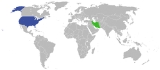
Political relations between
IranIran , officially the Islamic Republic of Iran , is a country in Southern and Western Asia. The name "Iran" has been in use natively since the Sassanian era and came into use internationally in 1935, before which the country was known to the Western world as Persia...
and the United StatesThe United States of America is a federal constitutional republic comprising fifty states and a federal district...
began in the mid-to-late 19th century. Initially, while Iran was very wary of British and Russian colonial interests during the Great Game, the United States was seen as a more trustworthy Western power, and the Americans Arthur Millspaugh and Morgan Shuster were even appointed treasurers-general by the Shahs of the time. During World War II, Iran was invaded by the United Kingdom and the Soviet Union, both US allies, but relations continued to be positive after the war until the later years of the government of Mohammad Mossadeq, who was overthrown by a coup organized by the CIA. This was followed by an era of close alliance between
ShahShāh is the title of the ruler of certain Southwest Asian and Central Asian countries, especially Persia , and derives from the Persian word shah, meaning "king".-History:...
Mohammad Reza PahlaviMohammad Rezā Shāh Pahlavi, Shah of Iran, Shah of Persia , ruled Iran from 16 September 1941 until his overthrow by the Iranian Revolution on 11 February 1979...
's regime and the American government, which was in turn followed by a dramatic reversal and hostility between the two countries after the 1979
Iranian RevolutionThe Iranian Revolution refers to events involving the overthrow of Iran's monarchy under Shah Mohammad Reza Pahlavi and its replacement with an Islamic republic under Ayatollah Ruhollah Khomeini, the leader of the...
.
Opinions differ over what has caused the decades of poor relations. Iranian explanations include everything from the natural and unavoidable conflict between the Islamic Revolution on the one hand, and American arrogance and desire for global
hegemonyHegemony is an indirect form of imperial dominance in which the hegemon rules sub-ordinate states by the implied means of power rather than direct military force. In Ancient Greece , hegemony denoted the politico–military dominance of a city-state over other city-states...
on the other. Other explanations include the Iranian government's need for an external
bogeymanA bogeyman is an amorphous imaginary being used by adults to frighten children into compliant behaviour...
to furnish a pretext for domestic repression against pro-democratic forces and to bind the government to its loyal constituency.
American fears that Iran is developing nuclear weapons have been a major militating factor in relations since shortly after the revolution.
Since 1995, the United States has had an embargo on trade with Iran.
Early relations
Political relations between
PersiaIran , officially the Islamic Republic of Iran , is a country in Southern and Western Asia. The name "Iran" has been in use natively since the Sassanian era and came into use internationally in 1935, before which the country was known to the Western world as Persia...
and the United States "began when the Shah of Persia, Nassereddin Shah Qajar, officially dispatched Persia's first ambassador, Mirza Abolhasan Shirazi, to Washington D.C. in 1856." In 1883,
Samuel BenjaminSamuel Greene Wheeler Benjamin was an American statesman.His parents were American missionaries in Greece. Born in Argos, Greece, but then educated in the United States, he pursued careers as a journalist, author, and diplomat...
was appointed by the United States as the first official diplomatic envoy to Iran, however; Ambassadorial relations were not established until 1944.
The first Persian Ambassador to the United States of America was Mirza Albohassan Khan Ilchi Kabir. Americans had been traveling to Iran since the early-to-mid 1880s, even before political relations existed between the two.
Justin PerkinsJustin Perkins was an American Presbyterian missionary and linguist...
and Asahel Grant were the first missionaries to be dispatched to Persia in 1834 via the
American Board of Commissioners for Foreign MissionsThe American Board of Commissioners for Foreign Missions was the first American Christian foreign mission agency. It was proposed in 1810 by recent graduates of Williams College and officially chartered in 1812. In 1961 it merged with other societies to form the United Church Board for World...
.
Amir KabirAmir Kabir , also known as Mirza Taghi Khan Amir-Nezam , also known by the titles of Atabak and Amir-e Nezam; chief minister to Naser al-Din Shah Qajar for the first three years of his reign and one of the most capable and innovative figures to appear in the whole Qajar period...
, Prime Minister under Nasereddin Shah, also initiated direct contacts with the American government in Washington. By the end of the 19th century, negotiations were underway for an American company to establish a railway system from the
Persian GulfThe Persian Gulf, in Southwest Asia, is an extension of the Indian Ocean located between Iran and the Arabian Peninsula.The Persian Gulf was the focus of the 1980–1988 Iran-Iraq War, in which each side attacked the other's oil tankers...
to
TehranTehran , sometimes spelled Teheran, is the capital of Iran and Tehran Province. With an estimated population of 8,429,807; it is also Iran's largest urban area and city, one of the largest cities in Western Asia, and is the world's 19th largest city.In the 20th century, Tehran was subject to...
.
Until World War II, relations between Iran and the United States remained cordial. As a result, many Iranians sympathetic to the Persian Constitutional Revolution came to view the U.S. as a "third force" in their struggle to break free of British and Russian dominance in Persian affairs. American industrial and business leaders were supportive of Persia's drive to modernize its economy and free itself from British and Russian influence.
In 1909, during the Persian Constitutional Revolution,
Howard BaskervilleHoward Conklin Baskerville was an American teacher in the Presbyterian mission school in Tabriz, Iran, who died fighting for Iranian democracy. He has been called the "American Lafayette in Iran." ...
, an American, died in
TabrizTabriz is the fourth largest city and one of the historical capitals of Iran and the capital of East Azerbaijan Province. Situated at an altitude of 1,350 meters at the junction of the Quri River and Aji River, it was the second largest city in Iran until the late 1960s, one of its former...
while trying to help the constitutionalists in a battle against royalist forces. After the Iranian parliament appointed American financial consultant
Morgan ShusterWilliam Morgan Shuster , American lawyer, civil servant, and publisher, who is best known as the treasurer-general of Persia by appointment of the Iranian parliament, or Majles, from May to December 1911.-Background:Shuster was born in Washington, DC and educated in the Columbian University and Law...
as appointed Treasurer General of Persia in 1911, an American was killed in
TehranTehran , sometimes spelled Teheran, is the capital of Iran and Tehran Province. With an estimated population of 8,429,807; it is also Iran's largest urban area and city, one of the largest cities in Western Asia, and is the world's 19th largest city.In the 20th century, Tehran was subject to...
by henchmen thought to be affiliated with Russian or British interests. Shuster became even more active in supporting the Constitutional revolution of Persia financially. When Iran's government ordered
Shu'a al-Saltaneh (شعاع السلطنه), the Shah's brother who was aligned with the goals of Imperial Russia in Persia, to surrender his assets, Shuster moved to execute the seizure. Imperial Russia immediately landed troops in Bandar Anzali, demanding a recourse and apology from the Persian government. Russia's General Liakhoff shelled
Iran's parliamentThe National Consultative Assembly of Iran , also called The Iranian Parliament or People's House, is the national legislative body of Iran...
in Tehran, and Morgan Shuster was forced to resign under British and Russian pressure. Shuster's book
The Strangling of Persia is a recount of the details of these events and is critical of Britain and Imperial Russia.
The American Embassy first reported to the Iran desk at the Foreign Office in London about the popular view of Britain's involvement in the 1921 coup that brought
Reza ShahRezā Shāh, also known as Rezā Shāh Pahlavi and Rezā Shāh Kabir , , was the Shah of the Imperial State of Iran from December 15, 1925, until he was forced to abdicate by the Anglo-Soviet invasion of Iran on September 16, 1941.In 1925, Reza Shah overthrew Ahmad Shah Qajar, the last Shah of the Qajar...
to power. A British Embassy report from 1932 admits that the British put Reza Shah "on the throne". At that time, Persia did not view the United States as an ally of Britain.
Morgan Shuster was soon followed by
Arthur MillspaughArthur Chester Millspaugh, PhD, was a former adviser at the U.S. State Department’s Office of the Foreign Trade, who was hired to re-organize the Finance Ministry of Iran from 1922–1927 and 1942-1945....
, who was appointed Treasurer General by Reza Shah, and
Arthur PopeArthur Upham Pope , was an American archaeologist and historian of Persian art.Born in Phenix, Rhode Island, graduated from Worcester Academy in 1899, and taught at Amherst College and the University of California. He married fellow Persian art historian, Phyllis Ackerman, in 1920. In 1923, Pope...
, who was a main driving force behind the Persian Empire revivalist policies of Reza Shah. The friendly relations between the United States and Iran lasted until the 1950s.
Current relations
Iran maintains an interests section at the Pakistani embassy in Washington, D.C., while the United States since 1980 maintains an interests section at the Swiss embassy in Tehran.
Mohammad Reza Pahlavi reign
Shah
Mohammad Reza PahlaviMohammad Rezā Shāh Pahlavi, Shah of Iran, Shah of Persia , ruled Iran from 16 September 1941 until his overthrow by the Iranian Revolution on 11 February 1979...
maintained close ties with the United States during most of his reign, which lasted from 1941 until he was overthrown by the Islamic Revolution in 1979. He pursued a Westernizing, modernizing economic policy, and a strongly pro-Western foreign policy; he also made a number of visits to America, where he was regarded as a friend.
Iran's long border with America's Cold War rival, the
Soviet UnionThe Soviet Union , officially the Union of Soviet Socialist Republics , was a constitutionally socialist state that existed in Eurasia between 1922 and 1991....
, and its position as the largest, most powerful country in the oil-rich Persian Gulf, made Iran a "pillar" of US foreign policy in the Middle East. Prior to the Iranian Revolution of 1979, many Iranian students resided in the United States.
Premier Mossadeq and his overthrow
In 1953, Prime Minister Mohammed Mossadeq was overthrown by a
Central Intelligence AgencyThe Central Intelligence Agency is a civilian intelligence agency of the United States government. It is an executive agency and reports directly to the Director of National Intelligence, responsible for providing national security intelligence assessment to senior United States policymakers...
(CIA)-organized coup, in what has been called "a crucial turning point both in Iran's modern history and in U.S. Iran relations." Many Iranians argue that "the 1953 coup and the extensive U.S. support for the shah in subsequent years were largely responsible for the shah's arbitrary rule," which led to the "deeply anti-American character" of the 1979 revolution.
Until the outbreak of World War II, the United States had no active policy toward Iran. When the Cold War began, the United States was alarmed by the attempt by the Soviet Union to set up separatist states in Iranian Azerbaijan and Kurdistan, as well as its demand for military rights to the Dardanelles in 1946. This fear was enhanced by the "loss of China" to communism, the uncovering of Soviet spy rings, and the start of the
Korean WarThe Korean War was a conventional war between South Korea, supported by the United Nations, and North Korea, supported by the People's Republic of China , with military material aid from the Soviet Union...
.
In 1952 and 1953, the
Abadan CrisisThe Abadan Crisis occurred from 1951 to 1954, after Iran nationalised the Iranian assets of the Anglo-Iranian Oil Company and expelled Western companies from oil refineries in the city of Abadan .-Prelude:...
took place when Iranian Prime Minister Mohammed Mossadeq began nationalization of the Anglo-Iranian Oil Company (AIOC). Established by the British in the early 20th century, the company shared profits (85% for Britain, and 15% for Iran), but the company withheld their financial records from the Iranian government. By 1951, Iranians supported nationalization of the AIOC, and Parliament unanimously agreed to nationalize its holding of, what was at the time, the British Empire’s largest company. The British retaliated with an embargo on Iranian oil, which was supported by international oil companies. Over the following months, negotiations over control and compensation for the oil were deadlocked, and Iran's economy deteriorated.
American President
TrumanHarry S. Truman was the 33rd President of the United States . As President Franklin D. Roosevelt's third vice president and the 34th Vice President of the United States , he succeeded to the presidency on April 12, 1945, when President Roosevelt died less than three months after beginning his...
pressed Britain to moderate its position in the negotiations and to not invade Iran. American policies created a feeling in Iran that the United States was on Mosaddeq's side and optimism that the oil dispute would soon be settled with "a series of innovative proposals to settle" the dispute, giving Iran "significant amounts of economic aid". Mosaddeq visited Washington, and the American government made "frequent statements expressing support for him."
At the same time, the United States honored the British embargo and, without Truman's knowledge, the CIA station in Tehran had been "carrying out covert activities" against Mosaddeq and the National Front "at least since the summer of 1952".
1953 Iranian coup d'état
As the cold war intensified, oil negotiations stalled, and the Republican President
Dwight D. EisenhowerDwight David "Ike" Eisenhower was the 34th President of the United States, from 1953 until 1961. He was a five-star general in the United States Army...
replaced Democratic President
Harry S. TrumanHarry S. Truman was the 33rd President of the United States . As President Franklin D. Roosevelt's third vice president and the 34th Vice President of the United States , he succeeded to the presidency on April 12, 1945, when President Roosevelt died less than three months after beginning his...
, the United States helped destabilize Mosaddeq on the theory that "rising internal tensions and continued deterioration ... might lead to a breakdown of government authority and open the way for at least a gradual assumption of control" Iran's well organized
TudehThe Tudeh Party of Iran is an Iranian communist party. Formed in 1941, with Soleiman Mohsen Eskandari as its head, it had considerable influence in its early years and played an important role during Mohammad Mosaddeq's campaign to nationalize the Anglo-Iranian Oil Company and his term as prime...
communist party. In spring and summer 1953, the United States and Britain, through a covert operation of the CIA called
Operation AjaxThe 1953 Iranian coup d'état was the overthrow of the democratically elected government of Iranian Prime Minister Mohammad Mosaddegh on 19 August 1953, orchestrated by the intelligence agencies of the United Kingdom and the United States under the name TPAJAX Project...
, conducted from the American Embassy in Tehran, helped organize a
coup d'étatA coup d'état state, literally: strike/blow of state)—also known as a coup, putsch, and overthrow—is the sudden, extrajudicial deposition of a government, usually by a small group of the existing state establishment—typically the military—to replace the deposed government with another body; either...
to overthrow the Mossadeq government. The operation initially failed, and the Shah fled to Italy, but a second attempt succeeded, and Mosaddeq was imprisoned.
According to a study of the coup headed by Mark J. Gasiorowski and Malcolm Byrne, intended "to resolve" the "controversy" over who and what were responsible, "it was geostrategic considerations, rather than a desire to destroy Mosaddeq's movement, to establish a dictatorship in Iran or to gain control over Iran's oil, that persuaded U.S. officials to undertake the coup."
Post-coup
Following the coup, the United States helped build up the Shah's regime. In the first three weeks, the American government gave Iran $68 million in emergency aid, and an additional $1.2 billion over the next decade.
During his reign, the Shah received significant American support, frequently making state visits to the
White HouseThe White House is the official residence and principal workplace of the president of the United States. Located at 1600 Pennsylvania Avenue NW in Washington, D.C., the house was designed by Irish-born James Hoban, and built between 1792 and 1800 of white-painted Aquia sandstone in the Neoclassical...
and earning praise from numerous American presidents. The Shah's close ties to Washington and his
WesternThe Western world, also known as the West and the Occident , is a term referring to the countries of Western Europe , the countries of the Americas, as well all countries of Northern and Central Europe, Australia and New Zealand...
ization policies soon angered some Iranians, especially the hardline Islamic conservatives.
In America, the coup was originally considered a triumph of covert action but is now considered by many to have left "a haunting and terrible legacy." In 2000, U.S. Secretary of State
Madeleine AlbrightMadeleine Korbelová Albright is the first woman to become a United States Secretary of State. She was appointed by U.S. President Bill Clinton on December 5, 1996, and was unanimously confirmed by a U.S. Senate vote of 99–0...
, called it a "setback for democratic government" in Iran. Supreme Leader
Ali KhameneiAyatollah Seyed Ali Hoseyni Khāmene’i is the Supreme Leader of Iran and the figurative head of the Muslim conservative establishment in Iran and Twelver Shi'a marja...
condemned the admission as "deceitful", complaining that it "did not even include an apology".
Cultural relations
Relations in the cultural sphere remained cordial. Pahlavi University,
Sharif University of TechnologySharif University of Technology is a university of higher education in technology, engineering and physical sciences in Tehran. Sharif University of Technology is one of the most prestigious universities in the country, and is considered Iran's MIT...
, and
Isfahan University of TechnologyIsfahan University of Technology is one of the most prestigious engineering universities in Iran. It is located 15 Kilometers north west of Isfahan and is one of the major universities and research poles in Iran in the fields of science, engineering and agriculture...
, three of Iran's top academic universities were all directly modeled on American institutions, such as the
University of ChicagoThe University of Chicago is a private research university in Chicago, Illinois, USA. It was founded by the American Baptist Education Society with a donation from oil magnate and philanthropist John D. Rockefeller and incorporated in 1890...
, MIT, and the
University of PennsylvaniaThe University of Pennsylvania is a private, Ivy League university located in Philadelphia, Pennsylvania, United States. Penn is the fourth-oldest institution of higher education in the United States,Penn is the fourth-oldest using the founding dates claimed by each institution...
. The Shah was generous in awarding American universities with financial gifts. For example, the
University of Southern CaliforniaThe University of Southern California is a private, not-for-profit, nonsectarian, research university located in Los Angeles, California, United States. USC was founded in 1880, making it California's oldest private research university...
received an endowed chair of petroleum engineering, and a million dollar donation was given to the
George Washington UniversityThe George Washington University is a private, coeducational comprehensive university located in Washington, D.C. in the United States...
to create an Iranian Studies program.
Growth of oil revenues
In the 1960s and 1970s, Iran's oil revenues grew considerably. Starting in the mid-1960s, this "weakened U.S. influence in Iranian politics" while strengthening the power of the Iranian state vis-a-vis the Iranian public. According to scholar Homa Katouzian, this put the United States "in the contradictory position of being regarded" by the Iranian public because of the 1953 coup "as the chief architect and instructor of the regime," while "its real influence" in domestic Iranian politics and policies "declined considerably".
1977-1979: Carter administration
In the late 1970s, American President
Jimmy CarterJames Earl "Jimmy" Carter, Jr. is an American politician who served as the 39th President of the United States and was the recipient of the 2002 Nobel Peace Prize, the only U.S. President to have received the Prize after leaving office...
emphasized human rights in his foreign policy, including the Shah's regime, which by 1977 had garnered unfavorable publicity in the West for its human rights record. That year, the Shah responded to Carter's "polite reminder" by granting amnesty to some prisoners and allowing the
Red CrossThe International Red Cross and Red Crescent Movement is an international humanitarian movement with approximately 97 million volunteers, members and staff worldwide which was founded to protect human life and health, to ensure respect for all human beings, and to prevent and alleviate human...
to visit prisons. Through 1977, liberal opposition formed organizations and issued open letters denouncing the Shah's regime.
At the same time, Carter angered anti-Shah Iranians with a New Years Eve 1978 toast to the Shah in which he said:
'Under the Shah’s brilliant leadership Iran is an island of stability in one of the most troublesome regions of the world. There is no other state figure whom I could appreciate and like more.'
Observers disagree over the nature of United States policy toward Iran under Carter as the Shah's regime crumbled. According to historian
Nikki KeddieNikki R. Keddie is an professor of Eastern, Iranian, and women's history. She retired from the University of California, Los Angeles after 35 years of teaching...
, the Carter administration followed "no clear policy" on Iran. The American ambassador to Iran,
William H. SullivanWilliam Healy Sullivan was an American Foreign Service career officer who served as Ambassador to Laos from 1964-1969, the Philippines from 1973-1977, and Iran from 1977-1979....
, recalled that the U.S. National Security Advisor
Zbigniew BrzezinskiZbigniew Kazimierz Brzezinski is a Polish American political scientist, geostrategist, and statesman who served as United States National Security Advisor to President Jimmy Carter from 1977 to 1981....
“repeatedly assured Pahlavi that the U.S. backed him fully". On November 4, 1978, Brzezinski called the Shah to tell him that the United States would "back him to the hilt." At the same time, high-level officials in the State Department believed the revolution was unstoppable. After visiting the Shah in summer of 1978, Secretary of the Treasury
W. Michael BlumenthalWerner Michael Blumenthal served as United States Secretary of the Treasury under President Jimmy Carter from 1977-1979.-Life and career:...
complained of the Shah's emotional collapse, reporting, "You've got a zombie out there." Brzezinski and Energy Secretary James Schlesinger were adamant in their assurances that the Shah would receive military support.
Another scholar, sociologist
Charles KurzmanCharles Kurzman is a Professor of Sociology at University of North Carolina at Chapel Hill who specializes in Middle East and Islamic studies. Among his publications are:* * * * * -External links:*...
, argues that, rather than being indecisive or sympathetic to the revolution, the Carter administration was consistently supportive of the Shah and urged the Iranian military to stage a "last-resort coup d'etat" even after the regime's cause was hopeless. In addition, some Iranian supporters of the Shah believe Carter betrayed the Shah.
The 1979 revolution
The 1979
Iranian RevolutionThe Iranian Revolution refers to events involving the overthrow of Iran's monarchy under Shah Mohammad Reza Pahlavi and its replacement with an Islamic republic under Ayatollah Ruhollah Khomeini, the leader of the...
, which ousted the pro-American Shah and replaced him with the anti-American Supreme Leader Ayatollah Khomeini, surprised the United States government, its State Department and intelligence services, which "consistently underestimated the magnitude and long-term implications of this unrest". Six months before the revolution culminated, the CIA had produced a report, stating that “Persia is not in a revolutionary or even a "prerevolutionary" situation”
The Islamic revolutionaries wished to extradite and execute the ousted Shah, and Carter refused to give him any further support or help return him to power. The Shah, suffering from
cancerCancer , known medically as a malignant neoplasm, is a large group of different diseases, all involving unregulated cell growth. In cancer, cells divide and grow uncontrollably, forming malignant tumors, and invade nearby parts of the body. The cancer may also spread to more distant parts of the...
, requested entry into the United States for treatment. The American embassy in Tehran opposed the request, as they were intent on stabilizing relations between the new interim revolutionary government of Iran and the United States.
Despite agreeing with the staff of the American embassy, Carter agreed after pressure from Kissinger, Rockefeller, and other pro-Shah political figures. The move was used by the Iranian revolutionaries to justify their claims that the former monarch was an American puppet, and this led to the storming of the American embassy by radical students allied with the Khomeini faction.
The 1979 Iran hostage crisis
On November 4, 1979, the revolutionary group
Muslim Student Followers of the Imam's LineMuslim Student Followers of the Imam's Line , also translated as Muslim Students of the Imam Khomeini Line, was an Iranian student group that occupied the U.S. embassy in Tehran on 4 November 1979...
, angered that the recently deposed Shah had been allowed into the United States, occupied the
American embassy in TehranThe Former Embassy of Iran in Washington, D.C. was the Imperial State of Iran's diplomatic mission to the United States.It is located at 3003-3005 Massachusetts Avenue, in Washington, D.C.'s Embassy Row neighborhood....
and took American diplomats hostage. The 52 American diplomats were held hostage for 444 days.
In Iran, the incident was seen by many as a blow against American influence in Iran and the liberal-moderate interim government of Prime Minister
Mehdi BazarganMehdi Bazargan was a prominent Iranian scholar, academic, long-time pro-democracy activist and head of Iran's interim government, making him Iran's first prime minister after the Iranian Revolution of 1979. He was the head of the first engineering department of Tehran University...
, who opposed the hostage taking and resigned soon after. The hostage takers felt that their action was connected to the 1953 American-backed coup against the government of Prime Minister Mosaddeq.
"You have no right to complain, because you took our whole country hostage in 1953.”
said one of the hostage takers to
Bruce LaingenLowell Bruce Laingen was the senior American official held hostage during the Iran hostage crisis.-Biography:Laingen, born on a farm in southern Minnesota, graduated from St. Olaf College. He also studied at the National War College, and received a M.A. in International Relations from the...
, chief U.S. diplomat in Iran at the time. Some Iranians were concerned that the United States may have been plotting another coup against their country in 1979 from the American embassy.
In the United States, the hostage-taking was seen as a violation of a centuries-old principle of international law that granted
diplomats immunity from arrestDiplomatic immunity is a form of legal immunity and a policy held between governments that ensures that diplomats are given safe passage and are considered not susceptible to lawsuit or prosecution under the host country's laws...
and diplomatic compounds
sovereigntySovereignty is the quality of having supreme, independent authority over a geographic area, such as a territory. It can be found in a power to rule and make law that rests on a political fact for which no purely legal explanation can be provided...
in the territory of the host country they occupy.
The United States military attempted a rescue operation,
Operation Eagle ClawOperation Eagle Claw was an American military operation ordered by President Jimmy Carter to attempt to put an end to the Iran hostage crisis by rescuing 52 Americans held captive at the U.S. Embassy in Tehran, Iran on 24 April 1980...
, on April 24, 1980, which resulted in an aborted mission and the deaths of eight American military men. The crisis ended with the signing of the
Algiers AccordsThe Algiers Accords of January 19, 1981, were brokered by the Algerian government between the United States and Iran to resolve the Iran hostage crisis. The crisis arose from the takeover of the American embassy in Tehran on November 4, 1979, and the taking hostage of the American staff there...
in
AlgeriaAlgeria , officially the People's Democratic Republic of Algeria , also formally referred to as the Democratic and Popular Republic of Algeria, is a country in the Maghreb region of Northwest Africa with Algiers as its capital.In terms of land area, it is the largest country in Africa and the Arab...
on January 19, 1981. On January 20, 1981, the date the treaty was signed, the hostages were released. The
Iran-United States Claims TribunalThe Iran-United States Claims Tribunal is an international arbitral tribunal established out of an agreement between Iran and the United States, under an understanding known as the Algiers Accords of January 19, 1981. The Algiers Accords were the outcome of negotiations between Iran and the United...
(located in
The HagueThe Hague is the capital city of the province of South Holland in the Netherlands. With a population of 500,000 inhabitants , it is the third largest city of the Netherlands, after Amsterdam and Rotterdam...
,
NetherlandsThe Netherlands is a constituent country of the Kingdom of the Netherlands, located mainly in North-West Europe and with several islands in the Caribbean. Mainland Netherlands borders the North Sea to the north and west, Belgium to the south, and Germany to the east, and shares maritime borders...
) was established for the purpose of handling claims of American nationals against Iran and of Iranian nationals against the United States. American contact with Iran through The Hague covers only legal matters.
The crisis led to lasting economic and diplomatic damage. On April 7, 1980, the United States broke diplomatic relations with Iran, a break which has yet to be restored. On April 24, 1981, the
Swiss GovernmentSwitzerland name of one of the Swiss cantons. ; ; ; or ), in its full name the Swiss Confederation , is a federal republic consisting of 26 cantons, with Bern as the seat of the federal authorities. The country is situated in Western Europe,Or Central Europe depending on the definition....
assumed representation of American interests in Tehran via an
interests sectionA protecting power is a state which somehow protects another state, and/or represents the interests of the protected state's citizens in a third state....
. Iranian interests in the United States are represented by the Iranian Interests Section of the Pakistani Embassy in Washington, D.C.
Economic consequences of the Iran hostage crisis
Before the Revolution, the United States was Iran's foremost economic and military partner. This facilitated the modernization of Iran's infrastructure and industry, with as many as 30,000 American expatriates residing in the country in a technical, consulting, or teaching capacity. Some analysts argue that the transformation may have been too rapid, fueling unrest and discontent among an important part of the population in the country and leading to the Revolution in 1979.
After the 1979 seizure of the American Embassy in Tehran, the United States froze about $12 billion in Iranian assets, including bank deposits, gold and other properties. According to American officials, most of those were released in 1981 as part of the deal to release the hostages. Some assets—Iranian officials say $10 billion, U.S. officials say much less—remain frozen, pending resolution of legal claims arising from the Revolution.
Commercial relations between Iran and the United States are restricted by American
sanctionsEconomic sanctions are domestic penalties applied by one country on another for a variety of reasons. Economic sanctions include, but are not limited to, tariffs, trade barriers, import duties, and import or export quotas...
and consist mainly of Iranian purchases of food, spare parts, and medical products as well as American purchases of carpets and food. Sanctions originally imposed in 1995 by President
Bill ClintonWilliam Jefferson "Bill" Clinton is an American politician who served as the 42nd President of the United States from 1993 to 2001. Inaugurated at age 46, he was the third-youngest president. He took office at the end of the Cold War, and was the first president of the baby boomer generation...
were renewed by President Bush, who cited the "unusual and extraordinary threat" to American national security posed by Iran. The 1995 executive orders prohibit American companies and their foreign subsidiaries from conducting business with Iran, while banning any "contract for the financing of the development of petroleum resources located in Iran". In addition, the
Iran and Libya Sanctions Act of 1996The Iran and Libya Sanctions Act of 1996 was a 1996 act of Congress that imposed economic sanctions on firms doing business with Iran and Libya. On September 30, 2006, the act was renamed to the Iran Sanctions Act , as it no longer applied to Libya, and extended until December 31, 2011...
(ILSA) imposed mandatory and discretionary sanctions on non-American companies investing more than $20 million annually in the Iranian
oilAn oil is any substance that is liquid at ambient temperatures and does not mix with water but may mix with other oils and organic solvents. This general definition includes vegetable oils, volatile essential oils, petrochemical oils, and synthetic oils....
and
natural gasNatural gas is a naturally occurring gas mixture consisting primarily of methane, typically with 0–20% higher hydrocarbons . It is found associated with other hydrocarbon fuel, in coal beds, as methane clathrates, and is an important fuel source and a major feedstock for fertilizers.Most natural...
sectors.
The ILSA was renewed for five more years in 2001.
CongressionalThe United States Congress is the bicameral legislature of the federal government of the United States, consisting of the Senate and the House of Representatives. The Congress meets in the United States Capitol in Washington, D.C....
bills signed in 2006 extended and added provisions to the act; on September 30, 2006, the act was renamed the Iran Sanctions Act (ISA), as it no longer applied to Libya, and extended until December 31, 2011.
Iran–Iraq War
See
United States support for Iraq during the Iran–Iraq warUnited States support for Iraq during the Iran–Iraq War, as a counterbalance to post-revolutionary Iran, included several billion dollars worth of economic aid, the sale of dual-use technology, non-U.S. origin weaponry, military intelligence, Special Operations training, and direct involvement in...
Then-American Secretary of State
Alexander HaigAlexander Meigs Haig, Jr. was a United States Army general who served as the United States Secretary of State under President Ronald Reagan and White House Chief of Staff under Presidents Richard Nixon and Gerald Ford...
may have stated that the United States gave
Iraqi PresidentThe President of Iraq is the head of state of Iraq and "safeguards the commitment to the Constitution and the preservation of Iraq's independence, sovereignty, unity, the security of its territories in accordance with the provisions of the Constitution." The President is elected by the Council of...
Saddam HusseinSaddam Hussein Abd al-Majid al-Tikriti was the fifth President of Iraq, serving in this capacity from 16 July 1979 until 9 April 2003...
approval to attack Iran:
"It was also interesting to confirm that President CarterJames Earl "Jimmy" Carter, Jr. is an American politician who served as the 39th President of the United States and was the recipient of the 2002 Nobel Peace Prize, the only U.S. President to have received the Prize after leaving office...
gave the Iraqis a green light to launch the war against Iran through Prince Fahd" of Jordan."
When Iraq invaded Iran, Carter called Iranian charges of American complicity "patently false". Carter's memoir,
Keeping Faith, briefly mentioned this accusation: “Typically, the Iranians accused me of planning and supporting the invasion." Journalist Said K. Aburish claimed that Hussein visited to
AmmanAmman is the capital of Jordan. It is the country's political, cultural and commercial centre and one of the oldest continuously inhabited cities in the world. The Greater Amman area has a population of 2,842,629 as of 2010. The population of Amman is expected to jump from 2.8 million to almost...
,
JordanJordan , officially the Hashemite Kingdom of Jordan , Al-Mamlaka al-Urduniyya al-Hashemiyya) is a kingdom on the East Bank of the River Jordan. The country borders Saudi Arabia to the east and south-east, Iraq to the north-east, Syria to the north and the West Bank and Israel to the west, sharing...
before the war, where he may have met with King Hussein three CIA agents. Aburish believes that there is "considerable evidence that he discussed his plans to invade Iran with the CIA agents". The records of the meeting that occurred on this date between American officials and King Hussein suggest that Saddam Hussein was not present and that the border disputes between Baghdad and Tehran were not discussed, but that joint efforts between Jordan and the United States to oppose Iran were discussed. Others have opposed this view; Eric Alterman in
The NationThe Nation is the oldest continuously published weekly magazine in the United States. The periodical, devoted to politics and culture, is self-described as "the flagship of the left." Founded on July 6, 1865, It is published by The Nation Company, L.P., at 33 Irving Place, New York City.The Nation...
has called the charge a “slander” and argued there is no credible evidence to back it up. Adam Tomkins wrote: "There were no diplomatic relations between the US and Iraq for seventeen years, until president Reagan restored them in 1984".
American intelligence and logistical support played a crucial role in arming Iraq in the Iraq-Iran war, although Bob Woodward states that the United States gave information to both sides, hoping "to engineer a stalemate. According to the American
Senate Banking CommitteeThe United States Senate Committee on Banking, Housing, and Urban Affairs has jurisdiction over matters related to: banks and banking, price controls, deposit insurance, export promotion and controls, federal monetary policy, financial aid to commerce and industry, issuance of redemption of notes,...
, the administrations of Presidents Reagan and
George H. W. BushGeorge Herbert Walker Bush is an American politician who served as the 41st President of the United States . He had previously served as the 43rd Vice President of the United States , a congressman, an ambassador, and Director of Central Intelligence.Bush was born in Milton, Massachusetts, to...
authorized the sale to Iraq of numerous
dual useDual-use is a term often used in politics and diplomacy to refer to technology which can be used for both peaceful and military aims. It often refers to the proliferation of nuclear weapons, but that of bioweapons is a major issue as well. The scientific reviews Dual-use is a term often used in...
items, including poisonous chemicals and deadly biological viruses, such as
anthraxAnthrax is an acute disease caused by the bacterium Bacillus anthracis. Most forms of the disease are lethal, and it affects both humans and other animals...
and
bubonic plaguePlague is a deadly infectious disease that is caused by the enterobacteria Yersinia pestis, named after the French-Swiss bacteriologist Alexandre Yersin. Primarily carried by rodents and spread to humans via fleas, the disease is notorious throughout history, due to the unrivaled scale of death...
.
According to senior military officers, the United States provided battle planning assistance to Iraq at a time when American intelligence agencies knew that Iraqi commanders would employ chemical weapons in waging the war. American officials publicly condemned Iraq's employment of mustard gas,
sarinSarin, or GB, is an organophosphorus compound with the formula [2CHO]CH3PF. It is a colorless, odorless liquid, which is used as a chemical weapon. It has been classified as a weapon of mass destruction in UN Resolution 687...
,
VXVX, IUPAC name O-ethyl S-[2-ethyl] methylphosphonothioate, is an extremely toxic substance whose only application is in chemical warfare as a nerve agent. As a chemical weapon, it is classified as a weapon of mass destruction by the United Nations in UN Resolution 687...
and other poisonous agents, especially after Iraq attacked Kurdish villagers in Halabja in March 1988. Sixty
Defense Intelligence AgencyThe Defense Intelligence Agency is a member of the Intelligence Community of the United States, and is the central producer and manager of military intelligence for the United States Department of Defense, employing over 16,500 U.S. military and civilian employees worldwide...
officers were secretly providing detailed information on Iranian deployments, tactical planning for battles, plans for airstrikes and bomb-damage assessments for Iraq, however. In contrast, Secretary of Defence Frank C. Carlucci said: "My understanding is that what was provided" to Iraq "was general order of battle information, not operational intelligence". "I certainly have no knowledge of U.S. participation in preparing battle and strike packages," he said, "and doubt strongly that that occurred." He added, "I did agree that Iraq should not lose the war, but I certainly had no foreknowledge of their use of chemical weapons." Secretary of State
Colin PowellColin Luther Powell is an American statesman and a retired four-star general in the United States Army. He was the 65th United States Secretary of State, serving under President George W. Bush from 2001 to 2005. He was the first African American to serve in that position. During his military...
, through a spokesman, said the officers' description of the program was "dead wrong," but declined to discuss it. According to reports of the Committee on Banking, Housing and Urban Affairs of the U.S. Senate, the United States sold chemical weapons, including anthrax, VX nerve gas, West Nile fever and
botulismBotulism also known as botulinus intoxication is a rare but serious paralytic illness caused by botulinum toxin which is metabolic waste produced under anaerobic conditions by the bacterium Clostridium botulinum, and affecting a wide range of mammals, birds and fish...
to Iraq until March 1992. The chairman of the Senate committee, Don Riegle, said: "The executive branch of our government approved 771 different export licences for sale of dual-use technology to Iraq. I think its a devastating record."
In 2000, U.S. Secretary of State
Madeleine AlbrightMadeleine Korbelová Albright is the first woman to become a United States Secretary of State. She was appointed by U.S. President Bill Clinton on December 5, 1996, and was unanimously confirmed by a U.S. Senate vote of 99–0...
expressed regret for that support.
1983: Hezbollah bombings
The United States contends that
Hezbollah has been involved in several anti-American terrorist attacks, including the April 1983 United States Embassy bombing which killed 17 Americans, the
1983 Beirut barracks bombingThe Beirut Barracks Bombing occurred during the Lebanese Civil War, when two truck bombs struck separate buildings housing United States and French military forces—members of the Multinational Force in Lebanon—killing 299 American and French servicemen...
which killed 241 U.S. peace keepers in
LebanonLebanon , officially the Republic of LebanonRepublic of Lebanon is the most common term used by Lebanese government agencies. The term Lebanese Republic, a literal translation of the official Arabic and French names that is not used in today's world. Arabic is the most common language spoken among...
, and the 1996
Khobar Towers bombingThe Khobar Towers bombing was a terrorist attack on part of a housing complex in the city of Khobar, Saudi Arabia, located near the national oil company headquarters of Dhahran. In 1996, Khobar Towers was being used to house foreign military personnel.Al-Qaeda has incorrectly been described by...
. An American district court judge ruled in 2003 that the April 1983 United States Embassy bombing was carried out with Iranian support.
United States District Court Judge Royce C. Lamberth declared that the Islamic Republic of Iran was responsible for the 1983 attack in a 2003 case brought by the victims' families. Lamberth concluded that Hezbollah was formed under the auspices of the Iranian government, was completely reliant on Iran in 1983, and assisted Iranian Ministry of Information and Security agents in carrying out the operation. An American federal court has also found that the Khobar Towers bombing was authorized by Ali Khomeini, then
ayatollahAyatollah is a high ranking title given to Usuli Twelver Shī‘ah clerics. Those who carry the title are experts in Islamic studies such as jurisprudence, ethics, and philosophy and usually teach in Islamic seminaries. The next lower clerical rank is Hojatoleslam wal-muslemin...
of Iran.
Iran-Contra Affair
In 1986, members of the Reagan administration helped sell weapons to Iran, using the profits to fund anti-communist
ContrasThe contras is a label given to the various rebel groups opposing Nicaragua's FSLN Sandinista Junta of National Reconstruction government following the July 1979 overthrow of Anastasio Somoza Debayle's dictatorship...
militants in
NicaraguaNicaragua is the largest country in the Central American American isthmus, bordered by Honduras to the north and Costa Rica to the south. The country is situated between 11 and 14 degrees north of the Equator in the Northern Hemisphere, which places it entirely within the tropics. The Pacific Ocean...
. Documents relating to the affair were destroyed or withheld from investigators by Reagan administration officials. In November 1986, President Ronald Reagan issued a televised statement that the arms sales did not occur. One week later, Reagan confirmed that weapons had been transferred to Iran. He denied that they were part of an exchange for hostages.
United States attack of 1988
In 1988, the United States launched
Operation Praying MantisOperation Praying Mantis was an attack on April 18, 1988, by U.S. naval forces within Iranian territorial waters in retaliation for the Iranian mining of the Persian Gulf during the Iran Iraq war and the subsequent damage to an American warship....
against Iran, claiming that it was retaliation for the Iranian mining of areas of the Persian Gulf as part of the Iran-Iraq war. The American attack was the largest American naval combat operation since World War II. American action began with coordinated strikes by two surface groups that neutralized the Sassan oil platform and the
SirriSirri Island , is an island in the Persian Gulf belonging to Iran.Sirri island is situated 76 km from Bandar-e Lengeh and 50 km east of Abu Musa island. The island is one of six in the Abu Musâ Island Group ....
oil platform of Iran. Iran lost one major warship and a smaller gunboat. Damage to the oil platforms was eventually repaired. Iran sued for reparations at the
International Court of JusticeThe International Court of Justice is the primary judicial organ of the United Nations. It is based in the Peace Palace in The Hague, Netherlands...
, stating that the United States breached the 1955 Treaty of Amity. The court dismissed the claim but noted that "the actions of the United States of America against Iranian oil platforms on October 19, 1987 (
Operation Nimble ArcherOperation Nimble Archer was the October 19, 1987, attack on two Iranian oil platforms in the Persian Gulf by United States Navy forces. The attack was a response to Iran's missile attack three days earlier on the MV Sea Isle City, a reflagged Kuwaiti oil tanker at anchor off Kuwait...
) and April 18, 1988 (Operation Praying Mantis) cannot be justified as measures necessary to protect the essential security interests of the United States of America." The American attack helped pressure Iran to agree to a ceasefire with Iraq later that summer.
1988: Iran Air Flight 655 tragedy
On July 3, 1988, near the end of the Iran–Iraq War, the U.S. Navy guided missile cruiser
USS VincennesThe fourth USS Vincennes is a U.S. Navy Ticonderoga class Aegis guided missile cruiser. On July 3, 1988, the ship shot down Iran Air Flight 655 over the Persian Gulf, killing all 290 civilian passengers on board, including 38 non-Iranians and 66 children.The ship was launched 14 April 1984 and...
shot down Iranian
AirbusAirbus SAS is an aircraft manufacturing subsidiary of EADS, a European aerospace company. Based in Blagnac, France, surburb of Toulouse, and with significant activity across Europe, the company produces around half of the world's jet airliners....
A300B2The Airbus A300 is a short- to medium-range widebody jet airliner. Launched in 1972 as the world's first twin-engined widebody, it was the first product of Airbus Industrie, a consortium of European aerospace companies, wholly owned today by EADS...
, which was on a scheduled commercial flight in Iranian airspace over the
Strait of HormuzThe Strait of Hormuz is a narrow, strategically important waterway between the Gulf of Oman in the southeast and the Persian Gulf. On the north coast is Iran and on the south coast is the United Arab Emirates and Musandam, an exclave of Oman....
. The attack killed 290 civilians from six nations, including 66 children. USS
Vincennes was in the Persian Gulf as part of
Operation Earnest WillOperation Earnest Will was the U.S. military protection of Kuwaiti owned tankers from Iranian attacks in 1987 and 1988, three years into the Tanker War phase of the Iran–Iraq War. It was the largest naval convoy operation since World War II.The U.S. Navy warships that escorted the tankers, part of...
. The United States initially contended that flight 655 was a warplane and then said that it was outside the civilian air corridor and did not respond to radio calls. Both statements were untrue, and the radio calls were made on military frequencies to which the airliner did not have access. According to the Iranian government, the attack was an intentional and unlawful act. Iran refused to accept the idea of mistaken identification, arguing that this constituted gross negligence and recklessness amounting to an international crime, because the aircraft was not on a trajectory that threatened the
Vincennes and had not aimed radar at it. The United States has expressed regret for the loss of innocent life but has not apologized to the Iranian government.
1990s: Clinton administration
In April 1995, a total
embargoAn embargo is the partial or complete prohibition of commerce and trade with a particular country, in order to isolate it. Embargoes are considered strong diplomatic measures imposed in an effort, by the imposing country, to elicit a given national-interest result from the country on which it is...
on dealings with Iran by American companies was imposed by Bill Clinton. This ended trade, which had been growing following the end of the Iran–Iraq War. The next year, the American Congress passed the Iran-Libya Sanctions act, designed to prevent other countries from making large investments in Iranian energy. The act was denounced by the European Union as invalid, but it blocked some investment for Iran.
Khatami and Iranian reformers
In January 1998, newly elected Iranian President
Mohammad KhatamiSayyid Mohammad Khātamī is an Iranian scholar, philosopher, Shiite theologian and Reformist politician. He served as the fifth President of Iran from August 2, 1997 to August 3, 2005. He also served as Iran's Minister of Culture in both the 1980s and 1990s...
called for a "dialogue of civilizations" with the United States in a CNN interview. In the interview, Khatami invoked
Alexis de TocquevilleAlexis-Charles-Henri Clérel de Tocqueville was a French political thinker and historian best known for his Democracy in America and The Old Regime and the Revolution . In both of these works, he explored the effects of the rising equality of social conditions on the individual and the state in...
's
Democracy in AmericaDe la démocratie en Amérique is a classic French text by Alexis de Tocqueville. A "literal" translation of its title is Of Democracy in America, but the usual translation of the title is simply Democracy in America...
to explain the similarities between American and Iranian quests for freedom. American Secretary of State Madeleine Albright responded positively, and the countries exchanged of wrestling teams. This also brought freer travel between the countries as well as an end to the American embargo of Iranian carpets and
pistachioThe pistachio, Pistacia vera in the Anacardiaceae family, is a small tree originally from Persia , which now can also be found in regions of Syria, Lebanon, Turkey, Greece, Kyrgyzstan, Turkmenistan, India, Pakistan, Egypt, Sicily and possibly Afghanistan , as well as in the United States,...
s. Relations then stalled due to opposition from Iranian conservatives and American preconditions for discussions, including changes in Iranian policy on Israel, nuclear energy, and support for terrorism.
Inter-Parliamentary (Congress-to-Majlis) informal talks
On August 31, 2000, four United States Congress members, Senator
Arlen SpecterArlen Specter is a former United States Senator from Pennsylvania. Specter is a Democrat, but was a Republican from 1965 until switching to the Democratic Party in 2009...
, Representative
Bob NeyRobert William Ney is an American politician from the U.S. state of Ohio. A Republican, Ney represented Ohio's 18th congressional district in the U.S. House of Representatives from 1995 until November 3, 2006, when he resigned...
, Representative
Gary AckermanGary Leonard Ackerman is the U.S. Representative for , serving since a special election in 1983. He is a member of the Democratic Party...
, and Representative
Eliot L. EngelEliot Lance Engel is the U.S. Representative for , serving since 1993. He is a member of the Democratic Party. He previously represented the 19th District from 1989 to 1993...
held informal talks in
New York CityNew York is the most populous city in the United States and the center of the New York Metropolitan Area, one of the most populous metropolitan areas in the world. New York exerts a significant impact upon global commerce, finance, media, art, fashion, research, technology, education, and...
with several Iranian leaders. The Iranians included
Mehdi KarroubiMehdi Karroubi is an influential Iranian reformist politician, democracy activist, mojtahed, and chairman of the National Trust Party. He was Chairman of the parliament from 1989 to 1992 and 2000 to 2004, and a presidential candidate in the 2005 and 2009 presidential elections.He is a founding...
, speaker of the
Majlis of IranThe National Consultative Assembly of Iran , also called The Iranian Parliament or People's House, is the national legislative body of Iran...
(Iranian Parliament);
Maurice MotamedMaurice Motamed or Morris Motamed was elected in 2000 and again in 2004 as a Jewish member of the Iranian Parliament , representing the Jewish community which has by Iran's constitution retained a reserved seat since the Persian Constitution of 1906.- Career :In Parliament, he has been active in...
, a Jewish member of the Majlis; and three other Iranian parliamentarians.
Concerns of Iranian and American governments
In 2003, Jahangir Amuzegaran, Finance Minister and Economic Ambassador in Iran's pre-1979 government, identified several obstacles to "resumption of relations" between the two countries from the American perspective:
- Iranian state sponsorship of international terrorism
- Pursuit of weapons of mass destruction
- Threats to neighbors in the Persian Gulf
- Repeated statements by the Iran's highest government officials that they wish "Death to America" and for Israel to "Vanish from the pages of time"
- Opposition to the Arab-Israeli peace process
- Violations of human rights
Human rights are "commonly understood as inalienable fundamental rights to which a person is inherently entitled simply because she or he is a human being." Human rights are thus conceived as universal and egalitarian . These rights may exist as natural rights or as legal rights, in both national...
He noted that "in recent years, the last two issues seem to have lost some of their potency and are now only infrequently raised. On the other hand, a new accusation of Iran's harboring of al Qaeda operatives has recently been added to the list".
Iran's original post-revolutionary list of demands required the United States to :
- Accept the legitimacy of the 1979 revolution
- Not interfere in Iran's internal affairs
- Deal with the Iranian regime on the basis of "respect and equality"
Amuzegaran noted subsequent demands by Iran:
- Lifting American economic sanctions
This article outlines economic, trade, scientific and military sanctions against Iran, which have been imposed by the U.S. government, or under U.S. pressure by the international community through the United Nations Security Council...
,
- Releasing frozen Iranian assets in the United States
- Ending the American military presence in the neighboring countries of Iraq and Afghanistan
- Removing the U.S. Navy from the Persian Gulf
- Ending perceived one-sided support for Israel
- Formally apologizing for intervention in Iran, including the CIA-backed overthrow
The 1953 Iranian coup d'état was the overthrow of the democratically elected government of Iranian Prime Minister Mohammad Mosaddegh on 19 August 1953, orchestrated by the intelligence agencies of the United Kingdom and the United States under the name TPAJAX Project...
of Mohammed Mossadegh in the 1950s
- Paying reparations for:
- American companies' assistance in developing Iraq's chemical weapons facilities during the Iran-Iraq war
- American support for anti-Iranian organizations (i.e. the People's Mujahedin of Iran
The People's Mujahedin of Iran is a terrorist militant organization that advocates the overthrow of the Islamic Republic of Iran....
[MEK]);
- USS Vincennes shooting down Iran Air Flight 655
Iran Air Flight 655 was a civilian jet airliner shot down by U.S. missiles on 3 July 1988, over the Strait of Hormuz, toward the end of the Iran–Iraq War...
- Economic damage caused by American sanctions and political pressure
- American unmanned aerial vehicle
An unmanned aerial vehicle , also known as a unmanned aircraft system , remotely piloted aircraft or unmanned aircraft, is a machine which functions either by the remote control of a navigator or pilot or autonomously, that is, as a self-directing entity...
flights over Iran violating Iranian airspace since 2003
- America's human rights record
"Axis of evil" speech
On January 29, 2002, American President
George W. BushGeorge Walker Bush is an American politician who served as the 43rd President of the United States, from 2001 to 2009. Before that, he was the 46th Governor of Texas, having served from 1995 to 2000....
gave his "
Axis of evil"Axis of evil" is a term initially used by the former United States President George W. Bush in his State of the Union Address on January 29, 2002 and often repeated throughout his presidency, describing governments that he accused of helping terrorism and seeking weapons of mass destruction...
" speech, describing Iran, along with
North KoreaThe Democratic People’s Republic of Korea , , is a country in East Asia, occupying the northern half of the Korean Peninsula. Its capital and largest city is Pyongyang. The Korean Demilitarized Zone serves as the buffer zone between North Korea and South Korea...
and
IraqIraq ; officially the Republic of Iraq is a country in Western Asia spanning most of the northwestern end of the Zagros mountain range, the eastern part of the Syrian Desert and the northern part of the Arabian Desert....
, as an axis of evil and warning that the proliferation of long-range missiles developed by these countries constituted terrorism and threatened the United States. The speech caused outrage in Iran and was condemned by reformists and conservatives.
Since 2003, the United States has been flying unmanned aerial vehicles, launched from Iraq, over Iran to obtain intelligence on Iran's nuclear program, reportedly providing little new information. The Iranian government has described the surveillance as illegal. In January 2006,
James RisenJames Risen is a Pulitzer Prize-winning American journalist for The New York Times who previously worked for the Los Angeles Times. He has written or co-written many articles concerning U.S...
, a
New York Times reporter, stated in his book
State of War that the CIA carried out a Clinton-approved operation in 2000 (
Operation MerlinOperation Merlin is an alleged United States covert operation under the Clinton Administration to provide Iran with a flawed design for building a nuclear weapon in order to delay the alleged Iranian nuclear weapons program.-History:...
) intended to delay Iran's nuclear energy program. According to Risen, the United States fed Iran flawed blueprints missing key components, but the plan backfired and may have aided Iran, as the flaw was likely corrected by the former Soviet nuclear scientist who headed the delivery operation.
"Grand Bargain" proposal
In 2003, prior to the
Iraq War, the Bush administration reportedly received overtures from the Iranian government. With help from the
American Iranian CouncilThe American-Iranian Council was formed in 1997 as a bi-partisan think tank focused upon promoting better relations between the United States and Iran. Former United States Secretary of State Cyrus Vance was the original honorary Chair of the organization...
, Iran purportedly proposed a "grand bargain", which would have resolved outstanding issues between the United States and Iran, including Iran's nuclear program and support for
HamasHamas is the Palestinian Sunni Islamic or Islamist political party that governs the Gaza Strip. Hamas also has a military wing, the Izz ad-Din al-Qassam Brigades...
and
Hezbollah. Bush administration officials, including
Richard ArmitageRichard Lee Armitage, GCMG AC CNZM was the 13th United States Deputy Secretary of State, the second-in-command at the State Department, serving from 2001 to 2005.-Early life and military career:...
, thought the Khatami government and the Swiss ambassador in Tehran were "promising more than it could deliver". Others, such as Vali Nasr and Gary Sick consider the lack of an American response to be a missed opportunity.
According to Trita Parsi, author of
Treacherous Alliance: The Secret Dealings of Israel, Iran and the United States, Lawrence Wilkerson, Colin Powell's chief of staff, said that "it was Cheney and Rumsfeld who made sure that Washington dismissed Iran's May 2003 offer to open up its nuclear program, rein in Hezbollah and cooperate against al-Qaeda".
2003: Border incursions begin
Several claims have been made that the US has violated Iranian territorial sovereignty since 2003, including drones, soldiers, and provocations and bombings by former or current members of the MEK and the
Party for a Free Life in KurdistanThe Party of Free Life of Kurdistan , is a militant Kurdish nationalist group with bases in the mountainous regions of northern Iraq, which has...
(PEJAK). An American
RQ-7 ShadowThe RQ-7 Shadow unmanned aerial vehicle is used by the United States Army and Marine Corps. Launched from a trailer-mounted pneumatic catapult, it is recovered with the aid of arresting gear similar to jets on an aircraft carrier...
and a Hermes UAV have crashed in Iran. In June 2005,
Scott RitterWilliam Scott Ritter, Jr. was an important United Nations weapons inspector in Iraq from 1991 to 1998, and later a critic of United States foreign policy in the Middle East. Prior to the U.S. invasion of Iraq in March 2003, Ritter stated that Iraq possessed no significant weapons of mass...
stated that American attacks on Iran had already begun through the use of drones.
Seymour HershSeymour Myron Hersh is an American Pulitzer Prize-winning investigative journalist and author based in Washington, D.C. He is a regular contributor to The New Yorker magazine on military and security matters...
stated that the United States has also been penetrating eastern Iran from
AfghanistanAfghanistan , officially the Islamic Republic of Afghanistan, is a landlocked country located in the centre of Asia, forming South Asia, Central Asia and the Middle East. With a population of about 29 million, it has an area of , making it the 42nd most populous and 41st largest nation in the world...
in a hunt for underground installations developing nuclear weapons.
Divide between public opinion and state policy
An American
ReutersReuters is a news agency headquartered in New York City. Until 2008 the Reuters news agency formed part of a British independent company, Reuters Group plc, which was also a provider of financial market data...
/
Zogby IBOPE Zogby International is an international market research, opinion polling firm founded in 1984 by John Zogby. The company polls and consults for a wide spectrum of business media, government, and political groups, and conducts public opinion research in more than 70 countries...
opinion poll published on September 28, 2006, found 70 percent of respondents opposed to any attack on Iran, 9 percent in favor of "air strikes on selected military targets", and 26 percent supportive of the use of ground forces. In a separate poll, 47 percent were opposed to Israeli intervention. An opinion poll in 2003 asking Iranians if they supported resuming government dialogue with the
United StatesThe United States of America is a federal constitutional republic comprising fifty states and a federal district...
found 75% in favor. The pollsters were jailed, and at least one spent several years in prison.
Although anti-American billboards can be found in Iran and the slogan "death to America" is heard in Friday prayers, some have noted that Iran "just might" have the "least anti-American populace in the Muslim world". Following the September 11 attacks, Iranians gathered in the Maidan-e-Mohseni shopping area in northern Tehran in a candlelit vigil for the victims of the attack. These vigils were violently broken up by
Ansar-e-HezbollahAnsar-e-Hezbollah is a militant conservative Islamic group in Iran. Its ideology revolves around devotion to upholding the principles of the revolution, especially the belief in Valiyat al-faqih....
hardliners.
2005-2009: Bush administration, second term
American journalist
Seymour HershSeymour Myron Hersh is an American Pulitzer Prize-winning investigative journalist and author based in Washington, D.C. He is a regular contributor to The New Yorker magazine on military and security matters...
stated in January 2005 that U.S. Central Command had been asked to revise the military's war plan, providing for a maximum ground and air invasion of Iran. He said that the "hawks" in the American government wished to act if
EU3The EU 3 refers to France, Germany and the United Kingdom, with relation to the status, power and influence of these three nations within the European Union...
negotiations did not succeed. He stated that a former intelligence official told him, "It's not
if we're going to do anything against Iran. They're doing it."
Scott RitterWilliam Scott Ritter, Jr. was an important United Nations weapons inspector in Iraq from 1991 to 1998, and later a critic of United States foreign policy in the Middle East. Prior to the U.S. invasion of Iraq in March 2003, Ritter stated that Iraq possessed no significant weapons of mass...
, former UN weapons of mass destruction inspector in Iraq, stated in June 2005 that
The PentagonThe Pentagon is the headquarters of the United States Department of Defense, located in Arlington County, Virginia. As a symbol of the U.S. military, "the Pentagon" is often used metonymically to refer to the Department of Defense rather than the building itself.Designed by the American architect...
was told to be ready to launch an aerial attack to destroy the Iranian nuclear program. He added that the American military was preparing a "massive military presence" in
AzerbaijanAzerbaijan , officially the Republic of Azerbaijan is the largest country in the Caucasus region of Eurasia. Located at the crossroads of Western Asia and Eastern Europe, it is bounded by the Caspian Sea to the east, Russia to the north, Georgia to the northwest, Armenia to the west, and Iran to...
that would foretell a major land-based campaign designed to capture Tehran. He also claimed that the American attack on Iran had "already begun".
In August 2005,
Mahmoud Ahmadinejad became Iran's president, giving Iran a religious and conservative president. The following month, the U.S. State Department was accused of refusing to issue
visasA visa is a document showing that a person is authorized to enter the territory for which it was issued, subject to permission of an immigration official at the time of actual entry. The authorization may be a document, but more commonly it is a stamp endorsed in the applicant's passport...
for Iran’s parliamentary speaker,
Mousa QorbaniHojjatol-Islam Mousa Qorbani is a Conservative Islamic mullah who serves as the presiding board member in the Islamic Consultative Assembly in the Islamic Republic of Iran. He is elected by people of Qaen as the member of parliament.-External links:**...
, and a group of senior Iranian officials to participate in a meeting held by the
United NationsThe United Nations is an international organization whose stated aims are facilitating cooperation in international law, international security, economic development, social progress, human rights, and achievement of world peace...
(UN). According to UN rules, the United States must grant visas to senior officials from any UN member states to take part in UN meetings, irrespective of their political views.
In 2006, the Pentagon created the
Iranian DirectorateThe Iranian Directorate or Directorate for Iran is a unit of The Pentagon created in 2006 to deal with intelligence on Iran in the context of diplomatic and military tensions between the United States and Iran...
to handle intelligence regarding Iran.
In March 2006,
Joseph CirincioneJoseph Cirincione is the President of the Ploughshares Fund, a public grant-making foundation focused on nuclear weapons policy and conflict resolution. He was appointed to the presidency by the Ploughshares board of directors on March 5, 2008...
, director for non-proliferation at the
Carnegie Endowment for International PeaceThe Carnegie Endowment for International Peace is a foreign-policy think tank based in Washington, D.C. The organization describes itself as being dedicated to advancing cooperation between nations and promoting active international engagement by the United States...
, wrote that "some senior officials have already made up their minds: They want to hit Iran" and that there "may be a coordinated campaign to prepare for a military strike on Iran."
Stephen ZunesStephen Zunes is an international relations scholar specializing in the Middle East specializing in Middle Eastern politics, U.S. foreign policy, and strategic nonviolent action. He is known internationally as a leading critic of United States policy in the Middle East, particularly under the...
, Professor at the
University of San FranciscoThe University of San Francisco , is a private, Jesuit/Catholic university located in San Francisco, California. Founded in 1855, USF was established as the first university in San Francisco. It is the second oldest institution for higher learning in California and the tenth-oldest university of...
and Middle East editor for the Foreign Policy in Focus Project, also believes that a military attack on Iran is being planned.
On 8 May 2006, Ahmadinejad sent a
personal letterOn May 8, 2006, Iranian President Mahmoud Ahmadinejad sent a missive directly to then United States President George W. Bush that proposed "new ways" to end the dispute over the Islamic Republic's development of nuclear power.-2006 missive:U.S...
to President Bush to propose "new ways" to end Iran's nuclear dispute. U.S. Secretary of State
Condoleezza RiceCondoleezza Rice is an American political scientist and diplomat. She served as the 66th United States Secretary of State, and was the second person to hold that office in the administration of President George W. Bush...
and National Security Adviser
Stephen HadleyStephen John Hadley was the 21st U.S. Assistant to the President for National Security Affairs , serving under President George W. Bush....
both dismissed it as a negotiating ploy and publicity stunt that did not address American concerns about Iran's nuclear program. Ahmadinejad later said that "the letter was an invitation to monotheism and justice, which are common to all divine prophets".
Bush insisted in August 2006 that "there must be consequences" for Iran's continued enrichment of
uraniumUranium is a silvery-white metallic chemical element in the actinide series of the periodic table, with atomic number 92. It is assigned the chemical symbol U. A uranium atom has 92 protons and 92 electrons, of which 6 are valence electrons...
. He said that "the world now faces a grave threat from the radical regime in Iran." Ahmadinejad invited Bush to a debate at the UN
General AssemblyFor two articles dealing with membership in the General Assembly, see:* General Assembly members* General Assembly observersThe United Nations General Assembly is one of the five principal organs of the United Nations and the only one in which all member nations have equal representation...
, which was to take place on September 18, 2006. The debate was to be about Iran's right to enrich uranium. The invitation was promptly rejected by White House spokesman
Tony SnowRobert Anthony "Tony" Snow was an American journalist, political commentator, television news anchor, syndicated columnist, radio host, musician, and the third White House Press Secretary under President George W. Bush. Snow also worked for President George H. W. Bush as chief speechwriter and...
, who said "There's not going to be a steel-cage grudge match between the President and Ahmadinejad".
In November 2006, Ahmadinejad wrote an open letter to the American people, stating that dialogue was urgently needed because of American activities in the Middle East and that the United States was concealing the truth about relations.
In April 2007, Michael T. Klare stated that President Bush had already taken the decision to attack Iran. He said that Bush's references to Iran in major televised speeches on January 10, January 23 and February 14, 2007, established that he "has already decided an attack is his only option and the rest is a charade he must go through to satisfy his European allies". Klare said that Bush had developed a
casus belli is a Latin expression meaning the justification for acts of war. means "incident", "rupture" or indeed "case", while means bellic...
in order to prepare public opinion for an attack, focused on claims that Iran supports attacks on American troops in Iraq, claims that Iran has a nuclear weapons program, and claims that Iran could become a dominant power in the region and destabilise pro-American governments in
IsraelThe State of Israel is a parliamentary republic located in the Middle East, along the eastern shore of the Mediterranean Sea...
,
JordanJordan , officially the Hashemite Kingdom of Jordan , Al-Mamlaka al-Urduniyya al-Hashemiyya) is a kingdom on the East Bank of the River Jordan. The country borders Saudi Arabia to the east and south-east, Iraq to the north-east, Syria to the north and the West Bank and Israel to the west, sharing...
,
Bahrain' , officially the Kingdom of Bahrain , is a small island state near the western shores of the Persian Gulf. It is ruled by the Al Khalifa royal family. The population in 2010 stood at 1,214,705, including 235,108 non-nationals. Formerly an emirate, Bahrain was declared a kingdom in 2002.Bahrain is...
and
Saudi ArabiaThe Kingdom of Saudi Arabia , commonly known in British English as Saudi Arabia and in Arabic as as-Sa‘ūdiyyah , is the largest state in Western Asia by land area, constituting the bulk of the Arabian Peninsula, and the second-largest in the Arab World...
, thereby endangering oil supplies.
In September 2007, Ahmadinejad addressed the UN General Assembly. Prior to this, he gave a speech at
Columbia UniversityColumbia University in the City of New York is a private, Ivy League university in Manhattan, New York City. Columbia is the oldest institution of higher learning in the state of New York, the fifth oldest in the United States, and one of the country's nine Colonial Colleges founded before the...
, where university president Lee Bollinger used his introduction to portray the Iranian leader as "astonishingly uneducated" and as a "cruel and petty dictator". Ahmadinejad answered a query about the treatment of gays in Iran by saying: "We don't have homosexuals like in your country. We don't have that in our country. We don't have this phenomenon; I don't know who's told you we have it". An aide later stated that he was misrepresented and was actually saying that "compared to American society, we don't have many homosexuals". Ahmadinejad was not permitted to lay a wreath at the World Trade Center site. He stated, "Many innocent people were killed there. Some of those people were American citizens, obviously...We obviously are very much against any terrorist action and any killing. And also we are very much against any plots to sow the seeds of discord among nations. Usually, you go to these sites to pay your respects. And also to perhaps to air your views about the root causes of such incidents." When told that Americans believed that Iran exported terrorism and would be offended by the "
photo opA photo op , short for photograph opportunity , is an opportunity to take a memorable and effective photograph of a politician, a celebrity, or a notable event...
", he replied, "Well, I'm amazed. How can you speak for the whole of the American nation?...You are representing a media and you're a reporter. The American nation is made up of 300 million people. There are different points of view over there".
In an April 2008 speech, Ahmadinejad described the September 11 attacks as a "suspect event", saying that all that happened was that "a building collapsed". He stated that the death toll was never published, that the victims' names were never published, and that the attacks were used subsequently as pretext for the invasions of
AfghanistanThe War in Afghanistan began on October 7, 2001, as the armed forces of the United States of America, the United Kingdom, Australia, and the Afghan United Front launched Operation Enduring Freedom...
and Iraq. That October, he expressed happiness about the 2008 global economic crisis and what he called "collapse of liberalism". He said the West has been driven to a dead-end and that Iran was proud "to put an end to liberal economy". The previous month, he had told the UN General Assembly, "The American empire in the world is reaching the end of its road, and its next rulers must limit their interference to their own borders".
U.S. military revises plans
In March 2005, the United States revised its
Doctrine for Joint Nuclear OperationsThe Doctrine for Joint Nuclear Operations was a U.S. Department of Defense document publicly discovered in 2005 on the circumstances under which commanders of U.S. forces could request the use of nuclear weapons...
to include
preemptiveA preemptive war is a war that is commenced in an attempt to repel or defeat a perceived inevitable offensive or invasion, or to gain a strategic advantage in an impending war before that threat materializes. It is a war which preemptively 'breaks the peace'. The term: 'preemptive war' is...
or possibly
preventiveA preventive war or preventative war is a war initiated to prevent another party from attacking, when an attack by that party is not imminent or known to be planned. Preventive war aims to forestall a shift in the balance of power by strategically attacking before the balance of power has a chance...
use on non-nuclear states.
In August 2005,
Philip GiraldiPhilip Giraldi is a former counter-terrorism specialist and military intelligence officer of the United States Central Intelligence Agency and a columnist and television commentator who is the Executive Director of the Council for the National Interest, a group that advocates for more even handed...
, a former CIA officer, stated that American Vice President
Dick CheneyRichard Bruce "Dick" Cheney served as the 46th Vice President of the United States , under George W. Bush....
had instructed STRATCOM to prepare "a contingency plan to be employed in response to another 9/11-type terrorist attack on the United States...
[including] a large-scale air assault on Iran employing both conventional and
tactical nuclear weaponA tactical nuclear weapon refers to a nuclear weapon which is designed to be used on a battlefield in military situations. This is as opposed to strategic nuclear weapons which are designed to menace large populations, to damage the enemy's ability to wage war, or for general deterrence...
s...not conditional on Iran actually being involved in the act of terrorism directed against the United States". Tactical nuclear weapons were specified because the targets are "hardened or are deep underground" and would not be destroyed by non-nuclear warheads. In 2006, Jorge Hirsch,
Michel ChossudovskyMichel Chossudovsky is a Canadian-based economist.He graduated from the University of Manchester, England, and obtained a PhD at the University of North Carolina, U. S...
, the
Campaign Against Sanctions and Military Intervention in IranCampaign Against Sanctions and Military Intervention in Iran is a group of academics, students and professionals of Iranian and non-Iranian backgrounds formed to oppose sanctions on Iran by the United States.-History:...
and
Seymour M. HershSeymour Myron Hersh is an American Pulitzer Prize-winning investigative journalist and author based in Washington, D.C. He is a regular contributor to The New Yorker magazine on military and security matters...
also stated that the United States planned to use nuclear weapons against Iran.
On April 18, 2006, a journalist asked Bush, "Sir, when you talk about Iran, and you talk about, how you have to have diplomatic efforts, you often say all options are on the table. Does that include, the possibility of a nuclear strike, is that something that your administration has plans about?" Bush replied, "All options are on the table".
The Iraq War has hurt American willingness to accept another war. A June 2006 CBS poll showed that 21 percent of Americans supported military action against Iran. 55 percent favored diplomacy, and 19 percent said Iran was not a threat to the United States. Some groups have organized opposition to an attack on Iran.
Iran's nuclear program
Since 2003, the United States has alleged that Iran has a program to develop nuclear weapons. Iran has maintained that its nuclear program is aimed only at generating electricity. The United States's position is that "a nuclear-armed Iran is not acceptable", but officials have denied that the United States is preparing for an imminent strike. The
United KingdomThe United Kingdom of Great Britain and Northern IrelandIn the United Kingdom and Dependencies, other languages have been officially recognised as legitimate autochthonous languages under the European Charter for Regional or Minority Languages...
(UK),
FranceThe French Republic , The French Republic , The French Republic , (commonly known as France , is a unitary semi-presidential republic in Western Europe with several overseas territories and islands located on other continents and in the Indian, Pacific, and Atlantic oceans. Metropolitan France...
and
GermanyGermany , officially the Federal Republic of Germany , is a federal parliamentary republic in Europe. The country consists of 16 states while the capital and largest city is Berlin. Germany covers an area of 357,021 km2 and has a largely temperate seasonal climate...
have also attempted to negotiate a cessation of nuclear enrichment activities by Iran.
In June 2005, Condoleezza Rice said that
International Atomic Energy AgencyThe International Atomic Energy Agency is an international organization that seeks to promote the peaceful use of nuclear energy, and to inhibit its use for any military purpose, including nuclear weapons. The IAEA was established as an autonomous organization on 29 July 1957...
(IAEA) head
Mohamed ElBaradei should either "toughen his stance on Iran" or not be chosen for a third term as IAEA head.
Both the United States and Iran are parties to the
Nuclear Non-Proliferation TreatyThe Treaty on the Non-Proliferation of Nuclear Weapons, commonly known as the Non-Proliferation Treaty or NPT, is a landmark international treaty whose objective is to prevent the spread of nuclear weapons and weapons technology, to promote cooperation in the peaceful uses of nuclear energy and to...
(NPT). The United States and other countries were alleged during the May 2005 NPT meeting to be in violation of the NPT through Article VI, which requires them to disarm. The IAEA has stated that Iran is in violation of a Safeguards Agreement related to the NPT, due to insufficient reporting of nuclear material, its processing and its use. Under Article IV, the treaty gives non-nuclear states the right to develop civilian nuclear energy programs. From 2003 to early 2006, tensions mounted between the United States and Iran while IAEA inspections of sensitive nuclear industry sites in Iran continued.
On March 8, 2006, American and European representatives noted that Iran has enough unenriched
uranium hexafluorideUranium hexafluoride , referred to as "hex" in the nuclear industry, is a compound used in the uranium enrichment process that produces fuel for nuclear reactors and nuclear weapons. It forms solid grey crystals at standard temperature and pressure , is highly toxic, reacts violently with water...
gas to make ten atomic bombs, adding that it was "time for the Security Council to act". The unenriched uranium cannot be used either in the Bushehr reactor, which is a
pressurized water reactorPressurized water reactors constitute a large majority of all western nuclear power plants and are one of three types of light water reactor , the other types being boiling water reactors and supercritical water reactors...
, nor in atomic bombs, unless it becomes
enrichedEnriched uranium is a kind of uranium in which the percent composition of uranium-235 has been increased through the process of isotope separation. Natural uranium is 99.284% 238U isotope, with 235U only constituting about 0.711% of its weight...
.
Bush's "wave of democracy"
George W. Bush has claimed that his administration's goal in Iraq was to bring democracy to countries in the Middle East and to oppose
islamofascismThe term Islamofascism is a neologism which draws an analogy between the ideological characteristics of specific Islamist movements from the turn of the 21st century on, and a broad range of European fascist movements of the early 20th century, neofascist movements, or totalitarianism.-Origins of...
. The anti-Iraq War
World Tribunal on IraqThe World Tribunal on Iraq was a people's court consisting of intellectuals, human rights campaigners and non-governmental organizations, and was active from 2003-2005. Set up following the 2003 invasion of Iraq it sprung from the anti-war movement and is modelled on the Russell Tribunal of the...
and others doubted the sincerity of this motive, pointing to what they believe to be an American
campaign against academia in IraqSince the 2003 invasion of Iraq, Iraqi academics have frequently been threatened with violence, kidnapped, or murdered. Although it is impossible to determine the exact scale of the violence and intimidation, the Iraqi Ministry of Higher Education reported that over 3,250 academics had fled the...
.
Robert DreyfussRobert Dreyfuss is a freelance investigative journalist whose work has appeared in The Nation, Rolling Stone, Mother Jones, The American Prospect, and other progressive publications. His work also appears on line at TomPaine.com....
, author of
Devil's Game: How the United States Helped Unleash Fundamentalist IslamDevil's Game: How the United States Helped Unleash Fundamentalist Islam is a book by Robert Dreyfuss, an investigative journalist. It discusses how Western governments supported the growth of Islamic radicals for several purposes.-Contents:...
, stated that American actions in the region support islamofascism rather than oppose it.
Iran fears of attack by the U.S.
Paul Pillar, the former CIA official who led the preparation of all National Intelligence Estimates (NIEs) on Iran from 2000 to 2005, told the InterPress Service that all NIEs on Iran during that period "addressed the Iranian fears of U.S. attack explicitly and related their desire for nuclear weapons to those fears". He added, "Iranian perceptions of threat, especially from the United States and Israel, were not the only factor, but were in our judgment part of what drove whatever effort they were making to build nuclear weapons". Another former CIA official, Ellen Laipson, said that "the Iranian fear of an attack by the United States has long been a standard element in NIEs on Iran". In 2006, the United States passed the
Iran Freedom and Support ActThe Iran Freedom Support Act is an Act of Congress that appropriated $10 million and directed the President of the United States to spend that money in support of groups opposed to the Iranian government. Opponents claimed the bill was a first step towards a US-led invasion of the country.In...
, which appropriated millions of dollars for human rights
Non-governmental organizationA non-governmental organization is a legally constituted organization created by natural or legal persons that operates independently from any government. The term originated from the United Nations , and is normally used to refer to organizations that do not form part of the government and are...
(NGOs) working in Iran. Several politicians in both countries have claimed the Act is a "stepping stone to war", although the Act prohibits the use of force against Iran.
In May 2007, Iran's top diplomat Foreign Minister Manouchehr Mottaki stated that Iran is "ready to talk" to the United States. That month, Iran announced willingness, under certain conditions, to improve its relations with the United States despite having passed up the opportunity for direct talks at the
IraqIraq ; officially the Republic of Iraq is a country in Western Asia spanning most of the northwestern end of the Zagros mountain range, the eastern part of the Syrian Desert and the northern part of the Arabian Desert....
conference in
Sharm El-SheikhSharm el-Sheikh is a city situated on the southern tip of the Sinai Peninsula, in South Sinai Governorate, Egypt, on the coastal strip along the Red Sea. Its population is approximately 35,000...
on May 3, 2007. The conference had been seen by the Americans as an opportunity to get closer to the Iranians and exchange gestures in a public forum.
U.S. military operations inside Iran
Scott Ritter has stated that CIA-backed bombings had been undertaken in Iran by the MEK, an opposition group included in the
U.S. State Department list of Foreign Terrorist Organizations"Foreign Terrorist Organization" is a designation of non-United States-based organizations declared terrorist by the United States Secretary of State in accordance with section 219 of the U.S. Immigration and Nationality Act...
. In April 2006, a blog called
The Raw StoryThe Raw Story is a progressive news, politics and weblog publication founded in 2004. Updated continuously, it is known primarily for its investigative reporting...
cited an unnamed UN source "close to" the UN Security Council, stating that the United States had used former MEK members as
proxiesA proxy war or proxy warfare is a war that results when opposing powers use third parties as substitutes for fighting each other directly. While powers have sometimes used governments as proxies, violent non-state actors, mercenaries, or other third parties are more often employed...
in Iran for "roughly a year". The blog said that the proxies were made to "swear an oath to Democracy and resign from the MEK" before being incorporated into American military units and trained for their operations in Iran.
In March 2006, the
Party for a Free Life in KurdistanThe Party of Free Life of Kurdistan , is a militant Kurdish nationalist group with bases in the mountainous regions of northern Iraq, which has...
(PEJAK), an opposition group closely linked to the
Kurdistan Workers PartyThe Kurdistan Workers' Party , commonly known as PKK, also known as KGK and formerly known as KADEK or KONGRA-GEL , is a Kurdish organization which has since 1984 been fighting an armed struggle against the Turkish state for an autonomous Kurdistan and greater cultural and political rights...
(PKK) killed 24 members of the Iranian security forces. The PEJAK is linked to the
Kurdistan Workers PartyThe Kurdistan Workers' Party , commonly known as PKK, also known as KGK and formerly known as KADEK or KONGRA-GEL , is a Kurdish organization which has since 1984 been fighting an armed struggle against the Turkish state for an autonomous Kurdistan and greater cultural and political rights...
(PKK), which is listed by the U.S. State Department as a Foreign Terrorist Organization.
Dennis KucinichDennis John Kucinich is the U.S. Representative for , serving since 1997. He was furthermore a candidate for the Democratic nomination for President of the United States in the 2004 and 2008 presidential elections....
stated in an April 18, 2006, letter to Bush that PEJAK was supported and coordinated by the United States, since it is based in Iraq, which is under the
de factoDe facto is a Latin expression that means "concerning fact." In law, it often means "in practice but not necessarily ordained by law" or "in practice or actuality, but not officially established." It is commonly used in contrast to de jure when referring to matters of law, governance, or...
control of American military forces. In November 2006, journalist
Seymour HershSeymour Myron Hersh is an American Pulitzer Prize-winning investigative journalist and author based in Washington, D.C. He is a regular contributor to The New Yorker magazine on military and security matters...
in
The New YorkerThe New Yorker is an American magazine of reportage, commentary, criticism, essays, fiction, satire, cartoons and poetry published by Condé Nast...
supported this claim, stating that the American military and the Israelis are giving the group equipment, training, and targeting information in order to create internal pressures in Iran.
Global intelligence company
StratforStrategic Forecasting, Inc., more commonly known as STRATFOR, is a global intelligence company founded in 1996 in Austin, Texas by George Friedman who is the founder, chief intelligence officer, and CEO of the company...
stated that the Islamic Revolutionary Guard Corps was attacked in early 2007: "this latest attack against IRGC guards was likely carried out by armed
BalochThe Baloch or Baluch are an ethnic group that belong to the larger Iranian peoples. Baluch people mainly inhabit the Balochistan region and Sistan and Baluchestan Province in the southeast corner of the Iranian plateau in Western Asia....
nationalists who have received a boost in support from Western intelligence agencies". On April 3, 2007, the
American Broadcasting CompanyThe American Broadcasting Company is an American commercial broadcasting television network. Created in 1943 from the former NBC Blue radio network, ABC is owned by The Walt Disney Company and is part of Disney-ABC Television Group. Its first broadcast on television was in 1948...
(ABC) stated that the United States had supported Jundullah since 2005. The
Washington Times has described Jundullah as a militant Islamic organization based in
WaziristanWaziristan is a mountainous region near the Northwest of Pakistan, bordering Afghanistan and covering some 11,585 km² . The area is entirely populated by ethnic Pashtuns . The language spoken in the valley is Pashto/Pakhto...
,
PakistanPakistan , officially the Islamic Republic of Pakistan is a sovereign state in South Asia. It has a coastline along the Arabian Sea and the Gulf of Oman in the south and is bordered by Afghanistan and Iran in the west, India in the east and China in the far northeast. In the north, Tajikistan...
and affiliated with Al-Qaeda that has claimed to kill approximately 400 Iranian soldiers.
The United States has escalated its covert operations against Iran, according to current and former military, intelligence, and congressional sources. They state that Bush sought up to $400,000,000 for these military operations, which were described in a secret Presidential Finding and are designed to destabilize Iran's religious leadership. The covert activities involve support of the minority Ahwazi Arab and Baluchi groups and other dissident organizations. United States Special Operations Forces have been conducting cross-border operations from southern Iraq, with Presidential authorization, since 2007. The scale and the scope of the operations in Iran, which involve the CIA and the Joint Special Operations Command (JSOC), have been significantly expanded in 2008.
The United States claims that Iran is backing Shiite militias in Iraq and supplying them with arms in order to wage a proxy war on America. The United States said that 170 Americans have died in this proxy war, but Iran denies these charges. Iraqi prime minister Nouri Maliki has praised Iran for its providing security and fighting terrorism in Iraq. In May 2008, the Los Angeles Times reported that both American military spokesmen and Iraqi officials backed off from some of the accusations against Iran when American experts examined weapons and munitions recovered from Shiite militias and found that they did not originate in Iran. American and Iranian ambassadors in Iraq have engaged in direct talks, but tensions remain high over this issue.
2006 sanctions against Iranian institutions
Pushing for international sanctions against Iran because of its nuclear program, the United States accused Iran of providing logistical and financial support to
Shi'aShia Islam is the second largest denomination of Islam. The followers of Shia Islam are called Shi'ites or Shias. "Shia" is the short form of the historic phrase Shīʻatu ʻAlī , meaning "followers of Ali", "faction of Ali", or "party of Ali".Like other schools of thought in Islam, Shia Islam is...
militias in
IraqIraq ; officially the Republic of Iraq is a country in Western Asia spanning most of the northwestern end of the Zagros mountain range, the eastern part of the Syrian Desert and the northern part of the Arabian Desert....
. Iran denied this claim. The American government imposed sanctions on an Iranian bank on September 8, 2006, barring it from direct or indirect dealings with American financial institutions. The move against
Bank Saderat IranBank Saderat Iran is an Iranian Bank. Its name means "the Export Bank of Iran". Bank Saderat Iran was founded by the prominent Mofarrah and Bolurfrushan families, commenced operation on 13 November 1952 with a board of three directors and 20 employees...
was announced by the undersecretary for treasury, who accused the bank of transferring funds for terrorist groups, including $50,000,000 to
Hezbollah. While Iranian financial institutions are barred from directly accessing the American financial system, they are permitted to do so indirectly through banks in other countries. He said the United States government would also persuade European financial institutions not to deal with Iran.
2007 US raids Iran Consulate General
In 2007, American armed forces raided the Iranian Consulate General located in
ErbilArbil / Hewlêr is the fourth largest city in Iraq after Baghdad, Basra and Mosul...
,
IraqIraq ; officially the Republic of Iraq is a country in Western Asia spanning most of the northwestern end of the Zagros mountain range, the eastern part of the Syrian Desert and the northern part of the Arabian Desert....
and arrested five staff members. Sources said that American forces landed their helicopters around the building, broke through the consulate’s gate, disarmed the guards, confiscated documents, arrested five staff members, and left for an undisclosed location. People living in the neighborhood were told they could not leave their homes. Three people who left their homes were arrested, and a wife of one of these men confirmed her husband's arrest.
RussiaRussia or , officially known as both Russia and the Russian Federation , is a country in northern Eurasia. It is a federal semi-presidential republic, comprising 83 federal subjects...
n Minister of Foreign Affairs Mikhail Kamynin said that the raid was an unacceptable violation of the
Vienna Convention on Consular RelationsThe Vienna Convention on Consular Relations of 1963 is an international treaty that defines a framework for consular relations between independent countries...
. The
Kurdistan Regional GovernmentThe Kurdistan Regional Government , , is the official ruling body of the predominantly Kurds-populated Kurdistan Region in Northern Iraq...
also expressed their disapproval.
At a hearing on Iraq on January 11, 2007, United States Senator Joseph Biden, chairman of the Senate Foreign Relations Committee, told Rice that the Bush Administration did not have the authority to send American troops on cross-border raids. Biden said, "I believe the present authorization granted the president to use force in Iraq does not cover that, and he does need congressional authority to do that. I just want to set that marker". Biden sent a follow-up letter to the White House asking for an explanation on the matter.
The same day, Iran's foreign ministry sent a letter to Iraq's foreign ministry, asking Iraq to stop the United States from interfering with Iraq-Iran relations. The official said, "We expect the Iraqi government to take immediate measures to set the aforesaid individuals free and to condemn the US troopers for the measure. Following up on the case and releasing the arrestees is a responsibility of primarily the Iraqi government and then the local government and officials of the Iraqi Kurdistan".
On November 9, American forces released two Iranian diplomats after 305 days, as well as seven other Iranian citizens. The officials were captured in the raid, and the others had been picked up in different parts of the country and held for periods ranging from three months to three years. American officials said, "The release followed a careful review of individual records to determine if they posed a security threat to Iraq, and if their detention was of continued intelligence value". American forces still hold 11 Iranian diplomats and citizens.
IRGC terrorist designation
The United States has opposed the activities of the Islamic Revolutionary Guard Corps (IRGC) based on "the group's growing involvement in Iraq and Afghanistan as well as its support for extremists throughout the Middle East". The United States branded the IRGC a terrorist organization, and Iran responded by declaring the CIA and U.S. Army to be terrorist organizations. The Iranian resolution cited American involvement in dropping nuclear bombs in Japan in World War II, using depleted uranium munitions in the Balkans, bombing and killing Iraqi civilians, and torturing terror suspects in prisons.
President
Hamid KarzaiHamid Karzai, GCMG is the 12th and current President of Afghanistan, taking office on 7 December 2004. He became a dominant political figure after the removal of the Taliban regime in late 2001...
of
AfghanistanAfghanistan , officially the Islamic Republic of Afghanistan, is a landlocked country located in the centre of Asia, forming South Asia, Central Asia and the Middle East. With a population of about 29 million, it has an area of , making it the 42nd most populous and 41st largest nation in the world...
has argued that Iran is "a helper and a solution" for Afghanistan, and Prime Minister
Nouri al-MalikiNouri Kamil Mohammed Hasan al-Maliki , also known as Jawad al-Maliki or Abu Esraa, is the Prime Minister of Iraq and the secretary-general of the Islamic Dawa Party. Al-Maliki and his government succeeded the Iraqi Transitional Government. He is currently in his second term as Prime Minister...
of Iraq stated that Iran has a "positive and constructive" role in helping the Iraqi government improve security in his wartorn nation. When asked if Iran is supplying weapons to the Taliban by
Voice of AmericaVoice of America is the official external broadcast institution of the United States federal government. It is one of five civilian U.S. international broadcasters working under the umbrella of the Broadcasting Board of Governors . VOA provides a wide range of programming for broadcast on radio...
, a U.S.-funded outlet, Ahmadinejad said the United States does not want Iran to be friends with Afghanistan: "What is the reason they are saying such things?"
Joseph CirincioneJoseph Cirincione is the President of the Ploughshares Fund, a public grant-making foundation focused on nuclear weapons policy and conflict resolution. He was appointed to the presidency by the Ploughshares board of directors on March 5, 2008...
, a nuclear proliferation expert at the
Center for American ProgressThe Center for American Progress is a progressive public policy research and advocacy organization. Its website states that the organization is "dedicated to improving the lives of Americans through progressive ideas and action." It has its headquarters in Washington D.C.Its President and Chief...
, said that "the only way you could get a nuclear deal is as part of a grand bargain, which at this point is completely out of reach". Michael Rubin, a senior research fellow with the
American Enterprise InstituteThe American Enterprise Institute for Public Policy Research is a conservative think tank founded in 1943. Its stated mission is "to defend the principles and improve the institutions of American freedom and democratic capitalism—limited government, private enterprise, individual liberty and...
, said he feared the IRGC designation "might exculpate the rest of the regime when, in reality, the IRGC's activities cannot be separated from the state leadership of Supreme Leader Khamenei or President Ahmadinejad". The Iranian newspaper
KayhanKayhan is an influential newspaper in Iran. Directly under the supervision of the Office of the Supreme Leader, it is regarded to be "the most conservative Iranian newspaper."...
quoted the commander of Iran's elite Revolutionary Guards as threatening to deal heavier blows against the United States in response to the designation.
Mohammad KhatamiSayyid Mohammad Khātamī is an Iranian scholar, philosopher, Shiite theologian and Reformist politician. He served as the fifth President of Iran from August 2, 1997 to August 3, 2005. He also served as Iran's Minister of Culture in both the 1980s and 1990s...
, former Reforms Front Iranian President hoped to "remind those in the U.S. Congress or elsewhere working for the benefit of the American nation to stand against these measures or the wall between the two countries grow taller and thicker".
This is the first time that official armed units of sovereign states are included in a list of banned terrorist groups. Kaveh L. Afrasiabi, a former consultant to the UN's program of Dialogue Among Civilizations, stated in
Asia Times Online that the move has possible legal implications: "Under international law, it could be challenged as illegal, and untenable, by isolating a branch of the Iranian government for selective targeting. This is contrary to the 1981 Algiers Accord's pledge of non-interference in Iran's internal affairs by the US government". News leaks about the prospective designation worried European governments and private sector firms, which could face prosecution in American courts for working with the IRGC.
2008 Naval dispute
The American government has stated that naval stand-offs between Iranian speedboats and American warships occurred in the Strait of Hormuz in December 2007 and January 2008. American officials accused Iran of harassing and provoking their naval vessels, but Iran denied the claim. The United States presented audio and video footage of the incident, which included threats made to the Americans. Iranians have told
The Washington PostThe Washington Post is Washington, D.C.'s largest newspaper and its oldest still-existing paper, founded in 1877. Located in the capital of the United States, The Post has a particular emphasis on national politics. D.C., Maryland, and Virginia editions are printed for daily circulation...
that the accent in the recording does not sound Iranian. Iran has accused the United States of creating a "media fuss" and has released its own abridged video recording of the incident, which does not contain threats. There has been significant confusion as to the source of the threatening radio transmissions. According to the newspaper
Navy TimesNavy Times is a weekly newspaper serving active, reserve and retired United States Navy personnel and their families, providing news, information and analysis as well as community lifestyle features, educational supplements and resource guides...
, the incident could have been caused by a locally famous heckler known as the "
Filipino Monkey"Filipino Monkey" is a taunt used by radio pranksters in maritime radio transmissions since at least the 1980s, especially in the Persian Gulf. This taunt is also used as a name for pranksters who make odd, confusing, or even threatening calls on VHF marine channel 16, which is the VHF calling and...
".
Covert action against Iran
In 2008,
New YorkerThe New Yorker is an American magazine of reportage, commentary, criticism, essays, fiction, satire, cartoons and poetry published by Condé Nast...
reporter
Seymour HershSeymour Myron Hersh is an American Pulitzer Prize-winning investigative journalist and author based in Washington, D.C. He is a regular contributor to The New Yorker magazine on military and security matters...
detailed American covert action plans against Iran involving the CIA,
Defense Intelligence AgencyThe Defense Intelligence Agency is a member of the Intelligence Community of the United States, and is the central producer and manager of military intelligence for the United States Department of Defense, employing over 16,500 U.S. military and civilian employees worldwide...
(DIA), and
Special ForcesSpecial forces, or special operations forces are terms used to describe elite military tactical teams trained to perform high-risk dangerous missions that conventional units cannot perform...
. He also stated that the United States was supporting several groups that are performing acts of violence inside Iran. He wrote, "The use of
Baluchi elementsThe Baloch or Baluch are an ethnic group that belong to the larger Iranian peoples. Baluch people mainly inhabit the Balochistan region and Sistan and Baluchestan Province in the southeast corner of the Iranian plateau in Western Asia....
, for example, is problematic,
Robert BaerRobert "Bob" Booker Baer is an American author and a former CIA case officer assigned to the Middle East. He is TIME.com's intelligence columnist and has contributed to Vanity Fair, The Wall Street Journal, and The Washington Post. Baer is a frequent commentator and author about issues related to...
, a former C.I.A. clandestine officer who worked for nearly two decades in South Asia and the Middle East, told me. 'The Baluchis are Sunni fundamentalists who hate the regime in Tehran, but you can also describe them as Al Qaeda,' Baer told me." He also states that the United States was supporting
JundallahJundallah, or Jondollah , also known as People's Resistance Movement of Iran , is an organization based in Balochistan that claims to be fighting for the rights of Sunni Muslims in Iran. It was founded by Abdolmalek Rigi who was captured and executed in Iran in 2010...
, a Sunni and
SalafiA Salafi come from Sunni Islam is a follower of an Islamic movement, Salafiyyah, that is supposed to take the Salaf who lived during the patristic period of early Islam as model examples...
group; the People's Mujahedin of Iran; and the PJAK.
Journalist
David IgnatiusDavid R. Ignatius , is an American journalist and novelist. He is an associate editor and columnist for The Washington Post. He also co-hosts PostGlobal, an online discussion of international issues at Washingtonpost.com, with Newsweek 's Fareed Zakaria...
of the Washington Post asserted that American covert action "appears to focus on political action and the collection of intelligence rather than on lethal operations". Iranian commentator Ali Eftagh stated that the covert actions are being made public by the American government as a form of
psychological warfarePsychological warfare , or the basic aspects of modern psychological operations , have been known by many other names or terms, including Psy Ops, Political Warfare, “Hearts and Minds,” and Propaganda...
.
Other events (2007 - 2008)
A meeting in Baghdad between Iranian and American diplomats was "the first formal direct contact after decades during which neither country has been willing to talk to the other."
Asia TimesAsia Times was a newspaper launched in Thailand by Thai tycoon Sondhi Limthongkul in 1995. The newspaper hired talent from around the world to produce a regional English-language newspaper....
commentator
Kaveh L AfrasiabiDr Kaveh L. Afrasiabi is a political scientist and author of Iranian origin who has lived for many years in the United States.-Teaching:Afrasiabi has taught political science at Tehran University, Boston University, and Bentley College...
noted that success in United States-Iran nuclear negotiations depends on Iranian perception of American respect.
A former Iranian diplomat, Nosratollah Tajik, was arrested in the UK and accused by the United States of smuggling arms. He initially appeared in court on April 19, 2007, fighting extradition to the US. The case is still ongoing.
Congressional Resolution 362 calls for a naval blockade of the
Strait of HormuzThe Strait of Hormuz is a narrow, strategically important waterway between the Gulf of Oman in the southeast and the Persian Gulf. On the north coast is Iran and on the south coast is the United Arab Emirates and Musandam, an exclave of Oman....
. As of June 2, 2008, the resolution had 146 co-sponsors. In January 2009,
The New York Times reported that the United States had rejected a 2008 appeal from Israel to attack Iran's main nuclear complex.
Panel's message to Obama
A panel of 20 Americans, who include academics and former ambassadors, warned against a military attack on Iran and called for unconditional negotiations, saying that dialogue was the only viable option to break "a cycle of threats and defiance". The panel included former special envoy to Afghanistan James Dobbins, former ambassador to the UN
Thomas PickeringThomas Reeve "Tom" Pickering , is a retired United States ambassador. Among his many diplomatic appointments, he served as U.S. Ambassador to the United Nations from 1989 to 1992.-Early life:...
, and Middle East scholars from American universities. They called on the United States to replace calls for regime change with a long-term strategy, allow Iran a "place at the table" in shaping the future of Iraq and Afghanistan, offer security assurances in the nuclear talks, and re-energize the Arab-Israeli peace process.
Obama Administration
Two days after
Barack ObamaBarack Hussein Obama II is the 44th and current President of the United States. He is the first African American to hold the office. Obama previously served as a United States Senator from Illinois, from January 2005 until he resigned following his victory in the 2008 presidential election.Born in...
was elected president in November 2008, Ahmadinejad issued the first congratulatory message to a newly elected American president since 1979: "Iran welcomes basic and fair changes in U.S. policies and conducts. I hope you will prefer real public interests and justice to the never-ending demands of a selfish minority and seize the opportunity to serve people so that you will be remembered with high esteem".
In his inaugural speech, President Obama said:
To the Muslim world, we seek a new way forward, based on mutual interest and mutual respect. To those leaders around the globe who seek to sow conflict, or blame their society's ills on the West — know that your people will judge you on what you can build, not what you destroy. To those who cling to power through corruption and deceit and the silencing of dissent, know that you are on the wrong side of history; but that we will extend a hand if you are willing to unclench your fist.
Ahmadinejad issued a list of grievances, including the 1953 coup, support for Saddam Hussein in the Iran-Iraq war, and the Iran Air Flight 655 incident. In March 2009, an official delegation of Hollywood actors and filmmakers met with their Iranian counterparts in Tehran as a symbol of United States-Iran relations, but Javad Shamghadri, the Arts Adviser to Ahmadinejad, rejected it and said, "Representatives of Iran’s film industry should only have an official meeting with representatives of the academy and Hollywood if they apologize for the insults and accusations against the Iranian nation during the past 30 years".
On March 19, 2009, the beginning of the festival of
NowruzNowrūz is the name of the Iranian New Year in Iranian calendars and the corresponding traditional celebrations. Nowruz is also widely referred to as the Persian New Year....
, Obama spoke directly to the Iranian people in a video saying, "The United States wants the Islamic Republic of Iran to take its rightful place in the community of nations. You have that right—but it comes with real responsibilities".
Roxana Saberi and detained diplomats
In April 2009, Iranian-American journalist
Roxana SaberiRoxana Saberi is an American journalist who was arrested in Iran in January 2009. On April 8, 2009, the Iranian government charged Saberi with espionage, which she denied. She was subsequently sentenced to an eight-year prison term...
was sentenced to eight years in prison after being convicting of spying for the United States. She was accused of possessing a classified document but denied the charge. After spending four months in prison, she was released in May, and the charge was dropped.
On July 9, 2009, the United States released five Iranian diplomats (Mohsen Bagheri, Mahmoud Farhadi, Majid Ghaemi, Majid Dagheri and Abbas Jami), who had been held since January 2007. Some analysts believe this was a part of hostage exchange deal between the countries. The U.S. State Department said the release was not part of a deal with Iran but was necessary under an American-Iraqi security pact.
Iranian presidential elections 2009
On June 12, 2009, Obama said of the Iranian presidential election: "We are excited to see what appears to be a robust debate taking place in Iran". Ahmadinejad's landslide win, which led to fraud allegations and
widespread protestsProtests following the 2009 Iranian presidential election against the disputed victory of Iranian President Mahmoud Ahmadinejad and in support of opposition candidates Mir-Hossein Mousavi and Mehdi Karroubi occurred in major cities in Iran and around the world starting June 13, 2009...
, received little comment from the United States. White House press secretary
Robert GibbsRobert Lane Gibbs was the 28th White House Press Secretary. Gibbs was the communications director for then-U.S. Senator Barack Obama and Obama's 2008 presidential campaign...
stated, "Like the rest of the world, we were impressed by the vigorous debate and enthusiasm that this election generated, particularly among young Iranians. We continue to monitor the entire situation closely, including reports of irregularities". Vice President Joe Biden said, "It sure looks like the way they're suppressing speech, the way they're suppressing crowds, the way in which people are being treated, that there's some real doubt". On June 15, State Department spokesman Ian Kelly declared that the US was "deeply troubled by the reports of violent arrests and possible voting irregularities".
Detention of U.S. Hikers over Kurdish Border
Three American hikers were arrested on July 31, 2009, in
IranIran , officially the Islamic Republic of Iran , is a country in Southern and Western Asia. The name "Iran" has been in use natively since the Sassanian era and came into use internationally in 1935, before which the country was known to the Western world as Persia...
after they crossed into Iranian territory. Reports say the hikers accidentally crossed into Iran while hiking between
HalabjaHalabja , is a Kurdish town in Northern Iraq, located about north-east of Baghdad and 8–10 miles from the Iranian border....
and Ahmad Awa in the
Kurdish RegionIraqi Kurdistan or Kurdistan Region is an autonomous region of Iraq. It borders Iran to the east, Turkey to the north, Syria to the west and the rest of Iraq to the south. The regional capital is Arbil, known in Kurdish as Hewlêr...
of Iraq.
Al-Qaeda Prisoners
Since the beginning of the
War in AfghanistanThe War in Afghanistan began on October 7, 2001, as the armed forces of the United States of America, the United Kingdom, Australia, and the Afghan United Front launched Operation Enduring Freedom...
, the United States believes that Al-Qaeda operatives have snuck into Iran. The United States has expressed concern about Iran possibly letting these prisoners leave the country, in violation of a UN treaty.
Strict enforcement of currency embargo
In the case of
United States v. BankiOn January 7, 2010, the U.S. Attorney for the Southern District of New York announced that naturalized U.S. citizen Mahmoud Reza Banki, born in Iran, had been arrested for criminal violations of the Iran Trade Embargo. On March 17, 2010, the US Attorney filed an indictment in United States...
, on June 5, 2010, a U.S. citizen was convicted of violating the Iran Trade Embargo by failing to request Iranian currency transfer licenses in advance from the
Office of Foreign Assets ControlThe Office of Foreign Assets Control is an agency of the United States Department of the Treasury under the auspices of the Under Secretary of the Treasury for Terrorism and Financial Intelligence. OFAC administers and enforces economic and trade sanctions based on U.S...
(OFAC).
Disappearance of Shahram Amiri
Iranian nuclear scientist
Shahram AmiriShahram Amiri is an Iranian nuclear scientist who disappeared from Iran for a little over a year under disputed circumstances. In the spring of 2009, he disappeared while apparently on pilgrimage to Mecca, Saudi Arabia. About a year later two videos appeared, each purporting to be declarations by...
disappeared in May 2009, and Iran accused the United States of abducting him. On the July 13, 2010, the
BBCThe British Broadcasting Corporation is a British public service broadcaster. Its headquarters is at Broadcasting House in the City of Westminster, London. It is the largest broadcaster in the world, with about 23,000 staff...
reported that Amiri had taken refuge in the Iranian interests section of Pakistani Embassy in Washington, D.C. and sought help to reach Iran.
Economic relations
Trade between Iran and the United States reached $623 million in 2008. According to the United States Census Bureau, American exports to Iran reached $93 million in 2007 and $537 million in 2008. American imports from Iran decreased from $148 million in 2007 to $86 million in 2008. This data does not include trade conducted through third countries to circumvent the trade embargo. It has been reported that the United States Treasury Department has granted nearly 10,000 special licenses to American companies over the past decade to conduct business with Iran.
American exports to Iran include cigarettes ($73 million), corn ($68 million); chemical wood pulp, soda or sulphate ($64 million); soybeans ($43 million); medical equipment ($27 million); vitamins ($18 million); and vegetable seeds ($12 million). In 2010, American exports to Iran dropped by 50% to $281.8 million.
See also
- Iran-America Society
The Iran-America Society was founded in the 1950s in Tehran, Iran to promote understanding between the people of Iran and the people of the United States of America. The founding Chairman of the Board was Ralph E. Becket. David Nalle was one of its early directors. Its office in Washington, DC...
- American Iranian Council
The American-Iranian Council was formed in 1997 as a bi-partisan think tank focused upon promoting better relations between the United States and Iran. Former United States Secretary of State Cyrus Vance was the original honorary Chair of the organization...
- Tehrangeles
Tehrangeles is a portmanteau deriving from the combination of Tehran, the capital of Iran, and Los Angeles. It is used when referring to the large number of former Iranian nationals and their descendants residing in the Los Angeles metropolitan area; it is the largest such population outside of...
- Lawrence Franklin espionage scandal
- Iranian Americans
- Iran–Iraq War
- United States support for Iran during the Iran–Iraq war
- United States support for Iraq during the Iran–Iraq war
United States support for Iraq during the Iran–Iraq War, as a counterbalance to post-revolutionary Iran, included several billion dollars worth of economic aid, the sale of dual-use technology, non-U.S. origin weaponry, military intelligence, Special Operations training, and direct involvement in...
- Granting US Visa to UN Member-States Officials
- Den of Espionage
- Carter Doctrine
The Carter Doctrine was a policy proclaimed by President of the United States Jimmy Carter in his State of the Union Address on January 23, 1980, which stated that the United States would use military force if necessary to defend its national interests in the Persian Gulf region...
- Sanctions against Iranian scientists
Scientific sanctions against Iranians include all actions taken to directly or indirectly suppress Iranian scientific community. United States and several other western countries, their scientific communities and companies have been actively involved in suppression of Iranian scientific community...
- Chicago's Persian heritage crisis
Chicago's Persian heritage crisis refers to a threat to seize invaluable Persian antiquities kept at the University of Chicago by the United States federal courts and also a threat to numerous other Persian antiquities kept in the Field Museum in Chicago...
- House Resolution 362
House Concurrent Resolution 362 is a bill and non-binding resolution in the United States House of Representatives that was introduced on May 22, 2008 by Gary Ackerman [D-NY] . It currently has 280 cosponsors as of April 24, 2009...
- List of Iranian Ambassadors to the United States
- Iran lobby in the United States
The Iran lobby is used to describe the coalition of organizations that seek and have sought to influence the foreign policy of the United States toward the Islamic Republic of Iran.- History :...
External links
- History of Iran - U.S. relations
- US-Iran Relations.com
- Stop War on Iran Campaign blog
- Iranian challenges, Chaillot Paper No. 89, May 2006, European Union Institute for Security Studies
The European Union Institute for Security Studies is a Paris-based EU agency of the Common Foreign and Security Policy . Its goals are to find a common security culture for the EU, to help develop and project the CFSP, and to enrich Europe’s strategic debate.The EUISS is an autonomous agency with...
- Daniel Strum, For Iran. A video diary of the visit of 17 American delegates of The Fellowship of Reconciliation to Iran in December 2005. video.google.com (33 minutes).
- Articles and debates about Iran by Council on Foreign Relations
The Council on Foreign Relations is an American nonprofit nonpartisan membership organization, publisher, and think tank specializing in U.S. foreign policy and international affairs...
- The current Bush administration will attack Iran; an Argument Map by [www.argumentations.com Argumentations].
- Stop War on Iran Campaign
- AIC Official Website
- PBS FRONTLINE Press Release
- Why Iranians Like America by Jeff Weintraub (discussing an article in the Washington Post)
- Contain and Engage: A New Strategy for Resolving the Nuclear Crisis with Iran
- Time line: US-Iran ties, BBC News
BBC News is the department of the British Broadcasting Corporation responsible for the gathering and broadcasting of news and current affairs. The department is the world's largest broadcast news organisation and generates about 120 hours of radio and television output each day, as well as online...
- A New Day in Iran? (pdf)
- US Treasury - Iran Sanctions
- News coverage of US-Iran Relations
- Changing American-Israeli Plans to Strike Iran
- US 'Iran attack plans' revealed; BBC News
BBC News is the department of the British Broadcasting Corporation responsible for the gathering and broadcasting of news and current affairs. The department is the world's largest broadcast news organisation and generates about 120 hours of radio and television output each day, as well as online...
- Michael Zirinsky, Onward Christian Soldiers: Presbyterian Missionaries and the Ambiguous Origins of American Relations with Iran, Bellagio Conference, Italy, August 2000. CIAONET
- FRONTLINE "Showdown With Iran"
- Iraqi fighters 'grilled for evidence on Iran'
- The cost of Containing Iran by Vali Nasr
Vali Nasr is a leading expert on Middle East and Islamic world, a best-selling author, influential commentator and Professor of International Politics at the Fletcher School of Law and Diplomacy of Tufts University, Senior Fellow in Foreign Policy at Brookings Institution, and a columnist for...
and Ray TakeyhRay Takeyh, PhD is an Iranian-American Middle East scholar, former United States Department of State official, and a Senior Fellow at the Council on Foreign Relations. He is also an Adjunct Professor at Georgetown University....
, Foreign AffairsForeign Affairs is an American magazine and website on international relations and U.S. foreign policy published since 1922 by the Council on Foreign Relations six times annually...
- Surrounded: Seeing the World from Iran’s Point of View by Dr. Houman A. Sadri, Associate Professor of International Relations at the University of Central Florida.
- Nir Rosen, Selling the War with Iran, The Washington Note, Thursday, May 1, 2008, http://www.thewashingtonnote.com/archives/2008/05/selling_the_war/.
- 'U.S. vs. Iran: Cold War, Too', Washington Post, July 29, 2007
- Seymour M. Hersh, Preparing the Battlefield: The Bush administration steps up its secret moves against Iran, The New Yorker, July 7, 2008, http://www.newyorker.com/reporting/2008/07/07/080707fa_fact_hersh?currentPage=1.
- Scott Fisher, An American in Iran (series), IslamOnline.net
- Sasan Fayazmanesh, Historical Amnesia: The Shoot Down of Iran Air Flight 655, Counterpunch, July 11, 2008, http://www.counterpunch.org/sasan07112008.html.
- A video recording of the Congressional Hearing regarding the American relationship with Iran, held on November 7, 2007, CapNews.Net: YouTube (2 hours, 25 min).
- PARS TIMES: Iran-US relations Comprehensive list of Internet links and resources
- Ups and Downs of US-Iran Relations (Timeline)
- online.wsj.com APRIL 1, 2009, Q&A With the Head of Iran's New America's Desk
- Therese Fagernes, Persia Lost: How the Foreign Policy Hawks of the George W. Bush Administration Blocked Rapprochement with Iran
- US-Iran relations - PressTV Video documentary
- Big Picture: Military Assistance Advisory Group: Iran US Army documentary on military assistance to Iran during the Shahs regime.