


Battle of al-Qadisiyyah

Encyclopedia
The Battle of al-Qādisiyyah ' onMouseout='HidePop("28130")' href="/topics/Arabic_transliteration">transliteration
, Ma'rakat al-Qādisiyyah; ; alternative spellings: Qadisiyya, Qadisiyyah, Kadisiya) was fought in 636; it was the decisive engagement between the Arab muslim army and the Sassanid
Persian army during the first period of Muslim expansion. It resulted in the Islamic conquest of Persia
, and was key to the conquest of Iraq
. The battle also saw the alleged alliance of Emperor Yazdegerd III with Emperor Heraclius
, who then married off his granddaughter Manyanh to Yazdegerd as a symbol of alliance.
. Khosrau II waged a war against the Byzantine
s to avenge Maurice's
death. Therefore, the Sassanid army
invaded and captured Syria
, Egypt
and Anatolia
and the True Cross
was carried away in triumph. The early defeat and eventual victory of the Romans was foretold in the Quran in Surah Ar-Room, The Romans
:
– Quran 030:2–6
Emperor Heraclius
, who succeeded Phocas in 610, united the Byzantine empire and began a war of reconquest. He successfully regained territory lost to the Sassanid Empire. He also defeated the Persians at the final and decisive Battle of Nineveh
and advanced towards Ctesiphon
. Khosrau fled, and Heraclius ordered his armies to retreat only after a pact was signed with the newly appointed Emperor Kavadh II
. According to the pact, the True Cross would be given back to Heraclius and all Byzantine territory that the Persians had captured would be evacuated.
was murdered in his palace by his son Kavadh II
in 629. Kavadh II put his 18 brothers to death and began negotiations with Heraclius
, but died after a reign of a few months. Ardashir III (c. 621–630), son of Kavadh II (628), was raised to the throne as a boy of 7 years, but was killed 18 months later by his general Farrokhan. Farrokhan was called Shahrbaraz
, a title meaning "the Boar of the Empire". Shahrbaraz took Damascus
and Jerusalem from the Byzantine Empire
in 613 and 614 respectively, during the Byzantine-Persian War when the True Cross
was carried away in triumph. Following the Persian surrender, Shahrbaraz was heavily involved in the intrigues of the Sassanian court. He made peace with Heraclius
and returned a relic that was accepted as the True Cross.
In April 630, he failed to deal with the invasion of Armenia by a Khazar-Gokturk force under Chorpan Tarkhan
. Then on 9 June 630 Shahrbaraz was slain, and succeeded by Purandokht, the daughter of the King Khosrau II
of Persia (590–628) . She was one of only two women to sit on the throne of the Sassanid dynasty, the other being her sister Azarmidokht. She was the 26th sovereign Monarch of Persia, from 629 to 631. When Purandokht ascended to the throne after the murder of the general Shahrbaraz, who had killed her nephew Ardashir III
, she was made Queen of Persia on the understanding that she would vacate the throne on Yazdgerd III
attaining majority. She attempted to bring stability to the empire by the implementation of justice, reconstruction of the infrastructure, lowering of taxes, minting coins, and a peace treaty with the Byzantine Empire. She also appointed Rostam Farrokhzād
as the commander in chief of the Persian army. She was, however, largely unsuccessful in her attempts to restore the power of the central authority, which was weakened considerably by civil wars, and she resigned or was murdered soon after. She was replaced by her sister Azarmidokht
who in turn was replaced by Hormizd VI
, a noble of the Persian court .
After 5 years of internal power struggle and the assassination of Khosrau II, Yazdgerd III (the grandson of Khosrau) became emperor at the age of 16. However, the real pillars of the state were generals Rostam Farrokhzād
and Firoz. There was violent friction between these two, although pressure from the Persian courtiers pushed this backstage. The coronation of Yazdgerd III
infused new life into the Sassanid Persians.
, the Caliph Abu Bakr
re-established control over Arabia through the Ridda Wars
, and then launched campaigns against the remaining Arabs of Syria
and Palestine
. He triggered the trajectory that would in few decades form the largest empire the world had ever seen. He thus put the nascent Islamic empire on a collision course with the Byzantine and Sassanid empires, which had been disputing these territories for centuries. The wars soon became a matter of conquest that would eventually result in the ultimate demise of the Byzantine empire
and the Sassanid empire
, as well as the annexation of 80% of their respective territories. To make certain of victory, Abu Bakr decided that the invading army would consist entirely of volunteers and it would be commanded by his best general, Khalid ibn al-Walid
. Khalid won quick victories in four consecutive battles: the Battle of Chains
, fought in April 633; the Battle of River
, fought in the 3rd week of April 633; the Battle of Walaja
, fought in May 633; followed by the decisive Battle of Ullais
, fought in the mid of May, 633. By now the Persian Empire was struggling and in the last week of May 633, the capital city of Iraq, Al-Hirah
, fell to the Muslims after the Battle of Hira
. Thereafter, the Siege of Al-Anbar
during June–July 633 resulted in surrender of the city after strong resistance. Khalid then moved towards the south and conquered the city of Ein ul Tamr after the Battle of Ein ul Tamr in the last week of July, 633. In November 633, the Persian counter-attack was repulsed by Khalid and in December 633, Muslim forces reached the border city of Firaz, where Khalid defeated the combined forces of the Sassanid Persians
, Byzantine Romans
and Christian Arabs in the Battle of Firaz
.
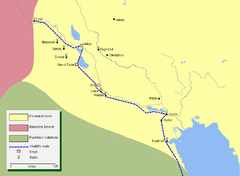 This was the last battle in his conquest of Iraq. By now, with the exception of Ctesiphon
, Khalid had captured whole of Iraq
. However, circumstances changed on the western front. The Byzantine forces
soon came in direct conflict in Syria
and Palestine
, and Khalid was sent to deal with this new development along with half of his army. Soon after, Caliph Abu Bakr
died in August 634 and was succeeded by Caliph Umar ibn al-Khattāb. Muslim forces in Iraq were now too few to control the region. After the devastating invasion by Khalid, Persians took time to recover. Moreover, the political instability was at its peak at Ctesiphon. Once the Persians recovered they concentrated more troops and mounted a counter attack. Muthanna ibn Haris, who was now commander in chief of the Muslim forces in Iraq, pulled his troops back from all outposts and evacuated Al-Hirah
. He then retreated to the region near the Arabian Desert
.
Meanwhile, Umar sent reinforcements from Madinah under the command of Abu Ubaid. The reinforcements reached Iraq in October 634, and Abu Ubaid assumed the command of the army and defeated the Sassanids at the Battle of Namaraq
near modern day Kufa
. Then, in the Battle of Kaskar, he recaptured Hira without any resistance.
The Persians then launched another counterattack, and were successful in defeating the Muslims at Battle of the Bridge
which killed Abu Ubaid, and the Muslims suffered heavy losses. Muthanna then assumed command of the army and withdrew the remnant of his army, about 3000 strong, across the Euphrates. The Persian commander Bahman was committed to drive the Muslims away from the Persian soil but was restrained from pursuing the defeated Muslims after being called back by Rustum to Ctesiphon to help in putting down the revolt against him. Muthanna retreated near the frontier of Arabia and called for reinforcements. Then, after getting sufficient reinforcements, he re-entered the fray and camped at the western bank of Euphrates, where a Persian force intercepted him and was defeated.
, Suwad, the fertile area between the Euphrates and the Tigris, remained unstable. Sometimes it was occupied by the Persians and sometimes by the Muslim force., This "tit-for-tat" struggle continued until emperor Yazdgerd III
consolidated his power and sought alliance with Byzantine
Emperor Heraclius
in 635, in an effort to prepare for a massive counter attack. Heraclius married his daughter to Yazdegerd III, according to an old Roman
tradition to seal an alliance. Heraclius then prepared for a major offense in Levant
. Meanwhile, Yazdegerd ordered a concentration of massive armies to pull back from Iraq
for good. This was supposed to be a well coordinated attacks by both emperors to annihilate the power of their common enemy, Caliph Umar
.
When Heraclius launched his offense in May of 636, Yazdegerd could not coordinate with Heraclius, and the plan did not come off. Umar, allegedly having intelligence of this alliance, devised his own plan. He wanted to finish off business first with the Byzantines and then reinforce the Muslim army at Yarmouk
. He sent 6000 soldiers in small bands to give the impression of a continuous stream of reinforcements. Meanwhile, Umar engaged Yazdegerd III, ordering Saad ibn Abi Waqqas to enter in peace negotiations with Yazdegerd III by inviting him to Islam
. Heraclius had instructed his general Vahan
, to not engage in battle with Muslims until his orders. However, fearing more reinforcement for the Muslims from Madinah and their growing strength, the Byzantines felt compelled to attack the Muslim forces before they get stronger. Heraclius's imperial army was annihilated at Battle of Yarmouk
in August of 636, three months before Qadisiyyah, ending the power of the Roman Emperor, for good. Nevertheless, Yazdegerd continued to execute his ambitious offensive plan and concentrated armies near his capital Ctesiphon
. A large force was put under the control of veteran general Rostam and was cantoned at Sabat near Ctesiphon. Getting news of the preparations of this massive counter-attack, Umar ordered Muthana to retreat to the edge of Arabian Desert and abandon Iraq.
The campaign of Iraq was now to be started again from the beginning. .
, an important member of the Quraysh tribe, and cousin of Prophet Muhammad, as commander of this army. In May 636, Saad marched from his camp at Sisra (near Madinah) with an army of 4,000 men and was instructed to join other armies, concentrated in northern Arabia, on his way to Iraq. Saad, being less experienced in the matter of war, was instructed by Caliph Umar to seek the advise of the experienced commanders. Once Saad entered Iraq, Umar sent orders to him to halt at al-Qadisiyyah, a small town, 30 miles from Kufah
. Muslims marched to Qadisiyyah and camped there on July 636.
Umar continued to issue strategic orders and commands to his army throughout the campaign. Umar wanted victory on Persian front but he ran short of the manpower and decided to lift the ban on the ex-apostate tribes of Arabia of not participating in state affairs. Because of this, the army raised was not the professional army, but was instead composed of newly recruited contingents from all over Arabia. Due to this fact, Umar was more concerned about providing it strategic aid. Umar, however was quite satisfied with the developments on Byzantine front, as the army there was a veteran, and was commanded by Abu Ubaidah ibn al-Jarrah
, and Khalid ibn Walid, a military genius. After they won a decisive victory against the Byzantine army at the Battle of Yarmouk
, Umar sent orders to Abu Ubaidah to immediately send a contingent of veterans to Iraq. Later, a force of 5,000 strong veterans of Yarmouk were also sent and arrived on second day of the battle. This proved to be the turning point in the battle. The battle fought was more between Caliph Umar
and Rostam Farrokhzād
, rather than between Saad and Rostam. On the other hand, the bulk of the Sassanid army was also made of new recruits since as bulk of the regular Sassanid forces was destroyed during the Battle of Walaja
and the Ullais
.
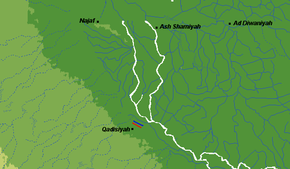 Qadisiyya was a small town on the west bank of the river Ateeq, a branch of the Euphrates
. Al-Hira, ancient capital of Lakhmid Dynasty, was laid about thirty miles west. According to present day geography it is situated at southwest of al-Hillah and Kufah
in Iraq.
The Sassanid Persians army, about 60,000 strong, fell in three main categories, infantry
, Persians heavy cavalry
,and the Elephant corps
. The Elephant corps were also known as Indian corps, as the elephants were trained and brought from the Persians provinces in India. On November 16, 636, the Sassanid army crossed over the west bank of Ateeq, and Rostum deployed his 45,000 strong infantry in four divisions, each about 150 meter apart from the other. 15,000 strong cavalry was divided among four divisions to be used as reserve for counter-attack and offensives. At Qaddasiyyah, about 33 Elephants were present, eight with each of four divisions of army. The battle front was about 4 km long.
The Sassanid Persians' right wing was commanded by Hormuzan, right center by Jalinus, left center by Beerzan
and left wing by Mihran. Rostam himself was stationed at an elevated seat shaded by a canopy near the west bank of the river, behind the right center, from where he could have a nice view of the battlefield. By his side waved the Derafsh-e-Kāveyān
(in Persian
: درفش کاویان, the 'flag of Kāveh
'), the standard of the Sassanid Persians. Rostam placed men at certain intervals between the battlefield and Capital Ctesiphon
to convey intelligence.
marched from Sharaf to Qadisiyya. After establishing the camp, organizing the defenses, and securing the river heads, Saad sent parties inside the Suwad to conduct raids.
Saad was continuously in contact with Caliph Umar, to whom he sent a detailed report of the geographical features of the land where the Muslims encamped and the land between Qaddasiyyah, Madinah and the region where the Persians were concentrating their forces.
The Muslim army at this point was about 30,000 strong, including 7,000 cavalry. Its strength rose to 36,000 strong once it was reinforced by the contingent from Syria and local Arabs allies.
Saad was suffering from sciatica
, and there were boils all over his body. Saad took a seat in the old royal palace at Qaddasiyyah from where he would direct the war operations and could have a good view of the battlefield. He appointed Khalid ibn Arfatah as his Deputy, who would carried out his instructions to the battlefield.
The Rashidun infantry
was deployed in four corps, with each corps having its own cavalry regiment which was stationed at the rear for counter-attacks. Each corps was about 150 meter apart from the other. The army was all formed on a tribal and clan basis, so that every man would fight next to well-known comrades and so that tribes may be held accountable for any weakness.
Saad ibn Abi Waqas was the commander in chief of the army, due to his illness he was unable to participate directly in the battle and thus made Khalid ibn Arfatah his deputy.
The Muslims' left wing was commanded by Shurahbeel ibn As-Samt, left center was commanded by Asim ibn Amr while the right center was commanded by Zuhra ibn Al-Hawiyya and right wing was commanded by Abdullah ibn Al-Mut'im. Cavalry of the right wing was commanded by Jareer ibn Abdullah and that of right center by Ath'ath ibn Qais.
was commonly used to protect the face, neck and cheek either as an aventail
from the helmet or as a mail coif.
Heavy leather sandals as well as Roman type sandal boots were also typical of the early Muslim soldiers.
Armor included, hardened leather scale or lamellar armour
and mail
. Infantry soldiers were more heavily armored than the horsemen. Hauberk
s and large wooden or wickerwork shield
s were used as well as long-shafted spears. Infantry spears were about 2.5 meters long and those of the cavalry were up to 5.5 meters long.
Swords used were a short infantry weapon like the Roman gladius
, and the Sassanid long sword. Both were worn hung from a baldric
. Bows were about two meters long when unbraced, about the same size as the famous English longbow
– with a maximum range of about 150 meters. Early Muslim archers were infantry archers who proved very effective against the opposing cavalry.
The troops at the Sassanid Persian front were lightly armed compared to the Rashidun troops deployed at the Byzantine front.
inviting them to Islam. For next three months, negotiations between Muslims and Persians continued.
On Caliph Umar's instructions, Saad sent an embassy to Persian court with instructions to convert the Sassanid emperor to Islam or to get him to agree to paying Jaziyah. An-Numan ibn Muqarrin led the Muslim emissary to Ctesiphon and met Emperor Yazdgerd III
. However, the mission failed.
 During one the meetings, Yazdgerd III, intending to humiliate the Muslims, ordered his menials to place a basket full of earth on Asim ibn Amr’s (one of the member of the emissary) head. The optimistic Muslim ambassador interpreted this gesture with the following words:
.
As tensions eased on the Syrian front, Caliph Umar instructed that negotiations be halted. This was an open signal to the Persians to prepare for battle. Rostam Farrokhzād, who was at Sabat, broke camp for Qadisiyyah. Roastam, however was inclined to avoid fighting; he once more opened peace negotiations. Saad sent Rabi bin Amir and later Mughirah bin Zurarah to hold talks. After the negotiations fell through, both sides prepared for battle.. Meanwhile, the Muslims were victorious at the Battle of Yarmouk
against the Byzantines.
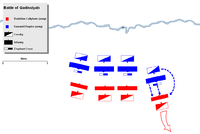 On 16 November 636, an intervening canal was choked up and converted into a road on Rostam’s orders at the dawn of morning and before dawn the entire Persian army crossed the canal. Rostam now armed himself with a double set of complete armour and requisite weapons. Both armies stood face to face about 500 meters apart. Rashidun's army was deployed facing northeast, while the Sassanid army,
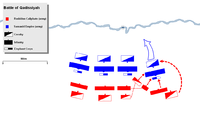 had a river at its rear, and was deployed facing southwest. The battle began with personal duels; Muslims Mubarizun
s stepped forward and many were slain on both sides. Muslim chronicles record several heroic duels between the Sassanid and Muslim champions. The purpose of these duels was to lower the morale of the opposing army by killing as many champions as possible. Having lost several champions in duels, Rostam began the battle by ordering his left wing to attack the Muslims' right wing.
The Persians' attack began with heavy showers of arrows,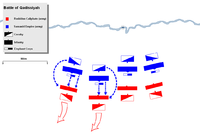 which caused considerable damage to the Muslims' right wing. Then elephants led a charge. Abdullah ibn Al-mutim, the Muslim commander of right wing, ordered Jareer ibn Abdullah, the Muslim cavalry commander of the right wing, to deal with the Sassanid elephants. As Jareer attempting to halt the advancing elephants, Sassanid heavy cavalry intercepted his force and routed the Muslim cavalry. As the elephants continued to advance, the Muslim infantry began to fall back.
Saad sent orders to Ath'ath ibn Qais,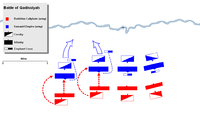 commander of the cavalry of right center to check the Sassanid cavalry advance. Ath’ath then led a cavalry regiment that reinforced the cavalry of right wing and launched a counter attack at the flank of the Sassanid left wing. Meanwhile, Saad sent orders to Zuhra ibn Al-Hawiyya, commander of Muslims right center to dispatch an infantry regiment to reinforce the infantry of right wing, an infantry regiment was sent under Hammal ibn Malik that helped the infantry of right wing in launching a counter attack against Sassanid. The Sassanid left wing retreated under the frontal attack by infantry of Muslims right wing reinforced by infantry regiment from right center and flanking attack by Muslims cavalry reinforced by a cavalry regiment from right center.
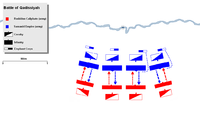 With the initial attacks repulsed, Rustam ordered his right center and his right wing to advance against the Muslims' elephants on their front. The Muslim left wing and left center were first subjected to intense archery, followed by charge of Sassanid right wing and right center. Once again, the Elephant corps led the charge. The Muslim cavalry, on left wing and left center, already in panic due to the charge of the elephants, were driven back by the combined action of Sassanid heavy cavalry and the elephants.
Saad sent word to Asim ibn Amr, commander of the left center, to overpower the elephants.
Asim’s strategy was to overcome the archers on the elephants' back and then cut the girths of the saddles. Asim ordered his archers to kill the men on elephants back and infantry men to cut the girths of the saddles, the Muslims' left wing follow suit. The tactic worked and Persians retired the elephants to the position behind the front lines, followed by a counter attack of Muslims. The Sassanid army's right center retreated followed by the retreat of right wing. By afternoon the Persian attacks on the Muslim left wing and left center were beaten back. Saad, in order to exploit this opportunity, ordered a counter attack. The Muslim front moved forward at once. The Muslim cavalry then charged from the flanks with full force. These repeated charges continued till the dusk a tactics known as Karr wa farr. The Muslim attacks were eventually repulsed by Rostam, who plunged into the foray personally and is said to have received several wounds.
The fighting ended at dusk. The battle was inconclusive, with considerable losses on both the sides. In the Muslim chronicles, the first day of the battle of Qaddasiyyah is known as Yaum-ul-Armah ("The Day of Disorder").
, cousin of Saad.. Qa’qa divided his advance guard into several small groups and instructed them to reach the battlefield one after the other giving the impression that a very large reinforcement has arrived. Hashim did the same and for the whole day these regiments kept on arriving, which demoralized Persians.
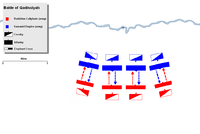 Qa’qa is said to have killed Persian general Bahman, who commanded the Sassanid army at Battle of Bridge and commander of Persians left center Beerzan, in a duel that day..
As there were no elephants in the Sassanid fighting force today, Saad sought to exploit this opportunity to gain any breakthrough if possible.
Saad thus ordered a general attack. All four Muslim corps surged forward, but the Sassanids stood firm against the repeated attacks of the Muslims and repulsed every attack. During these charges, Qa’qa resorted to an ingenious device. The camel
s were camouflaged to look like weird monsters.. These monsters moved to the Sassanid front and seeing them the Sassanid horses turned and bolted. With the disorganization of the Sassanid cavalry, the Persians infantry at left center became vulnerable. Saad ordered the Muslims to intensify the attack.
Qa’qa ibn Amr, now acting as a field commander of the Muslim army, planned to kill the Sassanid commander Rostum, and led a group of Mubarizun
s, from his Syrian contingent who were also the veterans of Battle of Yarmouk, through the Sassanids' right center towards Rostam's headquarter. Rustam again personally led a counter attack against the Muslims, and no breakthrough could be achieved. At dusk, the two armies pulled back to their camps.
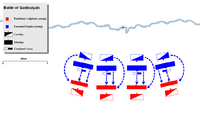 The Elephants corps was once again in the front of the Sassanid army, putting advantage to the Sassanid. Pressing this advantage into service, Rostam ordered a general attack on the front of the Muslims using his full force. All four Sassanid corps moved forward and stuck to the Muslims on their front.. The Sassanid Persians' attack began with the volley of arrows and projectiles. The Muslims sustained heavy losses before their archers retaliated. The Persian elephant’s corps once again led the charge supported by their infantry and cavalry.
At the approach of the Sassanid elephants, the Muslim riders once again became unnerved and led to confusion in the Muslim ranks. The Sassanids pressed the attack, and the Muslims fell back..
Through the gaps that had appeared in the Muslim ranks as a result of the Sassanid advance, Rostum sent a cavalry regiment to capture the old palace where Saad the Commander-in-Chief of the Muslim forces was stationed. The strategy of Rostum was that the Muslim Commander-in-Chief should be killed or taken captive with a view to demoralizing the Muslims.
 However, a strong cavalry contingent of the Muslims rushed to the spot, and drove away the Sassanid cavalry.
For Saad, there was only one way to win the battle, to destroy the Sassanid Elephant corps that was causing the greatest havoc among the Muslim ranks. He issued the orders that the elephants should be overpowered by blinding them and severing their trunks. After a long struggle, the Muslims finally succeeded in mutilating the elephants sufficiently to be driven off.
The frightened elephant corps rushed through the Sassanid ranks and made for the river. By noon no elephants were left on the battlefield.. The flight of the elephants caused considerable confusion in the Sassanid ranks. To exploit this situation even further, Saad ordered a general attack and the two armies clashed once again. In spite of the Muslim repeated charges, the Sassanid army held their ground. In the absence of Persian elephants, the Muslims once again brought camels camouflaged as monsters. The trick did not work and the Persian horses stood their ground..
The third day of the battle was the hardest day of the war. There were heavy casualties on both sides, and the battlefield was strewn with dead bodies of fallen warriors.
In spite of fatigue after three days' battle, the armies continued to fight. Fighting continued during the night until the dawn.
It became a war of stamina, with both sides on the verge of breaking. The strategy of Saad was to wear down the Persians, and snatch away victory from them. In the Muslim chronicles the third day of the Battle is known as Yaum-ul-Amas. The night was called Lailat-ul-Harir, meaning the "Night of Rumbling Noises"..
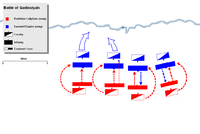 Qaqa, with the consent of Saad, was now acting as a field commander of the Muslim troops. He is reported to have addressed his men as follows:
The Muslims' left center led by Qa’qa surged forward and attacked the Sassanid right center, followed by the general attack of the Muslims' corps. The Sassanids were taken by surprise of the resumption of battle. The Sassanids left wing and left center were pushed back. Qa’qa again led a group of Mubarizuns against the Sassanids' left center and by noon, Qaqa and his men were able to pierce through the Sassanid center.
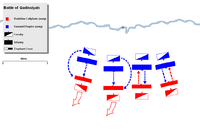
, The commander in chief of the Persian army was slain, which marked the defeat of the Persian army. Different accounts have been told of his mysterious death:
1) Qaqa and his men dashed towards the Sassanid Headquarter. Meanwhile, in the middle of sandstorm, Rostam, the Commander-in-Chief of the Sassanid Persian forces was found dead with over 600 wounds on his body.. The Persians were not aware of the death of Rostam, and they continued to fight. The Sassanid right wing counterattacked and gained its lost position, as the Muslims' left wing retreated back to their original position. The Muslims' left center, now under Qa’qa’s command, when denied the support of their left wing, also retreated back to its original position. Saad now ordered a general attack on Sassanid front to drive away the Persians, demoralized by the death of their charismatic leader. In the afternoon the Muslims mounted another attack.
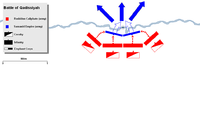 By this time even the Persians knew that their Commander-in-Chief had been killed. The Sassanid front, after putting up a last resistance, collapsed. With the collapse, a part of Sassanid army retreated in an organized manner while the other retreated in panic towards the river.
At this stage Jalinus took command of what was left of the Sassanid army. He claimed control of the bridge head, and succeeded in getting bulk of the Sassanid army across the bridge safely.
The battle of Qaddisiyyah was over, with Muslims victorious. Saad sent the cavalry regiments in various directions to pursue the fleeing Persians. The stragglers that the Muslims met in the way were either killed or taken captives. Even heavier casualties were suffered by Sassanids during these pursues..
2) There was a heavy sandstorm facing the Persian army on the final day of the battle.Rostam Farrokhzad
lay next to a camel in order to keep himself from the sandstorm while some weapons, such as axes, maces and swards had been loaded on the camel. Hilāl ibn `Ullafah accidentally cut the girdle of the load on the camel, not even knowing that Rostam was behind and under it. The weapons fell on Rostam and broke his back leaving him half dead and paralyzed. Hilal beheaded Rostam and shouted "I swear to the god of Kaaba that I have killed Rostam. Shocked by the head of their legendary leader dangling before their eyes, the Persians were demoralized and the commanders lost control of the army. Many Persian soldiers were slain in the chaos, many escaped through the river, and finally, the rest of the army surrendered..
gained a large amount of loot, including the famed jewel-encrusted royal standard, called the Derafsh-e-Kāveyān
(the 'flag of Kāveh
'). The jewel was then cut up and sold in pieces in Medina
. The Arab fighters became known as ‘’ahl al-Qādisiyyah’’ and held the highest prestige of the later Arab settlers within Iraq and its important garrison town, Kufa
.
As soon as the battle of Qadisiyya was over, Sa'ad sent a report of the victory of the Muslims to Umar. The battle of Qadisiyya shook the Sassanian rule in Iraq to its foundations, but that was not the end of their rule in Iraq. As long as the Sassanids held their capital Ctesiphon, there was always the danger that at some suitable moment they would make an attempt to recover what they had lost, and drive away the Arabs from Iraq. Caliph Umar thus sent instructions to Saad that as a sequel to the battle of Qaddisiyyah, the Muslims should push forward to capture Ctesiphon. The Siege of Ctesiphon
continued for two months and the city was finally taken in March 637 A.D.. Muslim forces conquered the Persian provinces up to Khuzistan. However, the conquest was slowed down due to a severe drought in Arabia in 638 and the plague
in southern Iraq and Syria in 639. After this, Caliph Umar wanted a break to manage the conquered territories and for then he wanted to leave rest of Persia to the Persians. Umar is reported to have said:
The Persian perspective however, was the polar opposite, one of great embarrassment, humility and scorn. The pride of the imperial Sassanids had been hurt by the conquest of Iraq by the Arabs. They continued the struggle to regain the lost territory. Thus a major Persian counter attack was launched and subsequently repulsed at the Battle of Nihawand
fought in December 641.
After which, a whole-scale invasion of the Sassanid Persian empire was planned by Umar to conquer their arch-rival entirely. The last Persian emperor was Yazdgerd III, who was killed in 653 during the reign of the Caliph Uthman
. His death officially marks the end of the Sassanid Royal lineage and empire.
Arabic transliteration
Different approaches and methods for the romanization of Arabic exist. They vary in the way that they address the inherent problems of rendering written and spoken Arabic in the Latin alphabet; they also use different symbols for Arabic phonemes that do not exist in English or other European...
, Ma'rakat al-Qādisiyyah; ; alternative spellings: Qadisiyya, Qadisiyyah, Kadisiya) was fought in 636; it was the decisive engagement between the Arab muslim army and the Sassanid
Sassanid Empire
The Sassanid Empire , known to its inhabitants as Ērānshahr and Ērān in Middle Persian and resulting in the New Persian terms Iranshahr and Iran , was the last pre-Islamic Persian Empire, ruled by the Sasanian Dynasty from 224 to 651...
Persian army during the first period of Muslim expansion. It resulted in the Islamic conquest of Persia
Islamic conquest of Persia
The Muslim conquest of Persia led to the end of the Sassanid Empire in 644, the fall of Sassanid dynasty in 651 and the eventual decline of the Zoroastrian religion in Persia...
, and was key to the conquest of Iraq
Iraq
Iraq ; officially the Republic of Iraq is a country in Western Asia spanning most of the northwestern end of the Zagros mountain range, the eastern part of the Syrian Desert and the northern part of the Arabian Desert....
. The battle also saw the alleged alliance of Emperor Yazdegerd III with Emperor Heraclius
Heraclius
Heraclius was Byzantine Emperor from 610 to 641.He was responsible for introducing Greek as the empire's official language. His rise to power began in 608, when he and his father, Heraclius the Elder, the exarch of Africa, successfully led a revolt against the unpopular usurper Phocas.Heraclius'...
, who then married off his granddaughter Manyanh to Yazdegerd as a symbol of alliance.
Background
During the Muslim Prophet Muhammad's lifetime, Persia was ruled by Emperor Khosrau IIKhosrau II
250px|thumb|Khosrau II 250px|thumb|Khosrau II 250px|thumb|Khosrau II (Khosrow II, Chosroes II, or Xosrov II in classical sources, sometimes called Parvez, "the Ever Victorious" – (in Persian: خسرو پرویز), was the twenty-second Sassanid King of Persia, reigning from 590 to 628...
. Khosrau II waged a war against the Byzantine
Byzantine
Byzantine usually refers to the Roman Empire during the Middle Ages.Byzantine may also refer to:* A citizen of the Byzantine Empire, or native Greek during the Middle Ages...
s to avenge Maurice's
Maurice (emperor)
Maurice was Byzantine Emperor from 582 to 602.A prominent general in his youth, Maurice fought with success against the Sassanid Persians...
death. Therefore, the Sassanid army
Sassanid army
The birth of the Sassanid army dates back to the rise of Ardashir I , the founder of the Sassanid dynasty, to the throne. Ardashir aimed at the revival of the Persian Empire, and to further this aim, he reformed the military by forming a standing army which was under his personal command and whose...
invaded and captured Syria
Syria
Syria , officially the Syrian Arab Republic , is a country in Western Asia, bordering Lebanon and the Mediterranean Sea to the West, Turkey to the north, Iraq to the east, Jordan to the south, and Israel to the southwest....
, Egypt
Egypt
Egypt , officially the Arab Republic of Egypt, Arabic: , is a country mainly in North Africa, with the Sinai Peninsula forming a land bridge in Southwest Asia. Egypt is thus a transcontinental country, and a major power in Africa, the Mediterranean Basin, the Middle East and the Muslim world...
and Anatolia
Anatolia
Anatolia is a geographic and historical term denoting the westernmost protrusion of Asia, comprising the majority of the Republic of Turkey...
and the True Cross
True Cross
The True Cross is the name for physical remnants which, by a Christian tradition, are believed to be from the cross upon which Jesus was crucified.According to post-Nicene historians, Socrates Scholasticus and others, the Empress Helena The True Cross is the name for physical remnants which, by a...
was carried away in triumph. The early defeat and eventual victory of the Romans was foretold in the Quran in Surah Ar-Room, The Romans
Ar-Rum
Surat Ar-Rum is the 30th sura of the Qur'an with 60 ayat.The surah begins by noting the recent defeat of the Romans by the Persians. It in turn calls Muslims to look forward to the victory it prophesies of the Emperor Heraclius' Christians over the Persian Zoroastrians...
:
– Quran 030:2–6
Emperor Heraclius
Heraclius
Heraclius was Byzantine Emperor from 610 to 641.He was responsible for introducing Greek as the empire's official language. His rise to power began in 608, when he and his father, Heraclius the Elder, the exarch of Africa, successfully led a revolt against the unpopular usurper Phocas.Heraclius'...
, who succeeded Phocas in 610, united the Byzantine empire and began a war of reconquest. He successfully regained territory lost to the Sassanid Empire. He also defeated the Persians at the final and decisive Battle of Nineveh
Battle of Nineveh (627)
The Battle of Nineveh was the climactic battle of the Byzantine-Sassanid War of 602–628. The Byzantine victory broke the power of the Sassanid dynasty and for a period of time restored the empire to its ancient boundaries in the Middle East...
and advanced towards Ctesiphon
Ctesiphon
Ctesiphon, the imperial capital of the Parthian Arsacids and of the Persian Sassanids, was one of the great cities of ancient Mesopotamia.The ruins of the city are located on the east bank of the Tigris, across the river from the Hellenistic city of Seleucia...
. Khosrau fled, and Heraclius ordered his armies to retreat only after a pact was signed with the newly appointed Emperor Kavadh II
Kavadh II
Kavadh II , twenty-third Sassanid King of Persia, son of Khosrau II , was raised to the throne in opposition to his father in February 628, after the great victories of the Emperor Heraclius...
. According to the pact, the True Cross would be given back to Heraclius and all Byzantine territory that the Persians had captured would be evacuated.
Internal conflicts of succession
Khosrau IIKhosrau II
250px|thumb|Khosrau II 250px|thumb|Khosrau II 250px|thumb|Khosrau II (Khosrow II, Chosroes II, or Xosrov II in classical sources, sometimes called Parvez, "the Ever Victorious" – (in Persian: خسرو پرویز), was the twenty-second Sassanid King of Persia, reigning from 590 to 628...
was murdered in his palace by his son Kavadh II
Kavadh II
Kavadh II , twenty-third Sassanid King of Persia, son of Khosrau II , was raised to the throne in opposition to his father in February 628, after the great victories of the Emperor Heraclius...
in 629. Kavadh II put his 18 brothers to death and began negotiations with Heraclius
Heraclius
Heraclius was Byzantine Emperor from 610 to 641.He was responsible for introducing Greek as the empire's official language. His rise to power began in 608, when he and his father, Heraclius the Elder, the exarch of Africa, successfully led a revolt against the unpopular usurper Phocas.Heraclius'...
, but died after a reign of a few months. Ardashir III (c. 621–630), son of Kavadh II (628), was raised to the throne as a boy of 7 years, but was killed 18 months later by his general Farrokhan. Farrokhan was called Shahrbaraz
Shahrbaraz
Shahrbaraz or Shahrwaraz was a general, with the rank of Eran Spahbod under Khosrau II . His name was Farrokhan, and Shahrbaraz was his title...
, a title meaning "the Boar of the Empire". Shahrbaraz took Damascus
Damascus
Damascus , commonly known in Syria as Al Sham , and as the City of Jasmine , is the capital and the second largest city of Syria after Aleppo, both are part of the country's 14 governorates. In addition to being one of the oldest continuously inhabited cities in the world, Damascus is a major...
and Jerusalem from the Byzantine Empire
Byzantine Empire
The Byzantine Empire was the Eastern Roman Empire during the periods of Late Antiquity and the Middle Ages, centred on the capital of Constantinople. Known simply as the Roman Empire or Romania to its inhabitants and neighbours, the Empire was the direct continuation of the Ancient Roman State...
in 613 and 614 respectively, during the Byzantine-Persian War when the True Cross
True Cross
The True Cross is the name for physical remnants which, by a Christian tradition, are believed to be from the cross upon which Jesus was crucified.According to post-Nicene historians, Socrates Scholasticus and others, the Empress Helena The True Cross is the name for physical remnants which, by a...
was carried away in triumph. Following the Persian surrender, Shahrbaraz was heavily involved in the intrigues of the Sassanian court. He made peace with Heraclius
Heraclius
Heraclius was Byzantine Emperor from 610 to 641.He was responsible for introducing Greek as the empire's official language. His rise to power began in 608, when he and his father, Heraclius the Elder, the exarch of Africa, successfully led a revolt against the unpopular usurper Phocas.Heraclius'...
and returned a relic that was accepted as the True Cross.
In April 630, he failed to deal with the invasion of Armenia by a Khazar-Gokturk force under Chorpan Tarkhan
Chorpan Tarkhan
Chorpan Tarkhan is recorded by Moses of Kalankatuyk as a Khazar general, "bloodthirsty and vile", who invaded and devastated Armenia in April 630 CE. He was most likely an officer in the army of the Western Gokturks led by Böri Shad in the wake of Ziebel's victory in the Third Persian-Turkic War...
. Then on 9 June 630 Shahrbaraz was slain, and succeeded by Purandokht, the daughter of the King Khosrau II
Khosrau II
250px|thumb|Khosrau II 250px|thumb|Khosrau II 250px|thumb|Khosrau II (Khosrow II, Chosroes II, or Xosrov II in classical sources, sometimes called Parvez, "the Ever Victorious" – (in Persian: خسرو پرویز), was the twenty-second Sassanid King of Persia, reigning from 590 to 628...
of Persia (590–628) . She was one of only two women to sit on the throne of the Sassanid dynasty, the other being her sister Azarmidokht. She was the 26th sovereign Monarch of Persia, from 629 to 631. When Purandokht ascended to the throne after the murder of the general Shahrbaraz, who had killed her nephew Ardashir III
Ardashir III
Ardashir III was the twenty-fourth Sassanid King of Persia from 628 to 630.He was a son of Kavadh II/Shiroes and "Anzoy the Roman". His mother was probably from the Byzantine Empire. He was raised to the throne as a boy of seven years, but was killed 18 months later by his general, Shahrbaraz .-...
, she was made Queen of Persia on the understanding that she would vacate the throne on Yazdgerd III
Yazdgerd III
Yazdegerd III or Yazdgerd III was the twenty-ninth and last king of the Sassanid dynasty of Iran and a grandson of Khosrau II . His father was Shahryar, whose mother was Miriam, the daughter of the Byzantine Emperor Maurice...
attaining majority. She attempted to bring stability to the empire by the implementation of justice, reconstruction of the infrastructure, lowering of taxes, minting coins, and a peace treaty with the Byzantine Empire. She also appointed Rostam Farrokhzād
Rostam Farrokhzad
Rostam Farrokhzād was the Ērān Spāhbod of the Sāsānian Empire under the reign of Yazdgird, r. 632 - 651...
as the commander in chief of the Persian army. She was, however, largely unsuccessful in her attempts to restore the power of the central authority, which was weakened considerably by civil wars, and she resigned or was murdered soon after. She was replaced by her sister Azarmidokht
Azarmidokht
Azarmidokht was the twenty-seventh Sassanid Monarch of Persia, and daughter of Khosrau II. She ruled Persia after her sister Purandokht.After the death of her father Khosrau II anarchy spread in the Sassanid empire. The subsequent rulers could stay for only a relatively brief time on the throne,...
who in turn was replaced by Hormizd VI
Hormizd VI
Hormizd VI or V, twenty-eighth Sassanid King of Persia, was one of the many pretenders who rose after the murder of Khosrau II in 628. He maintained himself about two years in the district of Nisibis. There was also a brief usurper king, not always numbered among the monarchs, called Hormizd V in...
, a noble of the Persian court .
After 5 years of internal power struggle and the assassination of Khosrau II, Yazdgerd III (the grandson of Khosrau) became emperor at the age of 16. However, the real pillars of the state were generals Rostam Farrokhzād
Rostam Farrokhzad
Rostam Farrokhzād was the Ērān Spāhbod of the Sāsānian Empire under the reign of Yazdgird, r. 632 - 651...
and Firoz. There was violent friction between these two, although pressure from the Persian courtiers pushed this backstage. The coronation of Yazdgerd III
Yazdgerd III
Yazdegerd III or Yazdgerd III was the twenty-ninth and last king of the Sassanid dynasty of Iran and a grandson of Khosrau II . His father was Shahryar, whose mother was Miriam, the daughter of the Byzantine Emperor Maurice...
infused new life into the Sassanid Persians.
Rise of Caliphate and invasion of Iraq
After Prophet MuhammadMuhammad
Muhammad |ligature]] at U+FDF4 ;Arabic pronunciation varies regionally; the first vowel ranges from ~~; the second and the last vowel: ~~~. There are dialects which have no stress. In Egypt, it is pronounced not in religious contexts...
, the Caliph Abu Bakr
Abu Bakr
Abu Bakr was a senior companion and the father-in-law of the Islamic prophet Muhammad. He ruled over the Rashidun Caliphate from 632-634 CE when he became the first Muslim Caliph following Muhammad's death...
re-established control over Arabia through the Ridda Wars
Ridda wars
The Ridda wars , also known as the Wars of Apostasy, were a series of military campaigns against the rebellion of several Arabian tribes launched by the Caliph Abu Bakr during 632 and 633 AD, after prophet Muhammad died....
, and then launched campaigns against the remaining Arabs of Syria
Syria
Syria , officially the Syrian Arab Republic , is a country in Western Asia, bordering Lebanon and the Mediterranean Sea to the West, Turkey to the north, Iraq to the east, Jordan to the south, and Israel to the southwest....
and Palestine
Palestine
Palestine is a conventional name, among others, used to describe the geographic region between the Mediterranean Sea and the Jordan River, and various adjoining lands....
. He triggered the trajectory that would in few decades form the largest empire the world had ever seen. He thus put the nascent Islamic empire on a collision course with the Byzantine and Sassanid empires, which had been disputing these territories for centuries. The wars soon became a matter of conquest that would eventually result in the ultimate demise of the Byzantine empire
Byzantine Empire
The Byzantine Empire was the Eastern Roman Empire during the periods of Late Antiquity and the Middle Ages, centred on the capital of Constantinople. Known simply as the Roman Empire or Romania to its inhabitants and neighbours, the Empire was the direct continuation of the Ancient Roman State...
and the Sassanid empire
Sassanid Empire
The Sassanid Empire , known to its inhabitants as Ērānshahr and Ērān in Middle Persian and resulting in the New Persian terms Iranshahr and Iran , was the last pre-Islamic Persian Empire, ruled by the Sasanian Dynasty from 224 to 651...
, as well as the annexation of 80% of their respective territories. To make certain of victory, Abu Bakr decided that the invading army would consist entirely of volunteers and it would be commanded by his best general, Khalid ibn al-Walid
Khalid ibn al-Walid
Khālid ibn al-Walīd also known as Sayf Allāh al-Maslūl , was a companion of the Islamic prophet Muhammad. He is noted for his military tactics and prowess, commanding the forces of Medina and those of his immediate successors of the Rashidun Caliphate; Abu Bakr and Umar...
. Khalid won quick victories in four consecutive battles: the Battle of Chains
Battle of Chains
The Battle of Sallasil or the Battle of Chains was the first battle fought between the Rashidun Caliphate and the Sassanid Persian Empire. The battle was fought soon after the Ridda Wars were over and Arabia was united under the authority of Caliph Abu Bakr...
, fought in April 633; the Battle of River
Battle of River
According to Arab and Muslim sources, the Battle of River took place in Mesopotamia between the forces of the Rashidun Caliphate and the Persian Empire. Muslims, under Khalid ibn al-Walid's command, defeated the numerically superior Persian army....
, fought in the 3rd week of April 633; the Battle of Walaja
Battle of Walaja
The Battle of Walaja was a battle fought in Mesopotamia in May 633 between the Rashidun Caliphate army under Khalid ibn al-Walid and al muthanna ibn haarithah against the Persian Empire and its Arab allies...
, fought in May 633; followed by the decisive Battle of Ullais
Battle of Ullais
The Battle of Ullais was fought between the forces of the Rashidun Caliphate and the Sassanid Persian Empire in the middle of May 633 A.D in Iraq, and is sometimes referred to as the Battle of Blood River since, as a result of the battle, there were enormous amounts of Sassanian and Arab Christian...
, fought in the mid of May, 633. By now the Persian Empire was struggling and in the last week of May 633, the capital city of Iraq, Al-Hirah
Al-Hirah
Al Hīra was an ancient city located south of al-Kufah in south-central Iraq.- Middle Ages:Al Hīra was a significant city in pre-Islamic Arab history. Originally a military encampment, in the 5th and 6th centuries CE it became the capital of the Lakhmids.The Arabs were migrating into the Near East...
, fell to the Muslims after the Battle of Hira
Battle of Hira
Al-Hirah city, widely known for its size and wealth, was a Sassanian dukedom as it was the capital of the Persian province of Iraq. Many of its Lakhmid Christian Arab inhabitants patrolled the desert on behalf of the Sassanians...
. Thereafter, the Siege of Al-Anbar
Battle of Al-Anbar
the Muslim Arab army was under the command of Khalid ibn al-Walid and the battle took place at Anbar which is located approximately 80 miles from the ancient city of Babylon. Khalid besieged the Sassanian Persians in the city fortress, which had strong walls. Scores of Muslim archers were used in...
during June–July 633 resulted in surrender of the city after strong resistance. Khalid then moved towards the south and conquered the city of Ein ul Tamr after the Battle of Ein ul Tamr in the last week of July, 633. In November 633, the Persian counter-attack was repulsed by Khalid and in December 633, Muslim forces reached the border city of Firaz, where Khalid defeated the combined forces of the Sassanid Persians
Sassanid army
The birth of the Sassanid army dates back to the rise of Ardashir I , the founder of the Sassanid dynasty, to the throne. Ardashir aimed at the revival of the Persian Empire, and to further this aim, he reformed the military by forming a standing army which was under his personal command and whose...
, Byzantine Romans
Byzantine army
The Byzantine army was the primary military body of the Byzantine armed forces, serving alongside the Byzantine navy. A direct descendant of the Roman army, the Byzantine army maintained a similar level of discipline, strategic prowess and organization...
and Christian Arabs in the Battle of Firaz
Battle of Firaz
The Battle of Firaz was the last battle of the Muslim Arab commander Khalid ibn al-Walid in Mesopotamia against the combined forces of the Byzantine Roman Empire, Sassanid Persian Empire, and Christian Arabs...
.
Ctesiphon
Ctesiphon, the imperial capital of the Parthian Arsacids and of the Persian Sassanids, was one of the great cities of ancient Mesopotamia.The ruins of the city are located on the east bank of the Tigris, across the river from the Hellenistic city of Seleucia...
, Khalid had captured whole of Iraq
Iraq
Iraq ; officially the Republic of Iraq is a country in Western Asia spanning most of the northwestern end of the Zagros mountain range, the eastern part of the Syrian Desert and the northern part of the Arabian Desert....
. However, circumstances changed on the western front. The Byzantine forces
Byzantine army
The Byzantine army was the primary military body of the Byzantine armed forces, serving alongside the Byzantine navy. A direct descendant of the Roman army, the Byzantine army maintained a similar level of discipline, strategic prowess and organization...
soon came in direct conflict in Syria
Syria
Syria , officially the Syrian Arab Republic , is a country in Western Asia, bordering Lebanon and the Mediterranean Sea to the West, Turkey to the north, Iraq to the east, Jordan to the south, and Israel to the southwest....
and Palestine
Palestine
Palestine is a conventional name, among others, used to describe the geographic region between the Mediterranean Sea and the Jordan River, and various adjoining lands....
, and Khalid was sent to deal with this new development along with half of his army. Soon after, Caliph Abu Bakr
Abu Bakr
Abu Bakr was a senior companion and the father-in-law of the Islamic prophet Muhammad. He ruled over the Rashidun Caliphate from 632-634 CE when he became the first Muslim Caliph following Muhammad's death...
died in August 634 and was succeeded by Caliph Umar ibn al-Khattāb. Muslim forces in Iraq were now too few to control the region. After the devastating invasion by Khalid, Persians took time to recover. Moreover, the political instability was at its peak at Ctesiphon. Once the Persians recovered they concentrated more troops and mounted a counter attack. Muthanna ibn Haris, who was now commander in chief of the Muslim forces in Iraq, pulled his troops back from all outposts and evacuated Al-Hirah
Al-Hirah
Al Hīra was an ancient city located south of al-Kufah in south-central Iraq.- Middle Ages:Al Hīra was a significant city in pre-Islamic Arab history. Originally a military encampment, in the 5th and 6th centuries CE it became the capital of the Lakhmids.The Arabs were migrating into the Near East...
. He then retreated to the region near the Arabian Desert
Arabian Desert
The Arabian Desert is a vast desert wilderness stretching from Yemen to the Persian Gulf and Oman to Jordan and Iraq. It occupies most of the Arabian Peninsula, with an area of...
.
Meanwhile, Umar sent reinforcements from Madinah under the command of Abu Ubaid. The reinforcements reached Iraq in October 634, and Abu Ubaid assumed the command of the army and defeated the Sassanids at the Battle of Namaraq
Battle of Namaraq
Battle of Namaraq was a conflict between Muslims and Persians that occurred in Namaraq, near modern day Kufa . During the Khilafat of Hazrat Abu Bakr, Muslims under the command of Musana and Khalid bin Walid conquered Hira, a part of the Persian Empire. The Persians became furious and determined...
near modern day Kufa
Kufa
Kufa is a city in Iraq, about south of Baghdad, and northeast of Najaf. It is located on the banks of the Euphrates River. The estimated population in 2003 was 110,000....
. Then, in the Battle of Kaskar, he recaptured Hira without any resistance.
The Persians then launched another counterattack, and were successful in defeating the Muslims at Battle of the Bridge
Battle of the Bridge
The Battle of the Bridge was fought between Arab Muslims led by Abu Ubaid, and the Persian Sasanian Empire forces led by Bahman. It is traditionally dated to the year 634, and was the only major Persian victory over the invading Muslim armies....
which killed Abu Ubaid, and the Muslims suffered heavy losses. Muthanna then assumed command of the army and withdrew the remnant of his army, about 3000 strong, across the Euphrates. The Persian commander Bahman was committed to drive the Muslims away from the Persian soil but was restrained from pursuing the defeated Muslims after being called back by Rustum to Ctesiphon to help in putting down the revolt against him. Muthanna retreated near the frontier of Arabia and called for reinforcements. Then, after getting sufficient reinforcements, he re-entered the fray and camped at the western bank of Euphrates, where a Persian force intercepted him and was defeated.
Persian counter-attack
Since Khalid left Iraq for SyriaSyria
Syria , officially the Syrian Arab Republic , is a country in Western Asia, bordering Lebanon and the Mediterranean Sea to the West, Turkey to the north, Iraq to the east, Jordan to the south, and Israel to the southwest....
, Suwad, the fertile area between the Euphrates and the Tigris, remained unstable. Sometimes it was occupied by the Persians and sometimes by the Muslim force., This "tit-for-tat" struggle continued until emperor Yazdgerd III
Yazdgerd III
Yazdegerd III or Yazdgerd III was the twenty-ninth and last king of the Sassanid dynasty of Iran and a grandson of Khosrau II . His father was Shahryar, whose mother was Miriam, the daughter of the Byzantine Emperor Maurice...
consolidated his power and sought alliance with Byzantine
Byzantine
Byzantine usually refers to the Roman Empire during the Middle Ages.Byzantine may also refer to:* A citizen of the Byzantine Empire, or native Greek during the Middle Ages...
Emperor Heraclius
Heraclius
Heraclius was Byzantine Emperor from 610 to 641.He was responsible for introducing Greek as the empire's official language. His rise to power began in 608, when he and his father, Heraclius the Elder, the exarch of Africa, successfully led a revolt against the unpopular usurper Phocas.Heraclius'...
in 635, in an effort to prepare for a massive counter attack. Heraclius married his daughter to Yazdegerd III, according to an old Roman
Ancient Rome
Ancient Rome was a thriving civilization that grew on the Italian Peninsula as early as the 8th century BC. Located along the Mediterranean Sea and centered on the city of Rome, it expanded to one of the largest empires in the ancient world....
tradition to seal an alliance. Heraclius then prepared for a major offense in Levant
Levant
The Levant or ) is the geographic region and culture zone of the "eastern Mediterranean littoral between Anatolia and Egypt" . The Levant includes most of modern Lebanon, Syria, Jordan, Israel, the Palestinian territories, and sometimes parts of Turkey and Iraq, and corresponds roughly to the...
. Meanwhile, Yazdegerd ordered a concentration of massive armies to pull back from Iraq
Iraq
Iraq ; officially the Republic of Iraq is a country in Western Asia spanning most of the northwestern end of the Zagros mountain range, the eastern part of the Syrian Desert and the northern part of the Arabian Desert....
for good. This was supposed to be a well coordinated attacks by both emperors to annihilate the power of their common enemy, Caliph Umar
Umar
`Umar ibn al-Khattāb c. 2 November , was a leading companion and adviser to the Islamic prophet Muhammad who later became the second Muslim Caliph after Muhammad's death....
.
When Heraclius launched his offense in May of 636, Yazdegerd could not coordinate with Heraclius, and the plan did not come off. Umar, allegedly having intelligence of this alliance, devised his own plan. He wanted to finish off business first with the Byzantines and then reinforce the Muslim army at Yarmouk
Yarmouk
* Yarmouk River* Battle of Yarmouk* Yarmouk University in Jordan* Yarmouk , an upscale neighborhood in Iraq* Al-Yarmouk Hospital * Yarmouk , an unofficial Palestinian refugee camp in Syria...
. He sent 6000 soldiers in small bands to give the impression of a continuous stream of reinforcements. Meanwhile, Umar engaged Yazdegerd III, ordering Saad ibn Abi Waqqas to enter in peace negotiations with Yazdegerd III by inviting him to Islam
Islam
Islam . The most common are and . : Arabic pronunciation varies regionally. The first vowel ranges from ~~. The second vowel ranges from ~~~...
. Heraclius had instructed his general Vahan
Vahan
Vahan or Vahana is a Sanskrit word meaning 'vehicle.' More specifically it means 'a vehicle of consciousness'.'Vahan' may also refer to:* Vahan, Armenia - a town* VAHAN - an Armenian manufactured assault rifle...
, to not engage in battle with Muslims until his orders. However, fearing more reinforcement for the Muslims from Madinah and their growing strength, the Byzantines felt compelled to attack the Muslim forces before they get stronger. Heraclius's imperial army was annihilated at Battle of Yarmouk
Battle of Yarmouk
The Battle of Yarmouk was a major battle between the Muslim Arab forces of the Rashidun Caliphate and the armies of the East Roman-Byzantine Empire. The battle consisted of a series of engagements that lasted for six days in August 636, near the Yarmouk River, along what is today the border...
in August of 636, three months before Qadisiyyah, ending the power of the Roman Emperor, for good. Nevertheless, Yazdegerd continued to execute his ambitious offensive plan and concentrated armies near his capital Ctesiphon
Ctesiphon
Ctesiphon, the imperial capital of the Parthian Arsacids and of the Persian Sassanids, was one of the great cities of ancient Mesopotamia.The ruins of the city are located on the east bank of the Tigris, across the river from the Hellenistic city of Seleucia...
. A large force was put under the control of veteran general Rostam and was cantoned at Sabat near Ctesiphon. Getting news of the preparations of this massive counter-attack, Umar ordered Muthana to retreat to the edge of Arabian Desert and abandon Iraq.
The campaign of Iraq was now to be started again from the beginning. .
Muslim battle preparation
Caliph Umar raised new armies from all over Arabia to send a large enough force to re-invade Iraq. Umar appointed Sa`d ibn Abī WaqqāsSa`d ibn Abi Waqqas
Saad ibn Abī Waqqās was an early convert to Islam in 610-11 and one of the important companions of the Islamic prophet Muhammad. Sa'd was the seventeenth person to embrace Islam at the age of seventeen...
, an important member of the Quraysh tribe, and cousin of Prophet Muhammad, as commander of this army. In May 636, Saad marched from his camp at Sisra (near Madinah) with an army of 4,000 men and was instructed to join other armies, concentrated in northern Arabia, on his way to Iraq. Saad, being less experienced in the matter of war, was instructed by Caliph Umar to seek the advise of the experienced commanders. Once Saad entered Iraq, Umar sent orders to him to halt at al-Qadisiyyah, a small town, 30 miles from Kufah
Kufah
Kufah may refer to:* Ovophis okinavensis, a.k.a. the Okinawa pitviper, a venomous pitviper species found in the Ryukyu Islands of Japan.* Alternative English spelling for Kufa, a city in modern Iraq....
. Muslims marched to Qadisiyyah and camped there on July 636.
Umar continued to issue strategic orders and commands to his army throughout the campaign. Umar wanted victory on Persian front but he ran short of the manpower and decided to lift the ban on the ex-apostate tribes of Arabia of not participating in state affairs. Because of this, the army raised was not the professional army, but was instead composed of newly recruited contingents from all over Arabia. Due to this fact, Umar was more concerned about providing it strategic aid. Umar, however was quite satisfied with the developments on Byzantine front, as the army there was a veteran, and was commanded by Abu Ubaidah ibn al-Jarrah
Abu Ubaidah ibn al-Jarrah
Amir ibn `Abdullah ibn al-Jarrah , more commonly known as Abu 'Ubaydah ibn al-Jarrah, was one of the ten companions of the Islamic prophet Muhammad who were promised Paradise as mentioned in early Islamic historical accounts and records...
, and Khalid ibn Walid, a military genius. After they won a decisive victory against the Byzantine army at the Battle of Yarmouk
Battle of Yarmouk
The Battle of Yarmouk was a major battle between the Muslim Arab forces of the Rashidun Caliphate and the armies of the East Roman-Byzantine Empire. The battle consisted of a series of engagements that lasted for six days in August 636, near the Yarmouk River, along what is today the border...
, Umar sent orders to Abu Ubaidah to immediately send a contingent of veterans to Iraq. Later, a force of 5,000 strong veterans of Yarmouk were also sent and arrived on second day of the battle. This proved to be the turning point in the battle. The battle fought was more between Caliph Umar
Umar
`Umar ibn al-Khattāb c. 2 November , was a leading companion and adviser to the Islamic prophet Muhammad who later became the second Muslim Caliph after Muhammad's death....
and Rostam Farrokhzād
Rostam Farrokhzad
Rostam Farrokhzād was the Ērān Spāhbod of the Sāsānian Empire under the reign of Yazdgird, r. 632 - 651...
, rather than between Saad and Rostam. On the other hand, the bulk of the Sassanid army was also made of new recruits since as bulk of the regular Sassanid forces was destroyed during the Battle of Walaja
Battle of Walaja
The Battle of Walaja was a battle fought in Mesopotamia in May 633 between the Rashidun Caliphate army under Khalid ibn al-Walid and al muthanna ibn haarithah against the Persian Empire and its Arab allies...
and the Ullais
Battle of Ullais
The Battle of Ullais was fought between the forces of the Rashidun Caliphate and the Sassanid Persian Empire in the middle of May 633 A.D in Iraq, and is sometimes referred to as the Battle of Blood River since, as a result of the battle, there were enormous amounts of Sassanian and Arab Christian...
.
Battlefield
Euphrates
The Euphrates is the longest and one of the most historically important rivers of Western Asia. Together with the Tigris, it is one of the two defining rivers of Mesopotamia...
. Al-Hira, ancient capital of Lakhmid Dynasty, was laid about thirty miles west. According to present day geography it is situated at southwest of al-Hillah and Kufah
Kufah
Kufah may refer to:* Ovophis okinavensis, a.k.a. the Okinawa pitviper, a venomous pitviper species found in the Ryukyu Islands of Japan.* Alternative English spelling for Kufa, a city in modern Iraq....
in Iraq.
Troop deployment
Modern estimates suggest that the size of Sassanid forces was about 60,000 strong and Muslims around 30,000 strong after being reinforced by the Syrian contingent on second day of the battle. These figures come from studying the logistical capabilities of the combatants, the sustainability of their respective bases of operations, and the overall manpower constraints affecting the Sassanids and Arabs. Most scholars, however, agree that the Sassanid army and their allies outnumbered the Muslim Arabs by a sizable margin.Sassanid Persian
The Persian army reached Qaddasiyyah in July 636 and established their highly fortified camps on the eastern bank of the Ateeq river. There was a strong bridge over the Ateeq river, and it was the only crossing to the main Sassanid camps, although they had boats available in reserve to cross the river.The Sassanid Persians army, about 60,000 strong, fell in three main categories, infantry
Infantry
Infantrymen are soldiers who are specifically trained for the role of fighting on foot to engage the enemy face to face and have historically borne the brunt of the casualties of combat in wars. As the oldest branch of combat arms, they are the backbone of armies...
, Persians heavy cavalry
Heavy cavalry
Heavy cavalry is a class of cavalry whose primary role was to engage in direct combat with enemy forces . Although their equipment differed greatly depending on the region and historical period, they were generally mounted on large powerful horses, and were often equipped with some form of scale,...
,and the Elephant corps
War elephant
A war elephant was an elephant trained and guided by humans for combat. Their main use was to charge the enemy, trampling them and breaking their ranks. A division of war elephants is known as elephantry....
. The Elephant corps were also known as Indian corps, as the elephants were trained and brought from the Persians provinces in India. On November 16, 636, the Sassanid army crossed over the west bank of Ateeq, and Rostum deployed his 45,000 strong infantry in four divisions, each about 150 meter apart from the other. 15,000 strong cavalry was divided among four divisions to be used as reserve for counter-attack and offensives. At Qaddasiyyah, about 33 Elephants were present, eight with each of four divisions of army. The battle front was about 4 km long.
The Sassanid Persians' right wing was commanded by Hormuzan, right center by Jalinus, left center by Beerzan
Beerzan
Beerzan was a general in the Sassanid Persian army and nobleman during the Arab invasions in 7th century Persia. Beerzan is known for his role in the battle of Battle of al-Qādisiyyah where he was killed in a hand-to-hand battle with the Muslim commander Qaqa.-At Al Qadisiyyah:At Qasisiyyah...
and left wing by Mihran. Rostam himself was stationed at an elevated seat shaded by a canopy near the west bank of the river, behind the right center, from where he could have a nice view of the battlefield. By his side waved the Derafsh-e-Kāveyān
Derafsh Kaviani
The Derafsh Kaviani , was the legendary royal standard of the Sassanid kings. The banner was also sometimes called the "standard of Jamshid" , the "standard of Fereydun" , and the "royal standard" .-Name:The name Drafš e Kāvīān The Derafsh Kaviani (Middle Persian: Drafš e Kāvīān), was the...
(in Persian
Persian language
Persian is an Iranian language within the Indo-Iranian branch of the Indo-European languages. It is primarily spoken in Iran, Afghanistan, Tajikistan and countries which historically came under Persian influence...
: درفش کاویان, the 'flag of Kāveh
Kaveh
Kāveh the Blacksmith, also known as The Blacksmith of Isfahan or Kaveh of Isfahan is a mythical figure in Persian mythology who leads a popular uprising against a ruthless foreign ruler, Zahhāk. His story is narrated in the Epic of Shāhnāma, the national epic of Iran by the 10th century Persian...
'), the standard of the Sassanid Persians. Rostam placed men at certain intervals between the battlefield and Capital Ctesiphon
Ctesiphon
Ctesiphon, the imperial capital of the Parthian Arsacids and of the Persian Sassanids, was one of the great cities of ancient Mesopotamia.The ruins of the city are located on the east bank of the Tigris, across the river from the Hellenistic city of Seleucia...
to convey intelligence.
Rashidun
In July 636 A.D. the main Muslim armyRashidun army
The Rashidun Caliphate Army or Rashidun army was the primary military body of the Rashidun Caliphate's armed forces during the Muslim conquests of the 7th century, serving alongside the Rashidun Navy...
marched from Sharaf to Qadisiyya. After establishing the camp, organizing the defenses, and securing the river heads, Saad sent parties inside the Suwad to conduct raids.
Saad was continuously in contact with Caliph Umar, to whom he sent a detailed report of the geographical features of the land where the Muslims encamped and the land between Qaddasiyyah, Madinah and the region where the Persians were concentrating their forces.
The Muslim army at this point was about 30,000 strong, including 7,000 cavalry. Its strength rose to 36,000 strong once it was reinforced by the contingent from Syria and local Arabs allies.
Saad was suffering from sciatica
Sciatica
Sciatica is a set of symptoms including pain that may be caused by general compression or irritation of one of five spinal nerve roots that give rise to each sciatic nerve, or by compression or irritation of the left or right or both sciatic nerves. The pain is felt in the lower back, buttock, or...
, and there were boils all over his body. Saad took a seat in the old royal palace at Qaddasiyyah from where he would direct the war operations and could have a good view of the battlefield. He appointed Khalid ibn Arfatah as his Deputy, who would carried out his instructions to the battlefield.
The Rashidun infantry
Rashidun army
The Rashidun Caliphate Army or Rashidun army was the primary military body of the Rashidun Caliphate's armed forces during the Muslim conquests of the 7th century, serving alongside the Rashidun Navy...
was deployed in four corps, with each corps having its own cavalry regiment which was stationed at the rear for counter-attacks. Each corps was about 150 meter apart from the other. The army was all formed on a tribal and clan basis, so that every man would fight next to well-known comrades and so that tribes may be held accountable for any weakness.
Saad ibn Abi Waqas was the commander in chief of the army, due to his illness he was unable to participate directly in the battle and thus made Khalid ibn Arfatah his deputy.
The Muslims' left wing was commanded by Shurahbeel ibn As-Samt, left center was commanded by Asim ibn Amr while the right center was commanded by Zuhra ibn Al-Hawiyya and right wing was commanded by Abdullah ibn Al-Mut'im. Cavalry of the right wing was commanded by Jareer ibn Abdullah and that of right center by Ath'ath ibn Qais.
Weaponry
The helmets included gilded helmets similar to that of silver helmets of Sassanid empire. MailMail (armour)
Mail is a type of armour consisting of small metal rings linked together in a pattern to form a mesh.-History:Mail was a highly successful type of armour and was used by nearly every metalworking culture....
was commonly used to protect the face, neck and cheek either as an aventail
Aventail
An aventail or camail is a flexible curtain of mail on a helmet that extends to cover the neck and shoulders. The mail could be attached to the helm by threading a leather cord through brass rings at the edge of the helm. Aventails were most commonly seen on bascinets in the 14th century and...
from the helmet or as a mail coif.
Heavy leather sandals as well as Roman type sandal boots were also typical of the early Muslim soldiers.
Armor included, hardened leather scale or lamellar armour
Lamellar armour
Lamellar armour was one of three early body armour types made from armour plates. The other two types are scale armour and laminar armour.-Description:...
and mail
Mail (armour)
Mail is a type of armour consisting of small metal rings linked together in a pattern to form a mesh.-History:Mail was a highly successful type of armour and was used by nearly every metalworking culture....
. Infantry soldiers were more heavily armored than the horsemen. Hauberk
Hauberk
A hauberk is a shirt of chainmail. The term is usually used to describe a shirt reaching at least to mid-thigh and including sleeves. Haubergeon generally refers to a shorter variant with partial sleeves, but the terms are often used interchangeably.- History :The word hauberk is derived from the...
s and large wooden or wickerwork shield
Shield
A shield is a type of personal armor, meant to intercept attacks, either by stopping projectiles such as arrows or redirecting a hit from a sword, mace or battle axe to the side of the shield-bearer....
s were used as well as long-shafted spears. Infantry spears were about 2.5 meters long and those of the cavalry were up to 5.5 meters long.
Swords used were a short infantry weapon like the Roman gladius
Gladius
Gladius was the Latin word for sword, and is used to represent the primary sword of Ancient Roman soldiers. Early ancient Roman swords were similar to those used by the Greeks. From the 3rd century BC, the Romans adopted swords similar to those used by the Celtiberians and others during the early...
, and the Sassanid long sword. Both were worn hung from a baldric
Baldric
A baldric is a belt worn over one shoulder that is typically used to carry a weapon or other implement such as a bugle or drum...
. Bows were about two meters long when unbraced, about the same size as the famous English longbow
English longbow
The English longbow, also called the Welsh longbow, is a powerful type of medieval longbow about 6 ft long used by the English and Welsh for hunting and as a weapon in medieval warfare...
– with a maximum range of about 150 meters. Early Muslim archers were infantry archers who proved very effective against the opposing cavalry.
The troops at the Sassanid Persian front were lightly armed compared to the Rashidun troops deployed at the Byzantine front.
The battle
The Muslims had encamped at Qadisiyyah with 30,000 men since July 636. Umar ordered Saad to send emissaries to Yasdegerd III and the Persian general, Rostam FarrokhzādRostam Farrokhzad
Rostam Farrokhzād was the Ērān Spāhbod of the Sāsānian Empire under the reign of Yazdgird, r. 632 - 651...
inviting them to Islam. For next three months, negotiations between Muslims and Persians continued.
On Caliph Umar's instructions, Saad sent an embassy to Persian court with instructions to convert the Sassanid emperor to Islam or to get him to agree to paying Jaziyah. An-Numan ibn Muqarrin led the Muslim emissary to Ctesiphon and met Emperor Yazdgerd III
Yazdgerd III
Yazdegerd III or Yazdgerd III was the twenty-ninth and last king of the Sassanid dynasty of Iran and a grandson of Khosrau II . His father was Shahryar, whose mother was Miriam, the daughter of the Byzantine Emperor Maurice...
. However, the mission failed.
.
As tensions eased on the Syrian front, Caliph Umar instructed that negotiations be halted. This was an open signal to the Persians to prepare for battle. Rostam Farrokhzād, who was at Sabat, broke camp for Qadisiyyah. Roastam, however was inclined to avoid fighting; he once more opened peace negotiations. Saad sent Rabi bin Amir and later Mughirah bin Zurarah to hold talks. After the negotiations fell through, both sides prepared for battle.. Meanwhile, the Muslims were victorious at the Battle of Yarmouk
Battle of Yarmouk
The Battle of Yarmouk was a major battle between the Muslim Arab forces of the Rashidun Caliphate and the armies of the East Roman-Byzantine Empire. The battle consisted of a series of engagements that lasted for six days in August 636, near the Yarmouk River, along what is today the border...
against the Byzantines.
Day-1
Mubarizun
Mubarizun was the special unit of the Rashidun army. It was composed of the elite warriors, who were the champion swordsmen, lancers and archers. In that era, battles usually were preluded by duels between the champion warriors of the opposing armies...
s stepped forward and many were slain on both sides. Muslim chronicles record several heroic duels between the Sassanid and Muslim champions. The purpose of these duels was to lower the morale of the opposing army by killing as many champions as possible. Having lost several champions in duels, Rostam began the battle by ordering his left wing to attack the Muslims' right wing.
The Persians' attack began with heavy showers of arrows,
Saad sent orders to Ath'ath ibn Qais,
Saad sent word to Asim ibn Amr, commander of the left center, to overpower the elephants.
Asim’s strategy was to overcome the archers on the elephants' back and then cut the girths of the saddles. Asim ordered his archers to kill the men on elephants back and infantry men to cut the girths of the saddles, the Muslims' left wing follow suit. The tactic worked and Persians retired the elephants to the position behind the front lines, followed by a counter attack of Muslims. The Sassanid army's right center retreated followed by the retreat of right wing. By afternoon the Persian attacks on the Muslim left wing and left center were beaten back. Saad, in order to exploit this opportunity, ordered a counter attack. The Muslim front moved forward at once. The Muslim cavalry then charged from the flanks with full force. These repeated charges continued till the dusk a tactics known as Karr wa farr. The Muslim attacks were eventually repulsed by Rostam, who plunged into the foray personally and is said to have received several wounds.
The fighting ended at dusk. The battle was inconclusive, with considerable losses on both the sides. In the Muslim chronicles, the first day of the battle of Qaddasiyyah is known as Yaum-ul-Armah ("The Day of Disorder").
Day-2
On 17 November, like the previous day Saad decided to start the day with Mubarizuns to inflict maximum moral damages to the Persian army. At noon, while duelings were still going on, reinforcement from Syria arrived for the Muslim army. First advance guard under Qa’qa ibn Amr arrived followed by the main army under its commander Hashim ibn UtbahHashim ibn Utbah
Hashim ibn Utbah bin Abi Waqas was a Muslim army commander. He was Sa`d ibn Abi Waqqas' nephew through his father, and was a Sahaba . Hashim participated in the Ridda wars against the rebellious Arabic tribes following the death of Prophet Mohammad in order to return them to Islam...
, cousin of Saad.. Qa’qa divided his advance guard into several small groups and instructed them to reach the battlefield one after the other giving the impression that a very large reinforcement has arrived. Hashim did the same and for the whole day these regiments kept on arriving, which demoralized Persians.
As there were no elephants in the Sassanid fighting force today, Saad sought to exploit this opportunity to gain any breakthrough if possible.
Saad thus ordered a general attack. All four Muslim corps surged forward, but the Sassanids stood firm against the repeated attacks of the Muslims and repulsed every attack. During these charges, Qa’qa resorted to an ingenious device. The camel
Camel
A camel is an even-toed ungulate within the genus Camelus, bearing distinctive fatty deposits known as humps on its back. There are two species of camels: the dromedary or Arabian camel has a single hump, and the bactrian has two humps. Dromedaries are native to the dry desert areas of West Asia,...
s were camouflaged to look like weird monsters.. These monsters moved to the Sassanid front and seeing them the Sassanid horses turned and bolted. With the disorganization of the Sassanid cavalry, the Persians infantry at left center became vulnerable. Saad ordered the Muslims to intensify the attack.
Qa’qa ibn Amr, now acting as a field commander of the Muslim army, planned to kill the Sassanid commander Rostum, and led a group of Mubarizun
Mubarizun
Mubarizun was the special unit of the Rashidun army. It was composed of the elite warriors, who were the champion swordsmen, lancers and archers. In that era, battles usually were preluded by duels between the champion warriors of the opposing armies...
s, from his Syrian contingent who were also the veterans of Battle of Yarmouk, through the Sassanids' right center towards Rostam's headquarter. Rustam again personally led a counter attack against the Muslims, and no breakthrough could be achieved. At dusk, the two armies pulled back to their camps.
Day-3
On 18 November, the third day of the battle began. Rostum wanted a quick victory and no more reinforcements to arrive.At the approach of the Sassanid elephants, the Muslim riders once again became unnerved and led to confusion in the Muslim ranks. The Sassanids pressed the attack, and the Muslims fell back..
Through the gaps that had appeared in the Muslim ranks as a result of the Sassanid advance, Rostum sent a cavalry regiment to capture the old palace where Saad the Commander-in-Chief of the Muslim forces was stationed. The strategy of Rostum was that the Muslim Commander-in-Chief should be killed or taken captive with a view to demoralizing the Muslims.
For Saad, there was only one way to win the battle, to destroy the Sassanid Elephant corps that was causing the greatest havoc among the Muslim ranks. He issued the orders that the elephants should be overpowered by blinding them and severing their trunks. After a long struggle, the Muslims finally succeeded in mutilating the elephants sufficiently to be driven off.
The frightened elephant corps rushed through the Sassanid ranks and made for the river. By noon no elephants were left on the battlefield.. The flight of the elephants caused considerable confusion in the Sassanid ranks. To exploit this situation even further, Saad ordered a general attack and the two armies clashed once again. In spite of the Muslim repeated charges, the Sassanid army held their ground. In the absence of Persian elephants, the Muslims once again brought camels camouflaged as monsters. The trick did not work and the Persian horses stood their ground..
The third day of the battle was the hardest day of the war. There were heavy casualties on both sides, and the battlefield was strewn with dead bodies of fallen warriors.
In spite of fatigue after three days' battle, the armies continued to fight. Fighting continued during the night until the dawn.
It became a war of stamina, with both sides on the verge of breaking. The strategy of Saad was to wear down the Persians, and snatch away victory from them. In the Muslim chronicles the third day of the Battle is known as Yaum-ul-Amas. The night was called Lailat-ul-Harir, meaning the "Night of Rumbling Noises"..
Day-4
At the sunrise of 19 November 636, the fighting had ceased, but the battle was still inconclusive.The Muslims' left center led by Qa’qa surged forward and attacked the Sassanid right center, followed by the general attack of the Muslims' corps. The Sassanids were taken by surprise of the resumption of battle. The Sassanids left wing and left center were pushed back. Qa’qa again led a group of Mubarizuns against the Sassanids' left center and by noon, Qaqa and his men were able to pierce through the Sassanid center.
The Final Battle
In the final day, Rostam FarrokhzadRostam Farrokhzad
Rostam Farrokhzād was the Ērān Spāhbod of the Sāsānian Empire under the reign of Yazdgird, r. 632 - 651...
, The commander in chief of the Persian army was slain, which marked the defeat of the Persian army. Different accounts have been told of his mysterious death:
1) Qaqa and his men dashed towards the Sassanid Headquarter. Meanwhile, in the middle of sandstorm, Rostam, the Commander-in-Chief of the Sassanid Persian forces was found dead with over 600 wounds on his body.. The Persians were not aware of the death of Rostam, and they continued to fight. The Sassanid right wing counterattacked and gained its lost position, as the Muslims' left wing retreated back to their original position. The Muslims' left center, now under Qa’qa’s command, when denied the support of their left wing, also retreated back to its original position. Saad now ordered a general attack on Sassanid front to drive away the Persians, demoralized by the death of their charismatic leader. In the afternoon the Muslims mounted another attack.
At this stage Jalinus took command of what was left of the Sassanid army. He claimed control of the bridge head, and succeeded in getting bulk of the Sassanid army across the bridge safely.
The battle of Qaddisiyyah was over, with Muslims victorious. Saad sent the cavalry regiments in various directions to pursue the fleeing Persians. The stragglers that the Muslims met in the way were either killed or taken captives. Even heavier casualties were suffered by Sassanids during these pursues..
2) There was a heavy sandstorm facing the Persian army on the final day of the battle.Rostam Farrokhzad
Rostam Farrokhzad
Rostam Farrokhzād was the Ērān Spāhbod of the Sāsānian Empire under the reign of Yazdgird, r. 632 - 651...
lay next to a camel in order to keep himself from the sandstorm while some weapons, such as axes, maces and swards had been loaded on the camel. Hilāl ibn `Ullafah accidentally cut the girdle of the load on the camel, not even knowing that Rostam was behind and under it. The weapons fell on Rostam and broke his back leaving him half dead and paralyzed. Hilal beheaded Rostam and shouted "I swear to the god of Kaaba that I have killed Rostam. Shocked by the head of their legendary leader dangling before their eyes, the Persians were demoralized and the commanders lost control of the army. Many Persian soldiers were slain in the chaos, many escaped through the river, and finally, the rest of the army surrendered..
Aftermath
From this battle, the Arab MuslimsArab Muslims
Arab Muslims are adherents of the religion of Islam who identify linguistically, culturally, or genealogically as Arabs. They greatly outnumber other ethnic groups in the Middle East. Muslims who are not Arabs are called mawali by Arab Muslims....
gained a large amount of loot, including the famed jewel-encrusted royal standard, called the Derafsh-e-Kāveyān
Derafsh Kaviani
The Derafsh Kaviani , was the legendary royal standard of the Sassanid kings. The banner was also sometimes called the "standard of Jamshid" , the "standard of Fereydun" , and the "royal standard" .-Name:The name Drafš e Kāvīān The Derafsh Kaviani (Middle Persian: Drafš e Kāvīān), was the...
(the 'flag of Kāveh
Kaveh
Kāveh the Blacksmith, also known as The Blacksmith of Isfahan or Kaveh of Isfahan is a mythical figure in Persian mythology who leads a popular uprising against a ruthless foreign ruler, Zahhāk. His story is narrated in the Epic of Shāhnāma, the national epic of Iran by the 10th century Persian...
'). The jewel was then cut up and sold in pieces in Medina
Medina
Medina , or ; also transliterated as Madinah, or madinat al-nabi "the city of the prophet") is a city in the Hejaz region of western Saudi Arabia, and serves as the capital of the Al Madinah Province. It is the second holiest city in Islam, and the burial place of the Islamic Prophet Muhammad, and...
. The Arab fighters became known as ‘’ahl al-Qādisiyyah’’ and held the highest prestige of the later Arab settlers within Iraq and its important garrison town, Kufa
Kufa
Kufa is a city in Iraq, about south of Baghdad, and northeast of Najaf. It is located on the banks of the Euphrates River. The estimated population in 2003 was 110,000....
.
As soon as the battle of Qadisiyya was over, Sa'ad sent a report of the victory of the Muslims to Umar. The battle of Qadisiyya shook the Sassanian rule in Iraq to its foundations, but that was not the end of their rule in Iraq. As long as the Sassanids held their capital Ctesiphon, there was always the danger that at some suitable moment they would make an attempt to recover what they had lost, and drive away the Arabs from Iraq. Caliph Umar thus sent instructions to Saad that as a sequel to the battle of Qaddisiyyah, the Muslims should push forward to capture Ctesiphon. The Siege of Ctesiphon
Siege of Ctesiphon
The successful Siege of Ctesiphon by the Rashidun army lasted about two months, from January to March 637. Ctesiphon, located on the east bank of the Tigris, was one of the great cities of the Persian Empire, an imperial capital of the Arsacids and of their successors, the Sassanids...
continued for two months and the city was finally taken in March 637 A.D.. Muslim forces conquered the Persian provinces up to Khuzistan. However, the conquest was slowed down due to a severe drought in Arabia in 638 and the plague
Bubonic plague
Plague is a deadly infectious disease that is caused by the enterobacteria Yersinia pestis, named after the French-Swiss bacteriologist Alexandre Yersin. Primarily carried by rodents and spread to humans via fleas, the disease is notorious throughout history, due to the unrivaled scale of death...
in southern Iraq and Syria in 639. After this, Caliph Umar wanted a break to manage the conquered territories and for then he wanted to leave rest of Persia to the Persians. Umar is reported to have said:
The Persian perspective however, was the polar opposite, one of great embarrassment, humility and scorn. The pride of the imperial Sassanids had been hurt by the conquest of Iraq by the Arabs. They continued the struggle to regain the lost territory. Thus a major Persian counter attack was launched and subsequently repulsed at the Battle of Nihawand
Battle of Nihawand
The Battle of Nahāvand Battle of Nahāwand was fought in 642 between Arab Muslims and Sassanid armies. The battle is known to Muslims as the "Victory of Victories." The History of Tabari mentions that Firuzan, the officer serving the Persian King Yazdgerd III had about 50,000 men, versus a Muslim...
fought in December 641.
After which, a whole-scale invasion of the Sassanid Persian empire was planned by Umar to conquer their arch-rival entirely. The last Persian emperor was Yazdgerd III, who was killed in 653 during the reign of the Caliph Uthman
Uthman
Uthman ibn Affan was one of the companions of Islamic prophet, Muhammad. He played a major role in early Islamic history as the third Sunni Rashidun or Rightly Guided Caliph....
. His death officially marks the end of the Sassanid Royal lineage and empire.
See also
- Modern usage of al-QādisiyyahModern usage of al-QadisiyyahThe Battle of al-Qādisiyyah was the decisive engagement between the Arab Muslim army and the Sassanid Persian army during the first period of Muslim expansion which resulted in the Islamic conquest of Persia.- Modern usage of al-Qādisiyyah :...
- Islamic conquest of PersiaIslamic conquest of PersiaThe Muslim conquest of Persia led to the end of the Sassanid Empire in 644, the fall of Sassanid dynasty in 651 and the eventual decline of the Zoroastrian religion in Persia...
- Muslim conquestsMuslim conquestsMuslim conquests also referred to as the Islamic conquests or Arab conquests, began with the Islamic prophet Muhammad. He established a new unified polity in the Arabian Peninsula which under the subsequent Rashidun and Umayyad Caliphates saw a century of rapid expansion of Muslim power.They...
- Sassanid EmpireSassanid EmpireThe Sassanid Empire , known to its inhabitants as Ērānshahr and Ērān in Middle Persian and resulting in the New Persian terms Iranshahr and Iran , was the last pre-Islamic Persian Empire, ruled by the Sasanian Dynasty from 224 to 651...
- Shāh-nāmehShahnamehThe Shahnameh or Shah-nama is a long epic poem written by the Persian poet Ferdowsi between c.977 and 1010 AD and is the national epic of Iran and related societies...