

Khuzestan Province

Encyclopedia
Provinces of Iran
Iran is subdivided into thirty one provinces , each governed from a local center, usually the largest local city, which is called the capital of that province...
of Iran
Iran
Iran , officially the Islamic Republic of Iran , is a country in Southern and Western Asia. The name "Iran" has been in use natively since the Sassanian era and came into use internationally in 1935, before which the country was known to the Western world as Persia...
. It is in the southwest of the country, bordering Iraq
Iraq
Iraq ; officially the Republic of Iraq is a country in Western Asia spanning most of the northwestern end of the Zagros mountain range, the eastern part of the Syrian Desert and the northern part of the Arabian Desert....
's Basra Province and the Persian Gulf
Persian Gulf
The Persian Gulf, in Southwest Asia, is an extension of the Indian Ocean located between Iran and the Arabian Peninsula.The Persian Gulf was the focus of the 1980–1988 Iran-Iraq War, in which each side attacked the other's oil tankers...
. Its capital is Ahwaz and covers an area of 63,238 km². Other major cities include Behbahan
Behbahan
Behbahan is a city in and the capital of Behbahan County, Khuzestan Province, Iran. At the 2006 census, its population was 99,204, in 24,204 families....
, Abadan, Andimeshk
Andimeshk
Andimeshk is a city in and the capital of Andimeshk County, Khuzestan Province, Iran. At the 2006 census, its population was 119,422, in 26,140 families....
, Khorramshahr
Khorramshahr
Khorramshahr is a city in and the capital of Khorramshahr County, Khuzestan Province, Iran. At the 2006 census, its population was 123,866, in 26,385 families.Khorramshahr is a port city located approximately north of Abadan...
, Bandar Imam
Bandar Imam
Bandar-e Emam Khomeyni is a city in and the capital of Bandar-e Emam Khomeyni District of Mahshahr County, Khuzestan Province, Iran. At the 2006 census, its population was 67,078, in 14,681 families....
, Dezful
Dezful
Dezful is a city in and the capital of Dezful County, Khuzestan Province, Iran. At the 2006 census, its population was 228,507, in 55,711 families.The city houses a bridge that dates back to 300 BC.In 2006, the city had 235,819 inhabitants.-History:...
, Shushtar
Shushtar
-External links:** Hamid-Reza Hosseini, Shush at the foot of Louvre , in Persian, Jadid Online, 10 March 2009, .Audio slideshow: .* .* * , PressTV, 13 June 2010....
, Omidiyeh
Omidiyeh
Omidiyeh is a city in and the capital of Omidiyeh County, Khuzestan Province, Iran. At the 2006 census, its population was 57,970, in 12,123 families.-External links:*...
, Izeh
Izeh
Izeh is a city in and the capital of Izeh County, Khuzestan Province, Iran. At the 2006 census, its population was 103,695, in 20,127 families....
, Baq-e-Malek
Baq-e-Malek
Bagh-e Malek is a city in and the capital of Bagh-e Malek County, Khuzestan Province, Iran. At the 2006 census, its population was 20,844, in 4,025 families....
, Mah Shahr, Dasht-i Mishan/Dasht-e-Azadegan, Ramhormoz
Ramhormoz
Ramhormoz is a city in and the capital of Ramhormoz County, Khuzestan Province, Iran. At the 2006 census, its population was 49,822, in 10,966 families....
, Shadegan
Shadegan
Shadegan is a city in and the capital of Shadegan County, Khuzestan Province, Iran. At the 2006 census, its population was 48,642, in 8,600 families.-External links:*...
, Susa
Susa
Susa was an ancient city of the Elamite, Persian and Parthian empires of Iran. It is located in the lower Zagros Mountains about east of the Tigris River, between the Karkheh and Dez Rivers....
, Masjed Soleiman, Minoo Island
Minoo Island
Minoo Island is an Iranian island in the Khuzestan province, in southwestern Iran and is close to the city of Abadan. The city of Minushahr is on the island....
and Hoveizeh
Hoveizeh
Hoveyzeh is a city in and the capital of Hoveyzeh County, Khuzestan Province, Iran. At the 2006 census, its population was 14,422, in 2,749 families....
.
Historically Khuzestan is what historians refer to as ancient Elam
Elam
Elam was an ancient civilization located in what is now southwest Iran. Elam was centered in the far west and the southwest of modern-day Iran, stretching from the lowlands of Khuzestan and Ilam Province, as well as a small part of southern Iraq...
, whose capital was in Susa
Susa
Susa was an ancient city of the Elamite, Persian and Parthian empires of Iran. It is located in the lower Zagros Mountains about east of the Tigris River, between the Karkheh and Dez Rivers....
. The Achaemenid
Achaemenid Empire
The Achaemenid Empire , sometimes known as First Persian Empire and/or Persian Empire, was founded in the 6th century BCE by Cyrus the Great who overthrew the Median confederation...
Old Persian term for Elam
Elam
Elam was an ancient civilization located in what is now southwest Iran. Elam was centered in the far west and the southwest of modern-day Iran, stretching from the lowlands of Khuzestan and Ilam Province, as well as a small part of southern Iraq...
was Hujiyā, which is present in the modern name. Khuzistan, meaning the Land of the Khuzi" refers to the original inhabitants of this province, the "Susian" people (Old Persian "Huza" or Huja (as in the inscription at the tomb of King Darius I at Naqsh-e Rostam, (the Shushan of the Hebrew sources) where it is recorded as inscription as "Hauja" or "Huja"). This is in conformity with the same evolutionary process where the Old Persian changed the name Sindh
Sindh
Sindh historically referred to as Ba'ab-ul-Islam , is one of the four provinces of Pakistan and historically is home to the Sindhi people. It is also locally known as the "Mehran". Though Muslims form the largest religious group in Sindh, a good number of Christians, Zoroastrians and Hindus can...
into Hind
Hind
The word Hind may refer to:* A female red deer* al-Hind , also Hind - The people of India or Indian subcontinent...
/Hindustan
Hindustan
Hindustan or Indostan, literal translation "Land of River Sindhu ", is one of the popular names of South Asia. It can also mean "the land of the Hindus"...
. In Middle Persian
Middle Persian
Middle Persian , indigenously known as "Pârsig" sometimes referred to as Pahlavi or Pehlevi, is the Middle Iranian language/ethnolect of Southwestern Iran that during Sassanid times became a prestige dialect and so came to be spoken in other regions as well. Middle Persian is classified as a...
the term evolves into "Khuz" and "Kuzi" The pre-Islamic Partho-Sassanid Inscriptions gives the name of the province as Khwuzestan.
The Persians settlers had by the 6th century BC, mixed with the native Elamite population. The assimilation, however, does not seem to have concluded until after the Islamic invasion of the 7th century, when the Muslim writers still mention "Khuzi" to be the primary language of the inhabitant of the province.
The seat of the province has for the most of its history been in the northern reaches of the land, first at Susa
Susa
Susa was an ancient city of the Elamite, Persian and Parthian empires of Iran. It is located in the lower Zagros Mountains about east of the Tigris River, between the Karkheh and Dez Rivers....
(Shush
Shush
Shush may be:*the Iranian town of Shush**the Persian name of ancient Susa, which is next to the modern town**Shush County, Iran**a Tehran metro station* S.H.U.S.H., the fictional peace-keeping organization* Slang to keep quiet...
) and then at Shushtar
Shushtar
-External links:** Hamid-Reza Hosseini, Shush at the foot of Louvre , in Persian, Jadid Online, 10 March 2009, .Audio slideshow: .* .* * , PressTV, 13 June 2010....
. During a short spell in the Sasanian era, the capital of the province was moved to its geographical center, where the river town of Hormuz-Ardasher, founded over the foundation of the ancient Hoorpahir by Ardashir I
Ardashir I
Ardashir I was the founder of the Sassanid Empire, was ruler of Istakhr , subsequently Fars Province , and finally "King of Kings of Sassanid Empire " with the overthrow of the Parthian Empire...
, the founder of the Sassanid Dynasty in 3rd century AD. This town is now known as Ahwaz. However, later in the Sasanian time and throughout the Islamic era, the provincial seat returned and stayed at Shushter, until the late Qajar period. With the increase in the international sea commerce arriving on the shores of Khuzistan, Ahwaz became a more suitable location for the provincial capital. The River Karun
Karun
The Kārun is Iran's most effluent, and the only navigable, river. It is 450 miles long. It rises in the Zard Kuh mountains of the Bakhtiari district in the Zagros Range, receiving many tributaries, such as the Dez and the Kuhrang, before passing through the capital of the Khuzestan Province of...
is navigable all the way to Ahwaz (above which, it flows through rapids). The town was thus refurbished by the order of the Qajar king, Naser al-Din Shah and renamed after him, Nâseri. Shushtar
Shushtar
-External links:** Hamid-Reza Hosseini, Shush at the foot of Louvre , in Persian, Jadid Online, 10 March 2009, .Audio slideshow: .* .* * , PressTV, 13 June 2010....
quickly declined, while Ahwaz/Nâseri
Nâseri
A name given to the old town of Ahwaz as it was refurbished and enlarged in the late 19th century by the eponymous Qajar king, Nasir al-Din Shah. The new name lasted into the 1930s, when it was once again changed back to the time-honored, Ahwaz...
prospered to the present day.
Currently, Khuzestan has 18 representatives
Member of Parliament
A Member of Parliament is a representative of the voters to a :parliament. In many countries with bicameral parliaments, the term applies specifically to members of the lower house, as upper houses often have a different title, such as senate, and thus also have different titles for its members,...
in Iran's parliament, the Majlis
Majlis of Iran
The National Consultative Assembly of Iran , also called The Iranian Parliament or People's House, is the national legislative body of Iran...
, and 6 representatives in the Assembly of Experts
Assembly of Experts
The Assembly of Experts of Iran , also translated as Council of Experts, is a deliberative body of 86 Mujtahids that is charged with electing and removing the Supreme Leader of Iran and supervising his activities.Members of the assembly are elected from a government-screened list of candidates by...
.
Etymology
Khouzi is referred to as people who make raw sugar from sugar cane fields of northern Sassanian planes up to Dez RiverDez River
The Dez River , the ancient Coprates , is a tributary of the Karun River and is 400 km long. It is the site of the Dez Dam.It is believed that a fortress protected a strategic bridge across the river at Dezful, whence the name, although no trace of this castle remains. The old part of the city...
side in Dezful
Dezful
Dezful is a city in and the capital of Dezful County, Khuzestan Province, Iran. At the 2006 census, its population was 228,507, in 55,711 families.The city houses a bridge that dates back to 300 BC.In 2006, the city had 235,819 inhabitants.-History:...
. Khouzhestan has been the land of Khouzhies who used to cultivate sugar cane even to day in Haft Tepe
Haft Tepe
Haft Tepe is an archaeological site situated in the Khuzestan Province in southwestern Iran. At this site the remains of the Elamite city of Kabnak were discovered in 1908, and excavations are still carried out.-History:...
.The name Khuzestan means "The Land of the Khuzi", refers to the original inhabitants of this province, the "Susian" people (Old Persian "Huza", Middle Persian
Middle Persian
Middle Persian , indigenously known as "Pârsig" sometimes referred to as Pahlavi or Pehlevi, is the Middle Iranian language/ethnolect of Southwestern Iran that during Sassanid times became a prestige dialect and so came to be spoken in other regions as well. Middle Persian is classified as a...
"Khuzi" (the Shushan of the Hebrew sources) in the same evolutionary manner that Old Persian changed the name Sindh
Sindh
Sindh historically referred to as Ba'ab-ul-Islam , is one of the four provinces of Pakistan and historically is home to the Sindhi people. It is also locally known as the "Mehran". Though Muslims form the largest religious group in Sindh, a good number of Christians, Zoroastrians and Hindus can...
into Hind"). The name of the city of Ahwaz also has the same origin as the name Khuzestan., being an Arabic broken plural
Broken plural
In linguistics, a broken plural is an irregular plural form of a noun or adjective found in the Semitic languages and other Afroasiatic languages such as Berber. Broken plurals are formed by changing the pattern of consonants and vowels inside the singular form...
from the compound name, "Suq al-Ahwaz" (Market of the Huzis)--the medieval name of the town, that replaced the Sasanian Persian name of the pre-Islamic times.
The southern half of the province (south of the Ahwaz Ridge
Ahwaz Ridge
The Ahwaz Ridge is a very narrow outcrop of rocky hills that extend from northwest near the town of Amarah on the Tigris in Iraq, southeast to the town of Ramhormoz, bisecting the Iranian province of Khuzistan in two. The city of Ahwaz/Ahvaz is located in the geographical center of the Ridge, where...
) was still known as "The Khudhi or The khooji" until the reign of the Safavid king Tahmasp I
Tahmasp I
Tahmasp or Tahmasb I was an influential Shah of Iran, who enjoyed the longest reign of any member of the Safavid dynasty...
and the 16th century. By the 17th century, it had come to be known—at least to the imperial Safavid chancery as Arabistan. The great history of Alamara-i Abbasi by Iskandar Beg Munshi
Iskandar Beg Munshi
Iskandar Beg Munshi — was a Persian historian, the court historian of the Safavid emperor Shah Abbas I. Iskandar Beg began as an accountant in the bureaucracy, but later became a privileged secretary of the Shahs. He wrote one of the greatest works of Persian historiography,...
, written during the reign of Shah Abbas I
Abbas I of Persia
Shāh ‘Abbās the Great was Shah of Iran, and generally considered the greatest ruler of the Safavid dynasty. He was the third son of Shah Mohammad....
the Great, regularly refers to the southern half of the province as "Arabistan
Arabistan
Arabistan or Arabestan may refer to:*The name of the Arabian Peninsula*A satrapy of the Achaemenid and Sassanid Persian empires.*The region of Khuzestan was also called "Arabistan" in some chronicles and reports, mainly during the Qajar era of the 19th century....
" and its ruler as the "wali
Wali
Walī , is an Arabic word meaning "custodian", "protector", "sponsor", or authority as denoted by its definition "crown". "Wali" is someone who has "Walayah" over somebody else. For example, in Fiqh the father is wali of his children. In Islam, the phrase ولي الله walīyu 'llāh...
of Arabistan," from whence Shah Abbas received troops. Some tribes from as far away as Yemen had settled the southern half of the province since the 7th century AD, giving rise to some of the most prominent Arab poets such as Abu Nuwas
Abu Nuwas
Abu-Nuwas al-Hasan ben Hani Al-Hakami ,a known as Abū-Nuwās , was one of the greatest of classical Arabic poets, who also composed in Persian on occasion. Born in the city of Ahvaz in Persia, of an Arab father and a Persian mother, he became a master of all the contemporary genres of Arabic poetry...
Ahwazi. They remain an integral part of Khuzistan up to now.
There have been many attempts at finding other sources for the name, but none have proved tenable.
Geography and climate
The province of Khuzestan can be basically divided into two regions, the rolling hills and mountainous regions north of the Ahwaz RidgeAhwaz Ridge
The Ahwaz Ridge is a very narrow outcrop of rocky hills that extend from northwest near the town of Amarah on the Tigris in Iraq, southeast to the town of Ramhormoz, bisecting the Iranian province of Khuzistan in two. The city of Ahwaz/Ahvaz is located in the geographical center of the Ridge, where...
, and the plains and marsh lands to its south. The area is irrigated by the Karoun, Karkheh, Jarahi and Maroun rivers. The northern section maintains a Persian (Lur
Lur
A lur is a long natural blowing horn without finger holes that is played by embouchure. Lurs can be straight or curved in various shapes. The purpose of the curves was to make long instruments easier to carry A lur is a long natural blowing horn without finger holes that is played by embouchure....
, Bakhtiari, Khuzi) majority, while the southern section had an Arabic speaking majority until the great flood of job seekers from all over Iran inundated the oil and commerce centers on the coasts of the Persian Gulf since the 1940s. Presently, Khouzestan has several minority and ethnic groups of Lors-Bakhtiyaris-ghashghayee- Arabs and Persians from periods of history that arabs were not mentioned anywhere.
Khuzestan has great potentials for agricultural expansion, which is almost unrivaled by the country's other provinces. Large and permanent rivers flow over the entire territory contributing to the fertility of the land. Karun
Karun
The Kārun is Iran's most effluent, and the only navigable, river. It is 450 miles long. It rises in the Zard Kuh mountains of the Bakhtiari district in the Zagros Range, receiving many tributaries, such as the Dez and the Kuhrang, before passing through the capital of the Khuzestan Province of...
, Iran's most effluent river, 850 kilometers long, flows into the Persian Gulf through this province. The agricultural potential of most of these rivers, however, and particularly in their lower reaches, is hampered by the fact that their waters carry salt, the amount of which increases as the rivers flow away from the source mountains and hills. In case of the Karun, a single tributary river, Rud-i Shur ("Salty River") that flows into the Karun above Shushtar
Shushtar
-External links:** Hamid-Reza Hosseini, Shush at the foot of Louvre , in Persian, Jadid Online, 10 March 2009, .Audio slideshow: .* .* * , PressTV, 13 June 2010....
contributes most of the salt that the river carries. As such, the freshness of the Karun waters can be greatly enhanced if the Rud-i Shur could be diverted away from the Karun. The same applies to the Jarahi
Jarahi
The Jarahi River , also spelt Jarrahi or Garrahi, is a major river in the Iranian province of Khuzestan. It rises in the southern Zagros mountains, and flowing westward, it empties into the Shadegan/Falahhiya marshes...
and Karkheh in their lower reaches. Only the Marun is exempt from this.
The climate of Khuzestan is generally hot and occasionally humid, particularly in the south, while winters are much more pleasant and dry. Summertime temperatures routinely exceed 50 degrees Celsius and in the winter it can drop below freezing, with occasional snowfall, all the way south to Ahwaz. Khuzestan province is known to master the hottest temperatures on record for a populated city anywhere in the world. Many sandstorms and duststorms are frequent with the arid and dessert style terrains.
Antiquity
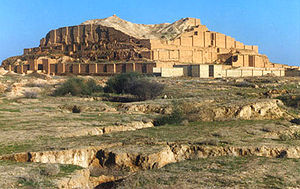
Susa
Susa was an ancient city of the Elamite, Persian and Parthian empires of Iran. It is located in the lower Zagros Mountains about east of the Tigris River, between the Karkheh and Dez Rivers....
. The first large scale empire based here was that of the powerful 4th millennium BC Elamites.
Archeological ruins verify the entire province of Khuzestan to be home to the Elamite civilization, a non-Semitic, and non-Indo-European-speaking kingdom, and
"the earliest civilization of Persia". The name Khuzestan is derived from the Elamite (Ūvja).
In fact, in the words of Elton L. Daniel
Elton L. Daniel
Elton L. Daniel, Ph.D., is a historian and Iranologist.A professor at the University of Hawaii, he received his doctorate from UT Austin. Elton Daniel is an associate editor of Encyclopædia Iranica, and has conducted research and traveled extensively in Iran, Turkey, Syria, Egypt, France, and the...
, the Elamites were "the founders of the first Iranian empire in the geographic sense." Hence the central geopolitical significance of Khuzestan, the seat of Iran's first empire.
In 640 BC, the Elamites were defeated by Ashurbanipal
Ashurbanipal
Ashurbanipal |Ashur]] is creator of an heir"; 685 BC – c. 627 BC), also spelled Assurbanipal or Ashshurbanipal, was an Assyrian king, the son of Esarhaddon and the last great king of the Neo-Assyrian Empire...
, coming under the rule of the Assyrians who brought destruction upon Susa and Chogha Zanbil. But in 538 BC, Cyrus the Great was able to re-conquer the Elamite lands. The city of Susa was then proclaimed as one of the Achaemenid capitals. Darius the Great
Darius I of Persia
Darius I , also known as Darius the Great, was the third king of kings of the Achaemenid Empire...
then erected a grand palace known as Apadana there in 521 BC. But this astonishing period of glory and splendor of the Achaemenian dynasty came to an end by the conquests of Alexander of Macedon. After Alexander, the Seleucid dynasty
Seleucid dynasty
The Seleucid dynasty or the Seleucidae was a Greek Macedonian royal family, founded by Seleucus I Nicator , which ruled the Seleucid Kingdom centered in the Near East and regions of the Asian part of the earlier Achaemenid Persian Empire during the Hellenistic period.-History:Seleucus was an...
came to rule the area.
As the Seleucid dynasty
Seleucid dynasty
The Seleucid dynasty or the Seleucidae was a Greek Macedonian royal family, founded by Seleucus I Nicator , which ruled the Seleucid Kingdom centered in the Near East and regions of the Asian part of the earlier Achaemenid Persian Empire during the Hellenistic period.-History:Seleucus was an...
weakened, Mehrdad I
Mithridates I of Parthia
Mithridates or Mithradates I was the "Great King" of Parthia from ca. 171 BC - 138 BC, succeeding his brother Phraates I. His father was King Phriapatius of Parthia, who died ca. 176 BC). Mithridates I made Parthia into a major political power by expanding the empire to the east, south, and west...
the Parthia
Parthia
Parthia is a region of north-eastern Iran, best known for having been the political and cultural base of the Arsacid dynasty, rulers of the Parthian Empire....
n (171-137 BC), gained ascendency over the region. During the Sassanid dynasty this area thrived tremendously and flourished, and this dynasty was responsible for the many constructions that were erected in Ahwaz, Shushtar
Shushtar
-External links:** Hamid-Reza Hosseini, Shush at the foot of Louvre , in Persian, Jadid Online, 10 March 2009, .Audio slideshow: .* .* * , PressTV, 13 June 2010....
, and the north of Andimeshk
Andimeshk
Andimeshk is a city in and the capital of Andimeshk County, Khuzestan Province, Iran. At the 2006 census, its population was 119,422, in 26,140 families....
.
During the early years of the reign of Shapur II
Shapur II
Shapur II the Great was the ninth King of the Persian Sassanid Empire from 309 to 379 and son of Hormizd II. During his long reign, the Sassanid Empire saw its first golden era since the reign of Shapur I...
(A.D. 309 or 310-379), Arabs crossed the Persian Gulf
Persian Gulf
The Persian Gulf, in Southwest Asia, is an extension of the Indian Ocean located between Iran and the Arabian Peninsula.The Persian Gulf was the focus of the 1980–1988 Iran-Iraq War, in which each side attacked the other's oil tankers...
from Bahrain
Bahrain
' , officially the Kingdom of Bahrain , is a small island state near the western shores of the Persian Gulf. It is ruled by the Al Khalifa royal family. The population in 2010 stood at 1,214,705, including 235,108 non-nationals. Formerly an emirate, Bahrain was declared a kingdom in 2002.Bahrain is...
to "Ardashir-Khora" of Fars and raided the interior. In retaliation, Shapur II led an expedition through Bahrain, defeated the combined forces of the Arab tribes of "Taghleb", "Bakr bin Wael", and "Abd Al-Qays" and advanced temporarily into Yamama in central Najd
Najd
Najd or Nejd , literally Highland, is the central region of the Arabian Peninsula.-Boundaries :The Arabic word nejd literally means "upland" and was once applied to a variety of regions within the Arabian Peninsula...
. The Sassanids resettled these tribes in Kerman
Kerman
- Geological characteristics :For the Iranian paleontologists, Kerman has always been considered a fossil paradise. Finding new dinosaur footprints in 2005 has now revealed new hopes for paleontologists to better understand the history of this area.- Economy :...
and Ahwaz. Arabs named Shapur II, as "Shabur Dhul-aktāf" after this battle.
The existence of prominent scientific and cultural centers such as Academy of Gundishapur
Academy of Gundishapur
The Academy of Gondishapur , also Jondishapur , was a renowned academy of learning in the city of Gundeshapur during late antiquity, the intellectual center of the Sassanid empire. It offered training in medicine, philosophy, theology and science. The faculty were versed in the Zoroastrian and...
which gathered distinguished medical scientists from Egypt
Egypt
Egypt , officially the Arab Republic of Egypt, Arabic: , is a country mainly in North Africa, with the Sinai Peninsula forming a land bridge in Southwest Asia. Egypt is thus a transcontinental country, and a major power in Africa, the Mediterranean Basin, the Middle East and the Muslim world...
, India, and Rome, shows the importance and prosperity of this region during this era. The Jondi-Shapur Medical School
Academy of Gundishapur
The Academy of Gondishapur , also Jondishapur , was a renowned academy of learning in the city of Gundeshapur during late antiquity, the intellectual center of the Sassanid empire. It offered training in medicine, philosophy, theology and science. The faculty were versed in the Zoroastrian and...
was founded by the order of Shapur I. It was repaired and restored by Shapur II (a.k.a. Zol-Aktaf: "The Possessor of Shoulder Blades") and was completed and expanded during the reign of Anushirvan.
The Arab Conquest of Khuzestan
Basra
Basra is the capital of Basra Governorate, in southern Iraq near Kuwait and Iran. It had an estimated population of two million as of 2009...
, who drove the Persian Hormozan out of Ahwaz. Susa
Susa
Susa was an ancient city of the Elamite, Persian and Parthian empires of Iran. It is located in the lower Zagros Mountains about east of the Tigris River, between the Karkheh and Dez Rivers....
later fell, so Hormozan fled to Shushtar
Shushtar
-External links:** Hamid-Reza Hosseini, Shush at the foot of Louvre , in Persian, Jadid Online, 10 March 2009, .Audio slideshow: .* .* * , PressTV, 13 June 2010....
. There his forces were besieged by Abu Musa for 18 months. Shushtar finally fell in 642 AD; the Khuzistan Chronicle records that a unknown arab, living in the city, befriended a man in the army, and dug tunnels through the wall in return for a third of the spoil. The Basrans purged the Nestorians - the Exegete of the city and the Bishop of Hormizd, and all their students - but kept Hormozan alive.
There followed the conquests of Jondishapoor and of many other districts along the Tigris. The battle of Nehavand
Nahavand
Nahavand is a city in and capital of Nahavand County, Hamadan Province, Iran. At the 2006 census, its population was 72,218, in 19,419 families. It is located south of Hamadan, east of Malayer and northwest of Borujerd...
finally secured Khuzestan for the Muslim armies.
It is interesting to notice that there was much cooperation between Sassanids and non-Muslim Arabs during the Muslim conquest period, which shows that those wars were not Arab vs. Persian, rather Muslim vs. non-Muslims. For instance in 633-634, Khaled ibn Walid leader of the Muslim Army, defeated a force of the Sassanids' Arab auxiliaries from the tribes of "Bakr", "'Ejl", "Taghleb" and "Namer" at "'Ayn Al-Tamr".
The Arab settlements by military garrisons in southern Iran was soon followed by other types of colonization. Some Arab families, for example, took the opportunity to gain control of private estates. Like the rest of Iran, the Arab invasion thus brought Khuzestan under occupation of the Arabs of the Umayyad
Umayyad
The Umayyad Caliphate was the second of the four major Arab caliphates established after the death of Muhammad. It was ruled by the Umayyad dynasty, whose name derives from Umayya ibn Abd Shams, the great-grandfather of the first Umayyad caliph. Although the Umayyad family originally came from the...
and Abbasid
Abbasid
The Abbasid Caliphate or, more simply, the Abbasids , was the third of the Islamic caliphates. It was ruled by the Abbasid dynasty of caliphs, who built their capital in Baghdad after overthrowing the Umayyad caliphate from all but the al-Andalus region....
Caliphates, until Ya'qub bin Laith as-Saffar
Ya'qub bin Laith as-Saffar
Ya'qub bin Laith as-Saffar or Ya'qub-i Laith Saffari was the founder of the Saffarid dynasty in Sistan, with its capital at Zaranj . He ruled territories that are now in Iran and Afghanistan, as well as portions of West Pakistan...
, from southeastern Iran, raised the flag of independence once more, and ultimately regained control over Khuzestan, among other parts of Iran, founding the short-lived Saffarid dynasty. From that point on, Iranian dynasties would continue to rule the region in succession as an important part of Iran.
In the Umayyad
Umayyad
The Umayyad Caliphate was the second of the four major Arab caliphates established after the death of Muhammad. It was ruled by the Umayyad dynasty, whose name derives from Umayya ibn Abd Shams, the great-grandfather of the first Umayyad caliph. Although the Umayyad family originally came from the...
period, large groups of nomads from the Hanifa, Bani Tamim, and Abd al-Qays tribes crossed the Persian Gulf
Persian Gulf
The Persian Gulf, in Southwest Asia, is an extension of the Indian Ocean located between Iran and the Arabian Peninsula.The Persian Gulf was the focus of the 1980–1988 Iran-Iraq War, in which each side attacked the other's oil tankers...
and occupied some of the richest Basra
Basra
Basra is the capital of Basra Governorate, in southern Iraq near Kuwait and Iran. It had an estimated population of two million as of 2009...
n territories around Ahwaz and in Fars during the second Islamic civil war in 661-665/680-684 A.D.
During the Abbassid period, in the second half of the 10th century, the Assad tribe, taking advantage of quarrels under the Buwayhids, penetrated into Khuzestan, where a group of Tamim had been living since pre-Islamic times. However, following the fall of the Abbassid dynasty, the flow of Arab immigrants into Persia gradually diminished, but it nonetheless continued.
In the latter part of the 16th century, the Bani Kaab , from Kuwait
Kuwait
The State of Kuwait is a sovereign Arab state situated in the north-east of the Arabian Peninsula in Western Asia. It is bordered by Saudi Arabia to the south at Khafji, and Iraq to the north at Basra. It lies on the north-western shore of the Persian Gulf. The name Kuwait is derived from the...
, settled in Khuzestan. And during the succeeding centuries, many more Arab tribes moved from southern Iraq to Khuzestan, and as a result, Khuzestan became "extensively Arabized". According to C.E. Bosworth in Encyclopædia Iranica
Encyclopædia Iranica
Encyclopædia Iranica is a project whose goal is to create a comprehensive and authoritative English language encyclopedia about the history, culture, and civilization of Iranian peoples from prehistory to modern times...
, under the Qajar dynasty "the province was known, as in Safavid times, as Arabistan, and during the Qajar period was administratively a governor-generalate." This designator, however, was reserved for the southern half of the province, from the Ahwaz Ridge
Ahwaz Ridge
The Ahwaz Ridge is a very narrow outcrop of rocky hills that extend from northwest near the town of Amarah on the Tigris in Iraq, southeast to the town of Ramhormoz, bisecting the Iranian province of Khuzistan in two. The city of Ahwaz/Ahvaz is located in the geographical center of the Ridge, where...
to the shores of the Gulf. The northern, more populous parts, with the capital at Shushtar
Shushtar
-External links:** Hamid-Reza Hosseini, Shush at the foot of Louvre , in Persian, Jadid Online, 10 March 2009, .Audio slideshow: .* .* * , PressTV, 13 June 2010....
, retained the old name, but also occasionally was incorporated into the district of the Greater Lur.
In 1856, in the course of the Anglo-Persian War
Anglo-Persian War
The Anglo-Persian War lasted between November 1, 1856 and April 4, 1857, and was fought between the United Kingdom of Great Britain and Ireland and Persia . In the war, the British opposed an attempt by Persia to reacquire the city of Herat...
over the city of Herat
Herat
Herāt is the capital of Herat province in Afghanistan. It is the third largest city of Afghanistan, with a population of about 397,456 as of 2006. It is situated in the valley of the Hari River, which flows from the mountains of central Afghanistan to the Karakum Desert in Turkmenistan...
, the British naval forces sailed up the Karun
Karun
The Kārun is Iran's most effluent, and the only navigable, river. It is 450 miles long. It rises in the Zard Kuh mountains of the Bakhtiari district in the Zagros Range, receiving many tributaries, such as the Dez and the Kuhrang, before passing through the capital of the Khuzestan Province of...
river all the way to Ahwaz. However, in the settlement that followed, they evacuated the province. Some tribal forces, such as those led by Sheikh Jabir al-Kaabi
Sheikh Jabir al-Kaabi
Sheikh Jabir al-Kaabi was the leader of the Bani Kaab Arab tribe and the Sheikh of Khorramshahr during the 19th century...
, the Sheikh of Mohammerah
Khorramshahr
Khorramshahr is a city in and the capital of Khorramshahr County, Khuzestan Province, Iran. At the 2006 census, its population was 123,866, in 26,385 families.Khorramshahr is a port city located approximately north of Abadan...
, fared better in opposing the invading British forces than those dispatched by the central government, which was quite feeble. But, the point of the invasion of the province and other coastal regions of southern Persia/Iran
Iran
Iran , officially the Islamic Republic of Iran , is a country in Southern and Western Asia. The name "Iran" has been in use natively since the Sassanian era and came into use internationally in 1935, before which the country was known to the Western world as Persia...
were to force the evacuation of Herat
Herat
Herāt is the capital of Herat province in Afghanistan. It is the third largest city of Afghanistan, with a population of about 397,456 as of 2006. It is situated in the valley of the Hari River, which flows from the mountains of central Afghanistan to the Karakum Desert in Turkmenistan...
by the Persians and not the permanent occupation of these regions.
Persian rule
In the past eighty years, except during the Iran-Iraq warIran-Iraq War
The Iran–Iraq War was an armed conflict between the armed forces of Iraq and Iran, lasting from September 1980 to August 1988, making it the longest conventional war of the twentieth century...
, the province of Khuzestan thrived and prospered and today accounts for one of the regions in Iran that holds an economic and defensive strategic position.
Prior to 1925, although nominally part of Iranian territory, the area functioned for many years effectively as an autonomous emirate known as "Arabistan". The emirate was dissolved by Reza Shah
Reza Shah
Rezā Shāh, also known as Rezā Shāh Pahlavi and Rezā Shāh Kabir , , was the Shah of the Imperial State of Iran from December 15, 1925, until he was forced to abdicate by the Anglo-Soviet invasion of Iran on September 16, 1941.In 1925, Reza Shah overthrew Ahmad Shah Qajar, the last Shah of the Qajar...
government, along with other autonomous regions of Persia, in a bid to centralize the state. The old, historic name of 'Khuzistan' came to be applied once again to the entire territory by 1936.
Under Islamic Republic
Saddam HusseinSaddam Hussein
Saddam Hussein Abd al-Majid al-Tikriti was the fifth President of Iraq, serving in this capacity from 16 July 1979 until 9 April 2003...
attempted to control Khuzestan during the Iran-Iraq war
Iran-Iraq War
The Iran–Iraq War was an armed conflict between the armed forces of Iraq and Iran, lasting from September 1980 to August 1988, making it the longest conventional war of the twentieth century...
, which forced thousands of Iranians to flee the province. He claimed Khuzestan belonged to Iraq because of the large number of Arabic speaking persons in that province. Being on the border with Iraq, Khuzestan suffered the heaviest damage of all Iranian provinces during the Iran-Iraq war
Iran-Iraq War
The Iran–Iraq War was an armed conflict between the armed forces of Iraq and Iran, lasting from September 1980 to August 1988, making it the longest conventional war of the twentieth century...
(1980–1988).
What used to be Iran's largest refinery at Abadan was destroyed, never to fully recover. Many of the famous nakhlestans (palm groves) were annihilated, cities were destroyed, historical sites were demolished, and nearly half the province went under the boots of Saddam's invading army. This created a mass exodus into other provinces that did not have the logistical capability of taking in such a large number of refugees.
However, by 1982, Iranian forces managed to push Saddam's
Operation Undeniable Victory
Operation Undeniable Victory also known as Operation Fath-ol-Mobeen was an Iranian operation conducted during the Iran-Iraq War, in March 1982....
forces back into Iraq. The battle of "the Liberation of Khorramshahr
Liberation of Khorramshahr
The Liberation of Khorramshahr was the Iranian recapture of the port city of Khorramshahr from the Iraqis on May 24, 1982 during the Iran–Iraq War. The Iraqis had captured the city early in the war on October 26, 1980. The successful retaking of the city was part of Operation Beit ol-Moqaddas...
" (one of Khuzestan's largest cities and the most important Iranian port prior to the war) was a turning point in the war, and is officially celebrated every year in Iran.
The government of the Islamic Republic of Iran does not conduct any official ethnic census in Iran
Iran
Iran , officially the Islamic Republic of Iran , is a country in Southern and Western Asia. The name "Iran" has been in use natively since the Sassanian era and came into use internationally in 1935, before which the country was known to the Western world as Persia...
, thus it is difficult to determine the exact demographics
Demographics
Demographics are the most recent statistical characteristics of a population. These types of data are used widely in sociology , public policy, and marketing. Commonly examined demographics include gender, race, age, disabilities, mobility, home ownership, employment status, and even location...
. Beginning in the early nineties, many ethnic Persian Khuzestanis began returning to the province, a trend which continues to this day as the major urban centres are being rebuilt and restored. Restoration has been slow due to neglect by the regime of the Islamic Republic
Islamic republic
Islamic republic is the name given to several states in the Muslim world including the Islamic Republics of Pakistan, Iran, Afghanistan, and Mauritania. Pakistan adopted the title under the constitution of 1956. Mauritania adopted it on 28 November 1958. Iran adopted it after the 1979 Iranian...
. The city of Khorramshahr
Khorramshahr
Khorramshahr is a city in and the capital of Khorramshahr County, Khuzestan Province, Iran. At the 2006 census, its population was 123,866, in 26,385 families.Khorramshahr is a port city located approximately north of Abadan...
was almost completely destroyed as a result of Saddam's scorched earth
Scorched earth
A scorched earth policy is a military strategy or operational method which involves destroying anything that might be useful to the enemy while advancing through or withdrawing from an area...
policy. Fortunately, Iranian forces were able to prevent the Iraqis from attempting to spread the execution of this policy to other major urban centres.
The Iranian Embassy Siege
Iranian Embassy Siege
The Iranian Embassy siege took place from 30 April to 5 May 1980, after a group of six armed men stormed the Iranian embassy in South Kensington, London. The gunmen took 26 people hostage—mostly embassy staff, but several visitors and a police officer, who had been guarding the embassy, were also...
of 1980 was a siege of the Iranian Embassy in London initiated by an Arab separatist group. Initially it emerged the terrorists wanted autonomy for Khuzestan; later they demanded the release of 91 of their comrades held in Iranian jails.
The group which claimed responsibility for the siege- the Arab Popular Movement in Arabistan- gave a number of press conferences in the following months, referring to what it described as "the racist rule of Khomeini". It threatened further international action as part of its campaign to gain self- rule for Khuzestan. But its links with Baghdad
Baghdad
Baghdad is the capital of Iraq, as well as the coterminous Baghdad Governorate. The population of Baghdad in 2011 is approximately 7,216,040...
served to undermine its argument that it was a purely Iran
Iran
Iran , officially the Islamic Republic of Iran , is a country in Southern and Western Asia. The name "Iran" has been in use natively since the Sassanian era and came into use internationally in 1935, before which the country was known to the Western world as Persia...
ian opposition group; there were allegations that it was backed by Iran's regional rival, Iraq
Iraq
Iraq ; officially the Republic of Iraq is a country in Western Asia spanning most of the northwestern end of the Zagros mountain range, the eastern part of the Syrian Desert and the northern part of the Arabian Desert....
. Their leader ("Salim" - Awn Ali Mohammed) along with four other members of the group were killed and the fifth member, Fowzi Badavi Nejad, was sentenced to life imprisonment.
In 2005, Ahwaz witnessed a number of terrorist attacks
Ahvaz Bombings
The Ahvaz bombings were a series of bomb explosions, that took place mostly in Ahvaz, Iran in 2005-2006, and were blamed on Ahvaz separatist organizations of Sunni Arabs. The bombings were linked to the violent April 15 unrest in Ahvaz, prior to the bombings...
, which came following the violent Ahvaz riots. The first bombing
Ahvaz Bombings
The Ahvaz bombings were a series of bomb explosions, that took place mostly in Ahvaz, Iran in 2005-2006, and were blamed on Ahvaz separatist organizations of Sunni Arabs. The bombings were linked to the violent April 15 unrest in Ahvaz, prior to the bombings...
came ahead of the presidential election on 12 June 2005.
Politics of the Khuzestan province
Khuzestan is ethnically diverse, home to a number of distinct peoples and tribal groups. This has a bearing on Khuzestan's electoral politics, with ethnic minority rights playing a significant role in the province's political culture. The province's geographical location bordering Iraq and its oil resources also make it a politically sensitive region, particularly given its history of foreign intervention, notably the Iraqi invasion of 1980. At the same time, there are ethnic grievances among the province's population, mostly from some Arab groups. The Arab population has established itself in Khuzestan mainly through the last 5 centuries of migration from neighbouring regions of Iraq well after the establishment of Iranic elements in the region.Some Arab groups complain over the distribution of the revenue generated by oil resources with claims that the central government is failing to invest profits from the oil industry in employment generation, post-war reconstruction and welfare projects. Low human development indicators among local Khuzestanis are contrasted with the wealth generation of the local oil industry. Minority rights are frequently identified with strategic concerns, with ethnic unrest perceived by the Iranian government as being generated by foreign governments to undermine the country's oil industry and its internal stability. The politics of Khuzestan therefore have international significance and go beyond the realm of electoral politics.
According to Jane's Information Group
Jane's Information Group
Jane's Information Group is a publishing company specializing in transportation and military topics.-History:It was founded by Fred T...
, "Most Iranian Arabs seek their constitutionally guaranteed rights and do not have a separatist agenda ... While it may be true that some Arab activists are separatists, most see themselves as Iranians first and declare their commitment to the state's territorial integrity."
People and culture
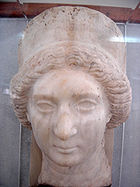
Khuzestan, unlike most other provinces in Iran, is inhabited by a number of ethnic minorities and peoples: Persians
Persian people
The Persian people are part of the Iranian peoples who speak the modern Persian language and closely akin Iranian dialects and languages. The origin of the ethnic Iranian/Persian peoples are traced to the Ancient Iranian peoples, who were part of the ancient Indo-Iranians and themselves part of...
in major cities, Iranian Arabs, the Bakhtiari Lurs
Lurs
Lurs are an Iranic people living mainly in south-western Iran. Their population is estimated at above two million. They occupy Lorestan, Bakhtiari, and Kuh-Gilu-Boir Ahmed. "....
, Behbahanis, Mizrahi Jews
Mizrahi Jews
Mizrahi Jews or Mizrahiyim, , also referred to as Adot HaMizrach are Jews descended from the Jewish communities of the Middle East, North Africa and the Caucasus...
, Laks
Lak people (Iran)
The Laks are an Iranian group in southwestern Iran. They speak Laki , a Northwestern Iranian language, that is usually grouped with Southern Kurdish dialects...
, and other Lurs of the north, the Turkic
Turkic peoples
The Turkic peoples are peoples residing in northern, central and western Asia, southern Siberia and northwestern China and parts of eastern Europe. They speak languages belonging to the Turkic language family. They share, to varying degrees, certain cultural traits and historical backgrounds...
-speaking Qashqai
Qashqai
Qashqai are the largest group of nomadic pastoralists people of Azeri descent who mainly live in the provinces of Fars, Khuzestan and southern Isfahan on the territory of modern Iran, especially around the city of Shiraz in Fars. They speak the Qashqai language which is a member of the Turkic...
and Afshari tribes, the Khuzis of Shush
Shush
Shush may be:*the Iranian town of Shush**the Persian name of ancient Susa, which is next to the modern town**Shush County, Iran**a Tehran metro station* S.H.U.S.H., the fictional peace-keeping organization* Slang to keep quiet...
/Susa
Susa
Susa was an ancient city of the Elamite, Persian and Parthian empires of Iran. It is located in the lower Zagros Mountains about east of the Tigris River, between the Karkheh and Dez Rivers....
, Dezful
Dezful
Dezful is a city in and the capital of Dezful County, Khuzestan Province, Iran. At the 2006 census, its population was 228,507, in 55,711 families.The city houses a bridge that dates back to 300 BC.In 2006, the city had 235,819 inhabitants.-History:...
, Shushtar
Shushtar
-External links:** Hamid-Reza Hosseini, Shush at the foot of Louvre , in Persian, Jadid Online, 10 March 2009, .Audio slideshow: .* .* * , PressTV, 13 June 2010....
, Andimeshk
Andimeshk
Andimeshk is a city in and the capital of Andimeshk County, Khuzestan Province, Iran. At the 2006 census, its population was 119,422, in 26,140 families....
and the inhabitants of the coastal regions of the Persian Gulf all make up the population of the province of Khuzestan. There are no official ethnic statistics released by Iran's government.
Khuzestan in literature
Khuzestan has long been the subject of many a writer and poet of Persia, banking on its ample sugar production to use the term as allegory for sweetness. Some popular verses are:زبس کز دامن لب شکر افشاند
شکر دامن به خوزستان بر افشاند
"Her lips aflow with sweet sugar,
The sweet sugar that aflows in Khuzestan."
Nizami
قد رعنای تو و قامت سرو کشمر
لب شیرین تو و شکر خوزستانی
"Your graceful figure like the cypress in Kashmar
Cypress of Kashmar
The Cypress of Kashmar is a mythical cypress tree of legendary beauty and gargantuan dimensions, celebrated in the Iranian epic Shahnameh and other sources...
,
Your sweet lips like the sugar of Khuzestan."
Nizari Qohistani
که باشد که پیوند سام سوار
نخواهد از اهواز تا قندهار
"So Sām hath not need ride afar
from Ahvaz
Ahvaz
-History:For a more comprehensive historical treatment of the area, see the history section of Khūzestān Province.-Ancient history:Ahvaz is the anagram of "Avaz" and "Avaja" which appear in Darius's epigraph...
up to Qandehar."
Ferdosi
Languages
Most Arabic-speakers speak a variety of ArabicVarieties of Arabic
The Arabic language is a Semitic language characterized by a wide number of linguistic varieties within its five regional forms. The largest divisions occur between the spoken languages of different regions. The Arabic of North Africa, for example, is often incomprehensible to an Arabic speaker...
distinct to the region known as Khuzestani Arabic
Khuzestani Arabic
Khuzestani Arabic is a dialect of Arabic spoken in the Iranian province of Khuzestan. It is an Iraqi Arabic dialect and contains many Persian loanwords.-References:*...
. Some Khuzestanis are bilingual, speaking both Persian
Persian language
Persian is an Iranian language within the Indo-Iranian branch of the Indo-European languages. It is primarily spoken in Iran, Afghanistan, Tajikistan and countries which historically came under Persian influence...
and Arabic
Arabic language
Arabic is a name applied to the descendants of the Classical Arabic language of the 6th century AD, used most prominently in the Quran, the Islamic Holy Book...
. The Persian
Khuzestani Persian
There are a number of Khuzestani Persian dialects unique to the province of Khuzestan in southwestern Iran.There are two main regional classifications, in addition to less common varieties:-Northern region:* Behbahani* Dezfuli* Masjed Soleiman...
, Bakhtiari Lurs and other Lur groups of western Khuzestan all speak distinct dialects unique to their areas. Shushtari,Dezfuli and Behbahani are other dialects spoken in Khuzestan. It is also not uncommon to find people able to speak a variety of indigenous dialects in addition to their own.
Traditions and religion
Khuzestani folk music is colorful and festive, and each native group has their own rich traditions and legacy in this area.The people of Khuzestan are predominantly Muslim
Muslim
A Muslim, also spelled Moslem, is an adherent of Islam, a monotheistic, Abrahamic religion based on the Quran, which Muslims consider the verbatim word of God as revealed to prophet Muhammad. "Muslim" is the Arabic term for "submitter" .Muslims believe that God is one and incomparable...
, followed by minorities (Jewish
Judaism
Judaism ) is the "religion, philosophy, and way of life" of the Jewish people...
and Mandean). Khuzestanis are also very well regarded for their hospitality and generosity.
Cuisine
SeafoodSeafood
Seafood is any form of marine life regarded as food by humans. Seafoods include fish, molluscs , crustaceans , echinoderms . Edible sea plants, such as some seaweeds and microalgae, are also seafood, and are widely eaten around the world, especially in Asia...
is the most important part of Khuzestani cuisine
Cuisine
Cuisine is a characteristic style of cooking practices and traditions, often associated with a specific culture. Cuisines are often named after the geographic areas or regions that they originate from...
, but many other dishes are also featured. The most popular Khuzestani dish is Ghalyeh Maahi. A popular fishdish that is prepared with heavy spices, onions and cilantro. The fish used in the dish is locally known as mahi soboor (shad
Shad
The shads or river herrings comprise the genus Alosa, fish related to herring in the family Clupeidae. They are distinct from others in that family by having a deeper body and spawning in rivers. The several species frequent different areas on both sides of the Atlantic Ocean, Mediterranean Sea....
fish), a species of fish
Fish
Fish are a paraphyletic group of organisms that consist of all gill-bearing aquatic vertebrate animals that lack limbs with digits. Included in this definition are the living hagfish, lampreys, and cartilaginous and bony fish, as well as various extinct related groups...
found in the Persian Gulf. Other provincial specialties include qæliye-mæhi ("fish casserole"), qæliye-meygu ("shrimp casserole"), ashe-mohshala (a Khorramshahr
Khorramshahr
Khorramshahr is a city in and the capital of Khorramshahr County, Khuzestan Province, Iran. At the 2006 census, its population was 123,866, in 26,385 families.Khorramshahr is a port city located approximately north of Abadan...
i breakfast stew), sær shir (a Dezful
Dezful
Dezful is a city in and the capital of Dezful County, Khuzestan Province, Iran. At the 2006 census, its population was 228,507, in 55,711 families.The city houses a bridge that dates back to 300 BC.In 2006, the city had 235,819 inhabitants.-History:...
i breakfast of heavy cream), hælim (a Shushtar
Shushtar
-External links:** Hamid-Reza Hosseini, Shush at the foot of Louvre , in Persian, Jadid Online, 10 March 2009, .Audio slideshow: .* .* * , PressTV, 13 June 2010....
i breakfast of wheatmeal with shredded lamb), and kohbbeh (a deep-fried rice cake with ground beef filling and other spices of Arabic origin, a variant on Levant
Levant
The Levant or ) is the geographic region and culture zone of the "eastern Mediterranean littoral between Anatolia and Egypt" . The Levant includes most of modern Lebanon, Syria, Jordan, Israel, the Palestinian territories, and sometimes parts of Turkey and Iraq, and corresponds roughly to the...
ine kibbeh
Kibbeh
Kibbeh or kibbe is an Arab dish made of bulgur or rice and chopped meat. The best-known variety is a torpedo-shaped fried croquette stuffed with minced beef or lamb. Other types of kibbeh may be shaped into balls or patties, and baked or cooked in broth.Kibbeh is a popular dish in Levantine...
). Also see Iranian cuisine
Iranian cuisine
Iranian cuisine is diverse, with each province featuring dishes, culinary traditions and styles distinct to its region.It includes a wide variety of foods ranging from chelo kabab , khoresht Iranian cuisine is diverse, with each province featuring dishes, culinary traditions and styles distinct to...
.
Historical figures
Many scientists, philosophers, and poets have come from Khuzestan, including Abu NuwasAbu Nuwas
Abu-Nuwas al-Hasan ben Hani Al-Hakami ,a known as Abū-Nuwās , was one of the greatest of classical Arabic poets, who also composed in Persian on occasion. Born in the city of Ahvaz in Persia, of an Arab father and a Persian mother, he became a master of all the contemporary genres of Arabic poetry...
, Abdollah ibn-Meymun Ahvazi, the astronomer Nowbækht-e Ahwazi
Naubakht
Nobakht Ahvazi also transliterated 'Naubakht') and his sons were astrologers from Ahvaz .Nobakht was particularly famous for having led a group of astrologers who picked an auspicious electional chart for the founding of Baghdad. His family also helped design the city...
and his sons as well as Jorjis, the son of Bakhtshua Gondishapuri
Bukhtishu
Bakhtshooa Gondishapoori were Persian Nestorian Christian physicians from the 7th, 8th, and 9th centuries, spanning 6 generations and 250 years. Some of them served as the personal physicians of Caliphs. Jurjis son of Bukht-Yishu was awarded 10,000 dinars by al-Mansur after attending to his malady...
, Ibn Sakit, Da'bal-e Khazai and Sheikh Mortedha Ansari
Morteza Ansari
Morteza Ansari , was a Shia jurist who "was generally acknowledged as the most eminent jurist of the time." Ansari has also been called the "first effective" model or Marja of the Shia or "the first scholar universally recognized as supreme authority in matters of Shii law", and the first to...
, a prominent Shi'a scholar from Dezful
Dezful
Dezful is a city in and the capital of Dezful County, Khuzestan Province, Iran. At the 2006 census, its population was 228,507, in 55,711 families.The city houses a bridge that dates back to 300 BC.In 2006, the city had 235,819 inhabitants.-History:...
.
Economy
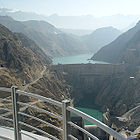
Iran
Iran , officially the Islamic Republic of Iran , is a country in Southern and Western Asia. The name "Iran" has been in use natively since the Sassanian era and came into use internationally in 1935, before which the country was known to the Western world as Persia...
, and as such is one of the wealthiest provinces in Iran. Khuzestan ranks third among Iran's provinces in GDP.
In 2005, Iran's government announced it was planning the country's second nuclear reactor to be built in Khuzestan province. The 360 MW reactor will be a Light Water PWR Reactor
Pressurized water reactor
Pressurized water reactors constitute a large majority of all western nuclear power plants and are one of three types of light water reactor , the other types being boiling water reactors and supercritical water reactors...
.
Khuzestan is also home to the Arvand Free Trade Zone. It is one of six economic Free Trade Zones in Iran. and the PETZONE (Petrochemical Special Economic Zone in Mahshahr
Mahshahr
Bandar-e Mahshahr is a city in and the capital of Mahshahr County, Khuzestan Province, Iran. At the 2006 census, its population was 109,927, in 24,110 families....
).
Shipping
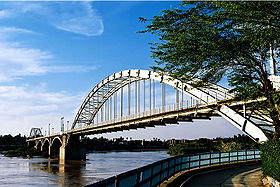
Austen Henry Layard
Sir Austen Henry Layard GCB, PC was a British traveller, archaeologist, cuneiformist, art historian, draughtsman, collector, author, politician and diplomat, best known as the excavator of Nimrud.-Family:...
, transported their merchandise via Karun's waterways, passing through Ahvaz all the way up to Langar near Shushtar, and then sent by road to Masjed Soleimanthe site of their first oil wells in the Naftoon oil field. Karoun is capable of the sailing of fairly large ships as far up as Shushtar
Shushtar
-External links:** Hamid-Reza Hosseini, Shush at the foot of Louvre , in Persian, Jadid Online, 10 March 2009, .Audio slideshow: .* .* * , PressTV, 13 June 2010....
.
Karkheh, Jarrahi, Arvand Rud, Handian, Shavoor, Bahmanshir (Bahman-Ardeshir), Maroon-Alaa', Dez, and many other rivers and water sources in the form of Khurs, lagoons, ponds, and marshes demonstrate the vastness of water resources in this region, and are the main reason for the variety of agricultural products developed in the area.
Agriculture
The abundance of water and fertility of soil have transformed this region into a rich and well-endowed land. The variety of agricultural products such as wheatWheat
Wheat is a cereal grain, originally from the Levant region of the Near East, but now cultivated worldwide. In 2007 world production of wheat was 607 million tons, making it the third most-produced cereal after maize and rice...
, barley
Barley
Barley is a major cereal grain, a member of the grass family. It serves as a major animal fodder, as a base malt for beer and certain distilled beverages, and as a component of various health foods...
, oily seeds, rice
Rice
Rice is the seed of the monocot plants Oryza sativa or Oryza glaberrima . As a cereal grain, it is the most important staple food for a large part of the world's human population, especially in East Asia, Southeast Asia, South Asia, the Middle East, and the West Indies...
, eucalyptus
Eucalyptus
Eucalyptus is a diverse genus of flowering trees in the myrtle family, Myrtaceae. Members of the genus dominate the tree flora of Australia...
, medical herbs; the existence of many palm and citrus
Citrus
Citrus is a common term and genus of flowering plants in the rue family, Rutaceae. Citrus is believed to have originated in the part of Southeast Asia bordered by Northeastern India, Myanmar and the Yunnan province of China...
farms; having mountains suitable for raising olive
Olive
The olive , Olea europaea), is a species of a small tree in the family Oleaceae, native to the coastal areas of the eastern Mediterranean Basin as well as northern Iran at the south end of the Caspian Sea.Its fruit, also called the olive, is of major agricultural importance in the...
s, and of course sugar cane - from which Khuzestan takes its name - all show the great potential of this fertile plain. In 2005, 51,000 hectares of land were planted ith sugar cane, producing 350,000 tons of sugar
Sugar
Sugar is a class of edible crystalline carbohydrates, mainly sucrose, lactose, and fructose, characterized by a sweet flavor.Sucrose in its refined form primarily comes from sugar cane and sugar beet...
. The abundance of water supplies, rivers, and dams, also have an influence on the fishery industries, which are prevalent in the area.
Industry
There are several cane sugar millCane sugar mill
A cane sugar mill is a factory that processes sugar cane to produce raw or white sugar.- Processing :Traditionally, sugarcane processing requires two stages. Mills extract raw sugar from freshly harvested cane, and sometimes bleach it to make "mill white" sugar for local consumption...
s in Khuzestan province, among them Haft Tepe
Haft Tepe
Haft Tepe is an archaeological site situated in the Khuzestan Province in southwestern Iran. At this site the remains of the Elamite city of Kabnak were discovered in 1908, and excavations are still carried out.-History:...
and Karun Agro Industry near Shushtar
Shushtar
-External links:** Hamid-Reza Hosseini, Shush at the foot of Louvre , in Persian, Jadid Online, 10 March 2009, .Audio slideshow: .* .* * , PressTV, 13 June 2010....
.
The Karun 3
Karun-3 dam
The Karun-3 dam is a hydroelectric dam on the Karun river in the province of Khuzestan, Iran. It was built to help meet Iran's energy demands as well as to provide flood control. The Karun has the highest discharge of Iran's rivers....
and 4, and Karkheh Dam, as well as the petroleum reserves provide Iran with national sources of revenue and energy. The petrochemical and steel industries, pipe making, the power stations that feed the national electricity grid, the chemical plants, and the large refineries are some of Iran's major industrial facilities.
The province is also home to Yadavaran Field
Yadavaran Field
Yadavaran Field oil field is one of the NIOC Recent Discoveries which is located in Khuzestan, Iran.The name is new, as the field is made up of two former fields, Koushk and Hosseinieh...
, a major oil field.
Higher education
- Khorramshahr University of Nautical Sciences and Technologies
- Ahvaz Jundishapur University of Medical SciencesAhvaz Jundishapur University of Medical SciencesAhvaz Jundishapur University of Medical Sciences is a medical school in Khuzestan Province of Iran.Located in southwestern Iran in the city of Ahvaz, the university was established as a College of Medicine administered by the Shahid Chamran University of Ahvaz in 1955, which itself was a revived...
- Petroleum University of Technology
- Shahid Chamran University of Ahwaz
- Shahid Chamran University-Dezful
- Islamic Azad University of Shushtar
- Islamic Azad University of Abadan
- Islamic Azad University of Omidiyeh
- Islamic Azad University of Ahvaz
- Islamic Azad University of Behbahan
- Islamic Azad University of Izeh
- Amirkabir University of TechnologyAmirkabir University of TechnologyAmirkabir University of Technology , formerly called the Tehran Polytechnic is a public research university located in Tehran, Iran. AUT is one of the most prestigious universities and the first established technical university in Iran...
, Mahshahr campus - Azad University of Mahshahr
Attractions of Khuzestan
Iran National Heritage Organization lists 140 sites of historical and cultural significance in Khuzestan, reflecting the fact that the province was once the seat of Iran's most ancient empire.Some of the more popular sites of attraction include:
- Choqa ZanbilChoqa ZanbilChogha Zanbil ; Elamite: Dur Untash) is an ancient Elamite complex in the Khuzestan province of Iran.It is one of the few existent ziggurats outside of Mesopotamia...
: The seat of the Elamite Empire, this zigguratZigguratZiggurats were massive structures built in the ancient Mesopotamian valley and western Iranian plateau, having the form of a terraced step pyramid of successively receding stories or levels.Notable ziggurats include the Great Ziggurat of Ur near Nasiriyah, Iraq; the Ziggurat of Aqar Quf near...
is a magnificent five-story temple that is one of the greatest ancient monuments in the Middle-East today. The monolith, with its labyrinthine walls made of thousands of large bricks with Elamite inscription, manifest the sheer antiquity of the shrine. The temple was religiously sacred and built in the honor of InshushinakInshushinakInshushinak was one of the major gods of the Elamites and the protector deity of Susa. The ziggurat at Choqa Zanbil is dedicated to him.-References:* ISBN 0-521-563585*...
, the protector deity of the city of SusaSusaSusa was an ancient city of the Elamite, Persian and Parthian empires of Iran. It is located in the lower Zagros Mountains about east of the Tigris River, between the Karkheh and Dez Rivers....
. - Shush-Daniel: Burial site of the Jewish prophet DanielDanielDaniel is the protagonist in the Book of Daniel of the Hebrew Bible. In the narrative, when Daniel was a young man, he was taken into Babylonian captivity where he was educated in Chaldean thought. However, he never converted to Neo-Babylonian ways...
. He is said to have died in SusaSusaSusa was an ancient city of the Elamite, Persian and Parthian empires of Iran. It is located in the lower Zagros Mountains about east of the Tigris River, between the Karkheh and Dez Rivers....
on his way to Jerusalem upon the order of Darius. The grave of Ya'qub bin Laith as-SaffarYa'qub bin Laith as-SaffarYa'qub bin Laith as-Saffar or Ya'qub-i Laith Saffari was the founder of the Saffarid dynasty in Sistan, with its capital at Zaranj . He ruled territories that are now in Iran and Afghanistan, as well as portions of West Pakistan...
, who rose against the oppression of the UmayyadUmayyadThe Umayyad Caliphate was the second of the four major Arab caliphates established after the death of Muhammad. It was ruled by the Umayyad dynasty, whose name derives from Umayya ibn Abd Shams, the great-grandfather of the first Umayyad caliph. Although the Umayyad family originally came from the...
Caliphate, is also located nearby. - DezfulDezfulDezful is a city in and the capital of Dezful County, Khuzestan Province, Iran. At the 2006 census, its population was 228,507, in 55,711 families.The city houses a bridge that dates back to 300 BC.In 2006, the city had 235,819 inhabitants.-History:...
(Dezh-pol), whose name is taken from a bridge (pol) over the DezDez RiverThe Dez River , the ancient Coprates , is a tributary of the Karun River and is 400 km long. It is the site of the Dez Dam.It is believed that a fortress protected a strategic bridge across the river at Dezful, whence the name, although no trace of this castle remains. The old part of the city...
river having 12 spans built by the order of Shapur I. This is the same bridge that was called "Andamesh Bridge" by historians such as Istakhri who says the city of AndimeshkAndimeshkAndimeshk is a city in and the capital of Andimeshk County, Khuzestan Province, Iran. At the 2006 census, its population was 119,422, in 26,140 families....
takes its name from this bridge. Muqaddasi called it "The City of the Bridge." - ShushtarShushtar-External links:** Hamid-Reza Hosseini, Shush at the foot of Louvre , in Persian, Jadid Online, 10 March 2009, .Audio slideshow: .* .* * , PressTV, 13 June 2010....
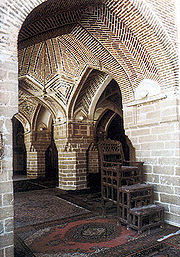
, Home to the famous Shushtar Watermills andone of the oldest fortress cities in Iran, known as the "City of Forty Elders" in local dialect. In and around Shushtar, there are many displays of ancient hydraulic engineering. There are also the Band Mizan and Band Qeysar, 2000 year old dams on the Karoun river and the famous Shadervan Bridge which is over 2000 years old.The Friday Mosque of Shushtar was built by the AbbasidAbbasidThe Abbasid Caliphate or, more simply, the Abbasids , was the third of the Islamic caliphates. It was ruled by the Abbasid dynasty of caliphs, who built their capital in Baghdad after overthrowing the Umayyad caliphate from all but the al-Andalus region....
s. The mosque, which features "Roman" arches, has 54 pillars and balconies. - IzehIzehIzeh is a city in and the capital of Izeh County, Khuzestan Province, Iran. At the 2006 census, its population was 103,695, in 20,127 families....
, or Izaj, was one of the main targets of the invading Islamic army in their conquest of Persia. Kharezad Bridge, one of the strangest bridges of the world, is situated in this city and was named after Ardeshir Babakan's mother. It is built over cast pillars of lead each 104 meters high. Ibn BattutaIbn BattutaAbu Abdullah Muhammad Ibn Battuta , or simply Ibn Battuta, also known as Shams ad–Din , was a Muslim Moroccan Berber explorer, known for his extensive travels published in the Rihla...
, who visited the city in the 14th century, refers to many monasteries, caravanseraiCaravanseraiA caravanserai, or khan, also known as caravansary, caravansera, or caravansara in English was a roadside inn where travelers could rest and recover from the day's journey...
s, aqueductAqueductAn aqueduct is a water supply or navigable channel constructed to convey water. In modern engineering, the term is used for any system of pipes, ditches, canals, tunnels, and other structures used for this purpose....
s, schools, and fortresses in the town. The brass statue of The Parthian Man, kept at the National Museum of IranNational Museum of IranThe National Museum of Iran is a museum in Tehran, Iran. It is the combination of two museums, the old Muze-ye Irân-e Bâstân , and the modernistic white travertine National Arts Museum , inaugurated in 1972...
, is from here. - Masjed Soleiman, another ancient town, has ancient fire altars and temples such as Sar-masjed and Bard-neshondeh. It is also the winter's resting area of the Bakhtiari tribe, and where William Knox D'ArcyWilliam Knox D'ArcyWilliam Knox D'Arcy was one of the principal founders of the oil and petrochemical industry in Persia .-Early life:...
dug Iran's first oil well. - Abadan is said to be where the tomb of Elijah, the long lived HebrewHebrewsHebrews is an ethnonym used in the Hebrew Bible...
prophet is. - IwanIwanAn iwan is a rectangular hall or space, usually vaulted, walled on three sides, with one end entirely open. The formal gateway to the iwan is called pishtaq, a Persian term for a portal projecting from the facade of a building, usually decorated with calligraphy bands, glazed tilework, and...
of HermesHermesHermes is the great messenger of the gods in Greek mythology and a guide to the Underworld. Hermes was born on Mount Kyllini in Arcadia. An Olympian god, he is also the patron of boundaries and of the travelers who cross them, of shepherds and cowherds, of the cunning of thieves, of orators and...
, and Iwan of Karkheh, two enigmatic ruins north of SusaSusaSusa was an ancient city of the Elamite, Persian and Parthian empires of Iran. It is located in the lower Zagros Mountains about east of the Tigris River, between the Karkheh and Dez Rivers....
.
Prominent people
- Babak Mostofizadeh, Patriarch and pioneer of Iranian Mountain Biking and professional downhill racer
- Siavash ShamsSiavash ShamsSiavash Shams is a popular and famous Persian and World music singer, songwriter, composer and record producer who has released 7 successful albums.-Early life:...
, famous Persian pop singer, songwriter and record producer - Mohammad Ali Assarehzadegan, researcher in Medical immunology and Molecular allergology, Ahwaz Jundishapur University of Medical Sciences
- Farid soleimani, the young chemical engineering studied in Isfahan.
- Mehrangiz KarMehrangiz KarMehrangiz Kar is a prominent Iranian lawyer, human right activist and author of the book Crossing the Red Line, as well as many articles.Mehrangiz Kar is a celebrated activist of women's rights in Iran....
, feminist lawyer and human rights activist. - Ezzat NegahbanEzzat NegahbanEzatollah Negahban was an Iranian archaeologist known as the father of Iranian modern archaeology.-Biography:Prof. Ezat O. Negahban was born Ahvaz, Iran...
, Patriarch of the Iranian modern archaeologyArchaeologyArchaeology, or archeology , is the study of human society, primarily through the recovery and analysis of the material culture and environmental data that they have left behind, which includes artifacts, architecture, biofacts and cultural landscapes...
. - Siavash GhomeyshiSiavash GhomeyshiSiavash Ghomayshi is an Iranian musician, singer and song writer.Siavash studied music in London where he got his Master's degree. He left Iran after 1979 and now lives in Los Angeles.-Biography:...
, singer, song writer and composer. - Kaiser Aminpour, famous poet.
- Rambod Shekarabi, actor.
- Hamid DabashiHamid DabashiHamid Dabashi born 1951 in Ahvaz is an Iranian-American Professor of Iranian Studies and Comparative Literature at Columbia University in New York City.He is the author of over twenty books...
, intellectual historian, cultural and literary critic. - Patrick MonahanPatrick Monahan (comedian)Patrick Monahan is an Irish-Iranian stand-up comedian born to an Irish father and an Iranian mother. He has performed at seven Edinburgh Festival Fringes, including five solo shows, and appeared multiple times on The Paul O'Grady Show...
, British comedian. - Parviz AbnarParviz AbnarParviz Abnar is an Iranian sound recordist.He graduated from the Academy of Cinema and Television in 1978. Abnar was the sound recordist for the film Rapport in 1986...
, sound recordist. - Kianoush Ayyari, director.
- Hamid Labkhandeh, director.
- Rahim MombeiniRahim MombeiniRahim Mombeini, president's deputy in charge of Iran's budget affairs, was born in 1334 in the village of Meydavood in Khuzestan. He is now deputy budget Department of Planning and Strategic Supervision.-References:...
, is now president's deputy in charge of Iran's budget affairs - Nasser TaghvaeeNasser TaghvaeeNāsser Taghvāí is an Iranian film director and screenwriter.Born in Abadan, Iran, he graduated from the Faculty of Literature in Tehran University. After early experiences as a storywriter, he began filming documentaries in 1967....
, director, photographer. - Parviz DehdariParviz DehdariParviz Dehdari was an Iranian football player and coach.-Early life:He was born on 21 March 1935 in Shiraz from an Abadani family. His family moved back to Abadan after his birth. He was grew in Abadan and began football in 1946.-Playing career:He initially to Jam Abadan in 1953...
, well-known footballer. - Ahmad NajafiAhmad NajafiAhmad Nadjafi Shoushtari is an Iranian actor and producer. He has a B.A. in Economics from the Woodbury University in Burbank, California. In 1976, he entered cinema by assisting Massoud Kimiayee in Ghazal. In 1976, he founded a movie distributing company in U.S., and he was the vice-president of...
, actor, film producer. - Reza Hayati Abadani, famous news reporter.
- Mohammad MousaviMohammad MousaviMohammad Mousavi is an Iranian musician noted for his ney work.Born in Ahvaz, south of Iran, he studied ney initially with Hassan Kassai. In 1966, he started performing for Iranian national radio programs.-External links:* ....
Ney soloist. - Rita Asgharpour, author.
- Bizhan EmkanianBizhan Emkanian-Selected filmography:* Bijan and Dream and Shoes -Short Film, 1969* Liegemen, 1981* The Daisy Flowers, 1984* Longing for Marriage, 1990-External links:...
, actor. - Ali ShamkhaniAli ShamkhaniAli Shamkhani is an Iranian admiral and politician. He was the Minister of Defense from August 19, 1997 until August 24, 2005 and was replaced by Mostafa Mohammad-Najjar.He is born in 1955 in Ahvaz, Khuzestan, he earned a B.S...
, Iran's minister of defense (1997–2005). - Masoud ShojaeiMasoud ShojaeiMasoud Soleimani Shojaei , sometimes known as just Masoud, is an Iranian footballer who plays for CA Osasuna in La Liga.Mainly an attacking midfielder who can also play as a forward, he is also an Iranian international.-Club career:...
, national football star. - Hossein Kaebi, national football star.
- Jalal Kameli MofradJalal Kameli MofradJalal Kameli-Mofrad is an Iranian football player who currently plays for Foolad in Iran's Premier League football as Captain.-Club career:Kameli Mofrad started his career at Foolad FC. At first due to his physical style, Mofrad played some good games and became a stater for his club. He was a...
, national football player. - Kamran Delan, popstar.
- The family of Bakhtshooa GondishapooriBukhtishuBakhtshooa Gondishapoori were Persian Nestorian Christian physicians from the 7th, 8th, and 9th centuries, spanning 6 generations and 250 years. Some of them served as the personal physicians of Caliphs. Jurjis son of Bukht-Yishu was awarded 10,000 dinars by al-Mansur after attending to his malady...
- Iman MobaliIman MobaliIman Mobali is an Iranian football player who currently plays for Al Sharjah in UAE Football League.-Club career:He was considered as the creative dynamo of the highly talented Foolad F.C., based in Iran's oil-rich Khuzestan province. Mobali was the key member of his team during Foolad's IPL...
, national football star. - Ahmad MahmoudAhmad MahmoudAhmad Mahmoud was an Iranian novelist.In his youth he worked as a day laborer, driver, construction worker and suffered imprisonment for leftist political views and oppositionist activities...
, novelist. - Akbar GolrangAkbar GolrangAkbar Golrang, born April 12, 1945, is an Iranian author and film director. He was born in Abadan and has directed over 20 films. In 1972 qualified as Film Director from The London Film School. 1976 Bachelor of Arts in Psychology from Lund University in Sweden...
, author and film director. - Mohammad Reza EskandariMohammad Reza EskandariMohammad Reza Eskandari was the Minister of Agriculture of the Islamic Republic of Iran from 2005 to 2009.-External links:*...
, Iran's current Minister of Agriculture - Mohsen RezaeeMohsen RezaeeMohsen Rezaee Mirgha'ed, also spelled Rezai and Rezaie , born Sabzevar Rezaee Mirgha'ed , is an Iranian politician, economist and former military commander, currently the Secretary of the Expediency Discernment Council of the Islamic Republic of Iran...
, Secretary of Iran's powerful Expediency Discernment CouncilExpediency Discernment CouncilThe Expediency Discernment Council of the System is an administrative assembly appointed by the Supreme Leader and was created upon the revision to the Constitution of the Islamic Republic of Iran on 6 February 1988... - Abu NuwasAbu NuwasAbu-Nuwas al-Hasan ben Hani Al-Hakami ,a known as Abū-Nuwās , was one of the greatest of classical Arabic poets, who also composed in Persian on occasion. Born in the city of Ahvaz in Persia, of an Arab father and a Persian mother, he became a master of all the contemporary genres of Arabic poetry...
, a well-known poet. - Majusi the famous physician.
- Abdullah-lbn-Meymoon Ahvazi
- NaubakhtNaubakhtNobakht Ahvazi also transliterated 'Naubakht') and his sons were astrologers from Ahvaz .Nobakht was particularly famous for having led a group of astrologers who picked an auspicious electional chart for the founding of Baghdad. His family also helped design the city...
, an astronomer, and his sons; - Ibn Sakit
- Da'bal-e-Khazai
- Ehsan Farrokhmanesh
- Reza Ebrahimi
- Jahangir MahmoudiJahangir MahmoudiJahangir Mahmoudi is an Iranian lawyer, human rights activist and politician.Mahmoudi is the founder of "Khuzestan defenders party". In late August 2004, he was arrested and jailed in Ahvaz, Iran due to his opposition to the Iranian regime....
- Dr. Daryoush Bahmaninejad, dentist
- Dr. Seyed Mohammad Javad Sanadizadeh, urologist
- Dr. Seyed Sharif Razavi Falahieh, Iranian State Banker
See also
- Ahwaz
- AndimeshkAndimeshkAndimeshk is a city in and the capital of Andimeshk County, Khuzestan Province, Iran. At the 2006 census, its population was 119,422, in 26,140 families....
- ShushtarShushtar-External links:** Hamid-Reza Hosseini, Shush at the foot of Louvre , in Persian, Jadid Online, 10 March 2009, .Audio slideshow: .* .* * , PressTV, 13 June 2010....
- SusaSusaSusa was an ancient city of the Elamite, Persian and Parthian empires of Iran. It is located in the lower Zagros Mountains about east of the Tigris River, between the Karkheh and Dez Rivers....
- Choqa ZanbilChoqa ZanbilChogha Zanbil ; Elamite: Dur Untash) is an ancient Elamite complex in the Khuzestan province of Iran.It is one of the few existent ziggurats outside of Mesopotamia...
- Islamic conquest of PersiaIslamic conquest of PersiaThe Muslim conquest of Persia led to the end of the Sassanid Empire in 644, the fall of Sassanid dynasty in 651 and the eventual decline of the Zoroastrian religion in Persia...
- Origin of the name KhuzestanOrigin of the name KhuzestanAlthough Herodotus and Xenophon referred to the entire region as Susiana, the name Khuzestan is what has been referred to the southwestern most province of Persia from antiquity.-"Khuzestan", origins:...
- Occupation of Khuzestan by MuslimsOccupation of Khuzestan by MuslimsThis article presents the occupation of southwestern Iran by Muslims in the 7th century according to Tabari's The History of the Prophets and Kings. The land considered in this article was known as Susiana at the time of the Sassanid Empire and now it is known as Khuzestan...
- Mesopotamian MarshesMesopotamian MarshesThe Mesopotamian Marshes are a wetland area located in southern Iraq and partially in southwestern Iran. Historically the marshlands, mainly composed of the separate but adjacent Central, Hawizeh and Hammar Marshes, used to be the largest wetland ecosystem of Western Eurasia...
- Tidal irrigation#Tidal irrigation at Abadan island, Iran
External links
- Haft Tappeh, Photos from Iran, Livius.
- Haft Tappe archeological site in Khuzestan
- Choqa Zanbil Ziggurat Official website
- Official website of Khuzestan Governorship
- Khuzestan Business Directory
- Khuzestan Travel Guide
- Khuzestan Province Department of Education (in Persian)
- Images of Khuzestan
- Khuzestan branch of the Iranian Students' News Agency (ISNAIranian Students' News AgencyThe Iranian Students News Agency is a news organization run by Iranian university students. Established on November 4, 1999 in order to report on news from Iranian universities it now covers a variety of national and international topics. Editors and correspondents are themselves students in a...
) - Khuzestan: The First Front in the War on Iran? by Zoltan Grossman
- Khuzestan Heritage Conservation Group (Taryana)
- Hamid-Reza Hosseini, Shush at the foot of LouvreLouvreThe Musée du Louvre – in English, the Louvre Museum or simply the Louvre – is one of the world's largest museums, the most visited art museum in the world and a historic monument. A central landmark of Paris, it is located on the Right Bank of the Seine in the 1st arrondissement...
(Shush dar dāman-e Louvre), in Persian, Jadid Online, 10 March 2009, http://www.jadidonline.com/story/10032009/frnk/susa_shush.
Audio slideshow: http://www.jadidonline.com/images/stories/flash_multimedia/Susa_shush_test/susa_high.html (6 min 31 sec).