


Ahvaz

Encyclopedia
History
For a more comprehensive historical treatment of the area, see the history section of Khūzestān ProvinceKhuzestan Province
Khuzestan Province is one of the 31 provinces of Iran. It is in the southwest of the country, bordering Iraq's Basra Province and the Persian Gulf. Its capital is Ahwaz and covers an area of 63,238 km²...
.
Ancient history
Ahvaz is the anagram of "Avaz" and "Avaja" which appear in Darius's epigraph. This word appears in Naqsh-Rostam inscription as "Khaja" or "Khooja" too.First named Ōhrmazd-Ardašēr (Persian: هرمزداردشیر) (Roamn Hormizdartazir) it was built near the beginning of the Sassanid dynasty
Sassanid Empire
The Sassanid Empire , known to its inhabitants as Ērānshahr and Ērān in Middle Persian and resulting in the New Persian terms Iranshahr and Iran , was the last pre-Islamic Persian Empire, ruled by the Sasanian Dynasty from 224 to 651...
on what historians believe to have been the site of the old city of Taryana
Taryana
Taryana was an ancient city in southwestern Iran where present Ahvaz is located, its history dates back to ~500 B.C. .-External links:* * * *...
, a notable city under the Persian Achaemenid
Achaemenid Empire
The Achaemenid Empire , sometimes known as First Persian Empire and/or Persian Empire, was founded in the 6th century BCE by Cyrus the Great who overthrew the Median confederation...
dynasty. It was founded either by Ardashir I
Ardashir I
Ardashir I was the founder of the Sassanid Empire, was ruler of Istakhr , subsequently Fars Province , and finally "King of Kings of Sassanid Empire " with the overthrow of the Parthian Empire...
in 230 (cf. Encyclopædia Iranica, al-Muqaddasi
Al-Muqaddasi
Muhammad ibn Ahmad Shams al-Din Al-Muqaddasi , also transliterated as Al-Maqdisi and el-Mukaddasi, was a medieval Arab geographer, author of Ahsan at-Taqasim fi Ma`rifat il-Aqalim .-Biography:Al-Muqaddasi, "the Hierosolomite" was born in Jerusalem in 946 AD...
, et al.) or (according to the Middle Persian Šahrestānīhā ī Ērānšahr) by his grandson Hormizd I
Hormizd I
Hormizd I was the third Sassanid King of Persia from 270/72 to 273.He was the youngest son of Shapur I , under whom he was governor of Khorasan, and appears in his wars against Rome Hormizd I was the third Sassanid King of Persia from 270/72 to 273.He was the youngest son of Shapur I...
; the town's name either combined Ardashir's name with the Zoroastrian name for God, Ōhrmazd
Ahura Mazda
Ahura Mazdā is the Avestan name for a divinity of the Old Iranian religion who was proclaimed the uncreated God by Zoroaster, the founder of Zoroastrianism...
or Hormizd's name with that of his grandfather. It became the seat of the province, and was also referred to as Hūmšēr. During the Sassanid era, an irrigation system and several dams were constructed, and the city prospered. Examples of Sassanid-era dams are Band-e Bala-rud, Band-e Mizan, Band-e Borj Ayar and Band-e Khak. The city replaced Susa
Susa
Susa was an ancient city of the Elamite, Persian and Parthian empires of Iran. It is located in the lower Zagros Mountains about east of the Tigris River, between the Karkheh and Dez Rivers....
, the ancient capital of Susiana, as the capital of what was then called Xuzestān.
The city had two sections; the nobles of the city lived in one part while the other was inhabited by merchants. When the Arabs invaded the area in 640, the part of the city home to the nobility was demolished but the Hūj-ī-stānwāčār "Market of Khūz State", the merchant area, remained intact. The city was therefore renamed Sūq al-Ahwāz, "Market of the Khuz", a semi-literal translation of the Persian name of this quarter - Ahwāz being the Arabic broken plural
Broken plural
In linguistics, a broken plural is an irregular plural form of a noun or adjective found in the Semitic languages and other Afroasiatic languages such as Berber. Broken plurals are formed by changing the pattern of consonants and vowels inside the singular form...
of Hûz, taken from the ancient Persian term for the native Elam
Elam
Elam was an ancient civilization located in what is now southwest Iran. Elam was centered in the far west and the southwest of modern-day Iran, stretching from the lowlands of Khuzestan and Ilam Province, as well as a small part of southern Iraq...
ite peoples, Hūja (remaining in medieval Xūzīg "of the Khuz" and modern Xuzestān "Khuz State", as noted by Yaqut al-Hamawi
Yaqut al-Hamawi
Yāqūt ibn-'Abdullah al-Rūmī al-Hamawī) was an Islamic biographer and geographer renowned for his encyclopedic writings on the Muslim world. "al-Rumi" refers to his Greek descent; "al-Hamawi" means that he is from Hama, Syria, and ibn-Abdullah is a reference to his father's name, Abdullah...
(1179–1229) and Abu-Mansoor Javalighi.
Medieval history
During the UmayyadUmayyad
The Umayyad Caliphate was the second of the four major Arab caliphates established after the death of Muhammad. It was ruled by the Umayyad dynasty, whose name derives from Umayya ibn Abd Shams, the great-grandfather of the first Umayyad caliph. Although the Umayyad family originally came from the...
and Abbasid
Abbasid
The Abbasid Caliphate or, more simply, the Abbasids , was the third of the Islamic caliphates. It was ruled by the Abbasid dynasty of caliphs, who built their capital in Baghdad after overthrowing the Umayyad caliphate from all but the al-Andalus region....
eras, Ahvaz flourished as a center for the cultivation of sugarcane
Sugarcane
Sugarcane refers to any of six to 37 species of tall perennial grasses of the genus Saccharum . Native to the warm temperate to tropical regions of South Asia, they have stout, jointed, fibrous stalks that are rich in sugar, and measure two to six metres tall...
and as the home of many well-known scholars. It is discussed by such respected medieval historians and geographers as ibn Hawqal
Ibn Hawqal
Muḥammad Abū’l-Qāsim Ibn Ḥawqal was a 10th century Muslim writer, geographer, and chronicler. His famous work, written in 977, is called Ṣūrat al-’Arḍ ....
, Tabari
Muhammad ibn Jarir al-Tabari
Abu Ja'far Muhammad ibn Jarir al-Tabari was a prominent and influential Sunni scholar and exegete of the Qur'an from Persia...
, Istakhri, al-Muqaddasi
Al-Muqaddasi
Muhammad ibn Ahmad Shams al-Din Al-Muqaddasi , also transliterated as Al-Maqdisi and el-Mukaddasi, was a medieval Arab geographer, author of Ahsan at-Taqasim fi Ma`rifat il-Aqalim .-Biography:Al-Muqaddasi, "the Hierosolomite" was born in Jerusalem in 946 AD...
, Ya'qubi
Ya'qubi
Ahmad ibn Abu Ya'qub ibn Ja'far ibn Wahb Ibn Wadih al-Ya'qubi , known as Ahmad al-Ya'qubi, or Ya'qubi, was a Berber Muslim geographer.-Biography:He was a great-grandson of Wadih, the freedman of the caliph Mansur...
, Masudi, and Mostowfi Qazvini
Hamdollah Mostowfi
Hamdollah Mostowfi was a Persian historian, geographer and epic poet.Mostowfi is the author of Nozhat ol-Gholub , Zafar-Nameh , and the Tarikh e Gozideh . His tomb is a structure with a blue turquoise conical dome, at Qazvin.-References and notes:...
. Nearby stood the Academy of Gundishapur
Academy of Gundishapur
The Academy of Gondishapur , also Jondishapur , was a renowned academy of learning in the city of Gundeshapur during late antiquity, the intellectual center of the Sassanid empire. It offered training in medicine, philosophy, theology and science. The faculty were versed in the Zoroastrian and...
, where the modern-day teaching hospital is said to have been first established.
Ahvaz was devastated in the bloody Mongol
Mongol Empire
The Mongol Empire , initially named as Greater Mongol State was a great empire during the 13th and 14th centuries...
invasions of the 13th and 14th centuries. Ahvaz subsequently declined into a mere village. The dam and irrigation channels, no longer maintained, eroded and finally collapsed early in the 19th century. During this time Ahvaz was primarily inhabited by Arabs and a small number of Sabians
Sabians
The Sabians of Middle Eastern tradition were a monotheistic Abrahamic religious group mentioned three times in the Quran: "the Jews, the Sabians, and the Christians." In the Hadith they are nothing but converts to Islam, while their identity in later Islamic literature became a matter of...
. Some minor cultivation continued, while all evidence of sugarcane plantations had vanished, although ruins of sugarcane mills from the medieval era remained in existence.
Modern history

Susa
Susa was an ancient city of the Elamite, Persian and Parthian empires of Iran. It is located in the lower Zagros Mountains about east of the Tigris River, between the Karkheh and Dez Rivers....
(Shush
Shush
Shush may be:*the Iranian town of Shush**the Persian name of ancient Susa, which is next to the modern town**Shush County, Iran**a Tehran metro station* S.H.U.S.H., the fictional peace-keeping organization* Slang to keep quiet...
) and then at Shushtar
Shushtar
-External links:** Hamid-Reza Hosseini, Shush at the foot of Louvre , in Persian, Jadid Online, 10 March 2009, .Audio slideshow: .* .* * , PressTV, 13 June 2010....
. During a short spell in the Sasanian era, the capital of the province was moved to its geographical center, where the river town of Hormuz-Ardashir (modern Ahvaz). However, later in the Sasanian time and throughout the Islamic era, the provincial seat returned and stayed at Shushtar
Shushtar
-External links:** Hamid-Reza Hosseini, Shush at the foot of Louvre , in Persian, Jadid Online, 10 March 2009, .Audio slideshow: .* .* * , PressTV, 13 June 2010....
, until the late Qajar period. With the increase in the international sea commerce arriving on the shores of Khuzestan, Ahvaz became a more suitable location for the provincial capital. The River Karun is navigable all the way to Ahvaz (above which, the Karun flows through rapids). The town was thus refurbished by the order of the Qajar king, Naser al-Din Shah and renamed after him, Nâseri
Nâseri
A name given to the old town of Ahwaz as it was refurbished and enlarged in the late 19th century by the eponymous Qajar king, Nasir al-Din Shah. The new name lasted into the 1930s, when it was once again changed back to the time-honored, Ahwaz...
. Shushtar quickly declined, while Ahvaz/Nâseri prospered to the present day.
In the 19th century, "Ahvaz was no more than a small borough
Borough
A borough is an administrative division in various countries. In principle, the term borough designates a self-governing township although, in practice, official use of the term varies widely....
inhabited mainly by Sha'ab Arab
Arab
Arab people, also known as Arabs , are a panethnicity primarily living in the Arab world, which is located in Western Asia and North Africa. They are identified as such on one or more of genealogical, linguistic, or cultural grounds, with tribal affiliations, and intra-tribal relationships playing...
s and a few Sabeans
Sabians
The Sabians of Middle Eastern tradition were a monotheistic Abrahamic religious group mentioned three times in the Quran: "the Jews, the Sabians, and the Christians." In the Hadith they are nothing but converts to Islam, while their identity in later Islamic literature became a matter of...
(1,500 to 2,000 inhabitants according to Ainsworth in 1835; 700 according to Curzon in 1890)."
In the 1880s, under Qajar
Qajar dynasty
The Qajar dynasty was an Iranian royal family of Turkic descent who ruled Persia from 1785 to 1925....
rule, the Karun River was dredged and re-opened to commerce. A newly-built railway crossed the Karun at Ahvaz. The city again became a commercial crossroads, linking river and rail traffic. The construction of the Suez Canal
Suez Canal
The Suez Canal , also known by the nickname "The Highway to India", is an artificial sea-level waterway in Egypt, connecting the Mediterranean Sea and the Red Sea. Opened in November 1869 after 10 years of construction work, it allows water transportation between Europe and Asia without navigation...
further stimulated trade. A port city was built near the old village of Ahvaz, and named Bandar-e-Naseri in honor of Nassereddin Shah Qajar.
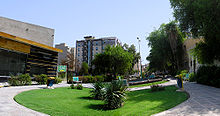
Khaz'al Khan
Sheikh Khaz'al ibn Jabir Al kaabi, GCIE, KCSI , Muaz us-Sultana, and Sardar-e-Aqdas , was the ruler of the semi-autonomous Sheikhdom of "Mohammerah")....
controlled this area and the name was changed to Nâseri. Afterwards, during the Pahlavi
Pahlavi dynasty
The Pahlavi dynasty consisted of two Iranian/Persian monarchs, father and son Reza Shah Pahlavi and Mohammad Reza Shah Pahlavi The Pahlavi dynasty consisted of two Iranian/Persian monarchs, father and son Reza Shah Pahlavi (reg. 1925–1941) and Mohammad Reza Shah Pahlavi The Pahlavi dynasty ...
period, it resumed its old name, Ahvaz. The government of the Khūzestān Province
Khuzestan Province
Khuzestan Province is one of the 31 provinces of Iran. It is in the southwest of the country, bordering Iraq's Basra Province and the Persian Gulf. Its capital is Ahwaz and covers an area of 63,238 km²...
was transferred there from Shûshtar
Shushtar
-External links:** Hamid-Reza Hosseini, Shush at the foot of Louvre , in Persian, Jadid Online, 10 March 2009, .Audio slideshow: .* .* * , PressTV, 13 June 2010....
in 1926. The trans-Iranian railroad reached Ahvaz in 1929 and by the World War II
World War II
World War II, or the Second World War , was a global conflict lasting from 1939 to 1945, involving most of the world's nations—including all of the great powers—eventually forming two opposing military alliances: the Allies and the Axis...
, Ahvaz had become the principal built-up area of interior of Khūzestān. Professional segregation remained well marked between various groups in that period still feebly integrated: Persians
Persian people
The Persian people are part of the Iranian peoples who speak the modern Persian language and closely akin Iranian dialects and languages. The origin of the ethnic Iranian/Persian peoples are traced to the Ancient Iranian peoples, who were part of the ancient Indo-Iranians and themselves part of...
, sub-groupings of Persians and Arab
Arab
Arab people, also known as Arabs , are a panethnicity primarily living in the Arab world, which is located in Western Asia and North Africa. They are identified as such on one or more of genealogical, linguistic, or cultural grounds, with tribal affiliations, and intra-tribal relationships playing...
s. Natives of the Isfahan
Esfahan Province
Isfahan Province , also transliterated as Esfahan, Espahan, Sepahan or Isphahan, is one of the 31 provinces of Iran. It is located in the center of the country. Its capital is the city of Isfahan.- Geography :...
region held an important place in retail trade, owners of cafes and hotels and as craftsmen.
Iraq attempted to annex Khūzestān and Ahvaz in 1980, resulting in the Iran–Iraq War (1980–1988). Ahvaz was close to the front lines and suffered badly during the war.
Iraq had pressed its claims to Khūzestān in part because many of the inhabitants of the area spoke Arabic rather than Persian
Persian language
Persian is an Iranian language within the Indo-Iranian branch of the Indo-European languages. It is primarily spoken in Iran, Afghanistan, Tajikistan and countries which historically came under Persian influence...
, the dominant language in Iran. Iraq had hoped to exacerbate ethnic tensions and win over popular support for the invaders. Most accounts say that the Iranian Arab inhabitants resisted the Iraqis rather than welcome them as liberators. However, some Iranian Arabs claim that as a minority they face discrimination from the central government; they agitate for the right to preserve their cultural and linguistic distinction and more provincial autonomy. See Politics of Khūzestān.
During the year 2005 the city witnessed a series of bomb explosions
Ahvaz Bombings
The Ahvaz bombings were a series of bomb explosions, that took place mostly in Ahvaz, Iran in 2005-2006, and were blamed on Ahvaz separatist organizations of Sunni Arabs. The bombings were linked to the violent April 15 unrest in Ahvaz, prior to the bombings...
. Many government sources relate these events to developments in Iraq, accusing foreign governments of organising and funding Arab separatist groups.
Contemporary Ahvaz
In 1989, the Foolad Ahvaz steel facility was built close to the town. This company is best known for its company-sponsored footballFootball (soccer)
Association football, more commonly known as football or soccer, is a sport played between two teams of eleven players with a spherical ball...
club, Foolad F.C., which was the chart-topper for Iran's Premier Football League
Iran's Premier Football League
The Iran Pro League , is a professional football league competition for clubs located at the highest level of the Iranian football league system.The league system resembles the system being used in England currently...
in 2005. Ahvaz is also home to another IPL football team, Esteghlal Ahvaz F.C..
Transportation
- Ahvaz is accessible via freeways to Isfahan and ShirazShirazShiraz may refer to:* Shiraz, Iran, a city in Iran* Shiraz County, an administrative subdivision of Iran* Vosketap, Armenia, formerly called ShirazPeople:* Hovhannes Shiraz, Armenian poet* Ara Shiraz, Armenian sculptor...
, and roadways to TehranTehranTehran , sometimes spelled Teheran, is the capital of Iran and Tehran Province. With an estimated population of 8,429,807; it is also Iran's largest urban area and city, one of the largest cities in Western Asia, and is the world's 19th largest city.In the 20th century, Tehran was subject to...
. - A metro urban railway system is being built by the Ahvaz urban railway. It will be a 23 km underground line with 24 stations.
- The airport is served by Iran Asseman Airlines (Dubai, Kuwait, Tehran, flying on Boeing 727-200s or Fokker F100s), Caspian AirlinesCaspian AirlinesCaspian Airlines is an airline headquartered in Tehran, Iran. Established in 1993, it operates services between Tehran and other major cities in Iran and international flights to Syria, Turkey, UAE and Ukraine. Its main base is Mehrabad International Airport, Tehran.-History:The airline was...
(Dubai, by MD-80), Iran AirIran AirIran Air , formally Airline of the Islamic Republic of Iran is the flag carrier airline of Iran, operating services to 60 destinations, 35 international and 25 domestic. The cargo fleet operates services to 20 scheduled and 5 charter destinations...
(Isfahan, Kuwait, Tehran, by Boeing 727-200 or Fokker 100), Iran Air ToursIran Air ToursIran Airtour is an airline based in Tehran, Iran. It is a subsidiary of Iran Air and operates scheduled domestic services and international services in the Middle East, as well as charter services including Europe...
(Isfahan, Mashad, Shiraz, Tehran, by MD-80), Kish AirKish AirKish Air is an airline based in Tehran, Iran. It operates international, domestic and charter services as a scheduled carrier. Its main base is Mehrabad Airport, Tehran.-History:...
(Tehran, by MD-80), and Saha Air (Tehran, by Boeing 707-300).
Colleges and universities
Ahvaz is also known for its universities as well as its role in commerce and industry. Ahvaz institutes of higher learning include:- Ahvaz Jundishapur University of Medical SciencesAhvaz Jundishapur University of Medical SciencesAhvaz Jundishapur University of Medical Sciences is a medical school in Khuzestan Province of Iran.Located in southwestern Iran in the city of Ahvaz, the university was established as a College of Medicine administered by the Shahid Chamran University of Ahvaz in 1955, which itself was a revived...
- Petroleum University of Technology
- Shahid Chamran University of AhvazShahid Chamran University of AhvazShahid Chamran University of Ahvaz is a major Iranian university in Ahvaz, Khuzestan, Iran.The campus today has and houses 13 colleges. In 2010, 4798 students were enrolled.-History:...
- Islamic Azad University Ahvaz Science and Research center
Some famous Ahvazis
- Sousan S. AltaieSousan S. AltaieDr. Sousan S. Altaie is Scientific Policy Advisor for the Office of In Vitro Diagnostic Devices in the United States. She joined the Food and Drug Administration in the Center for Drug Evaluation and Research in the Division of Anti-infective Drug Products as a primary reviewer in 1995...
, PHD Scientific Policy Advisor, OIVD CDRH, FDA - Ezzat NegahbanEzzat NegahbanEzatollah Negahban was an Iranian archaeologist known as the father of Iranian modern archaeology.-Biography:Prof. Ezat O. Negahban was born Ahvaz, Iran...
, Patriarch of modern Iranian archaeologyArchaeologyArchaeology, or archeology , is the study of human society, primarily through the recovery and analysis of the material culture and environmental data that they have left behind, which includes artifacts, architecture, biofacts and cultural landscapes...
. - Mehrangiz KarMehrangiz KarMehrangiz Kar is a prominent Iranian lawyer, human right activist and author of the book Crossing the Red Line, as well as many articles.Mehrangiz Kar is a celebrated activist of women's rights in Iran....
, Human rights activist. - Ahmad MahmoudAhmad MahmoudAhmad Mahmoud was an Iranian novelist.In his youth he worked as a day laborer, driver, construction worker and suffered imprisonment for leftist political views and oppositionist activities...
, Novelist. - Hamid DabashiHamid DabashiHamid Dabashi born 1951 in Ahvaz is an Iranian-American Professor of Iranian Studies and Comparative Literature at Columbia University in New York City.He is the author of over twenty books...
, Intellectual historian, cultural and literary critic - Mehrzad Boroujerdi, PhD International Relations, Professor of Political Science and Director of the Middle Eastern Studies Program at Syracuse University
- Patrick MonahanPatrick Monahan (comedian)Patrick Monahan is an Irish-Iranian stand-up comedian born to an Irish father and an Iranian mother. He has performed at seven Edinburgh Festival Fringes, including five solo shows, and appeared multiple times on The Paul O'Grady Show...
, British comedian. - Parviz AbnarParviz AbnarParviz Abnar is an Iranian sound recordist.He graduated from the Academy of Cinema and Television in 1978. Abnar was the sound recordist for the film Rapport in 1986...
, Iranian Sound recordist. - Mohammad-Reza Eskandari, Iran's former minister of Agriculture
- Abu NuwasAbu NuwasAbu-Nuwas al-Hasan ben Hani Al-Hakami ,a known as Abū-Nuwās , was one of the greatest of classical Arabic poets, who also composed in Persian on occasion. Born in the city of Ahvaz in Persia, of an Arab father and a Persian mother, he became a master of all the contemporary genres of Arabic poetry...
, figure in Arabic poetryArabic poetryArabic poetry is the earliest form of Arabic literature. Present knowledge of poetry in Arabic dates from the 6th century, but oral poetry is believed to predate that. Arabic poetry is categorized into two main types, rhymed, or measured, and prose, with the former greatly preceding the latter...
. - Ali ShamkhaniAli ShamkhaniAli Shamkhani is an Iranian admiral and politician. He was the Minister of Defense from August 19, 1997 until August 24, 2005 and was replaced by Mostafa Mohammad-Najjar.He is born in 1955 in Ahvaz, Khuzestan, he earned a B.S...
, Iranian Minister of Defense (1997–2005) - Amirreza AmirbakhtiarAmirreza AmirbakhtiarAmirreza Amirbakhtiar is an Iranian political activist. He was the head of Iran party's youth organisation and of the Iranian National Front in the Khuzestan province of Iran.-Birth and family:He was born into a famous Bakhtiari family...
, Political activist . - Hossein Kaebi, national football player
- Hamid ZangenehHamid ZangenehDr. Hamid Zangeneh is a professor of economics at Widener University, located in Chester, Pennsylvania.Zangeneh received his Ph.D. from the University of Missouri. He is a widely-published author, television commentator, and lecturer. He is currently the editor of the Journal of Iranian Research...
, economist, author, and activist. - Jalal Kameli MofradJalal Kameli MofradJalal Kameli-Mofrad is an Iranian football player who currently plays for Foolad in Iran's Premier League football as Captain.-Club career:Kameli Mofrad started his career at Foolad FC. At first due to his physical style, Mofrad played some good games and became a stater for his club. He was a...
, national football player - Hamed Haddadi, NBA basketball player
- Mohammad MousaviMohammad MousaviMohammad Mousavi is an Iranian musician noted for his ney work.Born in Ahvaz, south of Iran, he studied ney initially with Hassan Kassai. In 1966, he started performing for Iranian national radio programs.-External links:* ....
Ney soloist - Ali ibn Abbas al-MajusiAli ibn Abbas al-MajusiAli ibn al-'Abbas al-Majusi , also known as Masoudi, or Latinized as Haly Abbas, was a Persian physician and psychologist most famous for the Kitab al-Maliki or Complete Book of the Medical Art, his textbook on medicine and psychology.-Biography:He was born in Ahvaz, southwestern Persia, and...
, physician - NaubakhtNaubakhtNobakht Ahvazi also transliterated 'Naubakht') and his sons were astrologers from Ahvaz .Nobakht was particularly famous for having led a group of astrologers who picked an auspicious electional chart for the founding of Baghdad. His family also helped design the city...
, astronomer - Trita ParsiTrita ParsiTrita Parsi is the current president and founder of the National Iranian American Council, and author of the 2007 book, Treacherous Alliance: The Secret Dealings of Israel, Iran, and the United States.-Biography:...
, President and founder of the National Iranian American Council - mehdi yarrahi, singer
See also
- MandaeismMandaeismMandaeism or Mandaeanism is a Gnostic religion with a strongly dualistic worldview. Its adherents, the Mandaeans, revere Adam, Abel, Seth, Enosh, Noah, Shem, Aram and especially John the Baptist...
, Mandaic languageMandaic languageThe Mandaic language is the language of the Mandaean religion. Classical Mandaic is used by a section of the Mandaean community in liturgical rites.... - Khūzestān ProvinceKhuzestan ProvinceKhuzestan Province is one of the 31 provinces of Iran. It is in the southwest of the country, bordering Iraq's Basra Province and the Persian Gulf. Its capital is Ahwaz and covers an area of 63,238 km²...
- Politics of Khūzestān
- GundeshapurGundeshapurGundeshapur Gundeshapur Gundeshapur (Persian گندیشاپور, Gund-ī Shāh Pūr, Gondeshapur, Jondishapoor, Jondishapur, and Jondishapour, Gundishapur, Gondêšâpur, Jund-e Shapur, Jundê-Shâpûr, etc...
- SusaSusaSusa was an ancient city of the Elamite, Persian and Parthian empires of Iran. It is located in the lower Zagros Mountains about east of the Tigris River, between the Karkheh and Dez Rivers....
- ElamElamElam was an ancient civilization located in what is now southwest Iran. Elam was centered in the far west and the southwest of modern-day Iran, stretching from the lowlands of Khuzestan and Ilam Province, as well as a small part of southern Iraq...
- Choqa ZanbilChoqa ZanbilChogha Zanbil ; Elamite: Dur Untash) is an ancient Elamite complex in the Khuzestan province of Iran.It is one of the few existent ziggurats outside of Mesopotamia...
- History of IranHistory of IranThe history of Iran has been intertwined with the history of a larger historical region, comprising the area from the Danube River in the west to the Indus River and Jaxartes in the east and from the Caucasus, Caspian Sea, and Aral Sea in the north to the Persian Gulf and the Gulf of Oman and Egypt...
- Takhti Stadium (Ahvaz)Takhti Stadium (Ahvaz)The Takhti Stadium is a multi-purpose stadium in Ahvaz, Iran. It is currently used mostly for football matches. The stadium is able to hold 30,000 people.As of October 2007 only Esteghlal Ahvaz F.C...