
All Topics  
F-4 Phantom II

 
F 4 Phantom II

   Email Print
   Bookmark   Link


F-4 Phantom II


The McDonnell Douglas F-4 Phantom II is a two-seat, twin-engined, all-weather, long-range supersonic
Supersonic

The term supersonic is used to define a speed that is over the speed of sound . At a typical temperature like 21 ?C , the threshold value required for an object to be traveling at a supersonic speed is approximately 344 metre per second, ....
 interceptor jet fighter/fighter-bomber originally developed for the U.S. Navy
United States Navy

The United States Navy is the navy of the United States Armed Forces. It is one of the seven uniformed services of the United States. The U.S. Navy currently has approximately 331,682 personnel on active duty as of 31 December 2008 and 124,000 in the United States Navy Reserve....
 by McDonnell Aircraft
McDonnell Aircraft

The McDonnell Aircraft Corporation was an American aerospace manufacturer based in St. Louis, Missouri. The company was founded in 1939 by James Smith McDonnell, and was best known for its military fighters, including the F-4 Phantom II, and manned spacecraft including the Project Mercury and Project Gemini....
. Proving highly adaptable, it became a major part of the air wings of the U.S. Navy, U.S. Marine Corps
United States Marine Corps

The United States Marine Corps is a branch of the United States Armed Forces responsible for providing Military power projection from the sea, using the mobility of the United States Navy to rapidly deliver Marine Air-Ground Task Force....
, and U.S. Air Force
United States Air Force

The United States Air Force is the aerial warfare branch of the Military of the United States and one of the uniformed services of the United States....
. It was used extensively by all three of these services during the Vietnam War
Vietnam War

The Vietnam War, also known as the Second Indochina Wars, the Vietnam Conflict, or often in Vietnam the American War occurred in Vietnam, Laos and Cambodia from 1959 to April 30, 1975....
, serving as the principal air superiority fighter for both the Navy and Air Force, as well as being important in the ground-attack and reconnaissance
Reconnaissance

Reconnaissance is a military and medical term denoting exploration conducted to gain information. Militarily, its shorthand Australian, Canadian, and British form is recce , its American usage form is recon ....
 roles by the close of U.S.


Discussion
Ask a question about 'F-4 Phantom II'
Start a new discussion about 'F-4 Phantom II'
Answer questions from other users
Full Discussion Forum


Encyclopedia


The McDonnell Douglas F-4 Phantom II is a two-seat, twin-engined, all-weather, long-range supersonic
Supersonic

The term supersonic is used to define a speed that is over the speed of sound . At a typical temperature like 21 ?C , the threshold value required for an object to be traveling at a supersonic speed is approximately 344 metre per second, ....
 interceptor jet fighter/fighter-bomber originally developed for the U.S. Navy
United States Navy

The United States Navy is the navy of the United States Armed Forces. It is one of the seven uniformed services of the United States. The U.S. Navy currently has approximately 331,682 personnel on active duty as of 31 December 2008 and 124,000 in the United States Navy Reserve....
 by McDonnell Aircraft
McDonnell Aircraft

The McDonnell Aircraft Corporation was an American aerospace manufacturer based in St. Louis, Missouri. The company was founded in 1939 by James Smith McDonnell, and was best known for its military fighters, including the F-4 Phantom II, and manned spacecraft including the Project Mercury and Project Gemini....
. Proving highly adaptable, it became a major part of the air wings of the U.S. Navy, U.S. Marine Corps
United States Marine Corps

The United States Marine Corps is a branch of the United States Armed Forces responsible for providing Military power projection from the sea, using the mobility of the United States Navy to rapidly deliver Marine Air-Ground Task Force....
, and U.S. Air Force
United States Air Force

The United States Air Force is the aerial warfare branch of the Military of the United States and one of the uniformed services of the United States....
. It was used extensively by all three of these services during the Vietnam War
Vietnam War

The Vietnam War, also known as the Second Indochina Wars, the Vietnam Conflict, or often in Vietnam the American War occurred in Vietnam, Laos and Cambodia from 1959 to April 30, 1975....
, serving as the principal air superiority fighter for both the Navy and Air Force, as well as being important in the ground-attack and reconnaissance
Reconnaissance

Reconnaissance is a military and medical term denoting exploration conducted to gain information. Militarily, its shorthand Australian, Canadian, and British form is recce , its American usage form is recon ....
 roles by the close of U.S. involvement in the war.

First entering service in 1960, the Phantom continued to form a major part of U.S. military air power throughout the 1970s and 1980s, being gradually replaced by more modern aircraft such as the F-15 Eagle
F-15 Eagle

The McDonnell Douglas F-15 Eagle is a twin-engine, all-weather military tactics fighter aircraft designed to gain and maintain air superiority in aerial combat....
 and F-16 Fighting Falcon
F-16 Fighting Falcon

The Lockheed Martin F-16 Fighting Falcon is a Multirole combat aircraft jet aircraft fighter aircraft originally developed by General Dynamics for the United States Air Force....
 in the U.S. Air Force; the F-14 Tomcat
F-14 Tomcat

The Grumman F-14 Tomcat is a supersonic, twin-engine, two-seat, variable-sweep wing aircraft. The F-14 was the United States Navy's primary maritime air superiority fighter, fleet defense Interceptor aircraft and tactical reconnaissance platform from 1974 to 2006....
 and F/A-18 Hornet
F/A-18 Hornet

The McDonnell Douglas F/A-18 Hornet is an all-weather carrier-capable Multirole combat aircraft jet, designed to attack both ground and aerial targets....
 in the U.S. Navy; and the F/A-18 in the U.S. Marine Corps. It remained in use by the U.S. in the reconnaissance and Wild Weasel
Wild Weasel

Wild Weasel is a nickname for aircraft of the United States Air Force tasked with the Suppression of Enemy Air Defenses mission. Initially known by the operational code "IRON HAND" when first authorized on August 12, 1965, the term "Wild Weasel" derives from Project Wild Weasel, the USAF development program for a dedicated SAM-detection a...
 roles in the 1991 Gulf War
Gulf War

"Persian Gulf War" and "First Gulf War" redirect here. For other uses, see Persian Gulf War .The Persian Gulf War was a United Nations-authorized military conflict between Iraq and a Coalition of Gulf War from 34 nations commissioned with expelling Iraqi forces from Kuwait after Iraq's Invasion of Kuwait of Kuwait in August 1990....
, finally leaving service in 1996. The Phantom was also operated by the armed forces of 11 other nations. Israel
Israel

Israel officially the State of Israel , is a country in the Middle East located on the eastern shore of the Mediterranean Sea. It borders Lebanon in the north, Syria in the northeast, Jordan in the east, and Egypt on the southwest, and contains geographically diverse features within its relatively small area....
i Phantoms saw extensive combat in several Arab–Israeli conflict
Arab–Israeli conflict

The Arab?Israeli conflict spans roughly one century of political tensions and open hostilities, though Israel itself only was established in 1948....
s, while Iran
Iran

Iran , officially the Islamic Republic of Iran and formerly known internationally as Persian Empire until 1935, is a country in Central Eurasia, located on the northeastern shore of the Persian Gulf and the southern shore of the Caspian Sea....
 used its large fleet of Phantoms in the Iran–Iraq War. Phantoms remain in front line service with seven countries, and in use as an unmanned target
Unmanned aerial vehicle

File:MQ-9 Reaper in flight .jpgAn unmanned aerial vehicle is an unpiloted aircraft. UAVs come in two varieties: some are controlled from a remote location, and others fly autonomously based on pre-programmed flight plans using more complex dynamic automation systems....
 in the U.S. Air Force.

Phantom production ran from 1958 to 1981, with a total of 5,195 built. This extensive run makes it the second most-produced Western jet fighter, behind the F-86 Sabre
F-86 Sabre

The North American Aviation F-86 Sabre was a transonic jet fighter aircraft. The Sabre is best known for its Korean War role where it was pitted against the Soviet MiG-15 and obtained UN air superiority....
 at just under 10,000 examples.

Overview


The F-4 Phantom was designed as a fleet defense fighter for the U.S. Navy
United States Navy

The United States Navy is the navy of the United States Armed Forces. It is one of the seven uniformed services of the United States. The U.S. Navy currently has approximately 331,682 personnel on active duty as of 31 December 2008 and 124,000 in the United States Navy Reserve....
, and first entered service in 1960. By 1963, it had been adopted by the U.S. Air Force
United States Air Force

The United States Air Force is the aerial warfare branch of the Military of the United States and one of the uniformed services of the United States....
 for the fighter-bomber role. When production ended in 1981, 5,195 Phantom IIs had been built, making it the most numerous American supersonic military aircraft. Until the advent of the F-15 Eagle, the F-4 also held a record for the longest continuous production for a fighter with a run of 24 years. Innovations in the F-4 included an advanced pulse-doppler radar
Pulse-doppler radar

Pulse-Doppler is a radar system capable of not only detecting target location , but also measuring its radial velocity . It uses the Doppler effect to determine the relative velocity of objects; pulses of RF energy returning from the target are processed to measure the frequency shift between carrier cycles in each pulse and the original tra...
 and extensive use of titanium
Titanium

Titanium is a chemical element with the symbol Ti and atomic number 22. Sometimes called the ?space age metal?, it has a low density and is a strong, lustrous, corrosion-resistant transition metal with a silver colour....
 in its airframe.

Despite the imposing dimensions and a maximum takeoff weight of over 60,000 pounds (27,000 kg), the F-4 had a top speed of Mach
Mach number

Mach number is the speed of an object moving through air, or any fluid substance, divided by the speed of sound as it is in that substance. It is commonly used to represent an object's speed, when it is travelling at the speed of sound....
 2.23 and an initial climb of over 41,000 ft per minute (210 m/s). Shortly after its introduction, the Phantom set 15 world records, including an absolute speed record of 1,606.342 mph (2,585.086 km/h), and an absolute altitude record of 98,557 ft (30,040 m). Although set in 1959–1962, five of the speed records were not broken until 1975 when the F-15 Eagle came into service.

The F-4 could carry up to 18,650 pounds (8,480 kg) of weapons on nine external hardpoint
Hardpoint

A hardpoint is any part of an airframe designed to carry an external load. This technical description includes mountings for podded engines, but most commonly the term is used, as with weapon station, to refer to a point on the wings of military aircraft where external stores such as missiles, bombs, countermeasures, gun pods, or drop...
s, including air-to-air and air-to-ground missiles, and unguided, guided, and nuclear bombs. Since the F-8 Crusader
F-8 Crusader

The F-8 Crusader was a single-engine aircraft carrier-based fighter aircraft built by Vought. It replaced the Vought F-7 Cutlass. The first F-8 prototype was ready for flight in February 1955, and was the last United States fighter with guns as the primary weapon....
 was to be used for close combat, the F-4 was designed, like other interceptors of the day, without an internal cannon. In a dogfight, the RIO or WSO (commonly called "backseater" or "pitter") assisted in spotting opposing fighters, visually as well as on radar. It became the primary fighter-bomber of both the Navy and Air Force by the end of the Vietnam War
Vietnam War

The Vietnam War, also known as the Second Indochina Wars, the Vietnam Conflict, or often in Vietnam the American War occurred in Vietnam, Laos and Cambodia from 1959 to April 30, 1975....
.

Due to its distinctive appearance and widespread service with United States military and its allies, the F-4 is one of the best-known icons of the Cold War
Cold War

The Cold War was the continuing state of conflict, tension and competition that existed between a number of world powers, including the United States, the Soviet Union, People's Republic of China, France, United Kingdom and those countries' respective allies from the mid-1940s to the early 1990s....
. It served in the Vietnam War and Arab–Israeli conflicts, with American F-4 crews claiming 277 aerial victories in Southeast Asia and completing countless ground attack sortie
Sortie

Sortie is a term for deployment or dispatch of one military unit, be it of aircraft, ship or, in older times, of columns of troops from a fort....
s.

The F-4 Phantom has the distinction of being the last United States fighter flown to attain ace
Flying ace

A flying ace or fighter ace is a military aviation credited with shooting down several enemy aircraft during aerial combat. The actual number of air victories required to officially qualify as an "ace" has varied, but is usually considered to be five or more....
 status in the 20th century. During the Vietnam War, the USAF had one pilot and two WSOs, and the USN one pilot and one RIO, become aces in air-to-air combat. It was also a capable tactical reconnaissance and Wild Weasel (suppression of enemy air defenses
SEAD

SEAD , or Suppression of Enemy Air Defenses, also known as "Wild Weasels" and "Iron Hand" operations in the USA, are military actions to suppress enemy surface-based air defenses , primarily in, but not limited to, the first hours of an attack....
) platform, seeing action as late as 1991, during Operation Desert Storm
Gulf War

"Persian Gulf War" and "First Gulf War" redirect here. For other uses, see Persian Gulf War .The Persian Gulf War was a United Nations-authorized military conflict between Iraq and a Coalition of Gulf War from 34 nations commissioned with expelling Iraqi forces from Kuwait after Iraq's Invasion of Kuwait of Kuwait in August 1990....
.

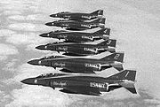
The F-4 Phantom II was also the only aircraft used by both US flight demonstration teams. The USAF Thunderbirds
U.S. Air Force Thunderbirds

The Thunderbirds are the Air Demonstration Squadron of the United States Air Force, based at Nellis Air Force Base in Las Vegas, Nevada. The squadron tours the United States of America and much of the world, performing aerobatic formation and solo flying in specially-marked USAF jet aircraft....
 (F-4E) and the USN Blue Angels
Blue Angels

The United States Navy's Navy Flight Demonstration Squadron, popularly known as the Blue Angels, first performed in 1946 and was the world's first officially sanctioned military aerial demonstration team....
 (F-4J) both switched to the Phantom for the 1969 season; the Thunderbirds flew it for five seasons, the Blue Angels for six.

The baseline performance of a Mach 2-class fighter with long range and a bomber-sized payload would be the template for the next generation of large and light/middle-weight fighters optimized for daylight air combat. The Phantom would be replaced by the F-15 Eagle and F-16 Fighting Falcon in the U.S. Air Force. In the U.S. Navy, it would be replaced by the F-14 Tomcat and the F/A-18 Hornet which revived the concept of a dual-role attack fighter.

Design and development


Origins

In 1952, McDonnell's Chief of Aerodynamics, Dave Lewis
David S. Lewis, Jr.

David Sloan Lewis, Jr., , was a major force in the aerospace and defense industry for four decades. His management skills were notable for their breadth, ranging over military and commercial aviation, space exploration, land combat systems, submarines and surface ships....
, was appointed by CEO Jim McDonnell to be the company’s Preliminary Design Manager. With no new aircraft competitions on the horizon, internal studies concluded the Navy had the greatest need for a new and different aircraft type: an attack fighter.

In 1953, McDonnell Aircraft began work on revising its F3H Demon
F3H Demon

The McDonnell Aircraft F3H Demon was a United States Navy aircraft carrier jet engine fighter aircraft. The successor to the F2H Banshee, after initial problems, it served from 1956 in aviation until 1964 in aviation....
 naval fighter, seeking expanded capabilities and better performance. The company developed several projects including a variant powered by a Wright J67 engine, and variants powered by two Wright J65
Wright J65

The Wright J65 was an Axial compressor turbojet engine produced by Curtiss-Wright under license from Armstrong Siddeley. A development of the Armstrong Siddeley Sapphire, the J65 powered a number of US designs....
 engines, or two General Electric J79
General Electric J79

The General Electric J79 is an axial-flow compressor turbojet engine built for use in a variety of fighter aircraft and bomber aircraft. Produced by GE Aviation and under license by other companies worldwide, it was one of the first US-designed engines to outperform designs from the United Kingdom, which had previously led in the jet field....
 engines. The J79-powered version promised a top speed of Mach
Mach number

Mach number is the speed of an object moving through air, or any fluid substance, divided by the speed of sound as it is in that substance. It is commonly used to represent an object's speed, when it is travelling at the speed of sound....
 1.97. On 19 September 1953, McDonnell approached the United States Navy
United States Navy

The United States Navy is the navy of the United States Armed Forces. It is one of the seven uniformed services of the United States. The U.S. Navy currently has approximately 331,682 personnel on active duty as of 31 December 2008 and 124,000 in the United States Navy Reserve....
 with a proposal for the "Super Demon". Uniquely, the aircraft was to be modular—it could be fitted with one- or two-seat noses for different missions, with different nose cones to accommodate radar, photo cameras, four 20-millimeter cannon, or 56 FFAR unguided rockets in addition to the nine hardpoint
Hardpoint

A hardpoint is any part of an airframe designed to carry an external load. This technical description includes mountings for podded engines, but most commonly the term is used, as with weapon station, to refer to a point on the wings of military aircraft where external stores such as missiles, bombs, countermeasures, gun pods, or drop...
s under the wings and the fuselage. The Navy was sufficiently interested to order a full-scale mock-up of the F3H-G/H, but felt that the upcoming Grumman XF9F-9
F-11 Tiger

The Grumman F11F/F-11 Tiger was a single-seat carrier-based United States Navy fighter aircraft in operation during the 1950s and 1960s. Originally designated the F11F Tiger in April 1955 under the 1922 United States Navy aircraft designation system, it was redesignated as F-11 Tiger under the 1962 United States Tri-Service aircra...
 and Vought XF8U-1
F-8 Crusader

The F-8 Crusader was a single-engine aircraft carrier-based fighter aircraft built by Vought. It replaced the Vought F-7 Cutlass. The first F-8 prototype was ready for flight in February 1955, and was the last United States fighter with guns as the primary weapon....
 already satisfied the need for the supersonic fighter.

The McDonnell design was therefore reworked into an all-weather fighter-bomber with 11 external hardpoints for weapons and on 18 October 1954, the company received a letter of intent for two YAH-1 prototypes. On 26 May 1955, four Navy officers arrived at the McDonnell offices and, within an hour, presented the company with an entirely new set of requirements. Because the Navy already had the A-4 Skyhawk
A-4 Skyhawk

The Douglas A-4 Skyhawk is a aircraft carrier ground-attack aircraft designed for the United States Navy and U.S. Marine Corps. The delta winged "Skyhawk", powered by a single turbojet was designed and produced by Douglas Aircraft Company ....
 for ground attack and F-8 Crusader for dogfighting, the project now had to fulfill the need for an all-weather fleet defense interceptor. A second crewman was added to operate the powerful radar.

XF4H-1 prototype

The XF4H-1 was designed to carry four semi-recessed AAM-N-6 Sparrow III
AIM-7 Sparrow

The AIM-7 Sparrow is a medium-range semi-active radar homing air-to-air missile operated by the United States Air Force, United States Navy, and United States Marine Corps as well as various allied air forces and navies....
 radar-guided missiles, and to be powered by two J79-GE-8 engines. As in the F-101 Voodoo
F-101 Voodoo

The McDonnell Aircraft F-101 Voodoo was a supersonic military fighter aircraft flown by the USAF and the RCAF. Initially designed as a long-range Escort fighter for the Strategic Air Command , the Voodoo served in a variety of other roles, including that of an all-weather interceptor aircraft with the Air Defense Command / Aerospace Defense...
, the engines sat low in the fuselage to maximize internal fuel capacity and ingested air through fixed geometry intake
Intake ramp

An intake ramp is a rectangular, plate-like device within the air intake of a jet engine, designed to generate a shock wave to aid the inlet compression process at supersonic speeds....
s. The thin-section wing had a leading edge sweep of 45 degrees and was equipped with a boundary layer control system for better low-speed handling.

Wind tunnel
Wind tunnel

A wind tunnel is a research tool developed to assist with studying the effects of air moving over or around solid objects.Ways that wind-speed and flow are measured in wind tunnels:...
 testing had revealed lateral instability requiring the addition of five degrees dihedral
Dihedral

Dihedral is the upward angle from horizontal of the wings or tail pane of a fixed-wing aircraft or the wing of a bird. Dihedral is also used in some types of kites such as box kites....
 to the wings. To avoid redesigning the titanium central section of the aircraft, McDonnell engineers angled up only the outer portions of the wings by 12 degrees which averaged to the required five degrees over the entire wingspan. The wings also received the distinctive "dogtooth" for improved control at high angles of attack
Angle of attack

Angle of attack is a term used in aerodynamics to describe the angle between the chord of an airfoil and the vector representing the relative motion between the airfoil and the air....
. The all-moving tailplane was given 23 degrees of anhedral to improve control at high angles of attack while still keeping the tailplane clear of the engine exhaust. In addition, air intakes were equipped with movable ramps to regulate airflow to the engines at supersonic speeds. All-weather intercept capability was achieved thanks to the AN/APQ-50 radar. To accommodate carrier operations, the landing gear was designed to withstand landings with a sink rate of 23 ft per second (7 m/s), while the nose strut could extend by some 20 inches (50 cm) to increase angle of attack at takeoff.

Naming the aircraft

There were proposals to name the F4H "Satan
Satan

Satan is a term that originates from the Abrahamic religions, being traditionally applied to an angel in Judeo-Christian belief, and to a Genie in Islamic belief....
" and "Mithras", the Persian god of light. In the end, the aircraft was given the less controversial name "Phantom II", the first "Phantom" being another McDonnell jet fighter, the FH-1 Phantom
FH Phantom

The McDonnell Aircraft Corporation FH Phantom was a twin-engined jet engine fighter aircraft designed and first flown during World War II for the United States Navy....
. The Phantom II was briefly given the designation F-110A and the name "Spectre" by the USAF, but neither title was used.

Prototype testing

On 25 July 1955, the Navy ordered two XF4H-1 test aircraft and five YF4H-1 pre-production fighters. The Phantom made its maiden flight on 27 May 1958 with Robert C. Little at the controls. A hydraulic problem precluded retraction of the landing gear but subsequent flights went more smoothly. Early testing resulted in redesign of the air intakes, including the distinctive addition of 12,500 bleed air
Bleed air

Bleed air in gas turbine engines is compressed air taken from within the engine, after the compressor stage and before the fuel is injected in the burners....
 holes on each ramp; and the aircraft soon squared off against the XF8U-3 Crusader III
XF8U-3 Crusader III

The Vought XF8U-3 Crusader III was an aircraft developed by Vought as a successor to the successful F-8 Crusader program and as a competitor to the F-4 Phantom II....
. Due to operator workload, the Navy wanted a two-seat aircraft and on 17 December 1958 the F4H was declared a winner. Delays with the J79-GE-8 engines meant that the first production aircraft were fitted with J79-GE-2 and -2A engines, each having 16,100 pound-force (71.8 kN) of afterburning
AfterBurner

The AfterBurner is a lighting solution for the Game Boy Advance system that was created by Triton-Labs.Originally, portablemonopoly.net was a website created to petition Nintendo to put some kind of light in their Game Boy Advance system....
 thrust. In 1959, the Phantom began carrier suitability trials with the first complete launch-recovery cycle performed on 15 February 1960 from USS Independence
USS Independence (CV-62)

The fifth USS Independence , formerly CVA-62, is a that was launched by New York Navy Yard 6 June 1958; sponsored by Mrs. Thomas S. Gates, wife of the Secretary of the Navy; and commissioned 10 January 1959; Captain R....
.

Production


Early in production, the radar was upgraded to a larger AN/APQ-72, necessitating the bulbous nose, and the canopy was reworked to improve visibility and make the rear cockpit less claustrophobic. The Phantom underwent a great many changes during its career, summarized in the "Variants" section below.

The USAF received Phantoms as the result of Defense Secretary Robert McNamara
Robert McNamara

Robert Strange McNamara is an United States business executive and the 8th United States Secretary of Defense. McNamara served as Defense Secretary during the Vietnam War from 1961 to 1968....
's push to create a unified fighter for all branches of the military. After an F-4B won the "Operation Highspeed" fly-off against the F-106 Delta Dart
F-106 Delta Dart

The Convair F-106 Delta Dart was the primary all-weather interceptor aircraft for the United States Air Force from the 1960s through the 1980s....
, the USAF borrowed two Naval F-4Bs, temporarily designating them F-110A "Spectre" in January 1962, and developed requirements for their own version. Unlike the Navy focus on interception, the USAF emphasized a fighter-bomber role. With McNamara's unification of designations on 18 September 1962, the Phantom became the F-4 with the Naval version designated F-4B and USAF F-4C. The first Air Force Phantom flew on 27 May 1963, exceeding Mach 2 on its maiden flight.

Phantom II production ended in the United States in 1979 after 5,195 had been built (5,057 by McDonnell Douglas and 138 in Japan by Mitsubishi), making it the second-most produced and exported American military-jet; the F-86 Sabre
F-86 Sabre

The North American Aviation F-86 Sabre was a transonic jet fighter aircraft. The Sabre is best known for its Korean War role where it was pitted against the Soviet MiG-15 and obtained UN air superiority....
 still remains the most numerous jet-powered warplane produced and exported by the United States. Of these, 2,874 went to the USAF, 1,264 to the Navy and Marine Corps, and the rest to foreign customers. The last U.S.-built F-4 went to Turkey, while the last F-4 ever built was completed in 1981 as an F-4EJ by Mitsubishi Heavy Industries
Mitsubishi Heavy Industries

, or MHI, is a Japanese company. It is one of the core companies of Mitsubishi Group....
 in Japan. , 631 Phantoms remained in active service worldwide, while the Phantom also remains in use as a drone operated by the U.S. military.

World records

To show off their new fighter, the Navy led a series of record-breaking flights early in Phantom development:

  • Operation Top Flight: On 6 December 1959, the second XF4H-1 performed a zoom climb to a world record 98,557 ft (30,040 m). The previous record of 94,658 ft (28,852 m) was set by a Soviet Sukhoi T-43-1
    Sukhoi Su-9

    The Sukhoi Su-9 was a single-engine, all-weather, missile-armed interceptor aircraft developed by the Soviet Union....
     prototype. Commander Lawrence E. Flint, Jr., USN accelerated his aircraft to Mach 2.5 at 47,000 ft (14,330 m) and climbed to 90,000 ft (27,430 m) at a 45 degree angle. He then shut down the engines and glided to the peak altitude. As the aircraft fell through 70,000 ft (21,300 m), Flint restarted the engines and resumed normal flight.
  • On 5 September 1960, an F4H-1 averaged 1,216.78 mph (1,958.16 km/h) over a 500 kilometer (311 mi) closed-circuit course.
  • On 25 September 1960, an F4H-1 averaged 1,390.21 mph (2,237.26 km/h) over a 100 kilometer (62 mi) closed-circuit course.
  • Operation LANA: To celebrate the 50th anniversary of Naval aviation (L is the Roman numeral for 50 and ANA stood for Anniversary of Naval Aviation) on 24 May 1961, Phantoms flew across the continental United States in under three hours and included several tanker refuelings. The fastest of the aircraft averaged 869.74 mph (1,400.28 km/h) and completed the trip in 2 hours 47 minutes, earning the pilot (and future NASA Astronaut), Lieutenant Richard Gordon
    Richard F. Gordon, Jr.

    Richard Francis Gordon, Jr., Captain , United States Navy, Ret. is a retired NASA astronaut. He is one of only List_of_Apollo_astronauts#People_who_flew_around_the_Moon_without_landing....
    , USN and RIO, Lieutenant Bobbie Long, USN, the 1961 Bendix trophy
    Bendix trophy

    The Bendix Trophy is an USA air racing trophy. The transcontinental, point-to-point race, sponsored by industrialist Vincent Bendix founder of Bendix Corporation, began in 1931 as part of the National Air Races....
    .
  • Operation Sageburner: On 28 August 1961, a Phantom averaged 902.769 mph (1,452.826 km/h) over a three-mile (4.82 km) course flying below 125 ft (40 m) at all times. Commander J.L. Felsman, USN was killed during the first attempt at this record on 18 May 1961 when his aircraft disintegrated in the air after pitch damper failure.
  • Operation Skyburner: On 22 December 1961, a modified Phantom with water injection
    Water injection (engines)

    Water injection, also known as anti-detonant injection, is a method for cooling the combustion chambers of engines by adding water to the cylinder or incoming fuel-air mixture, allowing for greater compression ratios and largely eliminating the problem of engine knocking ....
     set an absolute world record speed of 1,606.342 mph (2,585.086 km/h).
  • On 5 December 1961, another Phantom set a sustained altitude record of 66,443.8 ft (20,252.1 m).
  • Operation High Jump: A series of time-to-altitude records was set in early 1962; 34.523 seconds to 3,000 m (9,840 ft), 48.787 seconds to 6,000 m (19,680 ft), 61.629 seconds to 9,000 m (29,530 ft), 77.156 seconds to 12,000 m (39,370 ft), 114.548 seconds to 15,000 m (49,210 ft), 178.5 seconds to 20,000 m (65,600 ft), 230.44 seconds to 25,000 m (82,000 ft), and 371.43 seconds to 30,000 m (98,400 ft). Although not officially recognized, the Phantom zoom-climbed to over 100,000 ft (30,480 m) during the last attempt.


All in all, the Phantom set 16 world records. With the exception of Skyburner, all records were achieved in unmodified production aircraft. Five of the speed records remained unbeaten until the F-15 Eagle appeared in 1975.

Flight characteristics

In air combat, the Phantom's greatest advantage was its thrust, which permitted a skilled pilot to engage and disengage from the fight at will. The massive aircraft, designed to fire radar-guided missiles from beyond visual range
Beyond Visual Range missile

A Beyond Visual Range missile usually refers to an air-to-air missile that is capable of engaging at ranges beyond 20 nautical miles . This range has been achieved using dual pulse rocket motors or booster rocket motor and ramjet sustainer motor....
, lacked the agility of its Soviet opponents and was subject to adverse yaw
Adverse yaw

Adverse yaw is a secondary effect of the application of the ailerons in aircraft. Its cause and effect can be explained as follows:When the control column of an aircraft is moved to the right, the right aileron is deflected upwards, and the left aileron is deflected downwards, causing the aircraft to roll to the right....
 during hard maneuvering. Although thus subject to irrecoverable spins during aileron rolls, pilots reported the aircraft to be very communicative and easy to fly on the edge of its performance envelope. In 1972, the F-4E model was upgraded with leading edge slats
Slats

Slats are aerodynamic surfaces on the leading edge of the wings of fixed-wing aircraft which, when deployed, allow the wing to operate at a higher angle of attack....
 on the wing, greatly improving high-angle-of-attack
Angle of attack

Angle of attack is a term used in aerodynamics to describe the angle between the chord of an airfoil and the vector representing the relative motion between the airfoil and the air....
 maneuverability at the expense of top speed.

The J79 engines produced copious amounts of black smoke at military power which made the Phantoms easy to spot from a distance, a severe disadvantage in air combat against smaller aircraft. Pilots could eliminate the smoke by using afterburner
AfterBurner

The AfterBurner is a lighting solution for the Game Boy Advance system that was created by Triton-Labs.Originally, portablemonopoly.net was a website created to petition Nintendo to put some kind of light in their Game Boy Advance system....
, but at the cost of fuel efficiency. Some pilots adopted the procedure of running one engine in dry thrust at normal power setting, and the other in afterburner, resulting in the same total thrust as using both engines at full rated military power without generating the tell-tale smoke trail.

The F-4's biggest weakness, as it was initially designed, was its lack of an internal cannon. For a brief period, doctrine held that turning combat would be impossible at supersonic speeds and little effort was made to teach pilots air combat maneuvering. In reality, engagements quickly became subsonic. Furthermore, the relatively new heat-seeking and radar-guided missiles at the time were frequently reported as unreliable and pilots had to use multiple shots just to hit one target. To compound the problem, rules of engagement
Rules of engagement

In military or police operations, the rules of engagement determine when, where, and how force shall be used . Such rules are both general and specific, and there have been large variations between cultures throughout history....
 in Vietnam precluded long-range missile attacks in most instances, as visual identification was normally required. Many pilots found themselves on the tail of an enemy aircraft but too close to fire short-range Falcons or Sidewinders. Although in 1967 USAF F-4Cs began carrying SUU-16 or SUU-23 external gunpods containing a 20 millimeter M61 Vulcan
M61 Vulcan

The M61 Vulcan is a 20 mm hydraulically or pneumatically driven, six-barrel ed, air-cooled, electrically fired Gatling gun with an extremely high rate of fire....
 Gatling cannon, USAF cockpits were not equipped with lead-computing gunsights, virtually assuring a miss in a maneuvering fight. Some Marine Corps aircraft carried two pods for strafing. In addition to the loss of performance due to drag
Drag (physics)

The term drag is widely used in Physics and Engineering and is central to the field of fluid dynamics. "Drag" refers to forces that oppose the motion of a solid object through a fluid ....
, combat showed the externally mounted cannon to be inaccurate unless frequently boresighted, yet far more cost-effective than missiles. The lack of cannon was finally addressed by adding an internally mounted 20 millimeter M61 Vulcan on the F-4E.

Costs

F-4CRF-4CF-4DF-4E
Unit R&D
Research and development

The phrase research and development , according to the Organization for Economic Co-operation and Development, refers to "creative work undertaken on a systematic basis in order to increase the stock of knowledge, including knowledge of man, culture and society, and the use of this stock of knowledge to devise new applications [sic]" ...
 cost
- (2008) by 1973 - (2008) by 1973
Airframe (2008) (2008) (2008)
Engines (2008) (2008) (2008) (2008)
Electronics (2008) (2008) (2008) (2008)
Armament (2008) (2008) (2008) (2008)
Ordnance - - (2008) (2008)
Flyaway cost million (2008) million (2008) million (2008) million (2008)
Modification costs (2008) by 1973 (2008) by 1973 (2008) by 1973 (2008) by 1973
Cost per flying hour (2008) (2008) (2008) (2008)
Maintenance cost per flying hour 545 (1965)
(2008)
Note: Original amounts were in 1965 United States dollar
United States dollar

The United States dollar is the unit of currency of the United States and was defined by the Coinage Act of 1792 to be between 371 and 416 grains of silver ....
s. The figures in these tables have been adjusted for inflation.

Operational history


United States Navy

F 4j Phantom Ii Vf 31
On 30 December 1960, the VF-121 Pacemakers at NAS Miramar became the first Phantom operator with its F4H-1Fs (F-4As). The VF-74 Be-devilers
VF-74

The VF-74 Be-Devilers was a U.S. Navy fighter squadron stationed at NAS Oceana until their disestablishment in 1994....
 at NAS Oceana became the first deployable Phantom squadron when it received its F4H-1s (F-4Bs) on 8 July 1961. The squadron completed carrier qualifications in October 1961 and Phantom’s first full carrier deployment between August 1962 and March 1963 aboard . The second deployable US Atlantic Fleet squadron to receive F-4Bs was the VF-102 Diamondbacks, who promptly took their new aircraft on the shakedown cruise
Shakedown (testing)

A shakedown is a period of testing or a trial journey undergone by a ship, aircraft or other craft and its crew before being declared operational....
 of USS Enterprise
USS Enterprise (CVN-65)

USS Enterprise , formerly CVA-65, is the world's first nuclear-powered aircraft carrier and the eighth U.S. naval vessel to USS Enterprise. Like USS Enterprise of World War II fame, she is nicknamed the "Big E." At 1,123 feet , she is the longest naval vessel in the world, though her 93,500 tons displacement places her as t...
. The first deployable US Pacific Fleet
United States Pacific Fleet

The United States Pacific Fleet is a Pacific Ocean Navy theater-level component command of the United States Navy, under the operational control of the United States Pacific Command....
 squadron to receive the F-4B was the VF-114 Aardvarks
VF-114

The VF-114 Aardvarks was a U.S. Navy fighter squadron established on 20 January 1945 and deactivated on 30 April 1993....
, which participated in the September 1962 cruise aboard USS Kitty Hawk
USS Kitty Hawk (CV-63)

The supercarrier USS Kitty Hawk , formerly CVA-63, is the second naval ship named after Kitty Hawk, North Carolina, the site of the Wright brothers' first powered airplane flight....
.

By the time of the Tonkin Gulf incident, 13 of 31 deployable Navy squadrons were armed with the type. F-4Bs from USS Constellation
USS Constellation (CV-64)

USS Constellation , a Kitty Hawk class aircraft carrier supercarrier, was the third ship of the United States Navy to be named in honor of the "new constellation of stars" on the flag of the United States....
 made the first Phantom combat sortie of the Vietnam War
Vietnam War

The Vietnam War, also known as the Second Indochina Wars, the Vietnam Conflict, or often in Vietnam the American War occurred in Vietnam, Laos and Cambodia from 1959 to April 30, 1975....
 on 5 August 1964, flying bomber escort in Operation Pierce Arrow
Operation Pierce Arrow

Operation Pierce Arrow was a U.S. military operation during the Vietnam War.In response to the Gulf of Tonkin Incident when the USS Maddox of the United States Navy was attacked after having provoked North Vietnamese patrol boats once on August 2 1964 and allegedly again on August 4 as it gathered electronic intelligence while in the inter...
. The first Phantom air-to-air victory of the war took place on 9 April 1965 when an F-4B from VF-96 Fighting Falcons piloted by Lieutenant (junior grade) Terence M. Murphy and his RIO, Ensign Ronald Fegan, shot down a Chinese MiG-17 'Fresco'
Mikoyan-Gurevich MiG-17

The Mikoyan-Gurevich MiG-17 is a jet fighter aircraft produced in the USSR from 1952 and operated by numerous air forces in many variants. Licence production was carried out in East Germany, Poland and the Peoples Republic of China ....
. The Phantom was then shot down, apparently by an AIM-7 Sparrow from one of its wingmen. There continues to be controversy over whether the Phantom was shot down by MiG guns or whether, as enemy reports later indicated, an AIM-7 Sparrow III from one of Murphy's and Fegan's wingmen. On 17 June 1965, an F-4B from VF-21 Freelancers
VF-21

The VF-21 Freelancers was a U.S. Navy fighter squadron flying the F-14 Tomcat until disestablished in 1996....
 piloted by Commander Thomas C. Page and Lieutenant John C. Smith shot down the first North Vietnamese MiG of the war.

On 10 May 1972, Lieutenant Randy "Duke" Cunningham
Duke Cunningham

Randall Harold Cunningham , usually known as Randy or Duke, was a Republican Party member of the United States House of Representatives from California's 50th congressional district from 1991 to 2005....
 and Lieutenant (junior grade) William P. Driscoll
William P. Driscoll

William "Willy" "Irish" Driscoll is a former United States Navy Naval Flight Officer who received the Navy Cross during the Vietnam War for his role in an aerial dogfight with North Vietnamese MiGs....
 flying an F-4J, call sign
Call sign

In broadcasting and radio communications, a call sign is a unique designation for a transmitting station. In some countries they are used as names for broadcasting stations, but in many other countries they are not....
 "Showtime 100", shot down three MiG-17s to become the first flying ace
Flying ace

A flying ace or fighter ace is a military aviation credited with shooting down several enemy aircraft during aerial combat. The actual number of air victories required to officially qualify as an "ace" has varied, but is usually considered to be five or more....
s of the war. Their fifth victory was believed at the time to be over a mysterious North Vietnamese ace, Colonel Toon
Nguyen Toon

Nguyen Toon or "Colonel Toon" or "Tomb" was a mythology North Vietnamese fighter aircraft aviator and flying ace who allegedly shot down 13 United States aircraft during the Vietnam War....
, now considered mythical. On the return flight, the Phantom was damaged by an enemy surface-to-air missile
Surface-to-air missile

A surface to air missile or ground-to-air missile is a missile designed to be launched from the ground to destroy aircraft. It is a type of anti-aircraft....
. To avoid being captured, Cunningham and Driscoll flew their burning aircraft upside down (the damage made the aircraft uncontrollable in a conventional attitude) until they could eject over water. Cunningham and Driscoll became USN aces by shooting down five or more enemy aircraft.

During the war, Navy Phantom squadrons participated in 84 combat tours with F-4Bs, F-4Js, and F-4Ns. The Navy claimed 40 air-to-air victories at the cost of 71 Phantoms lost in combat (5 to aircraft, 13 to SAMs
Surface-to-air missile

A surface to air missile or ground-to-air missile is a missile designed to be launched from the ground to destroy aircraft. It is a type of anti-aircraft....
, and 53 to AAA
Anti-aircraft warfare

Anti-aircraft warfare, or air defense, is any method of engaging hostile military aircraft in defense of ground Tactical objective, ground or naval forces or denial of passage through a specific Territorial waters region, Area or anti-aircraft combat zone....
). An additional 54 Phantoms were lost in accidents. Of the 40 aircraft shot down by Navy and Marine Phantom crews, 22 were MiG-17s, 14 MiG-21s
Mikoyan-Gurevich MiG-21

The Mikoyan-Gurevich MiG-21 is a supersonic jet fighter aircraft, designed and built by the Mikoyan Design Bureau in the Soviet Union. It was popularly nicknamed "balalaika", from the aircraft's planform-view resemblance to the Balalaika or ol?wek by Polish pilots due to the shape of its fuselage....
, two Antonov An-2
Antonov An-2

The Antonov An-2 also nicknamed Annushka; is an extremely durable, light, single-engine biplane which first flew in 31 August 1947 and was the first plane designed by Antonov....
s, and two MiG-19s
Mikoyan-Gurevich MiG-19

The Mikoyan-Gurevich MiG-19 is a Soviet Union second-generation, single-seat, jet engine fighter aircraft. It was the first Soviet production aircraft capable of supersonic speeds in level flight....
. Of these, eight aircraft were downed by AIM-7 Sparrow missiles and 31 by AIM-9 Sidewinders.

By 1983, the F-4Ns had been completely replaced by F-14 Tomcat
F-14 Tomcat

The Grumman F-14 Tomcat is a supersonic, twin-engine, two-seat, variable-sweep wing aircraft. The F-14 was the United States Navy's primary maritime air superiority fighter, fleet defense Interceptor aircraft and tactical reconnaissance platform from 1974 to 2006....
s, and by 1986 the last F-4Ss were exchanged for F/A-18 Hornet
F/A-18 Hornet

The McDonnell Douglas F/A-18 Hornet is an all-weather carrier-capable Multirole combat aircraft jet, designed to attack both ground and aerial targets....
s. On 25 March 1986, an F-4S belonging to VF-151 Vigilantes became the last Navy Phantom to launch from an aircraft carrier, in this case, the USS Midway
USS Midway (CV-41)

USS Midway was an aircraft carrier of the United States Navy, the lead ship of Midway class aircraft carrier, and the first to be commissioned after the end of World War II....
. On 18 October 1986, an F-4S from the VF-202 Superheats
VF-202

The Fighter Squadron VF-202 Superheats was an aviation unit of the United States Naval Reserve based at Naval Air Station Joint Reserve Base Fort Worth, Texas....
, a Naval Reserve fighter squadron, made the last-ever Phantom carrier landing while operating aboard USS America
USS America (CV-66)

The third USS America , formerly CVA-66, was a Kitty Hawk class aircraft carrier supercarrier of the United States Navy that served from 1965 to 1996....
. In 1987, the last of the Naval Reserve-operated F-4Ss were replaced by F-14As. The last Phantoms in service with the Navy were QF-4 target drones operated by the Naval Air Warfare Center
Pacific Missile Test Center

The former name of Naval Air Warfare Center, Weapons Division. The name of the center was the Naval Air Missile Test Center prior to PMTC. It is located at Point Mugu, Ventura County, California....
s. These were retired in 2004.

United States Marine Corps

The Marines received their first F-4Bs in June 1962, with the Black Knights of VMFA-314
VMFA-314

Marine Fighter Attack Squadron 314 is a United States Marine Corps F/A-18 Hornet squadron. The squadron, known as the "Black Knights", is based at Marine Corps Air Station Miramar, California and falls under the command of Marine Aircraft Group 11 and the 3rd Marine Aircraft Wing but deploys with Carrier Air Wing Nine....
 at Marine Corps Air Station El Toro
Marine Corps Air Station El Toro

Marine Corps Air Station El Toro was a United States Marine Corps Air Station located near Irvine, California, at .Before it was decommissioned in 1999, it was the home of Marine Corps aviation on the West Coast....
, California becoming the first operational squadron. In addition to attack variants, the Marines also operated several tactical reconnaissance RF-4Bs. Marine Phantoms from VMFA-531
VMFA-531

Marine Fighter Attack Squadron 531 was a United States Marine Corps fighter squadron consisting of F/A-18 Hornets . Known as the "Grey Ghosts?, the squadron participated in action during World War II and the Vietnam War....
 arrived in Vietnam on 10 April 1965, flying close air support missions from land bases as well as from USS America. Marine F-4 pilots claimed three enemy MiGs (two while on exchange duty with the USAF) at the cost of 75 aircraft lost in combat, mostly to ground fire, and four in accidents. On 18 January 1992, the last Marine Phantom, an F-4S, was retired by the Cowboys of VMFA-112
VMFA-112

Marine Fighter Attack Squadron 112 is a reserve United States Marine Corps F/A-18 Hornet squadron. The squadron is based at Naval Air Station Joint Reserve Base Fort Worth, Texas and falls under the command of Marine Aircraft Group 41 , 4th Marine Aircraft Wing ....
. The squadron was re-equipped with F/A-18 Hornets.

United States Air Force


USAF F-4 Summary for Vietnam War action
AircraftWeapons/TacticsMiG-17MiG-19MiG-21Total
F-4CAIM-7 Sparrow401014
AIM-9 Sidewinder1201022
20 mm gun3014
Maneuvering tactics2002
F-4D AIM-4 Falcon4 015
AIM-7 Sparrow422026
AIM-9 Sidewinder0235
20 mm gun4.5026.5
Maneuvering tactics0022
F-4E AIM-7 Sparrow02810
AIM-9 Sidewinder0044
AIM-9+20 mm gun0011
20 mm gun0145
Maneuvering tactics0101
Total33.5866107.5


In USAF service the F-4 was initially designated the F-110 Spectre prior to the introduction of the 1962 United States Tri-Service aircraft designation system
1962 United States Tri-Service aircraft designation system

On 18 September 1962, the United States Department of Defense introduced a unified designation system for the aircraft of the Military of the United States....
. At first reluctant to adopt a Navy fighter, the USAF quickly embraced the design and became the largest Phantom user. The first Air Force Phantoms in Vietnam were F-4Cs from the 555th "Triple Nickel" Tactical Fighter Squadron
555th Fighter Squadron

The 555th Fighter Squadron is part of the 31st Fighter Wing at Aviano Air Base, Italy. It operates F-16 Fighting Falcon aircraft conducting an air superiority mission....
, which arrived in December 1964. Unlike the Navy, which flew the Phantom with a Naval Aviator
Naval Aviator

A United States Naval Aviator is a pilot in the United States Navy, United States Marine Corps or United States Coast Guard....
 (pilot) in the front seat and a Naval Flight Officer
Naval Flight Officer

A Naval Flight Officer is an officer in the United States Navy or United States Marine Corps that specializes in airborne weapons and sensor systems....
 as a radar intercept officer (RIO) in the back seat, the Air Force initially flew its Phantoms with a rated pilot in the back seat. This policy was later changed to using a navigator qualified as a weapon/targeting systems officer (later designated as weapon systems officer
Weapon systems officer

In the United States Air Force, the Weapon Systems Officer is an air flight officer directly involved in all air operations and List of aircraft weapons of the aircraft ....
 or WSO) in the rear seat. However, because they originally flew with pilots in the rear seat, all USAF Phantoms retained dual flight controls throughout their service life.

On 10 July, 1965 F-4Cs of the 45th Tactical Fighter Squadron, on temporary assignment in Vietnam, scored the USAF's first victories against North Vietnamese MiG-17s using AIM-9 Sidewinder
AIM-9 Sidewinder

The AIM-9 Sidewinder is a Infrared homing, short-range, air-to-air missile carried by fighter aircraft and recently, certain Attack helicopter. It is named after the Crotalus cerastes, which detects its prey via body heat and also because of the peculiar snake-like path of flight the early versions had when launched....
 air-to-air missiles. On 24 July 1965, another Phantom from the 45th Tactical Fighter Squadron became the first American aircraft to be downed by an enemy SAM
Surface-to-air missile

A surface to air missile or ground-to-air missile is a missile designed to be launched from the ground to destroy aircraft. It is a type of anti-aircraft....
, and on 5 October 1966 an 8th Tactical Fighter Wing F-4C became the first U.S. jet lost to an air-to-air missile
Air-to-air missile

An air-to-air missile is a guided missile fired from an aircraft for the purpose of destroying another aircraft. AAMs are typically powered by one or more rocket motors, usually solid-fuel rocket but sometimes liquid-fuel rocket....
, fired by a MiG-21 "Fishbed"
Mikoyan-Gurevich MiG-21

The Mikoyan-Gurevich MiG-21 is a supersonic jet fighter aircraft, designed and built by the Mikoyan Design Bureau in the Soviet Union. It was popularly nicknamed "balalaika", from the aircraft's planform-view resemblance to the Balalaika or ol?wek by Polish pilots due to the shape of its fuselage....
.

Early aircraft suffered from leaks in wing fuel tanks that required re-sealing after each flight and 85 aircraft were found to have cracks in outer wing ribs and stringers. There were also problems with aileron
Aileron

For the band with a similar name, see The AileronsAilerons are hinged control surfaces attached to the trailing edge of the wing of a fixed-wing aircraft....
 control cylinders, electrical connectors, and engine compartment fires. Reconnaissance RF-4Cs made their debut in Vietnam on 30 October 1965, flying the hazardous post-strike reconnaissance missions.

Although the F-4C was essentially identical to the Navy F-4B in flight performance and carried the Navy-designed Sidewinder missiles, USAF-tailored F-4Ds initially arrived in June 1967 equipped with AIM-4 Falcon
AIM-4 Falcon

The Hughes Aircraft AIM-4 Falcon was the first operational guided air-to-air missile of the United States Air Force....
s. However, the Falcon, like its predecessors, was designed to shoot down bombers flying straight and level. Its reliability proved no better than others, and its complex firing sequence and limited seeker-head cooling time made it virtually useless in combat against agile fighters. The F-4Ds reverted to using Sidewinders under the "Rivet Haste" program in early 1968, and by 1972, the AIM-7E-2 "Dogfight Sparrow" had become the preferred missile for USAF pilots. Like other Vietnam War Phantoms, the F-4Ds were urgently fitted with radar homing and warning
Radar

Radar is a system that uses electromagnetic radiation waves to identify the range, altitude, direction, or speed of both moving and fixed objects such as aircraft, ships, motor vehicles, weather formations, and terrain....
 (RHAW) antennae to detect the Soviet-built SA-2 Guideline SAMs.

From the initial deployment of the F-4C to Southeast Asia, USAF Phantoms performed both air superiority and ground attack roles, supporting not only ground troops in South Vietnam but also conducting bombing sorties in Laos and North Vietnam. As the F-105
F-105 Thunderchief

The Republic Aviation Company F-105 Thunderchief, was a supersonic fighter-bomber used by the United States Air Force. The Mach 2 capable F-105 bore the brunt of strike bombing over North Vietnam during the early years of the Vietnam War....
 force underwent severe attrition between 1965 and 1968, the bombing role of the F-4 proportionately increased until after November 1970 (when the last F-105D was withdrawn from combat) it became the primary USAF ordnance delivery system. In October 1972 the first squadron of EF-4C Wild Weasel
Wild Weasel

Wild Weasel is a nickname for aircraft of the United States Air Force tasked with the Suppression of Enemy Air Defenses mission. Initially known by the operational code "IRON HAND" when first authorized on August 12, 1965, the term "Wild Weasel" derives from Project Wild Weasel, the USAF development program for a dedicated SAM-detection a...
 aircraft deployed to Thailand on temporary duty. The "E" prefix was later dropped and the aircraft were simply known as F-4C Wild Weasels.

Sixteen squadrons of Phantoms were permanently deployed between 1965 and 1973, and 17 others deployed on temporary combat assignments. Peak numbers of combat F-4s occurred in 1972, when 353 were based in Thailand. A total of 445 Air Force Phantom fighter-bombers were lost, 370 in combat and 193 of those over North Vietnam (33 to MiGs, 30 to SAMs, and 307 to AAA).

The RF-4C was operated by four squadrons, and of the 83 losses, 72 were in combat including 38 over North Vietnam (seven to SAMs and 65 to AAA). By war's end the U.S. Air Force had lost a total of 528 F-4 and RF-4C Phantoms. When combined with US Naval/Marine losses of 233 Phantoms; 761 F-4/RF-4 Phantoms were lost in the Vietnam War.

F 4 Phantom in Flight Apr 1982
On 28 August 1972, Capt Steve Ritchie became the first USAF ace of the war. On 9 September 1972, WSO Capt Charles B. DeBellevue
Charles B. DeBellevue

Colonel Charles Barbin ?Chuck? DeBellevue is a retired officer in the United States Air Force. In 1972, while flying during the Vietnam War, DeBellevue became the first Air Force Weapon Systems Officer to become a flying flying ace....
 became the highest-scoring American ace of the war with six victories. and WSO Capt Jeffrey Feinstein became the last USAF ace of the war on 13 October 1972. Upon return to the United States, DeBellevue and Feinstein were given vision waivers, assigned to pilot training and requalified as USAF pilots in the F-4. According to the USAF, its F-4s scored 107½ MiG kills in Southeast Asia (50 by Sparrow, 31 by Sidewinder, five by Falcon, 15.5 by gun, and six by other means).

On 31 January 1972, the 170th Tactical Fighter Squadron/183d Tactical Fighter Group of the Illinois Air National Guard
Illinois Air National Guard

The Illinois Air National Guard is the subordinate air force element of the Illinois United States National Guard. It is located in the U.S. state of Illinois....
 became the first Air National Guard
Air National Guard

The Air National Guard , often referred to as the Air Guard, is the air force militia organized by each of the fifty U.S. states, the commonwealth of Puerto Rico, the territories of Guam and the U.S....
 unit to transition to Phantoms. The Phantom's ANG service lasted until 31 March 1990, when it was replaced by the F-16 Fighting Falcon
F-16 Fighting Falcon

The Lockheed Martin F-16 Fighting Falcon is a Multirole combat aircraft jet aircraft fighter aircraft originally developed by General Dynamics for the United States Air Force....
.

On 15 August 1990, 24 F-4G Wild Weasel
Wild Weasel

Wild Weasel is a nickname for aircraft of the United States Air Force tasked with the Suppression of Enemy Air Defenses mission. Initially known by the operational code "IRON HAND" when first authorized on August 12, 1965, the term "Wild Weasel" derives from Project Wild Weasel, the USAF development program for a dedicated SAM-detection a...
 Vs and six RF-4Cs were mobilized to the Middle East for Operation Desert Storm
Gulf War

"Persian Gulf War" and "First Gulf War" redirect here. For other uses, see Persian Gulf War .The Persian Gulf War was a United Nations-authorized military conflict between Iraq and a Coalition of Gulf War from 34 nations commissioned with expelling Iraqi forces from Kuwait after Iraq's Invasion of Kuwait of Kuwait in August 1990....
. The reason for this was that the F-4G was the only aircraft in the USAF inventory equipped for the suppression of enemy air defenses (SEAD)
SEAD

SEAD , or Suppression of Enemy Air Defenses, also known as "Wild Weasels" and "Iron Hand" operations in the USA, are military actions to suppress enemy surface-based air defenses , primarily in, but not limited to, the first hours of an attack....
 role since the EF-111 Raven lacked the offensive capability of the AGM-88 HARM
AGM-88 HARM

The AGM-88 High-speed Anti-radiation missile is a tactical, air-to-surface missile designed to home in on electronic transmissions coming from surface-to-air radar systems....
 missile, while the RF-4C was the only aircraft equipped with the ultra-long-range KS-127 LOROP (long-range oblique photography) camera. In spite of flying almost daily missions, only one RF-4C was lost in a fatal accident before the start of hostilities. One F-4G was lost when enemy fire damaged the fuel tanks and the aircraft ran out of fuel near a friendly airbase. The last USAF Phantoms, F-4G Wild Weasel Vs from 561st Fighter Squadron
561st Fighter Squadron

The 561st Tactical Fighter Squadron was an F-4 Phantom II Wild Weasel fighter aircraft squadron, stationed at Nellis Air Force Base in Las Vegas, Nevada....
, were retired on 26 March 1996. The last operational flight of the F-4G Wild Weasel was from the 190th Fighter Squadron, Idaho Air National Guard, in April 1996. The last operational USAF/ANG F-4 to land was flown by Maj Mike Webb and Maj Gary Leeder, Idaho ANG. Like the Navy, the Air Force continues to operate QF-4 target drones, serving with the 82d Aerial Targets Squadron
82d Aerial Targets Squadron

The 82d Aerial Target Squadron is located at Tyndall Air Force Base. This squadron is the only unit left in the United States Air Force to fly the F-4 Phantom II, although they are QF-4C/E/G versions in the role of aerial targets....
, it being expected that the F-4 will remain in the target role with the 82d ATRS until 2013/14.

Non-U.S. air forces


The Phantom served with the air forces of many countries, including Australia
Australia

Australia, officially the Commonwealth of Australia, is a country in the southern hemisphere comprising the Australia of the world's smallest continent, the major island of Tasmania, and numerous list of islands of Australia in the Indian Ocean and Pacific Oceans....
, Egypt
Egyptian Air Force

The Egyptian Air Force, or EAF , is the aviation branch of the Egyptian armed forces. The EAF is headed by an Air Marshal . Currently, the commander of the Egyptian Air Force is Air Marshal Reda Mahmoud Hafez Mohamed....
, Germany
Germany

Germany , officially the Federal Republic of Germany , is a country in Central Europe. It is bordered to the north by the North Sea, Denmark, and the Baltic Sea; to the east by Poland and the Czech Republic; to the south by Austria and Switzerland; and to the west by France, Luxembourg, Belgium, and the Netherlands....
, United Kingdom
United Kingdom

The United Kingdom of Great Britain and Northern Ireland, commonly known as the United Kingdom , the UK or Britain,is a sovereign state located off the northwestern coast of continental Europe....
, Greece
Greece

Greece , officially the Hellenic Republic , is a country in southeastern Europe, situated on the southern end of the Balkans. It has borders with Albania, Bulgaria and the former Yugoslav Republic of Macedonia to the north, and Turkey to the east....
, Iran
Iran

Iran , officially the Islamic Republic of Iran and formerly known internationally as Persian Empire until 1935, is a country in Central Eurasia, located on the northeastern shore of the Persian Gulf and the southern shore of the Caspian Sea....
, Israel
Israel

Israel officially the State of Israel , is a country in the Middle East located on the eastern shore of the Mediterranean Sea. It borders Lebanon in the north, Syria in the northeast, Jordan in the east, and Egypt on the southwest, and contains geographically diverse features within its relatively small area....
, Japan
Japan

Japan is an island country in East Asia. Located in the Pacific Ocean, it lies to the east of the Sea of Japan, People's Republic of China, North Korea, South Korea and Russia, stretching from the Sea of Okhotsk in the north to the East China Sea and Taiwan in the south....
, Spain
Spain

Spain or the Kingdom of Spain , is a country located in Southern Europe on the Iberian Peninsula.The Spanish constitution does not establish any official denomination of the country, even though Espa?a , Estado espa?ol and Naci?n espa?ola are used interchangeably....
, South Korea
South Korea

South Korea, officially the Republic of Korea , ), often referred to as Korea and the "names of Korea#Revival of the names", is a Semi-presidential system republic in East Asia, located in the southern half of the Korean Peninsula....
 and Turkey
Turkey

Turkey , known officially as the Republic of Turkey , is a Eurasian country that stretches across the Anatolian peninsula in southwest Asia and Thrace in the Balkans region of Southern Europe....
.

Australia
The Royal Australian Air Force
Royal Australian Air Force

The Royal Australian Air Force is the Air Force branch of the Australian Defence Force. The RAAF began in March 1912 as the Australian Flying Corps and became a fully independent Air Force in March 1921....
 (RAAF) leased 24 USAF F-4Es from 1970 to 1973 while waiting for their order for the General Dynamics F-111
General Dynamics F-111

The General Dynamics F-111 is a medium-range interdictor and fighter bomber aircraft that also fills the roles of strategic bomber, reconnaissance and electronic warfare in its various versions....
C to be delivered. They were so well-liked that the RAAF considered adopting the F-4E instead. They were operated from RAAF Amberley by No.1 Squadron and No.6 Squadron.

Egypt
In 1979, the Egyptian Air Force
Egyptian Air Force

The Egyptian Air Force, or EAF , is the aviation branch of the Egyptian armed forces. The EAF is headed by an Air Marshal . Currently, the commander of the Egyptian Air Force is Air Marshal Reda Mahmoud Hafez Mohamed....
 purchased 35 former USAF F-4Es along with a number of Sparrow, Sidewinder, and Maverick missiles from the US for $594 million as part of the "Peace Pharaoh" program. An additional seven surplus USAF aircraft were purchased in 1988. Three attrition replacements had been received by the end of the 1990s.

Phantoms in non-U.S. service.
F 4 Phantom Operators
ReceivedIn service as of 2001
Australia24 F-4ENone (returned to USA)None
Egypt45 F-4E30 F-4E34
Germany88 RF-4E
175 F-4F
145 F-4F
(110 upgraded to ICE)
59
Greece121 F-4E and RF-4E62 F-4E and RF-4E
(39 upgraded to Peace Icarus 2000)
53
Iran32 F-4D
177 F-4E
16 RF-4E
15 F-4D
29 F-4E
3 RF-4E
65
Israel274 F-4E
12 RF-4E
40 F-4E
53 Kurnass 2000 (all retired)
None
Japan140 F-4EJ
14 RF-4EJ
109 F-4EJ
12 RF-4EJ
91 F-4EJ/EF-4J
26 RF-4J
South Korea27 RF-4C
92 F-4D
103 F-4E
60 F-4D
70 F-4E
18 RF-4E
138
Spain40 F-4C
18 RF-4C
14 RF-4C (all retired and destroyed as targets)None
Turkey233 F-4E and RF-4E163 F-4E
(54 upgraded to Terminator 2020)
44 RF-4E
165
United Kingdom15 F-4J(UK)
50 F-4K
116 F-4M
NoneNone


Germany
The German Luftwaffe
Luftwaffe

is a generic German term for an air force. It is also the official name for two of the four historic German air forces, the Wehrmacht air arm founded in 1933 and disbanded in 1946; and the current Bundeswehr air arm founded in 1956....
 initially ordered the reconnaissance RF-4E in 1969, receiving a total of 88 aircraft which were delivered from January 1971. In 1982, the initially unarmed RF-4Es were given a secondary ground attack capability, and were retired in 1994.

In 1973, under the "Peace Rhine" program the Luftwaffe purchased the lightened and simplified F-4F which was upgraded in the mid-1980s. Twenty-four German-owned F-4Fs were operated by the 49th Tactical Fighter Wing of the USAF at Holloman AFB to train Luftwaffe crews until 2002. In 1975, Germany also received 10 F-4Es for training in the U.S. In the late 1990s, these were withdrawn from service, being replaced by F-4Fs. Germany also initiated the "ICE" (Improved Combat Efficiency) program in 1983. The 110 ICE-upgraded F-4Fs entered service in 1992, and are expected to remain in service until 2012.

Greece

In 1971 the Hellenic Air Force
Hellenic Air Force

The Hellenic Air Force is the air force of Greece. The mission of the Hellenic Air Force is to guard and protect Greek airspace, provide air assistance and support to the Hellenic Army and the Hellenic Navy, as well as the provision of humanitarian aid in Greece and around the world....
 ordered brand new F-4E Phantoms, with deliveries starting in 1974. Later (early 1990s) the Hellenic AF acquired surplus RF-4Es and F-4Es from the Luftwaffe and U.S. ANG.

Following the success of the German ICE program, on 11 August 1997, DASA of Germany received a contract to upgrade 39 aircraft to the very similar "Peace Icarus 2000" standard. The Hellenic AF operates 35 upgraded F-4E-PI2000 (338 and 339 Squadrons) and 22 RF-4E aircraft (348 Squadron) as of May 2008.

Iran
In the 1960s and 1970s, then U.S.-friendly Iran purchased 225 F-4D, F-4E and RF-4E Phantoms. The Islamic Republic of Iran Air Force
Islamic Republic of Iran Air Force

The 'Islamic Republic of Iran Air Force' is the air force of the Iranian armed forces....
 Phantoms saw action in the Iran-Iraq war
Iranian Air Force in Iran-Iraq war

File:PAF_F-7P_Lahore.jpgFile:Shenyang_J-6C_Albanian_Air_Force.jpgOn September 21 1980, the day before the Iran?Iraq War, the Iranian Air force was reported to have 447 functional Military aircraft stationed at 10 airbase throughout the country....
 in the 1980s and are kept operational by overhaul and servicing from Iran’s aerospace industry.

Israel
The Israeli Air Force
Israeli Air Force

The Israeli Air Force is the air force of the Israel Defense Forces. The current Commander in Chief is Aluf Ido Nehoshtan. The Israeli Air Force has approximately 700 aircraft....
 has been the largest foreign user of the Phantom, flying both newly built and ex-USAF aircraft, as well as several one-off special reconnaissance variants. The first F-4Es, nicknamed "Kurnass" (Heavy hammer), and RF-4Es, nicknamed "Orev" (Raven), were delivered in 1969 under the "Peace Echo I" program. Additional Phantoms arrived during the 1970s under "Peace Echo II" through "Peace Echo V" and "Nickel Grass" programs. Israeli Phantoms saw extensive combat during Arab–Israeli conflicts, first seeing action during the War of Attrition
War of Attrition

The War of Attrition was a limited war fought between Israel and forces of the Egyptian Republic and the Palestine Liberation Organization from 1967 to 1970....
. In the 1980s, Israel began the "Kurnass 2000" modernization program which significantly updated avionics. The last Israeli F-4s were retired in 2004.

Japan
From 1968, the Japan Air Self-Defense Force
Japan Air Self-Defense Force

The , or JASDF, is the aviation branch of the Japan Self-Defense Forces responsible for the defense of Japanese airspace and other aerospace operations....
 purchased a total of 140 F-4EJ Phantoms without aerial refueling and ground attack capabilities. Mitsubishi built 138 under license in Japan and 14 unarmed reconnaissance RF-4Es were imported. Of these, 96 F-4EJs have since been modified to the F-4EJ Kai (?? "modified") standard. Fifteen F-4EJs have been converted to reconnaissance aircraft designated RF-4EJ, with similar upgrades as the F-4EJ Kai. Japan has a fleet of 90 F-4s in service as of 2007 and studies are underway to replace them with either the Eurofighter Typhoon
Eurofighter Typhoon

The Eurofighter Typhoon is a twin-engine Canard -delta wing Multirole combat aircraft aircraft. It is being designed and built by a consortium of three separate partner companies: Alenia Aeronautica, BAE Systems, and EADS working through a holding company Eurofighter GmbH which was formed in 1986....
, Dassault Rafale, or one of several others.

South Korea
The Republic of Korea Air Force
Republic of Korea Air Force

The Republic of Korea Air Force is the air force of South Korea. It operates under the Ministry of National Defense.The ROKAF is an air force which has approximately 400 combat aircraft of American design, plus a few Russian and indigenously designed aircraft....
 purchased its first batch of ex-USAF F-4D Phantoms in 1968 under the "Peace Spectator" program. The ex-USAF F-4Ds continued to be delivered until 1988. The "Peace Pheasant II" program also provided newly-built and ex-USAF F-4Es. Currently F-4Ds are being retired from service by new F-15K Slam Eagles
F-15E Strike Eagle

The F-15E Strike Eagle is a 1980s United States all-weather strike fighter, designed for long-range Air interdiction of enemy ground targets deep behind enemy lines....
.

Spain

The Spanish Air Force
Spanish Air Force

The Spanish Air Force is the air force of Spain. It is one of the 3 branches of the Spanish Armed Forces and has the mission of defending the sovereignty and independence of Spain, its territorial integrity and constitutional freedoms, within airspace of Spain and its territories as well as to maintain the international security in operation...
 acquired its first batch of ex-USAF F-4C Phantoms in 1971 under the "Peace Alfa" program. Designated C.12, the aircraft were retired in 1989. At the same time, the SAF received a number of ex-USAF RF-4Cs, designated CR.12. In 1995–1996, these aircraft received extensive avionics upgrades. Spain retired its RF-4s in 2002.

Turkey
The Turkish Air Force
Turkish Air Force

The Turkish Air Force is a branch of the Turkish Armed Forces. It is one of the oldest air forces in the world and operates one of the largest combat aircraft fleets of NATO....
 received 40 F-4Es in 1974, with a further 32 F-4Es and 8 RF-4Es in 1977-78 under the "Peace Diamond III" program, followed by 40 ex-USAF aircraft in "Peace Diamond IV" in 1987, and a further 40 ex-U.S. Air National Guard Aircraft in 1991. A further 32 RF-4Es were transferred to Turkey after being retired by the Luftwaffe between 1992 and 1994. In 1995, IAI of Israel implemented an upgrade similar to Kurnass 2000 on 54 Turkish F-4Es which were dubbed the F-4E 2020 Terminator.

United Kingdom

The United Kingdom
United Kingdom

The United Kingdom of Great Britain and Northern Ireland, commonly known as the United Kingdom , the UK or Britain,is a sovereign state located off the northwestern coast of continental Europe....
 bought versions based on the USN F-4J for use with the Royal Air Force
Royal Air Force

The Royal Air Force is the United Kingdom's air force, the oldest independent air force in the world. Formed on 1 April 1918, the RAF has taken a significant role in British military history ever since, playing a large part in World War II and in more recent conflicts....
 and the Royal Navy
Royal Navy

The Royal Navy of the United Kingdom is the oldest of the British Armed Forces . From the mid-18th century until well into the 20th century, it was the most powerful navy in the world, playing a key part in establishing the British Empire as the dominant world power from 1815 until the early 1940s....
's Fleet Air Arm
Fleet Air Arm

The Fleet Air Arm is the branch of the Royal Navy responsible for the operation of the aircraft on board their ships. The Fleet Air Arm operates the AgustaWestland EH101, Westland Sea King and Westland Lynx helicopters, as well as the BAE Harrier II....
. The main differences were the use of the British Rolls-Royce Spey
Rolls-Royce Spey

The Rolls-Royce RB.168 Spey is a low-bypass turbofan engine originally designed and manufactured by Rolls-Royce Limited that has been in widespread service for over 40 years....
 engines and of British-made avionics. The RN and RAF versions were given the designation F-4K and F-4M respectively, and entered service as the Phantom FG.1 (fighter/ground attack) and Phantom FGR.2 (fighter/ground attack/reconnaissance).

After the Falklands War
Falklands War

The Falklands War , also called the Falklands Conflict/Crisis, was fought in 1982 between Argentina and the United Kingdom over the disputed Falkland Islands and South Georgia and the South Sandwich Islands....
, 15 upgraded ex-USN F-4Js, known as the F-4J(UK) entered RAF service to compensate for one interceptor squadron redeployed to the Falklands.

Around 15 RAF squadrons received various marks of Phantom, many of them based in Germany. The first to be equipped was 6 Squadron at RAF Leuchars
RAF Leuchars

RAF Leuchars is the most northerly air defence station in the United Kingdom. It is located in Leuchars, Fife, on the east coast of Scotland, near to the university town of St Andrews....
 in July 1969. One noteworthy deployment was to 43 Squadron where Phantom FG1s remained the squadron equipment for a remarkable twenty years, arriving in September 1969 and departing in July 1989. During this period the squadron was based throughout at Leuchars.

The interceptor Phantoms were replaced by the Panavia Tornado F3
Panavia Tornado ADV

The Panavia Tornado Air Defence Variant is a Fourth generation jet fighter Fighter aircraft/Interceptor aircraft version of the Panavia Tornado in service with the Royal Air Force....
 from the late 1980s onwards, and the last British Phantoms were retired in October 1992 when 74 Squadron disbanded.

Civilian use

Sandia National Laboratories used an F-4 mounted on a "rocket sled" in a crash test to see the results of an aircraft hitting a reinforced concrete structure, such as a nuclear power plant.

One aircraft, an F-4D (civilian registration NX749CF), is operated by the Massachusetts-based non-profit organization
Non-profit organization

A nonprofit organization is any organization that does not aim to make a profit, and which is not a public body....
 Collings Foundation as a "living history
Living history

Living history is an activity that incorporates historical tools, activities and dress into an interactive presentation that seeks to give observers and participants a sense of stepping back in time....
" exhibit. Funds to maintain and operate the aircraft, which is based in Houston, Texas
Houston, Texas

Houston is the fourth-largest city in the United States of America and the largest city within the state of Texas. As of the 2007 U.S. Census estimate, the city has a population of 2.2 million within an area of 600 square miles ....
, are raised through donations/sponsorships from public and commercial parties.

NASA
NASA

The National Aeronautics and Space Administration is an agency of the Federal government of the United States, responsible for the nation's public list of space agencies....
's Dryden Flight Research Center
Dryden Flight Research Center

The Dryden Flight Research Center , located inside Edwards Air Force Base, is an aeronautical research center operated by NASA. On March 26, 1976 it was named in honor of the late Dr....
 acquired an F-4A Phantom II on 3 December 1965. It made fifty-five flights in support of short programs, chase on X-15
North American X-15

The North American Aviation X-15 rocket-powered aircraft was part of the X-plane of experimental aircraft, initiated with the Bell X-1, that were made for the USAF, the NASA, and the USN....
 missions and lifting body flights. The F-4A also supported a biomedical monitoring program involving 1,000 flights by NASA Flight Research Center aerospace research pilots and students of the USAF Aerospace Research Pilot School flying high-performance aircraft. The pilots were instrumented to record accurate and reliable data of electrocardiogram, respiration rate and normal acceleration. In 1967, the F-4A supported a brief military-inspired program to determine whether an airplane's sonic boom could be directed and whether it could possibly be used as a weapon of sorts, or at least an annoyance. NASA also flew an F-4C in a spanwise blowing study from 1983 to 1985, after which it was returned to the Air Force.

Variants

F-4A, B, J, N and S
Variants for the US Navy and the US Marines. F-4B was upgraded to F-4N, and F-4J was upgraded to F-4S.
F-110 Spectre, F-4C, D and E
Variants for the U.S. Air Force. F-4E introduced an internal M61 Vulcan cannon. F-4D and E were widely exported.
F-4G Wild Weasel V
A dedicated SEAD variant with updated radar and avionics, converted from F-4E. The designation F-4G was applied earlier to an entirely different Navy Phantom.
F-4K and M
Variants for British military re-engined with Rolls-Royce Spey
Rolls-Royce Spey

The Rolls-Royce RB.168 Spey is a low-bypass turbofan engine originally designed and manufactured by Rolls-Royce Limited that has been in widespread service for over 40 years....
 turbofans.
F-4EJ
Simplified F-4E exported to and license-built in Japan.
F-4F
Simplified F-4E exported to Germany.


QF-4B, E, G, N and S
Retired aircraft converted into remote-controlled target drones used for weapons and defensive systems research.
RF-4B, C, and E
Tactical reconnaissance variants.


Culture


Nicknames

F 4 Parts Distribution
The Phantom gathered a number of nicknames during its career. Some of these names included "Rhino", "Double Ugly", the "Flying Anvil", "Flying Footlocker", "Flying Brick", "Lead Sled", the "Big Iron Sled" and the "Louisville Slugger". In recognition of its record of downing large numbers of Soviet-built MiGs
Mikoyan

Russian Aircraft Corporation MiG, or RSK MiG, is a Russian joint stock company. Formerly Mikoyan or Mikoyan-i-Gurevich Design Bureau , it is a military aircraft design bureau, primarily designing fighter aircraft....
, it was called the "World’s Leading Distributor of MiG Parts" As a reflection of excellent performance in spite of bulk, it was dubbed "the triumph of thrust over aerodynamics." German
Germany

Germany , officially the Federal Republic of Germany , is a country in Central Europe. It is bordered to the north by the North Sea, Denmark, and the Baltic Sea; to the east by Poland and the Czech Republic; to the south by Austria and Switzerland; and to the west by France, Luxembourg, Belgium, and the Netherlands....
 Luftwaffe
Luftwaffe

is a generic German term for an air force. It is also the official name for two of the four historic German air forces, the Wehrmacht air arm founded in 1933 and disbanded in 1946; and the current Bundeswehr air arm founded in 1956....
 crews called their F-4s the Eisenschwein ("Iron Pig"), Fliegender Ziegelstein ("Flying Brick") and Luftverteidigungsdiesel ("Air Defense Diesel").

Imitating the spelling of the aircraft’s name, McDonnell issued a series of patches. Pilots became "Phantom Phlyers", backseaters became "Phantom Pherrets", fans of the F-4 "Phantom Phanatics", and call it the "Phabulous Phantom". Ground crewmen who worked on the aircraft are known as "Phantom Phixers".

The Spook

Spook 1000
The aircraft's emblem is a whimsical cartoon ghost called "The Spook", which was created by McDonnell Douglas technical artist, Anthony "Tony" Wong, for shoulder patches. The name "Spook" was coined by the crews of either the 12th Tactical Fighter Wing or the 4453rd Combat Crew Training Wing at MacDill AFB. The figure is ubiquitous, appearing on every imaginable item associated with the F-4. The Spook has followed the Phantom around the world adopting local fashions; for example, the British adaptation of the U.S. "Phantom Man" is a Spook that sometimes wears a bowler hat and smokes a pipe.

Survivors


There are a number of F-4 Phantom IIs on display in the USA and worldwide. For example, a Phantom II F-4C-15-MC 37699, which is on loan from the USAF Museum
National Museum of the United States Air Force

The National Museum of the United States Air Force is the official National Museum of the United States Air Force and is located at Wright-Patterson Air Force Base, in Riverside, Ohio near Dayton, Ohio, Ohio....
, is on display at the Midland Air Museum
Midland Air Museum

The Midland Air Museum is situated just outside the village of Baginton in Warwickshire, England, and is adjacent to Coventry Airport. The museum includes the Sir Frank Whittle Jet Heritage Centre , where many exhibits are on display in a large hangar....
, Coventry
Coventry

Coventry is a City status in the United Kingdom and metropolitan borough in the county of West Midlands in England. With a population of 303,475 at the United Kingdom Census 2001 , Coventry is the 9th largest city in England and the 11th largest in the United Kingdom....
, England
England

native_name =|conventional_long_name = England|common_name = England|image_flag = Flag of England.svg|image_coat = England COA.svg|symbol_type = Royal Coat of Arms...
; a Phantom II F4H-1, BuNo 145310, U.S. Navy, is located at French Valley Airport
French Valley Airport

French Valley Airport is a county-owned public-use airport in southwestern Riverside County, California, California, located on Highway 79 near the communities of Murrieta, California and Temecula, California....
, Murrieta, California
Murrieta, California

Murrieta is a city in southwestern Riverside County, California, California, United States. The population was 44,282 at the 2000 census. Population was estimated to be 100,173 in 2008, making it one of the fastest growing cities in the state....
; and there is a dwindling number of reserve F-4s stored at Davis-Monthan Air Force Base
Davis-Monthan Air Force Base

Davis-Monthan Air Force Base is a United States Air Force base adjacent to Tucson, Arizona, Arizona. Davis-Monthan AFB is primarily an Air Combat Command installation with the 355th Fighter Wing as the host activity....
.

One aircraft, an F-4D, is operated by the Massachusetts
Massachusetts

The Commonwealth of Massachusetts is a U.S. state located in the New England region of the Northeastern United States United States. It borders Rhode Island and Connecticut to the south, New York to the west, and Vermont and New Hampshire to the north....
-based non-profit organization
Non-profit organization

A nonprofit organization is any organization that does not aim to make a profit, and which is not a public body....
 Collings Foundation as a "living history
Living history

Living history is an activity that incorporates historical tools, activities and dress into an interactive presentation that seeks to give observers and participants a sense of stepping back in time....
" exhibit. Funds to maintain and operate the aircraft, which is based in Houston, Texas
Houston, Texas

Houston is the fourth-largest city in the United States of America and the largest city within the state of Texas. As of the 2007 U.S. Census estimate, the city has a population of 2.2 million within an area of 600 square miles ....
, are raised through donations/sponsorships from public and commercial parties.

Specifications (F-4E)

Mcdonnell Douglas F 4 Phantom Ii

See also


Bibliography

  • Angelucci, Enzo. The American Fighter. Sparkford, Somerset: Haynes Publishing Group, 1987. ISBN 0-85429-635-2.
  • Beit-Hallahmi, Benjamin. The Israeli Connection: Whom Israel Arms and Why. London: I.G Tauris, 1987. ISBN 1-85043-069-1.
  • Bowers, Peter M. and Enzo Angellucci. The American Fighter. New York: Orion Books, 1987. ISBN 0-517-56588-9.
  • Burgess, Richard E. The Naval Aviation Guide, 4th ed. Annapolis, MD: Naval Institute Press, 1985. ISBN 0-87021-409-8.
  • Calvert, Denis. "Le Tigri della RAF (RAF's Tigers)"(in Italian). Aerei magazine N.5, Parma, Italy: Delta editrice, 1991.
  • Carrara, Dino. "Phantom Targets – The USAFs Last F-4 Squadron". Air International
    Air International

    AIR International is a United Kingdom aviation magazine covering current military aircraft and civil aviation topics. It has been in publication since 1971 and is currently published by Key Publishing Ltd....
     Volume 71, no. 5, November 2006. Stamford, Linconshire, UK: Key Publishing, pp. 42–48. ISSN 0306-5634.
  • Donald, David, "RAF Phantoms". Wings of Fame. London: Aerospace. Volume 15, 1999. pp. 4–21. ISBN 1-86184-033-0.
  • Donald, David and Jon Lake, eds. "Desert Storm – The First Phase". World Air Power Journal. London: Aerospace, Volume 5, Spring 1991. ISSN 0959-0750.
  • Donald, David and Jon Lake, eds. "Desert Storm: Gulf Victory". World Air Power Journal. London: Aerospace, Volume 6, Summer 1991. ISSN 0959-0750.
  • Donald, David and Lake Jon, eds. Encyclopedia of World Military Aircraft. London: AIRtime Publishing, 1996. ISBN 1-880588-24-2.
  • Donald, David and Jon Lake, eds. McDonnell F-4 Phantom: Spirit in the Skies. London: AIRtime Publishing, 2002. ISBN 1-880588-31-5.
  • Dorr, Robert F. "Navy Phantoms in Vietnam". Wings of Fame. Volume 1. 1995. London: Aerospace Publishing. ISBN 1-874023-68-9.
  • Dorr, Robert F. "McDonnell F3H Demon". Aeroplane. Volume 36, No. 3, March 2008. London: IBC, pp. 58–61.
  • Dorr, Robert F. and Chris Bishop, eds. Vietnam Air War Debrief. London: Aerospace Publishing, 1996. ISBN 1-874023-78-6.
  • Dorr, Robert F. and Jon Lake. Fighters of the United States Air Force. London: Temple Press, 1990. ISBN 0-600-55094-X.
  • Fricker, John. "Boeing /McDonnell Douglas F-4 Phantom II Current Operators". World Air Power Journal. London: Aerospace, Volume 40, Spring 2000. ISBN 1-86184-043-8.
  • Green, William and Gordon Swanborough. The Great Book of Fighters. St. Paul, Minnesota: MBI Publishing, 2001. ISBN 0-7603-1194-3.
  • Grossnick, Roy and William J. Armstrong. United States Naval Aviation, 1910-1995. Annapolis, Maryland: Naval Historical Center, 1997. ISBN 0-16049-124-X.
  • Higham, Robin and Carol Williams. Flying Combat Aircraft of USAAF-USAF (Vol.2). Manhattan, Kansas: Sunflower University Press, 1978. ISBN 0-8138-0375-6.
  • Hobson, Chris. Vietnam Air Losses, USAF, USN, USMC, Fixed-Wing Aircraft Losses in Southeast Asia 1961–1973. North Branch, Minnesota: Specialty Press, 2001. ISBN 1-85780-1156.
  • Jefford, C.G., RAF Squadrons. Shrewsbury: Airlife Publishing, 2nd edition, 2001. ISBN 1-84037-141-2
  • Jones, Lloyd S. U.S. Fighters: 1925–1980s. Fallbrook, California: Aero Publishers, Inc., 1975. ISBN 0-8168-9200-8.
  • Knaack, Marcelle Size. Encyclopedia of US Air Force Aircraft and Missile Systems: Volume 1 Post-World War II Fighters 1945-1973. Washington, DC: Office of Air Force History, 1978. ISBN 0-912799-59-5.
  • Lake Jon. Phantom Spirit in the Skies. London: Aerospace Publishing, 1992. ISBN 1-880588-04-8.
  • List, Friedrich. "German Air Arms Review". Air International Volume 70, No. 5, May 2006. Stamford, Linconshire, UK: Key Publishing, pp. 50–57. ISSN 0306-5634.
  • Nordeen, Lon. Fighters Over Israel. London: Guild Publishing, 1991. ISBN 1-85367-098-7.
  • Swanborough, Gordon and Peter Bowers. United States Military Aircraft Since 1909. Washington, District of Columbia: Smithsonian, 1989. ISBN 0-87474-880-1.
  • Swanborough, Gordon and Peter Bowers. United States Navy Aircraft since 1911. London: Putnam, 1976. ISBN 0-370-10054-9.
  • Taylor, Michael J.H. Jane’s American Fighting Aircraft of the 20th Century. New York: Mallard Press, 1991. ISBN 0-7924-5627-0.
  • Thetford, Owen. British Naval Aircraft since 1912. London: Putnam. Fourth Edition, 1994, pp. 254–255. ISBN 0-85177-861-5.
  • Thornborough, Anthony M. and Peter E. Davies. The Phantom Story. London: Arms and Armour Press, 1994. ISBN 1-85409-121-2.
  • Wagner, Ray. American Combat Planes, Third Enlarged Edition. New York: Doubleday, 1982. ISBN 0-385-13120-8.


External links