


Iraq sanctions

Encyclopedia
United Nations Security Council
The United Nations Security Council is one of the principal organs of the United Nations and is charged with the maintenance of international peace and security. Its powers, outlined in the United Nations Charter, include the establishment of peacekeeping operations, the establishment of...
on the nation of Iraq
Iraq
Iraq ; officially the Republic of Iraq is a country in Western Asia spanning most of the northwestern end of the Zagros mountain range, the eastern part of the Syrian Desert and the northern part of the Arabian Desert....
. They began August 6, 1990, four days after Iraq
Iraq
Iraq ; officially the Republic of Iraq is a country in Western Asia spanning most of the northwestern end of the Zagros mountain range, the eastern part of the Syrian Desert and the northern part of the Arabian Desert....
's invasion of Kuwait
Invasion of Kuwait
The Invasion of Kuwait, also known as the Iraq-Kuwait War, was a major conflict between the Republic of Iraq and the State of Kuwait, which resulted in the seven-month long Iraqi occupation of Kuwait, which subsequently led to direct military intervention by United States-led forces in the Gulf...
, stayed largely in force until May 2003 (after Saddam Hussein
Saddam Hussein
Saddam Hussein Abd al-Majid al-Tikriti was the fifth President of Iraq, serving in this capacity from 16 July 1979 until 9 April 2003...
's being forced from power), and certain portions including reparations to Kuwait persisting later and through the present.
The original stated purposes of the sanctions were to compel Iraq to withdraw from Kuwait, to pay reparations and to disclose and eliminate any weapons of mass destruction
Weapons of mass destruction
A weapon of mass destruction is a weapon that can kill and bring significant harm to a large number of humans and/or cause great damage to man-made structures , natural structures , or the biosphere in general...
.
Initially the UN Security Council imposed stringent economic sanctions
Economic sanctions
Economic sanctions are domestic penalties applied by one country on another for a variety of reasons. Economic sanctions include, but are not limited to, tariffs, trade barriers, import duties, and import or export quotas...
on Iraq through by adopting and enforcing United Nations Security Council Resolution 661
United Nations Security Council Resolution 661
In United Nations Security Council Resolution 661, adopted on August 6, 1990, reaffirming Resolution 660 and noting Iraq's refusal to comply with it and Kuwait's right of self-defence, the Council took steps to implement international sanctions on Iraq under Chapter VII of the United Nations Charter...
. After the end of the 1991 Gulf War
Gulf War
The Persian Gulf War , commonly referred to as simply the Gulf War, was a war waged by a U.N.-authorized coalition force from 34 nations led by the United States, against Iraq in response to Iraq's invasion and annexation of Kuwait.The war is also known under other names, such as the First Gulf...
, those sanctions were extended and elaborated on, including linkage to removal of weapons of mass destruction (WMD), by Resolution 687
United Nations Security Council Resolution 687
United Nations Security Council Resolution 687, adopted on April 3, 1991, after reaffirming resolutions 660, 661, 662, 664, 665, 666, 667, 669, 670, 674, 677, 678 and 686 , the Council set the terms, in a comprehensive resolution, with which Iraq was to comply after losing the Gulf War.The...
. The sanctions banned all trade
Trade
Trade is the transfer of ownership of goods and services from one person or entity to another. Trade is sometimes loosely called commerce or financial transaction or barter. A network that allows trade is called a market. The original form of trade was barter, the direct exchange of goods and...
and financial resources except for medicine and "in humanitarian circumstances" foodstuffs.
Estimates of excess civilian deaths during the sanctions vary widely, but range from 170,000 to over 1.5 million.
Goals
The UN Resolutions had the express goals of eliminating weapons of mass destruction and extended-range ballistic missiles, prohibiting any support for terrorismTerrorism
Terrorism is the systematic use of terror, especially as a means of coercion. In the international community, however, terrorism has no universally agreed, legally binding, criminal law definition...
, and forcing Iraq to pay war reparations and all foreign debt.
Some have held that a non-express goal of the sanctions was the removal of Saddam Hussein. For example, the Iraq Liberation Act of 1998 stated that U.S. policy was to "replace that regime",, an outcome that was not referenced in the U.N. resolutions but frequently mentioned by its supporters. In 1991, Paul Lewis wrote in the New York Times: "Ever since the trade embargo was imposed on Aug. 6, after the invasion of Kuwait, the United States has argued against any premature relaxation in the belief that by making life uncomfortable for the Iraqi people it will eventually encourage them to remove President Saddam Hussein from power." The economic sanctions failed to topple Saddam, and may have helped further entrench his rule. American war policy architect Douglas J. Feith argued that the sanctions diminished Iraq militarily while scholars George A. Lopez
George A. Lopez
George A. Lopez is a founding faculty of the Kroc Institute for International Peace Studies at the University of Notre Dame where he holds the Rev. Theodore M. Hesburgh, C.S.C. Chair in Peace Studies...
and David Cortright
David Cortright
David Cortright is an American scholar and peace activist. He is Director of Policy Studies at the Kroc Institute for International Peace Studies at the University of Notre Dame and Chair of the Board of the Fourth Freedom Forum....
credit sanctions with Compelling Iraq to accept inspections and monitoring; winning concessions from Baghdad on political issue such as the border dispute with Kuwait; preventing the rebuilding of Iraqi defenses after the Persian Gulf War; and blocking the import of vital materials and technologies for producing weapons of mass destruction
Weapons of mass destruction
A weapon of mass destruction is a weapon that can kill and bring significant harm to a large number of humans and/or cause great damage to man-made structures , natural structures , or the biosphere in general...
.". Hussein told his FBI interrogator that Iraq's armaments "had been eliminated by the UN sanctions."
Administration
As described by the United Nations Office of the Iraq Programme, the United Nations Security Council Resolution 661 imposed comprehensive sanctions on Iraq following that country’s invasion of Kuwait. This sanctions included strict limits both on the items that could be imported into Iraq and on those that could be exported.Limitations on Imports
The UN Sanctions Committee issue no complete list of items that could not be imported into Iraq. Instead, it evaluated applications for importing items to Iraq on an individual basis, according to UNSC Resolutions allowing only foodstuffs, medicines and products for essential civilian needs.Persons wishing to deliver items to Iraq, whether in trade or for charitable donation, were required to apply for export licenses to the authorities of individual UN member states, who then sent the application to the Sanctions Committee. The Committee made its decision in secret, and any one Committee member could veto a permission without giving any reason. As a rule, anything that could have a conceivable military use was banned, such as computers, tractors and trousers, although Committee asserted its sole discretion in determining what is essential for every Iraqi and either permitting or denying any thing to the Iraqi population. If the Committee granted approval, it sent its approval to the authorities of the country where the application came from, and that country then informed the applicant who then shipped the items, which remained subject to inspection at risk of impoundment.
Limitations on Exports and the Oil For Food Programme
Limitations on Iraqi exports (chiefly oil) made it difficult to fund the import of goods into Iraq. Following the 1991 Gulf War, a United Nations inter-agency mission assessed that "the Iraqi people may soon face a further imminent catastrophe, which could include epidemic and famine, if massive life-supporting needs are not rapidly met." The Government of Iraq declined offers (in UNSRC resolutions 706 and 712) to enable Iraq to sell limited quantities of oil to meet its people's needs.Acting under Chapter VII of the United Nations Charter, the Security Council established the Oil for Food Programme via resolution 986 on 14 April 1995 as intended a "temporary measure to provide for the humanitarian needs of the Iraqi people, until the fulfillment by Iraq of the relevant Security Council resolutions...".
Implementation of the Programme started in December 1996; its first shipment of supplies arrived in March 1997. The Programme was funded exclusively with the proceeds from Iraqi oil exports. At first, Iraq was permitted to sell $2 billion worth of oil every six months, with two-thirds of that amount to be used to meet Iraq’s humanitarian needs. In 1998, the limit was raised to $5.26 billion every six months. In December 1999, the Security Council removed the limit on the amount of oil exported.
Allocation of Export Proceeds
Iraqi oil export proceeds were allocated as follows:- 72% was allocated to the humanitarian Programme
- 25% was allocated to the Compensation Fund for war reparation payments
- 2.2% for United Nations administrative and operational costs
- 0.8% for the weapons inspection programme.
Of the 72% allocated to humanitarian purposes:
- 59% was earmarked for the contracting of supplies and equipment by the Government of Iraq for the 15 central and southern governorates.
- 13% for the three northern governorates, where the United Nations implemented the Programme on behalf of the Government of Iraq.
Enforcement of Sanctions
Enforcement of the sanctions was primarily by means of military force and legal sanctions. A Multinational Interception Force was organized and lead by the United States to intercept, inspect and possibly impound vessels, cargoes and crews suspected of carrying freight to or from Iraq. While the UN Sanctions Committee did not issue a complete list of items banned from import to Iraq, among the imports intercepted by the MIF were shipments of pencils, hubcaps and brassieres.The legal side of sanctions were enforcement through actions brought by individual governments. In the United States, legal enforcement was handled by the Office of Foreign Assets Control
Office of Foreign Assets Control
The Office of Foreign Assets Control is an agency of the United States Department of the Treasury under the auspices of the Under Secretary of the Treasury for Terrorism and Financial Intelligence. OFAC administers and enforces economic and trade sanctions based on U.S...
(OFAC). For example, in 2005 OFAC fined Voices in the Wilderness
Voices in the Wilderness
Masada Anniversary Edition Volume 2: Voices in the Wilderness is the second album in a series of five releases celebrating the 10th anniversary of John Zorn's Masada songbook project....
$20,000 for gifting medicine and other humanitarian supplies to Iraqis. In a similar case, OFAC is still attempting to collect (as of 2011) a $10,000 fine, plus interest, against Bert Sacks for bringing medicine to residents of Basra
Basra
Basra is the capital of Basra Governorate, in southern Iraq near Kuwait and Iran. It had an estimated population of two million as of 2009...
.
Effects on the Iraqi people during sanctions
High rates of malnutrition, lack of medical supplies, and diseases from lack of clean water were reported during sanctions; at least some of these results were anticipated in advance of the imposition of sanctions.The modern Iraqi economy had been highly dependent on oil exports; in 1989, the oil sector comprised 61% of the GNP. A drawback of this dependence was the narrowing of the economic base, with the agricultural sector rapidly declining in the 1970s. Some claim that, as a result, the post-1990 sanctions had a particularly devastating effect on Iraq’s economy and food security levels of the population.
Shortly after the sanctions were imposed, the Iraqi government developed a system of free food rations consisting of 1000 calories per person/day or 40% of the daily requirements, on which an estimated 60% of the population relied for a vital part of their sustenance. With the introduction of the Oil-for-Food Programme
Oil-for-Food Programme
The Oil-for-Food Programme , established by the United Nations in 1995 was established with the stated intent to allow Iraq to sell oil on the world market in exchange for food, medicine, and other humanitarian needs for ordinary Iraqi citizens without allowing Iraq to boost its military...
in 1997, this situation gradually improved. In May 2000 a United Nations Children's Fund (UNICEF) survey noted that almost half the children under 5 years suffered from diarrhoea, in a country where the population is marked by its youth, with 45% being under 14 years of age in 2000. Power shortages, lack of spare parts and insufficient technical know-how lead to the breakdown of many modern facilities.
The overall literacy rate in Iraq had been 78% in 1977 and 87% for adult women by 1985, but declined rapidly since then. Between 1990 and 1998, over one fifth of Iraqi children stopped enrolling in school, consequently increasing the number of non-literates and losing all the gains made in the previous decade. The 1990s also saw a dramatic increase in child labor, from a virtually non-existent level in the 1980s. The per capita income in Iraq dropped from $3510 in 1989 to $450 in 1996, heavily influenced by the rapid devaluation of the Iraqi dinar.
Iraq had been one of the few countries in the Middle East
Middle East
The Middle East is a region that encompasses Western Asia and Northern Africa. It is often used as a synonym for Near East, in opposition to Far East...
that invested in women’s education. But this situation changed from the late eighties on with increasing militarisation and a declining economic situation. Consequently the economic hardships and war casualties in the last decades have increased the number of women-headed households and working women.
Researcher Richard Garfield
Richard Garfield (nursing professor)
Richard Garfield is a public health and nursing professor at Columbia University. Garfield worked with Ministries of Health in several countries and in malaria control before coming to Columbia University, where he studied the effects of the economic sanctions on health conditions in Iraq, Cuba,...
estimated that "a minimum of 100,000 and a more likely estimate of 227,000 excess deaths among young children from August 1991 through March 1998" from all causes including sanctions. Other estimates have put the number at 170,000 children. UNICEF Executive Director Carol Bellamy said that
if the substantial reduction in child mortality throughout Iraq during the 1980s had continued through the 1990s, there would have been half a million fewer deaths of children under-five in the country as a whole during the eight year period 1991 to 1998. As a partial explanation, she pointed to a March statement of the Security Council Panel on Humanitarian Issues which states: "Even if not all suffering in Iraq can be imputed to external factors, especially sanctions, the Iraqi people would not be undergoing such deprivations in the absence of the prolonged measures imposed by the Security Council and the effects of war."
Chlorine
Chlorine
Chlorine is the chemical element with atomic number 17 and symbol Cl. It is the second lightest halogen, found in the periodic table in group 17. The element forms diatomic molecules under standard conditions, called dichlorine...
is commonly used to purify water
Water purification
Water purification is the process of removing undesirable chemicals, materials, and biological contaminants from contaminated water. The goal is to produce water fit for a specific purpose...
, but because it can also be used to make poisonous chlorine gas, the sanctions regime included banning its manufacture under any conditions throughout Iraq and its import severely restricted. Department of Defense studies indicated a high likelihood that this would result in many civilian deaths. David Sole, of the Detroit Water & Sewerage Department, argued that because high rates of diseases from lack of clean water followed the Gulf War
Gulf War
The Persian Gulf War , commonly referred to as simply the Gulf War, was a war waged by a U.N.-authorized coalition force from 34 nations led by the United States, against Iraq in response to Iraq's invasion and annexation of Kuwait.The war is also known under other names, such as the First Gulf...
and sanctions, liquid chlorine
Chlorine
Chlorine is the chemical element with atomic number 17 and symbol Cl. It is the second lightest halogen, found in the periodic table in group 17. The element forms diatomic molecules under standard conditions, called dichlorine...
should be sent to Iraq to disinfect water supplies.
Denis Halliday
Denis Halliday
Denis J. Halliday was the United Nations Humanitarian Coordinator in Iraq from September 1, 1997, until 1998. He is Irish and holds an M.A. in Economics, Geography and Public Administration from Trinity College, Dublin....
was appointed United Nations Humanitarian Coordinator in Baghdad, Iraq as of 1 September 1997, at the Assistant Secretary-General level. In October 1998 he resigned after a 34 year career with the UN in order to have the freedom to criticise the sanctions regime, saying "I don't want to administer a programme that satisfies the definition of genocide
Genocide
Genocide is defined as "the deliberate and systematic destruction, in whole or in part, of an ethnic, racial, religious, or national group", though what constitutes enough of a "part" to qualify as genocide has been subject to much debate by legal scholars...
" However Sophie Boukhari a UNESCO Courier journalist reports that "Some legal experts are skeptical about or even against using such terminology." and quotes Mario Bettati (who invented the notion of "the right of humanitarian intervention") "People who talk like that don’t know anything about law. The embargo has certainly affected the Iraqi people badly, but that’s not at all a crime against humanity or genocide." and reports that William Bourdon the secretary-general of International Federation of Human Rights Leagues said "one of the key elements of a crime against humanity and of genocide is intent. The embargo wasn’t imposed because the United States and Britain wanted children to die. If you think so, you have to prove it."
Halliday's successor, Hans von Sponeck
Hans von Sponeck
Hans Christof Graf von Sponeck was born 1939 in Bremen, Germany, the son of Hans Graf von Sponeck. He served as a UN Assistant Secretary-General and UN Humanitarian Coordinator for Iraq. In 1957 he was one of the first conscientious objectors in the Federal Republic of Germany...
, subsequently also resigned in protest, calling the effects of the sanctions a "true human tragedy". Jutta Burghardt, head of the World Food Program in Iraq, followed them.
Estimates of deaths due to sanctions
Estimates of excess deaths during sanctions vary depending on the source. The estimates vary due to differences in methodologies, and specific time-frames covered. A short listing of estimates follows:- Unicef: 500,000 children (including sanctions, collateral effects of war). "[As of 1999] [c]hildren under 5 years of age are dying at more than twice the rate they were ten years ago."
- Former U.N. Humanitarian Coordinator in Iraq Denis HallidayDenis HallidayDenis J. Halliday was the United Nations Humanitarian Coordinator in Iraq from September 1, 1997, until 1998. He is Irish and holds an M.A. in Economics, Geography and Public Administration from Trinity College, Dublin....
: "Two hundred thirty-nine thousand children 5 years old and under" as of 1998. - "probably ... 170,000 children", Project on Defense Alternatives, "The Wages of War", 20. October 2003
- 350,000 excess deaths among children "even using conservative estimates", Slate Explainer, "Are 1 Million Children Dying in Iraq?", 9. October 2001.
- Economist Michael Spagat: "very likely to be [less than] than half a million children." He claims that these estimates are unable to isolate the effects of sanctions alone due to the lack of "anything resembling a controlled experiment".
- "Richard GarfieldRichard Garfield (nursing professor)Richard Garfield is a public health and nursing professor at Columbia University. Garfield worked with Ministries of Health in several countries and in malaria control before coming to Columbia University, where he studied the effects of the economic sanctions on health conditions in Iraq, Cuba,...
, a Columbia UniversityColumbia UniversityColumbia University in the City of New York is a private, Ivy League university in Manhattan, New York City. Columbia is the oldest institution of higher learning in the state of New York, the fifth oldest in the United States, and one of the country's nine Colonial Colleges founded before the...
nursing professor ... cited the figures 345,000-530,000 for the entire 1990-2002 period" for sanctions-related excess deaths. - Zaidi, S. and Fawzi, M. C. S., (1995) The LancetThe LancetThe Lancet is a weekly peer-reviewed general medical journal. It is one of the world's best known, oldest, and most respected general medical journals...
British medical journal: 567,000 children. . A co-author (Zaidi) did a follow-up study in 1996, finding "much lower mortality rates for unknown reasons." - Former U.S. Attorney General Ramsey ClarkRamsey ClarkWilliam Ramsey Clark is an American lawyer, activist and former public official. He worked for the U.S. Department of Justice, which included service as United States Attorney General from 1967 to 1969, under President Lyndon B. Johnson...
: 1.5 million (includes sanctions, bombs and other weapons, depleted uranium poisoning). - British Member of Parliament George GallowayGeorge GallowayGeorge Galloway is a British politician, author, journalist and broadcaster who was a Member of Parliament from 1987 to 2010. He was formerly an MP for the Labour Party, first for Glasgow Hillhead and later for Glasgow Kelvin, before his expulsion from the party in October 2003, the same year...
: "a million Iraqis, most of them children." - Iraqi Baathist government: 1.5 million.
- Iraqi Cultural Minister Hammadi: 1.7 million (includes sanctions, bombs and other weapons, depleted uranium poisoning)
Infant and child death rates
BBC
The British Broadcasting Corporation is a British public service broadcaster. Its headquarters is at Broadcasting House in the City of Westminster, London. It is the largest broadcaster in the world, with about 23,000 staff...
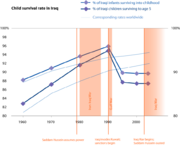
article reported that before Iraq sanctions were imposed by the UN in 1990, infant mortality had "fallen to 47 per 1,000 live births between 1984 and 1989. This compares to approximately 7 per 1,000 in the UK." The BBC article was reporting from a study of the London School of Hygiene & Tropical Medicine
London School of Hygiene & Tropical Medicine
The London School of Hygiene & Tropical Medicine is a constituent college of the federal University of London, specialising in public health and tropical medicine...
, titled "Sanctions and childhood mortality in Iraq", that was published in the May 2000 Lancet
The Lancet
The Lancet is a weekly peer-reviewed general medical journal. It is one of the world's best known, oldest, and most respected general medical journals...
medical journal. The study concluded that in southern and central Iraq, infant mortality rate between 1994 and 1999 had risen to 108 per 1,000. Child mortality rate, which refers to children between the age of one and five years, also drastically inclined from 56 to 131 per 1,000. In the autonomous northern region during the same period, infant mortality declined from 64 to 59 per 1000 and under-5 mortality fell from 80 to 72 per 1000, which was attributed to better food and resource allocation.
The Lancet publication was the result of two separate surveys by UNICEF between February and May 1999 in partnership with the local authorities and with technical support by the WHO. "The large sample sizes - nearly 24,000 households randomly selected from all governorates in the south and center of Iraq and 16,000 from the north - helped to ensure that the margin of error for child mortality in both surveys was low," UNICEF Executive Director Carol Bellamy said.
In the spring of 2000 a U.S. Congressional letter demanding the lifting of the sanctions garnered 71 signatures, while House Democratic Whip David Bonior called the economic sanctions against Iraq "infanticide masquerading as policy."
Oil for Food
As the sanctions faced mounting criticism of its humanitarian impacts, several UN resolutions were introduced that allowed Iraq to trade its oil for goods such as food and medicines. The earliest of these, UN Resolution 706 of 15 August 1991, allowed the sale of Iraqi oil in exchange for food.UN Resolution 712 of 19 September 1991 confirmed that Iraq could sell up to $1.6 billion USD in oil to fund an Oil For Food program.
In 1996, Iraq was allowed under the UN Oil-for-Food Programme
Oil-for-Food Programme
The Oil-for-Food Programme , established by the United Nations in 1995 was established with the stated intent to allow Iraq to sell oil on the world market in exchange for food, medicine, and other humanitarian needs for ordinary Iraqi citizens without allowing Iraq to boost its military...
(under Security Council Resolution 986
United Nations Security Council Resolution 986
United Nations Security Council Resolution 986, adopted unanimously on April 14, 1995, after reaffirming all resolutions on Iraq and noting the serious humanitarian situation with the Iraqi civilian population, the Council, acting under Chapter VII of the United Nations Charter, established a...
) to export $5.2 billion USD of oil every 6 months with which to purchase items needed to sustain the civilian population. After an initial refusal, Iraq signed a Memorandum of Understanding
Memorandum of understanding
A memorandum of understanding is a document describing a bilateral or multilateral agreement between parties. It expresses a convergence of will between the parties, indicating an intended common line of action. It is often used in cases where parties either do not imply a legal commitment or in...
(MOU) in May 1996 for implementation of that resolution. The Oil-for-Food Programme started in October 1997, and the first shipments of food arrived in March 1998. Twenty-five percent of the proceeds were redirected to a Persian Gulf War reparations account, and three percent into United Nations programs related to Iraq.
While the programme is creditted with improving the conditions of the population somewhat, it was not free from controversy itself. Denis Halliday
Denis Halliday
Denis J. Halliday was the United Nations Humanitarian Coordinator in Iraq from September 1, 1997, until 1998. He is Irish and holds an M.A. in Economics, Geography and Public Administration from Trinity College, Dublin....
who oversaw the Programm believed it inadequate to compensate for the adverse humanitarian impacts of the sanctions. The U.S. State Department criticized the Iraqi government for inadequately spending the money. In 2004/5 the Programme became the subject of major media attention over corruption
Political corruption
Political corruption is the use of legislated powers by government officials for illegitimate private gain. Misuse of government power for other purposes, such as repression of political opponents and general police brutality, is not considered political corruption. Neither are illegal acts by...
, as allegations surfaced such as that Iraq had systematically sold allocations of oil at below-market prices in return for some of the proceeds from the resale outside the scope of the Programme; investigations implicated individuals and companies from dozens of countries. See Oil For Food Programme - Investigations.
Lifting of sanctions
Following the 2003 Iraq War, the sanctions regime were largely ended on May 22, 2003 (with certain exceptions related to arms and to oil revenue) by paragraph 10 of UN Security Council Resolution 1483United Nations Security Council Resolution 1483
United Nations Security Council Resolution 1483, adopted on May 22, 2003, after recalling all previous resolutions on the situation between Iraq and Kuwait, the Council lifted trade sanctions against Iraq and terminated the Oil-for-Food Programme.The resolution was drafted by the United States and...
.
Sanctions which gave the USA and UK control over Iraq's oil revenue were not removed until December 2010. Sanctions which require 5% of Iraq's oil and natural gas revenue to be paid to Kuwait as reparations for Saddam Hussain's invasion are still in effect.
Culpability
Scholar Ramon Das, published in Human Rights Research Journal of the New Zealand Center for Public Law, examined each of the "most widely accepted ethical frameworks" in the context of violations of Iraqi human rights under the sanctions, finding that "primary responsibility rests with the UNSC [United Nations Security Council]" under these frameworks, including rights-utilitarianism, moral Kantianism, and consequentialism.Regional-difference-grounded culpability debate
Key statistical studies divide the country into "north" and "south/center" and note that mortality trends were more severe in the south/center.The Lancet and Unicef studies observed that child mortality decreased in the north and increased in the south/center between 1994 and 1999 but did not attempt to explain the disparity, or to apportion culpability; instead it recommended that "[b]oth the Government of Iraq and the U.N. Sanctions Committee should give priority to contracts for supplies that will have a direct impact on the well-being of children," UNICEF said.
Some sanctions commentators blame Saddam Hussein for the deaths resulting from sanctions. For example, Michael Rubin argued that the Kurdish and the Iraqi governments handled Oil For Food aid differently, and that therefore the Iraqi government policy, rather than the sanctions themselves, should be held responsible for any negative effects.' likewise, David Cortright
David Cortright
David Cortright is an American scholar and peace activist. He is Director of Policy Studies at the Kroc Institute for International Peace Studies at the University of Notre Dame and Chair of the Board of the Fourth Freedom Forum....
said that Iraq must "share responsibility." In the run-up to the Iraq War, some even disputed the idea that excess mortality exceeded 500,000, because the Iraq Government had interfered with objective collection of statistics (independent experts were barred at one point).
Other Western observers, such as Matt Welch
Matt Welch
Matt Welch is an American blogger, journalist, andlibertarian political pundit. Since 2008, he has been the editor-in-chief at the monthly libertarian journal, Reason. From 2006 to 2007, he was an editorial page editor for the Los Angeles Times...
and Anthony Arnove
Anthony Arnove
Anthony Arnove is a freelance literary editor, agent and activist based in Brooklyn. He is on the board of directors of Haymarket Books, and is active in the National Writers Union and the International Socialist Organization.- Early life :...
, argue that the differences in results noted by authors such as Rubin (above) may have been because the sanctions were not the same in the two parts of Iraq, due to several sorts of regional differences: in the per capita money, in agriculture, in war damage to infrastructure and in the relative ease of with which smugglers evaded sanctions through the porous Northern borders.
Iraqi attitudes toward the sanctions are complex, seeing them as part of a series of effects from decades of war; while no systematic study of attitudes has been permitted while that nation is dominated by Western military forces, interview-based research indicates attitudes focus on the deadly results of sanctions rather than apportion blame.
Arguments about the sanctions and the Iraq War
There is a controversy about the relationship between sanctions and the 2003 Iraq War.Some persons, such as Walter Russell Mead
Walter Russell Mead
Walter Russell Mead is James Clarke Chace Professor of Foreign Affairs and Humanities at Bard College and Editor-at-Large of The American Interest magazine, and is recognized as one of the country's leading students of American foreign policy . Until 2010, Mead was the Henry A. Kissinger Senior...
, accepted a large estimate of casualties due to sanctions, but argued that invading Iraq was better than continuing the sanctions regime, since "Each year of containment is a new Gulf War
Gulf War
The Persian Gulf War , commonly referred to as simply the Gulf War, was a war waged by a U.N.-authorized coalition force from 34 nations led by the United States, against Iraq in response to Iraq's invasion and annexation of Kuwait.The war is also known under other names, such as the First Gulf...
."
Former British Prime Minister Tony Blair
Tony Blair
Anthony Charles Lynton Blair is a former British Labour Party politician who served as the Prime Minister of the United Kingdom from 2 May 1997 to 27 June 2007. He was the Member of Parliament for Sedgefield from 1983 to 2007 and Leader of the Labour Party from 1994 to 2007...
, in his testimony to the Chilcot Inquiry
Chilcot Inquiry
The Iraq Inquiry, also referred to as the Chilcot Inquiry after its chairman, Sir John Chilcot, is a British public inquiry into the United Kingdom's role in the Iraq War...
, also argued that ending sanctions was one benefit of the war.
U.S. Vice President
Vice President of the United States
The Vice President of the United States is the holder of a public office created by the United States Constitution. The Vice President, together with the President of the United States, is indirectly elected by the people, through the Electoral College, to a four-year term...
Dick Cheney
Dick Cheney
Richard Bruce "Dick" Cheney served as the 46th Vice President of the United States , under George W. Bush....
, who called the sanctions "the most intrusive system of arms control in history", cited the breakdown of the sanctions as one cause or rationale for the Iraq war
Rationale for the Iraq War
The rationale for the Iraq War has been a contentious issue since the Bush administration began actively pressing for military intervention in Iraq in late 2001. The primary rationalization for the Iraq War was articulated by a joint resolution of the U.S. Congress known as the Iraq Resolution.The...
. While UN resolutions subsequent to the cessation of hostilities during the Persian Gulf War
Gulf War
The Persian Gulf War , commonly referred to as simply the Gulf War, was a war waged by a U.N.-authorized coalition force from 34 nations led by the United States, against Iraq in response to Iraq's invasion and annexation of Kuwait.The war is also known under other names, such as the First Gulf...
imposed several requisite responsibilities on Iraq for the removal of sanctions, the largest focus remained on the regime's development of nuclear, biological and chemical weapons, and in particular its laggard participation in the UNSCOM-led disarmament process required of it. The goal of several western governments had been that the disruptive effects of war and sanction would lead to a critical situation in which Iraqis would in some way effect "regime change", a removal of Saddam Hussein and his closest allies from power.
Albright Interview
On May 12, 1996, Madeleine AlbrightMadeleine Albright
Madeleine Korbelová Albright is the first woman to become a United States Secretary of State. She was appointed by U.S. President Bill Clinton on December 5, 1996, and was unanimously confirmed by a U.S. Senate vote of 99–0...
(then U.S. Ambassador to the United Nations) appeared on a 60 Minutes
60 Minutes
60 Minutes is an American television news magazine, which has run on CBS since 1968. The program was created by producer Don Hewitt who set it apart by using a unique style of reporter-centered investigation....
segment in which Lesley Stahl
Lesley Stahl
Lesley Rene Stahl is an American television journalist. Since 1991, she has reported for CBS on 60 Minutes.-Personal life:...
asked her "We have heard that half a million children have died. I mean, that's more children than died in Hiroshima. And, you know, is the price worth it?" and Albright replied "we think the price is worth it."
Albright wrote later that Saddam Hussein, not the sanctions, was to blame. She criticized Stahl's segment as "amount[ing] to Iraqi propaganda"; said that her question was a loaded question; wrote "I had fallen into a trap and said something I did not mean"; and regretted coming "across as cold-blooded and cruel". The segment won an Emmy Award. Albright's "non-denial" was taken by sanctions opponents as confirmation of a high number of sanctions related casualties.
Reactions to sanctions
There is evidence that the Iraqi government did not fully cooperate with the sanctions. For example, Hussein's son-in-law is heard speaking of concealing information from UN inspectors on audiotapes released in 2006. "I go back to the question of whether we should reveal everything or continue to be silent. Sir, since the meeting has taken this direction, I would say it is in our interest not to reveal." Hussein may have considered the many governments' displeasure with him, but particularly that of two veto-wielding UNSCUnited Nations Security Council
The United Nations Security Council is one of the principal organs of the United Nations and is charged with the maintenance of international peace and security. Its powers, outlined in the United Nations Charter, include the establishment of peacekeeping operations, the establishment of...
members, the United States
United States
The United States of America is a federal constitutional republic comprising fifty states and a federal district...
and United Kingdom
United Kingdom
The United Kingdom of Great Britain and Northern IrelandIn the United Kingdom and Dependencies, other languages have been officially recognised as legitimate autochthonous languages under the European Charter for Regional or Minority Languages...
(both of which took the hardest lines on Iraq), as a no-win situation
No-win situation
A no-win situation, also called a "lose-lose" situation, is one where a person has choices, but no choice leads to a net gain. For example, if an executioner offers the condemned the choice of dying by being hanged, shot, or poisoned, since all choices lead to death, the condemned is in a no-win...
and disincentive to cooperation in the process.
It has been alleged that UNSCOM had been infiltrated by British and American spies for purposes other than determining if Iraq possessed WMDs. Former inspector Scott Ritter
Scott Ritter
William Scott Ritter, Jr. was an important United Nations weapons inspector in Iraq from 1991 to 1998, and later a critic of United States foreign policy in the Middle East. Prior to the U.S. invasion of Iraq in March 2003, Ritter stated that Iraq possessed no significant weapons of mass...
was a prominent source of these charges. Former UNSCOM chief inspector David Kay
David Kay
Dr. David A. Kay is best known for heading the Iraq Survey Group and acting as a Weapons inspector in Iraq after the 2003 U.S. invasion.-Education:...
said "the longer it continued, the more the intelligence agencies would, often for very legitimate reasons, decide that they had to use the access they got through cooperation with UNSCOM to carry out their missions.".
Saddam, who saw all this as a violation of Iraq's sovereignty, became less cooperative and more obstructive of UNSCOM activities as the years wore on, and refused access for several years beginning in August 1998. Ultimately Saddam condemned the US for enforcing the sanctions through the UN and demanded nothing less than unconditional lifting of all sanctions on its country, including the weapons sanctions. The US and UN refused to do so out of concern that Saddam's regime would rebuild its once-powerful military and renew its WMD programs with the trade revenues.
Douglas Feith
Douglas Feith
Douglas J. Feith served as the Under Secretary of Defense for Policy for United States President George W. Bush from July 2001 until August 2005. His official responsibilities included the formulation of defense planning guidance and forces policy, United States Department of Defense relations...
reports that in 2001 "before the 9/11 attack, United States Secretary of State
United States Secretary of State
The United States Secretary of State is the head of the United States Department of State, concerned with foreign affairs. The Secretary is a member of the Cabinet and the highest-ranking cabinet secretary both in line of succession and order of precedence...
Colin Powell
Colin Powell
Colin Luther Powell is an American statesman and a retired four-star general in the United States Army. He was the 65th United States Secretary of State, serving under President George W. Bush from 2001 to 2005. He was the first African American to serve in that position. During his military...
advocated diluting the multinational economic sanctions, in the hope that a weaker set of sanctions could win stronger and more sustained international support." Renewed pressure in 2002 led to the entry of UNMOVIC
United Nations Monitoring, Verification and Inspection Commission
The United Nations Monitoring, Verification and Inspection Commission was created through the adoption of United Nations Security Council resolution 1284 of 17 December 1999....
, which received some degree of cooperation but failed to declare Iraq's disarmament immediately prior to the 2003 invasion of Iraq
2003 invasion of Iraq
The 2003 invasion of Iraq , was the start of the conflict known as the Iraq War, or Operation Iraqi Freedom, in which a combined force of troops from the United States, the United Kingdom, Australia and Poland invaded Iraq and toppled the regime of Saddam Hussein in 21 days of major combat operations...
, for which it was withdrawn and became inactive in Iraq.
In the 2004 Osama bin Laden video
2004 Osama bin Laden video
On October 29, 2004, at 21:00 UTC, the Arab television network, Al Jazeera, broadcast excerpts from a videotape of Osama bin Laden addressing the people of the United States, in which he accepts responsibility for the September 11, 2001 attacks, condemns the Bush government's response to those...
, Osama Bin Laden cited retribution for the sanctions as one of the
motivations for the September 11 attacks.
External links and References
- U.S. Department of State, Released September 13, 1999 (updated 2/23/00), "Saddam Hussein's Iraq"
- David Edwards, Zmag, 3 March 2000, Interview with Denis Halliday
- David CortrightDavid CortrightDavid Cortright is an American scholar and peace activist. He is Director of Policy Studies at the Kroc Institute for International Peace Studies at the University of Notre Dame and Chair of the Board of the Fourth Freedom Forum....
, "A Hard Look at Iraq Sanctions". The NationThe NationThe Nation is the oldest continuously published weekly magazine in the United States. The periodical, devoted to politics and culture, is self-described as "the flagship of the left." Founded on July 6, 1865, It is published by The Nation Company, L.P., at 33 Irving Place, New York City.The Nation...
, November 2001. - Council on Foreign RelationsCouncil on Foreign RelationsThe Council on Foreign Relations is an American nonprofit nonpartisan membership organization, publisher, and think tank specializing in U.S. foreign policy and international affairs...
, May 23, 2003, "Iraq: U.N. Sanctions" - The Daily TelegraphThe Daily TelegraphThe Daily Telegraph is a daily morning broadsheet newspaper distributed throughout the United Kingdom and internationally. The newspaper was founded by Arthur B...
, 25 May 2003, "Saddam's parades of dead babies are exposed as a cynical charade" - John PilgerJohn PilgerJohn Richard Pilger is an Australian journalist and documentary maker, based in London. He has twice won Britain's Journalist of the Year Award, and his documentaries have received academy awards in Britain and the US....
, New StatesmanNew StatesmanNew Statesman is a British centre-left political and cultural magazine published weekly in London. Founded in 1913, and connected with leading members of the Fabian Society, the magazine reached a circulation peak in the late 1960s....
, 4 October 2004, on why we ignored Iraq in the 1990s, and Impact of Iraq sanctions - IRIN News, news agency of the UN OCHA agency, looks again at the figures (August 2005): IRAQ: Child mortality rates finally dropping
- In These TimesIn These TimesIn These Times is a politically progressive monthly magazine of news and opinion published by the Institute for Public Affairs in Chicago...
, Christopher Hayes, March 6, 2006, "Were Sanctions Worth the Price?" - How Thirteen Years of US-Imposed (sic) Economic Sanctions Devastated Iraq Before the 2003 Invasion - video report by Democracy Now!Democracy Now!Democracy Now! and its staff have received several journalism awards, including the Gracie Award from American Women in Radio & Television; the George Polk Award for its 1998 radio documentary Drilling and Killing: Chevron and Nigeria's Oil Dictatorship, on the Chevron Corporation and the deaths of...