

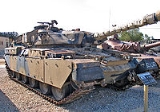
Chieftain tank

Encyclopedia
The FV 4201 Chieftain was the main battle tank
of the United Kingdom
during the 1960s and 1970s. It was one of the most advanced tanks of its era, and at the time of its introduction in 1966 had the most powerful main gun and heaviest armour of any tank in the world. The Chieftain also introduced a supine (lying backwards) driver position, enabling a heavily sloped hull with reduced height.
line of tanks that had emerged at the end of the Second World War
. The British had learned during the war that their tanks often lacked sufficient protection and firepower compared to those fielded by the enemy, and that this had led to high casualty levels when faced with the superior German tanks in World War II
.
In the post war period, the British Army bolstered the Centurion with the 120 mm gun Conqueror
heavy tank for long range anti-tank firepower against the Soviet IS-3.
Leyland, who had been involved in Centurion, had built their own prototypes of a new tank design in 1956, and these led to a War Office
specification for a new tank. The design was accepted in the early 1960s. Chieftain was designed to be as well protected as possible and to be equipped with a powerful 120 mm rifled gun. The heavy armour came at the price of reduced mobility, chiefly due to engine power limitations, which was perhaps the Chieftain's main drawback. The engine selected took the multi-fuel route and as introduced gave less than the planned output; improvements to the engine did not increase power to the desired value.
turret, in order to take full advantage of reclining the vehicle up to ten degrees in a hull-down position.
The driver lay semi-recumbent in the hull when his hatch was closed down, which helped to reduce overall height. The commander, gunner and loader were situated in the turret. To the left side of the turret was a large infra-red searchlight in an armoured housing.
The Leyland L60 engine is a two-stroke opposed piston design intended for multi-fuel use so that it could run on petrol or diesel or anything in between. In practice the engine did not deliver the expected power, and was unreliable, estimated to have a 90% breakdown rate, but improvements were introduced to address this. Primary problems included, cylinder liner failure, fan drive problems and perpetual leaks due to vibration and badly routed pipework. However, as the engine power improved the tank itself became heavier.
The tank was steered by conventional tillers hydraulically actuating onto external brake discs. The discs worked via the epicyclic gearbox providing "regenerative" steering. In reality the discs and pads became soaked in oil and diesel and the steering became difficult. The gearbox was operated motorcycle-style with a kick up/kick down "peg" on the left which actuated electro-hydraulic units in the gearbox; the accelerator was cable operated by the right foot. In the turret the loader was on the left and the gunner on the right of the gun with the commander behind the gunner. The suspension was of the Horstmann
bogie type, with large side plates to protect the tracks and provide stand-off protection from hollow charge attack.
The main armament was the 120 mm L11A5 rifled gun
. This differed from most contemporary main tank armament as it used projectiles and charges which were loaded separately, as opposed to a single fixed round. The charges were encased in combustible bags. Other tank guns, such as on the Conqueror, needed to store the spent shell cartridges or eject them outside. The combustible charges were stored in 36 recesses surrounded by a water/glycerine mixture - so-called "wet-stowage". In the event of a hit which penetrated the fighting compartment, the jacket would rupture, soaking the charges and preventing a catastrophic propellant explosion.
The gun could fire a wide range of ammunition, but the most commonly loaded types were high explosive squash head
(HESH), armour-piercing discarding sabot
(APDS), or practice round equivalents for both types. The Chieftain could store up to 62 projectiles (though a maximum of 36 APDS, limited by the propellant stowage). The gun was fully stabilised with a fully computerized integrated control system. The secondary armament consisted of a coaxial L8A1 7.62 mm
machine gun, and another 7.62 mm machine gun mounted on the commander's cupola.
The Chieftain had an NBC protection system, which the Centurion lacked.
The initial Fire-control system
(FCS) was the Marconi FV/GCE Mk 4. A .50-cal (12.7 mm) ranging gun was mounted above the main gun (with 300 rounds available). This fired ranging shots out to a maximum of 2600 yards (2,377.4 m), at which point the tracer in the ranging rounds burned out. The tank commander had a rotating cupola with nine vision blocks and a periscope, plus the 7.62 mm machine-gun and an infrared (IR) projector coaxial with the weapon. The aiming systems were provided for both gunner and tank commander; they had 1x or 8x selectable magnification power, and they were replaceable with IR vision systems for the night operations (3x magnification power). The left side of the turret had the big normal/ IR projector inside an armoured box. It had a relatively long range for this kind of system – up to 1–1.5 km (0.621372736649807–0.93205910497471 ).
From the beginning of the '70s, the Mk 3/3 version replaced the ranging gun with a Barr and Stroud
LF-2 laser rangefinder with a 10 kilometres (6.2 mi) range. This allowed engagements at much longer ranges, and also could be linked to the fire control system, allowing more rapid engagements and changes of target.
From the Mk 5 onwards, fire control was provided by the Marconi IFCS (Improved Fire Control System), using a digital ballistic computer. The upgrade was not finished until the end of 1980, when some examples (but not the majority) had the IR projector replaced with TOGS, the Termal image camera already fitted with the Challenger. Many examples had Stillbrew armour as well, meant to face Soviet 125 mm tank guns and heavy anti-tank missiles. These became the Mark 13 version.
an competitors, the Chieftain found a large export market in the Middle East
, but unlike the earlier Centurion, it was not adopted by any other NATO or Commonwealth countries.
The Chieftain proved itself capable in combat and able to be upgraded with enhancements both for overall improvement and to meet local requirements. The Chieftain tanks were continuously upgraded until the early 1990s when they were replaced by the Challenger
series of tanks whose design was influenced by that of Chieftain. The final Chieftain version used by the British Army until 1995, incorporated "Stillbrew" armour named after Colonel Still and John Brewer from the Military Vehicles and Engineering Establishment
(MVEE), the Improved Fire Control System (IFCS) and the Thermal Observation Gunnery Sight (TOGS).
The first Chieftain model was introduced in 1967. Chieftains were supplied to at least six countries, including Iran
, Kuwait
, Oman
and Jordan
. An agreement for sale of Chieftains to Israel
was cancelled by the British Government in 1969. The largest foreign sale was to Iran, which took delivery of 707 Mk-3P and Mk-5P, 125–189 FV-4030-1, 41 ARV and 14 AVLB before the 1979 revolution
. Further planned deliveries of the more capable 4030 series were cancelled at that point. The tank's main combat experience was in the Iran–Iraq War of 1980-88.
Mark 1 and Mark 2 models had coaxial .50 cal. ranging machine guns prior to the introduction of the laser rangefinder.
Chieftain Mk 2 : First service model with 650 hp engine.
Chieftain Mk 3 : Extra equipment fitted giving rise to several sub-marks.
Chieftain Mk.5 : Final production variant, with upgrades to the engine and NBC protection system.
Chieftain Mk.6-9 : Incremental upgrades to earlier Marks of tanks, including addition of Clansman radios.
Chieftain Mk.10 : Mark 9 upgrade, addition of Stillbrew Crew Protection Package to the turret front and turret ring.
Chieftain Mk.11 : Mark 10 upgrade, searchlight replaced with the Thermal Observation and Gunnery System (TOGS), manufactured by Barr and Stroud.
Chieftain Mk.12/13 : Proposed further upgrades, cancelled when the Challenger 2 was introduced.
Chieftain 900 : Chieftain with Chobham armour
FV4205 AVLB: Bridge-laying vehicle
FV4204 ARV/ARRV : Armoured Recovery Vehicle, Armoured Recovery and Repair Vehicle.
Chieftain AVRE: Armoured Vehicle Royal Engineers
, a British Army combat engineering variant used by the Royal Engineers
.
Chieftain Marksman: self-propelled anti-aircraft gun
version, equipped with the Marksman twin gun turret
.
Chieftain Mineclearer : Mine-clearing development.
Chieftain Sabre : Twin 30 mm AA turret.
Khalid (also designated 4030P2J - P = Phase & J = Jordan)/Shir (Lion) 1 : Jordanian / Iranian variant with running gear of the Challenger 1. Basically this was a transition vehicle from the Chieftain to the Shir 2 which had been intended for Iran but was subsequently cancelled. The Shir 2 tanks became Challenger 1 tanks after reworking at ROF Leeds. The vehicle chassis comprised the front half of a Chieftain Hull, Chieftain running gear and the rear of a 4030/2 Chassis (Sloping Hull). This allowed the fitment in the engine bay of a Rolls-Royce CV8 engine.
Weapon Carriers : The Chieftain chassis was modified to mount air defence weapons ("Marksman" 2 x 35 mm cannon) and a 155 mm howitzer in various modifications.
Shir 2 : Iranian variant. Visible external differences from the Chieftain Mk.5 included a sloping rear hull, Removal of the Searchlight from the left turret area and storage baskets refitted, water channel removed from around drivers hatch on the glacis plate, modified light clusters also on the glacis plate, Larger sight housing on commanders cupola.
Mobarez Tank
: Iranian upgraded version of the Chieftain.
Main battle tank
A main battle tank , also known as a battle tank or universal tank, is a tank that fills the heavy direct fire role of many modern armies. They were originally conceived to replace the light, medium, heavy and super-heavy tanks. Development was spurred onwards in the Cold War with the development...
of the United Kingdom
United Kingdom
The United Kingdom of Great Britain and Northern IrelandIn the United Kingdom and Dependencies, other languages have been officially recognised as legitimate autochthonous languages under the European Charter for Regional or Minority Languages...
during the 1960s and 1970s. It was one of the most advanced tanks of its era, and at the time of its introduction in 1966 had the most powerful main gun and heaviest armour of any tank in the world. The Chieftain also introduced a supine (lying backwards) driver position, enabling a heavily sloped hull with reduced height.
Development
The Chieftain was a radical evolutionary development of the successful CenturionCenturion tank
The Centurion, introduced in 1945, was the primary British main battle tank of the post-World War II period. It was a successful tank design, with upgrades, for many decades...
line of tanks that had emerged at the end of the Second World War
World War II
World War II, or the Second World War , was a global conflict lasting from 1939 to 1945, involving most of the world's nations—including all of the great powers—eventually forming two opposing military alliances: the Allies and the Axis...
. The British had learned during the war that their tanks often lacked sufficient protection and firepower compared to those fielded by the enemy, and that this had led to high casualty levels when faced with the superior German tanks in World War II
German tanks in World War II
Nazi Germany had several tank designs during World War II. In addition to these domestic designs, Germany also made use of various captured and foreign-built tanks.- Development and uses :...
.
In the post war period, the British Army bolstered the Centurion with the 120 mm gun Conqueror
Conqueror tank
The FV 214 Conqueror, also known as "Tank, Heavy No. 1, 120 mm Gun, Conqueror" was a British heavy tank of the post-war era. It was developed as a response to the Soviet Joseph Stalin IS-3 heavy tanks and carried a larger 120 mm gun compared to the 20-pounder gun carried by its peer the...
heavy tank for long range anti-tank firepower against the Soviet IS-3.
Leyland, who had been involved in Centurion, had built their own prototypes of a new tank design in 1956, and these led to a War Office
War Office
The War Office was a department of the British Government, responsible for the administration of the British Army between the 17th century and 1964, when its functions were transferred to the Ministry of Defence...
specification for a new tank. The design was accepted in the early 1960s. Chieftain was designed to be as well protected as possible and to be equipped with a powerful 120 mm rifled gun. The heavy armour came at the price of reduced mobility, chiefly due to engine power limitations, which was perhaps the Chieftain's main drawback. The engine selected took the multi-fuel route and as introduced gave less than the planned output; improvements to the engine did not increase power to the desired value.
Design
The Chieftain design included a heavily sloped hull and turret which greatly increased the effective thickness of the frontal armour - 388 mm (15.3 in) on the glacis (from an actual thickness of 120 mm (4.7 in)), and 390 mm (15.4 in) on the turret (from 195 mm (7.7 in)). It had a mantlelessGun mantlet
A gun mantlet is an armour plate or shield attached to an armoured fighting vehicle's gun, protecting the opening through which the weapon's barrel projects from the hull or turret armour and, in many cases, ensuring the vulnerable warhead of a loaded shell does not protrude past the vehicle's...
turret, in order to take full advantage of reclining the vehicle up to ten degrees in a hull-down position.
The driver lay semi-recumbent in the hull when his hatch was closed down, which helped to reduce overall height. The commander, gunner and loader were situated in the turret. To the left side of the turret was a large infra-red searchlight in an armoured housing.
The Leyland L60 engine is a two-stroke opposed piston design intended for multi-fuel use so that it could run on petrol or diesel or anything in between. In practice the engine did not deliver the expected power, and was unreliable, estimated to have a 90% breakdown rate, but improvements were introduced to address this. Primary problems included, cylinder liner failure, fan drive problems and perpetual leaks due to vibration and badly routed pipework. However, as the engine power improved the tank itself became heavier.
The tank was steered by conventional tillers hydraulically actuating onto external brake discs. The discs worked via the epicyclic gearbox providing "regenerative" steering. In reality the discs and pads became soaked in oil and diesel and the steering became difficult. The gearbox was operated motorcycle-style with a kick up/kick down "peg" on the left which actuated electro-hydraulic units in the gearbox; the accelerator was cable operated by the right foot. In the turret the loader was on the left and the gunner on the right of the gun with the commander behind the gunner. The suspension was of the Horstmann
Horstmann
Horstmann can refer to:* Horstmann suspension - Type of armoured fighting vehicle suspension.* Horstmann technique - Therapeutic massage technique working with blocked "energy".* Horstmann Cars - a British car manufacturer....
bogie type, with large side plates to protect the tracks and provide stand-off protection from hollow charge attack.
The main armament was the 120 mm L11A5 rifled gun
Royal Ordnance L11A5
The Royal Ordnance L11A5 is a 120 mm L/55 rifled tank gun design. It was the first of NATO's 120mm tank guns which became the standard calibre for Western tanks in the later period of the Cold War...
. This differed from most contemporary main tank armament as it used projectiles and charges which were loaded separately, as opposed to a single fixed round. The charges were encased in combustible bags. Other tank guns, such as on the Conqueror, needed to store the spent shell cartridges or eject them outside. The combustible charges were stored in 36 recesses surrounded by a water/glycerine mixture - so-called "wet-stowage". In the event of a hit which penetrated the fighting compartment, the jacket would rupture, soaking the charges and preventing a catastrophic propellant explosion.
The gun could fire a wide range of ammunition, but the most commonly loaded types were high explosive squash head
High explosive squash head
High explosive squash head is a type of explosive ammunition that is effective against buildings and is also used against tank armour. It was fielded chiefly by the British Army as the main explosive round of its main battle tanks during the Cold War...
(HESH), armour-piercing discarding sabot
Armour-piercing discarding sabot
Armour-piercing discarding sabot is a type of kinetic energy projectile fired from a gun to attack armoured targets. APDS rounds are sabot rounds and were commonly used in large calibre tank guns, but have now been superseded by armour-piercing fin-stabilized discarding sabot projectiles in such...
(APDS), or practice round equivalents for both types. The Chieftain could store up to 62 projectiles (though a maximum of 36 APDS, limited by the propellant stowage). The gun was fully stabilised with a fully computerized integrated control system. The secondary armament consisted of a coaxial L8A1 7.62 mm
FN MAG
The FN MAG is a Belgian 7.62 mm general-purpose machine gun, designed in the early 1950s at Fabrique Nationale by Ernest Vervier. It has been used by more than 80 countries, and it has been made under licence in countries such as Argentina, Egypt, India, Singapore, the United Kingdom and the...
machine gun, and another 7.62 mm machine gun mounted on the commander's cupola.
The Chieftain had an NBC protection system, which the Centurion lacked.
The initial Fire-control system
Fire-control system
A fire-control system is a number of components working together, usually a gun data computer, a director, and radar, which is designed to assist a weapon system in hitting its target. It performs the same task as a human gunner firing a weapon, but attempts to do so faster and more...
(FCS) was the Marconi FV/GCE Mk 4. A .50-cal (12.7 mm) ranging gun was mounted above the main gun (with 300 rounds available). This fired ranging shots out to a maximum of 2600 yards (2,377.4 m), at which point the tracer in the ranging rounds burned out. The tank commander had a rotating cupola with nine vision blocks and a periscope, plus the 7.62 mm machine-gun and an infrared (IR) projector coaxial with the weapon. The aiming systems were provided for both gunner and tank commander; they had 1x or 8x selectable magnification power, and they were replaceable with IR vision systems for the night operations (3x magnification power). The left side of the turret had the big normal/ IR projector inside an armoured box. It had a relatively long range for this kind of system – up to 1–1.5 km (0.621372736649807–0.93205910497471 ).
From the beginning of the '70s, the Mk 3/3 version replaced the ranging gun with a Barr and Stroud
Barr and Stroud
Barr & Stroud Limited was a pioneering Scottish optical engineering firm, based in Glasgow, that played a leading role in the development of modern optics, including rangefinders, for the Royal Navy and for other branches of British Armed Forces during the 20th century...
LF-2 laser rangefinder with a 10 kilometres (6.2 mi) range. This allowed engagements at much longer ranges, and also could be linked to the fire control system, allowing more rapid engagements and changes of target.
From the Mk 5 onwards, fire control was provided by the Marconi IFCS (Improved Fire Control System), using a digital ballistic computer. The upgrade was not finished until the end of 1980, when some examples (but not the majority) had the IR projector replaced with TOGS, the Termal image camera already fitted with the Challenger. Many examples had Stillbrew armour as well, meant to face Soviet 125 mm tank guns and heavy anti-tank missiles. These became the Mark 13 version.
Service
Like its EuropeEurope
Europe is, by convention, one of the world's seven continents. Comprising the westernmost peninsula of Eurasia, Europe is generally 'divided' from Asia to its east by the watershed divides of the Ural and Caucasus Mountains, the Ural River, the Caspian and Black Seas, and the waterways connecting...
an competitors, the Chieftain found a large export market in the Middle East
Middle East
The Middle East is a region that encompasses Western Asia and Northern Africa. It is often used as a synonym for Near East, in opposition to Far East...
, but unlike the earlier Centurion, it was not adopted by any other NATO or Commonwealth countries.
The Chieftain proved itself capable in combat and able to be upgraded with enhancements both for overall improvement and to meet local requirements. The Chieftain tanks were continuously upgraded until the early 1990s when they were replaced by the Challenger
Challenger 1 tank
The British FV4030/4 Challenger 1, was the main battle tank of the British Army from 1983 to the mid 1990s, when it was superseded by the Challenger 2. It is also currently used by the Jordanian Armed Forces as their main battle tank after heavy modifications...
series of tanks whose design was influenced by that of Chieftain. The final Chieftain version used by the British Army until 1995, incorporated "Stillbrew" armour named after Colonel Still and John Brewer from the Military Vehicles and Engineering Establishment
Military Vehicles and Engineering Establishment
The Military Vehicles and Engineering Establishment was a British defence research unit on Chobham Lane, Chertsey in Surrey. It was responsible for many innovations in armoured vehicle design, including ceramic Chobham armour.-History:...
(MVEE), the Improved Fire Control System (IFCS) and the Thermal Observation Gunnery Sight (TOGS).
The first Chieftain model was introduced in 1967. Chieftains were supplied to at least six countries, including Iran
Iran
Iran , officially the Islamic Republic of Iran , is a country in Southern and Western Asia. The name "Iran" has been in use natively since the Sassanian era and came into use internationally in 1935, before which the country was known to the Western world as Persia...
, Kuwait
Kuwait
The State of Kuwait is a sovereign Arab state situated in the north-east of the Arabian Peninsula in Western Asia. It is bordered by Saudi Arabia to the south at Khafji, and Iraq to the north at Basra. It lies on the north-western shore of the Persian Gulf. The name Kuwait is derived from the...
, Oman
Oman
Oman , officially called the Sultanate of Oman , is an Arab state in southwest Asia on the southeast coast of the Arabian Peninsula. It is bordered by the United Arab Emirates to the northwest, Saudi Arabia to the west, and Yemen to the southwest. The coast is formed by the Arabian Sea on the...
and Jordan
Jordan
Jordan , officially the Hashemite Kingdom of Jordan , Al-Mamlaka al-Urduniyya al-Hashemiyya) is a kingdom on the East Bank of the River Jordan. The country borders Saudi Arabia to the east and south-east, Iraq to the north-east, Syria to the north and the West Bank and Israel to the west, sharing...
. An agreement for sale of Chieftains to Israel
Israel
The State of Israel is a parliamentary republic located in the Middle East, along the eastern shore of the Mediterranean Sea...
was cancelled by the British Government in 1969. The largest foreign sale was to Iran, which took delivery of 707 Mk-3P and Mk-5P, 125–189 FV-4030-1, 41 ARV and 14 AVLB before the 1979 revolution
Iranian Revolution
The Iranian Revolution refers to events involving the overthrow of Iran's monarchy under Shah Mohammad Reza Pahlavi and its replacement with an Islamic republic under Ayatollah Ruhollah Khomeini, the leader of the...
. Further planned deliveries of the more capable 4030 series were cancelled at that point. The tank's main combat experience was in the Iran–Iraq War of 1980-88.
Specifications
- Crew: 4
- Combat Weight: 55 tons
- Overall Length: 10.8 m (gun forward)
- Hull Length: 7.5 m
- Height: 2.9 m
- Width: 3.5 m
- Powerplant: Leyland L60 (diesel, multi-fuel compression ignition) 695 bhp
- Range: 500 km
- Max Road Speed: 48 km/h
- Cross-Country Speed: 30 km/h
- Armour: turret front, 195 mm RHARolled homogeneous armourRolled homogeneous armour is a type of steel which is used to armour vehicles.-Composition:Armoured steel must be hard yet impervious to shock in order to resist high velocity metal projectiles. Steel with these characteristics is produced by processing cast steel billets of appropriate size and...
(60°)
Armament
- 120 mm L11A5 rifledRoyal Ordnance L11A5The Royal Ordnance L11A5 is a 120 mm L/55 rifled tank gun design. It was the first of NATO's 120mm tank guns which became the standard calibre for Western tanks in the later period of the Cold War...
tank gunTank gunA tank gun is the main armament of a tank. Modern tank guns are large-caliber high-velocity guns, capable of firing kinetic energy penetrators, high explosive anti-tank rounds, and in some cases guided missiles. Anti-aircraft guns can also be mounted to tanks.-Overview:Tank guns are a specific...
- Rate of fire: 8 rounds per minute
- Elevation: -10 to +20 degree
- Laser rangefinder
- Coaxial L8A1 7.62 mm machine gunMachine gunA machine gun is a fully automatic mounted or portable firearm, usually designed to fire rounds in quick succession from an ammunition belt or large-capacity magazine, typically at a rate of several hundred rounds per minute....
- Cupola-mounted L37A1 7.62mm machine gun
Mark 1 and Mark 2 models had coaxial .50 cal. ranging machine guns prior to the introduction of the laser rangefinder.
Equipment
- Twin ClansmanClansmanClansman is the name of a combat net radio system used by the British Army from 1976 to 2010.Clansman was developed by the Signals Research and Development Establishment in the 1960s, to satisfy a General Staff Requirement laid down in 1965...
VRC 353 VHF Radio sets - 1 C42 1 B47 LarkspurLarkspur radio systemLarkspur was the name of a tactical radio system used by the British Army. Its development started in the late 1940s with the first equipments being issued in the mid-1950s. It remained in service until replaced by Clansman in the late-1970s although some elements of Larkspur were still in service...
VHFVery high frequencyVery high frequency is the radio frequency range from 30 MHz to 300 MHz. Frequencies immediately below VHF are denoted High frequency , and the next higher frequencies are known as Ultra high frequency...
radios - 2 X 6-barrel smoke dischargers on turret
- Bulldozer blade (optional - fitted to one tank per squadron)
Variants
Chieftain Mk 1 : 40 training vehicles for 1965–1966.Chieftain Mk 2 : First service model with 650 hp engine.
Chieftain Mk 3 : Extra equipment fitted giving rise to several sub-marks.
Chieftain Mk.5 : Final production variant, with upgrades to the engine and NBC protection system.
Chieftain Mk.6-9 : Incremental upgrades to earlier Marks of tanks, including addition of Clansman radios.
Chieftain Mk.10 : Mark 9 upgrade, addition of Stillbrew Crew Protection Package to the turret front and turret ring.
Chieftain Mk.11 : Mark 10 upgrade, searchlight replaced with the Thermal Observation and Gunnery System (TOGS), manufactured by Barr and Stroud.
Chieftain Mk.12/13 : Proposed further upgrades, cancelled when the Challenger 2 was introduced.
Chieftain 900 : Chieftain with Chobham armour
Chobham armour
Chobham armour is the name informally given to a composite armour developed in the 1960s at the British tank research centre on Chobham Common, Surrey, England...
FV4205 AVLB: Bridge-laying vehicle
FV4204 ARV/ARRV : Armoured Recovery Vehicle, Armoured Recovery and Repair Vehicle.
Chieftain AVRE: Armoured Vehicle Royal Engineers
Armoured Vehicle Royal Engineers
Armoured Vehicle Royal Engineers is the title given to a series of armoured vehicles operated by the Royal Engineers for the purpose of battlefield engineer support. These vehicles have been either purpose-built or post-production modifications of existing tank-based armoured vehicles...
, a British Army combat engineering variant used by the Royal Engineers
Royal Engineers
The Corps of Royal Engineers, usually just called the Royal Engineers , and commonly known as the Sappers, is one of the corps of the British Army....
.
Chieftain Marksman: self-propelled anti-aircraft gun
Self-propelled anti-aircraft weapon
An anti-aircraft vehicle, also known as a self-propelled anti-aircraft weapon or self-propelled air defense system , is a mobile vehicle with a dedicated anti-aircraft capability...
version, equipped with the Marksman twin gun turret
Marksman anti-aircraft system
Marksman is a British anti-aircraft weapon system, consisting of a turret, a Marconi Series 400 radar and two Swiss 35 mm Oerlikon autocannons...
.
Chieftain Mineclearer : Mine-clearing development.
Chieftain Sabre : Twin 30 mm AA turret.
Khalid (also designated 4030P2J - P = Phase & J = Jordan)/Shir (Lion) 1 : Jordanian / Iranian variant with running gear of the Challenger 1. Basically this was a transition vehicle from the Chieftain to the Shir 2 which had been intended for Iran but was subsequently cancelled. The Shir 2 tanks became Challenger 1 tanks after reworking at ROF Leeds. The vehicle chassis comprised the front half of a Chieftain Hull, Chieftain running gear and the rear of a 4030/2 Chassis (Sloping Hull). This allowed the fitment in the engine bay of a Rolls-Royce CV8 engine.
Weapon Carriers : The Chieftain chassis was modified to mount air defence weapons ("Marksman" 2 x 35 mm cannon) and a 155 mm howitzer in various modifications.
Shir 2 : Iranian variant. Visible external differences from the Chieftain Mk.5 included a sloping rear hull, Removal of the Searchlight from the left turret area and storage baskets refitted, water channel removed from around drivers hatch on the glacis plate, modified light clusters also on the glacis plate, Larger sight housing on commanders cupola.
Mobarez Tank
Mobarez Tank
Mobarez meaning Warrior is an upgraded version of British Chieftain Tank by Iran.-Changes:The chassis of the tank is changed in back and sides. The fuel tank is replaced by a new repairable one. The gear box is changed so the tank can have 360 degrees turret turn. Also additional anti shock...
: Iranian upgraded version of the Chieftain.
Operators
- Used from 1965 to 1995.: 707 Mk-3P and Mk-5P, 125–189 FV-4030-1, 41 ARV and 14 AVLB obtained before the 1979 revolution. Further planned deliveries of the more capable 4030 series were cancelled at that point. 100 in service as of 2005. (100 in 1990, 250 in 1995, 140 in 2000, 200 in 2002).: 30 tanks in service with Iraqi Army in 1990. All destroyed or scrapped.: 274 Khalid delivered between 1981-1985 + 90 MK5/5 From Iraq. 350 in service : 175 in 1976, 45 in 1989, 20 in 1995, 17 in storage in 2000.: 27 delivered 1981–85.