

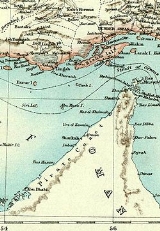
Abu Musa

Encyclopedia
Abu Musa is a 12-km² island
in the eastern Persian Gulf
, part of a six-island archipelago
near the entrance to the Strait of Hormuz
. The island is administered by Iran
as part of the Iranian province of Hormozgan, but is also claimed by the United Arab Emirates
(UAE).
Abu Musa's inhabitants call it "Gap-sabzu" , which means "the great green place." On old maps, the island is called Bumuf or Bum-i Musa, Persian for "the land of Musa
/Moses
."
As of 2010 the island had some 2,038 inhabitants making it Iran's smallest county
. The city of Abu Musa had a population of 1,868 as of 2010.
The ownership of Abu Musa is disputed between Iran and the UAE. The UK administered the island along with the other British-controlled islands in the Persian Gulf, including what is today the UAE. In the late 1960s, Britain transferred administration of the island to the British-appointed Sharjah, one of the seven sheikdoms that would later form the UAE. After Britain announced in 1968 that it would relinquish its hegemony in the Persian Gulf, Iran
moved to reattach the island politically to the mainland. In November 1971, UAE and Iran
agreed to give sovereignty to the former but allowed the latter to station troops on the island.
In 1980, the UAE took its claim to the United Nations
. In same year, Saddam Hussein attempted to justify the Iraq-Iran war by claiming that one of the objectives was to "liberate" Abu Musa, Greater Tunb, and Lesser Tunb. In 1992, Iran
increased its control by expelling foreign worker
s who operated the UAE-sponsored school, medical clinic, and power-generating station.
Island
An island or isle is any piece of sub-continental land that is surrounded by water. Very small islands such as emergent land features on atolls can be called islets, cays or keys. An island in a river or lake may be called an eyot , or holm...
in the eastern Persian Gulf
Persian Gulf
The Persian Gulf, in Southwest Asia, is an extension of the Indian Ocean located between Iran and the Arabian Peninsula.The Persian Gulf was the focus of the 1980–1988 Iran-Iraq War, in which each side attacked the other's oil tankers...
, part of a six-island archipelago
Archipelago
An archipelago , sometimes called an island group, is a chain or cluster of islands. The word archipelago is derived from the Greek ἄρχι- – arkhi- and πέλαγος – pélagos through the Italian arcipelago...
near the entrance to the Strait of Hormuz
Strait of Hormuz
The Strait of Hormuz is a narrow, strategically important waterway between the Gulf of Oman in the southeast and the Persian Gulf. On the north coast is Iran and on the south coast is the United Arab Emirates and Musandam, an exclave of Oman....
. The island is administered by Iran
Iran
Iran , officially the Islamic Republic of Iran , is a country in Southern and Western Asia. The name "Iran" has been in use natively since the Sassanian era and came into use internationally in 1935, before which the country was known to the Western world as Persia...
as part of the Iranian province of Hormozgan, but is also claimed by the United Arab Emirates
United Arab Emirates
The United Arab Emirates, abbreviated as the UAE, or shortened to "the Emirates", is a state situated in the southeast of the Arabian Peninsula in Western Asia on the Persian Gulf, bordering Oman, and Saudi Arabia, and sharing sea borders with Iraq, Kuwait, Bahrain, Qatar, and Iran.The UAE is a...
(UAE).
Abu Musa's inhabitants call it "Gap-sabzu" , which means "the great green place." On old maps, the island is called Bumuf or Bum-i Musa, Persian for "the land of Musa
Muša
Mūša is a river in Northern Lithuania and Southern Latvia , having its confluence with river Nemunėlis , in Latvia, near city Bauska. Mūša is a tributary of the river Lielupė. Mūša is 164 kilometres long....
/Moses
Moses
Moses was, according to the Hebrew Bible and Qur'an, a religious leader, lawgiver and prophet, to whom the authorship of the Torah is traditionally attributed...
."
As of 2010 the island had some 2,038 inhabitants making it Iran's smallest county
Counties of Iran
The provinces of Iran further subdivided into counties called shahrestan , an area inside an ostan, and consists of a city centre, few bakhsh and many villages around them. There are usually a few cities and rural agglomerations in each county. Rural agglomerations are a collection of a number...
. The city of Abu Musa had a population of 1,868 as of 2010.
The ownership of Abu Musa is disputed between Iran and the UAE. The UK administered the island along with the other British-controlled islands in the Persian Gulf, including what is today the UAE. In the late 1960s, Britain transferred administration of the island to the British-appointed Sharjah, one of the seven sheikdoms that would later form the UAE. After Britain announced in 1968 that it would relinquish its hegemony in the Persian Gulf, Iran
Iran
Iran , officially the Islamic Republic of Iran , is a country in Southern and Western Asia. The name "Iran" has been in use natively since the Sassanian era and came into use internationally in 1935, before which the country was known to the Western world as Persia...
moved to reattach the island politically to the mainland. In November 1971, UAE and Iran
Iran
Iran , officially the Islamic Republic of Iran , is a country in Southern and Western Asia. The name "Iran" has been in use natively since the Sassanian era and came into use internationally in 1935, before which the country was known to the Western world as Persia...
agreed to give sovereignty to the former but allowed the latter to station troops on the island.
In 1980, the UAE took its claim to the United Nations
United Nations
The United Nations is an international organization whose stated aims are facilitating cooperation in international law, international security, economic development, social progress, human rights, and achievement of world peace...
. In same year, Saddam Hussein attempted to justify the Iraq-Iran war by claiming that one of the objectives was to "liberate" Abu Musa, Greater Tunb, and Lesser Tunb. In 1992, Iran
Iran
Iran , officially the Islamic Republic of Iran , is a country in Southern and Western Asia. The name "Iran" has been in use natively since the Sassanian era and came into use internationally in 1935, before which the country was known to the Western world as Persia...
increased its control by expelling foreign worker
Foreign worker
A foreign worker is a person who works in a country other than the one of which he or she is a citizen. The term migrant worker as discussed in the migrant worker page is used in a particular UN resolution as a synonym for "foreign worker"...
s who operated the UAE-sponsored school, medical clinic, and power-generating station.
External links
- History, description, map of Abu Musa and nearby islands (Archived 2009-10-24)
- History of Abu Musa and The Tunbs
- UAE Interact Abu Musa News
- Abu Musa's military garrison
- Dispute between Iran and Sharjah
- Maritime Boundaries in the Persian Gulf: the case of Tunb and Abu Musa Islands
- Report of the International symposium on Modern Boundaries of Iran - Problems and practices of Iranian boundaries, Pirouz Mojtahed-Zadeh, 10/15/02