
Home      Discussion      Topics      Dictionary      Almanac
Signup       Login
Day of Ashura

Day of Ashura

Overview
The Day of Ashura ( is on the 10th day of Muharram
Muharram
Muharram is the first month of the Islamic calendar. It is one of the four sacred months of the year in which fighting is prohibited...

 in the Islamic calendar
Islamic calendar
The Islamic calendar or Muslim calendar or Hijri calendar is a lunar calendar based on 12 lunar months in a year of 354 or 355 days, used to date events in many Muslim countries , and used by Muslims everywhere to determine the proper day on which...

 and marks the climax of the Remembrance of Muharram.

It is commemorated by the Muslims as a day of mourning for the martyrdom of Husayn ibn Ali
Husayn ibn Ali
Ḥusayn ibn ‘Alī ibn Abī Ṭālib ‎ was the son of ‘Alī ibn Abī Ṭālib and Fātimah Zahrā...

, the grandson of the Islamic Prophet Muhammad
Muhammad
Muhammad ibn ‘Abdullāh , is the founder of the religion of Islam [ إِسْلامْ ] and is regarded by Muslims as a messenger and prophet of , the last and the greatest law-bearer in a series of Islamic prophets as taught by the...

 at the Battle of Karbala
Battle of Karbala
The Battle of Karbala took place on Muharram 10, in the year 61 of the Islamic calendar in Karbala, in present day Iraq...

 on 10 Muharram
Muharram
Muharram is the first month of the Islamic calendar. It is one of the four sacred months of the year in which fighting is prohibited...

 in the year 61 AH
Islamic calendar
The Islamic calendar or Muslim calendar or Hijri calendar is a lunar calendar based on 12 lunar months in a year of 354 or 355 days, used to date events in many Muslim countries , and used by Muslims everywhere to determine the proper day on which...

 (October 10, 680 AD). Sunni Muslims believe that Moses
Moses
Moses was, according to biblical texts, a religious leader, lawgiver, and prophet, to whom the authorship of the Torah is traditionally attributed. Also called Moshe Rabbeinu in Hebrew Moses was, according to biblical texts, a...

 fasted on that day to express gratitude to God for liberation of Israelites from Egypt
The Exodus
The Exodus, from the Greek word έξοδος, is an event that marked the departure of the Israelites from enslavement in ancient Egypt. The event is described in the Hebrew Bible, but no other original sources...

.
Discussion
Ask a question about 'Day of Ashura'
Start a new discussion about 'Day of Ashura'
Answer questions from other users
Full Discussion Forum
 
Encyclopedia
The Day of Ashura ( is on the 10th day of Muharram
Muharram
Muharram is the first month of the Islamic calendar. It is one of the four sacred months of the year in which fighting is prohibited...

 in the Islamic calendar
Islamic calendar
The Islamic calendar or Muslim calendar or Hijri calendar is a lunar calendar based on 12 lunar months in a year of 354 or 355 days, used to date events in many Muslim countries , and used by Muslims everywhere to determine the proper day on which...

 and marks the climax of the Remembrance of Muharram.

It is commemorated by the Muslims as a day of mourning for the martyrdom of Husayn ibn Ali
Husayn ibn Ali
Ḥusayn ibn ‘Alī ibn Abī Ṭālib ‎ was the son of ‘Alī ibn Abī Ṭālib and Fātimah Zahrā...

, the grandson of the Islamic Prophet Muhammad
Muhammad
Muhammad ibn ‘Abdullāh , is the founder of the religion of Islam [ إِسْلامْ ] and is regarded by Muslims as a messenger and prophet of , the last and the greatest law-bearer in a series of Islamic prophets as taught by the...

 at the Battle of Karbala
Battle of Karbala
The Battle of Karbala took place on Muharram 10, in the year 61 of the Islamic calendar in Karbala, in present day Iraq...

 on 10 Muharram
Muharram
Muharram is the first month of the Islamic calendar. It is one of the four sacred months of the year in which fighting is prohibited...

 in the year 61 AH
Islamic calendar
The Islamic calendar or Muslim calendar or Hijri calendar is a lunar calendar based on 12 lunar months in a year of 354 or 355 days, used to date events in many Muslim countries , and used by Muslims everywhere to determine the proper day on which...

 (October 10, 680 AD). Sunni Muslims believe that Moses
Moses
Moses was, according to biblical texts, a religious leader, lawgiver, and prophet, to whom the authorship of the Torah is traditionally attributed. Also called Moshe Rabbeinu in Hebrew Moses was, according to biblical texts, a...

 fasted on that day to express gratitude to God for liberation of Israelites from Egypt
The Exodus
The Exodus, from the Greek word έξοδος, is an event that marked the departure of the Israelites from enslavement in ancient Egypt. The event is described in the Hebrew Bible, but no other original sources...

. According to Sunni Muslim tradition
Sunnah
Sunnah is an Arabic word that means habit or usual practice. The Muslim usage of this term refers to the sayings and living habits of Muhammad, the main prophet of Islam....

, Muhammad
Muhammad
Muhammad ibn ‘Abdullāh , is the founder of the religion of Islam [ إِسْلامْ ] and is regarded by Muslims as a messenger and prophet of , the last and the greatest law-bearer in a series of Islamic prophets as taught by the...

 fasted on this day and asked other people to fast.

In some countries and regions such as Iran
Iran
Iran , officially the Islamic Republic of Iran is a country in Western Asia. The name Iran has been in use natively since the Sassanid period and came into international use from 1935, before which the country was known internationally as Persia...

, Iraq
Iraq
Iraq , officially the Republic of Iraq , also known as Mesopotamia, is a country in Western Asia spanning most of the northwestern end of the Zagros mountain range, the eastern part of the Syrian Desert and the northern part of the Arabian Desert.Iraq shares borders with Jordan to the west, Syria...

, Pakistan
Pakistan
Pakistan , officially the Islamic Republic of Pakistan, is a country located at the crossroads of South Asia, the Middle East, and Central Asia...

, Lebanon
Lebanon
Lebanon , officially the Republic of LebanonRepublic of Lebanon is the most common term used by Lebanese government agencies...

, Bahrain
Bahrain
The Kingdom of Bahrain is a small island country in the Persian Gulf ruled by the Al Khalifa royal family. Saudi Arabia lies to the west and is connected to Bahrain via the King Fahd Causeway, which was officially opened on the 25th of November 1986. Qatar is to the southeast across the Gulf of...

 and Jamaica
Jamaica
Jamaica is an island nation of the Greater Antilles, in length and as much as in width, amounting to 11,100 km2. It is situated in the Caribbean Sea, about south of Cuba, and west of Hispaniola, the island harboring the nation-states Haiti and the Dominican Republic...

, Commemoration of Husayn ibn Ali has become a national holiday and most ethnic and religious communities participate in it.

Etymology of Ashura


The word ashura
Ashura
Ashura may refer to:*Ashura, meaning "tenth" in Arabic.**The Day of Ashura, , Islamic day of mourning.**Yom Kippur in Judaism.*King Ashura, character from the manga series Tsubasa:Reservoir Chronicle...

means simply tenth in Arabic language
Arabic language
Arabic is a Central Semitic language, thus related to and classified alongside other Semitic languages such as Hebrew and the Neo-Aramaic languages. In terms of speakers, the Arabic macrolanguage is the largest member of the Semitic language family. It is spoken by more than 280 million people as...

; hence the name of the remembrance
Remembrance
Remembrance is the act of remembering, the ability to remember or a memorial. It may refer to:*Remembrance Day, a commemorative day observed by many Commonwealth countries.*Day of Remembrance for Truth and Justice, a commemorative day observed by Argentina....

, literally translated, means "the tenth day". The day is indeed the tenth day of the month, although some Islamic scholars offer up different etymologies. In his book Ghuniyatut Talibin, Sheikh Abdul Qadir Jilani writes that the Islamic scholars have a difference of opinion as to why this day is known as Ashura. The consensus is that the day is the tenth day of the Some scholars, however, suggest that this day is the tenth most important day that God has blessed Muslims with; hence the name Ashura.

Also the birthday of Baron Ashura
Baron Ashura
is a fictional character featuring in the works of mangaka Go Nagai. He/she is the main henchman of Dr. Hell, the antagonist of Super Robot series Mazinger Z...


Commemoration of the martyrdom of Husayn ibn Ali


History of the commemoration


This day is well-known because of mourning for the martyrdom of Husayn ibn Ali
Husayn ibn Ali
Ḥusayn ibn ‘Alī ibn Abī Ṭālib ‎ was the son of ‘Alī ibn Abī Ṭālib and Fātimah Zahrā...

 A.S the grandson of Muhammad
Muhammad
Muhammad ibn ‘Abdullāh , is the founder of the religion of Islam [ إِسْلامْ ] and is regarded by Muslims as a messenger and prophet of , the last and the greatest law-bearer in a series of Islamic prophets as taught by the...

 and the third Shia Imam, along with members of his family and close friends at the Battle of Karbala
Battle of Karbala
The Battle of Karbala took place on Muharram 10, in the year 61 of the Islamic calendar in Karbala, in present day Iraq...

 in the year 61 AH
Islamic calendar
The Islamic calendar or Muslim calendar or Hijri calendar is a lunar calendar based on 12 lunar months in a year of 354 or 355 days, used to date events in many Muslim countries , and used by Muslims everywhere to determine the proper day on which...

 (AD 680
680
680 was a leap year of the 7th century.-Europe:* The Bulgars subjugate the country of current-day Bulgaria.* Pippin of Herstal becomes Mayor of the Palace.* Erwig deposes Wamba to become king of the Visigoths....

). Yazid I
Yazid I
Yazīd ibn Mu‘āwiyati ibn Abī Sufyāni , commonly known as Yazid I, was the second Caliph of the Umayyad Caliphate and ruled for three years from 680 CE until his death in 683 CE. The period of Yazid's rule was a great disaster for the Muslims and his rule is still remembered by many, especially...

 was in power then and wanted the Bay'ah
Bay'ah
Bay'ah , literally means to sell, in Islamic terminology it is an oath of allegiance to a leader. It is known to have been practiced by the prophet Muhammad...

 (allegiance) of Husayn ibn Ali. Many Muslims believe Yazid was openly going against the teachings of Islam in public and changing the sunnah of Prophet Muhammad.

Husayn in his path toward Kufa
Kufa
Kufa is a city in Iraq, about 170 km south of Baghdad, and 10 km northeast of Najaf. It is located on the banks of the Euphrates River. The estimated population in 2003 was 110,000....

 encountered the army of Ubayd-Allah ibn Ziyad
Ubayd-Allah ibn Ziyad
Ubayd Allah ibn Ziyad was a son of Ziyad ibn Abi Sufyan after whose death in 673 he became the Governor of Kufa and Basra and later Khurasan.He also minted coinage, which survives to this day...

, the governor of Kufa. On October 10 680(Muharram 10, 61 AH), he and his small group of companions and family members, who were between 72 and 100 men of Husayn ibn Ali
Husayn ibn Ali
Ḥusayn ibn ‘Alī ibn Abī Ṭālib ‎ was the son of ‘Alī ibn Abī Ṭālib and Fātimah Zahrā...

 (the grandson of Muhammad). fought with a large army of perhaps more than 100,000 men under the command of Umar ibn Sa'ad
Umar ibn Sa'ad
Umar ibn Sa'ad or Amir ibn Sad , was the son of Sa'ad ibn Abi Waqqas. A clergyman, brutal dictator and governor of Iran|Ray]] city, he took orders given by Ibn Ziyad to command the troops that murdered[ Imam [Husayn ibn Ali]] in the Battle of Karbala, where they massacred the family of the Holy...

, son of the founder of Kufa. Husayn and all of his men were killed. Some of the bodies of the dead, including that of Husayn, were then mutilated.

Commemoration for Husayn ibn Ali began after Battle of Karbala
Battle of Karbala
The Battle of Karbala took place on Muharram 10, in the year 61 of the Islamic calendar in Karbala, in present day Iraq...

. After the massacre, the Umayyad
Umayyad
The Umayyad Caliphate was the second of the four Islamic caliphates established after the death of Muhammad. It was ruled by the Umayyad dynasty, whose name derives from Umayya ibn Abd Shams, the great-grandfather of the first Umayyad caliph. Although the Umayyad family originally came from the...

 army looted Husayn's camp and set off with his women and children for the court of Ibn Ziyad. A moving oration delivered by Zaynab in Kufa is recorded in some sources. The prisoners were next sent to the court of Yazid, Umayyad caliph, in Damascus
Damascus
Damascus is the capital and largest city of Syria. It is the oldest continuously inhabited city in the world and its current population is estimated at about 1,669,000...

, where one of his Syrian followers asked for Husayn's daughter Faṭimah al-Kubra, and once again it was Zaynab who came to the rescue and protected her honour. The family remained in Yazid's prison for a time. The first assembly (majlis) of Commemoration of Husayn ibn Ali is said to have been held by Zaynab in prison. In Damascus, too, she is reported to have delivered a poignant oration. The prison sentence ended when Hussain's 4 year old daughter died in captivity, a young girl who would stand at the window of the prison and tell the ladies who would gather outside about the tragedy that befell her family. Her death caused an uproar in the city, and Yazid - fearful of a revolution that may have begun as a result - freed the captives.
"Zaynab bint Ali
Zaynab bint Ali
Zaynab bint Ali was the daughter of the last caliph of Islam Ali , and granddaughter of Islamic prophet, Muhammad.In Shi'a views, she is a great figure of sacrifice and strength. In Iran, her birthday is recognized as Nurse's Day....

 quoted as she passed the prostrate body of her brother, Husayn. " O Muhammad! O Muhammad! May the angels of heaven bless you. Here is Husayn in the open, stained with blood and with limbs torn off. O Muhammad! Your daughters are prisoners, your progeny are killed, and the east wind blows dust over them." By God! She made every enemy and friend weep."
Tabari
Muhammad ibn Jarir al-Tabari
Abu Ja'far Muhammad ibn Jarir al-Tabari was one of the earliest, most prominent and famous Persian historian and exegete of the Qur'an,who wrote exclusively in Arabic , most famous for his Tarikh al-Tabari and Tafsir al-Tabari.-Name:His name means "Muhammad of Tabari, father [abu] of Jafar, son...

, History of the Prophets and Kings, Volume XIX The Caliphate of Yazid.


Just few years after Husayn's death his grave became a pilgrimage site among Shi'a. A tradition of pilgrimage to the Imam Husayn Shrine
Imam Husayn Shrine
The Shrine of Husayn ibn ‘Alī is a holy site of Shī‘ah Islām in the city of Karbalā, Iraq. It stands on the site of the grave of Husayn ibn ‘Alī, the second grandson of Muhammad, near the place where he was killed during the Battle of Karbalā in 680 C.E....

 and the other Karbala martyrs quickly developed, which is renown as Ziarat Ashura. The Umayyad
Umayyad
The Umayyad Caliphate was the second of the four Islamic caliphates established after the death of Muhammad. It was ruled by the Umayyad dynasty, whose name derives from Umayya ibn Abd Shams, the great-grandfather of the first Umayyad caliph. Although the Umayyad family originally came from the...

 and Abbasid
Abbasid
The Abbasid Caliphate was the third of the Islamic Caliphates of the Islamic Empire. It was ruled by the Abbasid dynasty of caliphs, who built their capital in Baghdad after overthrowing the Umayyad caliphs from all but Al Andalus....

 caliph
Caliph
The Caliph is the head of state in a Caliphate, and the title for the leader of the Islamic Ummah, an Islamic community ruled by the Shari'ah. It is a transliterated version of the Arabic word   which means "successor" or "representative"...

s tried to prevent construction of the shrines and discouraged pilgrimage to the sites. The tomb and its annexes were destroyed by the Abbasid caliph Al-Mutawakkil
Al-Mutawakkil
Al-Mutawakkil ˤAlā Allāh Jaˤfar ibn al-Muˤtasim was an Abbasid caliph who reigned in Samarra from 847 until 861...

 in 850-851 and Shi'a pilgrimage was prohibited, but shrines in Karbala
Karbala
Karbala is a city in Iraq, located about southwest of Baghdad at 32.61°N, 44.08°E. In the time of Husayn ibn Alī's life, the place was also known as al-Ghadiriyah, Naynawa, and Shathi'ul-Furaat. The estimated population in 2003 was 572,300 people. It is the capital of Karbala Governorate...

 and Najaf
Najaf
Najaf is a city in Iraq about 160 km south of Baghdad. Its estimated population in 2008 is 900,600 people. It is the capital of Najaf Governorate...

 were built by the Buwayhid
Buwayhid
Buyid dynasty, also known as the Buyid Empire or the Buyids , also known as Buwaihids, Buyahids, or Buyyids, were a Shī‘ah Persian dynasty that originated from Daylaman...

 emir 'Adud al-Daula
'Adud al-Daula
Aḍud al-Dawla or Azod od-Dowleh Fana Khusraw was an emir of the Buyid dynasty in Iran and Iraq...

 in 979-80.

It did not take long for public rites of remembrance for Husayn's martyrdom to develop from the early pilgrimages. Under the Buyid dynasty, Mu'izz ad-Dawla officiated at public commemoration of Ashura in Baghdad
Baghdad
Baghdad is the capital of Iraq and of Baghdad Governorate, with which it is coterminous. Having a municipal population estimated at 6.5 million, it is the largest city in Iraq and the second largest in the Arab World....

. These commemorations were also encouraged in Egypt
Egypt
Egypt , officially the Arab Republic of Egypt, is a country mainly in North Africa, with the Sinai Peninsula forming a land bridge in Western Asia...

 by the Fatimid
Fatimid
The Fatimid Caliphate or al-Fātimiyyūn was an Arab Shi'a dynasty that ruled over varying areas of the Maghreb, Egypt, Sicily, Malta and the Levant from 5 January 909 to 1171. The caliphate was ruled by the Fatimids, who established the Egyptian city of Cairo as their capital. The term Fatimite is...

 caliph al-'Aziz
Abu Mansoor Nizar al-Aziz Billah
Al-Aziz was the fifth Caliph of the Fatimids .Since Abdallah, the heir to the throne, had died before his father Ma'ad al-Muizz Li-Deenillah , his brother Abu l-Mansur Nizar al-Aziz acceded to the Caliphate with the help of Jawhar as-Siqilli. Under Al-Aziz the Fatimid Empire stretched as far as...

. From Seljuq times, Ashura rituals began to attract many participants from a variety of backgrounds, including Sunnis. With the recognition of Twelvers as the official religion by the Safavids, Mourning of Muharram
Mourning of Muharram
The Mourning of Muharram is an important period of mourning in the Shi'a branch of Islam, taking place in Muharram which is the first month of the Islamic calendar. It is also called the Remembrance of Muharram...

 extended throughout the first ten days of Muharram
Muharram
Muharram is the first month of the Islamic calendar. It is one of the four sacred months of the year in which fighting is prohibited...

.

Significance of Ashura for Shi'a Muslims


This day is of particular significance to Shi'a Muslim
Muslim
:A Muslim , , is an adherent of the religion of Islam. The feminine form is Muslimah . Literally, the word means "one who submits ". Muslim is the participle of the same verb of which Islam is the infinitive. Muslims believe that there is only one God, translated in Arabic as Allah...

s, who consider Hussein (the grandson of the Prophet) Ahl al-Bayt
Ahl al-Bayt
Ahl al-Bayt is an Arabic phrase literally meaning People of the House, or family. The phrase "ahl al-bayt" was used in Arabia before the advent of Islam to refer to one's clan, and would be adopted by the ruling family of a tribe. Within the Islamic tradition, the term refers to the family of...

 the third Imam
Imam
An imam is an Islamic leadership position, often the leader of a mosque and the community. Similar to spiritual leaders, the imam is the one who leads the prayer during Islamic gatherings. More often, the community turns to the mosque imam if they have an Islamic question...

 and the rightful successor of Muhammad
Muhammad
Muhammad ibn ‘Abdullāh , is the founder of the religion of Islam [ إِسْلامْ ] and is regarded by Muslims as a messenger and prophet of , the last and the greatest law-bearer in a series of Islamic prophets as taught by the...

. Many Shi'as make pilgrimages on Ashura to the Mashhad al-Husayn, the shrine
Shrine
A shrine is a holy or sacred place, which is dedicated to a specific deity, ancestor, hero, martyr, saint or similar figure of awe and respect, at which they are venerated or worshipped. Shrines often contain idols, relics, or other such objects associated with the figure being venerated...

 in Karbala
Karbala
Karbala is a city in Iraq, located about southwest of Baghdad at 32.61°N, 44.08°E. In the time of Husayn ibn Alī's life, the place was also known as al-Ghadiriyah, Naynawa, and Shathi'ul-Furaat. The estimated population in 2003 was 572,300 people. It is the capital of Karbala Governorate...

, Iraq
Iraq
Iraq , officially the Republic of Iraq , also known as Mesopotamia, is a country in Western Asia spanning most of the northwestern end of the Zagros mountain range, the eastern part of the Syrian Desert and the northern part of the Arabian Desert.Iraq shares borders with Jordan to the west, Syria...

 that is traditionally held to be Imam Hussein's tomb. On this day Shi'a are in remembrance, and mourning attire is worn. They refrain from music, since Arabic culture generally considers music impolite during death rituals. It is a time for sorrow and respect of the person's passing, and it is also a time for self-reflection, when one commits oneself to the mourning of the Imam Hussein completely. Weddings and parties are also never planned on this date by Shi'as. Shi'as also express mourning by crying and listening to poems about the tragedy and sermons on how Hussein and his family were martyred. This is intended to connect them with Hussein's suffering and martyrdom, and the sacrifices he made to keep Islam alive. Hussein's martyrdom is widely interpreted by Shi'a as a symbol of the struggle against injustice, tyranny, and oppression.

Shi'as believe the Battle of Karbala was between the forces of good and evil. Imam Hussain represented good while Yazid represented evil. Shi'as also believe the Battle of Karbala was fought to keep the Muslim religion untainted of any corruptions and they believed the path that Yazid was directing Islam was definitely for his own personal greed.

Shia Imams strongly insists that the day of Ashura should not be taken as a day of joy and festivity. According to a hadith
Hadith
Hadith are oral traditions relating to the words and deeds of the Islamic prophet Muhammad. Hadith are regarded by traditional schools of jurisprudence as important tools for determining the Muslim way of life, the sunnah. Hadith were originally oral traditions of Muhammad's actions and customs...

 which is reported from Ali
Ali
' was the cousin and son-in-law of the Islamic prophet Muhammad, and ruled over the Islamic Caliphate from 656 to 661...

 some people fabricated a hadith claiming it was on that day the God forgave Adam
Adam
Adam was, according to the Book of Genesis and the Qur'an, the first man created by God and noted in subsequent Jewish, Christian and Islamic commentary. His wife was Eve.- Etymology :...

, Noah
Noah
Noah was, according to the Bible, the tenth and last of the antediluvian Patriarchs; and a prophet according to the Qur'an...

's Ark rested on dry land, The Israelites were saved from Pharaoh's army, etc. The day of Ashura, according to Eighth Shia Imam
Twelve Imams
The Twelve Imams are the spiritual and political successors to Muhammad, the Prophet of Islam, in the Twelver or Ithna-‘ashariyyah branch of Shī‘ah Islam....

, Ali al-Rida
Ali al-Rida
‘Alī ibn Mūsā al-Riḍā was the seventh descendant of the Islamic prophet Muhammad and the eighth of the Twelve Imams...

, must be observed as a day of inactivity, sorrow and total disregard of worldly cares.

Shia refrain from drinking and eating in commemoration of Imam Hussein. This is known as Fakah, which is not a formal fast.

Many of the events associated with Ashura are held in special congregation halls known as "Imambargah" and Hussainia
Hussainia
A Hussainia is a congregation hall for Shia ritual ceremonies, especially those associated with the Remembrance of Muharram. The name comes from Husayn Ibn Ali, the grandson of Muhammad and an Imam of the Shia. Hussain was killed by Yazid I in Karbala, Iraq, over 1,300 years ago...

.

As suffering and cutting the body with knives or chains (matam) have been prohibited by many Shi'a marja
Marja
Marjaʿ , also appearing as Marja Taqlid or Marja Dini , literally means "Source to Imitate/Follow" or "Religious Reference". It is the label provided to Shia authority, a Grand Ayatollah with the authority to make legal decisions within the confines of Islamic law for followers and...

s like Ali Khamenei
Ali Khamenei
Ayatollah Sayyid Ali Hoseyni Khāmene’i , also known as Ali Khamenei, is an Iranian politician, cleric and the figurehead of the conservative establishment in Iran. He has been the Supreme Leader of Iran since 1989 and was president of Iran from 1981 to 1989...

, Supreme Leader of Iran
Supreme Leader of Iran
The post of Supreme Leader was created in the constitution of the Islamic Republic of Iran as the highest ranking political and religious authority of the nation, in accordance with the concept of Guardianship of the Islamic Jurists...

, some Shi'a observe mourning with blood donation which is called "Qame Zani" and flailing.

Certain rituals like the traditional flagellation ritual called zanjeer zani or zanjeer matam, involving the use of a zanjeer (a chain) are also performed. These are not religious customs but are popularly done to show solidarity with Imam Hussain and his family. People mourn the fact that they were not present at the battle to fight and save Hussain and his family. The chanting in Hindi is " Hai Hussain, hum kyun na huye!" meaning Oh Hussain! Why were we not born (in that time to protect and save you.)

At least many Shia believe that taking part in Ashura is to be absolved of sin. A popular Shia saying has it that, `a single tear shed for Hussain washes away a hundred sins.`

Popular customs


For Shi'as, commemoration of Ashura is not a festival, but rather a sad event, while Sunni Muslims view it as a victory God (Allah) has given to his prophet, Musa. This victory is the very reason, as Sunni Muslims believe, Muhammad
Muhammad
Muhammad ibn ‘Abdullāh , is the founder of the religion of Islam [ إِسْلامْ ] and is regarded by Muslims as a messenger and prophet of , the last and the greatest law-bearer in a series of Islamic prophets as taught by the...

 mentioned when recommending fasting on this day. For Shi'as, it is a period of intense grief and mourning. Mourners, congregate at a Mosque for sorrowful, poetic recitations such as marsiya, noha
Noha
Noha is a genre of Arabic, Persian, or Urdu prose depicting the martyrdom of the 12 Holy Imams. Strictly speaking noha is the sub-parts of Marsia. Nohas are usually poetry expressing the sorrow felt by Shia Muslims for their leaders....

, latmiya and soaz
Soaz
Soaz or soz is an elegiac poem written to commemorate the martyrdom and valour of Hazrat Imam Hussain and his comrades of the Karbala. In its form the soaz, salam and marsia, with a rhyming quatrain, and a couplet on a different rhyme...

 performed in memory of the martyrdom of Hussein, lamenting and grieving to the tune of beating drums and chants of "Ya Hussain
Ya Hussain
Yā Hussain is an Arabic phrase used by Shiite Muslims to invoke the memory or intervention of Hussain ibn Ali. It is especially used in the context of the Mourning of Muharram....

." Also Ulama
Ulama
Ulama could refer to:* Ulema, also spelled "Ulama", a community of legal scholars of Islam and the Sharia* Ulama, a variety of a Mesoamerican ballgame descended from an Aztec ritual....

s give sermons with themes of Hussein's personality and position in Islam, and the history of his uprising. The Sheikh of the mosque retells the Battle of Karbala to allow the listeners to relive the pain and sorrow endured by Hussein and his family. In Arab countries like Iraq
Iraq
Iraq , officially the Republic of Iraq , also known as Mesopotamia, is a country in Western Asia spanning most of the northwestern end of the Zagros mountain range, the eastern part of the Syrian Desert and the northern part of the Arabian Desert.Iraq shares borders with Jordan to the west, Syria...

 and Lebanon
Lebanon
Lebanon , officially the Republic of LebanonRepublic of Lebanon is the most common term used by Lebanese government agencies...

 they read Maqtal Al-Husayn
Maqtal al-Husayn
Maqtal al-Husayn is a book which narrates the story of battle of Karbala and death of Hussain ibn Ali. These books has written since the 8th century until now.-Maqtal:...

. In some places, such as Iran, Iraq and the Arab states of the Persian Gulf
Arab states of the Persian Gulf
The Arab Gulf States, also known as Arab states of the Persian Gulf or Gulf Arab states or Gulf states, are usually reserved for the six Arab monarchical states joined since 1981 in the Cooperation Council for the Arab States of the Gulf, or Gulf Cooperation Council : Bahrain, Saudi Arabia, the...

, Ta'zieh
Ta'zieh
Ta'zieh means Condolence Theater and Naqqali are traditional Persian theatrical genres in which the drama is conveyed wholly or predominantly through music and singing...

, passion plays, are also performed reenacting the Battle of Karbala
Battle of Karbala
The Battle of Karbala took place on Muharram 10, in the year 61 of the Islamic calendar in Karbala, in present day Iraq...

 and the suffering and martyrdom of Hussein at the hands of Yazid
Yazid I
Yazīd ibn Mu‘āwiyati ibn Abī Sufyāni , commonly known as Yazid I, was the second Caliph of the Umayyad Caliphate and ruled for three years from 680 CE until his death in 683 CE. The period of Yazid's rule was a great disaster for the Muslims and his rule is still remembered by many, especially...

.
For the duration of the remembrance, it is customary for mosques and some people to provide free meals (Niazz) on certain nights of the month to all people. Many people donate food and Middle Eastern sweets to the mosque. These meals are viewed as being special and holy, as they have been consecrated in the name of Husayn, and thus partaking of them is considered an act of communion with God
God
God is a deity in theistic and deistic religions and other belief systems, representing either the sole deity in monotheism, or a principal deity in polytheism....

, Hussain, and humanity
Human Race
The Human Race could be:* The Human species; see also World population* The Human Race , a comic book published by DC Comics* Human Race , a video game*The Human Race, 79th episode of YuYu Hakusho...

.

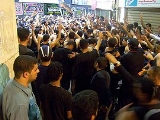
Many participants congregate together in public processions for ceremonial chest beating (matham/latmiya) as a display of their devotion to Husayn, in remembrance of his suffering and to preach that oppression will not last in the face of truth and justice. Others pay tribute to the time period by holding a Majilis, Surahs from the Quran and Maqtal Al-Husayn are read.

Today in Indonesia
Indonesia
The Republic of Indonesia is a country in Southeast Asia and Oceania. Indonesia comprises 17,508 islands. With an estimated population of around 237 million people, it is the world's fourth most populous country, with the world's largest population of Muslims.Indonesia is a republic, with an...

, the event is known as Tabuik
Tabuik
Tabuik is the local manifestation of the Remembrance of Muharram among the Minangkabau people in the coastal regions of West Sumatra, Indonesia, particularly in the city of Pariaman. The festival includes reenactments of the Battle of Karbala, and the playing of tassa and dhol drums...

 (Minangkabau language
Minangkabau language
The Minangkabau language is an Austronesian language, spoken by the Minangkabau-people of West Sumatra, in the western part of Riau and in several cities throughout Indonesia by migrated Minangkabau, who often trade or have a restaurant...

) or Tabut/Tabot (Indonesian
Indonesian language
Indonesian is the official national language of Indonesia. It is based on a version of Classical Malay of the Riau-Johor Sultanate. It was first declared the official language with the declaration of Indonesian independence in 1945, following the 1928 unifying-language declaration in the...

). Tabuik is the local manifestation of the Shi'a Muslim Remembrance of Muharram among the Minangkabau
Minangkabau
The Minangkabau ethnic group is indigenous to the highlands of West Sumatra, in Indonesia. Their culture is matrilineal, with property and land passing down from mother to daughter, while religious and political affairs are the province of men...

 people in the coastal regions of West Sumatra
West Sumatra
West Sumatra is a province of Indonesia. It lies on the west coast of the island Sumatra, and borders the provinces of North Sumatra to the north, Riau and Jambi to the east, and Bengkulu to the southeast. It includes the Mentawai Islands off the coast...

, particularly in the city of Pariaman
Pariaman
Pariaman is a coastal city in West Sumatra, Indonesia. Pariaman has 72,089 inhabitants , an area of 73.4 km² and a 12 km coastline...

. The festival includes reenactments of the Battle of Karbala
Battle of Karbala
The Battle of Karbala took place on Muharram 10, in the year 61 of the Islamic calendar in Karbala, in present day Iraq...

, and the playing of tassa
Tassa
Tassa drums are found amongst Indo-Caribbean people. The word "tassa" comes from the Persian tash and Hindi tasha, which both mean "kettle drum". The drum is an Indo-caribbean version of Indian and Persian precursors...

 and dhol
Dhol
For Armenian Dhol and Georgian Doli, see Nagara Not to be confused with doldrum, the dhol dohol , is a drum widely used in the Indian subcontinent, especially the Punjab region, and especially among the Sikhs of East Punjab...

 drums.

In countries like Turkey
Turkey
Turkey , known officially as the Republic of Turkey , is a Eurasian country that stretches across the Anatolian peninsula in Western Asia and Thrace in the Balkan region of southeastern Europe...

, there is the custom of eating Noah's Pudding Ashure
Ashure
Ashure or Noah's Pudding is a Turkish dessert that is made of a mixture consisting of grains, fruits and nuts. Ashure is a part of the culinary tradition of Turkey as well as many of the surrounding countries....

 as this day in Turkish is known as Aşure.

Commemoration of Husayn ibn Ali by non-Muslims


In some countries other religious communities commemorate this event.

In Trinidad and Tobago
Trinidad and Tobago
The Republic of Trinidad and Tobago is an archipelagic state in the southern Caribbean, lying northeast of the South American country of Venezuela and south of Grenada in the Lesser Antilles. It shares maritime boundaries with other nations including Barbados to the northeast, Guyana to the...

 and Jamaica
Jamaica
Jamaica is an island nation of the Greater Antilles, in length and as much as in width, amounting to 11,100 km2. It is situated in the Caribbean Sea, about south of Cuba, and west of Hispaniola, the island harboring the nation-states Haiti and the Dominican Republic...

 all ethnic and religious communities participate in this event, locally known as "Hosay
Hosay
Hosay or Tadjah is a West Indian street festival, in which multi-colored model mausoleums are paraded, then ritually offered up to the sea, or any body of water...

" or "Hussay", from "Husayn".

Significance of Ashura for Sunni muslims


According to Sunni Hadith
Hadith
Hadith are oral traditions relating to the words and deeds of the Islamic prophet Muhammad. Hadith are regarded by traditional schools of jurisprudence as important tools for determining the Muslim way of life, the sunnah. Hadith were originally oral traditions of Muhammad's actions and customs...

, Ashura was already known as a commemorative day during which some Meccans used to observe customary fasting. In hijrah event when Muhammad led his followers to Medina, he found the Jews of that area likewise observing fasts on the day of Ashura. At this, Muhammad affirmed the Islamic claim to the fast, and from then the Muslims have fasted on combinations of two or three consecutive days including the 10th of Muharram (e.g. 9th and 10th or 10th and 11th).

A companion of the prophet, Ibn Abas reports that the prophet went to Medina and found the Jews fasting on the tenth of Muharram. Muhammad inquired of them, "What is the significance of this day on which you fast?" They replied, "This is a good day, the day on which God rescued the children of Israel from their enemy. So, Moses fasted this day." Muhammad said, "We have more claim over Moses than you."

From then, Muhammad fasted on the tenth of Muharram.

The Shariah law however, shuns acts that resemble Jews and Christians. Thus it is reported in Mishkaat that Muhammad said, "Fast on the day of Ashura and oppose the Jews regarding it. Thus fast on the day before it and on the day after." (Taken from The Significance of Muharram by Rafique Valli, lecturer at the Islamic University for Girls, Johannesburg)

All Sunni Muslims believe that the fast on Ashura is optional.

The Ashura is commemorated for the following occasions which may have happened on the 10th Day of the Muharram
Muharram
Muharram is the first month of the Islamic calendar. It is one of the four sacred months of the year in which fighting is prohibited...

:
  • God had mercy on Adam
  • The deliverance of Noah from the flood
  • Abraham was saved from Nimrod's fire
  • Jacob's blindness was healed after Joseph's shirt was brought to him on this day (Quran)
  • Job was healed from his illness
  • The Israelites were saved from Pharaoh's army.
  • Jesus was brought up to heaven after attempts by the Romans to capture and crucify him failed.


All the above incidents are not confirmed to have taken place on Ashura in the Koran, nor by any strong Hadith. These have been reported in the weaker Hadith, but are nevertheless regarded possible by majority of the Sunni Muslims. The most authentic is the 5th incident where God saved Moses and the Israelites from Pharaoh. This is the reason why many Muslims fast on the 10th of Muharram.

Today, Sunnis regard fasting during Ashura as recommended, though not obligatory, having been superseded by the Ramadan
Ramadan
Ramadan is the ninth month of the Islamic calendar. It is the Islamic month of fasting, in which participating Muslims refrain from eating, drinking, smoking, and indulging in anything that is in excess or ill-natured; from dawn until sunset...

 fast.

Oddly, Sunnis in Egypt
Egypt
Egypt , officially the Arab Republic of Egypt, is a country mainly in North Africa, with the Sinai Peninsula forming a land bridge in Western Asia...

 customarily eat a pudding (also known as Ashura) after dinner on the Day of Ashura; it is a rice pudding
Rice pudding
Rice pudding is a dish made from rice mixed with water or milk and sometimes other ingredients. Different variants are used for either desserts or dinners. When used as a dessert, it is commonly combined with a sweetener.-History:...

 with nuts, raisin
Raisin
Raisins are dried grapes. They are produced in many regions of the world, such as Armenia, the United States, Australia, Chile, Argentina, Macedonia, Mexico, Greece, Syria, Turkey, India, Iran, Pakistan, Iraq, China, Afghanistan, Togo, and Jamaica, as well as South Africa and Southern and...

s, and rose water, and it is also known in Turkish
Turkish language
Turkish is spoken as a first language by over 63 million people worldwide, making it the most commonly spoken of the Turkic languages. Its speakers are located predominantly in Turkey and Cyprus, with smaller groups in Iraq, Greece, Bulgaria, the Republic of Macedonia, Kosovo, Albania and other...

 as Aşure. Given that Egypt was ruled by the Shi'ite Fatimid Caliphate and subsequently conquered by the Sunni Ayyubid dynasty
Ayyubid dynasty
The Ayyubids were a Sunni Muslim dynasty of Kurdish origin centered in Cairo and Damascus that ruled much of the Middle East during the 12th and 13th centuries CE. The Ayyubid family, under the brothers Ayyub and Shirkuh, originally served as soldiers for the Zengids until they gradually gained...

, it may be that the (bitter) fast of Ashura was turned on its head after the Fatimid regime was toppled.

Socio-political aspects


Commemoration of Ashura has great socio-political value for the Shi'a, who have been a minority throughout their history. "Al-Amd" asserts that the Shiite transference of Al-Husayn and Karbala ' from the framework of history to the domain of ideology and everlasting legend reflects their marginal and dissenting status in Arab-Islamic society. According to the prevailing conditions at the time of the commemoration, such reminiscences may become a framework for implicit dissent or explicit protest. It was, for instance, used during the Islamic Revolution of Iran , the Lebanese Civil War
Lebanese Civil War
The Lebanese Civil War was a multifaceted civil war in the nation of Lebanon in the Middle East. The war lasted from 1975 to 1990 and resulted in an estimated 130,000 to 250,000 civilian fatalities...

, the Lebanese resistance against the Israeli occupation
Israel-Lebanon conflict
The Israeli–Lebanese conflict describes a series of related military clashes involving Israel, Lebanon, and Syria, as well as various non-state militias acting from within Lebanon....

 and in the 1990s Uprising in Bahrain
1990s Uprising in Bahrain
The 1990s Uprising in Bahrain or 1990s Intifada was an Islamist led uprising that took place in Bahrain between 1994 and 2000.Like other uprisings during the 1990s, the Bahrain intifada stated aims were for democratic reform, and it was considered as the first movement in the Arab world where...

. Sometimes the `Ashura' celebrations associate the memory of Al-Husayn's martyrdom with the conditions of Islam and Muslims (both of which have been historically continually put down by the world powers) in reference to Imam Hussain's famous quote on the day of Ashura: "Every day is Ashura, every land is Karbala".

From the period of the Iranian Constitutional Revolution
Iranian Constitutional Revolution
The Iranian Constitutional Revolution took place between 1905 and 1911. The revolution led to the establishment of a parliament in Persia ....

 (1905-11) onward, mourning gatherings increasingly assumed a political aspect. Following an old established tradition, preachers compared the oppressors of the time with Imam Hosayn's enemies, the umayyads.

The political function of commemoration was very marked in the years leading up to the Islamic Revolution of 1978-79, as well as during the revolution itself. In addition, the implicit self-identification of the Muslim revolutionaries with Imam Hosayn led to a blossoming of the cult of the martyr, expressed most vividly, perhaps, in the vast cemetery of Behesht-e Zahra
Behesht-e Zahra
Behesht-e Zahra , is the largest cemetery in Iran. Located in the southern part of metropolitan Tehran, it is connected to the city by a metro line. Many of the deceased soldiers of the Iran–Iraq War are buried there...

, to the south of Tehran
Tehran
Tehran is the capital and largest city of Iran, and the administrative center of Tehran Province. Tehran is a sprawling city at the foot of the Tochal mountain range with an immense network of highways unparalleled in Western Asia...

, where the martyrs of the revolution and the war against Iraq are buried.

On the other hand some governments have banned this commemoration. In 1930s Reza Shah
Reza Shah

Not to be confused with Shah Mohammad Reza Pahlavi, his son.Rezā Shāh, also Rezā Shāh Pahlavi , , was the Shah of the Imperial State of Iran from December 15, 1925 until he was forced to abdicate by the Anglo-Soviet invasion of Iran in September 16, 1941.In 1925, Reza Shah overthrew Ahmad...

 forbade it in Iran
Iran
Iran , officially the Islamic Republic of Iran is a country in Western Asia. The name Iran has been in use natively since the Sassanid period and came into international use from 1935, before which the country was known internationally as Persia...

. The regime of Saddam Hussein
Saddam Hussein
Saddam Hussein Abd al-Majid al-Tikriti was the President of Iraq from 16 July 1979 until 9 April 2003...

 saw this as a potential threat and banned Ashura commemorations for many years. In the 1884 Hosay Massacre
Hosay Massacre
The Hosay massacre took place on Thursday October 30, 1884 in San Fernando, Trinidad when the British colonial authorities fired on participants in the annual Hosay procession who had been banned from entering the town.-Background:After the emancipation of slaves in...

, 22 people were killed in Trinidad and Tobago
Trinidad and Tobago
The Republic of Trinidad and Tobago is an archipelagic state in the southern Caribbean, lying northeast of the South American country of Venezuela and south of Grenada in the Lesser Antilles. It shares maritime boundaries with other nations including Barbados to the northeast, Guyana to the...

 when civilians attempted to carry out the Ashura rites, locally known as Hosay
Hosay
Hosay or Tadjah is a West Indian street festival, in which multi-colored model mausoleums are paraded, then ritually offered up to the sea, or any body of water...

, in defiance of the British
United Kingdom
The United Kingdom of Great Britain and Northern Ireland is a sovereign state located off the northwestern coast of continental Europe. It is an island country, spanning an archipelago including Great Britain, the northeastern part of Ireland, and many small islands...

 colonial authorities.

Violence during Ashura


The Sunni and Shi'a schism is highlighted by the difference in observance by Sunni and Shi'a Muslims. The violence is perpetrated by Sunni and Shia extremists. In countries that have significant populations of both sects, there is often violence during the holiday.

On June 20, 1994 the explosion of a bomb in a prayer hall of Imam Reza shrine
Imam Reza shrine
Imām Rezā shrine in Mashhad, Iran is a complex which contains the mausoleum of Imām Ridhā, the eighth Imām of Twelver Shi'ites. Also contained within the complex include: the Goharshad Mosque, a museum, a library, four seminaries, a cemetery, the Razavi University of Islamic Sciences, a dining...

 in Mashhad
Mashhad
Mashhad is one of the largest cities in Iran and one of the holiest cities in the Shia world. It is located east of Tehran, at the center of the Razavi Khorasan Province close to the borders of Afghanistan and Turkmenistan...

 killed at least 25 people. The Iranian government officially blamed Mujahedin-e-Khalq for the incident to avoid sectarian conflict between Shias and Sunnis. However, the Pakistani daily The News International
The News International
The News International is the second largest English language newspaper in Pakistan. The News has an ABC certified circulation of 140,000. It is published from Karachi, Lahore and Rawalpindi/Islamabad...

 reported on March 27, 1995, "Pakistani investigators have identified a 24-year-old religious fanatic Abdul Shakoor residing in Lyari in Karachi
Karachi
is the largest city, main seaport and the financial capital of Pakistan, and the capital of the province of Sindh. It is the 3rd largest city in the world by population and 20th largest city of the world, in terms of metropolitan population. It is Pakistan's premier centre of banking, industry, and...

, as an important Pakistan
Pakistan
Pakistan , officially the Islamic Republic of Pakistan, is a country located at the crossroads of South Asia, the Middle East, and Central Asia...

i associate of Ramzi Yousef
Ramzi Yousef
Ramzi Ahmed Yousef or Ramzi Mohammed Yousef , birth name possibly Abdul Basit Mahmoud Abdul Karim and also known by dozens of aliases, was born in Kuwait and is of Pakistani descent. He was one of the planners of the 1993 World Trade Center bombing...

. Abdul Shakoor had intimate contacts with Ramzi Ahmed Yousef and was responsible for the June 20, 1994, massive bomb explosion at the shrine Imam Ali Reza in Mashhad."

The 2004 (1425 AH) Shi'a pilgrimage to Karbala, the first since Saddam Hussein
Saddam Hussein
Saddam Hussein Abd al-Majid al-Tikriti was the President of Iraq from 16 July 1979 until 9 April 2003...

 was removed from power in Iraq, was marred by bomb attacks, which killed and wounded hundreds despite tight security.

On January 19, 2008, 7 million Iraq
Iraq
Iraq , officially the Republic of Iraq , also known as Mesopotamia, is a country in Western Asia spanning most of the northwestern end of the Zagros mountain range, the eastern part of the Syrian Desert and the northern part of the Arabian Desert.Iraq shares borders with Jordan to the west, Syria...

i Shia pilgrim
Pilgrim
A pilgrim is one who undertakes a pilgrimage, literally 'far afield'. This is traditionally a visit to a place of some religious or historic significance; often a considerable distance is traveled...

s marched through Karbala
Karbala
Karbala is a city in Iraq, located about southwest of Baghdad at 32.61°N, 44.08°E. In the time of Husayn ibn Alī's life, the place was also known as al-Ghadiriyah, Naynawa, and Shathi'ul-Furaat. The estimated population in 2003 was 572,300 people. It is the capital of Karbala Governorate...

 city, Iraq
Iraq
Iraq , officially the Republic of Iraq , also known as Mesopotamia, is a country in Western Asia spanning most of the northwestern end of the Zagros mountain range, the eastern part of the Syrian Desert and the northern part of the Arabian Desert.Iraq shares borders with Jordan to the west, Syria...

 to commemorate Ashura. 20,000 Iraqi troops and police guarded the event amid tensions due to clashes between Iraqi troops and members of a Shia cult, the Soldiers of Heaven
Soldiers of Heaven
The Soldiers of Heaven or Jund As-Samaa , also known as Supporters of the Mahdi is an armed Iraqi Shi'a messianic sect led by Ahmed Hassani al-Yemeni, who reportedly died in fighting in Basra, Iraq on 18 January 2008....

, which left around 263 people dead (in Basra
Basra
Al-Baṣrah is the capital of Basra Province, and had an estimated population of 3,800,200 as of 2009. Basra is also Iraq's main port, although it is incapable of deep water access, which is handled at the the port of Umm Qasr...

 and Nasiriya).

Ashura in the Gregorian calendar


While Ashura is always on the same day of the Islamic calendar
Islamic calendar
The Islamic calendar or Muslim calendar or Hijri calendar is a lunar calendar based on 12 lunar months in a year of 354 or 355 days, used to date events in many Muslim countries , and used by Muslims everywhere to determine the proper day on which...

, the date on the Gregorian calendar
Gregorian calendar
The Gregorian calendar is the internationally accepted civil calendar. It was first proposed by the Calabrian doctor Aloysius Lilius, and decreed by Pope Gregory XIII, after whom the calendar was named, on 24 February 1582 by the papal bull Inter gravissimas...

 varies from year to year due to differences between the two calendars, since the Islamic calendar is a lunar calendar
Lunar calendar
A lunar calendar is a calendar that is based on cycles of the moon phase. The only widely used purely lunar calendar is the Islamic calendar or Hijri calendar, whose year always consists of 12 lunar months...

 and the Gregorian calendar is a solar calendar
Solar calendar
A solar calendar is a calendar whose dates indicate the position of the earth on its revolution around the sun .-Tropical solar calendars:...

. Furthermore, the method used to determine when each Islamic month begins varies from country to country.
  • 2009: January 8 and December 28 (estimated)
  • 2010: December 16 (estimated)

See also

  • Husayn ibn Ali
    Husayn ibn Ali
    Ḥusayn ibn ‘Alī ibn Abī Ṭālib ‎ was the son of ‘Alī ibn Abī Ṭālib and Fātimah Zahrā...

  • Remembrance of Muharram
  • Battle of Karbala
    Battle of Karbala
    The Battle of Karbala took place on Muharram 10, in the year 61 of the Islamic calendar in Karbala, in present day Iraq...

  • Azadari
  • Mätam
    Matam
    Matam may refer to:*Bramham Gari Matham, a pilgrim in India.*Matam, Senegal, a city in Senegal*Matam, Israel, a business park in Haifa, Israel*Matam, Guinea, a district of the capital Conakry...

  • Hussainia
    Hussainia
    A Hussainia is a congregation hall for Shia ritual ceremonies, especially those associated with the Remembrance of Muharram. The name comes from Husayn Ibn Ali, the grandson of Muhammad and an Imam of the Shia. Hussain was killed by Yazid I in Karbala, Iraq, over 1,300 years ago...

  • Shahid (martyr)
    Shahid (martyr)
    'Shahid' is an Arabic word meaning "witness". It is a religious term in Islam, meaning "witness", as stated, but most often "martyr." It is used as a title for Muslims who have died fulfilling a religious commandment, or waging war for Islam.-General use:The shahid is considered one whose place...

  • List of Dawoodi Bohra Ashura Locations
  • Tabuik
    Tabuik
    Tabuik is the local manifestation of the Remembrance of Muharram among the Minangkabau people in the coastal regions of West Sumatra, Indonesia, particularly in the city of Pariaman. The festival includes reenactments of the Battle of Karbala, and the playing of tassa and dhol drums...

  • Hosay
    Hosay
    Hosay or Tadjah is a West Indian street festival, in which multi-colored model mausoleums are paraded, then ritually offered up to the sea, or any body of water...


External links