
| |
The Rev. Thomas Robert Malthus FRS (13 February 1766 – 23 December 1834)
was an English political economist and demographer.
His main contribution was to draw attention to the potential dangers of population growth:
"The power of population is indefinitely greater than the power in the earth to produce subsistence for man." For Malthus, a clergyman, this was divinely imposed to teach virtuous behaviour: optimistic ideas of social reform were doomed to failure.

Discussion
Ask a question about 'Thomas Malthus'
Start a new discussion about 'Thomas Malthus'
Answer questions from other users
|
Recent Posts

Quotations
The most successful supporters of tyranny are without doubt those general declaimers who attribute the distresses of the poor, and almost all evils to which society is subject, to human institutions and the iniquity of governments.
Essay on the Principle of Population
The germs of existence contained in this spot of earth, with ample food, and ample room to expand in, would fill millions of worlds in the course of a few thousand years.
Essay on the Principle of Population
The perpetual tendency of the race of man to increase beyond the means of subsistence is one of the general laws of animated nature, which we can have no reason to expect to change.
Essay on the Principle of Population
The immediate cause of the increase of population is the excess of the births above deaths; and the rate of increase, or the period of doubling, depends upon the proportion which the excess of the births above the deaths bears to the population.
Essay on the Principle of Population
The main peculiarity which distinguishes man from other animals, is the means of his support, is the power which he possesses of very greatly increasing these means.
Essay on the Principle of Population

Encyclopedia
The Rev. Thomas Robert Malthus FRS (13 February 1766 – 23 December 1834)
was an English political economist and demographer.
His main contribution was to draw attention to the potential dangers of population growth:
"The power of population is indefinitely greater than the power in the earth to produce subsistence for man." For Malthus, a clergyman, this was divinely imposed to teach virtuous behaviour: optimistic ideas of social reform were doomed to failure. He thus presented to the reader a dystopia, negative, image of the world, in contrast to the eutopias of writers such as Rousseau and William Godwin. A population crash based on this principle, (outlined in Malthus's An Essay on the Principle of Population), is called a "Malthusian catastrophe".
Malthus characteristically placed the longer-term stability of the economy above short-term expediency. He was a critic of the Poor Laws, and the only important economist to support the Corn Laws, which introduced a system of import taxes on wheat. He reasoned this would encourage domestic production, and so be to the long-term benefit.
Malthus has been hugely influential, and controversial, in economic, political, social and scientific thought. He was read by many of the later evolutionary biologists, particularly Charles Darwin and Alfred Russel Wallace, for whom it was a stepping-stone to the survival of the fittest. Malthus was, and still is, a writer of great significance.
Modern commentators generally refer to him as Thomas Malthus, but during his lifetime he went by his middle name, Robert.
Biography
Thomas Robert Malthus was the younger son among eight children born to Daniel and Henrietta Malthus in a country house, The Rookery, near Guildford, Surrey. The family was prosperous, with his father a personal friend of the philosopher David Hume and an acquaintance of Jean-Jacques Rousseau. The young Malthus received his education at home in Bramcote, Nottinghamshire and at the Dissenting Academy, Warrington until his admission to Jesus College, Cambridge in 1784. There he studied many subjects and took prizes in English declamation, Latin and Greek, but he graduated in mathematics. He earned a masters degree in 1791 and won election as a Fellow of Jesus College, Cambridge two years later. In 1797, he took orders and became an Anglican country curate at Okewood near Albury in Surrey.
His portrait, and descriptions by contemporaries, indicate that he was tall and good-looking, but with a hare-lip and cleft palate. Malthus married his cousin, Harriet, on April 12 1804, and had three children: Henry, Emily and Lucy. In 1805 he became Professor of History and Political Economy at the East India Company College (now known as Haileybury) in Hertfordshire. His students affectionately referred to him as "Pop" or "Population" Malthus. In 1818 Malthus became a Fellow of the Royal Society.
Bath Abbey in England hosts Malthus's tomb.
The Principle of Population Between 1798 and 1826 Malthus published six editions of his famous treatise, An Essay on the Principle of Population, updating each edition to incorporate new material, to address criticism, and to convey changes in his own perspectives on the subject. He wrote the original text in reaction to the optimism of his father and his father's associates, (notably Rousseau) regarding the future improvement of society. Malthus also constructed his case as a specific response to writings of William Godwin (1756-1836) and of the Marquis de Condorcet (1743-1794).
Malthus regarded ideals of future improvement in the lot of humanity with skepticism, considering that throughout history a segment of every human population seemed relegated to poverty. He explained this phenomenon by pointing out that population growth generally preceded expansion of the population's resources, in particular the primary resource of food.
In reading Malthus it is useful to distinguish between his primary axioms, which are virtually irrefutable, and the consequences of the axioms, about which there is no agreed consensus.
Primary theory: the axioms
"The power of population is indefinitely greater than the power in the earth to produce subsistence for man. Population, when unchecked, increases in a geometrical ratio. Subsistence increases only in an arithmetical ratio. A slight aquaintance with numbers will show the immensity of the first power in comparison with the second." See also Malthusian growth model.
Secondary theory: the consequences
"...in all societies, even those that are most vicious, the tendency to a virtuous attachment is so strong that there is a constant effort towards an increase of population. This constant effort as constantly tends to subject the lower classes of the society to distress and to prevent any great permanent amelioration of their condition."
"The way in which, these effects are produced seems to be this. We will suppose the means of subsistence in any country just equal to the easy support of its inhabitants. The constant effort towards population... increases the number of people before the means of subsistence are increased. The food therefore which before supported seven millions must now be divided among seven millions and a half or eight millions. The poor consequently must live much worse, and many of them be reduced to severe distress. The number of labourers also being above the proportion of the work in the market, the price of labour must tend toward a decrease, while the price of provisions would at the same time tend to rise. The labourer therefore must work harder to earn the same as he did before. During this season of distress, the discouragements to marriage, and the difficulty of rearing a family are so great that population is at a stand. In the mean time the cheapness of labour, the plenty of labourers, and the necessity of an increased industry amongst them, encourage cultivators to employ more labour upon their land, to turn up fresh soil, and to manure and improve more completely what is already in tillage, till ultimately the means of subsistence become in the same proportion to the population as at the period from which we set out. The situation of the labourer being then again tolerably comfortable, the restraints to population are in some degree loosened, and the same retrograde and progressive movements with respect to happiness are repeated."
Malthus also saw that societies through history had experienced at one time or another epidemics, famines, or wars: events that masked the fundamental problem of populations overstretching their resource limitations:
"The power of population is so superior to the power of the earth to produce subsistence for man, that premature death must in some shape or other visit the human race. The vices of mankind are active and able ministers of depopulation. They are the precursors in the great army of destruction, and often finish the dreadful work themselves. But should they fail in this war of extermination, sickly seasons, epidemics, pestilence, and plague advance in terrific array, and sweep off their thousands and tens of thousands. Should success be still incomplete, gigantic inevitable famine stalks in the rear, and with one mighty blow levels the population with the food of the world."
This passage suggests that techniques of animal husbandry could be applied to humans, anticipating the idea which Francis Galton named eugenics in 1883:
It does not... by any means seem impossible that by an attention to breed, a certain degree of improvement, similar to that among animals, might take place among men. Whether intellect could be communicated may be a matter of soubt; but size, strength, beauty, complexion, and perhaps longevity are in a degree transmissible.
Malthus rejects this idea on the grounds that it would require celibacy from 'bad specimens'; he found state intrusion into private life repugnant.
Proposed solutions
In the first edition of the Essay, Malthus suggested that only natural causes (such as accidents and old age), misery (war, pestilence, plague, and above all famine) [Book I, Ch. 2], and vice (which for Malthus included infanticide, murder, contraception and homosexuality) [Book I, Ch. 5.] could check excessive population-growth.
In the second and subsequent editions, Malthus proposed moral restraint (postponement of marriage until people could support a family, coupled with strict celibacy (sexual abstinence) until that time. This plan was consistent with virtue, economic gain and social improvement. Self-evidently, such restraint would be most relevant to the poor classes.
Therefore, Malthus's stand on public assistance to the poor is especially interesting. He proposed the gradual abolition of poor laws, by gradually reducing the number of persons qualifying for relief. Relief in dire distress would come from private charity. His reason was that poor relief acted against the longer-term interests of the poor by raising the price of commodities and undermining the independence and resilience of the peasant. In other words, the poor laws tended to "create the poor which they maintain".
It offended Malthus that critics claimed he lacked a caring attitude towards the situation of the poor. He wrote in an addition to the 1817 edition:
"I have written a chapter expressly on the practical direction of our charity; and in detached passages elsewhere have paid a just tribute to the exalted virtue of benevolence. To those who have read these parts of my work, and have attended to the general tone and spirit of the whole, I willingly appeal, if they are but tolerably candid, against these charges ... which intimate that I would root out the virtues of charity and benevolence without regard to the exaltation which they bestow on the moral dignity of our nature.... (p. 607)
Some, such as William Farr
and Karl Marx,
argued that Malthus did not fully recognize the human capacity to increase food supply. On this subject Malthus wrote: "The main peculiarity which distinguishes man from other animals, is the means of his support, is the power which he possesses of very greatly increasing these means."
Editions and versions of the book
- 1798: An Essay on the Principle of Population, as it affects the future improvement of society with remarks on the speculations of Mr. Godwin, M. Condorcet, and other writers.. Anonymously published.
- 1803: Second and much enlarged edition: An essay on the Principle of Population; or, a view of its past and present effects on human happiness; with an enquiry into our prospects respecting the future removal or mitigation of the evils which it occasions. Authorship acknowledged.
- 1806, 1807, 1817 and 1826: editions 3–6, with relatively minor changes from the second edition.
- 1823: Contributes article on Population to the supplement of the Encyclopedia Britannica.
- 1830: Reprints a long extract from the 1823 article as A summary view of the Principle of Population.
Malthus's expectations of growth in population Since 1800, global food production has greatly increased, but whether it has generally kept pace with population growth is a matter for debate (see multiple millions of deaths summarised in List of famines). Some call for new ways "to increase yields while preserving natural habitats and biodiversity", but the Malthusian view would be that this is not possible.
Elwell states that Malthus made no specific prediction regarding the future; and that what some interpret as prediction merely constituted Malthus's illustration of the power of geometric/exponential population growth compared to the arithmetic growth of food-production.
Rather than predicting the future, the Essay offers an evolutionary social theory. Eight major points regarding evolution appear in the 1798 Essay:
- subsistence severely limits population-level
- when the means of subsistence increases, population increases
- population-pressures stimulate increases in productivity
- increases in productivity stimulate further population-growth
- because productivity increases cannot maintain the potential rate of population growth, population requires strong checks to keep parity with the carrying-capacity
- individual cost/benefit decisions regarding sex, work, and children determine the expansion or contraction of population and production
- checks will come into operation as population exceeds subsistence-level
- the nature of these checks will have significant effect on the larger sociocultural system — Malthus points specifically to misery, vice, and poverty
Malthusian theory has had great influence on evolutionary theory, both in biology (as acknowledged by Darwin and Alfred Russel Wallace) and in the social sciences (compare Herbert Spencer). Malthus's population theory has also profoundly affected the ecological-evolutionary social theory of Gerhard Lenski and Marvin Harris. He can thus rank as a key contributing element of the canon of socioeconomic theory.
Criticism
Malthus has been subject to extraordinary personal criticism. He was criticised both for having no children, and for having too many, by people who knew nothing about his private life. Shelley called him "a eunuch and a tyrant", because he was a priest, though the Church of England does not require celibacy, and Malthus married in 1804. Marx repeated the lie, adding that Malthus had taken the vow of celibacy, and called him "superficial," "a professional plagiarist," "the agent of the landed aristocracy," "a paid advocate" and "the principal enemy of the people." In the 20th century an editor of the Everyman edition of Malthus said that Malthus had practiced population control by begetting eleven girls! He had two girls, one son. An overview of these personal insults is given by Garrett Hardin.
Contemporaries of Malthus
William Godwin responded to Malthus's criticisms of his own arguments with On Population (1820).
Other theoretical and political critiques of Malthus and Malthusian thinking emerged soon after the publication of the first Essay on Population, most notably in the work of the reformist industrialist Robert Owen, of the essayist William Hazlitt
and of the economists John Stuart Mill and Nassau William Senior,
and moralist William Cobbett. Note also True Law of Population (1845) by politician Thomas Doubleday, an adherent of Cobbett's views.
Marxist
Much opposition to Malthus's ideas came in the middle of the nineteenth century with the writings of Karl Marx (Capital, 1867) and Friedrich Engels (Outlines of a Critique of Political Economy, 1844), who argued that what Malthus saw as the problem of the pressure of population on the means of production actually represented the pressure of the means of production on population. They thus viewed it in terms of their concept of the reserve army of labour. In other words, the seeming excess of population that Malthus attributed to the seemingly innate disposition of the poor to reproduce beyond their means actually emerged as a product of the very dynamic of capitalist economy.
Engels called Malthus's hypothesis "...the crudest, most barbarous theory that ever existed, a system of despair which struck down all those beautiful phrases about love thy neighbour and world citizenship."
Vladimir I. Lenin sharply criticized Malthusian theory and its neo-Malthusian version, calling it a "reactionary doctrine" and "an attempt on the part of bourgeois ideologists to exonerate capitalism and to prove the inevitability of privation and misery for the working class under any social system".
Biological
Critical commentary on Malthus by biologists is largely peripheral to the main premises. For example, complaints that it justifies conservative social policies or that it leads to policies such as eugenics, are really 'concerned citizen' complaints, which apply to the secondary theory, or consequences. Such criticisms do not arise from the technical work of the professional biologist.
Darwin and Wallace both read and acknowledged the positive role played by Malthus in the development of their own ideas:
"In October 1938... I happened to read for amusement Malthus on Population... it at once struck me that under these circumstances favourable variations would tend to be preserved, and unfavourable ones to be destroyed. The result of this would be the formation of new species."
Ronald Fisher expressed criticism of the use of Malthus's theory as a basis for a theory of natural selection. This was not a denial of Malthus's basic premises, but rather a realization that natural selection can alter fecundity.
John Maynard Smith doubted that famine functioned as the great leveler that Malthus thought it was, but he also accepted the basic premises:
"[A population] cannot increase logarithmically for ever. Sooner or later, a shortage of resources must bring the increase to a halt. It was this insight which led both Darwin and Wallace acquired by reading... Malthus, and which led to the idea of natural selection."
Cornucopian
Some 19th-century economists believed that improvements in the division and specialization of labor, increased capital investment, and other factors had rendered some of Malthus's warnings implausible. In the absence of any improvement in technology or increase of capital equipment, an increased supply of labor may have a synergistic effect on productivity that overcomes the law of diminishing returns. As American land-economist Henry George observed with characteristic piquancy in dismissing Malthus: "Both the jayhawk and the man eat chickens; but the more jayhawks, the fewer chickens, while the more men, the more chickens."
Many 20th-century economists, such as Julian Lincoln Simon, have also criticised Malthus's conclusions. They note that despite the predictions of Malthus and the Neo-Malthusians, massive geometric population growth in the 20th century has not resulted in a Malthusian catastrophe, largely due to the influence of technological advances and the expansion of the market economy, division of labor, and stock of capital goods. The enviro-sceptic Bjørn Lomborg, echoes such arguments, and presents data showing that the environment is actually getting better. The former editor of Nature, John Maddox, is amongst those who regard Malthus as a failed prophet of doom.
Anthropological
Anthropologist Eric Ross depicts Malthus's work as a rationalization of the social inequities produced by the Industrial Revolution, anti-immigration movements, the eugenics movement and the various international development movements.
Economic
Malthus argued that as wages increase within an economy, the birth-rate increases while the death-rate decreases. He reasoned that high incomes allowed people to have sufficient means to raise their children, thus resulting in greater desire to have more children which increases the population. In addition, high incomes also allowed people to afford proper medication to fight off potentially harmful diseases, thus decreasing the death-rate. As a result, wage-increases caused population to grow as the birth-rate increases and the death-rate decreases. He further argued that as the supply of labor increases with the increased population-growth at a constant labor demand, the wages earned would decrease eventually to subsistence, where the birth-rate equals the death-rate, resulting in no growth in population. However, the world generally has experienced quite a different result than the one Malthus predicted. During the late 19th and early 20th century, the population (and wages) increased as the industrial revolution gathered pace. However, birth rates in highly-developed nations have dropped to bare replacement-levels, such that many Western nations like the US and Canada only grow due to immigration, and Japan faces a declining population when the post-World War II generation dies off.
Malthus assumed a constant labor-demand in his assessment of England, and in doing so he ignored the effects of industrialization. As the world became more industrialized, the level of technology and production grew, causing an increase in labor-demand. Thus, even though labor-supply increased, so did the demand for labor. In fact, the labor-demand arguably increased more than the supply, as measured by the historically observed increase in real wages globally with population growth.
Other works
Malthus's main work, in its two editions, The Principle of Population, states that he considers it to represent his basic position. But to neglect his later work would be to negate a large part of his contribution to the economics we study today as well as to overlook contradictions that might lead to a broader understanding of this controversial figure by the general public. His main work is a theory of irremediable, if not untreatable, scarcity. Thus, it falls under the general category of what let us call Scarcity Theory. Three of his works present material that falls under Theory of surplus value. These are (1815) The nature of Rent, (1820) Principles of political economy, and (1827) Definitions in Political Economy . His The Nature of Rent proposes rent to be a kind of surplus, whereas the previous general definition of rent was as an societal economic loss caused by personal financial gain derived from land scarcity. His Principles of Political Economy and Definitions in Political Economy defend the concept of the general glut, a theory that surplus value can be a problem. Rent as surplus, and a glut or surplus of goods as problems are somewhat different or opposite to his earlier scarcity theory of the Principle of Population and, so, charge the imagination.
1800: The present high price of provisions
This is his first published pamphlet. In this work, he argues against the notion prevailing in his locale that the high price of provisions was caused by the greed of intermediaries. Instead, Malthus says that the high price stems from poor laws which "increase the parish allowances in proportion to the price of corn" thereby, given a limited supply, forcing up the price of daily necessities. Then he concludes by saying that in time of scarcity such poor laws, by raising the price of corn more evenly, produce a beneficial effect. For citation, please see the document in question, Malthus' The present high price of provisions.
1814: Observations on the effects of the Corn Laws
Although prices of corn had been regulated since the seventeenth century, the Corn Laws originated in 1815. At the end of the Napoleonic Wars that year, Parliament passed legislation that stated that no foreign corn could be imported into Britain until domestic corn cost 80/- per quarter. The high price caused the cost of food to increase and so caused great distress among the working classes in the towns. This led to serious rioting in London and the Peterloo Massacre in Manchester.
In this pamphlet, printed during the parliamentary discussion, Malthus tentatively supported the free traders, arguing that as British corn was increasingly expensive to raise, it was best to supplement with cheaper foreign sources. This view he changed the next year.
1815: The nature of Rent
Rent is a major concept in economics. The primary theory of rent is defined by Ricardo, Malthus' contemporary and friendly rival, in Ricardo's Principles of Political Economy. To Ricardo, rent is value in excess of real production. This is caused by incident of ownership rather than by fundamental economic value imparted by free and equal trade.
Contrary to this basic concept of rent, Malthus states that rent cannot exist except in the case of surplus. Also he says that rent, having been accumulated, is subsequently a source of capital reinvestment, incurring the positive effects of the growth and accumulation of productive wealth. He proposes rent to be a kind of surplus, in opposition to Ricardo's concept in which it is a kind of negative money that landlords are able to pull out of the production of the land by measure of land's scarcity.
1815: The policy of restricting the importation of Grain
Malthus was the only economist of note to support customs duty on imported grain.
He had changed his mind from the previous year, siding now with the protectionists. Foreign laws, he noted, often prohibit or raise taxes on the export of corn in lean times, which meant that the British food supply was captive to foreign politics. By encouraging domestic production, Malthus argued, the Corn Laws would guarantee British self-sufficiency in food.
1820: Principles of political economy
1836: Second edition, posthumously published.
This was intended by Malthus to rival Ricardo's Principles (1817). It, and his 1827 Definitions in political economy (below), defend Sismondi's general glut theory as against Say's Law. Sayls Law states, "there can be no general glut". A general glut falls under the general category of Surplus Theory, rather than Scarcity Theory.
1923: The measure of Value, stated and illustrated
1827: Definitions in political economy
- "The question of a glut is exclusively whether it may be general, as well as particular, and not whether it may be permanent as well as temporary...[The] tendency, in the natural course of things, to cure a glut or scarcity, is no more a proof that such evils have never existed, than the tendency of the healing processes of nature to cure some disorders without assistance from man, is a proof that such disorders never existed."
Malthus' contribution to general glut theory would seem contrary to his main and more famous work on scarcity theory.
Other publications
A letter to Samuel Whitbread, Esq. M.P. on his proposed Bill for the Amendment of the Poor Laws. Johnson and Hatchard, London.1808. Spence on Commerce. Edinburgh Review 11, January, 429-448.1808. Newneham and others on the state of Ireland. Edinburgh Review 12, July, 336-355.1809. Newneham on the state of Ireland, Edinburgh Review 14 April, 151-170.1811. Depreciation of paper currency. Edinburgh Review 17, February, 340-372.1812. Pamphlets on the bullion question. Edinburgh Review 18, August, 448-470.1813. A letter to the Rt. Hon. Lord Grenville. Johnson, London.1817. Statement respecting the East-India College. Murray, London.1821. Godwin on Malthus. Edinburgh Review 35, July, 362-377.1823. Tooke – On high and low prices. Quarterly Review, 29(57), April, 214-239.1824. Political economy. Quarterly Review 30 (60), January, 297-334.1829. On the measure of the conditions necessary to the supply of commodities. Transactions of the Royal Society of Literature of the United Kingdom, Vol. 1. John Murray, London 171-180.1829. On the meaning which is most usually and most correctly attached to the term Value of a Commodity. Transactions of the Royal Society of Literature of the United Kingdom, Vol. 2. John Murray, London 74-81.
His religious views
As a believer and a clergyman, Malthus held that the inexorable tendency to population growth had been created by God for a moral purpose, with the constant harsh threat of poverty and starvation being designed to teach the virtues of hard work and virtuous behaviour.
The problem face by Malthus has occurred to many believers: why should an omnipotent and caring God permit the existence of wickedness and suffering in the world? His answer was that the role of evil is to energize us for the struggle for good. "Had population and food increased in the same ratio, it is probable that man might never have emerged from the savage state". The principle of population was more than the difference between an arithmetric and a geometric series; it was the spur for constructive activity:
- "Evil exists in the world not to create despair, but activity."
Malthus saw "the infinite variety of nature" which "cannot exist without inferior parts, or apparent blemishes". The function of such diversity and struggle was to enable the development of improved forms. Without such a contest, no species would be impelled to improve itself. Without the test of struggle, and the failure or even death of some, there would be no successful development of the population as a whole. For Malthus, good is invigorated by evil and life is replenished through death. Malthus painted a picture of fecundity in the face of enduring resource scarcity, in which adversity and evil can stimulate beneficial outcomes.
Influence Malthus's theory of population has proven very influential. In 1978 Michael H. Hart published a book called The 100: A Ranking of the Most Influential Persons in History, which placed Malthus at number 80 in this worldwide ranking.
At Haileybury, Malthus developed a theory of demand-supply mismatches which he called gluts. Considered ridiculous at the time, his theory foreshadowed later theories about the Great Depression, and the works of admirer and economist John Maynard Keynes.
Malthus's position as professor at the British East India Company training college, which he held until his death in 1834, gave his theories considerable influence over Britain's administration of India through most of the 19th century, continuing even under the Raj after the Company's dissolution in 1858. The official response to India's periodic famines (which had occurred every decade or two for centuries) became one of not entirely benign neglect: the authorities regarded the famines as necessary to keep the "excess" population in check.
A distinguished early convert to Malthusianism, British Prime Minister William Pitt The Younger (in office: 1783–1801 and 1804–1806), after reading the work of Malthus promptly withdrew a bill he had introduced that called for the extension of Poor Relief. Concerns about Malthus's theory helped promote the idea of a national population census in the UK. Government official John Rickman became instrumental in the carrying out of the first modern British census in 1801, under Pitt's administration. In the 1830s Malthus's writings strongly influenced Whig reforms which overturned Tory paternalism and brought in the Poor Law Amendment Act of 1834.
Before Malthus, commentators had regarded high fertility as an economic advantage, because it increased the number of workers available to the economy. Malthus, however, looked at fertility from a new perspective and convinced most economists that even though high fertility might increase the gross output, it tended to reduce output per capita. A number of other notable economists, such as David Ricardo (whom Malthus knew personally) and Alfred Marshall admired Malthus and/or came under his influence. Malthus took pride in the fact that some of the earliest converts to his population theory included Archdeacon William Paley, whose Natural Theology first appeared in 1802. Ironically, given Malthus's own opposition to contraception, his work exercised a strong influence on Francis Place (1771–1854), whose Neo-Malthusian movement became the first to advocate contraception. Place published his Illustrations and Proofs of the Principles of Population in 1822.
Malthus's idea of man's struggle for existence had an influence on the inception of Darwin's theory of evolution, along with A. P. de Candolle's idea of "nature's war". The struggle for existence provides the explanation of how natural selection produces the survival of the fittest, a phrase of Herbert Spencer. Darwin, in The Origin of Species, called his theory an application of the doctrines of Malthus in an area without the complicating factor of human intelligence. Darwin referred to Malthus as "that great philosopher" and wrote in his notebook that "Malthus on Man should be studied". Wallace called Malthus's essay "...the most important book I read..." and considered it "the most interesting coincidence" that reading Malthus led both himself and Darwin, independently, towards the idea of evolution.
The first Director-General of UNESCO, evolutionist and humanist Julian Huxley, wrote of The crowded world in his Evolutionary Humanism (1964), calling for a World population policy. Huxley openly criticised Communist and Roman Catholic attitudes to birth control, population control and overpopulation.
Malthusian ideas continue to have considerable influence. Paul R. Ehrlich has written several books predicting famine as a result of population increase: The Population Bomb (1968); Population, resources, environment: issues in human ecology (1970, with Anne Erlich); The end of affluence (1974, with Anne Erlich); The population explosion (1990, with Anne Ehrlich). Ehrlich predicted, in the late 1960s, that hundreds of millions would die from a coming overpopulation-crisis in the 1970s, and that by 1980 inhabitants of the United States would have a life-expectancy of only 42 years. Erlich's predictions have so far failed. Other examples of applied Malthusianism include the 1972 book The Limits to Growth published by the Club of Rome, and the Global 2000 report to the then President of the United States of America Jimmy Carter. Science-fiction author Isaac Asimov issued many appeals for population-control reflecting the perspective articulated by people from Thomas Malthus through Paul R. Ehrlich.
In the early 1980s, James Goldstone linked population variables to the English Revolution and David Lempert devised a model of demographics, economics, and political change in the multi-ethnic country of Mauritius. Goldstone has since modeled other revolutions by looking at demographics and economics and Lempert has explained Stalin's purges and the Russian Revolution of 1917 in terms of demographic factors that drive political economy. Ted Robert Gurr has also modeled political violence, such as in the Palestinian territories and in Rwanda/Congo (two of the world's regions of most rapidly-growing population) using similar variables in several comparative cases. These approaches suggest that political ideology follows demographic forces.
Malthus, sometimes regarded as the founding father of modern demography,
continues to inspire and influence futuristic visions, such as those of K Eric Drexler relating to space advocacy and molecular nanotechnology. As Drexler put it in Engines of Creation (1986): "In a sense, opening space will burst our limits to growth, since we know of no end to the universe. Nevertheless, Malthus was essentially right."
The Malthusian growth model now bears Malthus's name. The logistic function of Pierre Francois Verhulst (1804-1849) results in the well-known S-curve. Verhulst developed the logistic growth model favored by so many critics of the Malthusian growth model in 1838 only after reading Malthus's essay. Malthus has also inspired retired physics professor, Albert Bartlett, to lecture over 1,500 times on "Arithmetic, Population, and Energy", promoting sustainable living and explaining the mathematics of overpopulation.
[Malthus] became the best-abused man of the age There is hardly a cherished ideology, left or right, that is not brought into question by the principle of population.
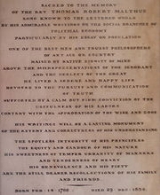
Epitaph The epitaph of Malthus in Bath Abbey reads:
Sacred to the memory of the Rev Thomas Robert Malthus, long known to the lettered world by his admirable writings on the social branches of political economy, particularly by his essay on population.
One of the best men and truest philosophers of any age or country, raised by native dignity of mind above the misrepresentation of the ignorant and the neglect of the great, he lived a serene and happy life devoted to the pursuit and communication of truth.
Supported by a calm but firm conviction of the usefulness of his labors.
Content with the approbation of the wise and good.
His writings will be a lasting monument of the extent and correctness of his understanding.
The spotless integrity of his principles, the equity and candour of his nature, his sweetness of temper, urbanity of manners and tenderness of heart, his benevolence and his piety are still dearer recollections of his family and friends.
Born February 14, 1766 Died December 29, 1834.
See also Limits to growth, from the Club of Rome Hypothetical future disasters Malthusian Catastrophe Malthusian Growth Model Malthusian equilibrium Malthusianism NSSM 200 Overpopulation World population
Further reading
- : a collection of essays for the Malthus Bicentenary
- : a collection of essays for the Malthus Bicentenary Conference, 1998
-
Conceptual origins of Malthus's Essay on Population, facsimile reprint of 8 Books in 6 volumes, edited by Yoshinobu Nanagita (ISBN 978-4-902454-14-7) www.aplink.co.jp/ep/4-902454-14-9.htm The Worldly Philosophers – the lives, times, and ideas of the great economic thinkers. Robert L. Heilbroner. Elwell, Frank W. 2001. A Commentary on Malthus' 1798 Essay on Population as social theory Mellen Press, Lewiston, NY. ISBN 0773476695.
Footnotes
External links
- 1st edition, 1798. Library of Economics and Liberty. Free online, full-text searchable.
- 6th edition, 1826. Library of Economics and Liberty. Free online, full-text searchable. Malthus published a major revision to his first edition--his second edition--in 1803. His 6th edition, published 1826, and revising his various 2nd-5th editions, became his widely cited 6th and final revision.
-
-
- refer section entitled Criticism of the Malthusian Theory. Catholic Encyclopedia website United Nations Population Fund website by Garrett Hardin in The Social Contract (1998) by Nigel Malthus, a direct descendant of Malthus's brother Sydenham Malthus from Darwin's Metaphor: Nature's Place in Victorian Culture by Professor Robert M. Young (1985, 1988, 1994). Cambridge University Press. dedicated to Malthus
|