


Society

Encyclopedia
A society, or a human society, is a group of people related
to each other through persistent relations, or a large social grouping sharing the same geographical or virtual territory, subject to the same political authority and dominant cultural expectations. Human societies are characterized by patterns of relationships (social relations) between individuals who share a distinctive culture
and institutions; a given society may be described as the sum total of such relationships among its constituent members. In the social sciences
, a larger society often evinces stratification
and/or dominance
patterns in subgroups.
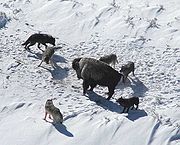 Insofar as it is collaborative, a society can enable its members to benefit in ways that would not otherwise be possible on an individual basis; both individual and social (common) benefits can thus be distinguished, or in many cases found to overlap.
A society can also consist of like-minded people governed by their own norms and values within a dominant, larger society. This is sometimes referred to as a subculture
, a term used extensively within criminology
.
More broadly, a society may be described as an economic, social
, or industrial
infrastructure
, made up of a varied collection of individuals. Members of a society may be from different ethnic group
s. A society can be a particular ethnic group, such as the Saxons
; a nation state, such as Bhutan
; or a broader cultural group, such as a Western society
. The word society may also refer to an organized
voluntary association
of people for religious, benevolent, cultural, scientific, political, patriotic, or other purposes. A "society" may even, though more by means of metaphor, refer to a social organism
such as an ant colony
or any cooperative
aggregate such as, for example, in some formulations
of artificial intelligence
.
word societas, which in turn was derived from the noun socius ("comrade
, friend, ally"; adjectival form socialis) used to describe a bond or interaction among parties that are friendly, or at least civil. Without an article, the term can refer to the entirety of humanity (also: "society in general", "society at large", etc.), although those who are unfriendly or uncivil to the remainder of society in this sense may be deemed to be "antisocial". Adam Smith
wrote that a society "may subsist among different men, as among different merchants, from a sense of its utility
without any mutual love or affection, if only they refrain from doing injury to each other."
Used in the sense of an association
, a society is a body of individuals outlined by the bounds of functional interdependence
, possibly comprising characteristics such as national
or cultural identity
, social solidarity, language
, or hierarchical organization
.
. The Great apes
have always been more (Bonobo
, Homo, Pan
) or less (Gorilla
, Pongo
) social animal
s, so Robinson Crusoe
-like situations are either fictions or unusual corner cases to the ubiquity of social context for humans, who fall between presocial and eusocial
in the spectrum of animal ethology.
societies, nomadic pastoral
societies, horticulturalist
or simple farming societies, and intensive agricultural
societies, also called civilization
s. Some consider industrial
and post-industrial
societies to be qualitatively different from traditional agricultural societies.
Today, anthropologists
and many social scientists vigorously oppose the notion of cultural evolution and rigid "stages" such as these. In fact, much anthropological data has suggested that complexity (civilization, population growth and density, specialization, etc.) does not always take the form of hierarchical social organization or stratification.
Cultural relativism
as a widespread approach or ethic has largely replaced notions of "primitive", better/worse, or "progress" in relation to cultures (including their material culture/technology and social organization).
According to anthropologist Maurice Godelier
, one critical novelty in human society, in contrast to humanity's closest biological relatives (chimpanzees and bonobo), is the parental role assumed by the males, which supposedly would be absent in our nearest relatives for whom paternity is not generally determinable.
, tribe
s, chiefdom
s, and state
societies. These structures may have varying degrees of political power
, depending on the cultural
, geographical
, and historical
environments that these societies must contend with. Thus, a more isolated society with the same level of technology and culture as other societies is more likely to survive than one in closer proximity to others that may encroach on their resources. A society that is unable to offer an effective response to other societies it competes with will usually be subsumed into the culture of the competing society.
Gerhard Lenski
differentiates societies based on their level of technology, communication, and economy: (1) hunters and gatherers, (2) simple agricultural, (3) advanced agricultural, (4) industrial, and (5) special (e.g. fishing societies or maritime societies). This is similar to the system earlier developed by anthropologists Morton H. Fried, a conflict theorist, and Elman Service
, an integration theorist, who have produced a system of classification for societies in all human cultures based on the evolution of social inequality
and the role of the state
. This system of classification contains four categories:
In addition to this there are:
Over time, some cultures have progressed toward more complex forms of organization
and control. This cultural evolution has a profound effect on patterns of community. Hunter-gatherer tribes settled around seasonal food stocks to become agrarian villages
. Villages grew to become towns and cities. Cities turned into city-state
s and nation-state
s.
Many societies distribute largess at the behest of some individual or some larger group of people. This type of generosity can be seen in all known cultures; typically, prestige accrues to the generous individual or group. Conversely, members of a society may also shun or scapegoat
members of the society who violate its norms
. Mechanisms such as gift-giving
, joking relationship
s and scapegoating, which may be seen in various types of human groupings, tend to be institution
alized within a society. Social evolution as a phenomenon carries with it certain elements that could be detrimental to the population it serves.
Some societies bestow status on an individual or group of people when that individual or group performs an admired or desired action. This type of recognition
is bestowed in the form of a name, title, manner of dress, or monetary reward. In many societies, adult male or female status is subject to a ritual or process of this type. Altruistic action in the interests of the larger group is seen in virtually all societies. The phenomena of community action, shunning, scapegoating, generosity, shared risk, and reward are common to many forms of society.
, and postindustrial.
, is the main economic activity. These societies can be subdivided according to their level of technology and their method of producing food. These subdivisions are hunting and gathering, pastoral, horticultural, agricultural, and feudal.
Hunting and gathering societies
The main form of food production in such societies is the daily collection of wild plants and the hunting of wild animals. Hunter-gatherers move around constantly in search of food. As a result, they do not build permanent villages or create a wide variety of artifacts
, and usually only form small groups such as bands
and tribe
s. However, some hunting and gathering societies in areas with abundant resources (such as the Tlingit) lived in larger groups and formed complex hierarchical social structures such as chiefdoms. The need for mobility also limits the size of these societies. They generally consist of fewer than 60 people and rarely exceed 100. Statuses within the tribe are relatively equal, and decisions are reached through general agreement. The ties that bind the tribe are more complex than those of the bands. Leadership
is personal—charismatic—and used for special purposes only in tribal society. There are no political offices containing real power, and a chief
is merely a person of influence, a sort of adviser; therefore, tribal consolidations for collective action are not governmental. The family forms the main social unit
, with most societal members being related by birth or marriage. This type of organization requires the family to carry out most social functions, including production
and education
.
Pastoral societies
Pastoralism
is a slightly more efficient form of subsistence. Rather than searching for food on a daily basis, members of a pastoral society rely on domesticated herd animals to meet their food needs. Pastoralists live a nomadic life, moving their herds from one pasture to another. Because their food supply is far more reliable, pastoral societies can support larger populations. Since there are food surpluses, fewer people are needed to produce food. As a result, the division of labor (the specialization by individuals or groups in the performance of specific economic activities) becomes more complex. For example, some people become craftworkers, producing tools, weapons, and jewelry. The production of goods encourages trade. This trade helps to create inequality, as some families acquire more goods than others do. These families often gain power through their increased wealth
. The passing on of property from one generation to another helps to centralize wealth and power. Over time emerge hereditary chieftainships, the typical form of government
in pastoral societies.
Horticultural societies
Fruits and vegetables grown in garden plots that have been cleared from the jungle or forest provide the main source of food in a horticultural society. These societies have a level of technology
and complexity similar to pastoral societies. Some horticultural groups use the slash-and-burn method to raise crops. The wild vegetation is cut and burned, and ashes are used as fertilizers. Horticulturists use human labor and simple tools to cultivate the land for one or more seasons. When the land becomes barren
, horticulturists clear a new plot and leave the old plot to revert to its natural state. They may return to the original land several years later and begin the process again. By rotating their garden plots, horticulturists can stay in one area for a fairly long period of time. This allows them to build semipermanent or permanent villages. The size of a village's population depends on the amount of land available for farming; thus villages can range from as few as 30 people to as many as 2000.
As with pastoral societies, surplus food leads to a more complex division of labor. Specialized roles in horticultural societies include craftspeople, shamans (religious leaders), and traders. This role specialization allows people to create a wide variety of artifacts. As in pastoral societies, surplus food can lead to inequalities in wealth and power within horticultural political systems are developed because of the settled nature of horticultural life.
Agricultural societies
Agricultural societies use technological advances to cultivate crops over a large area. Sociologists use the phrase Agricultural Revolution
to refer to the technological changes that occurred as long as 8,500 years ago that led to cultivating crops and raising farm animals. Increases in food supplies then led to larger populations than in earlier communities. This meant a greater surplus, which resulted in towns that became centers of trade supporting various rulers, educators, craftspeople, merchants, and religious leaders who did not have to worry about locating nourishment.
Greater degrees of social stratification appeared in agricultural societies. For example, women previously had higher social status because they shared labor more equally with men. In hunting and gathering societies, women even gathered more food than men. However, as food stores improved and women took on lesser roles in providing food for the family, they increasingly became subordinate to men. As villages and towns expanded into neighboring areas, conflicts with other communities inevitably occurred. Farmers provided warriors with food in exchange
for protection against invasion by enemies. A system of rulers with high social status also appeared. This nobility organized warriors to protect the society from invasion. In this way, the nobility managed to extract goods from “lesser” members of society.
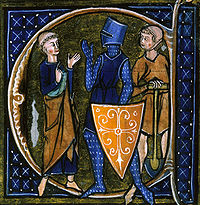 Feudal societies
Feudalism
was a form of society based on ownership of land. Unlike today's farmers, vassals under feudalism were bound to cultivating their lord's land. In exchange for military protection, the lords exploited the peasants into providing food, crops, crafts, homage, and other services to the landowner. The caste system of feudalism was often multigenerational; the families of peasants may have cultivated their lord's land for generations.
Between the 14th and 16th centuries, a new economic system emerged that began to replace feudalism. Capitalism
is marked by open competition in a free market, in which the means of production are privately owned. Europe's exploration of the Americas served as one impetus for the development of capitalism. The introduction of foreign metals, silks, and spices stimulated great commercial activity in European societies; as a result, hereditary chieftainships are prevalent.
Once again, the population boomed. Increased productivity made more goods available to everyone. However, inequality became even greater than before. The breakup of agricultural-based feudal societies caused many people to leave the land and seek employment in cities. This created a great surplus of labor and gave capitalists plenty of laborers who could be hired for extremely low wages.
has brought with it the emerging concepts of Western culture
, politics, and ideas, often referred to simply as "Western society. Geographically, it covers at the very least the countries of Western Europe, North America, Australia, and New Zealand. It sometimes also includes Eastern Europe, South America, and Israel.
The cultures and lifestyles of all of these stem from Western Europe. They all enjoy relatively strong economies and stable governments, allow freedom of religion, have chosen democracy as a form of governance, favor capitalism and international trade, are heavily influenced by Judeo-Christian values, and have some form of political and military alliance or cooperation.

Although the concept of information society
has been under discussion since the 1930s, in the modern world it is almost always applied to the manner in which information technologies have impacted society and culture. It therefore covers the effects of computers and telecommunications on the home, the workplace, schools, government, and various communities and organizations, as well as the emergence of new social forms in cyberspace.
One of the European Union
's areas of interest is the information society. Here policies are directed towards promoting an open and competitive digital economy
, research into information and communication technologies
, as well as their application to improve social inclusion, public services
, and quality of life
.
The International Telecommunications Union's World Summit on the Information Society
in Geneva and Tunis (2003 and 2005) has led to a number of policy and application areas where action is required. These include:
 As access to electronic information resources increased at the beginning of the 21st century, special attention was extended from the information society to the knowledge society. An analysis by the Irish government stated, "The capacity to manipulate, store and transmit large quantities of information cheaply has increased at a staggering rate over recent years. The digitisation of information and the associated pervasiveness of the Internet are facilitating a new intensity in the application of knowledge to economic activity, to the extent that it has become the predominant factor in the creation of wealth. As much as 70 to 80 percent of economic growth is now said to be due to new and better knowledge."
The Second World Summit on the Knowledge Society, held in Chania
, Crete
, in September 2009, gave special attention to the following topics:
Some academic, professional, and scientific associations
describe themselves as societies (for example, the American Mathematical Society
, the American Society of Civil Engineers
, or the Royal Society
).
In some countries, e.g. the United States, France, and Latin America, the term "society' is used in commerce
to denote a partnership between investor
s or the start of a business
. In the United Kingdom
, partnerships are not called societies, but co-operative
s or mutuals
are often known as societies (such as friendly societies
and building societies
).
Interpersonal relationship
An interpersonal relationship is an association between two or more people that may range from fleeting to enduring. This association may be based on limerence, love, solidarity, regular business interactions, or some other type of social commitment. Interpersonal relationships are formed in the...
to each other through persistent relations, or a large social grouping sharing the same geographical or virtual territory, subject to the same political authority and dominant cultural expectations. Human societies are characterized by patterns of relationships (social relations) between individuals who share a distinctive culture
Culture
Culture is a term that has many different inter-related meanings. For example, in 1952, Alfred Kroeber and Clyde Kluckhohn compiled a list of 164 definitions of "culture" in Culture: A Critical Review of Concepts and Definitions...
and institutions; a given society may be described as the sum total of such relationships among its constituent members. In the social sciences
Social sciences
Social science is the field of study concerned with society. "Social science" is commonly used as an umbrella term to refer to a plurality of fields outside of the natural sciences usually exclusive of the administrative or managerial sciences...
, a larger society often evinces stratification
Social stratification
In sociology the social stratification is a concept of class, involving the "classification of persons into groups based on shared socio-economic conditions ... a relational set of inequalities with economic, social, political and ideological dimensions."...
and/or dominance
Dominance hierarchy
A dominance hierarchy is the organization of individuals in a group that occurs when competition for resources leads to aggression...
patterns in subgroups.
A society can also consist of like-minded people governed by their own norms and values within a dominant, larger society. This is sometimes referred to as a subculture
Subculture
In sociology, anthropology and cultural studies, a subculture is a group of people with a culture which differentiates them from the larger culture to which they belong.- Definition :...
, a term used extensively within criminology
Criminology
Criminology is the scientific study of the nature, extent, causes, and control of criminal behavior in both the individual and in society...
.
More broadly, a society may be described as an economic, social
Social
The term social refers to a characteristic of living organisms...
, or industrial
Industry
Industry refers to the production of an economic good or service within an economy.-Industrial sectors:There are four key industrial economic sectors: the primary sector, largely raw material extraction industries such as mining and farming; the secondary sector, involving refining, construction,...
infrastructure
Infrastructure
Infrastructure is basic physical and organizational structures needed for the operation of a society or enterprise, or the services and facilities necessary for an economy to function...
, made up of a varied collection of individuals. Members of a society may be from different ethnic group
Ethnic group
An ethnic group is a group of people whose members identify with each other, through a common heritage, often consisting of a common language, a common culture and/or an ideology that stresses common ancestry or endogamy...
s. A society can be a particular ethnic group, such as the Saxons
Saxons
The Saxons were a confederation of Germanic tribes originating on the North German plain. The Saxons earliest known area of settlement is Northern Albingia, an area approximately that of modern Holstein...
; a nation state, such as Bhutan
Bhutan
Bhutan , officially the Kingdom of Bhutan, is a landlocked state in South Asia, located at the eastern end of the Himalayas and bordered to the south, east and west by the Republic of India and to the north by the People's Republic of China...
; or a broader cultural group, such as a Western society
Western culture
Western culture, sometimes equated with Western civilization or European civilization, refers to cultures of European origin and is used very broadly to refer to a heritage of social norms, ethical values, traditional customs, religious beliefs, political systems, and specific artifacts and...
. The word society may also refer to an organized
Organization
An organization is a social group which distributes tasks for a collective goal. The word itself is derived from the Greek word organon, itself derived from the better-known word ergon - as we know `organ` - and it means a compartment for a particular job.There are a variety of legal types of...
voluntary association
Voluntary association
A voluntary association or union is a group of individuals who enter into an agreement as volunteers to form a body to accomplish a purpose.Strictly speaking, in many jurisdictions no formalities are necessary to start an association...
of people for religious, benevolent, cultural, scientific, political, patriotic, or other purposes. A "society" may even, though more by means of metaphor, refer to a social organism
Social organism
In sociology, the social organism is theoretical concept in which a society or social structure is viewed as a “living organism.” From this perspective, typically, the relation of social features, e.g. law, family, crime, etc., are examined as they interact with other features of society to meet...
such as an ant colony
Ant colony
An ant colony is an underground lair where ants live, eat and mate. Colonies consist of a series of underground chambers, connected to each other and the surface of the earth by small tunnels. There are rooms for nurseries, food storage, and mating...
or any cooperative
Cooperation
Cooperation or co-operation is the process of working or acting together. In its simplest form it involves things working in harmony, side by side, while in its more complicated forms, it can involve something as complex as the inner workings of a human being or even the social patterns of a...
aggregate such as, for example, in some formulations
Society of Mind
The Society of Mind is both the title of a book and the name of a theory of natural intelligence as written and developed by Marvin Minsky.-Minsky's model:...
of artificial intelligence
Artificial intelligence
Artificial intelligence is the intelligence of machines and the branch of computer science that aims to create it. AI textbooks define the field as "the study and design of intelligent agents" where an intelligent agent is a system that perceives its environment and takes actions that maximize its...
.
Etymology and usage
The term "society" came from the LatinLatin
Latin is an Italic language originally spoken in Latium and Ancient Rome. It, along with most European languages, is a descendant of the ancient Proto-Indo-European language. Although it is considered a dead language, a number of scholars and members of the Christian clergy speak it fluently, and...
word societas, which in turn was derived from the noun socius ("comrade
Comrade
Comrade means "friend", "colleague", or "ally". The word comes from French camarade. The term is frequently used by left-wing organizations around the globe. "Comrade" has often become a stock phrase and form of address. This word has its regional equivalents available in many...
, friend, ally"; adjectival form socialis) used to describe a bond or interaction among parties that are friendly, or at least civil. Without an article, the term can refer to the entirety of humanity (also: "society in general", "society at large", etc.), although those who are unfriendly or uncivil to the remainder of society in this sense may be deemed to be "antisocial". Adam Smith
Adam Smith
Adam Smith was a Scottish social philosopher and a pioneer of political economy. One of the key figures of the Scottish Enlightenment, Smith is the author of The Theory of Moral Sentiments and An Inquiry into the Nature and Causes of the Wealth of Nations...
wrote that a society "may subsist among different men, as among different merchants, from a sense of its utility
Utility
In economics, utility is a measure of customer satisfaction, referring to the total satisfaction received by a consumer from consuming a good or service....
without any mutual love or affection, if only they refrain from doing injury to each other."
Used in the sense of an association
Voluntary association
A voluntary association or union is a group of individuals who enter into an agreement as volunteers to form a body to accomplish a purpose.Strictly speaking, in many jurisdictions no formalities are necessary to start an association...
, a society is a body of individuals outlined by the bounds of functional interdependence
Interdependence
Interdependence is a relation between its members such that each is mutually dependent on the others. This concept differs from a simple dependence relation, which implies that one member of the relationship can function or survive apart from the other....
, possibly comprising characteristics such as national
National identity
National identity is the person's identity and sense of belonging to one state or to one nation, a feeling one shares with a group of people, regardless of one's citizenship status....
or cultural identity
Cultural identity
Cultural identity is the identity of a group or culture, or of an individual as far as one is influenced by one's belonging to a group or culture. Cultural identity is similar to and has overlaps with, but is not synonymous with, identity politics....
, social solidarity, language
Language
Language may refer either to the specifically human capacity for acquiring and using complex systems of communication, or to a specific instance of such a system of complex communication...
, or hierarchical organization
Eusociality
Eusociality is a term used for the highest level of social organization in a hierarchical classification....
.
Conceptions of society
Society, in general, addresses the fact that an individual has rather limited means as an autonomous unitAutonomy
Autonomy is a concept found in moral, political and bioethical philosophy. Within these contexts, it is the capacity of a rational individual to make an informed, un-coerced decision...
. The Great apes
Great Apes
Great Apes may refer to*Great apes, species in the biological family Hominidae, including humans, chimpanzees, gorillas, and orangutans*Great Apes , a 1997 novel by Will Self...
have always been more (Bonobo
Bonobo
The bonobo , Pan paniscus, previously called the pygmy chimpanzee and less often, the dwarf or gracile chimpanzee, is a great ape and one of the two species making up the genus Pan. The other species in genus Pan is Pan troglodytes, or the common chimpanzee...
, Homo, Pan
Chimpanzee
Chimpanzee, sometimes colloquially chimp, is the common name for the two extant species of ape in the genus Pan. The Congo River forms the boundary between the native habitat of the two species:...
) or less (Gorilla
Gorilla
Gorillas are the largest extant species of primates. They are ground-dwelling, predominantly herbivorous apes that inhabit the forests of central Africa. Gorillas are divided into two species and either four or five subspecies...
, Pongo
Orangutan
Orangutans are the only exclusively Asian genus of extant great ape. The largest living arboreal animals, they have proportionally longer arms than the other, more terrestrial, great apes. They are among the most intelligent primates and use a variety of sophisticated tools, also making sleeping...
) social animal
Social animal
A social animal is a loosely defined term for an organism that is highly interactive with other members of its species to the point of having a recognizable and distinct society.All mammals are social to the extent that mothers and offspring bond...
s, so Robinson Crusoe
Robinson Crusoe
Robinson Crusoe is a novel by Daniel Defoe that was first published in 1719. Epistolary, confessional, and didactic in form, the book is a fictional autobiography of the title character—a castaway who spends 28 years on a remote tropical island near Trinidad, encountering cannibals, captives, and...
-like situations are either fictions or unusual corner cases to the ubiquity of social context for humans, who fall between presocial and eusocial
Eusociality
Eusociality is a term used for the highest level of social organization in a hierarchical classification....
in the spectrum of animal ethology.
In anthropology
Human societies are most often organized according to their primary means of subsistence. Social scientists have identified hunter-gathererHunter-gatherer
A hunter-gatherer or forage society is one in which most or all food is obtained from wild plants and animals, in contrast to agricultural societies which rely mainly on domesticated species. Hunting and gathering was the ancestral subsistence mode of Homo, and all modern humans were...
societies, nomadic pastoral
Pastoralism
Pastoralism or pastoral farming is the branch of agriculture concerned with the raising of livestock. It is animal husbandry: the care, tending and use of animals such as camels, goats, cattle, yaks, llamas, and sheep. It may have a mobile aspect, moving the herds in search of fresh pasture and...
societies, horticulturalist
Horticulture
Horticulture is the industry and science of plant cultivation including the process of preparing soil for the planting of seeds, tubers, or cuttings. Horticulturists work and conduct research in the disciplines of plant propagation and cultivation, crop production, plant breeding and genetic...
or simple farming societies, and intensive agricultural
Agriculture
Agriculture is the cultivation of animals, plants, fungi and other life forms for food, fiber, and other products used to sustain life. Agriculture was the key implement in the rise of sedentary human civilization, whereby farming of domesticated species created food surpluses that nurtured the...
societies, also called civilization
Civilization
Civilization is a sometimes controversial term that has been used in several related ways. Primarily, the term has been used to refer to the material and instrumental side of human cultures that are complex in terms of technology, science, and division of labor. Such civilizations are generally...
s. Some consider industrial
Industry
Industry refers to the production of an economic good or service within an economy.-Industrial sectors:There are four key industrial economic sectors: the primary sector, largely raw material extraction industries such as mining and farming; the secondary sector, involving refining, construction,...
and post-industrial
Post-industrial society
If a nation becomes "post-industrial" it passes through, or dodges, a phase of society predominated by a manufacturing-based economy and moves on to a structure of society based on the provision of information, innovation, finance, and services.-Characteristics:...
societies to be qualitatively different from traditional agricultural societies.
Today, anthropologists
Anthropology
Anthropology is the study of humanity. It has origins in the humanities, the natural sciences, and the social sciences. The term "anthropology" is from the Greek anthrōpos , "man", understood to mean mankind or humanity, and -logia , "discourse" or "study", and was first used in 1501 by German...
and many social scientists vigorously oppose the notion of cultural evolution and rigid "stages" such as these. In fact, much anthropological data has suggested that complexity (civilization, population growth and density, specialization, etc.) does not always take the form of hierarchical social organization or stratification.
Cultural relativism
Cultural relativism
Cultural relativism is the principle that an individual human's beliefs and activities should be understood by others in terms of that individual's own culture. This principle was established as axiomatic in anthropological research by Franz Boas in the first few decades of the 20th century and...
as a widespread approach or ethic has largely replaced notions of "primitive", better/worse, or "progress" in relation to cultures (including their material culture/technology and social organization).
According to anthropologist Maurice Godelier
Maurice Godelier
Born in Cambrai, France in 28 February 1934, Maurice Godelier is one of the most influential names in French anthropology. Directeur d'études at the École des Hautes Études en Sciences Sociales...
, one critical novelty in human society, in contrast to humanity's closest biological relatives (chimpanzees and bonobo), is the parental role assumed by the males, which supposedly would be absent in our nearest relatives for whom paternity is not generally determinable.
In political science
Societies may also be organized according to their political structure. In order of increasing size and complexity, there are bandsBand society
A band society is the simplest form of human society. A band generally consists of a small kin group, no larger than an extended family or clan; it has been defined as consisting of no more than 30 to 50 individuals.Bands have a loose organization...
, tribe
Tribe
A tribe, viewed historically or developmentally, consists of a social group existing before the development of, or outside of, states.Many anthropologists use the term tribal society to refer to societies organized largely on the basis of kinship, especially corporate descent groups .Some theorists...
s, chiefdom
Chiefdom
A chiefdom is a political economy that organizes regional populations through a hierarchy of the chief.In anthropological theory, one model of human social development rooted in ideas of cultural evolution describes a chiefdom as a form of social organization more complex than a tribe or a band...
s, and state
State (polity)
A state is an organized political community, living under a government. States may be sovereign and may enjoy a monopoly on the legal initiation of force and are not dependent on, or subject to any other power or state. Many states are federated states which participate in a federal union...
societies. These structures may have varying degrees of political power
Political power
Political power is a type of power held by a group in a society which allows administration of some or all of public resources, including labour, and wealth. There are many ways to obtain possession of such power. At the nation-state level political legitimacy for political power is held by the...
, depending on the cultural
Culture
Culture is a term that has many different inter-related meanings. For example, in 1952, Alfred Kroeber and Clyde Kluckhohn compiled a list of 164 definitions of "culture" in Culture: A Critical Review of Concepts and Definitions...
, geographical
Geography
Geography is the science that studies the lands, features, inhabitants, and phenomena of Earth. A literal translation would be "to describe or write about the Earth". The first person to use the word "geography" was Eratosthenes...
, and historical
History
History is the discovery, collection, organization, and presentation of information about past events. History can also mean the period of time after writing was invented. Scholars who write about history are called historians...
environments that these societies must contend with. Thus, a more isolated society with the same level of technology and culture as other societies is more likely to survive than one in closer proximity to others that may encroach on their resources. A society that is unable to offer an effective response to other societies it competes with will usually be subsumed into the culture of the competing society.
In sociology
SociologistSociology
Sociology is the study of society. It is a social science—a term with which it is sometimes synonymous—which uses various methods of empirical investigation and critical analysis to develop a body of knowledge about human social activity...
Gerhard Lenski
Gerhard Lenski
Gerhard Emmanuel Lenski is an American sociologist known for contributions to the sociology of religion, social inequality, and ecological-evolutionary social theory...
differentiates societies based on their level of technology, communication, and economy: (1) hunters and gatherers, (2) simple agricultural, (3) advanced agricultural, (4) industrial, and (5) special (e.g. fishing societies or maritime societies). This is similar to the system earlier developed by anthropologists Morton H. Fried, a conflict theorist, and Elman Service
Elman Service
Elman Rogers Service was an American cultural anthropologist.- Biography :He was born on May 18, 1915 in Tecumseh, Michigan and died on November 14, 1996 in Santa Barbara, California. He earned a Bachelors Degree in 1941 from the University of Michigan. He earned a Ph.D. in Anthropology from...
, an integration theorist, who have produced a system of classification for societies in all human cultures based on the evolution of social inequality
Social inequality
Social inequality refers to a situation in which individual groups in a society do not have equal social status. Areas of potential social inequality include voting rights, freedom of speech and assembly, the extent of property rights and access to education, health care, quality housing and other...
and the role of the state
State (polity)
A state is an organized political community, living under a government. States may be sovereign and may enjoy a monopoly on the legal initiation of force and are not dependent on, or subject to any other power or state. Many states are federated states which participate in a federal union...
. This system of classification contains four categories:
- Hunter-gathererHunter-gathererA hunter-gatherer or forage society is one in which most or all food is obtained from wild plants and animals, in contrast to agricultural societies which rely mainly on domesticated species. Hunting and gathering was the ancestral subsistence mode of Homo, and all modern humans were...
bands (categorization of duties and responsibilities). - TribalTribeA tribe, viewed historically or developmentally, consists of a social group existing before the development of, or outside of, states.Many anthropologists use the term tribal society to refer to societies organized largely on the basis of kinship, especially corporate descent groups .Some theorists...
societies in which there are some limited instances of social rank and prestige. - StratifiedSocial stratificationIn sociology the social stratification is a concept of class, involving the "classification of persons into groups based on shared socio-economic conditions ... a relational set of inequalities with economic, social, political and ideological dimensions."...
structures led by chieftainsTribal chiefA tribal chief is the leader of a tribal society or chiefdom. Tribal societies with social stratification under a single leader emerged in the Neolithic period out of earlier tribal structures with little stratification, and they remained prevalent throughout the Iron Age.In the case of ...
. - CivilizationCivilizationCivilization is a sometimes controversial term that has been used in several related ways. Primarily, the term has been used to refer to the material and instrumental side of human cultures that are complex in terms of technology, science, and division of labor. Such civilizations are generally...
s, with complex social hierarchies and organized, institutional governmentsGovernmentGovernment refers to the legislators, administrators, and arbitrators in the administrative bureaucracy who control a state at a given time, and to the system of government by which they are organized...
.
In addition to this there are:
- Humanity, mankind, upon which rest all the elements of society, including society's beliefs.
- Virtual societySociology of the InternetThe sociology of the Internet involves the application of sociological theory and method to the Internet as a source of information and communication...
, a society based on online identity, which is evolving in the information ageInformation AgeThe Information Age, also commonly known as the Computer Age or Digital Age, is an idea that the current age will be characterized by the ability of individuals to transfer information freely, and to have instant access to knowledge that would have been difficult or impossible to find previously...
.
Over time, some cultures have progressed toward more complex forms of organization
Organization
An organization is a social group which distributes tasks for a collective goal. The word itself is derived from the Greek word organon, itself derived from the better-known word ergon - as we know `organ` - and it means a compartment for a particular job.There are a variety of legal types of...
and control. This cultural evolution has a profound effect on patterns of community. Hunter-gatherer tribes settled around seasonal food stocks to become agrarian villages
Neolithic Revolution
The Neolithic Revolution was the first agricultural revolution. It was the transition from hunting and gathering to agriculture and settlement. Archaeological data indicates that various forms of plants and animal domestication evolved independently in 6 separate locations worldwide circa...
. Villages grew to become towns and cities. Cities turned into city-state
City-state
A city-state is an independent or autonomous entity whose territory consists of a city which is not administered as a part of another local government.-Historical city-states:...
s and nation-state
Nation-state
The nation state is a state that self-identifies as deriving its political legitimacy from serving as a sovereign entity for a nation as a sovereign territorial unit. The state is a political and geopolitical entity; the nation is a cultural and/or ethnic entity...
s.
Many societies distribute largess at the behest of some individual or some larger group of people. This type of generosity can be seen in all known cultures; typically, prestige accrues to the generous individual or group. Conversely, members of a society may also shun or scapegoat
Scapegoat
Scapegoating is the practice of singling out any party for unmerited negative treatment or blame. Scapegoating may be conducted by individuals against individuals , individuals against groups , groups against individuals , and groups against groups Scapegoating is the practice of singling out any...
members of the society who violate its norms
Norm (sociology)
Social norms are the accepted behaviors within a society or group. This sociological and social psychological term has been defined as "the rules that a group uses for appropriate and inappropriate values, beliefs, attitudes and behaviors. These rules may be explicit or implicit...
. Mechanisms such as gift-giving
Reciprocity (cultural anthropology)
In cultural anthropology and sociology, reciprocity is a way of defining people's informal exchange of goods and labour; that is, people's informal economic systems. It is the basis of most non-market economies. Since virtually all humans live in some kind of society and have at least a few...
, joking relationship
Joking relationship
A joking relationship is a term applied by anthropologists to the institutionalised form of interaction between certain pairs of people in some societies. Analysed by British social anthropologist Alfred Radcliffe-Brown in 1940, it describes a kind of ritualised banter that takes place, for example...
s and scapegoating, which may be seen in various types of human groupings, tend to be institution
Institution
An institution is any structure or mechanism of social order and cooperation governing the behavior of a set of individuals within a given human community...
alized within a society. Social evolution as a phenomenon carries with it certain elements that could be detrimental to the population it serves.
Some societies bestow status on an individual or group of people when that individual or group performs an admired or desired action. This type of recognition
Recognition (sociology)
Recognition in sociology is public acknowledgement of person's status or merits .When some person is recognized, he or she is accorded some special status, such as a name, title, or classification...
is bestowed in the form of a name, title, manner of dress, or monetary reward. In many societies, adult male or female status is subject to a ritual or process of this type. Altruistic action in the interests of the larger group is seen in virtually all societies. The phenomena of community action, shunning, scapegoating, generosity, shared risk, and reward are common to many forms of society.
Types of societies
Societies are social groups that differ according to subsistence strategies, the ways that humans use technology to provide needs for themselves. Although humans have established many types of societies throughout history, anthropologists tend to classify different societies according to the degree to which different groups within a society have unequal access to advantages such as resources, prestige, or power. Virtually all societies have developed some degree of inequality among their people through the process of social stratification, the division of members of a society into levels with unequal wealth, prestige, or power. Sociologists place societies in three broad categories: pre-industrial, industrialIndustrial society
In sociology, industrial society refers to a society driven by the use of technology to enable mass production, supporting a large population with a high capacity for division of labour. Such a structure developed in the west in the period of time following the Industrial Revolution, and replaced...
, and postindustrial.
Pre-industrial societies
In a pre-industrial society, food production, which is carried out through the use of human and animal laborManual labour
Manual labour , manual or manual work is physical work done by people, most especially in contrast to that done by machines, and also to that done by working animals...
, is the main economic activity. These societies can be subdivided according to their level of technology and their method of producing food. These subdivisions are hunting and gathering, pastoral, horticultural, agricultural, and feudal.
Hunting and gathering societies
The main form of food production in such societies is the daily collection of wild plants and the hunting of wild animals. Hunter-gatherers move around constantly in search of food. As a result, they do not build permanent villages or create a wide variety of artifacts
Artifact (archaeology)
An artifact or artefact is "something made or given shape by man, such as a tool or a work of art, esp an object of archaeological interest"...
, and usually only form small groups such as bands
Band society
A band society is the simplest form of human society. A band generally consists of a small kin group, no larger than an extended family or clan; it has been defined as consisting of no more than 30 to 50 individuals.Bands have a loose organization...
and tribe
Tribe
A tribe, viewed historically or developmentally, consists of a social group existing before the development of, or outside of, states.Many anthropologists use the term tribal society to refer to societies organized largely on the basis of kinship, especially corporate descent groups .Some theorists...
s. However, some hunting and gathering societies in areas with abundant resources (such as the Tlingit) lived in larger groups and formed complex hierarchical social structures such as chiefdoms. The need for mobility also limits the size of these societies. They generally consist of fewer than 60 people and rarely exceed 100. Statuses within the tribe are relatively equal, and decisions are reached through general agreement. The ties that bind the tribe are more complex than those of the bands. Leadership
Leadership
Leadership has been described as the “process of social influence in which one person can enlist the aid and support of others in the accomplishment of a common task". Other in-depth definitions of leadership have also emerged.-Theories:...
is personal—charismatic—and used for special purposes only in tribal society. There are no political offices containing real power, and a chief
Tribal chief
A tribal chief is the leader of a tribal society or chiefdom. Tribal societies with social stratification under a single leader emerged in the Neolithic period out of earlier tribal structures with little stratification, and they remained prevalent throughout the Iron Age.In the case of ...
is merely a person of influence, a sort of adviser; therefore, tribal consolidations for collective action are not governmental. The family forms the main social unit
Social unit
Social unit is a term used in sociology, anthropology, ethnology, and also in animal behaviour studies, zoology and biology to describe a social entity which is part of and participates in a larger social group or society....
, with most societal members being related by birth or marriage. This type of organization requires the family to carry out most social functions, including production
Production, costs, and pricing
The following outline is provided as an overview of and topical guide to industrial organization:Industrial organization – describes the behavior of firms in the marketplace with regard to production, pricing, employment and other decisions...
and education
Education
Education in its broadest, general sense is the means through which the aims and habits of a group of people lives on from one generation to the next. Generally, it occurs through any experience that has a formative effect on the way one thinks, feels, or acts...
.
Pastoral societies
Pastoralism
Pastoralism
Pastoralism or pastoral farming is the branch of agriculture concerned with the raising of livestock. It is animal husbandry: the care, tending and use of animals such as camels, goats, cattle, yaks, llamas, and sheep. It may have a mobile aspect, moving the herds in search of fresh pasture and...
is a slightly more efficient form of subsistence. Rather than searching for food on a daily basis, members of a pastoral society rely on domesticated herd animals to meet their food needs. Pastoralists live a nomadic life, moving their herds from one pasture to another. Because their food supply is far more reliable, pastoral societies can support larger populations. Since there are food surpluses, fewer people are needed to produce food. As a result, the division of labor (the specialization by individuals or groups in the performance of specific economic activities) becomes more complex. For example, some people become craftworkers, producing tools, weapons, and jewelry. The production of goods encourages trade. This trade helps to create inequality, as some families acquire more goods than others do. These families often gain power through their increased wealth
Wealth
Wealth is the abundance of valuable resources or material possessions. The word wealth is derived from the old English wela, which is from an Indo-European word stem...
. The passing on of property from one generation to another helps to centralize wealth and power. Over time emerge hereditary chieftainships, the typical form of government
Government
Government refers to the legislators, administrators, and arbitrators in the administrative bureaucracy who control a state at a given time, and to the system of government by which they are organized...
in pastoral societies.
Horticultural societies
Fruits and vegetables grown in garden plots that have been cleared from the jungle or forest provide the main source of food in a horticultural society. These societies have a level of technology
Technology
Technology is the making, usage, and knowledge of tools, machines, techniques, crafts, systems or methods of organization in order to solve a problem or perform a specific function. It can also refer to the collection of such tools, machinery, and procedures. The word technology comes ;...
and complexity similar to pastoral societies. Some horticultural groups use the slash-and-burn method to raise crops. The wild vegetation is cut and burned, and ashes are used as fertilizers. Horticulturists use human labor and simple tools to cultivate the land for one or more seasons. When the land becomes barren
Barren
Barren primarily refers to a state of Barrenness Barren as a place name can refer to:*Barren County, Kentucky*Barren Island *Barren Island, Brooklyn*Barren River LakeBarren can also refer to:...
, horticulturists clear a new plot and leave the old plot to revert to its natural state. They may return to the original land several years later and begin the process again. By rotating their garden plots, horticulturists can stay in one area for a fairly long period of time. This allows them to build semipermanent or permanent villages. The size of a village's population depends on the amount of land available for farming; thus villages can range from as few as 30 people to as many as 2000.
As with pastoral societies, surplus food leads to a more complex division of labor. Specialized roles in horticultural societies include craftspeople, shamans (religious leaders), and traders. This role specialization allows people to create a wide variety of artifacts. As in pastoral societies, surplus food can lead to inequalities in wealth and power within horticultural political systems are developed because of the settled nature of horticultural life.
Agricultural societies
Agricultural societies use technological advances to cultivate crops over a large area. Sociologists use the phrase Agricultural Revolution
Agricultural revolution
Agricultural Revolution or Agrarian Revolution may refer to:*The Neolithic Revolution , the initial transition from hunting and gathering to settled agriculture in prehistory...
to refer to the technological changes that occurred as long as 8,500 years ago that led to cultivating crops and raising farm animals. Increases in food supplies then led to larger populations than in earlier communities. This meant a greater surplus, which resulted in towns that became centers of trade supporting various rulers, educators, craftspeople, merchants, and religious leaders who did not have to worry about locating nourishment.
Greater degrees of social stratification appeared in agricultural societies. For example, women previously had higher social status because they shared labor more equally with men. In hunting and gathering societies, women even gathered more food than men. However, as food stores improved and women took on lesser roles in providing food for the family, they increasingly became subordinate to men. As villages and towns expanded into neighboring areas, conflicts with other communities inevitably occurred. Farmers provided warriors with food in exchange
Trade
Trade is the transfer of ownership of goods and services from one person or entity to another. Trade is sometimes loosely called commerce or financial transaction or barter. A network that allows trade is called a market. The original form of trade was barter, the direct exchange of goods and...
for protection against invasion by enemies. A system of rulers with high social status also appeared. This nobility organized warriors to protect the society from invasion. In this way, the nobility managed to extract goods from “lesser” members of society.
Feudalism
Feudalism
Feudalism was a set of legal and military customs in medieval Europe that flourished between the 9th and 15th centuries, which, broadly defined, was a system for ordering society around relationships derived from the holding of land in exchange for service or labour.Although derived from the...
was a form of society based on ownership of land. Unlike today's farmers, vassals under feudalism were bound to cultivating their lord's land. In exchange for military protection, the lords exploited the peasants into providing food, crops, crafts, homage, and other services to the landowner. The caste system of feudalism was often multigenerational; the families of peasants may have cultivated their lord's land for generations.
Between the 14th and 16th centuries, a new economic system emerged that began to replace feudalism. Capitalism
Capitalism
Capitalism is an economic system that became dominant in the Western world following the demise of feudalism. There is no consensus on the precise definition nor on how the term should be used as a historical category...
is marked by open competition in a free market, in which the means of production are privately owned. Europe's exploration of the Americas served as one impetus for the development of capitalism. The introduction of foreign metals, silks, and spices stimulated great commercial activity in European societies; as a result, hereditary chieftainships are prevalent.
Industrial societies
Industrial societies rely heavily on machines powered by fuels for the production of goods. This produced further dramatic increases in efficiency. The increased efficiency of production of the industrial revolution produced an even greater surplus than before. Now the surplus was not just agricultural goods, but also manufactured goods. This larger surplus caused all of the changes discussed earlier in the domestication revolution to become even more pronounced.Once again, the population boomed. Increased productivity made more goods available to everyone. However, inequality became even greater than before. The breakup of agricultural-based feudal societies caused many people to leave the land and seek employment in cities. This created a great surplus of labor and gave capitalists plenty of laborers who could be hired for extremely low wages.
Post-industrial societies
Postindustrial societies are societies dominated by information, services, and high technology more than the production of goods. Advanced industrial societies are now seeing a shift toward an increase in service sectors over manufacturing and production. The U.S. is the first country to have over half of its work force employed in service industries. Service industries include government, research, education, health, sales, law, banking, and so on. It is still too early to identify and understand all the ramifications this new kind of society will have for social life. In fact, even the phrase "postindustrial" belies the fact that we don't yet quite know what will follow industrial societies or the forms they will take.Contemporary usage
The term "society" is currently used to cover both a number of political and scientific connotations as well as a variety of associations.Western society
The development of the Western worldWestern world
The Western world, also known as the West and the Occident , is a term referring to the countries of Western Europe , the countries of the Americas, as well all countries of Northern and Central Europe, Australia and New Zealand...
has brought with it the emerging concepts of Western culture
Western culture
Western culture, sometimes equated with Western civilization or European civilization, refers to cultures of European origin and is used very broadly to refer to a heritage of social norms, ethical values, traditional customs, religious beliefs, political systems, and specific artifacts and...
, politics, and ideas, often referred to simply as "Western society. Geographically, it covers at the very least the countries of Western Europe, North America, Australia, and New Zealand. It sometimes also includes Eastern Europe, South America, and Israel.
The cultures and lifestyles of all of these stem from Western Europe. They all enjoy relatively strong economies and stable governments, allow freedom of religion, have chosen democracy as a form of governance, favor capitalism and international trade, are heavily influenced by Judeo-Christian values, and have some form of political and military alliance or cooperation.
Information society
Although the concept of information society
Information society
The aim of the information society is to gain competitive advantage internationally through using IT in a creative and productive way. An information society is a society in which the creation, distribution, diffusion, use, integration and manipulation of information is a significant economic,...
has been under discussion since the 1930s, in the modern world it is almost always applied to the manner in which information technologies have impacted society and culture. It therefore covers the effects of computers and telecommunications on the home, the workplace, schools, government, and various communities and organizations, as well as the emergence of new social forms in cyberspace.
One of the European Union
European Union
The European Union is an economic and political union of 27 independent member states which are located primarily in Europe. The EU traces its origins from the European Coal and Steel Community and the European Economic Community , formed by six countries in 1958...
's areas of interest is the information society. Here policies are directed towards promoting an open and competitive digital economy
Digital economy
A digital economy is an economy based on electronic goods and services produced by an electronic business and traded through electronic commerce...
, research into information and communication technologies
Information and communication technologies
Information and communications technology or information and communication technology, usually abbreviated as ICT, is often used as an extended synonym for information technology , but is usually a more general term that stresses the role of unified communications and the integration of...
, as well as their application to improve social inclusion, public services
Public services
Public services is a term usually used to mean services provided by government to its citizens, either directly or by financing private provision of services. The term is associated with a social consensus that certain services should be available to all, regardless of income...
, and quality of life
Quality of life
The term quality of life is used to evaluate the general well-being of individuals and societies. The term is used in a wide range of contexts, including the fields of international development, healthcare, and politics. Quality of life should not be confused with the concept of standard of...
.
The International Telecommunications Union's World Summit on the Information Society
World Summit on the Information Society
The World Summit on the Information Society was a pair of United Nations-sponsored conferences about information, communication and, in broad terms, the information society that took place in 2003 in Geneva and in 2005 in Tunis...
in Geneva and Tunis (2003 and 2005) has led to a number of policy and application areas where action is required. These include:
- promotion of ICTs for development;
- information and communication infrastructure;
- access to information and knowledge;
- capacity building;
- building confidence and security in the use of ICTs;
- enabling environment;
- ICT applications in the areas of government, business, learning, health, employment, environment, agriculture and science;
- cultural and linguistic diversity and local content;
- media;
- ethical dimensions of the information society; and
- international and regional cooperation.
Knowledge society
The Second World Summit on the Knowledge Society, held in Chania
Chania
Chaniá , , also transliterated Chania, Hania, and Xania, older form Chanea and Venetian Canea, Ottoman Turkish خانيه Hanya) is the second largest city of Crete and the capital of the Chania peripheral unit...
, Crete
Crete
Crete is the largest and most populous of the Greek islands, the fifth largest island in the Mediterranean Sea, and one of the thirteen administrative regions of Greece. It forms a significant part of the economy and cultural heritage of Greece while retaining its own local cultural traits...
, in September 2009, gave special attention to the following topics:
- business and enterprise computingEnterprise softwareEnterprise software, also known as enterprise application software , is software used in organizations, such as in a business or government, contrary to software chosen by individuals...
; - technology-enhanced learningTechnology-Enhanced LearningTechnology enhanced learning refers to the support of any learning activity through technology.TEL is often used synonymously with E-Learning even though there are significant differences. The main difference between the two expressions is that TEL focuses on the technological support of any...
; - social and humanistic computingSocial softwareSocial software applications include communication tools and interactive tools. Communication tools typically handle the capturing, storing and presentation of communication, usually written but increasingly including audio and video as well. Interactive tools handle mediated interactions between a...
; - culture, tourism and technology;
- e-government and e-democracyE-democracyE-democracy refers to the use of information technologies and communication technologies and strategies in political and governance processes...
; - innovation, sustainable development, and strategic management;
- service science, management, and engineeringService Science, Management and EngineeringService science, management, and engineering is a term introduced by IBM to describe service science, an interdisciplinary approach to the study, design, and implementation of services systems – complex systems in which specific arrangements of people and technologies take actions that provide...
; - intellectual and human capitalHuman capitalHuman capitalis the stock of competencies, knowledge and personality attributes embodied in the ability to perform labor so as to produce economic value. It is the attributes gained by a worker through education and experience...
development; - ICTs for ecology and the green economyGreen economyA green economy is one that results in improved human well-being and social equity, while significantly reducing environmental risks and ecological scarcities - United Nations Environment Programme...
; - future prospects for the knowledge society; and
- technologies and business models for the creative industriesCreative industriesThe creative industries refers to a range of economic activities which are concerned with the generation or exploitation of knowledge and information...
.
Other uses
People of many nations united by common political and cultural traditions, beliefs, or values are sometimes also said to form a society (such as Judeo-Christian, Eastern, and Western). When used in this context, the term is employed as a means of contrasting two or more "societies" whose members represent alternative conflicting and competing worldviews.Some academic, professional, and scientific associations
Voluntary association
A voluntary association or union is a group of individuals who enter into an agreement as volunteers to form a body to accomplish a purpose.Strictly speaking, in many jurisdictions no formalities are necessary to start an association...
describe themselves as societies (for example, the American Mathematical Society
American Mathematical Society
The American Mathematical Society is an association of professional mathematicians dedicated to the interests of mathematical research and scholarship, which it does with various publications and conferences as well as annual monetary awards and prizes to mathematicians.The society is one of the...
, the American Society of Civil Engineers
American Society of Civil Engineers
The American Society of Civil Engineers is a professional body founded in 1852 to represent members of the civil engineering profession worldwide. It is the oldest national engineering society in the United States. ASCE's vision is to have engineers positioned as global leaders who strive toward...
, or the Royal Society
Royal Society
The Royal Society of London for Improving Natural Knowledge, known simply as the Royal Society, is a learned society for science, and is possibly the oldest such society in existence. Founded in November 1660, it was granted a Royal Charter by King Charles II as the "Royal Society of London"...
).
In some countries, e.g. the United States, France, and Latin America, the term "society' is used in commerce
Commerce
While business refers to the value-creating activities of an organization for profit, commerce means the whole system of an economy that constitutes an environment for business. The system includes legal, economic, political, social, cultural, and technological systems that are in operation in any...
to denote a partnership between investor
Investor
An investor is a party that makes an investment into one or more categories of assets --- equity, debt securities, real estate, currency, commodity, derivatives such as put and call options, etc...
s or the start of a business
Business
A business is an organization engaged in the trade of goods, services, or both to consumers. Businesses are predominant in capitalist economies, where most of them are privately owned and administered to earn profit to increase the wealth of their owners. Businesses may also be not-for-profit...
. In the United Kingdom
United Kingdom
The United Kingdom of Great Britain and Northern IrelandIn the United Kingdom and Dependencies, other languages have been officially recognised as legitimate autochthonous languages under the European Charter for Regional or Minority Languages...
, partnerships are not called societies, but co-operative
Cooperative
A cooperative is a business organization owned and operated by a group of individuals for their mutual benefit...
s or mutuals
Mutual organization
A mutual, mutual organization, or mutual society is an organization based on the principle of mutuality. Unlike a true cooperative, members usually do not contribute to the capital of the company by direct investment, but derive their right to profits and votes through their customer relationship...
are often known as societies (such as friendly societies
Friendly society
A friendly society is a mutual association for insurance, pensions or savings and loan-like purposes, or cooperative banking. It is a mutual organization or benefit society composed of a body of people who join together for a common financial or social purpose...
and building societies
Building society
A building society is a financial institution owned by its members as a mutual organization. Building societies offer banking and related financial services, especially mortgage lending. These institutions are found in the United Kingdom and several other countries.The term "building society"...
).
See also
|
Further reading
- Effland, R. 1998. The Cultural Evolution of Civilizations Mesa Community College.
- Jenkins, R. 2002. Foundations of Sociology. London: Palgrave MacMillan. ISBN 0-333-96050-5.
- Lenski, G. 1974. Human Societies: An Introduction to Macrosociology. New York: McGraw- Hill, Inc.
- Raymond Williams, "www.flpmihai.blogspot.com", in: Williams, Key Words: A Vocabulary of Culture and Society. Fontana, 1976.
External links
- Definition of Society from the OEDOxford English DictionaryThe Oxford English Dictionary , published by the Oxford University Press, is the self-styled premier dictionary of the English language. Two fully bound print editions of the OED have been published under its current name, in 1928 and 1989. The first edition was published in twelve volumes , and...
. - Lecture notes on "Defining Society" from East Carolina University.
- Learning Commons - What is Culture ? - Glossary Item - Society
- Internet Modern History Sourcebook: Industrial Revolution
- "The Day the World Took Off" Six part video series from the University of Cambridge tracing the question "Why did the Industrial Revolution begin when and where it did."
- BBC History Home Page: Industrial Revolution
- National Museum of Science and Industry website: machines and personalities
- Industrial Revolution and the Standard of Living by Clark Nardinelli - the debate over whether standards of living rose or fell.
- Cliff Notes on Types of Societies
- Perceptions of Knowledge, Knowledge Society, and Knowledge Management