


Pierre-Joseph Proudhon

Encyclopedia
Pierre-Joseph Proudhon was a French
politician, mutualist
philosopher and socialist. He was a member of the French Parliament, and he was the first person to call himself an "anarchist". He is considered among the most influential theorists and organisers of anarchism
. After the events of 1848
he began to call himself a federalist
.
Proudhon, who was born in Besançon
, was a printer
who taught himself Latin
in order to better print books in the language. His best-known assertion is that Property is Theft!
, contained in his first major work, What is Property? Or, an Inquiry into the Principle of Right and Government
(Qu'est-ce que la propriété? Recherche sur le principe du droit et du gouvernement), published in 1840. The book's publication attracted the attention of the French authorities. It also attracted the scrutiny of Karl Marx
, who started a correspondence with its author. The two influenced each other: they met in Paris while Marx was exiled there. Their friendship finally ended when Marx responded to Proudhon's The System of Economic Contradictions, or The Philosophy of Poverty
with the provocatively titled The Poverty of Philosophy
. The dispute became one of the sources of the split between the anarchist and Marxist wings of the International Working Men's Association. Some, such as Edmund Wilson
, have contended that Marx's attack on Proudhon had its origin in the latter's defense of Karl Grün
, whom Marx bitterly disliked but who had been preparing translations of Proudhon's work.
Proudhon favored workers' associations
or co-operatives, as well as individual worker/peasant
possession, over private ownership or the nationalization
of land and workplaces. He considered that social revolution
could be achieved in a peaceful manner. In The Confessions of a Revolutionary Proudhon asserted that, Anarchy is Order Without Power, the phrase which much later inspired, in the view of some, the anarchist circled-A symbol, today "one of the most common graffiti
on the urban landscape." He unsuccessfully tried to create a national bank
, to be funded by what became an abortive attempt at an income tax
on capitalists and stockholders. Similar in some respects to a credit union
, it would have given interest-free loans.
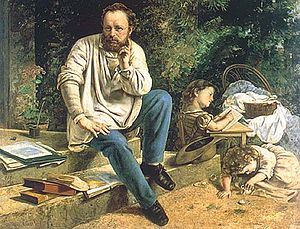 Proudhon was born in Besançon
, France; his father was a brewer's cooper
. As a boy, he herded cows and followed other similar, simple pursuits. But he was not entirely self-educated; at age 16, he entered his town's college, though his family was so poor that he could not buy the necessary books. He had to borrow them from his fellow students in order to copy the lessons. At age 19, he became a working compositor; later he rose to be a corrector for the press, proofreading
ecclesiastical works, and thereby acquiring a very competent knowledge of theology
. In this way also he came to learn Hebrew, and to compare it with Greek
, Latin
and French
; and it was the first proof of his intellectual audacity that on the strength of this he wrote an Essai de grammaire génerale. In 1838, he obtained the pension Suard, a bursary
of 1500 francs a year for three years, for the encouragement of young men of promise, which was in the gift of the Academy of Besançon.
His third memoir on property was a letter to the Fourierist, M. Considérant; he was tried for it at Besançon but was acquitted. In 1846, he published the Système des contradictions économiques ou Philosophie de la misère (or "The System of Economic Contradictions, or The Philosophy of Poverty
"). For some time, Proudhon ran a small printing establishment at Besançon, but without success; afterwards he became connected as a kind of manager with a commercial firm in Lyon
, France. In 1847, he left this job and finally settled in Paris, where he was now becoming celebrated as a leader of innovation. In this year he also became a Freemason
(1767–1855), who, since the French Revolution
in 1789, had been a longstanding politician, although often in the opposition. Beside Dupont de l'Eure, the provisional government was dominated by liberals
such as Lamartine
(Foreign Affairs), Ledru-Rollin (Interior), Crémieux
(Justice), Burdeau
(War), etc., because it was pursuing political reform at the expense of the socio-economic reform, which Proudhon considered basic. As during the 1830 July Revolution
, the Republican-Socialist Party
had set up a counter-government in the Hotel de Ville
, including Louis Blanc
, Armand Marrast
, Ferdinand Flocon, and workman Albert
.
Proudhon published his own perspective for reform which was completed in 1849, Solution du problème social ("Solution of the Social Problem"), in which he laid out a program of mutual financial cooperation among workers. He believed this would transfer control of economic relations from capitalists and financiers to workers. The central part of his plan was the establishment of a bank to provide credit at a very low rate of interest and the issuing exchange notes that would circulate instead of money based on gold.
During the Second French Republic (1848–1852), Proudhon had his biggest public effect through journalism. He got involved with four newspapers: Le Représentant du Peuple (February 1848 – August 1848); Le Peuple (September 1848 – June 1849); La Voix du Peuple (September 1849 – May 1850); Le Peuple de 1850 (June 1850 – October 1850). His polemical writing style, combined with his perception of himself as a political outsider, produced a cynical, combative journalism that appealed to many French workers but alienated others. He repeatedly criticised the government's policies and promoted reformation of credit and exchange. He tried to establish a popular bank (Banque du peuple) early in 1849, but despite over 13,000 people signing up (mostly workers), receipts were limited falling short of 18,000FF and the whole enterprise was essentially stillborn.
Proudhon ran for the constituent assembly
in April 1848, but was not elected, although his name appeared on the ballots in Paris, Lyon, Besançon, and Lille, France. He was successful, in the complementary elections of June 4, and served as a deputy during the debates over the National Workshops
, created by the February 25, 1848, decree passed by Republican Louis Blanc
. The workshops were to give work to the unemployed. Proudhon was never enthusiastic about such workshops, perceiving them to be essentially charitable institutions that did not resolve the problems of the economic system. He was against their elimination unless an alternative could be found for the workers who relied on the workshops for subsistence.
In 1848 the closing of the National Workshops provoked the June Days Uprising
and the violence shocked Proudhon. Visiting the barricades personally, he later reflected that his presence at the Bastille
at this time was "one of the most honorable acts of my life". But in general during the tumultuous events of 1848, Proudhon opposed insurrection by preaching peaceful conciliation, a stance that was in accord with his lifelong stance against violence. He disapproved of the revolts and demonstrations of February, May, and June 1848, though sympathetic to the social and psychological injustices that the insurrectionists had been forced to endure.
Proudhon died in Passy
, and is buried in Paris, at the cemetery of Montparnasse
(2nd division, near the Lenoir alley, in the tomb of the Proudhon family).
He was the first person to refer to himself as an anarchist. In What is Property, published in 1840, he defined anarchy as "the absence of a master, of a sovereign", and in The General idea of the Revolution
(1851) he urged a "society without authority." He extended this analysis beyond political institutions, arguing in What is Property? that "proprietor" was "synonymous" with "sovereign". For Proudhon:
Proudhon in his earliest works analyzed the nature and problems of the capitalist economy. While deeply critical of capitalism
, he also objected to those contemporary socialists who advocated centralised, hierarchical forms of association or state control of the economy. In a sequence of commentaries, from What is Property?
(1840) through the posthumously published Théorie de la propriété (Theory of Property, 1863–64), he declared in turn that "property is theft", "property is impossible", "property is despotism" and "property is freedom". When he said "property is theft", he was referring to the landowner or capitalist who he believed "stole" the profits from laborers. For Proudhon, the capitalist's employee was "subordinated, exploited: his permanent condition is one of obedience".
In asserting that property is freedom, he was referring not only to the product of an individual's labor, but to the peasant
or artisan
's home and tools of his trade and the income he received by selling his goods. For Proudhon, the only legitimate source of property is labor. What one produces is one's property and anything beyond that is not. He advocated worker self-management and was opposed to the private ownership of the means of production. As he put it in 1848:
Proudhon called himself a socialist, but he opposed state ownership of capital goods in favour of ownership by workers themselves in associations. This makes him one of the first theorists of libertarian socialism
. Proudhon was one of the main influences on the theory of workers' self-management
(autogestion), in the late 19th and 20th century.
Proudhon strenuously rejected the ownership of the products of labor by society or the state, arguing in What is Property? that while "property in product [...] does not carry with it property in the means of production" [...] The right to product is exclusive [...] the right to means is common" and applied this to the land ("the land is [...] a common thing") and workplaces ("all accumulated capital being social property, no one can be its exclusive proprietor".) He argued that while society owned the means of production or land, users would control and run them (under supervision from society), with the "organising of regulating societies" in order to "regulate the market".
This use-ownership he called "possession", and this economic system mutualism
. Proudhon had many arguments against entitlement to land and capital, including reasons based on morality, economics, politics, and individual liberty. One such argument was that it enabled profit, which in turn led to social instability and war by creating cycles of debt that eventually overcame the capacity of labor to pay them off. Another was that it produced "despotism" and turned workers into wage workers subject to the authority of a boss.
In What Is Property? Proudhon wrote:
Joseph Déjacque
attacked Proudhon's support for notions of patriarchy
, what late 20th century anarchists would term sexism
, as quite at odds with anarchist principles.
Towards the end of his life, Proudhon modified some of his earlier views. In The Principle of Federation (1863) he modified his earlier anti-state position, arguing for "the balancing of authority by liberty" and put forward a decentralised "theory of federal government". He also defined anarchy differently as "the government of each by himself", which meant "that political functions have been reduced to industrial functions, and that social order arises from nothing but transactions and exchanges." This work also saw him call his economic system an "agro-industrial federation", arguing that it would provide "specific federal arrangements is to protect the citizens of the federated states from capitalist and financial feudalism, both within them and from the outside" and so stop the re-introduction of "wage labour." This was because "political right requires to be buttressed by economic right."
In the posthumously published Theory of Property, he argued that "property is the only power that can act as a counterweight to the State." Hence, "Proudhon could retain the idea of property as theft, and at the same time offer a new definition of it as liberty. There is the constant possibility of abuse, exploitation, which spells theft. At the same time property is a spontaneous creation of society and a bulwark against the ever-encroaching power of the State."
He continued to oppose both capitalist and state property. In Theory of Property he maintains: "Now in 1840, I categorically rejected the notion of property...for both the group and the individual", but then states his new theory of property: "property is the greatest revolutionary force which exists, with an unequaled capacity for setting itself against authority..." and the "principal function of private property within the political system will be to act as a counterweight to the power of the State, and by so doing to insure the liberty of the individual." However, he continued to oppose concentrations of wealth and property, arguing for small-scale property ownership associated with peasants and artisans. He still opposed private property in land: "What I cannot accept, regarding land, is that the work put in gives a right to ownership of what has been worked on." In addition, he still believed that that "property" should be more equally distributed and limited in size to that actually used by individuals, families and workers associations. He supported the right of inheritance, and defended "as one of the foundations of the family and society." However, he refused to extend this beyond personal possessions arguing that "[u]nder the law of association, transmission of wealth does not apply to the instruments of labour."
As a consequence of his opposition to profit, wage labour, worker exploitation, ownership of land and capital, as well as to state property, Proudhon rejected both capitalism and communism. He adopted the term mutualism
for his brand of anarchism, which involved control of the means of production by the workers. In his vision, self-employed artisans, peasants, and cooperatives would trade their products on the market. For Proudhon, factories and other large workplaces would be run by "labor associations" operating on directly democratic principles. The state would be abolished; instead, society would be organized by a federation of "free communes" (a commune
is a local municipality in French). In 1863 Proudhon said: "All my economic ideas as developed over twenty-five years can be summed up in the words: agricultural-industrial federation. All my political ideas boil down to a similar formula: political federation or decentralization."
Proudhon opposed the charging of interest and rent, but did not seek to abolish them by law: "I protest that when I criticized... the complex of institutions of which property is the foundation stone, I never meant to forbid or suppress, by sovereign decree, ground rent and interest on capital. I think that all these manifestations of human activity should remain free and voluntary for all: I ask for them no modifications, restrictions or suppressions, other than those which result naturally and of necessity from the universalization of the principle of reciprocity which I propose."
Proudhon was a revolutionary, but his revolution did not mean violent upheaval or civil war, but rather the transformation of society. This transformation was essentially moral in nature and demanded the highest ethics from those who sought change. It was monetary reform, combined with organising a credit bank and workers associations, that Proudhon proposed to use as a lever to bring about the organization of society along new lines. He did not suggest how the monetary institutions would cope with the problem of inflation and with the need for the efficient allocation of scarce resources.
He made few public criticisms of Marx or Marxism
, because in his lifetime Marx was a relatively minor thinker; it was only after Proudhon's death that Marxism became a large movement. He did, however, criticize authoritarian socialists of his period. This included the state socialist Louis Blanc
, of whom Proudhon said, "Let me say to M. Blanc: you desire neither Catholicism nor monarchy nor nobility, but you must have a God, a religion, a dictatorship, a censorship, a hierarchy, distinctions, and ranks. For my part, I deny your God, your authority, your sovereignty, your judicial State, and all your representative mystifications." It was Proudhon's book What is Property? that convinced the young Karl Marx that private property
should be abolished.
In one of his first works, The Holy Family, Marx said, "Not only does Proudhon write in the interest of the proletarians, he is himself a proletarian, an ouvrier. His work is a scientific manifesto of the French proletariat." Marx, however, disagreed with Proudhon's anarchism and later published vicious criticisms of Proudhon. Marx wrote The Poverty of Philosophy as a refutation of Proudhon's The Philosophy of Poverty.
, who dismissed him as a bourgeois socialist for his pro-market views, Proudhon had an immediate and lasting influence on the anarchist movement, and, more recently, in the aftermaths of May 1968 and after the end of the Cold War
. His essay on What Is Government? is quite well known:
In addition to being considered a founding father of anarchism, he has also been considered by some to be a forerunner of fascism
. He was first used as a reference, surprisingly, in the Cercle Proudhon
, a right-wing association formed in 1911 by George Valois and Edouard Berth
. Both had been brought together by the syndicalist Georges Sorel
. But they would tend toward a synthesis of socialism
and nationalism
, mixing Proudhon's mutualism with Charles Maurras
' integralist nationalism. In 1925, George Valois founded the Faisceau
, the first fascist league which took its name from Mussolini
's fasci. Historian of fascism, in particular of French fascists, Zeev Sternhell
, has noted this use of Proudhon by the far-right. In The Birth Of Fascist Ideology, he states that:
K. Steven Vincent, however, states that “to argue that Proudhon was a proto-fascist suggests that one has never looked seriously at Proudhon’s writings.”
Proudhon influenced the non-conformists of the 1930s
, as well as anarchism. In the 1960s, he became the main influence of autogestion (workers' self-management
) in France, inspiring the CFDT
trade-union, created in 1964, and the Unified Socialist Party
(PSU), founded in 1960 and led until 1967 by Édouard Depreux
. In particular, autogestion influenced the LIP self-management experience in Besançon
.
Proudhon's thought has seen some revival since the end of the Cold War
and the fall of "real socialism
" in the Eastern Bloc
. It can be loosely related to modern attempts at direct democracy
. The Groupe Proudhon, related to the Fédération Anarchiste (Anarchist Federation), published a review from 1981 to 1983 and again since 1994. (The first period corresponds with the 1981 election
of Socialist
candidate François Mitterrand
and the economic liberal
turn of 1983 taken by the Socialist government.) It is staunchly anti-fascist
and related to the Section Carrément Anti Le Pen which opposes Jean-Marie Le Pen
). English-speaking anarchists have also attempted to keep the Proudhonian tradition alive and to engage in dialogue with Proudhon's ideas: Kevin Carson's mutualism
is self-consciously Proudhonian, and Shawn P. Wilbur has continued both to facilitate the translation into English of Proudhon's texts and to reflect on their significance for the contemporary anarchist project.
, A. Weil, and others are simply secret spies. Rothschild
, Crémieux
, Marx, Fould, evil choleric, envious, bitter men etc., etc., who hate us." (Carnets, vol. 2, p. 337: No VI, 178)
J. Salwyn Schapiro
argued in 1945 that Proudhon was a racist, “a glorifier of war for its own sake” and his “advocacy of personal dictatorship and his laudation of militarism can hardly be equalled in the reactionary writings of his or of our day.”
Other scholars have rejected Schapiro's claims. Graham Purchase states that while Proudhon was personally racist, “anti-semitism formed no part of Proudhon’s revolutionary programme.” Proudhon himself argued that under mutualism “[t]here will no longer be nationality, no longer fatherland, in the political sense of the words: they will mean only places of birth. Man, of whatever race or colour he may be, is an inhabitant of the universe; citizenship is everywhere an acquired right.”
Proudhon also opposed militarism and war, arguing that the “end of militarism is the mission of the nineteenth century, under pain of indefinite decadence” and that the “workers alone are capable of putting an end to war by creating economic equilibrium. This presupposes a radical revolution in ideas and morals.” As Robert L. Hoffman notes that War and Peace “ends by condemning war without reservation” and its “conclusion [is] that war is obsolete.” He argues that it “difficult to see how his purpose and overall conception could have been mistaken by any who read the whole book with care.” Marxist John Ehrenberg summarised Proudhon's position:
“If injustice was the cause of war, it followed that conflict could not be eliminated until society was reorganised along egalitarian lines. Proudhon had wanted to prove that the reign of political economy would be the reign of peace, finding it difficult to believe that people really thought he was defending militarism.”
Proudhon also rejected dictatorship, stating in the 1860s that “what I will always be . . . a republican, a democrat even, and a socialist into the bargain.” Henri de Lubac argued that, in terms of Proudhon’s critique of democracy, “we must not allow all this to hoodwink us. His invectives against democracy were not those of a counter-revolutionary. They were aimed at what he himself called ‘the false democracy’ . . . The attacked an apparently liberal ‘pseudo-democracy’ which ‘was not economic and social’ . . . ‘a Jacobinical democracy’” Proudhon “did not want to destroy, but complete, the work of 1789” and while “he had a grudge against the ‘old democracy’, the democracy of Robespierre and Marat” he repeatedly contrasted it “with a ‘young democracy’, which was a ‘social democracy.’”
According to historian of anarchism George Woodcock
, some positions Proudhon took "sorted oddly with his avowed anarchism". Woodcock cited for example Proudhon's proposition that each citizen perform one or two years militia service. The proposal appeared in the Programme Revolutionaire, an electoral manifesto issued by Proudhon after he was asked to run for a position in the provisional government. The text reads: "7° 'L'armée. Abolition immédiate de la conscription et des remplacements; obligation pour tout citoyen de faire, pendant un ou deux ans, le service militaire ; application de l'armée aux services administratifs et travaux d'utilité publique." ("Military service by all citizens is proposed as an alternative to conscription and the practice of "replacement", by which those who could avoided such service.") However, in the same document, Proudhon described the "form of government" he was proposing as "a centralization analogous with that of the State, but in which no one obeys, no one is dependent, and everyone is free and sovereign."
Albert Meltzer
has said that that though Proudhon used the term "anarchist", he was not one, and that he never engaged in "anarchist activity or struggle" but rather in "parliamentary activity".
}
http://vimeo.com/8150795
French people
The French are a nation that share a common French culture and speak the French language as a mother tongue. Historically, the French population are descended from peoples of Celtic, Latin and Germanic origin, and are today a mixture of several ethnic groups...
politician, mutualist
Mutualism (economic theory)
Mutualism is an anarchist school of thought that originates in the writings of Pierre-Joseph Proudhon, who envisioned a society where each person might possess a means of production, either individually or collectively, with trade representing equivalent amounts of labor in the free market...
philosopher and socialist. He was a member of the French Parliament, and he was the first person to call himself an "anarchist". He is considered among the most influential theorists and organisers of anarchism
Anarchism
Anarchism is generally defined as the political philosophy which holds the state to be undesirable, unnecessary, and harmful, or alternatively as opposing authority in the conduct of human relations...
. After the events of 1848
French Revolution of 1848
The 1848 Revolution in France was one of a wave of revolutions in 1848 in Europe. In France, the February revolution ended the Orleans monarchy and led to the creation of the French Second Republic. The February Revolution was really the belated second phase of the Revolution of 1830...
he began to call himself a federalist
Federalist
The term federalist describes several political beliefs around the world. Also, it may refer to the concept of federalism or the type of government called a federation...
.
Proudhon, who was born in Besançon
Besançon
Besançon , is the capital and principal city of the Franche-Comté region in eastern France. It had a population of about 237,000 inhabitants in the metropolitan area in 2008...
, was a printer
Printing
Printing is a process for reproducing text and image, typically with ink on paper using a printing press. It is often carried out as a large-scale industrial process, and is an essential part of publishing and transaction printing....
who taught himself Latin
Latin
Latin is an Italic language originally spoken in Latium and Ancient Rome. It, along with most European languages, is a descendant of the ancient Proto-Indo-European language. Although it is considered a dead language, a number of scholars and members of the Christian clergy speak it fluently, and...
in order to better print books in the language. His best-known assertion is that Property is Theft!
Property is theft!
Property is theft! is a slogan coined by French anarchist Pierre-Joseph Proudhon in his 1840 book What is Property? Or, an Inquiry into the Principle of Right and of Government....
, contained in his first major work, What is Property? Or, an Inquiry into the Principle of Right and Government
What Is Property?
What Is Property?: or, An Inquiry into the Principle of Right and of Government is an influential work of nonfiction on the concept of property and its relation to anarchist philosophy by the French anarchist and mutualist Pierre-Joseph Proudhon, first published in 1840.In the book, Proudhon most...
(Qu'est-ce que la propriété? Recherche sur le principe du droit et du gouvernement), published in 1840. The book's publication attracted the attention of the French authorities. It also attracted the scrutiny of Karl Marx
Karl Marx
Karl Heinrich Marx was a German philosopher, economist, sociologist, historian, journalist, and revolutionary socialist. His ideas played a significant role in the development of social science and the socialist political movement...
, who started a correspondence with its author. The two influenced each other: they met in Paris while Marx was exiled there. Their friendship finally ended when Marx responded to Proudhon's The System of Economic Contradictions, or The Philosophy of Poverty
The System of Economic Contradictions, or The Philosophy of Poverty
The System of Economic Contradictions, or Philosophy of Poverty is a work published in 1847 by Pierre-Joseph Proudhon. It inspired Karl Marx to write his rejoinder The Poverty of Philosophy.-External links:*...
with the provocatively titled The Poverty of Philosophy
The Poverty of Philosophy
Misère de la philosophie, German title Das Elend der Philosophie, English title The Poverty of Philosophy, is a book by Karl Marx published in Paris and Brussels in 1847, where he lived in exile in 1843-1849...
. The dispute became one of the sources of the split between the anarchist and Marxist wings of the International Working Men's Association. Some, such as Edmund Wilson
Edmund Wilson
Edmund Wilson was an American writer and literary and social critic and noted man of letters.-Early life:Wilson was born in Red Bank, New Jersey. His father, Edmund Wilson, Sr., was a lawyer and served as New Jersey Attorney General. Wilson attended The Hill School, a college preparatory...
, have contended that Marx's attack on Proudhon had its origin in the latter's defense of Karl Grün
Karl Grün
Karl Grün , also known by his alias Ernst von der Haide, was a German journalist, political theorist and socialist politician. He played a prominent role in radical political movements leading up to the Revolution of 1848 and participated in the revolution...
, whom Marx bitterly disliked but who had been preparing translations of Proudhon's work.
Proudhon favored workers' associations
Workers' council
A workers' council, or revolutionary councils, is the phenomenon where a single place of work or enterprise, such as a factory, school, or farm, is controlled collectively by the workers of that workplace, through the core principle of temporary and instantly revocable delegates.In a system with...
or co-operatives, as well as individual worker/peasant
Peasant
A peasant is an agricultural worker who generally tend to be poor and homeless-Etymology:The word is derived from 15th century French païsant meaning one from the pays, or countryside, ultimately from the Latin pagus, or outlying administrative district.- Position in society :Peasants typically...
possession, over private ownership or the nationalization
Nationalization
Nationalisation, also spelled nationalization, is the process of taking an industry or assets into government ownership by a national government or state. Nationalization usually refers to private assets, but may also mean assets owned by lower levels of government, such as municipalities, being...
of land and workplaces. He considered that social revolution
Social revolution
The term social revolution may have different connotations depending on the speaker.In the Trotskyist movement, the term "social revolution" refers to an upheaval in which existing property relations are smashed...
could be achieved in a peaceful manner. In The Confessions of a Revolutionary Proudhon asserted that, Anarchy is Order Without Power, the phrase which much later inspired, in the view of some, the anarchist circled-A symbol, today "one of the most common graffiti
Graffiti
Graffiti is the name for images or lettering scratched, scrawled, painted or marked in any manner on property....
on the urban landscape." He unsuccessfully tried to create a national bank
National bank
In banking, the term national bank carries several meanings:* especially in developing countries, a bank owned by the state* an ordinary private bank which operates nationally...
, to be funded by what became an abortive attempt at an income tax
Income tax
An income tax is a tax levied on the income of individuals or businesses . Various income tax systems exist, with varying degrees of tax incidence. Income taxation can be progressive, proportional, or regressive. When the tax is levied on the income of companies, it is often called a corporate...
on capitalists and stockholders. Similar in some respects to a credit union
Credit union
A credit union is a cooperative financial institution that is owned and controlled by its members and operated for the purpose of promoting thrift, providing credit at competitive rates, and providing other financial services to its members...
, it would have given interest-free loans.
Early years
Besançon
Besançon , is the capital and principal city of the Franche-Comté region in eastern France. It had a population of about 237,000 inhabitants in the metropolitan area in 2008...
, France; his father was a brewer's cooper
Cooper (profession)
Traditionally, a cooper is someone who makes wooden staved vessels of a conical form, of greater length than breadth, bound together with hoops and possessing flat ends or heads...
. As a boy, he herded cows and followed other similar, simple pursuits. But he was not entirely self-educated; at age 16, he entered his town's college, though his family was so poor that he could not buy the necessary books. He had to borrow them from his fellow students in order to copy the lessons. At age 19, he became a working compositor; later he rose to be a corrector for the press, proofreading
Proofreading
Proofreading is the reading of a galley proof or computer monitor to detect and correct production-errors of text or art. Proofreaders are expected to be consistently accurate by default because they occupy the last stage of typographic production before publication.-Traditional method:A proof is...
ecclesiastical works, and thereby acquiring a very competent knowledge of theology
Theology
Theology is the systematic and rational study of religion and its influences and of the nature of religious truths, or the learned profession acquired by completing specialized training in religious studies, usually at a university or school of divinity or seminary.-Definition:Augustine of Hippo...
. In this way also he came to learn Hebrew, and to compare it with Greek
Greek language
Greek is an independent branch of the Indo-European family of languages. Native to the southern Balkans, it has the longest documented history of any Indo-European language, spanning 34 centuries of written records. Its writing system has been the Greek alphabet for the majority of its history;...
, Latin
Latin
Latin is an Italic language originally spoken in Latium and Ancient Rome. It, along with most European languages, is a descendant of the ancient Proto-Indo-European language. Although it is considered a dead language, a number of scholars and members of the Christian clergy speak it fluently, and...
and French
French language
French is a Romance language spoken as a first language in France, the Romandy region in Switzerland, Wallonia and Brussels in Belgium, Monaco, the regions of Quebec and Acadia in Canada, and by various communities elsewhere. Second-language speakers of French are distributed throughout many parts...
; and it was the first proof of his intellectual audacity that on the strength of this he wrote an Essai de grammaire génerale. In 1838, he obtained the pension Suard, a bursary
Bursary
A bursary is strictly an office for a bursar and his or her staff in a school or college.In modern English usage, the term has become synonymous with "bursary award", a monetary award made by an institution to an individual or a group to assist the development of their education.According to The...
of 1500 francs a year for three years, for the encouragement of young men of promise, which was in the gift of the Academy of Besançon.
Interest in politics
In 1830, he wrote a treatise L'Utilité de la célébration du dimanche, which contained the seeds of his revolutionary ideas. About this time he went to Paris, France where he lived a poor, ascetic and studious life, but became acquainted with the socialist ideas which were then fomenting in the capital. In 1840 he published his first work Qu'est-ce que la propriété (or "What Is Property"). His famous answer to this question, "La propriété, c'est le vol" ("property is theft"), naturally did not please the Academy of Besançon, and there was some talk of withdrawing his pension; but he held it for the regular period.His third memoir on property was a letter to the Fourierist, M. Considérant; he was tried for it at Besançon but was acquitted. In 1846, he published the Système des contradictions économiques ou Philosophie de la misère (or "The System of Economic Contradictions, or The Philosophy of Poverty
The System of Economic Contradictions, or The Philosophy of Poverty
The System of Economic Contradictions, or Philosophy of Poverty is a work published in 1847 by Pierre-Joseph Proudhon. It inspired Karl Marx to write his rejoinder The Poverty of Philosophy.-External links:*...
"). For some time, Proudhon ran a small printing establishment at Besançon, but without success; afterwards he became connected as a kind of manager with a commercial firm in Lyon
Lyon
Lyon , is a city in east-central France in the Rhône-Alpes region, situated between Paris and Marseille. Lyon is located at from Paris, from Marseille, from Geneva, from Turin, and from Barcelona. The residents of the city are called Lyonnais....
, France. In 1847, he left this job and finally settled in Paris, where he was now becoming celebrated as a leader of innovation. In this year he also became a Freemason
Revolution of 1848
Proudhon was surprised by the Revolutions of 1848 in France. He participated in the February uprising and the composition of what he termed "the first republican proclamation" of the new republic. But he had misgivings about the new provisional government, headed by Dupont de l'EureJacques-Charles Dupont de l'Eure
Jacques-Charles Dupont de l'Eure was a French lawyer and statesman.He is best known as the first head of state of the Second Republic, after the collapse of the July Monarchy.-Early career:...
(1767–1855), who, since the French Revolution
French Revolution
The French Revolution , sometimes distinguished as the 'Great French Revolution' , was a period of radical social and political upheaval in France and Europe. The absolute monarchy that had ruled France for centuries collapsed in three years...
in 1789, had been a longstanding politician, although often in the opposition. Beside Dupont de l'Eure, the provisional government was dominated by liberals
Liberalism
Liberalism is the belief in the importance of liberty and equal rights. Liberals espouse a wide array of views depending on their understanding of these principles, but generally, liberals support ideas such as constitutionalism, liberal democracy, free and fair elections, human rights,...
such as Lamartine
Alphonse de Lamartine
Alphonse Marie Louis de Prat de Lamartine was a French writer, poet and politician who was instrumental in the foundation of the Second Republic.-Career:...
(Foreign Affairs), Ledru-Rollin (Interior), Crémieux
Adolphe Crémieux
Adolphe Crémieux was a French-Jewish lawyer and statesman, and a staunch defender of the human rights of the Jews of France. - Biography :...
(Justice), Burdeau
Auguste Burdeau
Auguste-Laurent Burdeau was a French politician.He was the son of a laborer at Lyon. Forced from childhood to earn his own living, he was enabled to secure an education by bursarships at the Lycée at Lyon and at the Lycée Louis-le-Grand in Paris.In 1870 he was at the École Normale Supérieure in...
(War), etc., because it was pursuing political reform at the expense of the socio-economic reform, which Proudhon considered basic. As during the 1830 July Revolution
July Revolution
The French Revolution of 1830, also known as the July Revolution or in French, saw the overthrow of King Charles X of France, the French Bourbon monarch, and the ascent of his cousin Louis-Philippe, Duke of Orléans, who himself, after 18 precarious years on the throne, would in turn be overthrown...
, the Republican-Socialist Party
Republican-Socialist Party
The Republican-Socialist Party was a French socialist political party during the French Third Republic, founded in 1911 and dissolved in 1934. It was founded by socialists who refused to join the SFIO founded in 1905. The PRS was a non-Marxist "reformist socialist" party located between the SFIO...
had set up a counter-government in the Hotel de Ville
Hôtel de Ville, Paris
The Hôtel de Ville |City Hall]]) in :Paris, France, is the building housing the City of Paris's administration. Standing on the place de l'Hôtel de Ville in the city's IVe arrondissement, it has been the location of the municipality of Paris since 1357...
, including Louis Blanc
Louis Blanc
Louis Jean Joseph Charles Blanc was a French politician and historian. A socialist who favored reforms, he called for the creation of cooperatives in order to guarantee employment for the urban poor....
, Armand Marrast
Armand Marrast
Armand Marrast was a French politician and mayor of Paris.- See also :* List of Presidents of the French National Assembly* List of mayors of Paris...
, Ferdinand Flocon, and workman Albert
Albert L'Ouvrier
Albert l'Ouvrier , born Alexandre Martin , was a French socialist statesman of the French Second Republic. He was the first member of the industrial working class to be in French government....
.
Proudhon published his own perspective for reform which was completed in 1849, Solution du problème social ("Solution of the Social Problem"), in which he laid out a program of mutual financial cooperation among workers. He believed this would transfer control of economic relations from capitalists and financiers to workers. The central part of his plan was the establishment of a bank to provide credit at a very low rate of interest and the issuing exchange notes that would circulate instead of money based on gold.
During the Second French Republic (1848–1852), Proudhon had his biggest public effect through journalism. He got involved with four newspapers: Le Représentant du Peuple (February 1848 – August 1848); Le Peuple (September 1848 – June 1849); La Voix du Peuple (September 1849 – May 1850); Le Peuple de 1850 (June 1850 – October 1850). His polemical writing style, combined with his perception of himself as a political outsider, produced a cynical, combative journalism that appealed to many French workers but alienated others. He repeatedly criticised the government's policies and promoted reformation of credit and exchange. He tried to establish a popular bank (Banque du peuple) early in 1849, but despite over 13,000 people signing up (mostly workers), receipts were limited falling short of 18,000FF and the whole enterprise was essentially stillborn.
Proudhon ran for the constituent assembly
Constituent assembly
A constituent assembly is a body composed for the purpose of drafting or adopting a constitution...
in April 1848, but was not elected, although his name appeared on the ballots in Paris, Lyon, Besançon, and Lille, France. He was successful, in the complementary elections of June 4, and served as a deputy during the debates over the National Workshops
National Workshops
National Workshops refer to areas of work provided for the unemployed by the French Second Republic after the Revolution of 1848. The political crisis which resulted in the abdication of Louis Philippe caused an acute industrial crisis adding to the general agricultural and commercial distress...
, created by the February 25, 1848, decree passed by Republican Louis Blanc
Louis Blanc
Louis Jean Joseph Charles Blanc was a French politician and historian. A socialist who favored reforms, he called for the creation of cooperatives in order to guarantee employment for the urban poor....
. The workshops were to give work to the unemployed. Proudhon was never enthusiastic about such workshops, perceiving them to be essentially charitable institutions that did not resolve the problems of the economic system. He was against their elimination unless an alternative could be found for the workers who relied on the workshops for subsistence.
In 1848 the closing of the National Workshops provoked the June Days Uprising
June Days Uprising
The June Days Uprising was a revolution staged by the citizens of France, whose only source of income was the National Workshops, from 23 June to 26 June 1848. The Workshops were created by the Second Republic in order to provide work and a source of income for the unemployed, however only...
and the violence shocked Proudhon. Visiting the barricades personally, he later reflected that his presence at the Bastille
Bastille
The Bastille was a fortress in Paris, known formally as the Bastille Saint-Antoine. It played an important role in the internal conflicts of France and for most of its history was used as a state prison by the kings of France. The Bastille was built in response to the English threat to the city of...
at this time was "one of the most honorable acts of my life". But in general during the tumultuous events of 1848, Proudhon opposed insurrection by preaching peaceful conciliation, a stance that was in accord with his lifelong stance against violence. He disapproved of the revolts and demonstrations of February, May, and June 1848, though sympathetic to the social and psychological injustices that the insurrectionists had been forced to endure.
Proudhon died in Passy
Passy
Passy is an area of Paris, France, located in the XVIe arrondissement, on the Right Bank. It is traditionally home to many of the city's wealthiest residents.Passy was formerly a commune...
, and is buried in Paris, at the cemetery of Montparnasse
Montparnasse
Montparnasse is an area of Paris, France, on the left bank of the river Seine, centred at the crossroads of the Boulevard du Montparnasse and the Rue de Rennes, between the Rue de Rennes and boulevard Raspail...
(2nd division, near the Lenoir alley, in the tomb of the Proudhon family).
Political philosophy
Proudhon declared in 1849:He was the first person to refer to himself as an anarchist. In What is Property, published in 1840, he defined anarchy as "the absence of a master, of a sovereign", and in The General idea of the Revolution
The General Idea of the Revolution in the Nineteenth Century
The General Idea of the Revolution in the Nineteenth Century was an influential manifesto written in 1851 by the anarchist philosopher Pierre-Joseph Proudhon...
(1851) he urged a "society without authority." He extended this analysis beyond political institutions, arguing in What is Property? that "proprietor" was "synonymous" with "sovereign". For Proudhon:
Proudhon in his earliest works analyzed the nature and problems of the capitalist economy. While deeply critical of capitalism
Capitalism
Capitalism is an economic system that became dominant in the Western world following the demise of feudalism. There is no consensus on the precise definition nor on how the term should be used as a historical category...
, he also objected to those contemporary socialists who advocated centralised, hierarchical forms of association or state control of the economy. In a sequence of commentaries, from What is Property?
What Is Property?
What Is Property?: or, An Inquiry into the Principle of Right and of Government is an influential work of nonfiction on the concept of property and its relation to anarchist philosophy by the French anarchist and mutualist Pierre-Joseph Proudhon, first published in 1840.In the book, Proudhon most...
(1840) through the posthumously published Théorie de la propriété (Theory of Property, 1863–64), he declared in turn that "property is theft", "property is impossible", "property is despotism" and "property is freedom". When he said "property is theft", he was referring to the landowner or capitalist who he believed "stole" the profits from laborers. For Proudhon, the capitalist's employee was "subordinated, exploited: his permanent condition is one of obedience".
In asserting that property is freedom, he was referring not only to the product of an individual's labor, but to the peasant
Peasant
A peasant is an agricultural worker who generally tend to be poor and homeless-Etymology:The word is derived from 15th century French païsant meaning one from the pays, or countryside, ultimately from the Latin pagus, or outlying administrative district.- Position in society :Peasants typically...
or artisan
Artisan
An artisan is a skilled manual worker who makes items that may be functional or strictly decorative, including furniture, clothing, jewellery, household items, and tools...
's home and tools of his trade and the income he received by selling his goods. For Proudhon, the only legitimate source of property is labor. What one produces is one's property and anything beyond that is not. He advocated worker self-management and was opposed to the private ownership of the means of production. As he put it in 1848:
Proudhon called himself a socialist, but he opposed state ownership of capital goods in favour of ownership by workers themselves in associations. This makes him one of the first theorists of libertarian socialism
Libertarian socialism
Libertarian socialism is a group of political philosophies that promote a non-hierarchical, non-bureaucratic, stateless society without private property in the means of production...
. Proudhon was one of the main influences on the theory of workers' self-management
Workers' self-management
Worker self-management is a form of workplace decision-making in which the workers themselves agree on choices instead of an owner or traditional supervisor telling workers what to do, how to do it and where to do it...
(autogestion), in the late 19th and 20th century.
Proudhon strenuously rejected the ownership of the products of labor by society or the state, arguing in What is Property? that while "property in product [...] does not carry with it property in the means of production" [...] The right to product is exclusive [...] the right to means is common" and applied this to the land ("the land is [...] a common thing") and workplaces ("all accumulated capital being social property, no one can be its exclusive proprietor".) He argued that while society owned the means of production or land, users would control and run them (under supervision from society), with the "organising of regulating societies" in order to "regulate the market".
This use-ownership he called "possession", and this economic system mutualism
Mutualism (economic theory)
Mutualism is an anarchist school of thought that originates in the writings of Pierre-Joseph Proudhon, who envisioned a society where each person might possess a means of production, either individually or collectively, with trade representing equivalent amounts of labor in the free market...
. Proudhon had many arguments against entitlement to land and capital, including reasons based on morality, economics, politics, and individual liberty. One such argument was that it enabled profit, which in turn led to social instability and war by creating cycles of debt that eventually overcame the capacity of labor to pay them off. Another was that it produced "despotism" and turned workers into wage workers subject to the authority of a boss.
In What Is Property? Proudhon wrote:
Joseph Déjacque
Joseph Déjacque
Joseph Déjacque was a French anarcho-communist poet and writer. He sought to abolish "personal property, property in land, buildings, workshops, shops, property in anything that is an instrument of work, production or consumption."Déjacque was the first to employ the term libertarian in a...
attacked Proudhon's support for notions of patriarchy
Patriarchy
Patriarchy is a social system in which the role of the male as the primary authority figure is central to social organization, and where fathers hold authority over women, children, and property. It implies the institutions of male rule and privilege, and entails female subordination...
, what late 20th century anarchists would term sexism
Sexism
Sexism, also known as gender discrimination or sex discrimination, is the application of the belief or attitude that there are characteristics implicit to one's gender that indirectly affect one's abilities in unrelated areas...
, as quite at odds with anarchist principles.
Towards the end of his life, Proudhon modified some of his earlier views. In The Principle of Federation (1863) he modified his earlier anti-state position, arguing for "the balancing of authority by liberty" and put forward a decentralised "theory of federal government". He also defined anarchy differently as "the government of each by himself", which meant "that political functions have been reduced to industrial functions, and that social order arises from nothing but transactions and exchanges." This work also saw him call his economic system an "agro-industrial federation", arguing that it would provide "specific federal arrangements is to protect the citizens of the federated states from capitalist and financial feudalism, both within them and from the outside" and so stop the re-introduction of "wage labour." This was because "political right requires to be buttressed by economic right."
In the posthumously published Theory of Property, he argued that "property is the only power that can act as a counterweight to the State." Hence, "Proudhon could retain the idea of property as theft, and at the same time offer a new definition of it as liberty. There is the constant possibility of abuse, exploitation, which spells theft. At the same time property is a spontaneous creation of society and a bulwark against the ever-encroaching power of the State."
He continued to oppose both capitalist and state property. In Theory of Property he maintains: "Now in 1840, I categorically rejected the notion of property...for both the group and the individual", but then states his new theory of property: "property is the greatest revolutionary force which exists, with an unequaled capacity for setting itself against authority..." and the "principal function of private property within the political system will be to act as a counterweight to the power of the State, and by so doing to insure the liberty of the individual." However, he continued to oppose concentrations of wealth and property, arguing for small-scale property ownership associated with peasants and artisans. He still opposed private property in land: "What I cannot accept, regarding land, is that the work put in gives a right to ownership of what has been worked on." In addition, he still believed that that "property" should be more equally distributed and limited in size to that actually used by individuals, families and workers associations. He supported the right of inheritance, and defended "as one of the foundations of the family and society." However, he refused to extend this beyond personal possessions arguing that "[u]nder the law of association, transmission of wealth does not apply to the instruments of labour."
As a consequence of his opposition to profit, wage labour, worker exploitation, ownership of land and capital, as well as to state property, Proudhon rejected both capitalism and communism. He adopted the term mutualism
Mutualism (economic theory)
Mutualism is an anarchist school of thought that originates in the writings of Pierre-Joseph Proudhon, who envisioned a society where each person might possess a means of production, either individually or collectively, with trade representing equivalent amounts of labor in the free market...
for his brand of anarchism, which involved control of the means of production by the workers. In his vision, self-employed artisans, peasants, and cooperatives would trade their products on the market. For Proudhon, factories and other large workplaces would be run by "labor associations" operating on directly democratic principles. The state would be abolished; instead, society would be organized by a federation of "free communes" (a commune
Communes of France
The commune is the lowest level of administrative division in the French Republic. French communes are roughly equivalent to incorporated municipalities or villages in the United States or Gemeinden in Germany...
is a local municipality in French). In 1863 Proudhon said: "All my economic ideas as developed over twenty-five years can be summed up in the words: agricultural-industrial federation. All my political ideas boil down to a similar formula: political federation or decentralization."
Proudhon opposed the charging of interest and rent, but did not seek to abolish them by law: "I protest that when I criticized... the complex of institutions of which property is the foundation stone, I never meant to forbid or suppress, by sovereign decree, ground rent and interest on capital. I think that all these manifestations of human activity should remain free and voluntary for all: I ask for them no modifications, restrictions or suppressions, other than those which result naturally and of necessity from the universalization of the principle of reciprocity which I propose."
Proudhon was a revolutionary, but his revolution did not mean violent upheaval or civil war, but rather the transformation of society. This transformation was essentially moral in nature and demanded the highest ethics from those who sought change. It was monetary reform, combined with organising a credit bank and workers associations, that Proudhon proposed to use as a lever to bring about the organization of society along new lines. He did not suggest how the monetary institutions would cope with the problem of inflation and with the need for the efficient allocation of scarce resources.
He made few public criticisms of Marx or Marxism
Marxism
Marxism is an economic and sociopolitical worldview and method of socioeconomic inquiry that centers upon a materialist interpretation of history, a dialectical view of social change, and an analysis and critique of the development of capitalism. Marxism was pioneered in the early to mid 19th...
, because in his lifetime Marx was a relatively minor thinker; it was only after Proudhon's death that Marxism became a large movement. He did, however, criticize authoritarian socialists of his period. This included the state socialist Louis Blanc
Louis Blanc
Louis Jean Joseph Charles Blanc was a French politician and historian. A socialist who favored reforms, he called for the creation of cooperatives in order to guarantee employment for the urban poor....
, of whom Proudhon said, "Let me say to M. Blanc: you desire neither Catholicism nor monarchy nor nobility, but you must have a God, a religion, a dictatorship, a censorship, a hierarchy, distinctions, and ranks. For my part, I deny your God, your authority, your sovereignty, your judicial State, and all your representative mystifications." It was Proudhon's book What is Property? that convinced the young Karl Marx that private property
Private property
Private property is the right of persons and firms to obtain, own, control, employ, dispose of, and bequeath land, capital, and other forms of property. Private property is distinguishable from public property, which refers to assets owned by a state, community or government rather than by...
should be abolished.
In one of his first works, The Holy Family, Marx said, "Not only does Proudhon write in the interest of the proletarians, he is himself a proletarian, an ouvrier. His work is a scientific manifesto of the French proletariat." Marx, however, disagreed with Proudhon's anarchism and later published vicious criticisms of Proudhon. Marx wrote The Poverty of Philosophy as a refutation of Proudhon's The Philosophy of Poverty.
Legacy
Although ultimately overshadowed by Karl MarxKarl Marx
Karl Heinrich Marx was a German philosopher, economist, sociologist, historian, journalist, and revolutionary socialist. His ideas played a significant role in the development of social science and the socialist political movement...
, who dismissed him as a bourgeois socialist for his pro-market views, Proudhon had an immediate and lasting influence on the anarchist movement, and, more recently, in the aftermaths of May 1968 and after the end of the Cold War
Cold War
The Cold War was the continuing state from roughly 1946 to 1991 of political conflict, military tension, proxy wars, and economic competition between the Communist World—primarily the Soviet Union and its satellite states and allies—and the powers of the Western world, primarily the United States...
. His essay on What Is Government? is quite well known:
In addition to being considered a founding father of anarchism, he has also been considered by some to be a forerunner of fascism
Fascism
Fascism is a radical authoritarian nationalist political ideology. Fascists seek to rejuvenate their nation based on commitment to the national community as an organic entity, in which individuals are bound together in national identity by suprapersonal connections of ancestry, culture, and blood...
. He was first used as a reference, surprisingly, in the Cercle Proudhon
Cercle Proudhon
The Cercle Proudhon was a political group founded in France on December 16, 1911 by George Valois and Édouard Berth. It was to include such people as French writer Pierre Drieu La Rochelle.-History:...
, a right-wing association formed in 1911 by George Valois and Edouard Berth
Édouard Berth
Édouard Berth was a major theorist of French syndicalism. Berth tried to unify the metaphysics of Marx and Bergson through his articulation of revolutionary self-organization of the proletariat....
. Both had been brought together by the syndicalist Georges Sorel
Georges Sorel
Georges Eugène Sorel was a French philosopher and theorist of revolutionary syndicalism. His notion of the power of myth in people's lives inspired Marxists and Fascists. It is, together with his defense of violence, the contribution for which he is most often remembered. Oron J...
. But they would tend toward a synthesis of socialism
Socialism
Socialism is an economic system characterized by social ownership of the means of production and cooperative management of the economy; or a political philosophy advocating such a system. "Social ownership" may refer to any one of, or a combination of, the following: cooperative enterprises,...
and nationalism
Nationalism
Nationalism is a political ideology that involves a strong identification of a group of individuals with a political entity defined in national terms, i.e. a nation. In the 'modernist' image of the nation, it is nationalism that creates national identity. There are various definitions for what...
, mixing Proudhon's mutualism with Charles Maurras
Charles Maurras
Charles-Marie-Photius Maurras was a French author, poet, and critic. He was a leader and principal thinker of Action Française, a political movement that was monarchist, anti-parliamentarist, and counter-revolutionary. Maurras' ideas greatly influenced National Catholicism and "nationalisme...
' integralist nationalism. In 1925, George Valois founded the Faisceau
Faisceau
Le Faisceau was a short-lived French Fascist political party. It was founded on November 11, 1925 as a far right league by Georges Valois. It was preceded by its newspaper, Le Nouveau Siècle - founded as a weekly on February 26, it became a daily after the party's creation.-Creation:Contributors...
, the first fascist league which took its name from Mussolini
Benito Mussolini
Benito Amilcare Andrea Mussolini was an Italian politician who led the National Fascist Party and is credited with being one of the key figures in the creation of Fascism....
's fasci. Historian of fascism, in particular of French fascists, Zeev Sternhell
Zeev Sternhell
Zeev Sternhell is an Israeli historian and one of the world's leading experts on Fascism. Sternhell headed the Department of Political Science at the Hebrew University of Jerusalem and writes for Haaretz newspaper.-Biography:...
, has noted this use of Proudhon by the far-right. In The Birth Of Fascist Ideology, he states that:
"the Action FrançaiseAction FrançaiseThe Action Française , founded in 1898, is a French Monarchist counter-revolutionary movement and periodical founded by Maurice Pujo and Henri Vaugeois and whose principal ideologist was Charles Maurras...
...from its inception regarded the author of La philosophie de la misère as one of its masters. He was given a place of honour in the weekly section of the journal of the movement entitled, precisely, 'Our Masters.' Proudhon owed this place in L'Action française to what the Maurrassians saw as his antirepublicanism, his anti-Semitism, his loathing of RousseauJean-Jacques RousseauJean-Jacques Rousseau was a Genevan philosopher, writer, and composer of 18th-century Romanticism. His political philosophy influenced the French Revolution as well as the overall development of modern political, sociological and educational thought.His novel Émile: or, On Education is a treatise...
, his disdain for the French RevolutionFrench RevolutionThe French Revolution , sometimes distinguished as the 'Great French Revolution' , was a period of radical social and political upheaval in France and Europe. The absolute monarchy that had ruled France for centuries collapsed in three years...
, democracyDemocracyDemocracy is generally defined as a form of government in which all adult citizens have an equal say in the decisions that affect their lives. Ideally, this includes equal participation in the proposal, development and passage of legislation into law...
, and parliamentarianism: and his championship of the nation, the family, tradition, and the monarchy."
K. Steven Vincent, however, states that “to argue that Proudhon was a proto-fascist suggests that one has never looked seriously at Proudhon’s writings.”
Proudhon influenced the non-conformists of the 1930s
Non-conformists of the 1930s
The Non-Conformists of the 1930s refers to a nebula of groups and individuals during the inter-war period in France which was looking for new solutions to face the political, economical and social crisis. The name was coined in 1969 by the historian Jean-Louis Loubet del Bayle to describe a...
, as well as anarchism. In the 1960s, he became the main influence of autogestion (workers' self-management
Workers' self-management
Worker self-management is a form of workplace decision-making in which the workers themselves agree on choices instead of an owner or traditional supervisor telling workers what to do, how to do it and where to do it...
) in France, inspiring the CFDT
Confédération Française Démocratique du Travail
-External links:*...
trade-union, created in 1964, and the Unified Socialist Party
Unified Socialist Party (France)
The Unified Socialist Party was a socialist political party in France, founded on April 3, 1960. It was originally led by Édouard Depreux , and by Michel Rocard .- History :...
(PSU), founded in 1960 and led until 1967 by Édouard Depreux
Édouard Depreux
Édouard Depreux was a French socialist journalist, essayist, and politician of the French Fourth Republic; he was born in Viesly and died in Paris.- Early career :...
. In particular, autogestion influenced the LIP self-management experience in Besançon
Besançon
Besançon , is the capital and principal city of the Franche-Comté region in eastern France. It had a population of about 237,000 inhabitants in the metropolitan area in 2008...
.
Proudhon's thought has seen some revival since the end of the Cold War
Cold War
The Cold War was the continuing state from roughly 1946 to 1991 of political conflict, military tension, proxy wars, and economic competition between the Communist World—primarily the Soviet Union and its satellite states and allies—and the powers of the Western world, primarily the United States...
and the fall of "real socialism
Real socialism
The Real socialism is a political term, popularized during the Brezhnev era in the Soviet Union, in relation to the rapidly changing socioeconomic reality of the Eastern Bloc countries, faced with the sharply declining increments of growth and the need for economic reform...
" in the Eastern Bloc
Eastern bloc
The term Eastern Bloc or Communist Bloc refers to the former communist states of Eastern and Central Europe, generally the Soviet Union and the countries of the Warsaw Pact...
. It can be loosely related to modern attempts at direct democracy
Direct democracy
Direct democracy is a form of government in which people vote on policy initiatives directly, as opposed to a representative democracy in which people vote for representatives who then vote on policy initiatives. Direct democracy is classically termed "pure democracy"...
. The Groupe Proudhon, related to the Fédération Anarchiste (Anarchist Federation), published a review from 1981 to 1983 and again since 1994. (The first period corresponds with the 1981 election
French presidential election, 1981
The French presidential election of 1981 took place on 10 May 1981, giving the presidency of France to François Mitterrand, the first Socialist president of the Fifth Republic....
of Socialist
Socialist Party (France)
The Socialist Party is a social-democratic political party in France and the largest party of the French centre-left. It is one of the two major contemporary political parties in France, along with the center-right Union for a Popular Movement...
candidate François Mitterrand
François Mitterrand
François Maurice Adrien Marie Mitterrand was the 21st President of the French Republic and ex officio Co-Prince of Andorra, serving from 1981 until 1995. He is the longest-serving President of France and, as leader of the Socialist Party, the only figure from the left so far elected President...
and the economic liberal
Economic liberalism
Economic liberalism is the ideological belief in giving all people economic freedom, and as such granting people with more basis to control their own lives and make their own mistakes. It is an economic philosophy that supports and promotes individual liberty and choice in economic matters and...
turn of 1983 taken by the Socialist government.) It is staunchly anti-fascist
Anti-fascism
Anti-fascism is the opposition to fascist ideologies, groups and individuals, such as that of the resistance movements during World War II. The related term antifa derives from Antifaschismus, which is German for anti-fascism; it refers to individuals and groups on the left of the political...
and related to the Section Carrément Anti Le Pen which opposes Jean-Marie Le Pen
Jean-Marie Le Pen
Jean-Marie Le Pen is a French far right-wing and nationalist politician who is founder and former president of the Front National party. Le Pen has run for the French presidency five times, most notably in 2002, when in a surprise upset he came second, polling more votes in the first round than...
). English-speaking anarchists have also attempted to keep the Proudhonian tradition alive and to engage in dialogue with Proudhon's ideas: Kevin Carson's mutualism
Mutualism (economic theory)
Mutualism is an anarchist school of thought that originates in the writings of Pierre-Joseph Proudhon, who envisioned a society where each person might possess a means of production, either individually or collectively, with trade representing equivalent amounts of labor in the free market...
is self-consciously Proudhonian, and Shawn P. Wilbur has continued both to facilitate the translation into English of Proudhon's texts and to reflect on their significance for the contemporary anarchist project.
Criticisms, alleged antisemitism
Stewart Edwards, the editor of the Selected Writings Of Pierre-Joseph Proudhon, remarks: "Proudhon's diaries (Carnets, ed. P. Haubtmann, Marcel Rivière, Paris 1960 to date) reveal that he had almost paranoid feelings of hatred against the Jews, common in Europe at the time. In 1847 he considered publishing an article against the Jewish race, which he said he "hated". The proposed article would have "called for the expulsion of the Jews from France... The Jew is the enemy of the human race. This race must be sent back to Asia, or exterminated. H. HeineHeinrich Heine
Christian Johann Heinrich Heine was one of the most significant German poets of the 19th century. He was also a journalist, essayist, and literary critic. He is best known outside Germany for his early lyric poetry, which was set to music in the form of Lieder by composers such as Robert Schumann...
, A. Weil, and others are simply secret spies. Rothschild
Rothschild family
The Rothschild family , known as The House of Rothschild, or more simply as the Rothschilds, is a Jewish-German family that established European banking and finance houses starting in the late 18th century...
, Crémieux
Adolphe Crémieux
Adolphe Crémieux was a French-Jewish lawyer and statesman, and a staunch defender of the human rights of the Jews of France. - Biography :...
, Marx, Fould, evil choleric, envious, bitter men etc., etc., who hate us." (Carnets, vol. 2, p. 337: No VI, 178)
J. Salwyn Schapiro
J. Salwyn Schapiro
Jacob Salwyn Schapiro was a Professor Emeritus of History at the City College of New York.-Work:In his book, Liberalism and the Challenge of Fascism, Schapiro set out to discuss the changes in both England and France. Prof...
argued in 1945 that Proudhon was a racist, “a glorifier of war for its own sake” and his “advocacy of personal dictatorship and his laudation of militarism can hardly be equalled in the reactionary writings of his or of our day.”
Other scholars have rejected Schapiro's claims. Graham Purchase states that while Proudhon was personally racist, “anti-semitism formed no part of Proudhon’s revolutionary programme.” Proudhon himself argued that under mutualism “[t]here will no longer be nationality, no longer fatherland, in the political sense of the words: they will mean only places of birth. Man, of whatever race or colour he may be, is an inhabitant of the universe; citizenship is everywhere an acquired right.”
Proudhon also opposed militarism and war, arguing that the “end of militarism is the mission of the nineteenth century, under pain of indefinite decadence” and that the “workers alone are capable of putting an end to war by creating economic equilibrium. This presupposes a radical revolution in ideas and morals.” As Robert L. Hoffman notes that War and Peace “ends by condemning war without reservation” and its “conclusion [is] that war is obsolete.” He argues that it “difficult to see how his purpose and overall conception could have been mistaken by any who read the whole book with care.” Marxist John Ehrenberg summarised Proudhon's position:
“If injustice was the cause of war, it followed that conflict could not be eliminated until society was reorganised along egalitarian lines. Proudhon had wanted to prove that the reign of political economy would be the reign of peace, finding it difficult to believe that people really thought he was defending militarism.”
Proudhon also rejected dictatorship, stating in the 1860s that “what I will always be . . . a republican, a democrat even, and a socialist into the bargain.” Henri de Lubac argued that, in terms of Proudhon’s critique of democracy, “we must not allow all this to hoodwink us. His invectives against democracy were not those of a counter-revolutionary. They were aimed at what he himself called ‘the false democracy’ . . . The attacked an apparently liberal ‘pseudo-democracy’ which ‘was not economic and social’ . . . ‘a Jacobinical democracy’” Proudhon “did not want to destroy, but complete, the work of 1789” and while “he had a grudge against the ‘old democracy’, the democracy of Robespierre and Marat” he repeatedly contrasted it “with a ‘young democracy’, which was a ‘social democracy.’”
According to historian of anarchism George Woodcock
George Woodcock
George Woodcock was a Canadian writer of political biography and history, an anarchist thinker, an essayist and literary critic. He was also a poet, and published several volumes of travel writing. He founded in 1959 the journal Canadian Literature, the first academic journal specifically...
, some positions Proudhon took "sorted oddly with his avowed anarchism". Woodcock cited for example Proudhon's proposition that each citizen perform one or two years militia service. The proposal appeared in the Programme Revolutionaire, an electoral manifesto issued by Proudhon after he was asked to run for a position in the provisional government. The text reads: "7° 'L'armée. Abolition immédiate de la conscription et des remplacements; obligation pour tout citoyen de faire, pendant un ou deux ans, le service militaire ; application de l'armée aux services administratifs et travaux d'utilité publique." ("Military service by all citizens is proposed as an alternative to conscription and the practice of "replacement", by which those who could avoided such service.") However, in the same document, Proudhon described the "form of government" he was proposing as "a centralization analogous with that of the State, but in which no one obeys, no one is dependent, and everyone is free and sovereign."
Albert Meltzer
Albert Meltzer
Albert Meltzer was an anarcho-communist activist and writer.-Early life:Meltzer was born in London, and attracted to anarchism at the age of fifteen as a direct result of taking boxing lessons . The Labour MP for Edmonton, Edith Summerskill was virulently anti-boxing and his school governors at...
has said that that though Proudhon used the term "anarchist", he was not one, and that he never engaged in "anarchist activity or struggle" but rather in "parliamentary activity".
Works online
- at the Fair Use Repository:
- at invisible molotov:
}
- at the Mondo Politico on-line Library:
- at the Electronic Text Center at the University of Virginia Library:
- Property is Theft! A Pierre-Joseph Proudhon Anthology, Iain McKay (editor), AK Press, 2011 at the bibliothèque numérique Les Classiques des sciences sociales, Université du Québec à ChicoutimiUniversité du Québec à ChicoutimiThe Université du Québec à Chicoutimi is a branch of the Université du Québec founded in 1969 and based in the Chicoutimi borough of Saguenay, Quebec. UQAC has secondary study centers in La Malbaie, Saint-Félicien, Alma and Sept-Îles...
- Les Malthusiens (1848)
- from Textes choisis
- from Justice et liberté
- Qu'est-ce que la propriété ? Ou recherches sur le principe du droit et du gouvernement (1840)
- Système des contradictions économiques ou Philosophie de la misère (1846)
- Théorie de la propriété (1862)
See also
- Social anarchismSocial anarchismSocial anarchism is a term originally used in 1971 by Giovanni Baldelli as the title of his book where he discusses the organization of an ethical society from an anarchist point of view...
- Individualist anarchismIndividualist anarchismIndividualist anarchism refers to several traditions of thought within the anarchist movement that emphasize the individual and his or her will over external determinants such as groups, society, traditions, and ideological systems. Individualist anarchism is not a single philosophy but refers to a...
- Self managementWorkers' self-managementWorker self-management is a form of workplace decision-making in which the workers themselves agree on choices instead of an owner or traditional supervisor telling workers what to do, how to do it and where to do it...
- Socialist economicsSocialist economicsSocialist economics are the economic theories and practices of hypothetical and existing socialist economic systems.A socialist economy is based on public ownership or independent cooperative ownership of the means of production, wherein production is carried out to directly produce use-value,...
- Individualist anarchism in EuropeIndividualist anarchism in EuropeIndividualist anarchism refers to several traditions of thought within the anarchist movement that emphasize the individual and his or her will over external determinants such as groups, society, traditions, and ideological systems.European individualist anarchism proceeded from the roots laid by...
- Cost the limit of priceCost the limit of priceCost the limit of price was a maxim coined by Josiah Warren, indicating a version of the labor theory of value. Warren maintained that the just compensation for labor could only be an equivalent amount of labor . Thus, profit, rent, and interest were considered unjust economic arrangements...
External links
-
- The General Idea of Proudhon's Revolution by Robert Graham (includes short timeline)
- BlackCrayon.com: People: Pierre-Joseph Proudhon
- Proudhon and Anarchism by Larry Gambone
- Proudhon by K. Steven Vincent
- Property is Theft! A Pierre-Joseph Proudhon Anthology
- "Où est passé Proudhon ?" a film by Anne Argouse and Hugues Peyret, www.antoinemartinprod.com/
http://vimeo.com/8150795