In Depth
See Also

Family

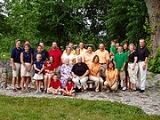
A family consists of a domestic group of people , typically affiliated by birth or marriage, or by comparable legal relationships including domestic partnership, adoption, surname and ownership . Although many people have understood familial relationships in terms of "blood", many anthropologists have argued that one must understand the notion of "blood" metaphorically, and that many societies understand 'family' through other concepts rather than through genetics. Article 16 of the Universal Declaration of Human Rights says: "The family is the natural and fundamental group unit of society and is entitled to protection by society and the State".

Discussions

  Discussion Features

   Ask a question about 'Family'

   Start a new discussion about 'Family'

   Answer questions about 'Family'

   'Family' discussion forum

Quotations

The family is the natural and fundamental group unit of society and is entitled to protection by society and the State.

In other words, I don't think people ought to be compelled to make the decision which they think is best for their family.

George W. Bush :—Washington, D.C., December 11, 2002

       More Quotes >>


Encyclopedia


A family consists of a domestic group of people , typically affiliated by birth or marriage, or by comparable legal relationships — including domestic partnership, adoption, surname and ownership .

Although many people have understood familial relationships in terms of "blood", many anthropologists have argued that one must understand the notion of "blood" metaphorically, and that many societies understand 'family' through other concepts rather than through genetics.

Article 16 of the Universal Declaration of Human Rights says: "The family is the natural and fundamental group unit of society and is entitled to protection by society and the State".

The family cross-culturally

According to sociology Sociology

Sociology is the study of society and human social action.... 

 and anthropology Anthropology

Anthropology consists of the study of humanity [i] . ... 

, the family has the primary function of reproducing — biologically, socially, or in both ways. Thus, one's experience of one's family shifts over time. From the perspective of children, the family functions as a family of orientation: the family serves to locate children socially, and plays a major role in their enculturation and socialization. From the point of view of the parent, the family serves as a family of procreation with the goal of producing, enculturating and socializing children.

Producing children, however important, does not exhaust the functions of the family. In societies with a sexual division of labor, marriage  must precede the formation of an economically productive household. In modern societies marriage entails particular rights and privileges that encourage the formation of new families even when participants have no intention of having children.

Typology

The structure of families traditionally hinges on relations between parents and children, on relations between spouses, or on both. Consequently, four major types of family exist:
  1. patrifocal
  2. matrifocal
  3. consanguineal
  4. conjugal

Note: this typology deals with "ideal" families. All societies tolerate some acceptable deviations from the ideal or statistical norm, owing either to incidental circumstances , to infertility or to personal preferences.
Patrifocal families
A patrifocal family consists of a father and his children.
Matrifocal families
A matrifocal family consists of a mother and her children — generally her biological offspring, although nearly every society also practises adoption Adoption

Adoption is the legal act of permanently placing a child with a parent or parents other than the birth p... 

 of children. This kind of family commonly develops where women have the resources to rear their children by themselves, or where men have more mobility than women. Some indigenous South American and Melanesian societies are matrifocal.

Among polygynous societies studied along the Orinoco river system in southern Venezuela, families are set up in two levels. The larger system consists of one man, one to five women, and their children. The smaller matrifocal family consists of each woman and her children. The children are reared by their mothers as they would in a simple matrifocal system, with most fathers not being closely involved.
Consanguineal families
A consanguineal family comes in various forms, but the most common subset consists of a mother and her children, and other people — usually the family of the mother. This kind of family commonly evolves where mothers do not have the resources to rear their children on their own, fathers are not often present, and especially where property changes ownership through inheritance. When men own important property, consanguineal families commonly consist of a husband and wife, their children, and other members of the husband's family.
Conjugal families
A conjugal family consists of one or more mothers and their children, and/or one or more fathers. This kind of family occurs commonly where a division of labor requires the participation of both men and women, and where families have relatively high mobility. A notable subset of this family type, the nuclear family, has one woman with one husband, and they raise their children. This was formerly known as the "Eskimo system" in anthropology.

Family in the West

The different types of families occur in a wide variety of settings, and their specific functions and meanings depend largely on their relationship to other social institutions. Sociologists Sociology

Sociology is the study of society and human social action.... 

 have an especial interest in the function and status of these forms in stratified societies.

Non-scholars, especially in the United States and Europe, use the term "nuclear family" to refer to conjugal families. Sociologists distinguish between conjugal families and nuclear families .

Non-scholars, especially in the United States and Europe, also use the term "extended family". This term has two distinct meanings. First, it serves as a synonym of "consanguinal family". Second, in societies dominated by the conjugal family, it refers to kindred who do not belong to the conjugal family.

These types refer to ideal or normative structures found in particular societies. Any society will exhibit some variation in the actual composition and conception of families. Much sociological, historical and anthropological research dedicates itself to the understanding of this variation, and of changes in the family form over time. Thus, some speak of the bourgeois family, a family structure arising out of 16th-century and 17th-century European households, in which the family centers on a marriage between a man and woman, with strictly-defined gender-roles. The man typically has responsibility for income and support, the woman for home and family matters.

In contemporary Europe and the United States, people in academic, political and civil sectors have called attention to single-father-headed households, and families headed by same-sex Gay

Gay is an adjective meaning "carefree", "happy", or "bright and showy"; however in modern usage, gay... 

 couples, although academics point out that these forms exist in other societies.

Roman Catholic Church Roman Catholic Church

The Roman Catholic Church or Catholic Church is the Christian [i] Church [i] ... 

 tradition places the family under the special protection of Saint Joseph Saint Joseph

According to Christian Gospel accounts and tradition Joseph "of the House of David [i]" also called ... 

, the patron of families, fathers, expectant mothers, house-sellers and house-buyers .

Economic function of the family

Anthropologists have often supposed that the family in a traditional society forms the primary economic unit. This economic role has gradually diminished in modern times, and in societies like the United States United States

The United States of America, also known as the United States, the U.S., the U.S.A., a... 

 it has become much smaller — except in certain sectors such as agriculture and in a few upper class Upper class

Upper class refers to a group of people at the top of a social hierarchy [i]. ... 

 families. In China China

China is a cultural region [i] and ancient civilization [i] in East Asia [i]. ... 

 the family as an economic unit still plays a strong role in the countryside. However, the relations between the economic role of the family, its socio-economic mode of production and cultural values remain highly complex.


Families and other sociological institutions

Wherever people agree that families seem fundamental to the ordered nature of society Society

A society is a grouping [i] of individual [i]s, which is characterised by common interest and m ... 

, other social institutions such as the state and organised religion Religion

Religion is a system of social coherence based on a common group of belief [i]s or attitudes concerning ... 

 will make special provisions for families and will support the idea of the family. This can however lead to problems if conflicting loyalties arise. Thus the Biblical prescription: "every one that hath forsaken houses, or brethren, or sisters, or father, or mother, or wife, or children, or lands, for my name's sake, shall receive a hundredfold, and shall inherit everlasting life" . Totalitarian states also can develop ambiguous attitudes to families, which they may perceive as potentially interfering with the fostering of official ideology and practice. Different attitudes to divorce and to denunciation may develop in this light.

Families and Political Structure

On the other hand family structures or its internal relationships may affect both state and religious institutions. J.F. del Giorgio in The Oldest Europeans points that the high status of women among the descendants of the post-glacial Paleolithic European population was coherent with the fierce love of freedom of pre-Indo-European tribes. He believes that the extraordinary respect for women in those families made that children raised in such atmosphere tended to distrust strong, authoritarian leaders. According to del Giorgio, European democracies have their roots in those ancient ancestors.

Kinship terminology

A kinship Kinship

Kinship is the most basic principle of organizing individuals into social groups, roles, and categories.... 

 terminology
describes a specific system of familial relationships. The now 2006

2006 is a common year starting on Sunday [i] of the Gregorian calendar [i].
... 

 rather dated anthropologist Louis Henry Morgan Lewis H. Morgan

Lewis Henry Morgan was an American ethnologist [i], anthropologist [i] and writer. ... 

  argued that kinship terminologies reflect different sets of distinctions. For example, most kinship terminologies distinguish between sexes and between generations . Moreover, he argued, kinship terminologies distinguish between relatives by blood and marriage .

However, Morgan also observed that different languages organize these distinctions differently. He thus proposed to describe kin terms and terminologies as either descriptive or classificatory. "Descriptive" terms refer to only one type of relationship, while "classificatory" terms refer to many types of relationships. Most kinship terminologies include both descriptive and classificatory terms. For example, Western societies provide only one way to express relationship with one's brother ; thus, in Western society, the word "brother" functions as a descriptive term. But many different ways exist to express relationship with one's male first-cousin ; thus, in Western society, the word "cousin" operates as a classificatory term.

Morgan discovered that a descriptive term in one society can become a classificatory term in another society. For example, in some societies one would refer to many different people as "mother" . Moreover, some societies do not lump together relatives that the West classifies together. For example, some languages have no one word equivalent to "cousin", because different terms refer to mother's sister's children and to father's sister's children.

Armed with these different terms, Morgan identified six basic patterns of kinship terminologies:

  • Hawaiian Hawaiian kinship

    Hawaiian kinship is a kinship [i] system used to define family [i]. ... 

    : the most classificatory; only distinguishes between sex and generation.
  • Sudanese: the most descriptive; no two relatives share the same term.
  • Eskimo Eskimo kinship

    Eskimo kinship is a kinship [i] system used to define family [i].... 

    : has both classificatory and descriptive terms; in addition to sex and generation, also distinguishes between lineal relatives and collateral relatives . Lineal relatives have highly descriptive terms, collateral relatives have highly classificatory terms.
  • Iroquois Iroquois kinship

    Iroquois kinship is a kinship [i] system used to define family [i]. ... 

    : has both classificatory and descriptive terms; in addition to sex and generation, also distinguishes between siblings of opposite sexes in the parental generation. Siblings of the same sex class as blood relatives, but siblings of the opposite sex count as relatives by marriage. Thus, one calls one's mother's sister "mother", and one's father's brother "father"; however, one refers to one's mother's brother as "father-in-law", and to one's father's sister as "mother-in-law".
  • Crow Crow kinship

    Crow kinship is a kinship [i] system used to define family [i]. ... 

    : like Iroquois, but further distinguishes between mother's side and father's side. Relatives on the mother's side of the family have more descriptive terms, and relatives on the father's side have more classificatory terms.
  • Omaha Omaha kinship

    Omaha kinship is a kinship [i] system used to define family [i]. ... 

    : like Iroquois, but further distinguishes between mother's side and father's side. Relatives on the mother's side of the family have more classificatory terms, and relatives on the father's side have more descriptive terms.


Societies in different parts of the world and using different languages may share the same basic terminology patterns; in such cases one can very easily translate the kinship terms of one language into another, although connotations may vary. But translators usually find it impossible to translate directly the kinship terms of a society that uses one system into the language of a society that uses a different system.

Some languages, such as Chinese Chinese language

Chinese is a language [i] that forms part of the Sino-Tibetan family [i] of lan ... 

 , Japanese Japanese language

Japanese is a language spoken by over 127 million people, mainly in Japan [i], but also by Japanese emi ... 

, and Hungarian Hungarian language

Hungarian is a Finno-Ugric language [i], unrelated to the other languages of Central Europe [i] ... 

, add another dimension to some relations: relative age. There exist, for example, different words for "older brother" and "younger brother". Thus, although Westerners may "naturally" agree with Morgan in seeing the term "brother" as descriptive rather than classificatory, speakers of these languages might disagree.

Other languages, such as Chiricahua, have reciprocal terms. So, a Chiricahua child calls her paternal grandmother -ch’iné and likewise this grandmother will call her son's child -ch’iné.

English kinship terminology


Most Western societies employ English-style kinship terminology. This kinship terminology commonly occurs in societies based on conjugal families, where nuclear families have a degree of relatively mobility.

Members of the nuclear family use descriptive kinship terms:
  • Mother Mother

    In the case of a mammal [i] such as a human [i], the biological mother gestates [i] her child in the ... 

    : the female parent
  • Father Father

    A father is traditionally the male [i] parent [i] of a child. ... 

    : the male parent
  • Son: the males born of the mother; sired by the father
  • Daughter: the females born of the mother; sired by the father
  • Brother Sibling

    Sibling denotes a brother or sister, respectively meaning a male or female who shares at least one... 

    : a male born of the same mother; sired by the same father
  • Sister Sibling

    Sibling denotes a brother or sister, respectively meaning a male or female who shares at least one... 

    : a female born of the same mother; sired by the same father


Such systems generally assume that the mother's husband has also served as the biological father. In some families, a woman may have children with more than one man or a man may have children with more than one woman. The system refers to a child who shares only one parent with another child as a "half-brother" or "half-sister". For children who do not share biological or adoptive parents in common, English-speakers use the term "step-brother" or "step-sister" to refer to their new relationship with each other when one of their biological parents marries one of the other child's biological parents.

Any person who marries the parent of that child becomes the "step-parent" of the child, either the "stepmother" or "stepfather". The same terms generally apply to children adopted into a family as to children born into the family.

Typically, societies with conjugal families also favor neolocal residence; thus upon marriage a person separates from the nuclear family of their childhood and forms a new nuclear family . This practice means that members of one's own nuclear family once functioned as members of another nuclear family, or may one day become members of another nuclear family.

Members of the nuclear families of members of one's own nuclear family may class as lineal or as collateral. Kin who regard them as lineal refer to them in terms that build on the terms used within the nuclear family:
  • Grandparent Grandparent

    Grandparents are family [i] members, the father and mother of a person's own father [i] and mother [i], ... 

    • Grandfather: a parent's father
    • Grandmother: a parent's mother
  • Grandson: a child's son
  • Granddaughter: a child's daughter


For collateral relatives, more classificatory terms come into play, terms that do not build on the terms used within the nuclear family:
  • Uncle: father's brother, father's sister's husband, mother's brother, mother's sister's husband
  • Aunt: father's sister, father's brother's wife, mother's sister, mother's brother's wife
  • Nephew: sister's son, brother's son
  • Niece: sister's daughter, brother's daughter

When additional generations intervene , the prefix "grand" modifies these terms. And as with grandparents and grandchildren, as more generations intervene the prefix becomes "great grand", adding an additional "great" for each additional generation.

Most collateral relatives have never had membership of the nuclear family of the members of one's own nuclear family.
  • Cousin: the most classificatory term; the children of aunts or uncles. One can further distinguish cousins by degrees of collaterality and by generation. Two persons of the same generation who share a grandparent count as "first cousins" ; if they share a great-grandparent they count as "second cousins" and so on. If two persons share an ancestor, one as a grandchild and the other as a great-grandchild of that individual, then the two descendants class as "first cousins once removed" ; if the shared ancestor figures as the grandparent of one individual and the great-great-grandparent of the other, the individuals class as "first cousins twice removed" , and so on. Similarly, if the shared ancestor figures as the great-grandparent of one person and the great-great-grandparent of the other, the individuals class as "second cousins once removed". Hence the phrase "third cousin once removed upwards".


Distant cousins of an older generation , though technically first cousins once removed, often get classified with "aunts" and "uncles".

Similarly, a person may refer to close friends of one's parents as "aunt" or "uncle", or may refer to close friends as "brother" or "sister", using the practice of fictive kinship.

English-speakers mark relationships by marriage with the tag "-in-law". The mother and father of one's spouse become one's mother-in-law and father-in-law; the female spouse of one's child becomes one's daughter-in-law and the male spouse of one's child becomes one's son-in-law. The term "sister-in-law" refers to three essentially different relationships, either the wife of one's brother, or the sister of one's spouse, or the wife of one's spouse's sibling. "Brother-in-law" expresses a similar ambiguity. No special terms exist for the rest of one's spouse's family.

The terms "half-brother" and "half-sister" indicate siblings who one share only one biological or adoptive parent.

Specific distinctions vary among Western societies. For instance, in French, the prefix beau- or belle- equates to both "-in-law" and "step-"; in other words, the term belle-soeur could refer to the sister of one's spouse, the wife of one's sibling, the wife of one's spouse's sibling, or the daughter of one's parent's spouse. In Spanish, each of the roles that English creates with the suffix "-in-law" has a different word , but a separate suffix -astro or -astra equates to "step-". In Swedish, terms for grandparents differ on the mother's and father's sides: mormor and morfar as opposed to farfar and farmor . In Dutch, no difference is made between nephews and male cousins, or nieces and female cousins. Unlike English, however, there is a difference between sexes of cousins. Nephews and male cousins are indicated using neef, where nieces and female cousins are called nicht.

One cannot always translate kin terms, and if one can, the outcome may remain culture-specific. For example, the Spanish word consuegro indicates the parent of one's son- or daughter-in-law ; the English language has no equivalent term. In polygynous African societies which use English and French as official languages, a sister-wife is another wife of one's husband; although these terms have come into common use , someone with a European cultural background may not readily understand the implications. The words brother, sister, aunt, uncle have stronger fictive-kinship nuances in many African cultures than in European ones, as exemplified by the phrase "he is my brother: same mother, same father" for a biological brother.

See also


  • Kinship terms
  • Ancestor
  • Child Child

    A child.Precise definitions vary; is the offspring, of any age, of two people.The American Heritage Dict... 

    • Illegitimacy
  • Clan
  • Consanguinity
    • Kin selection
    • Pedigree collapse
  • Domestic violence
  • Family
    • Complex family
    • Dysfunctional family
    • Grandfamily
    • Family history
    • Family life in literature
    • Family as a model for the state
    • Family law
    • Family name
    • Family therapy
    • Parenting
    • Father Father

      A father is traditionally the male [i] parent [i] of a child. ... 

    • Motherhood Mother

      In the case of a mammal [i] such as a human [i], the biological mother gestates [i] her child in the ... 

    • Grandparent Grandparent

      Grandparents are family [i] members, the father and mother of a person's own father [i] and mother [i], ... 

  • Genealogy
    • Cousin chart Cousin chart

      A cousin chart, or table of consanguinity [i], is a chart that identifies cousin relationships usi ... 

  • Household
  • Interpersonal relationship and Intimate relationship
    • Cohabitation
    • Common-law marriage
    • Divorce
    • Marriage
  • Sociology of the family
  • Familycentrics

References

  • American Kinship, David M. Schneider
  • A Natural History of Families, Scott Forbes, Princeton University Press, 2005, ISBN 0-691-09482-9
  • More Than Kin and Less Than Kind, Douglas W. Mock, Belknap Press, 2004, ISBN 0-674-01285-2

External links

  • Family Organization
  • - Get health information for whole family.
  • - freely-edited family tree of all human beings.
  • - Resource for finding ancestors of your family
  • Online Dictionary of the Social Sciences: http://bitbucket.icaap.org/
  • Cousins: http://www.tedpack.org/cousins.html
  • and Muslim Family
  • Grandparent Connection: http://www.thegrandparentconnection.org
  • The Good Enough Family: http://samvak.tripod.com/family.html
  • Cousin marriages: http://www.cousincouples.com/
  • Family Court: http://www.stephenbaskerville.net/
  • Website of Family Focus Australia Family Focus Australia

    Family Focus Australia Limited(Family Focus Australia or FFA) is a community based charity [i] ... 

  • Wiktionary entries for Western kinship terminology providing multilingual translations

, , , , ,


Categories: