
All Topics  
Walden

 
Walden

   Email Print
   Bookmark   Link


Walden


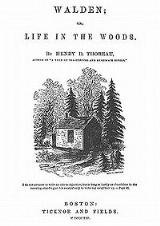
Walden (first published as Walden; or, Life in the Woods) by Henry David Thoreau
Henry David Thoreau

Henry David Thoreau was an United States author, poet, Natural history, tax resistance, development criticism, surveyor, historian, philosophy, and leading Transcendentalism....
 is one of the best-known non-fiction
Non-fiction

Non-fiction is an document or representation of a subject which is presented as fact. This presentation may be accurate or not; that is, it can give either a true or a false account of the subject in question....
 books written by an American
United States

The United States of America is a Federal government constitutional republic comprising U.S. state and a federal district. The country is situated mostly in central North America, where its Contiguous United States and Washington, D.C., the Capital districts and territories, lie between the Pacific Ocean and Atlantic Oceans, Borders of the U...
. Published in 1854, it details Thoreau's sojourn in a cabin near Walden Pond
Walden Pond

Walden Pond is a 102-foot deep pond, in area and around, located in Concord, Massachusetts, in the United States. A famous example of a Kettle , it was formed by retreating glaciers 10,000 - 12,000 years ago....
, amidst woodland owned by his friend and mentor Ralph Waldo Emerson
Ralph Waldo Emerson

Ralph Waldo Emerson was an American essayist, philosopher, poet, and leader of the transcendentalism movement in the early 19th century. His teachings directly influenced the growing New Thought movement of the mid 1800s....
, near Concord, Massachusetts
Concord, Massachusetts

Concord is a town in Middlesex County, Massachusetts, Massachusetts, in the United States. As of the 2000 Census, the town population was about 17,000....
. However, Emerson's lack of enthusiasm for the project can be seen in this thought delivered during Thoreau's funeral: "I so much regret the loss of his rare powers of action, that I cannot help counting it a fault in him that he had no ambition.


Discussion
Ask a question about 'Walden'
Start a new discussion about 'Walden'
Answer questions from other users
Full Discussion Forum


Quotations


A man is rich in proportion to the number of things which he can afford to let alone.

Age is no better, hardly so well, qualified for an instructor as youth, for it has not profited so much as it has lost.

As for doing good, that is one of the professions which are full.

As if you could kill time without injuring eternity.

I have learned that the swiftest traveller is he that goes afoot.

In the long run men hit only what they aim at. Therefore, though they should fail immediately, they had better aim at something high.


Encyclopedia


Walden (first published as Walden; or, Life in the Woods) by Henry David Thoreau
Henry David Thoreau

Henry David Thoreau was an United States author, poet, Natural history, tax resistance, development criticism, surveyor, historian, philosophy, and leading Transcendentalism....
 is one of the best-known non-fiction
Non-fiction

Non-fiction is an document or representation of a subject which is presented as fact. This presentation may be accurate or not; that is, it can give either a true or a false account of the subject in question....
 books written by an American
United States

The United States of America is a Federal government constitutional republic comprising U.S. state and a federal district. The country is situated mostly in central North America, where its Contiguous United States and Washington, D.C., the Capital districts and territories, lie between the Pacific Ocean and Atlantic Oceans, Borders of the U...
. Published in 1854, it details Thoreau's sojourn in a cabin near Walden Pond
Walden Pond

Walden Pond is a 102-foot deep pond, in area and around, located in Concord, Massachusetts, in the United States. A famous example of a Kettle , it was formed by retreating glaciers 10,000 - 12,000 years ago....
, amidst woodland owned by his friend and mentor Ralph Waldo Emerson
Ralph Waldo Emerson

Ralph Waldo Emerson was an American essayist, philosopher, poet, and leader of the transcendentalism movement in the early 19th century. His teachings directly influenced the growing New Thought movement of the mid 1800s....
, near Concord, Massachusetts
Concord, Massachusetts

Concord is a town in Middlesex County, Massachusetts, Massachusetts, in the United States. As of the 2000 Census, the town population was about 17,000....
. However, Emerson's lack of enthusiasm for the project can be seen in this thought delivered during Thoreau's funeral: "I so much regret the loss of his rare powers of action, that I cannot help counting it a fault in him that he had no ambition. Wanting this [that is, lacking ambition] instead of engineering for all America, he was the captain of a huckleberry
Huckleberry

Huckleberry may refer to:*Huckleberry plants from the family Ericaceae*Red Huckleberry *Garden huckleberry ...
 party. Pounding beans is good to the end of pounding empires one of these days; but if, at the end of years, it is still only beans!" Thoreau did not intend to live as a hermit
Hermit

A hermit is a person who lives to some greater or lesser degree in solitude and/or isolation from society.In Christianity the term was originally applied to a Christian who lives the eremitic life out of a religious conviction, namely the Catholic spirituality#Desert spirituality of the Old Testament ....
, for he received visitors and returned their visits. Instead, he hoped to isolate himself from society in order to gain a more objective understanding of it. Simple living
Simple living

Simple living is a lifestyle characterized by minimizing the 'more-is-better' pursuit of wealth and Consumerism. Adherents may choose simple living for a variety of personal reasons, such as spirituality, health, increase in 'quality time' for family and friends, Stress reduction, personal taste or frugality....
 and self-sufficiency
Self-sufficiency

Self-sufficiency refers to the state of not requiring any outside aid, support, or interaction, for survival; it is therefore a type of personal or collective Wiktionary:autonomy....
 were Thoreau's other goals, and the whole project was inspired by transcendentalist philosophy, which was one of the key ideas of the American Romantic Period. As Thoreau made clear in his book, his cabin was not in wilderness but at the edge of town, not far from his family home.

Synopsis


Economy: This is the first chapter and also the longest by far. Thoreau begins by outlining his project: a two-year and two-month stay at a crude cabin in the woods near Walden Pond. He does this, he says, in order to illustrate the spiritual benefits of a simplified lifestyle. He easily supplies the four necessities of life (food, shelter, clothing, and fuel). He meticulously records his expenditures and earnings, demonstrating his understanding of "economy," as he builds his house and buys and grows food. For a home and freedom, he spends a mere $28.13.

Complementary Verses: This chapter consists entirely of a poem, "The Pretensions of Poverty," by seventeenth-century English poet Thomas Carew
Thomas Carew

Thomas Carew was an England poet.He was the son of Sir Matthew Carew, master in chancery, and his wife, Alice Ingpenny, widow of Sir John Rivers, Lord Mayor of the City of London....
. The poem criticizes those who think that their poverty gives them unearned moral and intellectual superiority.

Where I Lived, and What I Lived For: After playing with the idea of buying a farm, Thoreau describes his cabin's location. Then he explains that he took up his abode at Walden Woods so as to "live deliberately, to front only the essential facts of life, and see if I could not learn what it had to teach, and not, when I came to die, discover that I had not lived."

Reading: Thoreau provides discourse on the benefits of reading classical literature (preferably in the original Greek or Latin
Latin

Latin is an Italic language, historically spoken in Latium and Ancient Rome. Through the Military history of the Roman Empire, Latin spread throughout the Mediterranean and a large part of Europe....
) and bemoans the lack of sophistication in Concord, manifested in the popularity of popular literature. He yearns for a utopia
Utopia

Utopia is a name for an ideal community or society, taken from the Utopia written in 1516 by Sir Thomas More describing a fictional island in the Atlantic Ocean, possessing a seemingly perfect social system-politics-legal system....
n time when each New England village will support "wise men" to educate and thereby ennoble the population.

Sounds: Thoreau opens this chapter by warning against relying too much on literature as a means of transcendence. Instead, one should experience life for oneself. Thus, after describing his cabin's beautiful natural surroundings and his casual housekeeping habits, Thoreau goes on to criticize the train whistle that interrupts his reverie. To him, the railroad symbolizes the destruction of the good old pastoral way of life. Following is a description of the sounds audible from his cabin: the church bells ringing, carriages rattling and rumbling, cows lowing, whip-poor-will
Whip-poor-will

The Whip-poor-will or whippoorwill, Caprimulgus vociferus, is a medium-sized nightjar from North America and Central America. The Whip-poor-will is commonly heard within its range, but less often seen....
s singing, owls hooting, frogs croaking, and cockerels crowing.

Solitude: Thoreau rhapsodizes about the beneficial effects of living solitary and close to nature. He loves to be alone, for "I never found the companion that was so companionable as solitude," and he is never lonely as long as he is close to nature. He believes there is no great value to be had by rubbing shoulders with the mass of humanity.

Visitors: Thoreau writes about the visitors to his cabin. Among the 25 or 30 visitors is a young French-Canadian woodchopper, Alec Therien, whom Thoreau idealizes as approaching the ideal man, and a runaway slave, whom Thoreau helps on his journey to freedom in Canada.

The Bean-Field: Thoreau relates his efforts to cultivate two and a half acres of beans. He plants in June and spends his summer mornings weeding the field with a hoe. He sells most of the crop, and his small profit of $8.71 covers his needs.

The Village: Thoreau visits the small town of Concord every day or two to hear the news, which he finds "as refreshing in its way as the rustle of the leaves." Nevertheless, he fondly but rather contemptuously compares Concord to a gopher
Gopher

Gopher may refer to:* Gopher , including:** True gopher, i.e. pocket gopher or member of Geomyidae, native to North America** Richardson's Ground Squirrel, a species of Spermophilus...
 colony. In late summer, he is arrested for refusing to pay federal taxes, but is released the next day. He explains that he refuses to pay taxes to a government that supports slavery.

The Ponds: In autumn, Thoreau rambles about the countryside and writes down his observations about the geography of Walden Pond and its neighbors: Flint's Pond (or Sandy Pond), White Pond, and Goose Pond. Although Flint's is the largest, Thoreau's favorites are Walden and White ponds. They are lovelier than diamonds, he says.

Baker Farm: While on an afternoon ramble in the woods, Thoreau gets caught in a rainstorm and takes shelter in the dirty, dismal hut of John Field, a penniless but hard-working Irish farmhand, and his wife and children. Thoreau urges Field to live a simple but independent and fulfilling life in the woods, thereby freeing himself of employers and creditors. But the Irishman won't give up his dreams of luxury, which is the American dream.

Higher Laws: Thoreau discusses whether hunting wild animals and eating meat is good. He concludes that the primitive, animal side of humans drives them to kill and eat animals, and that a person who transcends this propensity is superior to those who don't. (Thoreau eats fish.) In addition to vegetarianism, he lauds chastity, work, and teetotalism
Teetotalism

Teetotalism is the practice and promotion of complete abstinence from alcoholic beverages. A person who practices teetotalism is called a teetotaler or teetotaller ....
.

Brute Neighbors: Thoreau briefly discusses the many wild animals that are his neighbors at Walden. A description of the nesting habits of partridge
Partridge

Partridges are birds in the pheasant family, Phasianidae. They are a bird migration Old World group.These are medium-sized birds, intermediate between the larger pheasants and the smaller quails....
s is followed by a fascinating account of a massive battle between red and black ant
Black ant

Black ant is a term used for eusocial insects of the family Formicidae that are black in color. It has been used to describe many ants, including, but not limited to:...
s. Three of the combatants he takes into his cabin and examines them under a microscope as the black ant kills the two smaller red ones. Later, Thoreau takes his boat and tries to follow a teasing loon
Loon

The loons or divers are a group of aquatic birds found in many parts of North America and northern Eurasia. All living species of loons are members of one genus, Gavia, family , Gaviidae, and order Gaviiformes all of their own....
 about the pond.

House-Warming: After picking November berries in the woods, Thoreau bestirs himself to add a chimney and plaster the walls of his hut in order to stave off the cold of the oncoming winter. He also lays in a good supply of firewood, and expresses affection for wood and fire.

Former Inhabitants; and Winter Visitors: Thoreau relates the stories of people who formerly lived in the vicinity of Walden Pond. Then he talks about the few visitors he receives during the winter: a farmer, a woodchopper, and a poet (Ellery Channing).

Winter Animals: Thoreau amuses himself by watching wildlife during the winter. He relates his observations of owls, hare
Hare

Hares and jackrabbits are leporids belonging to the genus Lepus. Very young hares, less than one year old, are called leverets....
s, red squirrel
Red Squirrel

The red squirrel or Eurasian red squirrel is a species of tree squirrel . A tree-dwelling omnivore rodent, the red squirrel is common throughout Eurasia....
s, mice, and various birds as they hunt, sing, and eat the scraps and corn he put out for them. He also describes a fox hunt that passes by.

The Pond in Winter: Thoreau describes Walden Pond as it appears during the winter. He claims to have sounded its depths and located an underground outlet. Then he recounts how 100 laborers came to cut great blocks of ice from the pond, the ice to be shipped to the Carolinas.

Spring: As spring arrives, Walden and the other ponds melt with stentorian thundering and rumbling. Thoreau enjoys watching the thaw, and grows ecstatic as he witnesses the green rebirth of nature. He watches the geese winging their way north, and a hawk playing by itself in the sky. As nature is reborn, the narrator implies, so is he. He departs Walden on September 8, 1847.

Conclusion: This final chapter is more passionate and urgent than its predecessors. In it, he criticizes conformity: "If a man does not keep pace with his companions, perhaps it is because he hears a different drummer. Let him step to the music which he hears, however measured or far away." By doing these things, men may find happiness and self-fulfillment.
"I do not say that John or Jonathan will realize all this; but such is the character of that morrow which mere lapse of time can never make to dawn. The light which puts out our eyes is darkness to us. Only that day dawns to which we are awake. There is more day to dawn. The sun is but a morning star."


Themes

Walden emphasizes the importance of self-reliance, solitude, contemplation, and closeness to nature in transcending the "desperate" existence that, he argues, is the lot of most humans. The book is not a traditional autobiography
Autobiography

An autobiography is a biography written by its subject . The term was first used by the poet Robert Southey in 1809 in the English language Periodical publication Quarterly Review, but the form goes back to antiquity....
, but combines autobiography with a social critique of contemporary Western culture's consumerist and materialist attitudes and its distance from and destruction of nature. That the book is not simply a criticism of society, but also an attempt to engage creatively with the better aspects of contemporary culture, suggested both by Thoreau's proximity to Concord society and by his admiration for classical literature. There are signs of ambiguity, or an attempt to see an alternative side of something common the sound of a passing locomotive, for example, is compared to natural sounds.

Thoreau Cabin Statue Flickr
Walden is informed by American Transcendentalism, a philosophy developed mostly by Thoreau's friend and spiritual mentor Ralph Waldo Emerson
Ralph Waldo Emerson

Ralph Waldo Emerson was an American essayist, philosopher, poet, and leader of the transcendentalism movement in the early 19th century. His teachings directly influenced the growing New Thought movement of the mid 1800s....
. Emerson owned the land on which Thoreau built his cabin at Walden Pond, and Thoreau often used to walk over to Emerson's house for a meal and a conversation.

Thoreau regarded his sojourn at Walden as a noble experiment with a threefold purpose. First, he was escaping the dehumanizing effects of the Industrial Revolution
Industrial Revolution

The Industrial Revolution was a period in the late 18th and early 19th centuries when major changes in agriculture, manufacturing, production, and transportation had a profound effect on the socioeconomics and cultural conditions in United Kingdom....
 by returning to a simpler, agrarian lifestyle. (However, he never intended the experiment to be permanent, explicitly advised that he did not expect all his readers to follow his example, and never wrote against technology or industry as such.) Second, he was simplifying his life and reducing his expenditures, increasing the amount of leisure time in which he could work on his writings (most of A Week on the Concord and Merrimack Rivers
A Week on the Concord and Merrimack Rivers

A Week on the Concord and Merrimack Rivers is a book by Henry David Thoreau, first published in 1849. The book is ostensibly the narrative of a boat trip from Concord, Massachusetts to Concord, New Hampshire and back Thoreau had taken with his brother John in 1839....
 was written at Walden). Much of the book is devoted to stirring up awareness of how one's life is lived, materially and otherwise, and how one might choose to live it more deliberately possibly differently. Third, he was putting into practice the Transcendentalist belief that one can best transcend normality and experience the Ideal, or the Divine, through nature.

Critical response

Scottish author Robert Louis Stevenson
Robert Louis Stevenson

Robert Louis Balfour Stevenson , was a Scottish novelist, poet, essayist and Travel writing. Stevenson was greatly admired by many authors, including Jorge Luis Borges, Ernest Hemingway, Rudyard Kipling, Vladimir Nabokov, J....
 judged Thoreau’s endorsement of living alone in natural simplicity, apart from modern society, to be a mark of effeminacy, calling it "womanish solicitude; for there is something unmanly, something almost dastardly" about the lifestyle. Richard Zacks pokes fun at Thoreau in An Underground Education : The Unauthorized and Outrageous Supplement to Everything You Thought You Knew About Art, Sex, Business, Crime, Science, Medicine, and Other Fields of Human Knowledge saying:

Thoreau's 'Walden, or Life in the Woods' deserves its status as a great American book but let it be known that Nature Boy went home on weekends to raid the family cookie jar. While living the simple life in the woods, Thoreau walked into nearby Concord, Mass., almost every day. And his mom, who lived less than two miles away, delivered goodie baskets filled with meals, pies and doughnuts every Saturday. The more one reads in Thoreau's unpolished journal of his stay in the woods, the more his sojourn resembles suburban boys going to their tree-house in the backyard and pretending they're camping in the heart of the jungle.


Poet John Greenleaf Whittier
John Greenleaf Whittier

John Greenleaf Whittier was an influential American Quaker poet and ardent advocate of the abolition of slavery in the United States. He is usually listed as one of the Fireside Poets....
 criticized what he perceived as the message in Walden that man should lower himself to the level of a woodchuck and walk on four legs. He said: "Thoreau's Walden is a capital reading, but very wicked and heathenish... After all, for me, I prefer walking on two legs".

Modern influence

Site Throeau Cabin Loc
* Walden inspired the 1948 novel Walden Two
Walden Two

Walden Two is a utopian novel by Radical behaviorism psychologist B. F. Skinner, describing a small, thousand-person, rural planned community of happy, productive, and creative people....
 by psychologist B.F. Skinner.
  • Walden Three
    James W. Walter

    James W. Walter, Junior is an United States venture capitalist, author, and conspiracy theorist formerly involved in the 9/11 Truth Movement. He is best known for sponsoring advertisements asking to reopen the investigation of the September 11, 2001 attacks and offering financial rewards to anyone that could prove the World Trade Center wa...
    , a non-profit educational foundation that promotes sustainable societies, takes its name from the book.
  • In the early years of the Doonesbury
    Doonesbury

    Doonesbury is a comic strip by Garry Trudeau that chronicles the adventures and lives of a vast array of different characters of different ages, professions, and backgrounds?from the President of the United States to the title character, Michael Doonesbury, now a middle-aged, remarried father....
     comic strip, the main characters lived in a commune they named Walden Puddle, a reference to Walden Pond and a note of Thoreau's influence on the student counterculture of the time.
  • The meetings of the fictional Dead Poets Society in the eponymous 1989 film
    Dead Poets Society

    Dead Poets Society is a 1989 in film film directed by Peter Weir. Set in 1959 at a conservative and aristocratic boys prep school, it tells the story of an English teacher who inspires his students to change their lives of conformity through his teaching of poetry and literature....
     were all opened with a quote from Walden.
  • A Wilhelm Scream
    A Wilhelm Scream

    A Wilhelm Scream is a punk rock/melodic hardcore band from New Bedford, Massachusetts. Many people have referenced Strung Out, Hot Water Music, Propagandhi, and Strike Anywhere as the band's similar artists....
     has a song on their 2005 album Ruiner
    Ruiner

    Ruiner is the second length album from the Massachusetts based technical punk rock/melodic hardcore band A Wilhelm Scream....
     which refers to Thoreau, Walden, and nature. The title of the song is "When I Was Alive: Walden III." The lyrical excerpt is: "And like Thoreau, it's a quiet place for me. The sticks and the woods, it's all miles away from you."
  • Walden started a movement for less pollution and preserving wildlife.
  • Walden is one of the three books always carried by Phaedrus in Zen and the Art of Motorcycle Maintenance
    Zen and the Art of Motorcycle Maintenance

    Zen and the Art of Motorcycle Maintenance: An Inquiry into Values is the first of Robert M. Pirsig's texts in which he explores his Pirsig's metaphysics of quality....
    . The excerpt is: "..which can be read a hundred times without exhaustion."
  • In a Zits Comic, Jeremy is telling his mother that he's taking care of his summer reading by listening to books on Podcast while he plays video games. When his mother asks him what book he's listening to, he says it's Walden.
  • In the episode "Live Deliberately
    List of Ed episodes

    The following is an episode list for the NBC Comedy-drama television series Ed .Season 1: 2000-2001Season 2: 2001-2002...
    " of the TV show Ed
    Ed

    Ed, ed or ED can mean any of the following:...
    , Warren tries to impress a girl with his studious knowledge of Henry David Thoreau's simplified lifestyle by spending a weekend in a local mountain.
  • Walden is mentioned throughout the season 8, Frasier
    Frasier

    Frasier is an American situation comedy broadcast on National Broadcasting Company for eleven seasons, from September 16, 1993 to May 13, 2004....
     episode Cranes Unplugged.
  • Walden is mentioned and discussed in The Perks of Being a Wallflower
    The Perks of Being a Wallflower

    The Perks of Being a Wallflower is an epistolary novel written by American novelist Stephen Chbosky. It was published on February 1, 1999 by MTV....
     by Stephen Chbosky.
  • Walden is the pro-environment essay Eric Cartman submitted as his own in the South Park
    South Park

    South Park is an United Statesn animation situation comedy, notorious for its toilet humour, surrealism, and often black comedy, which satirizes Subject matter in South Park including religion, politics, violence, abuse, sexuality, and mental disorder....
     episode "Weight Gain 4000
    Weight Gain 4000

    Weight Gain 4000 is the second episode of Comedy Central's animated television series South Park. It originally aired on August 20, 1997....
    ".
  • Walden is an influence on the American author Paul Auster
    Paul Auster

    Paul Benjamin Auster is a Brooklyn-based author known for works blending absurdism and crime fiction, such as The New York Trilogy , Moon Palace and Brooklyn Follies ....
     and reference is made to it in many of his books.
  • In an episode of CBS' popular forensics drama CSI, criminalist Sara Sidle
    Sara Sidle

    Sara Sidle is a fictional character featured in the Television program CSI: Crime Scene Investigation. She is portrayed by actor Jorja Fox. Sidle is a Forensic science and one of the core characters of the show, which revolves around a forensics team from Clark County, Nevada that investigates cases in and around the city of Las Vegas, Ne...
     encounters her supervisor (and partner) Gil Grissom
    Gil Grissom

    Gilbert "Gil" Grissom, Doctor of Philosophy is a fictional character portrayed by William Petersen on the American TV crime drama CSI: Crime Scene Investigation....
     reading Walden in his office, sparking a brief conversation about the book that sheds light on their relationship. This foreshadows a subsequent episode, in which Grissom
    Gil Grissom

    Gilbert "Gil" Grissom, Doctor of Philosophy is a fictional character portrayed by William Petersen on the American TV crime drama CSI: Crime Scene Investigation....
     explains that he is taking a sabbatical at the fictional Williams University, to research and teach a seminar on the life cycle of a local mosquito species at nearby Walden Pond
    Walden Pond

    Walden Pond is a 102-foot deep pond, in area and around, located in Concord, Massachusetts, in the United States. A famous example of a Kettle , it was formed by retreating glaciers 10,000 - 12,000 years ago....
    .
  • A residential community
    Walden, Calgary

    Walden is a planned residential area neighbourhood in the south-east quadrant of Calgary, Alberta. It is located at the southern edge of the city, south of 194 Avenue S.E....
     in Calgary, Alberta is named after the book.
  • Larry and the Meaning of Life, the sequel to Vote For Larry
    Vote for Larry

    Vote For Larry is a comedy politics fictional Romance novel by Janet Tashjian. The book is the sequel to The Gospel According to Larry, and stems around the United States presidential election, 2004....
     by Janet Tashjian
    Janet Tashjian

    Janet Tashjian is an American author who writes books targeted at young adults. She is married and has a son....
    , takes place at Walden Pond and draws inspiration from Thoreau and Walden.
  • Walden is mentioned and discussed in The Adoration of Jenna Fox by Mary E. Pearson.
  • Walden School in The Learning Center for the Deaf is named after the pond nearby.
  • Walden is a key reference point in Jon Krakauer
    Jon Krakauer

    Jon Krakauer is an United States writer and mountaineer, well-known for outdoors and mountain-climbing writing....
    's 'Into The Wild
    Into the Wild

    Into the Wild by Jon Krakauer is a bestselling non-fiction book about the adventures of Christopher McCandless. It is an expansion of Krakauer's 9,000-word article, "Death of an Innocent", which appeared in the January 1993 issue of Outside ....
    ' (an account of Alaskan adventurer Christopher McCandless
    Christopher McCandless

    Christopher Johnson McCandless was an American wanderer who hiked into the Alaskan wilderness with little food and equipment, hoping to live a period of solitude....
    ), and is specifically quoted in the film adaptation of the same name
    Into the Wild (film)

    Into the Wild is a 2007 in film film based on the 1996 in literature non-fiction Into the Wild by Jon Krakauer about the adventures of Christopher McCandless....
    .
  • Walden is an illegal book passed around in the film The Girl from Monday
    The Girl from Monday

    The Girl from Monday is a film made in 2005. The film deals with the consequences of business monopolization and globalization. Filmed entirely in Jersey City and New York City, the film was first shown at the Sundance Film Festival....


External links

  • at