
All Topics  
Milton Friedman

 
Milton Friedman

   Email Print
   Bookmark   Link


Milton Friedman


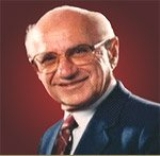
Milton Friedman (July 31, 1912 November 16, 2006) was an American
United States

The United States of America is a Federal government constitutional republic comprising U.S. state and a federal district. The country is situated mostly in central North America, where its Contiguous United States and Washington, D.C., the Capital districts and territories, lie between the Pacific Ocean and Atlantic Oceans, Borders of the U...
 economist
Economist

An economist is an expert in the social science of economics. The individual may also study, develop, and apply theories and concepts from economics and write about economic policy....
, statistician
Statistician

Statisticians work with theoretical and applied statistics in both the private and public sectors. The core of that work is to measure, interpret, and describe the world and human activity patterns within it....
 and public intellectual
Public intellectual

A public intellectual is a contemporary phrase for the archaic term publicist ? that is, a writer, academic, orator or mass media personality who regularly and visibly deals with matters of broad interest relating to government policy or social questions....
, and a recipient of the Nobel Memorial Prize in Economic Sciences. He is best known among scholars for his theoretical and empirical research, especially consumption
Consumption (economics)

Consumption is a common concept in economics, and gives rise to derived concepts such as consumer debt. Generally consumption is defined by opposition to Production theory basics....
 analysis, monetary
Money supply

In economics, money supply, or money stock, is the total amount of money available in an economy at a particular point in time. There are several ways to define "money", but standard measures usually include currency in circulation and demand deposits....
 history and theory, and for his demonstration of the complexity of stabilization policy. A global public followed his restatement of a political philosophy that insisted on minimizing the role of government in favor of the private sector.


Discussion
Ask a question about 'Milton Friedman'
Start a new discussion about 'Milton Friedman'
Answer questions from other users
Full Discussion Forum


Quotations


The free man will ask neither what his country can do for him nor what he can do for his country.

Introduction

The Federal Reserve definitely caused the Great Depression by contracting the amount of money in circulation by one-third from 1929 to 1933.

National Public Radio interview (Jan 1996)

The unions might be good for the people who are in the unions but it doesn't do a thing for the people who are unemployed because the union keeps down the number of jobs, it doesn't do a thing for them.

Interview with Brian Lamb, In Depth Book TV (2000)

The use of quantity of money as a target has not been a success. I'm not sure that I would as of today push it as hard as I once did.

Financial Times UK (7 June 2003)

With respect to teachers' salaries .... Poor teachers are grossly overpaid and good teachers grossly underpaid. Salary schedules tend to be uniform and determined far more by seniority.

Ch. 6 "The Role of Government in Education"


Encyclopedia


Milton Friedman (July 31, 1912 November 16, 2006) was an American
United States

The United States of America is a Federal government constitutional republic comprising U.S. state and a federal district. The country is situated mostly in central North America, where its Contiguous United States and Washington, D.C., the Capital districts and territories, lie between the Pacific Ocean and Atlantic Oceans, Borders of the U...
 economist
Economist

An economist is an expert in the social science of economics. The individual may also study, develop, and apply theories and concepts from economics and write about economic policy....
, statistician
Statistician

Statisticians work with theoretical and applied statistics in both the private and public sectors. The core of that work is to measure, interpret, and describe the world and human activity patterns within it....
 and public intellectual
Public intellectual

A public intellectual is a contemporary phrase for the archaic term publicist ? that is, a writer, academic, orator or mass media personality who regularly and visibly deals with matters of broad interest relating to government policy or social questions....
, and a recipient of the Nobel Memorial Prize in Economic Sciences. He is best known among scholars for his theoretical and empirical research, especially consumption
Consumption (economics)

Consumption is a common concept in economics, and gives rise to derived concepts such as consumer debt. Generally consumption is defined by opposition to Production theory basics....
 analysis, monetary
Money supply

In economics, money supply, or money stock, is the total amount of money available in an economy at a particular point in time. There are several ways to define "money", but standard measures usually include currency in circulation and demand deposits....
 history and theory, and for his demonstration of the complexity of stabilization policy. A global public followed his restatement of a political philosophy that insisted on minimizing the role of government in favor of the private sector. As a leader of the Chicago School of economics
Chicago school (economics)

The Chicago school of economics describes a neoclassical school of thought within the academic community of economists, with a strong focus around the faculty of University of Chicago, some of whom have constructed and popularized its principles....
, based at the University of Chicago
University of Chicago

The University of Chicago is a private university located principally in the Hyde Park, Chicago neighborhood of Chicago. Although an older university by the same name existed prior to its founding, the modern University of Chicago credits its founding to the oil magnate John D....
, he had a widespread influence in shaping the research agenda of the entire profession. Friedman's many monographs, books, scholarly articles, papers, magazine columns, television programs, videos and lectures
Works of Milton Friedman

A list of works by the prominent United States economist Milton Friedman follows:...
 cover a broad range of topics in microeconomics, macroeconomics, economic history, and public policy issues. The Economist
The Economist

The Economist is an English-language weekly news and international relations publication owned by The Economist Newspaper Ltd. and edited in London....
 hailed him as "the most influential economist of the second half of the 20th century…possibly of all of it".

Originally a Keynesian supporter of the New Deal
New Deal

The New Deal was the name that United States President of the United States Franklin D. Roosevelt gave to a sequence of central economic planning and economic stimulus programs he initiated between 1933 and 1938 with the goal of giving aid to the unemployed, reform of business and financial practices, and recovery of the Economy of the Unite...
 and advocate of high taxes, in the 1950s his reinterpretation of the Keynesian consumption function
Consumption function

In economics, the consumption function is a single mathematical function used to express consumer spending. It was developed by John Maynard Keynes and detailed most famously in his book The General Theory of Employment, Interest, and Money....
 challenged the basic Keynesian model. In the 1960s he promoted an alternative macroeconomic policy called monetarism
Monetarism

Monetarism is a school of economic thought concerning the determination of measures of national income and output and monetary economics. It focuses on the supply of money in an economy as the primary means by which the rate of inflation is determined....
. He theorized there existed a "natural rate of unemployment" and he argued the central government could not micromanage the economy because people would realize what the government was doing and shift their behavior to neutralize the impact of policies. He rejected the Phillips Curve
Phillips curve

The Phillips curve is a historical inverse relation between the rate of unemployment and the rate of inflation in an economy. Stated simply, the lower the unemployment in an economy, the higher the rate of increase in nominal wages in the economy....
 and predicted that Keynesian policies then in place would cause "stagflation
Stagflation

Stagflation is an economic situation in which inflation and economic stagnation occur simultaneously and remain unchecked for a period of time. The Portmanteau word "stagflation" is generally attributed to British politician Iain Macleod, who coined the term in a speech to Parliament of the United Kingdom in 1965....
" (high inflation and low growth). Though opposed to the existence of the Federal Reserve, Friedman argued that, given that it does exist, a steady expansion of the money supply was the only wise policy, and he warned against efforts by a treasury
Treasury

A treasury is any place where the currency or items of high monetary value are kept. The term was first used in Classical antiquity times to describe the votive buildings erected to house Sacrifice, such as the Siphnian Treasury in Delphi or many similar buildings erected in Olympia, Greece by competing city-states to impress others during t...
 or central bank
Central bank

A central bank, reserve bank, or monetary authority is the entity responsible for the monetary policy of a country or of a group of member states....
 to do otherwise.

Influenced by his close friend George Stigler
George Stigler

George Joseph Stigler was a United States of America economist. He won the Nobel Memorial Prize in Economic Sciences in 1982, and was a key leader of the Chicago School of Economics, along with his close friend Milton Friedman....
, Friedman opposed government regulation of many types. He once stated that his role in eliminating U.S. conscription
Conscription in the United States

Conscription in the United States has been employed several times, usually during war but also during the nominal peace of the Cold War. The United States discontinued the draft in 1973, moving to an all-volunteer United States Military, thus there is currently no mandatory conscription....
 was his proudest accomplishment, and his support for school choice
School choice

School choice is a term used to describe a wide array of programs aimed at giving families the opportunity to choose the school their children will attend....
 led him to found The Friedman Foundation for Educational Choice
The Friedman Foundation for Educational Choice

Introduction The Friedman Foundation for Educational Choice is an Indianapolis-based non-profit organization dedicated to the issue of school choice and committing to assisting education reform efforts....
. Friedman's political philosophy, which he considered classically liberal
Classical liberalism

Classical liberalism is a doctrine stressing individual freedom, free markets, and limited government. This includes the importance of human rationality, individual property rights, natural rights, the protection of civil liberties, individual freedom from restraint, equality under the law, constitutional limitation of government, free marke...
 and libertarian, stressed the advantages of the marketplace and the disadvantages of government intervention and regulation, strongly influencing the outlook of American conservatives and libertarians. In his 1962 book Capitalism and Freedom
Capitalism and Freedom

Capitalism and Freedom is a book by Milton Friedman originally published in 1962 in literature which discusses the role of economic capitalism in Liberalism society....
, Friedman advocated policies such as a volunteer military
Volunteer military

A volunteer military or all-volunteer military is one which derives its manpower from volunteers rather than conscription or mandatory service....
, freely floating exchange rate
Floating exchange rate

A floating exchange rate or a flexible exchange rate is a type of exchange rate regime wherein a currency's value is allowed to fluctuate according to the foreign exchange market....
s, abolition of licensing of doctors, a negative income tax
Negative income tax

In economics, a negative income tax is a progressive income tax system where people earning below a certain amount receive supplemental pay from the government instead of paying taxes to the government....
, and education voucher
Education voucher

A school voucher, also called an education voucher, is a certificate issued by the government by which parents can pay for the education of their children at a School choice, rather than the public school to which they are assigned....
s. His books and essays were widely read and even circulated underground behind the Iron Curtain
Iron Curtain

The Iron Curtain was the symbolic, ideological, and physical boundary dividing Europe into two separate areas from the end of World War II in 1945 until the end of the Cold War in 1991....
.

Friedman's methodological innovations were widely accepted by economists, but his policy prescriptions were highly controversial. Most economists in the 1960s rejected them, but since then they have had a growing international influence (especially in the US and Britain
United Kingdom

The United Kingdom of Great Britain and Northern Ireland, commonly known as the United Kingdom , the UK or Britain,is a sovereign state located off the northwestern coast of continental Europe....
), and in the 21st century have gained wide acceptance among many economists. He thus lived to see some of his laissez-faire
Laissez-faire

Laissez-faire is a term used to describe a policy of allowing events to take their own course. The term is a French language phrase literally meaning "let do"....
 ideas embraced by the mainstream, especially during the 1980s. His views of monetary policy, taxation, privatization and deregulation informed the policy of governments around the globe, especially the administrations of Margaret Thatcher
Margaret Thatcher

Margaret Hilda Thatcher, Baroness Thatcher Order of the Garter, Order of Merit, Her Majesty's Most Honourable Privy Council, Fellow of the Royal Society was Prime Minister of the United Kingdom from 1979 to 1990 and Leader of the Conservative Party of the Conservative Party from 1975 to 1990....
 in Britain, Ronald Reagan
Ronald Reagan

Ronald Wilson Reagan was the List of Presidents of the United States President of the United States and the 33rd Governor of California . Born in Illinois, Reagan moved to Los Angeles, California in the 1930s, where he was an actor, president of the Screen Actors Guild , and a spokesman for General Electric ....
 in the US, Brian Mulroney
Brian Mulroney

Martin Brian Mulroney, Queen's Privy Council for Canada, Order of Canada, National Order of Quebec was the List of Prime Ministers of Canada Prime Minister of Canada from September 17, 1984, to June 25, 1993 and was leader of the Progressive Conservative Party of Canada from 1983 to 1993....
 in Canada, Roger Douglas
Roger Douglas

Sir Roger Owen Douglas , a New Zealand politician, formerly served as a senior New Zealand Labour Party New Zealand Cabinet minister. He became arguably best-known for his prominent role in the radical economic restructuring undertaken by the Fourth Labour Government of New Zealand during the 1980s ....
 in New Zealand, Davíđ Oddsson
Davíđ Oddsson

Dav?? Oddsson is an Icelandic politician and the longest-serving Prime Minister of Iceland, holding office from 1991 to 2004. He also served as foreign minister from 2004 to 2005....
 in Iceland, Augusto Pinochet in Chile, and (after 1989) in many Eastern Europe
Eastern Europe

Eastern Europe is a term that applies to the geopolitical region encompassing the easternmost part of the Europe. Throughout history and to a lesser extent today, parts of Eastern Europe has been distinguishable from Western Europe and other regions due to cultural, religious, economic, and historical reasons, even though there i...
an countries.

Early life

Friedman was born on July 31, 1912, in Brooklyn, New York, to recent Jew
Jew

A Jew is a member of the Jewish people, an ethnoreligious group that traces its ancestry to the Israelites or Hebrews of the Ancient Near East....
ish immigrants from Beregszász in Hungary
History of Hungary 1700-1919

This article describes the History of Hungary between the end of Ottoman Hungary in 1699 and the end of Austria-Hungary 1919.Following the defeat of Ottoman forces led by Grand Vizier Kara Mustafa Pasha at the Battle of Vienna in 1683, at the hands of the combined armies of Poland and the Holy Roman Empire under Jan III Sobieski, was the decisive...
 (now Berehove
Berehove

Berehove is a city located in the Zakarpattia Oblast in western Ukraine, near the border with Hungary. Serving as the Capital city of the Berehivskyi Raion , the city itself is also designated as a separate raion within the oblast....
, part of Ukraine
Ukraine

Ukraine is a country in Eastern Europe. It is bordered by Russia to the east; Belarus to the north; Poland, Slovakia, and Hungary to the west; Romania and Moldova to the southwest; and the Black Sea and Sea of Azov to the south....
) both of whom worked as dry goods
Dry goods

Dry goods are products such as textiles, ready-to-wear clothing, and sundries. In U.S. retailing, a dry goods store carries consumer goods that are distinct from those carried by hardware stores and grocery stores, though "dry goods" as a term for textiles has been dated back to 1742 in England or even a century earlier....
 merchants. Shortly after Milton's birth, the family relocated to Rahway, New Jersey
Rahway, New Jersey

Rahway is a city in southern Union County, New Jersey, New Jersey, United States. It is part of the New York metropolitan area, being fifteen miles southwest of Manhattan, New York and five miles west of Staten Island, New York....
. A gifted student, Friedman graduated from Rahway High School
Rahway High School

Rahway High School is a four-year public high school that serves students in ninth through twelfth grades from Rahway, New Jersey, in Union County, New Jersey, New Jersey, United States, as part of the Rahway Public Schools....
 in 1928, shortly before his 16th birthday.

Friedman graduated from Rutgers University
Rutgers University

Rutgers, The State University of New Jersey , is the largest institution for higher education in the U.S. state of New Jersey. It was originally chartered as Queen's College in 1766 and is the Colonial colleges in the United States....
 in New Jersey
New Jersey

New Jersey is a state in the Mid-Atlantic States and Northeastern United States regions of the United States. It is bordered on the north by New York, on the east by the Hudson River and the Atlantic Ocean, on the southwest by Delaware, and on the west by Pennsylvania....
, where he specialized in Mathematics
Mathematics

Mathematics is the study of quantity, structure, space, change, and related topics of pattern and form. Mathematicians seek out patterns whether found in numbers, space, natural science, computers, imaginary abstractions, or elsewhere....
 and initially intended to become an actuary
Actuary

An actuary is a business professional who deals with the financial impact of risk and uncertainty. Actuaries have a deep understanding of financial security systems, their reasons for being, their complexity, their mathematics, and the way they work ....
. During his time at Rutgers, Friedman fell under the influence of two economics professors, Arthur F. Burns
Arthur F. Burns

Arthur Frank Burns was an United States economist. He served as Chairman of the Federal Reserve from 1970 to 1978....
 and Homer Jones
Homer Jones (economist)

Homer Jones was a prominent American economist.In the course of his career, Jones spent time at Rutgers University, the University of Chicago, The Brookings Institution and the Federal Deposit Insurance Corporation....
, who convinced him that modern Economics
Economics

File:Ballard Farmers' Market - vegetables.jpgEconomics is the Social sciences that studies the Production theory basics, Distribution , and Consumption of Good and Service ....
 could help end the Great Depression
Great Depression

File:International depression.pngThe Great Depression was a worldwide economic Recession starting in most places in 1929 and ending at different times in the 1930s or early 1940s for different countries....
.

Friedman took graduate work at the University of Chicago, earning an M.A.
Master of Arts (postgraduate)

A Master of Arts is a Postgraduate education academic degree master degree awarded by University in many countries. The degree is typically studied for in English language, Fine Arts, History, Humanities, Philosophy, Social Sciences or Theology and can be either fully-taught, research-based, or a combination of the two....
 in 1933. He was strongly influenced by Jacob Viner
Jacob Viner

Jacob Viner is best known for his enduring economic modelling of the wiktionary:firm, including the long- and short-run cost curves used by economists to this day....
, Frank Knight
Frank Knight

Frank Hyneman Knight was an important economist of the twentieth century. He was born in McLean County, Illinois in a devoutly Christian family of farmers....
, and Henry Simons
Henry Calvert Simons

Henry Calvert Simons was an American economist at the University of Chicago. His Competition law and monetarist models influenced the Chicago school of economics....
. It was at Chicago that Friedman met his future wife, economist Rose Director
Rose Friedman

Rose Director Friedman, also known as Rose D. Friedman and Rose Director, is the widow of Milton Friedman, the winner of the 1976 Nobel Prize in Economics, and sister of Aaron Director, a professor at the University of Chicago Law School....
. In 1933–34 he held a fellowship at Columbia University
Columbia University

Columbia University in the City of New York , is a private university in the United States and a member of the Ivy League. Columbia's main campus lies in the Morningside Heights, Manhattan neighborhood in the borough of Manhattan, in New York City....
, where he studied statistics
Statistics

Statistics is a Mathematics pertaining to the collection, analysis, interpretation or explanation, and presentation of data. It also provides tools for prediction and forecasting based on data....
 with renowned statistician and economist Harold Hotelling
Harold Hotelling

Harold Hotelling was a mathematical statistician and an influential economic theorist. His name is known to all statisticians because of Hotelling's T-square distribution and its use in statistical hypothesis testing and confidence regions....
. He was back in Chicago for 1934–35, spending the year working as a research assistant
Research assistant

A Research Assistant is a junior graduate student scholar, employed on a temporary contract by a college or university or a non-university research institution, for the purpose of academic research....
 for Henry Schultz
Henry Schultz

Henry Schultz was an American economist and statistician, one of the founders of econometrics....
, who was then working on his highly quantitative and empirical Theory and Measurement of Demand. During this year, Friedman formed what would prove to be lifelong friendships with George Stigler
George Stigler

George Joseph Stigler was a United States of America economist. He won the Nobel Memorial Prize in Economic Sciences in 1982, and was a key leader of the Chicago School of Economics, along with his close friend Milton Friedman....
 and Wilson Allen Wallis
Wilson Allen Wallis

Wilson Allen Wallis was an United States economist and statistician.He attended the University of Minnesota, Class of 1932, where he was a member of the Chi Phi Fraternity....
.

Public service

Friedman was initially unable to find academic employment, so in 1935, he followed his friend W. Allen Wallis to Washington, where Roosevelt's
Franklin D. Roosevelt

Franklin Delano Roosevelt , often referred to by his initials FDR, was the List of Presidents of the United States President of the United States....
 New Deal
New Deal

The New Deal was the name that United States President of the United States Franklin D. Roosevelt gave to a sequence of central economic planning and economic stimulus programs he initiated between 1933 and 1938 with the goal of giving aid to the unemployed, reform of business and financial practices, and recovery of the Economy of the Unite...
 was "a lifesaver" for many young economists. At this stage, Friedman said that he and his wife "regarded the job-creation programs such as the WPA
Works Progress Administration

The Works Progress Administration was the largest New Deal agency, employing millions of people and affecting almost every locality in the United States, especially rural and western mountain populations....
, CCC
Civilian Conservation Corps

File:CCC constructing road.gifThe Civilian Conservation Corps was a public work relief program for unemployed men, focused on natural resource conservation from 1933 to 1942....
, and PWA
Public Works Administration

The United States Public Works Administration, a New Deal Federal government of the United States agency headed by United States Secretary of the Interior Harold L....
 appropriate responses to the critical situation", but not "the price- and wage-fixing measures of the National Recovery Administration
National Recovery Administration

The National Recovery Administration , created in the United States of America under the 1933 National Industrial Recovery Act, was one of the New Deal programs of President of the United States Franklin D....
 and the Agricultural Adjustment Administration". Foreshadowing his later ideas, he saw price controls
Price controls

Price controls may refer to:* Price ceiling, the maximum price that can be charged* Price floor, the minimum price that can be charged...
 as interfering with an essential signaling mechanism to help resources go where they are most valued. Indeed, Friedman later concluded that all government intervention associated with the New Deal was "the wrong cure for the wrong disease", arguing that the money supply should simply have been expanded, instead of contracted. In Monetary History of the United States
Monetary History of the United States

A Monetary History of the United States, 1867-1960 is a book written in 1963 by Nobel laureate economist Milton Friedman and Anna J. Schwartz and is considered one of the most influential economics books of the twentieth century....
, he argues that the Great Depression
Great Depression

File:International depression.pngThe Great Depression was a worldwide economic Recession starting in most places in 1929 and ending at different times in the 1930s or early 1940s for different countries....
 was caused by monetary contraction
Contractionary monetary policy

Contractionary monetary policy is monetary policy that seeks to reduce the size of the money supply. They are fiscal policies, like lower spending and higher taxes, that reduce economic growth....
, which was the consequence of poor policymaking by the Federal reserve and the continuous crises in the banking system.

In 1935, he began work at the National Resources Committee, which was then working on a large consumer budget survey. Ideas from this project later became a part of his Theory of the Consumption Function. Friedman moved to the National Bureau of Economic Research
National Bureau of Economic Research

The National Bureau of Economic Research is a private, nonprofit research organization dedicated to studying the science and empirics of economics, especially the Economy of the United States....
 in fall 1937 to assist Simon Kuznets
Simon Kuznets

Simon Smith Kuznets was an American economist at the Wharton School of the University of Pennsylvaniawho won the 1971 Nobel Memorial Prize in Economic Sciences "for his empirically founded interpretation of economic growth which has led to new and deepened insight into the economic and social structure and process of development"....
 in his work on professional income. This work led to their jointly authored Incomes from Independent Professional Practice, which introduced the concepts of permanent and transitory income, a major component of the Permanent Income Hypothesis
Permanent income hypothesis

The permanent income hypothesis is a theory of Consumption that was developed by the American economist Milton Friedman. In its simplest form, the hypothesis states that the choices made by consumers regarding their consumption patterns are determined not by Present income but by their longer-term income expectations....
 that Friedman worked out in greater detail in the 1950s. The book hypothesizes that professional licensing artificially restricts the supply of services and raises prices.

In 1940, Friedman was appointed an assistant professor teaching Economics at the University of Wisconsin–Madison, but encountered antisemitism in the Economics department and decided to return to government service. Friedman spent 1941–43 working on wartime tax
Tax

To tax is to impose a financial charge or other levy upon an individual or Legal person by a state or the functional equivalent of a state.Taxes are also imposed by many subnational entity....
 policy for the Federal Government, as an advisor to senior officials of the United States Department of the Treasury
United States Department of the Treasury

The Department of the Treasury is an United States federal executive departments and the treasury of the United States Federal government of the United States....
. As a Treasury spokesman in 1942 he advocated a Keynesian
Keynesian economics

Keynesian economics The theories forming the basis of Keynesian economics were first presented in The General Theory of Employment, Interest and Money, published in 1936....
 policy of taxation
Taxation in the United States

Taxation in the United States is a complex system which may involve payment to at least four different levels of government and many methods of taxation....
, and during this time he helped to invent the payroll withholding tax
Withholding tax

Withholding tax is an amount withheld by the party making payment to another and paid to the taxation authorities. The amount the payer deducts may vary, depending on the nature of the product or service being paid for....
 system, although he later regretted it.

In his autobiography, he comments on "how thoroughly Keynesian I was then". As Friedman grew older he reversed himself; in 2006 he observed, "You know, it's a mystery as to why people think Roosevelt's
Franklin D. Roosevelt

Franklin Delano Roosevelt , often referred to by his initials FDR, was the List of Presidents of the United States President of the United States....
 policies pulled us out of the Depression
Great Depression

File:International depression.pngThe Great Depression was a worldwide economic Recession starting in most places in 1929 and ending at different times in the 1930s or early 1940s for different countries....
. The problem was that you had unemployed machines and unemployed people. How do you get them together by forming industrial cartels and keeping prices and wages up?"

Academic career


Early years

In 1943, Friedman joined the Division of War Research at Columbia University
Columbia University

Columbia University in the City of New York , is a private university in the United States and a member of the Ivy League. Columbia's main campus lies in the Morningside Heights, Manhattan neighborhood in the borough of Manhattan, in New York City....
 (headed by Wilson Allen Wallis
Wilson Allen Wallis

Wilson Allen Wallis was an United States economist and statistician.He attended the University of Minnesota, Class of 1932, where he was a member of the Chi Phi Fraternity....
 and Harold Hotelling
Harold Hotelling

Harold Hotelling was a mathematical statistician and an influential economic theorist. His name is known to all statisticians because of Hotelling's T-square distribution and its use in statistical hypothesis testing and confidence regions....
), where he spent the rest of the war years working as a mathematical statistician, focusing on problems of weapon
Weapon

A weapon is a tool used to apply or threaten to apply force for the purpose of hunting, attack or defense in combat, subduing enemy personnel, or to destroy enemy weapons, equipment and defensive structures....
s design, military tactics
Military tactics

Military tactics are the techniques for using weapons or military units in combination for engaging and defeating an Enemy in battle. Changes in philosophy and technology over time have been reflected in changes to military tactics....
, and metallurgical experiments. Then in 1945, Friedman submitted Incomes from Independent Professional Practice (co-authored with Kuznets and completed in 1940) to Columbia as his doctoral dissertation. The university awarded him a Ph.D.
Doctor of Philosophy

Doctor of Philosophy, abbreviated Ph.D. or PhD for the Latin , meaning "teacher of philosophy", is an postgraduate academic degree awarded by University....
 in 1946. Friedman spent the 1945–46 academic year teaching at the University of Minnesota
University of Minnesota

The University of Minnesota, Twin Cities is a public university research university located in Minneapolis and St. Paul, Minnesota, Minnesota, United States....
 (where his friend George Stigler was employed). On February 12th, 1945, his son, David D. Friedman
David D. Friedman

David Director Friedman is a writer who became a leading figure in the anarcho-capitalism community with the publication of his book The Machinery of Freedom ....
 was born.

University of Chicago

Harper Midway
In 1946, Friedman accepted an offer to teach economic theory at the University of Chicago (a position opened by departure of his former professor Jacob Viner
Jacob Viner

Jacob Viner is best known for his enduring economic modelling of the wiktionary:firm, including the long- and short-run cost curves used by economists to this day....
 to Princeton University). Friedman would stay at the University of Chicago for the next 30 years. There he helped build a close-knit intellectual community that produced a number of Nobel Prize winners, known collectively as the Chicago School of Economics
Chicago school (economics)

The Chicago school of economics describes a neoclassical school of thought within the academic community of economists, with a strong focus around the faculty of University of Chicago, some of whom have constructed and popularized its principles....
.

At the same time he moved to the University of Chicago, Arthur Burns, who was then the head of the National Bureau of Economic Research
National Bureau of Economic Research

The National Bureau of Economic Research is a private, nonprofit research organization dedicated to studying the science and empirics of economics, especially the Economy of the United States....
, asked Friedman to rejoin the Bureau's staff. He accepted the invitation, and assumed responsibility for the Bureau's inquiry into the role of money
Money

Money is anything that is generally accepted as payment for goods and services and repayment of debts. The main uses of money are as a medium of exchange, a unit of account, and a store of value....
 in the business cycle
Business cycle

The term business cycle or economic cycle refers to economy-wide fluctuations in production or economic activity over several months or years, around a long-term growth trend....
. As a result, he founded the "Workshop in Money and Banking" (the "Chicago Workshop"), which led a revival in monetary studies. During the latter half of the 1940s, Friedman began a collaboration with Anna Schwartz
Anna Schwartz

Anna Jacobson Schwartz is an economist at the National Bureau of Economic Research in New York City. She is a past president of the Western Economic Association ....
, an economic historian
Economic history

Economic history is the study of how economy evolved in the past. Analysis in economic history is undertaken using a combination of historical methods, statistical methods and by applying economic theory to historical situations....
 at the Bureau, that would ultimately result in the 1963 publication of a book co-authored by Friedman and Schwartz, A Monetary History of the United States, 1867–1960.

Friedman spent the 1954–55 academic year as a Fulbright Visiting Fellow at Gonville and Caius College, Cambridge
Gonville and Caius College, Cambridge

Gonville and Caius College, Cambridge is a constituent college of the University of Cambridge. Located in Cambridge, England, in the United Kingdom, the college is often referred to simply as Caius after the College?s second founder John Caius who fashionably Latin the spelling of his name after studying in Italy....
. At the time, the Cambridge economics faculty was deeply divided into a Keynesian majority (including Joan Robinson
Joan Robinson

Joan Violet Robinson was a Post-Keynesian economics who was well known for her knowledge of monetary economics and wide-ranging contributions to economic theory....
 and Richard Kahn
Richard Kahn, Baron Kahn

Richard Ferdinand Kahn, Baron Kahn, Order of the British Empire, Fellow of the British Academy was a United Kingdom economist.Kahn was born in Hampstead to Augustus Kahn, a German schoolmaster and an orthodox Jew, and Regina Schoyer....
) and a virulently anti-Keynesian minority (headed by Dennis Robertson
Dennis Robertson

Sir Dennis Holme Robertson was an United Kingdom economics who taught at University of Cambridge and University of London Universities.Robertson, the son of a Church of England clergyman, was born in Lowestoft and educated as a scholar of Eton College and at Trinity College, Cambridge, where he read Classics and Economics, graduating in 19...
). Friedman speculates that he was invited to the fellowship because his extreme laissez-faire
Laissez-faire

Laissez-faire is a term used to describe a policy of allowing events to take their own course. The term is a French language phrase literally meaning "let do"....
 views were unacceptable to both of the Cambridge factions, a fact that highlights how far out of the mainstream Friedman was in the 1950s. On the other hand his weekly columns for Newsweek magazine (1966-84) were widely read and increasingly influential in political and business circles.

Friedman was an economic adviser to Republican presidential candidate Barry Goldwater
Barry Goldwater

Barry Morris Goldwater was a five-term United States Senate from Arizona and the History of the United States Republican Party's nominee for President of the United States in the U.S....
 in 1964, who lost in a landslide to Lyndon Johnson, a liberal Democrat.

Nobel memorial prize and retirement

In 1976, Friedman won the Nobel Memorial Prize in Economic Sciences "for his achievements in the fields of consumption analysis, monetary
Money supply

In economics, money supply, or money stock, is the total amount of money available in an economy at a particular point in time. There are several ways to define "money", but standard measures usually include currency in circulation and demand deposits....
 history and theory and for his demonstration of the complexity of stabilization policy". In 1977, at age 65, Friedman retired from the University of Chicago after teaching there for 30 years. He and his wife moved to San Francisco
San Francisco, California

The City and County of San Francisco is the fourth most populous city in California and the List of United States cities by population in the United States, with a 2007 estimated population of 799,183....
. From 1977 on, he was affiliated with the Hoover Institution
Hoover Institution

The Hoover Institution on War, Revolution and Peace is a public policy think tank and library founded in 1919 by future U.S. president Herbert Hoover....
 at Stanford University
Stanford University

Leland Stanford Junior University, commonly referred to as Stanford University or Stanford, is a private university research university located in Stanford, California, California, United States....
. During the same year, Friedman was approached by the Palmer R. Chitester Fund
Palmer R. Chitester Fund

The Palmer R. Chitester Fund is a conservative Pennsylvania nonprofit corporation based in Erie, Pennsylvania. The Fund currently has three main initiatives: Free to Choose Media, which produces television programs and videos making conservative economic and political ideas accessible to a popular audience; izzit.org,which produces media f...
 and asked to create a television program presenting his economic and social philosophy. The Friedmans worked on this project for the next three years, and in 1980, the ten-part series, entitled Free to Choose
Free to Choose

Free to Choose is both a book and a ten-part television series, advocating US free market policy....
, aired on PBS
Public Broadcasting Service

The Public Broadcasting Service is an United States non-profit public broadcasting television service with 354 member TV stations in the United States....
. The companion book to the series (co-authored by Milton and his wife, Rose Friedman
Rose Friedman

Rose Director Friedman, also known as Rose D. Friedman and Rose Director, is the widow of Milton Friedman, the winner of the 1976 Nobel Prize in Economics, and sister of Aaron Director, a professor at the University of Chicago Law School....
), also entitled Free to Choose, was the bestselling nonfiction book of 1980 and has since been translated into 14 foreign languages.

Friedman served as an unofficial adviser to Ronald Reagan during his 1980 presidential campaign, and then served on the President's Economic Policy Advisory Board for the rest of the Reagan Administration
Reagan Administration

The United States President of the United States of Ronald Reagan, also known as the Reagan Administration, was a Republican Party administration headed by Ronald Reagan from January 20, 1981 to January 20, 1989....
. In 1988, he received the National Medal of Science
National Medal of Science

The National Medal of Science is an honor bestowed by the President of the United States to individuals in science and engineering who have made important contributions to the advancement of knowledge in the fields of behavioral science and social sciences, biology, chemistry, engineering, mathematics and physics....
 and Reagan honored him with the Presidential Medal of Freedom
Presidential Medal of Freedom

The Presidential Medal of Freedom is a decoration bestowed by the President of the United States and is, along with theequivalent Congressional Gold Medal bestowed by an act of United States Congress, the highest Civilian decorations of the United States in the United States....
. Milton Friedman is today known as one of the most influential economists of the 20th century. Throughout the 1980s and 1990s, Friedman continued to write op-ed
Op-ed

An op-ed, abbreviated from opposite the editorial page , is a newspaper article that expresses the opinions of a named writer who is usually unaffiliated with the newspaper's editorial board....
s and appear in the media. He made several trips to Eastern Europe
Eastern Europe

Eastern Europe is a term that applies to the geopolitical region encompassing the easternmost part of the Europe. Throughout history and to a lesser extent today, parts of Eastern Europe has been distinguishable from Western Europe and other regions due to cultural, religious, economic, and historical reasons, even though there i...
 and to China
China

China is a Culture of China, an ancient civilization, and, depending on perspective, a national or multinational entity extending over a large area in East Asia....
, where he also advised governments.

In Friedman's last email interview in 2006, he said that the greatest threat to the world's economy is "Islamofascism
Islamofascism

Islamofascism is a neologism concerning the association of the ideological or operational characteristics of certain Islamist movements from the late 20th century on, with European fascist movements of the early 20th century, neofascist movements, or totalitarianism....
, with terrorism
Terrorism

Terrorism, according to the Merriam-Webster online dictionary, is the systematic use of terror, "violent or destructive acts committed by groups in order to intimidate a population or government into granting their demands." At present, there is no internationally agreed upon definition of terrorism....
 as its weapon"
. In an in-person interview with Friedman and his wife that same month, he said that he opposed the US invasion of Iraq: "What's really killed the Republican Party isn't spending, it's Iraq. As it happens, I was opposed to going into Iraq from the beginning. I think it was a mistake, for the simple reason that I do not believe the United States of America ought to be involved in aggression." His wife disagreed that it was aggression. However, after a short argument with his wife, he added "But, having said that, once we went in to Iraq, it seems to me very important that we make a success of it." Milton Friedman died at the age of 94 in San Francisco
San Francisco, California

The City and County of San Francisco is the fourth most populous city in California and the List of United States cities by population in the United States, with a 2007 estimated population of 799,183....
 on November 16, 2006. Friedman's son is the philosopher and economist David D. Friedman
David D. Friedman

David Director Friedman is a writer who became a leading figure in the anarcho-capitalism community with the publication of his book The Machinery of Freedom ....
.

Scholarly contributions


Economics

Friedman was best known for reviving interest in the money supply as a determinant of the nominal value of output, that is, the quantity theory of money
Quantity theory of money

In economics, the quantity theory of money is a theory emphasizing the positive relationship of overall prices or the Real versus nominal value of expenditures to the money supply#Scope....
. Monetarism
Monetarism

Monetarism is a school of economic thought concerning the determination of measures of national income and output and monetary economics. It focuses on the supply of money in an economy as the primary means by which the rate of inflation is determined....
 is the set of views associated with modern quantity theory. Its origins can be traced back to the 16th-century School of Salamanca
School of Salamanca

The School of Salamanca is the renaissance of thought in diverse intellectual areas by Spain theology, rooted in the intellectual and pedagogical work of Francisco de Vitoria....
 or even further but Friedman's contribution is largely responsible for its modern formulation. He co-authored, with Anna Schwartz
Anna Schwartz

Anna Jacobson Schwartz is an economist at the National Bureau of Economic Research in New York City. She is a past president of the Western Economic Association ....
, A Monetary History of the United States (1963), which sought to examine the role of the money supply and economic activity
Economy of the United States

The economy of the United States is the List of countries by GDP in the world. Its gross domestic product was estimated as $14.2 trillion in 2008....
 in U.S. history. A striking conclusion of their research was one regarding the role of money supply fluctuations as contributing to economic fluctuations. Several regression studies with David Meiselman in the 1960s suggested the primacy of the money supply over investment and government spending in determining consumption and output. These challenged a prevailing but largely untested view on their relative importance. Friedman's empirical research and some theory supported the conclusion that the short-run effect of a change in the money supply was primarily on output but that the longer-run effect was primarily on the price level.

Friedman was the leading proponent of the monetarist
Monetarism

Monetarism is a school of economic thought concerning the determination of measures of national income and output and monetary economics. It focuses on the supply of money in an economy as the primary means by which the rate of inflation is determined....
 school of economic thought. He maintained that there is a close and stable link between inflation
Inflation

In economics, inflation is a rise in the general price level of goods and services in an economy over a period of time. The term "inflation" once referred to increases in the money supply ; however, economic debates about the relationship between money supply and price levels have led to its primary use today in describing price inflatio...
 and the money supply
Money supply

In economics, money supply, or money stock, is the total amount of money available in an economy at a particular point in time. There are several ways to define "money", but standard measures usually include currency in circulation and demand deposits....
, mainly that the phenomenon of inflation is to be regulated by controlling the amount of money poured into the national economy by the Federal Reserve Bank. He famously quipped that deflation can be fought against by "dropping money out of a helicopter". Friedman's arguments were designed to counter popular claims that inflation at the time was the result of increases in the oil price, or increases in wages: as he wrote, Friedman rejected the use of fiscal policy
Fiscal policy

In economics, fiscal policy is the use of government spending and revenue collection to influence the economy.Fiscal policy can be contrasted with the other main type of economic policy, monetary policy, which attempts to stabilize the economy by controlling interest rates and the supply of money....
 as a tool of demand
Demand

Economics*Demand ,the desire to own something and the ability to pay for it*Demand curve,a graphic representation of a demand schedule *Demand deposit, the money in checking accounts...
 management; and he held that the government's role in the guidance of the economy should be severely restricted. Friedman wrote extensively on the Great Depression, which he called the Great Contraction
Great Contraction

The Great Contraction is Milton Friedman's term for the Great Depression.Friedman labelled it thus because he believed that the depression lasted so long due to the Federal Reserve's mismanagement....
, arguing that it had been caused by an ordinary financial shock
Shock (economics)

In economics a shock is an unexpected or unpredictable event that affects an economy, either positively or negatively. Resiliance to such events depends on general preparedness, economic policy, existing infrastructure and effective emergency management planning....
 whose duration and seriousness were greatly increased by the subsequent contraction of the money supply caused by the misguided policies of the directors of the Federal Reserve.

Friedman also argued for the cessation of government intervention in currency markets
Foreign exchange market

The foreign exchange market market is where currency trading takes place. It is where banks and other official institutions facilitate the buying and selling of foreign currencies....
, thereby spawning an enormous literature on the subject, as well as promoting the practice of freely floating exchange rate
Exchange rate

In finance, the exchange rates between two currency specifies how much one currency is worth in terms of the other. It is the value of a foreign nation?s currency in terms of the home nation?s currency....
s. Friedman's macroeconomic theories were soon displaced. His close friend George Stigler
George Stigler

George Joseph Stigler was a United States of America economist. He won the Nobel Memorial Prize in Economic Sciences in 1982, and was a key leader of the Chicago School of Economics, along with his close friend Milton Friedman....
 explained, "As is customary in science, he did not win a full victory, in part because research was directed along different lines by the theory of rational expectations
Rational expectations

Rational expectations is an assumption used in many contemporary Model , and also in other areas of contemporary economics and game theory and in other applications of rational choice theory....
, a newer approach developed by Robert Lucas
Robert Lucas, Jr.

Robert Emerson Lucas, Jr. is an United States economist at the University of Chicago. He was named among the 10 best economists, and received the Bank of Sweden Prize in Economic Sciences in Memory of Alfred Nobel in 1995....
, also at the University of Chicago."

Friedman was also known for his work on the consumption function, the permanent income hypothesis
Permanent income hypothesis

The permanent income hypothesis is a theory of Consumption that was developed by the American economist Milton Friedman. In its simplest form, the hypothesis states that the choices made by consumers regarding their consumption patterns are determined not by Present income but by their longer-term income expectations....
 (1957), which Friedman himself referred to as his best scientific work. This work contended that rational consumers would spend a proportional amount of what they perceived to be their permanent income. Windfall gains would mostly be saved. Tax reductions likewise, as rational consumers would predict that taxes would have to rise later to balance public finances. Other important contributions include his critique of the Phillips curve
Phillips curve

The Phillips curve is a historical inverse relation between the rate of unemployment and the rate of inflation in an economy. Stated simply, the lower the unemployment in an economy, the higher the rate of increase in nominal wages in the economy....
 and the concept of the natural rate of unemployment
Natural rate of unemployment

The natural rate of unemployment is a concept of Economics activity developed in particular by Milton Friedman and Edmund Phelps in the 1960s, both recipients of the Nobel Prize in Economics....
 (1968). This critique associated his name, together with that of Edmumd Phelps, with the insight that a government that brings about higher inflation cannot permanently reduce unemployment by doing so. Unemployment may be temporarily lower, if the inflation is a surprise, but in the long run unemployment will be determined by the frictions and imperfections in the labour market.

Friedman's essay "The Methodology of Positive Economics
Essays in Positive Economics

Milton Friedman's book Essays in Positive Economics has as its lead an original essay "The Methodology of Positive Economics," on which this article focuses....
" (1953) set the epistemological course for his own subsequent research and to a degree that of the Chicago School of Economics
Chicago school (economics)

The Chicago school of economics describes a neoclassical school of thought within the academic community of economists, with a strong focus around the faculty of University of Chicago, some of whom have constructed and popularized its principles....
. There he argued that economics as science should be free of value judgments for it to be objective. Moreover, a useful economic theory should be judged not by its descriptive realism (hair color, etc.) but by its simplicity and fruitfulness as an engine of prediction.

Statistics

Although less popularly known for these advances, Friedman was also widely agreed to be a brilliant statistician. One of his most famous contributions to statistics
Statistics

Statistics is a Mathematics pertaining to the collection, analysis, interpretation or explanation, and presentation of data. It also provides tools for prediction and forecasting based on data....
 is sequential sampling. "Friedman did statistical work at the Division of War Research at Columbia. He and his colleagues came up with a sampling technique, known as sequential sampling, which became, in the words of The New Palgrave Dictionary of Economics, 'the standard analysis of quality control inspection.' The dictionary adds: 'Like many of Friedman’s contributions, in retrospect it seems remarkably simple and obvious to apply basic economic ideas to quality control; that however is a measure of his genius.'". Another well known statistical procedure he developed is the Friedman test
Friedman test

The Friedman test is a non-parametric statistics statistical test developed by the United States economist Milton Friedman. Similar to the parametric statistics repeated measures ANOVA, it is used to detect differences in treatments across multiple test attempts....
.

Other work

He was also a key member of the team during World War II that developed a new proximity fuse for anti-aircraft projectiles, which prevented bombs from going off unless they were near the object they are meant to destroy.

Public policy positions

Friedman was in favor of abolishing the Federal Reserve System
Federal Reserve System

The Federal Reserve System is the central banking system of the United States. Created in 1913 by the enactment of the Federal Reserve Act, it is a quasi-public banking system that comprises the presidentially appointed Board of Governors of the Federal Reserve System in Washington, D.C.; the Federal Open Market Committee; twelve regiona...
 and replacing it with a mechanical system in nature that would keep the quantity of money going up at a steady rate, issued directly by the government and cutting back on fractional reserve banking powers for the banks. He also supported libertarian
Libertarianism

Libertarianism is a term used by a political spectrum of Political philosophy which seek to promote individual liberty and seek to minimize or abolish the state....
 policies such as decriminalization of drugs and prostitution
Prostitution

The word prostitution is used to indicate:1. The exposing or otherwise offering oneself or someone else with the purpose of tempting potential customers to exchange money or goods for the promise of cooperativeness in sexual intercourse from the exposed person;...
.

Milton Friedman was the leading proponent of a volunteer military
Volunteer military

A volunteer military or all-volunteer military is one which derives its manpower from volunteers rather than conscription or mandatory service....
, stating that the draft
Conscription

Conscription is a general term for involuntary labor demanded by an established authority. It is most often used in the specific sense of government policies that require citizens to serve in the military....
 was "inconsistent with a free society". In Capitalism and Freedom, he argued that conscription is inequitable and arbitrary, preventing young men to shape their lives as they see fit. During the Nixon administration he headed the committee to explore a move towards a paid/volunteer armed force. He would later state that his role in eliminating the conscription in the United States
Conscription in the United States

Conscription in the United States has been employed several times, usually during war but also during the nominal peace of the Cold War. The United States discontinued the draft in 1973, moving to an all-volunteer United States Military, thus there is currently no mandatory conscription....
 was his proudest accomplishment. Friedman did, however, believe a nation could compel military training as a reserve in case of war time.

He served as a member of President Reagan's Economic Policy Advisory Board in 1981. In 1988, he received the Presidential Medal of Freedom
Presidential Medal of Freedom

The Presidential Medal of Freedom is a decoration bestowed by the President of the United States and is, along with theequivalent Congressional Gold Medal bestowed by an act of United States Congress, the highest Civilian decorations of the United States in the United States....
 and the National Medal of Science
National Medal of Science

The National Medal of Science is an honor bestowed by the President of the United States to individuals in science and engineering who have made important contributions to the advancement of knowledge in the fields of behavioral science and social sciences, biology, chemistry, engineering, mathematics and physics....
. He said that he was a libertarian philosophically, but a member of the U.S. Republican Party
Republican Party (United States)

The Republican Party is one of the two major party contemporary political parties in the United States, along with the Democratic Party . It is often called the Grand Old Party or the GOP....
 for the sake of "expediency" ("I am a libertarian with a small 'l' and a Republican with a capital 'R.' And I am a Republican with a capital 'R' on grounds of expediency, not on principle.") But, he said, "I think the term classical liberal
Classical liberalism

Classical liberalism is a doctrine stressing individual freedom, free markets, and limited government. This includes the importance of human rationality, individual property rights, natural rights, the protection of civil liberties, individual freedom from restraint, equality under the law, constitutional limitation of government, free marke...
 is also equally applicable. I don't really care very much what I'm called. I'm much more interested in having people thinking about the ideas, rather than the person."

Friedman was supportive of the state provision of some public good
Public good

In economics, a public good is a Good that is rivalry ed and excludability. This means, respectively, that consumption of the good by one individual does not reduce availability of the good for consumption by others; and that no one can be effectively excluded from using the good....
s that the market is not seen as being able to provide. However, he argued that many of the services performed by government could be performed better by the private sector. Above all, if some public goods are provided by the state, he believed that they should not be a legal monopoly
Legal monopoly

A legal monopoly, statutory monopoly, or de jure monopoly is a monopoly that is protected by law from competition. A statutory monopoly may take the form of a government monopoly where the state owns the particular means of production or government-granted monopoly where a private interest is protected from competition such as...
 where private competition is prohibited. For, example, in response to the United States Post Office's legal monopoly on mail, he said

Friedman made headlines by proposing a negative income tax
Negative income tax

In economics, a negative income tax is a progressive income tax system where people earning below a certain amount receive supplemental pay from the government instead of paying taxes to the government....
 to replace the existing welfare
Welfare (financial aid)

Welfare is financial assistance paid to people by governments. Some welfare is general, while specific and can only be invoked under certain circumstances, such as a scholarship....
 system and then opposing the bill to implement it because it merely supplemented the existing system rather than replace it.

In 2005, Friedman and more than 500 other economists called for discussions regarding the economic benefits of the legalization of marijuana
Legal issues of cannabis

Since the 20th century, most countries have enacted laws affecting the legality of cannabis regarding the cultivation, use, possession, or transfer of Cannabis for recreational use....
.

Michael Walker
Michael Walker (economist)

Michael Walker, Doctor of Philosophy is a Canada economist. He is best known as the founder of The Fraser Institute.He earned a Bachelor of Arts from St....
 of the Fraser Institute
Fraser Institute

The Fraser Institute is conservative and libertarian think tank based in Canada that espouses free market principles. Its stated mandate is to advocate for freedom and competitive markets....
 and Friedman hosted a series of conferences from 1986 to 1994. The goal was to create a clear definition of economic freedom
Economic freedom

Economic freedom is a controversy term used in economic research and policy debates. As with Freedom generally, there are various definitions, but no universally accepted concept of economic freedom....
 and a method for measuring it. Eventually this resulted in the first report on worldwide economic freedom, Economic Freedom in the World. This annual report has since provided data for numerous peer-reviewed studies and has influenced policy in several nations.

Along with sixteen other distinguished economists he opposed the Copyright Term Extension Act
Copyright Term Extension Act

The Copyright Term Extension Act of 1998 extended United States copyright law terms in the United States by 20 years. Since the Copyright Act of 1976, copyright would last for the life of the author plus 50 years, or 75 years for a work of corporate authorship....
 and filed an amicus brief in Eldred v. Ashcroft
Eldred v. Ashcroft

Eldred v. Ashcroft, was a court case in the United States challenging the United States constitutional law of the 1998 Sonny Bono Copyright Term Extension Act ....
.

Friedman argued for stronger basic legal (constitutional) protection of economic rights and freedoms in order to further promote industrial-commercial growth and prosperity and buttress democracy and freedom and the rule of law generally in society.

Honors, recognition, and influence

Friedman allowed the Cato Institute
Cato Institute

The Cato Institute is a libertarian think tank headquartered in Washington, D.C.The Institute's stated mission is "to broaden the parameters of Public policy debate to allow consideration of the traditional United States principles of limited government, individual liberty, free markets, and peace" by striving "to achieve greater involveme...
 to use his name for its Milton Friedman Prize for Advancing Liberty in 2001. The award is given out biannually. The Friedman Prize went to the late British economist Peter Bauer in 2002, Peruvian economist Hernando de Soto
Hernando de Soto (economist)

Hernando de Soto Polar is a Peruvian economist known for his work on the informal economy and on the importance of property rights. He is the president of Peru's Institute for Liberty and Democracy , located in Lima....
 in 2004, Mart Laar
Mart Laar

Mart Laar is an Estonian statesman, historian and a founding member of the Foundation for the Investigation of Communist Crimes . He was the Prime Minister of Estonia from 1992 to 1994 and from 1999 to 2002....
, former Estonian Prime Minister in 2006 and a young Venezuelan student Yon Goicoechea
Yon Goicoechea

Yon Goicoechea is the 2008 Milton Friedman Prize for Advancing Liberty winner. As a 23-year-old Venezuelan law student at Universidad Cat?lica Andr?s Bello in Caracas, Goicoechea was one of the main organizers of the pro-democracy Movimiento Estudiantil Venezolano cited as a key factor in the rejection of constitutional changes proposed...
 in 2008.

His wife Rose, sister of Aaron Director
Aaron Director

Aaron Director , a celebrated professor at the University of Chicago Law School, played a central role in the development of the Chicago school ....
, with whom he founded the Friedman Foundation for Educational Choice
The Friedman Foundation for Educational Choice

Introduction The Friedman Foundation for Educational Choice is an Indianapolis-based non-profit organization dedicated to the issue of school choice and committing to assisting education reform efforts....
, served in the international selection committee. Friedman's son, David D. Friedman
David D. Friedman

David Director Friedman is a writer who became a leading figure in the anarcho-capitalism community with the publication of his book The Machinery of Freedom ....
, has carried on his tradition of arguing in favor of free markets, but to a further extreme, advocating anarcho-capitalism
Anarcho-capitalism

Anarcho-capitalism , usually regarded to be an individualist anarchism political philosophy, advocates the elimination of the state and the elevation of the sovereign individual in a free market....
.

Hong Kong

Friedman once said "if you want to see capitalism in action, go to Hong Kong
Hong Kong

Hong Kong , officially the Hong Kong Special Administrative Region, is a territory located in Southern China in East Asia, bordering the province of Guangdong to the north and facing the South China Sea to the east, west and south....
". He wrote in 1990 that Hong Kong economy
Economy of Hong Kong

Hong Kong's highly favorable geographical position and entrepot trading opportunities are wealth-generating assets. It has a superb sheltered natural harbor....
 was perhaps the best example of a free market economy.

One month before his death, he wrote the article "Hong Kong Wrong - What would Cowperthwaite
John James Cowperthwaite

Sir John James Cowperthwaite Order of the British Empire Order of St Michael and St George ?????, was Financial Secretary of Hong Kong of Hong Kong from 1961 to 1971....
 say?" in the Wall Street Journal, criticizing Donald Tsang
Donald Tsang

Sir Donald Tsang Yum-Kuen, Hong Kong honours system, Order of the British Empire is the current Chief Executive of Hong Kong and Head of Government of Hong Kong....
, Chief Executive of Hong Kong, for abandoning "positive noninterventionism". Tsang later said he was merely changing the slogan to "big market, small government", where small government is defined as less than 20% of GDP. In a debate between Tsang and Alan Leong
Alan Leong

Alan Leong Kah Kit, Senior Counsel is a member of the Hong Kong Legislative Council of Hong Kong, representing the Kowloon East constituency and the vice-chairperson of the Independent Police Complaints Council....
, rivals for the position of Chief Executive, Leong brought up the topic and accused Tsang of angering Friedman to death.

Chile

In 1975, two years after the military coup that toppled the government of Salvador Allende
Salvador Allende

Salvador Isabelino Allende Gossens was President of Chile of Chile from November 1970 until his death during the 1973 Chilean coup d'?tat.Allende's involvement in Chilean political life spanned a period of nearly forty years....
, the economy of Chile
Chile

Chile, officially the Republic of Chile , is a country in South America occupying a long and narrow coastal strip wedged between the Andes mountains and the Pacific Ocean....
 experienced a crisis. Friedman accepted the invitation of a private foundation to visit Chile and lecture on principles of economic freedom. He spent five days in Chile. Friedman encapsulated his philosophy in a lecture at La Universidad Católica de Chile, saying: "free markets would undermine political centralization and political control."

Friedman also met with the military dictator, President Augusto Pinochet, during his visit but he did not serve as a formal advisor to the Chilean government. Later, Friedman said he believed that market reforms would undermine Pinochet. Chilean graduates of the Chicago School of Economics and its new local chapters had been appointed to key positions in the new government soon after the coup, which allowed them to advise Pinochet on economic policies in accord with the School's economic doctrine.

According to his critics, Friedman did not criticize Pinochet's dictatorship at the time, nor the assassinations, illegal imprisonments, torture, or other atrocities that were well-known by then. Later, in Free to Choose
Free to Choose

Free to Choose is both a book and a ten-part television series, advocating US free market policy....
, he said the following: "Chile is not a politically free system and I do not condone the political system ... the conditions of the people in the past few years has been getting better and not worse. They would be still better to get rid of the junta and to be able to have a free democratic system."

See more under Criticism
Milton Friedman

Milton Friedman was an United States economist, statistician and public intellectual, and a recipient of the Nobel Memorial Prize in Economic Sciences....
.

Friedman defended his role in Chile on the grounds that, in his opinion, the move towards open market policies not only improved the economic situation in Chile but also contributed to the softening of Pinochet's rule and to the eventual transition to a democratic government in 1990. That idea followed from Capitalism and Freedom, in which he declared that economic freedom is not only desirable in itself but is also a necessary condition for political freedom. He stressed that the lectures he gave in Chile were the same lectures he later gave in China
People's Republic of China

The People's Republic of China , commonly known as China, is the largest country in East Asia and the List of countries by population in the world with over 1.3 billion people, approximately a fifth of the world's population....
 and other socialist
Socialism

Socialism refers to a broad set of economic theories of social organization advocating public or state ownership and administration of the means of production and distribution of goods, and a society characterized by equality for all individuals, with a fair or Egalitarianism method of compensation....
 states. In the 2000 PBS documentary The Commanding Heights, Friedman continued to claim that criticism over his role in Chile missed his main point that freer markets led to freer people, and that Chile's unfree economy had led to the military government. Friedman argued that the economic liberalization he advocated led to the end of military rule and a free Chile.

Iceland

Friedman visited Iceland
Iceland

Iceland, officially the Republic of Iceland , is an island country located in the North Atlantic Ocean between mainland Europe and Greenland....
 in the autumn of 1984, met with prominent Icelanders and gave a lecture at the University of Iceland on the Tyranny of the Status Quo. He participated in a lively television debate on August 31, 1984 with leading socialist intellectuals, including President Ólafur Ragnar Grímsson
Ólafur Ragnar Grímsson

?lafur Ragnar Gr?msson is the fifth and current President of Iceland. He has served as President since 1996: he was re-elected unopposed in 2000, he was Icelandic presidential election 2004 for a third term in 2004, and was Icelandic presidential election, 2008 for a fourth term in 2008....
. When they complained that a fee was charged for attending his lecture at the University and that hitherto, lectures by visiting scholars had been free-of-charge, Friedman replied that previous lectures had not been free-of-charge in a meaningful sense: Lectures always have related costs. What mattered was whether attendees or non-attendees covered those costs. Friedman thought that it was fairer that only those who attended paid.

Friedman made a great impact on a group of young intellectuals in the Independence Party
Independence Party (Iceland)

The Independence Party is a centre-right political party in Iceland. It was formed in 1929 through a merger of the Conservative Party and the Liberal Party....
, including Davíđ Oddsson
Davíđ Oddsson

Dav?? Oddsson is an Icelandic politician and the longest-serving Prime Minister of Iceland, holding office from 1991 to 2004. He also served as foreign minister from 2004 to 2005....
 who became Prime Minister in 1991 and began a radical program of monetary and fiscal stabilization, privatization, tax rate reduction (e.g., lowering the corporate income tax rate from 45% to 18%), definition of exclusive use rights in fisheries, abolition of various government funds for aiding unprofitable enterprises and liberalization of currency transfers and capital markets. The Economic Freedom of the World index of Fraser Institute
Fraser Institute

The Fraser Institute is conservative and libertarian think tank based in Canada that espouses free market principles. Its stated mandate is to advocate for freedom and competitive markets....
, a Canadian think thank that espouses free market principles, ranked Iceland as the 53rd freest economy in the world in 1975, and the 9th freest in 2004. In 2008, the Index of Economic Freedom
Index of Economic Freedom

The Index of Economic Freedom is a series of 10 economic measurements created by the Heritage Foundation and Wall Street Journal. Its stated objective is to measure the degree of economic freedom in the world's nations....
 of Heritage Foundation
Heritage Foundation

The Heritage Foundation is an American American conservatism-leaning think tank based in Washington, D.C.The foundation took a leading role in the conservative movement during the presidency of Ronald Reagan, whose policies drew significantly from Heritage's policy study Mandate for Leadership....
, an American conservative think tank, ranked Iceland's economy as the 14th freest in the world. Davíđ Oddsson
Davíđ Oddsson

Dav?? Oddsson is an Icelandic politician and the longest-serving Prime Minister of Iceland, holding office from 1991 to 2004. He also served as foreign minister from 2004 to 2005....
 was Prime Minister for thirteen and a half years, to 2004. The latest Prime Minister, Geir H. Haarde, supported similar policies until the collapse of his government following the failure of all major Icelandic banks during the ongoing credit crisis..

Estonia

Although Friedman never visited Estonia
Estonia

Estonia , officially the Republic of Estonia is a country in the Baltic region of Northern Europe. It is bordered to the north by Finland across the Gulf of Finland, to the west by Sweden across the Baltic Sea, to the south by Latvia , and to the east by the Russia ....
, his book Free to Choose
Free to Choose

Free to Choose is both a book and a ten-part television series, advocating US free market policy....
 exercised a great influence on that nation's then 32-year-old prime minister, Mart Laar
Mart Laar

Mart Laar is an Estonian statesman, historian and a founding member of the Foundation for the Investigation of Communist Crimes . He was the Prime Minister of Estonia from 1992 to 1994 and from 1999 to 2002....
, who has claimed that it was the only book on economics he had read before taking office. Laar's reforms are often credited with responsibility for transforming Estonia from an impoverished Soviet Republic to the "Baltic Tiger". A prime element of Laar's program was introduction of the flat tax
Flat tax

A flat tax is a tax system with a constant tax rate. Usually the term flat tax would refer to household income being taxed at one marginal rate, in contrast with progressive taxes that may vary according to such parameters as income or usage levels....
. Laar won the 2006 Milton Friedman Prize for Advancing Liberty, awarded by the Cato Institute
Cato Institute

The Cato Institute is a libertarian think tank headquartered in Washington, D.C.The Institute's stated mission is "to broaden the parameters of Public policy debate to allow consideration of the traditional United States principles of limited government, individual liberty, free markets, and peace" by striving "to achieve greater involveme...
.

Criticism

Friedman has attracted substantial criticism over his views, both from economic liberals and those on the left.

Rothbard

In 1971, libertarian economist Murray Rothbard
Murray Rothbard

Murray Newton Rothbard was an American economics of the Austrian School who helped define modern libertarianism and founded a form of free-market anarchism he termed "anarcho-capitalism"....
 wrote a lengthy article for The Individualist which heavily criticized several of Friedman's viewpoints as totalitarian and statist. In particular, Rothbard criticized Friedman's viewpoint that the micro- and macro-spheres are entirely separate, with the government needing to take an active role in the macro-sphere, as false and dangerous, the view that it is beneficial for the government to control currency to maintain constant price levels as bogus and harmful, and the viewpoint that nonpaying beneficiaries of positive externalities
Externality

In economics, an externality or spillover is a positive or negative impact on a party not directly involved in an economic transaction. In such a case, prices do not reflect the full costs or benefits in production or consumption of a product or service....
 created by various services should be taxed to pay producers of that service as an absurd position that opens the door for the most ridiculous forms of totalitarianism. More generally, he criticizes Friedman's efforts to make the government more efficient as highly detrimental to individual liberty, and concludes that "And so, as we examine Milton Friedman’s credentials to be the leader of free-market economics, we arrive at the chilling conclusion that it is difficult to consider him a free-market economist at all." It should by noted, however, that some of Friedman's positions changed since 1971 when this criticism was made, including his stances on governmental control of money. In a 1995 interview in Reason magazine he said the "difference between me and people like Murray Rothbard is that, though I want to know what my ideal is, I think I also have to be willing to discuss changes that are less than ideal so long as they point me in that direction." He said he actually would "like to abolish the Fed," and points out that when he has written about the Fed it is simply his recommendations of how it should be run if it exists.

Letelier

On his work in Chile, Friedman came under heavy criticism from the exiled Chilean Foreign Affairs Minister Orlando Letelier
Orlando Letelier

Marcos Orlando Letelier del Solar was a Chilean economist, political figure, diplomat and, later, US-based activist. He was assassinated in Washington DC by Chilean DINA agents....
, who criticized Friedman's economic theories. In 1976, Letelier wrote:

When he went to receive his Nobel prize in Stockholm, he was met by demonstrations. In an interview on the PBS program Commanding Heights
Commanding Heights: The Battle for the World Economy

Commanding Heights: The Battle for the World Economy is a book by Daniel Yergin and Joseph Stanislaw, first published as The Commanding Heights: The Battle Between Government and the Marketplace That Is Remaking the Modern World in 1998....
 in 2000, Friedman attributed these demonstrations by opponents he recognized from earlier occasions to communists seeking to discredit anyone with even the slightest connection to Pinochet — such as himself — adding that "there was no doubt that there was a concerted effort to tar and feather me".

Klein

In her book The Shock Doctrine, the writer Naomi Klein
Naomi Klein

Naomi Klein is a Canada journalist, author and Activism well known for her political analyses and criticism of corporate globalization....
 accuses Friedman of being complicit in military coups in countries such as Chile
Chile

Chile, officially the Republic of Chile , is a country in South America occupying a long and narrow coastal strip wedged between the Andes mountains and the Pacific Ocean....
 and Indonesia
Indonesia

The Republic of Indonesia , is a transcontinental country in Southeast Asia and Oceania. Comprising Islands of Indonesia, it is the world's largest Archipelago state....
 that were used as a way to shock the population into accepting unpopular neoliberal policies for the benefit of foreign multinational companies. With regard to Chile, she expanded on Letelier's criticism to argue that repression was necessary to implement Chicago School economic policies there.

Johan Norberg
Johan Norberg

Johan Norberg is a Swedish ethnic group author and historian devoted to promoting economic globalization and libertarian positions. He is arguably most known as the author of In Defense of Global Capitalism....
 published a critical response to Klein's assertions, arguing that she "confuses libertarianism with the quite different concepts of corporatism and neoconservatism" and "she subjects Milton Friedman to one of the most malevolent distortions of a thinker's ideas in recent history."

Krugman

The Princeton University
Princeton University

Princeton University is a private university university located in Princeton, New Jersey, New Jersey, United States. The school is one of the eight universities of the Ivy League and has the largest per-student Financial endowment in the world....
 economist and Nobel laureate Paul Krugman
Paul Krugman

Paul Robin Krugman is an United States economist, columnist, and author. He is a professor of economics and international affairs at Princeton University, a centenary professor at the London School of Economics, and an op-ed columnist for The New York Times....
, while regarding Friedman as a "great economist and a great man," criticized him in 2007 by writing:

See also

  • Works of Milton Friedman
    Works of Milton Friedman

    A list of works by the prominent United States economist Milton Friedman follows:...
  • List of economists
    List of economists

    This is an alphabetical list of notable economists, that is, experts in the social science of economics. There is also a separate list of politicians with economics training....
  • List of notable Presidential Medal of Freedom recipients
  • History of economic thought
    History of economic thought

    The history of economic thought deals with different thinkers and theories in the field of political economy and economics from the ancient world to the present day....


Further reading


External links

  • December 12, 2006.