


Consequentialism

Encyclopedia
Consequentialism is the class of normative ethical theories
holding that the consequences
of one's conduct are the ultimate basis for any judgment about the rightness of that conduct. Thus, from a consequentialist standpoint, a morally right act (or omission) is one that will produce a good outcome, or consequence.
Consequentialism is usually distinguished from deontology
, in that deontology derives the rightness or wrongness of one's conduct from the character of the behaviour itself rather than the outcomes of the conduct. It is also distinguished from virtue ethics
, which focuses on the character of the agent rather than on the nature or consequences of the act (or omission) itself, and pragmatic ethics
which treats morality like science: advancing socially over the course of many lifetimes, such that any moral criterion is subject to revision.
Although all consequentialist theories use consequences as the basis for moral judgements, they differ in how they define moral goods
. In Mozi
's state consequentialism the moral good is state stability and in Jeremy Bentham
's utilitarianism
the moral good is pleasure and individual happiness.
Some argue that consequentialist and deontological theories are not necessarily mutually exclusive. For example, T.M. Scanlon advances the idea that human rights, which are commonly considered a "deontological" concept, can only be justified with reference to the consequences of having those rights. Similarly, Robert Nozick
argues for a theory that is mostly consequentialist, but incorporates inviolable "side-constraints" which restrict the sort of actions agents are permitted to do.
in her essay "Modern Moral Philosophy
" in 1958, to describe what she saw as the central error of certain moral theories, such as those propounded by Mill
and Sidgwick
.
, also known as state consequentialism, is an ethical theory which evaluates the moral worth of an action based on how much it contributes to the stability of a state. According to the Stanford Encyclopedia of Philosophy
, Mohist consequentialism, dating back to the 5th century BC, is the "world's earliest form of consequentialism, a remarkably sophisticated version based on a plurality of intrinsic goods taken as constitutive of human welfare." Unlike utilitarianism, which views pleasure as a moral good, "the basic goods in Mohist consequentialist thinking are... order, material wealth, and increase in population". During Mozi
's era, war and famines were common, and population growth was seen as a moral necessity for a harmonious society. The "material wealth" of Mohist consequentialism refers to basic needs
like shelter and clothing, and the "order" of Mohist consequentialism refers to Mozi's stance against warfare and violence, which he viewed as pointless and a threat to social stability. Stanford
sinologist David Shepherd Nivison
, in the The Cambridge History of Ancient China
, writes that the moral goods of Mohism "are interrelated: more basic wealth, then more reproduction; more people, then more production and wealth... if people have plenty, they would be good, filial, kind, and so on unproblematically." In contrast to Bentham, Mozi did not believe that individual happiness was important, the consequences of the state
outweigh the consequences of individual actions.
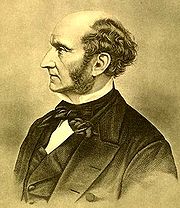
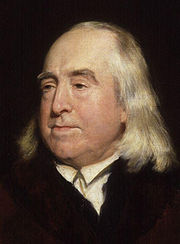
Summarily, Jeremy Bentham
states that people are driven by their interests and their fears, but their interests take precedence over their fears, and their interests are carried out in accordance with how people view the consequences that might be involved with their interests. "Happiness" on this account is defined as the maximization of pleasure and the minimization of pain.
Historically, hedonistic utilitarianism is the paradigmatic example of a consequentialist moral theory. This form of utilitarianism holds that what matters is the aggregate happiness; the happiness of everyone and not the happiness of any particular person. John Stuart Mill
, in his exposition of hedonistic utilitarianism, proposed a hierarchy of pleasures, meaning that the pursuit of certain kinds of pleasure is more highly valued than the pursuit of other pleasures. However, some contemporary utilitarians, such as Peter Singer
are concerned to maximize the satisfaction of preferences, hence "preference utilitarianism
". Other contemporary forms of utilitarianism mirror the forms of consequentialism outlined below.
can be understood as a consequentialist theory according to which the consequences for the individual agent are taken to matter more than any other result. Thus, egoism will prescribe actions that may be beneficial, detrimental, or neutral to the welfare of others. Some, like Henry Sidgwick
, argue that a certain degree of egoism promotes the general welfare of society for two reasons: because individuals know how to please themselves best, and because if everyone were an austere altruist then general welfare would inevitably decrease.
can be seen as a consequentialist ethic which prescribes that an individual take actions that have the best consequences for everyone except for himself. This was advocated by Auguste Comte
, who coined the term "altruism," and whose ethics can be summed up in the phrase: Live for others.
and rule egoism
.
Various theorists are split as to whether the rules are the only determinant of moral behavior or not. For example, Robert Nozick
holds that a certain set of minimal rules, which he calls "side-constraints", are necessary to ensure appropriate actions. There are also differences as to how absolute these moral rules are. Thus, while Nozick's side-constraints are absolute restrictions on behavior, Amartya Sen
proposes a theory that recognizes the importance of certain rules, but these rules are not absolute. That is, they may be violated if strict adherence to the rule would lead to much more undesirable consequences.
One of the most common objections to rule-consequentialism is that it is incoherent, because it is based on the consequentialist principle that what we should be concerned with is maximizing the good, but then it tells us not to act to maximize the good, but to follow rules (even in cases where we know that breaking the rule could produce better results).
Brad Hooker
avoided this objection by not basing his form of rule-consequentialism on the ideal of maximizing the good. He writes:
"…the best argument for rule-consequentialism is not that it derives from an overarching commitment to maximise the good. The best argument for rule-consequentialism is that it does a better job than its rivals of matching and tying together our moral convictions, as well as offering us help with our moral disagreements and uncertainties"
Derek Parfit
described Brad Hooker
's book on rule-consequentialism Ideal Code, Real World as the "best statement and defence, so far, of one of the most important moral theories."
One major difference between these two approaches is the agent's responsibility. Positive consequentialism demands that we bring about good states of affairs, whereas negative consequentialism may only require that we avoid bad ones. A more strenuous version of negative consequentialism may actually require active intervention, but only to prevent harm from being done. An alternative theory (using the example of negative utilitarianism) is that some consider the reduction of suffering (for the disadvantaged) to be more valuable than increased pleasure (for the affluent or luxurious).
Teleological theories differ on the nature of the end that actions ought to promote. Eudaemonist theories (Greek eudaimonia, "happiness") hold that the goal of ethics consists in some function or activity appropriate to man as a human being, and thus tend to emphasize the cultivation of virtue or excellence in the agent as the end of all action. These could be the classical virtues—courage
, temperance
, justice
, and wisdom
—that promoted the Greek ideal of man as the "rational animal", or the theological virtues—faith
, hope
, and love
—that distinguished the Christian ideal of man as a being created in the image of God.
Utilitarian-type theories hold that the end consists in an experience or feeling produced by the action. Hedonism
, for example, teaches that this feeling is pleasure—either one's own, as in egoism (the 17th-century English philosopher Thomas Hobbes
), or everyone's, as in universalistic hedonism, or utilitarianism
(the 19th-century English philosophers Jeremy Bentham
, John Stuart Mill
, and Henry Sidgwick
), with its formula of the "greatest pleasure of the greatest number."
Other utilitarian-type views include the claims that the end of action is survival and growth, as in evolutionary ethics
(the 19th-century English philosopher Herbert Spencer
); the experience of power, as in despotism
(the 16th-century Italian political philosopher Niccolò Machiavelli
and the 19th-century German Friedrich Nietzsche
); satisfaction and adjustment, as in pragmatism
(20th-century American philosophers Ralph Barton Perry
and John Dewey
); and freedom, as in existentialism
(the 20th-century French philosopher Jean-Paul Sartre
).
The chief problem for eudaemonist theories is to show that leading a life of virtue will also be attended by happiness—by the winning of the goods regarded as the chief end of action. That Job should suffer and Socrates
and Jesus
die while the wicked prosper, then seems unjust. Eudaemonists generally reply that the universe is moral and that, in Socrates' words, “No evil can happen to a good man, either in life or after death,” or, in Jesus' words, “But he who endures to the end will be saved.”
Utilitarian theories, on the other hand, must answer the charge that ends do not justify the means. The problem arises in these theories because they tend to separate the achieved ends from the action by which these ends were produced. One implication of utilitarianism is that one's intention in performing an act may include all of its foreseen consequences. The goodness of the intention then reflects the balance of the good and evil of these consequences, with no limits imposed upon it by the nature of the act itself—even if it be, say, the breaking of a promise or the execution of an innocent man. Utilitarianism, in answering this charge, must show either that what is apparently immoral is not really so or that, if it really is so, then closer examination of the consequences will bring this fact to light. Ideal utilitarianism (G.E. Moore and Hastings Rashdall
) tries to meet the difficulty by advocating a plurality of ends and including among them the attainment of virtue itself, which, as John Stuart Mill
affirmed, "may be felt a good in itself, and desired as such with as great intensity as any other good."
moral theories such as consequentialism is the ability to produce practical moral judgements. At the very least, any moral theory needs to define the standpoint from which the goodness of the consequences are to be determined. What is primarily at stake here is the responsibility
of the agent.
(selfless) account of consequentialism, is to employ an ideal, neutral observer from which moral judgements can be made. John Rawls
, a critic of utilitarianism, argues that utilitarianism, in common with other forms of consequentialism, relies on the perspective of such an ideal observer. The particular characteristics of this ideal observer can vary from an omniscient observer, who would grasp all the consequences of any action, to an ideally informed observer, who knows as much as could reasonably be expected, but not necessarily all the circumstances or all the possible consequences. Consequentialist theories that adopt this paradigm hold that right action is the action that will bring about the best consequences from this ideal observer's perspective.
and theories that demand that agents act for ends perhaps disconnected from their own interests and drives. These are called "agent-focused" and "agent-neutral" theories respectively. Agent-neutral consequentialism ignores the specific value a state of affairs has for any particular agent. Thus, in an agent-neutral theory, an actor's personal goals do not count any more than anyone else's goals in evaluating what action the actor should take. Agent-focused consequentialism, on the other hand, focuses on the particular needs of the moral agent. Thus, in an agent-focused account, such as one that Peter Railton
outlines, the actor might be concerned with the general welfare, but the actor is more concerned with the immediate welfare of herself and her friends and family. These two approaches could be reconciled by acknowledging the tension between an agent's interests as an individual and as a member of various groups, and seeking to somehow optimize among all of these interests. For example, it may be meaningful to speak of an action as being good for someone as an individual but bad for them as a citizen of their town.
, who is regarded as the founder of Utilitarianism
, argues that animals can experience pleasure and pain, thus demanding that 'non-human animals' should be a serious object of moral concern. More recently, Peter Singer
has argued that it is unreasonable that we do not give equal consideration to the interests of animals as to those of human beings when we choose the way we are to treat them. Such equal consideration does not necessarily imply identical treatment of humans and non-humans, any more than it necessarily implies identical treatment of all humans.
, a good action is one that results in an increase in pleasure
, and the best action is one that results in the most pleasure for the greatest number. Closely related is eudaimonic
consequentialism, according to which a full, flourishing life, which may or may not be the same as enjoying a great deal of pleasure, is the ultimate aim. Similarly, one might adopt an aesthetic consequentialism, in which the ultimate aim is to produce beauty. However, one might fix on non-psychological goods as the relevant effect. Thus, one might pursue an increase in material equality
or political liberty
instead of something like the more ephemeral "pleasure". Other theories adopt a package of several goods, all to be promoted equally. Whether a particular consequentialist theory focuses on a single good or many, conflicts and tensions between different good states of affairs are to be expected and must be adjudicated.
moral theories such as virtue ethics
. Whereas consequentialist theories posit that consequences of action should be the primary focus of our thinking about ethics, virtue ethics insists that it is the character rather than the consequences of actions that should be the focal point. Some virtue ethicists hold that consequentialist theories totally disregard the development and importance of moral character. For example, Philippa Foot
argues that consequences in themselves have no ethical content, unless it has been provided by a virtue such as benevolence.
However, consequentialism and virtue ethics need not be understood to be entirely antagonistic. Consequentialist theories can consider character in several ways. For example, the effects on the character of the agent or any other people involved in an action may be regarded as a relevant consequence. Similarly, a consequentialist theory may aim at the maximization of a particular virtue or set of virtues. Finally, following Foot's lead, one might adopt a sort of consequentialism that argues that virtuous activity ultimately produces the best consequences.
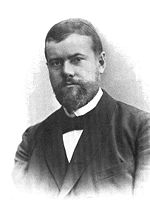
, in which individuals act in a faithful, rather than rational, manner.
Another criticism is that consequentialism does not account for why a better state of affairs is preferable for one group of people as opposed to another. For example, an action might lead to immediate negative consequences followed by positive consequences which occur two hundred years later and outweigh the negative consequences. As a result, there will be those who only experienced negative consequences and no positive ones.
G. E. M. Anscombe
objects to consequentialism on the grounds that it does not provide guidance in what one ought to do because there is no distinction between consequences that are foreseen and those that are intended (see Principle of double effect
).
Bernard Williams
has argued that consequentialism is alienating because it requires moral agents to put too much distance between themselves and their own projects and commitments. Williams argues that consequentialism requires moral agents to take a strictly impersonal view of all actions, since it is only the consequences, and not who produces them, that is said to matter. Williams argues that this demands too much of moral agents—since (he claims) consequentialism demands that they be willing to sacrifice any and all personal projects and commitments in any given circumstance in order to pursue the most beneficent course of action possible. He argues further that consequentialism fails to make sense of intuitions that it can matter whether or not someone is personally the author of a particular consequence. For example, that participating in a crime can matter, even if the crime would have been committed anyway, or would even have been worse, without the agent's participation.
Some consequentialists—most notably Peter Railton
—have attempted to develop a form of consequentialism that acknowledges and avoids the objections raised by Williams. Railton argues that Williams's criticisms can be avoided by adopting a form of consequentialism in which moral decisions are to be determined by the sort of life that they express. On his account, the agent should choose the sort of life that will, on the whole, produce the best overall effects.
Normative ethics
Normative ethics is the study of ethical action. It is the branch of philosophical ethics that investigates the set of questions that arise when considering how one ought to act, morally speaking...
holding that the consequences
Consequences
Consequences is an old parlour game in a similar vein to the Surrealist game exquisite corpse and Mad Libs.Each person takes a turn choosing a word or phrase for one of six questions, in this order.#Man's name#Woman's name#Place name#He said to her…...
of one's conduct are the ultimate basis for any judgment about the rightness of that conduct. Thus, from a consequentialist standpoint, a morally right act (or omission) is one that will produce a good outcome, or consequence.
Consequentialism is usually distinguished from deontology
Deontological ethics
Deontological ethics or deontology is the normative ethical position that judges the morality of an action based on the action's adherence to a rule or rules. It is sometimes described as "duty" or "obligation" or "rule" -based ethics, because rules "bind you to your duty"...
, in that deontology derives the rightness or wrongness of one's conduct from the character of the behaviour itself rather than the outcomes of the conduct. It is also distinguished from virtue ethics
Virtue ethics
Virtue ethics describes the character of a moral agent as a driving force for ethical behavior, rather than rules , consequentialism , or social context .The difference between these four approaches to morality tends to lie more in the way moral dilemmas are...
, which focuses on the character of the agent rather than on the nature or consequences of the act (or omission) itself, and pragmatic ethics
Pragmatic ethics
Pragmatic ethics is a theory of normative philosophical ethics. Ethical pragmatists, such as John Dewey, believe that societies have progressed morally in much the way they have attained progress in science...
which treats morality like science: advancing socially over the course of many lifetimes, such that any moral criterion is subject to revision.
Although all consequentialist theories use consequences as the basis for moral judgements, they differ in how they define moral goods
Value theory
Value theory encompasses a range of approaches to understanding how, why and to what degree people should value things; whether the thing is a person, idea, object, or anything else. This investigation began in ancient philosophy, where it is called axiology or ethics. Early philosophical...
. In Mozi
Mozi
Mozi |Lat.]] as Micius, ca. 470 BC – ca. 391 BC), original name Mo Di , was a Chinese philosopher during the Hundred Schools of Thought period . Born in Tengzhou, Shandong Province, China, he founded the school of Mohism, and argued strongly against Confucianism and Daoism...
's state consequentialism the moral good is state stability and in Jeremy Bentham
Jeremy Bentham
Jeremy Bentham was an English jurist, philosopher, and legal and social reformer. He became a leading theorist in Anglo-American philosophy of law, and a political radical whose ideas influenced the development of welfarism...
's utilitarianism
Utilitarianism
Utilitarianism is an ethical theory holding that the proper course of action is the one that maximizes the overall "happiness", by whatever means necessary. It is thus a form of consequentialism, meaning that the moral worth of an action is determined only by its resulting outcome, and that one can...
the moral good is pleasure and individual happiness.
Some argue that consequentialist and deontological theories are not necessarily mutually exclusive. For example, T.M. Scanlon advances the idea that human rights, which are commonly considered a "deontological" concept, can only be justified with reference to the consequences of having those rights. Similarly, Robert Nozick
Robert Nozick
Robert Nozick was an American political philosopher, most prominent in the 1970s and 1980s. He was a professor at Harvard University. He is best known for his book Anarchy, State, and Utopia , a right-libertarian answer to John Rawls's A Theory of Justice...
argues for a theory that is mostly consequentialist, but incorporates inviolable "side-constraints" which restrict the sort of actions agents are permitted to do.
Etymology
The term "consequentialism" was coined by G. E. M. AnscombeG. E. M. Anscombe
Gertrude Elizabeth Margaret Anscombe , better known as Elizabeth Anscombe, was a British analytic philosopher from Ireland. A student of Ludwig Wittgenstein, she became an authority on his work and edited and translated many books drawn from his writings, above all his Philosophical Investigations...
in her essay "Modern Moral Philosophy
Modern Moral Philosophy
Modern Moral Philosophy was an influential article on moral philosophy by G. E. M. Anscombe, originally published in the journal Philosophy, vol. 33, no. 124 ....
" in 1958, to describe what she saw as the central error of certain moral theories, such as those propounded by Mill
John Stuart Mill
John Stuart Mill was a British philosopher, economist and civil servant. An influential contributor to social theory, political theory, and political economy, his conception of liberty justified the freedom of the individual in opposition to unlimited state control. He was a proponent of...
and Sidgwick
Henry Sidgwick
Henry Sidgwick was an English utilitarian philosopher and economist. He was one of the founders and first president of the Society for Psychical Research, a member of the Metaphysical Society, and promoted the higher education of women...
.
State consequentialism
Mohist consequentialismMohist consequentialism
Mohist consequentialism, also known as state consequentialism, is a consequentialist ethical theory which evaluates the moral worth of an action based on how it contributes to the stability of a state, through social order, material wealth, and population growth...
, also known as state consequentialism, is an ethical theory which evaluates the moral worth of an action based on how much it contributes to the stability of a state. According to the Stanford Encyclopedia of Philosophy
Stanford Encyclopedia of Philosophy
The Stanford Encyclopedia of Philosophy is a freely-accessible online encyclopedia of philosophy maintained by Stanford University. Each entry is written and maintained by an expert in the field, including professors from over 65 academic institutions worldwide...
, Mohist consequentialism, dating back to the 5th century BC, is the "world's earliest form of consequentialism, a remarkably sophisticated version based on a plurality of intrinsic goods taken as constitutive of human welfare." Unlike utilitarianism, which views pleasure as a moral good, "the basic goods in Mohist consequentialist thinking are... order, material wealth, and increase in population". During Mozi
Mozi
Mozi |Lat.]] as Micius, ca. 470 BC – ca. 391 BC), original name Mo Di , was a Chinese philosopher during the Hundred Schools of Thought period . Born in Tengzhou, Shandong Province, China, he founded the school of Mohism, and argued strongly against Confucianism and Daoism...
's era, war and famines were common, and population growth was seen as a moral necessity for a harmonious society. The "material wealth" of Mohist consequentialism refers to basic needs
Maslow's hierarchy of needs
Maslow's hierarchy of needs is a theory in psychology, proposed by Abraham Maslow in his 1943 paper A Theory of Human Motivation. Maslow subsequently extended the idea to include his observations of humans' innate curiosity...
like shelter and clothing, and the "order" of Mohist consequentialism refers to Mozi's stance against warfare and violence, which he viewed as pointless and a threat to social stability. Stanford
Stanford University
The Leland Stanford Junior University, commonly referred to as Stanford University or Stanford, is a private research university on an campus located near Palo Alto, California. It is situated in the northwestern Santa Clara Valley on the San Francisco Peninsula, approximately northwest of San...
sinologist David Shepherd Nivison
David S. Nivison
David Shepherd Nivison is a sinologist in the United States. His Chinese name is Ni Dewei .-Biography:Nivison received his Ph.D. in Chinese from Harvard University. Although less known, his first Chinese teachers were Lien-sheng Yang and Hong Ye . Nivison learnt most of the subjects from them...
, in the The Cambridge History of Ancient China
The Cambridge History of Ancient China
The Cambridge History of Ancient China: From the Origins of Civilization to 221 BC is a book edited by Michael Loewe and Edward L. Shaughnessy, published by Cambridge University Press in 1999....
, writes that the moral goods of Mohism "are interrelated: more basic wealth, then more reproduction; more people, then more production and wealth... if people have plenty, they would be good, filial, kind, and so on unproblematically." In contrast to Bentham, Mozi did not believe that individual happiness was important, the consequences of the state
State (polity)
A state is an organized political community, living under a government. States may be sovereign and may enjoy a monopoly on the legal initiation of force and are not dependent on, or subject to any other power or state. Many states are federated states which participate in a federal union...
outweigh the consequences of individual actions.
Utilitarianism
Summarily, Jeremy Bentham
Jeremy Bentham
Jeremy Bentham was an English jurist, philosopher, and legal and social reformer. He became a leading theorist in Anglo-American philosophy of law, and a political radical whose ideas influenced the development of welfarism...
states that people are driven by their interests and their fears, but their interests take precedence over their fears, and their interests are carried out in accordance with how people view the consequences that might be involved with their interests. "Happiness" on this account is defined as the maximization of pleasure and the minimization of pain.
Historically, hedonistic utilitarianism is the paradigmatic example of a consequentialist moral theory. This form of utilitarianism holds that what matters is the aggregate happiness; the happiness of everyone and not the happiness of any particular person. John Stuart Mill
John Stuart Mill
John Stuart Mill was a British philosopher, economist and civil servant. An influential contributor to social theory, political theory, and political economy, his conception of liberty justified the freedom of the individual in opposition to unlimited state control. He was a proponent of...
, in his exposition of hedonistic utilitarianism, proposed a hierarchy of pleasures, meaning that the pursuit of certain kinds of pleasure is more highly valued than the pursuit of other pleasures. However, some contemporary utilitarians, such as Peter Singer
Peter Singer
Peter Albert David Singer is an Australian philosopher who is the Ira W. DeCamp Professor of Bioethics at Princeton University and Laureate Professor at the Centre for Applied Philosophy and Public Ethics at the University of Melbourne...
are concerned to maximize the satisfaction of preferences, hence "preference utilitarianism
Preference utilitarianism
Preference utilitarianism is one of the most popular forms of utilitarianism in contemporary philosophy. Unlike classical utilitarianism, which defines right actions as those that maximize pleasure and minimize pain, preference utilitarianism promotes actions that fulfill the interests of those...
". Other contemporary forms of utilitarianism mirror the forms of consequentialism outlined below.
Ethical egoism
Ethical egoismEthical egoism
Ethical egoism is the normative ethical position that moral agents ought to do what is in their own self-interest. It differs from psychological egoism, which claims that people can only act in their self-interest. Ethical egoism also differs from rational egoism, which holds merely that it is...
can be understood as a consequentialist theory according to which the consequences for the individual agent are taken to matter more than any other result. Thus, egoism will prescribe actions that may be beneficial, detrimental, or neutral to the welfare of others. Some, like Henry Sidgwick
Henry Sidgwick
Henry Sidgwick was an English utilitarian philosopher and economist. He was one of the founders and first president of the Society for Psychical Research, a member of the Metaphysical Society, and promoted the higher education of women...
, argue that a certain degree of egoism promotes the general welfare of society for two reasons: because individuals know how to please themselves best, and because if everyone were an austere altruist then general welfare would inevitably decrease.
Ethical altruism
Ethical altruismAltruism (ethics)
Altruism is an ethical doctrine that holds that individuals have a moral obligation to help, serve, or benefit others, if necessary at the sacrifice of self interest. Auguste Comte's version of altruism calls for living for the sake of others...
can be seen as a consequentialist ethic which prescribes that an individual take actions that have the best consequences for everyone except for himself. This was advocated by Auguste Comte
Auguste Comte
Isidore Auguste Marie François Xavier Comte , better known as Auguste Comte , was a French philosopher, a founder of the discipline of sociology and of the doctrine of positivism...
, who coined the term "altruism," and whose ethics can be summed up in the phrase: Live for others.
Rule consequentialism
In general, consequentialist theories focus on actions. However, this need not be the case. Rule consequentialism is a theory that is sometimes seen as an attempt to reconcile deontology and consequentialism—and in some cases, this is stated as a criticism of rule consequentialism. Like deontology, rule consequentialism holds that moral behavior involves following certain rules. However, rule consequentialism chooses rules based on the consequences that the selection of those rules have. Rule consequentialism exists in the forms of rule utilitarianismRule Utilitarianism
Rule utilitarianism is a form of utilitarianism that says actions are moral when they conform to the rules that lead to the greatest good, or that "the rightness or wrongness of a particular action is a function of the correctness of the rule of which it is an instance." For rule utilitarians, the...
and rule egoism
Rule egoism
Rule egoism is the doctrine under which an individual evaluates the optimal set of rules according to whether conformity to those rules bring the most benefit to himself.-See also:*Enlightened self-interest*Ethical egoism*Indirect self-interest...
.
Various theorists are split as to whether the rules are the only determinant of moral behavior or not. For example, Robert Nozick
Robert Nozick
Robert Nozick was an American political philosopher, most prominent in the 1970s and 1980s. He was a professor at Harvard University. He is best known for his book Anarchy, State, and Utopia , a right-libertarian answer to John Rawls's A Theory of Justice...
holds that a certain set of minimal rules, which he calls "side-constraints", are necessary to ensure appropriate actions. There are also differences as to how absolute these moral rules are. Thus, while Nozick's side-constraints are absolute restrictions on behavior, Amartya Sen
Amartya Sen
Amartya Sen, CH is an Indian economist who was awarded the 1998 Nobel Prize in Economic Sciences for his contributions to welfare economics and social choice theory, and for his interest in the problems of society's poorest members...
proposes a theory that recognizes the importance of certain rules, but these rules are not absolute. That is, they may be violated if strict adherence to the rule would lead to much more undesirable consequences.
One of the most common objections to rule-consequentialism is that it is incoherent, because it is based on the consequentialist principle that what we should be concerned with is maximizing the good, but then it tells us not to act to maximize the good, but to follow rules (even in cases where we know that breaking the rule could produce better results).
Brad Hooker
Brad Hooker
Brad Hooker is a philosopher who specialises in moral philosophy. He is a Professor at the University of Reading and is best known for his work defending rule-consequentialism ....
avoided this objection by not basing his form of rule-consequentialism on the ideal of maximizing the good. He writes:
"…the best argument for rule-consequentialism is not that it derives from an overarching commitment to maximise the good. The best argument for rule-consequentialism is that it does a better job than its rivals of matching and tying together our moral convictions, as well as offering us help with our moral disagreements and uncertainties"
Derek Parfit
Derek Parfit
Derek Parfit is a British philosopher who specializes in problems of personal identity, rationality and ethics, and the relations between them. His 1984 book Reasons and Persons has been very influential...
described Brad Hooker
Brad Hooker
Brad Hooker is a philosopher who specialises in moral philosophy. He is a Professor at the University of Reading and is best known for his work defending rule-consequentialism ....
's book on rule-consequentialism Ideal Code, Real World as the "best statement and defence, so far, of one of the most important moral theories."
Motive consequentialism
Another consequentialist version is motive consequentialism which looks if the state of affairs that results from the motive to choose an action is better or at least as good as each of the alternative state of affairs that would have resulted from alternative actions. This version gives relevance to the motive of an act and links it to its consequences. An act can therefore not be wrong if the decision to act was based on a right motive. A possible inference is, that one can not be blamed for mistaken judgements if the motivation was to do good.Negative consequentialism
Most consequentialist theories focus on promoting some sort of good consequences. However, one could equally well lay out a consequentialist theory that focuses solely on minimizing bad consequences. (Negative utilitarianism is an actual example.) Of course, the maximization of good consequences could in practice also involve the minimization of bad consequences, but the promotion of good consequences is usually of primary import.One major difference between these two approaches is the agent's responsibility. Positive consequentialism demands that we bring about good states of affairs, whereas negative consequentialism may only require that we avoid bad ones. A more strenuous version of negative consequentialism may actually require active intervention, but only to prevent harm from being done. An alternative theory (using the example of negative utilitarianism) is that some consider the reduction of suffering (for the disadvantaged) to be more valuable than increased pleasure (for the affluent or luxurious).
Teleological ethics
Teleological ethics (Greek telos, “end”; logos, “science”) is an ethical theory that holds that the ends or consequences of an act determine whether an act is good or evil. Teleological theories are often discussed in opposition to deontological ethical theories, which hold that acts themselves are inherently good or evil, regardless of the consequences of acts.Teleological theories differ on the nature of the end that actions ought to promote. Eudaemonist theories (Greek eudaimonia, "happiness") hold that the goal of ethics consists in some function or activity appropriate to man as a human being, and thus tend to emphasize the cultivation of virtue or excellence in the agent as the end of all action. These could be the classical virtues—courage
Courage
Courage is the ability to confront fear, pain, danger, uncertainty, or intimidation...
, temperance
Temperance (virtue)
Temperance has been studied by religious thinkers, philosophers, and more recently, psychologists, particularly in the positive psychology movement. It is considered a virtue, a core value that can be seen consistently across time and cultures...
, justice
Justice (virtue)
Justice is one of the four cardinal virtues in classical European philosophy and Roman Catholicism. It is the moderation between selfishness and selflessness....
, and wisdom
Wisdom
Wisdom is a deep understanding and realization of people, things, events or situations, resulting in the ability to apply perceptions, judgements and actions in keeping with this understanding. It often requires control of one's emotional reactions so that universal principles, reason and...
—that promoted the Greek ideal of man as the "rational animal", or the theological virtues—faith
Faith in Christianity
Faith, in Christianity, has been most commonly defined by the biblical formulation in the Letter to the Hebrews as "'the assurance of things hoped for, the conviction of things not seen". Most of the definitions in the history of Christian theology have followed this biblical formulation...
, hope
Hope
Hope is the emotional state which promotes the belief in a positive outcome related to events and circumstances in one's life. It is the "feeling that what is wanted can be had or that events will turn out for the best" or the act of "look[ing] forward to with desire and reasonable confidence" or...
, and love
Love
Love is an emotion of strong affection and personal attachment. In philosophical context, love is a virtue representing all of human kindness, compassion, and affection. Love is central to many religions, as in the Christian phrase, "God is love" or Agape in the Canonical gospels...
—that distinguished the Christian ideal of man as a being created in the image of God.
Utilitarian-type theories hold that the end consists in an experience or feeling produced by the action. Hedonism
Hedonism
Hedonism is a school of thought which argues that pleasure is the only intrinsic good. In very simple terms, a hedonist strives to maximize net pleasure .-Etymology:The name derives from the Greek word for "delight" ....
, for example, teaches that this feeling is pleasure—either one's own, as in egoism (the 17th-century English philosopher Thomas Hobbes
Thomas Hobbes
Thomas Hobbes of Malmesbury , in some older texts Thomas Hobbs of Malmsbury, was an English philosopher, best known today for his work on political philosophy...
), or everyone's, as in universalistic hedonism, or utilitarianism
Utilitarianism
Utilitarianism is an ethical theory holding that the proper course of action is the one that maximizes the overall "happiness", by whatever means necessary. It is thus a form of consequentialism, meaning that the moral worth of an action is determined only by its resulting outcome, and that one can...
(the 19th-century English philosophers Jeremy Bentham
Jeremy Bentham
Jeremy Bentham was an English jurist, philosopher, and legal and social reformer. He became a leading theorist in Anglo-American philosophy of law, and a political radical whose ideas influenced the development of welfarism...
, John Stuart Mill
John Stuart Mill
John Stuart Mill was a British philosopher, economist and civil servant. An influential contributor to social theory, political theory, and political economy, his conception of liberty justified the freedom of the individual in opposition to unlimited state control. He was a proponent of...
, and Henry Sidgwick
Henry Sidgwick
Henry Sidgwick was an English utilitarian philosopher and economist. He was one of the founders and first president of the Society for Psychical Research, a member of the Metaphysical Society, and promoted the higher education of women...
), with its formula of the "greatest pleasure of the greatest number."
Other utilitarian-type views include the claims that the end of action is survival and growth, as in evolutionary ethics
Evolutionary ethics
Evolutionary ethics could be either a form of descriptive ethics or normative ethics.Descriptive evolutionary ethics consists of biological approaches to ethics based on the role of evolution in shaping human psychology and behavior...
(the 19th-century English philosopher Herbert Spencer
Herbert Spencer
Herbert Spencer was an English philosopher, biologist, sociologist, and prominent classical liberal political theorist of the Victorian era....
); the experience of power, as in despotism
Despotism
Despotism is a form of government in which a single entity rules with absolute power. That entity may be an individual, as in an autocracy, or it may be a group, as in an oligarchy...
(the 16th-century Italian political philosopher Niccolò Machiavelli
Niccolò Machiavelli
Niccolò di Bernardo dei Machiavelli was an Italian historian, philosopher, humanist, and writer based in Florence during the Renaissance. He is one of the main founders of modern political science. He was a diplomat, political philosopher, playwright, and a civil servant of the Florentine Republic...
and the 19th-century German Friedrich Nietzsche
Friedrich Nietzsche
Friedrich Wilhelm Nietzsche was a 19th-century German philosopher, poet, composer and classical philologist...
); satisfaction and adjustment, as in pragmatism
Pragmatism
Pragmatism is a philosophical tradition centered on the linking of practice and theory. It describes a process where theory is extracted from practice, and applied back to practice to form what is called intelligent practice...
(20th-century American philosophers Ralph Barton Perry
Ralph Barton Perry
Ralph Barton Perry was an American philosopher.-Career:...
and John Dewey
John Dewey
John Dewey was an American philosopher, psychologist and educational reformer whose ideas have been influential in education and social reform. Dewey was an important early developer of the philosophy of pragmatism and one of the founders of functional psychology...
); and freedom, as in existentialism
Existentialism
Existentialism is a term applied to a school of 19th- and 20th-century philosophers who, despite profound doctrinal differences, shared the belief that philosophical thinking begins with the human subject—not merely the thinking subject, but the acting, feeling, living human individual...
(the 20th-century French philosopher Jean-Paul Sartre
Jean-Paul Sartre
Jean-Paul Charles Aymard Sartre was a French existentialist philosopher, playwright, novelist, screenwriter, political activist, biographer, and literary critic. He was one of the leading figures in 20th century French philosophy, particularly Marxism, and was one of the key figures in literary...
).
The chief problem for eudaemonist theories is to show that leading a life of virtue will also be attended by happiness—by the winning of the goods regarded as the chief end of action. That Job should suffer and Socrates
Socrates
Socrates was a classical Greek Athenian philosopher. Credited as one of the founders of Western philosophy, he is an enigmatic figure known chiefly through the accounts of later classical writers, especially the writings of his students Plato and Xenophon, and the plays of his contemporary ...
and Jesus
Jesus
Jesus of Nazareth , commonly referred to as Jesus Christ or simply as Jesus or Christ, is the central figure of Christianity...
die while the wicked prosper, then seems unjust. Eudaemonists generally reply that the universe is moral and that, in Socrates' words, “No evil can happen to a good man, either in life or after death,” or, in Jesus' words, “But he who endures to the end will be saved.”
Utilitarian theories, on the other hand, must answer the charge that ends do not justify the means. The problem arises in these theories because they tend to separate the achieved ends from the action by which these ends were produced. One implication of utilitarianism is that one's intention in performing an act may include all of its foreseen consequences. The goodness of the intention then reflects the balance of the good and evil of these consequences, with no limits imposed upon it by the nature of the act itself—even if it be, say, the breaking of a promise or the execution of an innocent man. Utilitarianism, in answering this charge, must show either that what is apparently immoral is not really so or that, if it really is so, then closer examination of the consequences will bring this fact to light. Ideal utilitarianism (G.E. Moore and Hastings Rashdall
Hastings Rashdall
Hastings Rashdall was an English philosopher who expounded a theory known as ideal utilitarianism.Son of an Anglican priest, he was educated at Harrow and received a scholarship for New College, Oxford...
) tries to meet the difficulty by advocating a plurality of ends and including among them the attainment of virtue itself, which, as John Stuart Mill
John Stuart Mill
John Stuart Mill was a British philosopher, economist and civil servant. An influential contributor to social theory, political theory, and political economy, his conception of liberty justified the freedom of the individual in opposition to unlimited state control. He was a proponent of...
affirmed, "may be felt a good in itself, and desired as such with as great intensity as any other good."
Action guidance
One important characteristic of many normativeNormative ethics
Normative ethics is the study of ethical action. It is the branch of philosophical ethics that investigates the set of questions that arise when considering how one ought to act, morally speaking...
moral theories such as consequentialism is the ability to produce practical moral judgements. At the very least, any moral theory needs to define the standpoint from which the goodness of the consequences are to be determined. What is primarily at stake here is the responsibility
Moral responsibility
Moral responsibility usually refers to the idea that a person has moral obligations in certain situations. Disobeying moral obligations, then, becomes grounds for justified punishment. Deciding what justifies punishment, if anything, is a principle concern of ethics.People who have moral...
of the agent.
The ideal observer
One common tactic among consequentialists, particularly those committed to an altruisticAltruism
Altruism is a concern for the welfare of others. It is a traditional virtue in many cultures, and a core aspect of various religious traditions, though the concept of 'others' toward whom concern should be directed can vary among cultures and religions. Altruism is the opposite of...
(selfless) account of consequentialism, is to employ an ideal, neutral observer from which moral judgements can be made. John Rawls
John Rawls
John Bordley Rawls was an American philosopher and a leading figure in moral and political philosophy. He held the James Bryant Conant University Professorship at Harvard University....
, a critic of utilitarianism, argues that utilitarianism, in common with other forms of consequentialism, relies on the perspective of such an ideal observer. The particular characteristics of this ideal observer can vary from an omniscient observer, who would grasp all the consequences of any action, to an ideally informed observer, who knows as much as could reasonably be expected, but not necessarily all the circumstances or all the possible consequences. Consequentialist theories that adopt this paradigm hold that right action is the action that will bring about the best consequences from this ideal observer's perspective.
The real observer
In practice, it is very difficult, and at times arguably impossible, to adopt the point of view of an ideal observer. Individual moral agents do not know everything about their particular situations, and thus do not know all the possible consequences of their potential actions. For this reason, some theorists have argued that consequentialist theories can only require agents to choose the best action in line with what they know about the situation. However, if this approach is naïvely adopted, then moral agents who, for example, recklessly fail to reflect on their situation, and act in a way that brings about terrible results, could be said to be acting in a morally justifiable way. Acting in a situation without first informing oneself of the circumstances of the situation can lead to even the most well-intended actions yielding miserable consequences. As a result, it could be argued that there is a moral imperative for an agent to inform himself as much as possible about a situation before judging the appropriate course of action. This imperative, of course, is derived from consequential thinking: a better-informed agent is able to bring about better consequences.Consequences for whom
Moral action always has an effect on certain people or things, the consequences. Various kinds of consequentialism can be differentiated by beneficiary of the good consequences. That is, one might ask "Consequences for whom?"Agent-focused or agent-neutral
A fundamental distinction can be drawn between theories that demand that agents act for ends in which they have some personal interest or motivationMotivation
Motivation is the driving force by which humans achieve their goals. Motivation is said to be intrinsic or extrinsic. The term is generally used for humans but it can also be used to describe the causes for animal behavior as well. This article refers to human motivation...
and theories that demand that agents act for ends perhaps disconnected from their own interests and drives. These are called "agent-focused" and "agent-neutral" theories respectively. Agent-neutral consequentialism ignores the specific value a state of affairs has for any particular agent. Thus, in an agent-neutral theory, an actor's personal goals do not count any more than anyone else's goals in evaluating what action the actor should take. Agent-focused consequentialism, on the other hand, focuses on the particular needs of the moral agent. Thus, in an agent-focused account, such as one that Peter Railton
Peter Railton
Peter Albert Railton is John Stephenson Perrin Professor of Philosophy at the University of Michigan, Ann Arbor. He received his Ph.D. from Princeton in 1980. His research interests center on contemporary metaethics and normative ethics, as well as consequentialism...
outlines, the actor might be concerned with the general welfare, but the actor is more concerned with the immediate welfare of herself and her friends and family. These two approaches could be reconciled by acknowledging the tension between an agent's interests as an individual and as a member of various groups, and seeking to somehow optimize among all of these interests. For example, it may be meaningful to speak of an action as being good for someone as an individual but bad for them as a citizen of their town.
Human-centered?
Many consequentialist theories may seem primarily concerned with human beings and their relationships with other human beings. However, some philosophers argue that we should not limit our ethical consideration to the interests of human beings alone. Jeremy BenthamJeremy Bentham
Jeremy Bentham was an English jurist, philosopher, and legal and social reformer. He became a leading theorist in Anglo-American philosophy of law, and a political radical whose ideas influenced the development of welfarism...
, who is regarded as the founder of Utilitarianism
Utilitarianism
Utilitarianism is an ethical theory holding that the proper course of action is the one that maximizes the overall "happiness", by whatever means necessary. It is thus a form of consequentialism, meaning that the moral worth of an action is determined only by its resulting outcome, and that one can...
, argues that animals can experience pleasure and pain, thus demanding that 'non-human animals' should be a serious object of moral concern. More recently, Peter Singer
Peter Singer
Peter Albert David Singer is an Australian philosopher who is the Ira W. DeCamp Professor of Bioethics at Princeton University and Laureate Professor at the Centre for Applied Philosophy and Public Ethics at the University of Melbourne...
has argued that it is unreasonable that we do not give equal consideration to the interests of animals as to those of human beings when we choose the way we are to treat them. Such equal consideration does not necessarily imply identical treatment of humans and non-humans, any more than it necessarily implies identical treatment of all humans.
Kinds of consequences
One way to divide various consequentialisms is by the types of consequences that are taken to matter most, that is, which consequences count as good states of affairs. According to utilitarianismUtilitarianism
Utilitarianism is an ethical theory holding that the proper course of action is the one that maximizes the overall "happiness", by whatever means necessary. It is thus a form of consequentialism, meaning that the moral worth of an action is determined only by its resulting outcome, and that one can...
, a good action is one that results in an increase in pleasure
Pleasure
Pleasure describes the broad class of mental states that humans and other animals experience as positive, enjoyable, or worth seeking. It includes more specific mental states such as happiness, entertainment, enjoyment, ecstasy, and euphoria...
, and the best action is one that results in the most pleasure for the greatest number. Closely related is eudaimonic
Eudaimonia
Eudaimonia or eudaemonia , sometimes Anglicized as eudemonia , is a Greek word commonly translated as happiness or welfare; however, "human flourishing" has been proposed as a more accurate translation...
consequentialism, according to which a full, flourishing life, which may or may not be the same as enjoying a great deal of pleasure, is the ultimate aim. Similarly, one might adopt an aesthetic consequentialism, in which the ultimate aim is to produce beauty. However, one might fix on non-psychological goods as the relevant effect. Thus, one might pursue an increase in material equality
Equality of outcome
Equality of outcome, equality of condition, or equality of results is a controversial political concept. Although it is not always clearly defined, it is usually taken to describe a state in which people have approximately the same material wealth or, more generally, in which the general conditions...
or political liberty
Freedom (political)
Political freedom is a central philosophy in Western history and political thought, and one of the most important features of democratic societies...
instead of something like the more ephemeral "pleasure". Other theories adopt a package of several goods, all to be promoted equally. Whether a particular consequentialist theory focuses on a single good or many, conflicts and tensions between different good states of affairs are to be expected and must be adjudicated.
Virtue ethics
Consequentialism can also be contrasted with aretaicArete
Areté is the term meaning "virtue" or "excellence", from Greek ἈρετήArete may also be used:*as a given name of persons or things:**Queen Arete , a character in Homer's Odyssey.***197 Arete, an asteroid....
moral theories such as virtue ethics
Virtue ethics
Virtue ethics describes the character of a moral agent as a driving force for ethical behavior, rather than rules , consequentialism , or social context .The difference between these four approaches to morality tends to lie more in the way moral dilemmas are...
. Whereas consequentialist theories posit that consequences of action should be the primary focus of our thinking about ethics, virtue ethics insists that it is the character rather than the consequences of actions that should be the focal point. Some virtue ethicists hold that consequentialist theories totally disregard the development and importance of moral character. For example, Philippa Foot
Philippa Foot
Philippa Ruth Foot was a British philosopher, most notable for her works in ethics. She was one of the founders of contemporary virtue ethics...
argues that consequences in themselves have no ethical content, unless it has been provided by a virtue such as benevolence.
However, consequentialism and virtue ethics need not be understood to be entirely antagonistic. Consequentialist theories can consider character in several ways. For example, the effects on the character of the agent or any other people involved in an action may be regarded as a relevant consequence. Similarly, a consequentialist theory may aim at the maximization of a particular virtue or set of virtues. Finally, following Foot's lead, one might adopt a sort of consequentialism that argues that virtuous activity ultimately produces the best consequences.
Ultimate End
The Ultimate end is a concept in the moral philosophy of Max WeberMax Weber
Karl Emil Maximilian "Max" Weber was a German sociologist and political economist who profoundly influenced social theory, social research, and the discipline of sociology itself...
, in which individuals act in a faithful, rather than rational, manner.
Criticisms
Some critics point out that consequentialism is contingent upon the actions of others. For example, someone might murder someone who has committed no wrongdoing and, as a result, produce what can be interpreted as a better outcome (such as a reduction in crime) because of how people react.Another criticism is that consequentialism does not account for why a better state of affairs is preferable for one group of people as opposed to another. For example, an action might lead to immediate negative consequences followed by positive consequences which occur two hundred years later and outweigh the negative consequences. As a result, there will be those who only experienced negative consequences and no positive ones.
G. E. M. Anscombe
G. E. M. Anscombe
Gertrude Elizabeth Margaret Anscombe , better known as Elizabeth Anscombe, was a British analytic philosopher from Ireland. A student of Ludwig Wittgenstein, she became an authority on his work and edited and translated many books drawn from his writings, above all his Philosophical Investigations...
objects to consequentialism on the grounds that it does not provide guidance in what one ought to do because there is no distinction between consequences that are foreseen and those that are intended (see Principle of double effect
Principle of double effect
The principle of double effect; also known as the rule of double effect; the doctrine of double effect, often abbreviated as DDE or PDE; double-effect reasoning; or simply double effect, is a set of ethical criteria for evaluating the permissibility of acting when one's otherwise legitimate act...
).
Bernard Williams
Bernard Williams
Sir Bernard Arthur Owen Williams was an English moral philosopher, described by The Times as the most brilliant and most important British moral philosopher of his time. His publications include Problems of the Self , Moral Luck , Ethics and the Limits of Philosophy , and Truth and Truthfulness...
has argued that consequentialism is alienating because it requires moral agents to put too much distance between themselves and their own projects and commitments. Williams argues that consequentialism requires moral agents to take a strictly impersonal view of all actions, since it is only the consequences, and not who produces them, that is said to matter. Williams argues that this demands too much of moral agents—since (he claims) consequentialism demands that they be willing to sacrifice any and all personal projects and commitments in any given circumstance in order to pursue the most beneficent course of action possible. He argues further that consequentialism fails to make sense of intuitions that it can matter whether or not someone is personally the author of a particular consequence. For example, that participating in a crime can matter, even if the crime would have been committed anyway, or would even have been worse, without the agent's participation.
Some consequentialists—most notably Peter Railton
Peter Railton
Peter Albert Railton is John Stephenson Perrin Professor of Philosophy at the University of Michigan, Ann Arbor. He received his Ph.D. from Princeton in 1980. His research interests center on contemporary metaethics and normative ethics, as well as consequentialism...
—have attempted to develop a form of consequentialism that acknowledges and avoids the objections raised by Williams. Railton argues that Williams's criticisms can be avoided by adopting a form of consequentialism in which moral decisions are to be determined by the sort of life that they express. On his account, the agent should choose the sort of life that will, on the whole, produce the best overall effects.
Notable consequentialists
- R. M. Adams (born 1937)
- Jonathan BaronJonathan BaronJonathan Baron is a Professor of Psychology at the University of Pennsylvania in the science of decision-making.-Life and career:Baron was born in Boston, Massachusetts, in 1944, and received a B.A. from Harvard in 1966 and a Ph.D. from Michigan in 1970, both in psychology...
(born 1944) - Jeremy BenthamJeremy BenthamJeremy Bentham was an English jurist, philosopher, and legal and social reformer. He became a leading theorist in Anglo-American philosophy of law, and a political radical whose ideas influenced the development of welfarism...
(1748–1832) - Richard B. Brandt (1910–1997)
- Milton FriedmanMilton FriedmanMilton Friedman was an American economist, statistician, academic, and author who taught at the University of Chicago for more than three decades...
(1912–2006) - Siddhārtha Gautama, the BuddhaBuddhaIn Buddhism, buddhahood is the state of perfect enlightenment attained by a buddha .In Buddhism, the term buddha usually refers to one who has become enlightened...
(c.563 BCE-483 BCE) - William GodwinWilliam GodwinWilliam Godwin was an English journalist, political philosopher and novelist. He is considered one of the first exponents of utilitarianism, and the first modern proponent of anarchism...
(1756–1836) - R.M. Hare (1919–2002)
- John HarsanyiJohn HarsanyiJohn Charles Harsanyi was a Hungarian-Australian-American economist and Nobel Memorial Prize in Economic Sciences winner....
(1920–2000) - Brad HookerBrad HookerBrad Hooker is a philosopher who specialises in moral philosophy. He is a Professor at the University of Reading and is best known for his work defending rule-consequentialism ....
- Francis HutchesonFrancis Hutcheson (philosopher)Francis Hutcheson was a philosopher born in Ireland to a family of Scottish Presbyterians who became one of the founding fathers of the Scottish Enlightenment....
(1694–1746) - Shelly KaganShelly KaganShelly Kagan is the Clark Professor of Philosophy at Yale University and the former Henry R. Luce Professor of Social Thought and Ethics. Originally a native of Skokie, Illinois, he received his B.A. from Wesleyan University and his Ph.D. from Princeton University under the supervision of Thomas...
- Niccolò MachiavelliNiccolò MachiavelliNiccolò di Bernardo dei Machiavelli was an Italian historian, philosopher, humanist, and writer based in Florence during the Renaissance. He is one of the main founders of modern political science. He was a diplomat, political philosopher, playwright, and a civil servant of the Florentine Republic...
(1469–1527) - James MillJames MillJames Mill was a Scottish historian, economist, political theorist, and philosopher. He was a founder of classical economics, together with David Ricardo, and the father of influential philosopher of classical liberalism, John Stuart Mill.-Life:Mill was born at Northwater Bridge, in the parish of...
(1773–1836) - John Stuart MillJohn Stuart MillJohn Stuart Mill was a British philosopher, economist and civil servant. An influential contributor to social theory, political theory, and political economy, his conception of liberty justified the freedom of the individual in opposition to unlimited state control. He was a proponent of...
(1806–1873) - G.E. Moore (1873–1958)
- MoziMoziMozi |Lat.]] as Micius, ca. 470 BC – ca. 391 BC), original name Mo Di , was a Chinese philosopher during the Hundred Schools of Thought period . Born in Tengzhou, Shandong Province, China, he founded the school of Mohism, and argued strongly against Confucianism and Daoism...
(470 BCE – 391 BCE) - Philip PettitPhilip PettitPhilip Noel Pettit is an Irish philosopher and political theorist. He is Laurence Rockefeller University Professor of Politics and Human Values at Princeton University...
(born 1945) - Peter RailtonPeter RailtonPeter Albert Railton is John Stephenson Perrin Professor of Philosophy at the University of Michigan, Ann Arbor. He received his Ph.D. from Princeton in 1980. His research interests center on contemporary metaethics and normative ethics, as well as consequentialism...
(born 1950) - Henry SidgwickHenry SidgwickHenry Sidgwick was an English utilitarian philosopher and economist. He was one of the founders and first president of the Society for Psychical Research, a member of the Metaphysical Society, and promoted the higher education of women...
(1838–1900) - Peter SingerPeter SingerPeter Albert David Singer is an Australian philosopher who is the Ira W. DeCamp Professor of Bioethics at Princeton University and Laureate Professor at the Centre for Applied Philosophy and Public Ethics at the University of Melbourne...
(born 1946) - J. J. C. SmartJ. J. C. SmartJohn Jamieson Carswell "Jack" Smart AC is an Australian philosopher and academic who is currently Emeritus Professor of Philosophy at Monash University, Australia...
(born 1920)
See also
- Rule consequentialism
- Doctrine of mental reservationDoctrine of mental reservationThe doctrine of mental reservation, or the doctrine of mental equivocation, was a special branch of casuistry developed in the late Middle Ages and the Renaissance, and most often associated with the Jesuits.- Secular use :...
- Demandingness objection
- DharmayuddhaDharmayuddhaDharmayuddha is a Sanskrit word made up of two roots: dharma meaning righteousness, and yuddha meaning warfare. In the ancient Indian texts, dharmayuddha refers to a war that is fought while following several rules that make the war fair....
- Giving What We CanGiving What We CanGiving What We Can is an international society for the promotion of poverty relief, in particular in the developing world.Founded by moral philosopher Dr Toby Ord in November 2009, Giving What We Can is not a charity itself: the aims of the organisation are instead to encourage people to commit to...
- Rule of lawRule of lawThe rule of law, sometimes called supremacy of law, is a legal maxim that says that governmental decisions should be made by applying known principles or laws with minimal discretion in their application...
- Rule According to Higher LawRule according to higher lawThe rule according to a higher law means that no written law may be enforced by the government unless it conforms with certain unwritten, universal principles of fairness, morality, and justice...
- UtilitarianismUtilitarianismUtilitarianism is an ethical theory holding that the proper course of action is the one that maximizes the overall "happiness", by whatever means necessary. It is thus a form of consequentialism, meaning that the moral worth of an action is determined only by its resulting outcome, and that one can...
- WelfarismWelfarismWelfarism is a form of consequentialism. Like all forms of consequentialism, welfarism is based on the premise that actions, policies, and/or rules should be evaluated on the basis of their consequences. Welfarism is the view that the morally significant consequences are impacts on human welfare...