

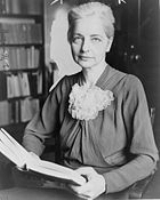
Ruth Benedict

Encyclopedia
Ruth Benedict was an American
anthropologist, cultural relativist, and folklorist.
She was born in New York City
, and attended Vassar College
, graduating in 1909. She entered graduate studies at Columbia University
in 1919, studying under Franz Boas
, receiving her PhD
and joining the faculty in 1923. Margaret Mead
, with whom she may have shared a romantic relationship, and Marvin Opler
were among her students and colleagues.
Franz Boas
, her teacher
and mentor
, has been called the father of American anthropology and his teachings and point of view are clearly evident in Benedict's work. Boas is author of many classic works including Race, Language, and Culture—perhaps the most potent anti-racist text to emerge from the academic world in his time. In it Boas attempts to prove that race, language
, and culture
are independent. Ruth Benedict was affected by the passionate egalitarianism
of Boas, her mentor, and continued it in her research and writing.
Benedict held the post of President of the American Anthropological Association
and was also a prominent member of the American Folklore Society
. She can be viewed as a transitional figure in her field. She redirected both anthropology and folklore away from the limited confines of culture-trait diffusion studies and towards theories of performance as integral to the interpretation of culture. She questioned the relationships between personality, art, language and culture, insisting that no trait existed in isolation or self-sufficiency, a theory which she championed in her Patterns of Culture.
Mrs. Fulton was deeply affected by her husband’s passing. Any mention of him caused her to be overwhelmed by grief; every March she cried at church and in bed. Ruth hated her mother’s sorrow and viewed it as a weakness. For her, the greatest taboos in life were crying in front of people and showing expressions of pain. She reminisced, “I did not love my mother; I resented her cult of grief…”. Because of this, the psychological effects on her childhood were profound, for “…in one stroke she [Ruth] experienced the loss of the two most nourishing and protective people around her—the loss of her father at death and her mother to grief”. Because of these traumatic experiences, Ruth began to create what she called two separate “worlds.” “Her” world she associated with her father, death, and beauty. This world was her escape from reality; a place of fantasy and happiness. She hated the “real” world full of her mother’s weeping, confusion, and grief, and made up games to escape. In one instance she created an imaginary house with a family and playmate on the other side of the hill. She recalled, “This imaginary playmate and her family lived a warm, friendly, life without recriminations and brawls”.
As a toddler, she contracted measles
which left her partially deaf, which was not discovered until she began school. Ruth also had a fascination with death as a young child. When she was four years old her grandmother took her to see an infant that had recently died. Upon seeing the dead child’s face, Ruth claimed that it was the most beautiful thing she had ever seen. This attraction to death merely continued from there. By the time she was 6 years old, Ruth liked to go to the barn and, instead of jumping in the hay like most children, would lie in the dark and imagine it as her grave. According to biographer Margaret Caffrey, this fascination with death was most likely a typical response that many children have when a close family member dies. Her relationship with death was a way for her to stay connected to her father, and to cope with his passing. However, the attraction towards death continued even into Ruth’s adult life. As a mature woman, she felt that the face, in death, showed the real beauty or ugliness of a person. She felt cheated if she didn’t see the dead faces of those she loved. For instance, at the funeral of her husband’s father she noted, “but in his coffin I really saw him, and it was more than all the rest”. She felt that even death could not erase the ugliness of a person’s heart and so in seeing his beautiful face, she felt that she saw who he really was.
At age seven Ruth began to write short verses and read any book she could get her hands on. Her favorite author was Jean Ingelow
and her favorite readings were A Legend of Bregenz and The Judas Tree, advanced literature for one so young. Through writing she was able to gain approval from her family. Writing was her outlet, and she wrote with an insightful perception about the realities of life. For example, in her senior year of high school she wrote a piece called, “Lulu’s Wedding (A True Story)” in which she recalled the wedding of a family serving girl. Instead of romanticizing the event, she revealed the true, unromantic, arranged marriage that Lulu went through because the man would take her, even though he was much older. Even at this young age, Ruth was perceptive about the realities of the world around her.
Although, Ruth Benedict’s fascination with death started at an early age, she continued to study how death affected people, throughout her career. In her book Patterns of Culture, Benedict studied the Pueblo culture and how they dealt with grieving and death. She describes in the book that individuals may deal with reactions to death, such as frustration and grief, differently. Societies all have social norms that they follow; some allow more expression when dealing with death, such as mourning, while other societies are not allowed to acknowledge it. The studies that Benedict conducted during her career relate directly to her experience with death that she encountered with her father early in her childhood.
Over the next few years, Ruth took up many different jobs trying to keep herself busy while searching for a purpose in her life. First she tried paid social work for the Charity Organization Society, but the work was too painful and sad. Soon after, she accepted a job as a teacher at the Westlake School for Girls in Los Angeles California. While working there she gained her interest in Asia that would later affect her choice of fieldwork as a working anthropologist. However, she was unhappy with this job as well and, after one year, left to teach English in Pasadena at the Orton School for Girls. These years were very difficult for Ruth as she suffered from depression and severe loneliness. “In spite of myself bitterness at having lived at all obsessed me; it seemed cruel that I had been born, cruel that, as my family taught me, I must go on living forever” She felt as if she were living behind a mask that hid the real her. “I am not afraid of pain, nor of sorrow. But this loneliness, this futility, this emptiness—I dare not face them”. She worried that she would never find a man to marry or find a career that she liked. However, through reading authors like Walt Whitman and Jeffries that stressed a worth, importance and enthusiasm for life she held onto hope for a better future.
The summer after her first year teaching at the Orton School she returned home to the Shattuck’s farm to spend some time in thought and peace. Eventually her prayers were heard and Stanley Benedict began to visit her at the farm. She had met him by chance in Buffalo, New York around 1910. That summer Ruth fell deeply in love with Stanley as he began to visit her more, and accepted his proposal for marriage. She was so happy it was as if she had become a different person. Her journal exclaimed, “How shall I say it? That I have attained to the zest for life? That I have looked in the face of God and had five days of magnificent comprehensions?—It is more than these, and better. It is the greatest thing in the world—and I have it. Is it not incredible?”. For the next few years Ruth Benedict no longer felt the incredible loneliness and sadness that had previously marked her life since childhood. She underwent several writing projects in order to keep busy besides the everyday housework chores in her new life with Stanley. She began to publish poems under different pseudonyms—Ruth Stanhope, Edgar Stanhope, and Anne Singleton. She also began work on writing a biography about Mary Wollstonecraft and other lesser known women that she felt deserved more acknowledgement for their work and contributions.
However by 1918, Ruth and Stanley began to drift away from each other and the loneliness and depression returned. In her search for a career, she decided to attend some lectures at the New School for Social Research while looking into the possibility of becoming an educational philosopher. While at the school she took a class called “Sex in Ethnology” taught by Elsie Clews Parsons. She enjoyed the class and took another anthropology course with Alexander Goldenweiser, a student of noted anthropologist Franz Boas
. With Goldenweiser as her teacher, Ruth’s love for anthropology steadily grew. As close friend Margaret Mead
explained, “Anthropology made the first ‘sense’ that any ordered approach to life had ever made to Ruth Benedict” After working with Goldenweiser for a year, he sent her to work as a graduate student with Franz Boas at Columbia University in 1921. Boas gave her graduate credit for the courses she’d completed at the New School for Social Research and Ruth wrote her dissertation “The Concept of the Guardian Spirit in North America”. Ruth continued on to teach at the university level and to write several ethnographies such as Patterns of Culture in 1934 and The Chrysanthemum and the Sword: Patters of Japanese Culture in 1946. She was well known for her studies of how culture and social conditions related to culture.
. Ruth Benedict worked during a time when women were still struggling to have equal rights as men, yet she published her book, Patterns of Culture, only 14 years after the women’s suffrage. She became the first woman to be recognized as a prominent leader of a learned profession.
was Franz Boas
. He was known as an astounding professor for anthropology during his years working at Columbia and taught many classes related to various fields of anthropology. Franz Boas began teaching at Columbia, as a lecturer, in 1896; however, at the time there was no anthropology department at the university. Boas and another colleague, James McKeen Cattell
, were both involved in a committee entitled American Association for the Advancement of Science. Together on this committee, Boas and Cattell expressed the importance of having a course in anthropology at the university. In 1899, an anthropology department was added to the Columbia curriculum.
After many years of teaching, Boas was looking for someone to help him with his teaching and fieldwork, and the classroom was the perfect place to look for his assistant. Boas had two main successors in mind: Edward Sapir
and Alfred Kroeber; however, both of them rejected the thought of coming to Columbia University for different reasons. During this time, in 1932, Benedict was holding the position of administrative officer for the anthropology department.
After all of the successors that Boas had considered, the major turning point for Benedict’s career was when she and Boas received funding for Project #35, which was concerned with the cultures of the North and South American Indians. The relationship between Boas and Benedict was purely academic and grew as Boas got older. In his later years, Franz Boas focused on having someone to continue his work after he passed away.
. Letters that Landes sent to Benedict state that she was enthralled by the way in which Benedict taught her classes, and with the way she forced the students to think in an unconventional way. Landes also stated that she was never as happy studying anthropology as when she was studying with Benedict and Boas. Landes has recorded that the friendship between herself and Benedict was one of the most meaningful friendships of her life; it was a friendship that encouraged her to expand her thoughts about anthropology and question the social norms of society.
and Ruth Benedict are considered to be the two most influential and famous women anthropologists of their time; this is why their paths often crossed throughout their work. One of the reasons Mead and Benedict got along well was because they both shared a passion for their work and they each felt a sense of pride at being a successful working woman during a time when this was uncommon. They were known to critique each other’s work frequently; they created a companionship that began through their work, but which also during the early period was of an erotic character. Both Benedict and Mead wanted to dislodge stereotypes about women during their time period and show that working women can be successful even though working society was seen as a man’s world.
The lives of Mead and Benedict were intertwined in various ways. They worked together in different fieldwork and they both conducted expeditions relating to various topics in anthropology. There is also speculation that the two were involved in a romantic relationship at some point in time. After Benedict died of a heart attack in 1948, Mead kept the legacy of Benedict’s work going by supervising projects that Benedict would have looked after, and editing and publishing notes from studies that Benedict had collected throughout her life.
The essential idea in Patterns of Culture is, according to the foreword by Margaret Mead, "her view of human cultures as 'personality writ large.'" Each culture, Benedict explains, chooses from "the great arc of human potentialities" only a few characteristics which become the leading personality traits of the persons living in that culture. These traits comprise an interdependent constellation of aesthetics and values in each culture which together add up to a unique gestalt. For example she described the emphasis on restraint in Pueblo
cultures of the American southwest, and the emphasis on abandon in the Native American
cultures of the Great Plains
. She used the Nietzschean
opposites of "Apollonian" and "Dionysian"
as the stimulus for her thought about these Native American cultures. She describes how in ancient Greece, the worshipers of Apollo
emphasized order and calm in their celebrations. In contrast, the worshipers of Dionysus
, the god of wine
, emphasized wildness, abandon, letting go. And so it was among Native Americans. She described in detail the contrasts between rituals, beliefs, personal preferences amongst people of diverse cultures to show how each culture had a "personality" that was encouraged in each individual.
Other anthropologists of the culture and personality school also developed these ideas—notably Margaret Mead in her Coming of Age in Samoa
(published before "Patterns of Culture") and Sex and Temperament in Three Primitive Societies (published just after Benedict's book came out). Benedict was a senior student of Franz Boas when Mead began to study with them, and they had extensive and reciprocal influence on each other's work. Abram Kardiner was also affected by these ideas, and in time the concept of "modal personality" was born: the cluster of traits most commonly thought to be observed in people of any given culture.
Benedict, in Patterns of Culture, expresses her belief in cultural relativism
. She desired to show that each culture has its own moral imperatives that can be understood only if one studies that culture as a whole. It was wrong, she felt, to disparage the customs or values of a culture different from one's own. Those customs had a meaning to the people who lived them which should not be dismissed or trivialized. We should not try to evaluate people by our standards alone. Morality
, she argued, was relative to the values of the culture in which one operated.
As she described the Kwakiutl
s of the Northwest Coast
(based on the fieldwork of her mentor Franz Boas), the Pueblos of New Mexico
(among whom she had direct experience), the nations of the Great Plains, and the Dobu
culture of New Guinea
(regarding whom she relied upon Mead and Reo Fortune
's fieldwork), she gave evidence that their values, even where they may seem strange, are intelligible in terms of their own coherent cultural systems and should be understood and respected.
Critics have objected to the degree of abstraction and generalization inherent in the "culture and personality" approach. Some have argued that particular patterns she found may only be a part or a subset of the whole cultures. For example, David Friend Aberle writes that the Pueblo people may be calm, gentle, and much given to ritual when in one mood or set of circumstances, but can be suspicious, retaliatory, and warlike in other circumstances. Nevertheless, Benedict's elegant descriptions are vivid, readable, and easy to relate to. New generations of students continue to find her arguments persuasive even after the culture and personality school has been abandoned by anthropologists generally.
In 1936 she was appointed an associate professor
at Columbia University
. However, by then Dr. Benedict had already assisted in the training and guidance of several Columbia students of anthropology including Margaret Mead
and Ruth Landes
.
Benedict was among the leading cultural anthropologists
who were recruited by the U.S. Government
for war-related research and consultation after U.S.
entry into World War II
.
"The world is shrinking" begin Benedict and Weltfish. "Thirty-seven nations are now united in a common cause—victory over Axis aggression, the military destruction of fascism
".(p. 1)
The nations united against fascism
, they continue, include "the most different physical types of men."
And the writers explicate, in section after section, the best evidence they knew for human equality. They want to encourage all these types of people to join together and not fight amongst themselves. "The peoples of the earth", they point out, "are one family. We all have just so many teeth, so many molars, just so many little bones and muscles—so we can only have come from one set of ancestors no matter what our color, the shape of our head, the texture of our hair. "The races of mankind are what the Bible
says they are—brothers. In their bodies is the record of their brotherhood."
Environment has to do with our physical traits. Dark skin affords some protection against strong tropical sunlight, for example.
But whatever our physical traits, regardless of the shape or size of our head, we are equally intelligent. "The best scientists cannot tell from examining a brain to what group of people its owner belonged....Some of the most brilliant men in the world have had very small brains. On the other hand, the world's largest brain belongs to an imbecile
."
Environment has more to do with intelligence than birth does, including how much money is spent on schools. "Southern Whites", for example, scored below "Northern Negroes" in the IQ tests
administered to the American Expeditionary Force
(AEF) in World War I
. And the per capita expenditures on schools in the South
were only "fractions" of those in northern states in 1917.
Not only is the intelligence of people the same, on the whole, but the blood has the same chemical composition. Different peoples don't have different blood—"all the races of man have all [the] blood type
s"—and can receive transfusions from one another to save lives.
And all people are of mixed race, produced by "the movements of peoples over the face of the earth...since before history
began."
This knowledge, and more, was intended to work against superiority—the superiority "a man claims when he says, 'I was born a member of a superior race.'....Racial prejudice," write the authors, "makes people ruthless."
that she published in 1946, incorporating results of her war-time research.
This book is an instance of Anthropology at a Distance. Study of a culture through its literature
, through newspaper clippings, through films and recordings, etc., was necessary when anthropologists aided the United States and its allies
in World War II. Unable to visit Nazi Germany
or Japan under Hirohito
, anthropologists made use of the cultural materials to produce studies at a distance. They were attempting to understand the cultural patterns that might be driving their aggression, and hoped to find possible weaknesses, or means of persuasion
that had been missed.
Benedict's war work included a major study, largely completed in 1944, aimed at understanding Japanese culture
. Americans found themselves unable to comprehend matters in Japanese culture. For instance, Americans
considered it quite natural for American prisoners of war to want their families to know they were alive, and to keep quiet when asked for information about troop movements, etc., while Japanese POWs, apparently, gave information freely and did not try to contact their families. Why was that? Why, too, did Asian peoples neither treat the Japanese as their liberators from Western colonialism
, nor accept their own supposedly obviously just place in a hierarchy that had Japanese at the top?
Benedict played a major role in grasping the place of the Emperor of Japan
in Japanese popular culture
, and formulating the recommendation to President Franklin D. Roosevelt
that permitting continuation of the Emperor's reign had to be part of the eventual surrender offer.
While one critic has written that The Chrysanthemum and the Sword is "long since... discredited since Benedict had no direct experience in Japan" , the Japanese ambassador to Pakistan
stated this in a public address:
Other Japanese who have read this work, according to Margaret Mead, found it on the whole accurate but somewhat "moralistic". Sections of the book were mentioned in Takeo Doi
's book, The Anatomy of Dependence
, though Doi is highly critical of Benedict's concept that Japan has a 'shame' culture, whose emphasis is on how one's moral conduct appear to outsider in contradistinction to America's (Christian) 'guilt' culture, in which the emphasis is on individual's internal conscience. Doi stated that, this claim clearly implies the former value system is inferior to the latter one.
began, Benedict was giving lectures at the Bryn Mawr College
for the Anna Howard Shaw Memorial Lectureship. These lectures were focused around the idea of synergy. Yet, WWII made her focus on other areas of concentration of anthropology and the lectures were never presented in their entirety. After the war was over, she focused on finishing her book The Chrysanthemum and the Sword
. It is important to note that her original notes for the synergy lecture were never found after her death. She was elected a Fellow of the American Academy of Arts and Sciences
in 1947. She continued her teaching after the war, advancing to the rank of full professor only two months before her death, and died in New York
on September 17, 1948.
A U.S. 46¢ Great Americans series
postage stamp
in her honor was issued October 20, 1995.
Stony Brook University
is named Benedict College, after Ruth Benedict for her achievements in the field.
United States
The United States of America is a federal constitutional republic comprising fifty states and a federal district...
anthropologist, cultural relativist, and folklorist.
She was born in New York City
New York City
New York is the most populous city in the United States and the center of the New York Metropolitan Area, one of the most populous metropolitan areas in the world. New York exerts a significant impact upon global commerce, finance, media, art, fashion, research, technology, education, and...
, and attended Vassar College
Vassar College
Vassar College is a private, coeducational liberal arts college in the town of Poughkeepsie, New York, in the United States. The Vassar campus comprises over and more than 100 buildings, including four National Historic Landmarks, ranging in style from Collegiate Gothic to International,...
, graduating in 1909. She entered graduate studies at Columbia University
Columbia University
Columbia University in the City of New York is a private, Ivy League university in Manhattan, New York City. Columbia is the oldest institution of higher learning in the state of New York, the fifth oldest in the United States, and one of the country's nine Colonial Colleges founded before the...
in 1919, studying under Franz Boas
Franz Boas
Franz Boas was a German-American anthropologist and a pioneer of modern anthropology who has been called the "Father of American Anthropology" and "the Father of Modern Anthropology." Like many such pioneers, he trained in other disciplines; he received his doctorate in physics, and did...
, receiving her PhD
Doctor of Philosophy
Doctor of Philosophy, abbreviated as Ph.D., PhD, D.Phil., or DPhil , in English-speaking countries, is a postgraduate academic degree awarded by universities...
and joining the faculty in 1923. Margaret Mead
Margaret Mead
Margaret Mead was an American cultural anthropologist, who was frequently a featured writer and speaker in the mass media throughout the 1960s and 1970s....
, with whom she may have shared a romantic relationship, and Marvin Opler
Marvin Opler
Marvin Kaufmann Opler was an American anthropologist and social psychiatrist. His brother Morris Edward Opler was also an anthropologist who studied the Southern Athabaskan peoples of North America. Morris and Marvin Opler were the sons of Austrian-born Arthur A. Opler, a merchant, and Fanny...
were among her students and colleagues.
Franz Boas
Franz Boas
Franz Boas was a German-American anthropologist and a pioneer of modern anthropology who has been called the "Father of American Anthropology" and "the Father of Modern Anthropology." Like many such pioneers, he trained in other disciplines; he received his doctorate in physics, and did...
, her teacher
Teacher
A teacher or schoolteacher is a person who provides education for pupils and students . The role of teacher is often formal and ongoing, carried out at a school or other place of formal education. In many countries, a person who wishes to become a teacher must first obtain specified professional...
and mentor
Mentor
In Greek mythology, Mentor was the son of Alcimus or Anchialus. In his old age Mentor was a friend of Odysseus who placed Mentor and Odysseus' foster-brother Eumaeus in charge of his son Telemachus, and of Odysseus' palace, when Odysseus left for the Trojan War.When Athena visited Telemachus she...
, has been called the father of American anthropology and his teachings and point of view are clearly evident in Benedict's work. Boas is author of many classic works including Race, Language, and Culture—perhaps the most potent anti-racist text to emerge from the academic world in his time. In it Boas attempts to prove that race, language
Language
Language may refer either to the specifically human capacity for acquiring and using complex systems of communication, or to a specific instance of such a system of complex communication...
, and culture
Culture
Culture is a term that has many different inter-related meanings. For example, in 1952, Alfred Kroeber and Clyde Kluckhohn compiled a list of 164 definitions of "culture" in Culture: A Critical Review of Concepts and Definitions...
are independent. Ruth Benedict was affected by the passionate egalitarianism
Egalitarianism
Egalitarianism is a trend of thought that favors equality of some sort among moral agents, whether persons or animals. Emphasis is placed upon the fact that equality contains the idea of equity of quality...
of Boas, her mentor, and continued it in her research and writing.
Benedict held the post of President of the American Anthropological Association
American Anthropological Association
The American Anthropological Association is a professional organization of scholars and practitioners in the field of anthropology. With 11,000 members, the Arlington, Virginia based association includes archaeologists, cultural anthropologists, biological anthropologists, linguistic...
and was also a prominent member of the American Folklore Society
American Folklore Society
The American Folklore Society is the US-based professional association for folklorists, with members from the US, Canada, and around the world. It was founded in 1888 by William Wells Newell, who stood at the center of a diverse group of university-based scholars, museum anthropologists, and men...
. She can be viewed as a transitional figure in her field. She redirected both anthropology and folklore away from the limited confines of culture-trait diffusion studies and towards theories of performance as integral to the interpretation of culture. She questioned the relationships between personality, art, language and culture, insisting that no trait existed in isolation or self-sufficiency, a theory which she championed in her Patterns of Culture.
Childhood
Ruth Benedict was born in New York City on June 5, 1887, to Beatrice and Frederick Fulton. Her mother worked in the city as a schoolteacher, while her father pursued a promising career as a homoeopathic doctor and surgeon. Although Mr. Fulton loved his work and research, it eventually led to an early death. His career was cut short when he acquired an unknown disease during one of his surgeries in 1888. Due to his illness the family moved back to Norwich, New York to the farm of Ruth’s maternal grandparents, the Shattucks. A year later he died in March, ten days after returning from a trip to Trinidad to search for a cure.Mrs. Fulton was deeply affected by her husband’s passing. Any mention of him caused her to be overwhelmed by grief; every March she cried at church and in bed. Ruth hated her mother’s sorrow and viewed it as a weakness. For her, the greatest taboos in life were crying in front of people and showing expressions of pain. She reminisced, “I did not love my mother; I resented her cult of grief…”. Because of this, the psychological effects on her childhood were profound, for “…in one stroke she [Ruth] experienced the loss of the two most nourishing and protective people around her—the loss of her father at death and her mother to grief”. Because of these traumatic experiences, Ruth began to create what she called two separate “worlds.” “Her” world she associated with her father, death, and beauty. This world was her escape from reality; a place of fantasy and happiness. She hated the “real” world full of her mother’s weeping, confusion, and grief, and made up games to escape. In one instance she created an imaginary house with a family and playmate on the other side of the hill. She recalled, “This imaginary playmate and her family lived a warm, friendly, life without recriminations and brawls”.
As a toddler, she contracted measles
Measles
Measles, also known as rubeola or morbilli, is an infection of the respiratory system caused by a virus, specifically a paramyxovirus of the genus Morbillivirus. Morbilliviruses, like other paramyxoviruses, are enveloped, single-stranded, negative-sense RNA viruses...
which left her partially deaf, which was not discovered until she began school. Ruth also had a fascination with death as a young child. When she was four years old her grandmother took her to see an infant that had recently died. Upon seeing the dead child’s face, Ruth claimed that it was the most beautiful thing she had ever seen. This attraction to death merely continued from there. By the time she was 6 years old, Ruth liked to go to the barn and, instead of jumping in the hay like most children, would lie in the dark and imagine it as her grave. According to biographer Margaret Caffrey, this fascination with death was most likely a typical response that many children have when a close family member dies. Her relationship with death was a way for her to stay connected to her father, and to cope with his passing. However, the attraction towards death continued even into Ruth’s adult life. As a mature woman, she felt that the face, in death, showed the real beauty or ugliness of a person. She felt cheated if she didn’t see the dead faces of those she loved. For instance, at the funeral of her husband’s father she noted, “but in his coffin I really saw him, and it was more than all the rest”. She felt that even death could not erase the ugliness of a person’s heart and so in seeing his beautiful face, she felt that she saw who he really was.
At age seven Ruth began to write short verses and read any book she could get her hands on. Her favorite author was Jean Ingelow
Jean Ingelow
Jean Ingelow , was an English poet and novelist.- Early life and education :Born at Boston, Lincolnshire, she was the daughter of William Ingelow, a banker...
and her favorite readings were A Legend of Bregenz and The Judas Tree, advanced literature for one so young. Through writing she was able to gain approval from her family. Writing was her outlet, and she wrote with an insightful perception about the realities of life. For example, in her senior year of high school she wrote a piece called, “Lulu’s Wedding (A True Story)” in which she recalled the wedding of a family serving girl. Instead of romanticizing the event, she revealed the true, unromantic, arranged marriage that Lulu went through because the man would take her, even though he was much older. Even at this young age, Ruth was perceptive about the realities of the world around her.
Although, Ruth Benedict’s fascination with death started at an early age, she continued to study how death affected people, throughout her career. In her book Patterns of Culture, Benedict studied the Pueblo culture and how they dealt with grieving and death. She describes in the book that individuals may deal with reactions to death, such as frustration and grief, differently. Societies all have social norms that they follow; some allow more expression when dealing with death, such as mourning, while other societies are not allowed to acknowledge it. The studies that Benedict conducted during her career relate directly to her experience with death that she encountered with her father early in her childhood.
Adolescence into adulthood
After high school, Margery (her sister) and Ruth were able to enter St. Margaret’s School for Girls, a college preparatory school, with help from a full time scholarship. The girls were successful in school and entered Vassar College in September 1905. In college, Ruth had more freedom than many other women of the time, but college still had its difficulties. During this time period stories were circulating that going to college led girls to become childless and never be married. Nevertheless, Ruth explored her interests in college and found writing as her way of expressing herself as an “intellectual radical” as she was sometimes called by her classmates. Author Walter Pater was a large influence on her life during this time as she strove to be like him and live a well-lived life. She graduated with her sister in 1909 with a major in English Literature. Unsure of what to do after college, she received an invitation to go on an all-expense paid tour around Europe by a wealthy trustee of the college. Accompanied by two girls from California that she’d never met, Katherine Norton and Elizabeth Atsatt, she traveled through France, Switzerland, Italy, Germany, and England for one year, having the opportunity of various home stays throughout the trip.Over the next few years, Ruth took up many different jobs trying to keep herself busy while searching for a purpose in her life. First she tried paid social work for the Charity Organization Society, but the work was too painful and sad. Soon after, she accepted a job as a teacher at the Westlake School for Girls in Los Angeles California. While working there she gained her interest in Asia that would later affect her choice of fieldwork as a working anthropologist. However, she was unhappy with this job as well and, after one year, left to teach English in Pasadena at the Orton School for Girls. These years were very difficult for Ruth as she suffered from depression and severe loneliness. “In spite of myself bitterness at having lived at all obsessed me; it seemed cruel that I had been born, cruel that, as my family taught me, I must go on living forever” She felt as if she were living behind a mask that hid the real her. “I am not afraid of pain, nor of sorrow. But this loneliness, this futility, this emptiness—I dare not face them”. She worried that she would never find a man to marry or find a career that she liked. However, through reading authors like Walt Whitman and Jeffries that stressed a worth, importance and enthusiasm for life she held onto hope for a better future.
The summer after her first year teaching at the Orton School she returned home to the Shattuck’s farm to spend some time in thought and peace. Eventually her prayers were heard and Stanley Benedict began to visit her at the farm. She had met him by chance in Buffalo, New York around 1910. That summer Ruth fell deeply in love with Stanley as he began to visit her more, and accepted his proposal for marriage. She was so happy it was as if she had become a different person. Her journal exclaimed, “How shall I say it? That I have attained to the zest for life? That I have looked in the face of God and had five days of magnificent comprehensions?—It is more than these, and better. It is the greatest thing in the world—and I have it. Is it not incredible?”. For the next few years Ruth Benedict no longer felt the incredible loneliness and sadness that had previously marked her life since childhood. She underwent several writing projects in order to keep busy besides the everyday housework chores in her new life with Stanley. She began to publish poems under different pseudonyms—Ruth Stanhope, Edgar Stanhope, and Anne Singleton. She also began work on writing a biography about Mary Wollstonecraft and other lesser known women that she felt deserved more acknowledgement for their work and contributions.
However by 1918, Ruth and Stanley began to drift away from each other and the loneliness and depression returned. In her search for a career, she decided to attend some lectures at the New School for Social Research while looking into the possibility of becoming an educational philosopher. While at the school she took a class called “Sex in Ethnology” taught by Elsie Clews Parsons. She enjoyed the class and took another anthropology course with Alexander Goldenweiser, a student of noted anthropologist Franz Boas
Franz Boas
Franz Boas was a German-American anthropologist and a pioneer of modern anthropology who has been called the "Father of American Anthropology" and "the Father of Modern Anthropology." Like many such pioneers, he trained in other disciplines; he received his doctorate in physics, and did...
. With Goldenweiser as her teacher, Ruth’s love for anthropology steadily grew. As close friend Margaret Mead
Margaret Mead
Margaret Mead was an American cultural anthropologist, who was frequently a featured writer and speaker in the mass media throughout the 1960s and 1970s....
explained, “Anthropology made the first ‘sense’ that any ordered approach to life had ever made to Ruth Benedict” After working with Goldenweiser for a year, he sent her to work as a graduate student with Franz Boas at Columbia University in 1921. Boas gave her graduate credit for the courses she’d completed at the New School for Social Research and Ruth wrote her dissertation “The Concept of the Guardian Spirit in North America”. Ruth continued on to teach at the university level and to write several ethnographies such as Patterns of Culture in 1934 and The Chrysanthemum and the Sword: Patters of Japanese Culture in 1946. She was well known for her studies of how culture and social conditions related to culture.
Challenges of the 1930s and 40s
The time period in which Ruth Benedict conducted most of her work was from the early 1930s to the mid 1940s. Benedict is most famous for her books, Patterns of Culture and The Chrysanthemum and the Sword; however, one thing that is important to keep in mind about these explorations is the time period in which they were conducted. As a young woman, Benedict received a very elite education for a woman during the early part of the 1900s. Though she came from a successful family, and this helped her attend these specific universities as a young woman, they were still regarded as academically superior in the country. This helped Benedict receive a building block for education and a jumping point in which she would be able to start her research around the world. Yet, there was a revolution during the early 1900s that gave Benedict the ability to be able to do her research: this was the women’s rights movementWomen's rights
Women's rights are entitlements and freedoms claimed for women and girls of all ages in many societies.In some places these rights are institutionalized or supported by law, local custom, and behaviour, whereas in others they may be ignored or suppressed...
. Ruth Benedict worked during a time when women were still struggling to have equal rights as men, yet she published her book, Patterns of Culture, only 14 years after the women’s suffrage. She became the first woman to be recognized as a prominent leader of a learned profession.
Relationship with Franz Boas
One professor whom Benedict studied under at Columbia UniversityColumbia University
Columbia University in the City of New York is a private, Ivy League university in Manhattan, New York City. Columbia is the oldest institution of higher learning in the state of New York, the fifth oldest in the United States, and one of the country's nine Colonial Colleges founded before the...
was Franz Boas
Franz Boas
Franz Boas was a German-American anthropologist and a pioneer of modern anthropology who has been called the "Father of American Anthropology" and "the Father of Modern Anthropology." Like many such pioneers, he trained in other disciplines; he received his doctorate in physics, and did...
. He was known as an astounding professor for anthropology during his years working at Columbia and taught many classes related to various fields of anthropology. Franz Boas began teaching at Columbia, as a lecturer, in 1896; however, at the time there was no anthropology department at the university. Boas and another colleague, James McKeen Cattell
James McKeen Cattell
James McKeen Cattell , American psychologist, was the first professor of psychology in the United States at the University of Pennsylvania and long-time editor and publisher of scientific journals and publications, most notably the journal Science...
, were both involved in a committee entitled American Association for the Advancement of Science. Together on this committee, Boas and Cattell expressed the importance of having a course in anthropology at the university. In 1899, an anthropology department was added to the Columbia curriculum.
After many years of teaching, Boas was looking for someone to help him with his teaching and fieldwork, and the classroom was the perfect place to look for his assistant. Boas had two main successors in mind: Edward Sapir
Edward Sapir
Edward Sapir was an American anthropologist-linguist, widely considered to be one of the most important figures in the early development of the discipline of linguistics....
and Alfred Kroeber; however, both of them rejected the thought of coming to Columbia University for different reasons. During this time, in 1932, Benedict was holding the position of administrative officer for the anthropology department.
After all of the successors that Boas had considered, the major turning point for Benedict’s career was when she and Boas received funding for Project #35, which was concerned with the cultures of the North and South American Indians. The relationship between Boas and Benedict was purely academic and grew as Boas got older. In his later years, Franz Boas focused on having someone to continue his work after he passed away.
Relationship with Ruth Schlossberg Landes
Boas regarded Benedict as an asset to the anthropology department, and often introduced her to students throughout the years. One student who felt especially fond of Ruth Benedict was Ruth Schlossberg LandesRuth Landes
Ruth Landes was an American cultural anthropologist best known for studies on Brazilian candomblé cults and her published study on the topic, City of Women...
. Letters that Landes sent to Benedict state that she was enthralled by the way in which Benedict taught her classes, and with the way she forced the students to think in an unconventional way. Landes also stated that she was never as happy studying anthropology as when she was studying with Benedict and Boas. Landes has recorded that the friendship between herself and Benedict was one of the most meaningful friendships of her life; it was a friendship that encouraged her to expand her thoughts about anthropology and question the social norms of society.
Relationship with Margaret Mead
Margaret MeadMargaret Mead
Margaret Mead was an American cultural anthropologist, who was frequently a featured writer and speaker in the mass media throughout the 1960s and 1970s....
and Ruth Benedict are considered to be the two most influential and famous women anthropologists of their time; this is why their paths often crossed throughout their work. One of the reasons Mead and Benedict got along well was because they both shared a passion for their work and they each felt a sense of pride at being a successful working woman during a time when this was uncommon. They were known to critique each other’s work frequently; they created a companionship that began through their work, but which also during the early period was of an erotic character. Both Benedict and Mead wanted to dislodge stereotypes about women during their time period and show that working women can be successful even though working society was seen as a man’s world.
The lives of Mead and Benedict were intertwined in various ways. They worked together in different fieldwork and they both conducted expeditions relating to various topics in anthropology. There is also speculation that the two were involved in a romantic relationship at some point in time. After Benedict died of a heart attack in 1948, Mead kept the legacy of Benedict’s work going by supervising projects that Benedict would have looked after, and editing and publishing notes from studies that Benedict had collected throughout her life.
Patterns of Culture
Benedict's Patterns of Culture (1934) was translated into fourteen languages and was published in many editions as standard reading for anthropology courses in American universities for years.The essential idea in Patterns of Culture is, according to the foreword by Margaret Mead, "her view of human cultures as 'personality writ large.'" Each culture, Benedict explains, chooses from "the great arc of human potentialities" only a few characteristics which become the leading personality traits of the persons living in that culture. These traits comprise an interdependent constellation of aesthetics and values in each culture which together add up to a unique gestalt. For example she described the emphasis on restraint in Pueblo
Pueblo
Pueblo is a term used to describe modern communities of Native Americans in the Southwestern United States of America. The first Spanish explorers of the Southwest used this term to describe the communities housed in apartment-like structures built of stone, adobe mud, and other local material...
cultures of the American southwest, and the emphasis on abandon in the Native American
Native Americans in the United States
Native Americans in the United States are the indigenous peoples in North America within the boundaries of the present-day continental United States, parts of Alaska, and the island state of Hawaii. They are composed of numerous, distinct tribes, states, and ethnic groups, many of which survive as...
cultures of the Great Plains
Great Plains
The Great Plains are a broad expanse of flat land, much of it covered in prairie, steppe and grassland, which lies west of the Mississippi River and east of the Rocky Mountains in the United States and Canada. This area covers parts of the U.S...
. She used the Nietzschean
Friedrich Nietzsche
Friedrich Wilhelm Nietzsche was a 19th-century German philosopher, poet, composer and classical philologist...
opposites of "Apollonian" and "Dionysian"
Apollonian and Dionysian
The Apollonian and Dionysian is a philosophical and literary concept, or dichotomy, based on certain features of ancient Greek mythology. Several Western philosophical and literary figures have invoked this dichotomy in critical and creative works....
as the stimulus for her thought about these Native American cultures. She describes how in ancient Greece, the worshipers of Apollo
Apollo
Apollo is one of the most important and complex of the Olympian deities in Greek and Roman mythology...
emphasized order and calm in their celebrations. In contrast, the worshipers of Dionysus
Dionysus
Dionysus was the god of the grape harvest, winemaking and wine, of ritual madness and ecstasy in Greek mythology. His name in Linear B tablets shows he was worshipped from c. 1500—1100 BC by Mycenean Greeks: other traces of Dionysian-type cult have been found in ancient Minoan Crete...
, the god of wine
Wine
Wine is an alcoholic beverage, made of fermented fruit juice, usually from grapes. The natural chemical balance of grapes lets them ferment without the addition of sugars, acids, enzymes, or other nutrients. Grape wine is produced by fermenting crushed grapes using various types of yeast. Yeast...
, emphasized wildness, abandon, letting go. And so it was among Native Americans. She described in detail the contrasts between rituals, beliefs, personal preferences amongst people of diverse cultures to show how each culture had a "personality" that was encouraged in each individual.
Other anthropologists of the culture and personality school also developed these ideas—notably Margaret Mead in her Coming of Age in Samoa
Coming of Age in Samoa
Coming of Age in Samoa is a book by American anthropologist Margaret Mead based upon her research and study of youth on the island of Ta'u in the Samoa Islands which primarily focused on adolescent girls. Mead was 23 years old when she carried out her field work in Samoa...
(published before "Patterns of Culture") and Sex and Temperament in Three Primitive Societies (published just after Benedict's book came out). Benedict was a senior student of Franz Boas when Mead began to study with them, and they had extensive and reciprocal influence on each other's work. Abram Kardiner was also affected by these ideas, and in time the concept of "modal personality" was born: the cluster of traits most commonly thought to be observed in people of any given culture.
Benedict, in Patterns of Culture, expresses her belief in cultural relativism
Cultural relativism
Cultural relativism is the principle that an individual human's beliefs and activities should be understood by others in terms of that individual's own culture. This principle was established as axiomatic in anthropological research by Franz Boas in the first few decades of the 20th century and...
. She desired to show that each culture has its own moral imperatives that can be understood only if one studies that culture as a whole. It was wrong, she felt, to disparage the customs or values of a culture different from one's own. Those customs had a meaning to the people who lived them which should not be dismissed or trivialized. We should not try to evaluate people by our standards alone. Morality
Morality
Morality is the differentiation among intentions, decisions, and actions between those that are good and bad . A moral code is a system of morality and a moral is any one practice or teaching within a moral code...
, she argued, was relative to the values of the culture in which one operated.
As she described the Kwakiutl
Kwakiutl
The term Kwakiutl, historically applied to the entire Kwakwaka'wakw ethno-linguistic group of originally 28 tribes, comes from one of the Kwakwaka'wakw tribes, the Kwagu'ł or Kwagyeulth, at Fort Rupert, with whom Franz Boas did most of his anthropological work and whose Indian Act Band government...
s of the Northwest Coast
Pacific Northwest
The Pacific Northwest is a region in northwestern North America, bounded by the Pacific Ocean to the west and, loosely, by the Rocky Mountains on the east. Definitions of the region vary and there is no commonly agreed upon boundary, even among Pacific Northwesterners. A common concept of the...
(based on the fieldwork of her mentor Franz Boas), the Pueblos of New Mexico
New Mexico
New Mexico is a state located in the southwest and western regions of the United States. New Mexico is also usually considered one of the Mountain States. With a population density of 16 per square mile, New Mexico is the sixth-most sparsely inhabited U.S...
(among whom she had direct experience), the nations of the Great Plains, and the Dobu
Dobu Island
Dobu Island is an island, part of D'Entrecasteaux Islands in Papua New Guinea. It is located south of Fergusson Island and north of Normanby Island.The people of Dobu were the subject of a seminal anthropological study by Reo Fortune...
culture of New Guinea
New Guinea
New Guinea is the world's second largest island, after Greenland, covering a land area of 786,000 km2. Located in the southwest Pacific Ocean, it lies geographically to the east of the Malay Archipelago, with which it is sometimes included as part of a greater Indo-Australian Archipelago...
(regarding whom she relied upon Mead and Reo Fortune
Reo Fortune
Reo Franklin Fortune was a New Zealand social anthropologist. Originally trained as a psychologist, Fortune was a lecturer in social anthropology at the Cambridge University, and a specialist in Melanesian language and culture. He was married to Margaret Mead, with whom he undertook field studies...
's fieldwork), she gave evidence that their values, even where they may seem strange, are intelligible in terms of their own coherent cultural systems and should be understood and respected.
Critics have objected to the degree of abstraction and generalization inherent in the "culture and personality" approach. Some have argued that particular patterns she found may only be a part or a subset of the whole cultures. For example, David Friend Aberle writes that the Pueblo people may be calm, gentle, and much given to ritual when in one mood or set of circumstances, but can be suspicious, retaliatory, and warlike in other circumstances. Nevertheless, Benedict's elegant descriptions are vivid, readable, and easy to relate to. New generations of students continue to find her arguments persuasive even after the culture and personality school has been abandoned by anthropologists generally.
In 1936 she was appointed an associate professor
Professor
A professor is a scholarly teacher; the precise meaning of the term varies by country. Literally, professor derives from Latin as a "person who professes" being usually an expert in arts or sciences; a teacher of high rank...
at Columbia University
Columbia University
Columbia University in the City of New York is a private, Ivy League university in Manhattan, New York City. Columbia is the oldest institution of higher learning in the state of New York, the fifth oldest in the United States, and one of the country's nine Colonial Colleges founded before the...
. However, by then Dr. Benedict had already assisted in the training and guidance of several Columbia students of anthropology including Margaret Mead
Margaret Mead
Margaret Mead was an American cultural anthropologist, who was frequently a featured writer and speaker in the mass media throughout the 1960s and 1970s....
and Ruth Landes
Ruth Landes
Ruth Landes was an American cultural anthropologist best known for studies on Brazilian candomblé cults and her published study on the topic, City of Women...
.
Benedict was among the leading cultural anthropologists
Cultural anthropology
Cultural anthropology is a branch of anthropology focused on the study of cultural variation among humans, collecting data about the impact of global economic and political processes on local cultural realities. Anthropologists use a variety of methods, including participant observation,...
who were recruited by the U.S. Government
Federal government of the United States
The federal government of the United States is the national government of the constitutional republic of fifty states that is the United States of America. The federal government comprises three distinct branches of government: a legislative, an executive and a judiciary. These branches and...
for war-related research and consultation after U.S.
United States
The United States of America is a federal constitutional republic comprising fifty states and a federal district...
entry into World War II
World War II
World War II, or the Second World War , was a global conflict lasting from 1939 to 1945, involving most of the world's nations—including all of the great powers—eventually forming two opposing military alliances: the Allies and the Axis...
.
"The Races of Mankind"
One of Benedict's lesser known works was a pamphlet "The Races of Mankind" which she wrote with her colleague at the Columbia University Department of Anthropology, Gene Weltfish. This pamphlet was intended for American troops and set forth, in simple language with cartoon illustrations, the scientific case against racist beliefs."The world is shrinking" begin Benedict and Weltfish. "Thirty-seven nations are now united in a common cause—victory over Axis aggression, the military destruction of fascism
Fascism
Fascism is a radical authoritarian nationalist political ideology. Fascists seek to rejuvenate their nation based on commitment to the national community as an organic entity, in which individuals are bound together in national identity by suprapersonal connections of ancestry, culture, and blood...
".(p. 1)
The nations united against fascism
Fascism
Fascism is a radical authoritarian nationalist political ideology. Fascists seek to rejuvenate their nation based on commitment to the national community as an organic entity, in which individuals are bound together in national identity by suprapersonal connections of ancestry, culture, and blood...
, they continue, include "the most different physical types of men."
And the writers explicate, in section after section, the best evidence they knew for human equality. They want to encourage all these types of people to join together and not fight amongst themselves. "The peoples of the earth", they point out, "are one family. We all have just so many teeth, so many molars, just so many little bones and muscles—so we can only have come from one set of ancestors no matter what our color, the shape of our head, the texture of our hair. "The races of mankind are what the Bible
Bible
The Bible refers to any one of the collections of the primary religious texts of Judaism and Christianity. There is no common version of the Bible, as the individual books , their contents and their order vary among denominations...
says they are—brothers. In their bodies is the record of their brotherhood."
Environment has to do with our physical traits. Dark skin affords some protection against strong tropical sunlight, for example.
But whatever our physical traits, regardless of the shape or size of our head, we are equally intelligent. "The best scientists cannot tell from examining a brain to what group of people its owner belonged....Some of the most brilliant men in the world have had very small brains. On the other hand, the world's largest brain belongs to an imbecile
Imbecile
Imbecile is a term for moderate to severe mental retardation, as well as for a type of criminal. It arises from the Latin word imbecillus, meaning weak, or weak-minded. "Imbecile" was once applied to people with an IQ of 26-50, between "moron" and "idiot" .The term was further refined into mental...
."
Environment has more to do with intelligence than birth does, including how much money is spent on schools. "Southern Whites", for example, scored below "Northern Negroes" in the IQ tests
Intelligence quotient
An intelligence quotient, or IQ, is a score derived from one of several different standardized tests designed to assess intelligence. When modern IQ tests are constructed, the mean score within an age group is set to 100 and the standard deviation to 15...
administered to the American Expeditionary Force
American Expeditionary Force
The American Expeditionary Forces or AEF were the United States Armed Forces sent to Europe in World War I. During the United States campaigns in World War I the AEF fought in France alongside British and French allied forces in the last year of the war, against Imperial German forces...
(AEF) in World War I
World War I
World War I , which was predominantly called the World War or the Great War from its occurrence until 1939, and the First World War or World War I thereafter, was a major war centred in Europe that began on 28 July 1914 and lasted until 11 November 1918...
. And the per capita expenditures on schools in the South
Southern United States
The Southern United States—commonly referred to as the American South, Dixie, or simply the South—constitutes a large distinctive area in the southeastern and south-central United States...
were only "fractions" of those in northern states in 1917.
-
- The difference....[arose] because of differences of income, education, cultural advantages, and other opportunities.
Not only is the intelligence of people the same, on the whole, but the blood has the same chemical composition. Different peoples don't have different blood—"all the races of man have all [the] blood type
Blood type
A blood type is a classification of blood based on the presence or absence of inherited antigenic substances on the surface of red blood cells . These antigens may be proteins, carbohydrates, glycoproteins, or glycolipids, depending on the blood group system...
s"—and can receive transfusions from one another to save lives.
And all people are of mixed race, produced by "the movements of peoples over the face of the earth...since before history
History
History is the discovery, collection, organization, and presentation of information about past events. History can also mean the period of time after writing was invented. Scholars who write about history are called historians...
began."
This knowledge, and more, was intended to work against superiority—the superiority "a man claims when he says, 'I was born a member of a superior race.'....Racial prejudice," write the authors, "makes people ruthless."
The Chrysanthemum and the Sword
Benedict is known not only for her earlier Patterns of Culture but also for her later book The Chrysanthemum and the Sword, the study of the society and culture of JapanJapan
Japan is an island nation in East Asia. Located in the Pacific Ocean, it lies to the east of the Sea of Japan, China, North Korea, South Korea and Russia, stretching from the Sea of Okhotsk in the north to the East China Sea and Taiwan in the south...
that she published in 1946, incorporating results of her war-time research.
This book is an instance of Anthropology at a Distance. Study of a culture through its literature
Literature
Literature is the art of written works, and is not bound to published sources...
, through newspaper clippings, through films and recordings, etc., was necessary when anthropologists aided the United States and its allies
Allies of World War II
The Allies of World War II were the countries that opposed the Axis powers during the Second World War . Former Axis states contributing to the Allied victory are not considered Allied states...
in World War II. Unable to visit Nazi Germany
Nazi Germany
Nazi Germany , also known as the Third Reich , but officially called German Reich from 1933 to 1943 and Greater German Reich from 26 June 1943 onward, is the name commonly used to refer to the state of Germany from 1933 to 1945, when it was a totalitarian dictatorship ruled by...
or Japan under Hirohito
Hirohito
, posthumously in Japan officially called Emperor Shōwa or , was the 124th Emperor of Japan according to the traditional order, reigning from December 25, 1926, until his death in 1989. Although better known outside of Japan by his personal name Hirohito, in Japan he is now referred to...
, anthropologists made use of the cultural materials to produce studies at a distance. They were attempting to understand the cultural patterns that might be driving their aggression, and hoped to find possible weaknesses, or means of persuasion
Persuasion
Persuasion is a form of social influence. It is the process of guiding or bringing oneself or another toward the adoption of an idea, attitude, or action by rational and symbolic means.- Methods :...
that had been missed.
Benedict's war work included a major study, largely completed in 1944, aimed at understanding Japanese culture
Culture of Japan
The culture of Japan has evolved greatly over the millennia, from the country's prehistoric Jōmon period to its contemporary hybrid culture, which combines influences from Asia, Europe and North America...
. Americans found themselves unable to comprehend matters in Japanese culture. For instance, Americans
United States
The United States of America is a federal constitutional republic comprising fifty states and a federal district...
considered it quite natural for American prisoners of war to want their families to know they were alive, and to keep quiet when asked for information about troop movements, etc., while Japanese POWs, apparently, gave information freely and did not try to contact their families. Why was that? Why, too, did Asian peoples neither treat the Japanese as their liberators from Western colonialism
Colonialism
Colonialism is the establishment, maintenance, acquisition and expansion of colonies in one territory by people from another territory. It is a process whereby the metropole claims sovereignty over the colony and the social structure, government, and economics of the colony are changed by...
, nor accept their own supposedly obviously just place in a hierarchy that had Japanese at the top?
Benedict played a major role in grasping the place of the Emperor of Japan
Emperor of Japan
The Emperor of Japan is, according to the 1947 Constitution of Japan, "the symbol of the state and of the unity of the people." He is a ceremonial figurehead under a form of constitutional monarchy and is head of the Japanese Imperial Family with functions as head of state. He is also the highest...
in Japanese popular culture
Japanese popular culture
Japanese popular culture not only reflects the attitudes and concerns of the present but also provides a link to the past. Japanese cinema, cuisine, television programs, manga, and music all developed from older artistic and literary traditions, and many of their themes and styles of presentation...
, and formulating the recommendation to President Franklin D. Roosevelt
Franklin D. Roosevelt
Franklin Delano Roosevelt , also known by his initials, FDR, was the 32nd President of the United States and a central figure in world events during the mid-20th century, leading the United States during a time of worldwide economic crisis and world war...
that permitting continuation of the Emperor's reign had to be part of the eventual surrender offer.
While one critic has written that The Chrysanthemum and the Sword is "long since... discredited since Benedict had no direct experience in Japan" , the Japanese ambassador to Pakistan
Pakistan
Pakistan , officially the Islamic Republic of Pakistan is a sovereign state in South Asia. It has a coastline along the Arabian Sea and the Gulf of Oman in the south and is bordered by Afghanistan and Iran in the west, India in the east and China in the far northeast. In the north, Tajikistan...
stated this in a public address:
- In 1946, Ruth Benedict, a well-known American cultural anthropologist, published a book on Japan entitled “The Chrysanthemum and The Sword”, which has been a must reading for many students of Japanese studies.
Other Japanese who have read this work, according to Margaret Mead, found it on the whole accurate but somewhat "moralistic". Sections of the book were mentioned in Takeo Doi
Takeo Doi
was a Japanese academic, psychoanalyst and author.-Early life:Doi was born in Tokyo, Japan in 1920. He was a graduate of the University of Tokyo.-Career:...
's book, The Anatomy of Dependence
The Anatomy of Dependence
is a non-fiction book written by Japanese psychoanalyst Takeo Doi. It was originally published in Japanese in 1971, and an English translation by John Bester was later published in 1973....
, though Doi is highly critical of Benedict's concept that Japan has a 'shame' culture, whose emphasis is on how one's moral conduct appear to outsider in contradistinction to America's (Christian) 'guilt' culture, in which the emphasis is on individual's internal conscience. Doi stated that, this claim clearly implies the former value system is inferior to the latter one.
Post-War
Before World War IIWorld War II
World War II, or the Second World War , was a global conflict lasting from 1939 to 1945, involving most of the world's nations—including all of the great powers—eventually forming two opposing military alliances: the Allies and the Axis...
began, Benedict was giving lectures at the Bryn Mawr College
Bryn Mawr College
Bryn Mawr College is a women's liberal arts college located in Bryn Mawr, a community in Lower Merion Township, Pennsylvania, ten miles west of Philadelphia. The name "Bryn Mawr" means "big hill" in Welsh....
for the Anna Howard Shaw Memorial Lectureship. These lectures were focused around the idea of synergy. Yet, WWII made her focus on other areas of concentration of anthropology and the lectures were never presented in their entirety. After the war was over, she focused on finishing her book The Chrysanthemum and the Sword
The Chrysanthemum and the Sword
The Chrysanthemum and the Sword: Patterns of Japanese Culture is an influential 1946 study of Japan by American anthropologist Ruth Benedict written at the invitation of the U.S. Office of War Information in order to understand and predict the behavior of the Japanese in World War II by reference...
. It is important to note that her original notes for the synergy lecture were never found after her death. She was elected a Fellow of the American Academy of Arts and Sciences
American Academy of Arts and Sciences
The American Academy of Arts and Sciences is an independent policy research center that conducts multidisciplinary studies of complex and emerging problems. The Academy’s elected members are leaders in the academic disciplines, the arts, business, and public affairs.James Bowdoin, John Adams, and...
in 1947. She continued her teaching after the war, advancing to the rank of full professor only two months before her death, and died in New York
New York
New York is a state in the Northeastern region of the United States. It is the nation's third most populous state. New York is bordered by New Jersey and Pennsylvania to the south, and by Connecticut, Massachusetts and Vermont to the east...
on September 17, 1948.
A U.S. 46¢ Great Americans series
Great Americans series
The Great Americans series is a set of definitive stamps issued by the United States Postal Service, starting on December 27, 1980 with the 19¢ stamp depicting Sequoyah, and continuing through 2002, the final stamp being the 78¢ Alice Paul self-adhesive stamp. The series, noted for its simplicity...
postage stamp
Postage stamp
A postage stamp is a small piece of paper that is purchased and displayed on an item of mail as evidence of payment of postage. Typically, stamps are made from special paper, with a national designation and denomination on the face, and a gum adhesive on the reverse side...
in her honor was issued October 20, 1995.
Eponym
A building at SUNYState University of New York
The State University of New York, abbreviated SUNY , is a system of public institutions of higher education in New York, United States. It is the largest comprehensive system of universities, colleges, and community colleges in the United States, with a total enrollment of 465,000 students, plus...
Stony Brook University
State University of New York at Stony Brook
The State University of New York at Stony Brook, also known as Stony Brook University, is a public research university located in Stony Brook, New York, on the North Shore of Long Island, about east of Manhattan....
is named Benedict College, after Ruth Benedict for her achievements in the field.
Works
- Benedict, Ruth. "Journals." An Anthropologist at Work: Writings of Ruth Benedict. Ed. Margaret Mead. Boston: Houghton Mifflin Company, 1959, pp. 118–155.
- Benedict, Ruth. "The Story of My Life..." An Anthropologist at Work: Writings of Ruth Benedict. Ed. Margaret Mead. Boston: Houghton Mifflin Company, 1959. pp. 97–112.
- Benedict, Ruth. "The Vision in Plains Culture." American Anthropologist 24:1-23. Benedict
- Benedict, Ruth. "Two Diaries." An Anthropologist at Work: Writings of Ruth Benedict. Ed. Margaret Mead. Boston: Houghton Mifflin Company, 1959, pp. 55–79.
- Benedict, Ruth. Patterns of Culture. New York: Houghton Mifflin, 1934.
- Benedict, Ruth, and Gene Weltfish. "The Races of Mankind", Public Affairs Pamphlet No. 85. New York: Public Affairs Committee, Inc., 1943.
- Benedict, Ruth. The Chrysanthemum and the Sword: Patterns of Japanese Culture. Rutland, VT and Tokyo, Japan: Charles E. Tuttle Co. 1954 orig. 1946.
- Benedict, Ruth. "Anthropology and the Humanities." American Anthropologist 50: 585-593. Benedict
Further reading
- Lummis, C. Douglas. "Ruth Benedict's Obituary for Japanese Culture". Japanfocus.org
- Babcock, Barbara. 1995. "Not in the First Person Singular" (reprinted in) Women Writing Culture. Eds. Behar, Ruth and Deborah A. Gordon. Berkeley: University of California PressUniversity of California PressUniversity of California Press, also known as UC Press, is a publishing house associated with the University of California that engages in academic publishing. It was founded in 1893 to publish books and papers for the faculty of the University of California, established 25 years earlier in 1868...
[11993]. - Bateson, Mary CatherineMary Catherine BatesonMary Catherine Bateson is an American writer and cultural anthropologist.A graduate of the Brearley School, Bateson is the daughter of Margaret Mead and Gregory Bateson. Since 1960, she has been married to Barkev Kassarjian, a professor of business management at Babson College...
. 1984. With a Daughter's Eye. New York: William Morrow. Memoir of Margaret Mead by her daughter, documenting the relationship between Mead and Benedict. - Geertz, Clifford. 1988. Works and Lives: The Anthropologist as Author. Stanford, CA: Stanford University PressStanford University PressThe Stanford University Press is the publishing house of Stanford University. In 1892, an independent publishing company was established at the university. The first use of the name "Stanford University Press" in a book's imprinting occurred in 1895...
. - Handler, Richard. 1986. "Vigorous Male and Aspiring Female: Poetry, Personality, and Culture in Edward Sapir and Ruth Benedict" in Malinowski, Rivers Benedict and Others: Essays on Culture and Personality, ed. George Stocking. Madison, WI: University of Wisconsin PressUniversity of Wisconsin PressThe University of Wisconsin Press is a non-profit university press publishing peer-reviewed books and journals. It primarily publishes work by scholars from the global academic community but also serves the citizens of Wisconsin by publishing important books about Wisconsin, the Upper Midwest, and...
. - Handler, Richard. 1990. "Ruth Benedict and the Modernist Sensibility," in Modernist Anthropology: From Fieldwork to Text, edited by Marc Manganaro, Princeton University Press. pp. 163–80.
- Lapsley, Hilary. 1999. Margaret Mead and Ruth Benedict: The Kinship of Women. Amherst, Mass.: University of Massachusetts PressUniversity of Massachusetts PressThe University of Massachusetts Press is a university press that is part of the University of Massachusetts. The press was founded in 1963, publishing scholarly books and non-fiction. The press imprint is overseen by an interdisciplinary faculty committee....
. ISBN 1-55849-181-3. - Numata, Sadaaki. 2000. "Remarks by H.E. Mr. Sadaaki Numata, Ambassador of Japan at the Prize Distribution Ceremony of Annual Chrysanthemum and Autumn Flowers Show at Rose and Jasmine Gardens on 25 November 2000" via the Internet ArchiveInternet ArchiveThe Internet Archive is a non-profit digital library with the stated mission of "universal access to all knowledge". It offers permanent storage and access to collections of digitized materials, including websites, music, moving images, and nearly 3 million public domain books. The Internet Archive...
. - Sandall, R ogerRoger SandallRoger Sandall is an essayist and commentator on cultural relativism and is best known as the author of The Culture Cult. He was born in Christchurch, New Zealand, in 1933 but has spent most of his career in Australia...
. 2001. The Culture Cult: Designer Tribalism and Other Essays. Boulder, CO: Westview Press. ISBN 0-8133-3863-8. - Stassinos, Elizabeth. 1997. "Marriage as Mystery Writ Symbiotically: The Benedicts’ Unpublished “Chemical Detective Story” of the “The Bo-Cu Plant.” History of Anthropology Newsletter (pp. 3–10). Vol. XXIV, Number 1. Department of Anthropology, University of ChicagoUniversity of ChicagoThe University of Chicago is a private research university in Chicago, Illinois, USA. It was founded by the American Baptist Education Society with a donation from oil magnate and philanthropist John D. Rockefeller and incorporated in 1890...
: Chicago. - Stassinos, Elizabeth. 1998. "Response to Visweswaren, 'Race and the culture of anthropology,'" American Anthropologist, Vol 100, No. 4. pp 981–983.
- Stassinos, Elizabeth. 2000. “Frankenstein’s Native” in Women Succeeding in the Sciences: Theories and Practices across Disciplines. Jody Bart (Ed.). Purdue University Press: Indiana. ISBN 978-1-55753-122-3
- Stassinos, Elizabeth. 2007. "Culture and Personality In Henry's Backyard: Boasian War Allegories in Children's Science Writ Large Stories," HIstories of Anthropology Annual Volume 2. Regna Darnell and Frederic W. Gleach (Eds.). University of Nebraska Press. ISBN 0-8032-6663-4
- Stassinos, Elizabeth. 2009. "An Early Case of Personality: Ruth Benedict's Autobiographical Fragment and the Case of the Biblical 'Boaz'" in Histories of Anthropology Volume 5. Regna Darnell and Frederick W. Gleach (Eds.). University of Nebraska Press. ISSN 1557-637X
External links
- American Ethnography -- Ruth Benedict's obituary, written by Margaret Mead, americanethnography.com