


Murti

Encyclopedia

Hinduism
Hinduism is the predominant and indigenous religious tradition of the Indian Subcontinent. Hinduism is known to its followers as , amongst many other expressions...
, a murti (Devanagari
Devanagari
Devanagari |deva]]" and "nāgarī" ), also called Nagari , is an abugida alphabet of India and Nepal...
: मूर्ति), or murthi, or vigraha or pratima typically refers to an image which expresses a Divine Spirit (murta). Meaning literally "embodiment", a murti is a representation of a divinity, made usually of stone, wood, or metal, which serves as a means through which a divinity may be worshiped. Hindus consider a murti worthy of serving as a focus of divine worship only after the divine is invoked in it for the purpose of offering worship. The depiction of the divinity must reflect the gestures and proportions outlined in religious tradition. It is a means of communication with the god or Brahman
Brahman
In Hinduism, Brahman is the one supreme, universal Spirit that is the origin and support of the phenomenal universe. Brahman is sometimes referred to as the Absolute or Godhead which is the Divine Ground of all being...
in Hinduism. Murti is a Sanskrit term which is meant to point to the transcendent "otherness" of the divine and when substituted with statue
Statue
A statue is a sculpture in the round representing a person or persons, an animal, an idea or an event, normally full-length, as opposed to a bust, and at least close to life-size, or larger...
or idol
Cult image
In the practice of religion, a cult image is a human-made object that is venerated for the deity, spirit or daemon that it embodies or represents...
- its inherent meaning is lost since neither is a correct translation of the word murti.
The murti is regarded by some Mahayana
Mahayana
Mahāyāna is one of the two main existing branches of Buddhism and a term for classification of Buddhist philosophies and practice...
Buddhists (e.g. Muktinath
Muktinath
Muktinath is a sacred place both for Hindus and Buddhists located in Muktinath Valley at an altitude of 3,710 meters at the foot of the Thorong La mountain pass , Mustang district, Nepal...
) during worship as a point of devotional and meditational focus. Puja of murtis is recommended, especially for Dvapara Yuga
Dvapara Yuga
Dvapara Yuga or Dwapara Yuga is the third out of four yugas, or ages, described in the scriptures of Hinduism. This yuga comes after Treta Yuga and is followed by Kali Yuga...
, and described in Pañcaratra
Pañcaratra
Pāñcarātra are the Vaishnava Sanskrit texts dedicated to worship of Narayana and form part of the Agamas.Unlike Vaikhanasa tradition, the Pancaratric tradition of Agamas prescribe image worship in the place of rituals like Yajnas, mentioned in the Vedas...
texts.
Many Hindus believe everything is God and contains the divine energy of God, so everything is worthy of worship be it the Murti, an icon, or nature itself.
Murti-worship as distinct from idol-worship
The notion that the term murti is equivalent to the English word "idol" is a misconception. The scholar Steven Rosen notes that early European missionaries were largely responsible for conflating the two terms by informing local Hindus that "idol" was the correct translation for "murti". Furthermore, scholar Diana Eck explains that the term murti is defined in Sanskrit as “anything which has definite shape and limits; a form, body, figure; an embodiment, incarnation, or manifestation.” Thus, the murti is more than a likeness; it is the deity itself taken “form".The uses of the word murti in the Upanishads and the Bhagavad-Gita suggest that the form is its essence." Thus, a murti is considered to be more than a mere likeness of a deity, but rather a manifestation of the deity itself.The Murti is like a way to communicate with the abstract one god (BrahmanBrahman
In Hinduism, Brahman is the one supreme, universal Spirit that is the origin and support of the phenomenal universe. Brahman is sometimes referred to as the Absolute or Godhead which is the Divine Ground of all being...
) which creates,sustains and dissolves creation.
Role in worship
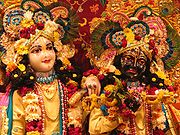
Shiva
Shiva is a major Hindu deity, and is the destroyer god or transformer among the Trimurti, the Hindu Trinity of the primary aspects of the divine. God Shiva is a yogi who has notice of everything that happens in the world and is the main aspect of life. Yet one with great power lives a life of a...
, Ganesha
Ganesha
Ganesha , also spelled Ganesa or Ganesh, also known as Ganapati , Vinayaka , and Pillaiyar , is one of the deities best-known and most widely worshipped in the Hindu pantheon. His image is found throughout India and Nepal. Hindu sects worship him regardless of affiliations...
, Rama
Rama
Rama or full name Ramachandra is considered to be the seventh avatar of Vishnu in Hinduism, and a king of Ayodhya in ancient Indian...
, Kali
Kali
' , also known as ' , is the Hindu goddess associated with power, shakti. The name Kali comes from kāla, which means black, time, death, lord of death, Shiva. Kali means "the black one". Since Shiva is called Kāla - the eternal time, Kālī, his consort, also means "Time" or "Death" . Hence, Kāli is...
, etc. From a religious point of view, these aspects of God are transcendental and have nothing to do with humanness, zoomorphism or even anthropomorphism, for God is eternal, He is 2 or four-handed, but it is rather so that humans are similar to God, but not that God is created by human and humans ascribe to Him human features: "Those who adhere to the Māyāvāda philosophy of anthropomorphism say, "The Absolute Truth is impersonal, but because we are persons we imagine that the Absolute Truth is also a person." This is a mistake, and in fact just the opposite is true. We have two hands, two legs, and a head because God Himself has these same features. We have personal forms because we are reflections of God." http://vedabase.net/tqk/12/en). Although Hinduism is commonly represented by such anthropomorphic religious murtis, aniconism
Aniconism
Aniconism is the practice or belief in avoiding or shunning images of divine beings, prophets or other respected religious figures, or in different manifestations, any human beings or living creatures. The term aniconic may be used to describe the absence of graphic representations in a particular...
is equally represented with such abstract symbols of God such as the Shiva linga and the saligrama. Furthermore, Hindus have found it easier to focus on anthropomorphic icons, as Lord Krishna said in the Bhagavad Gita
Bhagavad Gita
The ' , also more simply known as Gita, is a 700-verse Hindu scripture that is part of the ancient Sanskrit epic, the Mahabharata, but is frequently treated as a freestanding text, and in particular, as an Upanishad in its own right, one of the several books that constitute general Vedic tradition...
, Chapter 12, Verse 5,
Murtis are made according to the prescriptions of the Śilpa Śāstras
Shilpa shastras
Shilpa Shastras is an umbrella term for numerous Hindu texts that describe manual arts, the standards for religious Hindu iconography, prescribing among other things, the proportions of a sculptured figure, as well as rules of Hindu architecture.Sixty-four such arts or crafts, sometimes called ...
. They are shaped and formed by special artists known as shilpins. These artists "enter into moods of deep yogic meditation, thus fashioning images not in accordance with fancy but in accordance with scriptural canon" The five-metal alloy Panchaloha is sometimes used. They are installed by priests through the Prana pratishta
Prana pratishta
Prana pratistha is the Hindu theological term for a rite or ceremony by which a deity is infused or brought to inhabit a murti or icon of that deity...
('establishing the life') ceremony.
Devotional (bhakti
Bhakti
In Hinduism Bhakti is religious devotion in the form of active involvement of a devotee in worship of the divine.Within monotheistic Hinduism, it is the love felt by the worshipper towards the personal God, a concept expressed in Hindu theology as Svayam Bhagavan.Bhakti can be used of either...
) practices centered on cultivating a deep and personal bond of love with God often include veneration of murtis. Acts of devotion can include awakening the murti in the morning and making sure that it "is washed, dressed, and garlanded." Furthermore, the building of a temple for the murti is considered the highest act of devotion. Some Hindu denominations like Arya Samaj
Arya Samaj
Arya Samaj is a Hindu reform movement founded by Swami Dayananda on 10 April 1875. He was a sannyasi who believed in the infallible authority of the Vedas. Dayananda emphasized the ideals of brahmacharya...
and Satya Mahima Dharma
Satya Mahima Dharma
Satya Mahima Dharma is a religious tradition in Hinduism, from Orissa. It goes back to a historic person called Mahima Svama .He is said to have appeared in Puri in 1826...
, however, reject it, equating it with an idol worship
Idolatry
Idolatry is a pejorative term for the worship of an idol, a physical object such as a cult image, as a god, or practices believed to verge on worship, such as giving undue honour and regard to created forms other than God. In all the Abrahamic religions idolatry is strongly forbidden, although...
.
According to Satguru Sivaya Subramuniyaswami
Satguru Sivaya Subramuniyaswami
Sivaya Subramuniyaswami , also known as Gurudeva by his followers, was born in Oakland, California, on January 5, 1927, and adopted Saivism as a young man. He traveled to India and Sri Lanka where he received initiation from Yogaswami of Jaffna in 1949...
, “This is similar to our ability to communicate with others through the telephone
Telephone
The telephone , colloquially referred to as a phone, is a telecommunications device that transmits and receives sounds, usually the human voice. Telephones are a point-to-point communication system whose most basic function is to allow two people separated by large distances to talk to each other...
. One does not talk to the telephone; rather the telephone is a way to interact with another person. Without the telephone, one could not have a conversation across long distances; and without the sanctified image in the temple, one cannot easily talk with the Deity.” Moreover, anthropologist Christopher John Fuller notes that an image in Hinduism cannot be equated with a deity and the object of worship is the divine whose power is inside the image, and the image is not the object of worship itself, Hindus believe everything is worthy of worship as it contains divine energy emanating from the one god.
According to the Agamas, the स्थूलमूर्ति / बिम्बमूर्ति (bimbamurti, corporeal idol) is different from the मन्त्रमूर्ति (mantramurti, the idol with power), which is worshipped in classical temples. The mantramurti in the bimbamurti is worshipped only by the use of the appropriate rituals, gestures, hymns and offerings.
The human body as a temple
A common Hindu belief is that the body acts as a temple for the soul. Within that soul resides the Supreme Being. Thus in an attempt to faithfully serve the God that lies within, Hindus must maintain bodily purity. This would include purity via food consumption, personal hygiene, and mental processes. Furthermore, an external, manifest temple helps to keep the internal, intangible temple pure by offering ample opportunity for physical service.Significance
The requirements for the materials, measurements, proportion, decoration and symbolism of the murti are provided in technical manuals known as Shilpashastras. Explanation of the metaphysical significance of each stage of manufacture and the prescription of specific mantras to sanctify the process and evoke and invoke the power of the deity in the image are found in the liturgical handbooks (the Agamasand Tantras). In Southern India, the material used predominantly for murtis is black granite
Granite
Granite is a common and widely occurring type of intrusive, felsic, igneous rock. Granite usually has a medium- to coarse-grained texture. Occasionally some individual crystals are larger than the groundmass, in which case the texture is known as porphyritic. A granitic rock with a porphyritic...
, while material in North India is white marble
Marble
Marble is a metamorphic rock composed of recrystallized carbonate minerals, most commonly calcite or dolomite.Geologists use the term "marble" to refer to metamorphosed limestone; however stonemasons use the term more broadly to encompass unmetamorphosed limestone.Marble is commonly used for...
,but it is not the materials used that matter but the faith and belief of the followers in the one god, Brahman
Brahman
In Hinduism, Brahman is the one supreme, universal Spirit that is the origin and support of the phenomenal universe. Brahman is sometimes referred to as the Absolute or Godhead which is the Divine Ground of all being...
communicating with him, this is the significance of the Puja of the Murti.
External links
- Deity worship site (ISKCON, Gaudiya Vaishnava sampradaya)
- Bhakti Dayita Madhava Gosvami Maharaja on difference between idol and murti
- India Murti Art, Architecture, History and Culture Study Project