
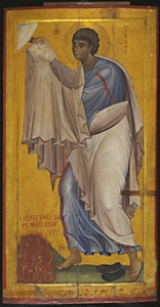
The
burning bush is an object described by the Book of Exodus (3:1-21) as being located on
Mount SinaiMount Sinai , also known as Mount Horeb, Mount Musa, Gabal Musa , Jabal Musa meaning "Moses' Mountain", is a mountain near Saint Catherine in the Sinai Peninsula of Egypt. A mountain called Mount Sinai is mentioned many times in the Book of Exodus in the Torah and the Bible as well as the Quran...
; according to the narrative, the bush was on fire, but was not consumed by the flames, hence the name. In the narrative, the
burning bush is the location at which
MosesMoses was, according to the Hebrew Bible and Qur'an, a religious leader, lawgiver and prophet, to whom the authorship of the Torah is traditionally attributed...
was appointed by
GodGod is the English name given to a singular being in theistic and deistic religions who is either the sole deity in monotheism, or a single deity in polytheism....
to lead the Israelites out of
EgyptEgypt , officially the Arab Republic of Egypt, Arabic: , is a country mainly in North Africa, with the Sinai Peninsula forming a land bridge in Southwest Asia. Egypt is thus a transcontinental country, and a major power in Africa, the Mediterranean Basin, the Middle East and the Muslim world...
and into
CanaanCanaan is a historical region roughly corresponding to modern-day Israel, Palestine, Lebanon, and the western parts of Jordan...
.
The Hebrew word used in the narrative, that is translated into English as
bush, is
seneh (סנה), which refers in particular to
brambleBrambles are thorny plants of the genus Rubus, in the rose family . Bramble fruit is the fruit of any such plant, including the blackberry and raspberry. The word comes from Germanic *bram-bezi, whence also German Brombeere , Dutch Braam and French framboise...
s;
seneh is a biblical
dis legomenonA hapax legomenon is a word which occurs only once within a context, either in the written record of an entire language, in the works of an author, or just in a single text. The term is sometimes used incorrectly to describe a word that occurs in just one of an author's works, even though it...
, only appearing in two places, both of which describe the
burning bush. It is possible that the reference to a burning bush is based on a mistaken interpretation of
SinaiThe Biblical Mount Sinai is the mountain at which the Book of Exodus states that the Ten Commandments were given to Moses by God...
(סיני), a mountain described by the Bible as being on fire, and some scholars think that the reference to the
burning bush in
DeuteronomyThe Book of Deuteronomy is the fifth book of the Hebrew Bible, and of the Jewish Torah/Pentateuch...
, in particular, might be a copyist's error, and may perhaps originally have been a reference to
Sinai.
Biblical narrative
In the narrative, an
angelAngels are mythical beings often depicted as messengers of God in the Hebrew and Christian Bibles along with the Quran. The English word angel is derived from the Greek ἄγγελος, a translation of in the Hebrew Bible ; a similar term, ملائكة , is used in the Qur'an...
of
YahwehYahweh is the name of God in the Bible, the God of Abraham, Isaac, Jacob, Jews and Christians.The word Yahweh is a modern scholarly convention for the Hebrew , transcribed into Roman letters as YHWH and known as the Tetragrammaton, for which the original pronunciation is unknown...
is described as appearing in the bush, and God is subsequently described as calling out from it to Moses, who had been grazing
JethroIn the Old Testament or the Hebrew Bible, Jethro |Shu-ayb]]) is Moses' father-in-law, a Kenite shepherd and priest of Midian. He is also revered as a prophet in his own right in the Druze religion, and considered an ancestor of the Druze.-In Exodus:...
's flocks there. When Moses starts to approach, God tells Moses to first take off his sandals, due to the place being holy ground, and Moses hides his face.
Textual scholarsTextual criticism is a branch of literary criticism that is concerned with the identification and removal of transcription errors in the texts of manuscripts...
regard the account of the
burning bush as being spliced together from the
JahwistThe Jahwist, also referred to as the Jehovist, Yahwist, or simply as J, is one of the sources of the Torah. It gets its name from the fact that it characteristically uses the term Yahweh for God in the book of Genesis...
and
ElohistThe Elohist is one of four sources of the Torah described by the Documentary Hypothesis. Its name comes from the term it uses for God: Elohim; it is characterised by, among other things, an abstract view of God, using "Horeb" instead of "Sinai" for the mountain where Moses received the laws of...
texts, with the Angel of Yahweh and the removal of sandals being part of the Elohist version, and the Yahwist's parallels to these being God and the turning away of Moses' face, respectively
When challenged on his identity, Yahweh replies that he is the God of the
PatriarchsThe Patriarchs of the Bible, when narrowly defined, are Abraham, the ancestor of all the Abrahamic nations; his son Isaac, the ancestor of the nations surrounding Israel/Judah; and Isaac's son Jacob, also named Israel, the ancestor of the Israelites...
-
AbrahamAbraham , whose birth name was Abram, is the eponym of the Abrahamic religions, among which are Judaism, Christianity and Islam...
,
IsaacIsaac as described in the Hebrew Bible, was the only son Abraham had with his wife Sarah, and was the father of Jacob and Esau. Isaac was one of the three patriarchs of the Israelites...
, and
JacobJacob "heel" or "leg-puller"), also later known as Israel , as described in the Hebrew Bible, the Talmud, the New Testament and the Qur'an was the third patriarch of the Hebrew people with whom God made a covenant, and ancestor of the tribes of Israel, which were named after his descendants.In the...
- and that he is
Yahweh. The text
derivesEtymology is the study of the history of words, their origins, and how their form and meaning have changed over time.For languages with a long written history, etymologists make use of texts in these languages and texts about the languages to gather knowledge about how words were used during...
Yahweh (יהוה) from the
HebrewHebrew is a Semitic language of the Afroasiatic language family. Culturally, is it considered by Jews and other religious groups as the language of the Jewish people, though other Jewish languages had originated among diaspora Jews, and the Hebrew language is also used by non-Jewish groups, such...
word
hayah (אהיה), meaning
he who is he, or I am that I am; the
KabbalahKabbalah/Kabala is a discipline and school of thought concerned with the esoteric aspect of Rabbinic Judaism. It was systematized in 11th-13th century Hachmei Provence and Spain, and again after the Expulsion from Spain, in 16th century Ottoman Palestine...
takes this to mean that Yahweh himself is equal to his name.
Biblical scholarsBiblical criticism is the scholarly "study and investigation of Biblical writings that seeks to make discerning judgments about these writings." It asks when and where a particular text originated; how, why, by whom, for whom, and in what circumstances it was produced; what influences were at work...
regard the triconsonantal root of
hawah (הוה), as a more likely origin for the name
Yahweh (יהוה);
hawah literally means
blow /
fall, and thus
Yahweh would be
he who blows /
he who [makes certain things] fall, suggesting the interpretation of a storm deity.
The text portrays Yahweh as telling Moses that he is sending him to the (unspecified)
PharaohPharaoh is a title used in many modern discussions of the ancient Egyptian rulers of all periods. The title originates in the term "pr-aa" which means "great house" and describes the royal palace...
in order to bring the Israelites out of Egypt, an action that Yahweh is described as having decided upon as a result of noticing that the Israelites were being oppressed by the Egyptians. Yahweh tells Moses to tell the
elders of the Israelites that Yahweh would lead them into the land of the
CanaanCanaan is a historical region roughly corresponding to modern-day Israel, Palestine, Lebanon, and the western parts of Jordan...
ites,
HittiteThe Hittites and children of Heth are a people or peoples mentioned in the Hebrew Bible. They are listed in Book of Genesis as second of the twelve Canaanite nations, descended from one Heth...
s,
AmoriteAmorite refers to an ancient Semitic people who occupied large parts of Mesopotamia from the 21st Century BC...
s, Hivites, and
JebusiteAccording to the Hebrew Bible, the Jebusites were a Canaanite tribe who inhabited and built Jerusalem prior to its conquest by King David; the Books of Kings state that Jerusalem was known as Jebus prior to this event...
s, a region generally referred to as a whole by the term
Canaan; this is described as being a land of
milk and honey.
According to the narrative: Yahweh instructs Moses to confront the Egyptians and Israelites and briefs the prophet on what is to take place. Yahweh then performs various demonstrative miracles in order to bolster Moses's credibility. Among other things, a staff was transmuted into a snake, Moses's hand was temporarily made to appear
leprousLeprosy or Hansen's disease is a chronic disease caused by the bacteria Mycobacterium leprae and Mycobacterium lepromatosis. Named after physician Gerhard Armauer Hansen, leprosy is primarily a granulomatous disease of the peripheral nerves and mucosa of the upper respiratory tract; skin lesions...
, and water was transmuted into blood, In the text, Yahweh instructs Moses to take
this staff in his hands, in order to perform miracles with it, as if it is a staff given to him, rather than his own; textual scholars argue that this latter instruction is the Elohist's version of the more detailed earlier description, where Moses uses his own staff, which they attribute to the Yahwist.
Despite the
signs, Moses is described as being very reluctant to take on the role, arguing that he lacked eloquence, and that someone else should be sent instead; in the text, Yahweh reacts by angrily rebuking Moses for presuming to lecture the One who made the mouth on who was qualified to speak and not to speak. Yet Yahweh concedes and allows
AaronIn the Hebrew Bible and the Qur'an, Aaron : Ααρών ), who is often called "'Aaron the Priest"' and once Aaron the Levite , was the older brother of Moses, and a prophet of God. He represented the priestly functions of his tribe, becoming the first High Priest of the Israelites...
to be sent to assist Moses, since Aaron is eloquent and was already on his way to meet Moses. This is the first time in the Torah that Aaron is mentioned, and here he is described as being Moses' mouth piece.
St. Catherine's Monastery
Christian
hermitA hermit is a person who lives, to some degree, in seclusion from society.In Christianity, the term was originally applied to a Christian who lives the eremitic life out of a religious conviction, namely the Desert Theology of the Old Testament .In the...
s originally gathered at
Mount SerbalMount Serbal is a mountain located in Wadi Feiran in southern Sinai, sometimes identified in texts as Gebel Serbal. At high, it is the fifth highest mountain in Egypt. It is part of the St. Catherine National Park...
, believing it to be the
biblical Mount SinaiThe Biblical Mount Sinai is the mountain at which the Book of Exodus states that the Ten Commandments were given to Moses by God...
. However, in the 4th century, under the
Byzantine EmpireThe Byzantine Empire was the Eastern Roman Empire during the periods of Late Antiquity and the Middle Ages, centred on the capital of Constantinople. Known simply as the Roman Empire or Romania to its inhabitants and neighbours, the Empire was the direct continuation of the Ancient Roman State...
, the monastery built there was abandoned in favour of the newer belief that Mount Saint Catherine was the Biblical Mount Sinai; a new monastery - St. Catherine's Monastery was built at its foot, and the alleged site of the biblical
burning bush was identified. The bush growing at the spot (a bramble, scientific name
Rubus sanctusRubus santus, commonly called holy bramble, is a species of bramble native to parts of Asia and Europe....
), was later transplanted several yards away to a courtyard of the monastery, and its original spot was covered by a chapel dedicated to the
AnnunciationThe Annunciation, also referred to as the Annunciation to the Blessed Virgin Mary or Annunciation of the Lord, is the Christian celebration of the announcement by the angel Gabriel to Virgin Mary, that she would conceive and become the mother of Jesus the Son of God. Gabriel told Mary to name her...
, with a silver star marking where the roots of the bush had come out of the ground. The Monks at St. Catherine's Monastery, following
church traditionSacred Tradition or Holy Tradition is a theological term used in some Christian traditions, primarily in the Roman Catholic, Anglican, Eastern Orthodox and Oriental Orthodox traditions, to refer to the fundamental basis of church authority....
, believe that this bush is, in fact, the original bush seen by Moses, rather than a later replacement, and anyone entering the chapel is required to remove their shoes, just as Moses was in the biblical account.
However, in modern times, it is not Mount Saint Catherine, but the adjacent
Jebel MusaMount Sinai , also known as Mount Horeb, Mount Musa, Gabal Musa , Jabal Musa meaning "Moses' Mountain", is a mountain near Saint Catherine in the Sinai Peninsula of Egypt. A mountain called Mount Sinai is mentioned many times in the Book of Exodus in the Torah and the Bible as well as the Quran...
(
Mount Moses), which is currently identified as
Mount Sinai by popular tradition and guide books; this identification arose from
bedouinThe Bedouin are a part of a predominantly desert-dwelling Arab ethnic group traditionally divided into tribes or clans, known in Arabic as ..-Etymology:...
tradition.
Mount Serbal, Jebel Musa, and Mount Saint Catherine, all lie at the southern tip of the
Sinai peninsulaThe Sinai Peninsula or Sinai is a triangular peninsula in Egypt about in area. It is situated between the Mediterranean Sea to the north, and the Red Sea to the south, and is the only part of Egyptian territory located in Asia as opposed to Africa, effectively serving as a land bridge between two...
, but the peninsula's name is a comparatively modern invention, and it was not known by that name at the time of
JosephusTitus Flavius Josephus , also called Joseph ben Matityahu , was a 1st-century Romano-Jewish historian and hagiographer of priestly and royal ancestry who recorded Jewish history, with special emphasis on the 1st century AD and the First Jewish–Roman War, which resulted in the Destruction of...
or earlier. Most modern scholars, as well as many modern theologians, dismiss the idea that the biblical Sinai was at the south of the peninsula, instead favouring locations in the Hijaz (at the north west of
Saudi ArabiaThe Kingdom of Saudi Arabia , commonly known in British English as Saudi Arabia and in Arabic as as-Sa‘ūdiyyah , is the largest state in Western Asia by land area, constituting the bulk of the Arabian Peninsula, and the second-largest in the Arab World...
), northern
ArabahThe Arabah , also known as Aravah, is a section of the Great Rift Valley running in a north-south orientation between the southern end of the Sea of Galilee down to the Dead Sea and continuing further south where it ends at the Gulf of Aqaba. It includes most of the border between Israel to the...
(in the vicinity of
PetraPetra is a historical and archaeological city in the Jordanian governorate of Ma'an that is famous for its rock cut architecture and water conduits system. Established sometime around the 6th century BC as the capital city of the Nabataeans, it is a symbol of Jordan as well as its most visited...
, or the surrounding area), or occasionally in the central or northern Sinai Peninsula. Hence, the majority of academics and theologians agree that if the
burning bush ever existed, then it is highly unlikely to be the bush preserved at St Catherine's Monastery.
Interpretations from Eastern Orthodoxy
In Eastern Orthodoxy a tradition exists, originating in the Orthodox Fathers of the Church and its Ecumenical Synods (or Councils), that the flame Moses saw was in fact God's
Uncreated Energies/GloryA real distinction between the essence and the energies of God is a central principle of Eastern Orthodox theology. Eastern Orthodox theology regards this distinction as more than a mere conceptual distinction...
, manifested as light, thus explaining why the bush was not consumed. Hence, it is not interpreted as a miracle in the sense of an event, which only temporarily exists, but is instead viewed as Moses being permitted to see these
Uncreated Energies/
Glory, which are considered to be eternal things; the Orthodox
definition of salvationThe branch of Christian theology that deals with salvation and redemption is called Soteriology. It is derived from the Greek sōtērion + English -logy....
is this vision of the
Uncreated Energies/
Glory, and it is a recurring theme in the works of Greek Orthodox theologians such as
John S. RomanidesJohn Savvas Romanides was a Greek Orthodox priest, author and professor who, for a long time, represented the Greek Church to the World Council of Churches. He was born in Piraeus, Greece, on 2 March 1928 but his parents emigrated to the United States when he was only two months old. He grew up in...
.
In Eastern Orthodox parlance, the preferred name for the event is
The Unburnt Bush, and the theology and hymnography of the church view it as prefiguring the virgin birth of
JesusJesus of Nazareth , commonly referred to as Jesus Christ or simply as Jesus or Christ, is the central figure of Christianity...
; Eastern Orthodox theology refers to Mary, the mother of Jesus as the
TheotokosTheotokos is the Greek title of Mary, the mother of Jesus used especially in the Eastern Orthodox, Oriental Orthodox, and Eastern Catholic Churches. Its literal English translations include God-bearer and the one who gives birth to God. Less literal translations include Mother of God...
("God bearer"), viewing her as having given birth to
Incarnate GodThe Incarnation in traditional Christianity is the belief that Jesus Christ the second person of the Trinity, also known as God the Son or the Logos , "became flesh" by being conceived in the womb of a woman, the Virgin Mary, also known as the Theotokos .The Incarnation is a fundamental theological...
without suffering any harm, or loss of
virginityVirginity refers to the state of a person who has never engaged in sexual intercourse. There are cultural and religious traditions which place special value and significance on this state, especially in the case of unmarried females, associated with notions of personal purity, honor and worth...
, in parallel to the bush being burnt without being consumed. There is an
IconAn icon is a religious work of art, most commonly a painting, from Eastern Christianity and in certain Eastern Catholic churches...
by the name of
the Unburnt Bush, which portrays Mary in the guise of
God bearer; the icon's feast day is held on the 4th of September (
While God speaks to Moses, in the narrative, Eastern Orthodoxy believes that the angel was also heard by Moses; Eastern orthodoxy interprets the angel as being the Logos of God, regarding it as the
Angel of Great Counsel mentioned by the
Septuagint version of
IsaiahIsaiah ; Greek: ', Ēsaïās ; "Yahu is salvation") was a prophet in the 8th-century BC Kingdom of Judah.Jews and Christians consider the Book of Isaiah a part of their Biblical canon; he is the first listed of the neviim akharonim, the later prophets. Many of the New Testament teachings of Jesus...
(it is
Counsellor, Almighty God in the
masoretic textThe Masoretic Text is the authoritative Hebrew text of the Jewish Bible and is regarded as Judaism's official version of the Tanakh. While the Masoretic Text defines the books of the Jewish canon, it also defines the precise letter-text of these biblical books, with their vocalization and...
).
Alternative theories
Benny ShanonBenny Shanon is a professor of Psychology at the Hebrew University of Jerusalem and holds the Mandel Chair in Cognitive Psychology and Education....
, professor of
cognitive psychologyCognitive psychology is a subdiscipline of psychology exploring internal mental processes.It is the study of how people perceive, remember, think, speak, and solve problems.Cognitive psychology differs from previous psychological approaches in two key ways....
at the
Hebrew University of JerusalemThe Hebrew University of Jerusalem ; ; abbreviated HUJI) is Israel's second-oldest university, after the Technion – Israel Institute of Technology. The Hebrew University has three campuses in Jerusalem and one in Rehovot. The world's largest Jewish studies library is located on its Edmond J...
wrote a paper, "Biblical Entheogens: a Speculative Hypothesis", in the philosophy journal
Time and MindTime and Mind is a peer-reviewed interdisciplinary academic journal published by Berg Publishers. It covers with the cognitive aspects of cross-related disciplines such as archaeology, anthropology, and psychology and about how findings about prehistory can help research on the brain and...
, which suggests Moses may have been under the influence of a hallucinogenic substance when he witnessed the burning bush. In the abstract, Shanon states that
entheogenAn entheogen , in the strict sense, is a psychoactive substance used in a religious, shamanic, or spiritual context. Historically, entheogens were mostly derived from plant sources and have been used in a variety of traditional religious contexts...
s found in arid regions of the
Sinai peninsulaThe Sinai Peninsula or Sinai is a triangular peninsula in Egypt about in area. It is situated between the Mediterranean Sea to the north, and the Red Sea to the south, and is the only part of Egyptian territory located in Asia as opposed to Africa, effectively serving as a land bridge between two...
and in the south of
Israel (i.e.
NegevThe Negev is a desert and semidesert region of southern Israel. The Arabs, including the native Bedouin population of the region, refer to the desert as al-Naqab. The origin of the word Neghebh is from the Hebrew root denoting 'dry'...
) were commonly used for religious purposes by the Israelites though he says "I have no direct proof of this interpretation," and "such proof cannot be expected." The plants he suggests may have caused the vision are
Peganum harmala, used by the
BedouinThe Bedouin are a part of a predominantly desert-dwelling Arab ethnic group traditionally divided into tribes or clans, known in Arabic as ..-Etymology:...
people in present times but not identified with any plant mentioned in the Bible, and
acaciaAcacia is a genus of shrubs and trees belonging to the subfamily Mimosoideae of the family Fabaceae, first described in Africa by the Swedish botanist Carl Linnaeus in 1773. Many non-Australian species tend to be thorny, whereas the majority of Australian acacias are not...
, mentioned frequently in the Bible, and also used in traditional Bedouin and Arab medicine. The effects of certain species of acacia are comparable to the effects of
ayahuascaAyahuasca is any of various psychoactive infusions or decoctions prepared from the Banisteriopsis spp. vine, usually mixed with the leaves of dimethyltryptamine-containing species of shrubs from the Psychotria genus...
, which can cause users to "
see musicSynesthesia , from the ancient Greek , "together," and , "sensation," is a neurologically based condition in which stimulation of one sensory or cognitive pathway leads to automatic, involuntary experiences in a second sensory or cognitive pathway...
".
William Robertson SmithWilliam Robertson Smith was a Scottish orientalist, Old Testament scholar, professor of divinity, and minister of the Free Church of Scotland. He was an editor of the Encyclopædia Britannica and contributor to the Encyclopaedia Biblica...
, in his book
The Religion of the Semites, suggested that the fire in the burning bush was a form of
static electricityStatic electricity refers to the build-up of electric charge on the surface of objects. The static charges remain on an object until they either bleed off to ground or are quickly neutralized by a discharge. Static electricity can be contrasted with current electricity, which can be delivered...
that can develop around such objects as bushes in arid climates.
Alexander and Zhenia Fleisher relate the Biblical story of the burning bush to the plant
DictamnusDictamnus is a genus of flowering plant in the family Rutaceae, with a single species, Dictamnus albus. It is known variously as Burning-bush, False Dittany, White Dittany, Gas-plant and Fraxinella. It is a perennial herb, native to southern Europe, north Africa and throughout...
. They note that
Intermittently, under yet unclear conditions, the plant excretes such a vast amount of volatiles that lighting a match near the flowers and seedpods causes the plant to be enveloped by flame. This flame quickly extinguishes without injury to the plant.
Colin HumphreysProfessor Sir Colin John Humphreys, CBE is a British physicist. He is the former Goldsmiths’ Professor of Materials Science and current Director of Research at Cambridge University, Professor of Experimental Physics at the Royal Institution in London and a Fellow of Selwyn College, Cambridge...
, however, notes that "the book of Exodus suggests a long-lasting fire that Moses went to investigate, not a fire that flares up and then rapidly goes out."
Symbolic uses of the burning bush
The burning bush has been a popular symbol among Reformed churches since it was first adopted by the Huguenots (
FrenchThe French Republic , The French Republic , The French Republic , (commonly known as France , is a unitary semi-presidential republic in Western Europe with several overseas territories and islands located on other continents and in the Indian, Pacific, and Atlantic oceans. Metropolitan France...
Calvinists) in 1583 during its 12th National
SynodA synod historically is a council of a church, usually convened to decide an issue of doctrine, administration or application. In modern usage, the word often refers to the governing body of a particular church, whether its members are meeting or not...
:
- The current symbol of the Reformed Church of France
The Reformed Church of France is a denomination in France with Calvinist origins. It is the original and largest Protestant denomination in France....
is a burning bush with the Huguenot crossThe Huguenot cross is a Christian religious symbol originating in France and is one of the more recognisable and popular symbols of the evangelical reformed faith. It is commonly found today as a piece of jewellery or engraved on buildings connected with the Reformed Church in France...
.
- The motto of the Church of Scotland
The Church of Scotland, known informally by its Scots language name, the Kirk, is a Presbyterian church, decisively shaped by the Scottish Reformation....
is Nec tamen consumebatur - Latin for Yet it was not consumed, an allusion to the biblical description of the burning bush, and a stylised depiction of the burning bush is used as the Church's symbol.
- The Burning Bush is also used as the basis of the symbol of the Presbyterian Church in Ireland
The Presbyterian Church in Ireland , is the largest Presbyterian denomination in Ireland, and the largest Protestant denomination in Northern Ireland...
, which uses the Latin motto Ardens sed virens, meaning Burning but flourishing, and is based on the biblical description of the burning bush. The same logo is used from the separated Free Presbyterian Church of UlsterThe Free Presbyterian Church is a Presbyterian denomination founded by the Rev. Ian Paisley in 1951. Most of its members live in Northern Ireland...
.
- The burning bush is also the symbol of the Presbyterian Church in Canada
The Presbyterian Church in Canada is the name of a Protestant Christian church, of presbyterian and reformed theology and polity, serving in Canada under this name since 1875, although the United Church of Canada claimed the right to the name from 1925 to 1939...
, Presbyterian Church in Australia, Presbyterian Church in New Zealand, Presbyterian Church in TaiwanThe Presbyterian Church in Taiwan was planted in Taiwan in the 19th century by Dr James Laidlaw Maxwell Snr of the Presbyterian Church of England and Dr George Leslie Mackay of the Presbyterian Church in Canada....
, Presbyterian Church in Singapore and the Presbyterian Church in MalaysiaThe Presbyterian Church in Malaysia or GPM is a Christian church in Malaysia. Established as an independent synod in 1974, it currently has approximately 7,000 members in 100 congregations nationwide .The current Moderator of the GPM is the Rev...
.
- The Burning Bush is the name of Far Eastern Bible College's theological journal.
The logo of the
Jewish Theological Seminary of AmericaThe Jewish Theological Seminary of America is one of the academic and spiritual centers of Conservative Judaism, and a major center for academic scholarship in Jewish studies.JTS operates five schools: Albert A...
is also an image of the Burning Bush with the phrase "and the bush was not consumed" in both English and in Hebrew.
External links