
All Topics  
Guru Granth Sahib

 
Guru Granth Sahib

   Email Print
   Bookmark   Link


Guru Granth Sahib


The Guru Granth Sahib (), or Adi Sri Guru Granth Sahib, is the holy scripture and the final Guru
Guru

A guru is a person who is regarded as having great knowledge, wisdom and authority in a certain area, and who uses these abilities to guide others....
 of the Sikh
Sikh

Sikh is the title and name given to an adherent of Sikhism. The term has its origin in the Sanskrit ' "disciple, learner" or ' "instruction"....
s. It is a voluminous text of 1430 pages, compiled and composed during the period of Sikh Gurus
Sikh Gurus

Sikhism was established by Guru Nanak and nine other Sikh Gurus over the period of 1469 to 1708. Most of the Gurus were born in Northern India, although they traveled extensively from as far west as Iraq to Assam in the east and Sri Lanka in the south....
, from 1469 to 1708. It is a collection of hymns or bhajan
Bhajan

A Bhajan is a type of Hindu devotional song, often simple, lyrical and expressing love for the divinity. The music is sometimes based on Indian classical music ragas and Tala s....
s, which describe what God is like and the right way to live. Guru Gobind Singh
Guru Gobind Singh

Guru Gobind Singh was the tenth Sikh Gurus of Sikhism. He was born in Patna, Bihar in India and became a Guru on November 11 1675, at the age of nine years, succeeding his father Guru Tegh Bahadur....
 (1666-1708), the tenth of the Sikh Gurus
Sikh Gurus

Sikhism was established by Guru Nanak and nine other Sikh Gurus over the period of 1469 to 1708. Most of the Gurus were born in Northern India, although they traveled extensively from as far west as Iraq to Assam in the east and Sri Lanka in the south....
, affirmed the sacred text Adi Granth
Adi Granth

Adi Granth is the early compilation of the Sikh Scriptures by Sri Guru Arjan Dev Ji, the fifth Sikh Guru, in 1604. This Granth is the Holy Scripture of the Sikhs....
 as his successor, terminating the line of human Gurus, and elevating the text to Guru Granth Sahib.


Discussion
Ask a question about 'Guru Granth Sahib'
Start a new discussion about 'Guru Granth Sahib'
Answer questions from other users
Full Discussion Forum


Quotations


The Guru is the Fulfiller of the desires of the mind.

53


Encyclopedia


The Guru Granth Sahib (), or Adi Sri Guru Granth Sahib, is the holy scripture and the final Guru
Guru

A guru is a person who is regarded as having great knowledge, wisdom and authority in a certain area, and who uses these abilities to guide others....
 of the Sikh
Sikh

Sikh is the title and name given to an adherent of Sikhism. The term has its origin in the Sanskrit ' "disciple, learner" or ' "instruction"....
s. It is a voluminous text of 1430 pages, compiled and composed during the period of Sikh Gurus
Sikh Gurus

Sikhism was established by Guru Nanak and nine other Sikh Gurus over the period of 1469 to 1708. Most of the Gurus were born in Northern India, although they traveled extensively from as far west as Iraq to Assam in the east and Sri Lanka in the south....
, from 1469 to 1708. It is a collection of hymns or bhajan
Bhajan

A Bhajan is a type of Hindu devotional song, often simple, lyrical and expressing love for the divinity. The music is sometimes based on Indian classical music ragas and Tala s....
s, which describe what God is like and the right way to live. Guru Gobind Singh
Guru Gobind Singh

Guru Gobind Singh was the tenth Sikh Gurus of Sikhism. He was born in Patna, Bihar in India and became a Guru on November 11 1675, at the age of nine years, succeeding his father Guru Tegh Bahadur....
 (1666-1708), the tenth of the Sikh Gurus
Sikh Gurus

Sikhism was established by Guru Nanak and nine other Sikh Gurus over the period of 1469 to 1708. Most of the Gurus were born in Northern India, although they traveled extensively from as far west as Iraq to Assam in the east and Sri Lanka in the south....
, affirmed the sacred text Adi Granth
Adi Granth

Adi Granth is the early compilation of the Sikh Scriptures by Sri Guru Arjan Dev Ji, the fifth Sikh Guru, in 1604. This Granth is the Holy Scripture of the Sikhs....
 as his successor, terminating the line of human Gurus, and elevating the text to Guru Granth Sahib. Thenceforward the text remained the holy scripture of the Sikhs, regarded as the living embodiment of the Ten Gurus. The role of Guru Granth Sahib, as a source or guide of prayer, is pivotal in worship in Sikhism
Sikhism

Sikhism , founded on the teachings of Guru Nanak and ten successive Sikh Gurus in fifteenth century Punjab region, is the Major religious groups organized religion in the world....
.

The Adi Granth was first compiled by the fifth Sikh guru, Guru Arjan Dev
Guru Arjan Dev

Guru Arjan Dev Ji or Guru Arjun Dev Ji was the fifth of the Ten Gurus of Sikhism and became a Guru on 1 September1581 following in the footsteps of Guru Ram Das....
 (1563-1606), from hymns of the first five Sikh gurus and other great saints of the Hindu and Muslim traditions. After the demise of the tenth Sikh guru many handwritten copies were prepared for distribution by Baba Deep Singh
Baba Deep Singh

Baba Deep Singh Ji is revered as one of the most hallowed martyrs in Sikh history. The term Baba is used to give respect to an elder in India....
.

Written in the Gurmukhi script, predominantly in archaic Punjabi with occasional use of other languages including Braj, Punjabi
Punjabi language

'Punjabi' , , is an Indo-Aryan language spoken by inhabitants of the historical Punjab region and their diasporas. Speakers include adherents of the religions of Islam, Sikhism and Hinduism....
, Khariboli
Khariboli

Khariboli , , native to western Uttar Pradesh and the Delhi region in India, is the prestige dialect of the Hindi-speaking states of India, and the basis of the officially approved versions of Hindi and Urdu, which are grammatically identical to Khariboli....
 (Hindi
Hindi

Standard Hindi, also known as High Hindi, Nagari Hindi or Literary Hindi is a Standard language register of Hindi. It is one of the 22 official languages of India, and is used, along with English language, for administration of the central government....
), Sanskrit, regional dialects, and Persian
Persian language

name=Persian|nativename=|pronunciation=[f??r'si]|image=|caption=Farsi in Perso-Arabic script |states= Iran, Afghanistan, Tajikistan, Uzbekistan, and Bahrain....
, often coalesced under the generic title of Sant Bhasha
Sant Bhasha

Sant Bhasha is a scriptural language related to both Punjabi language and Hindi languages. It was used extensively across medieval northern India by proponents of popular devotional religion, esp....
.

Meaning and role in Sikhism

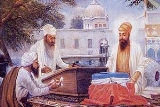
Dictation of the Guru Granth Saheb
Sikhs consider the Guru Granth Sahib a spiritual guide for all mankind for all generations to come, and it plays a central role in guiding the Sikhs' way of life. Its place in Sikh devotional life is based on two fundamental principles; that the text is divine revelation, and that all answers regarding religion and morality can be discovered within it. Its hymns and teachings are called Gurbani or "Word of the guru" and sometimes Dhurbani or "Word of God". Thus, in Sikh theology, the revealed divine word is the Guru.

The work of the numerous holy men who contributed to the Guru Granth Sahib is collectively referred to as Bhagat Bani or "Word of Devotees". These saints belonged to different social and religious backgrounds, including Hindus and Muslims, cobblers and untouchables. Although the Sikh Bhagats are not accorded the status of gurus in Sikhism, their work is equally revered. The Guru Granth Sahib is the sole and final successor of the line of gurus. Anyone claiming the status of living guru is considered a heretic.

History


The work of transcribing the teachings of Guru Nanak, the first guru and founder of Sikhism
Sikhism

Sikhism , founded on the teachings of Guru Nanak and ten successive Sikh Gurus in fifteenth century Punjab region, is the Major religious groups organized religion in the world....
, began in his lifetime. Guru Angad, the second guru of Sikhs, received Nanak's collection of songs and words in manuscript form: he added sixty-three of his own compositions. The third guru, Amar Das
Guru Amar Das

Guru Amar Das was the third of the Ten Gurus of Sikhism and became Guru on 26 March 1552 at the age of 73 following in the footsteps of Guru Angad, who died on 29 March 1552 aged 48....
, prepared a number of manuscripts, supplemented with 974 of his own compositions as well as the works of various Bhagats. These manuscripts, known as Goindwal pothis, mention the message of Guru Amar Das as to why the Bhagat Bani was included and how the Bhagats were influenced by Guru Nanak.

The fourth Guru also composed hymns. The fifth, Arjan Dev, in order to consolidate the Bani (Divine word) of earlier Gurus and to prevent spurious compositions creeping in, began early in 1599 to compile the Adi Granth according to the plan laid out by Nanak. The Tawarikh Guru Khalsa mentions that he issued a Hukamnama (official order), asking anyone who could contribute to do so. All of the sourcing and content was reviewed in order to ensure the authenticity of the existing revelation.

The final prepared volume, written by Bhai Gurdas
Bhai Gurdas

Bhai Gurdas was a Punjabi people Sikh writer, historian, missionary, and religious figure. He was the original scribe of the Guru Granth Sahib and a companion of four of the Sikh Gurus....
, under the direct supervision of Guru Arjan, included the compositions of the first five Sikh Gurus and of fifteen Bhagats, seventeen Bhatts ("bards", or traditional composers) and four others such as Bhai Mardana, a lifelong companion of Guru Nanak. The Adi Granth took five years to complete and was installed in Harmandir Sahib
Harmandir Sahib

Golden Temple or Darbar Sahib , informally referred to as The Golden Temple or Temple of God, is culturally the most significant place of worship of the Sikhs and one of the oldest Sikh gurdwaras....
 ("the abode of God"), popularly known as the Golden Temple, on September 01, 1604, with Baba Buddha as the first Granthi
Granthi

Granthi is a person of either gender, who performs the reading of the Guru Granth Sahib at religious occasions. The Granthi also performs the morning rites , reading the paath and sukhasan....
. This original volume is presently in Kartarpur
Kartarpur

Kartarpur , was established by Guru Nanak in 1522. When Guru Nanak passed away, Hindus and Muslims disagreed on how to perform his last rites....
 and bears the signature of the Guru Arjan.

Sri Guru Granth Sahib Nishan
This master copy was initially in the possession of Guru Hargobind, but was stolen by one of his grandsons, Dhir Mal, who wanted to lay claim to the title of Guru. The Sikhs, about 30 years later, recovered it forcibly and were made to return it on the order of the ninth Guru, Tegh Bahadur. Eventhough this master copy was improperly wrested from the community, its return underscored the message that no particular copy of the Adi Granth was more divine than another. This master copy of the Adi Granth (known as the "Kartarpur Pothi") which is of significant historical value, is displayed every year on the occasion of Vaisakhi
Vaisakhi

Vaisakhi is one of the most significant holidays in Sikh calendar, commemorating the establishment of the Khalsa in 1699. Vaisakhi is celebrated by the Khalsa as their birthday every year, the day corresponding to the event when they were created by Guru Gobind Singh in 1699....
 by the descendants of Dhir Mal in Kartarpur
Kartarpur

Kartarpur , was established by Guru Nanak in 1522. When Guru Nanak passed away, Hindus and Muslims disagreed on how to perform his last rites....
.

The redaction of the Adi Granth was prepared by Guru Gobind Singh
Guru Gobind Singh

Guru Gobind Singh was the tenth Sikh Gurus of Sikhism. He was born in Patna, Bihar in India and became a Guru on November 11 1675, at the age of nine years, succeeding his father Guru Tegh Bahadur....
 with the scribe Bhai Mani Singh at Talwandi Sabo (renamed as Damdama Sahib). Guru Gobind Singh added the hymns composed by Guru Tegh Bahadur but excluded his own. There is mention of Guru Gobind Singh's holding an "Akhand Path" (continued recital of Guru Granth Sahib). From Talwandi Sabo, Guru Gobind Singh went to Deccan. While at Nanded
Nanded

Nanded , is the second largest city in Marathwada region of Maharashtra state of India. Nanded is also district headquarter of Nanded District in Marathwada region or Aurangabad, Maharashtra revenue division....
, Guru Gobind Singh installed the final version prepared by him as the perpetual Guru of Sikhs in 1708.

The Guru Granth Sahib is divided into raga
Raga

Raga refers to musical mode used in Indian classical music. It is a series of five or more musical notes upon which a melody is made. In the Indian musical tradition, ragas are associated with different times of the day, or with seasons....
s or classical musical notes. The chronological division is on the basis of ragas and not on the order of succession of Gurus. As with the Adi Granth, Sikhs do not lay emphasis on any particular volume of Guru Granth Sahib as the Guru.

The Supreme Court of India
Supreme Court of India

The Supreme Court of India is the highest court of the land as established by Part V, Chapter IV of the Constitution of India. According to the Constitution of India, the role of the Supreme Court is that of a federal court, guardian of the Constitution and the highest court of appeal....
 holds that the Guru Granth Sahib should be, for historic and legal reasons, considered a 'Juristic person': "The Granth replaces the Guru after the tenth Guru. We unhesitatingly hold Guru Granth Sahib to be a juristic person." The court articulated this finding in the context of a case pertaining to a property dispute.

Elevation of Adi Granth to Guru Granth Sahib

The Adi Granth was conferred the title of "Guru of the Sikhs" by the tenth Guru, Guru Gobind Singh, in October, 1708. The event, when Guru Gobind Singh installed Adi Granth as the Guru of Sikhism, was recorded in a Bhatt Vahi (a bard's scroll) by an eyewitness, Narbud Singh, who was a bard at the Guru's court. There are a variety of other documents attesting to this proclamation by the tenth Guru.

Thus, despite some aberrations, the Sikhs overwhelmingly accept that the Guru Granth is their eternal Guru. This has been the understanding and conviction of the Sikhs, since that October day of 1708.

Guru's commandment

A close associate of Guru Gobind Singh and author of Rehit-nama, Prahlad Singh, recorded the Guru's commandment saying "With the order of the Eternal Lord has been established [Sikh] Panth: all the Sikhs hereby are commanded to obey the Granth as their Guru".(Rehat-nama, Bhai Prahlad Singh) Similarly Chaupa Singh, another associate of Guru Gobind Singh, has mentioned this commandment in his Rehat-nama.

Composition

The Sikh Gurus developed a new writing system, Gurmukhi, for writing their sacred literature. Although the exact origins of the script are unknown, it is believed to have existed in an elementary form during the time of Guru Nanak. According to Sikh tradition, Guru Angad is said to have invented the script, and popularised its use among the Sikhs. It is stated in Mahman Prakash, an early Sikh manuscript, that the script was invented by Guru Angad at the suggestion of Guru Nanak during the lifetime of the founder. The word Gurmukhi translates as "from the mouth of the Guru". The script was used, from the onset, for compiling Sikh scriptures. The Sikhs assign high degree of sanctity to Gurmukhi language script. The Gurmukhi language Script is also the official script for the Indian State of Punjab.

Guru Granth Sahib By Bhai Pratap Singh Giani
The Guru Granth Sahib is divided into fourteen hundred and thirty pages known as Angs (limbs) in Sikh tradition. It can be divided into three different sections:
  1. Introductory section consisting of the Mul Mantra
    Mul Mantra

    The Mul Mantar is the most important concept within the Guru Granth Sahib, and is considered the basis of Sikh theology; a position that is emphasized by its appearance as the first composition written in the Granth....
    , Japji and Sohila
    Sohila

    The collection of hymns called Sohila is repeated at bedtime by Sikhs. It consists of three hymns of Guru Nanak, one of Guru Ram Das, and one of Guru Arjan....
     composed by Guru Nanak
  2. Compositions of Sikh Gurus followed by those of Sikh Bhagats, collected according to chronology of Ragas or musical notes (see below).
  3. Compositions of Guru Tegh Bahadur.


The poems are divided on the basis of their musical setting in different raga
Raga

Raga refers to musical mode used in Indian classical music. It is a series of five or more musical notes upon which a melody is made. In the Indian musical tradition, ragas are associated with different times of the day, or with seasons....
s. A raga is a series of melodic motifs, based upon a definite scale or mode
Mode

Mode may mean:* Mode * Mode , the value that has the largest number of observations* Musical mode, a classification system of musical tonalities...
, that provide a basic structure around which the musician performs. The ragas are associated with different moods and times of the day and year. The total number of ragas in the Sikh system is thirty one, divided into fourteen ragas and seventeen raginis (less important or less definite ragas). Within the raga division, the songs are arranged in order of the Sikh gurus and Sikh bhagats with whom they are associated.

The various ragas are, in order: Raga Sri
Raga Sri

This is an Indian musical raga that apart from being said to have been related to Lord Shiva also appears in the Sikh tradition from northern India and is part of the Guru Granth Sahib....
, Manjh, Gauri
Gauri

Gauri is an India musical raga that appears in the Sikh tradition from northern India and is part of the Sikh holy scripture called Sri Guru Granth Sahib Every raga has a strict set of rules which govern the number of notes that can be used; which notes can be used; and their interplay that has to be adhered to for the composition of a tune...
, Asa
Asa

Asa may refer to:* A?a, Paris-born Nigerian singer-songwriter* Asa of Judah, son of Abijam, King of Judah.* Asa, Nigeria, in Kwara State* Asa , given name...
, Gujri, Devagandhari
Devagandhari

This is an India musical raga that appears in the Sikh tradition from northern India and is part of the Guru Granth Sahib. Every raga has a strict set of rules which govern the number of notes that can be used; which notes can be used; and their interplay that has to be adhered to for the composition of a tune....
, Bihagara
Bihagara

Bihagara is an Indian musical raga that appears in the Sikh tradition from northern India and is part of the Guru Granth Sahib. Every raga has a strict set of rules which govern the number of notes and their interplay that has to be adhered to for the composition of a tune....
, Wadahans, Sorath
Sorath

For a region in Gurjrat see Saurashtra 'Sorath: This is an India musical raga that appears in the Sikh tradition from northern India and is part of the Sikh holy scripture called Sri Guru Granth Sahib Every raga has a strict set of rules which govern the number of notes that can be used; which notes can be used; and their interplay t...
, Dhanasri, Jaitsri, Todi
Todi

Todi is a town and comune of the province of Perugia in central Italy. It is perched on a tall two-crested hill overlooking the east bank of the river Tiber, commanding distant views in every direction....
, Bairari
Bairari

This is an India musical raga that appears in the Sikh tradition from northern India and is part of the Sikh holy scripture called Sri Guru Granth Sahib or Guru Granth Sahib for short....
, Tilang, Suhi, Bilaval
Bilaval

Bilawal is a Hindustani classical music raga.It is one of the ragas that appears in the Sikh tradition from northern India, and is part of the Sikh holy scripture , the Sri Guru Granth Sahib....
, Gond (Gaund), Ramkali
Ramkali

Ramkali is a raga from Indian classical music which originated from Bhairav Thaat. In the raga, as like bhairav, second tune and sixth tune are Flat . Flat nishad and sharp madhyama are used often....
, Nut-Narayan, Mali-Gaura, Maru
Maru

Maru can refer to* Maru is a surname in Kutch, Gujarat, India.* Maru is a Maori war god.* Tumatauenga, the Maori god of war.* Maru - a Romanian village....
, Tukhari, Kedara, Bhairav (Bhairo), Basant
Basant

File:Basant by Ajaz anwar.jpgBasant is short for Basant Panchami , a Hindu festival in honor of Saraswati, the goddess of knowledge, music and art....
, Sarang
Sarang

Sarang is the helicopter formation display team of the Indian Air Force.The team flies four HAL Dhruvs. The name Sarang is symbolic as it is the national bird of India....
, Malar
Malar

There are several meanings for malar:*Tamil language for flower*Latin for cheek*Malar , a deity in the Forgotten Realms campaign setting of Dungeons & Dragons...
, Kanra, Kalyan, Prabhati and Jaijawanti. In addition there are twenty-two compositions of Vars (Traditional ballads). Nine of these have specific tunes and the rest can be sung to any tune.

Sanctity among Sikhs

Guru Har Rai   Mool Mantar
Sikhs observe total sanctity of the text in the Guru Granth Sahib. No one can change or alter any of the writings of the Sikh Gurus written in Guru Granth Sahib. This includes sentences, words, structure, grammar etc. This total sanctity was observed by the Gurus themselves. Guru Har Rai
Guru Har Rai

Guru Har Rai was the seventh of the Eleven Gurus of Sikhism and became Guru on 8 March1644 following in the footsteps of his grandfather, Guru Har Gobind, who was the sixth guru....
 had disowned his elder son, Ram Rai, because he had altered the wording of one of Guru Nanak's hymn. Ram Rai had been sent to Delhi, by Guru Har Rai, to explain Gurbani to Mughal Emperor Aurangzeb. In order to please the Emperor he altered the wording of hymns of Guru Nanak. The matter was reported to the Guru, who was displeased with his son and disowned him. Later when aged, Ram Rai
Guru Har Rai

Guru Har Rai was the seventh of the Eleven Gurus of Sikhism and became Guru on 8 March1644 following in the footsteps of his grandfather, Guru Har Gobind, who was the sixth guru....
 was forgiven by Guru Gobind Singh.

Translations

Translations of the Guru Granth Sahib are available. However, Sikhs believe that it is necessary to learn Gurmukhi, designed and used by the Sikh Gurus, to fully understand and appreciate the message. Translations only give a preliminary understanding of the Guru Granth Sahib. A Sikh is encouraged to learn Gurmukhi to fully experience and understand the Guru Granth Sahib.

Recitation

Sri Guru Granth Sahib
The Guru Granth Sahib is always placed in the centre of a Gurudwara and placed on a raised platform, known as Takht (throne). The Guru Granth is given the greatest respect and honour. Sikhs cover their heads and remove their shoes while in the presence of Guru Granth. Before coming into its presence, they bathe and bow before the Guru Granth. The Guru Granth is normally carried on the head and as a sign of respect not touched with unwashed hands or put on the floor.

The Guru Granth Sahib is always the focal point in any Gurudwara. It is attended with all signs of royalty, as was the custom with Sikh Gurus, and is placed upon a throne, and the congregation sits on the floor. It is waved upon by a chaur (sort of fan) which is made of fine material and a canopy is always placed over it. The devotees bow before the Guru as a sign of respect.

The Guru Granth Sahib is taken care of by a Granthi
Granthi

Granthi is a person of either gender, who performs the reading of the Guru Granth Sahib at religious occasions. The Granthi also performs the morning rites , reading the paath and sukhasan....
. He is responsible for reciting from Guru Granth and leading the Sikh prayer. The Granthi also acts as the caretaker of Guru Granth Sahib and this function may not be performed by any other person. It is kept covered in silken cloths, known as Rumala, to protect from heat, dust, pollution etc. It rests on a manji sahib under a rumala until brought out again.

Printing

The printing of Guru Granth Sahib is done by the official religious body of Sikhs based in Amritsar
Amritsar

Amritsar is located in the northwestern part of India and is the administrative headquarters of Amritsar district in the States and territories of India of Punjab, India, India....
. It is the sole worldwide publisher of Guru Granth Sahib. Great care is taken while making printed copies and strict code of conduct is observed during the task of printing.

Before the twentieth century, only hand written copies of Guru Granth Sahib were prepared. The first printed copy of Guru Granth Sahib was made in 1864. Since the early 20th century Guru Granth Sahib has a standard 1430 pages.

The Sri Guru Granth Sahib ji is currently printed in an authorised printing press
Printing press

A printing press is a mechanical device for applying pressure to an inked surface resting upon a medium , thereby transferring an image. The mechanical systems involved were first assembled in Germany by the goldsmith Johannes Gutenberg around 1439, based on existing screw-presses used to press cloth, grapes etc., and possibly to print wood...
 in the basement of the Gurdwara Ramsar in Amritsar
Amritsar

Amritsar is located in the northwestern part of India and is the administrative headquarters of Amritsar district in the States and territories of India of Punjab, India, India....
; any resulting printer's "waste" that has any of the sacred text on, is cremated at Goindval
Goindval

Goindval is a place in Amritsar district in the states of Punjab in India about 22 km. from Tarn Taran. It became an important center for the Sikh religion, during the Guruship of the Guru Amar Das....
 . However, unauthorised copies of Sri Guru Granth Sahib ji have been printed.

Treatment of damaged copies

Any copies of their sacred book Guru Granth Sahib
Guru Granth Sahib

The Guru Granth Sahib , or Adi Sri Guru Granth Sahib, is the holy scripture and the final Guru#Classification of gurus of the Sikhs. It is a voluminous text of 1430 pages, compiled and composed during the period of Sikh Gurus, from 1469 to 1708....
 which are too badly damaged to be used, and any printer's waste which has any of its text on, are cremated with a similar ceremony as cremating a deceased man. Such burning is called Agan Bhet. (For similar reasons, observant Jew
Jew

A Jew is a member of the Jewish people, an ethnoreligious group that traces its ancestry to the Israelites or Hebrews of the Ancient Near East....
s bury damaged Torah
Torah

The term "Torah" , or Five Books of Moses or Pentateuch, refers to the entirety of Judaism's founding Halakha and ethical religious texts....
 scrolls and hold for them a funeral similar to that for a human being.)
  • : A copy damaged in a fire
  • A copy damaged in a fire
  • : 4 copies damaged in New Orleans by the flood caused by Hurricane Katrina
    Hurricane Katrina

    Hurricane Katrina of the 2005 Atlantic hurricane season was the costliest Atlantic hurricane, as well as one of the five deadliest, in the history of the United States....
  • Printer's waste: see above.
  • : on the Nicobar Islands
    Nicobar Islands

    The Nicobar Islands are an island chain in the eastern Indian Ocean, and are part of the Union Territory of Andaman and Nicobar Islands, India....
     after the 2004 tsunami
    2004 Indian Ocean earthquake

    The was an undersea earthquake that occurred at 00:58:53 Coordinated Universal Time on December 26, 2004, with an epicentre off the west coast of Sumatra, Indonesia....
     (end of page).
  • MrSikhNet.com Blog query about an accumulation of download printouts of Sikh sacred text


Comments on Sri Guru Granth Sahib by Non-Sikhs

This is what Max Arthur Macauliffe
Max Arthur Macauliffe

Michael MacAuliffe, also known as Max Arthur Macauliffe , was a senior British administrator, prolific scholar and author. Macauliffe is renowned for his translation into English of Sikh scripture and history...
 writes about the authenticity of the Guru's teaching:
The Sikh
Sikh

Sikh is the title and name given to an adherent of Sikhism. The term has its origin in the Sanskrit ' "disciple, learner" or ' "instruction"....
 religion differs as regards the authenticity of its dogma
Dogma

Dogma is the established belief or doctrine held by a religion, ideology or any kind of organization: it is authority and not to be disputed, doubted or heresy....
s from most other theological systems. Many of the great teachers the world has known, have not left a line of their own composition and we only know what they taught through tradition or second-hand information. If Pythagoras
Pythagoras

Pythagoras of Samos was an Ionians Ancient Greeks mathematician and founder of the religious movement called Pythagoreanism. He is often revered as a great mathematician, mysticism and scientist; however some have questioned the scope of his contributions to mathematics and natural philosophy....
 wrote of his tenet
Tenet

Tenet may refer to* Tenet , a Canadian heavy metal band* Tenet Healthcare, a hospital holding company* Tenet people, an ethnic group in Sudan...
s, his writings have not descended to us. We know the teachings of Socrates
Socrates

Socrates was a Classical Greece Philosophy. Credited as one of the founders of Western philosophy, he is an enigmatic figure known only through the classical accounts of his students....
 only through the writings of Plato
Plato

Plato , was a Classical Greece Greeks philosopher, mathematician, writer of philosophical dialogues, and founder of the Platonic Academy in Ancient Athens, the first institution of higher learning in the western world....
 and Xenophon
Xenophon

Xenophon , son of Gryllus, of the deme Erchia of Athens, also known as Xenophon of Athens and Xenophon of Thebes, was a soldier, mercenary and a contemporary and admirer of Socrates....
. Buddha
Gautama Buddha

Siddhartha Gautama was a Spirituality teacher in the northern region of the Indian subcontinent who founded Buddhism. He is generally seen by Buddhists as the Supreme Buddhahood of our age....
 has left no written memorial of his teaching. Kungfu-tze, known to Europeans as Confucius
Confucius

This articles talks about a Chinese thinker and social philosopher. For a food company in China with its brand name "Master Kong", please refer to Tingyi Holding Corporation....
, left no documents in which he detailed the principles of his moral and social system. The founder of Christianity
Christianity

Christianity is a Monotheistic religion #Christian view religion centered on the life and teachings of Jesus as New Testament view on Jesus' life....
 did not reduce his doctrines to writing and for them we are obliged to trust to the gospels according to Matthew, Mark, Luke and John. The Arabian Prophet
Muhammad

Muhammad Patronymic#Arabic Abd Allah ibn Abd al Muttalib , is the founder of the Major religious groups of Islam and is regarded by Muslims as a Rasul and prophet of , the last and the greatest law-bearer in a series of prophets....
 did not himself reduce to writing the chapters of the Quran. They were written or compiled by his adherents and followers. But the compositions of Sikh Gurus are preserved and we know at first hand what they taught.


Miss Pearl S. Buck
Pearl S. Buck

Pearl Sydenstricker Buck also known as Sai Zhen Zhu , was a prolific United States sinologist and Pulitzer Prize for the Novel American writer....
, a Nobel
Nobel Prize

The Nobel Prize , established in the 1895 will of Swedish chemist Alfred Nobel; it was first awarded in Nobel Prize in Physics, Nobel Prize in Chemistry, Nobel Prize in Physiology or Medicine, Nobel Prize in Literature, and Nobel Peace Prize in 1901....
 laureate
Laureate

In English language, the word laureate has come to signify eminence or association with literary or military glory. It is also used for winners of the Nobel Prize....
, gives the following comment on receiving the First English translation of the Guru Granth Sahib:

.... I have studied the scriptures of the great religions, but I do not find elsewhere the same power of appeal to the heart and mind as I find here in these volumes. They are compact in spite of their length, and are a revelation of the vast reach of the human heart, varying from the most noble concept of God
God

God is a deity in theism and deism religions and other belief systems, representing either the sole deity in monotheism, or a principal deity in polytheism....
, to the recognition and indeed the insistence upon the practical needs of the human body. There is something strangely modern about these scriptures and this puzzles me until I learned that they are in fact comparatively modern, compiled as late as the 16th century, when explorers were beginning to discover that the globe upon which we all live is a single entity divided only by arbitrary lines of our own making. Perhaps this sense of unity is the source of power I find in these volumes. They speak to a person of any religion or of none. They speak for the human heart and the searching mind. ...
    • (From the foreword to the English translation of the Guru Granth Sahib by Gopal Singh, 1960)(bold added later)


Message of Guru Granth Sahib

Some of the major messages can be summarized as follows: -

  1. All peoples of the world are equal
    Message of Guru Granth Sahib

    The Guru Granth Sahib promotes a moral teaching that Sahib explains is about living a life of Truth, respect for others, and high moral standards. Followers of the Guru are considered to be members of the Sikh religion, and they are known as Gurmukh ? which literally means ?follower of Guru?....
  2. Women are equal
    Message of Guru Granth Sahib

    The Guru Granth Sahib promotes a moral teaching that Sahib explains is about living a life of Truth, respect for others, and high moral standards. Followers of the Guru are considered to be members of the Sikh religion, and they are known as Gurmukh ? which literally means ?follower of Guru?....
  3. One God for all
    Message of Guru Granth Sahib

    The Guru Granth Sahib promotes a moral teaching that Sahib explains is about living a life of Truth, respect for others, and high moral standards. Followers of the Guru are considered to be members of the Sikh religion, and they are known as Gurmukh ? which literally means ?follower of Guru?....
  4. Speak and live truthfully
    Message of Guru Granth Sahib

    The Guru Granth Sahib promotes a moral teaching that Sahib explains is about living a life of Truth, respect for others, and high moral standards. Followers of the Guru are considered to be members of the Sikh religion, and they are known as Gurmukh ? which literally means ?follower of Guru?....
  5. Control the five vices
    Message of Guru Granth Sahib

    The Guru Granth Sahib promotes a moral teaching that Sahib explains is about living a life of Truth, respect for others, and high moral standards. Followers of the Guru are considered to be members of the Sikh religion, and they are known as Gurmukh ? which literally means ?follower of Guru?....
  6. Live in God's hukam
    Message of Guru Granth Sahib

    The Guru Granth Sahib promotes a moral teaching that Sahib explains is about living a life of Truth, respect for others, and high moral standards. Followers of the Guru are considered to be members of the Sikh religion, and they are known as Gurmukh ? which literally means ?follower of Guru?....
     (The Will of the One GOD)
  7. Practice Humility, Kindness, Compassion, Love, etc
    Message of Guru Granth Sahib

    The Guru Granth Sahib promotes a moral teaching that Sahib explains is about living a life of Truth, respect for others, and high moral standards. Followers of the Guru are considered to be members of the Sikh religion, and they are known as Gurmukh ? which literally means ?follower of Guru?....
  8. Its Philosophy is unique as it preaches how to achieve oneness with god while still alive
    Message of Guru Granth Sahib

    The Guru Granth Sahib promotes a moral teaching that Sahib explains is about living a life of Truth, respect for others, and high moral standards. Followers of the Guru are considered to be members of the Sikh religion, and they are known as Gurmukh ? which literally means ?follower of Guru?....
  9. It guides us how how to liberate ourselves with guru’s wisdom from our daily sufferings
    Message of Guru Granth Sahib

    The Guru Granth Sahib promotes a moral teaching that Sahib explains is about living a life of Truth, respect for others, and high moral standards. Followers of the Guru are considered to be members of the Sikh religion, and they are known as Gurmukh ? which literally means ?follower of Guru?....
  10. It does not contain any stories, it’s a living treasure which uplifts humanity to achieve broad minded thinking
    Message of Guru Granth Sahib

    The Guru Granth Sahib promotes a moral teaching that Sahib explains is about living a life of Truth, respect for others, and high moral standards. Followers of the Guru are considered to be members of the Sikh religion, and they are known as Gurmukh ? which literally means ?follower of Guru?....


Care & Protocol to be Observed


Personal Behaviour

Any person carrying out any Service or Sewa
SEWA

SEWA is the Self-Employed Women's Association of India, a trade union founded in 1972 after a split in the Textile Labour Association . It was founded by the noted Gandhian and civil rights leader Dr....
  must observe the following
:
  • Head must be covered at all times.
  • Shoes must be removed outside the Guru's room.
  • Basic standards of personal hygiene are to be observed especially relating to cleanliness
  • Eating or drinking while in service is strictly avoided.
  • Complete silence is observed while in Guru's service.
  • Respectful attitude towards others who are present.


Environment

  • The room should be kept clean
  • The clothes that are used to cover Guru Granth are kept clean and changed daily. Some people choose to use decorated cloth, but this is not necessary.
  • Guru Granth is always placed on a Manji Sahib (small handmade bed like throne).
  • A canopy is always placed over Guru Granth.
  • A Chaur Sahib (artificial hairs bundled together to fan over the Guru Granth Sahib) is be provided besides Guru Granth with a small platform to house the Karah Parshad (sacramental food) and other offerings.


On the move

While Sri Guru Granth Sahib ji is on the move the following is observed:
  • Five initiated Sikhs accompany Sri Guru Granth Sahib ji at all times when traveling
  • Another Sikh does Chaur Sahib seva
  • The Main Sikh carrying Sri Guru Granth Sahib ji must put a clean Rumalla on his or her head before carefully and with respect placing Sri Guru Granth Sahib ji on this Rumalla. At all times, Sri Guru Granth Sahib ji should be covered with a small Rumalla so that Sri Guru Granth Sahib ji's Saroop is always fully "covered".
  • There should be recitation of "Waheguru
    Waheguru

    Waheguru It is the term most often used in Sikhism to refer to God, the Supreme Being or the creator of all. It means "The Wonderful Teacher" in the Punjabi language....
    " at all times.


Other considerations

  • No one sits on a higher platform than the Guru.


Guru Granth Sahib World University

Guru Sahib World University would be formally launched in July 2009. A decision to this effect was taken at a meeting of Sri Guru Granth Sahib Fourth Centenary Memorial Trust. The meeting was chaired by the Punjab Chief Minister Paraksh Singh Badal. Disclosing this, Mr. Harcharan Bains, Media Advisor to the Chief Minister said that apart from intensive work on Guru Granth Sahib studies, the University would focus on imparting education in post modern technologies such as Nano-technology, Bio-technology, Information Technology and Business Management besides comparative study of different religions. These courses would be introduced in the inaugural academic session next year.

Later, the University would also house the faculties in Emerging Technologies, Basic Sciences, Management, Social Sciences, Arts, Languages, Engineering, Architecture, Law and Social Justice. Work would woon commence on the construction of the Complex.

Other universities

Punjabi University
Punjabi University

Punjabi University, located at Patiala, is one of the premier institutions of higher education in Punjab, India, India.It was established on the 30 April, 1962, and is only the second University in the world to be named after a language, the first being Hebrew University of Israel....
, Patiala
Patiala

Patiala is a city in the Punjab, India state of India. Patiala district is one of the erstwhile princely cities of Punjab. Located in the south-eastern part of the state, it lies between 29?49? and 30?47? north latitude, 75?58? and 76?54' east longitude....
, has established a department which provides a number of academic courses on Guru Granth Sahib. The department was established in 1962. Sikhism
Sikhism

Sikhism , founded on the teachings of Guru Nanak and ten successive Sikh Gurus in fifteenth century Punjab region, is the Major religious groups organized religion in the world....
 is a revealed religion and as such the department was established to do research in Sikhism and Sikh scriptures. The aim of the department is to study Sikhism as an academic discpline and to produce source material for students working in the field of Sikh studies. The thrust areas of the departmental research are Sikh theology and Sikh Philosophy

The university has started work on an online academic course in advanced studies of the Guru Granth sahib. This academic course would be available internationally, to any student who wants academic training in the Sikh scripture. The academic exam papers would be designed by "The Advanced Centre for Development of Punjabi Language, Literature and Culture".

List of Sikh Gurus

See also

  • Message of Guru Granth Sahib
    Message of Guru Granth Sahib

    The Guru Granth Sahib promotes a moral teaching that Sahib explains is about living a life of Truth, respect for others, and high moral standards. Followers of the Guru are considered to be members of the Sikh religion, and they are known as Gurmukh ? which literally means ?follower of Guru?....
  • 300 Saal Guru de Naal
    300 Saal Guru de Naal

    In the pages of history, the year 2008 will be looked upon as a golden year for the Sikh community. During Oct-Nov this year, more than 4 million devotees will congregate at Nanded, to commemorate 300 years of the consecration of Sri Guru Granth Sahib Ji Maharaj as the eternal Guru and the heavenly journey of Sri Guru Gobind Singh Ji Maharaj....


Further reading

  • Sri Guru Granth Sahib (English Version) by Dr Gopal Singh M.A Ph.D., Published by World Book Centre in 1960


External links


Videos


Audio


Text

  • English translation of the Guru Granth Sahib


Other