


Bhakti yoga

Encyclopedia
Bhakti yoga also called Nagari , is an abugida alphabet of India and Nepal...
: भक्ति योग) is one of the types of yoga
Yoga
Yoga is a physical, mental, and spiritual discipline, originating in ancient India. The goal of yoga, or of the person practicing yoga, is the attainment of a state of perfect spiritual insight and tranquility while meditating on Supersoul...
mentioned in Hindu
Hindu
Hindu refers to an identity associated with the philosophical, religious and cultural systems that are indigenous to the Indian subcontinent. As used in the Constitution of India, the word "Hindu" is also attributed to all persons professing any Indian religion...
philosophies which denotes the spiritual practice of fostering loving devotion (bhakti
Bhakti
In Hinduism Bhakti is religious devotion in the form of active involvement of a devotee in worship of the divine.Within monotheistic Hinduism, it is the love felt by the worshipper towards the personal God, a concept expressed in Hindu theology as Svayam Bhagavan.Bhakti can be used of either...
) to a personal form of God.
The Bhagavad Gita
Bhagavad Gita
The ' , also more simply known as Gita, is a 700-verse Hindu scripture that is part of the ancient Sanskrit epic, the Mahabharata, but is frequently treated as a freestanding text, and in particular, as an Upanishad in its own right, one of the several books that constitute general Vedic tradition...
and Bhagavata Purana
Bhagavata purana
The Bhāgavata Purāṇa is one of the "Maha" Puranic texts of Hindu literature, with its primary focus on bhakti to the incarnations of Vishnu, particularly Krishna...
are two important scriptures which explain and develop the attitude of bhakti. Hindu movements in which bhakti is the main practice are called bhakti movement
Bhakti movement
The Bhakti movement is a Hindu religious movement in which the main spiritual practice is loving devotion among the Shaivite and Vaishnava saints. The Bhakti movement originated in ancient Tamil Nadu and began to spread to the north during the late medieval ages when north India was under Islamic...
s—the major schools are Shaivism
Shaivism
Shaivism is one of the four major sects of Hinduism, the others being Vaishnavism, Shaktism and Smartism. Followers of Shaivism, called "Shaivas," and also "Saivas" or "Saivites," revere Shiva as the Supreme Being. Shaivas believe that Shiva is All and in all, the creator, preserver, destroyer,...
, Vaishnavism
Vaishnavism
Vaishnavism is a tradition of Hinduism, distinguished from other schools by its worship of Vishnu, or his associated Avatars such as Rama and Krishna, as the original and supreme God....
, and Shaktism
Shaktism
Shaktism is a denomination of Hinduism that focuses worship upon Shakti or Devi – the Hindu Divine Mother – as the absolute, ultimate Godhead...
.
Philosophy
Bhakti is a SanskritSanskrit
Sanskrit , is a historical Indo-Aryan language and the primary liturgical language of Hinduism, Jainism and Buddhism.Buddhism: besides Pali, see Buddhist Hybrid Sanskrit Today, it is listed as one of the 22 scheduled languages of India and is an official language of the state of Uttarakhand...
term that signifies an attitude of devotion to a personal God that is typically based on a number of human relationships such as beloved-lover, friend-friend, parent-child, and master-servant.
The Bhagavata Purana
Bhagavata purana
The Bhāgavata Purāṇa is one of the "Maha" Puranic texts of Hindu literature, with its primary focus on bhakti to the incarnations of Vishnu, particularly Krishna...
teaches nine primary forms of bhakti, as explained by Prahlada
Prahlada
Prahlada is a character from the Puranic texts of Hinduism, wherein he is famed for his exclusive devotion to Vishnu, despite attempts in the story by his father, Hiranyakashipu, to turn him to the contrary...
:
(1) śravaṇa ("listening" to the scriptural stories of and his companions), (2) kīrtana ("praising," usually refers to ecstatic group singing), (3) smaraṇa ("remembering" or fixing the mind on Viṣṇu), (4) pāda-sevana (rendering service), (5) arcana (worshiping an image), (6) vandana (paying homage), (7) dāsya (servitude), (8) sākhya (friendship), and (9) ātma-nivedana(complete surrender of the self). (from Bhagata Purana, 7.5.23-24)
These nine principles of devotional service are described as helping the devotee remain constantly in touch with God. The processes of japa
Japa
Japa is a spiritual discipline involving the meditative repetition of a mantra or name of a divine power. The mantra or name may be spoken softly, enough for the practitioner to hear it, or it may be spoken purely within the recitor's mind...
and internal meditation on the aspirant devotees's chosen deity form (ishta deva) are especially popular in most bhakti schools. Bhakti is a yoga
Yoga
Yoga is a physical, mental, and spiritual discipline, originating in ancient India. The goal of yoga, or of the person practicing yoga, is the attainment of a state of perfect spiritual insight and tranquility while meditating on Supersoul...
path, in that its aim is a form of divine, loving union with the Supreme Lord. The exact form of the Lord, or type of union varies between the different schools, but the essence of each process is very similar.
The Indian spiritual teacher Meher Baba
Meher Baba
Meher Baba , , born Merwan Sheriar Irani, was an Indian mystic and spiritual master who declared publicly in 1954 that he was the Avatar of the age....
states, "Out of a number of practices which lead to the ultimate goal of humanity – God-Realization – Bhakti Yoga is one of the most important. Almost the whole of humanity is concerned with Bhakti Yoga, which, in simple words, means the art of worship. But it must be understood in all its true aspects, and not merely in a narrow and shallow sense, in which the term is commonly used and interpreted. The profound worship based on the high ideals of philosophy and spirituality, prompted by divine love, doubtless constitutes true Bhakti Yoga.
The Bhagavad Gita
While it has an extensive list of philosophical and religious associations, the Bhagavad GitaBhagavad Gita
The ' , also more simply known as Gita, is a 700-verse Hindu scripture that is part of the ancient Sanskrit epic, the Mahabharata, but is frequently treated as a freestanding text, and in particular, as an Upanishad in its own right, one of the several books that constitute general Vedic tradition...
is also seen as a cornerstone for Hindu Bhakti theism, especially within Vaishnavism
Vaishnavism
Vaishnavism is a tradition of Hinduism, distinguished from other schools by its worship of Vishnu, or his associated Avatars such as Rama and Krishna, as the original and supreme God....
. However, it has been interpreted by many as being a manual not limited just for devotees of Krishna
Krishna
Krishna is a central figure of Hinduism and is traditionally attributed the authorship of the Bhagavad Gita. He is the supreme Being and considered in some monotheistic traditions as an Avatar of Vishnu...
. Whatever be the case, it is adamant, in Krishna's words, that love
Love
Love is an emotion of strong affection and personal attachment. In philosophical context, love is a virtue representing all of human kindness, compassion, and affection. Love is central to many religions, as in the Christian phrase, "God is love" or Agape in the Canonical gospels...
and innocent pure intention is the most powerful motive force in a devotee's spiritual life. It is a very succinct and comprehensive statement on the mindset of the Bhakta (loving devotee) of Krishna, Svayam bhagavan
Svayam Bhagavan
Svayam Bhagavan , "The Lord" or Lord Himself, is a Sanskrit theological term. The term refers to the concept of absolute representation of the monotheistic God as Bhagavan within Hinduism....
:
Engage your mind always in thinking of Me, become My devotee, offer obeisances to Me and worship Me. Being completely absorbed in Me, surely you will come to Me. (B-Gita 9.34)
One can understand Me as I am, as the Supreme Personality of Godhead, only by devotional service. And when one is in full consciousness of Me by such devotion, he can enter into the kingdom of God. (B-Gita 18.55)
Branches
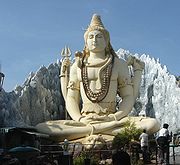
Shiva
Shiva is a major Hindu deity, and is the destroyer god or transformer among the Trimurti, the Hindu Trinity of the primary aspects of the divine. God Shiva is a yogi who has notice of everything that happens in the world and is the main aspect of life. Yet one with great power lives a life of a...
and the gods and goddesses associated with him; Vaishnavas, who worship forms of Vishnu
Vishnu
Vishnu is the Supreme god in the Vaishnavite tradition of Hinduism. Smarta followers of Adi Shankara, among others, venerate Vishnu as one of the five primary forms of God....
, his avataras, and others associated with him; Shaktas who worship a variety of goddesses. These schools are not always exclusive of each other—a bhakti's devotional practices to one form of god does not preclude worship of another form.
The bhakti movement began in South India and moved north, with an emphasis on devotion vs. ritual. It also opposed the caste system, with prominent bhakti poets Ravidas and Kabir
Kabir
Kabīr was a mystic poet and saint of India, whose writings have greatly influenced the Bhakti movement...
both writing against the hierarchy of caste. Altogether, bhakti resulted in a mass of devotional literature, music
Music
Music is an art form whose medium is sound and silence. Its common elements are pitch , rhythm , dynamics, and the sonic qualities of timbre and texture...
, dance
Dance
Dance is an art form that generally refers to movement of the body, usually rhythmic and to music, used as a form of expression, social interaction or presented in a spiritual or performance setting....
and art that has enriched the world and gave India renewed spiritual impetus, one eschewing unnecessary ritual
Ritual
A ritual is a set of actions, performed mainly for their symbolic value. It may be prescribed by a religion or by the traditions of a community. The term usually excludes actions which are arbitrarily chosen by the performers....
and artificial social boundaries.
Notable proponents of Bhakti
- Narada MuniNaradaNarada or Narada Muni is a divine sage from the Vaisnava tradition, who plays a prominent role in a number of the Puranic texts, especially in the Bhagavata Purana, and in the Ramayana...
- The AlvarsAlvarsThe alwar or azhwars were Tamil poet saints of south India who lived between the sixth and ninth centuries A.D. and espoused ‘emotional devotion’ or bhakti to Visnu-Krishna in their songs of longing, ecstasy and service. Sri Vaishnava orthodoxy posits the number of alvars as ten, though there are...
approx. 2nd century to 8th century - The NayanarsNayanarsThe Nayanars or Nayanmars were Shaivite devotional poets of Tamil Nadu, active between the fifth and the tenth centuries CE...
5th century to 10 century - Adi ShankaraAdi ShankaraAdi Shankara Adi Shankara Adi Shankara (IAST: pronounced , (Sanskrit: , ) (788 CE - 820 CE), also known as ' and ' was an Indian philosopher from Kalady of present day Kerala who consolidated the doctrine of advaita vedānta...
788 AD to 820 AD - Ramanujacharya 1017 AD to 1137 AD
- MadhvacharyaMadhvacharyaMadhvācārya was the chief proponent of Tattvavāda "Philosophy of Reality", popularly known as the Dvaita school of Hindu philosophy. It is one of the three most influential Vedānta philosophies. Madhvācārya was one of the important philosophers during the Bhakti movement. He was a pioneer in...
1238 AD to 1317 AD - JayadevaJayadevaJayadeva was a Sanskrit poet circa 1200 AD. He is most known for his composition, the epic poem Gita Govinda, which depicts the divine love of Krishna-an avatar of Vishnu and his consort, Radha, and it is mentioned that Radha is greater than Hari, and is considered an important text in the...
12th century - NimbarkaNimbarkaNimbarka , is known for propagating the Vaishnava Theology of Dvaitadvaita, duality in unity. According to scholars headed by Prof. Roma Bose, he lived in the 13th Century, on the assumption that Śrī Nimbārkācārya was the author of the work Madhvamukhamardana...
13th century - Chaitanya MahaprabhuChaitanya MahaprabhuChaitanya Mahaprabhu was a Vaishnava saint and social reformer in eastern India in the 16th century, believed by followers of Gaudiya Vaishnavism to be the full incarnation of Lord Krishna...
1486 AD to 1533 AD - TyāgarājaTyagarajaKakarla Tyagabrahmam , colloquially known as Tyāgarājar and Tyagayya was one of the greatest composers of Carnatic music or classical South Indian music. He, along with his contemporaries Muthuswami Dikshitar and Shyama Shastry, forms the Trinity of Carnatic music...
died 1847 AD - Bhaktivinoda ThakurBhaktivinoda ThakurSrila Bhaktivinoda Thakur , a prominent figure among the Gaudiya Vaishnavas of Bengal, was born Kedarnath Datta in the town of Birnagar, Bengal, India. He was the son of Raja Krsnananda Datta and Jagat Mohini Devi...
1838 AD to 1914 AD - Ramana MaharshiRamana MaharshiSri Ramana Maharshi , born Venkataraman Iyer, was a Hindu spiritual master . He was born to a Tamil-speaking Brahmin family in Tiruchuzhi, Tamil Nadu. After experiencing at age 16 what he later described as liberation , he left home for Arunachala, a mountain considered sacred by Hindus...
1878 AD to 1950 AD - Bhaktivedanta Swami Prabhupada 1896 AD to 1977 AD
- Vallabha AcharyaVallabha AcharyaVallabhacharya was a devotional philosopher, who founded the Pushti sect in India, following the philosophy of Shuddha advaita ....
1479 AD to 1531 AD