
All Topics  
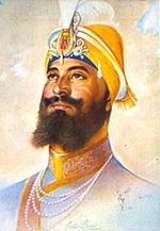
Guru Gobind Singh

 
Guru Gobind Singh

   Email Print
   Bookmark   Link


Guru Gobind Singh


Guru Gobind Singh () (December 22, 1666 – 7 October, 1708) was the tenth Guru
Sikh Gurus

Sikhism was established by Guru Nanak and nine other Sikh Gurus over the period of 1469 to 1708. Most of the Gurus were born in Northern India, although they traveled extensively from as far west as Iraq to Assam in the east and Sri Lanka in the south....
 of Sikhism
Sikhism

Sikhism , founded on the teachings of Guru Nanak and ten successive Sikh Gurus in fifteenth century Punjab region, is the Major religious groups organized religion in the world....
. He was born in Patna
Patna

Pa?na is the capital city of the Indian States and territories of India of Bihar, and one of the oldest continuously inhabited places in the world....
, Bihar
Bihar

Bihar is a States and territories of India in East India. Bihar is the 12th largest state in terms of geographical size 38,202 square mile and 3rd largest by population....
 in India
India

India, officially the Republic of India , is a country in South Asia. It is the List of countries and outlying territories by total area country by geographical area, the List of countries by population country, and the most populous liberal democracy in the world....
 and became a Guru on November 11 1675, at the age of nine years, succeeding his father Guru Tegh Bahadur. He was the leader of the Sikh faith, a warrior
Warrior

According to the Random House Dictionary, the term warrior has two meanings. The first Literal and figurative language use refers to "a person engaged or experienced in warfare." The second Literal and figurative language use refers to "a person who shows or has shown great vigor, courage, or aggressiveness, as in politics or athletics...
, a poet
Poet

A poet is a person who writes poetry....
, and a philosopher
Philosophy

Philosophy is the study of general problems concerning matters such as existence, knowledge, truth, beauty, justice, validity, mind, and language....
.

The impression of Guru Gobind Singh has not only elevated and altered the constitution of the minds of the Sikhs, but has operated materially and given amplitude to their physical frames.


Discussion
Ask a question about 'Guru Gobind Singh'
Start a new discussion about 'Guru Gobind Singh'
Answer questions from other users
Full Discussion Forum


Encyclopedia


Guru Gobind Singh () (December 22, 1666 – 7 October, 1708) was the tenth Guru
Sikh Gurus

Sikhism was established by Guru Nanak and nine other Sikh Gurus over the period of 1469 to 1708. Most of the Gurus were born in Northern India, although they traveled extensively from as far west as Iraq to Assam in the east and Sri Lanka in the south....
 of Sikhism
Sikhism

Sikhism , founded on the teachings of Guru Nanak and ten successive Sikh Gurus in fifteenth century Punjab region, is the Major religious groups organized religion in the world....
. He was born in Patna
Patna

Pa?na is the capital city of the Indian States and territories of India of Bihar, and one of the oldest continuously inhabited places in the world....
, Bihar
Bihar

Bihar is a States and territories of India in East India. Bihar is the 12th largest state in terms of geographical size 38,202 square mile and 3rd largest by population....
 in India
India

India, officially the Republic of India , is a country in South Asia. It is the List of countries and outlying territories by total area country by geographical area, the List of countries by population country, and the most populous liberal democracy in the world....
 and became a Guru on November 11 1675, at the age of nine years, succeeding his father Guru Tegh Bahadur. He was the leader of the Sikh faith, a warrior
Warrior

According to the Random House Dictionary, the term warrior has two meanings. The first Literal and figurative language use refers to "a person engaged or experienced in warfare." The second Literal and figurative language use refers to "a person who shows or has shown great vigor, courage, or aggressiveness, as in politics or athletics...
, a poet
Poet

A poet is a person who writes poetry....
, and a philosopher
Philosophy

Philosophy is the study of general problems concerning matters such as existence, knowledge, truth, beauty, justice, validity, mind, and language....
.

The impression of Guru Gobind Singh has not only elevated and altered the constitution of the minds of the Sikhs, but has operated materially and given amplitude to their physical frames. His establishment of the Khalsa
Khalsa

Khalsa is a Persian term which refers to the collective body of all baptism Sikhs. The Khalsa was originally established as a military order of "saint-soldiers" on March 30, 1699, by Guru Gobind Singh, the tenth Sikh Gurus....
 is considered as one of the most important events in the history of Sikhism
History of Sikhism

The history of Sikhism is closely associated with the history of Punjab and the the socio-political situation in medieval India....
. He fought twenty defensive battles with the Mughals
Mughal Empire

The Mughal Empire was a Muslim imperial power of the Indian subcontinent which began in 1526, ruled most of the Indian Subcontinent by the late 17th and early 18th centuries, and ended in the mid-19th century....
 and their alliances, such as Raja
Raja

A Raja is a monarch, or princely ruler of the Kshatriya Varna in Hinduism.The word 'raja'means 'rajan' in nepali which means the supreme king.It's normally the first given name in Nepal and surname in India which isused by hindus and buddhist....
s of Shivalik Hills. Guru Gobind Singh was the last human Sikh Guru; and declared the Guru Granth Sahib
Guru Granth Sahib

The Guru Granth Sahib , or Adi Sri Guru Granth Sahib, is the holy scripture and the final Guru#Classification of gurus of the Sikhs. It is a voluminous text of 1430 pages, compiled and composed during the period of Sikh Gurus, from 1469 to 1708....
, the holy scripture of Sikhism, as the next permanent Sikh Guru.

Biography


Early days

Guru Gobind Singh was born as Gobind Rai in Patna
Patna

Pa?na is the capital city of the Indian States and territories of India of Bihar, and one of the oldest continuously inhabited places in the world....
 to the ninth Sikh Guru Teg Bahadur
Guru Teg Bahadur

Guru Tegh Bahadur became the 9th Guru of Sikhism on 20 March 1665, following in the footsteps of his grand-nephew, Guru Har Krishan. Guru Tegh Bahadur was executed on the orders of Mughal Emperor Aurangzeb in Delhi....
 and his wife Mata Gujri. He was born while Guru Tegh Bahadur was touring Assam
Assam

Assam ) is a North-East India state of India with its capital at Dispur, in the outskirts of the city Guwahati. Located south of the eastern Himalayas, Assam comprises the Brahmaputra and the Barak River river valleys and the Karbi Anglong District and the North Cachar Hills with an area of 30,285 square miles ....
 to spread his teachings. According to a legend, the birth of Gobind Rai was prophesized by Pir
Pir (Sufism)

Pir is a title for a Sufi master. They are also referred to as a Shaikh, which is Arabic for Old Man. The title is often translated into English as "saint"....
 Bhikan Shah, a fakir
Fakir

A fakir or faqir is a Sufi, especially one who performs feats of endurance or apparent Magic . Derived from faqr , Lit: poverty.The word is usually used to refer to either the spiritual recluse or eremite or the common street beggar who chants holy names, scriptures or verses....
 from Thaksa village (now in Karnal District
Karnal District

Karnal is a Districts of Haryana of Haryana. The district headquarters is Karnal town. It is one of the oldest districts in Haryana state, existing since the inception of the state on 1 November 1966....
 of Haryana
Haryana

Haryana is a States and territories of India in the Punjab region of northern India. It is bordered by Punjab and Himachal Pradesh to the north, and by Rajasthan to the west and south....
).

One day, Bhikan Shah bowed towards the east during his prayers, contrary to the standard Islam
Islam

Islam is a Monotheism, Abrahamic religion originating with the teachings of the Prophets of Islam Muhammad, a 7th century Arab religious and political figure....
ic practice of bowing in the direction of Qibla
Qibla

Qiblah is an Arabic language word for the direction that should be faced when a Muslim prayer during Salah. Most mosques contain a mihrab in a wall that indicates the qiblah....
. When the villagers questioned his strange act, he stated that a special child, the savior chosen by the God, would be born in Patna, which lay to the East. He then traveled to Patna with a group of his followers to see the child. He placed two bowls of sweets before the newborn; one bowl was purchased from a Hindu's shop, and the second from a Muslim
Muslim

:A Muslim , , is an adherent of the religion of Islam. The feminine form is Muslimah . Literally, the word means "one who submits "....
's shop, thus signifying the two major contemporary religions in India. The baby placed his hands on both the bowls, thus indicating that both Hindus and Muslims will be treated equally by him. According to another legend, the fakir Araf Din of Lakhnaur (now in Ambala District
Ambala District

Ambala district is one of the 20 Districts of Haryana of Haryana States and territories of India in India. Ambala town is the administrative headquarters of the district....
) also bowed to the boy, and proclaimed him as divine.

Gobind Rai spent the first five years of his life in Patna. As a child, he used to play war games
Wargaming

A wargame is a game that represents a military operation. Wargaming is the hobby dedicated to the play of such games, which can also be called conflict simulations, or consims for short....
 with other children, leading mock battles. He had many admirers, including a learned Brahmin
Brahmin

Brahmin is the class of educators, law makers, scholars and preachers of Dharma in Hinduism. It is said to occupy the highest position among the varna in Hinduism of Hinduism....
 called Pandit Shiv Dutt. Once, Raja
Raja

A Raja is a monarch, or princely ruler of the Kshatriya Varna in Hinduism.The word 'raja'means 'rajan' in nepali which means the supreme king.It's normally the first given name in Nepal and surname in India which isused by hindus and buddhist....
 Fateh Chand of Patna and his Rani, a childless couple, visited Shiv Dutt, and asked him to bless them with a child. Shiv Dutt suggested that if an innocent child like Gobind Rai prayed to God, their desire would be fulfilled. The couple then asked young Gobind Rai to visit their palace, where the Rani asked Gobind Rai to pray to God to bless her with a son like him. Gobind Rai smiled and said that there can be nobody like him, so the Rani should call him her son. From that day, the Rani started calling him Bala Pritam ("child god"), a name that is used even today to refer to the Guru. The royal couple allowed Gobind Rai and his friends to freely play in their palace, and also built a big dining hall for the children.

Other admirers of the boy included two Nawabs, Rahim Baksh and Karim Baksh. Nawab Karim Baksh had gifted a village and gardens to the child.

Stay in Anandpur

Guru Tegh Bahadur had founded the city of Anandpur Sahib
Anandpur Sahib

Anandpur Sahib is a city and a municipal council in Rupnagar district in the state of Punjab , India. Known as "the holy City of Bliss," it is a holy city of the Sikhs and is one of their most important sacred places, closely linked with their religious traditions and history....
 in the year 1665, on the land purchased from the ruler of Bilaspur
Kahlur

Kahlur , covering an area of 1173 km?, and currently a part of Himachal Pradesh States and territories of India, was one of the Princely states of India during the period of the British Raj....
 (Kahlur). After his tour of eastern parts of India ended, he asked his family to come to Anandpur. Gobind Rai reached Anandpur (then known as Chakk Nanaki), on the foothills of the Sivalik Hills, in March 1672.

Gobind Rai's early education included study of Punjabi
Punjabi language

'Punjabi' , , is an Indo-Aryan language spoken by inhabitants of the historical Punjab region and their diasporas. Speakers include adherents of the religions of Islam, Sikhism and Hinduism....
, Braj, Sanskrit
Sanskrit

Sanskrit is a historical Indo-Aryan language, one of the liturgical languages of Hinduism and Buddhism, and one of the 22 official languages of India....
, Persian
Persian language

name=Persian|nativename=|pronunciation=[f??r'si]|image=|caption=Farsi in Perso-Arabic script |states= Iran, Afghanistan, Tajikistan, Uzbekistan, and Bahrain....
 and Arabic languages, and training as a soldier. He had started studying Hindi and Sanskrit while at Patna. In Anandpur, he started studying Punjabi under Sahib Chand, and Persian under Qazi Pir Mohammad. A Rajput
Rajput

A Rajput is a member of one of the major Hindu Kshatriya groups of Indian subcontinent. The Rajputs trace their roots to Rajputana. They enjoy a reputation as formidable soldiers and it is common to find many of them serving in the Indian Armed Forces....
 warrior was employed to train him in military skills and horse riding.

In 1675, some Kashmiri Pandit
Kashmiri Pandit

Kashmiri Pandit refers to a person who belongs to a sect of Hindu Pandits who originate from the Kashmir region, India.. It is known that they were residents of ancient Aryavarta ....
s led by Pandit Kirpa Ram of Matton visited Anandpur to seek Guru Tegh Bahadur's assistance against persecution from the Islamic Mughal
Mughal Empire

The Mughal Empire was a Muslim imperial power of the Indian subcontinent which began in 1526, ruled most of the Indian Subcontinent by the late 17th and early 18th centuries, and ended in the mid-19th century....
 rulers. Guru Tegh Bahadur proceeded to the Mughal capital Delhi
Delhi

Delhi , sometimes referred to as Dilli , is the List of most populous cities in India metropolis in India and, with over 11 million residents, the List of metropolitan areas by population....
, to discuss the emperor Aurangzeb
Aurangzeb

Aurangzeb Aurangzeb ruled India for 48 years, bringing a larger area under Mughal rule than ever before . He is generally regarded as the last Great Mughal ruler....
's policty towards the non-Muslims. The emperor had previously made very clear that the Guru's influence was unwelcome and was openly hostile to his presence. Guru Tegh Bahadur was beheaded on 11 November 1675 at Chandani Chowk, after refusing to convert to Islam. His head was to be put on the public square to deter the public from objecting to Aurangzeb's policies. The beheading of Guru Teg Bahadur frightened many of his disciples, some of whom even refused to acknowledge themselves as his followers, in order to avoid persecution. A disciple called Bhai Jaita (later Bhai Jivan Singh) picked up the severed head, before it could be put on display and brought it to Anandpur, and narrated the story of fear among the Guru's followers in Delhi.

After hearing of what had happened in Delhi, Guru Gobind decided to inculcate the martial spirit among his followers. Guru Tegh Bahadur, in preparation for the real possibility of his death at the hands of the emperor, had ordained his son as the next guru, before his departure to Delhi. Gobind Rai was formally installed as the Guru on the Baisakhi, on 11 November 1675.

Guru Gobind engaged 52 poets to translate the heroic Sanskrit epics into contemporary languages. He selected the warlike theme in many of his compositions to infuse martial spirit among his followers. He also wrote several compositions preaching love, equality and the worship of one God
God

God is a deity in theism and deism religions and other belief systems, representing either the sole deity in monotheism, or a principal deity in polytheism....
, and deprecating idolatry
Idolatry

Idolatry is usually defined as worship of any cult image, idea, or Object , as opposed to the worship of a monotheistic God. It is considered a major sin in the Abrahamic religions whereas in religions where such activity is not considered as sin, the term "idolatry" itself is absent....
 and superstition
Superstition

Superstition is a belief or notion, not based on reason or knowledge. The word is often used pejoratively to refer to supposedly irrational beliefs of others, and its precise meaning is therefore subjective....
.

Guru's increasing influence and power worried Raja Bhim Chand of Bilaspur
Kahlur

Kahlur , covering an area of 1173 km?, and currently a part of Himachal Pradesh States and territories of India, was one of the Princely states of India during the period of the British Raj....
 (Kahlur), in whose territory Anandpur was located. Meanwhile, the Guru ordered construction of a war drum
Drum

The drum is a member of the percussion instrument group, technically classified as a membranophone.. Drums consist of at least one membrane, called a drumhead or drum skin, that is stretched over a shell and struck, either directly with parts of a player's body, or with some sort of implement such as a drumstick, to produce sound....
 (nagara
Naqareh

The naqqara is a drum with a rounded back and a hide head. It is thus a membranophone.The term naqqara , also naqqarat, naqqarah, naqq?re, nakkare, nagora comes from the Arabic verb naqr- that means "to strike, beat"....
) called Ranjit Nagara to enthuse his soldiers. The use of such a war drum was limited to the chieftains, within their territory, and the Raja considered the use of Ranjit Nagara a hostile act. On his Prime Minister's advice, he arranged a meeting with the Guru in Anandpur. He was received with honor in the Guru's court, where his eyes fell at the valuable gifts presented to the Guru by the devotees. Later, Bhim Chand sent a message to the Guru, asking him to lend an elephant
Elephant

Elephants are large land mammals of the order Proboscidea and the family Elephantidae. There are three living species: the African Bush Elephant, the African Forest Elephant and the Asian Elephant ....
 called Prasadi (a gift from a devotee) to him. The Guru suspected that Bhim Chand wanted to gain permanent possession of the elephant, and declined his demand. He stated that the devotee who had presented the elephant, didn't want it to be given away to anybody else. The Raja was perturbed by the Guru's refusal to give away the elephant, his growing influence, and his interest in military exercises. An atmosphere of confrontation developed between the two on small issues.

Stay at Paunta

Guru Gobind Singh Meets Guru Nanak Dev
In April 1685, Guru Gobind Rai shifted his residence to Paonta in Sirmur
Sirmur

Sirmur was an independent kingdom in Indian subcontinent, founded in 1616. It became a part of Greater Nepal, before becoming a princely state in British India, located in the region that is now the Sirmaur district of Himachal Pradesh....
 state at the invitation of Raja Mat Prakash of Sirmur. The reasons for the shift are not clear. The author of Bichitra Natak doesn't mention any reason for shifting his residence to Paonta. According to the Gazetteer of the Sirmur state, the Guru was compelled to quit Anadpur due to differences with Bhim Chand, and went to Toka. From Toka, he was brought to Nahan
Nahan

Nahan is a town in Himachal Pradesh in India and is the headquarters of the Sirmaur District....
 (the capital of Sirmur) by Mat Prakash. From Nahan, he proceeded to Paonta. Mat Prakash invited the Guru to his kingdom in order to strengthen his position against Raja Fateh Shah
Fateh Shah

Fateh Shah was the king of Garhwal Kingdom, a small kingdom in North India, from 1684 to 1716....
 of Garhwal
Garhwal Kingdom

Garhwal was a princely state in the present Uttarakhand, India, founded in 1358 AD and which existed until it was annexed by the Gorkhas in 1803....
. At the request of Raja Mat Prakash, the Guru constructed a fort at Paonta with help of his followers, in a short time. He continued to increase his army. Raja Fateh Shah also paid a visit to the Guru, and was received with honor in his court. The Guru established a peace treaty between the two Rajas. The Guru remained at Paonta for around three years, and composed several texts.

The hostility between Bhim Chand and the Guru continued to increase during the latter's stay at Paonta, ultimately resulting in the Battle of Bhangani
Battle of Bhangani

The Battle of Bhangani was fought between Guru Gobind Singh's army and the combined forces of many Rajas of the Sivalik Hills , on 18 September 1688, at Bhangani near Paonta Sahib....
 near Paonta. Bhim Chand was supported by other hill Rajas, including Fateh Shah
Fateh Shah

Fateh Shah was the king of Garhwal Kingdom, a small kingdom in North India, from 1684 to 1716....
 of Garhwal
Garhwal Kingdom

Garhwal was a princely state in the present Uttarakhand, India, founded in 1358 AD and which existed until it was annexed by the Gorkhas in 1803....
, Kirpal of Katoch
Katoch

Katoch is the name of a Rajput clan belonging to the chandravanshi lineage. Their traditional areas of residence was Trigarta Kingdom, Jalandhar i.e....
, Gopal of Guler (or Guleria), Hari Chand of Hadur and the Raja of Jaswal. Bhim Chand was also aided by some defected Pathans employed by the Guru. The Guru's army consisted of his disciples, some Udasi
Udasi

Udasi is a religion, ascetic sadhu sect, which considers itself a denomination of Sikhism focused on the teachings of its founder, Sri Chand , son of Guru Nanak Dev, the founder and the first Guru of Sikhism....
s, some Pathans, and around 700 followers of Pir
Pir (Sufism)

Pir is a title for a Sufi master. They are also referred to as a Shaikh, which is Arabic for Old Man. The title is often translated into English as "saint"....
 Budhu Shah of Sadhaura. According to Bichitra Natak
Bichitra Natak

Bichitra Natak is from Dasam Granth generally attributed to Guru Gobind Singh, the 10th Sikh Guru spans from page 94 to page 175 of the 2326 pages....
, the Battle of Bhangani resulted in the Guru's victory.

Return to Anandpur

Sometime after the Battle of Bhangani, the Guru decided to return to Anandpur. On his way back to Anandpur, he camped at Sadhaura and Laharpur
Laharpur

Laharpur is a city and a municipal board in Sitapur district in the Indian States and territories of India of Uttar Pradesh....
 for a few days. After leaving the Sirmur state, he entered Ramgarh
Ramgarh, Uttarakhand

See Ramgarh for disambiguationRamgarh is a small hill station and tourist destination on the way to Mukteshwar in Nainital district of Uttarakhand, India....
 state and stayed at Tabra for more than a week. He then visited Raipur
Raipur, Uttarakhand

Raipur is a census town in Dehradun district in the Indian States and territories of India of Uttarakhand.GeographyRaipur is located at ....
 at the invitation of the local Rani
Rani

Rani, alternatively spelled Ranee, is the female equivalent of Raja. In many Indo-Aryan languages it can mean "queen" or "lady".People with the title Rani include:...
. After leaving Raipur, he continued his journey to Anandpur, passing through Toda, Nada, Dhakoli, Kotla, Ghanaula, Bunga, and Kiratpur. He reached Anandpur, and established peace with Raja Bhim Chand.

In the 1680s, to meet the expenses of his campaigns in Deccan, the Mughal emperor Aurangazeb ordered recovery of annual tributes from the rulers of hill states, who had been defaulting on the payment for three consecutive years. The duty of collecting tributes from Kangra and adjoining principalities was assigned to Alif Khan (or Alaf Khan). Two of the hill Rajas, Raja Kirpal Chand of Kangra
Kangra

Kangra is a city and a municipal council in Kangra district in the Indian States and territories of India of Himachal Pradesh....
 and Raja Dayal of Bijarwal, agreed to meet Alif Khan's demands. However, Raja Bhim Chand of Bilaspur (Kahlur) refused to pay the tribute, and formed an alliance of the local rulers opposed to the Mughals. Guru Gobind Singh also agreed to support him. In the Battle of Nadaun
Battle of Nadaun

The Battle of Nadaun was fought at Nadaun, between Raja Bhim Chand of Kahlur and the Mughal Empire under Alif Khan. Raja Bhim Chand was supported by Guru Gobind Singh and other hill chieftains, who had refused to pay tribute to the Mughal emperor....
, the armies of Alif Khan and his aides were defeated by the allied forces of Bhim Chand, Guru Gobind Singh and other hill Rajas. Different authors give the date of the battle variously as 1687, 1689, 1690, 20 March 1691, and 4 April 1691.

According to Bichitra Natak, Guru Gobind Singh remained at Nadaun, on the banks of the River Beas
Beas River

The Beas River is the second easternmost of the rivers of the Punjab region. The river rises in the Himalayas in central Himachal Pradesh, India, and flows for some 290 miles to the Sutlej River in western Punjab state....
, for eight days, and visited the places of all the chiefs. Later, both the parties made an agreement and peace was established.

In 1694, Dilawar Khan, the Mughal chief of Punjab
Punjab region

Punjab , also Panjab , is a region straddling the border between India and Pakistan. The "Five Rivers" are Beas River, Ravi River, Sutlej, Chenab and Jhelum River; all these are tributaries of the Indus river, Jhelum being the biggest one....
, sent his son with an army of one thousand men to Anandpur, to check the rising power of the Guru. As Khanzada crossed the Satluj river, Guru's scout Alam Chand (aka Alam Singh) alerted the Guru's forces. The Ranjit Nagara was beaten, and the Guru's men quickly marched to the river, forcing the Mughal army to retreat back.

The failure of Khanzada to check Guru's power provoked Dilawar Khan to plan a bigger attack on the Guru and other hill Rajas. He sent two thousand men under his slave Hussain to subdue them. Hussain defeated the Raja of Dadhwal and plundered Doon. Raja Kirpal (Katoch) of Kangra and Raja Bhim Chand of Kahlur accepted his suzerainty
Suzerainty

Suzerainty is a situation in which a region or nation is a tributary state to a more powerful entity which allows the tributary some limited domestic Wiktionary:autonomy to control its foreign affairs....
. Raja Gopal of Guler and Raja Ram Singh tried to negotiate with Hussain, but the talks failed. Hussain besieged Guler, and demanded ten thousand rupees from Raja Gopal. Gopal sent his envoy to Guru Gobind Singh, asking him to negotiate a peace treaty between Hussain and the Raja. The Guru sent his agent, Sangtia, with an escort of seven troopers. However, an agreement could not be reached, resulting in a battle (dated between 1695 to 1698). Kirpal and Bhim Chand fought on Hussain's side, while Raja Ram Singh and the Guru's men fought on Raja Gopal's side. The battle resulted in the deaths of Hussain, Kirpal and all of the Guru's men. Raja Bhim Chand's forces fled from the battlefield, thus resulting in the victory of Raja Gopal. Raja Gopal went to the Guru, thanked him, and offered him gifts. The battle is described in the Chapter 11 of Bichitra Natak.

After Hussain's death, Dilawar Khan sent his men Jujhar Singh and Chandel Rai to Sivalik Hills. However, they were defeated by Gaj Singh of Jaswal. The developments in the hill area caused anxiety to the Mughal emperor Aurangzeb, who sent forces under the command of his son, to restore Mughal authority in the region.

The Founding of the Khalsa

In 1699, the Guru sent hukmanamas (letters of authority) to his followers, requesting them to congregate at Anandpur on 30 March 1699, the day of Baisakhi (the annual harvest festival
Harvest festival

A harvest festival is an annual celebration which occurs around the time of the main harvest of a given region. Given the differences in climate and crops around the world, harvest festivals can be found at various times throughout the world....
). He addressed the congregation from the entryway of a small tent pitched on a small hill (now called Kesgarh Sahib). He first asked everyone who he was for them? Everyone answered - "You are our Guru." He then asked them who were they, to which everyone replied - "We are your Sikhs." Having reminded them of this relationship, He then said that today the Guru needs something from his Sikhs. Everyone said, "Hukum Karo, Sache Patshah" (Order us, True Lord). Then drawing His sword He asked for a volunteer who was willing to sacrifice his head. No one answered his first call, nor the second call, but on the third invitation, Daya Ram
Bhai Daya Singh

Bhai Daya Singh , one of the Panj Pyare or the Five Beloved celebrated in the Sikh tradition, was the son of Bhai Suddha, a Sobti Khatri of Lahore, and Mai Diali....
 (later known as Bhai Daya Singh) came forward and offered his head to the Guru. Guru Gobind Rai took the volunteer inside the tent, and emerged shortly, with blood dripping from his sword. He then demanded another head. One more volunteer came forward, and entered the tent with him. The Guru again emerged with blood on his sword. This happened three more times. Then the five volunteers came out of the tent in new clothing unharmed.

Gobind Rai then poured clear water into an iron bowl and adding Patashas (Punjabi sweeteners) into it, he stirred it with double-edged sword accompanied with recitations from Adi Granth. He called this mixture of sweetned water and iron as Amrit
Amrita

Amrita or Amrit is a Sanskrit word that literally means "without death", and is often referred to in texts as nectar. Corresponding to ambrosia, it has different significances in different Indian religions....
("nectar") and administered it to the five men. These five, who willingly volunteered to sacrifice their lives for their Guru, were given the title of the Panj Piare
Panj Piare

The Panj Piare , name given to the five Sikhs, Bhai Daya Singh, Bhai Dharam Singh, Bhai Himmat Singh, Bhai Mohkam Singh and Bhai Sahib Singh, who were so designated by Guru Gobind Singh at the historic divan at Anandpur Sahib on 30 March 1699 and who formed the nucleus of the Khalsa as the first batch to receive at his hands khanda di Pahul,...
 ("the five beloved ones") by their Guru. They were the first (baptized) Sikhs of the Khalsa
Khalsa

Khalsa is a Persian term which refers to the collective body of all baptism Sikhs. The Khalsa was originally established as a military order of "saint-soldiers" on March 30, 1699, by Guru Gobind Singh, the tenth Sikh Gurus....
: Daya Ram (Bhai Daya Singh
Bhai Daya Singh

Bhai Daya Singh , one of the Panj Pyare or the Five Beloved celebrated in the Sikh tradition, was the son of Bhai Suddha, a Sobti Khatri of Lahore, and Mai Diali....
), Dharam Das (Bhai Dharam Singh
Bhai Dharam Singh

Bhai Dharam Singh , one of the Panj Pyare or the Five Beloved, the forerunners of Khalsa, came of farming stock. He was the son of Bhai Sant Ram and Mai Sabho, of Hastinapur, an ancient town on the right bank of the Wikipedia:Ganges, 35 km northeast of Meerut....
), Himmat Rai (Bhai Himmat Singh
Bhai Himmat Singh

Bhai Himmat Singh , one of the Panj Pyare, or the Five Beloved, celebrated in Sikh history, was born in 1661 at Puri in a low-caste family of water suppliers....
), Mohkam Chand (Bhai Mohkam Singh
Bhai Mohkam Singh

Bhai Mohkam Singh . Born Mohkam Chand, one of the Panj Pyare or the Five Beloved of honoured memory in the Sikh tradition, was the son of Tirath Chand, a cloth printer of Dwarka in Gujarat....
), and Sahib Chand (Bhai Sahib Singh
Bhai Sahib Singh

Bhai Sahib Singh was one of the Panj Pyare or the Five Beloved of revered memory in the Sikh tradition, was born the son of Bhai Guru Narayana, a barber of Bidar in Karnataka, and his wife Ankamma....
).

Guru Gobind Singh then recited a line which has been the rallying-cry of the Khalsa since then:'Waheguru ji ka Khalsa, Waheguru ji Ki Fateh' (Khalsa belongs to God; victory belongs to God). He gave them all the name "Singh
Singh

Singh is derived from the Sanskrit word Si?ha meaning "Asiatic Lion". It is a common title, middle name, or surname in North India originally used by Hindu Rajputs, in 1699 it was also adopted by the Sikhs as per the wish of Guru Gobind Singh....
" (lion), and designated them collectively as Khalsa
Khalsa

Khalsa is a Persian term which refers to the collective body of all baptism Sikhs. The Khalsa was originally established as a military order of "saint-soldiers" on March 30, 1699, by Guru Gobind Singh, the tenth Sikh Gurus....
 (the Pure Ones), the body of baptized Sikhs. The Guru then astounded the five and the whole assembly as he knelt and asked them to in turn initiate him as a member, on an equal footing with them in the Khalsa, thus becoming the sixth member of the new order. His name became Gobind Singh.

Today members of the Khalsa consider Guru Gobind as their father, and Mata Sahib Kaur (not the Guru's wife), but a member of his household, as their mother. The Panj Piare were thus the first baptised Sikhs, and became the first members of the Khalsa brotherhood. Women were also initiated into the Khalsa, and given the title of kaur ("princess"). Though women are considered equal in Sikhism, men have been very slow to allow women to serve as the 'Panj Piare' who handle Baptism into the order to this day.

Guru Gobind Singh then addressed the audience -

Conflicts with the Rajas of Sivalik Hills


The formation of the military order Khalsa alerted the Raja
Raja

A Raja is a monarch, or princely ruler of the Kshatriya Varna in Hinduism.The word 'raja'means 'rajan' in nepali which means the supreme king.It's normally the first given name in Nepal and surname in India which isused by hindus and buddhist....
s of the Sivalik Hills. They united to evict the Guru from the region, but their expeditions during 1700-04 proved futile.

Balia Chand and Alim Chand, two hill chiefs, made a surprise attack on the Guru, while he was on a hunting expedition. In the ensuing combat, Alim Chand managed to escape, while Balia Chand was killed by Guru's aide Ude Singh.

After several failed attempts to check the rising power of the Guru, the hill chiefs petitioned the Mughal rulers to help them subdue the Guru. In response, the Mughal viceroy of Delhi
Delhi

Delhi , sometimes referred to as Dilli , is the List of most populous cities in India metropolis in India and, with over 11 million residents, the List of metropolitan areas by population....
 sent his generals Din Beg and Painda Khan, each with an army of five thousand men. The Mughal forces were joined by the armies of the hill chiefs. However, they failed to defeat the Guru's forces, and Painda Khan was killed in the First Battle of Anandpur
First Battle of Anandpur

The First Battle of Anandpur was fought at Anandpur, between the armies of the Sikh Guru Guru Gobind Singh and the Mughal Empire forces aided by the Rajas of the Sivalik Hills....
 (1701).

Alarmed at the Guru's rising influence, the Rajas of several hill states assembled at Bilaspur
Bilaspur, Himachal Pradesh

Bilaspur is a city and a municipal council in Bilaspur District, Himachal Pradesh in the state of Himachal Pradesh, India....
 to discuss the situation. The son of Bhim Chand, Raja Ajmer Chand of Kahlur
Kahlur

Kahlur , covering an area of 1173 km?, and currently a part of Himachal Pradesh States and territories of India, was one of the Princely states of India during the period of the British Raj....
, suggested forming an alliance to curb the Guru's rising power. Accordingly, the Rajas formed an alliance, and marched towards Anandpur. They sent a letter to the Guru, asking him to pay the arrears
Arrears

Arrears is a legal term for a type of debt which is overdue after missing an expected payment. It is also used for payments that occur at the end of a period....
 of rent for Anandpur (which lied in Ajmer Chand's territory), and leave the place. The Guru insisted that the land was bought by his father, and is therefore, his own property. A battle, dated from 1701 to 1704, followed. The hill Rajas were joined by a large number of Jatts and Gujjar
Gujjar

The Gujjar or Gurjar are an ethnic group in India and Pakistan. Alternative spellings include Gurjara, Gujar and Goojar....
s, under the command of Jagatullah. Duni Chand led five hundred men from Majha
Majha

File:Punjabdoabs1.jpgMajha is a historical region of the Punjab region comprising the modern districts of Amritsar District, Gurdaspur District and Tarn Taran Sahib in the India State of Punjab_ and the districts of Lahore District and Kasur District in the Pakistan Province of Punjab_....
 region to assist the Guru. Reinforcements from other areas also arrived to help the Guru. The conflict, known as the Second Battle of Anandpur
Second Battle of Anandpur

The Second Battle of Anandpur was fought at Anandpur, between the armies of the Sikh Guru Guru Gobind Singh and an allied force of the Rajas of the Sivalik Hills....
, resulted in retreat of the hill Rajas.

Later, the hill Rajas negotiated a peace agreement with the Guru, asking him to leave Anandpur temporarily. Accordingly, the Guru left for Nirmoh village. Seeing that Nirmoh was not fortified, Raja Ajmer Chand and the Raja of Kangra
Kangra

Kangra is a city and a municipal council in Kangra district in the Indian States and territories of India of Himachal Pradesh....
 launched an attack on the Guru's camp. However, they were not able to defeat the Guru. Meanwhile, Raja Ajmer Chand had sent his envoys to the Mughal viceroys in Sirhind and Delhi
Delhi

Delhi , sometimes referred to as Dilli , is the List of most populous cities in India metropolis in India and, with over 11 million residents, the List of metropolitan areas by population....
, seeking their help against the Guru. The army of Sirhind viceroy Wazir Khan arrived to assist the hill Rajas. The assault by Wazir Khan's army forced the Guru to retreat to Basoli, whose Raja was on good terms with the Guru.

After staying for a few days at Basoli, the Guru marched back to Anandpur, and the hill Rajas decided to make peace with the him. However, after two years of peace, the hostilities between the Rajas and the Guru reappeared due to Guru's rising power, and clashes between the Rajas' men and the Sikhs. Raja Ajmer Chand allied with the Rajas of Hindur, Chamba
Chamba

Chamba may refer to*Chamba, Himachal Pradesh, city in Himachal Pradesh, India*Chamba District, Himachal Pradesh, India*Chamba, Uttarakhand, small town in Tehri-Garhwal district, Uttarakhand, India...
 and Fatehpur
Fatehpur

Fatehpur may refer to,Towns in India* Uttar Pradesh** Fatehpur, Fatehpur, in Fatehpur district** Tehsil Fatehpur, in Barabanki district* Fatehpur, Shekhawati a town in the Sikar District of Indian States and territories of India of Rajasthan....
, and attacked Anandpur in 1703-04. They failed to oust the Guru in the Third Battle of Anandpur, and retreated.

After repeated pleas for assistance from the hill Rajas, the Mughal emperor sent a large army under Saiyad Khan's command, to check the Guru's power. Saiyad Khan was a brother-in-law
Brother-in-law

A brother-in-law is one's sister's husband, or one's spouse's brother. One's spouse's sister's husband is also considered a brother-in-law. The plural of this term is "brothers-in-law"....
 of Pir Budhu Shah, and defected to the Guru's side, after the Pir spoke highly of him. Ramzan Khan then took the command of the imperial army, and allied with the hill Rajas to attack Anandpur in March 1704. It was the crop-cutting time of the year, and the majority of the Guru's followers had dispersed to their homes. Although the Guru was assisted by two of his Muslim admirers, Maimun Khan and Saiyad Beg, his men were outnumbered and he decided to vacate Anandpur. The Mughal army plundered the city, and then proceeded to Sirhind. On their way back, they were caught in a surprise attack by the Guru's forces, who recovered the booty captured from Anandpur. The Guru then returned to Anandpur.

Evacuation from Anandpur

The hill chiefs then decided to approach the Mughal Emperor, Aurangzeb, through his Governor in Punjab, Wazir Khan, to help them subdue the Guru. Their memorandum spoke of his establishing the new order of Khalsa

At the plea of Raja Ajmer Chand, the Mughal emperor ordered the viceroys of Sirhind, Lahore
Lahore

is the capital of the Pakistani Subdivisions of Pakistan of Punjab and is the List of most populated metropolitan areas in Pakistan city in Pakistan after Karachi....
 and Kashmir
Kashmir

Kashmir is the northwestern region of the Indian subcontinent. Until the mid-19th century, the term "Kashmir" referred only to the valley lying between the Great Himalayas and the Pir Panjal range; since then, it has been used for a larger area that today includes the Indian administerd state of Jammu and Kashmir consisting of the Kashmir...
 to proceed against the Guru. The Mughal forces were joined by the armies of the hill Rajas, the Ranghars and the Gurjars of the area. The Guru also made preparations for the battle, and his followers from Majha
Majha

File:Punjabdoabs1.jpgMajha is a historical region of the Punjab region comprising the modern districts of Amritsar District, Gurdaspur District and Tarn Taran Sahib in the India State of Punjab_ and the districts of Lahore District and Kasur District in the Pakistan Province of Punjab_....
, Malwa
Malwa (Punjab)

Malwa is a region of Punjab and parts of Haryana between the Sutlej and Yamuna rivers. This Malwa should not be confused with the Malwa Plateau region of Madhya Pradesh, Central India....
, Doaba
Doaba

Doaba is the region of Punjab surrounded by the rivers Beas River and Sutlej River. The name "Doaba" literally translates to "land of two rivers" ....
 and other areas assembled at Anandpur.

The imperial forces attacked Anandpur in 1705, and laid a siege around the city. After a few days of the commencement of the siege, Raja Ajmer Chand sent his envoy to the Guru, offering withdrawal of the siege, in return for Guru's evacuation from Anandpur. The Guru refused to accept the offer, but many of his followers, suffering from lack of food and other supplies, asked him to accept the proposal. As more and more followers pressurized the Guru to accept Ajmer Chand's offer, he sent a message to Ajmer Chand offering to evacuate Anandpur, if the allied forces would first allow his treasury
Treasury

A treasury is any place where the currency or items of high monetary value are kept. The term was first used in Classical antiquity times to describe the votive buildings erected to house Sacrifice, such as the Siphnian Treasury in Delphi or many similar buildings erected in Olympia, Greece by competing city-states to impress others during t...
 and other property to be taken outside the city. The allied forces accepted the proposal. The Guru, in order to test their sincerity, sent a caravan
Caravan

Caravan may refer to:*Caravan , a group of travellers journeying together* Convoy, a group of vehicles or ships traveling together for mutual support...
 of loaded bullock
Bullock

A bullock is a castrated cattle, also known as a steer or ox. They are castrated so that the animal may be more docile or may put on weight more quickly....
s outside the fort. However, the allied forces attacked the caravan to loot the treasure. To their disappointment, they found out that the caravan had no treasure, just some rubbish articles. The Guru then decided not to vacate Anandpur, and refused to accept any further proposals from the allied forces.

Finally, the Mughal emperor Aurangzeb
Aurangzeb

Aurangzeb Aurangzeb ruled India for 48 years, bringing a larger area under Mughal rule than ever before . He is generally regarded as the last Great Mughal ruler....
 sent a signed letter to the Guru, swearing in name of Quran, that the Guru and his followers would be allowed a safe passage if he decided to evacuate Anandpur. The Guru, hard pressed by his followers and his family, accepted the offer, and evacuated Anandpur on 20-21 December, 1705.

On the first night after they left Anandpur, the Guru's contingent was attacked by the imperial forces. Following a few skirmishes, the Guru and his followers reached the banks of Sirsa river. The group could not keep together while crossing the flooded Sirsa (or Sarsa) river. The Guru's mother, and his two younger sons, Fateh Singh
Sahibzada Fateh Singh

Sahibzada Fateh Singh was the youngest of Guru Gobind Singh's four sons. He and his older brother, Sahibzada Zorawar Singh are among the most hallowed martyrs in Sikhism....
 and Zorawar Singh
Sahibzada Zorawar Singh

Sahibzada Zorawar Singh was the third of Guru Gobind Singh's four sons. He and his younger brother, Sahibzada Fateh Singh are among the most hallowed martyrs in Sikhism....
, strayed away from the main group. Guru's old servant, Gangu, escorted them to his village, Kheri. His wife Mata Jito, was in another group that also included Mata Sahib Kaur
Mata Sahib Kaur

Mata Sahib Kaur is known as the "Mother of the Khalsa". She earned the distinction by instilling the first Amrit with the sweetness that balances its fierceness....
; this group was escorted to Delhi
Delhi

Delhi , sometimes referred to as Dilli , is the List of most populous cities in India metropolis in India and, with over 11 million residents, the List of metropolitan areas by population....
 by Jawahar Singh. The flood in the river resulted in several of the Guru's followers getting drowned, and there was heavy loss of property and literature.

The Guru, with his two sons, and some other Sikhs, managed to cross the river and reached the Ghanaula village on the other side of the river. He instructed a band of hundred followers under Bachitar Singh to march to Rupar. The Guru, with the remaining followers, marched towards Kotla Nihang near Rupar, to stay with his trusted acquaintance Pathan Nihang Khan. From there, he proceeded to Machhiwara
Machhiwara

Machhiwara is a town and a nagar panchayat in Ludhiana district in the Indian States and territories of India of Punjab . Machhiwara is famous for Gurudwara Sri Charan Kanwal Sahib named after the Guru's feet that are compared to the lotus flower....
 and Raikot
Raikot

Raikot is a city and a municipal council in Ludhiana district in the Indian States and territories of India of Punjab ....
, halting at Bur Majra. He was informed that a large body of troops from Sirhind was chasing him. He decided to face the enemy troops at the fortress of Chamkaur. The imperial troops besieged the fortress at Chamkaur in December 1705, leading to the battle of Chamkaur
Battle of Chamkaur

The Battle Of Chamkaur or also known as Battle Of Chamkaur Sahib was a battle fought between Khalsa led by Guru Gobind Singh against the Mughal forces led by Wazir Khan and other Mughal Generals....
. The two elder sons of Guru Gobind Singh, Ajit Singh
Sahibzada Ajit Singh

Sahibzada Ajit Singh , was the eldest of Guru Gobind Singh's four sons. His younger brothers were Sahibzada Jujhar Singh, Sahibzada Zorawar Singh and Sahibzada Fateh Singh....
 and Jujhar Singh
Sahibzada Jujhar Singh

Sahibzada Jujhar Singh , the second son of Guru Gobind Singh, was born to Mata Jito at Anandpur Sahib on March 14, 1691. This event is now celebrated on April 9 each year according to the Nanakshahi Calendar)....
, fell in the battle. The Guru asked the remaining disciples to get ready for the final charge, and die fighting. However, his disciples insisted that the his survival was necessary for the survival of the Khalsa, and planned his escape from Chamkaur. It was decided that Sant Singh and Sangat Singh will stay in the fortress, while Daya Singh, Dharam Singh, and Man Singh will accompany the Guru out of Chamkaur. The Guru gave his kalghi (plume
Plume

Plume may refer to:In fashion:* A prominent bird feather#Utilitarian functions often used as an ornament** Hackle, an ornamental plume on a uniform headdress...
 used to decorate headgear
Headgear

Headgear, headwear or headdress is the name given to any element of clothing which is worn on one's head .Headgear serve a variety of purposes:...
) and his armor to Bhai Sant Singh, a Sikh who resembled him. Sant Singh was seated in the upper room where Guru was stationed. The Guru marched out of Chamkaur in the night, along with some followers. Next day, the Mughal army, which still believed that the Guru was inside the fortress, attacked the fortress, and killed all the Sikhs inside the fortress.

The Guru separated from his companions, and reached Machhiwara, after passing through Jandsar and Behlolpur. There, his three companions, Daya Singh, Dharam Singh and Man Singh rejoined him. Gulaba, an old masand of Machhiwara, gave them shelter, but feared for his own safety. Two Pathan horse merchants, Nabi Khan and Ghani Khan, decided to help him. The Khans, who were old acquaintances of the Guru, disguised him as the Pir
Pir (Sufism)

Pir is a title for a Sufi master. They are also referred to as a Shaikh, which is Arabic for Old Man. The title is often translated into English as "saint"....
 (Sufi saint) of Uchh village, and carried him to safety, in a palanquin. At Alam Gir, Nand Lal, a zamindar
Zamindar

Zamindar , also kniown as Zemindar, Zamindari, Jomidar or the Zamindari System were employed by the Mughal empire to collect taxes from peasants....
 decided to help the Guru. From Alam Gir, the Guru proceeded to Raikot
Raikot

Raikot is a city and a municipal council in Ludhiana district in the Indian States and territories of India of Punjab ....
. At Silaoni, Rai Kalla, the chief of Raikot, received him warmly. The Guru stayed there for some time.

Meanwhile, Guru's mother Mata Gujri and the his two younger sons were captured by Wazir Khan, the governor of Sirhind. The two boys were killed after refusing to convert to Islam, and Mata Gujri died soon after hearing of her grandsons' death.

Stay at Dina


Realizing that Rai Kot was not a suitable place to stage resistance against the Mughals, Guru Gobind Singh left Raikot, and spent two days at Hehar with Mahant Kirpal Das (who had earlier participated in the Battle of Bhangani
Battle of Bhangani

The Battle of Bhangani was fought between Guru Gobind Singh's army and the combined forces of many Rajas of the Sivalik Hills , on 18 September 1688, at Bhangani near Paonta Sahib....
). He then marched to Lamma Jatpura, where his companion Rai Kalla took leave. The Guru moved southwards, accompanied by three Sikhs. On the way he passed through the villages of Manuke, Mehdiana, Chakkar, Takhtupura and Madhe and finally reached Dina (now in Moga district) in Malwa (Punjab)
Malwa (Punjab)

Malwa is a region of Punjab and parts of Haryana between the Sutlej and Yamuna rivers. This Malwa should not be confused with the Malwa Plateau region of Madhya Pradesh, Central India....
. The people had heard that the Guru had been killed at Chamkaur, but the truth began to be known when he reached Dina. He was received warmly at Dina by Shamira, Lakhmira and Takht Mal, the three grandsons of Rai Jodh, a devotee of Guru Har Gobind
Guru Har Gobind

Guru Har Gobind also Sacha Badshah was the sixth of the Ten Gurus of Sikhism and became Guru on 25 May,1606 following in the footsteps of his father Guru Arjan Dev....
.

While at Dina, the Guru received a concilatory letter from Aurangzeb, asking him to come to Deccan to discuss the situation. The Guru was wary of Aurangzeb, who had beheaded his father, and whose army attacked him at Anandpur in spite of an oath in the name of Quran. The Guru rejected the emperor's offer, and wrote a long letter in Persian, titled 'Zafarnamah' (the Epistle of Victory). In the letter, the Guru reminded Aurangzeb of his misdeeds, and condemened the treacherous acts of the Mughals. He sent a group of Sikhs, consisting of Daya Singh, Dharam Singh, and some guards, to despatch the letter to Aurangzeb, who was camping in Ahmednagar
Ahmednagar

Ahmednagar is a city of Ahmednagar District in the states and territories of India of Maharashtra, India, on the west bank of the Sina river, about 120 km northeast of Pune and 120 km from Aurangabad district, Maharashtra....
.

Guru Gobind Singh moved onto Talwandi Sabo and was at place called Rohi when a group of forty Sikhs from Majha area of Punjab region accompanied by Mata Bhag Kaur, also known as Mai Bhago, visited him. They had come to offer their condolences over the death of his four sons and his mother, and also offered to effect a compromise between the Guru and Mughal authorities. The Guru narrated to them the atrocities of Mughals from the time of martyrdom of Guru Arjan to the laying of the siege of Anandpur. He rebuked them for their behaviour and put them to shame for talking like that. One of the leaders of the Jatha (group), Bhag Singh Jabhalia, said that it was not in their means to have more faith in the Guru. The Guru said that he had not called for them and they should write a disclaimer, which was signed by Bhag Singh Jabhalia and another four. The remaining thirty five did not sign the disclaimer. The Guru at the moment got the information of advancing Mughal forces led by Wazir Khan. He along with those acompanying him moved on to take positions by the side of a mound, which incidentally was also the only water source in the area.

At this stage Mata Bhag Kaur criticised the forty Sikhs for deserting Guru Gobind Singh at such a crucial stage. Her challenge made the forty to face the oncoming Mughal force led by Wazir Khan. In the action that occurred on 30 poh 1972 (December 29, 1705), beside the forty Sikhs and Mata Bhag Kaur from Majha, Guru Gobind Singh and those accompanying him also participated. After a showdown with arrows and bullets, the fight came down to close combat with swords and spears. By sunset all forty were dead or seriously injured and the Mughal forces retreated. Of the forty only three sikhs (Rai Singh, Sunder singh and Mahan singh) were in their last breath, while Bhag Kaur lay seriously injured. At their request Guru Gobind Singh tore the disclaimer and blessed them as Muktas (emanicipated). He also changed the name of the place, Ishar sar or Khidrana, to Muktsar
Muktsar

Muktsar is a city and a municipal council in Muktsar district in the Indian States and territories of India of Punjab . Muktsar's old name was Khidrane dee dhab ....
 in their honour.

Stay at Talwandi Sabo

Sri Guru Granth Sahib Nishan
From Mukatsar, the Guru moved to Rupana, Bhander, Gurusar, Thehri Bambiha, Rohila, Jangiana and Bhai Ka Kot. At Chatiana, the Brars who had fought for him at Muktsar, threatened to block his march as the Guru had failed to disburse pay arrears to them. A Sikh from the neighborhood area brought enough money, which enabled the Guru to pay off all the arrears. However, the leader of the Brars, Chaudhri Dana apologized the Guru on behalf of his people, and refused to accept any payment for himself. At his request, the Guru visited his native place Mehma Swai. The Guru continued his travel, passing through Lakhi Jungle
Lakhi Jungle

Lakhi Jungle is situated 15 km from Bathinda, on the way to Muktsar. A forest having old Gurudwara enjoyed the touches of Shri Guru Nanak Dev who recited one lakh holy Paths of Shri Japuji Sahib....
 (Lakhisar). From Lakhi, he visited nearby areas and initiated large number of people into Khalsa.

A landowner called Chaudhari Dalla welcomed the Guru to his estate, and took him to Talwandi Sabo (aka Talwandi Sabo Ki). On his way he passed through Chatiana, Kot Sahib Chand, Kot Bhai, Giddarbaha, Rohila, Jangirana, Bambiha, Bajak, Kaljhirani, Jassi Bagwali, Pakka Kalan and Chak Hira Singh. Guru Gobind Singh arrived at Talwandi Sabo on 20 January 1706, and stayed there for several months. The place is now called Damdama Sahib (the resting place). The Guru made a tour of the neighbouring villages, and initiated several people into the Khalsa.

When Wazir Khan learned that the Guru was at Sabo Ki Talwandi, he sent a letter to Chaudhri Dalla asking him to hand over Guru Gobind Singh to him. However, the Chaudhari refused to hand over the Guru, in spite of Wazir Khan's threats and promises of reward. Wazir Khan complained to the Emperor, who was in the Deccan. The Emperor received Dalla's letter written to Wazir Khan and also the Guru's Zafarnamah
Zafarnamah

Zafarnamah means the Epistle of Victory and is the name given to the letter sent by the tenth Sikh Guru, Guru Gobind Singh in 1705 to the Mughal Empire Emperor of India, Aurangzeb....
 at about the same time. He ordered Wazir Khan to remove all restrictions imposed on the Guru and stop harassing him.

The Guru's literature had been destroyed as he crossed the river after evacuating Anandpur. He dictated the Guru Granth Sahib
Guru Granth Sahib

The Guru Granth Sahib , or Adi Sri Guru Granth Sahib, is the holy scripture and the final Guru#Classification of gurus of the Sikhs. It is a voluminous text of 1430 pages, compiled and composed during the period of Sikh Gurus, from 1469 to 1708....
 to Bhai Mani Singh. A number of poets and scholars gathered around the Guru at Talwandi Sabo, and the place came to be known as Guru's Kashi
Varanasi

Varanasi , also commonly known as Benares or Banaras and Kashi , is a city situated on the left bank of the River Ganges River in the Indian state of Uttar Pradesh, regarded as holy by Hinduism, Buddhists and Jains, and is one of the List of oldest continuously inhabited cities....
 (Varanasi). The Guru's wife, who had separated from him at Anandpur, also reunited with him at Damdama Sahib. The Guru also reorganized his forces at this place, and took many Dogra
Dogra

The Dogras are an Indo-Aryans ethnic group in South Asia. They live predominantly in the Jammu region of Jammu and Kashmir but also in adjoining areas of Punjab, India, Himachal Pradesh, and Northeastern Pakistan....
s, Rathore
Rathore

The Rathore In India, their native languages are Hindi language and its dialects ** SHYAM SINGH 1532-1562 A.D....
s and Brars into his service.

After Aurganzeb's death

In response to the Guru's Zafarnamah, Aurangzeb expressed his wish for a personal meeting with the Guru. The Guru left for Deccan in October 1706 to meet Aurangzeb. He passed through what is now Rajasthan
Rajasthan

Rajasthan is the largest States and territories of India of the Republic of India in terms of area. It encompasses most of the area of the large, inhospitable Great Indian Desert , which has an edge paralleling the Sutlej-Indus river valley along its border with Pakistan....
, on his way to Ahmednagar
Ahmednagar

Ahmednagar is a city of Ahmednagar District in the states and territories of India of Maharashtra, India, on the west bank of the Sina river, about 120 km northeast of Pune and 120 km from Aurangabad district, Maharashtra....
, where the Emperor was encamped. At Baghaur (or Baghor), he received the news of Aurangzeb's death in March 1707, and decided to return to Punjab, via Shahjahanabad.

After the emperor's death, a war of succession broke out between his sons. The third son, Mohammad Azam (or Azim), declared himself the Emperor. The second son Muazzam
Bahadur Shah I

Muazzam Bahadur Shah , also known as Shah Alam I was a Mughal Emperors who ruled India from 1707 to 1712....
 (later Emperor Bahadur Shah) set out from Peshawar
Peshawar

is the capital of the North-West Frontier Province and the administrative centre for the Federally Administered Tribal Areas of Pakistan."Peshawar" literally means The High Fort in Persian language and is known as Pekhawar in Pashto....
 to claim the throne. The Guru's follower Bhai Nand Lal (who had earlier served in the Muazzam 's court) brought him a letter written by Muazzam. Muazzam had sought Guru's help in securing the throne, and had promised to pursue a policy of religious tolerance towards the non-Muslims. The Guru sent a band of his followers under the command of Bhai Dharam Singh, to help Muazzam. Muazzam's forces defeated Azam Shah's forces in the Battle of Jajau on 12 June 1707.

Muazzam ascended the throne as Bahadur Shah
Bahadur Shah I

Muazzam Bahadur Shah , also known as Shah Alam I was a Mughal Emperors who ruled India from 1707 to 1712....
. He invited Guru Gobind Singh for a meeting which took place at Agra
Agra

Agra is a city on the banks of the Yamuna in the northern States and territories of India of Uttar Pradesh, India. It finds mention in the epic Mahabharata when it was called Agrabana, or Paradise....
 on 23 July 1707. The Guru was received with honour and was given the title of Hind Ka Pir (the Saint
Pir (Sufism)

Pir is a title for a Sufi master. They are also referred to as a Shaikh, which is Arabic for Old Man. The title is often translated into English as "saint"....
 of India). The Guru stayed with the Emperor in Agra till November 1707. He made Dholpur
Dholpur

Dholpur is a city in eastern Rajasthan state of India. It is the administrative headquarters of Dholpur District.Dhaulpur was a part of Bharatpur district....
 a center of his missionary activities, and toured nearby areas for many days, before proceeding to Deccan. In November 1707, the Emperor had to march into Rajputana
Rajputana

Rajputana, also called Rajwar, was the pre-1949 name of the present-day Indian state of Rajasthan, the largest state of the Republic of India in terms of area....
 against the rebel Kachwaha
Kachwaha

The Kachwaha are a Suryavanshi Rajput clan who ruled a number of kingdoms and princely states in India such as Alwar, Maihar, Talcher, while the largest kingdom was Jaipur which was founded by Maharaja Sawai Jai Singh II in 1727....
s. He requested the Guru to accompany him. From Rajputana, the emperor marched to the Deccan to suppress the rebellion of his brother Kam Bakhsh, and the Guru accompanied him.

Guru Gobind Singh was not happy with Bahadur Shah's friendly attitude towards Wazir Khan of Sirhind. He parted ways with the Emperor at Hingoli
Hingoli

Hingoli is a city and a municipal council in Hingoli district in the Indian States and territories of India of Maharashtra....
, and reached Nanded
Nanded

Nanded , is the second largest city in Marathwada region of Maharashtra state of India. Nanded is also district headquarter of Nanded District in Marathwada region or Aurangabad, Maharashtra revenue division....
 in July 1708. At Nanded, the Guru camped on the banks of the river Godavari. Saiyad Khan, the former general of the imperial forces, resigned from his post and came to Nanded from Kangra, to see the Guru.

During a trip, the Guru met a bairagi (hermit) called Madho Das, whom he initiated into Khalsa as Gurbakhsh Singh. Gurbakhsh Singh, popularly known as "Banda Singh
Banda Bahadur

Banda Singh Bahadur was born in a Minhas Rajput family. He is considered one of the greatest and most hallowed warriors and martyrs of the Sikhs....
" or "Banda Bahadur", soon became his most trusted general.

While in Nanded, the Guru received in a letter from Saiyad Khan's sister Nasiran, the wife of Pir Budhu Shah of Sadhaura. The letter informed him that the Emperor's army had ransacked Sadhaura and hanged Pir Budhu Shah as a rebel, for having faith in Guru Gobind Singh, whom they considered as a Kaffir
Kaffir

Kaffir and similar may refer to:...
 ("infidel").

The Guru assumed that the Emperor had fallen prey to Wazir Khan's propaganda, and was plotting to kill all of his supporters. He sent a letter to the emperor, demanding an explanation for Pir Budhu Shah's death. There was no reply from the emperor. Instead, the Guru heard rumors that the emperor was planning to wage a battle against him. The Guru appointed Banda Singh as the commander of the Khalsa, and asked him to march towards Punjab.

Death


Wazir Khan, the Nawab of Sirhind, felt uneasy about any conciliation between Guru Gobind Singh and Bahadur Shah I
Bahadur Shah I

Muazzam Bahadur Shah , also known as Shah Alam I was a Mughal Emperors who ruled India from 1707 to 1712....
. He commissioned two Pathans, Jamshed Khan and Wasil Beg, to assassinate the Guru. The two secretly pursued the Guru and got an opportunity to attack him at Nanded
Nanded

Nanded , is the second largest city in Marathwada region of Maharashtra state of India. Nanded is also district headquarter of Nanded District in Marathwada region or Aurangabad, Maharashtra revenue division....
.

According to Sri Gur Sobha by the contemporary writer Senapati, Jamshed Khan stabbed the Guru in the left side below the heart while he was resting in his chamber after the Rehras
Rehras

The rehras sahib is the evening prayer of the Sikhs. It is recited at the end of a working day. Its purpose is to add energy to one's being, and covers a Sikh's business actions and living Ecosystem....
 prayer. Guru Gobind Singh killed the attacker with his sabre, while the attacker's fleeing companion was killed by the Sikhs who had rushed in on hearing the noise.

The European surgeon sent by Bahadar Shah stitched the Guru's wound. However, the wound re-opened and caused profuse bleeding, as the Guru tugged at a hard strong bow after a few days. Seeing his end was near, the Guru declared the Granth Sahib as the next Guru of the Sikhs,. He then sang his self-composed hymn:

"Agya bhai Akal ki tabhi chalayo Panth Sabh Sikhan ko hukam hai Guru manyo Granth Guru Granth Ji manyo pargat Guran ki deh Jo Prabhu ko milbo chahe khoj shabad mein le Raj karega Khalsa aqi rahei na koe Khwar hoe sabh milange bache sharan jo hoe."


Translation of the above:

"Under orders of the Immortal Being, the Panth was created. All the Sikhs are enjoined to accept the Granth as their Guru. Consider the Guru Granth as embodiment of the Gurus. Those who want to meet God, can find Him in its hymns. The Khalsa shall rule, and its opponents will be no more, Those separated will unite and all the devotees shall be saved


The Guru passed away along with his horse Dilbag on 7 October, 1708 at Nanded
Nanded

Nanded , is the second largest city in Marathwada region of Maharashtra state of India. Nanded is also district headquarter of Nanded District in Marathwada region or Aurangabad, Maharashtra revenue division....
.

Known literary works

Several works have been attributed to Guru Gobind Singh. Many of the literary works of him were lost during the evacuation of Anandpur Sahib
Anandpur Sahib

Anandpur Sahib is a city and a municipal council in Rupnagar district in the state of Punjab , India. Known as "the holy City of Bliss," it is a holy city of the Sikhs and is one of their most important sacred places, closely linked with their religious traditions and history....
. The collection of writings attributed to Guru Gobind Singh is known as Dasven Padshah Da Granth meaning Book of the Tenth Emperor. It is popularly referred to as the Dasam Granth
Dasam Granth

The Dasven Patshah Da Granth , Dasam Granth , , is a scripture of Sikhism, containing some of the texts composed by 10th Sikh Guru, Guru Gobind Singh....
. It is a compilation of hymns, Philosophical writings, autobiography of the Guru and many fables. All the compositions which form part of Dasam Granth, are not necessarily the work of Guru Gobind Singh himself. Several names of poets such as Sham, Ram occur within the compositions composed by poets of Guruji.

The underlying message of all the works is 'worship the creator and not the creations'. The following works are included in it:
  • Jaap Sahib
    Jaap Sahib

    Jaap Sahib is the morning prayer of the Sikhs. The Prayer or Bani was composed by the tenth Sikh Master, Guru Gobind Singh. This Bani is one of 5 Banis that a Sikh must recite everyday and is recited by the Panj Pyare while preparing Amrit on the occasion of Amrit Sanchar , a ceremony held to admit initiates into the Khalsa Brotherhood....
     (invoking Supreme God)
  • Akal Ustat
    Akal Ustat

    Akal Ustat is the name given to the second Bani in the second holy scriptures of the Sikhs called the Dasam Granth. This text spans from page 33 to page 94 of the 2326 pages of this holy book of the Sikhs at www.sridasam.org....
     (praises of God)
  • Bichitra Natak
    Bichitra Natak

    Bichitra Natak is from Dasam Granth generally attributed to Guru Gobind Singh, the 10th Sikh Guru spans from page 94 to page 175 of the 2326 pages....
     (an autobiography)
  • Chandi Charitar, I and II (the character of Goddess Chandi
    Chandi

    Chandi or Chandika is the supreme Goddess of Devi Mahatmya also known as Chandi or Durga Sapthashati. Chandi is described as the Supreme reality who is a combination of Mahakali, Maha Lakshmi and Maha Saraswati....
    )
  • Chandi di Var
    Chandi di Var

    Chandi di Var, also known as Var Sri Bhagauti Ji is a composition by Guru Gobind Singh included in the 5th chapter of Dasam Granth. It is based on an episode from the Sanskrit work Markandeya Purana, and describes the conflict between the Gods and the Demons....
    , the character of Goddess Durga
    Durga

    In Hinduism, the goddess Durga or Maa Durga "one who can redeem in situations of utmost distress". Durga is a form of Devi, the supremely radiant goddess, depicted as having ten arms, riding a lion or a tiger, carrying weapons , maintaining a meditative smile, and practicing mudras, or symbolic hand gestures....
     including Ardas
    Ardas

    The Ardas is a Sikh prayer that is done before performing or after undertaking any significant task; after reciting the daily Banis ; or completion of a service like the Paath, kirtan program or any other religious program....
  • Gyan Prabodh (the awakening of knowledge)
  • Chaubis Avatar
    Avatar

    Avatar or Avatara , often translated into English as incarnation, literally means descent and usually implies a deliberate descent from higher spiritual realms to lower realms of existence for special purposes....
     (24 incarnations of Vishnu
    Vishnu

    Vishnu , , is the Supreme God in Vaishnavite tradition of Hinduism. Smarta followers of Adi Shankara, among others, venerate Vishnu as one of panchadeva, and his supreme status is declared in the Hindu sacred texts like Yajurveda, the Rigveda and the Bhagavad Gita....
     ordered by Supreme God)
  • Shabad Hazaray
    Shabad Hazaray

    Shabad Hazaray is the Bani of longing for the beloved. It was written by Guru Arjan when he was separated from Guru Ram Das for a long period of time....
     (ten shabads which teach that only the Supreme God is to be worshipped)
  • Swayyae (33 stanzas)
  • Sri Mukh Baak Savaiye
  • Khalsa Mehma or Khalse di Mehima (the praises of the Khalsa)
  • Shastar Nam Mala (a list of weapons)
  • Zafarnama
    Zafarnama

    Zafarnama , is a Persian language-Arabic language compound word meaning the Book of Victory and one of the spelling variations of the following books:...
     a letter to Aurangzeb
    Aurangzeb

    Aurangzeb Aurangzeb ruled India for 48 years, bringing a larger area under Mughal rule than ever before . He is generally regarded as the last Great Mughal ruler....
  • Mangal Prakash, a part of Sau Sakhi


Further reading


External links

  • ,The definitive writings on the Sri Dasam Granth
  • , the collection of writings attributed to Guru Gobind Singh
  • ,The weapons of Guru Gobind Singh ji