

Aniconism

Encyclopedia
Aniconism is the practice or belief in avoiding or shunning image
s of divine beings, prophet
s or other respected religious figures, or in different manifestations, any human beings or living creatures. The term aniconic may be used to describe the absence of graphic representations in a particular belief system, regardless of whether an injunction against them exists. The word itself derives from Greek
εικων 'image' with the negative prefix an- (Greek privative alpha) and the suffix -ism
(Greek -ισμος).
Aniconism in religion is presented in greater detail in separate articles (see below under "Manifestations: Religion").
(the absence of images) and taboo
(the prohibition of images). The difference is that one expresses only the absence of images, while the other contains also an injunction
conceived to regulate their absence. An avoidance and repugnance of representations is called iconophobia, its antonymic reaction being that of an iconodule. When unformalized predispositions or clearly stated legislations are put in practice and enforced, leading to the removal and destruction of representations, the aniconism becomes iconoclasm
. Aniconism relates also to censorship
, which takes place after a representation was already produced, but before, or shorthly after, it is made public, and also involves less violence than iconoclasm. In common usage, "aniconism" is used to designate the absence of paintings and statues, "taboo" characterizes behaviours, "censorship" is applied to written materials and "iconoclasm" to the destruction of paintings and statues.
Some parts of the objects subjected to aniconism are more sensitive than others to representation. The eyes and the face are markers of identity for the species and the individual (the iris pattern is a powerful biometric identifier; portraits are the most common art subject; masks appear throughout cultures as means to protect one's privacy or take a new one; enocculation was supposed to remove the power, life and soul from depictions). The representation of genital parts are often avoided, usually on moral grounds, because they represent biological, social and symbolic power (suppressed through clothing of statues and paintings or digital blurring and ink blackening of photographs).
The forms of representation concerned by aniconism are in a wide sense, as well as etymologically, not restricted to particular ones, thus encompassing visual, auditory, odorific, gustative and tactile representations (examples are the periods of opposition to figurative music in musical history and criticism and the social marginality of actors—mimes of body and language—in many pre-modern societies). However, it is more common to see the term aniconism applied to material occurrences, bi-dimensional (painting) and three-dimensional (statues), thus leaving out ideas, language or performance, which are also types of re-presentation, re-enactment or re-embodiment.
) and continues to be an unobtrusive yet determinant factor across social areas, from religion and politics to science and arts.
Yet its most dramatic impact is for the future. Genetic modification, cloning
, artificial intelligence
and robotics
aim at reproducing the living body and consciousness. Already visible are the Byzantine arguments resurrected today about likeness, some arguing restraint and moratoria, some prophesizing an outphasing of humans by their own creations (Ray Kurzweil inter alia).
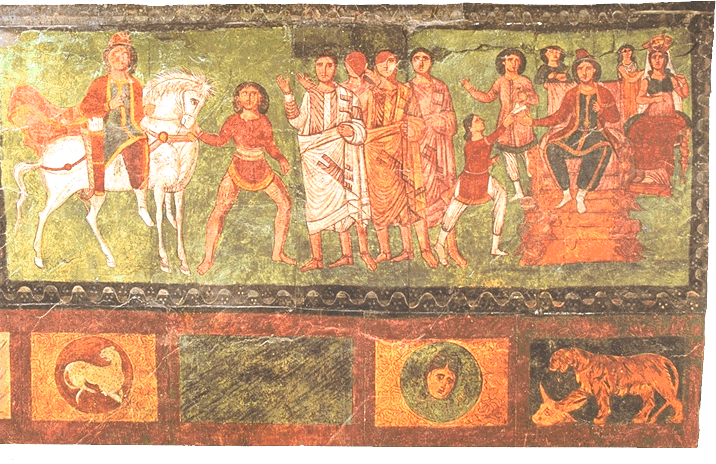 Aniconism is a gradual phenomenon, having appeared at various times in many cultures across the world and within the same culture during its history. It is usually restricted to specific circumstances of space (figurative images are absent from mosques, but not outside their walls), time (synagogues are not painted, but the oldest preserved one [3rd c. CE, Dura Europos
, Syria
] was), object (in Africa the High God has no statue or painting, but lesser deities do) or modality. The intensity of aniconism is characterized by periodicity (e.g. the alternance of iconoclast and image overloaded periods in Christianity).
)? Furthermore, how to present a general model by a specific occurrence (everybody knows what a human looks like, but everyone will draw him or her in a different way). Because these are inherent and not transitory problems, they generate a perpetual search for solutions, making of aniconism a continuously fluctuating phenomenon.
 Although aniconism is better known in connection to Abrahamic religions
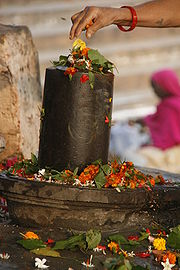
, basic patterns are shared between various religious beliefs including Hinduism which also has aniconistic beliefs. For example, although Hinduism is commonly represented by such anthropomorphic religious murti
s, aniconism is equally represented with such abstract symbols of God such as the Shiva linga and the saligrama. Moreover, Hindus have found it easier to focus on anthropmorphic icons, because god Krishna
said in the Bhagavad Gita
, Chapter 12, Verse 5, that it is much more difficult to focus on God as the unmanifested than God with form, due to human beings having the need to perceive via the senses. An iconoclastic phase in early Indian civilization is hypothesised, as the Aryan
invasions destroyed native Indian idols. Some modern branches of Hinduism, including the Brahmo Samaj
and Arya Samaj
reject religious images, as Sikhism
originally did.
In monotheism
, aniconism was shaped by specific theological considerations and their historical contexts. It emerged as a corollary of seeing God's position as the ultimate power holder, and the need to defend this unique status against competing external and internal forces, such as pagan idols, critical humans, and mass society
. Idolatry
is a threat to uniqueness, and one way that prophets and missionaries chose to fight it was through the prohibition of material representations. The same solution also worked against the pretension of humans to have the same power of creation as God (hence their banishment from the Heavens
, the destruction of Babel
, and the Second Commandment
in the biblical texts, or the myth of the golem
in Jewish literature). Sikhism
also encourages aniconism: Images or idols of Sikh guru
s are not to be worshiped, and actors can't play the role of Sikh gurus in films.
and the 20th c. Minimalist art
; or between (so to speak "zen
") Finnish design
and Hippie
luxuriance. In relation to Islamic Art, the term "aniconism" appears to have been coined by Oleg Grabar, in the 1987 "Postscriptum" to his The Formation of Islamic Art.
and the stylized portrait of Che Guevara
are examples where the power comes from the image of dead persons), there is a very short—yet essential to the political process—moment of aniconism. It is the lapse between the removal of the symbols of an outgoing power and their replacement with those of the incumbent. For example, part of the French Revolution
was also the smashing of royal statues, as so often repeated during social unrests. The covering of the head of a Saddam Hussein
statue with first the US, then the Iraqi flag during the 2003 invasion of Iraq
, is a special example where the politically offending is hidden from sight before being destroyed. The Hungarian Revolution of 1956 and the fall of Romania's Ceauşescu
in 1989 produced (apparently independent) examples of political symbol based on the void — the Hungarian and Romanian revolutionary flags
, where the Communist coat of arms are cut out. There are also reclusive leaders who benefit from the absence of their image, such as Taliban leader Mullah Omar
, of whom few photographs are known to exist.
The success of scientific visualization as a valuable method, research field, academic department and multi-million dollar industry is fairly recent, despite its long and sometimes illustrious history (the Sumer
ian maps of the sky, Leonardo da Vinci
's drawings). Some fields like Mathematics continue to be almost devoid of representations other than formulas and writing, and staunchly adverse to them (Benoît Mandelbrot
, who popularized the theory of fractals through the use of computer graphics to an extent rarely attained by a mathematical theory, was scoffed by his fellow scientists for daring to use imagery to think about intellectual concepts. Note also the role played by the famous Einstein-tongue
portrait for the popularity of the theory of relativity.) Non-visual thinking is a feature of many scientific traditions, but certainly not the only solution: in geometry for example, it is possible not only to visualize as figures the objects studied, but by using ingenious drawings, the process of demonstration itself. For many fields the abandonment of a purely aniconic science has represented a revolution in the way problems are thought and solved, and how science is presented to the public, the policy makers and the investors (such as the use of artists by NASA
to paint the worlds the agency’s scientists want to study).
The scientists' issue with representations is the potential for data falsehood of something "re-presented", that is having subsisted a transformation. Depending on the field, the problem is variously apprehended. In contrast with mathematicians, whose iconophobia is of an almost religious nature, physicist are confronted with material dilemmas on how to represent such elusive phenomena like quantum mechanics or the string theory. In the medical world images can be mistrusted, avoided or suppressed, depending on whether they are sources of errors in treatments (the size of a head tumor depends on the color map and the image contrast ) or on privacy and ethical issues (not all parents wish to visualize the unborn during echography screenings; forensic photography of corpses is not easily released to the public). There is also a material substratum to scientific aniconism: the difficulty of producing images (capture, processing, distribution; aspects of technology, finance and intellectual property rights).
aniconism varies from culture to culture from elaborate masks and statues of humans and animals to their total absence. A common feature, however, across the continent is that the "High God" is not given material shape. On the Germanic tribes
, the Roman historian Tacitus
writes the following: "They don't consider it mighty enough for the Heavens to depict Gods on walls or to display them in some human shape.". His observation is not general to all German people as documentary evidence suggests (see Ardre image stone
s).
In Australian Aboriginal culture
there is a prohibition and tribal lore and custom contravening the depiction of the newly or recently dead, including photographs, as this is held to inhibit their passage to the Great Dreaming
of the Ancestors. This has led some Australian newspapers to publish apologies alongside obituaries.
Image
An image is an artifact, for example a two-dimensional picture, that has a similar appearance to some subject—usually a physical object or a person.-Characteristics:...
s of divine beings, prophet
Prophet
In religion, a prophet, from the Greek word προφήτης profitis meaning "foreteller", is an individual who is claimed to have been contacted by the supernatural or the divine, and serves as an intermediary with humanity, delivering this newfound knowledge from the supernatural entity to other people...
s or other respected religious figures, or in different manifestations, any human beings or living creatures. The term aniconic may be used to describe the absence of graphic representations in a particular belief system, regardless of whether an injunction against them exists. The word itself derives from Greek
Ancient Greek
Ancient Greek is the stage of the Greek language in the periods spanning the times c. 9th–6th centuries BC, , c. 5th–4th centuries BC , and the c. 3rd century BC – 6th century AD of ancient Greece and the ancient world; being predated in the 2nd millennium BC by Mycenaean Greek...
εικων 'image' with the negative prefix an- (Greek privative alpha) and the suffix -ism
ISM
--ism :* -ism – a suffix, meaning adherence or following an ideology* Isms philosophical world views-ISM :ISM is an acronym of:*Idiopathic sclerosing mesenteritis*Imperial Service Medal*Incorporated Society of Musicians...
(Greek -ισμος).
Aniconism in religion is presented in greater detail in separate articles (see below under "Manifestations: Religion").
Categorization
Aniconism is a particular case of representationRepresentation (arts)
Representation is the use of signs that stand in for and take the place of something else. It is through representation that people organize the world and reality through the act of naming its elements...
(the absence of images) and taboo
Taboo
A taboo is a strong social prohibition relating to any area of human activity or social custom that is sacred and or forbidden based on moral judgment, religious beliefs and or scientific consensus. Breaking the taboo is usually considered objectionable or abhorrent by society...
(the prohibition of images). The difference is that one expresses only the absence of images, while the other contains also an injunction
Injunction
An injunction is an equitable remedy in the form of a court order that requires a party to do or refrain from doing certain acts. A party that fails to comply with an injunction faces criminal or civil penalties and may have to pay damages or accept sanctions...
conceived to regulate their absence. An avoidance and repugnance of representations is called iconophobia, its antonymic reaction being that of an iconodule. When unformalized predispositions or clearly stated legislations are put in practice and enforced, leading to the removal and destruction of representations, the aniconism becomes iconoclasm
Iconoclasm
Iconoclasm is the deliberate destruction of religious icons and other symbols or monuments, usually with religious or political motives. It is a frequent component of major political or religious changes...
. Aniconism relates also to censorship
Censorship
thumb|[[Book burning]] following the [[1973 Chilean coup d'état|1973 coup]] that installed the [[Military government of Chile |Pinochet regime]] in Chile...
, which takes place after a representation was already produced, but before, or shorthly after, it is made public, and also involves less violence than iconoclasm. In common usage, "aniconism" is used to designate the absence of paintings and statues, "taboo" characterizes behaviours, "censorship" is applied to written materials and "iconoclasm" to the destruction of paintings and statues.
Object
According to the occurrence considered, the object of aniconism extends to God only, to all deities and saint characters, to legendary and historical characters, to all humans, to animated beings and living beings, and finally to everything existing in the physical or supernatural world.Some parts of the objects subjected to aniconism are more sensitive than others to representation. The eyes and the face are markers of identity for the species and the individual (the iris pattern is a powerful biometric identifier; portraits are the most common art subject; masks appear throughout cultures as means to protect one's privacy or take a new one; enocculation was supposed to remove the power, life and soul from depictions). The representation of genital parts are often avoided, usually on moral grounds, because they represent biological, social and symbolic power (suppressed through clothing of statues and paintings or digital blurring and ink blackening of photographs).
The forms of representation concerned by aniconism are in a wide sense, as well as etymologically, not restricted to particular ones, thus encompassing visual, auditory, odorific, gustative and tactile representations (examples are the periods of opposition to figurative music in musical history and criticism and the social marginality of actors—mimes of body and language—in many pre-modern societies). However, it is more common to see the term aniconism applied to material occurrences, bi-dimensional (painting) and three-dimensional (statues), thus leaving out ideas, language or performance, which are also types of re-presentation, re-enactment or re-embodiment.
Impact
While seemingly trivial to the nonadherent, aniconism has fueled many social unrests and cultural damage throughout history (Byzantine and Reformation iconoclasmIconoclasm
Iconoclasm is the deliberate destruction of religious icons and other symbols or monuments, usually with religious or political motives. It is a frequent component of major political or religious changes...
) and continues to be an unobtrusive yet determinant factor across social areas, from religion and politics to science and arts.
Yet its most dramatic impact is for the future. Genetic modification, cloning
Cloning
Cloning in biology is the process of producing similar populations of genetically identical individuals that occurs in nature when organisms such as bacteria, insects or plants reproduce asexually. Cloning in biotechnology refers to processes used to create copies of DNA fragments , cells , or...
, artificial intelligence
Artificial intelligence
Artificial intelligence is the intelligence of machines and the branch of computer science that aims to create it. AI textbooks define the field as "the study and design of intelligent agents" where an intelligent agent is a system that perceives its environment and takes actions that maximize its...
and robotics
Robotics
Robotics is the branch of technology that deals with the design, construction, operation, structural disposition, manufacture and application of robots...
aim at reproducing the living body and consciousness. Already visible are the Byzantine arguments resurrected today about likeness, some arguing restraint and moratoria, some prophesizing an outphasing of humans by their own creations (Ray Kurzweil inter alia).
Distribution
Dura-Europos synagogue
The Dura-Europos synagogue is an ancient synagogue uncovered at Dura-Europos, Syria, in 1932. The last phase of construction was dated by an Aramaic inscription to 244 CE, making it one of the oldest synagogues in the world...
, Syria
Syria
Syria , officially the Syrian Arab Republic , is a country in Western Asia, bordering Lebanon and the Mediterranean Sea to the West, Turkey to the north, Iraq to the east, Jordan to the south, and Israel to the southwest....
] was), object (in Africa the High God has no statue or painting, but lesser deities do) or modality. The intensity of aniconism is characterized by periodicity (e.g. the alternance of iconoclast and image overloaded periods in Christianity).
Cognitive
The fundamental cause of aniconism is embedded in the problematic nature of representation itself. There is an unavoidable need to represent the world since this is how our cognition works, but what is the validity of a representation not perceptible to our biological senses of something outside their reach or immaterial (God, time, ultravioletUltraviolet
Ultraviolet light is electromagnetic radiation with a wavelength shorter than that of visible light, but longer than X-rays, in the range 10 nm to 400 nm, and energies from 3 eV to 124 eV...
)? Furthermore, how to present a general model by a specific occurrence (everybody knows what a human looks like, but everyone will draw him or her in a different way). Because these are inherent and not transitory problems, they generate a perpetual search for solutions, making of aniconism a continuously fluctuating phenomenon.
Religious
Abrahamic religions
Abrahamic religions are the monotheistic faiths emphasizing and tracing their common origin to Abraham or recognizing a spiritual tradition identified with him...
, basic patterns are shared between various religious beliefs including Hinduism which also has aniconistic beliefs. For example, although Hinduism is commonly represented by such anthropomorphic religious murti
Murti
In Hinduism, a murti , or murthi, or vigraha or pratima typically refers to an image which expresses a Divine Spirit . Meaning literally "embodiment", a murti is a representation of a divinity, made usually of stone, wood, or metal, which serves as a means through which a divinity may be worshiped...
s, aniconism is equally represented with such abstract symbols of God such as the Shiva linga and the saligrama. Moreover, Hindus have found it easier to focus on anthropmorphic icons, because god Krishna
Krishna
Krishna is a central figure of Hinduism and is traditionally attributed the authorship of the Bhagavad Gita. He is the supreme Being and considered in some monotheistic traditions as an Avatar of Vishnu...
said in the Bhagavad Gita
Bhagavad Gita
The ' , also more simply known as Gita, is a 700-verse Hindu scripture that is part of the ancient Sanskrit epic, the Mahabharata, but is frequently treated as a freestanding text, and in particular, as an Upanishad in its own right, one of the several books that constitute general Vedic tradition...
, Chapter 12, Verse 5, that it is much more difficult to focus on God as the unmanifested than God with form, due to human beings having the need to perceive via the senses. An iconoclastic phase in early Indian civilization is hypothesised, as the Aryan
Aryan
Aryan is an English language loanword derived from Sanskrit ārya and denoting variously*In scholarly usage:**Indo-Iranian languages *in dated usage:**the Indo-European languages more generally and their speakers...
invasions destroyed native Indian idols. Some modern branches of Hinduism, including the Brahmo Samaj
Brahmo Samaj
Brahmo Samaj is the societal component of the Brahmo religion which is mainly practiced today as the Adi Dharm after its eclipse in Bengal consequent to the exit of the Tattwabodini Sabha from its ranks in 1859. It was one of the most influential religious movements responsible for the making of...
and Arya Samaj
Arya Samaj
Arya Samaj is a Hindu reform movement founded by Swami Dayananda on 10 April 1875. He was a sannyasi who believed in the infallible authority of the Vedas. Dayananda emphasized the ideals of brahmacharya...
reject religious images, as Sikhism
Sikhism
Sikhism is a monotheistic religion founded during the 15th century in the Punjab region, by Guru Nanak Dev and continued to progress with ten successive Sikh Gurus . It is the fifth-largest organized religion in the world and one of the fastest-growing...
originally did.
In monotheism
Monotheism
Monotheism is the belief in the existence of one and only one god. Monotheism is characteristic of the Baha'i Faith, Christianity, Druzism, Hinduism, Islam, Judaism, Samaritanism, Sikhism and Zoroastrianism.While they profess the existence of only one deity, monotheistic religions may still...
, aniconism was shaped by specific theological considerations and their historical contexts. It emerged as a corollary of seeing God's position as the ultimate power holder, and the need to defend this unique status against competing external and internal forces, such as pagan idols, critical humans, and mass society
Mass society
Mass society is a description associated with society in the modern, industrial era. "Guided by the structural-functional approach and drawing on the ideas of Tönnies, Durkheim, and Weber, understands modernity as the emergence of a mass society...
. Idolatry
Idolatry
Idolatry is a pejorative term for the worship of an idol, a physical object such as a cult image, as a god, or practices believed to verge on worship, such as giving undue honour and regard to created forms other than God. In all the Abrahamic religions idolatry is strongly forbidden, although...
is a threat to uniqueness, and one way that prophets and missionaries chose to fight it was through the prohibition of material representations. The same solution also worked against the pretension of humans to have the same power of creation as God (hence their banishment from the Heavens
Heavens
Heavens was an independent rock band featuring Matt Skiba of Alkaline Trio and Josiah Steinbrick. The duo signed to Epitaph Records and released their debut album, Patent Pending, on September 12, 2006....
, the destruction of Babel
Babylon
Babylon was an Akkadian city-state of ancient Mesopotamia, the remains of which are found in present-day Al Hillah, Babil Province, Iraq, about 85 kilometers south of Baghdad...
, and the Second Commandment
Ten Commandments
The Ten Commandments, also known as the Decalogue , are a set of biblical principles relating to ethics and worship, which play a fundamental role in Judaism and most forms of Christianity. They include instructions to worship only God and to keep the Sabbath, and prohibitions against idolatry,...
in the biblical texts, or the myth of the golem
Golem
In Jewish folklore, a golem is an animated anthropomorphic being, created entirely from inanimate matter. The word was used to mean an amorphous, unformed material in Psalms and medieval writing....
in Jewish literature). Sikhism
Sikhism
Sikhism is a monotheistic religion founded during the 15th century in the Punjab region, by Guru Nanak Dev and continued to progress with ten successive Sikh Gurus . It is the fifth-largest organized religion in the world and one of the fastest-growing...
also encourages aniconism: Images or idols of Sikh guru
Guru
A guru is one who is regarded as having great knowledge, wisdom, and authority in a certain area, and who uses it to guide others . Other forms of manifestation of this principle can include parents, school teachers, non-human objects and even one's own intellectual discipline, if the...
s are not to be worshiped, and actors can't play the role of Sikh gurus in films.
Economical
The production of representations involves an expenditure of valuable human and material resources for ends that do not yield benefits critical for the survival of communities and individuals (paintings and statues). Especially in moments of crisis, representations come to be considered as threatening luxuries, that take away resources from where they are needed. Economic reasons are a culturally non-specific factor that has contributed to many instances of aniconism.Manifestations
Although aniconism is usually related to religion, it is manifest in many cultures and areas of life. A selection is presented below.Arts
Religious art and art with religious references make a substantial part of humanity's artistic production. As such, religious aniconism—discussed below—is in fact much about art. While not usually classified as aniconism, it occurs frequently in profane art, as a quantitative characteristic of amount of details present in objects. Extremes range for example between the 18th c. RococoRococo
Rococo , also referred to as "Late Baroque", is an 18th-century style which developed as Baroque artists gave up their symmetry and became increasingly ornate, florid, and playful...
and the 20th c. Minimalist art
Minimalism
Minimalism describes movements in various forms of art and design, especially visual art and music, where the work is set out to expose the essence, essentials or identity of a subject through eliminating all non-essential forms, features or concepts...
; or between (so to speak "zen
Zen
Zen is a school of Mahāyāna Buddhism founded by the Buddhist monk Bodhidharma. The word Zen is from the Japanese pronunciation of the Chinese word Chán , which in turn is derived from the Sanskrit word dhyāna, which can be approximately translated as "meditation" or "meditative state."Zen...
") Finnish design
Alvar Aalto
Hugo Alvar Henrik Aalto was a Finnish architect and designer. His work includes architecture, furniture, textiles and glassware...
and Hippie
Hippie
The hippie subculture was originally a youth movement that arose in the United States during the mid-1960s and spread to other countries around the world. The etymology of the term 'hippie' is from hipster, and was initially used to describe beatniks who had moved into San Francisco's...
luxuriance. In relation to Islamic Art, the term "aniconism" appears to have been coined by Oleg Grabar, in the 1987 "Postscriptum" to his The Formation of Islamic Art.
Politics
While politics heavily rely on the representation of governors and pretendants as an instrument of power (the presidents on US banknotesFederal Reserve Note
A Federal Reserve Note is a type of banknote used in the United States of America. Federal Reserve Notes are printed by the United States Bureau of Engraving and Printing on paper made by Crane & Co. of Dalton, Massachusetts. They are the only type of U.S...
and the stylized portrait of Che Guevara
Che Guevara
Ernesto "Che" Guevara , commonly known as el Che or simply Che, was an Argentine Marxist revolutionary, physician, author, intellectual, guerrilla leader, diplomat and military theorist...
are examples where the power comes from the image of dead persons), there is a very short—yet essential to the political process—moment of aniconism. It is the lapse between the removal of the symbols of an outgoing power and their replacement with those of the incumbent. For example, part of the French Revolution
French Revolution
The French Revolution , sometimes distinguished as the 'Great French Revolution' , was a period of radical social and political upheaval in France and Europe. The absolute monarchy that had ruled France for centuries collapsed in three years...
was also the smashing of royal statues, as so often repeated during social unrests. The covering of the head of a Saddam Hussein
Saddam Hussein
Saddam Hussein Abd al-Majid al-Tikriti was the fifth President of Iraq, serving in this capacity from 16 July 1979 until 9 April 2003...
statue with first the US, then the Iraqi flag during the 2003 invasion of Iraq
2003 invasion of Iraq
The 2003 invasion of Iraq , was the start of the conflict known as the Iraq War, or Operation Iraqi Freedom, in which a combined force of troops from the United States, the United Kingdom, Australia and Poland invaded Iraq and toppled the regime of Saddam Hussein in 21 days of major combat operations...
, is a special example where the politically offending is hidden from sight before being destroyed. The Hungarian Revolution of 1956 and the fall of Romania's Ceauşescu
Nicolae Ceausescu
Nicolae Ceaușescu was a Romanian Communist politician. He was General Secretary of the Romanian Communist Party from 1965 to 1989, and as such was the country's second and last Communist leader...
in 1989 produced (apparently independent) examples of political symbol based on the void — the Hungarian and Romanian revolutionary flags
Flag of Romania
The national flag of Romania is a tricolour with vertical stripes: beginning from the flagpole, blue, yellow and red. It has a width-length ratio of 2:3....
, where the Communist coat of arms are cut out. There are also reclusive leaders who benefit from the absence of their image, such as Taliban leader Mullah Omar
Mohammed Omar
Mullah Mohammed Omar , often simply called Mullah Omar, is the leader of the Taliban movement that operates in Afghanistan. He was Afghanistan's de facto head of state from 1996 to late 2001, under the official title "Head of the Supreme Council"...
, of whom few photographs are known to exist.
Religion
Note: A number of modern scholars, working on various cultures, have gathered material showing that in some cases the idea of aniconism in religion is an intellectual construction, suiting specific intents and historical contexts, rather than a fact of the tangible reality (Huntington for Buddhism, Clément for Islam and Bland for Judaism — references in the appropriate follow-up links).Science and technology
For most of its history, science and technology was essentially aniconic. (Even for such critical activities as architecture, there are few if any master-plans for structures like the pyramids, the Gothic cathedrals or urbanism, not to mention the less complex private houses. Cartography, important for the civil administration and the military, was before modern societies either inexistent because relying on the mental memory of guides, or schematic, recording only significant landmarks.)The success of scientific visualization as a valuable method, research field, academic department and multi-million dollar industry is fairly recent, despite its long and sometimes illustrious history (the Sumer
Sumer
Sumer was a civilization and historical region in southern Mesopotamia, modern Iraq during the Chalcolithic and Early Bronze Age....
ian maps of the sky, Leonardo da Vinci
Leonardo da Vinci
Leonardo di ser Piero da Vinci was an Italian Renaissance polymath: painter, sculptor, architect, musician, scientist, mathematician, engineer, inventor, anatomist, geologist, cartographer, botanist and writer whose genius, perhaps more than that of any other figure, epitomized the Renaissance...
's drawings). Some fields like Mathematics continue to be almost devoid of representations other than formulas and writing, and staunchly adverse to them (Benoît Mandelbrot
Benoît Mandelbrot
Benoît B. Mandelbrot was a French American mathematician. Born in Poland, he moved to France with his family when he was a child...
, who popularized the theory of fractals through the use of computer graphics to an extent rarely attained by a mathematical theory, was scoffed by his fellow scientists for daring to use imagery to think about intellectual concepts. Note also the role played by the famous Einstein-tongue
Albert Einstein in popular culture
Albert Einstein has been the subject of or inspiration for many works of popular culture.On Einstein's 72nd birthday on March 14, 1951, UPI photographer Arthur Sasse was trying to persuade him to smile for the camera, but having smiled for photographers many times that day, Einstein stuck out his...
portrait for the popularity of the theory of relativity.) Non-visual thinking is a feature of many scientific traditions, but certainly not the only solution: in geometry for example, it is possible not only to visualize as figures the objects studied, but by using ingenious drawings, the process of demonstration itself. For many fields the abandonment of a purely aniconic science has represented a revolution in the way problems are thought and solved, and how science is presented to the public, the policy makers and the investors (such as the use of artists by NASA
NASA
The National Aeronautics and Space Administration is the agency of the United States government that is responsible for the nation's civilian space program and for aeronautics and aerospace research...
to paint the worlds the agency’s scientists want to study).
The scientists' issue with representations is the potential for data falsehood of something "re-presented", that is having subsisted a transformation. Depending on the field, the problem is variously apprehended. In contrast with mathematicians, whose iconophobia is of an almost religious nature, physicist are confronted with material dilemmas on how to represent such elusive phenomena like quantum mechanics or the string theory. In the medical world images can be mistrusted, avoided or suppressed, depending on whether they are sources of errors in treatments (the size of a head tumor depends on the color map and the image contrast ) or on privacy and ethical issues (not all parents wish to visualize the unborn during echography screenings; forensic photography of corpses is not easily released to the public). There is also a material substratum to scientific aniconism: the difficulty of producing images (capture, processing, distribution; aspects of technology, finance and intellectual property rights).
Various cultures
In AfricaAfrican art
African art constitutes one of the most diverse legacies on earth. Though many casual observers tend to generalize "traditional" African art, the continent is full of people, societies, and civilizations, each with a unique visual special culture. The definition also includes the art of the African...
aniconism varies from culture to culture from elaborate masks and statues of humans and animals to their total absence. A common feature, however, across the continent is that the "High God" is not given material shape. On the Germanic tribes
Germanic peoples
The Germanic peoples are an Indo-European ethno-linguistic group of Northern European origin, identified by their use of the Indo-European Germanic languages which diversified out of Proto-Germanic during the Pre-Roman Iron Age.Originating about 1800 BCE from the Corded Ware Culture on the North...
, the Roman historian Tacitus
Tacitus
Publius Cornelius Tacitus was a senator and a historian of the Roman Empire. The surviving portions of his two major works—the Annals and the Histories—examine the reigns of the Roman Emperors Tiberius, Claudius, Nero and those who reigned in the Year of the Four Emperors...
writes the following: "They don't consider it mighty enough for the Heavens to depict Gods on walls or to display them in some human shape.". His observation is not general to all German people as documentary evidence suggests (see Ardre image stone
Ardre image stone
The Ardre image stones are a collection of ten rune and image stones, dated to the 8th to 11th centuries, that were discovered at a church in Ardre, which is about four kilometers north of Stånga, Gotland County, Sweden.-Description:...
s).
In Australian Aboriginal culture
Australian Aboriginal culture
Aboriginal Australia comprises hundreds of tribal divisions and language groups, with a diverse range of cultural practices.-Practices and ceremonies:*A Bora is an initiation ceremony in which young boys become men....
there is a prohibition and tribal lore and custom contravening the depiction of the newly or recently dead, including photographs, as this is held to inhibit their passage to the Great Dreaming
Dreamtime
In the animist framework of Australian Aboriginal mythology, The Dreaming is a sacred era in which ancestral Totemic Spirit Beings formed The Creation.-The Dreaming of the Aboriginal times:...
of the Ancestors. This has led some Australian newspapers to publish apologies alongside obituaries.