

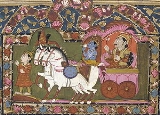
Bhagavad Gita

Unanswered Questions

Encyclopedia

Hindu
Hindu refers to an identity associated with the philosophical, religious and cultural systems that are indigenous to the Indian subcontinent. As used in the Constitution of India, the word "Hindu" is also attributed to all persons professing any Indian religion...
scripture that is part of the ancient Sanskrit
Sanskrit
Sanskrit , is a historical Indo-Aryan language and the primary liturgical language of Hinduism, Jainism and Buddhism.Buddhism: besides Pali, see Buddhist Hybrid Sanskrit Today, it is listed as one of the 22 scheduled languages of India and is an official language of the state of Uttarakhand...
epic, the Mahabharata
Mahabharata
The Mahabharata is one of the two major Sanskrit epics of ancient India and Nepal, the other being the Ramayana. The epic is part of itihasa....
, but is frequently treated as a freestanding text, and in particular, as an Upanishad
Upanishad
The Upanishads are philosophical texts considered to be an early source of Hindu religion. More than 200 are known, of which the first dozen or so, the oldest and most important, are variously referred to as the principal, main or old Upanishads...
in its own right, one of the several books that constitute general Vedic
Vedic
Vedic may refer to:* the Vedas, the oldest preserved Indic texts** Vedic Sanskrit, the language of these texts** Vedic period, during which these texts were produced** Vedic pantheon of gods mentioned in Vedas/vedic period...
tradition. It is revealed scripture in the views of Hindus, the scripture for Hindus represents the words and message of god, the book is considered among the most important texts in the history of literature
History of literature
The history of literature is the historical development of writings in prose or poetry which attempts to provide entertainment, enlightenment, or instruction to the reader/hearer/observer, as well as the development of the literary techniques used in the communication of these pieces. Not all...
and philosophy
Philosophy
Philosophy is the study of general and fundamental problems, such as those connected with existence, knowledge, values, reason, mind, and language. Philosophy is distinguished from other ways of addressing such problems by its critical, generally systematic approach and its reliance on rational...
. The teacher of the Bhagavad Gita is Lord Krishna
Krishna
Krishna is a central figure of Hinduism and is traditionally attributed the authorship of the Bhagavad Gita. He is the supreme Being and considered in some monotheistic traditions as an Avatar of Vishnu...
, who is revered by Hindus as a manifestation of God
Avatar
In Hinduism, an avatar is a deliberate descent of a deity to earth, or a descent of the Supreme Being and is mostly translated into English as "incarnation," but more accurately as "appearance" or "manifestation"....
(Parabrahman
Brahman
In Hinduism, Brahman is the one supreme, universal Spirit that is the origin and support of the phenomenal universe. Brahman is sometimes referred to as the Absolute or Godhead which is the Divine Ground of all being...
) Himself, and is referred to within as Bhagavan
Bhagavan
Bhagavan, also written Bhagwan or Bhagawan, from the Sanskrit nt-stem literally means "possessing fortune, blessed, prosperous" , and hence "illustrious, divine, venerable, holy", etc.In some traditions of Hinduism it is used to...
, the Divine One.
The context of the Gita is a conversation between Lord Krishna and the Pandava prince Arjuna
Arjuna
Arjuna in Indian mythology is the greatest warrior on earth and is one of the Pandavas, the heroes of the Hindu epic Mahābhārata. Arjuna, whose name means 'bright', 'shining', 'white' or 'silver' Arjuna (Devanagari: अर्जुन, Thai: อรชุน, Orachun, Tamil: Arjunan, Indonesian and Javanese: Harjuna,...
taking place in the middle of the battlefield before the start of the Kurukshetra War
Kurukshetra war
According to the Indian epic poem Mahābhārata, a dynastic succession struggle between two groups of cousins of an Indo-Aryan kingdom called Kuru, the Kauravas and Pandavas, for the throne of Hastinapura resulted in the Kurukshetra War in which a number of ancient kingdoms participated as allies of...
with armies on both sides ready to battle. Responding to Arjuna's confusion and moral dilemma about fighting his own cousins who command a tyranny imposed on a disputed empire, Lord Krishna explains to Arjuna his duties as a warrior and prince, and elaborates on different Yogic
Yoga
Yoga is a physical, mental, and spiritual discipline, originating in ancient India. The goal of yoga, or of the person practicing yoga, is the attainment of a state of perfect spiritual insight and tranquility while meditating on Supersoul...
and Vedantic philosophies, and explains different ways in which the soul can reach the supreme being with examples and analogies. This has led to the Gita often being described as a concise guide to Hindu theology and also as a practical, self-contained guide to life. During the discourse, Lord Krishna reveals His identity as the Supreme Being Himself (Svayam Bhagavan
Svayam Bhagavan
Svayam Bhagavan , "The Lord" or Lord Himself, is a Sanskrit theological term. The term refers to the concept of absolute representation of the monotheistic God as Bhagavan within Hinduism....
), blessing Arjuna with an awe-inspiring vision of His divine universal form.
The direct audience to Lord Krishna’s discourse of the Bhagavad Gita included Arjuna (addressee), Sanjaya
Sanjaya
Sanjaya is a character from the ancient Indian epic Mahābhārata.In Mahabharata, a story of war between the Pandavas and the Kauravas, the blind king Dhritarashtra is the father of the principals of the Kaurava side. Sanjaya is Dhritarashtra's advisor and also his charioteer...
(using Divya Drishti (or divine vision) gifted by the sage Veda Vyasa to watch the war and narrate the events to Dhritarashtra
Dhritarashtra
In the Mahābhārata, Dhritarashtra was King of Hastinapur at the time of the Kurukshetra War, the epic's climactic event. He was born the son of Vichitravirya's first wife Ambika, and was fathered by Vyasa. He was blind from birth, and became father to a hundred children by his wife Gandhari...
), spirit of Lord Hanuman
Hanuman
Hanuman , is a Hindu deity, who is an ardent devotee of Rama, a central character in the Indian epic Ramayana and one of the dearest devotees of lord Rama. A general among the vanaras, an ape-like race of forest-dwellers, Hanuman is an incarnation of the divine and a disciple of Lord Rama in the...
(perched atop Arjuna’s chariot) in his flag and Barbarika
Barbarika
In the Mahābhārata, Barbarika was the son of Ghatotkacha and Maurvi , daughter of Muru, a Yadava king.Barbarika was originally a yaksha, and was reborn as a man....
, son of Ghatotkacha
Ghatotkacha
Ghatotkacha , is a character in the Mahabharata, the son of Bhima and the giantess Hidimbi . His maternal parentage made him half-rakshasa and gave him many magical powers that made him an important fighter in the Kurukshetra war, the climax of the epic...
, who also witnessed the complete 18 days of action at Kurukshetra.
The Bhagavad Gita is also called , implying its having the status of an Upanishad
Upanishad
The Upanishads are philosophical texts considered to be an early source of Hindu religion. More than 200 are known, of which the first dozen or so, the oldest and most important, are variously referred to as the principal, main or old Upanishads...
, i.e. a Vedantic scripture.
Since the Gita is drawn from the Mahabharata, it is classified as a
Ramakrishna
Ramakrishna
Ramakrishna , born Gadadhar Chattopadhyay , was a famous mystic of 19th-century India. His religious school of thought led to the formation of the Ramakrishna Mission by his chief disciple Swami Vivekananda – both were influential figures in the Bengali Renaissance as well as the Hindu...
said that the essential message of the Gita can be obtained by repeating the word several times, "'Gita, Gita, Gita', you begin, but then find yourself saying 'ta-Gi, ta-Gi, ta-Gi'. Tagi means one who has renounced everything for God."
According to Swami Vivekananda
Swami Vivekananda
Swami Vivekananda , born Narendranath Dutta , was the chief disciple of the 19th century mystic Ramakrishna Paramahansa and the founder of the Ramakrishna Math and the Ramakrishna Mission...
, "If one reads this one Shloka — क्लैब्यं मा स्म गमः पार्थ नैतत्त्वय्युपपद्यते । क्षुद्रं हृदयदौर्बल्यं त्यक्त्वोत्तिष्ठ परंतप॥ — one gets all the merits of reading the entire Gita; for in this one Shloka lies imbedded the whole Message of the Gita.
Mahatma Gandhi
Mahatma Gandhi
Mohandas Karamchand Gandhi , pronounced . 2 October 1869 – 30 January 1948) was the pre-eminent political and ideological leader of India during the Indian independence movement...
writes, "The object of the Gita appears to me to be that of showing the most excellent way to attain self-realization" and this can be achieved by selfless action, "By desireless action; by renouncing fruits of action; by dedicating all activities to God, i.e., by surrendering oneself to Him body and soul." Gandhi called Gita, The Gospel of Selfless Action.
Eknath Easwaran
Eknath Easwaran
Eknath Easwaran was a spiritual teacher, an author of books on meditation and ways to lead a fulfilling life, as well as a translator and interpreter of Indian literature....
writes that the Gita's subject is "the war within, the struggle for self-mastery that every human being must wage if he or she is to emerge from life victorious", and "The language of battle is often found in the scriptures, for it conveys the strenuous, long, drawn-out campaign we must wage to free ourselves from the tyranny of the ego, the cause of all our suffering and sorrow".
Influence
The Bhagavad Gita's emphasis on selfless service was a prime source of inspiration for Mahatma Gandhi.J. Robert Oppenheimer, American physicist and director of the Manhattan Project
Manhattan Project
The Manhattan Project was a research and development program, led by the United States with participation from the United Kingdom and Canada, that produced the first atomic bomb during World War II. From 1942 to 1946, the project was under the direction of Major General Leslie Groves of the US Army...
, learned Sanskrit
Sanskrit
Sanskrit , is a historical Indo-Aryan language and the primary liturgical language of Hinduism, Jainism and Buddhism.Buddhism: besides Pali, see Buddhist Hybrid Sanskrit Today, it is listed as one of the 22 scheduled languages of India and is an official language of the state of Uttarakhand...
in 1933 and read the Bhagavad Gita in the original, citing it later as one of the most influential books to shape his philosophy of life. Upon witnessing the world's first nuclear test in 1945, he later said he had thought of the quotation "Now I am become Death, the destroyer of worlds", verse 32 from Chapter 11 of the Bhagavad Gita.
In a heterogeneous text, the Gita reconciles facets and schools of Hindu philosophy, including those of Brahmanical (orthodox Vedic) origin and the parallel ascetic
Shramana
A shramana is a wandering monk in certain ascetic traditions of ancient India including Jainism, Buddhism, and Ājīvikism. Famous śramaṇas include Mahavira and Gautama Buddha....
and Yogic
Raja Yoga
Rāja Yoga is concerned principally with the cultivation of the mind using meditation to further one's acquaintance with reality and finally achieve liberation.Raja yoga was first described in the Yoga Sutras of Patanjali, and is part of the Samkhya tradition.In the context of Hindu...
traditions. It had always been a creative text for Hindu priests and Yogis. Although it is not strictly part of the 'canon' of Vedic writings, almost all Hindu traditions draw upon the Gita as authoritative. For the Vedantic
Vedanta
Vedānta was originally a word used in Hindu philosophy as a synonym for that part of the Veda texts known also as the Upanishads. The name is a morphophonological form of Veda-anta = "Veda-end" = "the appendix to the Vedic hymns." It is also speculated that "Vedānta" means "the purpose or goal...
schools of Hindu philosophy, it belongs to one of the three foundational texts Prasthana Trayi (lit. "three points of departure"), the other two being the Upanishad
Upanishad
The Upanishads are philosophical texts considered to be an early source of Hindu religion. More than 200 are known, of which the first dozen or so, the oldest and most important, are variously referred to as the principal, main or old Upanishads...
s and Brahma Sutras.
A 2006 report suggests that the Gita is replacing the influence of "The Art of War
The Art of War
The Art of War is an ancient Chinese military treatise that is attributed to Sun Tzu , a high ranking military general and strategist during the late Spring and Autumn period...
" (ascendant in the 1980s and '90s) in the Western business community.
Classical commentaries
Traditionally the commentators belong to spiritual traditions or schools (sampradayaSampradaya
In Hinduism, a sampradaya can be translated as ‘tradition’ or a ‘religious system’, although the word commands much more respect and power in the Indian context than its translations in English does...
) and Guru lineages (parampara
Parampara
Parampara denotes a succession of teachers and disciples in traditional Indian culture and Indian religions such as Hinduism, Sikhism, Jainism and Buddhism...
), which claim to preserve teaching stemming either directly from Krishna himself or from other sources, each claiming to be faithful to the original message. In the words of Mysore Hiriyanna
Mysore Hiriyanna
Mysore Hiriyanna was one of the foremost writers on Indian philosophy who lived in the last century. His prominent works include Indian Conception of Values, Outlines of Indian Philosophy, Quest after Perfection and Art Experience...
, "[The Gita] is one of the hardest books to interpret, which accounts for the numerous commentaries on it – each differing from the rest in an essential point or the other."
Different translators and commentators have widely differing views on what multi-layered Sanskrit words and passages signify, and their presentation in English depending on the sampradaya they are affiliated to. Especially in Western philology
Philology
Philology is the study of language in written historical sources; it is a combination of literary studies, history and linguistics.Classical philology is the philology of Greek and Classical Latin...
, interpretations of particular passages often do not agree with traditional views.
The oldest and most influential medieval commentary was that of the founder of the Vedanta
Vedanta
Vedānta was originally a word used in Hindu philosophy as a synonym for that part of the Veda texts known also as the Upanishads. The name is a morphophonological form of Veda-anta = "Veda-end" = "the appendix to the Vedic hymns." It is also speculated that "Vedānta" means "the purpose or goal...
school of extreme 'non-dualism", Shankara
Adi Shankara
Adi Shankara Adi Shankara Adi Shankara (IAST: pronounced , (Sanskrit: , ) (788 CE - 820 CE), also known as ' and ' was an Indian philosopher from Kalady of present day Kerala who consolidated the doctrine of advaita vedānta...
(788–820 A. D.), also known as Shankaracharya (Sanskrit: ). Shankara's commentary was based on a recension of the Gita containing 700 verses, and that recension has been widely adopted by others. There is not universal agreement that he was the actual author of the commentary on the Bhagavad Gita that is attributed to him. A key commentary for the "modified non-dualist" school of Vedanta was written by Ramanujacharya (Sanskrit: ), who lived in the eleventh century A.D. Ramanujacharya's commentary chiefly seeks to show that the discipline of devotion to God (Bhakti yoga) is the way of salvation. The commentary by Madhva
Madhvacharya
Madhvācārya was the chief proponent of Tattvavāda "Philosophy of Reality", popularly known as the Dvaita school of Hindu philosophy. It is one of the three most influential Vedānta philosophies. Madhvācārya was one of the important philosophers during the Bhakti movement. He was a pioneer in...
, whose dates are given either as (b. 1199 – d. 1276) or as (b. 1238 – d. 1317), also known as Madhvacharya (Sanskrit: ), exemplifies thinking of the "dualist" school. Madhva's school of dualism asserts that there is, in a quotation provided by Winthrop Sargeant
Winthrop Sargeant
Winthrop Sargeant was an American music critic, violinist, and writer. He studied the violin in his native city with Albert Elkus and with Felix Prohaska and Lucien Capet in Europe. In 1922, at the age of 18, he became the youngest member of the San Francisco Symphony...
, "an eternal and complete distinction between the Supreme, the many souls, and matter and its divisions." Madhva is also considered to be one of the great commentators reflecting the viewpoint of the Vedanta school. Madhva has written two commentaries on Bhagavadgita : Bhāshya and Tātparya. They have been explained further by many ancient pontiffs of Dvaita School like Padmanabha Tirtha
Padmanabha Tirtha
Sri Padmanabha Theertha was one of the prominent disciples of Sri Madhvacharya, the founder of the Dvaita school of philosophy.Sri Padmanabha Tirtha was initially a follower of the Advaita school of philosophy and his earlier name was Shobhana Bhatta. He was one of the most well known scholars of...
, Jayatirtha
Jayatirtha
Seer Jayateertharu was the sixth pontiff of Sri Madhvacharya Peetha. He is one of the most important seers in the Dvaita philosophy on account of his elucidations of Sri Ananda Teertha's masterpieces...
and Raghavendra Tirtha.
In the Shaiva
Shaivism
Shaivism is one of the four major sects of Hinduism, the others being Vaishnavism, Shaktism and Smartism. Followers of Shaivism, called "Shaivas," and also "Saivas" or "Saivites," revere Shiva as the Supreme Being. Shaivas believe that Shiva is All and in all, the creator, preserver, destroyer,...
tradition, the renowned philosopher Abhinavagupta
Abhinavagupta
Abhinavagupta was one of India's greatest philosophers, mystics and aestheticians. He was also considered an important musician, poet, dramatist, exegete, theologian, and logician - a polymathic personality who exercised strong influences on Indian culture.He was born in the Valley of Kashmir in...
(10–11th century CE) has written a commentary on a slightly variant recension called Gitartha-Samgraha.
Other classical commentators include Nimbarka
Nimbarka
Nimbarka , is known for propagating the Vaishnava Theology of Dvaitadvaita, duality in unity. According to scholars headed by Prof. Roma Bose, he lived in the 13th Century, on the assumption that Śrī Nimbārkācārya was the author of the work Madhvamukhamardana...
(1162 CE
Common Era
Common Era ,abbreviated as CE, is an alternative designation for the calendar era originally introduced by Dionysius Exiguus in the 6th century, traditionally identified with Anno Domini .Dates before the year 1 CE are indicated by the usage of BCE, short for Before the Common Era Common Era...
), Vidyadhiraja Tirtha, Vallabha(1479 CE)., Madhusudana Saraswati, Raghavendra Tirtha, Vanamali Mishra, Chaitanya Mahaprabhu
Chaitanya Mahaprabhu
Chaitanya Mahaprabhu was a Vaishnava saint and social reformer in eastern India in the 16th century, believed by followers of Gaudiya Vaishnavism to be the full incarnation of Lord Krishna...
(1486 CE), while Dnyaneshwar
Dnyaneshwar
Dnyāneshwar , also known as Jñanadeva , was born into a Deshastha Brahmin Kulkarni family.He was a 13th century Maharashtrian Hindu saint , poet, philosopher and yogi of the Nath tradition whose works Bhavartha deepika teeka ,...
(1275–1296 CE) translated and commented on the Gita in Marathi
Marathi language
Marathi is an Indo-Aryan language spoken by the Marathi people of western and central India. It is the official language of the state of Maharashtra. There are over 68 million fluent speakers worldwide. Marathi has the fourth largest number of native speakers in India and is the fifteenth most...
, in his book Dnyaneshwari
Dnyaneshwari
The Dnyaneshwari is the commentary on Bhagavad Gita written by Marathi saint and poet Dnyaneshwar during the 13th century at age 16...
.
Independence movement
In modern times, notable commentaries were written by Bal Gangadhar TilakBal Gangadhar Tilak
Lokmanya Tilak –, was an Indian nationalist, teacher, social reformer and independence fighter who was the first popular leader of the Indian Independence Movement. The British colonial authorities derogatorily called the great leader "Father of the Indian unrest"...
and Mahatma Gandhi, who used the text to help inspire the Indian independence movement
Indian independence movement
The term Indian independence movement encompasses a wide area of political organisations, philosophies, and movements which had the common aim of ending first British East India Company rule, and then British imperial authority, in parts of South Asia...
. Tilak wrote his commentary while in jail during the period 1910–1911 serving a six-year sentence imposed by the British colonial government in India for sedition. While noting that the Gita teaches possible paths to liberation, his commentary places most emphasis on Karma yoga. No book was more central to Gandhi's life and thought than the Bhagavadgita, which he referred to as his "spiritual dictionary". During his stay in Yeravda jail in 1929, Gandhi wrote a commentary on the Bhagavad Gita in Gujarati
Gujarati language
Gujarati is an Indo-Aryan language, and part of the greater Indo-European language family. It is derived from a language called Old Gujarati which is the ancestor language of the modern Gujarati and Rajasthani languages...
. The Gujarati manuscript was translated into English by Mahadev Desai, who provided an additional introduction and commentary. It was published with a foreword by Gandhi in 1946. Mahatma Gandhi expressed his love for the Gita in these words: "I find a solace in the that I miss even in the Sermon on the Mount
Sermon on the Mount
The Sermon on the Mount is a collection of sayings and teachings of Jesus, which emphasizes his moral teaching found in the Gospel of Matthew...
. When disappointment stares me in the face and all alone I see not one ray of light, I go back to the . I find a verse here and a verse there and I immediately begin to smile in the midst of overwhelming tragedies – and my life has been full of external tragedies – and if they have left no visible, no indelible scar on me, I owe it all to the teaching of ."
Hindu revivalism and Neo-Hindu movements
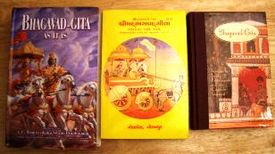
Sri Aurobindo
Sri Aurobindo , born Aurobindo Ghosh or Ghose , was an Indian nationalist, freedom fighter, philosopher, yogi, guru, and poet. He joined the Indian movement for freedom from British rule and for a duration became one of its most important leaders, before developing his own vision of human progress...
, Sarvepalli Radhakrishnan
Sarvepalli Radhakrishnan
Sir Sarvepalli Radhakrishnan , OM, FBA was an Indian philosopher and statesman. He was the first Vice President of India and subsequently the second President of India ....
and Swami Vivekananda
Swami Vivekananda
Swami Vivekananda , born Narendranath Dutta , was the chief disciple of the 19th century mystic Ramakrishna Paramahansa and the founder of the Ramakrishna Math and the Ramakrishna Mission...
, who took a syncretistic approach to the text.
Dayananda Saraswati (Chinmaya Mission)
Dayananda Saraswati (Chinmaya Mission)
Swami Dayananda Saraswati is a monk of the Hindu monastic order and a renowned traditional teacher of Advaita Vedanta.-Early life:...
of Arsha Vidya Gurukulam
Arsha Vidya Gurukulam
Arsha Vidya Gurukulam is the name of two related institutions for the study of traditional Indian practices. One of these is located on a campus in Saylorsburg, Pennsylvania; the other is located in Coimbatore, Tamil Nadu. The institute in Pennsylvania was founded in 1986 by Swami Dayananda...
wrote the most extensive commentary on the Gita, based on 363 lectures he delivered, spanning over 2000 pages. Swami Vivekananda, the follower of Sri Ramakrishna
Ramakrishna
Ramakrishna , born Gadadhar Chattopadhyay , was a famous mystic of 19th-century India. His religious school of thought led to the formation of the Ramakrishna Mission by his chief disciple Swami Vivekananda – both were influential figures in the Bengali Renaissance as well as the Hindu...
, was known for his commentaries on the four Yogas – Bhakti, Jnana, Karma and Raja Yoga. He drew from his knowledge of the Gita to expound on these Yogas. Swami Sivananda
Swami Sivananda
Swami Sivananda Saraswati was a Hindu spiritual teacher and a proponent of Yoga and Vedanta. Sivananda was born Kuppuswami in Pattamadai, in the Tirunelveli district of Tamil Nadu. He studied medicine and served in Malaya as a physician for several years before taking up monasticism...
advises the aspiring Yogi to read verses from the Bhagavad Gita every day. Paramahamsa Yogananda, writer of the famous Autobiography of a Yogi
Autobiography of a Yogi
In 1946, Paramahansa Yogananda , published his life story, Autobiography of a Yogi, which introduced many westerners to meditation and yoga...
, viewed the Bhagavad Gita as one of the world's most divine scriptures. A.C. Bhaktivedanta Swami Prabhupada, the founder of the International Society for Krishna Consciousness
International Society for Krishna Consciousness
The International Society for Krishna Consciousness , known colloquially as the Hare Krishna movement, is a Gaudiya Vaishnava religious organization. It was founded in 1966 in New York City by A.C. Bhaktivedanta Swami Prabhupada...
, wrote Bhagavad-Gītā As It Is, a commentary on the Gita from one of many perspectives of Gaudiya Vaishnavism
Gaudiya Vaishnavism
Gaudiya Vaishnavism is a Vaishnava religious movement founded by Chaitanya Mahaprabhu in India in the 16th century. "Gaudiya" refers to the Gauḍa region with Vaishnavism meaning "the worship of Vishnu"...
. The work became the principal text for the modern Hare Krishna
International Society for Krishna Consciousness
The International Society for Krishna Consciousness , known colloquially as the Hare Krishna movement, is a Gaudiya Vaishnava religious organization. It was founded in 1966 in New York City by A.C. Bhaktivedanta Swami Prabhupada...
movement, became one of few authoritative comments on Bhagavad-Gita (total number of Bhagavad-Gita editions, around the world in different languages, is at least several hundreds(quote-needed). Most of them are apa-sampradayic, not transmitted in disciplic succession, parampara).
Scholarly translations
The first English translation of the Bhagavad Gita was done by Charles WilkinsCharles Wilkins
Sir Charles Wilkins, KH, FRS , was an English typographer and Orientalist, notable as the first translator of Bhagavad Gita into English, and as the creator of the first Devanagari typeface....
in 1785. In 1981, Larson listed more than 40 English translations of the Gita, stating that "A complete listing of Gita translations and a related secondary bibliography would be nearly endless" (p. 514). He stated that "Overall... there is a massive translational tradition in English, pioneered by the British, solidly grounded philologically by the French and Germans, provided with its indigenous roots by a rich heritage of modern Indian comment and reflection, extended into various disciplinary areas by Americans, and having generated in our time a broadly based cross-cultural awareness of the importance of the Bhagavad Gita both as an expression of a specifically Indian spirituality and as one of the great religious "classics" of all time." (p. 518)
The Gita has also been translated into other European languages. In 1808, passages from the Gita were part of the first direct translation of Sanskrit into German, appearing in a book through which Friedrich Schlegel became known as the founder of Indian philology in Germany. Swami Rambhadracharya released the first Braille
Braille
The Braille system is a method that is widely used by blind people to read and write, and was the first digital form of writing.Braille was devised in 1825 by Louis Braille, a blind Frenchman. Each Braille character, or cell, is made up of six dot positions, arranged in a rectangle containing two...
version of the scripture, with the original Sanskrit text and a Hindi commentary, on 30 November 2007.
Adaptations
Philip GlassPhilip Glass
Philip Glass is an American composer. He is considered to be one of the most influential composers of the late 20th century and is widely acknowledged as a composer who has brought art music to the public .His music is often described as minimalist, along with...
retold the story of Gandhi's early development as an activist in South Africa through the text of the Gita in the opera Satyagraha
Satyagraha (opera)
Satyagraha is a 1979 opera in three acts for orchestra, chorus and soloists, composed by Philip Glass, with a libretto by Glass and Constance DeJong.Loosely based on the life of Mohandas K...
. The entire libretto of the opera consists of sayings from the Gita sung in the original Sanskrit. In Douglas Cuomo's
Douglas J. Cuomo
Douglas J. Cuomo is an American composer.-Biography:Born in Tucson, Arizona, raised in the San Francisco Bay Area and Amherst, Massachusetts, Douglas J. Cuomo began playing the trumpet in grade school and switched to guitar at the age of 12...
Arjuna's dilemma, the philosophical dilemma faced by Arjuna is dramatized in operatic form with a blend of Indian and Western music styles.
Robert Redford's film The Legend of Bagger Vance
The Legend of Bagger Vance
The Legend of Bagger Vance is a 2000 American film directed by Robert Redford and starring Will Smith, Matt Damon and Charlize Theron. It is based on the 1995 book of the same title by Steven Pressfield and takes place in the U.S. state of Georgia in 1931...
was a loose retelling of the Bhagavad Gita.
See also
- Ashtavakra GitaAshtavakra GitaThe Ashtavakra Gita or the Song of Ashtavakra, also known as Ashtavakra Samhita is an Advaita Vedanta scripture which documents a dialogue between the Perfect Master Ashtavakra and Janaka, the King of Mithila.-Significance:Ashtavakra Gita presents the traditional teachings of Advaita Vedanta...
- Avadhuta GitaAvadhuta GitaAvadhuta Gita is a Hindu text based on the principles of Advaita Vedanta . The singer of the Avadhuta Gita is Dattatreya, an Avadhuta, and according to the Nath Sampradaya, the work was heard and transcribed by two of Dattatreya's disciples—Swami and Kartika...
- The Ganesha Gita
- Gita DhyanamGita DhyanamThe , also called the Gītā Dhyāna or the Dhyāna Ślokas associated with the Gītā, is a 9-verse Sanskrit poem that has often been attached to the Bhagavad Gita, one of the most important scriptures of Hinduism...
- PuranasPuranasThe Puranas are a genre of important Hindu, Jain and Buddhist religious texts, notably consisting of narratives of the history of the universe from creation to destruction, genealogies of kings, heroes, sages, and demigods, and descriptions of Hindu cosmology, philosophy, and geography.Puranas...
- Uddhava GitaUddhavaUddhava is a character from the Puranic texts of Hinduism, who is the friend and counsellor of Krishna the Avatar. He plays a significant role in the Bhagavata Purana, being taught the processes of yoga and bhakti directly by Krishna...
- UpanishadUpanishadThe Upanishads are philosophical texts considered to be an early source of Hindu religion. More than 200 are known, of which the first dozen or so, the oldest and most important, are variously referred to as the principal, main or old Upanishads...
- VedasVedasThe Vedas are a large body of texts originating in ancient India. Composed in Vedic Sanskrit, the texts constitute the oldest layer of Sanskrit literature and the oldest scriptures of Hinduism....
- Vyadha GitaVyadha GitaThe Vyadha Gita is a part of the epic Mahabharata and consists of the teachings imparted by a vyadha to a brahmin sannyasin . It occurs in the Vana Parva section of Mahabharata and is told to Yudhisthira, a Pandava by sage Markandeya...
External links
Original text- Mahabharata 6.23–6.40 (sacred-texts.com)
- GRETIL etext of MBh 6 (text begins at 06,023)
Translations and commentaries
- 1890 translation by William Quan JudgeWilliam Quan JudgeWilliam Quan Judge was a mystic, esotericist, and occultist, and one of the founders of the original Theosophical Society. He was born in Dublin, Ireland. When he was 13 years old, his family emigrated to the United States...
- 1900 translation by Sir Edwin Arnold
- The Gita According to Gandhi by Mahadev DesaiMahadev DesaiMahadev Desai was an Indian independence activist and nationalist writer; he was most famously known for being the personal secretary of Mahatma Gandhi.-Career:...
of Mahatma GandhiMahatma GandhiMohandas Karamchand Gandhi , pronounced . 2 October 1869 – 30 January 1948) was the pre-eminent political and ideological leader of India during the Indian independence movement...
's 1929 GujratiGujarati languageGujarati is an Indo-Aryan language, and part of the greater Indo-European language family. It is derived from a language called Old Gujarati which is the ancestor language of the modern Gujarati and Rajasthani languages...
translation and commentary - 1942 translation by Swami SivanandaSwami SivanandaSwami Sivananda Saraswati was a Hindu spiritual teacher and a proponent of Yoga and Vedanta. Sivananda was born Kuppuswami in Pattamadai, in the Tirunelveli district of Tamil Nadu. He studied medicine and served in Malaya as a physician for several years before taking up monasticism...
- 1971 translation by A. C. Bhaktivedanta Swami PrabhupadaA. C. Bhaktivedanta Swami PrabhupadaAbhay Charanaravinda Bhaktivedanta Swami Prabhupada was a Gaudiya Vaishnava teacher and the founder-acharya of the International Society for Krishna Consciousness, commonly known as the "Hare Krishna Movement"...
entitled Bhagavad Gita As It IsBhagavad Gita As It IsBhagavad-Gītā As It Is is a translation and commentary of the Bhagavad Gita by A.C.Bhaktivedanta Swami Prabhupada, founder-acharya of the International Society for Krishna Consciousness...
with SanskritSanskritSanskrit , is a historical Indo-Aryan language and the primary liturgical language of Hinduism, Jainism and Buddhism.Buddhism: besides Pali, see Buddhist Hybrid Sanskrit Today, it is listed as one of the 22 scheduled languages of India and is an official language of the state of Uttarakhand...
text and English commentary. - 1983 translation by A. C. Bhaktivedanta Swami PrabhupadaA. C. Bhaktivedanta Swami PrabhupadaAbhay Charanaravinda Bhaktivedanta Swami Prabhupada was a Gaudiya Vaishnava teacher and the founder-acharya of the International Society for Krishna Consciousness, commonly known as the "Hare Krishna Movement"...
entitled Bhagavad Gita As It IsBhagavad Gita As It IsBhagavad-Gītā As It Is is a translation and commentary of the Bhagavad Gita by A.C.Bhaktivedanta Swami Prabhupada, founder-acharya of the International Society for Krishna Consciousness...
with SanskritSanskritSanskrit , is a historical Indo-Aryan language and the primary liturgical language of Hinduism, Jainism and Buddhism.Buddhism: besides Pali, see Buddhist Hybrid Sanskrit Today, it is listed as one of the 22 scheduled languages of India and is an official language of the state of Uttarakhand...
text and English commentary. - 1988 translation by Ramananda PrasadRamananda PrasadRamananda Prasad is the founder of the International Gita Society. He has translated the Bhagavad Gita into English in 1988 from the original Sanskrit texts and the book is currently in its fourth edition....
- 1992 translation and commentary by Swami Chinmayananda
- 1993 translation by Jagannatha Prakasa (John of AllFaith)
- 2001 translation by Sanderson Beck
- Six commentaries: by Adi Sankara, RamanujaRamanujaRamanuja ; traditionally 1017–1137, also known as Ramanujacharya, Ethirajar , Emperumannar, Lakshmana Muni, was a theologian, philosopher, and scriptural exegete...
, Sridhara Swami, Madhusudana SarasvatiMadhusudana SarasvatiMadhusūdana Sarasvatī was an Indian philosopher in the Advaita Vedānta tradition. He is disciple of viSveSvara sarasvatI and mAdhava sarasvatI, is the most celebrated name in the annals of the great dvaita-advaita debate. He also flourished in the 16th century...
, Visvanatha ChakravartiVisvanatha ChakravartiVisvanatha Chakravarti Thakura was a Gaudiya Vaishnava acharya born in the village of Devagram within Nadia district, West Bengal, India. His parents were Radhi Sreni brahmanas. He also had two brothers named Rambhadra and Raghunatha....
and Baladeva Vidyabhusana (all in sanskritSanskritSanskrit , is a historical Indo-Aryan language and the primary liturgical language of Hinduism, Jainism and Buddhism.Buddhism: besides Pali, see Buddhist Hybrid Sanskrit Today, it is listed as one of the 22 scheduled languages of India and is an official language of the state of Uttarakhand...
) - Essays on Gita by Sri AurobindoSri AurobindoSri Aurobindo , born Aurobindo Ghosh or Ghose , was an Indian nationalist, freedom fighter, philosopher, yogi, guru, and poet. He joined the Indian movement for freedom from British rule and for a duration became one of its most important leaders, before developing his own vision of human progress...
- Gita Supersite Original text, with several accompanying translations or commentaries in Sanskrit, English, or Hindi
- Srimad Bhagavad Gita
- Bhagavad-Gita Trust translation in multiple languages with audio and translation of commentary from the four authorized Vaishnava sampradayas
- Multiple English Translations
- http://www.vedicknowledge.com/books_maharishi/gita.htmlMaharishi Mahesh YogiMaharishi Mahesh YogiMaharishi Mahesh Yogi , born Mahesh Prasad Varma , developed the Transcendental Meditation technique and was the leader and guru of the TM movement, characterised as a new religious movement and also as non-religious...
on the Bhagavad-Gita, A New Translation and Commentary, Chapters 1–6]
Audio
- Recitation of verses in SanskritSanskritSanskrit , is a historical Indo-Aryan language and the primary liturgical language of Hinduism, Jainism and Buddhism.Buddhism: besides Pali, see Buddhist Hybrid Sanskrit Today, it is listed as one of the 22 scheduled languages of India and is an official language of the state of Uttarakhand...
(MP3MP3MPEG-1 or MPEG-2 Audio Layer III, more commonly referred to as MP3, is a patented digital audio encoding format using a form of lossy data compression...
format) - Bhagavad Gita (As It Is) Complete produced by The International Society for Krishna Consciousness
- Bhagavad Gita in 6 Languages
Journals