


Nehushtan

Encyclopedia
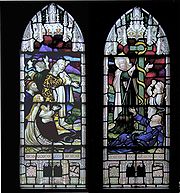
Hebrew Bible
The Hebrew Bible is a term used by biblical scholars outside of Judaism to refer to the Tanakh , a canonical collection of Jewish texts, and the common textual antecedent of the several canonical editions of the Christian Old Testament...
, was a sacred object in the form of a snake
Serpent (symbolism)
Serpent in Latin means: Rory Collins :&, in turn, from the Biblical Hebrew word of: "saraf" with root letters of: which refers to something burning-as, the pain of poisonous snake's bite was likened to internal burning.This word is commonly used in a specifically mythic or religious context,...
of brass
Brass
Brass is an alloy of copper and zinc; the proportions of zinc and copper can be varied to create a range of brasses with varying properties.In comparison, bronze is principally an alloy of copper and tin...
upon a pole.
The priestly source of the Torah
Priestly source
The Priestly Source is one of the sources of the Torah/Pentateuch in the bible. Primarily a product of the post-Exilic period when Judah was a province of the Persian empire , P was written to show that even when all seemed lost, God remained present with Israel...
says that Moses
Moses
Moses was, according to the Hebrew Bible and Qur'an, a religious leader, lawgiver and prophet, to whom the authorship of the Torah is traditionally attributed...
used a 'fiery serpent' to cure the Israelites from snakebite
Snakebite
A snakebite is an injury caused by a bite from a snake, often resulting in puncture wounds inflicted by the animal's fangs and sometimes resulting in envenomation. Although the majority of snake species are non-venomous and typically kill their prey with constriction rather than venom, venomous...
s.
King Hezekiah
Hezekiah
Hezekiah was the son of Ahaz and the 14th king of Judah. Edwin Thiele has concluded that his reign was between c. 715 and 686 BC. He is also one of the most prominent kings of Judah mentioned in the Hebrew Bible....
(reigned 715/6 – 687) instituted a religious iconoclastic
Iconoclasm
Iconoclasm is the deliberate destruction of religious icons and other symbols or monuments, usually with religious or political motives. It is a frequent component of major political or religious changes...
reform and destroyed "the brazen serpent that Moses had made; for unto those days the children of Israel did offer to it; and it was called Nehushtan."
The tradition of naming it Nehushtan is no older than the time of Hezekiah.
Serpent image
Snake worship
The worship of serpent deities is present in several old cultures, particularly in religion and mythology, where snakes were seen as entities of strength and renewal.-Hindu mythology:...
had been well established in Canaan
Canaan
Canaan is a historical region roughly corresponding to modern-day Israel, Palestine, Lebanon, and the western parts of Jordan...
in the Bronze Age
Bronze Age
The Bronze Age is a period characterized by the use of copper and its alloy bronze as the chief hard materials in the manufacture of some implements and weapons. Chronologically, it stands between the Stone Age and Iron Age...
: archaeologists have uncovered serpent cult objects in Bronze Age strata at several pre-Israelite cities in Canaan: two at Megiddo, one at Gezer
Gezer
Gezer was a Canaanite city-state and biblical town in ancient Israel. Tel Gezer , an archaeological site midway between Jerusalem and Tel Aviv, is now an Israeli national park....
, one in the sanctum sanctorum of the Area H temple at Hazor, and two at Shechem
Shechem
Shechem was a Canaanite city mentioned in the Amarna letters, and is mentioned in the Hebrew Bible as an Israelite city of the tribe of Manasseh and the first capital of the Kingdom of Israel...
.
According to Lowell K. Handy, the Nehushtan was originally the symbol of a minor god of snakebite-cure within the Temple. The name of this god is unknown, however, the use of "brazen serpent" is a subtle play on words that are based on the metal that the snake is made of: נחש (nachash) means "serpent", while נחשת (nachoshet) means "brass" or "bronze".
Origin
The Israelites set out from Mount HorMount Hor
Mount Hor is the name given in the Old Testament to two distinct mountains. One is in the Land of Edom on the East shore of the Dead Sea , the other by the Mediterranean Sea at the Northern border of the Land of Israel.-Mount Hor in Edom:This Mount Hor is situated "in the edge of the land of Edom"...
, where Aaron
Aaron
In the Hebrew Bible and the Qur'an, Aaron : Ααρών ), who is often called "'Aaron the Priest"' and once Aaron the Levite , was the older brother of Moses, and a prophet of God. He represented the priestly functions of his tribe, becoming the first High Priest of the Israelites...
was buried, to go to the Red Sea
Red Sea
The Red Sea is a seawater inlet of the Indian Ocean, lying between Africa and Asia. The connection to the ocean is in the south through the Bab el Mandeb strait and the Gulf of Aden. In the north, there is the Sinai Peninsula, the Gulf of Aqaba, and the Gulf of Suez...
. However they had to detour around the land of Edom
Edom
Edom or Idumea was a historical region of the Southern Levant located south of Judea and the Dead Sea. It is mentioned in biblical records as a 1st millennium BC Iron Age kingdom of Edom, and in classical antiquity the cognate name Idumea was used to refer to a smaller area in the same region...
(Numbers 20:21, 25). Frustrated and impatient, they complained against Yahweh
Yahweh
Yahweh is the name of God in the Bible, the God of Abraham, Isaac, Jacob, Jews and Christians.The word Yahweh is a modern scholarly convention for the Hebrew , transcribed into Roman letters as YHWH and known as the Tetragrammaton, for which the original pronunciation is unknown...
and Moses
Moses
Moses was, according to the Hebrew Bible and Qur'an, a religious leader, lawgiver and prophet, to whom the authorship of the Torah is traditionally attributed...
(Num. 21:4-5). This is the last of the complaint stories in the Book of Numbers
Book of Numbers
The Book of Numbers is the fourth book of the Hebrew Bible, and the fourth of five books of the Jewish Torah/Pentateuch....
. Just east of Palestine
Palestine
Palestine is a conventional name, among others, used to describe the geographic region between the Mediterranean Sea and the Jordan River, and various adjoining lands....
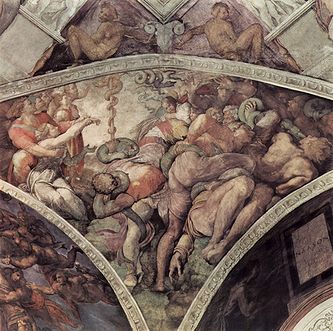
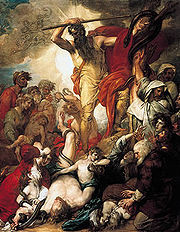
, God plagued them with "fiery serpents" for their mumurs against Him. For the sake of repentant ones, Moses was instructed by God to build a serpent of bronze that was used as an instrument to heal those who looked upon it .
In source criticism
Source criticism
A source criticism is a published source evaluation . An information source may be a document, a person, a speech, a fingerprint, a photo, an observation or anything used in order to obtain knowledge. In relation to a given purpose, a given information source may be more or less valid, reliable or...
by Martin Noth
Martin Noth
Martin Noth was a German scholar of the Hebrew Bible who specialized in the pre-Exilic history of the Hebrews. With Gerhard von Rad he pioneered the traditional-historical approach to biblical studies, emphasising the role of oral traditions in the formation of the biblical texts.-Life:Noth was...
, the bronze serpent passage in Numbers 21:4-9, proceeds smoothly and is free of doublets, thus it does not appear to divide into different 'sources' even with the unusual juxtapostion of 'God' in v.5. The predominating use of the name Yahweh
Yahweh
Yahweh is the name of God in the Bible, the God of Abraham, Isaac, Jacob, Jews and Christians.The word Yahweh is a modern scholarly convention for the Hebrew , transcribed into Roman letters as YHWH and known as the Tetragrammaton, for which the original pronunciation is unknown...
supposes that its appearance is original. In terms of the documentary hypothesis
Documentary hypothesis
The documentary hypothesis , holds that the Pentateuch was derived from originally independent, parallel and complete narratives, which were subsequently combined into the current form by a series of redactors...
, the narrative can be allocated to the E source.
Destruction
In 2 Kings 18:4, a bronze serpent was set up in the Jerusalem Temple sanctuary. The Masoretic textMasoretic Text
The Masoretic Text is the authoritative Hebrew text of the Jewish Bible and is regarded as Judaism's official version of the Tanakh. While the Masoretic Text defines the books of the Jewish canon, it also defines the precise letter-text of these biblical books, with their vocalization and...
says that "he [Hezekiah] called it Nehushtan". According to Young's Literal Translation
Young's Literal Translation
Young's Literal Translation is a translation of the Bible into English, published in 1862. The translation was made by Robert Young, compiler of Young's Analytical Concordance to the Bible and Concise Critical Comments on the New Testament. Young produced a "Revised Version" of the translation in...
, Nehushtan means "piece of brass" (2 Kings 18:4). Karen Randolph Joines makes the distinction that it was Hezekiah who discriminatingly called the image Nehushtan, rather than it being some common term used by the Israelites. When Hezekiah had become King, he tore down the Nehushtan. It has been suggested that Hezekiah's destruction of the Nehushtan was a result of the balance of power moving towards Assyria
Assyria
Assyria was a Semitic Akkadian kingdom, extant as a nation state from the mid–23rd century BC to 608 BC centred on the Upper Tigris river, in northern Mesopotamia , that came to rule regional empires a number of times through history. It was named for its original capital, the ancient city of Assur...
, which permitted him to remain on the throne of Judah as a puppet ruler. Hezekiah demonstrated his loyalty to the new regime by the destruction of an important symbol with Egyptian associations.
Significance in Christianity
As Moses lifted up the serpent in the wilderness, even so must the Son of ManSon of manThe phrase son of man is a primarily Semitic idiom that originated in Ancient Mesopotamia, used to denote humanity or self. The phrase is also used in Judaism and Christianity. The phrase used in the Greek, translated as Son of man is ὁ υἱὸς τοὺ ἀνθρώπου...
be lifted up, that whoever believes in Him should not perish but have eternal lifeEternal life (Christianity)In Christianity the term eternal life traditionally refers to continued life after death, rather than immortality. While scholars such as John H. Leith assert that...
-
The Serpent of bronze
Serpent (Bible)
Serpent is the term used to translate a variety of words in the Hebrew bible, the most common being , , the generic word for "snake"....
in Numbers 21
Chukat
Chukat, Hukath, or Chukkas is the 39th weekly Torah portion in the annual Jewish cycle of Torah reading and the sixth in the book of Numbers. It constitutes . Jews in the Diaspora generally read it in late June or July....
is a well known image for Christians because of its use by Jesus
Jesus
Jesus of Nazareth , commonly referred to as Jesus Christ or simply as Jesus or Christ, is the central figure of Christianity...
in the Gospel of John
Gospel of John
The Gospel According to John , commonly referred to as the Gospel of John or simply John, and often referred to in New Testament scholarship as the Fourth Gospel, is an account of the public ministry of Jesus...
. Jesus discussed his destiny with a Jewish teacher named Nicodemus
Nicodemus
Saint Nicodemus was a Pharisee and a member of the Sanhedrin, who, according to the Gospel of John, showed favour to Jesus...
by referencing a passage in Chukat
Chukat
Chukat, Hukath, or Chukkas is the 39th weekly Torah portion in the annual Jewish cycle of Torah reading and the sixth in the book of Numbers. It constitutes . Jews in the Diaspora generally read it in late June or July....
of the Torah
Torah
Torah- A scroll containing the first five books of the BibleThe Torah , is name given by Jews to the first five books of the bible—Genesis , Exodus , Leviticus , Numbers and Deuteronomy Torah- A scroll containing the first five books of the BibleThe Torah , is name given by Jews to the first five...
. Jesus gave a direct comparison between the raising up of the Son of Man
Son of man
The phrase son of man is a primarily Semitic idiom that originated in Ancient Mesopotamia, used to denote humanity or self. The phrase is also used in Judaism and Christianity. The phrase used in the Greek, translated as Son of man is ὁ υἱὸς τοὺ ἀνθρώπου...
and the act of the Mosaic serpent being raised up. Charles Spurgeon
Charles Spurgeon
Charles Haddon Spurgeon was a large British Particular Baptist preacher who remains highly influential among Christians of different denominations, among whom he is still known as the "Prince of Preachers"...
asserted that in this passage, Jesus was referring to his forthcoming crucifixion
Crucifixion of Jesus
The crucifixion of Jesus and his ensuing death is an event that occurred during the 1st century AD. Jesus, who Christians believe is the Son of God as well as the Messiah, was arrested, tried, and sentenced by Pontius Pilate to be scourged, and finally executed on a cross...
, and demonstrating the significance of the cross as spiritual healing from the curse of sin.
See also
- Serpent (Bible)Serpent (Bible)Serpent is the term used to translate a variety of words in the Hebrew bible, the most common being , , the generic word for "snake"....
- Serpent symbolismSerpent (symbolism)Serpent in Latin means: Rory Collins :&, in turn, from the Biblical Hebrew word of: "saraf" with root letters of: which refers to something burning-as, the pain of poisonous snake's bite was likened to internal burning.This word is commonly used in a specifically mythic or religious context,...
- CaduceusCaduceusThe caduceus is the staff carried by Hermes in Greek mythology. The same staff was also borne by heralds in general, for example by Iris, the messenger of Hera. It is a short staff entwined by two serpents, sometimes surmounted by wings...
- IdolatryIdolatryIdolatry is a pejorative term for the worship of an idol, a physical object such as a cult image, as a god, or practices believed to verge on worship, such as giving undue honour and regard to created forms other than God. In all the Abrahamic religions idolatry is strongly forbidden, although...
- OphitesOphitesThe Ophites or Ophians were members of a Christian Gnostic sect depicted by Hippolytus of Rome in a lost work, the Syntagma....
- Rod of AsclepiusRod of AsclepiusThe rod of Asclepius , also known as the asklepian, is an ancient symbol associated with astrology, the Greek god Asclepius, and with medicine and healing. It consists of a serpent entwined around a staff. The name of the symbol derives from its early and widespread association with Asclepius, the...
- UraeusUraeusThe Uraeus is the stylized, upright form of an Egyptian spitting cobra , used as a symbol of sovereignty, royalty, deity, and divine authority in ancient Egypt.The Uraeus is a symbol for the goddess Wadjet, who was one of the earliest Egyptian deities and who...
- Staff of Moses