
All Topics  
Chinese folk religion

 
Chinese Folk Religion

   Email Print
   Bookmark   Link


Chinese folk religion


Chinese folk religion is a collective label given to various folkloric
Folklore

Folklore is the body of expressive culture, including tales, music, dance, legends, oral history, proverbs, jokes, superstitions, customs, and so forth within a particular population comprising the traditions of that culture, subculture, or group ....
 beliefs that draws heavily from Chinese mythology
Chinese mythology

File:Nine-Dragons1.jpgChinese mythology is a collection of cultural history, folktales, and religions that have been passed down in oral or written form....
. This labeling is similar to how non-monotheistic religions are collectively called paganism
Paganism

Paganism is the blanket term given to describe religions and spiritual practices of pre-Christian Europe, and by extension a term for polytheistic?traditions or folk religion?worldwide seen from a Western or Christian viewpoint....
 in the West. It comprises the religion practiced in much of China
China

China is a Culture of China, an ancient civilization, and, depending on perspective, a national or multinational entity extending over a large area in East Asia....
 for thousands of years which included ancestor worship
Ancestor worship

Ancestor worship or ancestor veneration is a practice based on the belief that deceased family members have a continued existence, take an interest in the affairs of the world, and/or possess the ability to influence the fortune of the living....
 and drew heavily upon concepts and beings within Chinese mythology
Chinese mythology

File:Nine-Dragons1.jpgChinese mythology is a collection of cultural history, folktales, and religions that have been passed down in oral or written form....
.


Discussion
Ask a question about 'Chinese folk religion'
Start a new discussion about 'Chinese folk religion'
Answer questions from other users
Full Discussion Forum


Encyclopedia


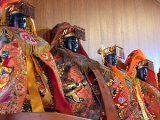
Matzu
Chinese folk religion is a collective label given to various folkloric
Folklore

Folklore is the body of expressive culture, including tales, music, dance, legends, oral history, proverbs, jokes, superstitions, customs, and so forth within a particular population comprising the traditions of that culture, subculture, or group ....
 beliefs that draws heavily from Chinese mythology
Chinese mythology

File:Nine-Dragons1.jpgChinese mythology is a collection of cultural history, folktales, and religions that have been passed down in oral or written form....
. This labeling is similar to how non-monotheistic religions are collectively called paganism
Paganism

Paganism is the blanket term given to describe religions and spiritual practices of pre-Christian Europe, and by extension a term for polytheistic?traditions or folk religion?worldwide seen from a Western or Christian viewpoint....
 in the West. It comprises the religion practiced in much of China
China

China is a Culture of China, an ancient civilization, and, depending on perspective, a national or multinational entity extending over a large area in East Asia....
 for thousands of years which included ancestor worship
Ancestor worship

Ancestor worship or ancestor veneration is a practice based on the belief that deceased family members have a continued existence, take an interest in the affairs of the world, and/or possess the ability to influence the fortune of the living....
 and drew heavily upon concepts and beings within Chinese mythology
Chinese mythology

File:Nine-Dragons1.jpgChinese mythology is a collection of cultural history, folktales, and religions that have been passed down in oral or written form....
. Chinese folk religion is sometimes seen as a constituent part of Chinese traditional religion, but more often, the two are regarded as synonymous. It is estimated that there are at least 394 million adherents to Chinese folk religion worldwide (see "major world religions").

Overview


Chinese folk religion
Folk religion

Folk religion consists of beliefs, superstitions and rituals transmitted from generation to generation in a specific culture. It could be contrasted with an organized religion or historical religion in which founders, creed, theology and ecclesiastical organizations are present....
 is composed of a combination of religious
Religion

A religion is an organized approach to human spirituality which usually encompasses a set of myth, symbols, beliefs and practices, often with a supernatural or transcendence quality, that give meaning to the practitioner's experiences of life through reference to a higher power or truth....
 practices, including Confucianist
Confucianism

Confucianism is a China Ethics and Philosophy developed from the teachings of the Chinese philosopher Confucius . It focuses on human morality and right action....
 ceremonies, ancestor worship
Ancestor worship

Ancestor worship or ancestor veneration is a practice based on the belief that deceased family members have a continued existence, take an interest in the affairs of the world, and/or possess the ability to influence the fortune of the living....
, Buddhism
Buddhism

Buddhism is a family of beliefs and practices considered by most to be a religionand is based on the teachings attributed to Siddhartha Gautama, commonly known as "The Buddha" , who was born in what is today Nepal....
 and Taoism
Taoism

Taoism refers to a variety of related philosophical and religious traditions and concepts. These traditions have influenced East Asia for over two thousand years and some have spread to the West....
. Chinese folk religion also retains traces of some of its ancestral neolithic
Neolithic

The Neolithic period was a period in the development of human technology, beginning about 9500 Before the Christian Era in the Middle East that is traditionally considered the last part of the Stone Age....
 belief systems which include the veneration of (and communication with) the sun
Sun

The Sun , a G V star, is the star at the center of the Solar System. The Earth and other matter orbit the Sun, which by itself accounts for about 98.6% of the Solar System's mass....
, moon
Moon

The Moon is Earth's only natural satellite and the List of natural satellites by diameter satellite in the Solar System. The average centre-to-centre distance from the Earth to the Moon is km, about thirty times the diameter of the Earth....
, earth
Earth

Earth is the third planet from the Sun. Earth is the largest of the terrestrial planets in the Solar System in diameter, mass and density. It is also referred to as the World and Wiktionary:Terra.Note that by International Astronomical Union convention, the term "Terra" is used for naming extensive land masses, rather...
, the heaven
Heaven

Heaven may refer to the physical heavens, the atmosphere or the seemingly endless expanse of the universe beyond. This is the traditional literal meaning of the term in English, however since at least AD 1000, it is typically also used to refer to an afterlife plane of existence in various religions and spirituality philosophy, often descri...
, and various star
Star

A star is a massive, luminous ball of Plasma that is held together by its own gravity. The nearest star to Earth is the Sun, which is the source of most of the energy on Earth....
s, as well as communication with animals. It has been practiced alongside Buddhism
Buddhism

Buddhism is a family of beliefs and practices considered by most to be a religionand is based on the teachings attributed to Siddhartha Gautama, commonly known as "The Buddha" , who was born in what is today Nepal....
, Confucianism
Confucianism

Confucianism is a China Ethics and Philosophy developed from the teachings of the Chinese philosopher Confucius . It focuses on human morality and right action....
, and Taoism
Taoism

Taoism refers to a variety of related philosophical and religious traditions and concepts. These traditions have influenced East Asia for over two thousand years and some have spread to the West....
 by Chinese people throughout the world for thousands of years.

Ceremonies, veneration
Veneration

In Christianity, veneration , or veneration of saints, is a special act of honoring a saint: a dead person who has been identified as singular in the traditions of the religion....
, legend
Legend

A legend is a narrative of human actions that are perceived both by teller and listeners to take place within human history and to possess certain qualities that give the tale verisimilitude ....
s, festival
Festival

A festival is an event, usually and ordinarily staged by a local community, which centers on some unique aspect of that community.Among many religions, a feast or festival is a set of celebrations in honour of God or Polytheism....
s and various devotions associated with different folk gods/deities and goddesses form an important part of Chinese culture even today. The veneration of secondary gods does not conflict with an individual's chosen religion, but is accepted as a complementary adjunct to Buddhism, Confucianism or Taoism. Some myth
Mythology

The word mythology refers to a body of folklore/myths/legends that a particular culture believes to be true and that often use the supernatural to interpret natural events and to explain the nature of the universe and humanity....
ical figures in folk culture have even been integrated into Buddhism as in the case of Miao Shan who is generally thought of having evolved into the Buddhist bodhisattva
Bodhisattva

In the Buddhist context, a bodhisattva means either "enlightened existence " or "enlightenment-being" or, given the variant Sanskrit spelling satva rather than sattva, "heroic-minded one for enlightenment "....
 Kuan Yin
Kuan Yin

Guanyin is the bodhisattva associated with compassion as veneration by East Asian Buddhism, usually as a female. The name Guanyin is short for Guanshi'yin which means "Vipassana the Sounds of the Samsara"....
. Other folk deities may date back to pre-Buddhist eras of Chinese history. The Chinese dragon
Chinese dragon

The China dragon or Oriental dragon is a mythical creature in East Asian culture with a China origin. It is visualized these days as a long, scaled, snake-like creature with four legs and five claws on each ....
 is one of the key religious icons in these beliefs.

Gods and goddesses


There are hundreds of gods and goddess as well as "saint
Saint

A saint in Christianity is a human being who has been called to holiness. The term is used differently by various denominations, with some, such as the Anglicans, Methodists, and Lutherans distinguishing between Saints and saints....
s," immortals
Eight Immortals

The Eight Immortals are a group of legendary Xian in Chinese mythology. Each Immortal's power can be transferred to a tool of power that can give life or destroy evil....
 and demigods. Historical figures noted for their bravery or virtue are also venerated and honored with their own festivals after they are apotheosized
Apotheosis

Apotheosis refers to the exaltation of a subject to divinity level. The term has meanings in theology, where it refers to a belief, and in art, where it refers to a genre....
. The following list represents some commonly worshipped deities:

(Note: This list is incomplete and should not be considered a full representation)

  • Guan Yu
    Guan Yu

    Guan Yu was a general under the warlord Liu Bei during the late Eastern Han Dynasty and Three Kingdoms era of China. He played a significant role in the civil war that led to the collapse of the Han Dynasty and the establishment of the Shu Han, of which Liu Bei was the first emperor....
    , the red-faced, bearded hero of Romance of the Three Kingdoms
    Romance of the Three Kingdoms

    Romance of the Three Kingdoms , written by Luo Guanzhong in the 14th century, is a Chinese historical novel based upon events in the turbulent years near the end of the Han Dynasty and the Three Kingdoms era of China, starting in 169 and ending with the reunification of the land in 280....
     and symbol of loyalty. He is the patron god of policemen, war, fortune, law, and gangsters, as he shows forgiveness, and often also serves as "Wu Sheng".


  • Baosheng Dadi, the "Great Emperor Protecting Life." A divine physician, whose powers extend to raising the dead. Worship is especially prevalent in Fujian
    Fujian

    is one of the Province of China on the southeast coast of People's Republic of China. Fujian borders Zhejiang to the north, Jiangxi to the west, and Guangdong to the south....
     and Taiwan
    Taiwan

    Taiwan is an island in East Asia. "Taiwan" is also commonly used to refer to the country governed by the Republic of China and to the ROC itself, which governs the island of Taiwan, Orchid Island and Green Island, Taiwan in the Pacific Ocean off the Taiwan coast, the Penghu islands in the Taiwan Strait, and Kinmen and the Matsu Islands...
    .


  • Cai Shen (?? "god of wealth"), named Gongming Zhao, who oversees the gaining and distribution of wealth through fortune
    Luck

    Luck is a chance happening, or that which happens beyond a person's control. Luck can be good or bad ....
    . He is often the deified manifestation of certain historical personalities. His shape is that of a giant blue whiskered cat.


  • Shou Xing (?? "god of longevity"), who stands for a healthy and long life. He is portrayed as an old baldy man with a walking stick in his right hand and a peach in his left.


  • Fu Shen (?? "god of happiness"), he looks like a traditional Chinese feudal lord with red clothing. He symbolizes happiness and joy. The god Eight Immortals
    Eight Immortals

    The Eight Immortals are a group of legendary Xian in Chinese mythology. Each Immortal's power can be transferred to a tool of power that can give life or destroy evil....
     (ba xian, ??) are important literary and artistic figures who were deified after death, and became objects of worship.


  • Hu Ye (?? "Lord Tiger"), a guardian spirit, often found at the bottom of Taoist temple shrines. Worshipers revere the tiger spirit in order to curse spiritual enemies. Rituals include stomping an effigy of a spiritual enemy in front of the tiger spirit as well as sacrificing meat offerings, paper gold, and others.


  • Jiu Wang Ye (??? "Nine Emperor God") refer to spirits of nine emperors, worshiped as emanations of Mazu
    Mazu

    Mazu may refer to the following Chinese topics* Mazu - popular deity in South China* Mazu Daoyi, a Zen teacher in medieval ChinaIt is also often used as transcription of the Japanese Matsu...
    , patron goddess of sailors. A festival is held over the first nine days of the ninth lunar month to celebrate the return from heaven to earth of the Nine Emperor spirits. This is celebrated primarily in Malaysia
    Malaysia

    Malaysia is a federation that consists of States of Malaysia in Southeast Asia with a total landmass of . The capital city is Kuala Lumpur, while Putrajaya is the seat of the federal government....
    .


  • Mazu
    Matsu (goddess)

    Mazu , also spelt Matsu, is the indigenous Goddess of the Sea who protects fishermen and sailors, and is invoked as the goddess who protects East Asians who are associated with the ocean....
    , the patroness, also considered as the goddess of sailors. Shrines can be found in coastal areas of Eastern and South-Eastern China. Today, belief in Mazu is especially popular in the South and South-East, including Fujian
    Fujian

    is one of the Province of China on the southeast coast of People's Republic of China. Fujian borders Zhejiang to the north, Jiangxi to the west, and Guangdong to the south....
    , Guangdong
    Guangdong

    Guangdong is a political divisions of China on the southern coast of People's Republic of China. The province is also known by an alternative English language name, the Canton Province....
    , Hainan
    Hainan

    Hainan is the smallest Provinces of China of the People's Republic of China. Although the province comprises some two hundred islands scattered among three archipelagos off the southern coast, all but three percent of its land mass is on Hainan Island , from which the province takes its name....
    , Taiwan
    Taiwan

    Taiwan is an island in East Asia. "Taiwan" is also commonly used to refer to the country governed by the Republic of China and to the ROC itself, which governs the island of Taiwan, Orchid Island and Green Island, Taiwan in the Pacific Ocean off the Taiwan coast, the Penghu islands in the Taiwan Strait, and Kinmen and the Matsu Islands...
    , Hong Kong
    Hong Kong

    Hong Kong , officially the Hong Kong Special Administrative Region, is a territory located in Southern China in East Asia, bordering the province of Guangdong to the north and facing the South China Sea to the east, west and south....
    , and Vietnam
    Vietnam

    Vietnam , officially the Socialist Republic of Vietnam , is the easternmost country on the Indochina Peninsula in Southeast Asia. It is bordered by People's Republic of China to the north, Laos to the northwest, Cambodia to the southwest, and the South China Sea to the east....
    .


  • Qiye (?? "Seventh Lord") and Baye (?? "Eighth Lord"), two generals and best friends, often seen as giant puppets in street parades. 8 is black, because he drowned rather than miss his appointment to meet with 7, even though a flood was coming. 7 has his tongue sticking out, because he hanged himself in mourning for 8.


  • Shangdi
    Shangdi

    Shangdi is the Supreme God in the original religious system of the Han Chinese people , a term used from the second millennium BC to the present day, as pronounced according to the modern Mandarin dialect....
     Shangdi (lit. Supreme Emperor) is originally the supreme god, synonymous with the concept of Tian
    Heaven

    Heaven may refer to the physical heavens, the atmosphere or the seemingly endless expanse of the universe beyond. This is the traditional literal meaning of the term in English, however since at least AD 1000, it is typically also used to refer to an afterlife plane of existence in various religions and spirituality philosophy, often descri...
    . This title/name was later applied to the supreme deity of various religions, including Yu Huang Dadi and the Christian God.


  • Cheng Huang
    Shing Wong

    City gods or town gods are deities in Chinese mythology, responsible for the affairs of the city. There are temples dedicated to the local town gods in many medium to large cities of China....
    , a class of protective deities: Each city has a Cheng Huang who looks after the fortunes of the city and judges the dead. Usually these are famous or noble persons from the city who were deified after death. The Cheng Huang Miao or "Shrine of the Cheng Huang" was often the focal point of a town in ancient times.


  • Sun Wukong
    Sun Wukong

    Sun Wukong , known in the West as the Monkey King, is the main character in the classical China epic novel Journey to the West. In the novel, he accompanies the monk Xuanzang on the journey to retrieve Buddhist sutras from India....
     (???,????; "The Monkey King" or "Great Sage Equaling Heaven") is the stone monkey born from heaven and earth who wreaked havoc in heaven and was punished by the Buddha under the five fingers mountain for 500 years. Released by the Tang Monk, Xuanzang
    Xuanzang

    Xuanzang [602 ? - 664] was a famous China Buddhist monk, scholar, traveler, and translator that brought up the interaction between History of China and History of India in the early Tang Dynasty period....
     (or Tang Sanzang), he traveled under Xuanzang as his disciple to the Thunder Monastery in the West (presumably India) for the Buddhist scriptures to redeem himself. Depending on which version of the Journey to the West
    Journey to the West

    Journey to the West is one of the Four Great Classical Novels of Chinese literature. Originally published anonymously in the 1590s during the Ming Dynasty, and even though no direct evidence of its authorship survives, it has been ascribed to the scholar Wu Cheng'en since the 20th century....
     legend, where Sun Wukong supposedly originates, Sun Wukong is only sometimes referred to as an actual god.


  • Tu Di Gong
    Tu Di Gong

    Tu Di Gong is a local earth god worshipped in China. A popular Chinese deity, he is worshiped by Chinese folk religion worshipers and Taoists....
     (???, tu dì gong), the "God of the earth", a genius loci
    Genius loci

    In Roman mythology a genius loci was the protective spirit of a place. It was often depicted as a Serpent . In contemporary usage, "genius loci" usually refers to a location's distinctive atmosphere, or a "spirit of place", rather than necessarily a guardian spirit....
     who protects a local place (especially hills), and whose statue may be found in roadside shrines. He is also the god of wealth, by virtue of his connection with the earth, and therefore, minerals and buried treasure.


  • Wenchangdi (??? "Emperor Promoting Culture"), god of students, scholars, and examination. He is worshiped by students who wish to pass their examinations. Inept examiners in ancient times sometimes sought "divine guidance" from him to decide rank between students.


  • Xi Wangmu
    Xi Wangmu

    The Queen Mother of the West is an ancient Chinese goddess whose origin can be traced back to oracle bone inscriptions of the fifteenth century BCE that record sacrifices to a "western mother"....
    , the "Queen Mother of the West" who reigns over a paradisaical mountain and has the power to make others immortal. In some myths, she is the mother of the Jade Emperor
    Jade Emperor

    The Jade Emperor , is the Taoist ruler of Heaven and all realms of existence below including that of Man and Hell according to a version of Chinese mythology....
    .


  • Yuexia Laoren (???? "Old Man Under the Moon"). The matchmaker who pairs lovers together, worshiped by those seeking their partner.


  • Zao Shen
    Zao Jun

    In Chinese folk religion and Chinese mythology, the Kitchen God, named Zao Jun or Zao Shen , is the most important of a plethora of Chinese domestic gods that protect the hearth and family with the addition of being celebrated in Vietnamese culture as well....
     (??|??), the 'Kitchen God' mentioned in the title of Amy Tan
    Amy Tan

    Amy Tan is an United States writer of Chinese people descent whose works explore mother-daughter relationships. In 1993, Tan's adaptation of her most popular fiction work, The Joy Luck Club, became a commercially The Joy Luck Club ....
    's novel, The Kitchen God's Wife. He reports to heaven on the behavior of the family of the house once a year, at Chinese New Year, and is given sticky rice in order to render his speech less comprehensible on that occasion.


  • Zhusheng Niangniang (???? "Birth-Registry Goddess"). She is worshiped by people who want children, or who want their child to be a boy.

Western views


The absence of a proper name for this religion, associated with the absence of any canonical literature, have for a long time caused Chinese folk religion to be viewed by Westerners as a popularized version of an "authentic" religion. Both in China and elsewhere, adherents often describe themselves, or are described by others, as followers of Buddhism, Taoism, Confucianism, or a mix among these.

Demographics


Many publications about religion in China do not include statistics on the number of adherents to traditional religion, with most adherents registered under the category of Taoist or Buddhist. However, despite the significant influence of those two belief-systems, Chinese traditional religion is not coterminous with them and, strictly speaking, marked distinctions exist. Nonetheless, such overlaps or blurring of distinctions are consistent with East Asian cultural understandings of religion and identity
Identity

Identity may refer to:...
 that do not require exclusive identification as an adherent of solely one distinct tradition.

See also


  • Ancestor worship
    Ancestor worship

    Ancestor worship or ancestor veneration is a practice based on the belief that deceased family members have a continued existence, take an interest in the affairs of the world, and/or possess the ability to influence the fortune of the living....
  • Animism
    Animism

    Animism is a philosophical, religious or spiritual idea that souls or spirits exist not only in humans and animals but also in plants, rock s, natural phenomena such as thunder, geographic features such as mountains or rivers, or other entities of the natural environment, a proposition also known as hylozoism in philosophy....
  • Buddhism
    Buddhism

    Buddhism is a family of beliefs and practices considered by most to be a religionand is based on the teachings attributed to Siddhartha Gautama, commonly known as "The Buddha" , who was born in what is today Nepal....
  • Chinese mythology
    Chinese mythology

    File:Nine-Dragons1.jpgChinese mythology is a collection of cultural history, folktales, and religions that have been passed down in oral or written form....
  • Chinese creation myth
  • Chinese spiritual world concepts
    Chinese spiritual world concepts

    Chinese spiritual world concepts are cultural practices or methods found in Culture of China. Some fit in the realms of a particular religion, others do not....
  • Feng shui
    Feng shui

    Feng shui is an ancient Chinese system of aesthetics believed to utilize the Laws of both heaven and Earth to help one improve life by receiving positive Qi....
  • Gods material shop
    Gods Material Shop

    A gods material shop is a shop specializing in supplying materials used in the practice of Chinese traditional religion.These shops are abundant in Chinese areas, from mainland China, Hong Kong, Taiwan, Singapore, Malaysia , and several Chinatowns....
  • Malaysian Chinese religion
    Malaysian Chinese religion

    Malaysian Chinese religion refers to religious beliefs of China origin as practiced by the sizable Chinese minority of Malaysia. These beliefs and practices are heavily influenced by the three faiths practiced by Chinese communities, Confucianism, Buddhism, and Taoism....
  • Religion in China
    Religion in China

    Religion in China has been characterized by Religious pluralism since the beginning of Chinese history. The Chinese religions are family-oriented and, unlike Western religions, do not demand the exclusive adherence of members....


Further reading


  • Manchao, Cheng, The Origin of Chinese Deities, Foreign Languages Press, Beijing, 1995. ISBN 7-119-00030-6
  • Paper, Jordan D., The Spirits are Drunk: Comparative Approaches to Chinese Religion, Albany, New York : State University of New York Press, 1995. ISBN 0791423158