
| |
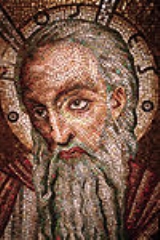
Moses (Egyptian, Latin: Moyses, ; Greek: in both the Septuagint and the New Testament; Arabic: , ; Ge'ez: , Musse) is a Biblical Hebrew religious leader, lawgiver, prophet, to whom the authorship of the Torah is traditionally attributed. Also called Moshe Rabbeinu in Hebrew (Hebrew: ?????? ????????, Lit. "Moses our Teacher"), he is the most important prophet in Judaism, and also an important prophet of Christianity, Islam, the Bahá'í Faith, Rastafari, Chrislam and many other faiths.
According to the book of Exodus, Moses was born in a time when war threatened and the large increase in the number of his people concerned the Pharaoh who was worried that they might help Egypt's enemies.

Discussion
Ask a question about 'Moses'
Start a new discussion about 'Moses'
Answer questions from other users
|
Recent Posts

Quotations
Fear not: for God is come to prove you, and that his fear may be before your faces, that ye sin not.
20:20 (KJV)
What you say, happens.
I have been a stranger in a strange land.
2:22 ( KJV), A sojourner have I become in a foreign land. , Everett Fox translation (1983), I have been a stranger in a foreign land. , Jewish Publication Society translation (1985; 1999)
O my LORD, I am not eloquent, neither heretofore, nor since thou hast spoken unto thy servant: but I am slow of speech, and of a slow tongue.
4:10 (KJV)
I pray thee, if I have found grace in thy sight, shew me now thy way, that I may know thee, that I may find grace in thy sight: and consider that this nation is thy people.
33:13 (KJV)

Encyclopedia
Moses (Egyptian, Latin: Moyses, ; Greek: in both the Septuagint and the New Testament; Arabic: , ; Ge'ez: , Musse) is a Biblical Hebrew religious leader, lawgiver, prophet, to whom the authorship of the Torah is traditionally attributed. Also called Moshe Rabbeinu in Hebrew (Hebrew: ?????? ????????, Lit. "Moses our Teacher"), he is the most important prophet in Judaism, and also an important prophet of Christianity, Islam, the Bahá'í Faith, Rastafari, Chrislam and many other faiths.
According to the book of Exodus, Moses was born in a time when war threatened and the large increase in the number of his people concerned the Pharaoh who was worried that they might help Egypt's enemies. His Hebrew mother, Jochebed, hid him when the Pharaoh ordered all newborn Hebrew boys to be killed, and he ended up being adopted into the Egyptian royal family. After killing an Egyptian slave-master, Moses fled across the Red Sea to Midian where he tended the flocks of Jethro, a priest of Midian on the slopes of Mt. Horeb. After the Ten Plagues were unleashed on Egypt, Moses led the Hebrew slaves out of Egypt, across the Red Sea, where they based themselves at Horeb and compased the borders of Edom. It was at this time, that according to the Bible, Moses received the Ten Commandments. Despite living to 120, Moses died before reaching the Land of Israel.
Religious texts
In the Bible the narratives of Moses are in Exodus, Leviticus, Numbers, and Deuteronomy while the main source for Moses' life is the Book of Exodus. The Book of Exodus takes up the narrative 230 years after the arrival of Jacob in Egypt. According to the Book of Exodus, Moses was a son of Amram, a member of the Levite tribe of Israel, having descended from Jacob, and his wife Jochebed. Jochebed (also Yocheved) was kin to Amram's father Kehath (Exodus 6:20). Moses had one older (by seven years) sister, Miriam, and one older (by three years) brother, Aaron. According to Genesis 46:11, Amram's father Kehath immigrated to Egypt with 70 of Jacob's household, making Moses part of the second generation of Israelites born during their time in Egypt.
In the Exodus account, the birth of Moses, on 7 Adar 2368 (about Feb-Mar 1391 BC), occurred at a time when the current Egyptian Pharaoh had commanded that all male Hebrew children born be killed by drowning in the river Nile. The Torah and Flavius Josephus leave the identity of this Pharaoh unstated.
Jochebed, the wife of the Levite Amram, bore a son and kept him concealed for three months. When she could keep him hidden no longer, rather than deliver him to be killed, she set him adrift on the Nile River in a small craft of bulrushes coated in pitch. According to Quran, she is commanded by God to place him in an ark and cast him on the waters of the Nile, thus abandoning him completely to God's protection and demonstrating her total trust in God. In the Biblical account, Moses' sister Miriam observed the progress of the tiny boat until it reached a place where Pharaoh's daughter Thermuthis (Bithiah) was bathing with her handmaidens. It is said that she spotted the baby in the basket and had her handmaiden fetch it for her. After several women had unsuccessfully attempted to nurse the child, Miriam came forward and asked Pharaoh's daughter if she would like a Hebrew woman to nurse the baby. Thereafter, Jochebed was employed as the child's nurse, and he grew and was brought to Pharaoh's daughter and became her son,and a younger brother to Ramesses II, the future Pharoah of Egypt. Moses would not be able to become Pharoah because he was not the 'blood' son of Bithiah , and he was the youngest.
This birth story is in many respects similar to the 7th century BC Neo-Assyrian version of the birth of the king Sargon of Akkad in the 24th century BC who, being born of modest means, was set in the Euphrates river in a basket of bulrushes and discovered by a member of the Akkadian royalty who reared him as their own.
Exodus and Flavius Josephus do not mention whether this daughter of Pharaoh was an only child or, if she was not an only child, whether she was an eldest child or an eldest daughter. Nor do they mention whether Thermuthis later had other natural or adopted children. If Ramesses II is the Pharaoh of the Oppression as is traditionally thought, identifying her would be extremely difficult as Rameses II is thought to have fathered over a hundred children. The daughter of Pharaoh named him with the Egyptian name Mes ses ,(birth protect) Mosheh, similar to the Hebrew word mashah, "to draw out".
In the Moses story related by the Quran, it was Pharaoh's wife who found Moses floating in the waters of the Nile and not his daughter. She convinced Pharaoh to keep him as their son because they were not blessed with any children.
In Greek translation, Mosheh was Hellenized as M??s?? (Mouses or Moses).
Names
- Strongs's concordance gives the name Moses as from the Egyptian mes ses.
- The Classical Rabbis in the Midrash identify Moses as one of seven biblical characters who were called by various names. Moses' other names were: Jekuthiel (by his mother), Heber (by his father), Jered (by Miriam), Avi Zanoah (by Aaron), Avi Gedor (by Kohath), Avi Soco (by his wet-nurse), Shemaiah ben Nethanel (by people of Israel). Moses is also attributed the names Toviah (as a first name), and Levi (as a family name) (Vayikra Rabbah 1:3), Heman , Mechoqeiq (lawgiver) and Ehl Gav Ish (Numbers 12:3)
- In Egyptian the name "Moses" means mes (birth) ses (protect) so named by Pharaoh's daughter after she had pulled the infant from the banks of the river. Further, Moses led the Israelites across the Red Sea, which also shows deliverance out of water. Josephus also cites this etymology.
- Some medieval Jewish scholars had suggested that Moses' actual name was the Egyptian translation of "to draw out", and that it was translated into Hebrew, either by the Bible, or by Moses himself later in his lifetime.
- Some modern scholars had suggested that the daughter of the pharaoh might have derived his name from the Egyptian name element mose, which means "son" or "formed of" or "has provided"; for example, "Thutmose" means "son of Thoth", and Rameses means "Ra has provided (a son)".
- According to Islamic tradition, his name, Musa, is derived from two Egyptian words: Mu which means water and sha meaning tree (or reeds), in reference to the fact that the basket in which the infant Moses floated came to rest by trees close to Pharaoh's residence.
- A growing number of critical scholars believe that Moses actually had a full Egyptian name, consisting of the root word -mose and the name of a god (similar to Rameses), but the name of the god was later dropped, either when he assimilated into Hebrew culture or by later scribes who were dismayed that their greatest prophet had such an Egyptian name.
Shepherd in Midian
After Moses had reached adulthood, he went to see how his brethren were faring. Seeing an Egyptian beating a Hebrew, he killed the Egyptian and buried the body in the sand, supposing that no one who knew about the incident would be disposed to talk about it. The next day, seeing two Hebrews quarreling, he endeavored to separate them, whereupon the Hebrew who was wronging the other taunted Moses for slaying the Egyptian. Moses soon discovered from a higher source that the affair was known, and that Pharaoh was likely to put him to death for it; he therefore made his escape across the red Sea to Midian. In Midian he stopped at a well, where he protected seven shepherdesses from a band of rude shepherds. The shepherdesses' father Hobab (also known as Raguel and Jethro, and presumably Shoaib according to Qur'an), a priest of Midian was immensely grateful for this assistance Moses had given his daughters, and adopted him as his son, gave his daughter Zipporah to him in marriage, and made him the superintendent of his herds. There he sojourned forty years, following the occupation of a shepherd, during which time his son Gershom was born.
One day, Moses led his flock to Mount Horeb , usually identified with Mount Sinai — a mountain that was thought in the Middle Ages to be located on the Sinai Peninsula, but that many scholars now believe was further east, at Elat located at the head of the Gulf of Aqaba between Edom and Moses' home in Midian on the slopes of Mount Horeb. While tending the flocks of Jethro at Mount Horeb, he saw a burning bush that would not be consumed. When he turned aside to look more closely at the marvel, God spoke to him from the bush, revealing His name to Moses.
Egypt: the Plagues and the Exodus
God commanded Moses to go to Egypt and deliver his fellow Hebrews from bondage. God had Moses practice transforming his rod into a serpent and inflicting and healing leprosy, and told him that he could also pour river water on dry land to change the water to blood. The Quran's account has emphasized Moses' mission to invite the Pharaoh to accept God's divine message as well as give salvation to the Israelites.
Moses then set off for Egypt, was nearly killed by God because his son was not circumcised. (The meaning of this latter obscure passage is debatable, because of the ambiguous nature of the Hebrew and its abrupt presence in the narrative. Several interpretations are therefore possible.) He was met on the way by his elder brother, Aaron, and gained a hearing with his oppressed kindred after they returned to Egypt, who believed Moses and Aaron after they saw the signs that were performed in the midst of the Israelite assembly. It is also revealed that during Moses' absence, the Pharaoh of the Oppression (sometimes identified with Ramesses II) had died, and been replaced by a new Pharaoh, known as the Pharaoh of the Exodus. If Rameses II is the Pharaoh of the Oppression, then this new Pharaoh would be Merneptah. Because the story the book of Exodus describes is catastrophic for the Egyptians — involving horrible plagues, the loss of thousands of slaves, and many deaths (possibly including the death of Pharaoh himself, although that matter is unclear in Exodus) — it is conspicuous that no Egyptian records speaking of Israelites in Egypt have ever been found. However, Merneptah, is indeed, historically known to have been a mediocre ruler, and certainly one weaker than Rameses II. Moses and Aaron went to Pharaoh and told him that the Lord God of Israel wanted Pharaoh to permit the Israelites to celebrate a feast in the wilderness. Pharaoh replied that he did not know their God and would not permit them to go celebrate the feast. Pharaoh upbraided Moses and Aaron and made the Israelites find their own straw needed to make the bricks required by their servitude, besides meeting the same daily quota of bricks. Moses and Aaron gained a second hearing with Pharaoh and changed Moses' rod into a serpent, but Pharaoh's magicians did the same with their rods. Moses and Aaron had a third opportunity when they went to meet the Pharaoh at the Nile riverbank, and Moses had Aaron turn the river to blood, but Pharaoh's magicians could do the same. Moses obtained a fourth meeting, and had Aaron bring frogs from the Nile to overrun Egypt, but Pharaoh's magicians were able to do the same thing. Apparently Pharaoh eventually got annoyed by the frogs and asked Moses to remove the frogs and promised to let the Israelites go observe their feast in the wilderness in return. The next day all the frogs died leaving a horrible stench and an enormous mess. This angered Pharaoh and he decided against letting the Israelites leave to observe the feast. Eventually Pharaoh let the Hebrews depart after Moses's God sent ten plagues upon the Egyptians. The third and fourth were the plague of gnats and flies. The fifth was the invasion of diseases on the Egyptians' cattle, oxen, goats, sheep, camels, and horses. Sixth were boils on the skins of Egyptians. Seventh, fiery hail and thunder struck Egypt. The eighth plague was locusts encompassing Egypt. The ninth plague was total darkness. The tenth plague culminated in the slaying of the Egyptian male first-borns, whereupon such terror seized the Egyptians that they ordered the Hebrews to leave in the Exodus. The events are commemorated as Passover, referring to how the plague "passed over" the houses of the Israelites while smiting the Egyptians.
The crossing of the Red Sea
And so Moses led his people eastward, beginning the long journey to Canaan from the Court of Pharoah. The people left so rapidly the bread was still unleavened in their pans. Stopping across the river to pick up the bones of Joseph from the darkness of his tomb at Succoth and then entering the wilderness of Etham. In the wilderness they encamped at Pi-hahiroth between Migdol and the sea facing Baal Zephon., Meanwhile, Pharaoh had a change of heart, and was in pursuit of them with 600 chariots. Shut in between this army and the sea, the Israelites despaired.
The people then continued to Marsa marching for three days along the wilderness of the Shur without finding water. Then they came to Elim where twelve water springs and 70 Palm trees greeted them.
From Elim they set out again and after 45 days they reached the wilderness of Sin between Elim and Sinai.
From there they reached the plain of Rephidim, and the rock of Mount Horeb at Elat completing the crossing of the Red Sea.
This is where Moses tended the flocks of Jethro, a priest of Midian, talked to a burning bush, produced water by striking the rock of Horeb with his staff, and directed the battle with the Amalek from the top of the mountian with Aaron holding up one hand and Hur of Midian the other.
Moses is reunited with Jethro and delivers the Ten Commandments here.
The years in the wilderness
When the people arrived at Marah, the water was bitter, causing the people to murmur against Moses. Moses cast a tree into the water, and the water became sweet. Later in the journey, after crossing the Red Sea from Elim to Elat the people began running low on supplies and again murmured against Moses and Aaron and said they would have preferred to die in Egypt, but God's provision of manna from the sky in the morning and quail in the evening took care of the situation. When the people camped in Rephidim, there was no water, so the people complained again and said, "Wherefore is this that thou hast brought us up out of Egypt, to kill us and our children and our cattle with thirst?" At Alush on Mt Horeb Moses struck a rock with his staff, and water came forth.
Amalekites, the indigenous people of Canaan, Edom and the Seir arrived and attacked the Israelites. In response, Moses bade Joshua lead the men to fight while he stood on mt. Horeb with the rod of God in his hand. As long as Moses held the rod up, Israel dominated the fighting, but if Moses let down his hands, the tide of the battle turned in favor of the Amalekites. Because Moses was getting tired, Aaron and Hur had Moses sit on a rock. Aaron held up one arm, Hur held up the other arm, and the Israelites routed the Amalekites.
Jethro, Moses' father-in-law, came to see Moses at Mt Horeb where Moses had tended Jethros flocks and brought Moses' wife and two sons with him. After Moses had told Jethro how the Israelites had escaped Egypt, Jethro went to offer sacrifices to the Lord, and then ate bread with the elders. The next day Jethro observed how Moses sat from morning to night giving judgement for the people. Jethro suggested that Moses appoint judges for lesser matters, a suggestion Moses heeded.
When the Israelites came to Mt. Horeb, they pitched camp near the mountain. Moses commanded the people not to touch the mountain. Moses received the Ten Commandments orally (but not yet in tablet form) and other moral laws. Moses then went up with Aaron, Nadab, Abihu, and seventy of the elders to see the God of Israel. Before Moses went up the mountain to receive the tablets, he told the elders to direct any questions that arose to Aaron or Hur. While Moses was on Mount Sinai receiving instruction on the laws for the Israelite community, the Israelites went to Aaron and asked him to make gods for them. After Aaron had received golden earrings from the people, he made a golden calf and said, "These are your gods, O Israel, who brought you up out of Egypt." A "solemnity of the Lord" was proclaimed for the following day, which began in the morning with sacrifices and was followed by revelry. After Moses had persuaded the Lord not to destroy the people of Israel, he went down from the mountain and was met by Joshua. Moses destroyed the calf and rebuked Aaron for the sin he had brought upon the people. Seeing that the people were uncontrollable, Moses went to the entry of the camp and said, "Who is on the Lord's side? Let him come unto me." All the sons of Levi rallied around Moses, who ordered them to go from gate to gate slaying the idolators.
Following this, according to the last chapters of Exodus, the Tabernacle was constructed, the priestly law ordained, the plan of encampment arranged both for the Levites and the non-priestly tribes, and the Tabernacle consecrated. Moses was given eight prayer laws that were to be carried out in regards to the Tabernacle. These laws included light, incense and sacrifice.
Miriam and Aaron spoke against Moses on account of his marriage to an Ethiopian, Josephus explains the marriage of Moses to this Ethiopian in the Antiquities of the Jews and about him being the only one through whom the Lord spoke. Miriam was punished with leprosy for seven days.
The people left Hazeroth and pitched camp in the wilderness of Paran. (Paran is a vaguely defined region in the northern part of the Sinai peninsula, just south of Canaan) Moses sent twelve spies into Canaan as scouts, including most famously Caleb and Joshua. After forty days, they returned to the Israelite camp, bringing back grapes and other produce as samples of the regions fertility. Although all the spies agreed that the land's resources were spectacular, only two of the twelve spies (Joshua and Caleb) were willing to try to conquer it, and are nearly stoned for their unpopular opinion. The people began weeping and wanted to return to Egypt. Moses turned down the opportunity to have the Israelites completely destroyed and a great nation made from his own offspring, and instead he told the people that they would wander the wilderness for forty years until all those twenty years or older who had refused to enter Canaan had died, and that their children would then enter and possess Canaan. Early the next morning, the Israelites said they had sinned and now wanted to take possession of Canaan. Moses told them not to attempt it, but the Israelites chose to disobey Moses and invade Canaan, but were repulsed by the Amalekites and Canaanites. According to the Quran, Moses encourages the Israelites to enter Canaan, but they are unwilling to fight the Canaanites, fearing certain defeat. Moses responds by pleading to Allah that he and his brother Aaron be separated from the rebellious Israelites.
The Tribe of Reuben, led by Korah, Dathan, Abiram, and two hundred fifty Israelite princes accused Moses and Aaron of raising themselves over the rest of the people. Moses told them to come the next morning with a censer for every man. Dathan and Abiram refused to come when summoned by Moses. Moses went to the place of Dathan and Abiram's tents. After Moses spoke the ground opened up and engulfed Dathan and Abiram's tents, after which it closed again. Fire consumed the two hundred fifty men with the censers. Moses had the censers taken and made into plates to cover the altar. The following day, the Israelites came and accused Moses and Aaron of having killed his fellow Israelites. The people were struck with a plague that killed fourteen thousand seven hundred persons, and was only ended when Aaron went with his censer into the midst of the people. To prevent further murmurings and settle the matter permanently, Moses had the chief prince of the non-Levitic tribes write his name on his staff and had them lay them in the sanctuary. He also had Aaron write his name on his staff and had it placed in the tabernacle. The next day, when Moses went into the tabernacle, Aaron's staff had budded, blossomed, and yielded almonds.
After leaving Sinai, the Israelites camped in Kadesh. After more complaints from the Israelites, Moses struck the stone twice, and water gushed forth. However, because Moses and Aaron had not shown the Lord's holiness, they were not permitted to enter the land to be given to the Israelites. This was the second occasion Moses struck a rock to bring forth water; however, it appears that both sites were named Meribah after these two incidents.
Now ready to enter Canaan, the Israelites abandon the idea of attacking the Canaanites head-on in Hebron, a city in the southern part of Canaan, having been informed by spies that they were too strong, it is decided that they will flank Hebron by going further East, around the Dead Sea. This requires that they pass through Edom, Moab, and Ammon. These three tribes are considered Hebrews by the Israelites as descendants of Lot, and therefore cannot be attacked. However they are also rivals, and are therefore not permissive in allowing the Israelites to openly pass through their territory. So Moses leads his people carefully along the eastern border of Edom, the southernmost of these territories. While the Israelites were making their journey around Edom, they complained about the manna. After many of the people had been bitten by serpents and died, Moses made the brass serpent and mounted it on a pole, and if those who were bitten looked at it, they did not die. According to the Biblical Book of Kings this brass serpent remained in existence until the days of King Hezekiah, who destroyed it after persons began treating it as an idol. When they reach Moab, it is revealed that Moab has been attacked and defeated by the Amorites led by a king named Sihon. The Amorites were a non-Hebrew Canannic people that once held power in the Fertile Crescent. When Moses asks the Amorites for passage and it is refused, Moses attacks the Amorites (as non-Hebrews, the Israelites have no reservations in attacking them), presumably weakened by conflict with the Moabites, and defeats them.
The Israelites now holding the territory of the Amorites just north of Moab, desire to expand their holdings by acquiring Bashan, a fertile territory north of Ammon famous for its oak trees and cattle. It is led by a king named Og. Later rabbinical legends made Og a survivor of the flood, suggesting the he had sat on the ark and was fed by Noah. The Israelites fight with Og's forces at Edrei, on the southern border of Bashan, where the Israelites are victorious and slay every man, woman, and child of his cities and take the spoil for their bounty.
Balak, king of Moab, having heard of the Israelites conquests, fears that his territory might be next. Therefore he sends elders of Moab, and of Midian, to Balaam (apparently a powerful and respected prophet), son of Beor (Bible), to induce him to come and curse the Israelites. Balaam's location is unclear. Balaam sends back word that he can only do what God commands, and God has, via a dream, told him not to go. Moab consequently sends higher ranking priests and offers Balaam honours, and so God tells Balaam to go with them. Balaam thus sets out with two servants to go to Balak, but an Angel tries to prevent him. At first the Angel is seen only by the ass Balaam is riding. After Balaam starts punishing the ass for refusing to move, it is miraculously given the power to speak to Balaam, and it complains about Balaam's treatment. At this point, Balaam is allowed to see the angel, who informs him that the ass is the only reason the Angel did not kill Balaam. Balaam immediately repents, but is told to go on.
Balak meets with Balaam at Kirjath-huzoth, and they go to the high places of Baal, and offer sacrifices at seven altars, leading to Balaam being given a prophecy by God, which Balaam relates to Balak. However, the prophecy blesses Israel; Balak remonstrates, but Balaam reminds him that he can only speak the words put in his mouth, so Balak takes him to another high place at Pisgah, to try again. Building another seven altars here, and making sacrifices on each, Balaam provides another prophecy blessing Israel. Balaam finally gets taken by a now very frustrated Balak to Peor, and, after the seven sacrifices there, decides not to seek enchantments but instead looks on the Israelites from the peak. The spirit of God comes upon Balaam and he delivers a third positive prophecy concerning Israel. Balak's anger rises to the point where he threatens Balaam, but Balaam merely offers a prediction of fate. Balaam then looks on the Kenites, and Amalekites and offers two more predictions of fate. Balak and Balaam then simply go to their respective homes. Later, Balaam informed Balak and the Midianites that, if they wished to overcome the Israelites for a short interval, they needed to seduce the Israelites to engage in idolatry. The Midianites sent beautiful women to the Israelite camp to seduce the young men to partake in idolatry, and the attempt proved successful.
Phinehas, the grandson of Aaron, put an end to the matter of the Midianite seduction by slaying two of the prominent offenders, but by that time a plague inflicted on the Israelites had already killed about twenty-four thousand persons. Moses was then told that because Phinehas had averted the wrath of God from the Israelites, Phinehas and his descendents were given the pledge of an everlasting priesthood.
After Moses had taken a census of the people, he sent an army to avenge the perceived evil brought on the Israelites by the Midianites. Numbers 31 says Moses instructed the Israelite soldiers to kill every Midianite woman, boy and the non-virgin girl, although virgin girls were shared amongst the soldiers. The Israelites killed Balaam, and the five kings of Midian: Evi, Rekem, Zur, Hur, and Reba.
Moses appointed Joshua, son of Nun, to succeed him as the leader of the Israelites. Moses then died at the age of 120.
Death
After all this was accomplished, Moses was warned that he would not be permitted to lead the nation of Israel across the Jordan river, but would die on its eastern shores (Num. 20:12).
He therefore assembled the tribes, and delivered to them a parting address, which forms the Book of Deuteronomy. In this address it is commonly accepted that he recapitulated the Law, reminding them of its most important features. When Moses finished, and he had pronounced a blessing on the people (Deut. 28:1-14), he went up Mount Nebo to the top of Pisgah, looked over the promised land of Israel spread out before him, and died, at the age of one hundred and twenty, on 7 Adar 2488 (about Feb-Mar 1271 BC). God Himself buried him in an unknown grave (Deut. 34:6). Moses was thus the human instrument in the creation of the nation of Israel by communicating to it the Torah. More humble than any other man (Num. 12:3), he enjoyed unique privileges, for "there hath not arisen a prophet since in Israel like unto Moses, whom the HaShem knew face to face" (Deut. 34:10).
Religion's views of Moses
Judaism There is a wealth of stories and additional information about Moses in the Jewish apocrypha and in the genre of rabbinical exegesis known as Midrash, as well as in the primary works of the Jewish oral law, the Mishnah and the Talmud.
Jewish historians who lived at Alexandria, such as Eupolemus, attributed to Moses the feat of having taught the Phoenicians their alphabet, similar to legends of Thoth. Artapanus of Alexandria explicitly identified Moses not only with Thoth / Hermes, but also with the Greek figure Musaeus (whom he calls "the teacher of Orpheus"), and ascribed to him the division of Egypt into 36 districts, each with its own liturgy. He names the princess who adopted Moses as Merris, wife of Pharaoh Chenephres.
Ancient sources mention an Assumption of Moses and a Testimony of Moses. A Latin text was found in Milan in the 19th century by Antonio Ceriani who called it the Assumption of Moses, even though it does not refer to an assumption of Moses or contain portions of the Assumption which are cited by ancient authors, and it is apparently actually the Testimony. The incident which the ancient authors cite is also mentioned in the Epistle of Jude.
To Orthodox Jews, Moses is really Moshe Rabbenu, `Eved HaShem, Avi haNeviim zya"a. He is called "Our Leader Moshe", "Servant of God", and "Father of all the Prophets". In their view, Moses not only received the Torah, but also the revealed (written and oral) and the hidden (the `hokhmat nistar teachings, which gave Judaism the Zohar of the Rashbi, the Torah of the Ari haQadosh and all that is discussed in the Heavenly Yeshiva between the Ramhal and his masters). He is also considered the greatest prophet.
Arising in part from his age, but also because 120 is elsewhere stated as the maximum age for Noah's descendants (one interpretation of ), "may you live to 120" has become a common blessing among Jews.
Christianity
For Christians, Moses — mentioned more often in the New Testament than any other Old Testament figure — is often a symbol of God's law, as reinforced and expounded on in the teachings of Jesus. New Testament writers often compared Jesus' words and deeds with Moses' to explain Jesus' mission. In Acts 7:39–43, 51–53, for example, the rejection of Moses by the Jews that worshiped the golden calf is likened to the rejection of Jesus by the Jews that continued in traditional Judaism.
Moses also figures in several of Jesus' messages. When he met the Pharisees Nicodemus at night in the third chapter of the Gospel of John, he compares Moses' lifting up of the bronze serpent in the wilderness, which any Israelite could look at and be healed, to his own lifting up (by his death and resurrection) for the people to look at and be healed. In the sixth chapter, Jesus responds to the people's claim that Moses provided them manna in the wilderness by saying that it was not Moses, but God, who provided. Calling himself the "bread of life", Jesus states that he is now provided to feed God's people.
He along with Elijah, is presented as meeting with Jesus in all three Gospel accounts of the Transfiguration of Jesus in Matthew 17, Mark 9, and Luke 9, respectively. Later Christians found numerous other parallels between the life of Moses and Jesus to the extent that Jesus was likened to a "second Moses." For instance, Jesus' escape from the slaughter by Herod in Bethlehem is compared to Moses' escape from Pharaoh's designs to kill Hebrew infants. Such parallels, unlike those mentioned above, are not pointed out in Scripture. See the article on typology.
His relevance to modern Christianity has not diminished. He is considered to be a saint by several churches; and is commemorated as a prophet in the respective Calendars of Saints of the Lutheran and Eastern Orthodox Churches on September 4. He is commemorated as one of the Holy Forefathers in the Calendar of Saints of the Armenian Apostolic Church on July 30.
Islam
Moses (Arabic: Musa) is mentioned more in the Qur'an than any other individual and his life is narrated and recounted more than any other prophet recognized in Islam. Moses is defined in Quran as both prophet (Nabi) and messenger (Rasul), which means he was one of the prophets who brought a scripture and law to his people. He has the status of being one of the Ulu al-azm apostles, that is those apostles who were endowed with special determination, constancy and forbearance in obeying the commands of God. Among prophets, Moses has been described as the one whose career as a messenger of God, lawgiver and leader of his community most closely parallels and foreshadows that of Muhammad.
In the Qur'an, Moses is included in the following passages: 2.49-61, 7.103-160, 10.75-93, 17.101-104, 20.9-97, 26.10-66, 27.7-14, 28.3-46, 40.23-30, 43.46-55, 44.17-31, and 79.15-25.
Most of the key events in Moses' life which are narrated in the Bible are to be found dispersed through the different Surahs of Quran, with a mystic story about meeting Khidr which is not found in the Bible. The Bible and Qur'an have different angles of view. The Bible has focused on Moses and the rescue of Israelites, while the Qur'an emphasized on the relation between Moses and God.
Mormonism
Members of the The Church of Jesus Christ of Latter-day Saints (also called Mormons) generally view Moses in the same way that other Christians do. However, in addition to accepting the Biblical account of Moses, Mormons include the Book of Moses as part of their scriptural canon. This book is believed to be the translated writings of Moses, and is included in the LDS Church's Pearl of Great Price. Latter-day Saints are also unique in believing that Moses was taken to heaven without having tasted death (translated). In addition, Joseph Smith, Jr. and Oliver Cowdery stated that on April 3, 1836, Moses appeared to them in the Kirtland Temple in a glorified, immortal, physical form and bestowed upon them the "keys of the gathering of Israel from the four parts of the earth, and the leading of the ten tribes from the land of the north."
Mandaeism
In Mandaeism, Moses is regarded as a false prophet. The God of Moses (YHWH) is said in Mandaeism to be an evil god or demon (whom they also identify with the sun). While it has been asserted that Mandaeanism is of Judaic origin, this has been disputed as they may also have had a common origin; at any rate, there are vehement polemics against Jews in Mandaean literature.
Academic view
The German scholar Martin Noth accepts that Moses may have had some connection with the preparations for the conquest of Canaan and recognizes a historical core "beneath" the Exodus and Sinai traditions. However, Noth holds that two different groups experienced the Exodus and Sinai events, and each group transmitted its own stories independently of the other one, writing that "The biblical story tracing the Hebrews from Egypt to Canaan resulted from an editor's weaving separate themes and traditions around a main character Moses, actually an obscure person from Moab."
Other scholars such as William Foxwell Albright have a more favorable view towards the traditional views regarding Moses, and accept the essence of the biblical story, as narrated between Exodus 1:8 and Deuteronomy 34:12, but recognize the impact that centuries of oral and written transmission have had on the account, causing it to acquire layers of accretions.
Historiography
Known extra-Biblical references to Moses date from many centuries after his supposed lifetime, and contain significant departures from the Biblical account. In addition to the Judeo-Roman or Judeo-Hellenic historians Artapanus, Eupolemus, Josephus, and Philo, a few gentile historians including Polyhistor, Manetho, Apion, Chaeremon of Alexandria, Tacitus and Porphyry make reference to him. The extent to which any of these accounts rely on earlier sources is unknown. Moses also appears in other religious texts such as the Midrash, Mishnah and Qur'an
No other surviving written records from Egypt, Assyria, etc., indisputably referring to the stories of the Bible or its main characters before ca. 850s BC have been found, and there is no known physical evidence (such as pottery shards or stone tablets) to corroborate Moses' existence.
Artapanus of Alexandria
This account is excerpted from the Hellenistic Jewish historian Artapanus of Alexandria (2nd century BC), as reproduced by Eusebius of Caesarea.
In Strabo
The following excerpt comes from the Roman historian Strabo (c. 24 AD):
In Tacitus
The Roman historian Tacitus (ca. 100 AD) mentions several possible origins of the Jews that were taught by those of his time.
The Antiquities of the Jews
Josephus relates several other incidents in connection with the Biblical account of Moses:
Before the incident in which Moses slew the Egyptian, Moses had led the Egyptians in a campaign against invading Ethiopians and routed them. While Moses was besieging one of the Ethiopians' cities, Tharbis, the daughter of the Ethiopian king, fell in love with Moses and wished to marry him. He agreed to do so if she would procure the deliverance of the city into his power. She did so immediately, and Moses promptly married her. This marriage is also mentioned in Numbers 12:1. The account of this expedition is also mentioned by Irenaeus, and the event would explain why St. Stephen refers to Moses as "mighty in his words and in his deeds" before Moses slew the Egyptian.
Flavius Josephus also gives significantly detailed accounts of the aftermath of Baalam's blessings and the events that lead to the slaying of Zimri.
Date of the Exodus
The Bible gives a date for the Exodus of c 1450 BC based on it being 480 years before the building of the temple in the 4th year of the reign of King Solomon and 430 years after the first arrival of Abraham in Egypt. Conjectures about the Exodus having taken place at other times are generally intended to demonstrate its agreement with other historic sources, archaeology, textual artifacts such as the form of contracts and the price of slaves, the geopolitical context, Egyptian campaign accounts and various king lists. Suggested dates range from 1450 to 1208 BC in the Eighteenth dynasty of Egypt and the Nineteenth dynasty of Egypt. At any time in this period the capital of Egypt is at Thebes and the crossing of the Red Sea from Thebes Red Sea Port Elim to Elat would be made in the company of Hatshepsuts Red Sea Fleet which was engaged in bringing mortuary supplies to the Temple of Karnak where frankincense, myrrh, bitumen, natron and linen from across the Red Sea were used in mummification.
- Based on the passages which say that Moses was born in a time when war threatened and there was a new Pharaoh who knew Joseph not and the passages in Genesis 14 describing Abrahams encounter with Chedolaomers campaign the geo political context suggests the Exodus occurred sometime around expulsion of the Hyksos by Kamose and the formation of the Eighteenth dynasty of Egypt by Amose. The building of a Red Sea fleet by Hatshepsut c 1458 BC and the campaign of Thutmosis III in pursuit of the Hyksos which lead up to the Battle of Megiddo c 1470 BC are considered compatible with the Bibles dating.
- It is thought to have occurred in the Eighteenth dynasty of Egypt, because this is the period when the Amarna letters, found in the library of Akhenaton at Amarna detailing the events that occurred in the reigns of himself and his predecessors Amenhotep III and Amenhotep IV (Akhenaten) tell of Canaan being invaded by "Ha ibru". Inscriptions portraying the battle of kadesh show ha ibru (the horsemen plural) as mounted bowmen serving as couriers for the Egyptians a couple of centuries later. This is the period when the Bible tells of the people of the Exodus attacking the same cities mentioned in the Egyptian accounts and placing them under the ban. There were also campaigns by Chedarlaomer against the cities of the Amalek along the Seir in the time of the Hebrew patriarchs Abraham, Isaac and Jacob some centuries before the Exodus. Doubt is thrown on the literal dating of the Bible suggesting that "forty years" might be just an idiom for "a long period of time", in the Old Testament despite the correlations. Further doubt arrises in that some scholars view the Habiru as members of a social underclass of people the MARTU, SAGAZ, KUR and apiru who are notorious as displaced semitic agricultural workers. Certainly there are plenty of brigands, vagrants, drifters, and nomadic pastorialists causing trouble throughout the Ancient Near East. Offshore its waters are full of sea people and pirates its trade routes regularly traversed by warlords, their campfollowers, sacred prostitutes, mercenaries, Shashu, bedouin raiders, warlike Amalek giants, Hittites, Mitanni and other trouble makers inclined to prey upon its merchant caravans and unwalled cities and villages. The sons of Israel are not the only candidates for hapiru or habiru anymore than they are a group of tribes, gene, oinkos and phratre confined to Egypt.
- A century ago some scholars thought the Exodus may have occurred during the 13th century BC, if the pharaoh of that time, Ramesses II, could be considered to be the pharaoh with whom Moses squabbled — either as the 'Pharaoh of the Exodus' himself, or the preceding 'Pharaoh of the Oppression', who is said to have commissioned the Hebrews to "(build) for Pharaoh treasure cities, Pithom and Raamses." These cities are now know known not to have been built under either Seti I or Rameses II, and are in fact the remains of a Twelfth dynasty of Egypt canal system. It was conjectured by some that the stele of Merneptah might refer to campaigns in Canaan and even to refer to Israel making him the 'Pharaoh of the Exodus until it was realized that there were problems with the reading of the inscription made by Fliders Petrie in 1896. The phrase he translated as mentioning "the people of YISRAEL their seed is not" actually refers the campaigns of his predecessors against Syrians. This is considered plausible by those who view the famous claim of the Year 5 Merneptah Stele (ca. 1208 BC) that "Israel is wasted, bare of seed," as propaganda to cover up this king's own loss of an army in the Red Sea. Taken at face value, however, the primary intent of the stela was clearly to commemorate Merneptah's victory over the Libyans and their Sea People allies. The reference to Canaan occurs only in the final lines of the document where Israel is mentioned after the city states of Ashkelon, Gezer and Yanoam perhaps to signal Merneptah's disdain or contempt for this new entity. In Exodus, the Pharaoh of the Exodus did not cross into Canaan since his Army was destroyed at the Red Sea. Hence, the traditional view that Ramesses II was the Pharaoh of either the Oppression or the Exodus is affirmed by the basic contents of the Merneptah Stele. Under this scenario, the Israelites would have been a nation without a state of their own who existed on the fringes of Canaan in Year 5 of Merneptah. This is suggested by the determinative sign written in the stela for Israel — "a throw stick plus a man and a woman over the three vertical plural lines" — which was "typically used by the Egyptians to signify nomadic groups or peoples without a fixed city-state," such as the Hebrew's previous life in Goshen.
- An unverified theory places the birth and/or adoption of Moses during a minor oppression in the reign of Amenhotep III, which was soon lifted, and claims that the more well-known oppression occurred during the reign of Horemheb, followed by the Exodus itself during the reign of Ramesses I. This is supported by the Haggadah of Pesach, which suggests that they were oppressed and then re-oppressed quite a few years later by Pharaoh. The Bible and Haggada suggest that the Pharaoh of the Exodus died in year 2 of his reign, matching Ramses I. The fact that Pi-Tum and Raamses were built during the reign of Ramses I also supports this view. Seti I records that during his reign the Shasu warred with each other, which some see as a reference to the Midyan and Moab wars. Seti's campaigns with the Shasu have also been compared with Balaam's exploits. However, many Egyptologists reject these comparisons as spurious.
- A more recent and non-Biblical view places Moses as a noble in the court of the Pharaoh Akhenaten (See below). A significant number of scholars, from Sigmund Freud to Joseph Campbell, suggest that Moses may have fled Egypt after Akhenaten's death (ca. 1334 BC) when many of the pharaoh's monotheistic reforms were being violently reversed. The principal ideas behind this theory are: the monotheistic religion of Akhenaten being a possible predecessor to Moses' monotheism, and the "Amarna letters", written by nobles to Akhenaten, which describe raiding bands of "Habiru" attacking the Egyptian territories in Mesopotamia.
- David Rohl, a British historian and archaeologist, author of the book "A Test of Time", places the birth of Moses during the reign of Pharaoh Khaneferre Sobekhotep IV of the 13th Egyptian Dynasty, and the Exodus during the reign of Pharaoh Dudimose (accession to the throne around 1457–1444), when according to Manetho "a blast from God smote the Egyptians".
Challenges to his historicity
- The suggestion that Moses was not a real historical figure and that the Exodus did not occur at all has been made by some archaeologists. Some archaeologists have claimed that surveys of ancient settlements in Sinai do not appear to show a great influx of people around the time of the Exodus (given variously as between 1500–1200 BCE), as would be expected from the arrival of Joshua and the Israelites in Canaan. This suggests that the biblical Exodus may not be a literal depiction. Archaeologists such as Israel Finkelstein, Ze'ev Herzog and William G. Dever, regard the Exodus as non-historical, at best containing a small germ of truth. According to Prof. Ze'ev Herzog, Director of the Institute of Archaeology at Tel Aviv University "This is what archaeologists have learned from their excavations in the Land of Israel: the Israelites were never in Egypt, did not wander in the desert, did not conquer the land in a military campaign and did not pass it on to the 12 tribes of Israel.... The many Egyptian documents that we have make no mention of the Israelites' presence in Egypt and are also silent about the events of the exodus.
The Bible Unearthed, Finkelstein points to the appearance of settlements in the central hill country around 1200, recognized by most archaeologists as the earliest of the known settlements of the Israelites. Using evidence from earlier periods, he shows a cyclical pattern to these highland settlements, corresponding to the state of the surrounding cultures. Finkelstein suggests that the local Canaanites would adapt their way of living from an agricultural lifestyle to a nomadic one and vice versa. When Egyptian rule collapsed after the invasion of the Sea Peoples, the central hill country could no longer sustain a large nomadic population, so they went from nomadism to sedentism. Dever agrees with the Canaanite origin of the Israelites but allows for the possibility of a Semitic tribe coming from Egyptian servitude among the early hilltop settlers and that Moses or a Moses-like figure may have existed in Transjordan ca 1250-1200.
- Biblical minimalists, such as Philip Davies, Niels Peter Lemche and Thomas L. Thompson, regard the Exodus as ahistorical. Hector Avalos, in "The End of Biblical Studies," states that the Exodus, as depicted in the Bible, is an idea that most biblical historians no longer support.
In Freud's historical psychoanalysis
There is also a psychoanalytical interpretation of Moses' life, put forward by Sigmund Freud in his last book, Moses and Monotheism, in 1937. Freud postulated that Moses was an Egyptian nobleman who adhered to the monotheism of Akhenaten. Following a theory proposed by a contemporary biblical critic, Freud, a committed atheist, believed that Moses was murdered in the wilderness, producing a collective sense of patricidal guilt that has been at the heart of Judaism ever since. "Judaism had been a religion of the father, Christianity became a religion of the son", he wrote. The possible Egyptian origin of Moses and of his message has received significant scholarly attention. Opponents of this view observe that the religion of the Torah seems different to Atenism in everything except the central feature of devotion to a single god, although this has been countered by a variety of arguments, e.g. pointing out the similarities between the Hymn to Aten and Psalm 104. Freud's interpretation of the historical Moses is not a prominent theory among historians, and is considered pseudohistory by most.
Criticism According to the Torah, Moses prescribed the death penalty for a huge range of offences, and for defeated enemies. As he is considered a holy figure, however, by Jews, Christians and Muslims, most criticism of his life and teachings has been left to others.
In the late eighteenth century, for example, the deist Thomas Paine commented at length on Moses' Laws in The Age of Reason, and gave his view that "the character of Moses, as stated in the Bible, is the most horrid that can be imagined". giving the story at as an example.
In the nineteenth century the agnostic Robert G. Ingersoll wrote " ...that all the ignorant, infamous, heartless, hideous things recorded in the 'inspired' Pentateuch are not the words of God, but simply 'Some Mistakes of Moses'".
More recently the atheist Richard Dawkins referring, like Paine, to the incident at , concluded drily "No, Moses was not a great role model for modern moralists.
Depictions
Moses is depicted in several U.S. government buildings because of his legacy as a lawgiver. Moses is one of the 23 lawgivers depicted in marble bas-reliefs in the chamber of the U.S. House of Representatives in the United States Capitol. His is the only forward facing bas-relief. An image of Moses holding two tablets written in Hebrew representing the Ten Commandments (and a partially visible list of commandments six through ten, the more "secular" commandments, behind his beard) is depicted on the frieze on the south wall of the U.S. Supreme Court building.
Horned Moses
, according to most translations, tells that after meeting with God the skin of Moses' face became radiant, frightening the Israelites and leading Moses to wear a veil. Jonathan Kirsch, in his book Moses: A Life, thought that, since Moses subsequently had to wear a veil to hide it, Moses' face was disfigured by a sort of "divine radiation burn".
This Exodus passage has led to one longstanding tradition that Moses grew horns. This is derived from an alternative interpretation of the Hebrew phrase . The root (qoph, resh, nun) may be read as either "horn" or "ray of light", depending on context. As a noun, this word turns up some ninety times within the Hebrew Bible, and always means "horn". The alternative meaning, "ray of light", turns up only in the post-Biblical Hebrew literature. As a verb, the three verses describing Moses' appearance are the only three examples in the Biblical and post-Biblical literature of this verb ever being translated as "shine". Aside from the references to Moses, the verb is always understood to mean "have horns" (cf: Ps 69:32, for the one other Biblical occurrence). translates to "the skin of his face".
Traditionally interpreted, these two words form an expression meaning that Moses was enlightened, literally that "the skin of his face shone" (as with a gloriole), as the KJV has it.
The Septuagint translates the Hebrew phrase as , "his face was glorified"; but Jerome translated the phrase into Latin as cornuta esset facies sua "his face was horned".
With apparent Biblical authority, and the added convenience of giving Moses a unique and easily identifiable visual attribute (something the other Old Testament prophets notably lacked), it remained standard in Western art to depict Moses with small horns until well after the Renaissance. Michelangelo's Moses, is probably the best-known example.
Not all the Renaissance Italian painters gave horns to Moses. The Venetian artist Tintoretto depicts Moses' face as radiating light, in his series about the life of the prophet in the San Rocco, Venice.
Popular artist renditions of saints include radiant light (a halo) behind the head, or over the crown of the head. Other traditions outside of religion include an aura to show an element of the supernatural, or possible energy field of the body.
Portrayals in popular culture
Dramatic portrayals
The Ten Commandments. He is portrayed by Charlton Heston. DeMille got the casting idea from the statue of Moses shown on this page as the director felt the famous statue actually looked like Heston. Moses had earlier been portrayed by Theodore Roberts in DeMille's 1923 silent film of the same name. A Ten Commandments television remake was produced in 2006. * Moses appears as the central character in the 1998 DreamWorks Pictures animated movie, The Prince of Egypt. He is voiced by Val Kilmer.
Parodies
History of the World, Part I, Moses is portrayed by Mel Brooks. The webcomic Jesus and Mo occasionally features a character called Moses. Moses appears in the form of the Master Control Program from Tron in Season 3 Episode 9 of the cartoon series South Park, which first aired on 07/28/1999 in the U.S..
Literature
In late David Gemmell's Troy series, Moses is exiled Egyptian (Gyppto) prince Ahmose. He joins Helikaon's crew under the name Gershom and becomes one of his closest friends after the death of Zidantas/Ox. He considers his grandfather, the pharaoh, a very wise man. Priam's daughter Kassandra shows him the truth: He was taken from his parents to replace pharaoh's stillborn son. He then goes to Egypt to free his people. When Thera volcano erupts, the sun is blotted out and because it happens right after Ramesses refuses to let them go, Jews believe that Moses did that.
See also
- Moses in rabbinic literature
- Torah
- The Exodus
- Aaron
- Joshua
- List of Biblical names
- List of founders of religious traditions
- Prophets of Islam
- Passage of the Red Sea
- Ipuwer Papyrus
- Seventh of Adar
- Mosaic authorship
- Table of prophets of Abrahamic religions
- Category:Moses
- Articles on Biblical books involving Moses: Exodus, Leviticus, Numbers, Deuteronomy
- Articles on Weekly Torah portions involving Moses: Va'eira, Bo, Beshalach, Yitro, Mishpatim, Terumah, Tetzaveh, Ki Tisa, Vayakhel, Pekudei, Tzav, Shemini, Tazria, Metzora, Acharei, Kedoshim, Emor, Behar, Bechukotai, Book of Numbers, Naso, Behaalotecha, Shlach, Korach, Chukat, Balak, Phinehas, Matot, Masei, Deuteronomy, Va'etchanan, Eikev, Re'eh, Shoftim, Ki Teitzei, Ki Tavo, Nitzavim, Vayelech, Haazinu, V'Zot HaBerachah
Further reading
Moses. New York: Putnam, 1958. ISBN 0742691373Assmann, Jan. Moses the Egyptian: The Memory of Egypt in Western Monotheism. Harvard University Press, 1997. ISBN 0-674-58738-3.Barzel, Hillel. "Moses: Tragedy and Sublimity." In Literary Interpretations of Biblical Narratives. Edited by Kenneth R.R. Gros Louis, with James S. Ackerman & Thayer S. Warshaw, 120–40. Nashville: Abingdon Press, 1974. ISBN 0-687-22131-5.Bernier, Michelle. "Charlton Heston: An Incredible Life". Createspace. 2008. ISBN 1440452932.Buber, Martin. Moses: The Revelation and the Covenant. New York: Harper, 1958.Card, Orson Scott. Stone Tables. Deseret Book Co., 1998. ISBN 1-57345-115-0.Chasidah, Yishai, Encyclopaedia of Biblical personalities: anthologized from the Talmud, Midrash and rabbinic writings, Shaar Press, Brooklyn, 2000Cohen, Joel. Moses: A Memoir. Mahwah, N.J.: Paulist Press, 2003. ISBN 0-8091-0558-6.Daiches, David. Moses: The Man and his Vision. New York: Praeger, 1975. ISBN 0-275-33740-5.Fast, Howard. Moses, Prince of Egypt. New York: Crown Pubs., 1958.Freud, Sigmund. Moses and Monotheism. New York: Vintage, 1967. ISBN 0-394-70014-7.Gjerman, Corey. Moses: The Father I Never Knew. Portland: Biblical Fantasticals, 2007. ISBN 978-1424171132.Halter, Marek. Zipporah, Wife of Moses. New York: Crown, 2005. ISBN 1400052793.Ingraham, J. H.. The Pillar of Fire: Or Israel in Bondage. New York: A.L. Burt, 1859. Reprinted Ann Arbor, Mich.: Scholarly Publishing Office, University of Michigan Library, 2006. ISBN 1425564917.Kirsch, Jonathan. Moses: A Life. New York: Ballantine, 1998. ISBN 0-345-41269-9.Kohn, Rebecca. Seven Days to the Sea: An Epic Novel of the Exodus. New York: Rugged Land, 2006. ISBN 1-59071-049-5.Lehman, S.M., rabbi Dr., (translator), Freedman, H., rabbi Dr., (ed.), Midrash Rabbah, 10 volumes, The Soncino Press, London, 1983Mann, Thomas. "Thou Shalt Have No Other Gods Before Me." In The Ten Commandments, 3–70. New York: Simon & Schuster, 1943.Sandmel, Samuel. Alone Atop the Mountain. Garden City, N.Y.: Doubleday, 1973. ISBN 0-385-03877-1.Southon, Arthur E. On Eagles' Wings. London: Cassell and Co., 1937. Reprinted New York: McGraw-Hill, 1954.Wiesel, Elie. “Moses: Portrait of a Leader.” In Messengers of God: Biblical Portraits & Legends, 174–210. New York: Random House, 1976. ISBN 0-394-49740-6.Wildavsky, Aaron. Moses as Political Leader. Jerusalem: Shalem Press, 2005. ISBN 965-7052-31-9.Wilson, Dorothy Clarke. Prince of Egypt. Philadelphia: Westminster Press, 1949
External links
- The entire context of the cited chapter of Strabo's work
|