

History of Schleswig-Holstein

Encyclopedia
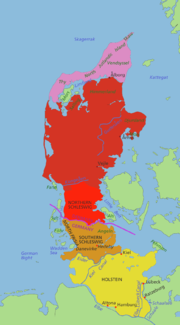
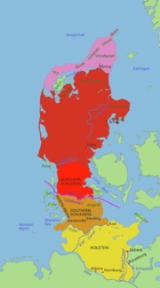
Jutland Peninsula
The Jutland Peninsula or more historically the Cimbrian Peninsula is a peninsula in Europe, divided between Denmark and Germany. The names are derived from the Jutes and the Cimbri....
is a long peninsula in Northern Europe
Northern Europe
Northern Europe is the northern part or region of Europe. Northern Europe typically refers to the seven countries in the northern part of the European subcontinent which includes Denmark, Estonia, Latvia, Lithuania, Norway, Finland and Sweden...
, and the current Schleswig-Holstein
Schleswig-Holstein
Schleswig-Holstein is the northernmost of the sixteen states of Germany, comprising most of the historical duchy of Holstein and the southern part of the former Duchy of Schleswig...
is its southern part. Schleswig
Schleswig
Schleswig or South Jutland is a region covering the area about 60 km north and 70 km south of the border between Germany and Denmark; the territory has been divided between the two countries since 1920, with Northern Schleswig in Denmark and Southern Schleswig in Germany...
is also called Southern Jutland
Southern Jutland
Southern Jutland is the name for the region south of the Kongeå in Jutland, Denmark. The region north of the Kongeå is called Nørrejylland . Both territories had their own ting assemblies in the Middle Ages . South Jutland is mentioned for the first time in the Knýtlinga saga.In the 13th century...
(Sønderjylland). The old Scandinavian sagas
Sagàs
Sagàs is a small town and municipality located in Catalonia, in the comarca of Berguedà. It is located in the geographical area of the pre-Pyrenees.-Population:...
, perhaps dating back to the times of the Angles
Angles
The Angles is a modern English term for a Germanic people who took their name from the ancestral cultural region of Angeln, a district located in Schleswig-Holstein, Germany...
and Jutes
Jutes
The Jutes, Iuti, or Iutæ were a Germanic people who, according to Bede, were one of the three most powerful Germanic peoples of their time, the other two being the Saxons and the Angles...
give the impression that Jutland has been divided into a northern and a southern part with the border running along the Kongeå
Kongeå
The river Kongeå defines the border between North and South Jutland in Jutland in Denmark.In 1864-1920 it was the border between Denmark and Germany....
River.
Taking into account both archeological findings and Roman
Ancient Rome
Ancient Rome was a thriving civilization that grew on the Italian Peninsula as early as the 8th century BC. Located along the Mediterranean Sea and centered on the city of Rome, it expanded to one of the largest empires in the ancient world....
sources, however, one could conclude that the Jutes
Jutes
The Jutes, Iuti, or Iutæ were a Germanic people who, according to Bede, were one of the three most powerful Germanic peoples of their time, the other two being the Saxons and the Angles...
inhabited both the Kongeå region and the more northern part of the peninsula, while the Angles
Angles
The Angles is a modern English term for a Germanic people who took their name from the ancestral cultural region of Angeln, a district located in Schleswig-Holstein, Germany...
lived approximately where the towns Haithabu and Schleswig later would emerge (originally centered in the southeast of Schleswig in Angeln
Angeln
Modern Angeln, also known as Anglia , is a small peninsula in Southern Schleswig in the northern Schleswig-Holstein, Germany, protruding into the Bay of Kiel...
), the Saxons
Saxons
The Saxons were a confederation of Germanic tribes originating on the North German plain. The Saxons earliest known area of settlement is Northern Albingia, an area approximately that of modern Holstein...
(earlier known apparently as the Reudingi) originally centered in Western Holstein (known historically as "Northalbingia
Nordalbingia
Nordalbingia was one of the four administrative regions of the medieval Duchy of Saxony, the others being Angria, Eastphalia, and Westphalia....
") and slavic
Slavic peoples
The Slavic people are an Indo-European panethnicity living in Eastern Europe, Southeast Europe, North Asia and Central Asia. The term Slavic represents a broad ethno-linguistic group of people, who speak languages belonging to the Slavic language family and share, to varying degrees, certain...
Wagrians, part of obodrites in Eastern Holstein. The Danes settled in the early Viking ages in Northern and Central Schleswig and the Northern Frisians
Frisians
The Frisians are a Germanic ethnic group native to the coastal parts of the Netherlands and Germany. They are concentrated in the Dutch provinces of Friesland and Groningen and, in Germany, East Frisia and North Frisia, that was a part of Denmark until 1864. They inhabit an area known as Frisia...
after approximately 900 in Western Schleswig.
The pattern of populated and unpopulated areas was relatively constant through Bronze Age
Bronze Age
The Bronze Age is a period characterized by the use of copper and its alloy bronze as the chief hard materials in the manufacture of some implements and weapons. Chronologically, it stands between the Stone Age and Iron Age...
and Iron Age
Iron Age
The Iron Age is the archaeological period generally occurring after the Bronze Age, marked by the prevalent use of iron. The early period of the age is characterized by the widespread use of iron or steel. The adoption of such material coincided with other changes in society, including differing...
.
After the Dark Ages migrations
Kingdom of Denmark
The Kingdom of Denmark or the Danish Realm , is a constitutional monarchy and sovereign state consisting of Denmark proper in northern Europe and two autonomous constituent countries, the Faroe Islands in the North Atlantic and Greenland in North America. Denmark is the hegemonial part, where the...
. Later also the contacts increased between the Danes and the people on the northern half of the Jutish peninsula.
Judging by today's placenames, then the southern linguistic
Linguistics
Linguistics is the scientific study of human language. Linguistics can be broadly broken into three categories or subfields of study: language form, language meaning, and language in context....
border of the Danish language
Danish language
Danish is a North Germanic language spoken by around six million people, principally in the country of Denmark. It is also spoken by 50,000 Germans of Danish ethnicity in the northern parts of Schleswig-Holstein, Germany, where it holds the status of minority language...
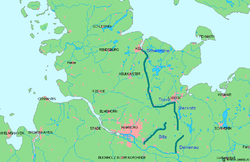
seems to have been (starting at the west) up the Treene river, along the Danevirke
Danevirke
The Danevirke The Danevirke The Danevirke (modern Danish spelling: Dannevirke; in Old Norse Danavirki ; in German Danewerk ; is a system of Danish fortifications in Schleswig-Holstein (Northern Germany). This important linear defensive earthwork was constructed across the neck of the Cimbrian...
(also known as Danewerk), then cutting across from the Schlei
Schlei
The Schlei is a narrow inlet of the Baltic Sea in Schleswig-Holstein in northern Germany. It stretches for approximately 20 miles from the Baltic near Kappeln and Arnis to the city of Schleswig. Along the Schlei are many small bays and swamps...
estuary to Eckernförde
Eckernförde
Eckernförde is a German city in Schleswig-Holstein, Kreis Rendsburg-Eckernförde at the Baltic Sea near Kiel. The population is about 23,000.All German submarines are stationed in Eckernförde....
, and leaving the Schwansen
Schwansen
Schwansen is a peninsula in Schleswig-Holstein, Germany, protruding into the Baltic Sea. It is located between the Eckernförde Bay in the south and the Schlei inlet in the north....
peninsula, while the West coast of Schleswig had been the area of the Frisian language.
After the Slavic migrations, the eastern area of modern Holstein was inhabited by Slavic Wagrians (Vagri) subgroup of Obotrites
Obotrites
The Obotrites , also commonly known as the Obodrites, Abotrites, or Abodrites, were a confederation of medieval West Slavic tribes within the territory of modern Mecklenburg and Holstein in northern Germany . For decades they were allies of Charlemagne in his wars against Germanic Saxons and Slavic...
(Obotritae).
Nordalbingia and Wagria in 8th century-9th century
Apart from Norther Holstein and Schleswig inghabited by DanesDanes
Danish people or Danes are the nation and ethnic group that is native to Denmark, and who speak Danish.The first mention of Danes within the Danish territory is on the Jelling Rune Stone which mentions how Harald Bluetooth converted the Danes to Christianity in the 10th century...
there were Nordalbingia
Nordalbingia
Nordalbingia was one of the four administrative regions of the medieval Duchy of Saxony, the others being Angria, Eastphalia, and Westphalia....
and Wagria in respectively, Western and Easterm Holstein.
Nordalbingia (German: Nordalbingien) was one of the four administrative regions of the medieval Duchy of Saxony, the others being Angria, Eastphalia, and Westphalia. Nordalbingia consisted of four districts: Dithmarschen, Holstein, Stormarn (north of the Elbe) and Hadeln (south of the Elbe).
The Wagri
Wagri
The Wagri, Wagiri, or Wagrians were a tribe of Polabian Slavs inhabiting Wagria, or eastern Holstein in northern Germany, from the ninth to twelfth centuries. They were a constituent tribe of the Obodrite confederacy....
, Wagiri, or Wagrians were a tribe of Polabian Slavs inhabiting Wagria, or eastern Holstein in northern Germany, from the ninth to twelfth centuries. They were a constituent tribe of the Obodrite confederacy.
Conquest of Nordalbingia by Obodrites and Franks
Following defeat of Norgalbingians in the Battle of Bornhöved (798)Battle of Bornhöved (798)
In the Battle of Bornhöved on the field of Sventanafeld near the village of Bornhöved near Neumünster in 798 the Obodrites, led by Drożko, allied with the Franks, defeated the Nordalbingian Saxons.- Background :...
by combined forces of Obodrites and Franks, where Saxons lost 4000 people, 10 000 families of Saxons were deported to other areas of empire. Areas north of Elbe were given to Obodrites, while Hadeln directly incorporated. However, Obodrites soon were invaded by Danes and only intervention of Charlemagne pushed them out of Eider river.
Danish, Saxon, Franks struggle for area of Holstein
As CharlemagneCharlemagne
Charlemagne was King of the Franks from 768 and Emperor of the Romans from 800 to his death in 814. He expanded the Frankish kingdom into an empire that incorporated much of Western and Central Europe. During his reign, he conquered Italy and was crowned by Pope Leo III on 25 December 800...
extended his realm in the late 8th century, he met a united Danish army which successfully defended Danevirke
Danevirke
The Danevirke The Danevirke The Danevirke (modern Danish spelling: Dannevirke; in Old Norse Danavirki ; in German Danewerk ; is a system of Danish fortifications in Schleswig-Holstein (Northern Germany). This important linear defensive earthwork was constructed across the neck of the Cimbrian...
, a fortified defensive barrier across the south of the territory western of the Schlei. A border was established at the Eider River
Eider
Eiders are large seaducks in the genus Somateria. Steller's Eider, despite its name, is in a different genus.The three extant species all breed in the cooler latitudes of the Northern hemisphere....
in 811.
This strength was enabled by three factors:
- the fishing,
- the good soil giving good pasture and harvests
- in particular the tax and customs revenues from the market in Haithabu, where all trade between the Baltic SeaBaltic SeaThe Baltic Sea is a brackish mediterranean sea located in Northern Europe, from 53°N to 66°N latitude and from 20°E to 26°E longitude. It is bounded by the Scandinavian Peninsula, the mainland of Europe, and the Danish islands. It drains into the Kattegat by way of the Øresund, the Great Belt and...
and Western Europe passed.
The Danevirke
Danevirke
The Danevirke The Danevirke The Danevirke (modern Danish spelling: Dannevirke; in Old Norse Danavirki ; in German Danewerk ; is a system of Danish fortifications in Schleswig-Holstein (Northern Germany). This important linear defensive earthwork was constructed across the neck of the Cimbrian...
was built immediately south of the road where boats or goods had to be hauled for approximately 5 kilometers between a Baltic Sea bay and the small river Rheider Au
Rheider Au
The Rheider Au is a tributary of the Treene. Its source is on the Geest near Schleswig. In the Viking period the route Eider - Treene - Rheider Au - Schlei served as a navigation way and/or transport or trade route between places to the north and the Baltic Sea, as commercial centres functioned ....
(Danish, Rejde Å) connected to the North Sea
North Sea
In the southwest, beyond the Straits of Dover, the North Sea becomes the English Channel connecting to the Atlantic Ocean. In the east, it connects to the Baltic Sea via the Skagerrak and Kattegat, narrow straits that separate Denmark from Norway and Sweden respectively...
. There on the narrowest part of southern Jutland was established the important transit market (Haithabu
Hedeby
Hedeby |heath]]land, and býr = yard, thus "heath yard"), mentioned by Alfred the Great as aet Haethe , in German Haddeby and Haithabu, a modern spelling of the runic Heiðabý was an important trading settlement in the Danish-northern German borderland during the Viking Age...
, also known as Hedeby), which was protected by the Danevirke fortification. Hedeby is located close to what is now the City of Schleswig.
The wealth of Schleswig, as reflected by impressive archeological finds on the site today, and the taxes from the Haithabu market, was enticing. A separate kingdom
Monarchy
A monarchy is a form of government in which the office of head of state is usually held until death or abdication and is often hereditary and includes a royal house. In some cases, the monarch is elected...
of Haithabu was established around year 900 by the Viking
Viking
The term Viking is customarily used to refer to the Norse explorers, warriors, merchants, and pirates who raided, traded, explored and settled in wide areas of Europe, Asia and the North Atlantic islands from the late 8th to the mid-11th century.These Norsemen used their famed longships to...
chieftain
Tribal chief
A tribal chief is the leader of a tribal society or chiefdom. Tribal societies with social stratification under a single leader emerged in the Neolithic period out of earlier tribal structures with little stratification, and they remained prevalent throughout the Iron Age.In the case of ...
Olaf from Svealand
Svealand
Svealand , Swealand or Sweden proper is the historical core region of Sweden. It is located in south central Sweden and is one of three lands of Sweden, bounded to the north by Norrland and to the south by Götaland. Deep forests, Tiveden, Tylöskog, Kolmården, separated Svealand from Götaland...
. Olaf's son and successor Gnupa was however killed in battle against the Danish king, and his kingdom vanished.
The southern border was then adjusted back and forth a few times. For instance, the German Emperor Otto II
Otto II, Holy Roman Emperor
Otto II , called the Red, was the third ruler of the Saxon or Ottonian dynasty, the son of Otto the Great and Adelaide of Italy.-Early years and co-ruler with Otto I:...
occupied the region between the River Eider and the Schlei in the years 974-983, called Mark of Schleswig, and stimulating German colonization. Later Haithabu was burned by Swede
Svealand
Svealand , Swealand or Sweden proper is the historical core region of Sweden. It is located in south central Sweden and is one of three lands of Sweden, bounded to the north by Norrland and to the south by Götaland. Deep forests, Tiveden, Tylöskog, Kolmården, separated Svealand from Götaland...
s, and first under the reign of King Sweyn Forkbeard (Svend Tveskæg)
Sweyn I of Denmark
Sweyn I Forkbeard was king of Denmark and England, as well as parts of Norway. His name appears as Swegen in the Anglo-Saxon Chronicle and he is also known in English as Svein, Swein, Sven the Dane, and Tuck.He was a Viking leader and the father of Cnut the Great...
(986-1014) the situation was stabilized, although raids against Haithabu would be repeated. Haithabu was once again and ultimately destroyed by fire in 1066. As Adam of Bremen
Adam of Bremen
Adam of Bremen was a German medieval chronicler. He lived and worked in the second half of the eleventh century. He is most famous for his chronicle Gesta Hammaburgensis Ecclesiae Pontificum .-Background:Little is known of his life other than hints from his own chronicles...
reported in 1076, the Eider River
Eider River
The Eider is the longest river of the German state of Schleswig-Holstein. The river starts near Bordesholm and reaches the southwestern outskirts of Kiel on the shores of the Baltic Sea, but flows to the west, ending in the North Sea...
was the border between Denmark and the Saxon
Lower Saxony
Lower Saxony is a German state situated in north-western Germany and is second in area and fourth in population among the sixteen states of Germany...
territories.
From the time Danes came to Schleswig from today’s eastern part of Denmark and Germans colonised Schleswig migrating from Holstein, the country north of the Elbe had been the battleground of Danes and Germans, as well as certain Slavic people. Danish scholars point to the existence of Danish placenames north for Eider and Danevirke as evidence that at least the most of Schleswig was at one time Danish; German scholars claim it, on the other hand, as essentially Germanic, due to the fact that Schleswig ever since had become an autonomous entity and a duchy since it has been populated and been dominated from the South. The Duchy of Schleswig, or South Jutland (Sønderjylland), had been a Danish fief, though having been more or less independent from the Kingdom of Denmark during the centuries, similarly to Holstein, that had been from the first a fief of the Germano-Roman Empire, originating in the small area of Nordalbingia
Nordalbingia
Nordalbingia was one of the four administrative regions of the medieval Duchy of Saxony, the others being Angria, Eastphalia, and Westphalia....
, in today western Holstein, inhabited then mostly by Saxons, but in 13th century expanded to the present Holstein, after winning local Danish overlord. Throughout the Middle Ages, Schleswig was a source of rivalry between Denmark and the nobility of the German duchy of Holstein. The Danish position can be exemplified with an inscription on a stone in the walls of the town of Rendsburg
Rendsburg
Rendsburg is a town on the River Eider and the Kiel Canal in the northeastern part of Schleswig-Holstein, Germany. It is the capital of the Kreis of Rendsburg-Eckernförde. As of 2006, it had a population of 28,476.-History:...
(Danish: Rendsborg) located on the border between Schleswig and Holstein: Eidora Terminus Imperii Romani ("The River Eider is the Border of the Holy Roman Empire"). A number of German nobles sought to challenge this.
The controversy in the 19th century raged round the ancient indissoluble union of the two duchies, and the inferences to be drawn from it; the Danish National Liberals
National Liberal Party (Denmark)
The National Liberal Party , was a Danish political party or political movement from the 1830s until about 1880.Often considered "the first Danish political party" the National Liberals were gradually founded as the opposition against the Danish absolute monarchy...
claimed Schleswig as an integral part of the Danish kingdom; the Germans claimed Holstein as a part of Germany and Schleswig also. The history of the relations of Schleswig and Holstein thus became of importance in the practical political question.
The area of Schleswig (South Jutland) was first inhabited by the mingled West Germanic tribes Cimbri
Cimbri
The Cimbri were a tribe from Northern Europe, who, together with the Teutones and the Ambrones threatened the Roman Republic in the late 2nd century BC. The Cimbri were probably Germanic, though some believe them to be of Celtic origin...
, Angles
Angles
The Angles is a modern English term for a Germanic people who took their name from the ancestral cultural region of Angeln, a district located in Schleswig-Holstein, Germany...
and Jutes
Jutes
The Jutes, Iuti, or Iutæ were a Germanic people who, according to Bede, were one of the three most powerful Germanic peoples of their time, the other two being the Saxons and the Angles...
, later also by the North Germanic Danes and West Germanic Frisians
Frisians
The Frisians are a Germanic ethnic group native to the coastal parts of the Netherlands and Germany. They are concentrated in the Dutch provinces of Friesland and Groningen and, in Germany, East Frisia and North Frisia, that was a part of Denmark until 1864. They inhabit an area known as Frisia...
. Holstein was inhabited mainly by the West Germanic Saxons, aside Wends
Wends
Wends is a historic name for West Slavs living near Germanic settlement areas. It does not refer to a homogeneous people, but to various peoples, tribes or groups depending on where and when it is used...
(such as Obotrites
Obotrites
The Obotrites , also commonly known as the Obodrites, Abotrites, or Abodrites, were a confederation of medieval West Slavic tribes within the territory of modern Mecklenburg and Holstein in northern Germany . For decades they were allies of Charlemagne in his wars against Germanic Saxons and Slavic...
) and other Slavic peoples in the East. The Saxons were the last of their nation to submit to Charlemagne (804), who put their country under Frankish
Franks
The Franks were a confederation of Germanic tribes first attested in the third century AD as living north and east of the Lower Rhine River. From the third to fifth centuries some Franks raided Roman territory while other Franks joined the Roman troops in Gaul. Only the Salian Franks formed a...
counts, the limits of the Empire being pushed in 810 as far as the Schlei in Schleswig. In 811 the river Eider
Eider
Eiders are large seaducks in the genus Somateria. Steller's Eider, despite its name, is in a different genus.The three extant species all breed in the cooler latitudes of the Northern hemisphere....
was declared as borderline between the Frankish Empire
Frankish Empire
Francia or Frankia, later also called the Frankish Empire , Frankish Kingdom , Frankish Realm or occasionally Frankland, was the territory inhabited and ruled by the Franks from the 3rd to the 10th century...
and Denmark
Denmark
Denmark is a Scandinavian country in Northern Europe. The countries of Denmark and Greenland, as well as the Faroe Islands, constitute the Kingdom of Denmark . It is the southernmost of the Nordic countries, southwest of Sweden and south of Norway, and bordered to the south by Germany. Denmark...
. Then began the secular struggle between the Danish kings and the German emperors, and in 934 the German king Henry I established the Mark of Schleswig (Limes Danarum) between the Eider and the Schlei as an outpost of Germany against the Danes.
South of this raged the contest between Germans and Slavs. The Slavs, conquered and Christianized, rose in revolt in 983, after the death of the emperor Otto II, and for a while reverted to paganism and independence. The Saxon dukes, however, continued to rule central Holstein, and when Lothair of Supplinburg became duke of Saxony (1106), on the extinction of the Billung line, he invested Adolf I of Schauenburg with the countship of Holstein.
12th century
The Earl (jarl) Knud Lavard (Eng. Canute LavardCanute Lavard
Canute Lavard was a Danish prince. Later he was the first Duke of Schleswig and the first border prince who was both a Danish and a German vassal, a position leafing towards the historical double position of Southern Jutland...
)(killed 1131), son of a Danish king, became Duke
Duke
A duke or duchess is a member of the nobility, historically of highest rank below the monarch, and historically controlling a duchy...
of Jutland
Jutland
Jutland , historically also called Cimbria, is the name of the peninsula that juts out in Northern Europe toward the rest of Scandinavia, forming the mainland part of Denmark. It has the North Sea to its west, Kattegat and Skagerrak to its north, the Baltic Sea to its east, and the Danish–German...
or Southern Jutland. His son ascended the Danish throne, and the main branch continued as Kings, and a cadet branch
Cadet branch
Cadet branch is a term in genealogy to describe the lineage of the descendants of the younger sons of a monarch or patriarch. In the ruling dynasties and noble families of much of Europe and Asia, the family's major assets – titles, realms, fiefs, property and income – have...
descended from Abel of Denmark
Abel of Denmark
Abel of Denmark was Duke of Schleswig from 1232 to 1252 and King of Denmark from 1250 until his death in 1252. He was the son of Valdemar II by his second wife, Infanta Berengária of Portugal, and brother to Eric IV and Christopher I....
received Southern Jutland (Slesvig
Slesvig
Slesvig is the Danish name for:* Schleswig, Schleswig-Holstein, a German city* The former Duchy of Schleswig * A former name for Hedeby, a Viking Age trading center, originally the largest town in the Nordic Countries...
) as their appanage
Appanage
An apanage or appanage or is the grant of an estate, titles, offices, or other things of value to the younger male children of a sovereign, who would otherwise have no inheritance under the system of primogeniture...
. During the rule of the dynasty Southern Jutland functioned as the Duchy
Duchy
A duchy is a territory, fief, or domain ruled by a duke or duchess.Some duchies were sovereign in areas that would become unified realms only during the Modern era . In contrast, others were subordinate districts of those kingdoms that unified either partially or completely during the Medieval era...
which provided for the expenses of Royal Princes. Rivalry of royal succession and particularly the tendency of autonomy led to longlasting feuds between the Dukes of Schleswig and the Kings of Denmark 1253–1325.
At that time, Germany expanded northwards and had set up the Schauenburg
Schauenburg
Schaumburg and Schauenburg are the two versions of the name of a regional German dynasty.The usage is scattered, historically as well as locally:* Schaumburg, a district and former county in Lower Saxony*Schauenburg, Hesse, a municipality in Germany...
family as counts of Holstein, under German suzerainty, first located in Nordalbingia
Nordalbingia
Nordalbingia was one of the four administrative regions of the medieval Duchy of Saxony, the others being Angria, Eastphalia, and Westphalia....
, the Saxon part of the region, in what now is western Holstein. Knud Lavard had also gained awhile parts of Holstein
Holstein
Holstein is the region between the rivers Elbe and Eider. It is part of Schleswig-Holstein, the northernmost state of Germany....
, and thereby came in conflict with Count Adolf (Schauenburg) in the German part of Holstein, as they both were very keen on expanding their influence and pacifying the Wagrian tribe (see: Wends
Wends
Wends is a historic name for West Slavs living near Germanic settlement areas. It does not refer to a homogeneous people, but to various peoples, tribes or groups depending on where and when it is used...
). Count Adolf succeeded and established the County of Holstein (1143) with about the borders it has had since then. Holstein
Holstein
Holstein is the region between the rivers Elbe and Eider. It is part of Schleswig-Holstein, the northernmost state of Germany....
was Christianized
Christianization
The historical phenomenon of Christianization is the conversion of individuals to Christianity or the conversion of entire peoples at once...
, many of the Wagrians were killed and the land was inhabited by settlers from Westphalia
Westphalia
Westphalia is a region in Germany, centred on the cities of Arnsberg, Bielefeld, Dortmund, Minden and Münster.Westphalia is roughly the region between the rivers Rhine and Weser, located north and south of the Ruhr River. No exact definition of borders can be given, because the name "Westphalia"...
, Friesland
Friesland
Friesland is a province in the north of the Netherlands and part of the ancient region of Frisia.Until the end of 1996, the province bore Friesland as its official name. In 1997 this Dutch name lost its official status to the Frisian Fryslân...
and Holland. Soon the towns of Holstein
Holstein
Holstein is the region between the rivers Elbe and Eider. It is part of Schleswig-Holstein, the northernmost state of Germany....
, as Lübeck
Lübeck
The Hanseatic City of Lübeck is the second-largest city in Schleswig-Holstein, in northern Germany, and one of the major ports of Germany. It was for several centuries the "capital" of the Hanseatic League and, because of its Brick Gothic architectural heritage, is listed by UNESCO as a World...
and Hamburg
Hamburg
-History:The first historic name for the city was, according to Claudius Ptolemy's reports, Treva.But the city takes its modern name, Hamburg, from the first permanent building on the site, a castle whose construction was ordered by the Emperor Charlemagne in AD 808...
, became serious trade competitors on the Baltic Sea
Baltic Sea
The Baltic Sea is a brackish mediterranean sea located in Northern Europe, from 53°N to 66°N latitude and from 20°E to 26°E longitude. It is bounded by the Scandinavian Peninsula, the mainland of Europe, and the Danish islands. It drains into the Kattegat by way of the Øresund, the Great Belt and...
.
13th century
Adolf I's son, Adolf II of Schauenburg (1128–1164), succeeded in re-conquering the Slavonic WagriWagri
The Wagri, Wagiri, or Wagrians were a tribe of Polabian Slavs inhabiting Wagria, or eastern Holstein in northern Germany, from the ninth to twelfth centuries. They were a constituent tribe of the Obodrite confederacy....
and founded the city and see of Lübeck
Lübeck
The Hanseatic City of Lübeck is the second-largest city in Schleswig-Holstein, in northern Germany, and one of the major ports of Germany. It was for several centuries the "capital" of the Hanseatic League and, because of its Brick Gothic architectural heritage, is listed by UNESCO as a World...
to hold them in check. Adolf III of Schauenburg
Adolf III of Schauenburg
Adolf III of Schauenburg was the Archbishop-Elector of Cologne from 1547 to 1556.-Biography:Adolf of Schauenburg was born on January 19, 1511 and baptized in Leuven in February 1511. He was the son of Jobst I of Schaumburg and his wife Maria of Nassau-Dillenburg.As a younger son, Adolf was...
(d. 1225), his successor, received Dithmarschen
Dithmarschen
Dithmarschen is a district in Schleswig-Holstein, Germany. It is bounded by the districts of Nordfriesland, Schleswig-Flensburg, Rendsburg-Eckernförde, and Steinburg, by the state of Lower Saxony , and by the North Sea.-Geography:The district is located on the North Sea...
in fee from the emperor Frederick I
Frederick I, Holy Roman Emperor
Frederick I Barbarossa was a German Holy Roman Emperor. He was elected King of Germany at Frankfurt on 4 March 1152 and crowned in Aachen on 9 March, crowned King of Italy in Pavia in 1155, and finally crowned Roman Emperor by Pope Adrian IV, on 18 June 1155, and two years later in 1157 the term...
, but in 1203 the fortunes of war compelled him to surrender Holstein to Valdemar II of Denmark
Valdemar II of Denmark
Valdemar II , called Valdemar the Victorious or Valdemar the Conqueror , was the King of Denmark from 1202 until his death in 1241. The nickname Sejr is a later invention and was not used during the King's own lifetime...
who mandated Albert of Orlamünde, the cession being confirmed in a Golden bull by the emperor Frederick II
Frederick II, Holy Roman Emperor
Frederick II , was one of the most powerful Holy Roman Emperors of the Middle Ages and head of the House of Hohenstaufen. His political and cultural ambitions, based in Sicily and stretching through Italy to Germany, and even to Jerusalem, were enormous...
in 1214 and the pope in 1217, thus provoking the German nobles in Holstein. Valdemar appointed his lieutenant in Holstein.
In 1223, King Valdemar and his eldest son were abducted by count Henry I of Schwerin (also known as Heinrich der Schwarze), and held captive in Castle Dannenberg
Dannenberg
- Places :* Dannenberg , a town in Germany* County of Dannenberg, a medieval fief founded by Henry the Lion- People :* Konrad Dannenberg, German-American engineer* Peter A Dannenberg, Russian general...
for several years. Count Henry demanded that Valdemar should surrender the land conquered in Holstein 20 years ago and become a vassal of the Holy Roman Emperor
Holy Roman Emperor
The Holy Roman Emperor is a term used by historians to denote a medieval ruler who, as German King, had also received the title of "Emperor of the Romans" from the Pope...
who in fact tried to intervene and arrange the release of Valdemar. Danish envoys refused these terms and Denmark declared war. The war ended in defeat of the troops under the command of Albert of Orlamünde at Mölln in 1225, and Valdemar was forced to surrender his conquests as the price of his own release and take an oath not to seek revenge.
Valdemar was released from captivity in 1226 and appealed to Pope Honorius III
Pope Honorius III
Pope Honorius III , previously known as Cencio Savelli, was Pope from 1216 to 1227.-Early work:He was born in Rome as son of Aimerico...
to have his oath repealed, a request the Pope granted. In 1226, Valdemar attacked the nobles of Holstein, and initially, had success.
On July 22, 1227 the two armies clashed at Bornhöved
Bornhöved
Bornhöved is a municipality in the district of Segeberg, in Schleswig-Holstein, Germany. It is situated approx. 15 km east of Neumünster.Bornhöved is part of the Amt Bornhöved....
in Holstein in the Battle of Bornhöved
Battle of Bornhöved (1227)
The Battle of Bornhöved took place on 22 July 1227 near Bornhöved in Holstein. Count Adolf IV of Schauenburg and Holstein — leading an army consisting of troops from the cities of Lübeck and Hamburg, about 1000 Dithmarsians and combined troops of Holstein next to various north German nobles —...
. The battle ended in a decisive victory for Adolf IV of Holstein
Adolf IV of Holstein
Adolf IV , was a Count of Schauenburg and of Holstein , of the family of the Schauenburger. Adolf was the eldest son of Adolf III of Schauenburg and Holstein by his second wife, Adelheid of Querfurt....
. During the battle the troops from Dithmarschen abandoned the Danish army and joined Adolf’s army. In the following peace, Valdemar II relinquished his conquests in Holstein for good and Holstein was permanently secured to the house of Schauenburg.
King Valdemar II, who had retained the former German Mark north of the Eider, in 1232 erected Schleswig as a duchy for his second son, Abel. Holstein on the other hand, after the death of Adolf IV in 1261, was split up into several countships by his sons and grandsons: the lines of Kiel, Plön, Schauenburg-Pinneberg and Rendsburg.
14th century
The connection between Schleswig and Holstein became closer during the 14th century as the ruling class and accompanying colonists intensely populated the Duchy Schleswig. Local lords of Schleswig had already early paid attention to keep Schleswig independent from the Kingdom of Denmark and to strengthen ties to the German Holstein. This tradition of autonomy showed itself in future politics for centuries to come.The rivalry, sometimes leading into war between the kings of Denmark and the Abelian dukes of Schleswig was expensive, and Denmark had to finance it through extensive loans. The Dukes of Schleswig were allied with the Counts of Holstein, who happened to become the main creditors of the Danish Crown, too, in the reign of the utterly incompetent king Christopher II of Denmark
Christopher II of Denmark
Christopher II was king of Denmark from 1320 to 1326 and again from 1329 until his death. He was son of Eric V. His name is connected with national disaster, as his rule ended in an almost total dissolution of the Danish state.-Biography:Being the brother of King Eric VI, Christopher was a...
.
On the death of King Valdemar's descendant Duke Eric in 1319, Christopher II of Denmark
Christopher II of Denmark
Christopher II was king of Denmark from 1320 to 1326 and again from 1329 until his death. He was son of Eric V. His name is connected with national disaster, as his rule ended in an almost total dissolution of the Danish state.-Biography:Being the brother of King Eric VI, Christopher was a...
attempted to seize the Duchy of Schleswig, the heir of which Valdemar III
Valdemar III of Denmark
Valdemar III of Denmark was a king of Denmark from 1326 to 1329 briefly when underage, as well as in 1325–26 and from 1330 to 1364 Duke of Schleswig as Valdemar V. He was a rival king set up against the unsuccessful Christopher II and was widely opposed by his many subjects. His term was ended...
was a minor; but Valdemar's guardian and uncle, Gerhard III of Holstein-Rendsburg (1304–1340), surnamed the Great and a notable warrior, drove back the Danes and, Christopher having been expelled, succeeded in procuring the election of Valdemar to the Danish throne, while Gerhard himself obtained the Duchy of Schleswig. King Valdemar was regarded as a usurper by most Danish nobles as he had been forced by the Schleswig-Holstein nobility to sign the Constitutio Valdemaria (June 7, 1326) promising that The Duchy of Schleswig and the Kingdom of Denmark must never be united under the same ruler. Schleswig was consequently granted to Count Gerhard, being the leader of one of the three lines of the Schauenburg dynasty. The constitution can be seen as a first precursor to the Treaty of Ribe and similarly laying down the principle of separation between the Duchy of Schleswig and the Kingdom of Denmark and indeed uniting Schleswig and Holstein for the first time.
In 1330, Christopher II
Christopher II of Denmark
Christopher II was king of Denmark from 1320 to 1326 and again from 1329 until his death. He was son of Eric V. His name is connected with national disaster, as his rule ended in an almost total dissolution of the Danish state.-Biography:Being the brother of King Eric VI, Christopher was a...
was restored to his throne and Valdemar III of Denmark
Valdemar III of Denmark
Valdemar III of Denmark was a king of Denmark from 1326 to 1329 briefly when underage, as well as in 1325–26 and from 1330 to 1364 Duke of Schleswig as Valdemar V. He was a rival king set up against the unsuccessful Christopher II and was widely opposed by his many subjects. His term was ended...
abdicated his untenable kingship and returned to his former position as Duke of Schleswig which he held as Valdemar V of Schleswig. As compensation, Gerhard was awarded the island of Funen
Funen
Funen , with a size of 2,984 km² , is the third-largest island of Denmark following Zealand and Vendsyssel-Thy, and the 163rd largest island of the world. Funen is located in the central part of the country and has a population of 454,358 inhabitants . The main city is Odense, connected to the...
as a fief instead. In 1331 war broke out between Gerhard and King Christopher II
Christopher II of Denmark
Christopher II was king of Denmark from 1320 to 1326 and again from 1329 until his death. He was son of Eric V. His name is connected with national disaster, as his rule ended in an almost total dissolution of the Danish state.-Biography:Being the brother of King Eric VI, Christopher was a...
, ending in Danish defeat. The peace terms were extremely harsh. King Christopher was only left in effective control of the small island of Langeland
Langeland
Langeland is a Danish island located between the Great Belt and Bay of Kiel. The island measures 285 km² and, as of 1 January 2010, has a population of 13,277. The island produces grain and is known as a recreational area. A bridge connects it to Tåsinge via Siø - a small island with a...
and faced the impossible task of raising 100,000 silver marks to redeem his country. Denmark had effectively been dissolved and was left without a king between 1332 and 1340. Gerhard, however, was assassinated in 1340 by a Dane.
In 1340, King Valdemar IV of Denmark
Valdemar IV of Denmark
Valdemar IV of Denmark or Waldemar ; , was King of Denmark from 1340 to 1375.-Ascension to the throne:...
began his more than twenty year long quest to reclaim his kingdom. While succeeding in regaining control of Zealand, Funen, Jutland, and Scania he, however, failed to obtain control of Schleswig, and its ducal line managed to continue its virtual independence.
This was the time when almost all of Denmark came under the supremacy of the Counts of Holstein, who possessed different parts of Denmark as pawns for their credits. King Valdemar IV (Atterdag)
Valdemar IV of Denmark
Valdemar IV of Denmark or Waldemar ; , was King of Denmark from 1340 to 1375.-Ascension to the throne:...
started to regain the kingdom part by part, and married his rival's sister Hedvig of Schleswig, the only daughter of Duke Eric II of Schleswig. Duke Valdemar of Slesvig's son, Henrik, was in 1364 nominally entfeoffed with the Duchy, although he never reached to regain more than the northernmost parts as he couldn't raise the necessary funds to repay the loans. With him, the Abelian line went extinct. The true holder of the lands was count of Holstein, but Henry's feudal heirs were his first cousin Margaret of Denmark
Margaret I of Denmark
Margaret I was Queen of Denmark, Norway and Sweden and founder of the Kalmar Union, which united the Scandinavian countries for over a century. Although she acted as queen regnant, the laws of contemporary Danish succession denied her formal queenship. Her title in Denmark was derived from her...
, queen of several Scandinavian realms, and Albert of Mecklenburg, son of Margaret's elder sister Ingeborg of Denmark.
In 1372, Valdemar Atterdag turned his attention to Schleswig and conquered Gram
Gram
The gram is a metric system unit of mass....
in 1372 and Flensburg
Flensburg
Flensburg is an independent town in the north of the German state of Schleswig-Holstein. Flensburg is the centre of the region of Southern Schleswig...
in 1373. Southern parts of Schleswig had been mortgaged to several German nobles by Duke Henry of Schleswig (d 1375, a son of the former king Valdemar III of Denmark
Valdemar III of Denmark
Valdemar III of Denmark was a king of Denmark from 1326 to 1329 briefly when underage, as well as in 1325–26 and from 1330 to 1364 Duke of Schleswig as Valdemar V. He was a rival king set up against the unsuccessful Christopher II and was widely opposed by his many subjects. His term was ended...
), the last duke of that line. The childless, elderly Henry transferred his rights to his kinsman and brother-in-law King Valdemar IV in 1373. The German nobles, however, refused to allow the king to repay the mortgage and redeem the area in question.
In 1374, Valdemar bought large tracts of land in the province and was on the verge of starting a campaign to conquer the rest when he died on October 24, 1374 and shortly hereon Duke Henrik died in 1375. It was then when the male lines both in the kingdom and the duchy became extinct, that the counts of Holstein seized on Schleswig, assuming at the same time the style of lords of Jutland. The nobles quickly took action and managed to regain more control of the Duchy which they emphasised to be independent of the Danish Crown.
In 1386, Queen Margaret I of Denmark
Margaret I of Denmark
Margaret I was Queen of Denmark, Norway and Sweden and founder of the Kalmar Union, which united the Scandinavian countries for over a century. Although she acted as queen regnant, the laws of contemporary Danish succession denied her formal queenship. Her title in Denmark was derived from her...
, younger daughter of Valdemar IV of Denmark and Helvig of Schleswig, granted Schleswig as a hereditary fief under the Danish crown to Count Gerhard VI of Holstein-Rendsburg, grandson of Gerhard III of Rendsburg, provided that he swore allegiance to her son King Oluf
Olav IV of Norway
Olaf II Haakonsson was king of Denmark as Olaf II and king of Norway as Olaf IV . Olaf was son of King Haakon VI of Norway and the grandson of King Magnus IV of Sweden. His mother was Queen Margaret I of Denmark which made him the grandson of King Valdemar IV of Denmark...
, although Schleswig actually still was hold autonomously by the Count of Holstein. Gerhard - after the extinction of the line of Kiel and Holstein (1390) – finally obtained the whole of the countship of Holstein in 1403, but not the small Schauenburg territories in Lower Saxony. With this merging of power begins the history of the union of Schleswig and Holstein.
15th century
Gerhard VI died in 1404, and soon afterwards war broke out between his sons and Eric of PomeraniaEric of Pomerania
Eric of Pomerania KG was King Eric III of Norway Norwegian Eirik, King Eric VII of Denmark , and as Eric King of Sweden...
, Margaret's successor on the throne of Denmark, who claimed South Jutland as an integral part of the Danish monarchy, a claim formally recognized by the emperor Sigismund
Sigismund, Holy Roman Emperor
Sigismund of Luxemburg KG was King of Hungary, of Croatia from 1387 to 1437, of Bohemia from 1419, and Holy Roman Emperor for four years from 1433 until 1437, the last Emperor of the House of Luxemburg. He was also King of Italy from 1431, and of Germany from 1411...
in 1424, it was not till 1440 that the struggle ended with the investiture of Count Adolf VIII, Gerhard's son, with the hereditary duchy of Schleswig by Christopher III of Denmark.
In 1409, King Eric VII of Denmark (Eric of Pomerania) forced the German nobles to surrender Flensburg
Flensburg
Flensburg is an independent town in the north of the German state of Schleswig-Holstein. Flensburg is the centre of the region of Southern Schleswig...
to him. War broke out in 1410, and Eric conquered Als and Ærø
Ærø
Ærø is one of the Danish Baltic Sea islands, and part of Region of Southern Denmark. The western portion of the island was the municipality of Ærøskøbing; the eastern portion of the island was the municipality of Marstal...
. In 1411, the nobles retook Flensburg, but in 1412 both sides agreed to a count of Mecklenburg to settle the dispute (Danish history claims his name was Ulrich of Mecklenburg). He awarded the city to Denmark, and Margaret I of Denmark
Margaret I of Denmark
Margaret I was Queen of Denmark, Norway and Sweden and founder of the Kalmar Union, which united the Scandinavian countries for over a century. Although she acted as queen regnant, the laws of contemporary Danish succession denied her formal queenship. Her title in Denmark was derived from her...
took possession of the city. In Flensburg she was struck by the plague and died shortly after. A new mediation attempt was undertaken in 1416 by the Hanseatic League
Hanseatic League
The Hanseatic League was an economic alliance of trading cities and their merchant guilds that dominated trade along the coast of Northern Europe...
. Both sides accepted, and Denmark pledged the city of Schleswig as security, and the Holsteiners the stronghold of Tönning
Tönning
Tönning is a town in the district of Nordfriesland in the German state of Schleswig-Holstein. During the Great Northern War, Tönning was besieged twice.-Geography:...
. The mediation was unsuccessful. In 1421, the Holsteiners succeeded in regaining Haderslev
Haderslev
Haderslev is a town and municipality on the east coast of the Jutland peninsula in south Denmark. Also included is the island of Årø as well as several other smaller islands in the Little Belt. The municipality covers and has a population of 56,414 . Its mayor is Jens Christian Gjesing,...
, Schleswig and Tønder
Tønder
Tønder is a municipality in Region of Southern Denmark on the Jutland peninsula in south Denmark. The municipality covers an area of 1,278 km², and has a total population of 40,367...
.
In 1422, Duke Henry X of Silesia (also known as duke Heinrich Rumpold), envoy of the Holy Roman Emperor, was recognised by both sides as arbitrator. He died, however, on January 18, 1423 before reaching a settlement. His master, Emperor Sigismund
Sigismund, Holy Roman Emperor
Sigismund of Luxemburg KG was King of Hungary, of Croatia from 1387 to 1437, of Bohemia from 1419, and Holy Roman Emperor for four years from 1433 until 1437, the last Emperor of the House of Luxemburg. He was also King of Italy from 1431, and of Germany from 1411...
now wished to settle the issue, a decision strongly opposed by the nobles of Holstein. In 1424, Emperor Sigismund ruled, based on the fact that the people of Schleswig spoke Danish, followed Danish customs and considered themselves to be Danes, that the territory rightfully belonged to the King of Denmark. Count Henry of Holstein protested and refused to follow the verdict.
In 1425 war broke out again. In 1431, a group of pro-German burghers opened the gates of Flensburg
Flensburg
Flensburg is an independent town in the north of the German state of Schleswig-Holstein. Flensburg is the centre of the region of Southern Schleswig...
and a German army marched in. In 1432 peace was settled, and Eric recognised the conquests made by the German nobles.
In 1439, the new Danish king Christopher III (also known as Christopher of Bavaria) bought the loyalty of count Adolf VIII of Holstein by granting him the entire Duchy of Schleswig as a hereditary fief but under the Danish crown.
On I the death of Christopher eight years later, Adolph's influence secured the election of his nephew Count Christian of Oldenburg to the vacant throne.
In 1448 Adolf, the Duke of Slesvig-Count of Holstein, who himself was one of the closest heirs to Scandinavian monarchies, was influential enough to get his nephew Count Christiern (Christian)
Christian I of Denmark
Christian I was a Danish monarch, king of Denmark , Norway and Sweden , under the Kalmar Union. In Sweden his short tenure as monarch was preceded by regents, Jöns Bengtsson Oxenstierna and Erik Axelsson Tott and succeeded by regent Kettil Karlsson Vasa...
of Oldenburg elected King of Denmark, and when the Duke had died and the Schauenburg dynasty in Holstein had thus went extinct, King Christian I of Denmark
Christian I of Denmark
Christian I was a Danish monarch, king of Denmark , Norway and Sweden , under the Kalmar Union. In Sweden his short tenure as monarch was preceded by regents, Jöns Bengtsson Oxenstierna and Erik Axelsson Tott and succeeded by regent Kettil Karlsson Vasa...
(son of Hedwig, the sister of the late duke Adolf) was chosen Duke of Slesvig and Count of Holstein in 1460, which was the first succession of Holstein in female line. In the following period of a hundred years, the Duchy and County many times was divided between heirs.
On the death of Adolf in 1459 without issue, King Christian I
Christian I of Denmark
Christian I was a Danish monarch, king of Denmark , Norway and Sweden , under the Kalmar Union. In Sweden his short tenure as monarch was preceded by regents, Jöns Bengtsson Oxenstierna and Erik Axelsson Tott and succeeded by regent Kettil Karlsson Vasa...
, though he had been forced to swear to the Constitutio Valdemariana, succeeded in asserting his claim to Schleswig in right of his mother, Adolf's sister. Instead of incorporating South Jutland with the Danish kingdom, however, he preferred to take advantage of the feeling of the estates in Schleswig and Holstein in favour of union to secure both provinces. On Schleswig the Schauenburg counts had no claim; their election in Holstein would have separated the countries; and it was easy therefore for Christian to secure his election both as duke of Schleswig and count of Holstein (March 5, 1460). Charter of The price he paid was a charter of privileges, issued first at Ribe and afterwards at Kiel, in which he promised to preserve the countries for ever as one and indivisible, indissoluble and conceded to the estates the right to refuse to elect union. Finally, in 1472 the emperor Frederick III
Frederick III, Holy Roman Emperor
Frederick the Peaceful KG was Duke of Austria as Frederick V from 1424, the successor of Albert II as German King as Frederick IV from 1440, and Holy Roman Emperor as Frederick III from 1452...
confirmed 1472. Christian I's overlordship over Dithmarschen and erected Dithmarschen
Dithmarschen
Dithmarschen is a district in Schleswig-Holstein, Germany. It is bounded by the districts of Nordfriesland, Schleswig-Flensburg, Rendsburg-Eckernförde, and Steinburg, by the state of Lower Saxony , and by the North Sea.-Geography:The district is located on the North Sea...
, Holstein, and Stormarn
Stormarn
Stormarn is a district in Schleswig-Holstein, Germany. It is bounded by the districts of Segeberg and Ostholstein, the city of Lübeck, the district of Lauenburg, and the city-state of Hamburg.-History:...
into the duchy of Holstein. The Holy Roman Emperor
Holy Roman Emperor
The Holy Roman Emperor is a term used by historians to denote a medieval ruler who, as German King, had also received the title of "Emperor of the Romans" from the Pope...
elevated Holstein as a Duchy.
In 1459, Adolf died without leaving an heir and no other count could produce claims to both the Duchy of Schleswig and the County of Holstein. The Danish King Christian I
Christian I of Denmark
Christian I was a Danish monarch, king of Denmark , Norway and Sweden , under the Kalmar Union. In Sweden his short tenure as monarch was preceded by regents, Jöns Bengtsson Oxenstierna and Erik Axelsson Tott and succeeded by regent Kettil Karlsson Vasa...
did however hold a claim to Schleswig, and the separation of Schleswig and Holstein would have meant economic ruin for many nobles of Holstein. Moreover, the German nobles failed to agree on which course to take. In 1460, King Christian called the nobility to Ribe
Ribe
Ribe , the oldest extant Danish town, is in southwest Jutland and has a population of 8,192 . Until 1 January 2007, it was the seat of both the surrounding municipality, and county...
, and on March 2, 1460, the nobles agreed to elect him as successor of Count Adolf as the new count of Holstein, in order to prevent the separation of the two provinces. On March 5, Christian granted a coronation charter (or Freiheitsbrief) which also repeated that Schleswig and Holstein must remain united "dat se bliven ewich tosamende ungedelt".
The Treaty of Ribe
Treaty of Ribe
The Treaty of Ribe was a proclamation at Ribe made by King Christian I of Denmark to a number of German nobles enabling himself to become Count of Holstein and regain control of Denmark's lost Duchy of Schleswig...
was a proclamation made by King Christian I of Denmark
Christian I of Denmark
Christian I was a Danish monarch, king of Denmark , Norway and Sweden , under the Kalmar Union. In Sweden his short tenure as monarch was preceded by regents, Jöns Bengtsson Oxenstierna and Erik Axelsson Tott and succeeded by regent Kettil Karlsson Vasa...
to a number of German
Germany
Germany , officially the Federal Republic of Germany , is a federal parliamentary republic in Europe. The country consists of 16 states while the capital and largest city is Berlin. Germany covers an area of 357,021 km2 and has a largely temperate seasonal climate...
nobles enabling himself to become count of Holstein and regain the Danish duchy of Schleswig. The most famous line of the proclamation was that the Danish duchy of Schleswig and the German duchy of Holstein should now be (in original Middle Low German
Middle Low German
Middle Low German is a language that is the descendant of Old Saxon and is the ancestor of modern Low German. It served as the international lingua franca of the Hanseatic League...
: Up Ewig Ungedeelt, meaning: Forever Undivided). The proclamation was issued in 1460 and established that the King of Denmark should also be duke of Schleswig and count of Holstein. Another clause gave the nobility the right to revolt should the king break the agreement (a usual feature of medieval coronation charters). Regarding Holstein, the arrangement was pretty straightforward, the King of Denmark became count of Holstein but was not allowed to annex the county to Denmark proper. Regarding Schleswig the arrangement seems at first rather odd, since Schleswig was a fief under the Danish crown, thus making the Danish king his own vassal. However, the German nobles saw this arrangement as a guarantee against too strong Danish domination and as a guarantee against a partition of Holstein between Danish nobles. The most important consequence of this agreement was the exclusion of Schleswig in subsequent Danish laws (although the medieval Danish Code of Jutland (in Danish: Jyske Lov) was maintained as the legal code of the duchy of Schleswig. Another important development was the gradual introduction of German administrators in the duchy of Schleswig leading to a gradual Germanification of the southern part of the province. This process was greatly increased following the Reformation, when German liturgy was introduced in churches in the southern half of Schleswig (although the vernacular of more than half of this area was Danish. The Germanification did not catch wind, however, before the end of the eighteenth century.
By this action, King Christian managed to gain control of the German province of Holstein, but the price was a permanent link between two provinces, one Danish and one German.
Schleswig-Holstein soon got a better educational system some centuries before Denmark proper and Norway. The German nobility in Schleswig and Holstein was already a numerous range of people, and education added plenty of people to administrative officials pool of the kings. In 16th and 17th centuries particularly, educated Schleswig-Holsteiners were recruited to government positions in Norway (where they supplanted indigenous lower Norwegian nobility
Norwegian nobility
Norwegian nobility are persons and families who in early times belonged to the supreme social, political, and military class and who later were members of the institutionalised nobility in the Kingdom of Norway. It has its historical roots in the group of chieftains and warriors which evolved...
from its public positions, being a cause of them developing more like odalbonde class than privileged) and also in Denmark, where very many government officials came from German stock (but the Danish nobility
Danish nobility
Nobility in Denmark was a leading social class until the 19th or 20th century. Danish nobility exists yet and has a recognized status in Denmark, a monarchy, but its real privileges have been abolished....
was not suppressed, they other immersed most successful of the newcomers into their ranks). This feature of Schleswig-Holstein being a utilized source of bureaucrats was a reason of Denmark's governmental half-Germanization in the subsequent centuries before 19th century romantics.
16th and 17th centuries
On the death of King Frederick IFrederick I of Denmark
Frederick I of Denmark and Norway was the King of Denmark and Norway. The name is also spelled Friedrich in German, Frederik in Danish, and Fredrik in Swedish and Norwegian...
(1523–1533), under whom the Reformation had been introduced into the duchies, occurred the first of several partitions of the inheritance of the house which the rights of overlordship in the various towns and territories of Schleswig were divided between them; the estates, however, remained undivided, and the king and duke ruled the country alternately. To make confusion worse, Frederick II in 1582 ceded certain lands in Haderslev
Haderslev
Haderslev is a town and municipality on the east coast of the Jutland peninsula in south Denmark. Also included is the island of Årø as well as several other smaller islands in the Little Belt. The municipality covers and has a population of 56,414 . Its mayor is Jens Christian Gjesing,...
to his brother John (Hans), who founded the line of Schleswig-Holstein-Sonderburg (Danish: Slesvig-Holsten-Sønderborg), and John's grandsons again partitioned this appanage, Ernest Günther (1609–1689), founding the line of Schleswig-Sonderburg-Augustenburg (Danish: Slesvig-Holsten-Augustenborg), and August Philip (1612–1675) that of Schleswig-Beck-Glücksburg (known since 1825 as Holstein-Sonderburg-Glücksburg). However, these were always under the King as Duke, and never directly under the Emperor (if they ever held lands in Holstein).
Meanwhile the Gottorp dukes were making themselves a great position in Europe. Frederick III, duke from 1616 to 1659, established the principle of primogeniture
Primogeniture
Primogeniture is the right, by law or custom, of the firstborn to inherit the entire estate, to the exclusion of younger siblings . Historically, the term implied male primogeniture, to the exclusion of females...
for his line, and the full sovereignty of his Schleswig dominions was secured to him by his son-in-law Charles X of Sweden by the convention of Copenhagen (May 12, 1658) and to his son Christian Albert (d. 1694) by the treaty of Oliva, though it was not till after years of warfare that Denmark admitted the claim by the convention of Altona (June 30, 1689). Christian Albert's son Frederick IV (d. 1702) was again attacked by Denmark, but had a powerful champion in Charles XII of Sweden
Charles XII of Sweden
Charles XII also Carl of Sweden, , Latinized to Carolus Rex, Turkish: Demirbaş Şarl, also known as Charles the Habitué was the King of the Swedish Empire from 1697 to 1718...
, who secured his rights by the treaty of Travendal in 1700. Frederick was killed at the Battle of Kliszów
Battle of Kliszów
The Battle of Klissow took place on July 8 / July 9 / July 19, 1702 near Kliszów, Poland-Lithuania, during the Great Northern War...
in 1702, and his brother Christian August acted as regent for his son Charles Frederick until 1718. In 1713 the regent broke the stipulated neutrality of the duchy in favour of Sweden and Frederick IV of Denmark
Frederick IV of Denmark
Frederick IV was the king of Denmark and Norway from 1699 until his death. Frederick was the son of King Christian V of Denmark and Norway and Charlotte Amalie of Hesse-Kassel .-Foreign affairs:...
seized the excuse to expel the duke by force of arms. Holstein was restored to him by the peace of Frederiksborg in 1720, but in the following year king Frederick IV was recognized as sovereign of Schleswig by the estates and by the princes of the Augustenburg and Glucksburg lines.
From the end of the 16th century the Duchies were split in only two parts: one held by the King of Denmark, and the other held by the Duke of Holstein-Gottorp.
During the 30-years' War the relations between the Duke and the King worsened. Finally in 1658, after the Danes had invaded Swedish territories south of Hamburg, the Duke cooperated with the Swedes in their counter-attack which almost eradicated the Danish Kingdom. The peace treaty stipulated that the Duke of Holstein-Gottorp
Holstein-Gottorp
Holstein-Gottorp or Schleswig-Holstein-Gottorp is the historiographical name, as well as contemporary shorthand name, for the parts of the duchies of Schleswig and Holstein that were ruled by the dukes of Schleswig-Holstein-Gottorp. Other parts of the duchies were ruled by the kings of Denmark. The...
no longer was a vassal of the Danish Crown in Schleswig.
18th century
As Sweden in the 1713 Siege of TönningSiege of Tönning
During the Great Northern War, the fortress of Tönning in the territory of Holstein-Gottorp, an ally of the Swedish Empire, was besieged twice: Denmark-Norway was forced to lift the first siege in 1700, but a combined force of the anti-Swedish coalition successfully besieged and took Tönning in...
had lost its influence on Holstein-Gottorp, Denmark could again subjugate the entire Slesvig to the Danish realm; Holstein-Gottorps lost their lands in Schleswig, but continued as independent Dukes in their portion of Holstein. This status was cemented in the Treaty of Frederiksborg
Treaty of Frederiksborg
The Treaty of Frederiksborg refers to the treaty signed at Frederiksborg Palace on 3 July 1720 that ended the Great Northern War between Sweden and Denmark-Norway. Sweden paid 600,000 Riksdaler in damages, broke the alliance with Holstein and forfeited its right to duty free passage of Öresund...
in 1720. The prior royal and ducal regions of Schleswig were united under the king. The Duke remained Duke of Holstein-Gottorp under the German Emperor until 1773 when (almost) all of Holstein was gained by the King of Denmark by treaty from Paul I of Russia
Paul I of Russia
Paul I was the Emperor of Russia between 1796 and 1801. He also was the 72nd Prince and Grand Master of the Order of Malta .-Childhood:...
, the heir of Holstein-Gottorp. The Danish king (Christian VII) had been a German Duke of Holstein, and now received all Holstein, but that formally under the Empire.
Peter as duke of Gottorp, Adolf Frederick, bishop of Lübeck
Lübeck
The Hanseatic City of Lübeck is the second-largest city in Schleswig-Holstein, in northern Germany, and one of the major ports of Germany. It was for several centuries the "capital" of the Hanseatic League and, because of its Brick Gothic architectural heritage, is listed by UNESCO as a World...
, son of Christian August, acted as regent until 1745; in 1751 he became king of Sweden. But the duchies' rulers of Russia had no interest in maintaining their part of Holstein and their confused and disputed common rights in Jutland, and in 1767 the empress Catherine II
Catherine II of Russia
Catherine II, also known as Catherine the Great , Empress of Russia, was born in Stettin, Pomerania, Prussia on as Sophie Friederike Auguste von Anhalt-Zerbst-Dornburg...
resigned them, by the treaty of Copenhagen, in the name of her son Paul, who confirmed this action on coming of age in 1773. Oldenburg and Delmenhorst, surrendered by the Danish king in compensation, were handed over to Frederick August, bishop of Lübeck, the second son of Christian August, who thus founded the younger line of the house of Gottorp. Schleswig and Holstein were thus once more united under the Danish king.
19th century
On the abolition of the Holy Roman EmpireHoly Roman Empire
The Holy Roman Empire was a realm that existed from 962 to 1806 in Central Europe.It was ruled by the Holy Roman Emperor. Its character changed during the Middle Ages and the Early Modern period, when the power of the emperor gradually weakened in favour of the princes...
in 1806, Holstein was practically, though not formally, incorporated in Denmark. Under the administration of the Danish prime minister Count Bernstorff, himself from Schleswig, many reforms were carried out in the duchies, for example, abolition of torture and of serfdom; at the same time Danish laws and coinage were introduced, and Danish was made the official language for communication with Copenhagen. Since, however, the Danish court itself at the time was largely German in language and feeling, this produced no serious expressions of resentment.
The settlement of 1806 was reversed, and while Schleswig remained as before, Holstein and Lauenburg were included in the new German Confederation
German Confederation
The German Confederation was the loose association of Central European states created by the Congress of Vienna in 1815 to coordinate the economies of separate German-speaking countries. It acted as a buffer between the powerful states of Austria and Prussia...
. The opening up of the Schleswig-Holstein question
Schleswig-Holstein Question
The Schleswig-Holstein Question was a complex of diplomatic and other issues arising in the 19th century from the relations of two duchies, Schleswig and Holstein , to the Danish crown and to the German Confederation....
thus became sooner or later inevitable. The Germans of Holstein, influenced by the new national enthusiasm evoked by the War of Liberation, resented more than ever the attempts of the government of Copenhagen to treat them as part of the Danish monarchy and, encouraged by the sympathy of the Germans in Schleswig, early tried to reassert in the interests of Germanism the old principle of the unity of the duchies. The political atmosphere, however, had changed at Copenhagen also; and their demands were met by the Danes with a nationalist temper as intractable as their own. Affairs were ripe for a crisis, which the threatened failure of the common male heirs to the kingdom and the duchies precipitated.
The Duchy
Duchy
A duchy is a territory, fief, or domain ruled by a duke or duchess.Some duchies were sovereign in areas that would become unified realms only during the Modern era . In contrast, others were subordinate districts of those kingdoms that unified either partially or completely during the Medieval era...
of Schleswig was originally an integrated part of Denmark, but was in medieval times established as a fief under the Kingdom of Denmark, with the same relation to the Danish Crown as for example Brandenburg or Bavaria had to the German Emperor. Holstein had as a German fief been part of Germany, and was eventually established as a single united province. Schleswig and Holstein have at different times belonged in part or completely to either Denmark, Germany, or been virtually independent of both nations. The exception is that Schleswig had never been part of Germany before the Second War of Schleswig
Second War of Schleswig
The Second Schleswig War was the second military conflict as a result of the Schleswig-Holstein Question. It began on 1 February 1864, when Prussian forces crossed the border into Schleswig.Denmark fought Prussia and Austria...
in 1864. For many centuries, the King of Denmark was both a Danish Duke of Schleswig and a German Duke of Holstein. The short version is: Schleswig was either integrated in Denmark or a Danish fief, and Holstein was a German fief. Both were for several centuries ruled by the Kings of Denmark. In 1721 all of Schleswig was united as a single Duchy under the King of Denmark, and the Great Powers of Europe confirmed in an international treaty that all future Kings of Denmark should automatically become Duke of Schleswig and Schleswig would consequently always follow the same line of succession as the one chosen in the Kingdom of Denmark.
The duchy of Schleswig was legally a Danish fief and not part of the Holy Roman Empire or, after 1815, of the German Confederation (German: Deutscher Bund, Danish: Tysk Forbund), but the duchy of Holstein was a German fief and part of both the Empire and later the German Confederation of 1815–1866. It was one of the oddities of both the Holy Roman Empire and of the German Confederation that foreign heads of state could be and often were also members of the constitutional organs of the Empire and the Confederation if they held a territory that was part of the Empire or the Confederation. The King of Denmark had a seat in the organs of the German Confederation because he was also Duke of Holstein.
Schleswig-Holstein Question
The Schleswig-Holstein QuestionSchleswig-Holstein Question
The Schleswig-Holstein Question was a complex of diplomatic and other issues arising in the 19th century from the relations of two duchies, Schleswig and Holstein , to the Danish crown and to the German Confederation....
was the name given to the whole complex of diplomatic and other issues arising in the 19th century out of the relations of the two duchies, Schleswig and Holstein, to the Danish crown and the German Confederation on the other.
In 1806–1815 the government of Denmark had claimed Schleswig and Holstein to be parts of the monarchy of Denmark, which was not popular among the German population in Schleswig-Holstein, who had traditionally the large majority. However, this development sparked a German national awakening after the Napoleonic wars and led to a strong popular movement in Holstein and Southern Schleswig for re-unification of Holstein and also Schleswig with a new Prussia
Prussia
Prussia was a German kingdom and historic state originating out of the Duchy of Prussia and the Margraviate of Brandenburg. For centuries, the House of Hohenzollern ruled Prussia, successfully expanding its size by way of an unusually well-organized and effective army. Prussia shaped the history...
n-dominated Germany.
The childlessness of King Frederick VII of Denmark
Frederick VII of Denmark
Frederick VII was a King of Denmark. He reigned from 1848 until his death. He was the last Danish monarch of the older Royal branch of the House of Oldenburg and also the last king of Denmark to rule as an absolute monarch...
worked in favor of the Germans, as did the ancient Treaty of Ribe
Treaty of Ribe
The Treaty of Ribe was a proclamation at Ribe made by King Christian I of Denmark to a number of German nobles enabling himself to become Count of Holstein and regain control of Denmark's lost Duchy of Schleswig...
, which stipulated that the two duchies must never be separated. A counter-movement developed among the Danish population in northern Schleswig and (from 1838) in Denmark, where the Liberals insisted that Schleswig as a fief had belonged to Denmark for centuries and that the Eider River
Eider River
The Eider is the longest river of the German state of Schleswig-Holstein. The river starts near Bordesholm and reaches the southwestern outskirts of Kiel on the shores of the Baltic Sea, but flows to the west, ending in the North Sea...
, the historic border between Schleswig and Holstein, should mark the frontier between Germany and Denmark. The Danish nationalists thus aspired to incorporate Schleswig into Denmark, in the process separating it from Holstein. The Germans conversely sought to confirm Schleswig's association with Holstein, in the process detaching Schleswig from Denmark and bringing it into the German Confederation.
The Danish succession
When Christian VIIIChristian VIII of Denmark
Christian VIII , was king of Denmark from 1839 to 1848 and, as Christian Frederick, king of Norway in 1814. He was the eldest son of Hereditary Prince Frederick of Denmark and Norway and Sophia Frederica of Mecklenburg-Schwerin, born in 1786 at Christiansborg Palace in Copenhagen...
succeeded his first cousin Frederick VI
Frederick VI of Denmark
Frederick VI reigned as King of Denmark , and as king of Norway .-Regent of Denmark:Frederick's parents were King Christian VII and Caroline Matilda of Wales...
in 1839 the elder male line of the house of Oldenburg was obviously on the point of extinction, the king's only son and heir having no children. Ever since 1834, when joint succession, consultative estates had been re-established for the duchies, the question of the succession had been debated in this assembly. To German opinion the solution seemed clear enough. The crown of Denmark could be inherited by female heirs (see Louise of Hesse); in the duchy of Holstein the Salic law
Salic law
Salic law was a body of traditional law codified for governing the Salian Franks in the early Middle Ages during the reign of King Clovis I in the 6th century...
had never been repealed and, in the event of a failure of male heirs to Christian VIII, the succession would pass to the Dukes of Augustenburg — although this was debatable as the dynasty itself had received Holstein by Christian I of Denmark
Christian I of Denmark
Christian I was a Danish monarch, king of Denmark , Norway and Sweden , under the Kalmar Union. In Sweden his short tenure as monarch was preceded by regents, Jöns Bengtsson Oxenstierna and Erik Axelsson Tott and succeeded by regent Kettil Karlsson Vasa...
being the son of the sister of the last Schauenburg, Adolf VIII.
Danish opinion, on the other hand, clamoured for a royal pronouncement proclaiming the principle of the indivisibility of the monarchy and its transmission intact to a single heir, in accordance with the royal law. To this Christian VIII yielded so far as to issue in 1846 letters patent declaring that the royal law in the matter of the succession was in full force so far as Schleswig was concerned, in accordance with the letters patent of August 22, 1721, the oath of fidelity of September 3, 1721, the guarantees given by France and Great Britain in the same year and the treaties of 1767 and 1773 with Russia. As to Holstein, he stated that certain circumstances prevented him from giving, in regard to some parts of the duchy, so clear a decision as in the case of Schleswig. The principle of the independence of Schleswig and of its union with Holstein were expressly reaffirmed. An appeal against this by the estates of Holstein to the German diet received no attention.
On January 28, Christian VIII issued a rescript proclaiming a new constitution which, while preserving the autonomy of the different parts of the country, incorporated them for common purposes in a single organization. The estates of the duchies replied by demanding the incorporation of Schleswig-Holstein, as a single constitutional state, in the German Confederation.
First War of Schleswig
In March 1848 these differences led to an open uprising by the German-minded Estate assembliesThe States
The States or the Estates signifies the assembly of the representatives of the estates of the realm, called together for purposes of legislation or deliberation...
in the duchies in support of independence from Denmark and of close association with the German Confederation
German Confederation
The German Confederation was the loose association of Central European states created by the Congress of Vienna in 1815 to coordinate the economies of separate German-speaking countries. It acted as a buffer between the powerful states of Austria and Prussia...
. The military intervention of Prussia helped the rising: the Prussian army drove Denmark's troops from Schleswig and Holstein.
Frederick VII
Frederick VII of Denmark
Frederick VII was a King of Denmark. He reigned from 1848 until his death. He was the last Danish monarch of the older Royal branch of the House of Oldenburg and also the last king of Denmark to rule as an absolute monarch...
, who had succeeded his father at the end of January, declared (March 4) that he had no right to deal in this way with Schleswig, and, yielding to the importunity of the Eider-Danish party, withdrew the rescript of January (April 4) and announced to the people of Schleswig (March 27) the promulgation of a liberal constitution under which the duchy, while preserving its local autonomy, would become an integral part of Denmark.
A Liberal constitution for Holstein was not seriously considered in Copenhagen
Copenhagen
Copenhagen is the capital and largest city of Denmark, with an urban population of 1,199,224 and a metropolitan population of 1,930,260 . With the completion of the transnational Øresund Bridge in 2000, Copenhagen has become the centre of the increasingly integrating Øresund Region...
since it was a well-known fact that the German political elite of Holstein was far more conservative than the one in Copenhagen. This proved to be true, as the politicians of Holstein demanded that the Constitution of Denmark be scrapped, not only in Schleswig but also in Denmark, as well as demanding that Schleswig immediately follow Holstein and become a member of the German Confederation and eventually a part of the new united Germany.
The rebels established a provisional government at Kiel
Kiel
Kiel is the capital and most populous city in the northern German state of Schleswig-Holstein, with a population of 238,049 .Kiel is approximately north of Hamburg. Due to its geographic location in the north of Germany, the southeast of the Jutland peninsula, and the southwestern shore of the...
; and the duke of Augustenburg had hurried to Berlin to secure the assistance of Prussia in asserting around 1848 his rights. This was at the very crisis of the revolution in Berlin, and the Prussian government saw in the proposed intervention in Denmark in a popular cause an excellent opportunity for restoring its damaged prestige. Prussian troops were accordingly marched into Holstein.
This war between Denmark one the one hand and the two duchies and Prussia on the other lasted three years (1848–1850) and only ended when the Great Power
Great power
A great power is a nation or state that has the ability to exert its influence on a global scale. Great powers characteristically possess military and economic strength and diplomatic and cultural influence which may cause small powers to consider the opinions of great powers before taking actions...
s pressured Prussia into accepting the London Convention of 1852. Under the terms of this peace agreement, the German Confederation returned the duchies of Schleswig and Holstein to Denmark. In an agreement with Prussia under the London Protocol of 1852, the Danish government in return undertook not to tie Schleswig more closely to Denmark than to the duchy of Holstein.
In 1848 King Frederick VII of Denmark declared that he would grant Denmark a Liberal Constitution and the immediate goal for the Danish national movement was to secure that this Constitution would not only give rights to all Danes, that is, not only to the Kingdom of Denmark, but also to Danes (and Germans) living in Schleswig. Furthermore, they demanded the protection of the Danish language in Schleswig since the dominating language in almost a quarter of Schleswig had changed from Danish to German since the beginning of the nineteenth century.
Nationalist circles in Denmark advocated danification of Schleswig (but not of Holstein) as Danish national culture had risen much in past decades.
On April 12, 1848 the diet recognized the provisional government of Schleswig and commissioned Prussia to enforce its decrees, General Wrangel was ordered to occupy Schleswig also.
But the Germans had reckoned without the European powers, which were united in opposing any dismemberment of Denmark, even Austria refusing to assist in enforcing the German view. Swedish troops landed to assist the Danes; Nicholas I of Russia
Nicholas I of Russia
Nicholas I , was the Emperor of Russia from 1825 until 1855, known as one of the most reactionary of the Russian monarchs. On the eve of his death, the Russian Empire reached its historical zenith spanning over 20 million square kilometers...
, speaking with authority as Head of the elder Gottorp line, pointed out to King Frederick William IV the risks of a collision; Great Britain, though the Danes rejected her mediation, threatened to send her fleet to assist in preserving the status quo. Frederick William new ordered Wrangel to withdraw his troops from the duchies; but the general refused to obey, on the plea that he was under the command not of the king of Prussia but of the regent of Germany, and proposed that, at least, any treaty concluded should be presented for ratification to the Frankfort government. This the Danes refused; and negotiations were broken off. Prussia was now confronted on the one side by the German nation urging her clamorously to action, on the other side by the European powers with one voice threatening the worst consequences should she persist.
On August 26, 1848, after painful hesitation, Frederick William chose what seemed the lesser of two evils, and Prussia signed at Malmö
Malmö
Malmö , in the southernmost province of Scania, is the third most populous city in Sweden, after Stockholm and Gothenburg.Malmö is the seat of Malmö Municipality and the capital of Skåne County...
a convention which yielded practically all the Danish demands. The Holstein estates appealed to the German parliament, which hotly took up their cause; but it was soon clear that the central government had no means of enforcing its views, and in the end the convention was ratified at Frankfurt
Frankfurt
Frankfurt am Main , commonly known simply as Frankfurt, is the largest city in the German state of Hesse and the fifth-largest city in Germany, with a 2010 population of 688,249. The urban area had an estimated population of 2,300,000 in 2010...
.
The convention was only in the nature of a truce establishing a temporary modus vivendi, and the main issues, left unsettled, continued to be hotly debated. At a conference held in London in October, Denmark suggested an arrangement on the basis of a separation of Schleswig from Holstein, which was about to become a member of the new German empire, Schleswig to have a separate constitution under the Danish crown. This was supported by Great Britain and Russia.
On January 27, 1849 it was accepted by Prussia and the German government. The negotiations broke down, however, on the refusal of Denmark to yield the principle of the indissoluble union with the Danish crown.
On February 23 the truce was at an end, and on April 3, the war was renewed.
The principles which Prussia was commissioned to enforce as the mandatory of Germany were:
- that they were independent states
- that their union was indissoluble
- that they were hereditary only in the male line
At this point the tsar
Tsar
Tsar is a title used to designate certain European Slavic monarchs or supreme rulers. As a system of government in the Tsardom of Russia and Russian Empire, it is known as Tsarist autocracy, or Tsarism...
intervened in favour of peace; and Prussia, conscious of her restored strength and weary of the intractable temper of the Frankfort government, determined to take matters into her own hands.
On July 10, 1849 another truce was signed; Schleswig, until the peace, was to be administered separately, under a mixed commission, Holstein was to be governed by a vicegerent of the German empire – an arrangement equally offensive to German and Danish sentiment. A settlement seemed as far off as ever; the Danes still clamoured for the principle of succession in the female line and union with Denmark, the Germans for that of succession in the male line and union with Holstein.
In 1849 the Constitution of Denmark was adopted. This complicated matters further, as many Danes wished for the new democratic constitution to apply for all Danes, including in the Danes in Schleswig. The constitutions of Holstein and Schleswig were dominated by the Estates system
Estates of the realm
The Estates of the realm were the broad social orders of the hierarchically conceived society, recognized in the Middle Ages and Early Modern period in Christian Europe; they are sometimes distinguished as the three estates: the clergy, the nobility, and commoners, and are often referred to by...
, giving more power to the most affluent members of society, with the result that both Schleswig and Holstein were politically dominated by a predominantly German class of landowners. Thus two systems of government co-existed within the same state: democracy
Democracy
Democracy is generally defined as a form of government in which all adult citizens have an equal say in the decisions that affect their lives. Ideally, this includes equal participation in the proposal, development and passage of legislation into law...
in Denmark, and absolutism
Absolute monarchy
Absolute monarchy is a monarchical form of government in which the monarch exercises ultimate governing authority as head of state and head of government, his or her power not being limited by a constitution or by the law. An absolute monarch thus wields unrestricted political power over the...
in Schleswig and Holstein. The three units were governed by one cabinet, consisting of liberal ministers of Denmark who urged for economical and social reforms, and conservative ministers of the Holstein nobility who opposed political reform. This caused a deadlock for practical lawmaking. Moreover, Danish opponents of this so-called Unitary State (Helstaten) feared that Holstein's presence in the government and, at the same time, membership of the German Confederation would lead to increased German interference with Schleswig, or even into purely Danish affairs.
In Copenhagen, the Palace and most of the administration supported a strict adherence to the status quo. Same applied to foreign powers such as Great Britain, France and Russia, who would not accept a weakened Denmark in favour of Germany, nor that Prussia acquired Holstein with the important naval harbour of Kiel
Kiel
Kiel is the capital and most populous city in the northern German state of Schleswig-Holstein, with a population of 238,049 .Kiel is approximately north of Hamburg. Due to its geographic location in the north of Germany, the southeast of the Jutland peninsula, and the southwestern shore of the...
or controlled the entrance to the Baltic.
In April 1850, in utter weariness Prussia proposed a definitive peace on the basis of the status quo ante bellum and the postponement of all questions as to mutual rights. To Palmerston
Henry Temple, 3rd Viscount Palmerston
Henry John Temple, 3rd Viscount Palmerston, KG, GCB, PC , known popularly as Lord Palmerston, was a British statesman who served twice as Prime Minister in the mid-19th century...
the basis seemed meaningless, the proposed settlement to settle nothing. The emperor Nicholas, openly disgusted with Frederick William's weak-kneed truckling to the Revolution, again intervened. To him the duke of Augustenburg was a rebel; Russia had guaranteed Schleswig to the Danish crown by the treaties of 1767 and 1773; as for Holstein, if the king of Denmark was unable to deal with the rebels there, he himself would intervene as he had done in Hungary. The threat was reinforced by the menace of the European situation. Austria and Prussia were on the verge of war, and the sole hope of preventing Russia from throwing her sword into the scale of Austria lay in settling the Schleswig-Holstein question in the sense desired by her. The only alternative, an alliance with the devil's nephew, Louis Napoleon, who already dreamed of acquiring the Rhine frontier for France at the price of his aid in establishing German sea-power by the cession of the duchies, was abhorrent to Frederick William.
After the First War of Schleswig
A peace treaty was signed between Prussia and Denmark on July 2, 1850. Both parties reserved all their antecedent rights. Denmark was satisfied, since the treaty empowered the king-duke to restore his authority in Holstein with or without the consent of the German Confederation.Danish troops now marched in to coerce the refractory duchies; but while the fighting went on negotiations among the powers continued, and on August 2, 1850 Great Britain, France, Russia and Norway-Sweden signed a protocol, to which Austria subsequently adhered, approving the principle of restoring the integrity of the Danish monarchy. The Copenhagen government. which in May 1851 made an abortive attempt to come to an understanding with the inhabitants of the duchies by convening an assembly of notables at Flensburg
Flensburg
Flensburg is an independent town in the north of the German state of Schleswig-Holstein. Flensburg is the centre of the region of Southern Schleswig...
, issued on December 6, 1851 a project for the future organization of the monarchy on the basis of the equality of its constituent states, with a common ministry; and on January 28, 1852 a royal letter announced the institution of a unitary state which, while maintaining the fundamental constitution of Denmark, would increase the parliamentary powers of the estates of the two duchies. This proclamation was approved by Prussia and Austria, and by the German federal diet insofar as it affected Holstein and Lauenburg. The question of the succession was the next approached. Only the question of the Augustenburg succession made an agreement between the powers impossible, and on March 31, 1852 the duke of Augustenburg resigned his claim in return for a money payment. Further adjustments followed.
Another factor which doomed Danish interests, was that not only was the power of German culture rising, but conflicts with German States in the south, namely Prussia and Austria
Austria
Austria , officially the Republic of Austria , is a landlocked country of roughly 8.4 million people in Central Europe. It is bordered by the Czech Republic and Germany to the north, Slovakia and Hungary to the east, Slovenia and Italy to the south, and Switzerland and Liechtenstein to the...
. Schleswig and Holstein would, of course and inevitable, become the subject of a territorial dispute involving military encounters among the three states, Denmark, Prussia and Austria.
Danish government found itself nervous as it became expected that Frederik VII would leave no son, and that upon his death, under Salic law
Salic law
Salic law was a body of traditional law codified for governing the Salian Franks in the early Middle Ages during the reign of King Clovis I in the 6th century...
, the possible Crown Princess would have no actual legal right to Schleswig and Holstein (of course that was debatable, as the dynasty itself had received Holstein by Christian I being son of the sister of last Schauenburg count of Holstein, but Salic Law was convenient to German nationalists in this case, furthermore was Schleswig a fief to the kings of Denmark with the Danish Kings Law, Kongeloven). Ethnic-Danish citizens of Schleswig (South Jutland) panicked over the possibility of being separated from their mother country, agitated against the German element, and demanded that Denmark declare Schleswig, as an integral part of Denmark, which outraged German nationalists.
Holstein was part of the territory of the German Confederation
German Confederation
The German Confederation was the loose association of Central European states created by the Congress of Vienna in 1815 to coordinate the economies of separate German-speaking countries. It acted as a buffer between the powerful states of Austria and Prussia...
, with which an annexation of whole Schleswig and Holstein to Denmark would have been incompatible. This gave a good pretext to Prussia to engage in war with Denmark in order to seize Schleswig and Holstein for itself, both by pleasing nationalists by 'liberating' Germans from Danish rule, and by implementing the law of the German Confederation.
After the renunciation by the emperor of Russia and others of their eventual rights, Charlotte, landgravine of Hesse, sister of Christian VIII
Christian VIII of Denmark
Christian VIII , was king of Denmark from 1839 to 1848 and, as Christian Frederick, king of Norway in 1814. He was the eldest son of Hereditary Prince Frederick of Denmark and Norway and Sophia Frederica of Mecklenburg-Schwerin, born in 1786 at Christiansborg Palace in Copenhagen...
, and her son Prince Frederick transferred their rights to the latter's sister Louise, who in her turn transferred them to her husband Prince Christian of Glucksburg.
On May 8, 1852, this arrangement received international sanction by the protocol signed in London by the five great powers and Norway and Sweden.
On July 31, 1853, Frederick VII of Denmark
Frederick VII of Denmark
Frederick VII was a King of Denmark. He reigned from 1848 until his death. He was the last Danish monarch of the older Royal branch of the House of Oldenburg and also the last king of Denmark to rule as an absolute monarch...
gave his assent to a law settling the crown on Prince Christian, prince of Denmark, and his male heirs. The protocol of London, while consecrating the principle of the integrity of Denmark, stipulated that the rights of the German Confederation in Holstein and Lauenburg should remain unaffected. It was, in fact, a compromise, and left the fundamental issues unsettled. The German federal diet had not been represented in London, and the terms of the protocol were regarded in Germany as a humiliation. As for the Danes, they were far from being satisfied with the settlement, which they approved only insofar as it gave them a basis for a more vigorous prosecution of their unionist schemes.
On February 15 and June 11, 1854 Frederick VII, after consulting the estates, promulgated special constitutions for Schleswig and Holstein respectively, under which the provincial assemblies received certain very limited powers.
On July 26, 1854 he published a common Danish constitution for the whole monarchy; it was little more unitary than a veiled absolutism.
On October 2, 1855 it was superseded by a parliamentary constitution of a modified type. The legality of this constitution was disputed by the two German great powers, on the ground that the estates of the duchies had not been consulted as promised in the royal letter of December 6, 1851.
On February 11, 1858 the diet of the German Confederation
German Confederation
The German Confederation was the loose association of Central European states created by the Congress of Vienna in 1815 to coordinate the economies of separate German-speaking countries. It acted as a buffer between the powerful states of Austria and Prussia...
refused to admit its validity so far as Holstein and Lauenburg were concerned.
In the early 1860s the "Schleswig-Holstein Question" once more became the subject of lively international debate, but with the difference that support for the Danish position was in decline. The Crimean War
Crimean War
The Crimean War was a conflict fought between the Russian Empire and an alliance of the French Empire, the British Empire, the Ottoman Empire, and the Kingdom of Sardinia. The war was part of a long-running contest between the major European powers for influence over territories of the declining...
had crippled the power of Russia
Russia
Russia or , officially known as both Russia and the Russian Federation , is a country in northern Eurasia. It is a federal semi-presidential republic, comprising 83 federal subjects...
, and France
France
The French Republic , The French Republic , The French Republic , (commonly known as France , is a unitary semi-presidential republic in Western Europe with several overseas territories and islands located on other continents and in the Indian, Pacific, and Atlantic oceans. Metropolitan France...
was prepared to renounce support for Danish interests in the duchies in exchange for compensations to herself elsewhere.
Queen Victoria and her consort Prince Albert had sympathy for the German position, but it was tempered by British ministers who saw the growth of German sea-power in the Baltic Sea as a danger to British naval supremacy, and consequently Great Britain
Great Britain
Great Britain or Britain is an island situated to the northwest of Continental Europe. It is the ninth largest island in the world, and the largest European island, as well as the largest of the British Isles...
sided with the Danes.
To that was added a grievance about tolls charged on shipping passing through the Danish Straits
Danish straits
The Danish straits are the three channels connecting the Baltic Sea to the North Sea through the Kattegat and Skagerrak. They transect Denmark, and are not to be confused with the Denmark Strait between Greenland and Iceland...
to pass between the Baltic Sea and the North Sea. To avoid that expense, Prussia planned the Kiel Canal
Kiel Canal
The Kiel Canal , known as the Kaiser-Wilhelm-Kanal until 1948, is a long canal in the German state of Schleswig-Holstein.The canal links the North Sea at Brunsbüttel to the Baltic Sea at Kiel-Holtenau. An average of is saved by using the Kiel Canal instead of going around the Jutland Peninsula....
, which could not be built as long as Denmark ruled Holstein.
The secessionist movement continued throughout the 1850s and 1860s, as proponents of German unification increasingly expressed the wish to include two Danish-ruled provinces Holstein and Schleswig in a 'Greater Germany'. Holstein was completely German, while the situation in Schleswig was complex. It was linguistically mixed between German, Danish and North Frisian
North Frisian language
North Frisian is a minority language of Germany, spoken by about 10,000 people in North Frisia. The language is part of the larger group of the West Germanic Frisian languages.-Classification:...
. The population was predominantly of Danish ethnicity, but many of them had switched to the German language since the 17th century. German culture dominated in clergy and nobility, whereas Danish had a lower social status. For centuries, when the rule of the King was absolute, these conditions had created few tensions. When ideas of democracy spread and national currents emerged from ca. 1820, some professed sympathy with German, others with Danish nationality.
The medieval Treaty of Ribe
Treaty of Ribe
The Treaty of Ribe was a proclamation at Ribe made by King Christian I of Denmark to a number of German nobles enabling himself to become Count of Holstein and regain control of Denmark's lost Duchy of Schleswig...
had proclaimed that Schleswig and Holstein were indivisible, however in another context. As the events of 1863 threatened to politically divide the two duchies, Prussia was handed a good pretext to engage in war with Denmark to seize Schleswig-Holstein for itself, both by pleasing nationalists in "liberating" Germans from Danish rule, and by implementing the law of the German Confederation
German Confederation
The German Confederation was the loose association of Central European states created by the Congress of Vienna in 1815 to coordinate the economies of separate German-speaking countries. It acted as a buffer between the powerful states of Austria and Prussia...
.
On July 29, 1853, In response to the renewed Danish claim to Schleswig as integral Danish territory, the German Diet
Diet (assembly)
In politics, a diet is a formal deliberative assembly. The term is mainly used historically for the Imperial Diet, the general assembly of the Imperial Estates of the Holy Roman Empire, and for the legislative bodies of certain countries.-Etymology:...
(instructed by Bismarck
Otto von Bismarck
Otto Eduard Leopold, Prince of Bismarck, Duke of Lauenburg , simply known as Otto von Bismarck, was a Prussian-German statesman whose actions unified Germany, made it a major player in world affairs, and created a balance of power that kept Europe at peace after 1871.As Minister President of...
) threatened German federal intervention.
On November 6, 1853, Frederick VII issued a proclamation abolishing the Danish constitution
Constitution
A constitution is a set of fundamental principles or established precedents according to which a state or other organization is governed. These rules together make up, i.e. constitute, what the entity is...
so far as it affected Holstein and Lauenburg, while keeping it for Denmark and Schleswig.
Even this concession violated the principle of the indissoluble union of the duchies, but the German diet, fully occupied at home, determined to refrain from further action till the Danish parliament should make another effort to pass a law or budget affecting the whole kingdom without consulting the estates of the duchies.
In July 1860 this happened, and in the spring of 1861 the estates were once more at open odds with the Danish government. The German diet now prepared for armed intervention; but it was in no condition to carry out its threats, and Denmark decided, on the advice of Great Britain, to ignore it and open negotiations directly with Prussia and Austria as independent powers. These demanded the restoration of the union between the duchies, a question beyond the competence of the Confederation. Denmark replied with a refusal to recognize the right of any foreign power to interfere in her relations with Schleswig; to which Austria, anxious to conciliate the smaller German princes, responded with a vigorous protest against Danish infringements of the compact of 1852.
Lord John Russell
John Russell, 1st Earl Russell
John Russell, 1st Earl Russell, KG, GCMG, PC , known as Lord John Russell before 1861, was an English Whig and Liberal politician who served twice as Prime Minister of the United Kingdom in the mid-19th century....
now intervened, on behalf of Great Britain, with a proposal for a settlement of the whole question on the basis of the independence of the duchies under the Danish crown, with a decennial budget for common expenses to be agreed on by the four assemblies, and a supreme council of state consisting in relative proportion of Danes and Germans. This was accepted by Russia and by the German great powers, and Denmark found herself isolated in Europe. The international situation, however, favoured a bold attitude, and she met the representations of the powers with a flat defiance. The retention of Schleswig as an integral part of the monarchy was to Denmark a matter of life and death; the German Confederation
German Confederation
The German Confederation was the loose association of Central European states created by the Congress of Vienna in 1815 to coordinate the economies of separate German-speaking countries. It acted as a buffer between the powerful states of Austria and Prussia...
had made the terms of the protocol of 1852, defining the intimate relations between the duchies, the excuse for unwarrantable interference in the internal affairs of the Denmark.
On March 30, 1863, as a result of this, a royal compact's proclamation was published at Copenhagen repudiating the compacts of 1852, and, by defining the separate position of Holstein in the Danish monarchy, negativing once for all the claims of Germany upon Schleswig.
Three main movements had evolved, each with its goal:
- A German movement in the two duchies dreamt of an independent Schleswig-Holstein under a liberal constitution. First a personal unionPersonal unionA personal union is the combination by which two or more different states have the same monarch while their boundaries, their laws and their interests remain distinct. It should not be confused with a federation which is internationally considered a single state...
with Denmark was outlined, as proposed by Uwe Jens Lornsen in 1830. Later, as it the succession problem appeared and the national sympathies of Danish royalty became evident, the Schleswig-Holstein movement called for an independent state ruled by the house of Augustenburg, a cadet branchCadet branchCadet branch is a term in genealogy to describe the lineage of the descendants of the younger sons of a monarch or patriarch. In the ruling dynasties and noble families of much of Europe and Asia, the family's major assets – titles, realms, fiefs, property and income – have...
of the Danish royal family. The movement largely ignored the fact that the northern half of Schleswig was predominantly Danish-minded.
- In Denmark, nationalists wished a "Denmark to the Eider RiverEider RiverThe Eider is the longest river of the German state of Schleswig-Holstein. The river starts near Bordesholm and reaches the southwestern outskirts of Kiel on the shores of the Baltic Sea, but flows to the west, ending in the North Sea...
", implying a reincorporation of Schleswig into Denmark and an end to the century-long German dominance in this region's politics. This scenario would mean a total exclusion of Holstein from the Danish monarchy, barring the conservative aristocracy of Holstein from Danish politics, thus easing liberal reforms. The Eider movement underestimated the German element of Southern Schleswig or thought they could be re-convinced of their Danish heritage.
- A less vociferous, but more influential stance was the keeping of the Danish unitary state as it was, one kingdom and two duchies. This would avoid any partition, but it would also not solve the ethnical controversy and the constitutional issues. Most Danish civil servants and the major powers of Russia, England and France supported this status quo.
- A fourth scenario, that Schleswig and Holstein should both be incorporated into Prussia as a mere province, was hardly considered before or during the war of 1864. However, it was to be the outcome after the Austro-Prussian WarAustro-Prussian WarThe Austro-Prussian War was a war fought in 1866 between the German Confederation under the leadership of the Austrian Empire and its German allies on one side and the Kingdom of Prussia with its German allies and Italy on the...
two years later.
As the heir-less king Frederick VII grew older, Denmark's successive National-Liberal cabinets became increasingly focused on maintaining control of Schleswig following the king's future death.
Both duchies were ruled by the kings of Denmark and shared a long mutual history, but their association with Denmark was extremely complex. Holstein was a German fief and a member of the German Confederation. Denmark, and Schleswig (as it was a Danish fief), were outside the German Confederation. German nationalists claimed that the succession laws of the two duchies were different from the similar law in Denmark. Danes, however, claimed that this only applied to Holstein, but that Schleswig was subject to the Danish law of succession. A further complication was a much-cited reference in the 1460 Treaty of Ribe
Treaty of Ribe
The Treaty of Ribe was a proclamation at Ribe made by King Christian I of Denmark to a number of German nobles enabling himself to become Count of Holstein and regain control of Denmark's lost Duchy of Schleswig...
stipulating that Schleswig and Holstein should "be together and forever unseparated". As counter-evidence, and in favour of the Danish view, rulings of a Danish clerical court and a German Emperor, of 1424 and 1421 respectively, were produced.
In 1863 King Frederick VII of Denmark died leaving no heir. According to the line of succession of Denmark and Schleswig, the crowns of both Denmark and Schleswig would now pass to Duke Christian of Glücksburg (the future King Christian IX), the crown of Holstein was considered to be more problematic. This decision was challenged by a rival pro-German branch of the Danish royal family, the House of Augustenburg (Danish: Augustenborg) who demanded, like in 1848, the crowns of both Schleswig and Holstein. This happened at a particularly critical time as work on a new constitution for the joint affairs of Denmark and Schleswig had just been completed with the draft awaiting his signature.
The November Constitution
The new so-called November Constitution would not annex Schleswig to Denmark directly, but instead create a joint parliament (with the medieval title RigsraadetRigsraadet
Rigsraadet, or Riksrådet, , is the name of the councils of the Scandinavian countries that ruled the countries together with the kings from late Middle Ages to the 17th century...
) to govern the joint affairs of both Denmark and Schleswig. Both entities would maintain their individual parliaments as well. A similar initiative, but also including Holstein, had been attempted in 1855, but proved a failure because of the opposition of the people in Schleswig and their support in Germany. Most importantly, Article I clarified the question of succession: The form of government shall be that of a constitutional monarchy. Royal authority shall be inherited. The law of succession is specified in the law of succession of July 31, 1853 applying for the entire Danish monarchy. http://www.roennebech.dk/www_fredericiashistorie/html/fredericia/artikler/novemberforfatningen.html
Denmark's new king, Christian IX
Christian IX of Denmark
Christian IX was King of Denmark from 16 November 1863 to 29 January 1906.Growing up as a prince of Schleswig-Holstein-Sonderburg-Glücksburg, a junior branch of the House of Oldenburg which had ruled Denmark since 1448, Christian was originally not in the immediate line of succession to the Danish...
, was in a position of extraordinary difficulty. The first sovereign act he was called upon to perform was to sign the new constitution. To sign was to violate the terms of the London Protocol which would probably lead to war. To refuse to sign was to place himself in antagonism to the united sentiment of his Danish subjects, which was the basis of his reign. He chose what seemed the lesser of two evils, and on November 18 signed the constitution.
The news was seen as a violation of the London Protocol, which prohibited such a change in the status quo. It was received in Germany with manifestations of excitement and anger. Frederick, duke of Augustenburg, son of the prince who in 1852 had renounced the succession to the duchies, now claimed his rights on the ground that he had had no share in the renunciation. In Holstein an agitation in his favor had begun from the first, and this was extended to Schleswig when the terms of the new Danish constitution became known. His claim was enthusiastically supported by the German princes and people, and in spite of the negative attitude of Austria and Prussia the federal diet at the initiative of Otto von Bismarck
Otto von Bismarck
Otto Eduard Leopold, Prince of Bismarck, Duke of Lauenburg , simply known as Otto von Bismarck, was a Prussian-German statesman whose actions unified Germany, made it a major player in world affairs, and created a balance of power that kept Europe at peace after 1871.As Minister President of...
decided to occupy Holstein pending the settlement of the decree of succession.
Second War of Schleswig
On December 24, 1863, Saxon and Hanoverian troops marched into the German duchy of Holstein in the name of the German Confederation, and supported by their presence and by the loyalty of the Holsteiners the duke of Augustenburg assumed the government under the style of Duke Frederick VIIIFrederick VIII, Duke of Schleswig-Holstein
Duke Frederick VIII , succeeded nominally as the Duke of Schleswig-Holstein from 1863 while Prussia actually took overlordship and real administrative power.-Life:...
.
It was clear to Bismarck that Austria and Prussia, as parties to the London-protocol of 1852, must and uphold the succession as fixed by it, and that any action they might take in consequence of the violation of that compact by Denmark must be so correct as to deprive Europe of all excuse for interference. The publication of the new constitution by Christian IX
Christian IX of Denmark
Christian IX was King of Denmark from 16 November 1863 to 29 January 1906.Growing up as a prince of Schleswig-Holstein-Sonderburg-Glücksburg, a junior branch of the House of Oldenburg which had ruled Denmark since 1448, Christian was originally not in the immediate line of succession to the Danish...
was in itself sufficient to justify them. As to the ultimate outcome of their effective intervention, that could be left to the future to decide. Austria had no clear views. King William wavered between his Prussian feeling and a sentimental sympathy with the duke of Augustenburg. Bismarck alone knew exactly what he wanted, and how to attain it. "From the beginning", he said later (Reflections, ii. 10), "I kept annexation steadily before my eyes."
After Christian IX of Denmark merged Schleswig (not Holstein) into Denmark in 1863 after his ascension to the Danish throne that year, Bismarck's diplomatic abilities finally convinced Austria to participate in the war, with the assent of the other European large powers and under the auspices of the German Confederation.
The protests of Great Britain and Russia against the action of the German diet, together with the proposal of Count Beust, on behalf of Saxony, that Bavaria should bring forward in that assembly a formal motion for the recognition of Duke Frederick's claims, helped Bismarck to persuade Austria that immediate action must be taken.
On December 28 a motion was introduced in the diet by Austria and Prussia, calling on the Confederation to occupy Schleswig as a pledge for the observance by Denmark of the compacts of 1852. This implied the recognition of the rights of Christian IX, and was indignantly rejected; whereupon the diet was informed that the Austrian and Prussian governments would act in the matter as independent European powers.
On January 16, 1864 the agreement between them was signed. An article drafted by Austria, intended to safeguard the settlement of 1852, was replaced at Bismarck's instance by another which stated that the two powers would decide only in concert on the relations of the duchies, and that they would in no case determine the question of the succession save by mutual consent; and Bismarck issued an ultimatum to Denmark demanding that the November Constitution should be abolished within 48 hours. This was rejected by the Danish government.
The Austrian and Prussian forces crossed the Eider into Schleswig on February 1, 1864, and war was inevitable.
An invasion of Denmark itself had not been part of the original programme of the allies; but on February 18 some Prussian hussar
Hussar
Hussar refers to a number of types of light cavalry which originated in Hungary in the 14th century, tracing its roots from Serbian medieval cavalry tradition, brought to Hungary in the course of the Serb migrations, which began in the late 14th century....
s, in the excitement of a cavalry skirmish, crossed the frontier and occupied the village of Kolding
Kolding
Kolding is a Danish seaport located at the head of Kolding Fjord in Region of Southern Denmark . It is the site of the council Kolding Municipality. It is a transportation, commercial, and manufacturing centre, and has numerous industrial companies, principally geared towards shipbuilding...
. Bismarck determined to use this circumstance to revise the whole situation. He urged upon the Austrians the necessity for a strong policy, so as to settle once for all not only the question of the duchies but the wider question of the German Confederation; and Austria reluctantly consented to press the war.
On March 11 a fresh agreement was signed between the powers, under which the compacts of 1852 were declared to be no longer valid, and the position of the duchies within the Danish monarchy as a whole was to be made the subject of a friendly understanding.
Meanwhile, however, Lord John Russell on behalf of Great Britain, supported by Russia, France and Sweden, had intervened with a proposal that the whole question should once more be submitted to a European conference. The German powers agreed on condition that the compacts of 1852 (London-protocoll) should not be taken as a basis, and that the duchies should be bound to Denmark by a personal tie only. But the proceedings of the conference, which opened at London on April 25, only revealed the inextricable tangle of the issues involved.
Beust, on behalf of the Confederation, demanded the recognition of the Augustenburg claimant; Austria leaned to a settlement on. the lines of that of 1852; Prussia, it was increasingly clear, aimed at the acquisition of the duchies. The first step towards the realization of this latter ambition was to secure the recognition of the absolute independence of the duchies, and this Austria could only oppose at the risk of forfeiting her whole influence in Germany. The two powers, then, agreed to demand the complete political independence of the duchies bound together by common institutions. The next move was uncertain. As to the question of annexation Prussia would leave that open, but made it clear that any settlement must involve the complete military subordination of Schleswig-Holstein to herself. This alarmed Austria, which had no wish to see a further extension of Prussia's already overgrown power, and she began to champion the claims of the duke of Augustenburg. This contingency, however, Bismarck had foreseen and himself offered to support the claims of the duke at the conference if he would undertake to subordinate himself in all naval and military matters to Prussia, surrender Kiel for the purposes of a Prussian war-harbour, give Prussia the control of the projected North Sea Canal, and enter the Prussian Customs Union. On this basis, with Austria's support, the whole matter might have been arranged without—as Beust pointed out (Mem. 1. 272)
Austria, the other leading state of the German Confederation was reluctant to engage in a "war of liberation" because of its own problems with various nationalities. After Christian IX of Denmark
Christian IX of Denmark
Christian IX was King of Denmark from 16 November 1863 to 29 January 1906.Growing up as a prince of Schleswig-Holstein-Sonderburg-Glücksburg, a junior branch of the House of Oldenburg which had ruled Denmark since 1448, Christian was originally not in the immediate line of succession to the Danish...
merged Schleswig and Holstein into Denmark in 1863 after his ascension to the Danish throne that year, Bismarck
Otto von Bismarck
Otto Eduard Leopold, Prince of Bismarck, Duke of Lauenburg , simply known as Otto von Bismarck, was a Prussian-German statesman whose actions unified Germany, made it a major player in world affairs, and created a balance of power that kept Europe at peace after 1871.As Minister President of...
's diplomatic abilities finally convinced Austria to participate in the war, with the assent of the other European large powers and under the auspices of the German Confederation.
On June 25 the London conference broke up without having arrived at any conclusion. On the 24th, in view of the end of the truce, Austria and Prussia had arrived at a new agreement, the object of the war being now declared to be the complete separation of the duchies from Denmark. As the result of the short campaign that followed, the preliminaries of a treaty of peace were signed on August 1, the king of Denmark renouncing all his rights in the duchies in favour of the emperor of Austria and the king of Prussia.
The definitive treaty was signed at Vienna on October 30, 1864. By Article XIX, a period of six years was allowed during which the inhabitants of the duchies might opt for Danish nationality and transfer themselves and their goods to Denmark; and the right of indigenacy was guaranteed to all, whether in the kingdom or the duchies, who enjoyed it at the time of the exchange of ratifications of the treaty.
This Second War of Schleswig
Second War of Schleswig
The Second Schleswig War was the second military conflict as a result of the Schleswig-Holstein Question. It began on 1 February 1864, when Prussian forces crossed the border into Schleswig.Denmark fought Prussia and Austria...
of 1864 was presented by invaders to be an implementation of the law of the Confederation (Bundesexekution) in Germany. After the defeat in the Battle of Dybbøl
Battle of Dybbøl
The Battle of Dybbøl was the key battle of the Second War of Schleswig and occurred on the morning of 18 April 1864 following a siege lasting from 7 April. Denmark suffered a severe defeat against the German Confederation which decided the war...
, the Danes were unable to defend the borders of Schleswig, then had to retreat to Denmark proper, and finally were pushed out of the entire Jutland
Jutland
Jutland , historically also called Cimbria, is the name of the peninsula that juts out in Northern Europe toward the rest of Scandinavia, forming the mainland part of Denmark. It has the North Sea to its west, Kattegat and Skagerrak to its north, the Baltic Sea to its east, and the Danish–German...
peninsula. Denmark capitulated and Prussia and Austria took over the administration of Schleswig and Holstein respectively under the Gastein Convention
Gastein Convention
In diplomacy, the Gastein Convention, also called the Convention of Badgastein, a treaty signed at Bad Gastein in Austria on August 20, 1865, embodied agreements between the two principal powers of the German Confederation, Prussia and Austria, over the governing of the provinces of Schleswig and...
of August 14, 1865.
The north border of Schleswig-Holstein as from 1864 to 1920 differs a little from the north border of the modern Danish county of Sønderjylland: in the east Hejls and the Skamlingsbanke hill were not in Schleswig-Holstein but are now in Sønderjylland county; in the west Hviding and Rejsby were in Schleswig-Holstein. They used to be in Ribe County
Ribe County
Ribe Amt is a former county on the Jutland peninsula of southwest Denmark. It included Denmark's fifth largest city, Esbjerg. The county was abolished effective January 1, 2007, when it merged into Region of Southern Denmark .-List of County Mayors:-Municipalities :...
before the 2007 Danish Municipal Reform.
After the Second War of Schleswig
It did not take long for disagreements between Prussia and Austria over both the administration and the future of the duchies to surface. BismarckOtto von Bismarck
Otto Eduard Leopold, Prince of Bismarck, Duke of Lauenburg , simply known as Otto von Bismarck, was a Prussian-German statesman whose actions unified Germany, made it a major player in world affairs, and created a balance of power that kept Europe at peace after 1871.As Minister President of...
used these as a pretext to engineer what became the Austro-Prussian War
Austro-Prussian War
The Austro-Prussian War was a war fought in 1866 between the German Confederation under the leadership of the Austrian Empire and its German allies on one side and the Kingdom of Prussia with its German allies and Italy on the...
of 1866. Austria's defeat at the Battle of Königgrätz
Battle of Königgrätz
The Battle of Königgrätz , also known as the Battle of Sadowa, Sadová, or Hradec Králové, was the decisive battle of the Austro-Prussian War, in which the Kingdom of Prussia defeated the Austrian Empire...
was followed by the dissolution of the German Confederation
German Confederation
The German Confederation was the loose association of Central European states created by the Congress of Vienna in 1815 to coordinate the economies of separate German-speaking countries. It acted as a buffer between the powerful states of Austria and Prussia...
and Austria's withdrawal from Holstein, which, along with Schleswig, in turn was annexed by Prussia.
Following the Austro-Prussian War of 1866, section five of the Peace of Prague stated that the people on Northern Schleswig should be granted the right to a referendum on whether they would remain under Prussian rule or return to Danish rule. This promise was never fulfilled by Germany.
In any case, because of the mix of Danes and Germans who lived there and the various feudal obligations of the players, the Schleswig-Holstein Question problem was considered intractable by many. Lord Palmerston
Henry Temple, 3rd Viscount Palmerston
Henry John Temple, 3rd Viscount Palmerston, KG, GCB, PC , known popularly as Lord Palmerston, was a British statesman who served twice as Prime Minister in the mid-19th century...
said of the issue that only three people understood the Schleswig-Holstein question: one was dead, the other had gone insane, and the third was himself, but he had forgotten it.
This was convenient for Palmerston, as the government knew that Britain was almost powerless on the continent and had no chance of countering Prussia's military or manufacturing might. Meanwhile, in 1864, the Danish royal family, impressed by Victoria's trappings of Empire, arranged the marriage of the Princess to the future Edward VII, so helping to reverse the Anglo-German alliance, which led to the 1914 war. Niall Ferguson in Empire quotes Kitchener in 1914: "We haven't an army, and we have taken on the foremost military power in Europe".
The Schleswig-Holstein Question from this time onward became merged in the larger question of the general relations of Austria and Prussia, and its later developments are a result of the war of 1866. It survived, however, as between Danes and Germans, though narrowed down to the question of the fate of the Danish population of the northern duchy. This question is of great interest to students of international law and as illustrating the practical problems involved in the assertion of the modern principle of nationality.
In the Austro-Prussian War
Austro-Prussian War
The Austro-Prussian War was a war fought in 1866 between the German Confederation under the leadership of the Austrian Empire and its German allies on one side and the Kingdom of Prussia with its German allies and Italy on the...
of 1866 Prussia took Holstein from Austria.
Danes under German rule
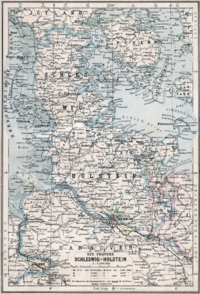
Peace of Prague (1866)
The Peace of Prague was a peace treaty signed at Prague on 23 August 1866, which ended the Austro-Prussian War. The treaty was lenient toward the Austrian Empire because Otto von Bismarck had persuaded William I that maintaining Austria's place in Europe would be better in the future for Prussia...
(August 23, 1866). Under Article XIX of the former treaty the Danish subjects domiciled in the ceded territories had the right, within six years of the exchange of ratifications, of opting for the Danish nationality and transferring themselves, their families and their personal property to Denmark, while keeping their landed property in the duchies. The last paragraph of the Article ran:
- "Le droit d'indigénat, tant dans le royaume de Danemark que dans les Duchés, est conservé à tous les individus qui le possèdent a l'époque de l'échange des ratifications du présent Traité".
By Article V of the Peace of Prague, Schleswig was ceded by Austria to Prussia with the reservation that the populations of the North of Schleswig shall be again united with Denmark in the event of their expressing a desire so to be by a vote freely exercised. Taking advantage of the terms of these treaties, about 50,000 Danes from North Schleswig (out of a total population of some 150,000) opted for Denmark and were expelled across the frontier, pending the plebiscite which was to restore their country to them. The plebiscite never came. Its inclusion in the treaty had been no more than a diplomatic device to save the face of the emperor Napoleon III; Prussia had from the first no intention of surrendering an inch of the territory that had been had conquered; the outcome of the Franco-German War made it unnecessary to pretend that the plebiscite might occur; and by the Treaty of Vienna
Treaty of Vienna
There were several treaties of Vienna:* Treaty of Vienna * Treaty of Vienna Austro-Polish alliance in the Second Northern War, ineffective...
of October 11, 1878, the clause relating to the plebiscite was formally abrogated with the assent of Austria.
Meanwhile the Danish optants, disappointed of their hopes, had begun to stream back over the frontier into Schleswig. By doing so they lost, under the Danish law, their rights as Danish citizens, without acquiring those of Prussian subjects; and this disability was transmitted to their children. By Article XIX of the Treaty of 1864, indeed, they should have been secured the rights of indigenacy, which, while falling short of complete citizenship, implied, according to Danish law, all the essential guarantees for civil liberty. But in German law the right of Indigenat is not clearly differentiated from the status of a subject; and the supreme court at Kiel decided in several cases that those who had opted for Danish nationality had forfeited their rights under the Indigenat paragraph of the Treaty of Vienna.
Thus, in the frontier districts, a large and increasing class of people dwelt in a sort of political limbo, having lost their Danish citizenship through ceasing to be domiciled in Denmark, and unable to acquire Prussian citizenship because they had failed to apply for it within the six years stipulated in the Treaty of 1864. Their exclusion from the rights of Prussian subjects was due, however, to causes other than the letter of the treaty.
The Danes, in spite of every discouragement, never ceased to strive for the preservation and extension of their national traditions and language; the Germans were equally bent on effectually absorbing these recalcitrant Teutons into the general life of the German empire; and to this end the uncertain status of the Danish optants was a useful means. Danish agitators of German nationality could not be touched so long as they were careful to keep within the limits of the law; pro-Danish newspapers owned and staffed by German subjects enjoyed immunity in accordance with the constitution, which guarantees the liberty of the press.
The case of the optants was far different. These unfortunates, who numbered a large proportion of the population, were subject to domiciliary visits, and to arbitrary perquisitions, arrest and expulsion. When the pro-Danish newspapers, after the expulsion of several optant editors, were careful to appoint none but German subjects, the vengeance of the authorities fell upon optant type-setters, printers and printers devils. The Prussian police, indeed, developed an almost superhuman- capacity for detecting optants: and since these pariahs were mingled indistinguishably with the mass of the people, no household and no business was safe from official inquisition.
One instance, out of man,y may serve to illustrate the type of offence that served as excuse for this systematic official persecution. On April 27, 1896 the second volume for 1895 of the Sønderjyske Aarboger was confiscated for having used the historic term Sonderjylland (South Jutland) for Schleswig. To add to the misery, the Danish government refused to allow the Danish optants expelled by Prussia to settle in Denmark, though this rule was modified by the Danish Nationality Law of 1898 in favour of the children of optants born after the passing of the law. It was not till the signature of the treaty between Prussia and Denmark on January 11, 1907 that these intolerable Treaty of Conditions was ended.
By this treaty, the German January government undertook to allow all children born of Danish optants before the passing of the new Danish Nationality Law of 1898 to acquire Prussian nationality on the usual conditions and on their own application. This provision was not to affect the ordinary legal rights of expulsion as exercised by either power, but the Danish government undertook not to refuse to the children of Schleswig optants who should not seek to acquire or who could not legally acquire Prussian nationality permission to reside in Denmark. The provisions of the treaty apply not only to the children of Schleswig optants, but to their direct descendants in all decrees.
This adjustment, brought about by the friendly intercourse between the courts of Berlin and Copenhagen, seemed to close the last phase of the Schleswig question. Yet, so far from allaying, it apparently only served to embitter the inter-racial feud. The autochthonous Germans of the Northern Marches regarded the new treaty as a betrayal, and refused to give the kiss of peace to their hereditary enemies. For forty years Germanism, backed by all the weight of the empire and imposed with all the weapons of official persecution, had barely held its own in North Schleswig; despite an enormous emigration, in 1905 139,000 of the 148,000 inhabitants of North Schleswig spoke Danish, while of the German-speaking immigrants it was found that more than a third spoke Danish in the first generation, although from 1864 onward, German had gradually been substituted for Danish in the churches, the schools, and even in the playground.
After 1888, German was the only language of instruction in schools in Schleswig. But the scattered outposts of Germanism could hardly be expected to acquiesce without a struggle in a situation that threatened them with social and economic extinction. Forty years of dominance, secured by official favour, had filled them with a double measure of aggressive pride of race, and the question of the rival nationalities in Schleswig, like that in Poland, remained a source of trouble and weakness within the frontiers of the German empire.
After World War I
After Germany had lost World War IWorld War I
World War I , which was predominantly called the World War or the Great War from its occurrence until 1939, and the First World War or World War I thereafter, was a major war centred in Europe that began on 28 July 1914 and lasted until 11 November 1918...
, in which Denmark had been neutral, the victors offered Denmark to redraw the border between Denmark and Germany. The sitting government of Carl Theodor Zahle
Carl Theodor Zahle
Carl Theodor Zahle , Danish lawyer and politician; prime minister of Denmark 1909-1910, 1913-1920. In 1895 he was elected member of the lower chamber of the Danish parliament, Folketinget, for Venstrereformpartiet...
chose to hold the Schleswig Plebiscite to let the inhabitants of Schleswig decide which nation they, and the land they lived on, should belong to. King Christian X of Denmark
Christian X of Denmark
Christian X was King of Denmark from 1912 to 1947 and the only King of Iceland between 1918 and 1944....
, supported by various groups, was opposed to the division. Using a clause in the Danish constitution that the king appointed and dismissed the Danish cabinet, and using the justification that the he felt the Danish population was at odds with Zahle's politics, the king dismissed Zahle and asked Otto Liebe
Otto Liebe
Carl Julius Otto Liebe was Prime Minister of Denmark 30 March 1920 to 5 April 1920. His cabinet was called the Cabinet of Otto Liebe.Otto Liebe was a lawyer and the son of a conservative politician...
to form the Cabinet of Liebe to manage the country until a parliamentary election could be held and a new cabinet formed. Since Zahle's had support from a small majority in the Folketing
Folketing
The Folketing , is the national parliament of Denmark. The name literally means "People's thing"—that is, the people's governing assembly. It is located in Christiansborg Palace, on the islet of Slotsholmen in central Copenhagen....
his Social Liberal Party and the allied Social Democrats
Social Democrats (Denmark)
The Social Democrats , is a Danish political party committed to the political ideology of social democracy. It is the major coalition partner in Denmark's government since the 2011 parliamentary election, and party leader Helle Thorning-Schmidt is the current Prime Minister of Denmark...
felt that the king had effectively staged a state coup against the Danish democracy. A general strike was organized by Fagbevægelsen to put pressure on the king and his allies. As Otto Liebe was unable to organize an election, M. P. Friis replaced him after a week, and succeeded in holding the election, and as a result the Social Liberal Party lost half their electoral support and their rivals the Liberal Party (Denmark) were able to form the minority cabinet led by Niels Neergaard
Niels Neergaard
Niels Thomasius Neergaard was a Danish historian and political figure, a member of the Liberal Moderate Venstre and since 1910 of Venstre...
: the Cabinet of Neergaard II. The whole affair was called the Easter Crisis of 1920
Easter Crisis of 1920
The Easter Crisis of 1920 was a constitutional crisis and a significant event in the development of constitutional monarchy in Denmark. It began with the dismissal of the elected government by the reigning monarch, King Christian X, a reserve power which was granted to him by the Danish constitution...
.
The Allied powers arranged a referendum in Northern and Central Schleswig. In Northern Schleswig on February 10, 1920 75% voted for re-unification with Denmark and 25% voted for Germany. In Central Schleswig on March 14, 1920 the results were reversed; 80% voted for Germany and just 20% for Denmark, primarily in Flensburg. While in Northern Schleswig some smaller regions (for example Tønder
Tønder
Tønder is a municipality in Region of Southern Denmark on the Jutland peninsula in south Denmark. The municipality covers an area of 1,278 km², and has a total population of 40,367...
) had a clear majority of voters for Germany in Central Schleswig all regions voted for Germany (see Schleswig Plebiscites
Schleswig Plebiscites
The Schleswig Plebiscites were two plebiscites, organized according to section XII, articles 109 to 114 of the Treaty of Versailles of June 28, 1919, in order to determine the future border between Denmark and Germany through the former duchy of Schleswig...
). No vote ever took place in the southern third of Schleswig, because the result for Germany was predictable. On June 15, 1920, Northern Schleswig officially returned to Danish rule. Germany continued to hold the whole of Holstein and southern and central Schleswig, later becoming the Prussian province of Schleswig-Holstein. The Danish-German border was the only one of the borders imposed on Germany following World War I which was never challenged by Hitler.
World War II
In the Second World War, after Nazi GermanyNazi Germany
Nazi Germany , also known as the Third Reich , but officially called German Reich from 1933 to 1943 and Greater German Reich from 26 June 1943 onward, is the name commonly used to refer to the state of Germany from 1933 to 1945, when it was a totalitarian dictatorship ruled by...
occupied the whole of Denmark, there was agitation by local Nazi leaders in Schleswig-Holstein to restore the pre-World War I border and re-annex to Germany the areas granted to Denmark after the plebiscite — as the Nazis did in Alsace-Lorraine
Alsace-Lorraine
The Imperial Territory of Alsace-Lorraine was a territory created by the German Empire in 1871 after it annexed most of Alsace and the Moselle region of Lorraine following its victory in the Franco-Prussian War. The Alsatian part lay in the Rhine Valley on the west bank of the Rhine River and east...
at the same period. However, Hitler vetoed any such step, out of a general Nazi policy at the time to base the occupation of Denmark on a kind of accommodation with the Danish Government, and avoid outright confrontations with the Danes.
After World War II
After Germany had lost World War IIWorld War II
World War II, or the Second World War , was a global conflict lasting from 1939 to 1945, involving most of the world's nations—including all of the great powers—eventually forming two opposing military alliances: the Allies and the Axis...
there again was a possibility that Denmark could reacquire some of its lost territory in Schleswig. Though no territorial changes came of it, it had the effect that Prime Minister Knud Kristensen
Knud Kristensen
Knud Kristensen was Prime Minister of Denmark 7 November 1945 to 13 November 1947 in the first elected government after the German occupation of Denmark during World War II. After the October 1945 election Knud Kristensen formed the Cabinet of Knud Kristensen, a minority government consisting...
was forced to resign after a vote of no confidence because the Folketing did not support his enthusiasm for incorporating Southern Schleswig into Denmark.
Although there was, as a result, a Danish minority in Southern Schleswig and a German minority in Northern Schleswig, the minorities were granted rights to practice their language and culture, to such a degree that the division and minorities are not a political issue between Denmark and Germany.
Because of the Expulsion of Germans after World War II
Expulsion of Germans after World War II
The later stages of World War II, and the period after the end of that war, saw the forced migration of millions of German nationals and ethnic Germans from various European states and territories, mostly into the areas which would become post-war Germany and post-war Austria...
the population of Schleswig-Holstein increased 33 percent (860,000 people).
See also
- Danish exonyms for places in Germany
- David BlackbournDavid BlackbournDavid Gordon Blackbourn is the Coolidge Professor of History at Harvard University and director of the university's Minda de Gunzberg Center for European Studies. Blackbourn teaches and researches primarily in the fields of German and modern European history...
, History of Germany, 1780-1918 - German exonyms for places in DenmarkGerman exonyms for places in DenmarkBelow is list of German language exonyms for places in Denmark :*København Kopenhagen*Hejls Heils*Mandø Mandö*Ribe Ripen-Sønderjylland:-See also:*German exonyms*List of European exonyms...
- List of rulers of Schleswig-Holstein
Further reading
- Carr, Carr. Schleswig-Holstein, 1815–1848: A Study in National Conflict (Manchester University Press, 1963).
- Price, Arnold. "Schleswig-Holstein" in Encyclopedia of 1848 Revolutions (2005) online
- Steefel, Lawrence D. The Schleswig-Holstein Question. 1863-1864 (Harvard U.P. 1923).