

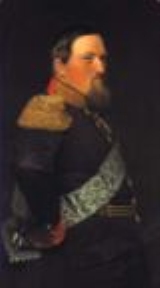
Frederick VII of Denmark

Encyclopedia
Frederick VII (Frederik Carl Christian) (6 October 1808 – 15 November 1863) was a King of Denmark. He reigned from 1848 until his death. He was the last Danish monarch of the older Royal branch of the House of Oldenburg
and also the last king
of Denmark
to rule as an absolute monarch. During his reign, he signed a constitution
that established a Danish parliament and made the country a constitutional monarchy
.
Frederick VII managed to make himself one of the most beloved Danish kings of recent times. This was probably due partially to his relinquishment of absolutism
and partially to his personality. In spite of many weaknesses documented by his contemporaries — drinking, eccentric behavior, etc. — he also possessed something of a gift as an actor. He could be both folksy and genuinely hearty, able to appear as a ”simple, yet dignified monarch”. During his many travels throughout Denmark, he cultivated contacts with ordinary subjects. He was also a keen antiquarian and according to the later Danish archaeologist
P.V. Glob, it was "he, more than anyone else, [who] helped to arouse the wide interest in Danish antiquities".
Christian's motto
was, The people's love, my strength.
to Christian VIII of Denmark
and Duchess Charlotte Frederica of Mecklenburg-Schwerin
. His maternal grandparents were Friedrich Franz I, Grand Duke of Mecklenburg-Schwerin
, and Luise, Duchess of Saxe-Gotha
.
on 1 November 1828 to his second cousin Princess Vilhelmine Marie of Denmark
, a daughter of King Frederick VI of Denmark
. They separated in 1834 and divorced in 1837. On 10 June 1841 he married for a second time to Caroline Charlotte Mariane of Mecklenburg-Strelitz, whom he divorced in 1846.
On 7 August 1850 in Frederiksborg Palace
, he morganatically married Lovisa Christina Rasmussen
, whom he created Landgravine Danner in 1850 (in Denmark known as Countess Danner), a common milliner and former ballet dancer who had for many years been his acquaintance or mistress
, the natural daughter of G. L. Köppen and of Juliane Caroline Rasmussen. This marriage seems to have been happy, although it aroused great moral indignation among the nobility and the bourgeoisie
. Countess Danner, who was denounced as a vulgar gold-digger by her enemies, but a doughty and unaffected “daughter of the people” by her admirers, seems to have had a stabilizing effect on him. She also worked at maintaining his popularity by letting him “meet the people” of the provinces.
, the succession question was already being brought forward. (See below: Succession crisis)
It has recently been claimed that the king did indeed father a son, Frederik Carl Christian Poulsen, born on 21 November 1843, as a result of his relationship with Else Maria Guldborg Pedersen (also referred to as Marie Poulsen), which took place after his first two unhappy marriages. This was brought forward in a book published in 1994 and again in a book published in 2009. According to an article in Politiken, the author of the latter book, who believes herself to be the great-granddaughter of Frederick VII, is in possession of four letters from the King to Marie Poulsen in which he acknowledged paternity. The letters are quoted in the book. In all cases, however, extramarital offspring were and still are barred from the line of succession
.
It has been claimed Frederick had a same-sex relationship with his friend, Carl Berling, printer
and owner of the newspaper
Berlingske Tidende
. The bisexual Berling had an illegitimate child with Louise Rasmussen, Carl Christian, who was much liked by the King, to the extent that he insisted on signing the new constitution on Carl Christian's 8th birthday on 5 June 1849. To retain a tinge of decency, the King married Louise Rasmussen and the trio then moved into the royal castle where Berling was appointed Chamberlain
and remained until 1861. The public indignation within higher circles over Frederick's morganatic marriage is well-known, but reasons have rarely been explained in detail.
dynasty, had a rather neglected childhood after the divorce of his parents. His youth was marked by private scandals and for many years he appeared as the ”problem child” of the royal family.
When he succeeded to the throne in January 1848, he was almost at once met by the demands for a constitution. The Schleswig-Holsteiners wanted an independent state while the Danes wished to maintain South Jutland as a Danish area. The king soon yielded to the Danish demands, and in March he accepted the end of absolutism
, which resulted in the June Constitution of 1849. During the First War of Schleswig
against the German powers in 1848–51, Frederick appeared as ”the national leader” and was regarded almost as a war hero, despite having never taken any active part in the struggles.
During his reign, Frederick on the whole behaved as a constitutional monarch. He did not, however, quite give up interfering in politics. In 1854, he contributed to the fall of the strongly conservative Ørsted
cabinet, and in 1859–60, he accepted a liberal government appointed on the initiative of his wife. During the crisis in the Duchies in 1862–63, shortly before his death, he spoke openly for an inter-Scandinavian military co-operation. Those minor crises created frictions and maintained some permanent insecurity, but did not damage his general popularity. In some of these affairs, he overstepped the mark beyond any doubt; on the other hand, the first Danish constitution was somewhat vague as regards to the limits of royal power.
The Frederick's rule also witnessed the heyday of the National Liberal Party
, which was in office from 1854. This period was marked by some political and economic reforms, such as the beginning of the demolition of the walls around Copenhagen and, in 1857, the introduction of free trade
. The constant quarrels with the opposition regarding the Schleswig-Holstein Question
and German demands to try not to unite Denmark with Schleswig (South Jutland) led to some changes to the constitution in order to fit the foreign political situation, which created frustration in Denmark. The National Liberals therefore at last favored a more resistant course against the Germans, which led to the Second War of Schleswig
in 1864. The king wholeheartedly supported this course and just before his sudden death he was prepared to sign a new special constitution for Denmark and Schleswig (the so-called November Constitution).
In 1848, Frederick VII was created the 978th Knight
of the Order of the Golden Fleece
in Spain
.
, was chosen as his heir-presumptive in 1852. When Frederick died in 1863, Christian took the throne as Christian IX
.
Because of Salic law
, the succession after childless Frederick was a difficult question to arrange. It did not go smoothly, but caused a war. Nationalism in the German-speaking parts of Schleswig-Holstein
meant that no solution to keep the Duchies united with Denmark was satisfactory. The duchies
were inherited according to the Salic law among descendants of Helwig of Schauenburg
, the senior of which after Frederick himself was Frederick, Duke of Augustenburg (who proclaimed himself Duke of Schleswig-Holstein after Frederick VII's death). This Frederick of Augustenburg had become the symbol of the nationalist
German independence movement in Schleswig-Holstein
since the time that his father, in exchange for money, had renounced his claims as first in line to inherit the twin Duchies of Schleswig
and Holstein
following the London Protocol
of 8 May 1852, which concluded the First War of Schleswig
. Because of his father's renunciation, Frederick was regarded as ineligible to succeed.
Denmark was also under Salic Law, but only among descendants of Frederick III
(who was the first hereditary monarch
of Denmark, since before him the kingdom had been officially elective). Therefore, the members of the Schleswig-Holstein branches of Augustenborg and Glücksburg, agnates with the King, were not allowed to succeed under that provision. Agnatic descendance of Frederick III became extinct when Frederick VII died, and at that point, the succession law promulgated by Frederick III provided a "semi-Salic" succession. There were, however, several alternative ways to interpret the line of succession, because the provision was not entirely clear on whether it be the closest female relative or what to inherit. The question was solved by an election and a separate law to confirm the new successor.
The closest female relatives of Frederick VII were the issue of his paternal aunt, Princess Louise Charlotte of Denmark
, who had married a cadet Landgrave of Hesse
. However, they were not agnatic descendants of the royal family and thus were not eligible to succeed in Schleswig-Holstein. The dynastic female heiresses according to the original primogeniture
from Frederick III were the childless daughters of the late king Frederick VI, after whom the original primogeniture would have led to heirs of Louise Augusta of Denmark, sister of Frederick VI, who had married the then-Duke of Augustenburg. The chief heir to that line was the self-same Frederick of Augustenburg, but his turn would have come only after the death of a childless Princess who was very much alive in 1863.
Some rights also belonged to the Glücksburg line, a more junior branch of the royal clan. They were also heirs of Frederick III through an ancestress who was a daughter of King Frederick V of Denmark
, and they were more junior agnatic heirs eligible to succeed in Schleswig-Holstein. They were Christian of Glücksburg (1818–1906) and his two elder brothers, eldest of whom was childless, but the second had produced children, also male children.
Prince Christian of Glücksburg (1818–1906) had been a foster "grandson" of the sonless royal couple Frederick VI
and Queen Marie Sophie
, thus familiar with the royal court and the traditions of the recent monarchs. Prince Christian was great-nephew of Queen Marie Sophie and a descendant of a first cousin of Frederick VI. He was brought up as Danish, having lived in Danish-speaking lands of the royal dynasty, and was not attached to German nationalism. Although these did not mean anything legally, they made him a relatively good candidate from the Danish viewpoint. As a junior agnatic descendant, he was eligible to inherit Schleswig-Holstein, but ne was not first-in-line. As a descendant of Frederick III, he was eligible to succeed in Denmark, but not first-in-line, however that line was not very clear.
Christian of Glücksburg married Princess ouise of Hesse-Kassel, eldest daughter of the closest female relative of Frederick VII. Louise's mother and brothers, Princes of Hesse, renounced their rights in favor of Louise and her husband. Prince Christian's wife was now the closest female heiress of Frederick VII.
The thorny question of the application of semi-Salic provision in the succession of Denmark was at that point resolved by legislation through which Prince Christian of Glücksburg was chosen in 1852 to succeed King Frederick VII in Denmark.
Frederick VII died in Glücksburg
in 1863 and was interred in Roskilde Cathedral
. Christian took the throne as Christian IX
.
In November 1863, Frederick of Augustenborg claimed the twin-duchies in succession
after King Frederick VII of Denmark, who also was the Duke
of Schleswig and Holstein and who had died without a male heir.
Prussia and Austria started the Second War of Schleswig
.
House of Oldenburg
The House of Oldenburg is a North German dynasty and one of Europe's most influential Royal Houses with branches that rule or have ruled in Denmark, Russia, Greece, Norway, Schleswig, Holstein, Oldenburg and Sweden...
and also the last king
Monarch
A monarch is the person who heads a monarchy. This is a form of government in which a state or polity is ruled or controlled by an individual who typically inherits the throne by birth and occasionally rules for life or until abdication...
of Denmark
Denmark
Denmark is a Scandinavian country in Northern Europe. The countries of Denmark and Greenland, as well as the Faroe Islands, constitute the Kingdom of Denmark . It is the southernmost of the Nordic countries, southwest of Sweden and south of Norway, and bordered to the south by Germany. Denmark...
to rule as an absolute monarch. During his reign, he signed a constitution
Constitution of Denmark
The Constitutional Act of Denmark is the Kingdom of Denmark's constitution, or fundamental law. Originally verified in 1849, the last revision was signed on 5 June 1953 as "the existing law, for all to unswerving comply with, the Constitutional Act of Denmark".-Idea and structure:The main...
that established a Danish parliament and made the country a constitutional monarchy
Constitutional monarchy
Constitutional monarchy is a form of government in which a monarch acts as head of state within the parameters of a constitution, whether it be a written, uncodified or blended constitution...
.
Frederick VII managed to make himself one of the most beloved Danish kings of recent times. This was probably due partially to his relinquishment of absolutism
Absolute monarchy
Absolute monarchy is a monarchical form of government in which the monarch exercises ultimate governing authority as head of state and head of government, his or her power not being limited by a constitution or by the law. An absolute monarch thus wields unrestricted political power over the...
and partially to his personality. In spite of many weaknesses documented by his contemporaries — drinking, eccentric behavior, etc. — he also possessed something of a gift as an actor. He could be both folksy and genuinely hearty, able to appear as a ”simple, yet dignified monarch”. During his many travels throughout Denmark, he cultivated contacts with ordinary subjects. He was also a keen antiquarian and according to the later Danish archaeologist
Archaeology
Archaeology, or archeology , is the study of human society, primarily through the recovery and analysis of the material culture and environmental data that they have left behind, which includes artifacts, architecture, biofacts and cultural landscapes...
P.V. Glob, it was "he, more than anyone else, [who] helped to arouse the wide interest in Danish antiquities".
Christian's motto
Royal mottos of Danish monarchs
The use of a royal motto is an old tradition among Danish monarchs, dating back at least 500 years. The use of such a motto was a way for a monarch to emphasize values or beliefs he / she held dear...
was, The people's love, my strength.
Family
Frederick was born at Amalienborg PalaceAmalienborg Palace
Amalienborg Palace is the winter home of the Danish royal family, and is located in Copenhagen, Denmark. It consists of four identical classicizing palace façades with rococo interiors around an octagonal courtyard ; in the centre of the square is a monumental equestrian statue of Amalienborg's...
to Christian VIII of Denmark
Christian VIII of Denmark
Christian VIII , was king of Denmark from 1839 to 1848 and, as Christian Frederick, king of Norway in 1814. He was the eldest son of Hereditary Prince Frederick of Denmark and Norway and Sophia Frederica of Mecklenburg-Schwerin, born in 1786 at Christiansborg Palace in Copenhagen...
and Duchess Charlotte Frederica of Mecklenburg-Schwerin
Duchess Charlotte Frederica of Mecklenburg-Schwerin
Charlotte Frederica of Mecklenburg-Schwerin , was the first wife of King Christian VIII from 1806 until 1810, before he became King of Denmark. She was a daughter of Frederick Francis I, Grand Duke of Mecklenburg-Schwerin, and Princess Louise of Saxe-Gotha-Altenburg.-Marriage:Charlotte Frederica...
. His maternal grandparents were Friedrich Franz I, Grand Duke of Mecklenburg-Schwerin
Friedrich Franz I, Grand Duke of Mecklenburg-Schwerin
Frederick Francis I, Grand Duke of Mecklenburg [-Schwerin] ruled over the German state of Mecklenburg-Schwerin, first as Duke and then as Grand Duke .-Biography:...
, and Luise, Duchess of Saxe-Gotha
Saxe-Gotha
Saxe-Gotha was one of the Saxon duchies held by the Ernestine of the Wettin dynasty in the former Landgraviate of Thuringia. The ducal residence was erected at Gotha....
.
Marriages
The king's first two marriages both ended in scandal and divorce. He was first married in CopenhagenCopenhagen
Copenhagen is the capital and largest city of Denmark, with an urban population of 1,199,224 and a metropolitan population of 1,930,260 . With the completion of the transnational Øresund Bridge in 2000, Copenhagen has become the centre of the increasingly integrating Øresund Region...
on 1 November 1828 to his second cousin Princess Vilhelmine Marie of Denmark
Princess Vilhelmine Marie of Denmark
Princess Vilhelmine Marie of Denmark and Norway was the youngest daughter of Frederick VI of Denmark and his wife and first cousin Marie Sophie of Hesse-Kassel...
, a daughter of King Frederick VI of Denmark
Frederick VI of Denmark
Frederick VI reigned as King of Denmark , and as king of Norway .-Regent of Denmark:Frederick's parents were King Christian VII and Caroline Matilda of Wales...
. They separated in 1834 and divorced in 1837. On 10 June 1841 he married for a second time to Caroline Charlotte Mariane of Mecklenburg-Strelitz, whom he divorced in 1846.
On 7 August 1850 in Frederiksborg Palace
Frederiksborg Palace
Frederiksborg castle is a castle in Hillerød, Denmark. It was built as a royal residence for King Christian IV, and is now known as The Museum of National History. The current building replaced a previous castle erected by Frederick II, and is the largest Renaissance palace in Scandinavia...
, he morganatically married Lovisa Christina Rasmussen
Louise Rasmussen
Louise Christine Rasmussen, also known as Countess Danner , was a Danish Ballet dancer and stage actor. She was the mistress and later the morganatic spouse of King Frederick VII of Denmark...
, whom he created Landgravine Danner in 1850 (in Denmark known as Countess Danner), a common milliner and former ballet dancer who had for many years been his acquaintance or mistress
Mistress (lover)
A mistress is a long-term female lover and companion who is not married to her partner; the term is used especially when her partner is married. The relationship generally is stable and at least semi-permanent; however, the couple does not live together openly. Also the relationship is usually,...
, the natural daughter of G. L. Köppen and of Juliane Caroline Rasmussen. This marriage seems to have been happy, although it aroused great moral indignation among the nobility and the bourgeoisie
Bourgeoisie
In sociology and political science, bourgeoisie describes a range of groups across history. In the Western world, between the late 18th century and the present day, the bourgeoisie is a social class "characterized by their ownership of capital and their related culture." A member of the...
. Countess Danner, who was denounced as a vulgar gold-digger by her enemies, but a doughty and unaffected “daughter of the people” by her admirers, seems to have had a stabilizing effect on him. She also worked at maintaining his popularity by letting him “meet the people” of the provinces.
Extramarital relations and possible offspring
The expectation that Frederick would not likely produce offspring, despite numerous affairs, was widespread, but sources rarely state the reasons. Some speculate that Frederick was infertile. During the reign of Frederick's father, King Christian VIIIChristian VIII of Denmark
Christian VIII , was king of Denmark from 1839 to 1848 and, as Christian Frederick, king of Norway in 1814. He was the eldest son of Hereditary Prince Frederick of Denmark and Norway and Sophia Frederica of Mecklenburg-Schwerin, born in 1786 at Christiansborg Palace in Copenhagen...
, the succession question was already being brought forward. (See below: Succession crisis)
It has recently been claimed that the king did indeed father a son, Frederik Carl Christian Poulsen, born on 21 November 1843, as a result of his relationship with Else Maria Guldborg Pedersen (also referred to as Marie Poulsen), which took place after his first two unhappy marriages. This was brought forward in a book published in 1994 and again in a book published in 2009. According to an article in Politiken, the author of the latter book, who believes herself to be the great-granddaughter of Frederick VII, is in possession of four letters from the King to Marie Poulsen in which he acknowledged paternity. The letters are quoted in the book. In all cases, however, extramarital offspring were and still are barred from the line of succession
Line of succession to the Danish Throne
Denmark used a system of male-preference primogeniture until 2009. The male preference cognatic primogeniture was changed in favour of an absolute primogeniture...
.
It has been claimed Frederick had a same-sex relationship with his friend, Carl Berling, printer
Printer (publisher)
In publishing, printers are both companies providing printing services and individuals who directly operate printing presses. With the invention of the moveable type printing press by Johannes Gutenberg around 1450, printing—and printers—proliferated throughout Europe.Today, printers are found...
and owner of the newspaper
Newspaper
A newspaper is a scheduled publication containing news of current events, informative articles, diverse features and advertising. It usually is printed on relatively inexpensive, low-grade paper such as newsprint. By 2007, there were 6580 daily newspapers in the world selling 395 million copies a...
Berlingske Tidende
Berlingske Tidende
Berlingske, previously known as Berlingske Tidende , is a Danish national daily newspaper based in Copenhagen...
. The bisexual Berling had an illegitimate child with Louise Rasmussen, Carl Christian, who was much liked by the King, to the extent that he insisted on signing the new constitution on Carl Christian's 8th birthday on 5 June 1849. To retain a tinge of decency, the King married Louise Rasmussen and the trio then moved into the royal castle where Berling was appointed Chamberlain
Chamberlain (office)
A chamberlain is an officer in charge of managing a household. In many countries there are ceremonial posts associated with the household of the sovereign....
and remained until 1861. The public indignation within higher circles over Frederick's morganatic marriage is well-known, but reasons have rarely been explained in detail.
Reign
Frederick, who was the last king of the older branch of the OldenburgHouse of Oldenburg
The House of Oldenburg is a North German dynasty and one of Europe's most influential Royal Houses with branches that rule or have ruled in Denmark, Russia, Greece, Norway, Schleswig, Holstein, Oldenburg and Sweden...
dynasty, had a rather neglected childhood after the divorce of his parents. His youth was marked by private scandals and for many years he appeared as the ”problem child” of the royal family.
When he succeeded to the throne in January 1848, he was almost at once met by the demands for a constitution. The Schleswig-Holsteiners wanted an independent state while the Danes wished to maintain South Jutland as a Danish area. The king soon yielded to the Danish demands, and in March he accepted the end of absolutism
Absolute monarchy
Absolute monarchy is a monarchical form of government in which the monarch exercises ultimate governing authority as head of state and head of government, his or her power not being limited by a constitution or by the law. An absolute monarch thus wields unrestricted political power over the...
, which resulted in the June Constitution of 1849. During the First War of Schleswig
First War of Schleswig
The First Schleswig War or Three Years' War was the first round of military conflict in southern Denmark and northern Germany rooted in the Schleswig-Holstein Question, contesting the issue of who should control the Duchies of Schleswig and Holstein. The war, which lasted from 1848–1851,...
against the German powers in 1848–51, Frederick appeared as ”the national leader” and was regarded almost as a war hero, despite having never taken any active part in the struggles.
During his reign, Frederick on the whole behaved as a constitutional monarch. He did not, however, quite give up interfering in politics. In 1854, he contributed to the fall of the strongly conservative Ørsted
Anders Sandøe Ørsted
Anders Sandøe Ørsted was a Danish politician and jurist. He served as the Prime Minister of Denmark in 1853-1854 as leader of the Cabinet of Ørsted....
cabinet, and in 1859–60, he accepted a liberal government appointed on the initiative of his wife. During the crisis in the Duchies in 1862–63, shortly before his death, he spoke openly for an inter-Scandinavian military co-operation. Those minor crises created frictions and maintained some permanent insecurity, but did not damage his general popularity. In some of these affairs, he overstepped the mark beyond any doubt; on the other hand, the first Danish constitution was somewhat vague as regards to the limits of royal power.
The Frederick's rule also witnessed the heyday of the National Liberal Party
National Liberal Party (Denmark)
The National Liberal Party , was a Danish political party or political movement from the 1830s until about 1880.Often considered "the first Danish political party" the National Liberals were gradually founded as the opposition against the Danish absolute monarchy...
, which was in office from 1854. This period was marked by some political and economic reforms, such as the beginning of the demolition of the walls around Copenhagen and, in 1857, the introduction of free trade
Free trade
Under a free trade policy, prices emerge from supply and demand, and are the sole determinant of resource allocation. 'Free' trade differs from other forms of trade policy where the allocation of goods and services among trading countries are determined by price strategies that may differ from...
. The constant quarrels with the opposition regarding the Schleswig-Holstein Question
Schleswig-Holstein Question
The Schleswig-Holstein Question was a complex of diplomatic and other issues arising in the 19th century from the relations of two duchies, Schleswig and Holstein , to the Danish crown and to the German Confederation....
and German demands to try not to unite Denmark with Schleswig (South Jutland) led to some changes to the constitution in order to fit the foreign political situation, which created frustration in Denmark. The National Liberals therefore at last favored a more resistant course against the Germans, which led to the Second War of Schleswig
Second War of Schleswig
The Second Schleswig War was the second military conflict as a result of the Schleswig-Holstein Question. It began on 1 February 1864, when Prussian forces crossed the border into Schleswig.Denmark fought Prussia and Austria...
in 1864. The king wholeheartedly supported this course and just before his sudden death he was prepared to sign a new special constitution for Denmark and Schleswig (the so-called November Constitution).
In 1848, Frederick VII was created the 978th Knight
Knight
A knight was a member of a class of lower nobility in the High Middle Ages.By the Late Middle Ages, the rank had become associated with the ideals of chivalry, a code of conduct for the perfect courtly Christian warrior....
of the Order of the Golden Fleece
Order of the Golden Fleece
The Order of the Golden Fleece is an order of chivalry founded in Bruges by Philip III, Duke of Burgundy in 1430, to celebrate his marriage to the Portuguese princess Infanta Isabella of Portugal, daughter of King John I of Portugal. It evolved as one of the most prestigious orders in Europe...
in Spain
Spain
Spain , officially the Kingdom of Spain languages]] under the European Charter for Regional or Minority Languages. In each of these, Spain's official name is as follows:;;;;;;), is a country and member state of the European Union located in southwestern Europe on the Iberian Peninsula...
.
Succession crisis
Frederick was married three times, but produced no legitimate issue. The fact that he reached middle age without producing an heir meant that Prince Christian of Glücksburg (1818–1906), the descendant of a cousin of King Frederick VIFrederick VI of Denmark
Frederick VI reigned as King of Denmark , and as king of Norway .-Regent of Denmark:Frederick's parents were King Christian VII and Caroline Matilda of Wales...
, was chosen as his heir-presumptive in 1852. When Frederick died in 1863, Christian took the throne as Christian IX
Christian IX of Denmark
Christian IX was King of Denmark from 16 November 1863 to 29 January 1906.Growing up as a prince of Schleswig-Holstein-Sonderburg-Glücksburg, a junior branch of the House of Oldenburg which had ruled Denmark since 1448, Christian was originally not in the immediate line of succession to the Danish...
.
Because of Salic law
Salic law
Salic law was a body of traditional law codified for governing the Salian Franks in the early Middle Ages during the reign of King Clovis I in the 6th century...
, the succession after childless Frederick was a difficult question to arrange. It did not go smoothly, but caused a war. Nationalism in the German-speaking parts of Schleswig-Holstein
Schleswig-Holstein
Schleswig-Holstein is the northernmost of the sixteen states of Germany, comprising most of the historical duchy of Holstein and the southern part of the former Duchy of Schleswig...
meant that no solution to keep the Duchies united with Denmark was satisfactory. The duchies
Duchy
A duchy is a territory, fief, or domain ruled by a duke or duchess.Some duchies were sovereign in areas that would become unified realms only during the Modern era . In contrast, others were subordinate districts of those kingdoms that unified either partially or completely during the Medieval era...
were inherited according to the Salic law among descendants of Helwig of Schauenburg
Schaumburg
Schaumburg is a district of Lower Saxony, Germany. It is bounded by the districts of Nienburg, Hanover and Hamelin-Pyrmont, and the state of North Rhine-Westphalia .-History:...
, the senior of which after Frederick himself was Frederick, Duke of Augustenburg (who proclaimed himself Duke of Schleswig-Holstein after Frederick VII's death). This Frederick of Augustenburg had become the symbol of the nationalist
Nationalism
Nationalism is a political ideology that involves a strong identification of a group of individuals with a political entity defined in national terms, i.e. a nation. In the 'modernist' image of the nation, it is nationalism that creates national identity. There are various definitions for what...
German independence movement in Schleswig-Holstein
Schleswig-Holstein
Schleswig-Holstein is the northernmost of the sixteen states of Germany, comprising most of the historical duchy of Holstein and the southern part of the former Duchy of Schleswig...
since the time that his father, in exchange for money, had renounced his claims as first in line to inherit the twin Duchies of Schleswig
Schleswig
Schleswig or South Jutland is a region covering the area about 60 km north and 70 km south of the border between Germany and Denmark; the territory has been divided between the two countries since 1920, with Northern Schleswig in Denmark and Southern Schleswig in Germany...
and Holstein
Holstein
Holstein is the region between the rivers Elbe and Eider. It is part of Schleswig-Holstein, the northernmost state of Germany....
following the London Protocol
London Protocol
-1814:On June 21, 1814, a secret convention between the Great Powers: United Kingdom of Great Britain and Ireland, Prussia, Austria, and Russia awarded the territory of current Belgium and the Netherlands to William I of the Netherlands, then "Sovereign Prince" of the United Netherlands...
of 8 May 1852, which concluded the First War of Schleswig
First War of Schleswig
The First Schleswig War or Three Years' War was the first round of military conflict in southern Denmark and northern Germany rooted in the Schleswig-Holstein Question, contesting the issue of who should control the Duchies of Schleswig and Holstein. The war, which lasted from 1848–1851,...
. Because of his father's renunciation, Frederick was regarded as ineligible to succeed.
Denmark was also under Salic Law, but only among descendants of Frederick III
Frederick III of Denmark
Frederick III was king of Denmark and Norway from 1648 until his death. He instituted absolute monarchy in Denmark and Norway in 1660, confirmed by law in 1665 as the first in western historiography. He was born the second-eldest son of Christian IV of Denmark and Anne Catherine of Brandenburg...
(who was the first hereditary monarch
Monarch
A monarch is the person who heads a monarchy. This is a form of government in which a state or polity is ruled or controlled by an individual who typically inherits the throne by birth and occasionally rules for life or until abdication...
of Denmark, since before him the kingdom had been officially elective). Therefore, the members of the Schleswig-Holstein branches of Augustenborg and Glücksburg, agnates with the King, were not allowed to succeed under that provision. Agnatic descendance of Frederick III became extinct when Frederick VII died, and at that point, the succession law promulgated by Frederick III provided a "semi-Salic" succession. There were, however, several alternative ways to interpret the line of succession, because the provision was not entirely clear on whether it be the closest female relative or what to inherit. The question was solved by an election and a separate law to confirm the new successor.
The closest female relatives of Frederick VII were the issue of his paternal aunt, Princess Louise Charlotte of Denmark
Princess Louise Charlotte of Denmark
Princess Louise Charlotte of Denmark was a princess of Denmark.She was born in Christiansborg Palace to Hereditary Prince Frederick of Denmark and Norway and Sophia Frederica of Mecklenburg-Schwerin , Princess and Duchess of Mecklenburg-Schwerin.-Marriage:On 10 November 1810 in Amalienborg Palace...
, who had married a cadet Landgrave of Hesse
Hesse
Hesse or Hessia is both a cultural region of Germany and the name of an individual German state.* The cultural region of Hesse includes both the State of Hesse and the area known as Rhenish Hesse in the neighbouring Rhineland-Palatinate state...
. However, they were not agnatic descendants of the royal family and thus were not eligible to succeed in Schleswig-Holstein. The dynastic female heiresses according to the original primogeniture
Primogeniture
Primogeniture is the right, by law or custom, of the firstborn to inherit the entire estate, to the exclusion of younger siblings . Historically, the term implied male primogeniture, to the exclusion of females...
from Frederick III were the childless daughters of the late king Frederick VI, after whom the original primogeniture would have led to heirs of Louise Augusta of Denmark, sister of Frederick VI, who had married the then-Duke of Augustenburg. The chief heir to that line was the self-same Frederick of Augustenburg, but his turn would have come only after the death of a childless Princess who was very much alive in 1863.
Some rights also belonged to the Glücksburg line, a more junior branch of the royal clan. They were also heirs of Frederick III through an ancestress who was a daughter of King Frederick V of Denmark
Frederick V of Denmark
Frederick V was king of Denmark and Norway from 1746, son of Christian VI of Denmark and Sophia Magdalen of Brandenburg-Kulmbach.-Early life:...
, and they were more junior agnatic heirs eligible to succeed in Schleswig-Holstein. They were Christian of Glücksburg (1818–1906) and his two elder brothers, eldest of whom was childless, but the second had produced children, also male children.
Prince Christian of Glücksburg (1818–1906) had been a foster "grandson" of the sonless royal couple Frederick VI
Frederick VI of Denmark
Frederick VI reigned as King of Denmark , and as king of Norway .-Regent of Denmark:Frederick's parents were King Christian VII and Caroline Matilda of Wales...
and Queen Marie Sophie
Marie Sophie of Hesse-Kassel
thumb|Queen Marie Sophie portrayed by [[Cornelius Høyer]] Marie Sophie Frederikke of Hesse-Kassel was Queen Consort of Denmark and Norway. She also served as Regent of Denmark in 1814–1815.-Background:...
, thus familiar with the royal court and the traditions of the recent monarchs. Prince Christian was great-nephew of Queen Marie Sophie and a descendant of a first cousin of Frederick VI. He was brought up as Danish, having lived in Danish-speaking lands of the royal dynasty, and was not attached to German nationalism. Although these did not mean anything legally, they made him a relatively good candidate from the Danish viewpoint. As a junior agnatic descendant, he was eligible to inherit Schleswig-Holstein, but ne was not first-in-line. As a descendant of Frederick III, he was eligible to succeed in Denmark, but not first-in-line, however that line was not very clear.
Christian of Glücksburg married Princess ouise of Hesse-Kassel, eldest daughter of the closest female relative of Frederick VII. Louise's mother and brothers, Princes of Hesse, renounced their rights in favor of Louise and her husband. Prince Christian's wife was now the closest female heiress of Frederick VII.
The thorny question of the application of semi-Salic provision in the succession of Denmark was at that point resolved by legislation through which Prince Christian of Glücksburg was chosen in 1852 to succeed King Frederick VII in Denmark.
Frederick VII died in Glücksburg
Glücksburg
Glücksburg is a small town in the district Schleswig-Flensburg, in Schleswig-Holstein, Germany.It is situated on the south side of the Flensburg Fjord, an inlet of the Baltic Sea, approx. 10 km northeast of Flensburg...
in 1863 and was interred in Roskilde Cathedral
Roskilde Cathedral
Roskilde Cathedral , in the city of Roskilde on the island of Zealand in eastern Denmark, is a cathedral of the Lutheran Church of Denmark. The first Gothic cathedral to be built of brick, it encouraged the spread of the Brick Gothic style throughout Northern Europe...
. Christian took the throne as Christian IX
Christian IX of Denmark
Christian IX was King of Denmark from 16 November 1863 to 29 January 1906.Growing up as a prince of Schleswig-Holstein-Sonderburg-Glücksburg, a junior branch of the House of Oldenburg which had ruled Denmark since 1448, Christian was originally not in the immediate line of succession to the Danish...
.
In November 1863, Frederick of Augustenborg claimed the twin-duchies in succession
Order of succession
An order of succession is a formula or algorithm that determines who inherits an office upon the death, resignation, or removal of its current occupant.-Monarchies and nobility:...
after King Frederick VII of Denmark, who also was the Duke
Duke
A duke or duchess is a member of the nobility, historically of highest rank below the monarch, and historically controlling a duchy...
of Schleswig and Holstein and who had died without a male heir.
Prussia and Austria started the Second War of Schleswig
Second War of Schleswig
The Second Schleswig War was the second military conflict as a result of the Schleswig-Holstein Question. It began on 1 February 1864, when Prussian forces crossed the border into Schleswig.Denmark fought Prussia and Austria...
.
Ancestry
External links
- http://www.danskekonger.dk/eng/biografi/FreVII.html