
All Topics  
Paul I of Russia

 
Paul I of Russia

   Email Print
   Bookmark   Link


Paul I of Russia


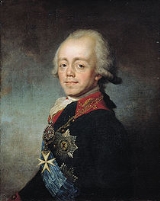
Paul (; Pavel Petrovich) ( – ) was the Emperor of Russia between 1796 and 1801.

Childhood
Paul was born in the Palace of Empress Elisabeth in St Petersburg. He was the son of Elizabeth's heir, her nephew, the Grand Duke Peter
Peter III of Russia

Peter III was Emperor of Russian Empire for six months in 1762. According to most historians, he was mentally immature and very pro-Prussian, which made him an unpopular leader....
, later Emperor Peter III, and his wife, the Grand Duchess Catherine, later Empress Catherine II
Catherine II of Russia

Catherine II, called Catherine the Great .The Russian empress Catherine II, known as Catherine the Great, reigned from 1762 to 1796. Under her direct auspices the Russian Empire expanded, improved in its administration, and underwent a dramatic policy of Westernization....
. In her memoirs, Catherine strongly implies that Paul's father was not Peter, but her lover Sergei Saltykov. Supporters of Catherine's claim assume that Peter III was sterile, and was unable to even engage in normal sexual relations with her until he had a surgical operation performed, and so could not have sired the boy himself.


Discussion
Ask a question about 'Paul I of Russia'
Start a new discussion about 'Paul I of Russia'
Answer questions from other users
Full Discussion Forum


Recent Posts


Encyclopedia


Paul (; Pavel Petrovich) ( – ) was the Emperor of Russia between 1796 and 1801.

Childhood


Paul was born in the Palace of Empress Elisabeth in St Petersburg. He was the son of Elizabeth's heir, her nephew, the Grand Duke Peter
Peter III of Russia

Peter III was Emperor of Russian Empire for six months in 1762. According to most historians, he was mentally immature and very pro-Prussian, which made him an unpopular leader....
, later Emperor Peter III, and his wife, the Grand Duchess Catherine, later Empress Catherine II
Catherine II of Russia

Catherine II, called Catherine the Great .The Russian empress Catherine II, known as Catherine the Great, reigned from 1762 to 1796. Under her direct auspices the Russian Empire expanded, improved in its administration, and underwent a dramatic policy of Westernization....
. In her memoirs, Catherine strongly implies that Paul's father was not Peter, but her lover Sergei Saltykov. Supporters of Catherine's claim assume that Peter III was sterile, and was unable to even engage in normal sexual relations with her until he had a surgical operation performed, and so could not have sired the boy himself. Although the story was much aired by Paul's enemies, it is fairly likely that this was simply an attempt to cast doubt on Paul's right to the throne, in order to prop up Catherine's own somewhat shaky claim. He physically resembled the Grand Duke so one might doubt the claims of illegitimacy.

During his infancy, Paul was taken from the care of his mother by the Empress Elizabeth
Elizabeth of Russia

Elizaveta Petrovna , also known as Yelisavet and Elizabeth, was an Empress of Russia who took the country into the War of Austrian Succession and the Seven Years' War ....
, whose ill-judged fondness allegedly injured his health. As a boy, he was reported to be intelligent and good-looking. His pugnosed facial features in later life are attributed to an attack of typhus
Typhus

Epidemic typhus is a form of typhus so named because the disease often causes epidemics following wars and natural disasters. The causative organism is Rickettsia prowazekii, transmitted by the human body louse ....
, from which he suffered in 1771. It has been asserted that his mother hated him, and was only restrained from putting him to death while he was still a boy by the fear of what the consequences of another palace crime might be to herself. Lord Buckinghamshire
John Hobart, 2nd Earl of Buckinghamshire

John Hobart, 2nd Earl of Buckinghamshire was an English nobleman and politician.The son of John Hobart, 1st Earl of Buckinghamshire by his first marriage, he was educated at Westminster School and Christ's College, Cambridge....
, the British Ambassador
Ambassador

An ambassador is the highest ranking diplomat who represents their country. They are usually accredited to a Sovereignty or government, or to an international organization, to serve as the official representative of their country....
 at her court, expressed this opinion as early as 1764. However, others suggest that the Empress, who was usually very fond of children, treated Paul with kindness. He was put in the charge of a trustworthy governor, Nikita Ivanovich Panin
Nikita Ivanovich Panin

Count Nikita Ivanovich Panin was an influential Russia statesman and political mentor to Catherine II of Russia for the first eighteen years of her reign....
, and of competent tutors.

Her dissolute court provided a bad home for a boy destined to become the sovereign, but Catherine took great trouble to arrange his first marriage with Wilhelmina Louisa (who acquired the Russian name "Natalia Alexeievna
Natalia Alexeievna of Russia

The Grand Duchess Natalia Alexeievna of Russia was the first wife of the future Tsar Paul I of Russia, the only son of the Empress Catherine II....
"), one of the daughters of Ludwig IX, Landgrave of Hesse-Darmstadt
Landgraviate of Hesse-Darmstadt

The Landgraviate of Hesse-Darmstadt was a member state of the Holy Roman Empire. It was formed in 1567 following the division of the Landgraviate of Hesse between the four sons of Philip I, Landgrave of Hesse, the last Landgrave of Hesse....
, in 1773, and allowed him to attend the Council in order that he might be trained for his work as Emperor. His tutor, Poroshin, complained of him that he was "always in a hurry," acting and speaking without reflection.

Early life


After his first wife died in childbirth, his mother arranged another marriage on October 7, 1776, with the beautiful Sophia Dorothea of Württemberg
Kingdom of Württemberg

The Kingdom of W?rttemberg was a state that existed from 1806 to 1918 and is currently located in Baden-W?rttemberg, Germany....
, given the new name Maria Feodorovna. At this time he began to be involved in intrigues. He believed he was the target of assassination. He also suspected his mother of intending to kill him, and once openly accused her of causing broken glass to be mingled with his food.

Yet, though his mother removed him from the council and began to keep him at a distance, her actions were not unkind. The use made of his name by the rebel Pugachev, who had impersonated his father Peter, tended no doubt to render Paul's position more difficult. On the birth of his first child in 1777 the Empress gave him an estate, Pavlovsk
Pavlovsk

Pavlovsk is a town situated in Russia, from and under jurisdiction of Saint Petersburg, just to the south of Tsarskoye Selo. It is located at , with a population of 14,960 ....
. Paul and his wife gained leave to travel through western Europe in 1781-1782. In 1783 the Empress granted him another estate at Gatchina
Gatchina

Gatchina is a types of inhabited localities in Russia in Leningrad Oblast, Russia, located 45 km south of Saint Petersburg by the road leading to Pskov....
, where he was allowed to maintain a brigade of soldiers whom he drilled on the Prussian model.

Ascension to the throne


Pawlowsk Palast 2005 B
Paul became emperor after Catherine suffered a stroke
Stroke

A stroke is the rapidly developing loss of brain function due to a disturbance in the blood supply to the brain. According to the National Stroke Association, a "stroke" occurs when a blood clot blocks and artery or a blood vessel breaks, interrupting blood flow to an area of the brain....
 on November 5 1796, and died in bed without having regained consciousness. His first action was to inquire about and, if possible, to destroy her testament, as it was rumoured that she had expressed wishes to exclude Paul from succession and to leave the throne to Alexander, her eldest grandson. These fears probably contributed to Paul's promulgation of the famous Pauline Laws, which established the strict principle of primogeniture
Primogeniture

Primogeniture is the common law right of the firstborn son to inherit the entire Estate , to the exclusion of younger siblings. It is the tradition brought by the Normans to England in 1066....
 in the House of Romanov
Romanov

The House of Romanov was the second and last monarchy dynasty of Russia, which ruled the country from 1613 to 1917. From 1762 until the February Revolution of 1917, the Russian Empire was ruled for five generations by a line of the House of Oldenburg descended from the marriage of a Romanov grand duchess to the Duke of Holstein-Gottorp....
 and were not to be modified by his successors.

During the first year of his reign, Paul emphatically reversed many of the policies of his mother. Although he accused many of Jacobinism
Jacobin (politics)

In the context of the French Revolution, a Jacobin originally meant a member of the Jacobin Club , but even at that time, the term Jacobins had been popularly applied to all promulgators of revolutionary opinions....
 and exiled people merely for wearing Parisian dress or reading French books, he allowed Catherine's best known critic, Radishchev, to return from Siberia
Siberia

Siberia , is the name given to the vast region constituting almost all of North Asia and for the most part currently serving as the massive central and eastern portion of the Russian Federation, having served in the same capacity previously for the Soviet Union from its beginning, and the Russian Empire beginning in the 16th century....
n exile. The army, then poised to attack Persia
Persian Expedition of 1796

The Persian Expedition of Catherine the Great, alongside the Persian Expedition of Peter the Great, was one of the Russo-Persian Wars of the 18th century which did not entail any lasting consequences for either belligerent....
 in accordance with Catherine's last design, was recalled to the capital within one month of Paul's ascension. His father Peter was reburied with great pomp at the royal sepulchre in the Peter and Paul Cathedral
Peter and Paul Cathedral

The Peter and Paul Cathedral is located inside the Peter and Paul Fortress in Saint Petersburg, Russia. The fortress, originally built under Peter I of Russia and designed by Domenico Trezzini, is the first and oldest landmark in St....
. To the rumour of his illegitimacy Paul responded by parading his descent from Peter the Great
Peter I of Russia

Peter I the Great or Pyotr Alexeyevich Romanov ruled Russia and later the Russian Empire from until his death, jointly ruling before 1696 with his weak and sickly half-brother, Ivan V of Russia....
. The inscription on the monument to the first Emperor of Russia
Monument to Peter I (St. Michael's Castle)

The Monument to Peter I is a bronze equestrian statue of Peter I of Russia in front of the St. Michael's Castle in Saint Petersburg, Russia....
 erected in Paul's time near the St. Michael's Castle reads in Russian
Russian language

Russian is the most geographically widespread language of Eurasia, the most widely spoken of the Slavic languages, and the largest native language in Europe....
 "To the Great-Grandfather from the Great-Grandson", a subtle but obvious mockery of Latin
Latin

Latin is an Italic language, historically spoken in Latium and Ancient Rome. Through the Military history of the Roman Empire, Latin spread throughout the Mediterranean and a large part of Europe....
 "PETRO PRIMO CATHERINA SECUNDA", the pompous dedication by Catherine on the 'Bronze Horseman', the most famous statue of Peter in St Petersburg.

Purported eccentricities


Emperor Paul was idealistic and capable of great generosity, but he was also mercurial and capable of vindictiveness. Apart from Radishchev, he liberated Novikov
Nikolay Novikov

Nikolay Ivanovich Novikov was a Russian writer and philanthropist most representative of his country's Age of Enlightenment. Frequently considered to be the first Russian journalist, he aimed at advancing the cultural and educational level of the Russian public....
 from the fortress of Shlisselburg
Shlisselburg

Shlisselburg is a types of inhabited localities in Russia in Leningrad Oblast, Russia, situated at the head of the Neva River on Lake Ladoga, east of Saint Petersburg....
, and also Tadeusz Kosciuszko
Tadeusz Kosciuszko

Andrzej Tadeusz Bonawentura Kosciuszko of Roch III Coat of Arms was a Poland military leader who is regarded as a national hero in Poland, Lithuania, Belarus, and the United States....
, yet both liberated persons were kept in their own estates under police supervision. He viewed the Russian nobility
Russian nobility

The Russian nobility arose in the 14th century and essentially governed Russia until the October Revolution of 1917.The Russian language word for nobility, Dvoryanstvo , derives from the Russian word dvor , meaning the Court of a prince or duke and later, of the tsar....
 as decadent and corrupt, and was determined to transform them into a disciplined, principled, loyal caste resembling a medieval chivalric order
Chivalric order

Chivalric orders are orders of knights that were created by European monarchs in imitation of the military orders of the Crusades. After the crusades, the memory of these crusading military orders became idealised and romanticised, resulting in the late medieval notion of chivalry, and is reflected in the Arthurian romances of the time....
. To those few who conformed to his view of a modern-day knight (e.g., his favourites Kutaysov, Arakcheyev
Aleksey Arakcheyev

Count Alexey Andreyevich Arakcheyev was a Russian general and statesman under the reign of Alexander I of Russia.As he grew up, he was Peter Ivanovich Melissino's pupil and rapidly started teaching arithmetic and geometry....
, Rostopchin
Fyodor Rostopchin

Count Fyodor Vasilievich Rostopchin was a controversial Russian statesman. He appears as a character in Leo Tolstoy's War and Peace, in which he is presented very unfavorably....
) he granted more serfs during five years of his reign than his mother had presented to her lovers during thirty-four years of her own. Those who did not share his chivalric views were dismissed or lost their places at court: seven field marshals and 333 generals fell into this category.

In accordance with his chivalric ideals, Paul was elected as the Grand Master of the Knights Hospitaller, to whom he gave shelter following their ejection from Malta
Malta

Malta , officially the Republic of Malta , is a densely populated developed country European microstates microstate in the European Union....
 by Napoleon
Napoleon I of France

Napoleon Bonaparte later known as Emperor Napoleon I, was a military and political leader of France whose actions shaped European politics in the early 19th century....
. His leadership resulted in the establishment of the Russian tradition of the Knights Hospitaller
Russian tradition of the Knights Hospitaller

Blessed Gerard created the Knights Hospitaller as a distinctive Order from the previous Benedictine establishment of Hospitallers . It provided medical care and protection for pilgrims visiting Jerusalem....
 (Order of St John/Maltese Order) within the Imperial Orders
Chivalric order

Chivalric orders are orders of knights that were created by European monarchs in imitation of the military orders of the Crusades. After the crusades, the memory of these crusading military orders became idealised and romanticised, resulting in the late medieval notion of chivalry, and is reflected in the Arthurian romances of the time....
 of Russia. At a great expense, he built three castle
Castle

A castle is a defensive structure seen as one of the main symbols of the Middle Ages. The term has a history of scholarly debate surrounding its exact meaning, but it is usually regarded as being distinct from the general terms fort or fortress in that it describes a residence of a monarch or noble and commands a specific defensive territor...
s in or around the Russian capital. Much was made of his courtly love
Courtly love

Courtly love was a medieval European conception of nobly and chivalry expressing love and admiration. Generally, courtly love was secret and between members of the nobility....
 affair with Anna Lopukhina
Anna Lopukhina

Countess Anna Petrovna Lopukhina was a royal mistress of Paul I of Russia of Imperial Russia.She belonged to one of the oldest families of Russian nobility, which owed its distinction to Eudoxia Lopukhina's marriage to Peter I of Russia and of which the unfortunate Natalia Lopukhina was also a member....
, but the relationship seems to have been platonic
Platonic love

Platonic love is a deep and spiritual connection between two individuals: within such a relationship there does not exist any form of sexual connection or sexual elements....
 and was barely more than another detail in his ideal of chivalric manhood.

Morbidly suspicious of democracy and anything Western-European, Paul banned the import of books and censored correspondence with foreigners. He closed down private printing presses and deleted from the Russian dictionary the words meaning: "citizen", "club", "society" and "revolution". In 1797 he dictated a law banning modern dress including round hats, top boots, long pants, and shoes with laces, then sent a couple hundred armed troops onto the streets of St. Petersburg with orders to attack anyone who did not adhere to the new dress code.

Foreign affairs

Paul's independent conduct of the foreign affairs plunged the country into the War of the Second Coalition against France
France

France , officially the French Republic , is a country whose Metropolitan France is located in Western Europe and that also comprises various Overseas departments and territories of France....
 in 1798, when he sent Suvorov to batter Napoleon in Switzerland
Switzerland

Switzerland is a landlocked Swiss Alps country of roughly 7.7 million people in Western Europe with an area of 41,285 km?. Switzerland is a federal republic consisting of 26 states called Cantons of Switzerland....
 and Ushakov to assist Nelson's operations in the Mediterranean. After great hardships endured and great victories won in either campaign, the emperor suddenly changed his mind and turned toward armed neutrality against the United Kingdom of Great Britain and Ireland
United Kingdom of Great Britain and Ireland

The United Kingdom of Great Britain and Ireland was the formal name and the state form of the United Kingdom from 1 January 1801 until 12 April 1927....
 in 1801.

In both cases it seems as if he acted on personal pique, quarrelling with France because he took a "sentimental" interest in the Hospitallers, and then with Britain after it had captured Malta
Malta

Malta , officially the Republic of Malta , is a densely populated developed country European microstates microstate in the European Union....
, their traditional home. Besides the previously abandoned plans of a joint Russo-French naval assault on the United Kingdom, another of his famous follies was the dispatching of the Cossack
Cossack

The term Cossacks is applied to specific militaristic communities of various ethnicities living in the southern steppe regions of Ukraine and Russia....
 expeditionary force to fight the British in India
India

India, officially the Republic of India , is a country in South Asia. It is the List of countries and outlying territories by total area country by geographical area, the List of countries by population country, and the most populous liberal democracy in the world....
 (see Indian March of Paul).

Assassination

Saint Petersburg St Michael's Castle
Paul's premonitions of assassination were well-founded. His attempts to force the nobility to adopt a code of chivalry alienated many of his trusted advisors. The Emperor also discovered outrageous machinations and corruption in the Russian treasury. Although he repealed Catherine's law which allowed the corporal punishment of the free classes and directed reforms which resulted in greater rights for the peasantry, and better treatment for serfs on agricultural estates, most of his policies were viewed as a great annoyance to the noble class and induced his enemies to work out a plan of action.

A conspiracy was organized—some months before it was executed—by Counts Petr Alekseevich Pahlen
Petr Alekseevich Pahlen

Count Peter Alekseyevich Pahlen was a Russian courtier who played a pivotal role in the assassination of Emperor Paul. He was a general since 1798, a count since 1799, and the Military Governor of St....
, Nikita Petrovich Panin
Nikita Petrovich Panin

Count Nikita Petrovich Panin , a famous Russian diplomat, vice-chancellor, State Chancellor 6 Oct 1799 - 18 Nov 1800 and Foreign Minister of Russia....
, and the half-Spanish, half-Neapolitan adventurer Admiral Ribas
José de Ribas

Jos? Pascual Domingo de Ribas y Boyons known in Russia as Osip Mikhailovich Deribas was a Russian admiral of Spanish-Irish origin. Son of the Spanish consul in Naples, he had been born in that city -then under Spanish rule- but he joined Russian Army as "member of the Spanish nobility" in 1772....
. The death of Ribas delayed the execution. On the night of the , Paul was murdered in his bedroom in the newly built St Michael's Castle by a band of dismissed officers headed by General Bennigsen, a Hanover
Hanover

Hanover or Hannover#Definitions , on the river Leine, is the capital city of the Federal states of Germany of Lower Saxony , Germany and was once by personal union the family seat of the House of Hanover, in their dignities as the dukes of Brunswick-L?neburg ....
ian in the Russian service, and General Yashvil
Vladimir Mikhailovich Yashvil

Prince Vladimir Mikhailovich Yashvil was a Russian Empire general of Georgia noble origin personally involved in the assassination of Paul I of Russia ....
, a Georgian
Georgia (country)

Georgia is a transcontinental country in the Caucasus region, located at the dividing line between Europe and Asia. It is bordered by the Russia to the north, Azerbaijan to the east, Armenia to the south, and Turkey to the southwest....
. They charged into his bedroom, flushed with drink after supping together, and found Paul hiding behind some drapes in the corner. The conspirators pulled him out, forced him to the table, and tried to compel him to sign his abdication. Paul offered some resistance, and one of the assassins struck him with a sword, after which he was strangled and trampled to death. He was succeeded by his son, the 23-year-old Alexander I
Alexander I of Russia

Alexander I of Russia , also known as Alexander the Blessed served as Tsar of Russia from 23 March 1801 to 1 December 1825 and Ruler of Poland from 1815 to 1825, as well as the first Russian Grand Duke of Finland....
—who was actually in the palace—and to whom General Nicholas Zubov, one of the assassins, announced his accession, accompanied by the admonition, "Time to grow up! Go and rule!".

Legacy


The popular view of Paul I has long been that he was mad, had a mistress, and accepted the office of Grand Master
Russian tradition of the Knights Hospitaller

Blessed Gerard created the Knights Hospitaller as a distinctive Order from the previous Benedictine establishment of Hospitallers . It provided medical care and protection for pilgrims visiting Jerusalem....
 of the Order of St John
Knights Hospitaller

The Sovereign Military Hospitaller Order of Saint John of Jerusalem, of Rhodes and of Malta is a Roman Catholic Church order based in Rome, Italy....
, which furthered his delusions. These eccentricities and his unpredictability in other areas naturally led, this view goes, to his assassination. This portrait of Paul was promoted by his assassins and their supporters, and has become accepted wisdom mainly by repetition.

Paulparade
Comparatively recent research has reconsidered and rehabilitated the character of Paul I. In the 1970s, two academic panels provided the assessments of new research into Paul I: one at Montreal in 1973 and the other at St. Louis in 1976. Some of the findings were presented in 1979: Paul I: A reassessment of His Life and Reign, University Center for International Studies, University of Pittsburgh, 1979. The reappraisal of Paul I has demonstrated his character as someone of high morals, who followed his conscience. His infidelity is dismissed as unlikely, and the involvement with the Order of St. John is understood against a background of his idealising their history as a lesson in high chivalric ideals which he wished the Russian nobility would adopt. Paul saw in the Russian nobles an element of degeneracy, and introducing the high ideals of the Knights of Malta
Knights Hospitaller

The Sovereign Military Hospitaller Order of Saint John of Jerusalem, of Rhodes and of Malta is a Roman Catholic Church order based in Rome, Italy....
 was his method of reform. Paul suffered a lonely and strict upbringing, and whilst he was eccentric and neurotic, he was not mentally unbalanced. Though an analysis of his biography reveals an obsessive-compulsive personality, he had "characteristics fairly common in the population at large". Where Paul differed was that, by 1796, he had to manage the whole of the Russian Empire. In some Orthodox Christian churches Paul I is even venerated as a saint, although he has not been officially canonized.

A recent film on the rule of Paul I was produced by Lenfilm
Lenfilm

Kinostudiya "Lenfilm" is a production company of the Russian film industry, with its own film studio, located in Saint Petersburg, Russia, formerly Leningrad, R.S.F.S.R....
 in 2003. Poor, Poor Paul ("??????, ?????? ?????") is directed by Vitaliy Mel'nikov and stars Viktor Sukhorukov as Paul and Oleg Yankovsky
Oleg Yankovsky

Oleg Ivanovich Yankovsky is a Soviet Union/Russian actor who has excelled in psychologically sophisticated roles of modern intellectuals. In 1991, he became, together with Alla Pugacheva, the last person to be named a People's Artist of the USSR....
 as Count Pahlen, who headed a conspiracy against him. The film portrays Paul I more compassionately than the long-existing stories about him. The movie won the Michael Tariverdiev Prize for best music to a film at the Open Russian Film Festival "Kinotavr
Kinotavr

Kinotavr , also known as Sochi Open Russian Film Festival is an open film festival carried out in the resort city of Sochi, Russia annually in June since 1991....
" in 2003.

Gallery


Image:Rokotov paul 1 as child.JPG|Pavel Petrovich as a Child (1761), by Fedor Rokotov Image:Hotchino.jpg|The rooms of Gatchina
Gatchina

Gatchina is a types of inhabited localities in Russia in Leningrad Oblast, Russia, located 45 km south of Saint Petersburg by the road leading to Pskov....
 palace where Grand Duke Paul spent his youth Image:EaglePaul.jpg|State Arms under Emperor Paul, incorporating the cross of the Order of Malta, circa 1800


Ancestry


See also

  • Manifesto of three-day corvee
    Manifesto of three-day corvee

    File:Ukaz o trekhdnevnoy barschine.jpgThe Manifesto of three-day corvee or An Imperial Edict Forbidding Sunday Labor by Serfs was issued by the Russian emperor Paul I of Russia on April 5th, 1797 as a first ever legal attempt at extending the rights of Russian serfs....
  • Tsars of Russia family tree


Further reading

  • A reasonable and balanced picture of Paul I, can be gained from: Hugh (Ed) Paul I: A reassessment of His Life and Reign, University Center for International Studies, University of Pittsburgh, 1979
  • For Paul's early life: K. Waliszewski, Autour d'un trone (Paris, 1894), or the English translation, The Story of a Throne (London, 1895), and P. Morane, Paul I. de Russie avant l'avenement (Paris, 1907)
  • For Paul's reign: T. Schiemann, Geschichte Russlands unter Nikolaus I (Berlin, 1904), vol. i. and Die Ermordung Pauls, by the same author (Berlin, 1902)
  • Other readings: (in Russian) V.V.Uzdenikov. Monety Rossiyi XVIII-nachala XX veka (Russian coinage from XVIII to the beginning of XX century). Moscow - 1994. ISBN 5-87613-001-X


|-

External links

  • &
  • by Saul Zaklad