
All Topics  
Tribal chief

 
Tribal Chief

   Email Print
   Bookmark   Link


Tribal chief


A traditional tribal chief is the leader
Leadership

Leadership is one of the most salient aspects of the organizational context. However, defining leadership has been challenging. The following sections discuss several important aspects of leadership including a description of what leadership is and a description of several popular theories and styles of leadership....
 of a tribe
Tribe

A tribe, viewed historically or developmentally, consists of a social group existing before the development of, or outside of, states.Many anthropologists use the term to refer to societies organized largely on the basis of kinship, especially corporate descent groups ....
, or the head of a tribal form of self-government.

The notion of a "tribal chief" is rather vague and arbitrary; neither chief nor tribe is clearly defined, so in many cases other designations are used for the same institution, such as petty ruler or even headman (in a very small but autonomous community, e.g.


Discussion
Ask a question about 'Tribal chief'
Start a new discussion about 'Tribal chief'
Answer questions from other users
Full Discussion Forum


Encyclopedia


Rhodesia Chief Badge
A traditional tribal chief is the leader
Leadership

Leadership is one of the most salient aspects of the organizational context. However, defining leadership has been challenging. The following sections discuss several important aspects of leadership including a description of what leadership is and a description of several popular theories and styles of leadership....
 of a tribe
Tribe

A tribe, viewed historically or developmentally, consists of a social group existing before the development of, or outside of, states.Many anthropologists use the term to refer to societies organized largely on the basis of kinship, especially corporate descent groups ....
, or the head of a tribal form of self-government.

The notion of a "tribal chief" is rather vague and arbitrary; neither chief nor tribe is clearly defined, so in many cases other designations are used for the same institution, such as petty ruler or even headman (in a very small but autonomous community, e.g. in the jungle). In some cases they merely lead a traditional consultative entity within a larger polity, in other cases tribal autonomy comes closer to statehood. A chieftain is a leader of a tribe.

There are many variations on it, but the most common types are the chairman of a council (usually of 'elder
Elder (administrative title)

The term Elder is used in several different countries and organizations to indicate a position of authority. This usage is usually derived from the notion that the oldest members of a group are the wisest and thus most qualified to rule, provide council or some other form of leadership....
s') and/or a (broader) popular assembly
Popular assembly

A popular assembly is a localized citizen gathering to address issues of importance to the community.These assemblies can work with other forms of government, but the term is often used in contrast to political processes that use less Direct democracy , such as a National assembly and other Representative democracy ....
 in 'parliamentary' cultures, the war chief (can be an alternative or additional post in war time), the hereditary chief, the politically dominant medicineman ('theocratic
Theocracy

Theocracy is a form of government in which a god or deity is recognized as the state's supreme civil ruler, or in a broader sense, a form of government in which a state is governed by immediate divine guidance or by officials who are regarded as divinely guided....
' cultures).

The term is usually distinct from chiefs at still lower levels, such as village headman (geographically defined) or clan chief (an essentially genealogical notion), as the notion 'tribal' rather requires an ethno-cultural identity (racial, linguistic, religious etc.) as well as some political (representative, legislative, executive and/or judicial) expression.

Modern states providing an organized form of tribal chiefships


India

Adivasi in Sanskrit refers to indigenous people who are living from ages. (Adi meaning first and vasi meaning habitant.) These tribes do have "Chiefs" and they are referred by various names. The north eastern states of India with a large tribal population is a valid case study, with tribal chiefs enjoying a lot of power and status in the region. See also Rigvedic tribes
Rigvedic tribes

The Indo-Aryans tribes mentioned in the Rigveda are described as semi-nomadic pastoralists, subdivided into temporary settlements and headed by a tribal chief assisted by a Vedic priesthood....
.

Oceania

The Solomon Islands
Solomon Islands

For the group of islands rather than the nation, see Solomon Islands .The Solomon Islands is a country in Melanesia, east of Papua New Guinea, consisting of nearly one thousand islands....
 have a Local Court Act which empowers chiefs to deal with crimes in their communities.

Scotland


In Scotland
Scotland

conventional_long_name = ScotlandAlba|common_name= Scotland|image_flag = Flag of Scotland.svg|flag_width = 130px...
, the Lord Lyon decides who is the rightful chief of each clan. However, the role of clan chief is now largely ceremonial, and has little power.

United States

Goyathlay

Historical cultural differences between tribes
Generally, a tribe or nation are considered to be part of an ethnic group
Ethnic group

An ethnic group is a group of humans whose members identify with each other, through a common heritage that is real or presumed.Ethnic identity is further marked by the recognition from others of a group's distinctiveness and the recognition of common culture, linguistic, religion, human behaviour or Race traits, real or presumed, as indic...
, usually sharing cultural value
Value (personal and cultural)

A personal and cultural value is a relative ethic value, an assumption upon which implementation can be extrapolated. A value system is a set of consistent value and measures....
s. For example, the forest
Forest

File:Stara planina suma.jpgA forest is an area with a high density of trees. There are many definitions of a forest, based on various criteria....
-dwelling Chippewa historically built dwellings from the bark of trees, as opposed to the Great Plains
Great Plains

The Great Plains are the broad expanse of prairie and steppe which lie west of the Mississippi River and east of the Rocky Mountains in the United States and Canada....
-dwelling tribes, who would not have access to trees, except by trade, for example for lodgepole
Lodgepole Pine

Lodgepole Pine is a common tree in western North America. Like all pines, it is evergreen.There are three subspecies, one of them with two Variety ....
s. Thus the tribes of the Great Plains might typically dwell in skin-covered tipi
Tipi

A tipi is a conical tent originally made of animal skins or birch bark and popularized by the Native Americans in the United States of the Great Plains....
s rather than bark lodges. But some Plains tribes built their lodges of earth
Earth

Earth is the third planet from the Sun. Earth is the largest of the terrestrial planets in the Solar System in diameter, mass and density. It is also referred to as the World and Wiktionary:Terra.Note that by International Astronomical Union convention, the term "Terra" is used for naming extensive land masses, rather...
, as for example the Pawnee
Pawnee

The Pawnee are a Native Americans in the United States tribe that historically lived along the Platte River, Loup River and Republican Rivers in present-day Nebraska and in Northern Kansas....
; the Pueblo people
Pueblo people

The Pueblo people are a Native Americans in the United States people in the Southwestern United States. Their traditional economy is based on agriculture and trade....
 built their dwellings of stone and earth; some Puebloans were matrilineal.

Political power in a tribe
A chief might be considered to hold political power, say by oratory or by example. But on the North American continent, it was historically possible to evade the political power of another by migration. The Mingo
Mingo

The Mingo are an Iroquoian languages group of Native Americans in the United States that migrated west to the Ohio Country in the mid-eighteenth century....
s, for example, were Iroquois
Iroquois

The Iroquois Confederacy is a group of First Nations/Native Americans in the United States that originally consisted of five nations: the Mohawk nation, the Oneida tribe, the Onondaga , the Cayuga nation, and the Seneca nation....
 who migrated further west to the sparsely populated Ohio Country
Ohio Country

The Ohio Country was the name used in the 18th century for the regions of North America west of the Appalachian Mountains and in the region of the upper Ohio River south of Lake Erie....
 during the 18th century. Two Haudenosaunee, or Iroquois, Hiawatha
Hiawatha

Hiawatha , who lived in the 1100s, 1400s, or 1500s, was variously a leader of the Onondaga and Mohawk nation nations of Native Americans in the United States....
 and the Great Peacemaker
The Great Peacemaker

The Great Peacemaker, sometimes referred to as Deganawida or "Dekanawida" was, along with Hiawatha, the traditional founder of the Haudenosaunee Confederacy, a political and cultural union of several Native Americans in the United States tribes residing in the present day state of New York....
, formulated a constitution for the Iroquois Confederation.

The tribes were pacified by units of the US Army in the nineteenth century, and were also subject to forced schooling in the decades afterward. Thus it is uncommon for today's tribes to have a purely Native American cultural background, and today Native Americans are simply another ethnicity of the secular American people. Because formal education is now respected, some like Peter McDonald
Peter McDonald (tribal council chairman)

Peter McDonald was first elected tribal council chairman of the Navajo nation in 1970. He ran afoul of Federal and tribal regulations and currently is serving prison time in a 14-year sentence....
, a Navajo, left their jobs in the mainstream US economy to become chairman of the tribal council.

Not all tribal leaders need be men; Wilma Mankiller
Wilma Mankiller

Wilma Pearl Mankiller was the first female Tribal chief of the Cherokee Nation. She served as the Principal Chief for ten years from 1985 to 1995....
 (1945- ) was a well-known Chief of the Cherokee
Cherokee

The Cherokee are a Native Americans in the United States people orginally from the Southeastern United States . They are linguistically connected to speakers of the Iroquoian language....
 Nation. Also, though the seat of power might be the chief, they were not free to wield power without the consent of a council of elders. For example: Cherokee men were not permitted to go to war without the consent of the council of women.

Tribal government is an official form of government in the United States
United States

The United States of America is a Federal government constitutional republic comprising U.S. state and a federal district. The country is situated mostly in central North America, where its Contiguous United States and Washington, D.C., the Capital districts and territories, lie between the Pacific Ocean and Atlantic Oceans, Borders of the U...
and in other countries around the world.

Historically the US government treated tribes as seats of political power, and made treaties with the tribes as legal entities. But frequently the territory of the tribes fell under the authority of the Bureau of Indian Affairs
Bureau of Indian Affairs

The Bureau of Indian Affairs is an agency of the federal government of the United States within the United States Department of the Interior charged with the administration and management of 55.7 million acres of land held in trust by the United States for Native Americans in the United States, List of Native American Tribal Entities and A...
 (BIA) as reservation
Reservation

Reservation may refer to:* Indian reservation, in the United States* Indian reserve, in Canada* Reservation , a caveat to a treaty* Reservation in India, a government policy imposing quotas for political representation...
s held in trust for the tribes. Citizenship was formerly considered a tribal matter. For example, it was not until 1924 that the Pueblo people
Pueblo people

The Pueblo people are a Native Americans in the United States people in the Southwestern United States. Their traditional economy is based on agriculture and trade....
 were granted US citizenship, and it was not until 1948 that the Puebloans were granted the right to vote in state elections in New Mexico
New Mexico

New Mexico is a U. S. State located in the Southwestern United States of the United States. Inhabited by Native Americans in the United States populations for many centuries, it has also has been part of the Spanish Empire viceroyalty of New Spain, part of Mexico, and a U.S....
. In Wisconsin, the Menominee
Menominee

Some placenames use other spellings, see also Menomonee and Menomonie, Wisconsin.The Menominee are a nation of Native Americans in the United States living in Wisconsin....
 Nation has its own county Menominee County, Wisconsin
Menominee County, Wisconsin

Menominee County is a county in the U.S. state of Wisconsin. In 2000, the population was 4,562. Its county seat is Keshena, Wisconsin.The county was created on July 3, 1959, in anticipation of the termination of the Menominee Indian Reservation in 1961....
 with special car license plates; 87% of the county's population is Native American.

Secular (mainstream) Americans often find pride and comfort in realizing that at least part of their ethnic ancestry is Native American, although the connection is usually only sentimental and not economic or cultural. Thus there is some political power in one's ability to claim a Native American connection (as in the Black Seminole).

Economic power in a tribe
Because the Nations were sovereign, with Treaty rights with the Federal government, the innovated Indian gaming (1988), that is, on-reservation gambling casinos, a 14 billion dollar industry, nationwide. This has been imitated in many of the respective states which still have Native American tribes. The money to be made has engendered some political scandal. For example, the Tigua tribe, which fled their ancestral lands in New Mexico during the Pueblo revolt of 1680, and who then settled on land in El Paso County, Texas
El Paso County, Texas

El Paso County is the westernmost county in the U.S. state of Texas. According to the 2007 U.S. Census population estimates, the county had a population of 755,085, up 75,463 from the 2000 Census....
 has paid for a low probable return to the tribe because of the Jack Abramoff
Jack Abramoff

Jack Abramoff is an American former lobbyist, and a Businessperson who was a central figure in a series of Jack Abramoff scandals. He is currently incarcerated at the satellite prison camp adjacent to the Federal Correctional Institution in Cumberland, Maryland....
 publicity.

Many of the tribes use professional management for their money. Thus the Mescalero Apache have renovated their Inn of the Mountain Gods to include gambling as well as the previous tourism, lodging, and skiing in the older Inn, as of 2005.

The Navajo nation defeated bids to open casinos in 1994, but by 2004, the Shiprock
Shiprock

Shiprock, is a rock formation rising nearly above the high-desert plain on the Navajo Nation and in San Juan County, New Mexico, New Mexico, about southwest of the town of Shiprock, New Mexico, which is named for the peak....
 casino was a fait accompli.

See also: Economy of the Iroquois
Economy of the Iroquois

The economy of the Iroquois originally focused on communal production and combined elements of both horticulture and hunter-gatherer systems. The tribes of the Iroquois Confederacy and other Northern Iroquoian languages-speaking peoples, including the Huron, lived in the region including what is now New York and the Great Lakes area....


Tribal government in the United States
There are distinct differences between the modern day "Chair" of a sovereign Indian Nation's governing body and the role of "Chief". Generally speaking, while each is organized in its own distinct way, there are loose similarities to the British system blending ceremony and government. The individual who "chairs" the governing body is akin to Prime Minister and the "Chief" is more akin to a monarch or spiritual leader.

Many Native American tribes in the United States have formed a leadership council, often called the "Tribal Council", and have a leader of the council who generally carries the title of "Chair" (Chairman, Chairperson, Chairwoman). Some simply appoint a "spokesperson" for the Tribal Council. Generally the leadership position is either elected by popular vote of the tribal membership or appointed/elected from among his/her elected tribal council peers in a more parliamentary type of approach. Many of today's tribal chairs are women.

All too often non-Native Americans naively refer to the individual who chairs the governmental organization as "Chief", incorrectly. Presumably many are familiar with the mystic of a "Chief" as he is often portrayed on film or in literature. That individual is recognized because of birthright or perhaps some spiritual circumstance.

Many Tribes do still recognize the rightful "Chief" as part of ceremonial and culture events in a way somewhat similar to the role of, or difference to, a modern-day British monarch.

There are over 100 tribal governments in the United States.

Tribal government around the world

Kaiapos
Many minority ethnic groups in many countries have founded semi-autonomous regions in their part of the country such as the Kurds in Iraq
Iraq

Iraq , officially the Republic of Iraq , is a country in Western Asia spanning most of the northwestern end of the Zagros Mountains, the eastern part of the Syrian Desert and the northern part of the Arabian Desert....
. Also, weak governments in Africa
Africa

Africa is the world's second-largest and second most-populous continent, after Asia. At about 30.2 million km? including adjacent islands, it covers 6% of the Earth's total surface area and 20.4% of the total land area....
 usually have no control over far-flung regions with ethnic minorities. During the 600 BC to 200 BC Period, there were many tribes in India
India

India, officially the Republic of India , is a country in South Asia. It is the List of countries and outlying territories by total area country by geographical area, the List of countries by population country, and the most populous liberal democracy in the world....
. The Tribal Chief, also known as Raja in those times, lead the tribe and was generally the oldest and wisest in the tribe.

In Gaelic Ireland

In Gaelic Ireland
Ireland

Ireland is the List of islands by area in Europe, and the twentieth-largest island in the world. It lies to the north-west of continental Europe and is surrounded by hundreds of islands and islet....
, up to its destruction in the 16th Century, hundreds of families such as the Cunninghams, O'Neill
O'Neill

O'Neill may refer to:People* O'Neill - origin and history of the Irish surname; people with the name* Dan O'Neill, radical cartoonist of the 1960s and 1970s who became intentionally involved in lawsuits with Disney....
s, McMahon
McMahon

McMahon is an Irish people surname. The McMahons rose to power in 1250 AD, in the Kingdom of Airg?alla, which roughly evolved into the present day County Monaghan....
s, MacCarthys, Byrne
Byrne

Byrne meaning 'raven', is derived from the Irish name ? Broin, and is the seventh most common last name in Ireland today....
s and O'Flaherty
O'Flaherty

O'Flaherty is a major Ireland clan, originally called the Muintir Mhurchadha, of which the name Ua Flaithbertaig became the name of its ruling dynasty....
s, organised as clans like tribes, were ruled by tribal chiefs of the name
Chiefs of the Name

For the Scottish form of Chief of the Name, see Scottish clan chief.The Chief of the Name is the recognised head of a family or clan. The term is in use as a title in Ireland and Scotland where Celtic traditions still survive....
 or taoisigh (a title later adopted for the prime minister
Taoiseach

The Taoiseach The Taoiseach is appointed by the President of Ireland upon the nomination of D?il ?ireann , and must, while he remains in office, retain the support of a majority in the D?il....
 of the Republic of Ireland
Republic of Ireland

Ireland is an Island country in north-western Europe. The modern Sovereignty state occupies about five-sixths of the island of Ireland, which was partitioned by the British on 3 May 1921....
), titled according to their surname as The O'Neill, The O'Flaherty etc. In Federated Kingdoms such as Airgialla
Airgíalla

Airg?alla was the name of an Irish federation and Ireland kingdom which first formed around the 7th century.The historical region spanned the provinces of Leinster and Ulster equating with modern day County Louth, and County Monaghan....
, the subKingdom lords
Lords

Lords may refer to:...
 competited for the title of The over wider clan kingdom. Gaelic Inaugurations had religious and civil rituals, where new chieftains or

R? is an ancient Goidelic languages word, meaning King. It is used in historical texts referring to the Irish and Scottish kings and those of similar rank....
 would stand on the clans Inauguration stone. This system came to an end at the end of the 16th century.

Specific tribal chief titles

The following lists are doubtlessly quite incomplete
There are titles for the most prestigious tribal leaderships, see rather under terms marking them out as such, e.g. High Chief, or even as princely titles. This terminology, which ultimately is only a western rendering of widely varied cultural and historical traditions, is quite inconsistent; for instance Polynesian titles using Tu'i
Tu'i

Tu'i, also spelled more simplistically Tui, is a Polynesian traditional title for tribal chiefs or princes. In translations, the highest such positions are often rendered as "king"....
 are sometimes rendered as Paramount Chief
Paramount chief

A paramount chief is the highest-level traditional tribal chief or political leader in a regional or local polity or country typically administered politically with a Chiefdom....
, sometimes as King.


In Asian tribes


Famous Asian tribal chiefs
Yellow Emperor
*Yellow Emperor
Yellow Emperor

Huang-di, or the Yellow Emperor, is a legendary Chinese sovereign and culture hero who is considered in Chinese mythology to be the ancestor of all Han Chinese....


Huang-di, (??/?? huángdì)(BC 2300) or the Yellow Emperor, was the tribal chief who is considered in Chinese mythology to be the ancestor of all Han Chinese.

  • Yandi
Shennong (Traditional Chinese: ??)(BC 2300), also known as the Yan Emperor or the Emperor of the Five Grains.

  • Modu Shanyu
    Modu Shanyu

    Modu Shanyu was the founder of the Asian Hun Empire , in 209 BC. According to Chinese records, the name is Modu. The beginning of his rule is also accepted as the formation of the first systematic nomad army....


Modu Shanyu (Turkic: Mete, Chinese: ????) (born 234 BC) was the founder of the Asian Hun Empire (Xiongnu
Xiongnu

The Xiongnu were a confederation of nomadic tribes from Central Asia with a ruling class of unknown origin and other subjugated tribes. They lived on the steppes north of China, and appear in Chinese sources from the 3rd century BC as controlling an empire stretching beyond the borders of modern day Mongolia....
 Empire), in 209 BC. According to Chinese records, the name is Modu. The beginning of his rule is also accepted as the formation of the first systematic nomad army. The years of his rule were 209 BCE to 174 BCE.

  • Tuoba Liwei
    Tuoba Liwei

    Tuoba Liwei was the first leader of the Tuoba clan of the Xianbei people, from 219-277....


Tuoba Liwei (Chinese: ????; pinyin: Tuòbá Lìwéi) was the first leader of the Tuoba
Tuoba

Tuoba or T'o-pa in Wade-Giles was a clan of the Xianbei people in the early centuries of the 1st millennium AD. They established the State of Dai from 310 to 376 AD, and the Northern Wei Dynasty from 386 to 536 AD....
 clan of the Xianbei
Xianbei

The Xianbei were a significant nomadic people residing in Manchuria and eastern Mongolia, or Greater Khingan. They were descendants of Donghu before migrating into areas of the modern Chinese provinces of Shanxi, Shaanxi, Gansu, Qinghai, Hebei, Inner Mongolia, and Liaoning....
 people, from AD 219-AD 277.

  • Wanyan Aguda
    Wanyan Aguda

    Wanyan Aguda was the chieftain of the Jurchen Wanyan tribe, founder and first emperor of the Jin Dynasty . He was the younger brother of Wanyan Wuyashu and the descendant of Hanpu....


Wanyan Aguda (Chinese:?????; Han name ???) (1068-1123, r. 1115-1123) was the chieftain of the Jurchen Wanyan tribe, founder and first emperor of the Jin Dynasty (Chinese:??). He was the younger brother of Wanyan Wuyashu and the descendant of Wanyan Hanpu. Aguda was given the temple name Taizu (Chinese:??).

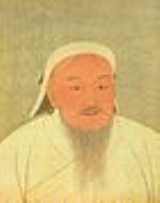
  • Ghengis Khan


Genghis Khan ( 1162–1227), born Temüjin, was the Mongol founder, Khan and posthumously declared Khagan (emperor) of the Mongol Empire, the largest contiguous empire
Empire

Empire derives from the Latin word imperium, denoting ?military command? in Roman. Politically, an empire is a geographically extensive group of states and peoples united and ruled either by a monarch or an oligarchy....
 in history.

He came to power by uniting many of the nomadic tribes of northeast Asia. After founding the Mongol Empire
Mongol Empire

The Mongol Empire was the List of largest empires#Contiguous Empires empire and the largest bar none. It emerged from the unification of Mongols and Turkic peoples tribes in modern day Mongolia, and grew through Mongol invasions, after Genghis Khan had been proclaimed ruler of all Mongols in 1206....
 and being proclaimed "Genghis Khan", he started the Mongol invasions
Mongol invasions

The Mongol invasions progressed throughout the 13th century, resulting in the vast Mongol Empire covering much of Asia by 1300.The Mongol Empire emerged in the course of the 13th century by a series of conquests and invasions throughout Central Asia and Western Asia, reaching Eastern Europe by the 1240s....
 and raids of the Kara-Khitan Khanate
Kara-Khitan Khanate

The Kara-Khitan Khanate, or Western Liao was a Khitan people empire in Central Asia. The dynasty was founded by Yel? Dashi, who led the remnants of the Chinese Liao Dynasty to Central Asia after fleeing from the Jurchen conquest of their homeland in North and Northeast China....
, Caucasus
Caucasus

The Caucasus or Caucas is a geopolitical region located between Europe, Asia, and the Middle East. It is home to Europe's highest mountain ....
, Khwarezmid Empire, Western Xia
Western Xia

The Western Xia Dynasty or the Tangut Empire was a state that existed from 1038 up to 1227 in what are now the northwestern provinces of China of Gansu, Shaanxi, and Ningxia....
 and Jin
Jin

The Chinese character ? can mean either "muscle" or "tendon" . Exercises designed to develop Jin are known as Jingong . In the context of Chinese martial arts, such exercises develop the ability to recruit the tendons at the beginning and end of a movement as a means of enhancing and delivering the force generated by the stance and body....
 dynasties. During his life, the Mongol Empire eventually occupied a substantial portion of Central Asia
Central Asia

Central Asia is a region of Asia from the Caspian Sea in the west to central China in the east, and from southern Russia in the north to northern India in the south....
.

  • Nurhachi#Name and titles
Nurhaci is also known as the Taizu Emperor. Nurhaci was the last chieftain of the Jiànzhou Jurchens
Jurchens

The Jurchens were a Tungusic peoples who inhabited the region of Manchuria until the 17th century, when they adopted the name Manchu. They established the Jin Dynasty between 1115 and 1122; it lasted until 1234 when the Mongols arrived....
 and First Khan of Later Jin.

  • The Datu
    Datu

    Datu or datto is the title for chieftains and monarchs in the Philippines. Together with sultan and raja, they are also titles of royalty and currently used in Malaysia, Brunei, Philippines and Indonesia....
    s were the chieftain
    Datu

    Datu or datto is the title for chieftains and monarchs in the Philippines. Together with sultan and raja, they are also titles of royalty and currently used in Malaysia, Brunei, Philippines and Indonesia....
    s who led the immigrations to the Philippines
    Philippines

    The Philippines, officially known as the Republic of the Philippines, is a country in Southeast Asia with Manila as its capital city. It comprises 7,107 islands in the western Pacific Ocean....
    . When Magellan arrived in the Philippines, they found that some local (Hindu or Buddhist) kings were styled Raja
    Raja

    A Raja is a monarch, or princely ruler of the Kshatriya Varna in Hinduism.The word 'raja'means 'rajan' in nepali which means the supreme king.It's normally the first given name in Nepal and surname in India which isused by hindus and buddhist....
    hs, or in the Muslim islands, many kings were Sultan
    Sultan

    Sultan is an Islamic honorifics, with several historical meanings. Originally it was an Arabic language abstract noun meaning "strength", "authority", or "rulership", derived from the verbal noun ???? sulah, meaning "authority" or "power"....
    s
  • Gam is the style of the elected tribal village chiefs among the Adi people
    Adi people

    The Adi is a major collective tribe living in the Himalayan hills of Arunachal Pradesh , and they are found in the temperate and sub-tropical regions within the districts of East Siang, Upper Siang, and Dibang Valley....
  • (Lal)s were the Chieftains who had ruled various parts of the state of Mizoram (India)till 1953.


In American tribes

  • Tlacatecuhtli ("chief of men") among the Aztec
    Aztec

    Aztec is a term used to refer to certain ethnic groups of central Mexico, particularly those groups who spoke the Nahuatl and who achieved political and military dominance over large parts of Mesoamerica in the 14th, 15th and 16th centuries, a period referred to as the Late post-Classic period in Mesoamerican chronology....
    s
  • Chief
    Chief

    Chief may refer to:...
    , among the in the United States of America
  • lonco
    Lonco

    A lonco is a tribal chief of the Mapuches. These were often Ulmen, the wealthier men in the lof. In wartime loncos of the various local rehue or the larger aillarehue would gather in a koyag or parliament and would elect a toqui to lead the warriors in battle....
     (mapudungun: longko, 'head') among the Mapuche
    Mapuche

    The Mapuche are the Indigenous peoples of the Americas inhabitants of Central and Southern Chile and Southern Argentina. They were known as Araucanians by the Spaniards....
  • Morubixaba
    Cacique

    Cacique or Cazique from the ta?no word for the pre-Columbian tribal Tribal chief, of the Taino tribes in the Bahamas, Greater Antilles, and the northern Lesser Antilles....
     - tribal Cacique (chief) of the Tupi people
  • Tyee tribal chief of the Chinookan (Chinook)
    Chinookan

    Chinookan refers to several groups of Native Americans in the United States in the Pacific Northwest region of the United States. In the early 19th century, the Chinookan peoples lived along the lower and middle Columbia River in present-day Oregon and Washington....


In African tribes

  • Gbong Gwon
  • Gio
    Gio Tribe

    The Gio or Dan people is an ethnic group in north-eastern Liberia and in C?te d'Ivoire....
     (of Liberia and Côte d'Ivoire.)
  • Krahn
    Krahn

    Krahn is an ethnic group of Liberia; it is also the language traditionally spoken by these people.The Krahn are a native ethnic group who were present in the area known as Liberia before the formation of the country....
     (of Liberia and La Côte d'Ivoire.)
  • Morêna
    Morena

    Morena is a city and a municipality in Morena district in the Indian States and territories of India of Madhya Pradesh. It is also known as Muraina and is the administrative headquarters of Morena District and of Chambal Division....
  • Orkoiyot
    Orkoiyot

    An Orkoiyot is the supreme chief of the Nandi of Kenya. As the Nandi have a dual administrative system, the Orkoiyot is the chief spiritual leader and also has the authority to make decisions regarding security, involving the waging of war....
     (Nandi people, in Kenya)
  • Kgosi (Botswana)
  • Nkosi (Zulu, Ndebele and Xhosa peoples, South Africa and Zimbabwe)
  • Akan
    Akan

    Akan may be:*Akan, Gabon*Akan people, an ethnic group in Ghana and Cote D'Ivoire**Akan States, any of several states organized in the 16th or 17th century by the Akan people...
     (Asante or Ashanti, Akyem or Akim, Kwahu, Fante, Nzema, Akuapim, Brong, Ahafo, Wassa and Ahanta people of Ghana)


In Oceania

  • Ariki
    Ariki

    An ariki , aliki , ?ariki , ali?i , or ari'i in the Society Islands... is or was a member of a hereditary chiefly or noble rank in Polynesia....
    , 'ariki henua
  • Ibedul
  • Iroijlaplap
    Iroijlaplap

    Iroijlaplap is the title given to the paramount chiefs in the Marshall Islands.Article III of the Constitution of the Marshall Islands recognizes the title, and establishes a Council of Iroij, composed of holders of the title of Iroijlaplap, or other analogous traditional titles, chosen from holders of the chieftainship among the several co...
  • Nahnmwarki, Lepen Palikir
  • Rangatira
    Rangatira

    Rangatira are the hereditary Maori Tribal chief, descended from the chieftain of a waka , a boat of the first Maori settlers. These chieftains were men of great leadership and wisdom, each of whom commanded their own retinue of Maori Toa....
    , a chief of Maori
    Maori

    The Maori are the indigenous people Polynesian people of Aotearoa . The group probably arrived in south-western Polynesia in several waves at some time before 1300....
     in New Zealand
    New Zealand

    New Zealand is an island country in the south-western Pacific Ocean comprising two main landmasses , and numerous Islands of New Zealand, most notably Stewart Island/Rakiura and the Chatham Islands....
  • Ratu
    Ratu

    Ratu is a title used by Fijians of chiefly rank. An equivalent title, Adi is used by females of chiefly rank. it is also an Indonesian language word for Queen....


Sources and references


See also

  • Chiefs of the Name
    Chiefs of the Name

    For the Scottish form of Chief of the Name, see Scottish clan chief.The Chief of the Name is the recognised head of a family or clan. The term is in use as a title in Ireland and Scotland where Celtic traditions still survive....
  • Chieftain
  • House of chiefs
    House of chiefs

    A House of chiefs is an assembly, either legislative or advisory, that is neither representative nor simply appointed and/or filled ex-officio, but consists of all or part of the traditional leaders, known as Tribal chiefs, of a country or polity....
  • Indirect rule
    Indirect rule

    Indirect rule is a type of European colonial policy in which the traditional local power structure, or at least part of it, is incorporated into the colonial administrative structure....
  • Israelite
    Israelite

    According to the Tanakh, the Israelites were the descendants of the Biblical patriarch Jacob. They were divided into twelve tribes, each descended from one of twelve sons or grandsons of Jacob....
  • Opperhoofd
    Opperhoofd

    Opperhoofd is a Dutch language word which literally means 'supreme head'.The Danish language equivalent Opperhoved, which is derived from a Danish pronunciation of the Dutch word, is also treated here....
  • Paramount Chief
    Paramount chief

    A paramount chief is the highest-level traditional tribal chief or political leader in a regional or local polity or country typically administered politically with a Chiefdom....
  • Sachem
    Sachem

    Sachem may refer to:* Sachem, a Native American leader* A leader of Tammany Hall* The Sachem award, which replaced the Sagamore of the Wabash as Indiana's highest civilian honor...
  • Sagamore
    Sagamore

    OriginSagamore is a title of leadership historically given to the head of some Native Americans in the United States tribes. One source explains:...
  • Scottish clan chiefs


External links