

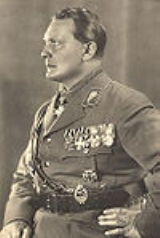
Hermann Göring

Encyclopedia
Hermann Wilhelm Göring, (or Goering; ˈɡøːʁɪŋ; 12 January 189315 October 1946) was a German politician
, military leader, and a leading member of the Nazi Party. He was a veteran of World War I
as an ace fighter pilot, and a recipient of the coveted Pour le Mérite
, also known as "The Blue Max". He was the last commander of Jagdgeschwader 1, the fighter wing once led by Manfred von Richthofen
, "The Red Baron".
In 1935, Göring was appointed Commander-in-Chief of the Luftwaffe
, a position he was to hold until the final days of World War II
. By mid-1940, Göring was at the peak of his power and influence. Adolf Hitler
had promoted him to the rank of Reichsmarschall
, making Göring senior to all other Wehrmacht
commanders, and in 1941 Hitler designated him as his successor and deputy in all his offices. By 1942, with the German war effort stumbling on both fronts, Göring's standing with Hitler was very greatly reduced. Göring largely withdrew from the military and political scene to enjoy the pleasures of life as a wealthy and powerful man. After World War II, Göring was convicted of war crime
s and crimes against humanity at the Nuremberg Trials
. He was sentenced to death by hanging, but committed suicide by cyanide
ingestion two hours before he was due to be hanged just after midnight.
, Bavaria
. His father Heinrich Ernst Göring
(31 October 1839–7 December 1913) had been the first Governor-General of the German protectorate of South West Africa
(modern-day Namibia
) as well as being a former cavalry officer and member of the German consular service. Göring had among his paternal ancestors Eberle/Eberlin
, a Swiss-German family of high bourgeoisie
.
Göring was a relative of such Eberle/Eberlin descendants as the German aviation pioneer Count Ferdinand von Zeppelin
; German romantic nationalist Hermann Grimm (1828–1901), an author of the concept of the German hero as a mover of history, whom the Nazis claimed as one of their ideological forerunners; the industrialist family Merck
, the owners of the pharmaceutical giant Merck
; German Baroness Gertrud von Le Fort
, one of the world's major Catholic writers and poets of the 20th century, whose works were largely inspired by her revulsion against Nazism; and Carl J. Burckhardt, Swiss diplomat, historian, and President of the International Red Cross.
In a historical coincidence, Göring was related via the Eberle/Eberlin line to Jacob Burckhardt
(1818–1897), a great Swiss scholar of art and culture who was a major political and social thinker as well an opponent of nationalism and militarism, who rejected German claims of cultural and intellectual superiority and predicted a cataclysmic 20th century in which violent demagogues, whom he called "terrible simplifiers", would play central roles.
Göring's mother Franziska "Fanny" Tiefenbrunn (1859–15 July 1923) came from a Bavaria
n peasant family. The marriage of a gentleman to a lower class woman occurred only because Heinrich Ernst Göring
was a widower. Hermann Göring was one of five children; his brothers were Albert Göring
and Karl Göring, and his sisters were Olga Therese Sophia Göring and Paula Elisabeth Rosa Göring, the last of whom were from his father's first marriage. Although antisemitism had become rampant in Germany at that time, his parents were not antisemitic .
Göring's younger brother Albert Göring was opposed to the Nazi regime and helped Jews and dissidents in Germany during the Nazi era, much like Oskar Schindler
. In one instance, Albert helped Hermann himself by intervening on behalf of one of his wife’s film colleagues, Henny Porten. Henny, an erstwhile sweetheart of German cinema, found herself professionally ostracised after she refused to divorce her Jewish husband, Dr. William von Kaufman. After meeting Henny in a Hamburg hotel and learning of her predicament, Emmy Göring pleaded with Hermann to call his younger brother Albert, who was, at the time, the technical director of Tobis-Sascha Filmindustrie AG in Vienna. Hermann made the call, and Albert duly arranged Henny a film contract in Vienna, ensuring her a livelihood.
Göring's nephew—Hans-Joachim Göring—was a pilot in the Luftwaffe with III Gruppe./ZG 76
, flying the Messerschmitt Bf 110
. Hans-Joachim was killed in action on 11 July 1940, when his Bf 110 was shot down by Hawker Hurricane
s of No. 78 Squadron RAF
. His aircraft crashed into Portland Harbour
, Dorset
, England.
who defeated the Roman
legions at Teutoburg Forest
. However, the name was possibly to honor his godfather, a Christian of Jewish descent born Hermann Epenstein. Epenstein—whose father was an army surgeon in Berlin—became a wealthy physician and businessman and a major if not paternal influence on Göring's childhood. Hermann's father held diplomatic posts in Africa and in Haiti
, climates considered too harsh for a young European child. This resulted in lengthy separation from his parents, and much of Hermann's very early childhood was spent with governesses and with distant relatives. Heinrich Göring retired circa 1898, and had to support his large family solely on his civil service pension. Thus for financial reasons the Görings became permanent house guests of their longtime friend, Göring's probable namesake. Epenstein had acquired a minor title (through service and donation to the Crown) and was now Hermann, Ritter
von Epenstein.
Von Epenstein purchased two largely dilapidated castles, Burg Veldenstein in Bavaria and Burg Mauterndorf
near Salzburg
, Austria, whose very expensive restorations were ongoing by the time of Hermann Göring's birth. Both castles were to be residences of the Göring family, their official "caretakers" until 1913. Both castles were also ultimately to be Hermann's property.
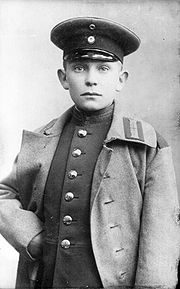 According to some biographers of both Hermann Göring and his younger brother Albert Göring, soon after the family took residence in his castles, von Epenstein began an adulterous relationship with Frau Göring and may in fact have been Albert's father. (Albert's physical resemblance to von Epenstein was noted even during his childhood and is evident in photographs.) Whatever the nature of von Epenstein's relationship with his mother, the young Hermann Göring enjoyed a close relationship with his godfather.
Göring was initially unaware of von Epenstein's Jewish ancestry. He was enrolled in a prestigious Austrian boarding school, where his tuition was paid by von Epenstein. Then he wrote an essay in praise of his godfather and was mocked by the school's antisemitic headmaster for professing such admiration for a Jew. Göring denied the allegation, but was then presented with proof in the "Semi-Gotha", a book which catalogued German-speaking nobility of insufficient status to be listed in the Almanach de Gotha
. (Von Epenstein had bought his title and castles, and so was relegated to the lesser reference.) Göring remained steadfast in his devotion to his family's friend and patron so adamantly that he left the school and used what money he had to purchase a train ticket home. The action seems to have tightened the already considerable bond between godfather and godson.
Relations between the Göring family and von Epenstein became far more formal during Göring's adolescence (causing Mosley and other biographers to speculate that perhaps the theorized affair ended naturally or that the elderly Heinrich discovered he was a cuckold and threatened its exposure). By the time of Heinrich Göring's death, the family no longer lived in a residence supplied by von Epenstein, or seemed to have much contact at all with him. The family's comfortable circumstances indicate the Ritter may have continued to support them financially. Late in his life, Ritter von Epenstein married Lily, a singer who was half his age. He bequeathed her his estate in his will, but requested that she in turn bequeath the castles at Mauterndorf and Veldenstein to his godson Hermann upon her own death.
, Franconia
and then attended the cadet institutes at Karlsruhe
and the military college at Berlin Lichterfelde. Göring was commissioned in the Prussian
army on 22 June 1912 in the Prinz Wilhelm Regiment (112th Infantry), headquartered at Mulhouse
as part of the 29th Division
of the Imperial German Army.
During the first year of World War I, Göring served with an infantry regiment in the Vosges
region. He was hospitalized with rheumatism
resulting from the damp of trench warfare. While he was recovering, his friend Bruno Loerzer
convinced him to transfer to the Luftstreitkräfte
("air combat force") of the German army. Göring's transfer request was turned down. But later that year, Göring flew as Loerzer's observer in Feldfliegerabteilung 25 (FFA 25) - Göring had informally transferred himself. He was detected and sentenced to three weeks' confinement to barracks. The sentence was never carried out: by the time it was imposed Göring's association with Loerzer had been regularized. They were assigned as a team to FFA 25 in the Crown Prince's Fifth Army — "though it seems that they had to steal a plane in order to qualify." They flew reconnaissance and bombing missions for which the Crown Prince invested both Göring and Loerzer with the Iron Cross
, first class.
On completing his pilot's training course he was posted back to FFA 2 in October 1915. Göring had already claimed two air victories as an Observer (one unconfirmed). He gained another flying a Fokker E.III
single-seater scout in March 1916. In October 1916, he was posted to Jagdstaffel 5, but was wounded in action in November. In February 1917, he joined Jagdstaffel 26. He now scored steadily until in May 1917, when he got his first command, Jasta 27. Serving with Jastas 5, 26 and 27, he claimed 21 air victories. Besides the Iron Cross, he was awarded the Zaehring Lion
with swords, the Friedrich Order
and the House Order of Hohenzollern
with swords, third class, and finally in May 1918, the coveted Pour le Mérite
. On 7 July 1918, after the death of Wilhelm Reinhard
, the successor of The Red Baron
, he was made commander of the famed "Flying Circus", Jagdgeschwader 1
.
In June 1917, after a lengthy dogfight, Göring shot down Australian pilot Frank Slee. The battle is recounted in The Rise and Fall of Hermann Göring. Göring landed and met the Australian, and presented Slee with his Iron Cross. Years after, Slee gave Göring's Iron Cross to a friend, who later died on the beach during the Normandy Landings. Also during the war Göring had through his generous treatment made a friend of his prisoner of war Captain Frank Beaumont, a Royal Flying Corps
pilot. "It was part of Goering's creed to admire a good enemy, and he did his best to keep Captain Beaumont from being taken over by the Army."
Göring finished the war with 22 confirmed kills.
Because of his arrogance, Göring's appointment as commander of Jagdgeschwader 1 had not been well received. When demobilized during the first weeks of November 1918, Göring and his officers spent most of their time in the Stiftskeller, the best restaurant and drinking place in Aschaffenburg
. Yet he was the only veteran of Jagdgeschwader 1
never invited to post-war reunions.
Göring was genuinely surprised (at least by his own account) at Germany's defeat in World War I. He felt personally violated by the surrender, the Kaiser's abdication, the humiliating terms, and the supposed treachery of the post-war German politicians who had "goaded the people [to uprising] [and] who [had] stabbed our glorious Army in the back [thinking] of nothing but of attaining power and of enriching themselves at the expense of the people." Ordered to surrender the planes of his squadron to the Allies in December 1918, Göring and his fellow pilots intentionally wrecked the planes on landing. This action paralleled the scuttling
of surrendered ships. Typical for the political climate of the day, he was not arrested or even officially reprimanded for his action.
, tried "barnstorming
", and in 1921 he joined Svensk Lufttrafik, a Swedish airline. He was also listed on the officer rolls of the Reichswehr
, the post–World War I peacetime army of Germany, and by 1933 had risen to the rank of Generalmajor. He was made a Generalleutnant in 1935 and then a General in the Luftwaffe upon its founding later that year.
Göring as a veteran pilot was often hired to fly businessmen and others on private aircraft. He worked in Denmark and Sweden as a commercial pilot. One wintry evening he was hired by Count Eric von Rosen to fly him to his castle from Stockholm. Invited to spend the night there, it may have been here that Göring first saw the swastika
emblem, a family badge which was set in the chimney piece around the roaring fire.
This was also the first time Göring saw his future wife. A great staircase led down into the hall opposite the fireplace. As Göring looked up he saw a woman coming down the staircase as if toward him. He thought she was very beautiful. The count introduced his sister-in-law Baroness Carin von Kantzow
(née Freiin von Fock, 1888–1931) to the 27-year-old Göring.
Carin was a tall, maternal, unhappy, sentimental woman five years Göring's senior, estranged from her husband and in delicate health. Göring was immediately smitten with her. Carin's eldest sister and biographer claimed that it was love at first sight. Carin was carefully looked after by her parents as well as by Count and Countess von Rosen. She was also married and had an eight-year-old son Thomas to whom she was devoted. No romance other than one of courtly love
was possible at this point.
. Von Kantzow behaved generously. He provided a financial settlement which enabled Carin and Göring to set up their first home together in Germany. It was a hunting lodge at Hochkreuth in the Bavarian Alps, near Bayrischzell
, some 50 mi (80.5 km) from Munich
.
(SA) as the Oberster SA-Führer. After stepping down as SA Commander, he was appointed an SA-Gruppenführer
(Lieutenant General) and held this rank on the SA rolls until 1945. Hitler later recalled his early association with Göring thus:
At this time, Carin—who liked Hitler—often played hostess to meetings of leading Nazis including her husband, Hitler, Hess
, Rosenberg
and Röhm
.
Göring was with Hitler in the Beer Hall Putsch
in Munich on 9 November 1923. He marched beside Hitler at the head of the SA. When the Bavarian police broke up the march with gunfire, Göring was seriously wounded in the groin.
, Carin arranged for Göring to be spirited away to Austria. Göring was in no way fit to travel and the journey may have aggravated his condition, although he did avoid arrest. Göring was X-rayed and operated on in the hospital at Innsbruck
. Carin wrote to her mother from Göring's bedside on 8 December 1923 describing his terrible pain: "... in spite of being dosed with morphine
every day, his pain stays just as bad as ever." This was the beginning of his morphine addiction, which would last until his imprisonment at Nuremberg. Meanwhile in Munich the authorities declared Göring a wanted man.
The Görings—acutely short of funds and reliant on the good will of Nazi sympathizers abroad—moved from Austria to Venice
, then in May 1924 to Rome via Florence
and Siena
. Göring met Benito Mussolini
in Rome. Mussolini expressed some interest in meeting Hitler, by then in prison, on his release. Personal problems, however, continued to multiply. Göring's mother had died in 1923. By 1925, it was Carin's mother who was ill. The Görings—with difficulty—raised the money for a journey in spring 1925 to Sweden via Austria, Czechoslovakia
, Poland, and Danzig. Göring had become a violent morphine addict and Carin's family were shocked by his deterioration when they saw him. Carin, herself an epileptic, had to let the doctors and police take full charge of Göring. He was certified a dangerous drug addict and placed in the violent ward of Långbro asylum on 1 September 1925. Biographer Roger Manvell
quoted a Stockholm psychiatrist who had seen him before he was committed to Långbro: "Göring was very violent and had to be placed in a straitjacket
but was not insane."
The 1925 psychiatrist's reports claimed Göring to be weak of character, a hysteric and unstable personality, sentimental yet callous, violent when afraid and a person whose bravado hid a basic lack of moral courage. "Like many men capable of great acts of physical courage which verge quite often on desperation, he lacked the finer kind of courage in the conduct of his life which was needed when serious difficulties overcame him."
At the time of Göring's detention, all doctors' reports in Sweden were matters of public record. In 1925, Carin sued for custody of her son. Nils von Kantzow, her ex-husband, used a doctor's report on Carin and Göring as evidence to show that neither of them was fit to look after the boy, and so von Kantzow kept custody. The reports were also used by political opponents in Germany.
Carin Göring died of heart failure on 17 October 1931.
—an ex-Communist radical—was arrested on the scene and claimed sole responsibility for the Reichstag fire
. But many observers believed that the Nazis set the fire to justify the subsequent crackdown. Göring in particular was suspected: he was first on the scene, and both Hitler and Goebbels were apparently surprised by the news. At Nuremberg, General Franz Halder
testified that Göring admitted responsibility:
William L. Shirer in his seminal study The Rise and Fall Of The Third Reich states that all of the evidence points strongly to the most unusual of possible scenarios being what actually happened, that Van der Lube coincidentally was present to start another fire at the same time that Göring and his accomplices also went into the Reichstag to start a different fire. While admitting how strange it sounds, the evidence that Shirer presents in his book makes a compelling case for this unusual situation.
Göring in his own Nuremberg testimony denied this story. It remains unclear whether Göring was responsible for the fire, although it seem fairly certain that van der Lubbe did enter the Reichstag with the intent to commit arson. The following is a transcript excerpt from the Nuremberg Trials:
. He proposed to her in Weimar
in February 1935. The wedding took place on 10 April 1935 in Berlin and was celebrated like the marriage of an emperor. They had a daughter, Edda Göring (born 2 June 1938) who was reportedly named after Countess Edda Ciano
, eldest child of Benito Mussolini
, although other sources say she was named after a friend of her mother. Edda's Godfather was Adolf Hitler.
in January 1933, Göring was appointed as minister without portfolio
. He was one of only two other Nazis named to the Cabinet (the other being Wilhelm Frick
) even though the Nazis were the largest party in the Reichstag and nominally the senior partner in the Nazi-DNVP
coalition. However, in a little-noticed development, he was named Interior Minister of Prussia — a move which gave him command of the largest state police force in Germany. Soon after taking office, he began filling the political and intelligence units of the Prussian police with Nazis. On 26 April 1933, he formally detached these units from the regular Prussian police and reorganized them under his command as the Gestapo
, a secret state police intended to serve the Nazi cause.
Göring was one of the key figures in the process of Gleichschaltung
("forcible coordination") that established the Nazi dictatorship. For example, in 1933, Göring banned all Roman Catholic newspapers in Germany, not only to suppress resistance to National Socialism but also to deprive the population of alternative forms of association and means of political communication.
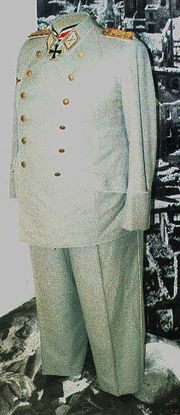 In the Nazi regime's early years, Göring served as minister in various key positions at both the Reich (German national) level and other levels as required. For example, in the state of Prussia, Göring was responsible for the economy as well as re-armament.
In 1934/35, Göring, acting as Prussian Prime Minister, was intimately involved in the dubious acquisition of the Guelph Treasure of Brunswick (the so-called "Welfenschatz") - a unique collection of early medieval religious precious metalwork, at that time in the hands of some persecuted German-Jewish art dealers from Frankfurt
, and one of the most important church treasuries to have survived from medieval Germany.
On 20 April 1934, Göring and Himmler agreed to put aside their differences (largely because of mutual hatred and growing dread of the SA or Sturmabteilung) and Göring transferred full authority over the Gestapo to Himmler, who was also named chief of all German police forces outside Prussia. With the Gestapo under their control, Himmler and Heydrich plotted—with Göring—to use it with the SS to crush the SA. Göring retained Special Police Battalion Wecke, which he converted to a paramilitary unit attached to the Landespolizei
(State Police), Landespolizeigruppe General Göring. This formation participated in the Night of the Long Knives
, when the SA leaders were purged. Göring was head of the Forschungsamt (FA), which secretly monitored telephone and radio communications, the FA was connected to the SS
, the SD
, and Abwehr
intelligence services.
In 1936, he became Plenipotentiary
of the Four Year Plan
for German rearmament, where he effectively took control of the economy — as economics minister Hjalmar Schacht
became increasingly reluctant to pursue rapid rearmament and eventually resigned. The vast steel plant Reichswerke Hermann Göring
was named after him. He gained great influence with Hitler (who placed a high value on rearmament). He never seemed to accept the Hitler Myth
quite as much as Goebbels and Himmler, but remained loyal nevertheless.
In 1938, Göring forced out the War Minister, Field Marshal Werner von Blomberg
, and the Army commander, General von Fritsch
. They had welcomed Hitler's accession in 1933, but then annoyed him by criticising his plans for expansionist wars. Göring, who had been best man at Blomberg's recent wedding to a 26-year-old typist, discovered that Frau Blomberg had a criminal record for posing for pornographic photos in 1932, which Göring misrepresented as being for prostitution as a way of smearing her husband. This led to Blomberg's resigning. Fritsch was accused of homosexual activity and, though completely innocent, resigned in shock and disgust. He was later exonerated by a "court of honor" presided over by Göring.
Also in 1938, Göring played a key role in the Anschluss
(annexation) of Austria. At the height of the crisis, Göring spoke on the telephone to Austrian Chancellor Schuschnigg
. Göring announced Germany's intent to march into Austria, and threatened war and the destruction of Austria if there was any resistance. Schuschnigg collapsed, and the German army marched into Austria without resistance.
s from industrialists for favourable decisions as Four Year Plan director, and money for supplying arms to the Spanish Republicans in the Spanish Civil War
via Pyrkal
in Greece (although Germany was supporting Franco and the Nationalists).
Göring also "collected" several other offices, such as Reichsforst- und Jägermeister (Reich Master of the Forest and Hunt), for which he received high government salaries. His Chief Huntsman was Walter Frevert.
In 1933, Göring acquired a vast estate in the Schorfheide Forest
in Brandenburg
, 40 km (24.9 mi) northeast of Berlin, and built his great manor house
there. It was named Carinhall
in memory of his first wife Carin. He exulted in aristocrat
ic trappings, such as a coat of arms
, and ceremonial swords and daggers, such as the Wedding Sword (an oversized broadsword with elaborate gold hilt presented to Göring at his 1935 wedding to Emmy). He also owned many uniforms and jewelry.
Göring was also noted for his patronage of music, especially opera
. He entertained frequently and lavishly. Most infamously, he collected art
, looting from numerous museums (some in Germany itself), stealing from Jewish collectors, or buying for grossly discounted prices in occupied countries.
When Göring was promoted to the unique rank of Reichsmarschall, he designed an elaborate personal flag for himself. The design included a German eagle, swastika
, and crossed marshal's batons on one side, and on the other the Großkreuz des Eisernen Kreuzes ("Grand Cross of the Iron Cross
") between four Luftwaffe eagles. He had the flag carried by a personal standard-bearer at all public occasions.
 Göring was known for his extravagant tastes and garish clothing. Hans-Ulrich Rudel
, the top Stuka pilot of the war, recalled twice meeting Göring dressed in outlandish costumes: first, a medieval hunting costume, practicing archery
with his doctor, and second, dressed in a russet toga
fastened with a golden clasp, smoking an abnormally large pipe. Italian Foreign Minister
Ciano
once noted Göring wearing a fur coat looking like what "a high grade prostitute wears to the opera." His personal car—dubbed "The Blue Goose"—was an aviation blue Mercedes 540K Special Cabriolet
. It had luxurious features, as well as special additions, including bullet-proof glass and bomb resistant armor for protection, and modifications to allow him to fit his girth behind the wheel.
Though he liked to be called "der Eiserne" (the Iron Man), the once-dashing and muscular fighter pilot had become corpulent. He was however one of the few Nazi leaders who did not take offence at hearing jokes about himself, "no matter how rude," taking them as a sign of his popularity. Germans joked about his ego, saying that he would wear an admiral's uniform to take a bath, and his obesity, joking that "he sits down on his stomach."
in his study of German foreign policy in the Nazi era noted that besides Hitler's foreign policy programme that there were three rival programs supported by factions in the Nazi Party, whom Hildebrand dubbed the agrarians, the revolutionary socialists, and the Wilhelmine Imperialists.
Göring was the most prominent of the Wilhelmine Imperialists. This group wanted to restore the German frontiers of 1914, regain the pre-1914 overseas empire, and make Eastern Europe
Germany's exclusive sphere of influence. This was a much more limited set of goals than Hitler's dream of Lebensraum
to be carved out with merciless racial wars. By contrast, Göring and the Wilhelmine Imperialist faction were more guided by traditional Machtpolitik
in their foreign policy conceptions. Furthermore, they expected to achieve their goals within the established international order. While not rejecting war as an option, they preferred diplomacy and sought political domination in eastern Europe rather than the military conquests envisioned by Hitler. They also rejected Hitler's mystical vision of war as a necessary ordeal for the nation, and of perpetual war as desirable. Göring himself feared that a major war might interfere with his luxurious lifestyle. Göring's advocacy of this policy led to his temporary exclusion by Hitler for a time in 1938–1939 from foreign policy decisions. Göring's unwillingness to offer a major challenge to Hitler prevented him from offering any serious resistance to Hitler's policies, and the Wilhelmine Imperialists had no real influence.
Göring had some private doubts about the wisdom of Hitler’s policies attacking Poland, which he felt would cause a world war, and was anxious to see a compromise solution. This was especially the case as the Forschungsamt (FA), Göring's private intelligence agency, had broken the codes the British Embassy in Berlin used to communicate with London. The FA's work showed that British Prime Minister Neville Chamberlain
was determined to go to war if Germany invaded Poland in 1939. This directly contradicted the advice given to Hitler by Foreign Minister Joachim von Ribbentrop
(a man whom Göring loathed at the best of times) that Chamberlain would not honor the “guarantee” he had given Poland in March 1939 if Germany attacked that country.
In the summer of 1939, Göring and the rest of the Wilhelmine Imperialists made a last ditch effort to assert their foreign policy program. Göring was involved in desperate attempts to avert a war in by using various amateur diplomats, such as his deputy Helmuth Wohltat at the Four Year Plan organization, British civil servant Sir Horace Wilson, newspaper proprietor Lord Kemsley
, and would be peace-makers like Swedish businessmen Axel Wenner-Gren
and Birger Dahlerus
, who served as couriers between Göring and various British officials. All of these efforts came to naught because Hitler (who much preferred Ribbentrop’s assessment of Britain to Göring's) would not be deterred from attacking Poland in 1939, and the Wilhelmine Imperialists were unwilling and unable to challenge Hitler despite their reservations about his foreign policy.
 Göring was responsible for the Nuremberg laws
and for charging Jews with a billion reichsmark fine for Kristallnacht
, which he never denied at his trial. However, his role in and awareness of the extermination of the Jews is much more controversial.
Göring claimed at Nuremberg that he was not anti-Semitic, and it is generally accepted that the anti-Semitism of Goebbels and Himmler was far stronger than that of Göring, who was more cynical than ideological in all of his attitudes. He occasionally intervened to shield individual Jews from harm, (including his own deputy, Erhard Milch
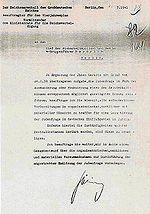
) sometimes in exchange for a bribe, sometimes after a request from his wife Emmy or his anti-Nazi brother Albert. Göring despised Himmler and he often sparred with Goebbels who was in favor of more radical measures against the Jews. However, some of the quotes provided at the Nuremberg trial show his apparent antisemitic side, though much milder than that of Goebbels or Himmler, some apparently said as ironic retorts to Goebbels. Despite his sporadic actions to help individuals, Göring was deemed complicit in the Holocaust: he was the highest figure in the Nazi hierarchy to issue a written order for the "complete solution of the Jewish Question", as he issued a memo to Reinhard Heydrich
to organize the practical details. Göring, who issued this memo in place of Hitler, which he occasionally did, wrote in the memo to "submit to me as soon as possible a general plan of the administrative, financial and material measures necessary for carrying out the desired Final Solution
of the Jewish question." This was in July 1941, many months before, according to most historians, the decision to exterminate Jews was taken. Göring, who at Nuremberg trial unrepentantly took responsibility for his actions, as opposed to most other defendants who blamed Hitler, maintained to his death that this meant relocation of Jews, and that he did not know of the subsequent extermination. Following this transfer of the Jewish question to Heydrich and Himmler, at the Wannsee Conference
in early 1942, the Holocaust was planned with Heydrich as the most senior officer present, reporting directly to Himmler.
In 1989, historian and noted Nazi sympathizer David Irving
published a biography of Göring, which in part said that he had disapproved of the persecution of Jews and offered documented evidence as proof. Much of Irving's work, however, has been discredited, and Göring's complicity in the Final Solution remains a point of contention.
. When Hitler repudiated Versailles, in 1935, the Luftwaffe was unveiled, with Göring as Minister and Oberbefehlshaber (Supreme Commander). In 1938, he became the first Generalfeldmarschall (Field Marshal) of the Luftwaffe; this promotion also made him the highest ranking officer in Germany. Göring directed the rapid creation of this new branch of service. Within a few years, Germany produced large numbers of the world's most advanced military aircraft.
In 1936, Göring at Hitler's direction sent several hundred aircraft along with several thousand air and ground crew, to assist the Nationalists in the Spanish Civil War
. This became known as the Condor Legion
.
By 1939, the Luftwaffe was one of the most advanced and powerful air forces in the world.
s of the British
and American
armies. Fallschirmjäger units were awarded 134 Knight's Cross of the Iron Cross
es between the years 1940–1945.
In addition to the Fallschirmjäger, there were also the Luftwaffe Field Division
s, which were organised as basic infantry units but were led by officers with little training for ground combat, and generally performed badly as combat troops as a result. The Hermann Göring Panzerdivision
was also raised and served with distinction in the Italian campaign.
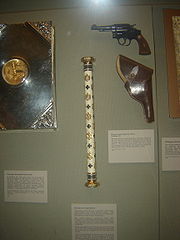 Göring was skeptical of Hitler's war plans. He believed Germany was not prepared for a new conflict and, in particular, that his Luftwaffe was not yet ready to beat the British Royal Air Force
(RAF).
However, once Hitler decided on war, Göring supported him completely. On 1 September 1939, the first day of the war, Hitler spoke to the Reichstag. In this speech, he designated Göring as his successor "if anything should befall me."
Initially, decisive German victories followed quickly one after the other. The Luftwaffe destroyed the Polish Air Force
within two weeks. The Fallschirmjäger seized key airfields in Norway and captured Fort Eben-Emael
in Belgium. German air-to-ground attacks served as the "flying artillery" of the Panzer
troops in the blitzkrieg of France. "Leave it to my Luftwaffe" became Göring's perpetual gloat.
After the defeat of France, Hitler awarded Göring the Grand Cross of the Iron Cross
for his successful leadership. By a decree on 19 July 1940, Hitler promoted Göring to the rank of Reichsmarschall
des Grossdeutschen Reiches (Reich Marshal of the Greater German Reich), a special rank which made him senior to all other Army and Luftwaffe Field Marshals. It also reinforced his status as Hitler's chosen successor, as a result of which the Führer gave Göring personal use of Kransberg Castle
.
Göring's political and military careers were at their peak. Göring had already received the Knight's Cross of the Iron Cross
on 30 September 1939 as Commander in Chief of the Luftwaffe.
Göring promised Hitler that the Luftwaffe would quickly destroy the RAF, or break British morale with devastating air raids. He personally directed the first attacks on Britain from his private luxury train. But the Luftwaffe failed to gain control of the skies in the Battle of Britain
. This was Hitler's first defeat. Britain withstood the worst Luftwaffe bombers could do for the eight months of "the Blitz
" without being cowed by circumstances. However, the damage inflicted on British cities largely maintained Göring's prestige. The Luftwaffe conducted bombings of Belgrade in April 1941, and Fallschirmjäger captured Crete
from the British Army the following month.
was doomed to defeat. After trying, completely in vain, to convince Hitler to give up Operation Barbarossa
, he embraced the campaign. Hitler still relied on him completely. On 29 June, Hitler composed a special 'testament', which was kept secret till the end of the war. This formally designated Göring as "my deputy in all my offices" if Hitler was unable to function as dictator of Germany, and his successor if he died. Ironically, Göring did not know the contents of this testament, which was marked "To be opened only by the Reichsmarschall", until after leaving Berlin in April 1945 for Berchtesgaden, where it had been kept.
The Luftwaffe shared in the initial victories in the east, destroying thousands of Soviet aircraft. But as Soviet resistance grew and the weather turned bad, the Luftwaffe became overstretched and exhausted.
Göring by this time had lost interest in administering the Luftwaffe. That duty was left to others like Udet
and Jeschonnek
. Aircraft production lagged and Udet killed himself in November 1941. Yet Göring persisted in outlandish promises. When the Soviets surrounded a German army in Stalingrad
in 1942, Göring encouraged Hitler to fight for the city rather than retreat. He asserted that the Luftwaffe would deliver 500 ST (453.6 t) per day of supplies to the trapped force. In fact, no more than 100 ST (90.7 t) were ever delivered in a day, and usually much less. While Göring's men struggled to fly in the savage Russian winter, Göring celebrated his 50th birthday.
Göring was in charge of exploiting the vast industrial resources captured during the war, particularly in the Soviet Union. This proved to be an almost total failure, and little of the available potential was effectively harnessed for the service of the German military machine.
will not be subjected to a single bomb. If an enemy bomber reaches the Ruhr, my name is not Hermann Göring: you can call me Meier!" ("I want to be called Meier if ..." is a German idiom to express that something is impossible. Meier [in several spelling variants] is the second most common surname in Germany.) He also said he would eat his hat.
But as early as 1940, British aircraft raided targets in Germany, debunking Göring's assurance that the Reich would never be attacked; the British were—throughout the war—destined to be his personal undoing. However, the initial raids were unsuccessful in inflicting significant damage to German infrastructure, allowing Göring to reassure the public especially as the German air defense network improved. However, in 1942 the British Area Bombing Directive
was issued, the main workhorse aircraft of the later part of the war came into service (the Halifax and Lancaster
made up the backbone of the Command, and had a longer range, higher speed and much greater bomb load than the earlier aircraft; the classic aircraft of the Pathfinders, the de Havilland Mosquito
, also made its appearance) and America began transferring long-range strategic bombers to England for further air raids.
By 1942, hundreds of Allied bombers were bombing Germany; occasionally, there were as many as 1,000. The Luftwaffe responded with night fighters and anti-aircraft guns, but entire cities such as Cologne (Köln
) and Hamburg
were destroyed anyway. Göring was still nominally in charge, but in practice he had little to do with operations. When Göring visited the devastated cities, civilians called out "Hello, Mr. Meier. How's your hat?" By the end of the war, Berlin's air raid sirens were bitterly known to the city's residents as "Meier's trumpets", or "Meier's hunting horns". Civilians would also call the bomber war "a defeat in every city".
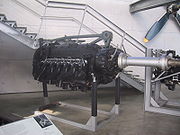 The Luftwaffes own efforts at having a strategic bomber force had been crippled even before the war began, from the death in 1936 of General Walter Wever
, the Luftwaffes primary promoter for Germany to have a strategic bombing capability, and a subsequent placement of greater value on medium bombers such as the Heinkel He 111
, and Schnellbomber
fast medium bombers, such as the Junkers Ju 88
. Belated efforts in replacement designs of greater performance in altitude, speed and range, such as the Bomber B
development program and Amerika Bomber
trans-oceanic range strategic bomber design competition, either never worked out due to inadequate powerplants or the inability to complete the development of new airframe designs from the constantly worsening war and aircraft production facility situations. These problems led to the Luftwaffe continuing to primarily use the pre-war origin medium bomber designs, or barely upgraded versions of them. The only German aircraft design of a comparable capability and size to Allied heavy bombers such as the B-17 to see wartime service, the troubled Heinkel He 177
Greif, had been afflicted with having to use a set of four DB 601
engines paired up into twin "power systems" as the "DB 606", partly due to its mis-assignment as a "giant Stuka" from its beginnings heavily influencing its design, and by September 1942, Goering had roundly derided the DB 606, and its later development, the DB 610, as monstrous zusammengeschweißte Motoren, or "welded-together engines", that could not be properly maintained in service, as installed in the He 177A, the one German aircraft design that Goering is said to have despised the most during the war years.
Göring's prestige, reputation, and influence with Hitler all declined, especially after the Stalingrad debacle. Hitler could not publicly repudiate him without embarrassment, but contact between them largely stopped. Göring withdrew from the military and political scene to enjoy the pleasures of life as a wealthy and powerful man. His reputation for extravagance made him particularly unpopular as ordinary Germans began to suffer deprivation.
, arrived with unexpected news: Hitler—who had by this time conceded that Germany had lost—had suggested that Göring would be better suited to negotiate peace terms. To Koller, this seemed to indicate that Hitler wanted Göring to take over the leadership of the Reich.
Göring was initially unsure of what to do, largely because he did not want to give Martin Bormann
, who now controlled access to Hitler, a window to seize greater power. He thought that if he waited he'd be accused of dereliction of duty. On the other hand, he feared being accused of treason if he did try to assume power. He then pulled his copy of Hitler's secret decree of 1941 from a safe. It clearly stated that Göring was not only Hitler's designated successor, but was to act as his deputy if Hitler ever became incapacitated. Göring, Koller, and Hans Lammers
—the state secretary of the Reich Chancellery—all agreed that Hitler faced almost certain death by staying in Berlin to lead the defence of the capital against the Soviets. They also agreed that by staying in Berlin, Hitler had incapacitated himself from governing and Göring had a clear duty to assume power as Hitler's deputy.
On 23 April, as Soviet troops closed in around Berlin, Göring sent a carefully worded telegram
by radio to Hitler, asking Hitler to confirm that he was to take over the "total leadership of the Reich." He added that if he did not hear back from Hitler by 22:00, he would assume Hitler was incapacitated, and would assume leadership of the Reich. A few minutes later, he sent a radio message to Ribbentrop stating that if the foreign minister got no further word, he was to come to Berchtesgaden immediately.
However, Bormann received the telegram before Hitler did. He portrayed it as an ultimatum to surrender power or face a coup d'état
. The message to Ribbentrop, suggesting that Göring was already acting as Hitler's successor, provided further ammunition for Bormann. On 25 April, Hitler issued a telegram to Göring telling him that he had committed "high treason" and gave him the option of resigning all of his offices in exchange for his life. However, not long after that, Bormann ordered the SS in Berchtesgaden to arrest Göring. In his last will and testament
, Hitler dismissed Göring from all of his offices and expelled him from the Nazi Party.
Shortly after Hitler completed his will, Bormann ordered the SS to execute Göring, his wife, and their daughter (Hitler's own goddaughter) if Berlin were to fall. But this order was ignored. Instead, the Görings and their SS captors moved together, to the same Schloß Mauterndorf where Göring had spent much of his childhood and which he had inherited (along with Burg Veldenstein) from his godfather's widow in 1938. (Göring had arranged for preferential treatment for the woman, and protected her from confiscation and arrest as the widow of a wealthy Jew.)
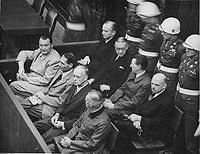 Göring surrendered to U.S. soldiers on 9 May 1945 in Bavaria. He was flown by United States Army
pilot Mayhew Foster
from Austria to Germany, where he was debriefed and then in November of that same year tried in Nuremberg
for war crimes. He was the third-highest-ranking Nazi official tried at Nuremberg, behind Reich President (former Admiral) Karl Dönitz
and former Deputy Führer
Rudolf Hess
. Göring's last days were spent with Captain Gustave Gilbert
, a German-speaking American intelligence officer and psychologist
, who had access to all the prisoners held in the Nuremberg jail. Gilbert classified Göring as having an I.Q.
of 138, the same as Dönitz. Gilbert kept a journal which he later published as Nuremberg Diary
. Here he describes Göring on the evening of 18 April 1946, as the trials were halted for a three-day Easter
recess:
In taking the witness stand during his part of the trial, Göring claimed that he was not antisemitic; however, Albert Speer
reported that in the prison yard at Nuremberg, after someone made a remark about Jewish survivors in Hungary, he had overheard Göring say, "So, there are still some there? I thought we had knocked off all of them. Somebody slipped up again." Despite his claims of non-involvement, he was confronted with orders he had signed for the murder of Jews and prisoners of war.
Though he defended himself vigorously, and actually appeared to be winning the trial early on (partly by building popularity with the court audience by making jokes and finding holes in the prosecution's case), he was found guilty and sentenced to death by hanging. The judgment stated that:
Göring made an appeal, offering to accept the court's death sentence if he were shot as a soldier instead of hanged as a common criminal, but the court refused.
Defying the sentence imposed by his captors, he committed suicide with a potassium cyanide
capsule the night before he was to be hanged. Göring—who suffered from dermatitis
—had hidden two cyanide capsules in jars of opaque skin cream. It has been claimed that Göring befriended U.S. Army Lieutenant Jack G. Wheelis, who was stationed at the Nuremberg Trials and helped Göring obtain cyanide which had been hidden among Göring's personal effects when they were confiscated by the Army. In 2005, former U.S. Army Private Herbert Lee Stivers claimed he gave Göring "medicine" hidden inside a gift fountain pen from a German woman the private had met and flirted with. Stivers served in the 1st Infantry Division's 26th Infantry Regiment, who formed the honor guard for the Nuremberg Trials. Stivers claims to have been unaware of what the "medicine" he delivered actually was until after Göring's death. Göring's biographer, David Irving, has dismissed this claim as pure fabrication. Because he committed suicide, his dead body was displayed by the gallows for the witnesses of the executions.
After their deaths, the bodies of Göring and the executed Nazi leaders were cremated
in the East Cemetery, Munich (Ostfriedhof). His ashes were disposed of in the Isar
river in Munich.
The well-known quotation, and its variations,
is frequently attributed to Göring during the inter-war period. Whether or not he actually used this phrase is unclear; it did not originate with him. The line comes from Nazi playwright Hanns Johst
's play Schlageter, "Wenn ich Kultur
höre ... entsichere ich meinen Browning" ("Whenever I hear of culture... I release the safety-catch of my Browning"). Nor was Göring the only Nazi official to use this phrase: Rudolf Hess
used it as well, and it was a popular cliché in Germany, often in the form: "Wenn ich 'Kultur' höre, nehme ich meine Pistole." ("Whenever I hear 'culture', I take my pistol" or "When I hear of culture, I pick up my gun.")
Footage of Göring has been included in many films, notably in the 1935 Triumph of the Will
by Leni Riefenstahl
.
He was mentioned in Yukio Mishima
's novel After the Banquet
during the retired Japanese ambassadors' dinner at Setsugoan.
In Keith Laumer
's Worlds of the Imperium
, set in an alternate history where the two World Wars never happened and there was never a Nazi party, Hermann Göring has a double who is a decent and respectable character.
In the Riverworld
Books by Philip Jose Farmer
, Göring is one of the support characters.
|-
|-
|-
|-
|-
|-
|-
|-
|-
Politician
A politician, political leader, or political figure is an individual who is involved in influencing public policy and decision making...
, military leader, and a leading member of the Nazi Party. He was a veteran of World War I
World War I
World War I , which was predominantly called the World War or the Great War from its occurrence until 1939, and the First World War or World War I thereafter, was a major war centred in Europe that began on 28 July 1914 and lasted until 11 November 1918...
as an ace fighter pilot, and a recipient of the coveted Pour le Mérite
Pour le Mérite
The Pour le Mérite, known informally as the Blue Max , was the Kingdom of Prussia's highest military order for German soldiers until the end of World War I....
, also known as "The Blue Max". He was the last commander of Jagdgeschwader 1, the fighter wing once led by Manfred von Richthofen
Manfred von Richthofen
Manfred Albrecht Freiherr von Richthofen , also widely known as the Red Baron, was a German fighter pilot with the Imperial German Army Air Service during World War I...
, "The Red Baron".
In 1935, Göring was appointed Commander-in-Chief of the Luftwaffe
Luftwaffe
Luftwaffe is a generic German term for an air force. It is also the official name for two of the four historic German air forces, the Wehrmacht air arm founded in 1935 and disbanded in 1946; and the current Bundeswehr air arm founded in 1956....
, a position he was to hold until the final days of World War II
World War II
World War II, or the Second World War , was a global conflict lasting from 1939 to 1945, involving most of the world's nations—including all of the great powers—eventually forming two opposing military alliances: the Allies and the Axis...
. By mid-1940, Göring was at the peak of his power and influence. Adolf Hitler
Adolf Hitler
Adolf Hitler was an Austrian-born German politician and the leader of the National Socialist German Workers Party , commonly referred to as the Nazi Party). He was Chancellor of Germany from 1933 to 1945, and head of state from 1934 to 1945...
had promoted him to the rank of Reichsmarschall
Reichsmarschall
Reichsmarschall literally in ; was the highest rank in the armed forces of Nazi Germany during World War II after the position of Supreme Commander held by Adolf Hitler....
, making Göring senior to all other Wehrmacht
Wehrmacht
The Wehrmacht – from , to defend and , the might/power) were the unified armed forces of Nazi Germany from 1935 to 1945. It consisted of the Heer , the Kriegsmarine and the Luftwaffe .-Origin and use of the term:...
commanders, and in 1941 Hitler designated him as his successor and deputy in all his offices. By 1942, with the German war effort stumbling on both fronts, Göring's standing with Hitler was very greatly reduced. Göring largely withdrew from the military and political scene to enjoy the pleasures of life as a wealthy and powerful man. After World War II, Göring was convicted of war crime
War crime
War crimes are serious violations of the laws applicable in armed conflict giving rise to individual criminal responsibility...
s and crimes against humanity at the Nuremberg Trials
Nuremberg Trials
The Nuremberg Trials were a series of military tribunals, held by the victorious Allied forces of World War II, most notable for the prosecution of prominent members of the political, military, and economic leadership of the defeated Nazi Germany....
. He was sentenced to death by hanging, but committed suicide by cyanide
Cyanide poisoning
Cyanide poisoning occurs when a living organism is exposed to a compound that produces cyanide ions when dissolved in water. Common poisonous cyanide compounds include hydrogen cyanide gas and the crystalline solids potassium cyanide and sodium cyanide...
ingestion two hours before he was due to be hanged just after midnight.
Family background and relatives
Göring was born on 12 January 1893 at the Marienbad sanatorium in RosenheimRosenheim
Rosenheim is a town in Bavaria at the confluence of the rivers Inn and Mangfall. It is seat of administration of the district of Rosenheim, but is not a part of it.-Geography:...
, Bavaria
Kingdom of Bavaria
The Kingdom of Bavaria was a German state that existed from 1806 to 1918. The Bavarian Elector Maximilian IV Joseph of the House of Wittelsbach became the first King of Bavaria in 1806 as Maximilian I Joseph. The monarchy would remain held by the Wittelsbachs until the kingdom's dissolution in 1918...
. His father Heinrich Ernst Göring
Heinrich Ernst Göring
Heinrich Ernst Göring was a German jurist and diplomat who served as colonial governor of German South-West Africa. He was the father of five children including Hermann Göring, the Nazi leader and commander of the Luftwaffe....
(31 October 1839–7 December 1913) had been the first Governor-General of the German protectorate of South West Africa
South West Africa
South-West Africa was the name that was used for the modern day Republic of Namibia during the earlier eras when the territory was controlled by the German Empire and later by South Africa....
(modern-day Namibia
Namibia
Namibia, officially the Republic of Namibia , is a country in southern Africa whose western border is the Atlantic Ocean. It shares land borders with Angola and Zambia to the north, Botswana to the east and South Africa to the south and east. It gained independence from South Africa on 21 March...
) as well as being a former cavalry officer and member of the German consular service. Göring had among his paternal ancestors Eberle/Eberlin
Eberlin
-List of people with surname Eberlin :* Daniel Eberlin , German composer and violinist* Johann Eberlin von Günzburg , German theologian* Johann Ernst Eberlin , German composer and organist...
, a Swiss-German family of high bourgeoisie
Bourgeoisie
In sociology and political science, bourgeoisie describes a range of groups across history. In the Western world, between the late 18th century and the present day, the bourgeoisie is a social class "characterized by their ownership of capital and their related culture." A member of the...
.
Göring was a relative of such Eberle/Eberlin descendants as the German aviation pioneer Count Ferdinand von Zeppelin
Ferdinand von Zeppelin
Ferdinand Adolf Heinrich August Graf von Zeppelin was a German general and later aircraft manufacturer. He founded the Zeppelin Airship company...
; German romantic nationalist Hermann Grimm (1828–1901), an author of the concept of the German hero as a mover of history, whom the Nazis claimed as one of their ideological forerunners; the industrialist family Merck
Merck family
Friedrich Jacob Merck purchased the second town pharmacy in Darmstadt, known as the Engel-Apotheke or Angel Pharmacy. When Friedrich died, the pharmacy was passed on to his nephew and ever since has gone from father to son...
, the owners of the pharmaceutical giant Merck
Merck KGaA
Merck KGaA is a German chemical and pharmaceutical company. Merck, also known as “German Merck” and “Merck Darmstadt”, was founded in Darmstadt, Germany, in 1668, making it the world's oldest operating chemical and pharmaceutical company. The company was privately owned until going public in 1995...
; German Baroness Gertrud von Le Fort
Gertrud von Le Fort
Gertrud von Le Fort was a German writer of novels, poems, and essays. She came from a Protestant background, but converted to Catholicism in 1926. Most of Gertrud's writings come after this conversion...
, one of the world's major Catholic writers and poets of the 20th century, whose works were largely inspired by her revulsion against Nazism; and Carl J. Burckhardt, Swiss diplomat, historian, and President of the International Red Cross.
In a historical coincidence, Göring was related via the Eberle/Eberlin line to Jacob Burckhardt
Jacob Burckhardt
Carl Jacob Christoph Burckhardt was a historian of art and culture, and an influential figure in the historiography of each field. He is known as one of the major progenitors of cultural history, albeit in a form very different from how cultural history is conceived and studied in academia today...
(1818–1897), a great Swiss scholar of art and culture who was a major political and social thinker as well an opponent of nationalism and militarism, who rejected German claims of cultural and intellectual superiority and predicted a cataclysmic 20th century in which violent demagogues, whom he called "terrible simplifiers", would play central roles.
Göring's mother Franziska "Fanny" Tiefenbrunn (1859–15 July 1923) came from a Bavaria
Bavaria
Bavaria, formally the Free State of Bavaria is a state of Germany, located in the southeast of Germany. With an area of , it is the largest state by area, forming almost 20% of the total land area of Germany...
n peasant family. The marriage of a gentleman to a lower class woman occurred only because Heinrich Ernst Göring
Heinrich Ernst Göring
Heinrich Ernst Göring was a German jurist and diplomat who served as colonial governor of German South-West Africa. He was the father of five children including Hermann Göring, the Nazi leader and commander of the Luftwaffe....
was a widower. Hermann Göring was one of five children; his brothers were Albert Göring
Albert Göring
Albert Günther Göring was a German businessman, notable for helping Jews and dissidents survive in Germany in World War II. His older brother, Hermann Göring, held the rank of Reichsmarschall of Nazi Germany and was convicted as a war criminal.-Early life:Albert Göring was born on the 9th of March...
and Karl Göring, and his sisters were Olga Therese Sophia Göring and Paula Elisabeth Rosa Göring, the last of whom were from his father's first marriage. Although antisemitism had become rampant in Germany at that time, his parents were not antisemitic .
Göring's younger brother Albert Göring was opposed to the Nazi regime and helped Jews and dissidents in Germany during the Nazi era, much like Oskar Schindler
Oskar Schindler
Oskar Schindler was an ethnic German industrialist born in Moravia. He is credited with saving over 1,100 Jews during the Holocaust by employing them in his enamelware and ammunitions factories, which were located in what is now Poland and the Czech Republic respectively.He is the subject of the...
. In one instance, Albert helped Hermann himself by intervening on behalf of one of his wife’s film colleagues, Henny Porten. Henny, an erstwhile sweetheart of German cinema, found herself professionally ostracised after she refused to divorce her Jewish husband, Dr. William von Kaufman. After meeting Henny in a Hamburg hotel and learning of her predicament, Emmy Göring pleaded with Hermann to call his younger brother Albert, who was, at the time, the technical director of Tobis-Sascha Filmindustrie AG in Vienna. Hermann made the call, and Albert duly arranged Henny a film contract in Vienna, ensuring her a livelihood.
Göring's nephew—Hans-Joachim Göring—was a pilot in the Luftwaffe with III Gruppe./ZG 76
Zerstörergeschwader 76
Zerstörergeschwader 76 or ZG 76 was a Luftwaffe heavy/destroyer Fighter Aircraft-wing of World War II.-History:...
, flying the Messerschmitt Bf 110
Messerschmitt Bf 110
The Messerschmitt Bf 110, often called Me 110, was a twin-engine heavy fighter in the service of the Luftwaffe during World War II. Hermann Göring was a proponent of the Bf 110, and nicknamed it his Eisenseiten...
. Hans-Joachim was killed in action on 11 July 1940, when his Bf 110 was shot down by Hawker Hurricane
Hawker Hurricane
The Hawker Hurricane is a British single-seat fighter aircraft that was designed and predominantly built by Hawker Aircraft Ltd for the Royal Air Force...
s of No. 78 Squadron RAF
No. 78 Squadron RAF
No. 78 Squadron of the Royal Air Force operates the Merlin HC3/3A transport helicopter from RAF Benson.Until December 2007 it was the operator of two Westland Sea King HAR3s from RAF Mount Pleasant, Falkland Islands.-History:No...
. His aircraft crashed into Portland Harbour
Portland Harbour
Portland Harbour is located beside the Isle of Portland, off Dorset, on the south coast of England. It is one of the largest man-made harbours in the world. Grid reference: .-History:...
, Dorset
Dorset
Dorset , is a county in South West England on the English Channel coast. The county town is Dorchester which is situated in the south. The Hampshire towns of Bournemouth and Christchurch joined the county with the reorganisation of local government in 1974...
, England.
Early life and Ritter von Epenstein
Göring later claimed his given name was chosen to honor the ArminiusArminius
Arminius , also known as Armin or Hermann was a chieftain of the Germanic Cherusci who defeated a Roman army in the Battle of the Teutoburg Forest...
who defeated the Roman
Roman Empire
The Roman Empire was the post-Republican period of the ancient Roman civilization, characterised by an autocratic form of government and large territorial holdings in Europe and around the Mediterranean....
legions at Teutoburg Forest
Teutoburg Forest
The Teutoburg Forest is a range of low, forested mountains in the German states of Lower Saxony and North Rhine-Westphalia which used to be believed to be the scene of a decisive battle in AD 9...
. However, the name was possibly to honor his godfather, a Christian of Jewish descent born Hermann Epenstein. Epenstein—whose father was an army surgeon in Berlin—became a wealthy physician and businessman and a major if not paternal influence on Göring's childhood. Hermann's father held diplomatic posts in Africa and in Haiti
Haiti
Haiti , officially the Republic of Haiti , is a Caribbean country. It occupies the western, smaller portion of the island of Hispaniola, in the Greater Antillean archipelago, which it shares with the Dominican Republic. Ayiti was the indigenous Taíno or Amerindian name for the island...
, climates considered too harsh for a young European child. This resulted in lengthy separation from his parents, and much of Hermann's very early childhood was spent with governesses and with distant relatives. Heinrich Göring retired circa 1898, and had to support his large family solely on his civil service pension. Thus for financial reasons the Görings became permanent house guests of their longtime friend, Göring's probable namesake. Epenstein had acquired a minor title (through service and donation to the Crown) and was now Hermann, Ritter
Ritter
Ritter is a designation used as a title of nobility in German-speaking areas. Traditionally it denotes the second lowest rank within the nobility, standing above "Edler" and below "Freiherr"...
von Epenstein.
Von Epenstein purchased two largely dilapidated castles, Burg Veldenstein in Bavaria and Burg Mauterndorf
Mauterndorf
Mauterndorf is a market town in the Tamsweg district in the Austrian state of Salzburg. The municipality also comprises the Katastralgemeinden Faningberg, Neuseß and Steindorf.-History:...
near Salzburg
Salzburg
-Population development:In 1935, the population significantly increased when Salzburg absorbed adjacent municipalities. After World War II, numerous refugees found a new home in the city. New residential space was created for American soldiers of the postwar Occupation, and could be used for...
, Austria, whose very expensive restorations were ongoing by the time of Hermann Göring's birth. Both castles were to be residences of the Göring family, their official "caretakers" until 1913. Both castles were also ultimately to be Hermann's property.
Göring was initially unaware of von Epenstein's Jewish ancestry. He was enrolled in a prestigious Austrian boarding school, where his tuition was paid by von Epenstein. Then he wrote an essay in praise of his godfather and was mocked by the school's antisemitic headmaster for professing such admiration for a Jew. Göring denied the allegation, but was then presented with proof in the "Semi-Gotha", a book which catalogued German-speaking nobility of insufficient status to be listed in the Almanach de Gotha
Almanach de Gotha
The Almanach de Gotha was a respected directory of Europe's highest nobility and royalty. First published in 1763 by C.W. Ettinger in Gotha at the ducal court of Frederick III, Duke of Saxe-Gotha-Altenburg, it was regarded as an authority in the classification of monarchies, princely and ducal...
. (Von Epenstein had bought his title and castles, and so was relegated to the lesser reference.) Göring remained steadfast in his devotion to his family's friend and patron so adamantly that he left the school and used what money he had to purchase a train ticket home. The action seems to have tightened the already considerable bond between godfather and godson.
Relations between the Göring family and von Epenstein became far more formal during Göring's adolescence (causing Mosley and other biographers to speculate that perhaps the theorized affair ended naturally or that the elderly Heinrich discovered he was a cuckold and threatened its exposure). By the time of Heinrich Göring's death, the family no longer lived in a residence supplied by von Epenstein, or seemed to have much contact at all with him. The family's comfortable circumstances indicate the Ritter may have continued to support them financially. Late in his life, Ritter von Epenstein married Lily, a singer who was half his age. He bequeathed her his estate in his will, but requested that she in turn bequeath the castles at Mauterndorf and Veldenstein to his godson Hermann upon her own death.
World War I
Göring was sent to boarding school at AnsbachAnsbach
Ansbach, originally Onolzbach, is a town in Bavaria, Germany. It is the capital of the administrative region of Middle Franconia. Ansbach is situated southwest of Nuremberg and north of Munich, on the Fränkische Rezat, a tributary of the Main river. As of 2004, its population was 40,723.Ansbach...
, Franconia
Franconia
Franconia is a region of Germany comprising the northern parts of the modern state of Bavaria, a small part of southern Thuringia, and a region in northeastern Baden-Württemberg called Tauberfranken...
and then attended the cadet institutes at Karlsruhe
Karlsruhe
The City of Karlsruhe is a city in the southwest of Germany, in the state of Baden-Württemberg, located near the French-German border.Karlsruhe was founded in 1715 as Karlsruhe Palace, when Germany was a series of principalities and city states...
and the military college at Berlin Lichterfelde. Göring was commissioned in the Prussian
Kingdom of Prussia
The Kingdom of Prussia was a German kingdom from 1701 to 1918. Until the defeat of Germany in World War I, it comprised almost two-thirds of the area of the German Empire...
army on 22 June 1912 in the Prinz Wilhelm Regiment (112th Infantry), headquartered at Mulhouse
Mulhouse
Mulhouse |mill]] hamlet) is a city and commune in eastern France, close to the Swiss and German borders. With a population of 110,514 and 278,206 inhabitants in the metropolitan area in 2006, it is the largest city in the Haut-Rhin département, and the second largest in the Alsace region after...
as part of the 29th Division
29th Division (German Empire)
The 29th Division was a unit of the Prussian/German Army, almost entirely made up of troops from the Grand Duchy of Baden. It was formed in Karlsruhe on July 1, 1871. The division was subordinated in peacetime to the XIV Army Corps...
of the Imperial German Army.
During the first year of World War I, Göring served with an infantry regiment in the Vosges
Vosges
Vosges is a French department, named after the local mountain range. It contains the hometown of Joan of Arc, Domrémy.-History:The Vosges department is one of the original 83 departments of France, created on February 9, 1790 during the French Revolution. It was made of territories that had been...
region. He was hospitalized with rheumatism
Rheumatism
Rheumatism or rheumatic disorder is a non-specific term for medical problems affecting the joints and connective tissue. The study of, and therapeutic interventions in, such disorders is called rheumatology.-Terminology:...
resulting from the damp of trench warfare. While he was recovering, his friend Bruno Loerzer
Bruno Loerzer
Bruno Loerzer was an officer in the German Luftstreitkräfte during World War I and Luftwaffe during World War II....
convinced him to transfer to the Luftstreitkräfte
Luftstreitkräfte
The Deutsche Luftstreitkräfte , known before October 1916 as Die Fliegertruppen des deutschen Kaiserreiches , or simply Die Fliegertruppen, was the air arm of the Imperial German Army during World War I...
("air combat force") of the German army. Göring's transfer request was turned down. But later that year, Göring flew as Loerzer's observer in Feldfliegerabteilung 25 (FFA 25) - Göring had informally transferred himself. He was detected and sentenced to three weeks' confinement to barracks. The sentence was never carried out: by the time it was imposed Göring's association with Loerzer had been regularized. They were assigned as a team to FFA 25 in the Crown Prince's Fifth Army — "though it seems that they had to steal a plane in order to qualify." They flew reconnaissance and bombing missions for which the Crown Prince invested both Göring and Loerzer with the Iron Cross
Iron Cross
The Iron Cross is a cross symbol typically in black with a white or silver outline that originated after 1219 when the Kingdom of Jerusalem granted the Teutonic Order the right to combine the Teutonic Black Cross placed above a silver Cross of Jerusalem....
, first class.
On completing his pilot's training course he was posted back to FFA 2 in October 1915. Göring had already claimed two air victories as an Observer (one unconfirmed). He gained another flying a Fokker E.III
Fokker E.III
|-See also:...
single-seater scout in March 1916. In October 1916, he was posted to Jagdstaffel 5, but was wounded in action in November. In February 1917, he joined Jagdstaffel 26. He now scored steadily until in May 1917, when he got his first command, Jasta 27. Serving with Jastas 5, 26 and 27, he claimed 21 air victories. Besides the Iron Cross, he was awarded the Zaehring Lion
Order of the Zähringer Lion
The Order of the Zähringer Lion was instituted on 26 December 1812 by Karl, Grand Duke of Baden, in memory of the Dukes of Zähringen from whom he was descended.-Classes:It had five classes.*Grand Cross*Commander, 1st Class*Commander, 2nd Class...
with swords, the Friedrich Order
Friedrich Order
The Friedrich Order, German: "Friedrichs-Orden" or "Friedrichsorden" was an order of merit of the German Kingdom of Württemberg. It was instituted on the first of January 1830 by the second king of Württemberg, Wilhelm I in remembrance of his father, King Friedrich I.The order had one class...
and the House Order of Hohenzollern
House Order of Hohenzollern
The House Order of Hohenzollern was an order of chivalry of the House of Hohenzollern. It was both a military and a civil award...
with swords, third class, and finally in May 1918, the coveted Pour le Mérite
Pour le Mérite
The Pour le Mérite, known informally as the Blue Max , was the Kingdom of Prussia's highest military order for German soldiers until the end of World War I....
. On 7 July 1918, after the death of Wilhelm Reinhard
Wilhelm Reinhard
Wilhelm "Willi" Reinhard was a German pilot during World War I. Reinhard was born in Düsseldorf and became a flying ace during the war, credited with 20 victories....
, the successor of The Red Baron
Manfred von Richthofen
Manfred Albrecht Freiherr von Richthofen , also widely known as the Red Baron, was a German fighter pilot with the Imperial German Army Air Service during World War I...
, he was made commander of the famed "Flying Circus", Jagdgeschwader 1
Jagdgeschwader 1 (World War 1)
The Jagdgeschwader 1 of World War I, was a fighter unit comprising four Jastas or 'fighter squadrons', originally raised by combining Jastas 4, 6, 10 and 11, on 24 June 1917 with Manfred von Richthofen as commodore...
.
In June 1917, after a lengthy dogfight, Göring shot down Australian pilot Frank Slee. The battle is recounted in The Rise and Fall of Hermann Göring. Göring landed and met the Australian, and presented Slee with his Iron Cross. Years after, Slee gave Göring's Iron Cross to a friend, who later died on the beach during the Normandy Landings. Also during the war Göring had through his generous treatment made a friend of his prisoner of war Captain Frank Beaumont, a Royal Flying Corps
Royal Flying Corps
The Royal Flying Corps was the over-land air arm of the British military during most of the First World War. During the early part of the war, the RFC's responsibilities were centred on support of the British Army, via artillery co-operation and photographic reconnaissance...
pilot. "It was part of Goering's creed to admire a good enemy, and he did his best to keep Captain Beaumont from being taken over by the Army."
Göring finished the war with 22 confirmed kills.
Because of his arrogance, Göring's appointment as commander of Jagdgeschwader 1 had not been well received. When demobilized during the first weeks of November 1918, Göring and his officers spent most of their time in the Stiftskeller, the best restaurant and drinking place in Aschaffenburg
Aschaffenburg
Aschaffenburg is a city in northwest Bavaria, Germany. The town of Aschaffenburg is not considered part of the district of Aschaffenburg, but is the administrative seat.Aschaffenburg is known as the Tor zum Spessart or "gate to the Spessart"...
. Yet he was the only veteran of Jagdgeschwader 1
Jagdgeschwader 1 (World War 1)
The Jagdgeschwader 1 of World War I, was a fighter unit comprising four Jastas or 'fighter squadrons', originally raised by combining Jastas 4, 6, 10 and 11, on 24 June 1917 with Manfred von Richthofen as commodore...
never invited to post-war reunions.
Göring was genuinely surprised (at least by his own account) at Germany's defeat in World War I. He felt personally violated by the surrender, the Kaiser's abdication, the humiliating terms, and the supposed treachery of the post-war German politicians who had "goaded the people [to uprising] [and] who [had] stabbed our glorious Army in the back [thinking] of nothing but of attaining power and of enriching themselves at the expense of the people." Ordered to surrender the planes of his squadron to the Allies in December 1918, Göring and his fellow pilots intentionally wrecked the planes on landing. This action paralleled the scuttling
Scuttling of the German fleet in Scapa Flow
The scuttling of the German fleet took place at the Royal Navy's base at Scapa Flow, in Scotland, after the end of the First World War. The High Seas Fleet had been interned there under the terms of the Armistice whilst negotiations took place over the fate of the ships...
of surrendered ships. Typical for the political climate of the day, he was not arrested or even officially reprimanded for his action.
Post-war
He remained in flying after the war, worked briefly at FokkerFokker
Fokker was a Dutch aircraft manufacturer named after its founder, Anthony Fokker. The company operated under several different names, starting out in 1912 in Schwerin, Germany, moving to the Netherlands in 1919....
, tried "barnstorming
Barnstorming
Barnstorming was a popular form of entertainment in the 1920s in which stunt pilots would perform tricks with airplanes, either individually or in groups called a flying circus. Barnstorming was the first major form of civil aviation in the history of flight...
", and in 1921 he joined Svensk Lufttrafik, a Swedish airline. He was also listed on the officer rolls of the Reichswehr
Reichswehr
The Reichswehr formed the military organisation of Germany from 1919 until 1935, when it was renamed the Wehrmacht ....
, the post–World War I peacetime army of Germany, and by 1933 had risen to the rank of Generalmajor. He was made a Generalleutnant in 1935 and then a General in the Luftwaffe upon its founding later that year.
Göring as a veteran pilot was often hired to fly businessmen and others on private aircraft. He worked in Denmark and Sweden as a commercial pilot. One wintry evening he was hired by Count Eric von Rosen to fly him to his castle from Stockholm. Invited to spend the night there, it may have been here that Göring first saw the swastika
Swastika
The swastika is an equilateral cross with its arms bent at right angles, in either right-facing form in counter clock motion or its mirrored left-facing form in clock motion. Earliest archaeological evidence of swastika-shaped ornaments dates back to the Indus Valley Civilization of Ancient...
emblem, a family badge which was set in the chimney piece around the roaring fire.
This was also the first time Göring saw his future wife. A great staircase led down into the hall opposite the fireplace. As Göring looked up he saw a woman coming down the staircase as if toward him. He thought she was very beautiful. The count introduced his sister-in-law Baroness Carin von Kantzow
Carin Göring
Carin Axelina Hulda Göring was the Swedish first wife of Hermann Göring.She was born Carin Fock in Stockholm in 1888. Her father Commander Baron Carl Fock was a Swedish Army colonel, from a family who had immigrated from Westphalia. Her mother, Huldine Fock Carin Axelina Hulda Göring (21 October...
(née Freiin von Fock, 1888–1931) to the 27-year-old Göring.
Carin was a tall, maternal, unhappy, sentimental woman five years Göring's senior, estranged from her husband and in delicate health. Göring was immediately smitten with her. Carin's eldest sister and biographer claimed that it was love at first sight. Carin was carefully looked after by her parents as well as by Count and Countess von Rosen. She was also married and had an eight-year-old son Thomas to whom she was devoted. No romance other than one of courtly love
Courtly love
Courtly love was a medieval European conception of nobly and chivalrously expressing love and admiration. Generally, courtly love was secret and between members of the nobility. It was also generally not practiced between husband and wife....
was possible at this point.
First marriage
Carin divorced her estranged husband, Nils Gustav von Kantzow, in December 1922. She married Göring on 3 January 1923 in StockholmStockholm
Stockholm is the capital and the largest city of Sweden and constitutes the most populated urban area in Scandinavia. Stockholm is the most populous city in Sweden, with a population of 851,155 in the municipality , 1.37 million in the urban area , and around 2.1 million in the metropolitan area...
. Von Kantzow behaved generously. He provided a financial settlement which enabled Carin and Göring to set up their first home together in Germany. It was a hunting lodge at Hochkreuth in the Bavarian Alps, near Bayrischzell
Bayrischzell
Bayrischzell is a municipality in the district of Miesbach in Bavaria in Germany....
, some 50 mi (80.5 km) from Munich
Munich
Munich The city's motto is "" . Before 2006, it was "Weltstadt mit Herz" . Its native name, , is derived from the Old High German Munichen, meaning "by the monks' place". The city's name derives from the monks of the Benedictine order who founded the city; hence the monk depicted on the city's coat...
.
Early Nazi
Göring joined the Nazi Party in 1922 and took over leadership of the SturmabteilungSturmabteilung
The Sturmabteilung functioned as a paramilitary organization of the National Socialist German Workers' Party . It played a key role in Adolf Hitler's rise to power in the 1920s and 1930s...
(SA) as the Oberster SA-Führer. After stepping down as SA Commander, he was appointed an SA-Gruppenführer
Gruppenführer
Gruppenführer was an early paramilitary rank of the Nazi Party, first created in 1925 as a senior rank of the SA.-SS rank:...
(Lieutenant General) and held this rank on the SA rolls until 1945. Hitler later recalled his early association with Göring thus:
At this time, Carin—who liked Hitler—often played hostess to meetings of leading Nazis including her husband, Hitler, Hess
Rudolf Hess
Rudolf Walter Richard Hess was a prominent Nazi politician who was Adolf Hitler's deputy in the Nazi Party during the 1930s and early 1940s...
, Rosenberg
Alfred Rosenberg
' was an early and intellectually influential member of the Nazi Party. Rosenberg was first introduced to Adolf Hitler by Dietrich Eckart; he later held several important posts in the Nazi government...
and Röhm
Ernst Röhm
Ernst Julius Röhm, was a German officer in the Bavarian Army and later an early Nazi leader. He was a co-founder of the Sturmabteilung , the Nazi Party militia, and later was its commander...
.
Göring was with Hitler in the Beer Hall Putsch
Beer Hall Putsch
The Beer Hall Putsch was a failed attempt at revolution that occurred between the evening of 8 November and the early afternoon of 9 November 1923, when Nazi Party leader Adolf Hitler, Generalquartiermeister Erich Ludendorff, and other heads of the Kampfbund unsuccessfully tried to seize power...
in Munich on 9 November 1923. He marched beside Hitler at the head of the SA. When the Bavarian police broke up the march with gunfire, Göring was seriously wounded in the groin.
Addiction and exile
Although he was stricken with pneumoniaPneumonia
Pneumonia is an inflammatory condition of the lung—especially affecting the microscopic air sacs —associated with fever, chest symptoms, and a lack of air space on a chest X-ray. Pneumonia is typically caused by an infection but there are a number of other causes...
, Carin arranged for Göring to be spirited away to Austria. Göring was in no way fit to travel and the journey may have aggravated his condition, although he did avoid arrest. Göring was X-rayed and operated on in the hospital at Innsbruck
Innsbruck
- Main sights :- Buildings :*Golden Roof*Kaiserliche Hofburg *Hofkirche with the cenotaph of Maximilian I, Holy Roman Emperor*Altes Landhaus...
. Carin wrote to her mother from Göring's bedside on 8 December 1923 describing his terrible pain: "... in spite of being dosed with morphine
Morphine
Morphine is a potent opiate analgesic medication and is considered to be the prototypical opioid. It was first isolated in 1804 by Friedrich Sertürner, first distributed by same in 1817, and first commercially sold by Merck in 1827, which at the time was a single small chemists' shop. It was more...
every day, his pain stays just as bad as ever." This was the beginning of his morphine addiction, which would last until his imprisonment at Nuremberg. Meanwhile in Munich the authorities declared Göring a wanted man.
The Görings—acutely short of funds and reliant on the good will of Nazi sympathizers abroad—moved from Austria to Venice
Venice
Venice is a city in northern Italy which is renowned for the beauty of its setting, its architecture and its artworks. It is the capital of the Veneto region...
, then in May 1924 to Rome via Florence
Florence
Florence is the capital city of the Italian region of Tuscany and of the province of Florence. It is the most populous city in Tuscany, with approximately 370,000 inhabitants, expanding to over 1.5 million in the metropolitan area....
and Siena
Siena
Siena is a city in Tuscany, Italy. It is the capital of the province of Siena.The historic centre of Siena has been declared by UNESCO a World Heritage Site. It is one of the nation's most visited tourist attractions, with over 163,000 international arrivals in 2008...
. Göring met Benito Mussolini
Benito Mussolini
Benito Amilcare Andrea Mussolini was an Italian politician who led the National Fascist Party and is credited with being one of the key figures in the creation of Fascism....
in Rome. Mussolini expressed some interest in meeting Hitler, by then in prison, on his release. Personal problems, however, continued to multiply. Göring's mother had died in 1923. By 1925, it was Carin's mother who was ill. The Görings—with difficulty—raised the money for a journey in spring 1925 to Sweden via Austria, Czechoslovakia
Czechoslovakia
Czechoslovakia or Czecho-Slovakia was a sovereign state in Central Europe which existed from October 1918, when it declared its independence from the Austro-Hungarian Empire, until 1992...
, Poland, and Danzig. Göring had become a violent morphine addict and Carin's family were shocked by his deterioration when they saw him. Carin, herself an epileptic, had to let the doctors and police take full charge of Göring. He was certified a dangerous drug addict and placed in the violent ward of Långbro asylum on 1 September 1925. Biographer Roger Manvell
Roger Manvell
Roger Arnold Manvell was the first director of the British Film Academy , author of many books on films and film-making, and authored and co-authored many books on Nazi Germany, including biographies of Adolf Hitler, Rudolf Hess, Heinrich Himmler, Joseph Goebbels and Hermann Göring...
quoted a Stockholm psychiatrist who had seen him before he was committed to Långbro: "Göring was very violent and had to be placed in a straitjacket
Straitjacket
A straitjacket is a garment shaped like a jacket with overlong sleeves and is typically used to restrain a person who may otherwise cause harm to themselves or others. Once the arms are inserted into the straitjacket's sleeves, they are then crossed across the chest...
but was not insane."
The 1925 psychiatrist's reports claimed Göring to be weak of character, a hysteric and unstable personality, sentimental yet callous, violent when afraid and a person whose bravado hid a basic lack of moral courage. "Like many men capable of great acts of physical courage which verge quite often on desperation, he lacked the finer kind of courage in the conduct of his life which was needed when serious difficulties overcame him."
At the time of Göring's detention, all doctors' reports in Sweden were matters of public record. In 1925, Carin sued for custody of her son. Nils von Kantzow, her ex-husband, used a doctor's report on Carin and Göring as evidence to show that neither of them was fit to look after the boy, and so von Kantzow kept custody. The reports were also used by political opponents in Germany.
Carin Göring died of heart failure on 17 October 1931.
Possible responsibility for the Reichstag fire
Marinus van der LubbeMarinus van der Lubbe
Marinus van der Lubbe was a Dutch council communist convicted of, and controversially executed for, setting fire to the German Reichstag building on February 27, 1933, an event known as the Reichstag fire. ....
—an ex-Communist radical—was arrested on the scene and claimed sole responsibility for the Reichstag fire
Reichstag fire
The Reichstag fire was an arson attack on the Reichstag building in Berlin on 27 February 1933. The event is seen as pivotal in the establishment of Nazi Germany....
. But many observers believed that the Nazis set the fire to justify the subsequent crackdown. Göring in particular was suspected: he was first on the scene, and both Hitler and Goebbels were apparently surprised by the news. At Nuremberg, General Franz Halder
Franz Halder
Franz Halder was a German General and the head of the Army General Staff from 1938 until September, 1942, when he was dismissed after frequent disagreements with Adolf Hitler.-Early life:...
testified that Göring admitted responsibility:
William L. Shirer in his seminal study The Rise and Fall Of The Third Reich states that all of the evidence points strongly to the most unusual of possible scenarios being what actually happened, that Van der Lube coincidentally was present to start another fire at the same time that Göring and his accomplices also went into the Reichstag to start a different fire. While admitting how strange it sounds, the evidence that Shirer presents in his book makes a compelling case for this unusual situation.
Göring in his own Nuremberg testimony denied this story. It remains unclear whether Göring was responsible for the fire, although it seem fairly certain that van der Lubbe did enter the Reichstag with the intent to commit arson. The following is a transcript excerpt from the Nuremberg Trials:
GOERING: This conversation did not take place and I request that I be confronted with Herr Halder. First of all I want to emphasize that what is written here is utter nonsense. It says, "The only one who really knows the Reichstag is I." The Reichstag was known to every representative in the Reichstag. The fire took place only in the general assembly room, and many hundreds or thousands of people knew this room as well as I did. A statement of this type is utter nonsense. How Herr Halder came to make that statement I do not know. Apparently that bad memory, which also let him down in military matters, is the only explanation.
MR. ROBERT JACKSONRobert H. JacksonRobert Houghwout Jackson was United States Attorney General and an Associate Justice of the United States Supreme Court . He was also the chief United States prosecutor at the Nuremberg Trials...
: You know who Halder is?
GOERING: Only too well.
GOERING: That accusation that I had set fire to the Reichstag came from a certain foreign press. That could not bother me because it was not consistent with the facts. I had no reason or motive for setting fire to the Reichstag. From the artistic point of view I did not at all regret that the assembly chamber was burned – I hoped to build a better one. But I did regret very much that I was forced to find a new meeting place for the Reichstag and, not being able to find one, I had to give up my Kroll Opera House, that is, the second State Opera House, for that purpose. The opera seemed to me much more important than the Reichstag.
MR. ROBERT JACKSON: Have you ever boasted of burning the Reichstag building, even by way of joking?
GOERING: No. I made a joke, if that is the one you are referring to, when I said that, ′after this, I should be competing with NeroNeroNero , was Roman Emperor from 54 to 68, and the last in the Julio-Claudian dynasty. Nero was adopted by his great-uncle Claudius to become his heir and successor, and succeeded to the throne in 54 following Claudius' death....
and that probably people would soon be saying that, dressed in a red toga and holding a lyre in my hand, I looked on at the fire and played while the Reichstag was burning′. That was the joke. But the fact was that I almost perished in the flames, which would have been very unfortunate for the German people, but very fortunate for their enemies.
MR. ROBERT JACKSON: You never stated then that you burned the Reichstag?
GOERING: No. I know that Herr Rauschning said in the book which he wrote, and which has often been referred to here, that I had discussed this with him. I saw Herr Rauschning only twice in my life and only for a short time on each occasion. If I had set fire to the Reichstag, I would presumably have let that be known only to my closest circle of confidants, if at all. I would not have told it to a man whom I did not know and whose appearance I could not describe at all today. That is an absolute distortion of the truth.
Second marriage
During the early 1930s Göring was often in the company of Emmy Sonnemann (1893–1973), an actress from HamburgHamburg
-History:The first historic name for the city was, according to Claudius Ptolemy's reports, Treva.But the city takes its modern name, Hamburg, from the first permanent building on the site, a castle whose construction was ordered by the Emperor Charlemagne in AD 808...
. He proposed to her in Weimar
Weimar
Weimar is a city in Germany famous for its cultural heritage. It is located in the federal state of Thuringia , north of the Thüringer Wald, east of Erfurt, and southwest of Halle and Leipzig. Its current population is approximately 65,000. The oldest record of the city dates from the year 899...
in February 1935. The wedding took place on 10 April 1935 in Berlin and was celebrated like the marriage of an emperor. They had a daughter, Edda Göring (born 2 June 1938) who was reportedly named after Countess Edda Ciano
Edda Mussolini
Edda Mussolini was the eldest child of Benito Mussolini, Italy's fascist dictator from 1922 to 1943. Upon her marriage to fascist propagandist and foreign minister Galeazzo Ciano she became Edda Ciano, Countess of Cortellazzo and Buccari.She strongly denied her involvement in the National Fascist...
, eldest child of Benito Mussolini
Benito Mussolini
Benito Amilcare Andrea Mussolini was an Italian politician who led the National Fascist Party and is credited with being one of the key figures in the creation of Fascism....
, although other sources say she was named after a friend of her mother. Edda's Godfather was Adolf Hitler.
Nazi potentate
When Hitler was named chancellor of GermanyChancellor of Germany
The Chancellor of Germany is, under the German 1949 constitution, the head of government of Germany...
in January 1933, Göring was appointed as minister without portfolio
Minister without Portfolio
A minister without portfolio is either a government minister with no specific responsibilities or a minister that does not head a particular ministry...
. He was one of only two other Nazis named to the Cabinet (the other being Wilhelm Frick
Wilhelm Frick
Wilhelm Frick was a prominent German Nazi official serving as Minister of the Interior of the Third Reich. After the end of World War II, he was tried for war crimes at the Nuremberg Trials and executed...
) even though the Nazis were the largest party in the Reichstag and nominally the senior partner in the Nazi-DNVP
German National People's Party
The German National People's Party was a national conservative party in Germany during the time of the Weimar Republic. Before the rise of the NSDAP it was the main nationalist party in Weimar Germany composed of nationalists, reactionary monarchists, völkisch, and antisemitic elements, and...
coalition. However, in a little-noticed development, he was named Interior Minister of Prussia — a move which gave him command of the largest state police force in Germany. Soon after taking office, he began filling the political and intelligence units of the Prussian police with Nazis. On 26 April 1933, he formally detached these units from the regular Prussian police and reorganized them under his command as the Gestapo
Gestapo
The Gestapo was the official secret police of Nazi Germany. Beginning on 20 April 1934, it was under the administration of the SS leader Heinrich Himmler in his position as Chief of German Police...
, a secret state police intended to serve the Nazi cause.
Göring was one of the key figures in the process of Gleichschaltung
Gleichschaltung
Gleichschaltung , meaning "coordination", "making the same", "bringing into line", is a Nazi term for the process by which the Nazi regime successively established a system of totalitarian control and tight coordination over all aspects of society. The historian Richard J...
("forcible coordination") that established the Nazi dictatorship. For example, in 1933, Göring banned all Roman Catholic newspapers in Germany, not only to suppress resistance to National Socialism but also to deprive the population of alternative forms of association and means of political communication.
In 1934/35, Göring, acting as Prussian Prime Minister, was intimately involved in the dubious acquisition of the Guelph Treasure of Brunswick (the so-called "Welfenschatz") - a unique collection of early medieval religious precious metalwork, at that time in the hands of some persecuted German-Jewish art dealers from Frankfurt
Frankfurt
Frankfurt am Main , commonly known simply as Frankfurt, is the largest city in the German state of Hesse and the fifth-largest city in Germany, with a 2010 population of 688,249. The urban area had an estimated population of 2,300,000 in 2010...
, and one of the most important church treasuries to have survived from medieval Germany.
On 20 April 1934, Göring and Himmler agreed to put aside their differences (largely because of mutual hatred and growing dread of the SA or Sturmabteilung) and Göring transferred full authority over the Gestapo to Himmler, who was also named chief of all German police forces outside Prussia. With the Gestapo under their control, Himmler and Heydrich plotted—with Göring—to use it with the SS to crush the SA. Göring retained Special Police Battalion Wecke, which he converted to a paramilitary unit attached to the Landespolizei
Landespolizei
thumb|[[Germany|German]] police officer in [[Hamburg]]The Landespolizei are the main police forces of Germany. They are under the sole jurisdiction, funded and operated by the states of Germany.-History:...
(State Police), Landespolizeigruppe General Göring. This formation participated in the Night of the Long Knives
Night of the Long Knives
The Night of the Long Knives , sometimes called "Operation Hummingbird " or in Germany the "Röhm-Putsch," was a purge that took place in Nazi Germany between June 30 and July 2, 1934, when the Nazi regime carried out a series of political murders...
, when the SA leaders were purged. Göring was head of the Forschungsamt (FA), which secretly monitored telephone and radio communications, the FA was connected to the SS
Schutzstaffel
The Schutzstaffel |Sig runes]]) was a major paramilitary organization under Adolf Hitler and the Nazi Party. Built upon the Nazi ideology, the SS under Heinrich Himmler's command was responsible for many of the crimes against humanity during World War II...
, the SD
Sicherheitsdienst
Sicherheitsdienst , full title Sicherheitsdienst des Reichsführers-SS, or SD, was the intelligence agency of the SS and the Nazi Party in Nazi Germany. The organization was the first Nazi Party intelligence organization to be established and was often considered a "sister organization" with the...
, and Abwehr
Abwehr
The Abwehr was a German military intelligence organisation from 1921 to 1944. The term Abwehr was used as a concession to Allied demands that Germany's post-World War I intelligence activities be for "defensive" purposes only...
intelligence services.
In 1936, he became Plenipotentiary
Plenipotentiary
The word plenipotentiary has two meanings. As a noun, it refers to a person who has "full powers." In particular, the term commonly refers to a diplomat fully authorized to represent his government as a prerogative...
of the Four Year Plan
Four year plan
The Four Year Plan was a series of economic reforms created by the Nazi Party. The main aim of the four year plan was to prepare Germany for war in four years...
for German rearmament, where he effectively took control of the economy — as economics minister Hjalmar Schacht
Hjalmar Schacht
Dr. Hjalmar Horace Greeley Schacht was a German economist, banker, liberal politician, and co-founder of the German Democratic Party. He served as the Currency Commissioner and President of the Reichsbank under the Weimar Republic...
became increasingly reluctant to pursue rapid rearmament and eventually resigned. The vast steel plant Reichswerke Hermann Göring
Reichswerke Hermann Göring
Reichswerke Hermann Göring was an industrial conglomerate of Nazi Germany. It was established in July 1937 to extract and process domestic iron ores from Salzgitter that were deemed uneconomical by the privately held steel mills...
was named after him. He gained great influence with Hitler (who placed a high value on rearmament). He never seemed to accept the Hitler Myth
Hitler Myth
The Hitler Myth is a concept which embodies two key points in Nazi ideology; firstly it presents Hitler as a demigod figure, who both embodies and shapes the German people and thus giving him a mandate to rule. Secondly it presents Hitler as a mighty defender of the German people against its foes,...
quite as much as Goebbels and Himmler, but remained loyal nevertheless.
In 1938, Göring forced out the War Minister, Field Marshal Werner von Blomberg
Werner von Blomberg
Werner Eduard Fritz von Blomberg was a German Generalfeldmarschall, Minister of War and Commander-in-Chief of the Armed Forces until January 1938.-Early life:...
, and the Army commander, General von Fritsch
Werner von Fritsch
Werner Thomas Ludwig Freiherr von Fritsch was a prominent Wehrmacht officer, member of the German High Command, and the second German general to be killed during World War II.-Early life:...
. They had welcomed Hitler's accession in 1933, but then annoyed him by criticising his plans for expansionist wars. Göring, who had been best man at Blomberg's recent wedding to a 26-year-old typist, discovered that Frau Blomberg had a criminal record for posing for pornographic photos in 1932, which Göring misrepresented as being for prostitution as a way of smearing her husband. This led to Blomberg's resigning. Fritsch was accused of homosexual activity and, though completely innocent, resigned in shock and disgust. He was later exonerated by a "court of honor" presided over by Göring.
Also in 1938, Göring played a key role in the Anschluss
Anschluss
The Anschluss , also known as the ', was the occupation and annexation of Austria into Nazi Germany in 1938....
(annexation) of Austria. At the height of the crisis, Göring spoke on the telephone to Austrian Chancellor Schuschnigg
Kurt Schuschnigg
Kurt Alois Josef Johann Schuschnigg was Chancellor of the First Austrian Republic, following the assassination of his predecessor, Dr. Engelbert Dollfuss, in July 1934, until Germany’s invasion of Austria, , in March 1938...
. Göring announced Germany's intent to march into Austria, and threatened war and the destruction of Austria if there was any resistance. Schuschnigg collapsed, and the German army marched into Austria without resistance.
Personal properties
The confiscation of Jewish property gave Göring great opportunities to amass a personal fortune. Some properties he seized himself, or acquired for a nominal price. In other cases, he collected bribes for allowing others to steal Jewish property. He also took kickbackPolitical corruption
Political corruption is the use of legislated powers by government officials for illegitimate private gain. Misuse of government power for other purposes, such as repression of political opponents and general police brutality, is not considered political corruption. Neither are illegal acts by...
s from industrialists for favourable decisions as Four Year Plan director, and money for supplying arms to the Spanish Republicans in the Spanish Civil War
Foreign involvement in the Spanish Civil War
The Spanish Civil War had large numbers of non-Spanish citizens participating in combat and advisory positions. Foreign governments contributed varying amounts of financial assistance and military aid to Nationalist forces led by Generalísimo Francisco Franco and those fighting on behalf of the...
via Pyrkal
Pyrkal
Founded in 1874, Pyrkal is one of the oldest Defence Industries in Greece and the main producer of ammunition and explosives in the country. Throughout its history it has been one of the largest Greek companies, in fact a reflection of the history of Greek Industry itself...
in Greece (although Germany was supporting Franco and the Nationalists).
Göring also "collected" several other offices, such as Reichsforst- und Jägermeister (Reich Master of the Forest and Hunt), for which he received high government salaries. His Chief Huntsman was Walter Frevert.
In 1933, Göring acquired a vast estate in the Schorfheide Forest
Schorfheide-Chorin Biosphere Reserve
The Schorfheide-Chorin Biosphere Reserve, often shortened to Schorfheide, is a nature reserve in the German State of Brandenburg near the Polish border. The reserve was established in 1990 following the German Reunification and is under the protection of the UNESCO Man and Biosphere Reserve Programme...
in Brandenburg
Brandenburg
Brandenburg is one of the sixteen federal-states of Germany. It lies in the east of the country and is one of the new federal states that were re-created in 1990 upon the reunification of the former West Germany and East Germany. The capital is Potsdam...
, 40 km (24.9 mi) northeast of Berlin, and built his great manor house
Manor house
A manor house is a country house that historically formed the administrative centre of a manor, the lowest unit of territorial organisation in the feudal system in Europe. The term is applied to country houses that belonged to the gentry and other grand stately homes...
there. It was named Carinhall
Carinhall
Carinhall was the country residence of Hermann Göring, built on a large hunting estate northeast of Berlin in the Schorfheide forest between the Großdöllner See and the Wuckersee in the north of Brandenburg....
in memory of his first wife Carin. He exulted in aristocrat
Aristocracy
Aristocracy , is a form of government in which a few elite citizens rule. The term derives from the Greek aristokratia, meaning "rule of the best". In origin in Ancient Greece, it was conceived of as rule by the best qualified citizens, and contrasted with monarchy...
ic trappings, such as a coat of arms
Heraldry
Heraldry is the profession, study, or art of creating, granting, and blazoning arms and ruling on questions of rank or protocol, as exercised by an officer of arms. Heraldry comes from Anglo-Norman herald, from the Germanic compound harja-waldaz, "army commander"...
, and ceremonial swords and daggers, such as the Wedding Sword (an oversized broadsword with elaborate gold hilt presented to Göring at his 1935 wedding to Emmy). He also owned many uniforms and jewelry.
Göring was also noted for his patronage of music, especially opera
Opera
Opera is an art form in which singers and musicians perform a dramatic work combining text and musical score, usually in a theatrical setting. Opera incorporates many of the elements of spoken theatre, such as acting, scenery, and costumes and sometimes includes dance...
. He entertained frequently and lavishly. Most infamously, he collected art
Nazi plunder
Nazi plunder refers to art theft and other items stolen as a result of the organized looting of European countries during the time of the Third Reich by agents acting on behalf of the ruling Nazi Party of Germany. Plundering occurred from 1933 until the end of World War II, particularly by military...
, looting from numerous museums (some in Germany itself), stealing from Jewish collectors, or buying for grossly discounted prices in occupied countries.
When Göring was promoted to the unique rank of Reichsmarschall, he designed an elaborate personal flag for himself. The design included a German eagle, swastika
Swastika
The swastika is an equilateral cross with its arms bent at right angles, in either right-facing form in counter clock motion or its mirrored left-facing form in clock motion. Earliest archaeological evidence of swastika-shaped ornaments dates back to the Indus Valley Civilization of Ancient...
, and crossed marshal's batons on one side, and on the other the Großkreuz des Eisernen Kreuzes ("Grand Cross of the Iron Cross
Grand Cross of the Iron Cross
The Grand Cross of the Iron Cross was a decoration intended for victorious generals of the Prussian Army and its allies. It was the highest class of the Iron Cross. Along with the Iron Cross 1st and 2nd Class, the Grand Cross was founded on March 10, 1813, during the Napoleonic Wars. It was...
") between four Luftwaffe eagles. He had the flag carried by a personal standard-bearer at all public occasions.
Hans-Ulrich Rudel
Hans-Ulrich Rudel was a Stuka dive-bomber pilot during World War II and a member of the Nazi party. The most highly decorated German serviceman of the war, Rudel was one of only 27 military men to be awarded the Knight's Cross of the Iron Cross with Oak Leaves, Swords and Diamonds, and the only...
, the top Stuka pilot of the war, recalled twice meeting Göring dressed in outlandish costumes: first, a medieval hunting costume, practicing archery
Archery
Archery is the art, practice, or skill of propelling arrows with the use of a bow, from Latin arcus. Archery has historically been used for hunting and combat; in modern times, however, its main use is that of a recreational activity...
with his doctor, and second, dressed in a russet toga
Toga
The toga, a distinctive garment of Ancient Rome, was a cloth of perhaps 20 ft in length which was wrapped around the body and was generally worn over a tunic. The toga was made of wool, and the tunic under it often was made of linen. After the 2nd century BC, the toga was a garment worn...
fastened with a golden clasp, smoking an abnormally large pipe. Italian Foreign Minister
Foreign minister
A Minister of Foreign Affairs, or foreign minister, is a cabinet minister who helps form the foreign policy of a sovereign state. The foreign minister is often regarded as the most senior ministerial position below that of the head of government . It is often granted to the deputy prime minister in...
Ciano
Galeazzo Ciano
Gian Galeazzo Ciano, 2nd Count of Cortellazzo and Buccari was an Italian Minister of Foreign Affairs and Benito Mussolini's son-in-law. In early 1944 Count Ciano was shot by firing squad at the behest of his father-in-law, Mussolini under pressure from Nazi Germany.-Early life:Ciano was born in...
once noted Göring wearing a fur coat looking like what "a high grade prostitute wears to the opera." His personal car—dubbed "The Blue Goose"—was an aviation blue Mercedes 540K Special Cabriolet
Mercedes-Benz 540K
Mercedes-Benz 540K is a car from the German firm Mercedes-Benz from 1935 to 1940.-Creation:Introduced at the 1936 Paris Motor Show, the Friedrich Geiger designed car was a development to the 500K, itself a development of the SSK...
. It had luxurious features, as well as special additions, including bullet-proof glass and bomb resistant armor for protection, and modifications to allow him to fit his girth behind the wheel.
Though he liked to be called "der Eiserne" (the Iron Man), the once-dashing and muscular fighter pilot had become corpulent. He was however one of the few Nazi leaders who did not take offence at hearing jokes about himself, "no matter how rude," taking them as a sign of his popularity. Germans joked about his ego, saying that he would wear an admiral's uniform to take a bath, and his obesity, joking that "he sits down on his stomach."
Göring and foreign policy
Göring was certainly an ardent Nazi and utterly loyal to Hitler. But his preferences in foreign policy were different. The German diplomatic historian Klaus HildebrandKlaus Hildebrand
Klaus Hildebrand is a German conservative historian whose area of expertise is 19th-20th century German political and military history.- Biography :...
in his study of German foreign policy in the Nazi era noted that besides Hitler's foreign policy programme that there were three rival programs supported by factions in the Nazi Party, whom Hildebrand dubbed the agrarians, the revolutionary socialists, and the Wilhelmine Imperialists.
Göring was the most prominent of the Wilhelmine Imperialists. This group wanted to restore the German frontiers of 1914, regain the pre-1914 overseas empire, and make Eastern Europe
Eastern Europe
Eastern Europe is the eastern part of Europe. The term has widely disparate geopolitical, geographical, cultural and socioeconomic readings, which makes it highly context-dependent and even volatile, and there are "almost as many definitions of Eastern Europe as there are scholars of the region"...
Germany's exclusive sphere of influence. This was a much more limited set of goals than Hitler's dream of Lebensraum
Lebensraum
was one of the major political ideas of Adolf Hitler, and an important component of Nazi ideology. It served as the motivation for the expansionist policies of Nazi Germany, aiming to provide extra space for the growth of the German population, for a Greater Germany...
to be carved out with merciless racial wars. By contrast, Göring and the Wilhelmine Imperialist faction were more guided by traditional Machtpolitik
Power politics
Power politics, or Machtpolitik , is a state of international relations in which sovereigns protect their own interests by threatening one another with military, economic, or political aggression...
in their foreign policy conceptions. Furthermore, they expected to achieve their goals within the established international order. While not rejecting war as an option, they preferred diplomacy and sought political domination in eastern Europe rather than the military conquests envisioned by Hitler. They also rejected Hitler's mystical vision of war as a necessary ordeal for the nation, and of perpetual war as desirable. Göring himself feared that a major war might interfere with his luxurious lifestyle. Göring's advocacy of this policy led to his temporary exclusion by Hitler for a time in 1938–1939 from foreign policy decisions. Göring's unwillingness to offer a major challenge to Hitler prevented him from offering any serious resistance to Hitler's policies, and the Wilhelmine Imperialists had no real influence.
Göring had some private doubts about the wisdom of Hitler’s policies attacking Poland, which he felt would cause a world war, and was anxious to see a compromise solution. This was especially the case as the Forschungsamt (FA), Göring's private intelligence agency, had broken the codes the British Embassy in Berlin used to communicate with London. The FA's work showed that British Prime Minister Neville Chamberlain
Neville Chamberlain
Arthur Neville Chamberlain FRS was a British Conservative politician who served as Prime Minister of the United Kingdom from May 1937 to May 1940. Chamberlain is best known for his appeasement foreign policy, and in particular for his signing of the Munich Agreement in 1938, conceding the...
was determined to go to war if Germany invaded Poland in 1939. This directly contradicted the advice given to Hitler by Foreign Minister Joachim von Ribbentrop
Joachim von Ribbentrop
Ulrich Friedrich Wilhelm Joachim von Ribbentrop was Foreign Minister of Germany from 1938 until 1945. He was later hanged for war crimes after the Nuremberg Trials.-Early life:...
(a man whom Göring loathed at the best of times) that Chamberlain would not honor the “guarantee” he had given Poland in March 1939 if Germany attacked that country.
In the summer of 1939, Göring and the rest of the Wilhelmine Imperialists made a last ditch effort to assert their foreign policy program. Göring was involved in desperate attempts to avert a war in by using various amateur diplomats, such as his deputy Helmuth Wohltat at the Four Year Plan organization, British civil servant Sir Horace Wilson, newspaper proprietor Lord Kemsley
Viscount Kemsley
Viscount Kemsley, of Dropmore in the County of Buckingham, is a title in the Peerage of the United Kingdom. It was created in 1945 for the press lord Gomer Berry, 1st Baron Kemsley...
, and would be peace-makers like Swedish businessmen Axel Wenner-Gren
Axel Wenner-Gren
Axel Lennart Wenner-Gren was a Swedish entrepreneur and one of the wealthiest men in the world during the 1930s....
and Birger Dahlerus
Birger Dahlerus
Johan Birger Essen Dahlerus was a Swedish businessman, amateur diplomat, and friend of Hermann Göring who tried through diplomatic channels to prevent the Second World War...
, who served as couriers between Göring and various British officials. All of these efforts came to naught because Hitler (who much preferred Ribbentrop’s assessment of Britain to Göring's) would not be deterred from attacking Poland in 1939, and the Wilhelmine Imperialists were unwilling and unable to challenge Hitler despite their reservations about his foreign policy.
Complicity in the Holocaust
Nuremberg Laws
The Nuremberg Laws of 1935 were antisemitic laws in Nazi Germany introduced at the annual Nuremberg Rally of the Nazi Party. After the takeover of power in 1933 by Hitler, Nazism became an official ideology incorporating scientific racism and antisemitism...
and for charging Jews with a billion reichsmark fine for Kristallnacht
Kristallnacht
Kristallnacht, also referred to as the Night of Broken Glass, and also Reichskristallnacht, Pogromnacht, and Novemberpogrome, was a pogrom or series of attacks against Jews throughout Nazi Germany and parts of Austria on 9–10 November 1938.Jewish homes were ransacked, as were shops, towns and...
, which he never denied at his trial. However, his role in and awareness of the extermination of the Jews is much more controversial.
Göring claimed at Nuremberg that he was not anti-Semitic, and it is generally accepted that the anti-Semitism of Goebbels and Himmler was far stronger than that of Göring, who was more cynical than ideological in all of his attitudes. He occasionally intervened to shield individual Jews from harm, (including his own deputy, Erhard Milch
Erhard Milch
Erhard Milch was a German Field Marshal who oversaw the development of the Luftwaffe as part of the re-armament of Germany following World War I, and served as founding Director of Deutsche Luft Hansa...
) sometimes in exchange for a bribe, sometimes after a request from his wife Emmy or his anti-Nazi brother Albert. Göring despised Himmler and he often sparred with Goebbels who was in favor of more radical measures against the Jews. However, some of the quotes provided at the Nuremberg trial show his apparent antisemitic side, though much milder than that of Goebbels or Himmler, some apparently said as ironic retorts to Goebbels. Despite his sporadic actions to help individuals, Göring was deemed complicit in the Holocaust: he was the highest figure in the Nazi hierarchy to issue a written order for the "complete solution of the Jewish Question", as he issued a memo to Reinhard Heydrich
Reinhard Heydrich
Reinhard Tristan Eugen Heydrich , also known as The Hangman, was a high-ranking German Nazi official.He was SS-Obergruppenführer and General der Polizei, chief of the Reich Main Security Office and Stellvertretender Reichsprotektor of Bohemia and Moravia...
to organize the practical details. Göring, who issued this memo in place of Hitler, which he occasionally did, wrote in the memo to "submit to me as soon as possible a general plan of the administrative, financial and material measures necessary for carrying out the desired Final Solution
Final Solution
The Final Solution was Nazi Germany's plan and execution of the systematic genocide of European Jews during World War II, resulting in the most deadly phase of the Holocaust...
of the Jewish question." This was in July 1941, many months before, according to most historians, the decision to exterminate Jews was taken. Göring, who at Nuremberg trial unrepentantly took responsibility for his actions, as opposed to most other defendants who blamed Hitler, maintained to his death that this meant relocation of Jews, and that he did not know of the subsequent extermination. Following this transfer of the Jewish question to Heydrich and Himmler, at the Wannsee Conference
Wannsee Conference
The Wannsee Conference was a meeting of senior officials of the Nazi German regime, held in the Berlin suburb of Wannsee on 20 January 1942. The purpose of the conference was to inform administrative leaders of Departments responsible for various policies relating to Jews, that Reinhard Heydrich...
in early 1942, the Holocaust was planned with Heydrich as the most senior officer present, reporting directly to Himmler.
In 1989, historian and noted Nazi sympathizer David Irving
David Irving
David John Cawdell Irving is an English writer,best known for his denial of the Holocaust, who specialises in the military and political history of World War II, with a focus on Nazi Germany...
published a biography of Göring, which in part said that he had disapproved of the persecution of Jews and offered documented evidence as proof. Much of Irving's work, however, has been discredited, and Göring's complicity in the Final Solution remains a point of contention.
Head of the Luftwaffe
When the Nazis took power, Göring was Minister of Civil Air Transport, which was a screen for the build-up of German military aviation, prohibited by the Treaty of VersaillesTreaty of Versailles
The Treaty of Versailles was one of the peace treaties at the end of World War I. It ended the state of war between Germany and the Allied Powers. It was signed on 28 June 1919, exactly five years after the assassination of Archduke Franz Ferdinand. The other Central Powers on the German side of...
. When Hitler repudiated Versailles, in 1935, the Luftwaffe was unveiled, with Göring as Minister and Oberbefehlshaber (Supreme Commander). In 1938, he became the first Generalfeldmarschall (Field Marshal) of the Luftwaffe; this promotion also made him the highest ranking officer in Germany. Göring directed the rapid creation of this new branch of service. Within a few years, Germany produced large numbers of the world's most advanced military aircraft.
In 1936, Göring at Hitler's direction sent several hundred aircraft along with several thousand air and ground crew, to assist the Nationalists in the Spanish Civil War
Spanish Civil War
The Spanish Civil WarAlso known as The Crusade among Nationalists, the Fourth Carlist War among Carlists, and The Rebellion or Uprising among Republicans. was a major conflict fought in Spain from 17 July 1936 to 1 April 1939...
. This became known as the Condor Legion
Condor Legion
The Condor Legion was a unit composed of volunteers from the German Air Force and from the German Army which served with the Nationalists during the Spanish Civil War of July 1936 to March 1939. The Condor Legion developed methods of terror bombing which were used widely in the Second World War...
.
By 1939, the Luftwaffe was one of the most advanced and powerful air forces in the world.
Göring's army
Unusually, the Luftwaffe also included its own ground troops, which became in a sense, Göring's private army. German Fallschirmjäger (parachute and glider) troops were organised as part of the Luftwaffe, not as part of the Army. Subject to rigorous training, they came to be regarded as elite troops, much the same as the paratrooperParatrooper
Paratroopers are soldiers trained in parachuting and generally operate as part of an airborne force.Paratroopers are used for tactical advantage as they can be inserted into the battlefield from the air, thereby allowing them to be positioned in areas not accessible by land...
s of the British
British Army
The British Army is the land warfare branch of Her Majesty's Armed Forces in the United Kingdom. It came into being with the unification of the Kingdom of England and Scotland into the Kingdom of Great Britain in 1707. The new British Army incorporated Regiments that had already existed in England...
and American
United States Army
The United States Army is the main branch of the United States Armed Forces responsible for land-based military operations. It is the largest and oldest established branch of the U.S. military, and is one of seven U.S. uniformed services...
armies. Fallschirmjäger units were awarded 134 Knight's Cross of the Iron Cross
Knight's Cross of the Iron Cross
The Knight's Cross of the Iron Cross was a grade of the 1939 version of the 1813 created Iron Cross . The Knight's Cross of the Iron Cross was the highest award of Germany to recognize extreme battlefield bravery or successful military leadership during World War II...
es between the years 1940–1945.
In addition to the Fallschirmjäger, there were also the Luftwaffe Field Division
Luftwaffe Field Division
The Luftwaffe Field Divisions were German military formations which fought during World War II.-History:...
s, which were organised as basic infantry units but were led by officers with little training for ground combat, and generally performed badly as combat troops as a result. The Hermann Göring Panzerdivision
Fallschirm-Panzer Division 1 Hermann Göring
The Fallschirm-Panzer-Division 1. Hermann Göring was an élite German Luftwaffe armoured division. The HG saw action in North Africa, Sicily, Italy and on the Eastern front...
was also raised and served with distinction in the Italian campaign.
Second World War
Royal Air Force
The Royal Air Force is the aerial warfare service branch of the British Armed Forces. Formed on 1 April 1918, it is the oldest independent air force in the world...
(RAF).
However, once Hitler decided on war, Göring supported him completely. On 1 September 1939, the first day of the war, Hitler spoke to the Reichstag. In this speech, he designated Göring as his successor "if anything should befall me."
Initially, decisive German victories followed quickly one after the other. The Luftwaffe destroyed the Polish Air Force
Polish Air Force
The Polish Air Force is the military Air Force wing of the Polish Armed Forces. Until July 2004 it was officially known as Wojska Lotnicze i Obrony Powietrznej...
within two weeks. The Fallschirmjäger seized key airfields in Norway and captured Fort Eben-Emael
Fort Eben-Emael
Fort Eben-Emael is an inactive Belgian fortress located between Liège and Maastricht, on the Belgian-Dutch border, near the Albert Canal, and designed to defend Belgium from a German attack across the narrow belt of Dutch territory in the region. Constructed in 1931–1935, it was reputed to be...
in Belgium. German air-to-ground attacks served as the "flying artillery" of the Panzer
Panzer
A Panzer is a German language word that, when used as a noun, means "tank". When it is used as an adjective, it means either tank or "armoured" .- Etymology :...
troops in the blitzkrieg of France. "Leave it to my Luftwaffe" became Göring's perpetual gloat.
After the defeat of France, Hitler awarded Göring the Grand Cross of the Iron Cross
Grand Cross of the Iron Cross
The Grand Cross of the Iron Cross was a decoration intended for victorious generals of the Prussian Army and its allies. It was the highest class of the Iron Cross. Along with the Iron Cross 1st and 2nd Class, the Grand Cross was founded on March 10, 1813, during the Napoleonic Wars. It was...
for his successful leadership. By a decree on 19 July 1940, Hitler promoted Göring to the rank of Reichsmarschall
Reichsmarschall
Reichsmarschall literally in ; was the highest rank in the armed forces of Nazi Germany during World War II after the position of Supreme Commander held by Adolf Hitler....
des Grossdeutschen Reiches (Reich Marshal of the Greater German Reich), a special rank which made him senior to all other Army and Luftwaffe Field Marshals. It also reinforced his status as Hitler's chosen successor, as a result of which the Führer gave Göring personal use of Kransberg Castle
Kransberg Castle
Kransberg Castle is situated on a steep rock near Kransberg , a village with about 800 inhabitants in the Taunus mountains in the German province of Hesse. The medieval building, which acquired its current appearance in the late 19th century, served military and intelligence purposes in World War...
.
Göring's political and military careers were at their peak. Göring had already received the Knight's Cross of the Iron Cross
Knight's Cross of the Iron Cross
The Knight's Cross of the Iron Cross was a grade of the 1939 version of the 1813 created Iron Cross . The Knight's Cross of the Iron Cross was the highest award of Germany to recognize extreme battlefield bravery or successful military leadership during World War II...
on 30 September 1939 as Commander in Chief of the Luftwaffe.
Göring promised Hitler that the Luftwaffe would quickly destroy the RAF, or break British morale with devastating air raids. He personally directed the first attacks on Britain from his private luxury train. But the Luftwaffe failed to gain control of the skies in the Battle of Britain
Battle of Britain
The Battle of Britain is the name given to the World War II air campaign waged by the German Air Force against the United Kingdom during the summer and autumn of 1940...
. This was Hitler's first defeat. Britain withstood the worst Luftwaffe bombers could do for the eight months of "the Blitz
The Blitz
The Blitz was the sustained strategic bombing of Britain by Nazi Germany between 7 September 1940 and 10 May 1941, during the Second World War. The city of London was bombed by the Luftwaffe for 76 consecutive nights and many towns and cities across the country followed...
" without being cowed by circumstances. However, the damage inflicted on British cities largely maintained Göring's prestige. The Luftwaffe conducted bombings of Belgrade in April 1941, and Fallschirmjäger captured Crete
Crete
Crete is the largest and most populous of the Greek islands, the fifth largest island in the Mediterranean Sea, and one of the thirteen administrative regions of Greece. It forms a significant part of the economy and cultural heritage of Greece while retaining its own local cultural traits...
from the British Army the following month.
Eastern front
If Göring had been skeptical about war against Britain and France, he was absolutely certain that a new campaign against the Soviet UnionSoviet Union
The Soviet Union , officially the Union of Soviet Socialist Republics , was a constitutionally socialist state that existed in Eurasia between 1922 and 1991....
was doomed to defeat. After trying, completely in vain, to convince Hitler to give up Operation Barbarossa
Operation Barbarossa
Operation Barbarossa was the code name for Germany's invasion of the Soviet Union during World War II that began on 22 June 1941. Over 4.5 million troops of the Axis powers invaded the USSR along a front., the largest invasion in the history of warfare...
, he embraced the campaign. Hitler still relied on him completely. On 29 June, Hitler composed a special 'testament', which was kept secret till the end of the war. This formally designated Göring as "my deputy in all my offices" if Hitler was unable to function as dictator of Germany, and his successor if he died. Ironically, Göring did not know the contents of this testament, which was marked "To be opened only by the Reichsmarschall", until after leaving Berlin in April 1945 for Berchtesgaden, where it had been kept.
The Luftwaffe shared in the initial victories in the east, destroying thousands of Soviet aircraft. But as Soviet resistance grew and the weather turned bad, the Luftwaffe became overstretched and exhausted.
Göring by this time had lost interest in administering the Luftwaffe. That duty was left to others like Udet
Ernst Udet
Colonel General Ernst Udet was the second-highest scoring German flying ace of World War I. He was one of the youngest aces and was the highest scoring German ace to survive the war . His 62 victories were second only to Manfred von Richthofen, his commander in the Flying Circus...
and Jeschonnek
Hans Jeschonnek
Hans Jeschonnek was a German Generaloberst and a Chief of the General Staff of Nazi Germany′s Luftwaffe during World War II. He committed suicide in August 1943.-Biography:...
. Aircraft production lagged and Udet killed himself in November 1941. Yet Göring persisted in outlandish promises. When the Soviets surrounded a German army in Stalingrad
Battle of Stalingrad
The Battle of Stalingrad was a major battle of World War II in which Nazi Germany and its allies fought the Soviet Union for control of the city of Stalingrad in southwestern Russia. The battle took place between 23 August 1942 and 2 February 1943...
in 1942, Göring encouraged Hitler to fight for the city rather than retreat. He asserted that the Luftwaffe would deliver 500 ST (453.6 t) per day of supplies to the trapped force. In fact, no more than 100 ST (90.7 t) were ever delivered in a day, and usually much less. While Göring's men struggled to fly in the savage Russian winter, Göring celebrated his 50th birthday.
Göring was in charge of exploiting the vast industrial resources captured during the war, particularly in the Soviet Union. This proved to be an almost total failure, and little of the available potential was effectively harnessed for the service of the German military machine.
Bomber war
On 9 August 1939, Göring boasted "The RuhrRuhr Area
The Ruhr, by German-speaking geographers and historians more accurately called Ruhr district or Ruhr region , is an urban area in North Rhine-Westphalia, Germany. With 4435 km² and a population of some 5.2 million , it is the largest urban agglomeration in Germany...
will not be subjected to a single bomb. If an enemy bomber reaches the Ruhr, my name is not Hermann Göring: you can call me Meier!" ("I want to be called Meier if ..." is a German idiom to express that something is impossible. Meier [in several spelling variants] is the second most common surname in Germany.) He also said he would eat his hat.
But as early as 1940, British aircraft raided targets in Germany, debunking Göring's assurance that the Reich would never be attacked; the British were—throughout the war—destined to be his personal undoing. However, the initial raids were unsuccessful in inflicting significant damage to German infrastructure, allowing Göring to reassure the public especially as the German air defense network improved. However, in 1942 the British Area Bombing Directive
Area bombing directive
The Area Bombing Directive was a directive from the wartime British Government's Air Ministry to the Royal Air Force which ordered RAF bombers to attack the German industrial workforce and the morale of the German populace through bombing German cities and their civilian inhabitants.- Background...
was issued, the main workhorse aircraft of the later part of the war came into service (the Halifax and Lancaster
Avro Lancaster
The Avro Lancaster is a British four-engined Second World War heavy bomber made initially by Avro for the Royal Air Force . It first saw active service in 1942, and together with the Handley Page Halifax it was one of the main heavy bombers of the RAF, the RCAF, and squadrons from other...
made up the backbone of the Command, and had a longer range, higher speed and much greater bomb load than the earlier aircraft; the classic aircraft of the Pathfinders, the de Havilland Mosquito
De Havilland Mosquito
The de Havilland DH.98 Mosquito was a British multi-role combat aircraft that served during the Second World War and the postwar era. It was known affectionately as the "Mossie" to its crews and was also nicknamed "The Wooden Wonder"...
, also made its appearance) and America began transferring long-range strategic bombers to England for further air raids.
By 1942, hundreds of Allied bombers were bombing Germany; occasionally, there were as many as 1,000. The Luftwaffe responded with night fighters and anti-aircraft guns, but entire cities such as Cologne (Köln
KOLN
KOLN, digital channel 10, is the CBS affiliate in Lincoln, Nebraska. It operates a satellite station, KGIN, on digital channel 11 in Grand Island. KGIN repeats all KOLN programming, but airs separate commercials...
) and Hamburg
Hamburg
-History:The first historic name for the city was, according to Claudius Ptolemy's reports, Treva.But the city takes its modern name, Hamburg, from the first permanent building on the site, a castle whose construction was ordered by the Emperor Charlemagne in AD 808...
were destroyed anyway. Göring was still nominally in charge, but in practice he had little to do with operations. When Göring visited the devastated cities, civilians called out "Hello, Mr. Meier. How's your hat?" By the end of the war, Berlin's air raid sirens were bitterly known to the city's residents as "Meier's trumpets", or "Meier's hunting horns". Civilians would also call the bomber war "a defeat in every city".
Walther Wever (general)
Walther Wever was a pre-World War II Luftwaffe Commander.-Early life:Walther Wever was born on 11 November 1887 in Wilhelmsort in the county of Bromberg . He was the son of Arnold Wever, the one-time director of a Berlin bank and the grandson of the Prussian Prosecutor-General Dr...
, the Luftwaffes primary promoter for Germany to have a strategic bombing capability, and a subsequent placement of greater value on medium bombers such as the Heinkel He 111
Heinkel He 111
The Heinkel He 111 was a German aircraft designed by Siegfried and Walter Günter in the early 1930s in violation of the Treaty of Versailles. Often described as a "Wolf in sheep's clothing", it masqueraded as a transport aircraft, but its purpose was to provide the Luftwaffe with a fast medium...
, and Schnellbomber
Schnellbomber
A Schnellbomber is a high-speed bomber. The concept developed in the 1930s when it was believed that a very fast bomber could simply outrun its enemies....
fast medium bombers, such as the Junkers Ju 88
Junkers Ju 88
The Junkers Ju 88 was a World War II German Luftwaffe twin-engine, multi-role aircraft. Designed by Hugo Junkers' company through the services of two American aviation engineers in the mid-1930s, it suffered from a number of technical problems during the later stages of its development and early...
. Belated efforts in replacement designs of greater performance in altitude, speed and range, such as the Bomber B
Bomber B
Bomber B was a German military aircraft design competition dating to just before the start of World War II to develop a second-generation high-speed bomber that would both be a direct successor to the Schnellbomber design philosophy, and to replace all medium and heavy bombers then in service with...
development program and Amerika Bomber
Amerika Bomber
The Amerika-Bomber project was an initiative of the Reichsluftfahrtministerium, the Nazi Germany Air Ministry, to obtain a long-range strategic bomber for the Luftwaffe that would be capable of striking the continental United States from Germany, a range of about 5,800 km...
trans-oceanic range strategic bomber design competition, either never worked out due to inadequate powerplants or the inability to complete the development of new airframe designs from the constantly worsening war and aircraft production facility situations. These problems led to the Luftwaffe continuing to primarily use the pre-war origin medium bomber designs, or barely upgraded versions of them. The only German aircraft design of a comparable capability and size to Allied heavy bombers such as the B-17 to see wartime service, the troubled Heinkel He 177
Heinkel He 177
The Heinkel He 177 Greif was the only operational long-range bomber to be operated by the Luftwaffe. Starting its existence as Germany's first purpose-built heavy bomber just before the war, and built in large numbers during World War II, it was also mistakenly tasked, right from its beginnings,...
Greif, had been afflicted with having to use a set of four DB 601
Daimler-Benz DB 601
|-See also:-Bibliography:* Mankau, Heinz and Peter Petrick. Messerschmitt Bf 110, Me 210, Me 410. Raumfahrt, Germany: Aviatic Verlag, 2001. ISBN 3-92550-562-8.* Neil Gregor Daimler-Benz in the Third Reich. Yale University Press, 1998-External links:...
engines paired up into twin "power systems" as the "DB 606", partly due to its mis-assignment as a "giant Stuka" from its beginnings heavily influencing its design, and by September 1942, Goering had roundly derided the DB 606, and its later development, the DB 610, as monstrous zusammengeschweißte Motoren, or "welded-together engines", that could not be properly maintained in service, as installed in the He 177A, the one German aircraft design that Goering is said to have despised the most during the war years.
Göring's prestige, reputation, and influence with Hitler all declined, especially after the Stalingrad debacle. Hitler could not publicly repudiate him without embarrassment, but contact between them largely stopped. Göring withdrew from the military and political scene to enjoy the pleasures of life as a wealthy and powerful man. His reputation for extravagance made him particularly unpopular as ordinary Germans began to suffer deprivation.
End of the war
In 1945, Göring fled the Berlin area with trainloads of treasures for the Nazi alpine resort in Berchtesgaden. Soon afterward, the Luftwaffes chief of staff, Karl KollerKarl Koller
Karl Koller may refer to:*Karl Koller *Karl Koller *Karl Koller...
, arrived with unexpected news: Hitler—who had by this time conceded that Germany had lost—had suggested that Göring would be better suited to negotiate peace terms. To Koller, this seemed to indicate that Hitler wanted Göring to take over the leadership of the Reich.
Göring was initially unsure of what to do, largely because he did not want to give Martin Bormann
Martin Bormann
Martin Ludwig Bormann was a prominent Nazi official. He became head of the Party Chancellery and private secretary to Adolf Hitler...
, who now controlled access to Hitler, a window to seize greater power. He thought that if he waited he'd be accused of dereliction of duty. On the other hand, he feared being accused of treason if he did try to assume power. He then pulled his copy of Hitler's secret decree of 1941 from a safe. It clearly stated that Göring was not only Hitler's designated successor, but was to act as his deputy if Hitler ever became incapacitated. Göring, Koller, and Hans Lammers
Hans Lammers
Dr.jur. Hans Heinrich Lammers was a German jurist and prominent Nazi politician. From 1933 until 1945 he served as head of the Reich Chancellery under Adolf Hitler....
—the state secretary of the Reich Chancellery—all agreed that Hitler faced almost certain death by staying in Berlin to lead the defence of the capital against the Soviets. They also agreed that by staying in Berlin, Hitler had incapacitated himself from governing and Göring had a clear duty to assume power as Hitler's deputy.
On 23 April, as Soviet troops closed in around Berlin, Göring sent a carefully worded telegram
Telegraphy
Telegraphy is the long-distance transmission of messages via some form of signalling technology. Telegraphy requires messages to be converted to a code which is known to both sender and receiver...
by radio to Hitler, asking Hitler to confirm that he was to take over the "total leadership of the Reich." He added that if he did not hear back from Hitler by 22:00, he would assume Hitler was incapacitated, and would assume leadership of the Reich. A few minutes later, he sent a radio message to Ribbentrop stating that if the foreign minister got no further word, he was to come to Berchtesgaden immediately.
However, Bormann received the telegram before Hitler did. He portrayed it as an ultimatum to surrender power or face a coup d'état
Coup d'état
A coup d'état state, literally: strike/blow of state)—also known as a coup, putsch, and overthrow—is the sudden, extrajudicial deposition of a government, usually by a small group of the existing state establishment—typically the military—to replace the deposed government with another body; either...
. The message to Ribbentrop, suggesting that Göring was already acting as Hitler's successor, provided further ammunition for Bormann. On 25 April, Hitler issued a telegram to Göring telling him that he had committed "high treason" and gave him the option of resigning all of his offices in exchange for his life. However, not long after that, Bormann ordered the SS in Berchtesgaden to arrest Göring. In his last will and testament
Last will and testament of Adolf Hitler
The last will and testament of Adolf Hitler was dictated by Hitler to his secretary Traudl Junge in his Berlin Führerbunker on April 29, 1945, the day he and Eva Braun married. They committed suicide the next day , two days before the surrender of Berlin to the Soviets on May 2, and just over a...
, Hitler dismissed Göring from all of his offices and expelled him from the Nazi Party.
Shortly after Hitler completed his will, Bormann ordered the SS to execute Göring, his wife, and their daughter (Hitler's own goddaughter) if Berlin were to fall. But this order was ignored. Instead, the Görings and their SS captors moved together, to the same Schloß Mauterndorf where Göring had spent much of his childhood and which he had inherited (along with Burg Veldenstein) from his godfather's widow in 1938. (Göring had arranged for preferential treatment for the woman, and protected her from confiscation and arrest as the widow of a wealthy Jew.)
Capture, trial, and death
United States Army
The United States Army is the main branch of the United States Armed Forces responsible for land-based military operations. It is the largest and oldest established branch of the U.S. military, and is one of seven U.S. uniformed services...
pilot Mayhew Foster
Mayhew Foster
Mayhew Y. "Bo" Foster was an American soldier who flew captured Nazi war criminal Hermann Göring from Austria to Germany for interrogation by the 7th Army. For his actions in World War II, Foster was awarded both the Silver Star and the Légion d'Honneur.At the end of the war, Göring surrendered...
from Austria to Germany, where he was debriefed and then in November of that same year tried in Nuremberg
Nuremberg Trials
The Nuremberg Trials were a series of military tribunals, held by the victorious Allied forces of World War II, most notable for the prosecution of prominent members of the political, military, and economic leadership of the defeated Nazi Germany....
for war crimes. He was the third-highest-ranking Nazi official tried at Nuremberg, behind Reich President (former Admiral) Karl Dönitz
Karl Dönitz
Karl Dönitz was a German naval commander during World War II. He started his career in the German Navy during World War I. In 1918, while he was in command of , the submarine was sunk by British forces and Dönitz was taken prisoner...
and former Deputy Führer
Deputy Führer
Deputy Führer was the title for the deputy head of the Nazi Party, which was held by Rudolf Hess until his flight to the United Kingdom in 1941. After this event, Adolf Hitler abolished the office and replaced it with the office of Party Chancellery, which was given to Martin Bormann....
Rudolf Hess
Rudolf Hess
Rudolf Walter Richard Hess was a prominent Nazi politician who was Adolf Hitler's deputy in the Nazi Party during the 1930s and early 1940s...
. Göring's last days were spent with Captain Gustave Gilbert
Gustave Gilbert
Gustave Mark Gilbert was an American psychologist best known for his writings containing observations of high ranking Nazi leaders during the Nuremberg Trials. His Psychology of Dictatorship was an attempt to profile Adolf Hitler using as reference the testimonials of Hitler’s closest generals and...
, a German-speaking American intelligence officer and psychologist
Psychologist
Psychologist is a professional or academic title used by individuals who are either:* Clinical professionals who work with patients in a variety of therapeutic contexts .* Scientists conducting psychological research or teaching psychology in a college...
, who had access to all the prisoners held in the Nuremberg jail. Gilbert classified Göring as having an I.Q.
Intelligence quotient
An intelligence quotient, or IQ, is a score derived from one of several different standardized tests designed to assess intelligence. When modern IQ tests are constructed, the mean score within an age group is set to 100 and the standard deviation to 15...
of 138, the same as Dönitz. Gilbert kept a journal which he later published as Nuremberg Diary
Nuremberg Diary
Nuremberg Diary is Gustave Gilbert's account of and interviews he conducted during the Nuremberg Trials of Nazi leaders, including Hermann Göring, involved in World War II and the Holocaust. Gilbert served as a prison psychologist in Nuremberg, where he had close contact with those on trial...
. Here he describes Göring on the evening of 18 April 1946, as the trials were halted for a three-day Easter
Easter
Easter is the central feast in the Christian liturgical year. According to the Canonical gospels, Jesus rose from the dead on the third day after his crucifixion. His resurrection is celebrated on Easter Day or Easter Sunday...
recess:
In taking the witness stand during his part of the trial, Göring claimed that he was not antisemitic; however, Albert Speer
Albert Speer
Albert Speer, born Berthold Konrad Hermann Albert Speer, was a German architect who was, for a part of World War II, Minister of Armaments and War Production for the Third Reich. Speer was Adolf Hitler's chief architect before assuming ministerial office...
reported that in the prison yard at Nuremberg, after someone made a remark about Jewish survivors in Hungary, he had overheard Göring say, "So, there are still some there? I thought we had knocked off all of them. Somebody slipped up again." Despite his claims of non-involvement, he was confronted with orders he had signed for the murder of Jews and prisoners of war.
Though he defended himself vigorously, and actually appeared to be winning the trial early on (partly by building popularity with the court audience by making jokes and finding holes in the prosecution's case), he was found guilty and sentenced to death by hanging. The judgment stated that:
Göring made an appeal, offering to accept the court's death sentence if he were shot as a soldier instead of hanged as a common criminal, but the court refused.
Defying the sentence imposed by his captors, he committed suicide with a potassium cyanide
Potassium cyanide
Potassium cyanide is an inorganic compound with the formula KCN. This colorless crystalline compound, similar in appearance to sugar, is highly soluble in water. Most KCN is used in gold mining, organic synthesis, and electroplating. Smaller applications include jewelry for chemical gilding and...
capsule the night before he was to be hanged. Göring—who suffered from dermatitis
Dermatitis
-Etymology:Dermatitis derives from Greek derma "skin" + -itis "inflammation" and genetic disorder.-Terminology:There are several different types of dermatitis. The different kinds usually have in common an allergic reaction to specific allergens. The term may describe eczema, which is also called...
—had hidden two cyanide capsules in jars of opaque skin cream. It has been claimed that Göring befriended U.S. Army Lieutenant Jack G. Wheelis, who was stationed at the Nuremberg Trials and helped Göring obtain cyanide which had been hidden among Göring's personal effects when they were confiscated by the Army. In 2005, former U.S. Army Private Herbert Lee Stivers claimed he gave Göring "medicine" hidden inside a gift fountain pen from a German woman the private had met and flirted with. Stivers served in the 1st Infantry Division's 26th Infantry Regiment, who formed the honor guard for the Nuremberg Trials. Stivers claims to have been unaware of what the "medicine" he delivered actually was until after Göring's death. Göring's biographer, David Irving, has dismissed this claim as pure fabrication. Because he committed suicide, his dead body was displayed by the gallows for the witnesses of the executions.
After their deaths, the bodies of Göring and the executed Nazi leaders were cremated
Cremation
Cremation is the process of reducing bodies to basic chemical compounds such as gasses and bone fragments. This is accomplished through high-temperature burning, vaporization and oxidation....
in the East Cemetery, Munich (Ostfriedhof). His ashes were disposed of in the Isar
Isar
The Isar is a river in Tyrol, Austria and Bavaria, Germany. Its source is in the Karwendel range of the Alps in Tyrol; it enters Germany near Mittenwald, and flows through Bad Tölz, Munich, and Landshut before reaching the Danube near Deggendorf. At 295 km in length, it is the fourth largest river...
river in Munich.
Quotations
Göring spoke about war and extreme nationalism to Captain Gilbert, as recorded in Gilbert's Nuremberg Diary:The well-known quotation, and its variations,
is frequently attributed to Göring during the inter-war period. Whether or not he actually used this phrase is unclear; it did not originate with him. The line comes from Nazi playwright Hanns Johst
Hanns Johst
Hanns Johst was a German playwright and Nazi Poet Laureate.Hanns Johst was born in Seehausen as the son of an elementary school teacher. He grew up in Oschatz and Leipzig. As a juvenile he planned to become a missionary. When he was 17 years old he worked as an auxiliary in a Bethel Institution...
's play Schlageter, "Wenn ich Kultur
Culture
Culture is a term that has many different inter-related meanings. For example, in 1952, Alfred Kroeber and Clyde Kluckhohn compiled a list of 164 definitions of "culture" in Culture: A Critical Review of Concepts and Definitions...
höre ... entsichere ich meinen Browning" ("Whenever I hear of culture... I release the safety-catch of my Browning"). Nor was Göring the only Nazi official to use this phrase: Rudolf Hess
Rudolf Hess
Rudolf Walter Richard Hess was a prominent Nazi politician who was Adolf Hitler's deputy in the Nazi Party during the 1930s and early 1940s...
used it as well, and it was a popular cliché in Germany, often in the form: "Wenn ich 'Kultur' höre, nehme ich meine Pistole." ("Whenever I hear 'culture', I take my pistol" or "When I hear of culture, I pick up my gun.")
In film and fiction
He has been portrayed by:- Curly HowardCurly HowardJerome Lester "Jerry" Horwitz , better known by his stage name Curly Howard, was an American comedian and vaudevillian. He is best known as a member of the American slapstick comedy team the Three Stooges, along with his older brothers Moe Howard and Shemp Howard, and actor Larry Fine...
parodied Göring as "Field Marshal Curly Gallstone" - 1940, in the Three StoogesThree StoogesThe Three Stooges were an American vaudeville and comedy act of the early to mid–20th century best known for their numerous short subject films. Their hallmark was physical farce and extreme slapstick. In films, the Stooges were commonly known by their first names: "Moe, Larry, and Curly" and "Moe,...
short You Nazty Spy! (the earliest film parody of the Nazi leadership) and as "Field Marshal Herring" -1941- in the sequel I'll Never Heil AgainI'll Never Heil AgainI'll Never Heil Again is the 56th short subject starring American slapstick comedy team the Three Stooges. The trio made a total of 190 shorts for Columbia Pictures between 1934 and 1959.-Plot:...
. - Billy GilbertBilly GilbertBilly Gilbert was an American comedian and actor known for his comic sneeze routines. He appeared in over 200 feature films, short subjects and television shows starting in 1929. He is not to be confused with silent film actor Billy Gilbert Billy Gilbert (September 12, 1894 – September 23,...
parodied Göring as "Minister Herring" - 1940 - Charlie ChaplinCharlie ChaplinSir Charles Spencer "Charlie" Chaplin, KBE was an English comic actor, film director and composer best known for his work during the silent film era. He became the most famous film star in the world before the end of World War I...
's The Great DictatorThe Great DictatorThe Great Dictator is a comedy film by Charlie Chaplin released in October 1940. Like most Chaplin films, he wrote, produced, and directed, in addition to starring as the lead. Having been the only Hollywood film maker to continue to make silent films well into the period of sound films, this was...
. - Vernon DentVernon DentVernon Bruce Dent was a comic actor who appeared in over 400 films in his career. He co-starred in many short films for Columbia Pictures, frequently as the foil to the Three Stooges.-Early career:...
parodied Göring as "Field Marshal Boring" - 1943 - in the Three StoogesThree StoogesThe Three Stooges were an American vaudeville and comedy act of the early to mid–20th century best known for their numerous short subject films. Their hallmark was physical farce and extreme slapstick. In films, the Stooges were commonly known by their first names: "Moe, Larry, and Curly" and "Moe,...
short Higher Than a KiteHigher Than a KiteHigher Than a Kite is the 72nd short subject starring American slapstick comedy team the Three Stooges. The trio made a total of 190 shorts for Columbia Pictures between 1934 and 1959.-Plot:...
. - Alex Pope - 1944 The Hitler Gang.
- At the beginning of the episode of the Donald DuckDonald DuckDonald Fauntleroy Duck is a cartoon character created in 1934 at Walt Disney Productions and licensed by The Walt Disney Company. Donald is an anthropomorphic white duck with a yellow-orange bill, legs, and feet. He typically wears a sailor suit with a cap and a black or red bow tie. Donald is most...
cartoon Der Fuehrer's FaceDer Fuehrer's FaceDer Fuehrer's Face is a 1943 American animated short film produced by Walt Disney Productions and released by RKO Radio Pictures. The cartoon, which features Donald Duck in a nightmare setting working at a factory in Nazi Germany, was made in an effort to sell war bonds and is an example of...
, Göring is marching in a procession with other Nazi figures in a dream sequence. - Mel BlancMel BlancMelvin Jerome "Mel" Blanc was an American voice actor and comedian. Although he began his nearly six-decade-long career performing in radio commercials, Blanc is best remembered for his work with Warner Bros...
voiced a bumbling Göring, called "Fatso" by Bugs BunnyBugs BunnyBugs Bunny is a animated character created in 1938 at Leon Schlesinger Productions, later Warner Bros. Cartoons. Bugs is an anthropomorphic gray rabbit and is famous for his flippant, insouciant personality and his portrayal as a trickster. He has primarily appeared in animated cartoons, most...
, in the Merrie MelodyMerrie MelodiesMerrie Melodies is the name of a series of animated cartoons distributed by Warner Bros. Pictures between 1931 and 1969.Originally produced by Harman-Ising Pictures, Merrie Melodies were produced by Leon Schlesinger Productions from 1933 to 1944. Schlesinger sold his studio to Warner Bros. in 1944,...
cartoonCartoonA cartoon is a form of two-dimensional illustrated visual art. While the specific definition has changed over time, modern usage refers to a typically non-realistic or semi-realistic drawing or painting intended for satire, caricature, or humor, or to the artistic style of such works...
Herr Meets HareHerr Meets HareHerr Meets Hare is a 1945 Merrie Melodies cartoon directed by Friz Freleng. This short, coming a few months before the collapse of the Third Reich, was one of the last major wartime cartoons from Warner Brothers...
, directed in 1945 by Friz FrelengFriz FrelengIsadore "Friz" Freleng was an animator, cartoonist, director, and producer best known for his work on the Looney Tunes and Merrie Melodies series of cartoons from Warner Bros....
. - Jan WerichJan WerichJan Werich was a Czech actor, playwright and writer.-Life:Between 1916 to 1924 he attended "reálné gymnasium" in Křemencová Street in Prague...
- 1949, Padeniye Berlina (both parts) - Kurt Wetzel - 1955, Ernst Thälmann - Führer seiner KlasseErnst Thälmann (film)Ernst Thälmann is an East German film in two parts about the life of the German Communist leader Ernst Thälmann, directed by Kurt Maetzig and starring Günther Simon in the title role. The first picture, Ernst Thälmann - Sohn seiner Klasse , was released at 1954...
and 1971, LiberationLiberation (film series)Liberation is an epic five-part film series considered the most large-scale World War II film ever made in the Soviet Union. Filmed from 1967 to 1971, the first part was released during 1970 for the 25th anniversary of Victory Day...
. - Hein Riess - 1969, Battle of BritainBattle of Britain (film)Battle of Britain is a 1969 Technicolor film directed by Guy Hamilton, and produced by Harry Saltzman and S. Benjamin Fisz. The film broadly relates the events of the Battle of Britain...
. - John BannerJohn BannerJohn Banner , born Johann Banner, was an American film and television actor, who was born and died in Vienna, Austria....
- 1970 "Fat Hermann Go Home" "Hogans Heroes" - Barry PrimusBarry PrimusBarry Primus is an American television and film actor.Primus is primarily an actor, but has also doubled and tripled as writer and director. He worked on stage for the first decade of his career. He gained some experience on TV in shows like The Defenders, East Side/West Side and The Virginian...
- 1971, Von Richthofen and BrownVon Richthofen and BrownVon Richthofen and Brown also known as The Red Baron, is a film directed by Roger Corman, and starring John Phillip Law and Don Stroud as the titular characters....
. - Pavle Vuisić - 1971, Nirnberški epilog.
- David KingDavid KingDavid or Dave King may refer to:In sports:*David King , Australian rules footballer for the Kangaroos Football Club*Dave King , Scottish businessman, Rangers F.C...
- 1981 The BunkerThe Bunker (1981 film)The Bunker is a 1981 CBS television film, Time/Life production based on the book The Bunker. The movie makes significant deviations from James O'Donnell's book--published in 1978. The deviations are mainly due to an effort to clarify the events, and allowing the actors license to interpret some of...
(television movie). - Reinhard KolldehoffReinhard KolldehoffReinhard Kolldehoff was a German film actor. He appeared in 140 films between 1941 and 1988.He was born and died in Berlin, Germany.-Selected filmography:* Bürgermeister Anna * Hanussen...
- 1983 The Winds of WarThe Winds of WarThe Winds of War is Herman Wouk's second book about World War II, the first being The Caine Mutiny . Published in 1971, it was followed up seven years later by War and Remembrance; originally conceived as one volume, Wouk decided to break it in two when he realized it took nearly 1000 pages just to...
(television miniseries). - Joss AcklandJoss AcklandSidney Edmond Jocelyn Ackland CBE , known as Joss Ackland, is an English actor who has appeared in more than 130 films and numerous television roles.-Early life:...
- 1988 The Man Who Lived at the Ritz (television movie). - Volker SpenglerVolker SpenglerVolker Spengler is a German actor who was one of Rainer Werner Fassbinder's key collaborators.His most noted role with Fassbinder was as the transsexual Erwin/Elvira of the film In a Year of 13 Moons ....
- 1996, The OgreThe Ogre (film)The score is composed by Michael Nyman and features strictly brass, woodwind, and percussion instruments by members of the Michael Nyman Band. The music was rerecorded by Wingates Band, with the woodwind parts transcribed for brass, on the 2006 album, Nyman Brass.-Track listing:#Knights at School...
, directed by Volker SchlöndorffVolker SchlöndorffVolker Schlöndorff is a Berlin-based German filmmaker who has worked in Germany, France and the United States...
, also starring John MalkovichJohn MalkovichJohn Gavin Malkovich is an American actor, producer, director and fashion designer with his label Technobohemian. Over the last 25 years of his career, Malkovich has appeared in more than 70 motion pictures. For his roles in Places in the Heart and In the Line of Fire, he received Academy Award...
. - Glenn ShadixGlenn ShadixWilliam Glenn Shadix Scott , born William Glenn Shadix, was an American actor, known for his role as Otho Fenlock in Tim Burton's horror/comedy film Beetlejuice and the voice of the Mayor of Halloween Town in The Nightmare Before Christmas.-Early life and education:Shadix was born in Bessemer,...
- 1996, The Empty MirrorThe Empty MirrorThe Empty Mirror is a 1996 film set in the underground Führerbunker where Adolf Hitler and his clan of loyal backers strive to outlast the destruction of the Third Reich.-Plot:...
. - Brian Cox - 2000, NurembergNuremberg (2000 film)Nuremberg is a 2000 Canadian/United States television docudrama, based on the book Nuremberg: Infamy on Trial by Joseph E. Persico, that tells the story of the Nuremberg Trials.-Part one:...
(television movie), also starring Alec BaldwinAlec BaldwinAlexander Rae "Alec" Baldwin III is an American actor who has appeared on film, stage, and television.Baldwin first gained recognition through television for his work in the soap opera Knots Landing in the role of Joshua Rush. He was a cast member for two seasons before his character was killed off...
and Jill HennessyJill HennessyJillian Noel "Jill" Hennessy is a Canadian actress and musician known for her television roles on Law & Order and Crossing Jordan.-Early life:...
. - Chris LarkinChris LarkinChris Larkin is an English actor.He was born Christopher Stephens in the Middlesex Hospital in London and trained at the London Academy of Music and Dramatic Art. He is the elder son of Dame Maggie Smith, and the late Sir Robert Stephens...
- 2003, Hitler: The Rise of EvilHitler: The Rise of EvilHitler: The Rise of Evil is a Canadian TV miniseries in two parts, directed by Christian Duguay and produced by Alliance Atlantis. It explores Adolf Hitler's rise and his early consolidation of power during the years after World War I and focuses on how the embittered, politically fragmented and...
(television movieTelevision movieA television film is a feature film that is a television program produced for and originally distributed by a television network, in contrast to...
). - Mathias Gnädinger - 2004, Der UntergangDownfall (film)Downfall is a 2004 German/Italian/Austrian epic war film directed by Oliver Hirschbiegel, depicting the final ten days of Adolf Hitler's life in his Berlin bunker and Nazi Germany in 1945....
. - Hannes Hellmann - 2006, Nuremberg: Goering's Last Stand.
- Robert PughRobert PughRobert Pugh is a Welsh film and television actor.Pugh was born in Cilfynydd and graduated from Rose Bruford College in 1976. In 2007, he co-starred alongside Genevieve O'Reilly and Geraldine James in ITV1 drama The Time of Your Life, where he played a parent whose 36-year-old daughter was...
in the 2006 BBCBBCThe British Broadcasting Corporation is a British public service broadcaster. Its headquarters is at Broadcasting House in the City of Westminster, London. It is the largest broadcaster in the world, with about 23,000 staff...
docudramaDocudramaIn film, television programming and staged theatre, docudrama is a documentary-style genre that features dramatized re-enactments of actual historical events. As a neologism, the term is often confused with docufiction....
Nuremberg: Nazis on TrialNuremberg: Nazis on TrialNuremberg: Nazis on Trial, is a BBC documentary film series consisting of three one-hour films that re-enact the Nuremberg War Trials of Albert Speer, Hermann Göring and Rudolf Hess...
. - Gerhard Haase-Hindenberg in the 2008 film ValkyrieValkyrie (film)Valkyrie is a 2008 American historical thriller film set in Nazi Germany during World War II. The film depicts the 20 July plot in 1944 by German army officers to assassinate Adolf Hitler and to use the Operation Valkyrie national emergency plan to take control of the country...
.
Footage of Göring has been included in many films, notably in the 1935 Triumph of the Will
Triumph of the Will
Triumph of the Will is a propaganda film made by Leni Riefenstahl. It chronicles the 1934 Nazi Party Congress in Nuremberg, which was attended by more than 700,000 Nazi supporters. The film contains excerpts from speeches given by various Nazi leaders at the Congress, including portions of...
by Leni Riefenstahl
Leni Riefenstahl
Helene Bertha Amalie "Leni" Riefenstahl was a German film director, actress and dancer widely noted for her aesthetics and innovations as a filmmaker. Her most famous film was Triumph des Willens , a propaganda film made at the 1934 Nuremberg congress of the Nazi Party...
.
He was mentioned in Yukio Mishima
Yukio Mishima
was the pen name of , a Japanese author, poet, playwright, actor and film director, also remembered for his ritual suicide by seppuku after a failed coup d'état...
's novel After the Banquet
After the Banquet
After the Banquet is a novel by Yukio Mishima. It follows Kazu, a middle-age proprietress of an upscale Japanese restaurant that caters to politicians. She meets a semi-retired ambassador, Noguchi, grows to like him, and eventually marries him...
during the retired Japanese ambassadors' dinner at Setsugoan.
In Keith Laumer
Keith Laumer
John Keith Laumer was an American science fiction author. Prior to becoming a full-time writer, he was an officer in the United States Air Force and a U.S. diplomat...
's Worlds of the Imperium
Worlds of the Imperium
Worlds of the Imperium is a science-fiction novel by Keith Laumer. It was originally published in 1962. It is an example of an alternate history novel in which a man from our reality becomes involved with another parallel world in which the American Revolution never happened and the secret of...
, set in an alternate history where the two World Wars never happened and there was never a Nazi party, Hermann Göring has a double who is a decent and respectable character.
In the Riverworld
Riverworld
Riverworld is a fictional planet and the setting for a series of science fiction books written by Philip José Farmer . Riverworld is an artificial environment where all humans are reconstructed. The books explore interactions of individuals from many different cultures and time periods...
Books by Philip Jose Farmer
Philip José Farmer
Philip José Farmer was an American author, principally known for his award-winning science fiction and fantasy novels and short stories....
, Göring is one of the support characters.
See also
- Air warfare of World War IIAir warfare of World War IIAir warfare of World War II was a major component of World War II in all theatres, and consumed a large fraction of the industrial output of the major powers....
- Glossary of Nazi Germany
- Glossary of German military terms
- List of Nazi Party leaders and officials
- Research Materials: Max Planck Society ArchiveResearch Materials: Max Planck Society ArchiveAt the end of World War II, the Kaiser Wilhelm Society was renamed the Max Planck Society, and the institutes associated with the Kaiser Wilhelm Society were renamed "Max Planck" institutes. The records that were archived under the former Kaiser Wilhelm Society and its institutes were placed in the...
Sources
Excerpt from Germany Reborn- Weal, John. Messerschmitt Bf 110 Zerstörer Aces World War Two. Osprey, 1999. ISBN 1855327538
External links
- TRIAL: Göring trial
- "The Iron Knight"
- Germany Reborn by Hermann Göring
- Nuremberg Trial Proceedings Vol. 9 Transcript of Goering's testimony at the trial
- Göring's last prison interview he gave to US Army Intelligence before the Nuremberg Trials published by World War II Magazine
|-
|-
|-
|-
|-
|-
|-
|-
|-